




Abstract
This article explores how a secondary ethnic studies course leveraged immigrant families’ literacies rooted in the Mexican spiritual ritual of Las Posadas for in-school literacy instruction and to engage in community-responsive grassroots processions as social protest. Using ethnographic and participatory design research, the authors—one a university researcher and the other an ethnic studies teacher—examine the literacy practices of a long-standing immigrant community–classroom partnership that unites day laborers, families, students, and teachers in the name of justice and refuge. Using photographs, interviews, students’ literacy artifacts, focus groups, and field notes, this study asks, (a) What do literacies look like in an ethnic studies course that designed learning around local community knowledge and sanctuary? (b) How do students respond to such curricular design? This study contributes ethnographic knowledge on school-based participatory research projects that build on the intergenerational literacies, sociopolitical awareness, and social movements of Latinx immigrant families.
It’s a Thursday evening in 2017, about 12 days before Christmas, and more than 300 Latinx students, parents, children, and community members gather in downtown La Feria, California, 1 in a candlelit procession. The community is gathering for its 10th annual Social Justice Posada, a secular rendition of the familiar Catholic Mexican religious ritual that reenacts the Holy Family’s search for refuge and lodging in Bethlehem. During advent season, traditional Catholic Posadas throughout Mexico and the U.S. Southwest feature participants who carry a doll to symbolize baby Jesus, and spend 8 to 10 evenings processing through their neighborhoods, carefully stopping at previously selected homes and businesses in their neighborhoods to ask for shelter. Often, adults dress as Mary and Joseph and are rejected multiple times before they are met with hospitality. In traditional Catholic Posadas, people peacefully walk and read biblical scriptures, sing religious songs, and end the procession in community with delicious food (Hondagneu-Sotelo et al., 2004).
What makes this community Posada different, however, is that the spiritually grounded ritual is reinterpreted through an immigrant rights lens. The central metaphor of Mary, Joseph, and baby Jesus seeking refuge is replaced with immigrants seeking sanctuary and human rights in the United States. While these school-sponsored Posadas have existed in response to anti-immigrant legislations for more than 10 years, the spirit of the 2017 Posada felt slightly more dire during Donald Trump’s first year in office. Aggressive anti-immigrant rhetoric and policies like travel bans, family separation and detention, and anti-sanctuary city policies, as well as efforts to dismantle temporary protected status, have caused not only indignities but also increasing anxiety in the lives of children and mixed-status families (Nguyen & Kebede, 2017). In this context, schools and teachers continue to experience an “awakening to the unavoidable relationship between schooling and political life” (Mirra et al., 2018, p. 42). The ongoing criminalization of immigrant families, moreover, continues to disrupt and stigmatize the schooling experiences of immigrant-origin children (Nguyen & Kebede, 2017).
In this article, we respond to Patel’s (2018) recent call to imagine both schools and literacy as sanctuary for immigrant communities and work to provide concrete practices and networks that educators can engage to stand more deeply in solidarity with vulnerable communities. Thus, this study reports on a transformative social design experiment (Gutiérrez & Jurow, 2016) called Social Justice Posadas, also known as Las Posadas, and situated within an English-elective Chicanx/Latinx studies course. This grassroots project is an ongoing partnership with immigrant day laborers, parents, and advocates of the greater immigrant rights movement. Since winter of 2008, Las Posadas have been cosponsored by La Feria’s Day Labor Center (LFDLC), which serves as a place for undocumented workers—many of whom are students’ relatives—as they find dignified wages and educate themselves about their rights in the United States. Toward this end, this research explores the following questions:
This article explores relevant literature about immigrant family activism, literacies, and the potential of mobilizing students’ everyday knowledge of contentious politics for transformative in-school literacy instruction and civic education. We explore the curricular unit under study, the context, the participants, and the methods for data collection and analysis. We then present and analyze literacies of refuge—approaches to reading and writing that affirm the rights, dignity, humanity, legal protection, and futurity of immigrant communities—within the embittered sociopolitical climate. To conclude, we offer a discussion and implications for practice and further research.
Immigrant Families, Social Movements, and Cultural Modeling
The United States is home to approximately 11 million undocumented immigrants and an estimated 67% of the U.S. undocumented population derives from Latin American countries (Migration Policy Institute, 2016). Many Latinx immigrants, especially those from Mexico and Central America, have been displaced from their countries “as a result of complex factors that were initiated or supported by the US—including free trade agreements and wars that devastated immigrants’ home countries and their national economies” (Abrego & Gleeson, 2014, p. 210). Latinx undocumented immigrants in the United States continue to be disproportionately targeted for and affected by deportation. For example, 96.7% of all deportations in 2013 were people of Latin American descent (Magaña-Salgado, 2014). Without a doubt, these sociopolitical contexts have a social, emotional, and psychological effect on children from mixed-status households and their ability to learn while at school.
Specifically, more than one-quarter of today’s U.S. population are either immigrants or the children of immigrants; 5.1 million young people have at least one undocumented parent in their household (Capps et al., 2016). Yet throughout the last three decades, the United States has seen an intensification in collective action for immigrant rights against the increasingly harsh policies and enforcement tactics of the U.S. government (Gonzales, 2013). Due to the high number of deportations of undocumented persons, many Latinx immigrant families have faced intense forms of separation from loved ones who were born in the United States or have already attained citizenship (Pallares, 2014). Furthermore, the organizing strategies of immigrant communities against xenophobic policies have often incorporated practices of various religious faiths to protect mixed-status families (Hondagneu-Sotelo et al., 2004). Pallares (2014) foregrounds “the family” as a salient political construct within the contemporary U.S.-based immigrant rights movement as the majority of the organizing has been intergenerational (Bloemraad & Trost, 2008). Challenged with fewer pathways to citizenship, “immigrants without legal status and their supporters have organized around the concept of the family as a political subject . . . with its rights violated by immigration laws” (Pallares, 2014, p. 1). Thus, activists from mixed-status families have relied on the unit of the family as an affective right and source of mobilization against detention and deportation.
Lee’s (2007) cultural modeling framework foregrounds the design of learning environments that utilize youths’ everyday knowledge to support specific subject-matter literacy. According to Lee, “the challenge is to select highly generative cultural data sets and not to trivialize making connections between everyday knowledge and school based knowledge” (p. 35). Cultural data sets “represent practices and knowledge that schools not only devalue, but which schools have historically viewed as detrimental to academic progress” (p. 58). Orellana and Eksner (2006) advocated that cultural modeling research captures a larger understanding of cultural practices. Subsequently, Orellana (2009) and Orellana and Reynolds (2008) have examined the cognitively rich language and literacy practices that Latinx children engage in in their homes through their use of translation and interpretation for their families, as well as how these skills can be leveraged for academic learning. For 21st-century Latinx immigrant-background children, contentious politics are often a defining feature embedded into their sociopolitical contexts (A. Street et al., 2017), and family participation in social movements is a cultural practice that has great potential for subject-matter instruction.
Moreover, Vossoughi (2014) contends political education, or “the conscious[ly] organize[d] opportunities for students to analyze and work to transform the social problems that directly affect their everyday lives” (p. 354), is a rich context for literacy development. Scant cultural modeling literature has documented students’ knowledge of and participation in social movements, which are defined as “collective challenges based on common purposes and social solidarities, in sustained interactions with elites, opponents, and authorities” (Tarrow, 1998, p. 4). Through protests, immigrant families come to develop “repertoires of contention” or a “set of routines that are learned, shared, and acted out through a relatively deliberate process of choice . . . [and] emerge from struggle” (Tilly, 1995, p. 42). Immigrant families’ repertoires of contention embody a range of “alternative ways to act collectively” (p. 42) as they confront oppressive establishments. Research on youth participation in immigrant family social movements and the dimensions of learning attained through such apprenticeships have been documented in sociology and political science (Bloemraad & Trost, 2008; A. Street et al., 2017). Even as youth become a source of collective identification of resistance through contemporary immigrant rights social movements, very little research to date has explored how youth participation can serve as robust cultural data sets for subject-matter literacy instruction.
Latinx Literacies as Social Practice and Lived Civics
Literacy researchers anchored in critical and sociocultural perspectives have documented the dynamic nature of Latinx adolescents and immigrant family literacies as social practice (Brooks, 2017; de los Ríos, 2018; Flores, 2018; Gallo & Link, 2015; Ghiso, 2016; Orellana, 2009). Rather than regard literacy as simply a neutral and consumable skill, scholars aligned with critical and sociocultural traditions understand reading and writing as recursive processes that are grounded in social actions and view literacy as inextricably linked with power relations (Freire, 1970; B. V. Street, 1984). Literacy as social practice helps us see the connection between reading and writing and the social structures in which they are embedded (B. V. Street, 1984). Thus, learning literacy is not only reading the word but also reading the world through critical social analysis (Freire, 1970). From this view, literacy plays a key role “in civic development not as a functional tool, but as a discipline that encourages dreaming about potential democratic futures” (Mirra et al., 2018, p. 427).
Due to myopic school-based conceptualizations of literacy and language, Latinx students’ sophisticated linguistic and cultural assets are seldom valued for learning (García, 2009). Scholars argue that to best serve the nuanced needs of immigrant-origin youth, educators must acknowledge and build inquiries around their lives and the out-of-school social forces that impact their lives (Dutro & Haberl, 2018; Moll et al., 1992; Skerrett & Bomer, 2013). Similarly, Campano et al. (2016) urge that educational partnerships adopt an “ethos of radical hospitality” (p. 14) when working alongside vulnerable immigrant families. Furthermore, the role of religious cultural practices in transnational youths’ critical literacy development remains an underexplored area of research (Skerrett, 2014).
With regard to civics, the last two decades have been replete with social movements composed of youth of color working to dismantle racial inequality. Cohen et al.’s (2018) concept of “lived civics” is grounded in the community-based literacies through which immigrant youth and youth of color explore issues of related concern, contest racialized narratives, and resist oppressive legislation and practices in their communities. This framework sees students’ lived experiences as the critical starting point to explore and interrogate inequality and applicable methods for social change. Traditional civics content delivery, often steeped in White, middle-class norms, frequently engages current-event discussions, simulations of democratic processes, and service-learning projects (Mirra & Garcia, 2017). These approaches, however, habitually fail to explicitly address the interests, identities, and experiences of youth of color, “whose perspectives on the state and democratic processes are often dramatically different than so-called mainstream attitudes” (Cohen et al., 2018, p. 2). Increasingly, scholars are pointing to the urgent nexus of critical civic education and ethnic studies (Kwon & de los Ríos, 2019). Ethnic studies courses—which place racialization and colonialism at the forefront—have seen a robust revitalization in the last two decades (de los Ríos, 2017). This study responds to the undertheorized relationship between literacies, civics, and ethnic studies.
Situating the Inland Empire
La Feria sits on the border of Los Angeles and San Bernardino Counties and is where the “Inland Empire,” a booming suburban region east of Los Angeles County, begins. Throughout the Inland Empire, the exploited labor of primarily Mexican migrants built the regional California citrus industry for primarily White agricultural elites (De Lara, 2018). Today’s immigrant families, moreover, have increasingly found themselves in the Inland Empire due to the relatively lower cost of housing than in Los Angeles County. These historical dynamics have created racialized hierarchies between Latinx and White communities and aggressive anti-immigrant practices, including a surge of Immigration Customs Enforcement (ICE) and police checkpoints targeting this region specifically over the last 15 years. In response, intergenerational networks and coalitions have helped spark agentive mobilization on behalf of immigrant communities (Gonzales, 2013).
In the city of La Feria, the movement of brown bodies has long been surveilled—immigrants have typically encountered checkpoints in the pathways to and from their homes, K-12 schools, and stores. This has fostered a state of fear in La Feria and has ultimately posed the question of who has “the right” to reside in the suburbs of the Inland Empire (Carpio et al., 2011). When Las Posadas first started, authorities primarily targeted southward-moving traffic from a major freeway in La Feria—thus not interrupting families going northward, toward a primarily White, middle-class town. La Feria parents’ active participation in LFDLC’s campaigns to resist the checkpoints and anti-immigrant legislations like the Sensenbrenner Bill (HR 4437), which was passed in the House of Representatives of the 109th Congress in December 2005, first ignited Cati (Author 1), the then Chicanx/Latinx studies teacher, to partner with the parents and day laborers and to learn from their ongoing participation in local activism.
As the founding teacher of the high school ethnic studies class, Cati had a number of conversations with parents and LFDLC leaders about the projects that could be done collaboratively. Several of the parents, who were also day laborers, thought joint Posadas would be most appropriate to stand in solidarity with immigrants.
Designing Sanctuary-Based Curriculum
Drawing from a 10-year iterative process, we created a 5-week unit that worked to codify students’ lived experiences and dissonances as a place for academic literacy development. Specifically, building on the work of Canagarajah (2013), we took up a critical translingual approach (Seltzer & de los Ríos, 2018) that brings multimodal and multilingual texts to the center of students’ critical inquiry with race, language, and language ideologies. This approach is rooted in critical literacy (Freire, 1970) and “the multilingual turn” (May, 2013), which disrupts the dominant positioning of English monolingualism as the norm. In contrast, a critical translingual approach normalizes students’ everyday translanguaging and designs units that center students’ “diverse languages, symbol systems and modalities of communication” (Canagarajah, 2013, p. 41). As such, we worked to position students’ lived bilingual experiences as a resource for thinking about “how language is used and, importantly, how language [is] used against them” (Alim, 2005, p. 28).
Arturo Molina (Author 2) has taught the ethnic studies course from 2011 to the present and was the classroom teacher at the time of this study. Since the Common Core State Standards call for complex text sets, Arturo used an array of multimodal texts to explore immigration, discrimination, and sanctuary. The unit started with a close reading of Trump’s disturbing June 15, 2015, statements during his candidacy speech in Manhattan, where he (a) relayed to the world that if he were elected, he would build a physical wall along the U.S.–Mexico border and (b) stated numerous myths about Mexicans. Students later read social science research that statistically disproves Trump’s statement that immigrant populations increase violence and crime in sanctuary cities, specifically Gonzalez O’Brien et al.’s (2017) article “The Politics of Refuge.” Students also heard firsthand testimonios in Spanish from several LFDLC jornaleros (day laborers) who discussed the importance of safe places for immigrant workers.
The speech, research article, and oral testimonios complemented two corridos, which are Spanish folk ballads rooted in 19th-century Mexico that often hold steadfast lessons about political life, forced migration, and global capitalism. Arturo paired an older corrido by Los Tigres del Norte, “Tres Veces Mojado” (“Three Times a Border Crosser”), alongside a contemporary corrido by norteño group Calibre 50, “El Corrido de Juanito.” “Tres Veces Mojado” chronicles the hardships of immigrants from El Salvador as they are pressed to cross three national borders to seek refuge in the United States. Similarly, “El Corrido de Juanito” narrates the struggle of a Mexican immigrant who seeks a more dignified life for his children, but is quickly confronted with racial discrimination and exploitation upon settling in the United States. With the corridos (primarily in Spanish with sprinkles of English), students both read and listened to the songs and were asked to make margin notes on these translingual texts. Moreover, students read these corridos alongside excerpts of Reyna Grande’s young adult novel The Distance Between Us, which explores the perilous journey of young siblings to the United States and their struggles upon arriving. Socratic seminars offered students multiple entry points to connect with and across these texts and the opportunity to articulate opinions on social issues like immigration.
These multimodal and multilingual texts served as a foundation for future investigations, where Arturo asked students to conduct research that contests many of the myths about immigrants referenced in mainstream media. Students examined advocacy think-tank websites, such as American Immigration Council, and websites for teachers, including Teaching Tolerance, where scholarly sources with ample data refuted harmful stereotypes and inaccurate statements. Students were then apprenticed—by both students’ peers and the authors—into the social practice of multimodal text production in the form of “fact posters” for the Posada’s culminating procession. As a longtime social practice of sanctuary, Posadas are a widely recognized form of “social change from below” (Zibechi, 2011, p. xii).
Finally, after equipping themselves with knowledge on immigration and their creation of multimodal texts for Las Posadas, students self-selected into committees (e.g., decorations, route, food, chants/music, security, LFDLC liaisons) where they would organize the actual procession—the end product of this unit—and share their literacy artifacts with the public. In this phase, students composed business letters to local businesses—using the English language arts (ELA) standard related to business letters—notifying them about Las Posadas and asking whether they would be interested in participating or hosting them as one of the “sanctuary points” on the route. At each sanctuary point, Posada participants would stop, speak, and sing, and students would share their classroom research on immigration. As noted, over the course of the unit, students engaged numerous literacy activities that explored nuanced understandings of refuge and sanctuary.
Method
Findings explored in this article are part of a larger community-based study examining the iterative process of a teacher and researcher designing and learning alongside one another and the community. Central to transformative social design research is (a) the development of innovative approaches for learning, (b) addressing questions about the nature of learning in its social context, (c) learning in “the real world,” and (d) understanding the ways in which complex learning ecologies support learning (Gutiérrez & Jurow, 2016).
Participatory Design Research (PDR) and Researcher Positionalities
Our methodology is informed by what Bang and Vossoughi (2016) call participatory design research (PDR) and is rooted in relationality, local community knowledge, and social transformation. As opposed to top-down forms of design research, PDR envisages itself as an open system that orients toward communities’ tensions and contradictions as a critical engine for social transformation. Thus, PDR helps to reveal inconsistencies between teachers and researchers, across community spaces and neighborhoods, and turns toward those tensions as possible spaces for the precise social change that needs to happen (Bang & Vossoughi, 2016).
In first designing this work collaboratively, we did not assume La Feria residents “were previously speechless or that the foundational plains of sociopolitical critique were barren” (Tuck & Guishard, 2013, p. 18). Rather, since we knew that La Feria parents were already organizing around the checkpoints in the community through the LFDLC, we worked to “[build] on the existing strengths and talents of communities while assisting in the cultivation of new capacities and skills” (p. 19). In turn, this urged “qualitative shifts in subject-subject relations that emerge within processes of partnering and afford[ed] new social and educational possibilities” (Bang & Vossoughi, 2016, p. 176). Furthermore, while the class was technically an English-medium course where the majority of instruction was in English, students and Arturo regularly translanguaged (García, 2009) through their reading and discussion of texts, drawing from their fluid language practices for classroom instruction. In addition, the majority of our collaborative work together in the Chicanx/Latinx studies course and the LFDLC occurred in Spanish, pointing to the robust cognitive and linguistic abilities of youth to leverage their bilingualism for not only class instruction but also grassroots community engagement. Normalizing students’ translanguaging was integral to our PDR model because it was the authentic discourse practice of the community and as such became the medium through which students connected out-of-school knowledge to in-school literacies.
In addition, we merge our use of PDR with ethnographic methods. While PDR sensitizes us to processes of how practitioners and researchers come together to codesign, ethnographers focus us on prolonged observation of the everyday cultural practices, voices, and ways of being (S. Vossoughi, Personal Communication, January 17, 2018). PDR takes a stance that requires close attention to the ways people work to generate alternative futures and amplifies the readily available agency in communities (Bang & Vossoughi, 2016; Gutiérrez & Jurow, 2016). When Arturo began teaching at the school in 2010, Cati was the classroom teacher who taught the Chicanx/Latinx studies course and had cofounded Las Posadas with LFDLC members and parents in 2008. In the year before Cati left the classroom to begin her graduate studies, she helped Arturo prepare to take over the Chicanx/Latinx studies courses as well as the Posadas Project that she had spearheaded years prior. Although some of the course content remained similar, Arturo devised much of the curriculum during the time of this research. The Las Posadas unit, however, was codesigned collectively. As bilingual children of Mexican immigrants who spent portions of our childhoods in La Feria and as previous/current teachers at the school site, our “studying side by side” (Erickson, 2006, p. 255) allowed us to develop more candid accounts of the cultural processes involved in this sustained community-based work. Throughout the course, and this unit especially, we adopted an “inquiry stance” alongside students and families, “a continual process of . . . questioning the ways knowledge and practice are constructed” (Cochran-Smith & Lytle, 2009, p. 121), which called us to engage in our own critical reflexivity throughout the iterative research process.
Context of Study
The public high school site is located in La Feria, California, and reflects the racial, ethnic, and linguistic makeup of the surrounding community. At the time of the study, the school demographics were 85% Latino, 12% African American, and 3% undisclosed; 81% of students received free or reduced-price lunch. About 48% of students were classified as English language learners, with Spanish as the primary language spoken. During our research, Arturo’s class was composed of immigrants or children of immigrants (mostly from Mexico and three families from El Salvador), and one-third of whom were emergent bilinguals. During the 2017–2018 year, both Las Posadas and the ethnic studies course were in their 10th year. As noted previously, while these were not traditional religious Posadas, they drew from students’ religious and cultural literacies and politicized funds of knowledge (Gallo & Link, 2015; Moll et al., 1992). Moreover, homing in on data from the 2017–2018 academic school year, for the purpose of this article we asked, What do literacies look like in one ethnic studies course that designed learning around local community knowledge and sanctuary? And, How did students respond to such curricular design?
Method, Participants, and Sampling
To answer these questions, our data sources included participant observation of the 55-min course, ethnographic field notes of both classroom instruction and Las Posadas, analytic memos, semistructured interviews ranging from 30 to 45 min with 30 students, student literacy artifacts collected from all participating students, two youth focus groups, photographs, and audio recordings of classroom life and Las Posadas. We both partook in the collection of data sources mentioned, and at the time of the study, Arturo was the full-time classroom teacher, and Cati observed three times each week to capture deeper ethnographic knowledge as a participant observer.
While Cati conducted weekly observations over the course of the entire academic year, this article reports only on students’ participation during the 5-week unit and its culminating Posada in winter 2017. While all 33 enrolled students were invited to participate in the interviews after school, 30 interviews were completed due to some scheduling conflicts. The participants were split evenly by gender, with one more girl participant than boys. During the interviews, we asked the students to describe (a) their experiences with literacy across the unit, (b) their fact poster and why they chose to illustrate what they did, and (c) their experiences with the cumulative procession/Posada. Our analysis of these materials underscored how students’ learning in the class was connected to and informed by broader sociopolitical and economic forces. Over time, we developed a set of practices within our PDR, including shared processes of codesign in curriculum, coauthorship of research questions, coanalysis of youths’ literacy artifacts, and now writing.
Data Analysis
Our work included a collaborative cycle of data analysis and drew from deductive and inductive approaches (Miles & Huberman, 1994). As we gathered data—recordings of our design-team meetings, field notes from classroom practices and Las Posadas, student interviews, and student literacy artifacts—we brought that information to our meetings and reviewed it together. After each student interview, Cati first transcribed the interviews verbatim, reading and rereading them and noting initial salient points (Luttrell, 2010). Inductive codes were derived from data in which we adapted Luttrell’s three-step coding procedure (see Table 1).
Sample Codes, Definitions, and Examples.
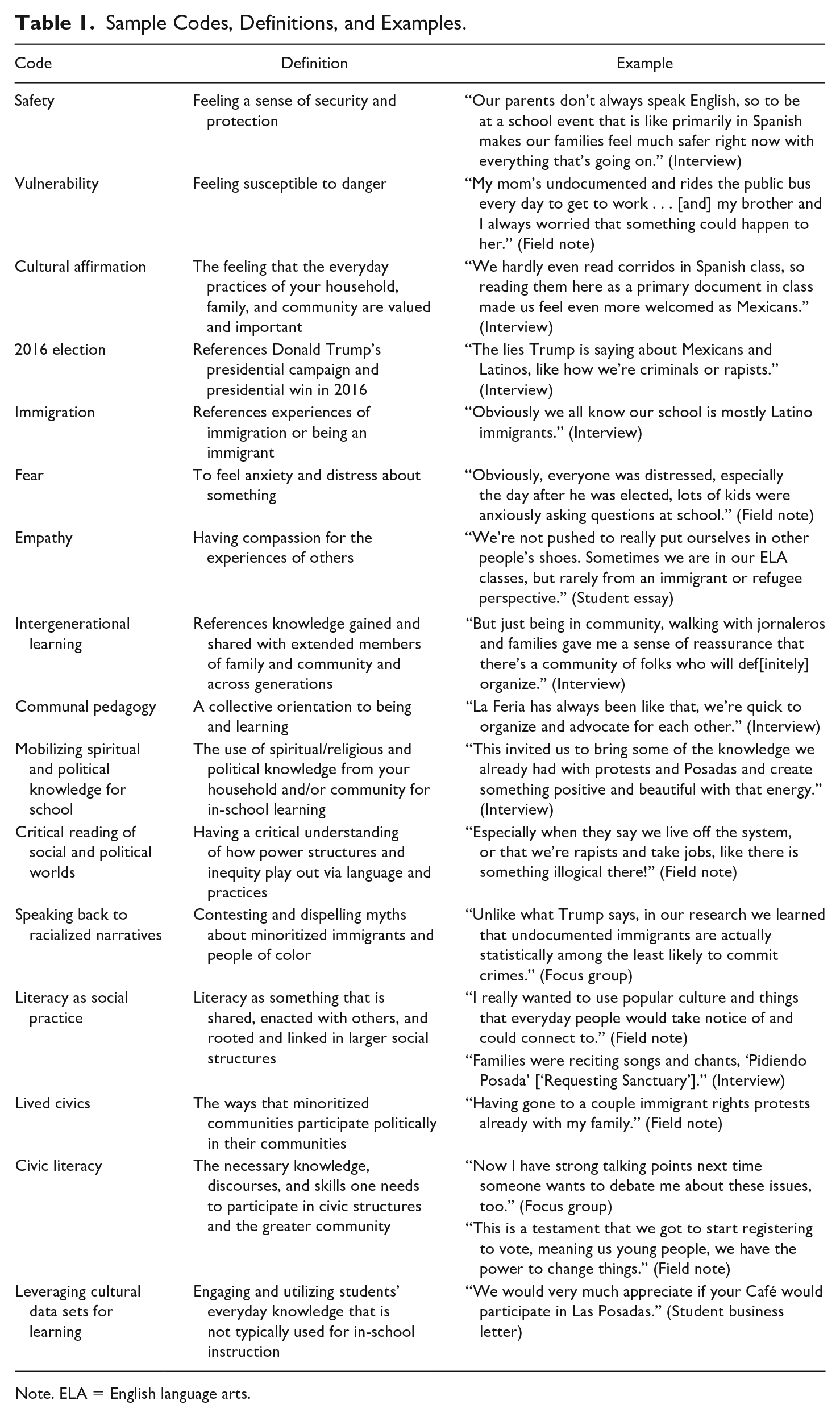
Note. ELA = English language arts.
During the initial interpretation of data, we noted “recurring images, words, phrases, and metaphors” (Luttrell, 2010, p. 262) that arose from students’ writing and perceptions of the classroom unit and Las Posadas. Some of these included “safety,” “vulnerability,” “cultural affirmation,” “empathy,” “immigration,” “fear,” and “the 2016 election.” During the subsequent reading, we took note of students’ literacy practices and combed for “coherence among a string of stories” (p. 262). Some of these included “intergenerational learning,” “communal pedagogies,” “mobilizing spiritual and political knowledge for school,” “critical reading of social/political worlds,” and “writing/speaking back to racialized narratives.” During the third reading, we considered patterns across all of the data and engaged in coding that used theories from our conceptual framework. For example, we looked for “literacy as social practice,” “lived civics,” “civic literacy,” “pedagogizing social movements,” and “leveraging cultural data sets for literacy learning.” Following the systematic coding process and the constant reference back to our research questions, we developed major themes and subthemes in which the initial five were collapsed down to two core themes. We returned to the data at this point to reevaluate our interpretations of the themes. Triangulation was required to justify emerging themes (Miles & Huberman, 1994).
Literacies of Refuge: Contesting “Mainstreamed” Narratives of Harm
In response to our first research question, we delineate from students’ perspectives some of the ways that literacy was designed throughout the unit. Participating students’ voices and literacy products grounded in Las Posadas espoused heightened sociopolitical awareness and spoke back to White nationalist discourses, particularly the dominant idea that links immigrant populations to increased crime in sanctuary cities. For example, in describing her fellow classmates’ in-class research process across online websites, Brenda noted, We had to do complex research across different sources and websites to inform ourselves and to counter many of the lies Trump is saying about Mexicans and Latinos, like how we’re criminals or rapists . . . and I think I know a lot of stuff already, but in doing this research, it opened my eyes to a lot of stuff that was really kinda sad . . . like around what some people actually think of immigrants, about us. Having even more proof that so many of these things Trump says are total lies, and having access to that knowledge in a class like this one, it makes me even more unapologetically here and want to keep fighting for justice now that we’re a sanctuary city.
In Brenda’s interview, she referenced La Feria City Council’s recent declaration of La Feria as a “sanctuary city” in December 2017, a designation that prohibits local law enforcement from using their resources to carry out federal immigration enforcement activities, including ICE detention and deportation. Prior to La Feria being an official sanctuary city, Brenda acknowledged that many students “lived in constant fear” due to virulent anti-immigrant rhetoric and practices; she shared, “My mom’s undocumented and rides the public bus every day to get to work . . . [and] my brother and I always worried that something could happen to her.” Brenda’s in-class research helped her to relinquish some of that fear and feel more “unapologetically here.”
Another student, Pablo, shared, “Unlike what Trump says, in our research we learned that undocumented immigrants are actually statistically among the least likely to commit crimes” (Focus group, December 10, 2017), a statistic that Pablo later shared aloud during the Posada procession. Students brought their everyday dissonances to the classroom as an asset and scaffold for literacy development—their families’ lived experiences with law enforcement, ICE, and anti-immigrant sentiments and legislations served as a “highly generative cultural data set” (Lee, 2007, p. 35). In turn, students bridged connections between their everyday experiences with in-school reading and writing that repudiated stigmatizing stereotypes of immigrants that persist throughout society.
Similarly, another student, Fernando, shared that part of the “uniqueness” of the unit included its centering of corridos as an academic text (Field note, November 12, 2017). Despite this fact, Carlos lamented, “We hardly even read corridos in Spanish class, so reading them here as a primary document in class made us feel even more welcomed as Mexicans” (Personal Communication, November 16, 2017). By incorporating dissident folklore, like corridos, which have a history of denouncing the status quo and subverting U.S. Anglo domination at the U.S.–Mexico border (Paredes, 1958), students felt that reading and writing in Arturo’s class “tapped into our cultures” (Field note, December 3, 2017). Through figurative language, the corrido “Tres Veces Mojado” raised awareness of the unique and complicated struggles of Central Americans. For instance, one student, Vero, shared, “My mom’s from El Salvador, so to closely read a Spanish song about our struggle and how we’re discriminated against meant a lot because it’s different from the Mexican experience” (Focus group, December 10, 2017). It is vital for us to explore the heterogeneity of Latinx youth’s experiences because they are too often collapsed into one hegemonic ethnolinguistic category.
Among the texts engaged in class, students regularly shared that amid the hatred felt, immigrants are simply “trying to provide a better life for their families” and “need to stick together” (Field note, January 7, 2018). One student, José, wrote in his business letter to Café con Leche, a local café: We would very much appreciate if your Café would participate in Las Posadas. This event intends to demonstrate the dangers and prejudices that immigrants face in the United States. We are supporting the immigrant community, especially since now immigrants are facing more hatred than ever.
Through their assignments, students voiced unity and resisted myths about sanctuary cities. Arturo worked to create a learning community where deep-seated feelings of experiencing discrimination could be honored while also still promoting hope and civic action. The bulk of the texts engaged in class built both empathy and deeper understanding around the legal rights, protection, and humanity of immigrants. Moreover, by problematizing dominant narratives about why people immigrate to the United States, texts like The Distance Between Us allowed students to explore how people are often put in extremely vulnerable positions—both in their countries of origin and then later in the United States—as they navigate a life that is as safe and dignified as possible.
In addition, students contested another problematic discourse that vilifies immigrants. In their fact posters, students overwhelmingly problematized the common perception that immigrants do not pay taxes, especially in California. One student, Elva, prepared a fact poster for the Posada that included a meme-like image of Lisa Simpson (Figure 1).
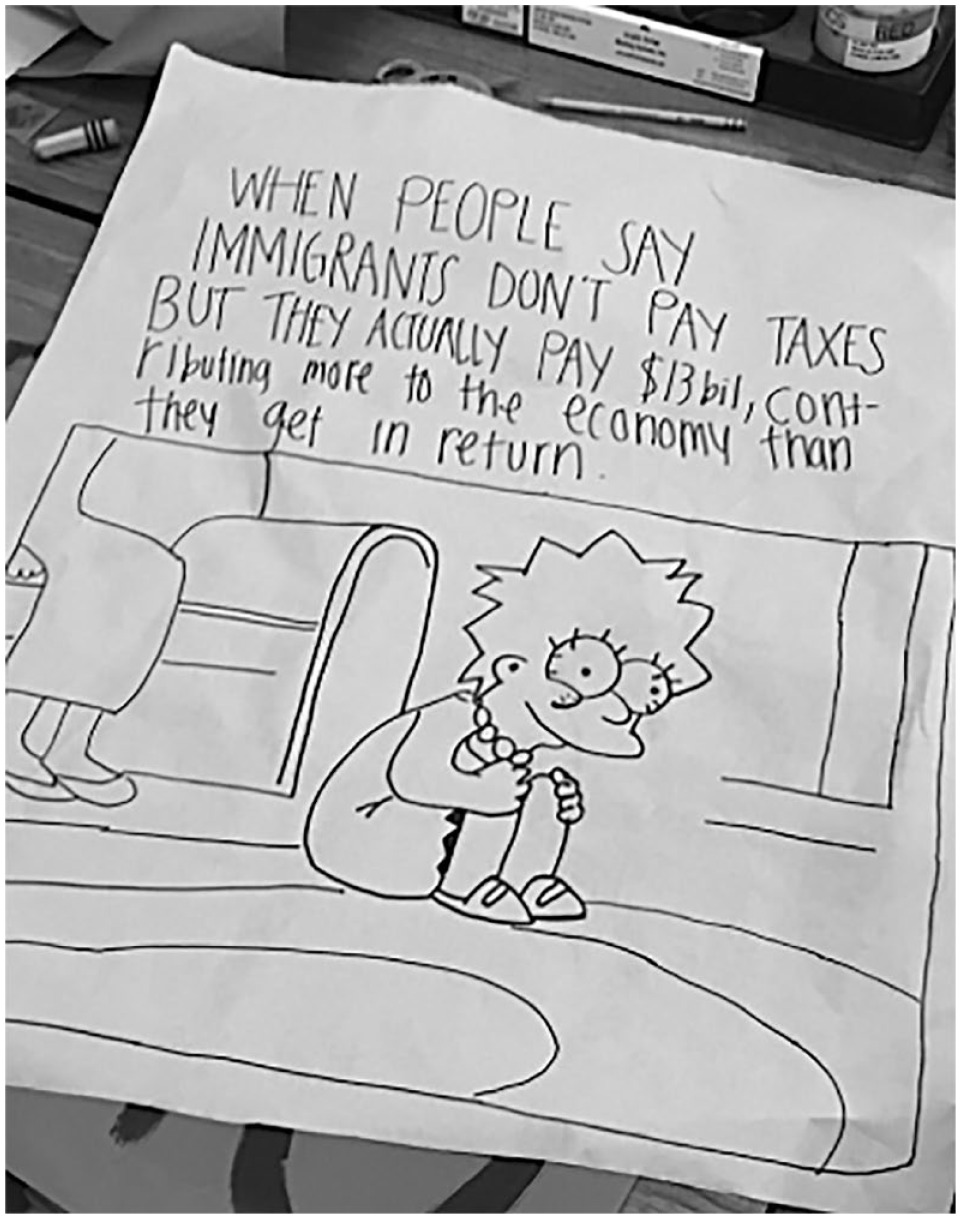
Lisa Simpson.
In response to this poster, Elva explained, Having gone to a couple immigrant rights protests already with my family, these posters were cool because we were invited to be creative with them. I like Lisa Simpson, and Lisa always looks all stressed out. Similarly, a lot of kids right now are really stressed with all the lies being said about our families. Especially when they say we live off the system, or that we’re rapists and take jobs, like there is something illogical there! We immigrants know that that’s completely not true . . . This invited us to bring some of the knowledge we already had with protests and Posadas and create something positive and beautiful with that energy.
Similarly, Ivan created a fact poster with a parallel statement; however, his incorporated his favorite stunt man and actor, Jackie Chan, appearing very confused (Figure 2).
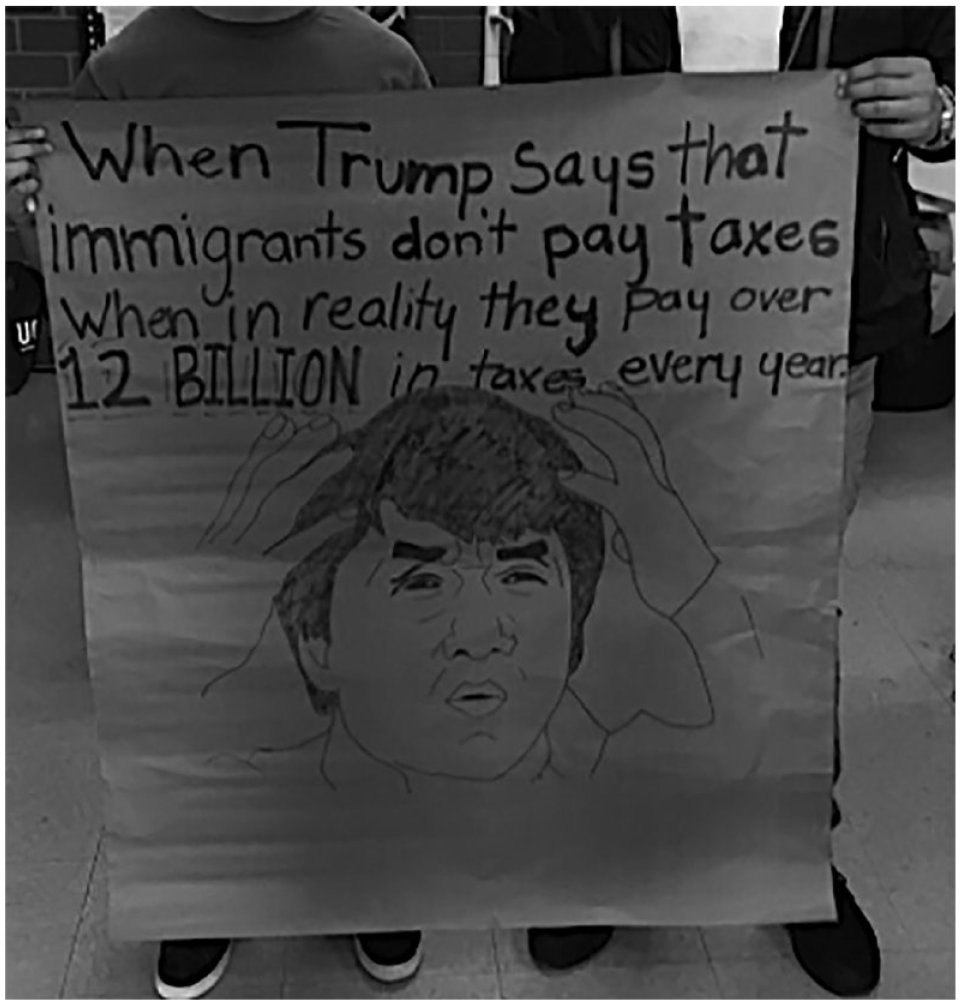
Jackie Chan.
When Arturo interviewed Ivan about what his fact poster represented, he described, It’s about the economy, like how we supposedly don’t contribute to the economy or pay state taxes. My poster said, “When Trump says that immigrants don’t pay taxes . . . but they actually pay billions!” It’s a picture of Jackie Chan’s face looking totally confused. I really wanted to use popular culture and things that everyday people would take notice of and could connect to.
The dynamic and collective dialogue visualized in students’ fact posters that were meme-like represent their innovative cultural displays of everyday knowledge and their civic dialogue with institutions themselves, including schools. These multimodal texts amplified alternative dimensions of students’ agency, performativity, and civic literacies through public circulation practices. Students’ fact posters convey the ways that youth—when provided a space to engage literacy as a refuge and participate in their communities in socially transformative ways—can contest and counternarrate harmful narratives and create shifts in local and public discourses.
The literacy activities taken up in the unit assisted students with conceptualizing their own problem-solving skills and highlight the academic learning involved in naming and mobilizing politicized “cultural data sets.” The unit ultimately invited students to engage in inquiry processes that helped them articulate arguments, hone persuasive language and appeals, critique social structures, and use systematized evidence to enter civic conversations around institutional oppression. Moreover, students’ performance of Las Posadas as a ritualized form of justice helped to invert disempowering narratives about immigrant communities and instead worked to create social empowerment and sanction participating students’ lived expertise with in/justice.
“Pidiendo Posada” as Ritual of Justice: Walking in the Beauty of Resistance
In response to both research questions, we explicitly highlight students’ responses to the unit and procession itself as a transformative intervention in the face of the hostile climate that students and families have been enduring. In December 2017, the Social Justice Posada was larger than it had ever been, and many students felt that it was, in part, due to the 2016 presidential election causing people to seek out a safe community. One student, Julio, shared candidly in an interview: Our families go every year because [Las Posadas] are always so welcoming . . . But this year was even bigger. Our parents don’t always speak English, so to be at a school event that is like primarily in Spanish makes our families feel much safer right now with everything that’s going on.
Julio’s words point to his community’s collective desire for safe spaces as well as the power of families’ use of Spanish being valued and repositioned into a “normative [form] of knowing” (Bang & Vossoughi, 2016, p. 175). Another student, Minerva, spoke of the anxiety that rippled across students’ lives shortly after the 2016 presidential election and what Las Posadas meant in that moment for her: Obviously, everyone was distressed, especially the day after he was elected, lots of kids were anxiously asking questions at school, a lot of mixed emotions about Trump being elected. Las Posadas helped tranquil those emotions, especially the procession. That actually did something for us! . . . Families were reciting songs and chants, “Pidiendo Posada” [“Requesting Sanctuary”] . . . and while that didn’t fix anything in that exact moment, it helped bring tranquility because obviously we all know our school is mostly Latino immigrants, a lot of people have undocumented parents or tíos or are undocumented themselves . . . So lots of anxiety. The negative rhetoric about immigrants really harms us. But just being in community, walking with jornaleros and families gave me a sense of reassurance that there’s a community of folks who will def[initely] organize. La Feria has always been like that, we’re quick to organize and advocate for each other. Las Posadas is a testament to that every year.
Both Julio’s and Minerva’s words underscore the urgency for schools and teachers to recognize students’ enduring hardships as well as build upon the existing agency and lived civic practices in the community. Locating herself within a larger struggle, Minerva astutely reminds us, “We’re quick to organize and advocate for each other,” which signifies her awareness of the greater community actions that had preceded that evening’s Posada. Furthermore, Minerva’s mention of the intergenerational nature of walking collectively through Las Posadas reminds educators that laborers and elders in the community can broaden youths’ sociopolitical consciousness by enacting their own forms of activist literacies whereby they identify issues and employ problem-solving skills that youth may not have thought about. Rooted in her understandings of refuge and sanctuary, Camila wrote in her final essay, We’re not pushed to really put ourselves in other people’s shoes. Sometimes we are in our ELA classes, but rarely from an immigrant or refugee perspective. If people could see why and understand what forces people to have to leave their homes, people would better understand immigrant struggles. This project, from bringing in the academic part of the reading, writing and research beforehand in class, then the mixture of art, music, activism, and unity with families, jornaleros, and teachers, to me that’s what sanctuary looks like.
Camila’s words highlight the politically polarized social world that immigrant-origin youth navigate and the need for literacy classrooms to better foster empathy as a means for social transformation (Mirra et al., 2018). As students like Julio, Minerva, and Camila participate firsthand in their communities’ agentive responses to the increasingly draconian immigration control policies and practices, students are honing their critical literacies, civic engagement practices, and repertoires of contention (Tilly, 1995). Lee (2007) contends that even students’ cultural displays of knowledge grounded in their everyday lives and “viewed as unrelated to schooling can be scaffolded in service of domain-specific learning” (p. 18). This classroom work can include taking up nondominant literary genres and translingual texts (like those aforementioned) that incorporate students’ transnational and bilingual knowledge of the ways immigration policies affect their lives and also their communities’ development of repertoires of contention to said policies. The centering of “real world” issues in students’ sociocultural contexts, the use of students’ authentic forms of translanguaging, and the dissonances of students’ everyday lives proved to be central to our design of justice-oriented learning.
As an annual ritual of justice, numerous students often referenced Las Posadas as a form of bella resistencia (beautiful resistance) to the attacks on immigrant families’ humanity (Focus group, December 17, 2018). In response to the 2017 Posada’s larger turnout, one student, Alfonso, who had just turned 18, felt inspired to start registering his friends and family members who were eligible to vote. By highlighting how literacy is inextricably linked to and imperative for civic behaviors, Alfonso shared that “this is a testament that we got to start registering to vote, meaning us young people, we have the power to change things” (Personal Communication, December 15, 2018). Another student, Joanna, said that students “look forward to coming back once they’re alumni because they get to see friends, old teachers, and LFDLC leaders . . . [E]very year it’s a different but similar struggle, the racist attacks on immigrants slightly change” (Personal Communication, December 3, 2017). Any community-responsive ethnic studies project must be rooted in relationality and in the needs and hopes of the people themselves, which will inevitably shift according to the social context. When Las Posadas first began in 2008, they focused primarily on raising awareness of the discriminatory ICE and police checkpoints in La Feria. However, in 2017, they focused more on the threatening racial climate under Trump and how the sheer humanity of immigrant and asylum-seeking families was literally on trial. As a ritualized form of community participation that centered civic discourses and raised awareness of local, state, and federal policies, Las Posadas underscore the necessity to keep reimagining curricula across disciplines that center the lived political participation, rituals, and literacies of immigrant communities.
Echoing some of these sentiments, Guadalupe shared in a focus group: What made this so special is that we did all this learning and building of vocabulary beforehand at school but then did it in the community, like we did the procession and chants and songs with our posters in the community, and in downtown of all places, an area I love because of all of its cultural art. The class portion of it especially helped us see how the mainstream rhetoric is used against us and how false it is. And now I have strong talking points next time someone wants to debate me about these issues, too.
The idea of action in the community resonated with students. As echoed by Guadalupe, the cultural data sets employed in the unit centered community spaces and topics that students had prior knowledge about but engaged them in different and new ways (Lee, 2007). What is salient about Arturo’s critical translingual approach is not only the positioning of students to think critically about how dominant language is used against their community, but ultimately the co-creation of a space where this vulnerable knowledge could be safely shared and collectively acted on. Taking a grassroots approach to curriculum design (Seltzer & de los Ríos, 2018), students’ lived histories, family cultural practices, and experiences were foundational components of their learning. Students were encouraged to “live civically” not only in the community but in their ethnic studies course, which valorized and mobilized their intimate knowledge of the ways that they are racialized for literacy learning. As the hate-saturated speech toward immigrant communities increases, youth will continue to bring their lived experiences with racialization to classrooms and will entrust their teachers to value those knowledges for learning (Lee, 2007).
Discussion and Implications
The perennial issue of xenophobia—which existed long before the current presidential administration—remains a grave problem that educators must continue to take seriously. The contemporary immigrant rights movement faces a dynamic form of political power—an “anti-migrant hegemony” (Gonzales, 2013)—endures to threaten the unit of immigrant families, including through recurring calls from elected officials to dismantle the Fourteenth Amendment of birthright citizenship for undocumented parents. Every day is unpredictable, especially for the emotional and physical well-being of our nation’s most vulnerable families and children. In this context, Patel (2018) urges us to see that “true sanctuary requires much more furtive, strategic, and selfless behavior on the part of those who already enjoy the protection of walking freely in society” (p. 528). This includes educators, and we urge them to attune more closely to the devastating ripple effects of state terror within our students’ lives and neighborhoods. This calls us all to conceive of school spaces and classrooms in more inclusive ways that span curricula and include community engagement with families, resisting deficit-laden racialization processes and responsibly incorporating the experiences of marginalized communities.
In doing this work responsibly and ethically, we urge the field to (re)think the “directionality” of participatory and community-based literacy projects and partnerships. Specifically, we encourage the field to consider what can be learned from participatory research projects that “grow from” rather than “precede” grassroots movements for change. As educators, we did not “bring” a participatory project “to the community”; rather, we took heed of the deep relational work that parents and the local labor community were already engaged in and worked to build upon the abundance of local activism extant in the community. As educators continually strive to reorient their classrooms to better centralize young people’s knowledge to help solve our most egregious social problems, they must also remain acutely aware of how easy it is to misappropriate students’ cultural and religious practices in the name of literacy instruction.
As coresearchers, we demonstrate the iterative codesign of a space that centered students’ lived civic and cultural practices of resistance and respectfully considered families’ assets and literacies. We aim not to essentialize the experiences of all Latinx youth from immigrant backgrounds, but to highlight one salient way La Feria students participated intergenerationally in a classroom–community partnership that blended literacy and social action. Ultimately, we offer the notion of Latinx immigrant social movements, specifically Posadas, as literacy itself—a vehicle through which young people critically read and write themselves into the world—and as a means by which educators can mobilize students’ politicized cultural data sets for learning. By providing entry points for students to center their knowledge of contentious politics, analyze societal power structures, and take an active role in their communities, Las Posadas fostered the analytical, literacy, and communication skills that are essential to informed democratic participation. An ethnic studies approach to civics—where participants identify racialized issues of contention, learn inquiry tools, conduct research to inform themselves and others, and disrupt those problems through community-based action—can supplement the low-quality civic education that immigrant-origin students of color in urban schools often experience (Cohen et al., 2018). More research is necessary to capture the unique forms of political socialization occurring in ethnic studies classrooms, especially given these classrooms’ interdisciplinary autonomy.
Las Posadas demonstrate one way that Latinx immigrant communities reject hegemonic constructions imposed on them in order to create their own intergenerational spaces fertile with critical awareness, critique, and political engagement. It is these precise spaces and movements that literacy educators need to see, hear, and learn from so that we can usher in more dignified literacy instruction that builds on marginalized students’ vast amounts of knowledge. Lastly, Patel (2018) reminds us that teachers and schools must “see migrant children not as charity but as people who have been made vulnerable by a transnational system of capitalist policies” (p. 527). It is imperative that educators more diligently turn their analytic lens not only to the structural displacement of people from the Global South but also to immigrant youths’ and families’ ingenuity and unique deployment of rituals, knowledge, literacies, and religious and cultural practices from their engagements in “social change from below” (Zibechi, 2011, p. xii).
Supplemental Material
Trnaslated_Abstracts_Rios – Supplemental material for Literacies of Refuge: “Pidiendo Posada” as Ritual of Justice
Supplemental material, Trnaslated_Abstracts_Rios for Literacies of Refuge: “Pidiendo Posada” as Ritual of Justice by Cati V. de los Ríos and Arturo Molina in Journal of Literacy Research
Footnotes
Acknowledgements
The authors greatly thank the greater La Feria community, including Suzanne Foster, José Calderon, and Eddie Gonzáles. We are also deeply grateful to Roger Viet Chung, Shirin Vossoughi, Tracy Buenavista, Kate Seltzer, Caitlin Patler, Jenni Higgs, Laura Chávez-Moreno, and Chris Zepeda-Millán for their support and insight on this research.
Declaration of Conflicting Interests
The author(s) declared no potential conflicts of interest with respect to the research, authorship, and/or publication of this article.
Funding
The author(s) received no financial support for the research, authorship, and/or publication of this article.
Supplemental Material

Notes
References
Supplementary Material
Please find the following supplemental material available below.
For Open Access articles published under a Creative Commons License, all supplemental material carries the same license as the article it is associated with.
For non-Open Access articles published, all supplemental material carries a non-exclusive license, and permission requests for re-use of supplemental material or any part of supplemental material shall be sent directly to the copyright owner as specified in the copyright notice associated with the article.
