



Abstract
In its pursuit for equal opportunity for all students, the field of civic education has largely ignored a significant segment of the school population: students with disabilities (SWD). While numerous studies have documented the benefits of high-quality civic learning for youth, these benefits are not equally distributed among students. Indeed, White students, economically advantaged students, and students in higher tracked classes are the most likely to participate in high-quality civic learning opportunities. Meanwhile, little is known about the high-quality civic learning opportunities provided to SWD because they are routinely absent from research and policy discussions.
Any meaningful commitment to respecting SWD as competent, contributing citizens in a democratic society requires preparing them to advocate for themselves and for others as fully as possible, which in turn requires high-quality civic learning opportunities in our schools. Moreover, we need to better understand which students are included in civic education and in what ways because these efforts communicate important lessons about who is a valued member of “we the people” and the school community. As such, this study explores the current landscape of civic education for SWD by examining the extent to which they receive equitable exposure to high-quality civic learning opportunities and engage civically within their communities.
Drawing on more than 48,000 survey responses from high school students in Chicago Public Schools, a quantitative analysis was conducted to examine the relationship between four demographic variables (disability status, socioeconomic status, race/ethnicity, and gender) and seven outcome variables attending to both traditional and digital forms of civic education. Notably, this appears to be the first large-scale empirical study to examine these indicators for SWD.
There are statistically significant differences between the civic education experiences provided to SWD and students without disabilities, even when controlling for socioeconomic status, race/ethnicity, and gender. In particular, SWD are more likely to be excluded from discussion-based experiences than service-based experiences. Moreover, the magnitude of the differences based on disability status was equal to or greater than that of the differences explained by other demographic variables in the majority of cases. These findings demonstrate that disability status is a factor that deserves greater attention in civic education research and pedagogy.
Civic education scholars routinely posit that schools should prepare all students to be informed and effective participants in democratic life. To do otherwise would mean allowing “some votes and voices [to] count more or less than others” (Gould et al., 2011, p. 18), which contradicts the very ideals on which democracy is founded. And yet, in the pursuit of equal opportunity, the field of civic education has largely ignored a significant segment of the school population: students with disabilities (SWD). Indeed, in 2002, when Sherrod and colleagues laid the groundwork for conceptualizing citizenship development inclusive of diverse youth, there was no mention of SWD. Even more current civic education research that acknowledges disability as one example of diversity still fails to consider what full inclusion for these students might look like (see Levinson, 2012a).
Of course, this disregard for the civic education of SWD will come as no surprise to disability studies scholars. According to Taylor (2020), the dominant philosophical models of civic education require “a particular level and display of intellectual ability, communicative competence, social independence, and behaviour” (p. 53) that do not make room for undesirable differences and thus construct SWD, especially those with intellectual disabilities, as incapable of citizenship. What these models fail to recognize, however, is that displays of ability and intelligence depend on several factors, including the subjectivity of the assessment/assessor, agendas of power or control, and access to education and the opportunities that result from it (Erevelles, 2002; Hehir, 2002; Kliewer et al., 2015; Wolbring, 2012). The problem, then, lies not with SWD, but with our inadequate understanding of student capabilities and the restrictive notions of citizenship advanced by many civic education scholars.
If we do not take seriously the need to study the civic education of SWD, what judgments are we making about whose votes and voices matter in democratic society? History has taught us that, in most cases, the rights of marginalized groups are not adequately protected by those in power when group members are excluded from civic and political participation (Dahl, 2006). Indeed, it was not until the Americans with Disabilities Act of 1990 was passed that individuals with disabilities were legally protected from discrimination in employment, government, and public sectors. But by then, historical patterns of segregation and exclusion had already resulted in lower education levels, limited voter registration and turnout, higher unemployment rates, and increased social isolation that made it more difficult for individuals with disabilities to generate civic and political capital (Schur et al., 2003). By extension, the exclusion of SWD from civic education research only exacerbates their disenfranchisement and disengagement.
According to the late political theorist Robert Dahl (2006), an “ideal democracy” requires a system of fundamental rights that “every member of the demos” is entitled to exercise, including the right to participate in political processes, the right to have one’s vote counted equally to others, the right to learn about relevant policies and their consequences, and the right to choose which items are included on the policy agenda. Although the concept of an ideal democracy is just that—an ideal by which to establish an end goal or moral judgment—it does allow for the empirical study of an existing system. Certainly, an examination of American democracy falls outside the scope of this study, but smaller democratic units such as schools provide an appropriate and useful starting point for determining the extent to which we can approach the ideal, particularly for marginalized groups (Levinson, 2012b). And a large-scale empirical study that focuses on the civic education of SWD is long overdue.
So what might civic equity look like for SWD in schools? To be sure, this challenging question cannot be answered by any one discipline or person. Rather, critical scholars from civic education, disability studies, and special education must come together to reconceptualize how schools should prepare SWD for civic life, and this study attempts to guide the conversation by drawing from existing scholarship across multiple disciplines. Along these lines, I offer a working definition of civic equity for SWD:
To start, SWD should be provided with equal access to high-quality civic learning opportunities in schools, and their inclusion in such opportunities must allow for meaningful and authentic participation. For example, when working on a service learning project, SWD should be involved with every stage of the process, not just assigned to the “easy” tasks on the day of action. As another example, SWD should be included in class discussions about current events and controversial issues, not relegated to learning basic civic “facts,” like the number of representatives in Congress.
In addition, SWD should not be excluded from participation in high-quality civic learning opportunities simply because they do not display a particular level of intellectual, communicative, social, or behavioral competence. It is time for civic education scholars and practitioners alike to confront the able-bodied and able-minded norms regularly celebrated in schools. Take, for instance, the double-edged sword of independence, a dominant trope in the civic education literature. As Taylor (2020) noted, when students without disabilities (SWOD) ask for help, they are viewed as exhibiting positive traits of independence. Yet, when SWD ask for help, their independence is questioned or taken away through orders for professional aides, relegation to a self-contained classroom, or disenfranchisement (to name a few examples). Why do we construct the need for support differently for SWD and SWOD? And why should needing support, even when the need is significant, threaten a person’s civic agency or opportunities for civic growth?
Any meaningful commitment to respecting SWD as competent, contributing citizens in a democratic society requires preparing them to advocate for themselves and for others as fully as possible, which in turn requires high-quality civic learning opportunities in our schools. Moreover, we need to better understand which students are included in civic education and in what ways because these efforts communicate important lessons about who is a valued member of “we the people” and the school community.
As such, this study explores the current landscape of civic education for SWD in a large urban school district by examining the extent to which they receive equitable exposure to high-quality civic learning opportunities and engage civically within their communities. Notably, this appears to be the first large-scale empirical study to examine these indicators for SWD, and it attends to both traditional and digital forms of civic education to account for the rapidly changing nature of schooling in the digital age.
Literature
If the National Assessment of Educational Progress (NAEP) civics assessment is any indication, robust civic education is still hard to come by in schools across the United States. In 2018, the most recent year of assessment, only 26% of eighth-grade SWOD performed at or above proficient (National Center for Education Statistics [NCES], 2020a). Perhaps even more concerning, these results were not significantly different from the previous civics assessments conducted in 2014, 2010, 2006, or 1998 (NCES, 2020a). The situation is much worse for SWD, whose civic assessment results are far lower than those of SWOD. In fact, a mere 6% of eighth-grade SWD performed at or above proficient, and these results were not significantly different from previous civics assessments (NCES, 2020b). While the NAEP civics assessment primarily measures students’ civic knowledge, a supplemental questionnaire asks students about their exposure to high-quality civic learning opportunities (NCES, 2018). Unfortunately, these data are not publicly available and thus cannot shed light on the type and quality of civic learning opportunities available to SWD. As it stands, then, the NAEP data provide a limited understanding of the state of civic education because close-ended performance assessments are inadequate indicators of how learning is supported in schools, especially for SWD (Taylor, 2020).
It should also be noted that the dichotomous labeling of SWD and SWOD, a common practice in research, suggests that disability is a binary variable. On the contrary, the disability community is composed of individuals with diverse identities, needs, and goals, but many studies do not or cannot disaggregate their data based on disability classification. When a study makes this distinction in the literature, I do as well, except when I am summarizing a group of mixed population studies or making a general point about the larger community.
High-Quality Civic Education and Who Gets It
Since the release of The Civic Mission of Schools report in 2003, scholars and educators have advocated for a well-rounded approach to civic education that includes six proven practices: (1) classroom instruction, (2) discussions of current events and controversial issues, (3) service learning, (4) extracurricular activities, (5) school governance, and (6) simulations of democratic processes (Gibson & Levine, 2003; Gould et al., 2011). When students have access to such high-quality civic learning opportunities, studies show increases in the degree to which youth follow the news, vote in elections, engage in respectful and productive debates, serve their communities, and judge the accuracy of political claims (Biesta et al., 2014; Kahne & Sporte, 2008; Youniss & Levine, 2009). However, these benefits are not equitably distributed across racial/ethnic and socioeconomic demographics because school and community factors (e.g., teacher retention, tracked classes, funding, local partnerships) may contribute to more favorable civic learning environments for some students over others. Indeed, high-quality civic learning opportunities are more readily available to White students, economically advantaged students, and students in higher tracked classes (Hansen et al., 2018; Kahne & Middaugh, 2008; Kawashima-Ginsberg, 2013).
Much less is known about the high-quality civic learning opportunities provided to SWD. Although the field of civic education is quite established, SWD are routinely absent from research and policy discussions (Carter et al., 2013; Hamot et al., 2005; Mann et al., 2015). Even the quadrennial reports written by NCES about the NAEP civics assessments do not address issues related to SWD, except to describe how they were included or excluded in assessment procedures (see Lutkus et al., 1999; Lutkus & Weiss, 2007; NCES, 2011). Without research in this area, such omissions reinforce exclusionary practices in civic education rather than enhancing opportunities for civic development and agency.
What Have We Learned From Social Studies Scholarship?
According to Lintner (2017), social studies and special education have enjoyed a “beautiful relationship” for decades. Most of this work was influenced by the increasing percentage of SWD being educated in general classes, particularly in social studies. Indeed, the percentage of SWD aged 6 to 21 years who spent 80% or more of their day in general education classes has increased from 47% in 2000 to 63% in 2017 (NCES, 2019). Moreover, a new study confirmed that social studies teachers have a higher caseload of SWD compared with their colleagues in mathematics and English language arts (Mullins et al., 2020). The same study also found that less than 40% of these social studies teachers received professional development focused on SWD, and out of those who did receive the professional development, 34% rated it “not useful” (Mullins et al., 2020). As such, a host of special education researchers have turned their attention to designing strategies to support the diversity of learners now included in mainstream social studies classrooms (see De La Paz & MacArthur, 2003; Hintz, 2017; Jordan et al., 2017; Lintner & Kumpiene, 2017; Lintner & Schweder, 2011; Ryan et al., 2019). Unfortunately, these efforts rarely focus on civic learning or civic engagement opportunities (see Lintner, 2017).
What Have We Learned From Disability Studies and Special Education Scholarship?
The literature that does examine civic learning opportunities for SWD is limited in scope. With respect to the six proven practices, the most researched opportunity is service learning. Although service learning looks different at each school, its root purpose is to bridge content that students learn in their classes with projects that address a need in the community (Yoder et al., 1996). A number of studies show that participation in service learning can improve academic, functional, behavioral, emotional, and social skills for SWD (Brill, 1994; Carter et al., 2012; Kleinert et al., 2004; McCarty & Hazelkorn, 2001; Olnes, 2008; Yoder & Retish, 1994). However, far too many service learning programs “advance narrow, some might argue, safer visions of who can best serve and what that service should be” (Mann et al., 2015, p. 59) and thereby restrict SWD from participating meaningfully or authentically. For example, as Mann et al. noted, some educators insist that the needs of SWD are best served in segregated learning environments, or they position SWD as the recipients of service, not equal partners with their peers as providers of service. Both of these models reinforce the notion that SWD are dependents on society, not competent members who can work collectively with others to contribute to it. Moreover, segregated programming robs all students of the opportunity to work with individuals with diverse abilities and to value the unique strengths and skills of their peers. Unfortunately, a systematic review of journal articles on service learning and SWD found relatively few descriptions of inclusive programming, and segregated learning environments were concentrated at the high school level and for students labeled with emotional disturbance (Dymond et al., 2011).
Only a few studies have looked at the civic learning opportunities available to SWD more broadly. In 2017, for instance, Ditchman et al. conducted a survey of 206 young adults (ages 18–21) with developmental disabilities and found that participation in extracurricular activities and access to civics curriculum were strongly associated with postschool civic engagement. Notably, the strongest predictors of postschool civic engagement were students’ civic self-efficacy (i.e., the perceived ability to influence the community through action), followed by their sense of connectedness to the community (Ditchman et al., 2017). Along the same lines, a telephone survey of 700 adult individuals with disabilities found that internal efficacy and civic skills were both statistically significant predictors of political participation (Schur et al., 2003). Together, these studies suggest that civic learning opportunities can boost positive attitudes around civic engagement for SWD, which in turn can lead to greater participation in the political process later in life.
More theoretical studies promote self-determination as a strategy to enhance citizenship skills for SWD. As Salend (2011) explained, teaching SWD to set goals, solve problems, and self-regulate empowers them to become responsible and active members of a democratic society. Indeed, SWD who were self-determined were more likely to be assertive, independent, employed, and integrated within the community (Ward, 2005; Wehmeyer & Palmer, 2003; Wehmeyer & Schalock, 2001). Mandated transition planning for SWD provides educators with a useful system for linking self-determination strategies with civic education because the process involves student-centered goal setting for life after high school (Carter et al., 2008; Deardorf et al., 2020; Vakil et al., 2010). However, critical disability studies scholars warn that the concept of self-determination is frequently co-opted by pedagogy that reinforces circumscribed expectations of social regulation and academic performance (Peterson, 2009). For example, skill-based curriculum may provide limited or superficial opportunities to develop civic agency that ignore the contextualized environments in which SWD live, study, work, and play (Cowley & Bacon, 2013).
What Have We Learned From Community Scholarship?
A handful of studies examining out-of-school programs provide insight into how schools can more meaningfully adapt their civic education curriculum to include SWD by linking self-determination training with civic engagement opportunities. For example, the Texas Statewide Youth Leadership Forum (TXYLF) operates an intensive weeklong summer program for high school SWD that provides mentoring, individualized opportunities, and direct experiences to learn self-advocacy and leadership concepts and skills. A study examining the efficacy of the TXYLF curriculum found statistically significant increases in the self-advocacy abilities of intervention participants, with the largest gains for students with developmental delays (Grenwelge & Zhang, 2012). According to the researchers, TXYLF’s success is largely attributed to its multifaceted approach and its ability to connect content and skill-building with the real world (e.g., the opportunity to participate in legislative activities at the state capitol and the development of a leadership plan to implement in participants’ own communities; Grenwelge & Zhang, 2012). Indeed, a collaborative relationship between schools and community agencies is essential to providing the experiences and support necessary for SWD to practice leadership and self-advocacy in their schools and communities (Carter et al., 2013; Test et al., 2009; Vakil et al., 2010). As another example, education professionals working at a social care facility partnered with its residents with intellectual disabilities to create and administer a self-determination and active citizenship training program. The residents and education professionals were treated as equal contributors to the development of the training program, and everyone had the right to listen, be heard, vote, and participate in problem-solving dialogue. After the structure and materials of the program were collaboratively designed, participants completed the training in one of three experimental groups: (1) residents only, (2) education professionals only, and (3) residents and education professionals together. The resulting study found higher levels of self-determination and opportunities for choice among all residents with intellectual disabilities, but statistically significant increases for those residents who completed the training in conjunction with the education professionals (Fontana-Lana & Petitpierre, 2017). In this way, residents with intellectual disabilities experienced the greatest increases through integrated opportunities for learning and practice. Both of these studies demonstrate that self-determination training with a civic engagement lens is one effective way to empower the voices of SWD.
The Current Challenge for Schools
The relative exclusion of SWD from comprehensive civic education research raises an important question about their schooling experience: Do schools actually view SWD as civic actors whose voices deserve to be included as part of the local and national dialogue? According to Taylor (2018), individuals with disabilities are rarely valued as participants in the production of knowledge, even with regard to their own experiences. And when these individuals do contribute to the shaping of knowledge, it is more often as the object of research and theory (Taylor, 2018). Disability studies scholars argue, however, that the inclusion of individuals with disabilities in social, political, and intellectual spaces is necessary if we hope to challenge the status quo (Boxall et al., 2004; Connor & Valle, 2015; O’Donovan, 2010). As O’Donovan (2010) explained, “Cognitive diversity promises novel ways of thinking and new understandings of what knowledge is, who makes it, and how it is made” (p. 172). In the context of schools, normalized expectations for how students should learn and behave widely determine which learning opportunities are available to SWD (Ferri & Connor, 2006; Hehir, 2002). For example, in a study about voting education in group homes, one participant reasoned, “If they have trouble brushing their teeth, I am skeptical . . . they can . . . make an informed choice to vote [ellipses in original]” (Agran & Hughes, 2013, p. 60). Similarly, in schools where education is created for SWD instead of co-constructed with them, opportunities to develop civic agency are lost (Mullins, 2019). In doing so, schools undermine the status of SWD as credible epistemic agents who deserve to be included in the same civic learning opportunities as their peers.
Research Questions
As the literature demonstrates, when scholars conduct research on the civic education of SWD, two areas receive the most attention: service learning and self-determination. But service learning and self-determination instruction frequently exclude SWD from meaningful, authentic, or integrated civic learning experiences, and they do not represent a well-rounded civic education on their own. Furthermore, the focus of service learning and self-determination, especially as they play out for SWD, is to encourage certain actions and behaviors rather than allow for engagement around current events or controversial issues. Conceptually, then, there appears to be a divide in the civic agendas made available to SWD—service to society is encouraged and facilitated, but sharing one’s ideas and opinions is not.
With this conceptual framework in mind, this study addresses the following research questions:
Methods
This analysis draws on a subset of data collected through the 5Essentials survey administered annually to students attending Chicago Public Schools (CPS) through a partnership between the school district and the University of Chicago’s Consortium on School Research. The subset is composed of 30 survey items that were divided into two versions: Version A, with 16 items, and Version B, with 14 items. The items asked students about their experiences with traditional and digital civic learning opportunities and civic engagement both in and out of school.
Approximately 50% of all CPS high school students (Grades 9–12) taking the survey were randomly assigned to answer the subset of civic items, such that 25% of all students received Version A, and 25% received Version B. Assignment to any particular version of the subset was independent each year. This analysis focuses on the data collected during the spring of 2017 (Wave 1) and the spring of 2018 (Wave 2). The total sample size of students was 48,353 for Wave 1 and 48,438 for Wave 2. Because the results for both waves were so similar, Tables 1 to 3 only report the data for Wave 2.
Descriptive Statistics for All Outcome Variables.
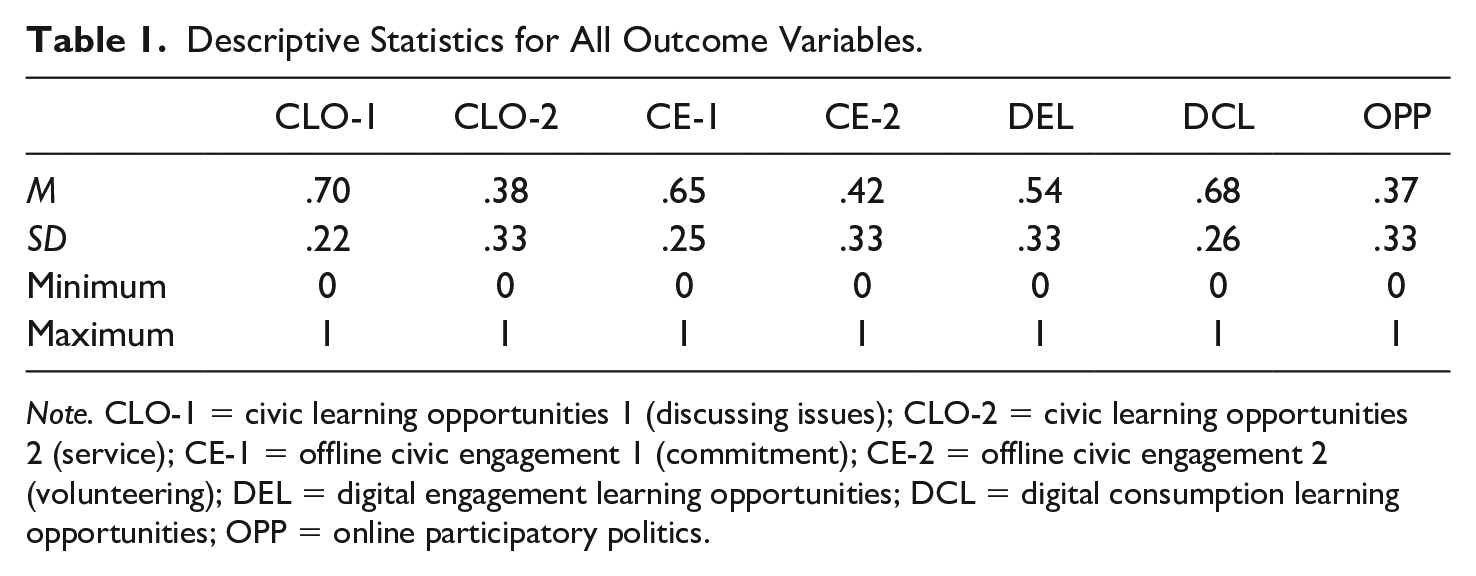
Note. CLO-1 = civic learning opportunities 1 (discussing issues); CLO-2 = civic learning opportunities 2 (service); CE-1 = offline civic engagement 1 (commitment); CE-2 = offline civic engagement 2 (volunteering); DEL = digital engagement learning opportunities; DCL = digital consumption learning opportunities; OPP = online participatory politics.
Regression Coefficients for Traditional Civic Outcome Variables.
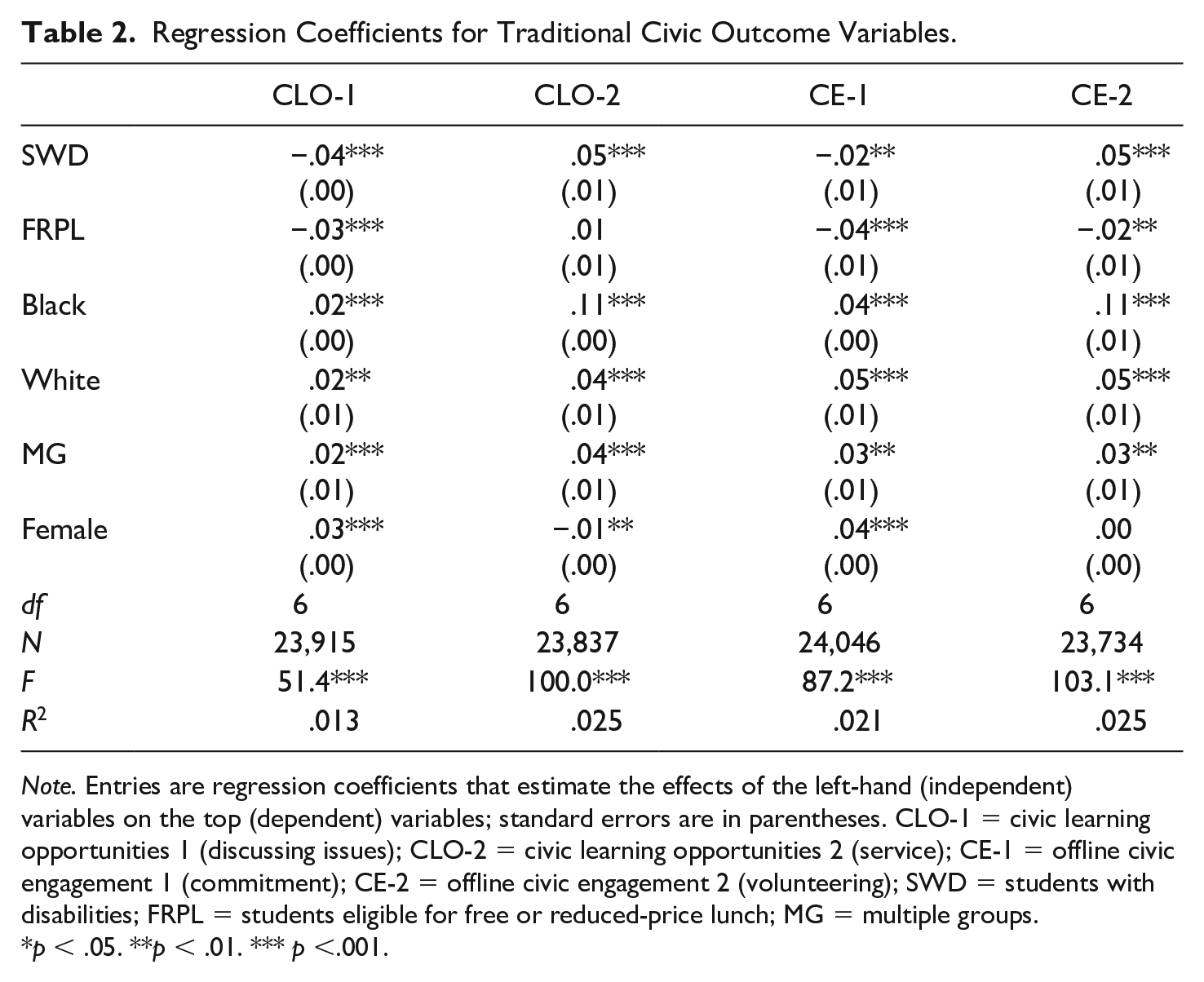
Note. Entries are regression coefficients that estimate the effects of the left-hand (independent) variables on the top (dependent) variables; standard errors are in parentheses. CLO-1 = civic learning opportunities 1 (discussing issues); CLO-2 = civic learning opportunities 2 (service); CE-1 = offline civic engagement 1 (commitment); CE-2 = offline civic engagement 2 (volunteering); SWD = students with disabilities; FRPL = students eligible for free or reduced-price lunch; MG = multiple groups.
p < .05. **p < .01. *** p <.001.
Regression Coefficients for Digital Civic Outcome Variables
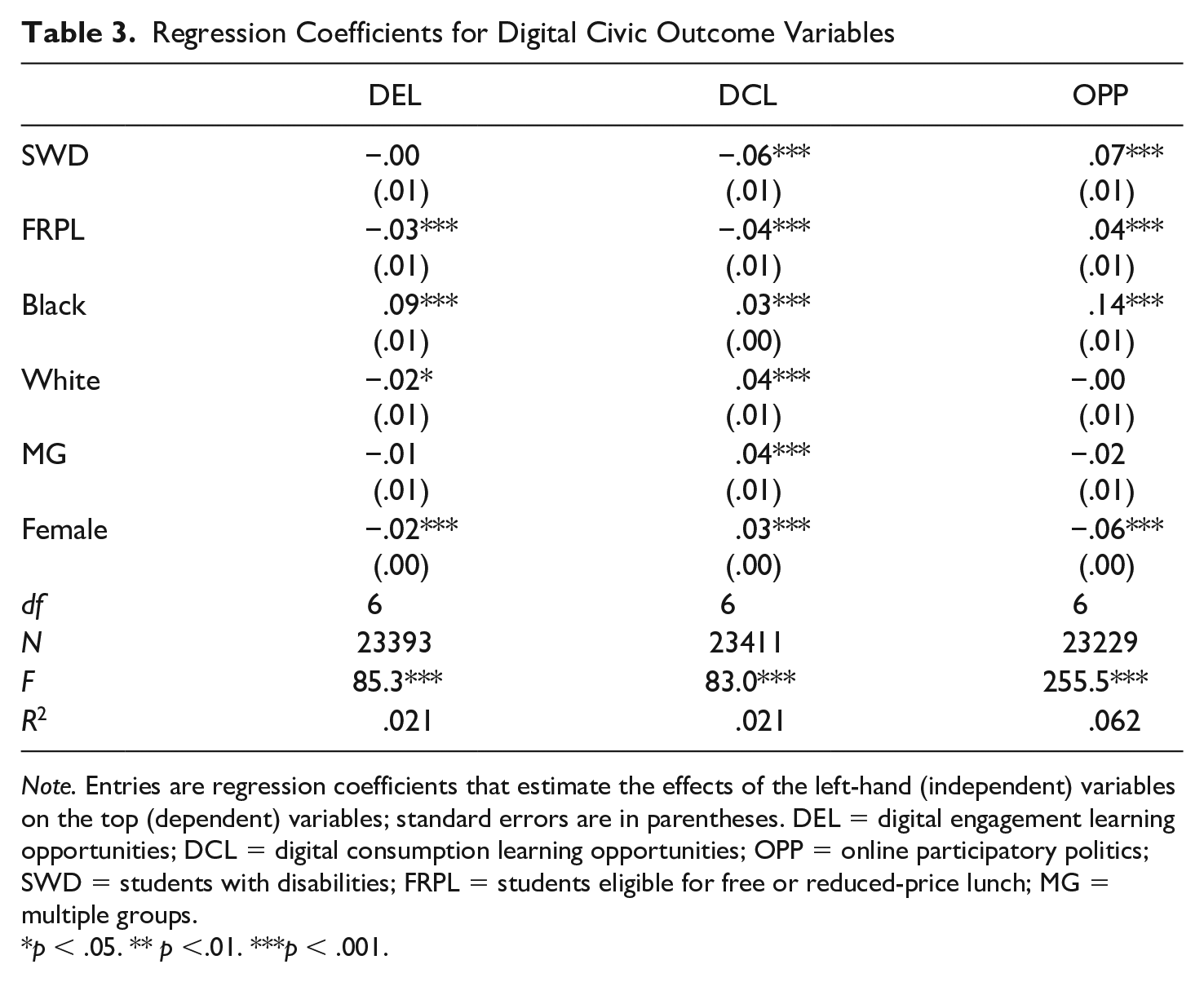
Note. Entries are regression coefficients that estimate the effects of the left-hand (independent) variables on the top (dependent) variables; standard errors are in parentheses. DEL = digital engagement learning opportunities; DCL = digital consumption learning opportunities; OPP = online participatory politics; SWD = students with disabilities; FRPL = students eligible for free or reduced-price lunch; MG = multiple groups.
p < .05. ** p <.01. ***p < .001.
Setting and Participants
CPS is uniquely positioned for studying the landscape of civic education because of its districtwide commitment to bolstering such programming (Berkman, 2020). Indeed, in 2016, the district pledged to prepare all students for success in civic life and launched a strategic plan to expand civic learning opportunities at every high school. In particular, students are required to take one semester-long civics course designed specifically for Chicago’s youth, the district renewed its commitment to service learning through classroom projects, and schools were encouraged to expand Student Voice Committees. The Department of Social Science and Civic Engagement also provides consistent curricular training and support to teachers across subjects and grade levels to promote civic education throughout the district. As a result, students in CPS are likely to receive more civic learning opportunities compared with students in other school districts that do not prioritize civic education. That said, wide variation in the quality of civic learning opportunities still exists among schools within CPS.
In 2018, CPS served more than 370,000 students. The overwhelming majority of these students (77.7%) qualified for free or reduced-price lunch (FRPL), a percentage that grew more concentrated in secondary schools. Most students in the district identified as either Hispanic/Latinx (46.7%) or African American/Black (36.6%), with only 10.5% and 4.1% of students identifying as White or Asian, respectively. Finally, 18.3% of students were English language learners, and 13.7% of students received special education services.
Dependent Variables
In this analysis, I distinguish between four types of civic learning opportunities and three types of civic engagement that the literature shows are conceptually distinct (Gould et al., 2011). For example, survey items that asked about the content of class discussions were analyzed separately from those that asked about the frequency with which students plan to vote or volunteer in their communities. A similar framework was used by my colleagues Bowyer and Kahne (2020) in their study on the same survey.
Accordingly, the items that measured civic learning opportunities and civic engagement in similar ways were indexed to create seven continuous, highly correlated outcome variables. The items were also recoded to position the indices on a 0 to 1 scale. The first four variables measured traditional civic outcomes: civic learning opportunities 1 (discussing issues), civic learning opportunities 2 (service), offline civic engagement 1 (commitment), and offline civic engagement 2 (volunteering). The remaining three variables measured digital civic outcomes: digital engagement learning opportunities, digital consumption learning, and online participatory politics. Table 1 reports the mean, standard deviation, minimum, and maximum for each of these variables.
Civic Learning Opportunities
Version A of the survey included four items that asked students about their exposure to traditional civic learning opportunities in school. Three of these items were averaged to create a reliable “civic learning opportunities 1 (discussing issues)” index (Cronbach’s alpha: Wave 1 = .89; Wave 2 = .88). On a scale ranging from strongly disagree to strongly agree, these items asked students how the following statements characterized their in-class experiences:
“I have discussed current events and/or controversial issues.”
“I have learned about societal issues that I care about.”
“I am encouraged to consider multiple views on controversial issues.”
Because service projects provide a distinct learning opportunity from discussions that take place in the classroom, the item measuring service was not indexed so that it could be evaluated independently. The civic learning opportunities 2 (service) variable asked students to rate the frequency with which they were “involved in a project to improve [their] school or community” in their classes, on a scale from never to three or more times. To account for a noncontinuous (and therefore nonnormal) variable, an ordinal regression was run in addition to a multiple linear regression on this item.
Together, these four items represent examples of best practices in civic education (Gibson & Levine, 2003; Gould et al., 2011) and have been field tested in several other studies (e.g., Kahne & Middaugh, 2009; Torney-Purta et al., 2007).
Offline Civic Engagement
Version A of the survey also included six items that asked students about their level of civic engagement with local and national issues. Four of these items were averaged to create a reliable “offline civic engagement 1 (commitment)” index (Cronbach’s alpha: Wave 1 = .88; Wave 2 = .89). Using a scale ranging from not at all true to completely true, these items asked students whether the following statements applied to them:
“Getting involved in improving my community is important to me.”
“Following community or national issues is important to me.”
“There are issues in my community or the nation that I care deeply about.”
“I expect to vote in elections once I am old enough.”
Two additional items were averaged to create a reliable “offline civic engagement 2 (volunteering)” index (Cronbach’s alpha: Wave 1 = .81; Wave 2 = .80). These items asked students to rate the frequency with which they participated in the following activities outside school, on a scale from never to three or more times:
“Raised money and/or volunteered for a cause you care about?”
“Worked or cooperated with others to try to solve a problem affecting your school, city or neighborhood?”
These six items have been accepted as age-appropriate forms of civic engagement (Zukin et al., 2006).
Digital Engagement Learning Opportunities
Version B of the survey included two items that asked students about their exposure to learning opportunities around sharing one’s voice online. These items were averaged to create a reliable “digital engagement learning opportunities” index (Cronbach’s alpha: Wave 1 = .81; Wave 2 = .80). They asked students to rate the frequency with which the following activities occurred in their classes, on a scale from never to three or more times:
“Discussed how to effectively share your opinion on social or political issues online (for example, by blogging or tweeting or posting comments).”
“Created and shared something on the internet related to a societal issue.”
These two items reflect essential skills necessary for young people to participate in civic issues online (Kahne et al., 2016).
Digital Consumption Learning Opportunities
Version B of the survey also included four items that asked students about their exposure to media literacy in school. All four of these items were averaged to create a reliable “digital consumption learning opportunities” index (Cronbach’s alpha: Wave 1 = .86; Wave 2 = .85). They asked students to rate the frequency with which the following activities occurred in their classes, on a scale from never to three or more times:
“Talked about how to find different points of view on political and social issues on the internet.”
“Discussed how to tell if the information you find online is trustworthy.”
“Researched or searched for information online.”
“Discussed the importance of evaluating the evidence that backs up people’s opinions.”
These four items represent examples of learning opportunities that have been found to increase young people’s ability to assess the credibility of information found online (Hodgin & Kahne, 2018).
Online Participatory Politics
In addition, Version B of the survey included four items that asked students about their engagement with political issues online. Four of these items were averaged to create an extremely reliable “online participatory politics” index (Cronbach’s alpha: Wave 1 = .94; Wave 2 = .95) that asked students to rate the frequency with which they created or shared political information on social media, on a scale from never to several times a week:
“Shared someone else’s article, blog, picture, or video related to politics.”
“Created and shared your own article, blog, picture, or video related to politics.”
“Commented or tweeted about an article, blog, picture, or video related to politics.”
“Posted a status update or sent an email, tweet, or instant message related to politics.”
Finally, these four items demonstrate ways young people can exert influence through digital tools and have been shown to reliably measure online participatory politics (Kahne & Bowyer, 2018). Conceptually, these items align with what other scholars call, for example, connected civics (Ito et al., 2015) and political social networking (Bode et al., 2014).
Independent Variables
Survey responses were linked to student demographic data provided by CPS in accordance with their administrative records. For the purposes of this analysis, students were grouped along four demographic variables: (1) disability status, (2) socioeconomic status, (3) race/ethnicity, and (4) gender. A student’s disability status was based on the provision of an individualized education program (IEP) by the district; no information was provided about disability classification or educational placement. A student’s socioeconomic status was based on their eligibility for FRPL, an indicator that the student lived within 185% of the poverty line or lower. A student’s race/ethnicity was self-reported by families on district enrollment forms. Although CPS provided data for eight distinct racial/ethnic categories, groups with a survey response rate of less than 5% were merged into one category called “multiple groups” (MG). 1 Finally, a student’s gender was self-reported by families on district enrollment forms.
The demographic data for all survey respondents were consistent across both waves of the survey:
Disability status—SWD (13%); SWOD (87%)
Socioeconomic status—FRPL eligible (83%); FRPL ineligible (17%)
Race/ethnicity—Latinx (50%); Black (34%); White (10%); MG (6%)
Gender—male (52%); female (48%)
Data Analysis
A multiple linear regression analysis was conducted to examine the relationship between four demographic variables (disability status, socioeconomic status, race/ethnicity, and gender) and each of the seven outcome variables: civic learning opportunities 1 (discussing issues), civic learning opportunities 2 (service), offline civic engagement 1 (commitment), offline civic engagement 2 (volunteering), digital engagement learning opportunities, digital consumption learning opportunities, and online participatory politics.
For the nominal variable of race/ethnicity, Latinx students were chosen as the baseline category for comparison because they made up the largest group in the population. However, several footnotes report the results with Black students as the baseline category for comparison to provide additional context.
The scales used for the indexed outcome variables were treated as continuous. The assumptions of multiple linear regression were met for linearity, multicollinearity, and homoscedasticity, but they were violated for normality. However, with large-scale data sets, analysis of variance tests were robust for validity against this violation. As previously noted, an ordinal regression was run in addition to a multiple linear regression on the one noncontinuous variable to account for violations of normality in the model.
Results
The regression analyses indicate statistically significant differences between the civic learning opportunities and civic engagement of SWD and SWOD, even when controlling for socioeconomic status, race/ethnicity, and gender. Whereas some of these differences were disadvantageous to SWD, outcome variables that measured service, volunteering, and online political participation showed differences that were advantageous to SWD. In addition, in most cases, the magnitude of these differences was equal to or greater than that of the differences explained by other demographic variables.
Traditional Civic Outcomes
Table 2 reports the regression coefficients for traditional civic outcome variables for all students across demographic variables. Looking first at the civic learning opportunities 1 (CLO-1) variable, which asked whether students learned about and discussed important societal issues in class, SWD were significantly less likely to have these opportunities compared with SWOD when controlling for socioeconomic status, race/ethnicity, and gender. Notably, the difference between SWD and SWOD (b = −.04) was greater than the difference between students eligible and ineligible for FRPL (b = −.03), the differences across all races/ethnicities (b = .02; b = .02; b = .01), and the difference between males and females (b = .03). On the other hand, the civic learning opportunities 2 (CLO-2) variable, which asked about the frequency with which students engaged in service projects, showed that SWD were significantly more likely to have these opportunities than SWOD when controlling for all other demographic variables. While this difference (b = .05) was greater than the differences observed across most other demographic variables, there was one important exception: The difference between Latinx and Black students (b = .11) was even greater than the difference between SWD and SWOD. 2
Looking next at the offline civic engagement 1 (CE-1) variable, which asked whether students followed community and national issues, SWD reported significantly less interest compared with SWOD when controlling for socioeconomic status, race/ethnicity, and gender. This difference (b = −.02) was smaller than the differences observed across all other demographic variables. 3 However, the offline civic engagement 2 (CE-2) variable, which asked about the frequency with which students raised money, volunteered, or worked to solve a community problem, showed that SWD were significantly more likely to participate in these activities compared with SWOD when controlling for all other demographic variables. Once again, this difference (b = .05) was greater than or equal to the differences observed across most other demographic variables, except for the difference between Latinx and Black students (b = .11). 4
Digital Civic Outcomes
Table 3 reports the regression coefficients for digital civic outcome variables for all students across demographic variables. Interestingly, the digital engagement learning opportunities (DEL) variable, which asked students if they learned to create and share media about societal issues in their classes, showed no significant differences between SWD and SWOD when controlling for socioeconomic status, race/ethnicity, and gender. But the digital consumption learning opportunities (DCL) variable, which asked students if they learned how to tell whether online information is reliable, showed that SWD were significantly less likely to receive such instruction compared with SWOD when controlling for all other demographic variables. Importantly, this difference (b = −.06) was greater than the differences observed across all other demographic variables. 5 Finally, looking at the online participatory politics (OPP) variable, which asked about the frequency with which students created or shared political information on social media, SWD were significantly more likely to do so compared with SWOD when controlling for all other demographic variables. Yet again, this difference (b = .07) was greater than the differences observed across most other demographic variables, except for the difference between Latinx and Black students (b = .14). 6
In sum, the distribution of high-quality civic learning opportunities and civic engagement did not advantage either SWD or SWOD across the board. On the outcome variables CLO-1, CE-1, and DCL, SWD showed decreased opportunity or participation, whereas on the outcome variables CLO-2, CE-2, and OPP, SWD actually showed increased opportunity or participation. Moreover, disability status proved to be just as salient a variable as race/ethnicity, socioeconomic status, and gender on the majority of civic outcomes.
Discussion
Drawing from a sample of more than 48,000 high school students (Grades 9–12) attending CPS, this study provides a large-scale exploration of the civic education landscape for SWD. In particular, the analysis examines the extent to which SWD are exposed to traditional and digital civic learning opportunities in their schools, as well as their civic engagement with community and political life. As my colleagues Bowyer and Kahne (2020) explain, both traditional and digital civic learning opportunities lead to greater civic engagement, which means that schools can meaningfully contribute to the civic development of youth.
Conceptual Differences
Despite CPS’s districtwide commitment to civic education, there are important conceptual differences between the high-quality civic learning opportunities provided to SWD and those provided to SWOD. On one hand, SWD were significantly less likely to discuss controversial issues (CLO-1) and the credibility of online information (DCL) in their classes compared with SWOD. But on the other hand, SWD were significantly more likely to participate in service projects (CLO-2) and create or share political posts on social media (OPP) compared with SWOD. 7 Given that these are desirable learning experiences for all students, what explains the inequitable distribution?
As hypothesized at the beginning of this study, it appears that discussion-based civic learning opportunities are made less available to SWD than service-based civic learning opportunities. Stated another way, SWD are more likely to be excluded from activities in which educators require or expect certain levels of cognitive or communicative competence, but not from activities that ask students to lend a helping hand. This conceptual distinction is important because it suggests that we do not value the civic contributions of SWD and the civic contributions of SWOD equally. Although community service is certainly a noble and worthwhile experience for anyone to take part in, it only represents one dimension of democratic activity. Furthermore, the data did not allow us to examine the level and quality of participation experienced by the students in this study. For example, were SWD working alongside their peers in the research and organization stages of a project, or were they only included when the time came to pass out flyers, serve the homeless, or plant the trees? Inclusive class discussions, on the other hand, can provide all students, but especially SWD, with critical opportunities to engage with issues, share their thoughts and ideas, and have their opinions matter. In this way, making the space for SWD to become thoughtful actors in a democratic society, rather than just actors, better supports the true purpose of civic education.
Perhaps most concerning is how these conceptual differences may be impacting civic engagement for SWD. While SWD were significantly less interested in following local and national issues (CE-1) compared with SWOD, they were significantly more likely to volunteer in their communities (CE-2). Although causation cannot be established from this analysis, it is not hard to imagine that students who do not get the chance to learn about important societal issues in their classes are then less likely to follow them on their own. Moreover, it is not hard to imagine that students who are provided with opportunities to engage in service through their schools are then more likely to volunteer outside school.
The increased creation or sharing of political posts on social media (OPP) suggests that SWD feel more empowered or able to express their opinions online. However, when coupled with the fact that SWD receive less exposure to media literacy instruction (DCL), higher rates of OPP could also signal the increased creation or circulation of political misinformation. Indeed, among other demographic groups included in this analysis, those with higher rates of DCL also had lower rates of OPP, though causation cannot be established between the two outcome variables.
Demographic Differences
Although many factors play a role in explaining the extent to which students receive high-quality civic learning opportunities and engage civically within their communities, disability status is a factor that deserves greater attention. For one thing, very few scholars have looked at the impact of disability status on civic education in schools, and this study indicates that significant differences exist between SWD and SWOD. For another, the differences attributed to disability status have a similar or greater magnitude than the differences attributed to other demographic factors included in the analysis. These findings demonstrate that disability status is just as salient, if not more so, than socioeconomic status, race/ethnicity, and gender when it comes to accessing civic learning opportunities and civic engagement in schools and communities. At the very least, disability status is worthy of greater consideration in the civic education literature than it has previously been afforded.
Other Factors
While this study does not provide school-level data about the support available to educators or students for civic education in CPS, it is important to acknowledge how these factors may impact the distribution of civic learning opportunities and civic engagement. For example, even if educators receive professional development on high-quality civic learning opportunities, these trainings may not address how to individualize content or modify approaches to meet the unique needs of SWD in the classroom or in their IEPs (Cowley & Bacon, 2013; Mullins et al., 2020). Educators would likewise benefit from targeted training on student-centered transition planning to provide authentic opportunities for SWD to exercise civic agency by setting their own goals and identifying needed support for civic engagement. As another example, a student’s educational placement (e.g., general classes, self-contained classes, specialized schools) impacts not only their access to civic learning opportunities overall, but also the quality and inclusiveness of those opportunities (Kawashima-Ginsberg, 2013; Mann et al., 2015). Of course, civic equity for SWD requires equal access to high-quality civic learning opportunities across academic spaces and curriculum levels, but the extent to which teachers are prepared to encourage and facilitate the contributions of SWD cannot be ignored.
The Path to Civic Equity
As I reflect on what it means to provide civic equity for SWD, I am first struck by how little attention has been paid to the issue by civic education scholars. Despite repeated commissions to discuss inequality across the field, SWD are conspicuously absent from these conversations. And yet, this study has shown that disability status is as salient a demographic variable as socioeconomic status, race/ethnicity, and gender. So, if we truly care about democracy, a more inclusive conversation needs to start now.
I am also struck by how easy it is to normalize able-bodied and able-minded expectations of students, even with the best of intentions. CPS has long since acknowledged that its civic education programs need reform, and it continually works toward providing high-quality civic learning opportunities to its students. Even still, the conceptual distinctions apparent in this study demonstrate the fractured civic agenda made available to SWD when educators circumscribe notions of citizenship in their schools and classrooms. Indeed, a civic education without inclusive spaces for SWD to articulate what they think about societal issues is a lost opportunity to treat them with respect as full citizens. What is more, if CPS represents a school district dedicated to improving civic education in its schools, the results of this study suggest there is much work to be done across the country.
When civic learning opportunities and civic engagement are inequitably distributed among students, schools communicate their own civic lessons about how state institutions treat different groups of people. As a result, young people may be socialized to look at SWD as the incapable or dependent “other,” as opposed to fellow citizens inherently deserving of regard and respect. To counteract this effect, schools need to be more intentional about providing equitable access to high-quality civic learning opportunities for SWD, especially through opportunities to engage in dialogue, debate, and research on important societal topics, both offline and online. However, as we have learned from previous research, providing high-quality civic learning opportunities is only half the battle. Educators must also encourage and facilitate meaningful participation for SWD to make learning experiences truly inclusive (Dymond et al., 2011). This may take the form of connecting content and skill-building with the real world (Grenwelge & Zhang, 2012), providing integrated opportunities for practice and leadership (Carter et al., 2013; Fontana-Lana & Petitpierre, 2017), establishing collaborative partnerships with community organizations (Test et al., 2009), co-constructing curriculum and transition goals with students (Taylor, 2020), and developing students’ perceived ability to influence the community through civic action (Ditchman et al., 2017). To be sure, this means that we must focus on the types and level of civic education made available to SWD in schools, as well as the support put in place for educators to provide and facilitate such learning experiences.
Limitations
Although the data sample is large, the overwhelming majority of CPS students are economically disadvantaged and predominantly Latinx and/or Black. Because socioeconomic status and race/ethnicity were both salient variables in their own respect throughout this analysis, these findings may not be generalizable to other populations, which is why additional large-scale studies are necessary. Moreover, the data set only indicated whether students received an IEP from CPS for the school year; no additional information was provided about students’ disability classifications or educational settings to determine the role of these variables on civic learning opportunities and civic engagement. As such, more granular studies that allow for disaggregation of the data on SWD are equally necessary. Finally, it is important to acknowledge the limitations of survey data. Because responses were self-reported, it is possible that participants inaccurately remembered their experiences, misunderstood the questions, or experienced survey fatigue, thereby reducing the quality of the data. Notwithstanding said limitations, the 5Essentials survey data allowed us to begin exploring issues of civic equity for SWD, an area about which we still know so little.
Conclusion
Based on a long history of marginalization in schools and a relative absence from the civic education literature, I would not have been surprised to find that SWD were exposed to fewer civic learning opportunities and less likely to engage civically within their communities compared with SWOD across the board. But the results of this study turned out to be much more nuanced. Although SWD were less likely to participate in discussions about controversial issues and the credibility of online information, they were more likely to participate in service projects and engage politically online. And, perhaps consequently, SWD were less interested in following local and national issues, but more likely to volunteer in their communities. This study reveals that the ways in which SWD are receiving fewer civic learning opportunities reflect deficit models of thinking about their abilities to contribute in schools and society. If we facilitate opportunities for SWD to serve and volunteer, but not to discuss and deliberate, we are not developing full civic actors. So then I must ask, Why do we better facilitate some learning opportunities and not others? And how can we rid ourselves of the able-bodied and able-minded notions of citizenship impacting our work?
Footnotes
Declaration of Conflicting Interests
The author(s) declared no potential conflicts of interest with respect to the research, authorship, and/or publication of this article.
Funding
The author(s) received no financial support for the research, authorship, and/or publication of this article.