




Abstract
Using data from a 4-year longitudinal ethnography, this study moves from a classroom to the playground to examine a multiage community engaged in a deeply revered playground game with a history stretching back nearly a decade. Mediated discourse analysis is leveraged to examine the game’s historical nexus of practice, rooted in embodied and oral modes of transmission, and to understand how the nexus was transformed with the introduction of written transmission in the form of the first official rulebook. Contentious negotiations on the playground and in the classroom emerged regarding questions of textual ownership, authorship, and authority. Findings suggest that written text did not supersede oral transmission but instead prompted more talk as well as more writing. Significantly, making space for these negotiations created opportunities for writing to be(come) significant to children as children as they passionately and critically negotiated how to sustain their own collective brand of literacy.
Children’s eyes dart back-and-forth between their math assignment and the clock on the wall. Those final ticks of the clock before recess each afternoon are some of the longest of the day. The post-lunch sleepiness subsides as the kinetic energy of 50 children—ready to be outside now—collects and swirls around the room. The final tick of the clock and a simultaneous announcement from the teacher that it is indeed time for recess bring a flurry of activity: coats, hats, and boots appear from jumbled cubbies; shoes are tied, zippers are unstuck, and lost mittens are found. I grab my field notebook on the way out, skeptical that I’ll need it. This is recess, after all—a time to get away from the serious work of reading, writing, and meaning making in the classroom. After spending the last five hours inside, walking outside is a near impossibility for these young children. I walk too slowly, a flurry of feet scooting by me, desperate for the cool air and sunshine to hit their faces. Screams and laughter fill the air as the children run ahead to the playground. They are finally free. Walking down the steps to the blacktop, Abe yells to me, “Do you want to play Red vs. Gray?” Explaining that I’m unsure how to play and should probably just watch, he cajoles: “We’ve been playing it forever. It’s easy. You don’t even have to know all the rules—you can just learn as you go. Want to be on the red team or the gray team?” (Audio data and field notes, March 7, 2011)
Adults standing at the edges of the school playground often see little rhyme or reason to children’s actions, assuming that “play” offers a simple respite from the complex literacy (and other) “work” occurring inside classrooms. My introduction to the game of Red vs. Gray on that chilly March afternoon was the surprising beginning of nearly 3 years of focused inquiry around the chaotic jumble of practices, bodies, histories, and texts creating the nexus of the distinctive classroom game. By extending a longitudinal ethnography to the playground, I found this multiage community engaged in a deeply revered set of social practices at recess with resonance and connections across time.
Previous work examining the making and remaking of children’s games and songs on the playground (e.g., Bishop & Curtis, 2001; Davies, 1982; Grugeon, 2005; Hart, 1993; J. Marsh, 2012; K. Marsh, 2008; Opie & Opie, 1969; Sutton-Smith, 1990; Thorne, 1993; Willett, Richards, Marsh, Burn, & Bishop, 2013) has largely focused on the role of “oral transmission” in understanding transformation and continuity over time. This study builds on this scholarship by examining how this particular community of children collectively engaged in embodied and oral transmission as well as written transmission to iteratively coauthor and transform their culture’s long-standing playground game of Red vs. Gray. In essence, this game and the embedded peer (inter)actions (Boulton & Smith, 1993; Pellegrini & Blatchford, 2000; Sutton-Smith, 1982) offer opportunities to consider how children came to understand, question, and protest the introduction of writing as a mediator of their fiercely protected childlore. The creation of a rule book by one child faced swift resistance from some members of the community, setting off a series of events—unfolding across the playground, classroom, and homes—that forced children to consider a range of complex questions in relation to orality, textuality, history/tradition, and authorship: Who has the power to (re)write/(re)make a collectively authored, historically situated game?
Situating Children’s Playground Games
In framing this work, it is helpful to draw a few key distinctions between children’s games and play (Garvey, 1977), though the two certainly overlap at times in backyards, parks, streets, and in this case, the school playground. Both play and games are rule governed, but it is in how these rules are developed that the distinctions emerge. Play is contingent and ambiguous (Sutton-Smith, 1997): It is maintained by co-players agreeing upon a set of “as if” conditions. Players’ actions are “only play” and have a different meaning inside the play frame (Bateson, 1975), which expires at the end of the session. In this way, play is “made fresh daily” (Wohlwend, 2013a), as each play event opens the possibilities for meanings to be (re)negotiated. Pretend play is the aspect of children’s play most thoroughly studied, particularly in the field of early childhood literacy education (see Dyson, 1997; Roskos & Christie, 2007; Wohlwend, 2013a).
Games, on the contrary, are guided by explicit, preexisting rules, and violation of these rules most often results in some form of sanction, not renegotiation (Garvey, 1977). Game rules are passed on by word of mouth (oral transmission) and informal observations, situating games alongside riddles, rhymes, songs, and jokes as key cultural products of childhood (i.e., folklore/”childlore”; Sutton-Smith, 1970). The ordinariness of childhood games has led to them being largely overlooked by adults, though Sutton-Smith (1970) cites this as a grave mistake given that games are a “systematic part of the human repertoire” (p. 4), extending critical insight in understanding children’s social, emotional, and cognitive development (Piaget, 1965).
Folklorists Opie and Opie (1969) were among the first to study how children play games in everyday spaces rather than theorizing about how children “ought to play” (p. v). In the landmark book Children’s Games in Street and Playground (Opie & Opie, 1969), they collected, curated, categorized, and historicized thousands of children’s naturally occurring, self-organized outdoor games based on information from over 10,000 children across the United Kingdom (ages 6-12). Based on their classification system, the playground game under examination in this study (Red vs. Gray) is best viewed as a local instantiation of “catch”: a game in which a “player attempts to intercept other players who are obliged to move from one designated place to another” (Opie & Opie, 1969, p. xix). Though the names of games were highly localized, the rules were largely consistent across spaces and times. Folklorists’ ancestral tracing of children’s games is illuminating: It frames playful, spontaneous practices and meanings on the 21st-century playground as having deeply rooted historical and spatial trajectories (Bishop & Curtis, 2001), whereby “games [have been] tested and confirmed by centuries of children, who have played them and passed them on. . .without reference to print [emphasis added], parliament, or adult propriety” (Opie & Opie, 1969, p. 1).
Longitudinal Classroom Ethnography
Using data from a 4-year longitudinal classroom ethnography (Bloome, 2012), I aimed to understand how Red vs. Gray, a playground game played “forever” in/by a community of children, was negotiated, contested, and sustained across time and space, with particular interest in the introduction of written texts.
Context and Participants
The community at the center of this research was a multiage classroom at Park Elementary School, a preK-6 public neighborhood school in a midwestern part of the United States. In the interests of confidentiality and anonymity, the name used for the school as well as the names of the teachers and children are pseudonyms. Participants and their families were informed of the study and each gave permission to share quotes, photographs, and written artifacts. This particular classroom was selected because it eschewed the typical organization of children into single grades according to biological age; alternatively, in this classroom, approximately 45 to 55 children ranging in ages from 5 to 13 years old (Grades K-6) shared the space together each day with their two veteran teachers, Mr. W and Ms. D. The community space included two classrooms connected by a small storage. Children of all ages and the two teachers moved between the two classrooms many times a day, allowing for flexible arrangements of children and resources at different points in the schedule (e.g., morning meeting, read-aloud, writing workshop, reading workshop, math, science). Although there were physically two classrooms and two teachers, the K-6 community referred to itself a single classroom.
Once a child joined the community, he or she remained in the classroom until moving on to middle school, meaning that a student could spend up to seven consecutive years in this classroom with the same teachers and core group of peers. The connected and historical nature of this classroom structure offered the opportunity for “old-timers” to pass institutional knowledge on to “newcomers” (Lave & Wenger, 1991, p. 37). New members were apprenticed into the community through “participating in ongoing activities that both preceded and outlived their own presence” (Roth & Lee, 2006, p. 35), rather than through teachers directly disseminating knowledge. The overlapping and extended nature of membership allowed for a collective set of practices to exist across time (e.g., the game of Red vs. Gray), held within the group’s institutional memory, enacted and embodied by current members on a daily basis.
Students entered the K-6 multiage class by teacher recommendation, parent request, or a general lottery that included new students to the school. The administration’s intention was to ensure that this K-6 multiage classroom represented the racial, linguistic, and economic makeup of the overall school population. In the Lincoln County Community School Corporation, Park Elementary was one of only a few in-town neighborhood schools where many children could walk or ride bikes each morning. The zoning of the district meant that Park Elementary was more racially, linguistically, and economically diverse than the largely rural district overall. Nearly 75% of the students at Park Elementary participated in the free or reduced-price lunch program (compared with only 36% for the district overall), and the school’s student population was 70% White, 13% Black, 9% Latino, and 11% multiracial (compared with a county that was 87% White and 4% Black).
At one point in the early 2000s, nearly all classrooms at Park Elementary were multiage (Grades K-2, 3-4, 5-6), but as state-level accountability testing increased, including statewide letter grades for each school, the school faced outside pressure to move to single-grade classrooms. Across these years, the K-6 multiage classroom (started in 2001) was the only multiage classroom to survive. However, in the final year of the study, two new multiage classrooms had reemerged based on interest from families and teachers.
Ethnographic Positioning
I position this research methodologically as a cross between a classroom ethnography (Bloome, 2012) and an ethnography of literacy (Baynham, 2004). Historically, classroom ethnographies have explored a range of research questions related to literacy learning, but the contexts of these studies, due to the structure of Western schools, have been almost universally limited to observing a narrow age range of children interacting, conversing, and learning together with a single teacher in a single room. Ethnographies of literacy, on the contrary, have pushed researchers’ gaze away from classrooms and toward questions of literacy use in everyday life (playgrounds, grocery stores, homes, etc.) (e.g., Heath, 1983).
Ethnographers interested in childhood culture(s) face significant research challenges in that the “lines between ‘children’ and ‘adults’ are sharply drawn” (Dyson, 2013, p. 408) within Western culture—especially in schools where age is closely associated with authority. This creates a complicated proposition: For a researcher, gaining access to unofficial worlds, and to their unfolding dramas and mediating texts, entails negotiating a position for the self, one that is as unobtrusive as possible but, still, available for child commentary on the goings on. That position tends to be one of a nonthreatening adult friend. (Dyson, 2013, p. 408)
Much of my time in the field was spent writing field notes and informally talking to children during natural breaks in the action, sending the message to children that I was not a/the “teacher” but was engaged in important work of my own (Dyson & Genishi, 2005). By setting myself apart from the typical role of adult surveillance (i.e., refraining from verbal and physical actions commonly associated with controlling children’s behaviors), I was able to gain access to a better understanding of how children maneuvered within and between the official and unofficial worlds of school (Dyson, 2001).
In negotiating my ethnographic role in the classroom over multiple years, I came to take the position of a “peripheral participant” (Adler & Adler, 1987), engaging in the daily life of the classroom (and playground, lunchroom, and hallways) and collecting data at least two times a week (often more) over the course of 4 years. Despite the extended nature of this study, I was never a true insider in this classroom community. I was not a child. I was not the teacher(s). Consequently, I was always negotiating a role that was part outsider, part insider. Sunstein and Chiseri-Strater (2002) suggest that powerful insights are produced by combining the viewpoints of an “outsider ‘stepping in’ and an insider ‘stepping out’ of the culture” (p. 9). Because the researcher acts as the primary instrument in ethnographic research (Wolcott, 1999), I worked to guard against possible blind spots. I self-consciously and regularly examined my position and relationships with the children and the teachers in the classroom. One way this was done was by periodically self-checking, asking three questions of my fieldwork and field notes: (a) What surprised me? (tracking assumptions), (b) What intrigued me? (tracking positions), and (c) What disturbed me? (tracking tensions) (Sunstein & Chiseri-Strater, 2002, p. 96). My continual reflection on these questions in my research journal acted as an emergent form of data analysis that helped me move more purposely between detachment and involvement, subjectivity and objectivity, and insider and outsider stances that are always coupled in fieldworking.
Data Collection
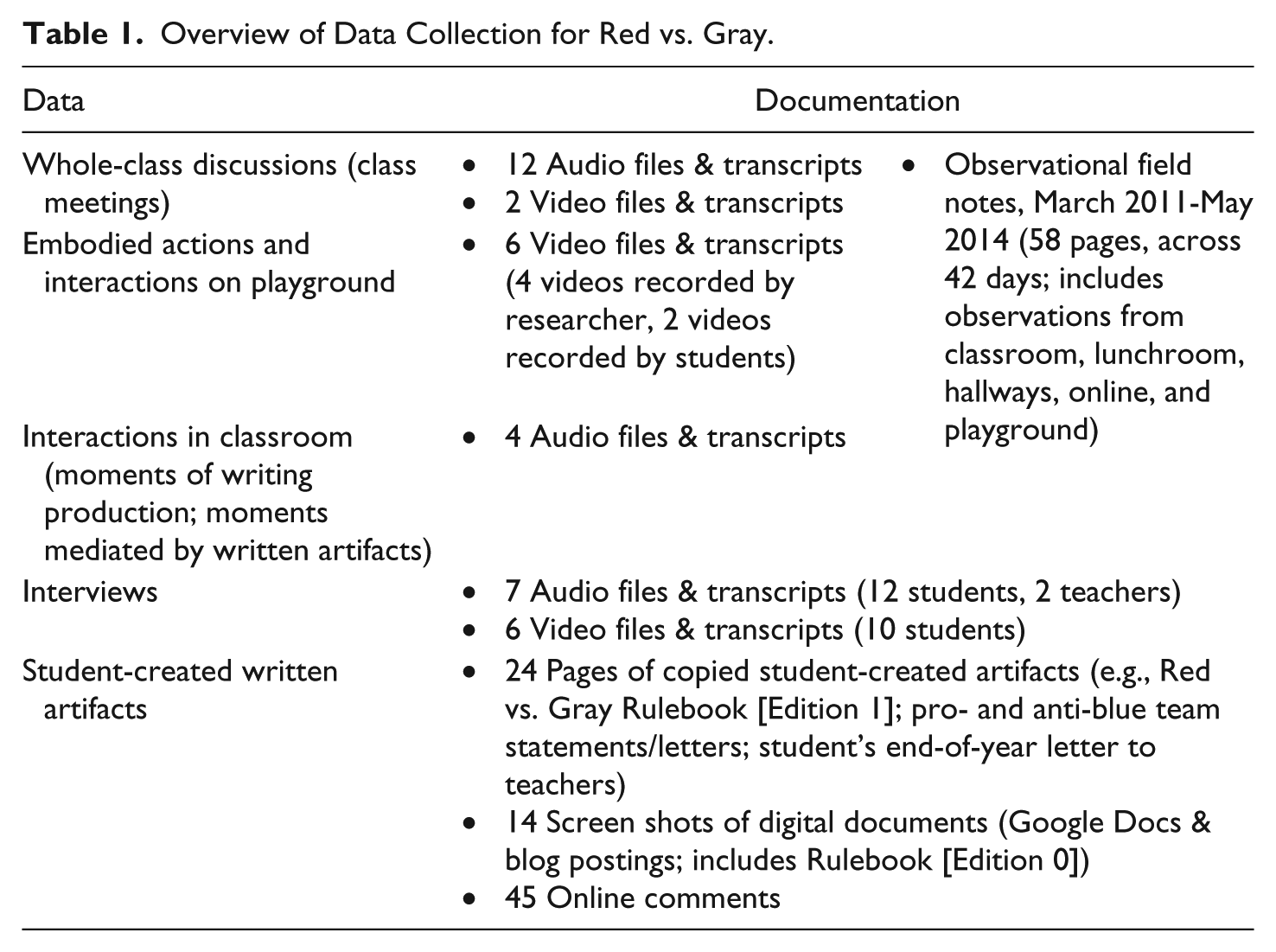
Over a 4-year period, I documented observations as a participant observer within the multiage classroom through a mix of data sources, including extensive field notes, photographs, audiotapes, videotapes, textual artifacts, interviews, and classroom maps. Data sources most relevant to understanding the making and (re)making of the game Red vs. Gray included video recordings of the game being played at recess (created by the students and me); interviews with teachers, current students, and previous students; audio recordings of classroom discussions about the game; field notes from the classroom and playground; and textual and digital artifacts produced by children in relation to the game. See Table 1 for an overview of data informing the analysis of Red vs. Gray.
Overview of Data Collection for Red vs. Gray.
Theoretical and Analytical Framework
I selected mediated discourse analysis (MDA; Scollon, 2001a, 2001b; Scollon & Scollon, 2004) as the analytical framework because it takes action as the unit of analysis rather than an artifact/text, event, or strip of talk. Social actions are called mediated actions within MDA to highlight that cultural tools or mediational means (e.g., language/talk, writing) mediate all social actions. In other words, writing is positioned not as a final product but as a mediated action, a socially situated practice that occurs within a nexus of practice, which in this case was Red vs. Gray.
Scollon and Scollon’s (2004) approach to MDA can be synthesized by asking who’s doing what with which artifact. It is critical to note that an artifact is positioned in an auxiliary role to a person participating within a local embodied community of practice as well as within wider circulating histories, discourses, global trends, popular media, and so on (Wohlwend, 2013b, p. 56). In this way, MDA offers a productive analytical framework to respond to Dyson’s (2013) critique of prior writing research and resultant theories of writing development that have largely emphasized artifacts to the point of ignoring who’s doing what: The usual portrayal of writing development is not, in fact, about writing at all. That is, it is not about children becoming participants in the social practices mediated by the production of texts. The unit of analysis—the form of a written product—is inappropriate. (p. 415)
With the spotlight on who’s doing what, MDA frames children as actors and players who actively engage in socially situated practices or activities with the hope of being recognized as certain kinds of people (i.e., socially recognized identities).
A critical part of any multiyear longitudinal ethnography is deciding what to analyze more closely. More than 4 years of field notes, photographs, artifacts, and interviews offer an overwhelming data set, but leveraging MDA as an analytical tool offered a systematic way to meaningfully filter data through the recursive processes of data collection and analysis (Wohlwend, 2013b). The filtering process occurred during data collection, rather than before or after, as suggested in other analytical frameworks.
In the first step of the filtering process, I located participants and meditational means, surveying key curricular sites, informants, practices, and materials of relevance to my broad scholarly interest in the role of writing and learning to write in this multiage classroom. This work left me with a broad understanding of writing life and development in this community.
The next step of the filtering process—identifying issues of importance to participants—was the most productive, narrowing the analytical focus to writing events and actions that were significant to children as children. Within this step, I located sites of engagement where writing and artifacts were most relevant to children across their days, months, and years in the K-6 multiage classroom. Scollon (2001b) uses the term “site of engagement” to refer to a social space where a window is “opened through an intersection of social practices and mediational means (cultural tools) that make that action the focal point of attention of the relevant participants” (pp. 3-4). In essence, this step of the filtering process valued the identification of locations and issues of importance to community members rather than presupposing my own concerns and questions onto a context/community. The relevance of particular sites of engagement for the K-6 community was determined by triangulating data sources collected across time as well as by engaging children and teachers in informal and semistructured interviews aimed at interpreting emergent findings. The final step of the filtering process was checking identified sites of engagement against cultural studies, systems, and previous scholarship.
Through this engagement in the MDA filtering process, I identified multiple sites of engagement, one of which serves as the focus of this article: the classroom playground game known as Red vs. Gray. It became clear early on that from children’s emic experience, Red vs. Gray was the tradition that defined their years of membership in the community. Accordingly, this “site” epitomizes Scollon’s urgings, alongside Dyson’s (2001) in relation to writing, to identify actions, discourses, and artifacts that are relevant to children.
Navigating the Nexus
MDA positions Red vs. Gray as a “nexus of practice” or the intersection of multiple practices (or mediated actions) that are recognizable to a group of social actors (i.e., community members in the K-6 classroom over time). For example, when former members of the multiage community came back to visit, they immediately recognized children’s social actions on the playground as Red vs. Gray. In essence, time “sedimented” (Lane, 2014) extemporaneous social actions on the playground repeated day after day for many years and transformed them into recognizable social practices. Norris and Jones (2005) draw on Bourdieu (1977) to define a practice as “a social action with a history” (p. 9). Thus, social practices associated with Red vs. Gray have arisen, developed, and been established over time through interaction.
When playing Red vs. Gray, children implicitly agreed to follow a set of rules that had been made and (re)made each afternoon on the playground for over a decade. Knowledge of and about the game were part of a well-developed, socially constructed set of “collective memories” (Bloome, Beierle, Grigorenko, & Goldman, 2009) that were distributed across time, space, and players. Explicit discussion of the rules was necessary only when a player was thought to have broken the rules in some way; thus, arguments over the Red vs. Gray rules were essentially disagreements over interpretation and power. I position this talk as a critical practice of what it meant to be involved in, or to “practice,” the game. Rather than assume that Red vs. Gray only became a literate event once written texts emerged, I argue that in this community, the Red vs. Gray game itself (with or without written texts) was essentially a coauthored, malleable text—recorded/transmitted not with a pencil, but primarily through embodied play and talk—by hundreds of children over nearly a decade.
With such a long history, a strong—but largely unquestioned—nexus of practice developed over the years around what it meant to identify as a Red vs. Gray player in this community, stretching far beyond the physical actions of running and tagging to include practices, discourses, and identities extending beyond the boundaries of the playground. To navigate the long-standing nexus, MDA positions Red vs. Gray as a set of complex social actions that can be examined within the intersection of (a) the historical bod(ies), (b) the interaction order or social arrangement by which children came together, and (c) the discourses in place (Scollon & Scollon, 2004). In the following sections, each of these elements is analyzed as a way to better understand the social complexities involved in this game, rich with history and meaning for the children of the K-6 community.
Historical Bodies: The Origins of Red vs. Gray
There were various creation stories that even newcomers could recite after their first few months in the classroom, but most centered on a “couple of girls chasing around a couple of boys” on the playground “a long, long time ago.” Teachers pinpointed these early events to have occurred around 2004, preceding even the oldest children in the class at the time of my research. This is an important distinction as it highlights the existence of collective memory regarding the game: a “narrative that has been established as publicly held” (Bloome et al., 2009, p. 322). In becoming a member of any community, individuals learn the group’s collective narratives and adopt these as their own as part of the assimilation process (Zerubavel, 2003). For the multiage community, playing Red vs. Gray was considered one of the defining features of membership.
The history of the game was filled with stories of agentive children ensuring that Red vs. Gray would survive to be handed down to new generations of students in spite of the meddling of adults who—as adults will do—attempted to co-opt, revise, or shut down the game altogether at different points over the years. A sixth grader’s letter to teachers at the end of one school year highlighted the historical background as well as the ongoing tensions involved with Red vs. Gray: This letter would not be complete without something on Red vs. Gray. It has taken many forms, but I think (I’m not sure, though) that it can be traced back 6 years to when Tabitha and I used to attack Mike, David, and Louis during recess. . . .This became Boys vs. Girls, which had the same rules as Red vs. Gray. The problem with this game was that some boys would go on the girls’ team and vice versa. So we made Red vs. Gray. For a while the playground supervisors banned Red vs. Gray and so instead we played Dragons vs. Unicorns, which just happened to have the same rules.
It is easy to empathize with the adults referred to in the letter who assumedly grew tired of hearing children’s arguments and thus decided to ban the game rather than deal with the messy world of children’s social negotiations and peer culture. What’s particularly interesting is that in stories such as this child’s that trace the history of the game, Red vs. Gray was often implicated in a way that required devotion, ritual, dedication, sacrifice, and commitment to ensure continuity from one generation to the next. As one child explained upon graduation to middle school, “I’ve grown up with Red vs. Gray. It’s been a major part of my life, and I’d really hate to see it go.”
Interaction Order: It’s a Game
Without the ability to structure teams based on gender, children pulled from the tools and resources available to revise the tag game once again. Just as a wooden spoon may be transformed into a telephone or a magic wand during children’s imaginative play, the community repurposed the surfaces and equipment on the playground to meet their needs at the time. Children noted there were two distinct areas of the playground: “Red” was the plastic ground underneath the climbing equipment and “Gray” was the concrete basketball and tetherball courts. Demarcating the playground in this way became the basis for the name Red vs. Gray and was the way the two teams continued to be referred to years later, despite the fact that much of the red plastic ground covering was replaced years ago with brown wood chips and the gray was paved to look black. The weight and significance of history insisted that the original name of Red vs. Gray remain.
The rules of Red vs. Gray aligned most closely with Opie and Opie’s (1969) description of the game of “French and English” (19th century), later known as “Capture the Flag” in the United States (20th century), alongside elements borrowed from the game “Prisoner” (18th century). Players on the red team could not be tagged in the red areas of the playground (plastic and mulched), while players on the gray team could not be tagged in the gray (concrete) areas of the playground. However, when a red player was tagged in the gray area, he or she was sent to jail, a designated piece of equipment in that area (e.g., monkey bars, slide, basketball goal) and vice versa for the gray team. The only way to release a teammate from jail was to run to the opposing area and tag the person, but a player risked being tagged by the opposing team during this attempt. In the multiple years I spent observing the game, I never witnessed it end with a clear winner—in fact, children generally appeared uninterested in the question of which side had won, knowing that the whistle marking the end of recess today was not the end of the game; it was merely a temporary pause until recess tomorrow.
The number of children playing Red vs. Gray at recess fluctuated from week to week, day to day, and even minute to minute over the course of the study. The game always commenced as soon as children’s feet hit the playground, notably without any formal process of picking or organizing official teams. The game continued until it was time to line up to go inside, but there was fluidity in terms of who was playing at any point in between. Children could join or leave the game at any time without a formal announcement: A game may start with 20 players, have 12 players midway through recess, and end with 30 players. The permeable boundaries of participation foreground the origins of this game in children’s spontaneous play rather than the structured version of games and sports propagated by adults in other, more formal school and out-of-school spaces. During my observations, anywhere from six to 40 children played the game, with the number typically hovering around 15 to 20 players. A core group of eight children played every day for the entire recess, but most children opted in and out. Players represented children across all ages (Grades K-6), with kindergartners (and new class members) encouraged to play in the earliest days of the school year. This was a “play and learn” kind of game rather than a “watch and learn” game. On multiple occasions, I observed children in Grades K-2 set up their own game of Red vs. Gray when they happened to be on the playground without their older classmates.
Discourses: Ways of Being, Talking, Acting, Valuing . . . and Writing
Historically, the meaning-making process around Red vs. Gray relied on embodying and talking about the rules—in heated, breathless moments of disagreement on the playground or later in reflective class meeting discussions. These became the accepted ways of doing Red vs. Gray and being a Red vs. Gray player over the first 8 years of its existence. Rather than thinking about children having knowledge (as a noun) of the game, children’s knowing was a verb where learning was situated as an ongoing process of engagement within this particular community (Lave & Wenger, 1991). Across the years, children in the multiage classroom engaged in the ongoing process of using talk to build consensus and a collective understanding of the culturally significant embodied text/game.
Written transmission was officially introduced into the nexus with one student’s publication of the first complete rule book in the history of the game (see Figures 1 and 2 in the online supplemental files). Abe explained that he had wanted to create something like this for many years, but it wasn’t until sixth grade—after playing and talking and thinking about the game for 5 years—that he’d managed to construct a complete “edition” that could be distributed to community members now and in the future.
When I first started I was just a player and there was no rule book. Lots of times I’ve heard people say, “Let’s make a rule book and like start a committee to start it.” But it never really got anywhere. I mean, they wrote like a few rules, but it just never actually got published. So, I decided to make a rule book. I started a committee and the same thing happened. I made a few [partial rule books], but it never really got around and we never really got a good edition. I actually do have a few of those [old ones]; they were Edition Zero, because they were never really published or distributed.
What started as a Google Doc and blog the previous spring, as Abe hoped to get peer feedback on early drafts of the rules, was presented as an official four-page rule book in September (Year 3 of the longitudinal ethnography): typed and bound with a plastic cover over the large title—“Red vs. Gray”—printed in a large calligraphic font. His clear emphases on spelling, editing, design, and aesthetics (e.g., font choice, paper choice) were notable given Abe’s general disregard for these things in relation to his everyday writing practices in the classroom (see online supplemental Figure 1).
Looking only at the composing and social practices that Abe engaged in as part of the official school day before the creation of this rule book, he could easily be labeled as a resistant or even apathetic writer who often chose to stand on the periphery of a rich writing community. Over his years in the classroom, he took little interest in sharing his writing or in collaborating or cowriting with peers. This reluctance to share was in part related to his difficulty navigating peer interactions. Argumentative and legalistic discourse practices that Abe picked up through his daily interactions with his father, a practicing attorney, served him well at home but historically had not always translated well to making friends with children his own age. However, developing the Red vs. Gray rule book offered Abe an opportunity to apply his specialized “funds of knowledge” (González, Moll, & Amanti, 2006), those practices and discourses developed, practiced, and acquired at home (e.g., formal language, legalese, critical thinking, argumentation, evidential claims, acronyms, advanced vocabulary), productively in relation to a classroom issue. Writing became a way to do something and be someone in the world/classroom community—a way to socially connect with peers in ways that largely precluded Abe outside the world of Red vs. Gray.
Within an MDA frame, Abe can be viewed as a historical body (a 5-year member of the community) doing an action (writing) with particular materials (computer, printer, binder) to create a meaningful artifact (the Red vs. Gray rule book). In the process of publishing the rule book, he engaged in a series of mediated actions in the hope that his peers would recognize the assemblage of practices (e.g., gathering a committee, publicly posting drafts, formally printing and binding the documents) as the social action of “composing official rules.” He explained that an earlier edition (“Edition Zero”) was “weaker” than the most recent one (“Edition 1”) because the paper wasn’t as strong, the binding was too large, the font size was too small, the grammar was poor, and more generally “there were quite a few mistakes and things that had to be corrected.” Though Abe shared it with an explicit request for feedback from the community, the design and discoursal choices in Edition 1 conveyed a certain sense of finality to readers, an officialdom at odds with the idea that Abe was open to making significant revisions. One can imagine an entirely different set of classroom (inter)actions emerging had the rules been scrawled in Abe’s hard-to-read handwriting, spelling mistakes littered across a crumpled composition notebook page.
Changing the Nexus of Practice
The introduction of the rule book offered the opportunity to explore and unpack how Red vs. Gray as a particular site of engagement, with multiple and intersecting social practices—individual and collective—came to be questioned and even contested by the larger K-6 multiage community. The following sections consider how the historical nexus of the game was ruptured with the introduction of written transmission. Particular attention is given to changes in the discourses in place and the historical body as integral to the transformative potential of the publication of a rule book and subsequent community (re)actions. Inquiry tools from discourse analysis were leveraged to examine the changing discursive (re)construction of the game with the introduction of written transmission. The use of the “Sign Systems and Ways of Knowing” building task (Gee, 2011) was particularly useful in understanding how children leveraged written language to “create, sustain, revise, change, privilege [and] disprivilege” (p. 211) historic, entrenched ways of playing the game, making new knowledge claims about what it meant for players to “know” the game.
Discourses in Place
Writing down the previously embodied rules complicated the discourses in place around the game and produced an ongoing community debate about whether there was a difference between “writing down” the rules versus “making up” the rules. Personally, Abe positioned himself as a mediator: [My] job is to write the rules. And try to help enforce the rules, not create them, ’cause I didn’t create the game. And I’ve never wished to change the game. And I would really prefer if there didn’t have to be a rule book. I mean, can you play soccer without a rule book? Sure. The rule book is kind of more a formality than it is a requirement, but it is helpful to have a clear set of rules so people can read.
Meanings that had previously existed only as a living text—embodied, revised, (re)made, and (re)negotiated daily—became concretized in Abe’s written documents, intensifying tensions and producing moments of rupture as children grappled with complex questions of textual ownership and authority related to this revered game. The community collectively pondered whether Abe had the right to author-ize rules that had operated in this community for years. Did writing down the rules in the present change the meaning of the rules in this game historically rooted in decades of daily play?
In the weeks after the rule book was introduced, children played, talked, and wrote their way to collectively construct and reconstruct the game. Essentially, children tried to decide whether they should change the nexus of practice for the action of the game—moving from a reliance on distributed embodied expertise to a codified set of rules. This would alter the nexus of practice for Red vs. Gray in that the rules would be less open to collective interpretation or negotiation in the moment on the playground. Children drew on a variety of resources, including of discourses in place, as they considered the possibility of changing the nexus of practice for the action of the game. It is important to keep in mind that the term “discourses in place” goes far beyond simply ways of talking (Gee, 2011) and is directly related to what it is possible to do and be in the game and beyond.
Two central discourses were identified as cycling in and out of the traditional negotiation space around Red vs. Gray: (a) democratic classroom discourse and (b) historical discourse. These were not stand-alone discourses; there was a degree of interdiscursivity that served to instantiate secondary discourse patterns related to old-timer and newcomer identities. The cumulative years of membership in the classroom became an identifiable label that provided old-timers intimate and embodied access to the historical discourses that consequently privileged their voices in the community. In effect, the old-timers flaunted their historical knowledge to enact identities of expertise, exerting power over the newcomers, particularly in relation to the tradition of Red vs. Gray.
Democratic classroom discourse
The most encompassing discourse in place in the multiage classroom was that of the democratic classroom (Mayer, 2012; Parker, 2006), which positioned children as agentive citizens who shared decision-making responsibilities with adults. This was the discourse most commonly observed in the classroom during my many years of observation. Rather than teachers having absolute control of the space, student-led choice figured prominently in the community. The democratic classroom discourse was most evident during class meetings when children discussed relevant social issues and proposed potential solutions. For example, during one meeting focused on Red vs. Gray, fifth grader Rahm brought up an issue he’d noticed recently: The red and gray teams had been very uneven—both in number of players as well as what kinds of actions those players engaged in.
Well, I know [Red vs. Gray] is a tagging game, but it seems like gray is doing the most tagging and red are just the runners, because they run from one red side to the other red side and gray is like staying in a big circle trying to tag everybody.
Because there was no formal process of picking teams at the start of recess each day, the gray team often ended up with far more players than the red one based on a desire to be a “tagger” instead of a “runner.” Rahm’s observation initiated 10 min of student-led discussion about whether this was a problem or a unique feature of the game, touching on questions such as: Did it matter that the teams were uneven? Had the numbers always been uneven or was this a new pattern? What should we do about it? Luna, a sixth grader and 4-year member of the classroom, proposed the following solution: So, what I was going to say is connected to Rahm’s.. . . I’ve switched before because the teams are really unfair, like if red had six [players] and gray had twelve [players], I’d probably go to red and then there’d be seven. So I mean, sometimes you have to switch, just so it can be fair, but I mean you don’t just switch [laugh] when someone’s chasing you. That’s just not right.
Luna’s solution, rooted in the democratic classroom discourse, foregrounded the need for democratic citizens (and players of Red vs. Gray) to play an active part in democratic life: acting for the public good, fighting against injustice(s) big and small, and standing up for fellow citizens’ civil and political rights. Rather than waiting for an official policy, debate, or teacher/adult/politician to intervene, democratic citizenship requires responsible human action in order to make life together—in the classroom and beyond—possible.
Historical discourse
A second prominent discourse, especially in regard to Red vs. Gray, was the historical discourse (Zerubavel, 2003). Because this was a multiage classroom where children stayed together for many years, the historical discourse was a significant factor in how children made sense of their lives together across time. With Red vs. Gray, the historical discourse led members to claim history as precedent—citing past stories and traditions as the context for present actions and decisions. For example, Thea, a fifth grader, offered the following critique of the present state of the game during a class discussion about rule changes: I’ve been in this class for 6 years. And I’ve played Red vs. Gray probably at least one hundred times every year, and . . . for like 4 years the rules were the same. But then last year they started to change a little bit. And now it’s almost like it’s a totally new game ’cause so many people are bringing up new rules and new additions. I personally loved the old Red vs. Gray, and I don’t want to change it.
The historical discourse was deeply rooted in embodied practices. No single current community member claimed that he or she had created Red vs. Gray, but those old-timers with more experience playing the game often claimed the authority to make more informed appraisals of the proposed rules than a newcomer to the classroom. In Thea’s version of history, rule changes over the last few years had gradually degraded Red vs. Gray to the point where it was no longer as fun to play.
This historical discourse claimed history as the ultimate guide for the way the game was supposed to be played, but it also, above all else, essentialized the continuity of the game year after year after year. Abe’s rule book emerged out of his desire to ensure the game was played even after he moved on to middle school: It’s been played for over a decade. People have always played it, and it’s a fundamental part of our class. . . . I mean, how many other classes have a game that only they play, that they’ve made up? It is tradition. And I would really hate to see it go.
Though the historical discourse was largely resistant to rule changes, the deepest commitment was to ensuring the “tradition” continued despite name changes, slight rule changes, and new players. Traditions such as Red vs. Gray, with years of embodied practice and hundreds of players/participants, develop a kind of nostalgia that can mask an honest reckoning with history in relation to the present moment. During whole-class discussions, only a select few children, such as Evan, demonstrated an ability to resist nostalgia when engaging in the historical discourse. Evan once offered, “The thing is don’t feel bad that we’re arguing this year; the rules have been argued through as long as I can remember.” Evan offered context for the current moment that suggested negotiating the rules was not new and was in fact a central part of the experience of playing Red vs. Gray both “then” and “now.” While these oral conversations may have been as old as the game itself, the move to write down the rules was new.
Written Transmission Mediates a Series of Transformative Events
The rule book: Introducing a new discourse
In producing his rule book, Abe foregrounded the historical discourse while introducing a new discourse in place: rule of law. In moving from Red vs. Gray as a living history—(re)negotiated daily—with distributed expertise along the entire cycle of the old-timers, Abe positioned himself as a cultural knowledge broker, codifying historical experiences and understandings on paper. He used precise language, required under rule of law discourse, to document the rules (“R”) and history (“H”) of the game, even going so far as to include definitions (“D”) that explained insider terms such as “puppy guarding,” “faking,” and “chaining” (see online supplemental Figure 2). For example, R3 [rule 3]: If you are found Puppy Guarding intentionally or repeatedly, the people in the jail get a free walk back to their own territory. The exceptions to this rule are (1) when the jail is under attack or (2) when you are checking. D1 [definition 1]: “Puppy guarding” is defined as going into the jail area on your territory. At [Park Elementary School], the Red team jail is anywhere within arm’s length of the center post and the gray team jail is the area inside a designated circle. Note: before play can begin, you need to establish jail areas. The jail area and the puppy guarding area are identical to each other.
In addition, the integration of historical factoids woven into the rules implicitly argued that players could not understand the rules without also understanding its history: “H1 [history 1]: Originally the [Park Elementary] playground was actually red and gray but the gray area was blacktopped so now it is black.”
Beyond ways of talking, the rule of law discourse also claimed authority by code (i.e., laws) and police-like enforcement. Abe explicitly tied his Red vs. Gray rule book to the “thousand page” law books his father had at home.
Currently some people want to get a pocket-sized [edition of Red vs. Gray]. But I haven’t actually been able to do that—it’s just a future plan. . . . [Like] if there’s like a major rule [infraction] you could go inside and check it or just memorize the rules, but if there’s something that happens right then [on the playground], if you’re not sure, because you can’t really carry the full-sized edition—like a book, you can’t just carry one of those wherever you go. So if you need to check quickly, the pocket-sized could be of help.
Here Abe positioned the rule book as a direct mediator in the everyday actions of Red vs. Gray on the playground far into the future. He saw it as a way to enforce rules and resolve questions that continued to arise within and across the weeks and years, reducing the need for verbal arguments. In other words, Abe proposed that the authority of Red vs. Gray resided in the codified rule book rather than in on-site negotiations between players (democratic classroom discourse) or in prior personal experiences with the game (historical discourse), generating a struggle for discourse in action. Beyond contesting these discourses, Abe’s rule book contested children’s meaning-making in the present moment by codifying the past in a material form with the ability to carry meaning across timescales.
(Dis)rupture: A series of transformative events
The introduction of the rule of law discourse alongside the rule book was essentially a proposal to transform a long-established nexus of practice for the game. The rule book implied a move away from verbal co-negotiation within the seconds and minutes of recess time on the playground each day to a written record that offered opportunities for temporal continuity. Abe anticipated little pushback from the community; after all, he was just “writing down the rules” (i.e., encoding collectively held ideas)—as opposed to creating new rules. His goal was to make the game more accessible to interested players—now and in the future—and eliminate the need to argue about the rules. But the introduction of the rule book immediately alarmed many members of the community: Some questioned the need for a written set of rules, others questioned whether Abe was the right person to write the rules, and others even questioned the rules themselves (as written). Concerns stemmed from moving distributed knowledge and expertise—traditions of the democratic classroom discourse and peer culture more generally—and fixing them in legalistic print under one person’s surveillance (rule of law discourse).
Peer resistance to the rule book—and the implicit proposal to transform the nexus of practice—was swift and (re)actionary efforts were strong. One particularly telling example of community protest, demonstrating the (re)actions of the changing nexus, occurred on the playground within days of the rule book being published.
The school doors fly open. Galloping of feet hit the sidewalk, streaming towards the playground below. The rallying cry of “R-e-e-e-e-e-d-d-d-d vs. G-r-r-r-r-r-a-a-a-a-ay” carries through the warm air. A second grader—always the same second grader—drops his hand to the ground in one swift movement and the game officially begins. The first ten minutes go by in a blur before I notice something amiss in the usual movements, rhythms, and sounds of the game that I’d grown so accustomed to over the weeks and months on the playground. A (dis)rupture was afoot. Sixth graders Blake and Tucker, newcomers to the community, walk around the playground together, stopping to talk to various Red vs. Gray players. Soon enough the pair collects a handful of players who walk to the line separating the “Red” side from the “Gray.” Huddled together, they announce: “We are team BLUE!” Blake follows up, “The blue team will be like a neutral team that has no home base so we’ll have to run around the whole time. We can be tagged on both the red and gray sides. It’ll make it a lot more fun.” Children discuss this proposal for a few moments before tempers flare and frustrations move from thoughtful talk to yelling and finger pointing. Many old-timers—especially Abe—are resistant to the idea of adding a new team to the beloved version of the game. But newly recruited blue team members, primarily newcomers, seem genuinely convinced that a new team will add an interesting new twist to an old game. Chaos ensues. Reluctantly, Ms. D intervenes, “Let’s say that we won’t have any rule changes until we can all discuss the ideas during an ‘emergency’ class meeting tomorrow. Until then, let’s play using the same rules we’ve always had.” (Audio data and field notes, November 18, 2012)
The game continued as usual that day, but when lining up to go back inside, arguments over the blue team erupted again. Blake became particularly frustrated by what he perceived as a lack of willingness to consider his ideas seriously. Unable to focus back in the classroom, Blake decided to write down his arguments for why there should be a blue team in the form of a letter (see online supplemental Figure 3), explaining that he could share this “pro-blue” perspective with the rest of the community tomorrow during the “emergency” class meeting.
The following morning, Abe showed up to school clutching a stack of papers. He proceeded to hand out copies of new Red vs. Gray–related documents that he had written at home the previous night. Rather than make a whole-class announcement, he went around to talk to children working individually or in small groups around the room, mirroring how a politician might campaign door-to-door. Each student or group that Abe met with received a copy of an “anti-blue” position statement (composed by him) as well as a copy of Blake’s “pro-blue” statement/letter from the previous day. The distribution of these documents intensified already heightened emotions and narrowed positions in the community. Abe’s rebuttal to Blake’s pro-blue position statement was steeped in historical discourse, emphasizing that the community tried having a neutral team years ago (i.e., historical precedence), but a third team just “complicated the game.” Blake’s written document, on the contrary, focused on the here-and-now, embodied experience of the game: A lot of people like myself like to keep running and think it’s a waste of time guarding your territory. . . . Team blue would never win, but they would have fun and that’s what tag games are supposed to be. Fun.
Children quickly aligned themselves with either pro-blue or anti-blue as well as taking a stance on the rule book itself. Sensing that things were spiraling out of control quickly, Ms. D asked Abe to stop passing out the documents until everything could be discussed during the whole-class meeting that morning. The conversation that commenced that day—and continued across the following days and weeks and months—was premised on opening up space for children to collectively philosophize (Haynes, 2002) and construct an “enlarged understanding” (Parker, 2006) about how “play” fit with ideas of historical precedence, improvisation and revision, power/expertise, and, of course, written language. In the meantime, this production of talk about texts did not halt the moving bodies on the playground. After all, the most significant rule of all was that Red vs. Gray must go on. The game continued to be played each day at recess under the “old” rules (e.g., no blue team), while talk inside the classroom raged on and on and on.
Discussion
It should be of little surprise that a recess game would elicit such division and contestation from a community of children. In the world of formal schooling, recess has long offered children the most interactional space—temporally, socially, and physically—to engage in practices and relationships rooted in their genuine childhood culture (Willett et al., 2013). Children are fiercely protective over recess in part because it is their time rather than adults’ time. Recess is a time to play: a time to be—to momentarily escape the restrictive state of becoming that governs children’s interactions with adults (Boulton & Smith, 1993). But temporally, one of the essential elements of children’s play is that it is “made fresh daily” (Wohlwend, 2013a, p. 49), meaning that playful interactions are open to impromptu ruptures and new trajectories. Essentially, the introduction of written transmission came to test just how playful a deeply historical game like Red vs. Gray can be.
In tracing children’s practices across spaces, from running to talking and tagging to writing, the complexity of Red vs. Gray’s nexus of practice comes into focus. This wasn’t just a game. This was a way of being, doing, talking, and, with the introduction of the rule book, a way of writing that was relevant to children as children. Of particular interest in relation to this series of events were the ways written artifacts intensified and then ruptured the historical nexus of practice in place for nearly a decade and momentarily became central mediators in children’s process of collectively making sense of Red vs. Gray. Once written language was introduced, children were challenged to critically examine whether written transmission was simply a reflection or mirror of historically rooted oral and embodied transmission, built up over decades of interactions on the playground, or whether written transmission substantively (dis)ruptured their beloved game.
The time-honored democratic classroom discourse had long valued embodied action and talk, but with the introduction of the rule of law discourse, written language gained power as a tool to officially ensure that one’s voice was heard in the community. Using MDA’s simplified analytical question of “Who’s doing what?,” findings highlight how children engaged in the intertwined practices of writing, talking, and playing in order to affix or remix the meaning of the beloved game of Red vs. Gray. Old-timer Abe initially leveraged writing and the rule of law discourse as a way to preserve the legacy of the game far beyond his own years in the classroom. In other words, writing was a tool for affixing meaning over the minutes, days, months, and years. In contrast, newcomers Blake and Tucker attempted to keep expertise and negotiations fluid by spontaneously recruiting blue team members during recess one day. They proposed an emphasis on embodied actions within the short timescale, implicitly arguing that meaning should be open to negotiation by all players in the here and now. Their actions suggested that all community members—newcomers and old-timers—should have the power to make/(re)make this historically situated game. But in this new nexus of practice, these in-the-moment actions came to be transmediated into textual forms that prompted an emergency class meeting (a particular interaction order) to sort through and interpret these new actions, texts, and talk.
The events in this community illustrate the complexity in moving from ephemeral, embodied play, (re)made on a daily basis through talk and action, to written transmission/texts and back again. In the process of considering a range of complex questions in relation to what happens when the rules are written down, one child observed: “I think . . . more of the arguing started once like all the rules were written down in the book.” Of course the “arguing” had existed as long as the game itself, but the introduction/rupture of written language foregrounded issues of power and authorship. Children experienced firsthand that written texts are never neutral; texts are “always positioned and positioning” (Janks, 2013, p. 231), written from particular perspectives, produced by authors with particular goals that may or may not serve the interests of the larger community. This includes policy documents—like the Red vs. Gray rule book—that rely on the appearance of neutrality to wield power over constituents. The rule book, with its typed pages, spiral binding, plastic cover, script-like font, and use of the term “compiled and edited” rather than “written by,” emphasized the officialdom of this document in speaking not for a singular “me” but for a collective “us.” When faced with written artifacts in the real world, readers are on high alert for bias/perspective in a letter to the editor or published memoir, but author-less policy documents written in rule of law discourse require readers to engage with texts with a heightened sense of criticality. These children and teachers demonstrated the power of using classroom space(s)/time(s) to engage in collective conversations about “policy” documents, power, and the (dis)connections between play/action and written forms of meaning-making. Their work and play together emphasize that critical reading, writing, and social action practices happen within/across a community rather than inside the heads of individuals.
Implications
The (re)actions of the children in the K-6 community to the introduction of written transmission into the world/practice of Red vs. Gray complicate the assumption that written texts in a classroom will reduce the need for talk; as demonstrated in the analyses here, the emergence of the written texts in the real world prompt more talk and more writing. This disrupts deeply held beliefs about literate development as moving from oral language (talk) to increasingly complex written language (implying the absence of talk). Brandt (1990) speaks directly to the importance of talk as part of literacy development in relation to writing, rather than talk being superseded by writing: Talk is not merely a temporary scaffold for young initiates: it continues to be a central means by which people come to public consensus about texts and thus sustain their collective brand of literacy [emphasis added]. One need only think about the most literacy-intensive institutions in our society—universities, for instance, or the legal system—to realize that the more an institution produces and depends upon written language, the more talk about written language plays a role in that institution. (p. 114)
Red vs. Gray was a way of sustaining this community’s “collective brand of literacy”—through particular ways of acting (e.g., running, tagging, “puppy guarding”), talking, and now writing. This reflects a view of literacy development that is not sustained in textual production alone but in the complex involvement of readers and writers at work and play. In moving away from “literacy as textuality” to “literacy as involvement,” the players of Red vs. Gray can be viewed as readers, writers, and community members at play, growing in the ability to “use language to sustain intersubjective processes” (Brandt, 1990, p. 113) in relation to textual production and questions of textual authority.
The development of a collective brand of literacy is not just another standard for school-based spaces but is at the heart of all strong, socially just institutions. With 50 community members of varying ages, levels of expertise, desires, and experiences, these children encountered the struggles and strengths of our own country’s enduring democratic project (Mayer, 2012): delicately exploring how to balance the needs and desires of the individual (often best addressed through in-the-moment talk with others) with those of the collective (often best addressed through written texts that codify fairness at a policy level). It was in children’s emotionally engaged close reading (i.e., interrogation) of the rule book that they were compelled to ask the kind of critical questions required of all citizens in a democracy: What happens (or should happen) in the space(s) between embodied action, talk, and textual transmission/representation? Whose voice(s) count(s) (more)? Can and should games/policies change over time in response to new players/members? How do we coauthor/(re)make rules, policies, and written artifacts that speak for the collective?
The analyses provided are not intended to suggest that children solved these enduring questions, ones contemplated by institutions and governments across the globe for centuries. But the analyses do suggest that by offering space(s) and time(s) for these kinds of complex negotiations, children came to see the nexus of practice surrounding a beloved recess game—imbued with particular ways of acting, talking, reading, and writing—as a valued component of what it meant to learn in school (and beyond), not simply part of what it means to play at recess. It is in learning to become a member of a “sustained community of practice” (Lave, 1991, p. 65) that children experienced the power of written transmission as simultaneously coercive and productive, necessitating a critical eye and ongoing critical conversations about how authors are ascribing/inscribing particular versions of histories as well as possible futures, bodies, and identities.
Supplemental Material
OL_SUPP_FG1_Buchholz – Supplemental material for Author(iz)ing a Playground Game: “The Arguing Started Once the Rules Were Written Down”
Supplemental material, OL_SUPP_FG1_Buchholz for Author(iz)ing a Playground Game: “The Arguing Started Once the Rules Were Written Down” by Beth A. Buchholz in Journal of Literacy Research
Supplemental Material
OL_SUPP_FG_2_Buchholz – Supplemental material for Author(iz)ing a Playground Game: “The Arguing Started Once the Rules Were Written Down”
Supplemental material, OL_SUPP_FG_2_Buchholz for Author(iz)ing a Playground Game: “The Arguing Started Once the Rules Were Written Down” by Beth A. Buchholz in Journal of Literacy Research
Supplemental Material
OL_SUPP_FG_3_Buchholzjpg – Supplemental material for Author(iz)ing a Playground Game: “The Arguing Started Once the Rules Were Written Down”
Supplemental material, OL_SUPP_FG_3_Buchholzjpg for Author(iz)ing a Playground Game: “The Arguing Started Once the Rules Were Written Down” by Beth A. Buchholz in Journal of Literacy Research
Footnotes
Declaration of Conflicting Interests
The author(s) declared no potential conflicts of interest with respect to the research, authorship, and/or publication of this article.
Funding
The author(s) received no financial support for the research, authorship, and/or publication of this article.
Supplemental Material
Supplemental material is available for this article online.
References
Supplementary Material
Please find the following supplemental material available below.
For Open Access articles published under a Creative Commons License, all supplemental material carries the same license as the article it is associated with.
For non-Open Access articles published, all supplemental material carries a non-exclusive license, and permission requests for re-use of supplemental material or any part of supplemental material shall be sent directly to the copyright owner as specified in the copyright notice associated with the article.


