




Abstract
Drawing upon tenets of critical theory, cultural capital, global epistemologies, decolonization, Indigenous ways of knowing, mobility and translanguaging, ethics, and global citizenship, this article proposes a model of cross-cultural meaning making and worldly reading as a foundation for global epistemological eclecticism in our research and pedagogical pursuits. The imaginary represents an aspirational model in the interest of decolonizing and supporting “other”—notably confronting western exclusivity and racism and mobilizing epistemologies of southern scholars and Indigenous communities.
Keywords
Where do you begin telling someone that their world is not the only one? Let us challenge the systems that confine us and are used to immobilize others. The bandwidth exists; the virtual architectural possibilities can be imagined. We have the capabilities to support different languages and epistemologies, various modes of thinking and expression, a range of different types of exchanges as well as afford multiple perspectives and to do so with ethical integrity and global relevance.
Global meaning making represents a turn to a global politic involving cross-cultural research and pedagogical engagements that acknowledge and capitalize upon cultural understandings and ways of knowing. As such, it is enfranchising—supporting the mobilization and participation especially in terms of cross-cultural epistemologies. The approach is aligned with ecological tenets, ethical cultural engagements, and democratic decision making (i.e., bottom-up or horizontal negotiations rather than top-down). Global meaning makers are cultural players with a license to make meanings informed by and fused with the meanings of others.
This model of meaning making befits a commitment to research and pedagogy that situates diversity on a new ethical plane, aligned with a form of epistemological ecological activism that confronts and moves beyond the systems in place that play a role in the exclusion or filtering of the cultural “other” in our global conversations. Western literacy scholars might imagine themselves as advancing cross-cultural pursuits, but their practices would suggest otherwise. Educators may tout their support of global developmental interests and participate in global partnerships and solicitations, but they are harbingers of Western epistemologies who align themselves with global developments that perpetuate a bias toward these Western epistemologies. And while they might tout internationalization, most pedagogy and research exist in a Eurocentric cultural cocoon. The systems these educational researchers operate in advance Western imperialism colonizing “others” within and across nations. Cultural ways of knowing and diverse epistemologies that might breathe life into educational and scholarly pursuits are oftentimes strangled and immobilized by the operations that filter out “other.”
The proposed model builds upon discussions among the growing circle of literacy scholars invested in global thinking, especially researchers investigating translanguaging, hybridity and global mobility (e.g., Lam & Warriner, 2012; Nelson, Barrera, Skinner, & Fuentes, 2016; Pieterese, 2005; Rizvi, 2009; Robertson, 1985) cosmopolitanism (e.g., Bhabha, 1994; Hull, Stornaiuolo, & Sahni, 2010; Luke, 2004), and global citizenship (e.g., Torres, 2015; United Nations Educational, Scientific and Cultural Organization, 2015). This model stems from the search for other spaces as discussed by Gutiérrez (2008, 2011) and Gutiérrez, Baquedano-López, and Tejeda (1999), the argument for a more generous science respectful of cultures (e.g., Campano, Honeyford, Sánchez, & Vander Zanden, 2010; de Sousa Santos, 2007b, 2013; Singh, Fenway, & Apple, 2005; Stein, 2017b). It draws heavily upon issues of mobility of people, culture, and literacies. It is consistent with the culturally based model of community-based literacy events and practices explored by Purcell-Gates, Perry, and Briseño (2011), the dynamics of literacy across time of space befitting participatory notions of literacy (e.g., Dyson, 1988; Jenkins, Clinton, Purushotma, Robison, & Weigel, 2008), and pursuits of Indigenous studies of ways (e.g., Battiste & Henderson, 2000; R. Bishop, 1994; Nakata, 2001, 2004; L. Rigney & Hattam, 2018; D. M. Rigney, Hemming, & Bignall, 2018). It also aligns with the transliteracy framework by Stornaiuolo, Smith, and Phillips (2017) that explores dimensions such as emergence, uptake, resonance, and scale as a way of capturing “different kinds of relations among people and things—whether in horizontal, vertical, rhizomatic, or other relationships—and highlight(ing) people’s literacy practices within and across systems that (re)produce, exacerbate, and/or challenge social inequities” (p. 84).
This article begins with an introduction to agency, positionality, critical reflexology, translanguaging, mobility, and transformative change. Then, in a fashion that is both illustrative and pertinent, the article shifts to a discussion of the systemic challenges pertaining to research traditions and Indigenous pedagogies. This is followed by an exploration of some crisscrossing tenets for global meaning making: issues of reimaging and transformation, adaptation and translanguaging, digital and media affordances, critical reflexivity, decolonization, mindfulness, truth interrogation, and activism.
The article’s design befits a Web-based platform with various overlapping, layered, and linked windows mangled rather than linear. However, the experience of its development seems more craft-like, befitting a patchwork of ideas or a quilt stitched together with a rather blunt needle and frayed threads. The patchwork quilt explores readings of our worlds against the push and pull of internationalization versus Indigeneity, standardization versus ecological diversity. The metaphor of a quilt will resonate with those literacy educators wrestling with cross-cultural matters in an age of standardization of our educational and research practices and involved in interrogating their own ethics and practices in cross-cultural research and practices. As a quilt, it is a work in progress, with much to be added and stitching yet to be done. The term global meaning maker is synonymous with global reader, but its use is meant to highlight the reader’s role as an agent in their own meaning making rather than engaging in those forms of close reading that might make reading a more receptive act equivalent with translation. The term global meaning maker is enlisted in hopes of replacing passive, receptive, asocial, acultural, apolitical, restrictive, and repressive forms of reading with more active, collective, critical, cross-border, line stepping, interrogative, widely intertextual, and adaptive engagements.
Exploring a Model of Global Cross-Cultural Meaning Making: Systemic Challenges
Consistent with the argument of Luke (2011) and drawing upon Dewey (1920/1948), Lemke (1995), Cole (1996, 2010), and others (e.g., Bourdieu, 1991; Lankshear & McLaren, 1993), the proposed model aligns with an ecological disposition of diversity with adequate “bandwidth” for inter-operationability across diverse cultural ways of knowing.
Rather than a preordained social order perpetuating subjugation, colonization, or exclusion, the global cross-cultural meaning making espoused is aligned with advocacy for cultural respect and self-determination befitting the ideals espoused by the United Nations (UN) in some of its declarations—the World Declaration on Education for All, ratified in 1990, and the more recent Declaration on the Rights of Indigenous Peoples, ratified in 2006. The Declaration on Education for All proclaimed education as a basic right for all and was anchored in respect for culture. The 1990 UN charter touts “an education for all” with a
responsibility to respect and build upon their collective cultural, linguistic and spiritual heritage, to promote the education of others, to further the cause of social justice, to achieve environmental protection, to be tolerant towards social, political and religious systems which differ from their own. (Article 1)
More recently, the UN’s Declaration on the Rights of Indigenous Peoples declared in Article 3 a right to self-determination, in Article 14 a right to establish and control their own education system tied to the language and culture, and in Article 31 rights relative to traditional knowledge. While there may be a void between what occurs in practice and what is espoused, the declarations have the potential to serve as a mantra for informing global meaning making. In particular, befitting ecumenical values and an ethic of respect, a global reading would align with tenets of (a) local self-determination over global authority, (b) integration and accommodation over subjugation and assimilation, and (c) inclusiveness over exclusivity.
Before presenting some dimensions of global meaning making, the article begins with confronting the global domination of the Westernized epistemological systems and those policies and practices governing the learning of “other”—in particular, our scholarly epistemological practices in literacy education and the colonizing enculturation of Indigenous learners. It is argued that the current systems are serving Western or Northern interests while immobilizing, dismissing, and demeaning the epistemologies and cultural practices of the South and people who are Indigenous.
Confronting Westernized Epistemological Systems
Scholarly Epistemological Practices
De Sousa Santos (2007a, 2007b) and Connell (2007) suggest that Western research has achieved a monopoly through protectionism that inhibits global knowledge developments, especially in non-Western countries. Insularity, nationalism, Western exclusivity, and control of global governance and outlets are part of the leveraging Western norms and conventions that preclude other epistemologies.
A form of epistemological assimilation operates despite the changing international readership of key recognized journals and a rise in the number of submissions by non-Westerners from Southern and Eastern countries. For example, while China has reached a parity with the United States in terms of submissions to journals included in globally recognized outlets, such as those registered by the Web of Science and the Social Science Citation Index (SSCI), China’s success rate and those of other non-Western countries are woeful. For example, for Asian countries, with the exception of submissions from Japan, acceptance rates in the period of 2012 through 2016 were 15% to 23%, which is less than half the rate of their Western counterparts (e.g., United States, 42%; United Kingdom, 45%; Germany, 45%). For Africa, the acceptance rates fell below 10%, except for South Africa, which approached 30% (Tierney, 2017). In data acquired for the Reading Research Quarterly (RRQ) and Journal of Literacy Research (JLR), the lack of international articles by Eastern or Southern authors suggests a combination of a limited number of international submissions coupled with few acceptances of papers from authors other than Western ones. 1
If we enlist indicators of mobility (emergence, uptake, resonance, and scale) such as proposed by Stornaiuolo et al. (2017), the current conditions suggest immobilization of non-Western research in the global context. For example, if “uptake” is an indicator and indices such as citations are measures, then non-Western research pales in comparison with Western research. It is as if Southern research is dismissed unless it is aligned with Western research norms and interests. Recent studies of the articles and citations included in the JLR, the RRQ, and the American Educational Research Journal (AERJ) over the last 10 years revealed that references to a Western or Eurocentric theorizing are dominant, while citations of non-Western scholarship verge on being nonexistent (Kan, Tierney, & Xiang, 2017). 2
As shown in Figure 1, using the application Hirsch index (Hirsch, 2005) to extrapolate a measure of impact based upon a combination of citations and overall acceptances for refereed works in education for 2016, the influence of Western nations is dominant (Scimago Lab, n.d.). 3 For many non-Western nations, it is as if they are slighted participants in the global knowledge economy insofar as it is measured. Indeed, the lack of mentions and citations suggests a squelching of studies outside of Western traditions and interests.
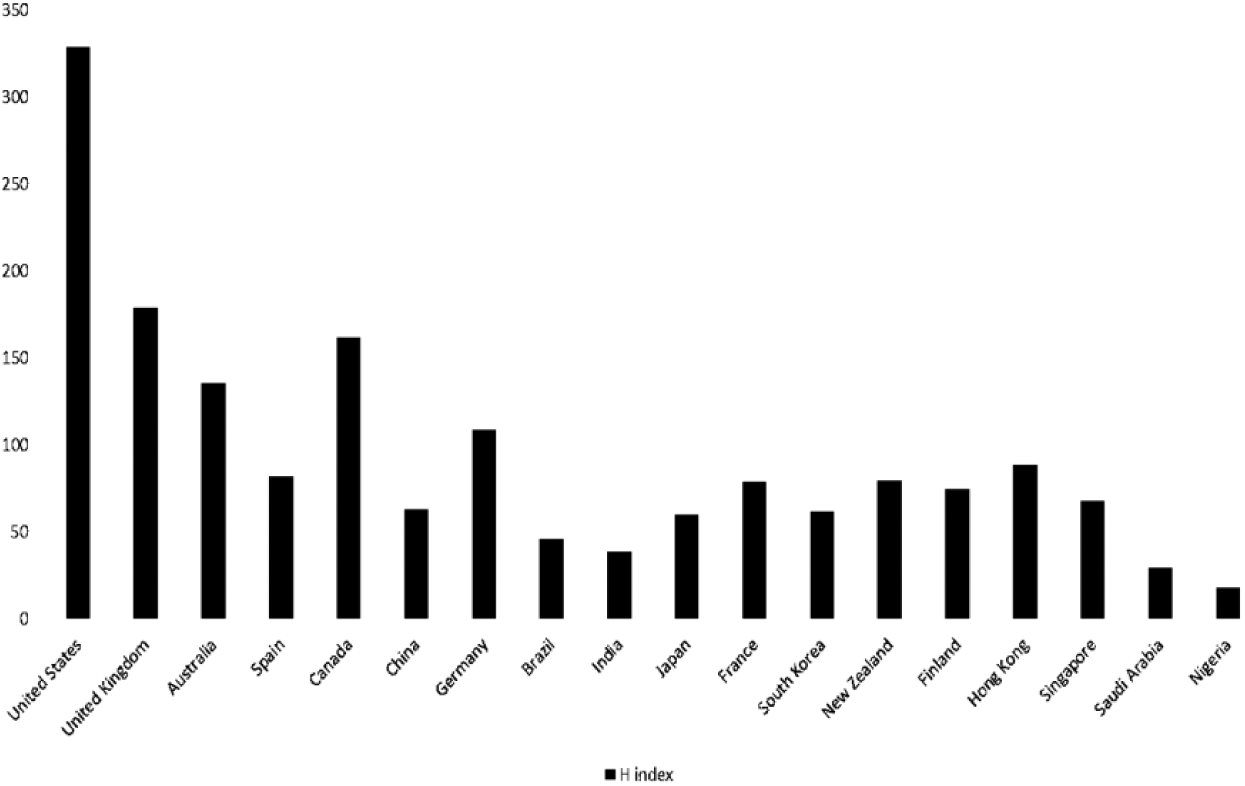
Hirsch index for education echolarship by countries in 2016.
Even in areas of study with an extensive history tied to non-Western research, the same tendency to exclude “other” persists. In a study of the advent of multiliteracies using bibliometric analyses, it was found that Latin American scholarship in the area was ignored. The preponderance of citations in the area was the work of Westerners, including many self-citations by the Western architects (i.e., New London Group), as if their work was its sole foundation (R. Rogers, 2018; Trigos-Carillo & Rogers, 2017). The researchers argue,
The invisibility of scholarship from Latin America in North American scholarship is troubling because of the accumulative impact it has on our field, discipline, and profession. Without access to and recognition of diverse traditions of scholarship, we will continue to reinforce hierarchies of thought, knowledge, and belief systems. (Trigos-Carillo & Rogers, 2017, p. 383)
Unfortunately, despite advancing transnationality as well as increasing cognizance of postcolonial critiques, there seems to be a form of self-indulgence perpetuating Western exclusivity. This bias is leveraged by global benchmarks that are exclusively Western and an acquiescence to Western standards of traditional empiricism (Tierney, 2018; Zhao, Beckett, & Wang, 2017) without regard for current discussions of other epistemologies (Chen, 2010; Connell, Collyer, Maia, & Morrell, 2017; Park, 2018; Takayama, Sriprakash, & Connell, 2017). Educational literacy research journals and those included in the revered SSCI are aligned with Eurocentrism, isolationism, and protectionism. They almost exclusively list only Western journals. For example, they exclude from their approved list any journal published in mainland China. Looked at from the perspectives of Southern or Eastern scholars aspiring to be published in SSCI outlets, they are faced with editorial predispositions that presuppose a form of subjugation to Western forms of empiricism, a kind of epistemological resocialization rather than the possibility of more organic-ecological coexistence that might be mutually engaging and accommodating (Tierney, 2018).
The circumstances reflect a global knowledge economy that secures Western interests by imposing multileveled regularity systems favoring Western empiricism almost exclusively. The approach perpetuates a coercive form of empiricism by the West as it amalgamates Western preferences via review systems that are likely to portray studies as deficient or unacceptable unless aligned with Western rhetorical styles tied to Western theorists and scholarship related to Western circumstances. As Takayama (2009) contends,
Given that the existing unequal structure automatically warrants Western scholars the right to speak “on behalf of the world,” they have ethical responsibility to bring in sophisticated theoretical work from the margin that should immensely contribute to the discussion in the centre . . . . Democratic space must be generated . . . where non-Western scholars and activists can participate in theoretical knowledge production on an equal footing with Euro-American counterparts. (p. 364)
If the stewards of our field desire to democratize our epistemologies, then changes are needed to the regulatory systems (e.g., research and style demands, editorial board representation) that control knowledge flow. Instead, practices need to be introduced that bridge across borders and open up a wider sphere of accepted scholarly genres (Cummings & Hoebink, 2017; Tierney & Kan, 2016). Such change is not straightforward given the systemic forces at play, including the constitution of editorial boards and reviewer panels that lack a diverse global representation. Again, if epistemological diversity is being sought, then current practices serve different ends. Current practices represent forms of enculturation that embed Southern or Eastern studies into Western frames.
As Spivak (1988) argues, change would require recognition of and a reckoning with a complicity with empirical imperialism. Western scholars should be asking: Are their practices aligned with a form of colonization? Are Westerners directing non-Western scholars to adapt their scholarship (epistemologies, content, and presentation) without regard to the possible incompatibilities of western criteria to non-Western epistemological antecedents? Are Western scholars complicit with thwarting, discounting, or subverting local scholarly traditions? Are they endangering the ongoing development and enlistment of different epistemologies and replacing them with their own Western forms?
If greater trafficking between East and West, North and South is an aspiration, then the logic and regulatory monoculture nature of scientific knowledge must be confronted with approaches to knowledge that are decolonizing, emancipatory, and supportive of diversity (de Sousa Santos, Nunes, & Meneses, 2007). Perhaps global meaning making should consider the modes of operation of people who cross the line (Gutiérrez et al., 2017), who are skilled at adaptation, engage in digital innovations of scholarly presentations, or forms of translanguaging especially along borders where cultures cross or brush up against one another (Kim, 2016; Nelson et al., 2016).
Eurocentric Enculturation of Indigenous Learners
Colonization by immobilizing or making invisible local ways of knowing extends beyond journals to what occurs in schools. As Luke (2011) detailed in his review “Generalizing Across Borders: Policy and the Limits of Educational Science,” education policy makers in the United States, Australia, and elsewhere seem intent on standardizing education while sidelining cultural considerations—befitting a form of eugenics that places “other” as less deserving or invisible.
For Australian Aboriginal and Torres Strait Islanders (ATSI), racism and classism have persisted in Australia since the British fleet of convict ships and soldiers arrived in the late 1700s, denying that any society existed in this Great Southern Land that they now declared their own. They not only ignored, they attempted to displace Indigenous peoples and their cultures and languages. Rather than being respectful, the treatment of Australian ATSI was culturally bankrupt. And, nowadays, despite government acts feigning reconciliation, there remains a mix of inertia and belligerence toward advancing cultural ways of knowing. Unfortunately, educational policies directed at supporting Indigenous communities, such as in Australia and the United States, emphasize standardization and accountability aligned with predominantly Eurocentric curricula. This emphasis may or may not be problematic for privileged students with backgrounds aligned with the dominant culture, but for Indigenous students they add to the void.
Access, participation, and success rates at the tertiary level fall significantly below the proportion of ATSI in the population (usually 1%, compared with 4% of the population), and graduation rates fall significantly below those for non-Indigenous students. The majority of Indigenous students have not done well adjusting to Western standards as measured by Western indices or competing with their counterparts, who were often economically privileged or with European heritage (Behrendt, Larkin, Griew, & Kelly, 2012; The University of Sydney Senior Executive Group Indigenous Education Review Working Group, 2010).
As concluded by the recent inquiry on the state of education for ATSI by the Australian House of Representatives Standing Committee on Indigenous Affairs, the education system is failing them in terms of access and opportunity as well as the quality of teaching and relevance. A major contribution to the problem, as the report poignantly declares, is that Indigenous students do not feel a “sense of belonging when at school. This is because they attend schools that do not accept the relevance of, or acknowledge, understand or celebrate their culture, which results in children not feeling culturally safe” (Australian House of Representatives Standing Committee on Indigenous Affairs, 2017, p. 43). This fits with Australian Indigenous educational leader Bob Morgan’s (2018) portrayal of being an Indigenous stranger in his own land, reflecting a guest paradigm for non-Westerners and Indigenous peoples where outsiders are expected to align with the Western/colonizing subjugating and exclusionary norms. Their education is devoid of cultural affirmation and connections. The content covered and the enlisted teaching approaches are crafted according to Western curriculum standards rather than Aboriginal knowledge. Indigenous elements may serve as objects for study, but not as ways of knowing that are tied to a community’s cultural values and epistemologies. Furthermore, despite attempts to prepare teachers with Indigenous backgrounds, a survey of ATSI teacher candidates enrolled in Australia teacher education programs reported that many of these ATSI students encountered racist behavior and other nonsupportive conditions that contributed to only a small proportion (approximately 30%) completing their teacher preparation programs (Lampert & Burnett, 2012).
Such immobilization should not be a surprise. The strategy taken by the Australian government for the K-12 sector and Australian universities is consistent with a view that schools and the university will mold ATSI students into their Western image. Indeed, when confronting university administrators at the executive level with the possibility of complicity with social reproduction of economic privilege and racism, the responses defend the reputation of the university ahead of social responsibility and cultural responsiveness. University executive use arguments in support of objectivity and culturally free approaches to justify their position. 4 They advance the discourse of bridging the gap to maintain a curriculum entrenched in privileging Western ways of knowing. Increasingly, they advocate culture competency in a fashion that lacks specificity for ATSI students (e.g., The University of Sydney, 2018). Ironically and problematically, while Indigenous ways of knowing are not integrated into university programs except as objects to be studied, Western scholars with no Aboriginal heritage have, in significant numbers, been funded to study Indigeneity.
In many countries, knowledge regulation overrides knowledge emancipation (Luke, 2011). Indigenous ways of knowing are unsubscribed and not positioned as foundational to educational endeavors. Policy makers pivot to a discourse of “bridging the gap” and a “level playing field” that shifts the onus of responsibility to the marginalized and simultaneously sidelines and depreciates ATSI communities’ ways of knowing. Unfortunately, there appears to be an avoidance or ignorance of the burgeoning literature on Indigenous ways of knowing emanating out of New Zealand, Canada, and Australia (e.g., Battiste, 1998; Battiste & Henderson, 2000; R. Bishop, 1994; Nakata, 2001, 2004; Ocholla, 2007; L. Rigney & Hattam, 2018; D. M. Rigney et al., 2018; L. T. Smith, 1999; G. H. Smith, 2000, 2015)
The differences between Indigenous methodologies and Western traditions are not insignificant. As highlighted by Martin Nakata (2007, 2008), a Torres Strait Islander from Australia, they relate to what, how, and why knowledge is pursued as well as how knowledge is positioned, validated, and enlisted. As Nakata has detailed, Indigenous knowledge is different in the following ways:
the range and role of different sources of knowledge—experience, observation, history, language, stories, dreams, nature, and animals;
the nature of the state of knowledge—its animations, permanency, or changeability; its state of flux; and its relationship to the past, present, and future;
the position of knowing within the community collective; and
the basis for how knowledge and knowing are validated and used.
As Marie Battiste from the Potlotek First Nations in Nova Scotia, Canada, and James Youngblood Henderson, a member of the Chickasaw Nations, have stressed: Indigenous knowing represents a significant shift from Western reductionism and objectification to holistic reflections on the world that involve spiritual connections and a high degree of interrelatedness of people and their world. As they indicate, Indigenous scholars hold to a view of knowledge as less fixed, befitting an orientation to the world that is ecological, involving an intimacy between people and their natural worlds—past, present, and future (Battiste & Henderson, 2000). 5
It is not displacing one epistemology with the other but a matter of positioning Indigenous knowledge as significant or primary, with the possibility of it being separate, fused, or integrated with Western ways of knowing. In discussing New Zealand’s success in terms of a Maori-based educational focus, Maori scholar Graham Hingangaroa Smith (2000) has argued, “We ought to be open to using any theory and practice with emancipatory relevance to our Indigenous struggle” (p. 214). Or, as Rangimarie Mahuika (2008) noted,
The resistance to colonialism . . . requires a deeper understanding and “dismantling” of the “master’s house,” a re-programming of the oppressor’s tools, so that revitalization and resistance might be made more effective in the ever evolving present and future. Indeed, after two hundred or more years of colonization to suggest that Maori are capable of existing without being influenced by western ways of thinking is unrealistic . . . Finding the correct balance and configuration within which iwi, hapu, Maori and even non-Maori knowledges and influences might be harnessed most effectively remains one of the major challenges for Maori and Maori scholars. (p. 12)
Looked at through a mobility lens, jurisdictional matters often loom as significant obstructions, especially as one moves across communities. At times, they involve legal matters; at other times, they involve interpersonal relationships. For example, in remote and predominantly Indigenous communities, educators often report difficulties bridging between the schools and the communities unless there are Aboriginal persons from the community in key roles in the schools. The University of British Columbia has a history of engagement of the Indigenous community on the campus and in different activities. Indeed, many of the local elders act as witnesses or are approached when there are events that warrant First Nations oversight. In contrast, in Australia, many of the universities have seemed detached from their history other than perhaps making a brief acknowledgment at some meetings that the university is on ancestral lands. Indeed, the vice chancellor at the University of Sydney differentiates between community-located and community-engaged in ways that limit access to the urban community in which it is embedded. 6 The University of Sydney is located on traditional Aboriginal lands of the Cadigal people and nowadays is adjacent to the largest urban Aboriginal population in Australia.
In African countries, given their different histories with colonization and their own regional diversities, repositioning epistemologies would require similar but distinct, complex considerations that are respectful of regional differences, varying tribal interests, disparate religious affiliations, and how local versus colonial knowledges are positioned and viewed (Onukaogu, 2011). For example, as Assié-Lumumba (2017) noted, the repositioning of Nigeria’s indigenous ways of knowing would entail a consideration and unraveling of the complexities of the residuals of colonization. As she stated,
Contemporary African education has suffered from several fundamental problems. One of them is the forced juxtaposition of the European and the African systems of education on a hierarchical basis, with the European system on the top and the only one considered legitimate. While it was denied agency, the African system was not successfully eradicated by colonial policy. Individuals and groups are forced to resolve the tension between the two without the benefit of consistent, systemic, and sustained policy that attempts to create a constructive dialogue between them. Another major problem is the lack of systematized and appropriated mechanisms to permanently invigorate the Indigenous system as the foundation and using it with confidence, thereby unfreezing Africa’s empowering and positive cultural reference, which was denied free agency for the purpose of justifying transatlantic enslavement and colonial domination. (p. 11)
The reality is the uptake of initiatives directed at cultural ways of knowing and decolonization will vary by location and in terms of what is being pursued. It will involve the challenge of understanding and finding one’s way in the tricky space of others. It will likely depend upon an understanding of histories and negotiations with community participants. As Ghiso, Campano, Player, and Rusoja (2016) suggest, it should involve
the robust multilingual counterpublics of their students’ home and neighbourhood communities into the curriculum. This may initially be done through developing partnerships with local organizations and viewing parents and community leaders as partners who have critical knowledge about the potential role of education in a participatory democracy. (p. 24)
Drawing from work in Argentina, it might involve a democratization of education via Horizontalidad (Campano et al., 2010) to “reorganize the hierarchical template of politics and construct new forms of participatory democracy. This process of horizontalidad is both the ‘end’ and the ‘means to an end’” (p. 278).
For many Indigenous groups, the deeply embedded impact of colonial forces still pervades the education curriculum, and many of the practices that define access, meritocracy, and progress, including who is marginalized or in the mainstream. Unfortunately, despite policy makers’ hopes and project claims, there are no “silver bullets,” nor is it tenable to impose a “one size fits all” approach, even within a country. Different schools have different circumstances, different histories, and different needs. If there are commonalities, they relate to a commitment for communities to breathe life into schools and for schools to breathe life into communities. In turn, there is a need for personnel with the knowledge of development and culture along with connections to the community. Unfortunately, surveys of teachers suggest that they lack the knowledge and strategies to address the cultural ways of knowing of the Indigenous students they encounter, whether they are teaching these students in urban or remote settings (e.g., Luke, Shield, Théroux, Tones, & Villegas, 2011). As a number of Indigenous scholars stress, without more substantial development of teachers’ understanding of the communities they serve, they will likely fall back to mainstream and “White” informed practices (Phillips, Phillips, Whatman, & McLaughlin, 2007; Prior, 2009; Woods & Biermann, 2009) under the same yolk of colonialism. As Maori scholar Graham Hingangaroa Smith has suggested, one should engage in ways that endorse and transact with diverse cultures that are mutually supportive, and not in a fashion that dismisses them or reelevates colonial dispositions of the past (G. H. Smith, 2000).
Pursuing Dimensions of Global Meaning Making
Global meaning making, as imagined, is not a scripted reading of the world following a strict protocol applied in a singular or monolithic fashion. The dynamic processes are by their very nature diversified, multilayered, and multifaceted, involving fusions and adaptations of ideas and styles. Global meaning making involves complex negotiations that are not preset or standardized but anchored in ethics aligned with respect for the local and the pursuit of reciprocity between local and global and ecological eclecticism.
Interrupting Existing Frames
Andreotti and de Souza (2011), building upon Spivak (1988, 1990, 1999), have argued global responsiveness calls for approaches that disrupt the normative—an imaginary that challenges the colonized status quo. As Andreotti and de Souza (2011) have suggested, there is a need for readers to interrogate ideas, especially in terms of the systems at work. In particular, they suggest readers should be alert to the colonizing constructions of the world (e.g., hegemonic, ethnocentric, ahistorical, depolitic, paternalistic, simplistic) and our complicities with their systemic continuation. They draw upon Spivak (1988, 1990, 1999) to suggest the importance of identifying desires as a way to “de-mystify the fantasies behind them and to open up possibilities previously unintelligible to the invested self” (Andreotti & de Souza, 2011, p. 225). Similarly, Stein (2017a) has suggested there is need for a decolonial orientation:
The first move is to interrupt and denaturalize the epistemological and ontological frames of modern existence that are produced through violent and unsustainable relationships and processes—and to ask about the role of education in reproducing and/or interrupting these frames. This means going beyond simply rearranging the content within existing frames, and instead stepping back to ask about the conditions and productive effects of the frame itself. The second move is one of grappling with/at the limits of the kinds of relations and futures that are possible within existing frames, so that we might start to disinvest from attachments to their harmful promises, and to learn the lessons from our repeated mistakes. Finally, the third move is one of attending to the need to reimagine and recreate what is possible—and to ask about the role of education in facilitating these other possibilities. (p. 44)
Decolonizing Spaces: Adapting, Translanguaging, Fusing, Border-Crossing
Inherent in this model of global meaning making is the view that all of us are planetary dwellers with a shared interest in sustainability. Therefore, we are interested in spaces that support cross-cultural engagements to which all can bring cultural capital that is distinctive to their meaning making, and all of us can actively contribute to a global trajectory built upon support for diversity where differences without violent intent are respected. To these ends, the spaces pursued should be decolonizing—a form of knowledge emancipation where the cultural capital (knowledge and ways of knowing) of various meaning makers is respected (de Sousa Santos, 2007a).
These spaces would need to be diverse rather than standardized, ever changing and continually adapted, especially by the bottom-up and sideways flows of people, ideas, and acts informed by cultural appreciations and ethical tenets (Abdi, 2015; Campano et al., 2010; King, 2017; Tierney, 2017a, 2017b, 2017c). Some spaces may operate and support meaning making that is seamless; some spaces may prove inaccessible or present barriers to meaning making and impede one’s ability to be a protagonist. Spaces are politically embedded within systems that global meaning makers might need to disrupt or circumvent, or they may need to look elsewhere. Indeed, meaning makers might require “in between” spaces, a third space, or separate spaces, depending upon the parties involved and the exchanges espoused (Gutiérrez, 2008). As Massey (2005) suggests, spaces for cross-cultural exchanges require Westerners to look inward and outward within and across public and private spaces.
It may be that “uptakes” occur horizontally across sites or boundaries, not unlike the translanguaging that occurs at borders as cultures brush against one another (e.g., Nelson et al., 2016) or as individuals or groups toy with or test boundaries with what might be termed line stepping. As Gutiérrez et al. (2017) describe,
Line-stepping is an instantiation of boundary crossing where an individual deliberately and consciously pushes against society’s ideological constraints. Rather than seeing boundaries as static, we recognize their dynamism. By subtly identifying and testing a line, the line-stepper learns how and where lines are permeable and the available latitude in their enforcement. At times, youth will encroach the lines without going over them; at other times, they will cross the lines, attempting to ascertain the severity of the consequences of their boundary crossing. (p. 53)
Global meaning making may include mixing, remixing, adapting, fusing, and taking up ideas (endorsing, refuting, protesting, mocking).
The media within which we exist nowadays may offer spaces that widen the forms, as well as the reach of and possibilities for alternative engagements. Digital affordances can be prefabricated or customized designs that are fertile sites for sharing and advancing ideas, including renditions tied to different epistemologies and artistic renderings. With increased access, heightened bandwidth, and a variety of outlets, digital spaces offer global meaning makers less-regulated venues to assemble, explore, share, and connect. It would be hoped that it would be pursued respectfully, lest a profit orientation and commodification or political ambitions override the interests or the proprietary rights of individuals or communities.
Reading Self
The ideological foundation of the pursuit of a model of critical global meaning making is tied to challenging isolationism, protectionism, nationalism, and forms of exceptionalism and unwarranted privilege. Rather than perpetuating the reader’s compliance with a global inequitable status quo, global meaning making interrogates whose interests are served by global developments and affordances. Readings should be pursued heeding “otherness” and advocating for respectful cross-cultural engagements.
It undoubtedly requires a study of self in ways that challenge self-righteous engagements in enfranchisement or failure to self-implicate. Global meaning makers should, as Spivak (1988, 1990) suggests, be contemplative as they reconcile their complicity with their own privilege and adopt dispositions and approaches that are not presumptuous, colonizing, or recolonizing. The proposed model of meaning making requires self-interrogation of one’s own enculturation in a fashion that involves continual scrutinizing of interests and activities and of positionality, perspectives, and biases. As Spivak (1988) warns, such self-examinations should be ongoing lest they become aligned with the systems they purport to challenge. Global meaning makers should be careful not to position themselves as the savior or champion of others. As Abdi (2015), warns, well-intended allies or advocates should be alert to those tendencies that give the appearance of eclecticism but align with the systems they purport to challenge. As he states,
[There is] a European predestination to save non-cultured natives from themselves . . . [and] we should not discount . . . the need to see beyond the fog of the still problematically benevolent political correctness as the creators of the new scholarship are somehow oblivious in turning the gaze upon themselves and societies. (p. 16)
Indigenizing
Alatas (2006) has argued that relevance is the key determinant in Indigenizing developments, but this does not entail a total dismissal of others in the interest of nativism. The notion of sui generis, as enlisted by Indigenous scholars, should be considered a guideline where the validity of an epistemology is judged by the context of its use and internal consistency. Befitting the Indigenous notion of sui generis, epistemologies could be positioned in a fashion that respects Indigenous self-defining, distinctive coherency and roots. These epistemologies should be considered primary rather than secondary, and not in the shadow of others or to be fitted, subordinated, or modified to align with terms externally imposed by outsiders (Hampton, 1995). As Maori scholars Graham Hingangaroa Smith (2000, 2015) and Linda Smith (1999, 2005) have argued, cross-cultural engagements should proceed in a manner that is respectful of the histories, ways of knowing, needs, hopes, and values of all. The specific circumstances of “others” should be respected, including geographies of time and space, ecological systems’ local norms, self-realization, and self-determination.
Essentially, global researchers crossing borders should do so in ways that are not restricted to Western norms but that incorporate terms emanating from local cultural expectations, consistent with the notions of Giddens (1999), who argues for a global dialectic. As Park (2018) suggests, drawing upon Chen’s (2010) discussion of Asia as Method, if scholars were to look at Asia, they should engage in “a paradigm shift to look at Asia with a de-imperialized, de-colonized, and de–Cold War mentality” (p. 760).
Shifting to an Ecology of Eclecticism
Ideally, a commitment to global meaning making would entail university faculty embracing a shift to internationalization that entails support for scholarly pursuits befitting eclecticism over Western exclusivity or exceptionalism. Oftentimes, universities and professional associations are sites where a form of epistemological imposition and resocialization occurs, tailored to Eurocentric traditions that befit colonialism or assimilation rather than epistemological eclecticism, Indigeneity, and internationalism (Abdi, 2015; Connell, 2007; Nozaki, 2009; Takayama, 2009; Takayama et al., 2017). The scholarly practices of Western institutions are predisposed to engagements tied to Western Eurocentric models of research and developments, as well as ethics that may be more a priori than formative, and more detached and refrained than participatory and consultative. They often seem to operate under the banner of internationalization but pursue international activities as subordinate or supplemental rather than fully integrated into university life and courses of study. Certainly, foreigners (especially non-Westerners) are greeted with a welcome mat, maps, and support on campuses and at conference venues, but they are treated as if they are tourists rather than enfranchised voices. With few exceptions (e.g., Singh, 2011), international scholars and students are often expected to divest themselves of their own histories and align with Western research genres and Western theorists and research. It is as if non-Westerners are expected to be resocialized as Westerners and frame their inquiries in Western thought. There is often no attempt to bridge to work situated in other traditions or other histories. It is as if the international scholar or student is expected to adjust, rather than the Western institutions and faculty doing so.
It is hoped that the importance of differences would be considered essential (Grigorov & Fleuri, 2012; Misiaszek, 2015). Accordingly, global meaning makers should employ an ecological lens that questions the influence their research has on diverse cultures, especially the impact on our epistemologies over time—the extent to which our research builds upon and complements the local or traditional ways of knowing, or displaces or contributes to their extinction, what de Sousa Santos (2007a, 2007b, 2013) describes as their epistimecide.
Being Mindful: Finding a Higher Moral Plane
To engage in global meaning making might require us to move to a new moral ground that bridges across and within nations between the privileged and the marginalized, across gender and races, and between Indigenous and immigrant. It is a moral plane aligned with an ethic of responsibility for others (e.g., Butler, 2011; King, 2017; Kristeva, 1991; Levinas, 1974/1981, 1993, 1995). To achieve this goal, there is a need for aspirational spaces where cross-cultural meaning making can happen in multiples and proceed in a manner that is responsive, respectful, relevant, and energizing. It is a destination that entails a journey involving a traverse across complex and diverse terrain (ecologically, epistemologically, and ethically).
As Kohlberg (1981) suggests, there may be need for a seventh level of moral principle to which global reading and research should aspire—a level that looks more broadly at the ethics of decision making aligned with a fuller and ongoing consideration of the future of a society. As Appadurai (2005) comments, it is not just a matter of ecumenicalism and generosity; it requires suspending certainty and opening oneself up to debate, to differences, and to considering grassroots internationalism as a crucible for emergent new forms of global ethics. It is consistent with the discussion by de Sousa Santos et al. (2007) of the need for a shift from western epistemologies being used as the metonym for knowledge to western being positioned as one of its constituents’ knowledges along with other knowledges. As he suggests, there is need for a shift from knowledge as regulation to knowledge as emancipation.
Being an Activist or Actionist
Global meaning making entails cultural protagonism. For those engaged in international pursuits, it entails straddling multiple locales in different countries, including spaces where racism, classism, and ethnic and various other forms of discrimination may be deep-seated, almost intractable, and perhaps perpetuated unless challenged.
Global meaning makers will need to address the tug of war between homogeneity and heterogeneity, privilege and responsibility, global and local. It involves what Hymes (1990) describes as a kind of dialectic between insider–outsider perspectives. Global meaning making is rarely solitary; engagements are participatory. It involves multiple dependencies: colleagues and collaborators with local knowledge, Indigenous histories, migrant pasts, and cultural moorings in other places—Oceania, Asia, the Americas, and Africa. 7
Activism is integral to the proposed meaning making. As Hall (1978) and Choudry (2015) suggest, activism involves continuously testing, acting on, trying out, and repeating the cycle as one moves forward. As Haluza-Delay (2003) asserts: “Knowledge uncovers the oppressive structures and confronts power. However, it is not the ‘knowledge’ alone that does this, but the process by which the knowledge is taken up and used in the community, altering ‘common-sense’” (p. 86). In accordance with activism, global meaning making involves
thinking, talking about, researching and theorizing about what is going on, what they are going to do next and how to analyse the situations they face, whether in relation to attending a demonstration, a meeting, a confrontation with institutional forces or planning the next action or campaign. (Kinsman, 2006, p. 134)
The activism associated with global meaning making befits Gramsci’s (1982) view that scholars should be “organic” versus “traditional intellectuals,” engaged with the public rather than remaining cocooned in and perpetuating only their academic theorizing and studies. This notion fits with interrogating the systems and is not unlike Freirean (1973) conscientização, or transformative change, or what Lather (1986) termed “catalytic validity.” Moreover, it is consistent with a model of reading and research that some characterize as formative and that aspires to be transformative. As Goodwin (2012) suggests, it should be “an orientation to inquiry with an obligation to action” (p. 3) involving participation tied to local interests and pursued cyclically. The goals of activism are forms of engagement that are mobilizing communities. It shifts the role of researcher to that of a supporter and ally (A. Bishop, 2009) rather than distant observer, critic, or director.
Combined with digital affordances, activism can entail supporting platforms that contribute to a world with fewer walls and without the jurisdictional constraints that often censor or immobilize “other.” As T. Rogers, Winters, Perry, and LaMonde (2015) have demonstrated, various digital media can be used as a means for youth who might be disenfranchised to speak out about societal issues, including matters of their identity. As Rogers et al. (2015) describe, the enlistment of digital resources supported “expressions of resistance to the inheritance of the broken promises of democratic citizenship and their ability to imagine new possibilities of public engagement” (p. 2). The youth they observed were involved in “juxtaposing . . . hybridizing . . . remixing” (p. 102) as forms of counternarratives and to speak for themselves. Notwithstanding the need for ongoing ethical examinations of the role of the digital in society (Deuze, Blank, & Speers, 2012; Hepp & Krotz, 2014; Luke, 2018), the power and the significance of digital affordances should not be underestimated. These literacies “serve as vehicles to name our worlds, interact with others, imagine, test ideas and change our world. The affordances have become as integral to meaning making, as air is associated with breathing” (Beach & Tierney, 2016, p. 135).
Interrogating Truth/Post-Truth
Global meaning making represents an approach to the world anchored in reigniting democratic approaches to cultural ways of knowing by thwarting systems that perpetuate insularity and limit the flow of cultures and ideas of others. It represents an approach to our worlds that challenges authoritarian circumstances that attempt to control knowledge narrowly or position other cultures as having fake or lesser forms of narrative.
Global meaning making entails the use of frames that are aligned with advances in critical race and feminist theory (e.g., Butler, 2011) and postmodernism (Peters, 2017) to examine how people and ideas are positioned and travel (Leander & Sheehy, 2004; Stornaiuolo et al., 2017). To these ends, global meaning making requires a consciousness of (a) the cultural streams that mobilize claims, (b) the jurisdiction constraints enlisted to entitle or immobilize strands of thought, and (c) the practices and ploys that might cast ideas in certain ways or attempt to scale up support in the interest of arguing for universals. Essentially, global meaning making requires an interrogation of global and local meanings in terms of their antecedents and constitution—especially their relevance to sociopolitical considerations historically, culturally, and ecologically. It requires being vigilant about what is presented by whom to whom, why, when, and where—cognizant of the intentions and possible effects.
Global meaning making is not seen as a pursuit aligned with post-truthism or the building of walls that prevent the migration or flow of ideas of others. Rather, global meaning making purports to confront the regressive tendencies of the current “post-truth” world, especially the insularity of approaches to ideas that advance the suppression of environmental and social developments and the walling off truth with unfettered hyperboles, misrepresentation, oppressive personifications, and claiming false equivalencies. In contrast, global meaning making focused on Indigeneity and epistemological eclecticism is rooted in reciprocity, respect, and responsiveness, together with a planetary ecology tied to some higher ethical hopes for democracy that accommodates differences as it fuses compassion, understandings, and possible complementarities.
Global meaning making is a call for a dialectic that overrides the current predilection to exist in cultural cocoons and digital bubbles that are pretailored and governed by practices and policies that perpetuate insularity and use divisive representations (explicitly or implicitly) of others in public rallies, rarified scholarly spaces, or sites for teaching and learning.
Closing Words
Across the Maori communities in New Zealand, there is a creed, “Unity not Uniformity,” undergirding the agreement across the diverse Maori communities to respect one another at the same time as they work together in the interests of the larger society. The creed does not override situated differences but treats them as complementary. Global meaning making entails forms of transaction that occur in support of a reckoning of oneself and one’s cultural ways of knowing as one journeys across borders with others and for the interests of all. It represents a mix of participatory literacy promoting approaches that are cooperative, collaborative, and contrastive but respectful and reciprocal. It befits a planet that is ecumenical and emancipatory.
A key thesis undergirding the rationale for global meaning making is the advancement of “other” alongside of “all,” in concert with accommodations rather than assimilation of differences—that is, the pursuit of eclecticism that supports a form of global complementarity or interoperationality. It entails a turn from self-righteousness to critical reflexivity, from imposition and imperialism to respect and restraint, as one develops cross-border understandings and challenges one’s insularity, ignorance, and historic depreciation of others while interrogating complicity with one’s own advancement via asserting forms of global jurisdictional mandates or misinterpreting, misrepresenting, or disregarding the rights, character, languages, and cultures of others.
The pursuit of a global meaning maker is a call for exchanges in a futuristic, pluralistic world. It involves an approach to literacy that involves shared responsibilities as well as a commitment to diversity, opportunities for expression, and ethical possibilities. It does seem we are at a confluence of developments that may serve as precursors to enacting change. The aspirational model of global meaning making includes a call for forms of meaning making involving activism akin to Angela Davis’s (2016) suggestions at the Steve Biko memorial lecture:
An essential dimension of the learning process is critical thinking, learning how to question things as they are, learning how to imagine the possibility of something different is the very essence of education. Facts are easily attainable . . . but what do we do with that information? Steve Biko and his comrades led vast numbers of students to raise questions about apartheid and to imagine a different world even as they clashed with the world as it was. Knowledge is useless unless it assists us to question habits, social practices, institutions, ideologies and the state. The questioning cannot end . . . The young activists of today stand on our shoulders and because they stand on our shoulders, they see something of what we have seen, but they also see and understand a great deal more. They are beginning to address unresolved questions and some of the erasures and foreclosure. They stand on our shoulders, but we do not provide a steady foundation precisely because our questions were questions of a different era. Our critiques were expressed in the inadequate discourse of the past. The young activists want to reveal the erasures. They want to question what we did not have the full capacity to question in our time . . . they sway, they teeter, they totter, they falter, make terrible mistakes, just as we did at their age when we stood on the shoulders of those who came before us. But just as we learned from our mistakes, they must be allowed to learn from theirs. (Davis, 2016)
Supplemental Material
Supplemental_Material_803134 – Supplemental material for Toward a Model of Global Meaning Making
Supplemental material, Supplemental_Material_803134 for Toward a Model of Global Meaning Making by Robert J. Tierney in Journal of Literacy Research
Footnotes
Acknowledgements
My thanks to my fellow global travelers who have shaped my thoughts and illuminated my path. As drafts of the paper were formulated, the guidance and input of Theresa, Greg and Lauren, Irabinna and Bob, Graham and Jo-Anne, Budd, Amy, Glynda, Kris, and Allan, Carrie and Adam, Bing Gee Jang, Emeka, Changyun Kang, Kan Wei, Xiang Ran and Fazal were invaluable.
Declaration of Conflicting Interests
The author(s) declared no potential conflicts of interest with respect to the research, authorship, and/or publication of this article.
Funding
The author(s) received no financial support for the research, authorship, and/or publication of this article.
Notes
References
Supplementary Material
Please find the following supplemental material available below.
For Open Access articles published under a Creative Commons License, all supplemental material carries the same license as the article it is associated with.
For non-Open Access articles published, all supplemental material carries a non-exclusive license, and permission requests for re-use of supplemental material or any part of supplemental material shall be sent directly to the copyright owner as specified in the copyright notice associated with the article.
