



Abstract
This study engages with current debate around global education and internationalization of higher education(HE). There is an identified need to critically reflect on how global education commitments are introduced to HE students, and how the debates are brought to individual as well as institutional levels. The study explores how students in a Finnish university develop their understanding of global education, citizenship and potential dispositions towards global responsibility. The students participated in an international seminar on the global Education for All (EFA) process, with purposefully planned participatory activities and cross-cultural dialogues, and reflected on their learning about the global process in assignments. A rigorous qualitative thematic analysis was conducted on the students’ written learning assignments (n = 43). The analysis revealed that students learned about the global EFA process and targets, and reflected on general and personal significance of the process as well as the connections between the local and global. They placed the responsibility for educational transformation in three distinct levels: the ‘other’; ‘we’; and ‘I’. The findings suggest that purposefully designed learning activities guide students to develop their understanding of global education and to disposition themselves as responsible future education professionals, both prerequisites of global citizenship and transformation of education.
Keywords
Introduction
This study seeks to engage with the current debate around the internationalization and globalization of higher education (HE) (e.g. Maringe and Foskett, 2010; Robson, 2011), including the role of local and global factors (Rumbley and Altbach, 2016), diversity (Denson and Bowman, 2013), and global citizenship (Maguth and Hilburn, 2015; Mannion et al., 2011). Our focus is on university students’ learning, their perceptions of local and global, responsiveness to diversity and sense of belonging to a global community as students of education sciences or future teachers, leaders and scholars with responsibilities. The study context is Finland but the participating students in education sciences are from over 30 countries. It is the students’ reflections that have guided us to critically look at how students perceive globalization in university level education sciences, and particularly their responsibility as students and future education professionals.
Recent critical research on internationalized and globalized HE has recognized the risk that HE maintains or imposes the traditionally dominant, Western perceptions of knowledge (de Sousa Santos, 2014; Stein et al., 2016), reinforces neoliberal assumptions of interdependence by preparing graduates to participate in a seemingly inevitable global market economy (Bauman, 2013), and promotes individual responsibilities as a substitute for political action and corporate responsibilities (Priestley et al., 2010) resulting in social justice taking an ambiguous normative and strategic role and presence in discourse (Singh, 2011). Rumbley and Altbach (2016) have emphasized the role of HE in analysing and developing the understanding of the connections between the local and the global. It can be assumed that the question of epistemologies of knowledge becomes a foundational issue in the reflections on connections between the local and the global. Thus, spaces for diverse discourses have to be created and actors from beyond the boundaries of academia should be included in global education. The ‘Southern epistemologies’ suggested by de Sousa Santos (2014, 2016) recognize the incompleteness of all knowledges and that engaging in intercultural translation means becoming more and more aware of the incompleteness of knowledge.
Among the neo-liberal, liberal and critical discursive orientations present in (internationalized) HE (Andreotti de Oliveira et al., 2016), the position of global education has been widely discussed. Several researchers have supported the liberal–critical discourse as a catalyst for transformative development and social justice. Boni et al. (2016), for instance, propose that the role of HE be looked at from the perspective of human development, rather than that of producing human capital thereby countering the tendency to view education in commercial terms. King (2016) highlights the need to recognize what the globally agreed Sustainable Development Goals (SDGs) represent and the ways in which they relate to different interests and contexts of development. This process can be supported by the use of measurements, not as final answers, but as tools ‘to serve debate, through providing information on what is valued’ (Barrett, 2011: 129) reintroducing reflexivity into multiple levels of educational development and administration. Andreotti de Oliveira argues for the importance of critical literacy as ‘an educational practice that emphasizes the connections between language, knowledge, power and subjectivities’ (Andreotti de Oliveira, 2015/2016: 193) to go beyond individual reflections to collective interpretations, referring to socially, culturally and historically situated stories that recognize ontological premises. Critical literacies challenge the separation of self from other and draw attention to the way in which what is said, thought and done intertwine individuals with the collective.
These ongoing debates highlight that HE not merely develops knowledge and skills but also provides a context within which teachers, students as well as scientists and administrators can ‘imagine new possibilities for social justice’ as they ‘encounter multiple others, engage in difficult knowledge and explore the zone of discomfort to reimagine the world in which they live’ (Lanas, 2014: 173). The imagining may create spaces for critical reflection on personal involvement in education as well as collective actions, practices and policies that sustain as well as constrain education and educational development. It is this kind of imagining that supports the development of dispositions (Andreotti de Oliveira et al., 2015) based on critical educational awareness, the most important aim of university-level education (Värri, 2010).
The globally agreed SDGs set a new ethical demand for the field of educational sciences; that is, the need to acknowledge responsibility (Bexell and Jönsson, 2016) for the ongoing development of education and the transformation of education systems to work towards achieving the globally set goals for sustainable human development. The challenge for HE institutions has been how to engage students in global issues and how to guide them to recognize the role and purpose of education as a potentially transformative as well as an instrumental endeavour. Different from the policy level goals of internationalization with the emphasis on competitiveness, economic growth and employment prospects and economical gains, HE students have been found to value cross-cultural learning and the sense of global connectedness (Bourn, 2012). Unlike global citizenship, which tends to loosen the bonds between the local and global by binding individuals to global interests, global connectedness values the experience of people being closer, reducing the anticipated distance between cultures and possible tensions between local and global, making sense of the world and learning the required knowledge and skills to engage in securing a better world (Andreotti de Oliveira et al., 2015; Bourn, 2012; Lehtomäki, Posti-Ahokas & Moate, 2015; Lehtomäki, Moate & Posti-Ahokas, 2016).
It is global citizenship, however, that the United Nations Global Education First Initiative urges education, including HE, to foster in order to ensure sustainable development (UNESCO, 2014a). A recent study on the notion of global citizenship during an online course on internationalization with teachers from ten HE institutions in different countries, however, found that global citizenship all-too-easily continues to represent a capitalist, Western–colonial approach, even with teachers that are open to new ideas and ready to make changes in their teaching (Clifford and Montgomery, 2014). Arguably, it is the way in which ‘citizenship’ is perceived that makes a significant difference to the kind of education offered and the learning that is realized. If global citizenship is perceived as a transnational and global phenomenon, the rights and responsibilities of national citizenships may be replaced by self-interests and market forces with little regard for political boundaries. In this way global citizenship aligns itself with ‘liquid modernities’ sustained by the flux of constant change and the increasing separation of power from politics (Bauman, 2014/2016) and educational discourse turns to technical measurements of performance with a focus on competitiveness. This does not have to be the case, however, as global education that aims at ‘global citizenship’ can be implemented in various ways and for various reasons (Bourn, 2014). As a catalyst for transformation, education can promote ‘critical thinking about complex global issues, and […] skills such as communication, cooperation and conflict resolution to resolve these issues’ (UNESCO 2014a: 20). Moreover, as global citizenship draws on earlier initiatives with critical histories and alternative conceptualizations (Mannion et al., 2011) it can potentially foster new ways of thinking and acting in education and beyond. Discussing the contested notions of global citizenship and global education, Clifford and Montgomery (2014) refer to Nussbaum’s (2002: 302) statement that in HE ‘we have the opportunity to do better, producing Socratic citizens who are capable of thinking for themselves, arguing with tradition, and understanding with sympathy the conditions of lives different from their own. Now we are beginning to seize that opportunity. That is not “political correctness”, that is the cultivation of humanity.’
In light of the critical roots of global education and global citizenship we need to continue questioning how HE introduces the concepts, discusses implementation and possible scenarios, and, in particular, whether learning contributes to the development of critical thinking skills, as expected (Priestley et al., 2010). Previous research has pointed out the differences between disciplines in HE in terms of space for critical thinking and reflections on social and political challenges, such as power distribution and relations, (in)equality and (in)justice (Clifford and Montgomery, 2014; Joseph, 2012). In Finnish HE and in education sciences, there is space for critical thinking but more research is needed to understand how it is and could be used (Räsänen, 2009). In this study, a wide range of current and future educational professionals – students of education, practising teachers, non-governmental organizations (NGOs), educational scientists and administrators – were invited to enter into dialogues together during a two-day SDG4 seminar entitled ‘Teaching and Learning: Achieving quality for all’. The aim is to explore how notions of global responsibility and potential dispositions towards global responsibility begin to form through the use of dialogue as an experience that looks ‘towards individual processes of thinking and reflection, as well as towards the constitution of cultural practices and communities at particular historical moments’ (Renshaw, 2004: 2). The context and rationale for the study are outlined in the following section.
Context and rationale
The context for this study is a participatory international seminar on global education, annually organized at a Finnish University since 2011. These seminars have been purposefully designed to encourage meaningful learning through knowledge sharing, cross-cultural dialogues and critical reflections. Fink’s (2013) dimensions of significant learning experiences in HE guided the purposeful design, with the emphasis on making learning meaningful for students in education sciences (Lehtomäki, Posti-Ahokas & Moate, 2015; Lehtomäki, Moate & Posti-Ahokas, 2016). The presenters and participants (ranging from 120 to 180 at each event) have included national and international students of educational sciences from various degree programmes (from early childhood education to teacher education, special needs education, educational leadership and adult education), exchange students, visiting scholars from partner universities and representatives of collaboration networks, government and civil society organizations and university staff. In addition to students of education sciences, also some students and staff of communication, social sciences and development studies have participated in the seminars. The seminars were also accessible online.
The broad range of geographical, disciplinary, cultural and social experiences and understanding between the participants has suggested rich resources for cross-cultural dialogues transcending the conventional boundaries of HE. By cross-cultural dialogues we mean that all participants were invited to cross boundaries related to environments of growth and schooling, study disciplines, world views, customs and languages, rather than reducing diversity to countries and nationalities (Patel, 2015). Research has shown, however, that disciplinary cultural dynamics in HE institutions can work against cross-cultural initiatives if pedagogical practices inadequately support learning dialogues (Miller-Idriss and Shami, 2012; Schweisfurth, 2012; Tian and Lowe, 2009). Recognizing this challenge, the seminars have offered a variety of engaging activities, such as formal presentations and panel discussions with guest presenters from schools, and national and international organizations (e.g. UNESCO and the Teachers Without Borders network) and students, drama, workshops, films followed by discussions and learning cafés to create opportunities for different kinds of dialogues and critical engagement (Crosling et al., 2014). These events have shared up-to-date research findings and responses to the challenges of education in different contexts with the aim of supporting critical literacy and reflections within and following the seminars (Andreotti de Oliveira, 2015/2016).
The student participants have a range of different educational experiences, perspectives and values. This study analyses the students’ written learning assignments that reflect on their learning related to the seminar theme and accompanying literature on global education development and challenges including the summary of the 2014 Global Education Monitoring Report (UNESCO 2014b). The research questions are: (a) how do the students relate ‘local’ experiences of education and ‘global’ notions of education (global connectedness)? and (b) where do the students place the responsibility for educational transformation (dispositioning)?
Data and analysis
The participatory international seminar was part of a university course on international policies and practises in education sciences. The first author taught the course, conducted research, clarified the dual role of the teacher–researcher and informed the students about the research at the beginning of the course. Participation in research was voluntary and withdrawing from the research was possible at any time without any effect on the grading of the course. The students were asked to sign a consent form allowing their reflective written learning assignments to be used anonymously for research purposes.
The data are 43 written learning assignments by 45 students who attended the 2014 seminar. The actual number of seminar participants was 130 but this study focuses on the students who participated in the seminar as part of their studies, and thus were required to submit a written learning assignment. With the students’ permission, the learning assignments and photographs taken during the seminar may be used in research. All details identifying the students were removed before the data analyses and reporting. During an introductory session before the seminar, the students received general information and discussed key concepts related to global education development. The students were instructed to choose one of the EFA Global Monitoring Reports and to discuss the report theme in relation to one country (home or another country) according to their own interests. The students were also provided with critical literature related to the EFA process. They could choose whether to work alone or as a pair. Additionally, the students were asked to reflect on their own experience related to the theme, situation in the country selected, the main issues in the global development, and to their learning experiences during the two-day international participatory EFA seminar. The instructions, links to the EFA Global Monitoring Reports and suggestions for literature were available through the university online learning environment and the students had the possibility to ask questions and share views.
Four students worked in pairs. In the total 43 learning assignments, 10 reported on African countries, 5 on the Americas, 13 on Asian countries and 13 on European countries; one learning assignment discussed the EFA process in general and one focused on sub-Saharan Africa. Most students (n = 24) chose to reflect on the most recent EFA Global Monitoring Report (2014) at the time of the seminar, while five analysed gender based on the 2003/2004 EFA Report and four analysed quality by drawing on the 2005 EFA Report.
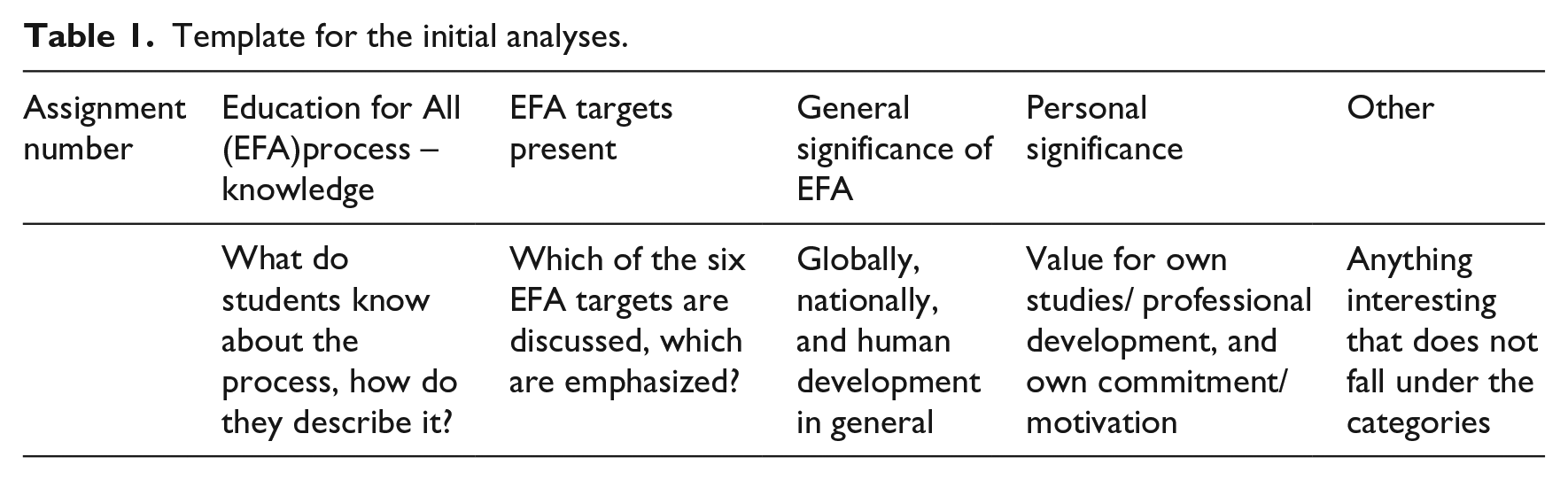
The data analysis involved several stages. First, three researchers read all the learning assignments and discussed their preliminary findings (Table 1), which led to the identification of two broad themes that were of particular interest in the assignments: (a) the way in which notions of local were related to notions of global (Table 2); and (b) the way in which students referred to responsibility for transforming education. The following stages of analysis sought to investigate these themes further. In the second stage of analysis the 43 assignments were divided into three groups and each researcher carried out the thematic content analysis (Braun and Clarke, 2006) of one group in detail focusing on the way in which students referred to the ‘local’ and ‘global’ in their assignments and in particular the way in which notions of ‘local’ were used as a lens for conceptualizing ‘global’ and vice versa.
Template for the initial analyses.
Exploring the presence of and relationship between the local and global in student assignments: an example of the first round of analysis.
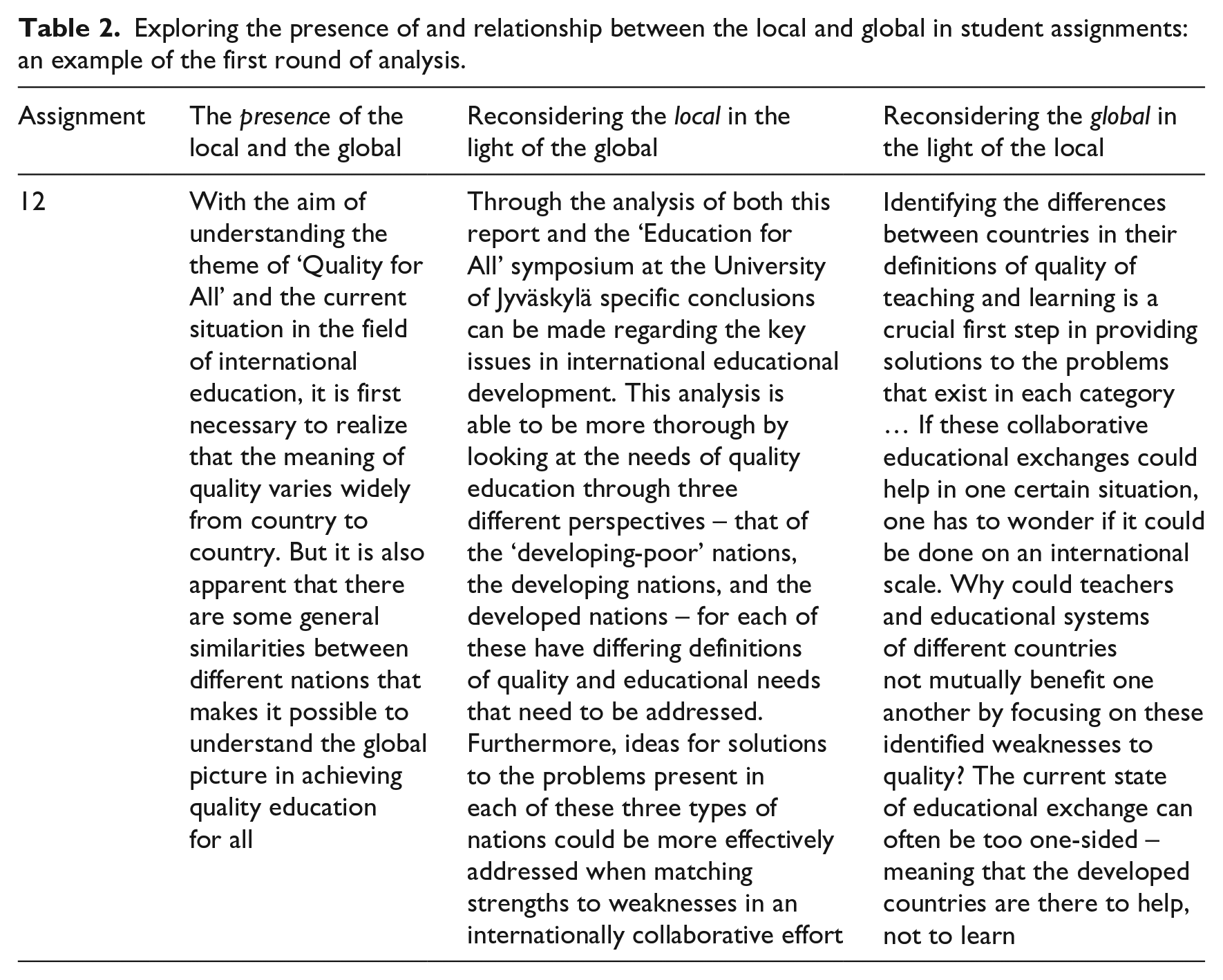
The three researchers shared their findings before deciding on the next step that was to identify which themes were present in the participants’ reconsiderations of the local in light of the global. The analysis at this stage explicitly focused on the way in which participants: (a) understood their own values and attitudes; (b) critically reflected; (c) linked their own views with local issues and broader contexts; (d) envisioned possibilities; and (e) interacted with diverse peers (Bourn, 2014; Denson and Bowman, 2013; Scheunpflug, 2011).
The final stage of analysis sought to understand the way in which notions of responsibility were present in the participants’ assignments. On the one hand, our attention was drawn to the way in which the students seemed to critically reconsider educational systems they were already familiar with, and on the other hand, the notion of responsibility seemed to recur in different ways. The students reported on the location of responsibility, though this was not requested in the instructions for the learning assignment. This suggests the different ways in which the students personalized the extent to which they engaged in the debate. Therefore, the final stage of analysis was divided into two steps: (a) focusing first on the presence of and relationship between the local and global in the student assignments (Table 3); and (b) the way in which responsibility was referred to in the assignments.
Exploring how students refer to responsibility in their assignments.
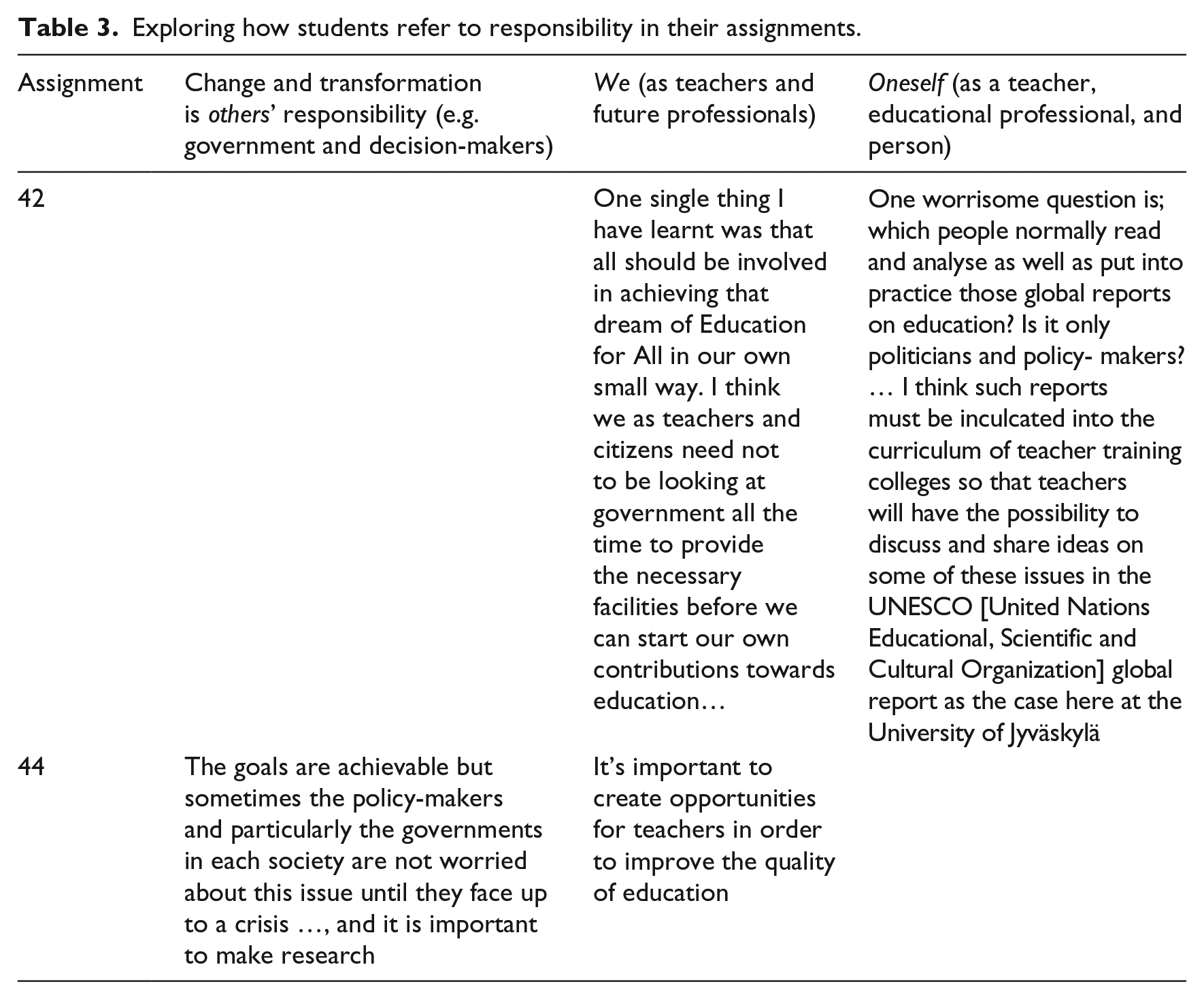
These different stages of analysis provided an overview of the overall dataset as well as two sub-sets concentrated on our particular areas of interest. The identified themes and findings are presented in the next section.
Findings
The findings first reported here focus on the way in which the students related ‘local’ experiences of education and ‘global’ notions or situation of education having entered into cross-cultural dialogues with a variety of partners. Through the analysis outlined above, we identified five themes that indicate how the students entered into their learning and experienced that learning through the dialogues (Table 4).
Five themes characterizing students’ reconsiderations of the local and the global.
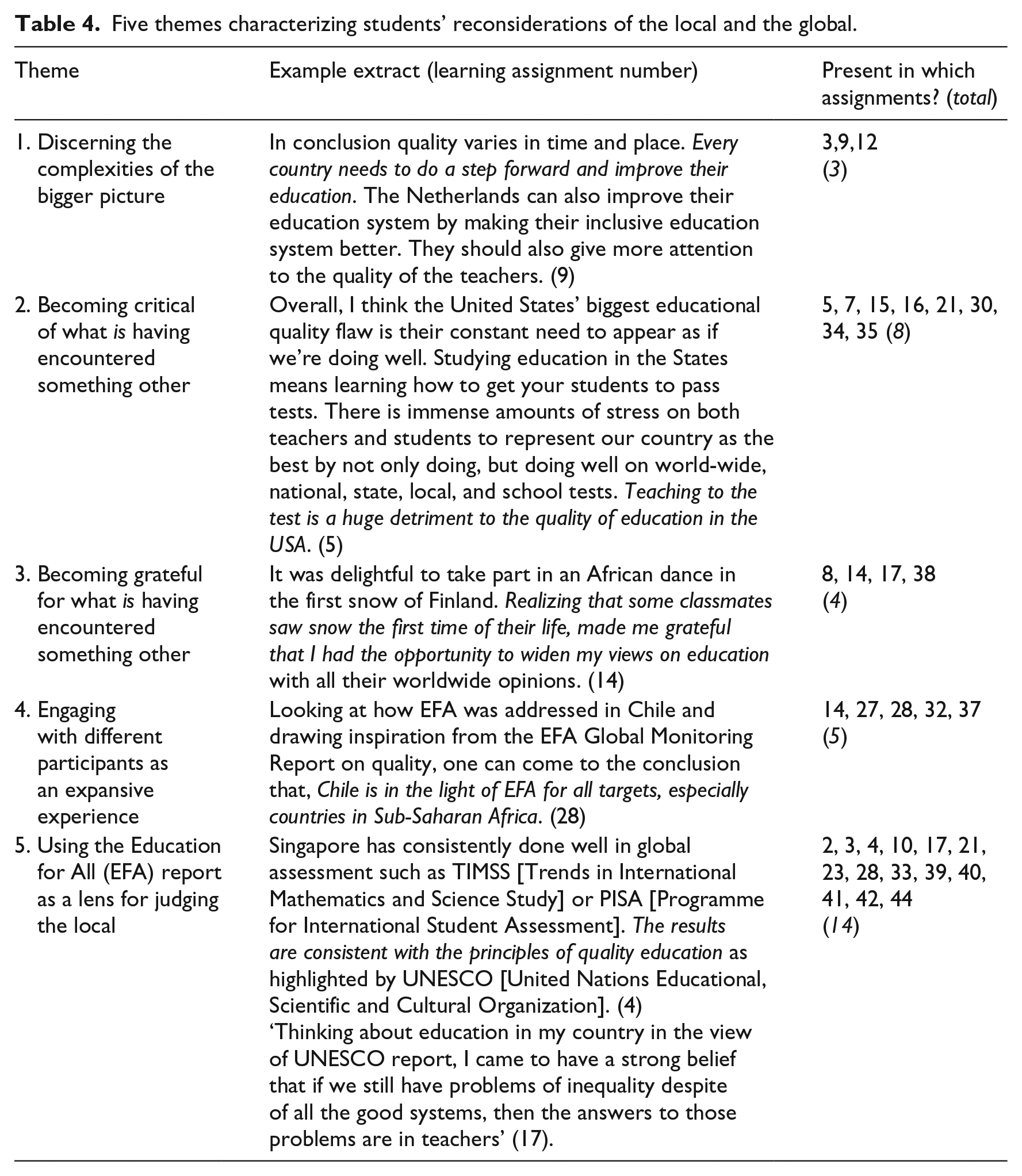
Theme 1 ‘Discerning the complexities of the bigger picture’ represents the way in which a number of the students began to reconsider the complexities of the bigger picture through a critical response to ‘global’ categories. As the participants gained understanding of the global situation it seemed that becoming aware of the complexity of education provided an opportunity for active meaning-making. As one student wrote, ‘there are no such countries having a perfect educational system and the situation is always changing. I thought it was a meaningful [issue] to remove the existing power balance of developing and developed countries and put all countries on the same place’ (learning assignment, in this section referred to as LA, 3 referring to the number of the LA). The learning assignments indicated that students began to recognize positive as well as negative features of local (familiar) educational systems and to become more sensitive to different contexts. They also suggested possible courses of action in response to the seminar raising issues that should receive further attention, such as inclusion and teacher quality within a particular context (LA 9) or across nations (LA 12).
Theme 2 ‘Becoming critical of what is having encountered something other’ represents the way in which encountering something other can support the development of critical thinking skills as, for example, seeing something familiar in a new light. The students noted that in addition to gaining new knowledge they valued, ‘the opportunity to reflect my own point of views and the situation in my home country … when I am telling about something and then people are asking why it is like that. That helps me to reflect and reconsider things’ (LA 16). The broader parameter for comparison appeared to help the students to recognize values present in their own education systems that they might have previously taken for granted. The learning assignments suggested that the students began to identify gaps between policy, practice and educational research (e.g. LA 7), as well as the educational potential and current limitations of different contexts (e.g. LA 35). As the students compared different contexts and exchanged ideas, different perspectives began to open up. Importantly the students did not seek to resolve different perspectives but recognized the value of building connections, ‘even though our opinions didn’t match I think both our minds opened up to the other one’s perspective and helped us to be more reflective on the things we take for granted, given and right’ (LA 21).
Theme 3 ‘Becoming grateful for what is having encountered something other’ represents the way in which participants appeared to be increasingly grateful for what is having encountered something other. This ‘something other’ could be knowledge about education in other countries (LAs 8, 17, and 38) but also a shared experience, as the excerpt in Table 4 illustrates. It is noteworthy, that the relational skill of empathy and openness to the experiences of others helped the students build understanding as they recognized, for example, the value of minimum standards such as the provision of compulsory education (LAs 8 and 38). One student pointed out that with a broader point of view it is easier to recognize ‘how much blessed I am having all the access and chances to get proper education and choose what I want to do’ (LA 17).
Theme 3 draws attention to the way in which participants re-viewed what is, while theme 4 ‘Engaging with different participants as an expansive experience’ illustrates the way in which engaging with difference can open new possibilities for understanding. This sense of something more was particularly present in five learning assignments. Although the participants wrote of being ‘overwhelmed’ and ‘startled’ (LA 14) and personally feeling pressure to make the right choices (LA 37), the weight of these feelings, did not undermine the value of the experience for these participants. As with theme 2, the participants valued the opportunity to consider new ideas and be inspired by good examples from elsewhere. Through these experiences the students expressed an interest and desire to know more, because they recognized previously abstract problems, such as gender inequality (LA 37) and socioeconomic disparity (LAs 27, 28, 32, and 37) as part of lived experience requiring attention. As one participant wrote, ‘similar with Chile, we are a developing but emerging country in the world arena, education is the bedrock for our economic progress […]. But we have so many problems [that] need to be solved’ (LA 27).
Theme 5 ‘Using the EFA report as a lens for judging the local’ draws on the way in which the students used the EFA reports as a lens for reflecting on the local or country and theme specific developments. It is of little surprise that this theme is present in a number of the learning assignments, because the students were instructed to reflect on the theme or report on their choice. Significant differences exist, however, in the way in which the students used the reports as a lens. Some students saw the reports as a source of information and a call for action. One participant wrote, for example, ‘Against all expectations, XXX did not achieve gender parity in secondary education according to the UNESCO Global EFA Monitoring Report 2008 […]. The XXX education system should focus on promoting gender parity especially in vocational schools, in order to fight gender bias in education and to provide equal job opportunities and earnings later on’ (LA 36). Other participants noted how the reports support critical reflection on one’s own system (LAs 3, 17, 33, 39, 40, 42, and 44) as well as educational challenges in other contexts (LAs 21 and 41). In these examples engagement with the EFA reports appears to promote greater critical awareness as local knowledge is re-considered from a different vantage point and new understandings as well as further questions open up.
The students used, however, the EFA reports also to limit rather than feed critical reflection. This was particularly the case when some students referred to the report(s) as an authority or criterion for defining success and quality in abstract terms with no reference to lived experience as affirmation or contradiction of the reports (e.g. LA 4). Other students compared countries and contexts, as the findings in the EFA reports grouped different countries together (e.g. LA 2 and LA 10). Although these examples provide viable starting points for critical considerations, the students made no further comments nor considered any further actions. It is perhaps worth considering whether the published documents limited the students’ critical reflection on the subject matter of the EFA reports. If this is the case, however, it suggests that using only conventional academic reading and writing assignments in HE may fail to foster global responsibility as a critical way of thinking and responding, going beyond the demonstration of abstract knowledge.
The second research finding presented here relates to where the students locate the responsibility for the transformation of education. The question of who is responsible was not part of the learning assignment instructions but a notion that was present in a significant number of assignments. The students recognized, for example, the need to be responsible for legislative (e.g. LAs 6, 8, 19, and 24), societal (e.g. LAs 5, 9, and 28) and economic (LAs 18 and 41) change and they located responsibility on several different levels, as illustrated in Table 5.
Students recognizing and locating responsibility.
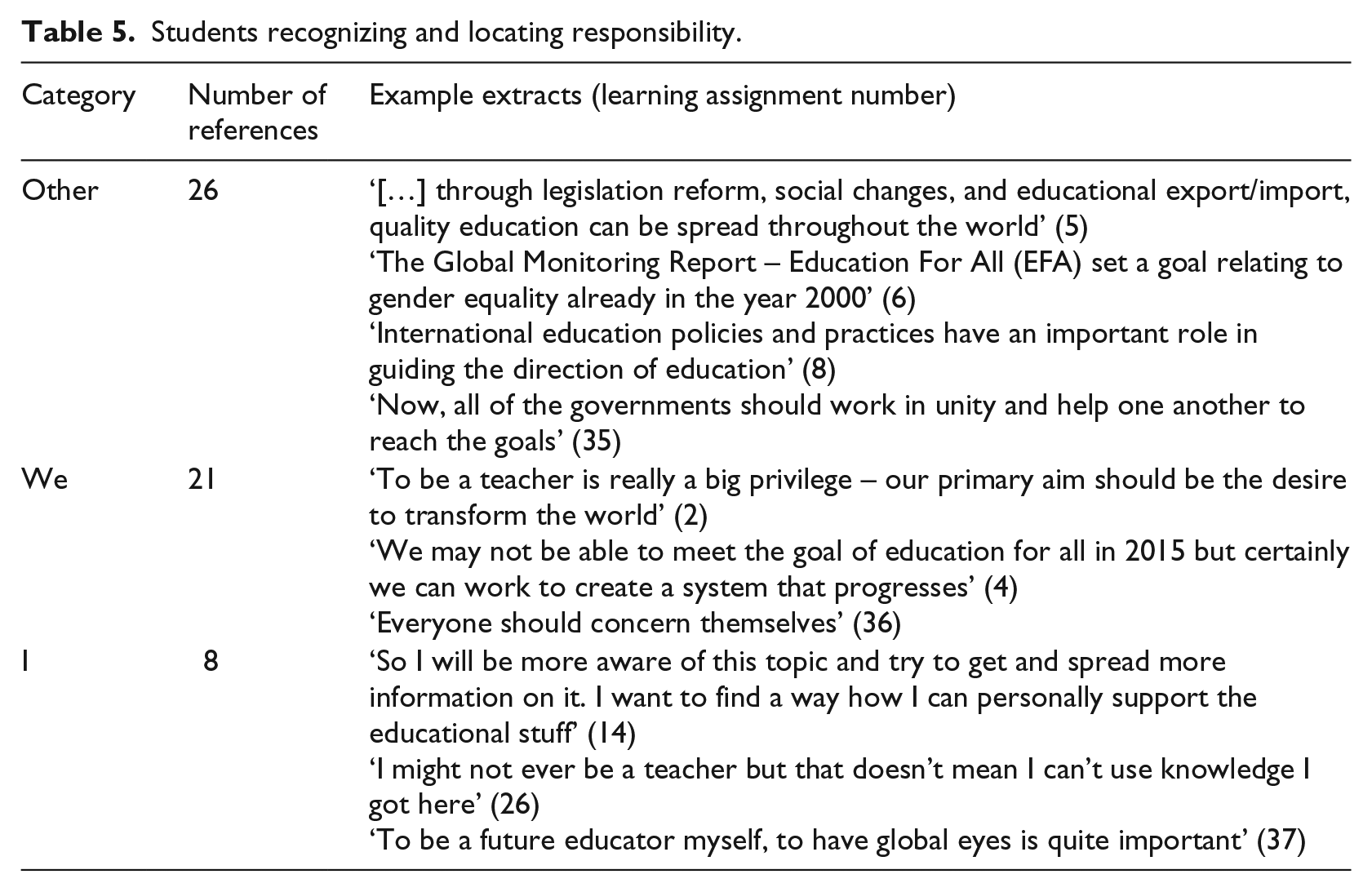
The ‘other’ category in Table 5 includes the references made to international agencies and donors, national governments and policy-makers responsible for setting priorities and defining policies as well as influencing professional conditions and practices. In this category the ‘other’ seemed to possess a significant amount of power to determine the direction of change, yet many of the students recognized the slow pace of change threatening the success of international treaties and governmental policies (e.g. LA 2) and expressed personal frustration at the lack of influence policies have had to date (e.g. LAs 6 and 7). As one student wrote, ‘I believe that the “education for all” objective could be met if policy makers have a burning desire to care for [like] they choose to care for their loved ones’ (LA 19) highlighting a perceived discrepancy between personal hope and political will.
The students also recognized the shared responsibility of educational professionals, a group that they identified with. This was a collective form of responsibility that included critical thinking, progressing, envisioning change and collaboration as ‘we are the critical mass’ (LA 15). Whereas the category of ‘other’ highlighted the need for direction and conditional support for change, ‘we’ places responsibility at a more grassroots level. Together, for example, we can concentrate on everyone being educated (LA 2), we can work as a team (LA 7), we can make a difference (LA 14), we can ‘start our own contributions towards education’ (LA 42). These remarks express vision accompanied by action, recognizing that together ‘we can work to create a system that progresses’ (LA 4).
The third form of responsibility expressed by the students was a personal stance with regard to what an individual can and may do. This stance included statements about what is important for one personally, expressions of where individual commitments lie, and the desire to make a difference within one’s own context: ‘After I understand how important it will be in the future, I, as an English and homeroom teacher […] will commit myself to improve and broaden my visions all over the world’ (LA 29). Moreover, this category reveals an understanding of why the students had pursued educational studies in the first place and the realization reinforced their sense of commitment and responsibility, ‘I deeper understood why I want to study in [the] Education Programme. And I felt there are some responsibilities that I should take’ (LA 37). Several students noted that at the individual level they can make a significant difference through the sharing of knowledge (LAs 14 and 26), building collaborative relationships (LA 15) and as teachers focusing on the marginalized and disadvantaged (LAs 17 and 42). It is at this level that visions become reality and critical global citizenship is truly fostered and enacted. If critical global citizenship involves responsibility at the collective level as well as individual level, then the relationship between HE institutes and students of education deserves greater attention. This is the focus of the final discussion.
Discussion
The seminar that provided the context for this research was a meeting place for university students and a wide variety of educational stakeholders – governmental officials, NGOs, teachers, special educators, educational researchers and teacher educators. The university hosting the seminar was well-placed to engage with the diverse educational stakeholders and to build a bridge between them. Furthermore, the students valued the combination of academic knowledge and practical applications or relational engagement. The participatory learning activities created space for dialogues that crossed geographical, temporal, cultural, professional and social boundaries. The breadth of this space reflects a broader conceptualization of education (Tikly, 2015) and global education (UNESCO, 2014a) without anticipating final answers or assuming that engagement would mean ignoring the challenges of sharing responsibility for life together (Lanas, 2014; Posti-Ahokas et al., 2016).
Five themes were identified in response to our first research question, how ‘local’ experiences of education and ‘global’ notions of education are related through the cross-cultural dialogues. The findings underline the importance of giving students the opportunity to engage with educational issues through transformative pedagogies that go beyond formal readings and discussions; of including active and embodied methodologies creating spaces for authentic cross-cultural dialogue and critical reconsiderations (see Author, 2015 for a detailed description of methodologies adopted in the seminars). Through this kind of engagement, students can gain a broader understanding of education as a worldwide phenomenon and as a process that many different actors value and are investing in, supporting previous research results (Author, 2015, 2016).
Although the findings suggest that for many students the seminar fostered a more profound understanding of education and their role within it, the reported themes were not present in all of the assignments nor did all of the participants recognize the responsibility required to transform education. With regard to the students’ experiences; how to guide students to make the most of opportunities that go beyond knowledge and understanding, and even beyond cognitive skills? It is these areas after all, that are conventionally valued within HE, as well as in educational contexts that prepare the way for university studies. Arguably, this first dilemma corresponds with the second dilemma as to how to foster greater responsibility in educational professionals, especially those that are unaware of the difference they can make as individuals. If education and experiences of education fail to correspond with the different dimensions of significant learning experiences (Fink, 2013) and being human (Tikly, 2015), this might explain why notions of responsibility are absent from some of the learning assignments, though also these students strive to work as educational professionals.
By encountering education as a global phenomenon, the students appeared to re-consider and re-cognize their own experiences and local understandings of education. Moreover, through this reconsideration the participants seemed to create a new understanding of the local in the light of the global, not as binary opposites (Andreotti de Oliveira et al., 2015), rather seeing the local as part of global educational development and the interconnections between the two (Rumbley and Altbach, 2016). In other words, the students began to connect their knowledge and own experiences to the wider debates around education, using these debates to view their roles in education from a new perspective. It is perhaps for this reason that notions of responsibility became part of their reflections, as expressed in the learning assignments suggesting their developing disposition as future educators.
In response to our second research question – where is the responsibility for educational transformation placed? – three distinct levels were identified. These levels range from the distant ‘other’, referring to international and national organizations responsible for the development and structural implementation of educational change, to the ‘we’, that is educational professionals that together represent a broad array of knowledge, skills and resources, to the individual ‘I’ that can enact the vision of educational transformation in possibly small, yet concrete ways. These findings suggest a critical, mutual connection between the global, local, collective and personal. The individual I can be inspired by the vision of the other, yet if I is absent from the process, the vision may be undermined. Collaboration between educational professionals can create rich pools of resources, but again structural conditions and individual wills may invest in or undermine this potential. The study reported here suggests that it is in the personal–collective space where the connections between these different layers can come to the fore, although this does not exonerate political bodies from their educational responsibilities that work on a different level. It is the individual–collective space that HE institutes, however, can and need to foster as a seedbed for critical thinking and global citizenship.
The findings of this study suggest that the students began to connect their knowledge and own experiences to the wider debates around education, using these to view their roles in education from a new perspective. In the personal–collective space the connections between the different layers, global, distant, collective and individual came to the fore. The students’ critical reflections on notions of responsibility, as well as the way in which purposefully planned significant learning enabled students to make sense of their own responsibilities, suggest developing dispositions, which Andreotti de Oliveira et al. (2015) emphasize as prerequisite for global citizenship. The dispositioning towards global citizens bears a special significance, as the students expressed their roles as future education professionals, educating the next generations of teachers, learners and experts.
Global education is to ‘focus upon the development of who the educator is as a person, including his or her values, attitudes, and associated dispositions’ (Bamber et al., 2013: 5), while recognizing that ‘values and attitudes play a significant role in translating aspirations to practice’ (Bamber et al., 2013: 9). As some students did not realize their own and potential responsibilities, however, it is important to note that education may foster as well as suppress citizenship as a national or global concept. It is encouraging, nevertheless, that several of the themes and notions of responsibility were present in many of the learning assignments of the students from different contexts and with various educational histories.
The students’ developing dispositions as responsible local/global citizens and educators suggest that further research and theorizing on processes of meaningful learning and engagement are needed. The discussions on the SDGs and the role of HE have focused on responsibility as accountability from institutional perspectives (Bexell and Jönsson, 2016), thus ignoring the biggest human resources in HE, that is the students. This calls for research that reaches beyond perceiving HE as an institutional entity (cf. Stein et al., 2016) and places the next generation, students as key partners in the transformation of education. Their developing critical thinking deserves more attention. By fostering notions of responsibility at an individual as well as collective level within a community of learners the disjuncture between economic and mercantile visions of global citizenship and social justice may be critically reconsidered and reconfigured leading to the development of critical global citizens willing to engage with education at local levels whilst remaining aware of their connections to other educational stakeholders and broader visions of education and social justice.
Educators in different contexts play a transformative role in society on local and global levels. Therefore, HE institutions, teacher educators as well as other education professionals have a responsibility to maintain and foster dialogue between different educational stakeholders. As educational researchers, we need to critically review our actions and responses to our actions within and beyond HE to responsibly continue with our efforts to contribute to a good life worth living for all.
Global targets, including the SDGs (UN, 2015), may remain as visions that ‘could mean all things to all people’ (Sayed and Ahmed, 2015: 337) unless ownership of, for instance, global education development is approached through broad consultations with teachers and other educational stakeholders, including the cohorts now studying in HE, that is, future education professionals. As researchers, we suggest that by paying critical attention to the different dimensions of significant learning, HE studies have the potential to engage students, open up debates connecting individual, collective, local and global levels; and contributing to transforming education towards the global commitments, yet with critical thinking.
An option for future research would be to investigate how the students’ understandings of global education and notions of global citizenship continue to transform some-time after the seminar. It may be that for some students, the time between the seminar and the assignment was short, and that after more time they would make the most of the opportunity to learn and engage in different ways. On the other hand, it would also be important to see whether those students who reported significant transformations of understanding continued to engage in a wider dialogue, and whether and how they acted on their responsibilities over time, and considering also the rapidly changing social and political landscapes and challenges, related to power, discrimination, migration, xenophobia, hostility and climate change, influencing also education systems and professionals, both locally and globally. Knowledge about on-going learning processes would help HE institutions to design study programmes that contribute to sustained responsible engagement and global citizenship as a meaningful learning process in the direction of Socratic civilization, as suggested by Nussbaum (2002) yet recognizing diverse epistemologies of knowledge (de Sousa Santos, 2014, 2016).
Footnotes
Declaration of Conflicting Interests
The author(s) declared no potential conflicts of interest with respect to the research, authorship, and/or publication of this article.
Funding
The author(s) received no financial support for the research, authorship, and/or publication of this article.
