




Abstract
Globally, teacher education (TE) is challenged to change relationships with schools and teachers and become more collaborative in teaching and research. This study examined the way knowledge is developed, shared, and used when school and institution of higher education (IHE) partners create research networks in the context of master’s programs for in-service teachers. These knowledge processes were studied from a social network perspective and compared in two different TE contexts. During 10 months, this mixed method study obtained two school networks and 36 personal networks and 124 critical incidents from 36 individual logs and interviews. Cross-case analyses provide insight in the social network structures, interpersonal relationships, and knowledge processes among IHE’s and school’s partners as well as the challenges in developing closer research relationships in a TE context.
Keywords
Introduction
A central issue in the global debate about teacher education (TE) is the nature of the relationship between an institution of higher education (IHE) and schools (Avalos, 2011; Darling-Hammond, 2010; Furlong, Cochran-Smith, & Brennan, 2013; Organisation for Economic Co-operation and Development [OECD], 2013; Zeichner, 2012). IHEs are challenged to change their relationships with schools and teachers in teaching and research. Teacher educators are urged to extend their involvement with practitioners “on the ground” and work in closer partnership with teachers and schools (Darling-Hammond, 2010; Handscomb, Gu, & Varley, 2014; OECD, 2013). This is reflected in two major partnership trends. First, in many countries, the trend of establishing TE programs in schools co-created by IHEs, schools, and school districts is increasing. Examples of these TE partnerships can be found in the rapidly growing alternative TE programs in the United States and the recently established Teaching Schools in the United Kingdom in which IHEs and schools collaborate on training and professional development of educators and conduct school-based research (Beauchamp, Clarke, Hulme, & Murray, 2015; Department for Education, 2013; Greany & Brown, 2015; Grossman & McDonald, 2008). Second, school-university partnerships have been created, as reflected in professional development schools, school-university (research) partnerships, and school-university networks (Darling-Hammond, 2005; Goodlad, 1994; McLaughlin & Black-Hawkins, 2007; Sachs & Groundwater-Smith, 1999; Veugelers & O’Hair, 2005).
The recent debate in TE centers on the type of model designed for better collaborative research and learning between IHEs and schools. Efforts have primarily been made regarding the idea of (re)structuring the partnership from centered on the university to more school-centered or hybrid types (e.g., Beauchamp et al., 2013; National Council for Accreditation of Teacher Education, 2010). Although searching for the best formal partnership structure is important and at times challenging, strengthening the informal, social network structure and interpersonal relationships among school and university educators that enable collaborative learning is equally important but often overlooked (Martin, Snow, & Franklin Torrez, 2011).
This study examines this informal, social dimension of partnerships and focuses on the changing research relationships between IHEs and schools. In TE, a growing number of school-university partnerships aim at closer collaboration in research (Avalos, 2011; van Swet, Ponte, & Smit, 2007). They aim at connecting school and university staff to foster knowledge processes of developing, sharing, and using research-based knowledge that may increase evidence-based practice and strengthen teaching practice in schools. Although this type of partnership approach is on the rise in policy and practice, it is at the same time relatively new to TE. Most of the TE programs with such a research partnership approach are still in the phase of experimenting; different avenues are explored, and currently too little empirical evidence about their specific natures, processes, and outcomes exist.
Recently, scholars in TE have suggested that postgraduate master’s programs for in-service teachers could be a promising new avenue that may connect the IHEs that offer the program to the schools of the in-service teachers enrolled in the program (Baumfield & McLaughlin 2006; Cornelissen, van Swet, Beijaard, & Bergen, 2011; van Swet et al., 2007). Scholars describe an approach in which collaborative research relationships are developed between IHEs and schools during the program. In this partnership approach, IHEs not only focus on the professional development of individual teachers but also support them in developing, sharing, and using research-based knowledge for improving educational practice in their school communities. This study explores the way these knowledge processes occur in school-university research networks embedded in master’s programs for in-service teachers. It attempts to understand in what way knowledge based on teacher research in a master’s program is developed, shared, and used in the interpersonal relationships among school and IHE faculty.
The developing, sharing, and using of research-based knowledge were studied over time in two TE contexts where IHEs purposefully used their master’s program to support these knowledge processes in school by fostering research relationships among master’s students, school, and IHE faculty. In earlier studies, we explored each of these two cases separately (Cornelissen et al. 2014, 2015). In this study, we aim at gaining a deeper and broader understanding of the partnership approach in postgraduate master’s programs for in-service teachers in particular and in TE in general. Therefore, we have chosen to compare the two cases. In this field of study in TE, such cross-case comparisons are often lacking. In agreement with Grossman and McDonald’s (2008) observation, we reckon that such studies can be challenging but at the same time are crucial to strengthening the body of knowledge in the domain of TE and take the field to a new level of understanding. Based on these cross-case analyses, researchers can further test and aggregate understandings by formulating new hypotheses that can be tested in other contexts and a larger set of cases.
A cognitive social network approach was adopted that investigates people’s perceptions of social networks and the interpersonal (knowledge) processes among their network members in their own right (Tasselli, Kilduff, & Menges, 2015). Social network surveys in schools were used to gain insight into the overall quantitative social patterns and structures, while logs and interviews with individual participants were employed to gain deeper insight into the specific, qualitative nature of the interpersonal relationships and knowledge processes that reside with this broader social structure.
The unique contribution of this work is to provide insight as to the challenges of establishing interpersonal research relationships between IHEs’ and schools’ staff in TE contexts as well as the support that needs to be in place when developing such closer research relationships. Next, we will further elaborate on the nature and challenges of school-university research networks in a TE context and the knowledge processes and social relationships that occur within them.
Theoretical Framework
School-University Research Networks Embedded in Master’s Programs
In school-university research networks embedded in master’s programs, university supervisors support master’s students (i.e., in-service teachers) in developing research-based knowledge by conducting practice-oriented research in their own schools (Cornelissen et al., 2011). This practice-oriented research refers to a broad array of research approaches to practice, such as action research, self-study, and design research (Zeichner & Noffke, 2001). In these programs, the relationship between the research supervisors and their students in schools provides a potential bridge between university and school by connecting the networks of both organizations (cf. Martin et al., 2011). In the school-university network under study, knowledge developed in the students’ practice-oriented research can be shared and used with colleagues in school as well as with the research supervisors and their colleagues in the IHE.
A master’s program enacted as a school-university research network is different from the more common and increasingly debated approach in which master’s programs focus on supporting individual students in developing their own professional knowledge (Burton & Goodman, 2011; La Velle, 2013; Tom, 1999). The collaborative research network approach to the master’s program places new demands on schools and universities as well as on the teachers and supervisors involved. In this approach, university faculty may, for example, collaborate with principals and teachers at their students’ schools to find ways to develop, share, and use valuable knowledge from students’ research at the school and/or university (Martin et al., 2011). Such a program is no longer a single endeavor of postgraduate teacher education but instead one that fosters collaborative relationships and knowledge processes between schools and IHEs (Baumfield & McLaughlin, 2006; van Swet et al., 2007). IHEs not only focus on supporting master’s students in developing their own professional knowledge through conducting research but also aim to increase collaborative knowledge sharing and using in schools and universities. Although promising, this approach appears to be challenging in a number of ways.
Challenges in Fostering Interpersonal Relationships That Support Knowledge Processes in School-University Research Networks
The first challenge in fostering interpersonal research relationships among school and IHE staff is the way that norms, expectations, and goals can vary between school and university partners in the network (Dallmer, 2004; Goodlad, 1994). There is an important tension between what is traditionally expected in a faculty position at a university and what is needed to create research relationships with schools. Building interpersonal relationships with educators in partner schools is complex and can occupy a significant amount of teacher educators’ time, and yet the development of these relationships typically does not contribute significantly to an academic career, as faculty tend to depend on “traditional” activities such as researching, writing, and publishing (Berg, 2004; Burton & Greher, 2007; Ginsberg & Rhodes, 2003) as those are rewarded in the university. A similar tension may also exist from the school staff side as teachers invest time in collaborations that might not address pressing educational concerns or contribute to their daily teaching practice (LePage, Boudreau, Maier, Robinson, & Cox, 2001). To foster a network of collaborative research relationships, a shift in university and school cultures that results in valuing the partnership work of university and school faculty seems necessary (McLaughlin & Black-Hawkins, 2007).
A second challenge emphasized throughout the partnership literature is developing equal, collaborative relationships between school and university partners instead of the traditional hierarchical relationship in which university professors are perceived to be “authority figures” (Dallmer, 2004; LePage et al., 2001; Martin et al., 2011; Matoba, Shibata, Reza, & Arani, 2007; Zeichner, 2010). Developing an equal relationship requires authentic engagement with the others’ values, practices, and goals as well as developing trusting relationships between the partners (Cuenca, Schmeichel, Butler, Dinkelman, & Nichols, 2011; Martin et al., 2011). Relationships between partners can be strengthened through setting common (research) agendas, making decisions democratically, distributing power evenly, and creating equal relationships between academic and practitioner knowledge (Dallmer, 2004; LePage et al., 2001; McLaughlin & Black-Hawkins, 2007; Zeichner, 2010).
A third challenge is that these complex partnerships may require new competencies from teacher educators (Martin et al., 2011). In most of the partnership work, teacher educators enter the schools to work with practitioners. Through working in the university and school worlds, teacher educators act as “brokers,” “boundary crossers,” or “boundary workers” (Akkerman & Bakker, 2011), which entails crossing not only the physical borders between school and university but also the borders of organizational (sub)cultures, teaching domains, and professional identities (Akkerman & Bakker, 2011; Dallmer, 2004). Effective boundary crossing is complex work fraught with difficulties, and there is no one best way. Teacher educators must be competent to negotiate the network of relationships in the school-university partnership (Martin et al., 2011) as well as navigate multiple social interactions, perspectives, voices, and integrate divergent discourses, practices, and professional identities (Dallmer, 2004; Martin et al., 2011; Walker & Nocon, 2007).
For the purpose of gaining more insight into this challenging social nature of school-university research networks, it is important to explore among the involved school and IHE staff the processes of developing, sharing, and using knowledge on the one hand and their social relationships on the other.
Developing, Sharing, and Using Knowledge in Research Networks
In the literature, different views on the nature of knowledge and the processes in which it is developed, shared, and used in a network are described. Paavola, Lipponen, and Hakkarainen (2004) build on the work of Sfard (1998) and describe three main ways of thinking about these knowledge processes. First, they describe knowledge processes from the “acquisition metaphor,” which focuses on knowledge in the head of the individual. In this commonly held view, the individual mind is a kind of “container,” in which knowledge can be constructed during processes of transfer and application. For many years, this “acquisition” view has been dominant in studying knowledge processes (e.g., Salomon & Perkins 1989). Second, Paavola and colleagues describe a contrasting view of the “participation metaphor,” which focuses on interactive knowledge processes through participating in communities in situated contexts. Here, knowledge is distributed among individuals and situated in their relationships and participative activities. It is argued that knowledge and knowing are closely tied to the context of events in which people participate (e.g., Lave & Wenger, 1991). Third, Paavola and colleagues describe the “knowledge creation metaphor,” which focuses on the collaborative process of developing something new. In contrast with the other two views, it “addresses processes, practices, and social structures that are likely to encourage formation of new knowledge and innovations rather than adaption to the existing culture or assimilation of current knowledge” (Hakkarainen, Palonen, Paavola, & Lehtinen, 2008, p. 12). Here, people collaboratively develop mediated artifacts, such as knowledge, ideas, practices, materials, and concepts. It is emphasized that during this collaborative process different forms of knowledge and activities interact. Models that reflect the “knowledge creation” view (e.g., Bereiter, 2002; Engeström, Miettinen, & Punamäki, 1999; Hargreaves, 1999; Nonaka & Takeuchi, 1995) acknowledge the importance of explicit, conceptual knowledge (e.g., theory) but at the same time emphasize that such knowledge is closely tied to tacit, embodied knowledge of individuals. In this view, sharing and using of knowledge always require personal interpretation, and such knowledge processes are embedded in social practices and activities (Cornelissen, de Jong, & Kessels, 2012).
For this study, we decided to examine the developing, sharing, and using of knowledge based on master’s students’ research from the knowledge creation view. Often in service, master’s students do research in their schools, and when students are participating in school-university research networks, they are expected to develop, share, and use new knowledge in/for their school contexts. These knowledge processes take place on the crossroads of the formal education received in the master’s program and the informal social exchange in their school community (van Swet et al., 2007). The knowledge creation view is considered a promising approach for studying such knowledge processes in both these formal educational and informal workplace learning settings (Paavola et al., 2004). Furthermore, the knowledge creation view emphasizes the interaction between explicit, conceptual knowledge and tacit, embodied knowledge that is at the core of many in-service master’s programs’ curricula, in particular of their research component (Caillier & Riordan, 2009; van Swet et al., 2007). These programs are designed to support master’s students in developing and connecting theory to their personal insights from school practice. The knowledge creation view implies that at their core these processes of developing, sharing, and using of knowledge are social and collaborative in nature. Therefore, the underlying study focuses on examining the enabling social context that supports the developing, sharing, and using of knowledge in practice-oriented research of master’s students (e.g., ideas, practices, materials, concepts). For this purpose, a social network perspective was adopted in this study.
Understanding Enabling Social Structures and Processes: A Social Network Perspective
Social network theory provides insight into the social structures and processes involved in changing education that are stretched across individuals and levels of the educational system (Daly, 2010). Generally speaking, social network theory is concerned with the pattern of social relationships that exists between people in a social network (Scott, 2000). A social network perspective extends the primary focus on individuals to understanding the interaction with the larger social infrastructure in which they reside (Borgatti & Foster, 2003; Cross, Borgatti, & Parker, 2001). Network literature typically refers to two approaches in explaining social phenomena (Borgatti & Foster, 2003): (a) structuralist and (b) interpersonal relationships (connectionist).
In the structuralist view, network relationships are treated as “roads.” Explanations are sought from the structure of the network and patterns of interconnection. It is argued that individuals may be influenced by their positions in the network structure. Outcomes of knowledge and learning processes are explained from the network structure and the structural positions of the individual network members (Moolenaar, 2012). For example, a teacher being central in a network (meaning a relatively greater number of relationships) where new ideas for teaching are shared may explain a positive view of the school’s innovative climate (Moolenaar et al., 2014). Scholars have found that highly centralized network structures dominated by one or a few members are effective in sharing codified knowledge or information (e.g., research report) (Cummings & Cross, 2003) but inhibit the access to and sharing of noncodified knowledge that is more difficult to articulate (e.g., about creating a more inclusive classroom practice) (Daly & Finnigan, 2010a, 2010b). Furthermore, research suggests that densely connected networks, which have many relationships, tend to move knowledge more quickly through the network than less dense networks do (Borgatti & Foster, 2003; Daly & Finnigan, 2010a, 2010b). It should be noted that the size of the network is generally negatively correlated with its density (Morrison, 2002). Dense networks with limited connections to external groups can easily lead to an over-circulation of the same knowledge. Network members who are trapped in such “echo chambers” do not tap into new insights that come from external ties and as such may inhibit the development, sharing, or using of new knowledge (Uzzi, Amaral, & Reed-Tsochas, 2007).
In the interpersonal relationships view on social networks, the focus is on the network “traffic.” Here, relationships are treated as conduits through which resources, such as information and knowledge, flow. In this view, it is argued that the relational exchange process in the network influences the individuals involved. Outcomes of knowledge and learning processes are explained from the nature and quality of the relationships among the network members (Cornelissen et al., 2012), not strictly from the structural position in a network. Network scholars have identified aspects of interpersonal relationships that positively affect collaboratively developing, sharing, and using knowledge. These factors include: (a) Trust: Trusting relationships create a safe environment in which members are willing to exchange knowledge (Moolenaar, Daly, & Sleegers, 2011; Smith & Barclay, 1997); (b) Expertise: Experts are oftentimes identified and sought by other network members as knowledgeable sources of expertise (Cross, Parker, Prusak, & Borgatti, 2001; Hakkarainen et al., 2008); (c) Engagement: Engaging in joint problem-solving and other collaborative activities supports network members in developing knowledge (Cross, Parker, et al., 2001); (d) Value: Valuing the knowledge of others and seeking this expertise may support network members to advance and refine their knowledge (Borgatti & Cross, 2003; Cross, Parker, et al., 2001); (e) Reciprocity: The level of mutual exchange of knowledge and resources between network members influences the extent to what network members jointly develop, share, and use knowledge (Kilduff & Tsai, 2003; LePage et al., 2001; Moolenaar et al., 2011; van Swet & Ponte, 2007; Yamagata-Lynch & Smaldino, 2006).
In this study, we look at three levels of relations: personal networks (often referred to as “ego-networks”) of individual network members, pair networks (often named “dyad networks”) that examine dyads/pairs of network members, and whole network (often referred to as “network level”), which includes all network members (e.g., all teaching staff in school) (Borgatti & Foster, 2003; Carpenter, Li, & Jiang, 2012). Recent literature outside education (Phelps, Heidl, & Wadhwa, 2012; Tasselli et al., 2015) as well as in (teacher) education (Cornelissen et al., 2014, 2015; Hakkarainen et al., 2008) suggest that studying each of these levels (personal, pair, and whole network) can provide insight into complex social phenomena, such as the developing, sharing, and using of knowledge as knowledge exists at all levels in the system.
Studies that adopt a knowledge creation view suggest that understanding the social structures and processes that enable the developing, sharing, and using of knowledge is complex and requires a comprehensive approach that addresses both the social network structures in which individuals reside as well as the nature of the relationships among individual network actors (Cornelissen et al., 2012; Hakkarainen et al., 2008). Therefore, we decided to investigate both the network structure (structuralist view) and the nature and quality of interpersonal relationships in school-university research networks (interpersonal view) at each level of the network (personal, dyad, whole network). The structuralist view is considered to support understanding of the overall social network structure in the schools where master’s students reside. The interpersonal relationships view is thought to promote understanding of the nature of the relationships among master’s students, school colleagues, and IHE faculty as well as in what way research-based knowledge flows through them. Together, the two network views and three network levels can give us a broader and deeper understanding of the network and knowledge processes in school-university research networks (the table in Appendix A summarizes this approach).
Research Questions
We compared two TE master’s programs’ contexts that both deliberately focused on enabling reciprocal research relationships among educators in schools and IHEs. We considered that exploring and comparing their social network structures, interpersonal relationships, and knowledge processes on the different network levels (network, dyad, personal) would allow us to reach this study’s goal of better understanding the particular challenges in the informal social context of such a partnership approach in TE.
This resulted in the following exploratory research question:
Research Question 1: In what way are the major differences between the two network cases in the perceived social network structures and interpersonal relationships related to the major differences in the perceived processes of developing, sharing, and using of knowledge based on master’s students’ research?
More specific subquestions to be answered are:
Research Question 1a: What are the main differences and similarities between the two network cases on the whole network level of master’s students’ schools for the way knowledge based on master’s students’ research is perceived to be developed, shared, and used?
Research Question 1b: What are the main differences and similarities between the two network cases on the dyad network level of master’s student-supervisor pairs for the way knowledge based on master’s students’ research is perceived to be developed, shared, and used?
Research Question 1c: What are the main differences and similarities between the two network cases on the personal network level of master’s students and supervisors for the way knowledge based on master’s students’ research is perceived to be developed, shared, and used?
Method
A longitudinal, mixed-method comparative case study design was adopted. This type of research design is considered to yield deeper and broader understandings of complex real-world phenomena (Yin, 2003), like the knowledge processes and social relationships in school-university research networks. For both networks, knowledge processes were studied from a structural and interpersonal perspective on the level of the personal, dyad, and whole network. Quantitative social network methods were used to examine structural network aspects, while qualitative methods (logs, interviews) were used to examine aspects of interpersonal relationships among network members. In this article, we will focus on the outcomes of this cross-case analysis. For detailed descriptions of the within-case analyses, we refer to previously published studies (Cornelissen et al., 2014, 2015).
Contexts
To support understanding of the outcomes, the contexts of both school-university network contexts are briefly described (for detailed descriptions, see Cornelissen et al., 2014, 2015).
Network 1
The first network context was a two-year part-time graduate master’s program for special educational needs (SEN) offered to teachers in mainstream and special education by a TE institution at a university of applied sciences in the Netherlands. This program was selected because it teaches in-service teachers to research their own practices (for a detailed program description, see van Swet et al., 2007). Moreover, the institution focused on building a community of learners between the university and students’ schools and linking TE to educational reform. In the Netherlands, master’s programs are offered by research universities or universities of applied sciences. The latter universities offer master’s programs that are more geared to the practice of teaching staff. Master’s degrees are not obligatory for primary and junior secondary education teachers in the Netherlands, but growing numbers of teachers are gaining master’s degrees after their bachelor’s through in-service education (Pijl, 2010).
In the program, students had chosen their own research topic and conducted their research in the second year of the master’s program. The research timeline covered over half of that year’s study activities. The nature of this research was practice-oriented and aimed at supporting master’s students in their professional development and improving their own teaching or school practice. The research was completed with a written research report, which had to meet the European standards for master’s education.
During their research, master’s students and their research supervisors came together in a small cooperative inquiry group that was established for the purpose of providing research support as well as collaborative learning and inquiry. The research supervisors occasionally visited the school of their master’s students, but most of the time the students traveled to the university for their meetings.
Network 2
The context of the second network consisted of a master’s program offered by the Graduate School of Education (GSE) at a Charter Management Organization (CMO) in the U.S. Southwest. In the past decade, this CMO has grown from a single charter school to 12 schools spanning the K–12 grades: five high schools, four middle schools, and three elementary schools. In 2007, the CMO opened the first GSE in the United States to offer a master’s program in teacher leadership and school leadership embedded within a K–12 school environment that aims to link teacher education and school reform (for an elaborate program description, see Caillier & Riordan, 2009).
The GSE focuses on building a community of learners and explicitly aims to build teachers’ capacity for critically inquiring and designing their own practices. The backbone of the GSE’s master of education (MEd) program is considered the action-research component in which master’s students inquire into their own practice and contribute to change within their classrooms and the school. In the first year of this two-year, part-time program, students meet in three-hour classes once a week and design an action research project. In the program’s second year, students conduct a yearlong action research and attend bimonthly research seminars to support their projects. Furthermore, students receive support and feedback on research activities in regular meetings with a critical friend from the program and a GSE faculty member who acts as a research advisor.
Selection of Participants
In both network contexts, we purposively selected participants based on four criteria: (a) an in-service teacher conducting practice-oriented research in the second year of the master’s program, (b) an educator in the master’s program who was paired up to support in-service teachers (i.e., master’s students) in conducting practice-oriented research in school, (c) a school where several in-service teachers were conducting research in the master’s program, and (d) a school where university and school staff were engaging in a collaborative process of mutually developing, sharing, and using knowledge based on master’s students research. The third criterion enabled us to take into account a variety of individual network participants in the same school context and to distinguish differences and similarities among them. The fourth criterion enabled us to study master’s programs in which reciprocal relationships were present to support knowledge processes.
In both teacher education program networks, we identified a school partner that met our criteria. This school was committed to building the envisioned collaborative research relationships with the institution of TE in the context of the master’s program. In the first network, this resulted in selecting five individual participants: three master’s students (working at one school) and two research supervisors from the TE program at the IHE. The master’s students were all working at the same school for special education (primary and secondary education). This school was located in a rural area in the southern part of the Netherlands and had 48 staff members. It provided education to students aged 4 to 20 years with severe, profound, and complex learning and behavioral difficulties. Students were divided among five grade levels, which were organized around age. For each group of students, teachers shared responsibility with a teacher assistant.
In the second network, we selected four participants: two master’s students and their two research supervisors from the TE program at the IHE. The master’s students were both working at the same school within the CMO and had 19 staff members. Like in the first network, this school also was committed to using the master’s program and the master’s students’ research for developing collaborative research relationships with the institution of TE. The school provided education to students aged 11 to 14 and was divided in three grade levels (sixth, seventh, and eighth grades). The teachers work in interdisciplinary teams of two (one from the Humanities Department and Mathematics and Sciences Department) to develop a program for their group of students (50–70 students); their teaching schedule accommodates team teaching, common planning time, and interaction with colleagues within and across grades, departments, and schools. Table 1 provides an overview of the individual participants selected from the programs.
Selected Participants

Note: FTE = full-time equivalent; N1 = Network 1; N2 = Network 2.
RS1 is the supervisor of MS2.
RS2 is the supervisor of MS1 and MS3
Although in this network supervisors were referred to as advisors, the term supervisor is used for the purpose of using a consistent terminology in the comparison.
RS1 is the supervisor of MS1.
RS2 is the supervisor of MS2.
Data Collection
School Network Questionnaire
In the academic year after the master’s students completed their research, a questionnaire was conducted with questions about individual attributes and social relationships in the knowledge processes in schools for both networks (Figure 1). The questionnaire was distributed to the selected master’s students, all of their school colleagues, and the selected research supervisors at the TE institution. Participants were asked to indicate from which colleagues in this network they get new ideas for teaching. Data collection resulted in a 100% response rate. This high response rate strengthened validity and reliability of the subsequent network analysis. Questions were designed to collect data about individual attributes (i.e., gender, position, grade, subject, and years at school and as educator) and social relationships between school staff during knowledge processes. We asked participants to respond to the following prompt: “Please select, from whom do you get new ideas for teaching?” We provided them with a roster of school staff, including the research supervisors, and asked them to assess the relationships with their colleagues on a binary scale (0 = no interaction; 1 = interaction). We focused on teaching ideas since the master’s programs’ knowledge processes originated from master’s students’ practice-oriented research, which aimed to impact their own teaching practice. In this way, we could gain insight into how the structure of the school network might support such knowledge processes of master’s students.

Data collection processes in Networks 1 and 2.
Personal Network Questionnaire
A personal (“ego”) network questionnaire was given to the selected students and research supervisors at four different times and asked about individual attributes and social relationships between school staff during knowledge processes (Figure 1). The questionnaire was also distributed to the selected master’s students and research supervisors, which asked to nominate colleagues who gave respondents new teaching ideas while discussing master’s students’ research. In order to generate these names, we asked master’s students to respond to the prompt: “What colleagues in school provided you new ideas for your teaching when you discussed your research?” and research supervisors to a similar prompt: “What colleagues in the institution of TE provided you new ideas for your teaching when you discussed research of the selected master’s student that you are supervising?” They were also asked to state the position of nominated colleagues and assess the quality of relationships with nominated colleagues with respect to trust, engagement, expertise, and value. Based on our theoretical framework, we assessed the quality of relationships by asking four questions derived from Cross, Parker, et al. (2001) and Borgatti and Cross (2003) that examined: (a) trust: “With whom do you discuss personal matters?”; (b) engagement: “When seeking advice who understands your issue and assists in solving the issue?”; (c) expertise: “Who do you consider to have knowledge and skills?”; and (d) value: “Who has expertise that is of value in your work?”
Logs and Interviews
Data were collected from the selected master’s students and research supervisors over four time periods during and after the research period (Figure 1). Participants were asked to report any significant critical incident during that particular period. Critical incidents were defined as moments during their practice when they experienced that knowledge originating from the research was developed, shared, or used effectively or ineffectively. As an aid to writing the logs, participants received a sheet with guiding questions that described the critical incident itself and their thoughts, feelings, and reasons for their behavior. On average, participants reported three or four incidents in each period, with a maximum of six and a minimum of two. After reading the reports, the researcher conducted a semi-structured interview with the students; each lasted 1 to 1.5 hours. An interview protocol was used to explore aspects of the critical incidents, which the participants had reported in their logs. Table 2 provides examples of critical incidents as well as log and interview questions. In this way, we could gain a broad and in-depth insight into how participants perceived the knowledge processes in the network.
Examples of Critical Incidents, Log, and Interview Questions

Table 3 summarizes the number of participants in relation to the different data collection methods and main concepts of this study’s research questions. Figure 1 provides an overview of the data collection process in both networks.
Data Collection: Sources and Methods With Respect to Main Concepts of Research Questions

Note: MS = master’s student; RS = research supervisor; SC = school colleague.
Overall, the data collection was similar for both networks (see Table 3 and Figure 1). However, the timing differed; in Network 2—due to practical reasons—one instead of three periods of data collection took place after graduation. In total, two school networks and 36 personal networks were obtained, and 124 critical incidents were collected from 36 individual logs and interviews.
Data Analysis
Analysis took place on the network, dyad, and personal levels, namely, the whole school network, the dyadic relationships between master’s students and their research supervisors from the IHE, and the individual master’s students’ and supervisors’ relationships with colleagues. Subsequently, the outcomes of the analysis of the two networks were compared for their social structures and interpersonal relationships and the way developing, sharing, and using research-based knowledge occurred within them on the network, dyad, and personal levels.
Quantitative Analysis
Social network analysis was used to examine aspects of the network structure, namely, the patterns of interactions between network members during knowledge processes (Wasserman & Faust, 1994). Social network data obtained from the questionnaires were entered into UCINET (Borgatti, Everett, & Freeman, 2005) to calculate network measures. Visual representations of the networks were generated by using NetDraw (Borgatti, 2002). We investigated network structure on the three network levels.
School network
Based on our theoretical framework, we measured the schools’ networks’ size, density, reciprocity, centralization, and E-I index to gain insight into the extent that the school’s social network structures support knowledge processes. Size refers to the number of network members in a network. Density refers to the ratio of the number of existing relationships to the possible number of relationships between network members in the network. Density ranges from 0 (no relationships in the network) to 1 (all network members are connected). Reciprocity refers to the ratio of the number of reciprocated relationships to the total number of observed relationships in the network. Reciprocity ranges from 0 (no reciprocated relationships in the network) to 1 (all observed relationships are reciprocated). Centralization refers to the difference between one or a few highly central network members with many relationships and the other more peripheral network members. Centralization ranges from 0 (all network members have the same number of relationships) to 1 (all network members have one relationship in the network with the same single network member). The E-I index refers to the degree of group-embeddedness and cross-group connections and is used to explain the degree of closure within and between subgroups in a network. The E-I index ranges from −1 (all relationships are inside a certain group) to 1 (all relationships go outside a certain group).
Student-supervisor dyad networks
The personal networks of the master’s student and his or her research supervisor were extracted from the school network and combined to create a pair (“dyad”) network. The quality of these networks was examined by measuring their size, density, and reciprocity.
Personal networks
We explored the personal networks of the master’s students and their research supervisors over time to get a better understanding of the way knowledge processes originating from master’s students’ research occurred in the school-university research network. The analysis focused on the strong relationships between each participant and his or her colleagues since they facilitate collaborative knowledge processes. Relationships were considered strong when network members perceived the relationships were characterized by all four examined characteristics (i.e., trust, engagement, expertise, and value). The number of strong relationships that each participant indicated within his or her own organization was counted at four time points to gain insight into the development of the size of these personal networks.
Qualitative Analysis
The interviews were audiotaped and transcribed verbatim. In our analysis of the interview data, we focused on understanding how participants perceived their interpersonal relationships and knowledge processes. The analysis of the transcript data followed an approach described in more detail in the study of Cornelissen and colleagues (2011) that focused on exploring network members’ perceptions of their research network and the processes of developing, sharing, and using knowledge from master’s students’ research. In this study, 15 aspects were distinguished that were used as a category system to select fragments from the interviews (for description categories, see Appendix A). This category system was considered a reliable instrument for analyzing the data based on its scores for interrater reliability (Cohen’s kappa of 0.74) and intrarater reliability (Cohen’s kappa of 0.83). For each participant, matrices were built that summarized fragments pertaining to a category in a particular cell (Miles & Huberman, 1994). An example of such matrix is provided in Appendix C. The cells were compared among the matrices of the participants in the two networks, focusing on the main differences and similarities. Member checking was conducted by explaining to each participant the matrix that summarized their perceptions and inviting them to improve or add to the descriptions (Miles & Huberman, 1994).
Results
Tables 4 and 5 provide the main findings from the quantitative analyses on the levels of the whole network (school), dyad (pair student-supervisor), and personal levels (individual students and supervisors).
Next, we describe results from the cross-case analyses in which we continue systematically exploring these findings for the developing, sharing, and using of knowledge on the three network levels (network, dyad, personal).
Schools Networks: Different Connectivity, but Supervisors Remain Part of Both Networks after Graduation
Figure 2 shows that in Network 1 (N1) and Network 2 (N2), research supervisors remained part of their master’s students’ school network after the students graduated. In both networks, the master’s students and research supervisors differ in their positions in the school network, with some were central and others more peripheral.
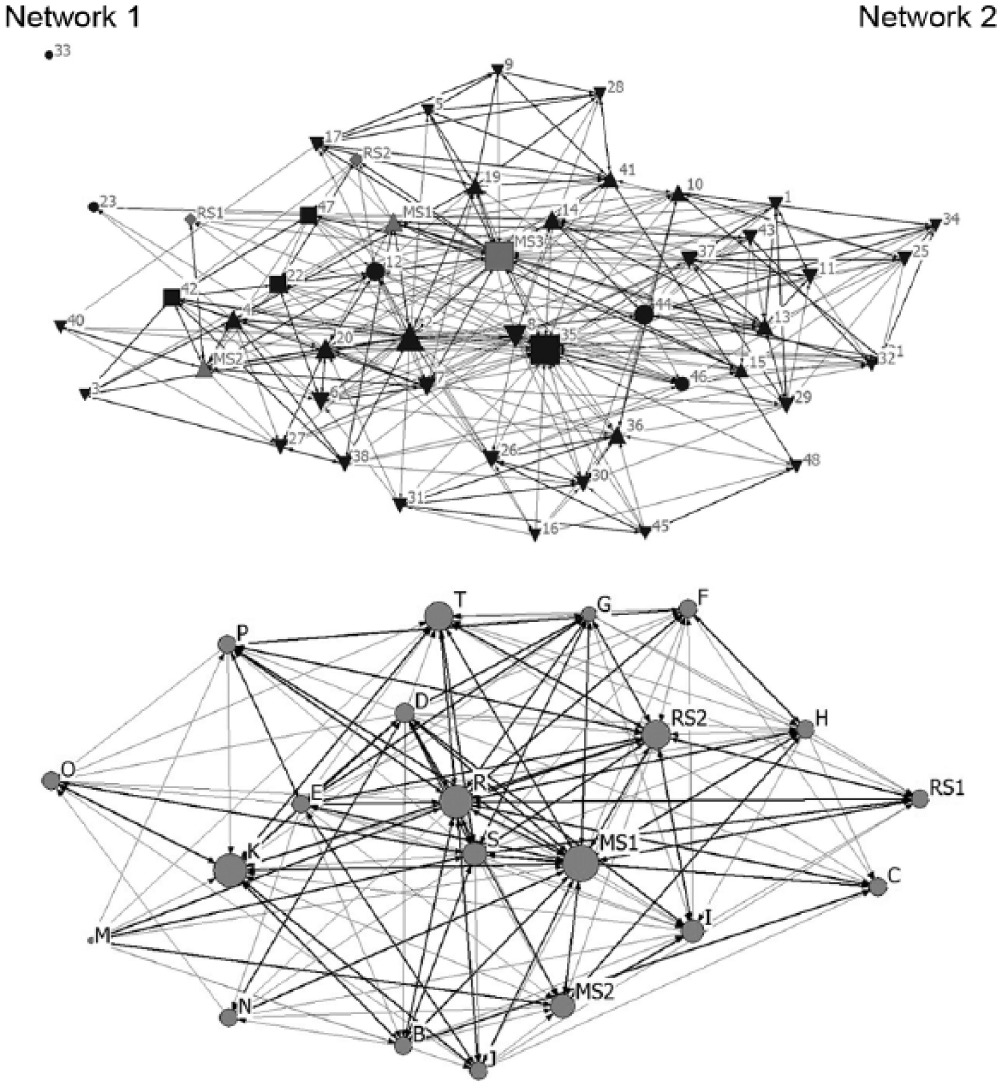
School networks in knowledge processes.
In further exploring the differences in these networks, the network-level data in Table 4 show that educators in N2 were distinctly better connected to colleagues across their school network than N1 educators. First, educators in N2 engaged―on average―with more of their colleagues in knowledge processes, and more of these relationships were reciprocated (density = .16 and .48, reciprocity = .32 and .46 for N1 and N2, respectively). Second, educators in N2 tended to engage more with colleagues from other groups across the school, while educators in N1 tended to focus more on colleagues within their groups at school (E-I index = –.08 and .43 for N1 and N2, respectively).
Overview of Outcomes Measures for Networks 1 and 2

Note: MS = master’s student; RS = research supervisor; pair = combined personal networks of master’s student and his or her research supervisor; size = number of network members; density = ratio of existing relationships to possible number of relationships; reciprocity = ratio of reciprocated relationships to total number of reported relationships; centralization = difference between one or a few highly central network members and other more peripheral network members; E-I index = degree of group-embeddedness and cross-group connections; t = time point on which ego network data was collected about the number of strong, “high-quality” relationships with colleagues that participants had used to engage in knowledge processes based on students’ research in the past 8to 10 weeks. Graduation is in Network 1 at t1, and in Network 2 at t3.
Developing: Differences in Shared Focus for Developing Knowledge
Table 5 shows that in N2 (35.6%), participants reported somewhat more on knowledge developing than in N1 (27.2%). Comparative qualitative analyses show a stronger difference and indicate that in the context of the N2 there was a more explicit and shared focus on developing knowledge for their school practice than in the context of N1. In N2, RS2N2 explained how the context of their master’s program and school were driven by explicit and shared design principles that supported master’s students in developing knowledge in their research from a common focus:
We really want to prepare people to be good colleagues and teacher leaders in settings that are driven by the High Tech High design principles. . . . Of course, we hope that all of them [master’s students] will be working on this . . . it’s the whole point of the program.
In N1, this common focus for developing knowledge was less evident in the context of their school and master’s program. MS2N1 considered that the focus of the master’s program and the practice-oriented research were not shared and directed to the main focus areas of their school development: “I can’t think of a research that has been developed from the school’s main focus areas.”
Overview of Division of Fragments Referring to Knowledge Processes: Networks 1 and 2

Note: MS = master’s student; RS = research supervisor.
Sharing: Differences in Capacity of Schools for Sharing Knowledge
Table 5 shows that reports on knowledge sharing were much more dominant in N2 (60.6%) than in N1 (38.9%). The subsequent comparative qualitative analysis revealed that in the context of N2, many more opportunities were provided for sharing knowledge. Master’s students had opportunities to share knowledge they developed with colleagues inside and outside their department by: (a) collaborating with their teacher partner and school colleagues, (b) publishing in books and their school’s journal, (c) contributing to meetings of the GSE’s programs for the next cohort of MEd students and new teachers, and (d) presenting at conferences and meetings with colleagues from inside and outside their school. RS2N2 emphasized that they valued master’s students sharing their research-based knowledge with their school colleagues:“How are you going to share this work with colleagues? That’s also important to us.”
In the context of N1, there were fewer opportunities provided for master’s students to share their research-based knowledge. MS2N1 felt that school administrators were not keen enough on providing opportunities for sharing valuable knowledge from their research:
The moment school administrators hear about the contents of such a study . . . then it seems evident to me that you say: “Guys, we’re putting this on the agenda and do something with it” . . . but this kind of initiatives is lacking.
Using: Different Opportunities in the University for Knowledge Use
Table 5 shows that participants in N1 referred much more to knowledge using (33.9%) than in N2 (3.8%). When we closer examine the reports on knowledge using, we notice that in N1, in particular MS2N1 (57.4%) and his supervisor RS1N1 (63.7%) focused in their interview reports on the use of knowledge. Comparative qualitative analysis showed that unlike participants in N2, MS2N1 and RS1N1 reported on using MS2N1’s research-based knowledge in the university context of N1. In the next section, we will further explore on the level of interpersonal relationships in what way this pair managed to use the students’ knowledge in the university context of N1.
Student-Supervisor Networks: Nature and Quality of Relationships Matter for Knowledge Developing and Sharing
The individual network sizes in N1 and N2 (Table 4) show that four out of five supervisors had a significantly smaller network than their master’s student. An exception is Pair 2 (N2) where the supervisor reached more colleagues than the master’s student in his own school.
Developing: Similar Variety in Nature of Student-Supervisor Relationships to Support Knowledge Development
Table 5 provides more insight into the aforementioned exception. It shows that in Pair 2 (N2), RS2N2 (95.4%) and MS2N2 (41.4%) focused strongly on developing knowledge. In N1, also one pair focused more on developing knowledge (RS2N1 = 48.3% and MS1N1 = 55.1%) than the others.
Comparative qualitative analysis showed that in both pairs, the master’s students were struggling in their research and the research supervisors were struggling with finding the best way to support them. This struggle in their research caused for both students delays in completing their research and developing knowledge. Both research supervisors felt uncomfortable with this lack of progress in their student’s research and responded by changing the relationship with their student. While supervisors in the other pairs of N1 and N2 exhibited a collegial/equal relationship to support their student, both supervisors in these two dyads changed to a more “formal/directive” relationship in which they began to set deadlines and demand certain outcomes of their student. RS2N1 noticed how he felt that he had to become more directive with his student: “I thought it would be a smooth process, but it appears now that it isn’t . . . I need to create a structure, because otherwise it’s going wrong.” Through this more formal and directive relationship between them and their students, they hoped to encourage their students to proceed in their study and graduate on time.
Sharing: Differences in Levels of Trust and Engagement
Table 5 shows, in both N1 and N2, differences in the frequencies of fragments in which the pairs of master’s students and research supervisors referred to knowledge sharing. However, in N2, this difference is bigger than in N1. In N2, MS1N2 and her supervisor RS1N2 referred six times as much to knowledge sharing than MS2N2 and RS2N2 did. In N1, this difference between the pairs was smaller.
Comparative qualitative analysis indicated that in N1 there was trust and engagement in each student-supervisor relationship. The two pairs in N2 exhibited clear differences in the levels of trust and engagement in the student-supervisor relationships. MS1N2 explained how she appreciated the high level of trust in her relationships with RS1N2 and the way she was providing her opportunities to share her knowledge:
I don’t know how she [RS1N2] does it but she makes you feel very confident to go to her and she invites us to come present . . . I don’t know how she does it, but she’s a friend, an advisor, and a colleague all at once.
In contrast, MS2N2 and RS2N2 felt that levels of trust and engagement in their relationship had decreased during the research. RS2N2 explained that he had felt as if MS2N2 had taken advantage of his patience and understanding when MS2 N2 did not respond to any of his emails or requests: “There was a piece of it that was almost resentful, I felt like I was being strung along a little bit. . . . I felt that he [MS2N2] was taking advantage of the person I am.”
Using: Differences in Levels of Engagement for Using Knowledge in University
Table 5 shows that the pair of MS2N1 and RS1N1 (N1) referred much more to knowledge using than the other pairs in N1 or N2. Comparative qualitative analysis indicates that the relationship between RS1N1 and MS2N1 showed a more active engagement in using MS2N1’s knowledge in the university context of N1. After her student’s graduation, RS1N1 continued to actively search for opportunities in the university to use the instrument and teacher training course that were developed based on MS2N1’s research:
For example there is also a new request from teacher assistants to learn more about a topic related to his research . . . I immediately see him [MS2N1] going there. We still have to arrange it . . . , but I think this can be another good place to use his instrument!
In N2 such reports on active engagement in the student-supervisor relationship during knowledge use were lacking.
Personal Networks: Similar Activity in Reaching Out to Colleagues and Lack of Knowledge Use in School
Table 4 shows a similar variety in the levels of reciprocity in relationships with school colleagues in N1 (ranging from .45 to .27) and N2 (ranging from .79 to .39), suggesting that some of the master’s students’ and research supervisors’ relationships were more likely to support knowledge sharing and using with colleagues than others. Table 4 shows that regardless of this variety in reciprocity, most master’s students and research supervisors started to increase the use of their strong ties with colleagues to engage in knowledge processes in their school or IHE. However, they also shared an overall lack of reports on actual use of research-based knowledge among colleagues in their networks in school and IHE. Only the reports of MS2N1 (57.4%) and his supervisor RS1N1 (63.7%) in N1 showed a preponderance of fragments referring to using knowledge.
Developing: Similar Individual Focus on Developing Useful Knowledge for Practice
Comparative qualitative analysis showed that in both N1 and N2 participants wanted to develop knowledge, which could be useful for improving their school practice and that of their colleagues. In the reported perceptions of each participant, we found a distinct focus on the usefulness of the content knowledge that master’s students developed about their research topics. This perceived usefulness stimulated participants to engage in knowledge processes with their colleagues after master’s students’ graduation. However, we found that when participants regarded this usefulness not evident, their reports before as well as after graduation remained more focused on the process of knowledge developing. In N2, RS2N2 reflected on the content knowledge that his student MS2N2 had developed in his research and considered that it was not ready to use in practice, which had prevented him from further sharing it: “Had the content been what I had understood it to be, I would be sharing with everyone.”
Sharing: Different Levels of Reciprocity in Sharing Knowledge With Colleagues
Comparative qualitative analysis indicated that in sharing the research-based knowledge with colleagues, participants in N2 encountered overall more reciprocal knowledge exchange. Table 5 shows that in N2, three out of four participants focused in their reports on the process of knowledge sharing (MS1N2, MS2N2, and RS1N2) and in N1 only one out of six participants (MS3N1). Comparative qualitative analysis showed that these three participants in N2 reported exclusively on positive emotions when engaging with colleagues in knowledge sharing. They became excited when colleagues appreciated what they were sharing and were sharing back their ideas, MS1N2 noticed:
Both my colleague and I are really excited about the in-service learning in our classes. . . . He was just really giving a lot of positive feedback and I heard about his ideas and they’re awesome.
However, in N1, three out of five participants (MS2N1, MS3N1, and RS2N1) also reported on negative emotions when sharing knowledge with their colleagues. They were disappointed when on several occasions their school colleagues did not share anything back; MS2N1 was disappointed that nobody followed up with him after he had presented about his research in school: “It stays with ‘hearing’ and that’s what I regret; then I think like: Okay I’m not continuing to put more of my energy in it.”
Using: Differences in Actual Use of Knowledge
Table 5 shows that only the reports of MS2N1 (57.4%) and his supervisor RS1N1 (63.7%) in N1 showed a clear preponderance of fragments referring to knowledge using. Comparative analysis indicates that although every participant expressed a clear desire to develop useful knowledge and was trying to connect to colleagues to further share and use their knowledge after graduation, they were provided very little time for this in their work allocation. Only MS2N1 and RS1N1 were successful in using the developed knowledge in their university context in their own time. RS1N1 explained that she was excited that together with MS2N1 she had been able to use MS2N1’s research-based knowledge to develop a teacher training course, which he could teach at the university:
He comes from our master’s program and . . . there was a need for a training course on his research topic; he created a training course together with me. That was just really exciting!
In contrast, the comparative qualitative analysis provided little evidence that participants in N1 and N2 actually used students’ research-based knowledge in their school contexts.
Conclusion and Discussion
In the introduction, we highlighted the current global challenge of TE to change relationships with schools and teachers and become more collaborative in teaching and research. We argued that understanding and strengthening of the informal social network structure and interpersonal relationships among school and university educators is crucial but often overlooked. This study examined this informal social dimension of partnerships and examined the way knowledge is developed, shared, and used when schools and IHEs partners create research networks in the context of TE master’s programs. This study is one of the first to investigate these knowledge processes from a social network perspective and compare them in two different TE contexts. In answer to our three research subquestions, we summarize for both networks on their three network levels (network, dyad, personal) the different factors in network structures and interpersonal relationships that played a role in the developing, sharing, and using of the knowledge from teachers’ research (Table 6).
Comparative Overview Outcomes Networks 1 and 2

In answer to our main research question, we summarize for each of the three network levels the key findings that the comparative analyses of these networks revealed:
School Network: N2’s school network showed a higher connectivity (higher density, reciprocity, and E-I index) that can enable knowledge processes. This network was found to have a more explicit and shared focus for developing knowledge and there were more opportunities for knowledge sharing provided. Regardless of the level of connectivity, the research supervisors remained part of the school network after their master’s students’ graduation in both networks.
Student-Supervisor Networks: In both networks, trusting and engaged relationships between master’s students and their supervisors appeared to be related to perceived higher levels of knowledge sharing. Such “high quality” student-supervisor relationships seemed more equal during knowledge development and showed a balance in their dyad networks in which students had significantly larger networks in their schools than their supervisors. However, only one pair with such high-quality relationship showed active engagement during the actual use of the developed knowledge in their IHE.
Personal Networks: In both networks, master’s students and research supervisors unanimously focused on developing useful knowledge for practice. Subsequently, when the research was completed, most of them increasingly began to seek out colleagues to share this knowledge that they believed could be useful for their colleagues’ practices as well. Unlike in N1, school colleagues in N2 shared back knowledge when master’s students shared the knowledge that they developed in their research. However, none of the participants in N1 and N2 provided evidence that this knowledge was actually used in the practice of master’s students’ schools.
In the following, we’ll discuss each of these key findings in relation to our theoretical framework and methods to provide more insight into the social structure and interpersonal relationships in research networks between IHEs and schools.
The Role of Social Structure in Knowledge Processes in School-University Research Networks in TE Programs
The social structures that exist within master’s students’ schools influence the developing, sharing, and using of the knowledge that students develop in the TE program. Our study echoes earlier findings inside as well as outside education that organizations in which colleagues are well connected provide fertile ground for sharing of knowledge (Daly & Finnigan, 2010a, 2010b; Phelps et al., 2012; Uzzi et al., 2007). We note that the fact that N2 was denser than N1 could have been influenced by its lower network size (Morisson, 2002). However, the higher level of reciprocity, the higher number of relationships between subgroups in the network, and the perceptions of network members confirm to us that N2 was overall better connected than N1 and more supportive of knowledge processes. Our findings confirm that such well-connected organizations, like N2, are often purposeful in fostering a social structure that enables collaboratively developing and sharing of knowledge among staff (Senge, 1990). The fact that N2’s school was so much more deliberate and successful in fostering knowledge processes among their staff than N1 could be influenced by the collaborative focus of N2’s larger context; the CMO of which N2 was a part purposefully embedded the IHE in their school environment to foster a community of collaborative learners among the staff of their CMO’s schools.
Although the extent to which social structures in students’ schools differed in their ability to support knowledge processes, all four research supervisors in N1 and N2 remained part of their students’ school networks after their graduation. This confirms notions of other scholars that research relationships between IHEs and students’ schools may be sustained after graduation (Baumfield & McLaughlin, 2006; van Swet & Ponte, 2007). We consider this sustained relationship a remarkable observation because research shows that in “traditional” master’s programs the networks and knowledge processes between school and IHEs often are limited to the duration of the master’s program (LePage et al., 2001). Increasing the duration of this relationship between research supervisors, master’s students and their school colleagues can improve future knowledge developing, sharing, and using; it allows supervisors to better understand local contexts of their students’ schools and tailor their support to the schools’ contexts (Phelps et al., 2012). Partnership experiences show that when university staff become “closer” and more embedded in the school environment, it supports them in better understanding the kind of knowledge that teachers value and use (McLaughlin & Black Hawkins, 2007; Zeichner, 2010). Moreover, becoming “closer” to the complex practice of teaching in their students’ schools challenges their assumptions about practice and enables them to better understand the local needs of teachers and pupils (LePage et al., 2001; Martin et al., 2011; Zeichner, 2010). This in turn could help to overcome the aforementioned challenge of discrepancies in goals and expectations between school and university partners; when research supervisors are better in tune with their students’ school contexts, they can ensure that research collaborations contribute to addressing educational concerns and daily teaching practice of school staff.
Although these findings show the potential of the master’s program to connect IHEs and schools in research, we found a lack of actual knowledge use in schools that demonstrates the complexity of this new research relationship in TE. Findings of the interpersonal relationships in the partnership networks provided more insight in aspects of the research relationship’s potential and complexity.
The Role of Interpersonal Relationships in Knowledge Processes in School-University Research Networks in TE Programs
The nature of the relationships between supervisors and master’s students influences knowledge developing and sharing. The developing and sharing of knowledge in the network seem to benefit from “high quality” student-supervisor relationships that were experienced as equal/collegial and characterized by higher levels of trust and engagement. We wonder why we found less evidence that such relationship also supported knowledge use. An explanation could be related to our study’s design. It might be that we did not allow sufficient time to observe knowledge use after students completed their research and graduated. In particular, in N2 there was only one point of data collection after graduation. A second explanation could be that after graduation students became too absorbed with their daily teaching practice that collaborating with colleagues in also using their developed knowledge was a bridge too far. A third explanation might be that the lack of knowledge use was influenced by the challenge that we described in our theory as the tension between “traditional” expectations at the IHE and what is required to create “new” reciprocal relationships in research (Berg, 2004; Burton & Greher, 2007; LePage et al., 2001). We observed this tension clearly in the pairs where students were struggling in research and supervisors shifted to a traditional role that focuses on supporting students to graduate instead of sharing and/or using their developed knowledge. Maybe also the role of the supervisors in the other pairs still remained too traditional, not supporting the use of students’ developed knowledge in school after their graduation.
We noticed that in both networks some pairs of students and supervisors were struggling with creating the aforementioned high-quality relationship. Their struggle confirms the described challenge of creating equal relationships in partnership networks (Dallmer, 2004; LePage et al., 2001; Martin et al., 2011; Zeichner, 2010). It might even point to a specific tension inherent to creating research relationships in the context of a master’s program, namely, in a situation where teacher educators grade the work of student teachers, relationships between them can never be fully equalized (cf. LePage et al., 2001; Martin et al., 2011; van Swet & Ponte, 2007). This relates to the challenge that we described in our theory that teacher educators need new competencies for partnership work; it highlights that in TE contexts, teacher educators need to be competent in negotiating this tension between the need for equal collaborative relationships and the present hierarchy during the program.
Our analyses of the dyad networks’ structures led us to believe that there might be a partnership potential dormant in the collaborative student-supervisor relationships. We noticed that most master’s students had significantly larger networks in their schools than their supervisors. We consider that supervisors could use the relationship with their student as a gateway for connecting to more school colleagues and support knowledge processes in the larger school network. In both networks, this gateway remained untapped potential. How to effectively tap into this potential would be interesting to explore because often teacher educators struggle to get connected in school and have to invest much of their (limited) time and energy in establishing connections with educators in partner schools (Le Page et al., 2001; Martin et al., 2011).
After their graduation, all master’s students increased the number of relationships with colleagues to further share or use the knowledge that they had developed in their research. Although in N2 students experienced reciprocity during knowledge sharing with colleagues, none of the students in this study provided evidence of relationships in which knowledge was actually used in school. As mentioned previously, this finding could be influenced by our study’s design. However, failing to reach this ultimate goal of the collaborative research relationships makes us wonder if master’s students perhaps lacked “network” competencies of creating meaningful collaborative relationships with colleagues for sharing and using the developed knowledge (Baker-Doyle, 2011). Research shows that teachers have varying capacities in relational skills and strongly differ in the intentionality with which they manage their networks in school (Moolenaar et al., 2014). Another explanation for not yet meeting this final partnership goal may be related to the partners’ (implicit) conceptions of the research relationship between school and IHE in the master’s program. Often research partnership relationships are aspired to be collaborative with a high degree of mutual engagement, but instead in practice, they are mainly viewed from a service perspective that entails a more one-directional relationship (Handscomb et al., 2014; McLaughlin & Black Hawkins, 2007); for example, when the IHE mainly serves as the provider of research training to teachers. Perhaps the conceptions of research relationships of master’s students’ schools and IHEs were at some points still framed by service- instead of collaboration-oriented views, suggesting that after the service of the master’s program ended (master’s students’ graduation) also the collaboration that could support further use of the knowledge that students had developed in their schools was aborted.
Limitations, Implications, and Recommendations
This research was an explorative study in an understudied field and had some important limitations. In exploring the two networks, we used a bounded network approach that confined the networks to the educators in master’s students’ schools. We acknowledge that knowledge processes networks might have stretched beyond the boundaries of these particular schools. We also point to the fact that in this study we choose to investigate the perceptions and personal interpretations of social networks and knowledge processes in their own right. Often such perceptions are important drivers of people’s actions in the network, and we have argued from a knowledge creation view that the sharing and using of knowledge (also) relies on personal interpretations of knowledge. At the same time, we acknowledge that such perceptional data may also contain cognitive biases in their reports on social networks and knowledge processes, for example, misperceiving the reciprocity of relationships or people’s own centrality in a network (Brands, 2013; Tasselli et al., 2015). A related limitation concerns the fact that the participants’ contextual perceptions of their school structures, (knowledge) processes, cultures, and teacher education programs reside in the broader (national) structures, discourses, policies, and cultural contexts of both cases. Although both cases were based in Western countries with similar educational purposes and a similar Anglo-Saxon model of an in-service master’s program, we acknowledge that in our comparison, participants’ personal perceptions and interpretations of their school contexts could have been influenced by differences in the broader contexts of both cases. In future comparative studies of the social networks and knowledge processes, we recommend to further disentangle the influence of differences in personal perceptions and characteristics of the broader contexts. Furthermore, we acknowledge that there was a difference in timing of the data collection between the two cases. The fact that N2 had fewer data collection points after students’ graduation may have restricted the observation of knowledge use in this context. The exploratory nature of this comparative case study implies that generalization of the results will require follow-up studies in which our findings could for example inform hypotheses that can be further explored in other TE contexts and across a higher number of cases.
One of this study’s important implications for TE practice is related to the sparse accounts of knowledge use that we observed. This implies that in addition to supporting students in their research to develop knowledge in a valid and reliable way, IHEs may consider extending their support of students in partner schools in sharing and using knowledge that contributes to improving their practice. Subsequently, this extension of support implies that research supervisors need to be competent and facilitated in supporting the sharing and using of research-based knowledge in schools.
We recommend researchers to continue to systematically compare outcomes across TE contexts to gain a deeper and broader understanding of their research relationships with schools (Grossman & McDonald, 2008). Ultimately, we believe that understanding and securing these conditions will support IHEs and schools to reach their full potential of developing research relationships in which they collaboratively study and address the complex challenges of today’s education.
Footnotes
Appendices
Example of Individual Matrix

| Aspects | Knowledge developing | Knowledge sharing | Knowledge using |
|---|---|---|---|
| Members | |||
|
|
|
|
|
| *Embrained—reflecting on literature, research activities, and own practice | *Embrained—sharing personal insights from literature and research activities | *Embrained—using insights she gained from reading literature in her practice | |
| *Procedural—gaining insights about research methods | *Procedural—sharing experiences with doing research | ||
| *Encoded—sharing a book & model | |||
|
|
|
|
|
| *Getting ideas from others—for: conducting research, developing knowledge useful to practice, talking to people who could support her | *Talking—about research outcomes and research insights relevant to practice | *Acting—in her daily work practice to support her colleagues and one of her student’s parents | |
| *Experimenting—she engages in systematical and unsystematical experiments with new activities (in relation to study) in her classroom | *Presenting—together with school presenting a book about their research experiences | *Developing—a scheme to support a student’s parents in helping their child | |
| *Reflecting—on implications for her own classroom practice in relation to insights from her study | *Writing—chapter in book about her literature study | ||
| *Doing things together—sharing insights from her study with team teacher + assistants when experimenting with teaching in their classroom | |||
|
|
|
|
|
| *Usefulness—for improving practice in school; she appreciated it when people confirmed usefulness for their practice | *Connectivity—connection of developed knowledge to other people’s knowledge, practice, views | *Usefulness—for practice so it would contribute to teaching and her students’ development | |
| *Feasibility—of developing knowledge in her research, for example, by involving “critical friends” within school in her study | *Usefulness—for practice (e.g., contribution to school curriculum) or certain people (e.g., teacher with similar problem) | *Feasibility—she considered how she could use her insights and if her colleagues would accept it | |
| *Stimulation—of her research process in which she developed knowledge, for example, when others pay interest to and give advice on her study | *Stimulation—through: friendly & competent support research supervisor; interest and engagement of colleagues with her research; collaborating with colleagues with similar vision | ||
| *Opportunities—that knowledge sharing provides for collaboration with others around research topic | |||
|
|
|
|
|
| *Evaluating—process and outcomes of knowledge developing | *Evaluating—moments of knowledge sharing and noticing that: she also was getting more in return (advice, info); she got to know people with whom she shared better; people were coming back for more | *Planning—she was considering ways she could plan the use of her knowledge; one way was by strategically involving other people in her research (creating partners/allies) to convince them of the importance to use her (future) research outcomes | |
| *Planning—moment of knowledge development, for example, interviews | *Planning—activities to share her insights in a team meeting | ||
| *Predicting—process and outcomes of knowledge developing, for example, outcomes of interviews | |||
| *Enhancing quality—by involving (perspectives of) other members in research activities | |||
|
|
|
|
|
| *Positive—enthusiasm when people showed interest and confirmed relevance of study; glad when people gave information and advice relevant to conducting her study | *Positive—enthusiasm when sharing her insights and being able to explain her ideas; satisfied when she could support others with advice and people confirmed that her insights were useful to practice in school; proud when her manager presented the book she wrote a chapter for; secure/comfortable when sharing insights with research supervisor | *Positive—enthusiasm when she used knowledge and noticed that it was of benefit to others; confidence when she noticed that she could use her knowledge in her practice | |
| *Negative—doubting importance and relevance of her study | *Negative—feeling insecure about research and relevance of research topic to school practice | ||
|
|
|||
|
|
Developing knowledge with “inner circle” of trustees: a buddy from another team; management member who was fellow master’s student; gymnastics teacher; colleagues from room for smokers; team teacher + teacher assistants | Trust enabled her to share her insights open and honestly, with: interested colleagues in room for smokers; her research supervisor; colleagues from day care | Trustful relationships with colleagues from day care made her feel safe enough to use insights from her study for collaboratively developing a plan for one of her students |
|
|
|
Not referred to | Not referred to |
| *Formal—management member provided inside information helpful to her research | |||
| *Informal—she determined agenda items for team meeting, and convinced her team teacher + teacher assistants to join her in experiments | |||
|
|
|
|
|
| *Active—people were participating in research activities, like studying and improving practice, which created awareness and ownership of the research subject among them | *Passive—colleagues by listening to her insights and experiences; research supervisor by giving advice on writing about her research; management member by giving advice whom she should talk to about her research | *Active—other network members showed active engagement when they could use the research insights to improve their own practice and it was of benefit to their students | |
| *Passive—people supported her by listening and giving advice with respect to her research process | *Passive—she used insights from her study to give advice to other people and supported them in using these insights too | ||
|
|
When she got to know others’ expertise and its value to her research she tried to involve them, for example, expertise of: teaching practice, research methods, research topic | Through sharing, other people got to know the master’s student’s expertise and in return they became interested and started sharing their expertise and experiences with the master’s student | Gymnastics teacher realized that the master’s students’ expertise could benefit his practice and he decided to use the insights from her study in his teaching |
|
|
|||
|
|
|
|
|
| *Individual—aiming for improving her classroom practice and for involving others in her research to enhance buy-in for the relevance of her research topic | *Collective—she shared her research insights and together with colleagues she formulated collective goals for improving practice in her own classroom and the whole school with respect to her research subject | *Individual—purpose referred to using insights she considered important for improving the education for her students | |
| *Collective—thinking how she could contribute with her research to collective purposes of school and formulating a collective purpose with a colleague with respect to student support in their classrooms | *Collective—purpose referred to using insights together with partner teacher + assistants for improving the education for her students | ||
|
|
|
|
|
| *Storytelling—quick exchange of experiences from her research with buddy of another team and colleagues in smokers’ room | *Storytelling—exchanging insights from her research with colleagues in smokers’ room | *Giving aid/advice—during conversation with parent, based on insights she gained from reading literature | |
| *Giving aid/advice—by gymnastics teacher, teacher colleague, and management member on: topics and methods for research and people important to involve in her research | *Giving aid/advice—about doing research, writing about research, coping with issues in practice, whom she should talk to about her research | *Sharing materials/ideas—with colleagues and parents for support of their students/children | |
| *Sharing materials/ideas—for teaching and research with: gym. teacher, colleague from smoker’s room, partner teacher + assistants | *Sharing materials/ideas—sharing ideas, opinions, insights with gymnastics teacher, and sharing a scheme and insights from her research with a teacher from another team | *Joint work—she uses insights when making a plan for one of her students together with colleagues from day care | |
| *Joint work—when developing questionnaire with colleague; conducting questionnaire and research experiments with partner teacher + assistants | |||
|
|
*Literature study | Not referred to | Not referred to |
| *Designing questionnaire and interviews | |||
| *Testing and conducting interviews | |||
|
|
|
|
|
| *Formal—management member (fellow master’s student), supported her by sharing information important to her research and directing her to people important to her research | *Formal—she appreciated compliments of the school manager on her contribution about her research to the book; she noticed that she did not share her insights with management members who were not so much present in her work practice | *Distributed—by using insights from her research she could take the lead in making improvement plans for classroom practice together with her partner teacher and internal coach (Senco) | |
| *Distributed—master’s student took the lead in creating own network of “critical friends” in school and she led small classroom experiments that she conducted with team teacher + assistants for her research | *Distributed—she decided to share together with her partner teacher and assistants outcomes of their research experiments at a school’s study afternoon | ||
|
|
|
|
|
| *External—together with colleague she was considering ways to develop knowledge which would enable school to account for learning outcomes for school inspection | *Internal—sharing insights from her research at a school’s study afternoon to stimulate other colleagues in school to improve there education with respect to her research topic too | *Internal—insights were used to establish improvement plans for her own teaching practice and the gymnastics teacher used her research insights to make improvement plans for his practice | |
| *Internal—together with colleague she was thinking of ways to improve education to support their students | |||
|
|
|
|
Not referred to |
| *Supporting professional development—inquiry group and research supervisor in the master’s program; she also tried to support professional development of colleagues by involving them in research activities | *Supporting professional development—when research supervisor supported her in writing a book chapter about her literature study | ||
| *Providing resources—when school regularly organizes study afternoons for sharing insights and experiences | |||
Funding
Part of the research leading to these results has received funding from the People Programme (Marie Curie Actions) of the European Union’s Seventh Framework Programme (FP7/2007-2013) under REA grant agreement n°298865.
Authors
FRANK CORNELISSEN is a Marie Curie research fellow at the University of Cambridge and University of California San Diego. His research interests comprise networks in education, teacher leadership, practitioner research, and school-university partnerships. His mailing address is University of Cambridge, 184 Hills Road, Cambridge, CB2 8PQ, UK and his email address is
YI-HWA LIOU is an assistant professor at the National Taipei University of Education in Taiwan. Her research focuses on the capacity and connectedness of educational leaders in managing dynamic organizational-level challenges such as educational reform, organizational change, school crises from a nonlinear organizational theory’s perspective, theory of social capital, as well as the use of social network concept and analysis.
ALAN DALY is a professor and Chair of the Department of Education Studies at the University of California, San Diego. His research and teaching primarily focuses on leadership, educational policy and change, and social network theory and analysis.
JACQUELINE VAN SWET is a lector at Fontys University of Applied Sciences, Tilburg, the Netherlands. Her research interests comprise teachers in collaboration, working across disciplines on pupils’ development opportunities.
DOUWE BEIJAARD is a professor of professional learning and dean of the Eindhoven School of Education (ESoE) of the Eindhoven University of Technology, the Netherlands. His research interests pertain to the professional identity, development, and quality of (beginning) teachers.
THEO C.M. BERGEN is an emeritus professor of education of the Radboud University Nijmegen, the Netherlands. His research interests are in the field of school-based teacher learning and professional development.
ESTHER CANRINUS is a postdoctoral researcher at Department of Teacher Education and School Research of the University of Oslo, Norway. Her research interests include the development, professional identity, motivation, and engagement of teachers.