




Abstract
Identifying the factor structure of online reading to learn is important for the development of theory, assessment, and instruction. Traditional comprehension models have been developed from, and for, offline reading. This study used online reading to determine an optimal factor structure for modeling online research and comprehension among 426 sixth graders (ages 12 and 13). Confirmatory factor analysis was employed to evaluate an assessment of online research and comprehension based on a widely referenced theoretical model. Student performance reflected the theoretical constructs of the model, but several additional constructs appeared, resulting in a six-factor model: (a) locating information with a search engine, (b) questioning credibility of information, (c) confirming credibility of information, (d) identifying main ideas from a single online resource, (e) synthesizing information across multiple online resources, and (f) communicating a justified, source-based position. The findings are discussed in terms of theory, assessment, and instruction.
Theories of reading comprehension have long served to inform research, practice, and assessment in reading (e.g., Gates, 1921; Kintsch, 1998; Snow, 2002). All, however, have been developed from offline reading and for offline reading. As a result, they are both limited and limiting: They are limited to offline contexts, and they limit our ability to think in new ways about new forms of reading possible today. Today, reading takes place online in contexts that go beyond the reading of offline texts (Alvermann, 2002; Drew, 2012; Drounin & Davis, 2009) and in ways that may overlap but are not isomorphic with offline reading (Coiro, 2011). There is little theoretical and assessment work available to advance our understanding of reading to learn in these new contexts. New theories and new assessments are needed to capture the nature of reading online, especially reading to learn from online information as this ability is now important in every disciplinary area.
Anders, Yaden, Iddings, Katz, and Rogers (2016) called for greater attention to theory in the work we do as literacy researchers. Kintsch and Kintsch (2005) have suggested that an assessment conceptualized within a theory can inform both assessment and also our understanding of that theory. The purpose of this study is to explore theory by defining the factor structure of a new assessment of reading to learn from online information. The assessment was based on a theory of online research and comprehension developed from, and for, online contexts (Leu, Kinzer, Coiro, Castek, & Henry, 2013).
In this article, we first summarize research on reading to learn from online information. Next, we describe how this research is appearing in national standards and in international assessments. Then we describe a recent theory of online research and comprehension that was used to frame the assessment for this study. Finally, we present the factor structure that emerged from student performance and discuss the implications for theory, assessment, and instruction.
Reading to Learn From Online Information
The Internet has become a defining technology for reading and learning in these new times (Leu et al., 2013; Mills, 2010). As a result, researchers and policy makers have realized the need for understanding, assessing, and teaching the skills required to read and learn on the Internet (see Cho, Woodward, Li, & Barlow, 2017; Goldman, Braasch, Wiley, Graesser, & Brodowinska, 2012; Organisation for Economic Co-operation and Development [OECD], 2011). This work has become particularly important as students seem to be rather unskilled with reading to learn from online information (Bennett, Maton, & Kervin, 2008; Forzani, 2016; Kuiper, Volman, & Terwel, 2008).
Some forms of online reading appear to be different from offline reading, though the precise nature of the difference is still emerging. Afflerbach and Cho (2010) reviewed 46 studies focused on reading strategy use during Internet and hypertext reading. Their analysis showed evidence of strategies that “appear to have no counterpart in traditional reading” (p. 217). Many strategies centered around a reader’s ability to apply methods to reduce his or her levels of uncertainty while navigating and negotiating appropriate reading paths in a shifting problem space (see also Zhang & Duke, 2008).
At least two lines of research have emerged in this area. First, research on reading to learn from online information has expanded our understanding of reading comprehension (e.g., Cho & Afflerbach, 2017; Goldman et al., 2012; Kiili, Laurinen, Marttunen, & Leu, 2012). Second, research on information problem solving online has expanded our understanding of problem solving in complex environments (e.g., Brand-Gruwel, Wopereis, & Vermetten, 2005; Brand-Gruwel, Wopereis, & Walraven, 2009).
Although these two lines of research have theorized somewhat similar component structures, each uses slightly different component labels: (a) identifying the question/defining the problem, (b) locating/searching for information, (c) evaluating/scanning information, (d) synthesizing/processing information, and (e) communicating/presenting information. Many of these components have appeared in think-aloud studies with small sample sizes (e.g., Brand-Gruwel et al., 2005; Coiro & Dobler, 2007). However, the complete factor structure has never been explored with larger scale studies to establish the validity of these components and structure.
This study was designed to examine the specific components derived from reading to learn from online information to focus the evaluation on a well-specified theoretical model (Leu et al., 2013).
Reading to Learn From Online Information in National Standards
The component structure studied in this investigation has found its way into educational standards and curricula around the world, despite the fact that it has yet to be tested. It is found, for example, in these boldfaced terms within an important design principle of the Common Core State Standards in the United States (National Governors Association Center for Best Practices & Council of Chief State School Officers, 2010).
To be ready for college, workforce training, and life in a technological society, students need the ability to
Australia, too, has included somewhat similar components in the Australia Curriculum (Australian Curriculum Assessment and Reporting Authority, n.d.): ICT competence is an important component of the English curriculum. . . . Students also progressively develop skills in using information technology when
In Finland, the context for this study, similar components also appear, especially in two of the seven competency areas: information and communication technologies (ICT) and multiliteracies (Finnish National Board of Education, 2014). For instance, the ICT section identifies the importance of using search engines to find information from multiple resources, critically evaluating information, and using multiple information resources in knowledge construction, or synthesis. The multiliteracies section also emphasizes critical evaluation by emphasizing the importance of understanding different purposes and perspectives of texts.
Many nations now include these components for reading to learn with online information in their standards. This suggests the importance of evaluating a theoretical model and an assessment framed around these components.
International Assessments of Reading to Learn From Online Information
Recently, two international assessments have provided useful direction for thinking about the assessment of reading to learn from online information among adolescents: (a) the Digital Reading Assessment of the Program for International Student Assessment, or PISA (OECD, 2011), and (b) International Association for the Evaluation of Educational Achievement’s (IEA) International Computer and Information Literacy Study, or ICILS (Fraillon, Ainley, Schulz, Friedman, & Gebhardt, 2014).
The Digital Reading Assessment (OECD, 2011) was designed to evaluate students’ skills in three areas: access and retrieve, integrate and interpret, and reflect and evaluate. The ICILS (Fraillon et al., 2014) has two main dimensions. The first dimension focuses on collecting and managing information that includes three aspects: knowing about and understanding computer use, accessing and evaluating information, and managing information. The second dimension includes producing and exchanging information.
Neither international assessment, however, evaluated students’ ability to search for information with a dynamic search engine that simulates actual keyword entry and the generation of a results page. As work in information seeking online demonstrates (e.g., Bilal & Kirby, 2002; Schacter, Chung, & Dorr, 1998), this is an essential aspect of reading to learn from online information. The present study used statistical modeling for evaluating a component structure derived from a theory that shared many of the component skills found in these international assessments but included search engine use.
Theoretical Perspective
A theory of online research and comprehension (Leu, Kinzer, Coiro, & Cammack, 2004; Leu et al., 2013) was used to frame this study. Online research and comprehension is defined as a self-directed process of constructing text and knowledge when seeking answers to questions on the Internet. It uses the term research to establish the inquiry nature of most reading on the Internet. It uses the term comprehension to establish its connection to traditional comprehension models. This connection recognizes that reading on the Internet includes a complex layering of offline and online comprehension processes. Online research and comprehension comprises five components that are next briefly described.
Online research and comprehension is usually prompted by a question (Brand-Gruwel et al., 2005) that often directs the process (Zhang & Duke, 2008). In this study, we designed a prespecified activity that required students to work with a common question to standardize the task and permit reliable analyses.
Online readers typically locate relevant information with the help of search engines (Brand-Gruwel et al., 2009; Cho & Afflerbach, 2015). In the present study, a search engine was included in the assessment to evaluate students’ ability with constructing an appropriate query (Guinee, Eagleton, & Hall, 2003) and analyzing search engine results (Rouet, Ros, Goumi, Macedo-Rouet, & Dinet, 2011).
The Internet, with information that varies widely in quality, challenges readers to critically evaluate the credibility of online information (Fabos, 2008; Forzani, 2016; Wineburg, McGrew, Breakstone, & Ortega, 2016). When evaluating credibility, skilled readers pay attention to at least two aspects of the resource: expertise and trustworthiness (Flanagin & Metzger, 2008; Tseng & Fogg, 1999). To evaluate varying types of online information, this study asked students to evaluate two types of resources: an academic, somewhat neutral, resource and a commercial, somewhat biased, resource.
The ability to synthesize, or integrate, ideas from multiple online resources is a particularly important aspect of online research and comprehension (DeSchryver, 2015; Goldman et al., 2012). Readers select important ideas from multiple resources, and they organize, connect, compare, and contrast these ideas to build a coherent understanding of the issue (Cho & Afflerbach, 2015; Rouet, 2006; Strømsø, Bråten, & Britt, 2010). In the present study, we evaluated synthesis by asking students to first take notes from four online resources that provided different perspectives and, in some cases, conflicting information about the issue and then integrate information from these notes.
Online research and comprehension conceives of a close connection between the reading and the writing that takes place during online communication. Studies investigating online inquiry processes often ask students to communicate their understanding with an essay (Goldman et al., 2012; Le Bigot & Rouet, 2007). In the current study, students were asked to communicate a recommendation, with justifications, to a fictitious school principal in an email. This allowed us to evaluate students’ abilities to take and justify a position and also their sensitivity to audience.
Research Question
This study sought to determine the factor structure for the online research and comprehension process. Specifically, we used the following research question to direct the investigation:
What is the optimal factor structure for a performance-based assessment that was conceptualized within a theory of online research and comprehension?
The answer can provide useful information about both the validity of the assessment and the theory on which it is based (Kintsch & Kintsch, 2005), informing us about the important classroom issue of reading to learn from online information.
Method
Participants
Participants in this study were 426 sixth graders (219 boys and 207 girls) ages 12 and 13. Students were recruited from 24 classes representing eight Finnish elementary schools that included both suburban and rural schools. All students spoke Finnish as their first language. Almost all students had access to the Internet at home: 99% of students reported having home access via desktop computer, laptop, or tablet, and 96% reported having home access via smartphone. While family income data are not available, participating students represented the typical range of socioeconomic status in Finland in terms of highest parental education: 40% of students had at least one parent with university education, 26% had at least one parent with a university of applied sciences education, 33% had both parents with vocational education or a high school education, and 2% of students’ parents did not have further education after comprehensive schooling. Generally, students reflected the average range of reading ability found in Finland in both fluency and reading comprehension.
Online Research and Comprehension Measure
Students’ skills were measured with an “
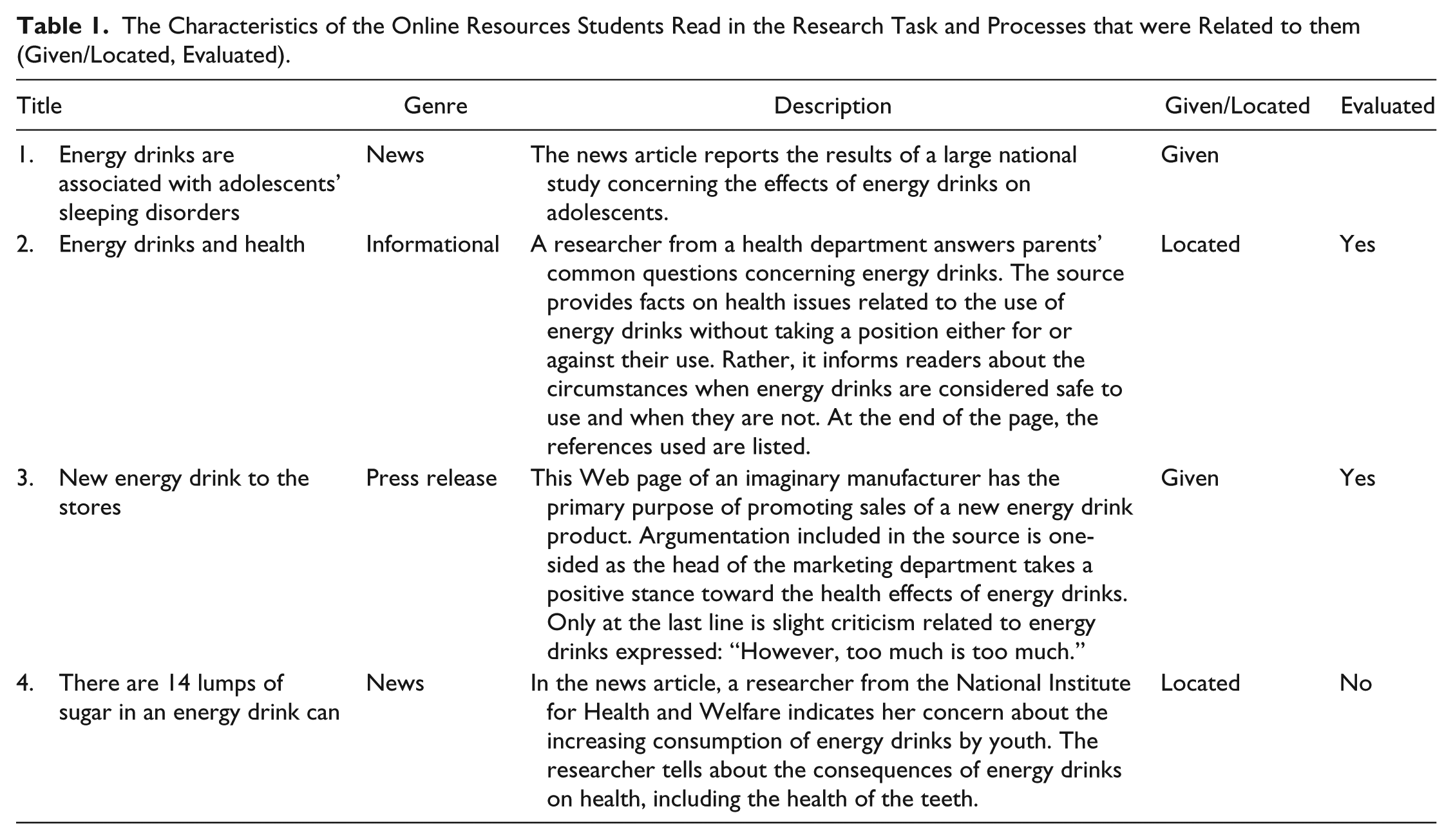
Students were given an online research task in a virtual online space where they were guided by an avatar. They received an email message from a school principal, which asked them to use online information to explore the health effects of energy drinks and provide a recommendation as to whether or not she should allow an energy drink machine to be placed in the school. To compose an informed recommendation, students read four online resources that were within their reading ability. The texts explored the health effects of energy drinks from different perspectives. Two online resources were given to students and students were asked to locate two others with a search engine. In addition, students were later asked to evaluate two of these resources in relation to the authors’ expertise and the overall credibility of resources. The flow of the task is presented in Figure 1. Furthermore, Table 1 summarizes the characteristics of each online resource and indicates whether students were initially given a resource or asked to locate it. It also shows which resources students were asked to evaluate.
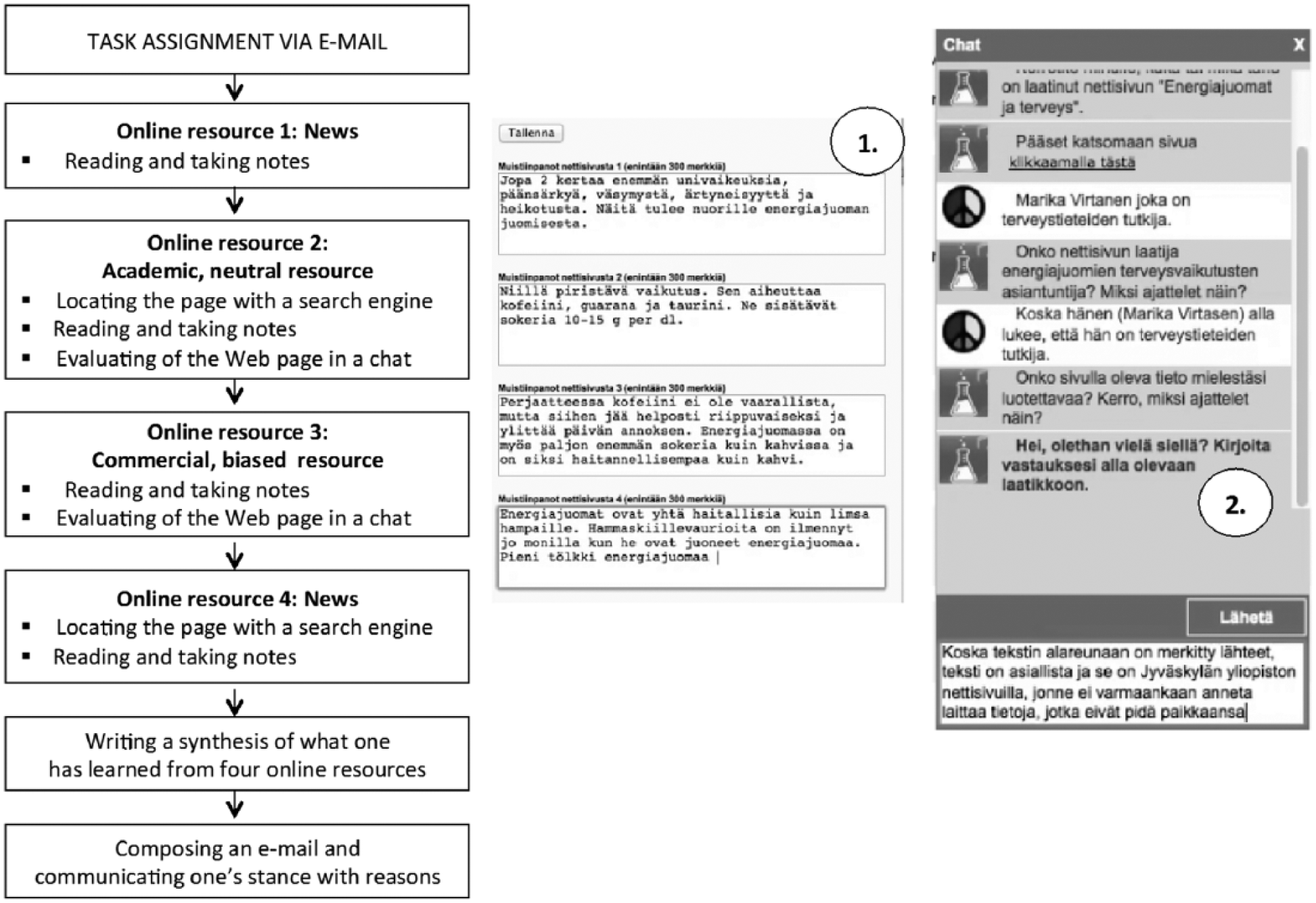
Flow of the online research and comprehension task, and screen shots of (a) the note-taking tool and (b) the evaluation chat environment.
The Characteristics of the Online Resources Students Read in the Research Task and Processes that were Related to them (Given/Located, Evaluated).
Two changes were made to the ILA. First, instead of evaluating the credibility of a single online resource, students evaluated two resources that varied in purpose, argumentation, and author’s expertise. Second, instead of three partial summaries from separate resources, students composed a final summary of their knowledge from all resources. Students in Finland had a limited amount of time (1 class hr) to complete the test, and we wanted to provide sufficient time to compose the final summary.
Data Collection
Data were collected at schools during a 45-min period during regular classes. Students worked with identical laptops, and the assessment was run from the local server of each laptop. As we had a limited number of laptops, half of the class worked on the task at a time. This ensured that students could be placed in the classroom so that they were not able to see other students’ screens. Students proceeded at their own pace and, if needed, they were allowed to use their 15-min recess to complete the task. If students encountered technical problems, the researchers helped them to proceed with the task, but only solved technical issues. These were infrequent.
Scoring Students’ Performance in the Online Research Task
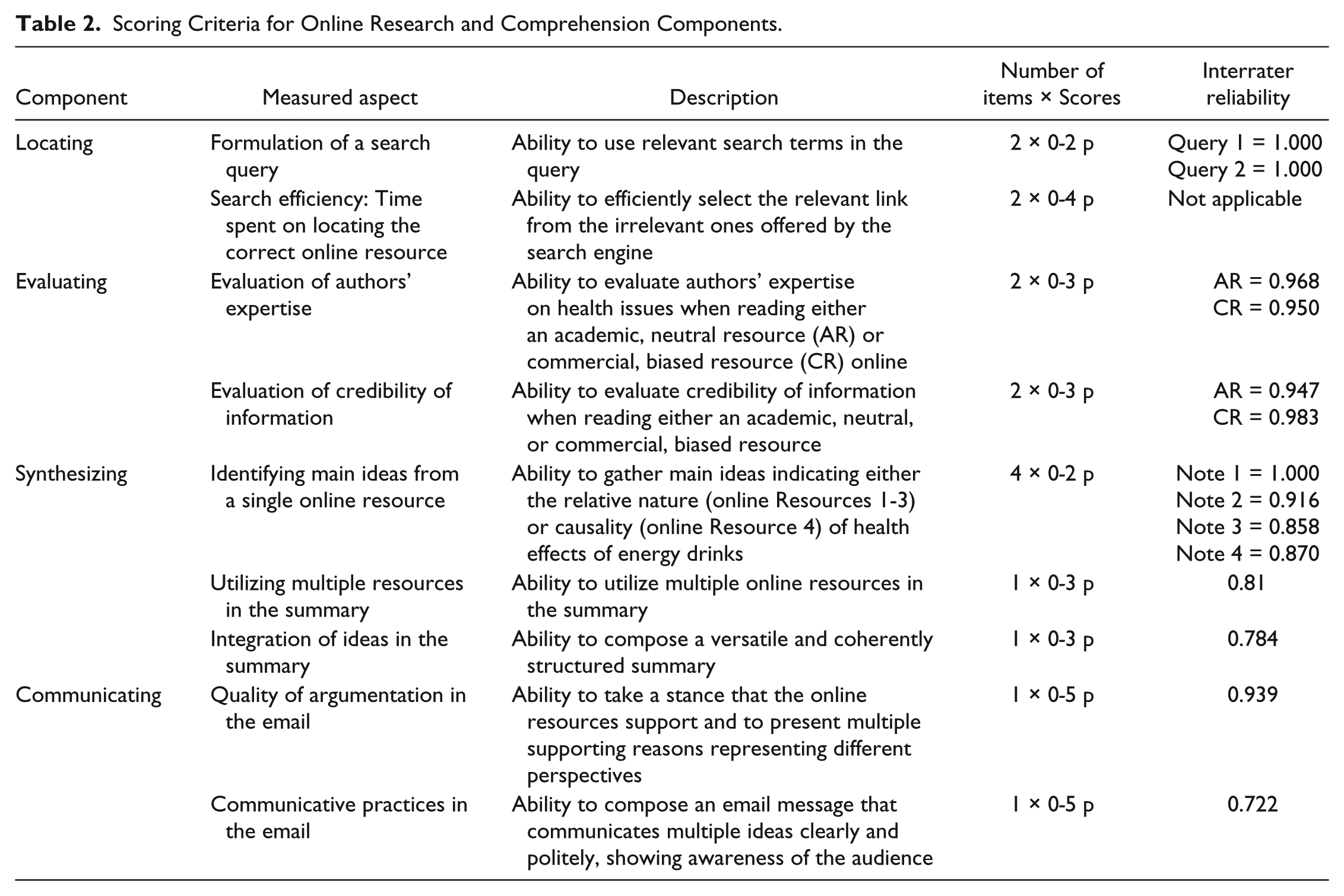
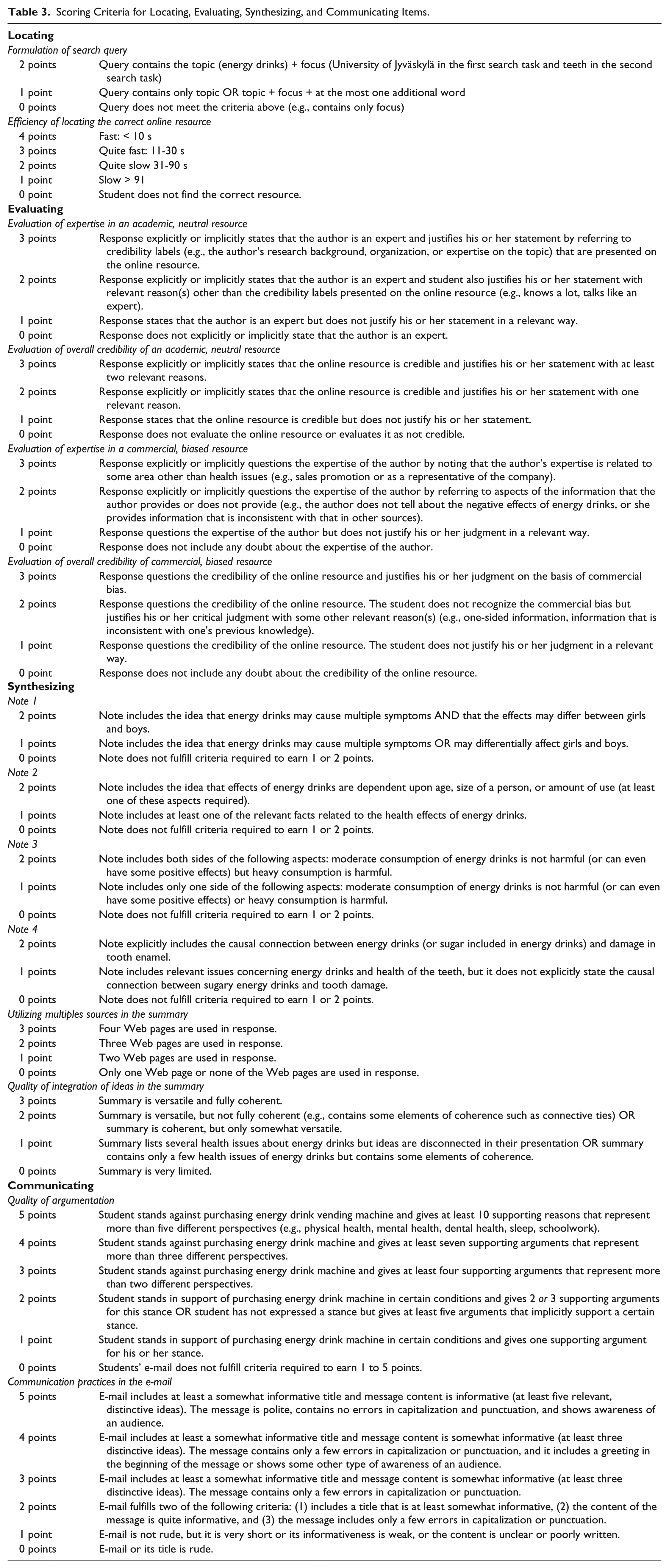
Table 2 provides the scoring rubric used to measure each skill. Score ranges varied in accordance with the complexity of the students’ answers or activities. For example, the shorter range (0-2 points) was used to score students’ keyword queries, whereas the longer range (0-5 points) was used to score variables related to communicating via email, where the longest email was as long as 183 words. Table 2 also includes estimates of interrater reliability. The first coder scored all the responses, after which the second coder scored 20% of the responses from randomly selected participants for all variables except for the measurement of time spent on locating the correct page, which was auto scored. Kappa values ranged from 0.722 to 1.000. Table 3 includes a detailed description of how each item was scored.
Scoring Criteria for Online Research and Comprehension Components.
Scoring Criteria for Locating, Evaluating, Synthesizing, and Communicating Items.
In this study, the system provided students with the correct online resource if they were unable to locate it in 3 minutes. In spite of this feature, some students did not realize (or show concern) that the resource they selected and read was not the correct one. This resulted in the possibility that these students would not receive scores from the notes that they were asked to take, related to the target resources that they failed to locate (Resources 2 and 4). To minimize the error, students who did not take notes from the correct resources were not included in the analysis of the variable NOTE2 (n = 41, or 9.2%) or NOTE4 (n = 24, or 5.6%) or both of them (n = 9, or 2.1%). The inability to locate a correct resource may have had some influence on scores in the use of sources (SUM1) and the quality of the summary (SUM2). In addition, location issues may have influenced the quality of argumentation in email messages (COM1) because these students may have been exposed to less of the relevant content compared with students who had an opportunity to read all four of the target online resources. These consequences are somewhat similar to what often happens during online research and comprehension, when performance at early stages often affects later stages of performance (see Henry, 2006).
Statistical Analyses
Confirmatory factor analysis (CFA) was employed to assess the measurement model of online research and comprehension. Mplus 7.4 software was used. A variance-adjusted weighted least squares (WLSMV) estimation method was employed because categorical variables were included in the model and six of them were not normally distributed. Also, the WLSMV estimator has been demonstrated to provide less biased estimates for factor loadings with categorical variables (Li, 2016), which further supported its use.
The starting point for CFA modeling was the four-factor model of online research and comprehension (Leu et al., 2013). It was hypothesized that alternative models could exist for online research and comprehension measured with the ILA. The following fit indices and cutoff values were used for indicating goodness of fit: χ²-test (ns, p > .05), root mean square error of approximation (RMSEA) values ≤ .06, and Tucker–Lewis index (TLI) and comparative fit index (CFI) values ≥ .95 (Hu & Bentler, 1999).
Should the four-factor model show lack of fit, it was planned to continue the CFA by adopting a model generation approach. In this approach, the aim is to establish a model that is acceptable in terms of both statistics and theory (Kline, 2011). Here, the hypothesized measurement model of online research and comprehension originated from the current theory. Therefore, the approach suited our purpose, which was to show the possible incongruity between our data and the hypothesized model. This process was iterative, where the model was altered in each step based on modification indices and on the theoretical justification until a sufficient model was established. In the last step, the resulting, less restrictive, model was tested against the more restrictive one using the chi-square difference (χ2-diff-test) test. When comparing these two nested models, the DIFFTEST-option, implemented in Mplus, was employed.
Findings
To estimate the best measurement model for this type of assessment, a simulation within an online space, we initially estimated a four-factor model for online research and comprehension, based on existing theory. All parameter estimates (see Figure 2) were statistically significant (ps < .01). Similarly, all fit indices except the χ²-test indicated good model fit, χ²(84) = 172.20, p < .001; RMSEA = .05; CFI = .97; TLI = .96. However, modification indices suggested that allowing the residuals of SUM1 and SUM2 to correlate would improve the model. Instead of estimating the residual correlation, the Synthesizing factor was divided into two factors: Identifying Main Ideas and Synthesizing.
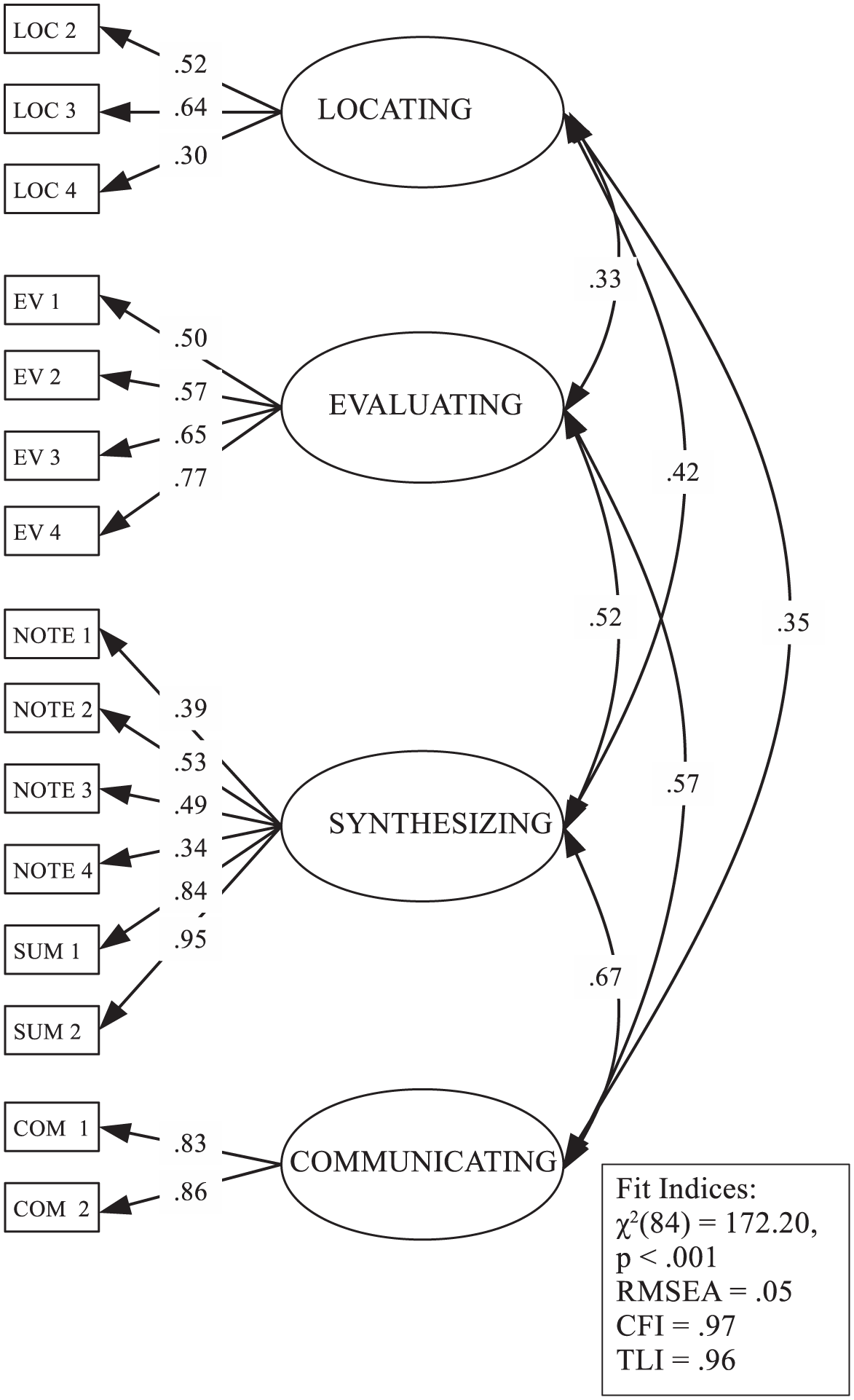
Four-factor measurement model of online research and comprehension, including standardized parameter estimates and fit indices.
Data in this study suggest that the act of composing a summary is based on the ability to integrate multiple ideas collected when taking notes, but it appears to consist of two, somewhat separate, elements. First, composing a summary appears to require one to identify and take notes on the main ideas from each online resource. Second, it requires one to integrate or synthesize the main ideas from multiple resources into a cohesive summary. These findings are consistent with research that differentiates between the processes of determining important ideas and synthesizing important ideas within and across static printed texts (Pressley & Afflerbach, 1995) and more dynamic digital texts (Cho & Afflerbach, 2017).
In line with the results of four-factor model analysis, the five-factor model (see Figure 3), with the factors of Identifying Main Ideas and Synthesizing, demonstrated good fit to the data. Fit indices were above or under the cutoff values, except for the χ²-test, which was significant, χ²(80) = 143.15, p < .001; RMSEA = .04; CFI = .98; TLI = .97. The χ²-difference test indicated that the less restricted five-factor model would fit the data better, χ2-diff (4) = 23.60, p < .001, than the four-factor model. Yet, the modification indices suggested that the model fit would be better if the residuals of variables EV1 and EV2 were allowed to correlate. Thus, instead of estimating residual correlation, the Evaluating factor was divided into two factors: EV1 + EV2 and EV3 + EV4. From a theoretical perspective, this means that evaluating an academic, somewhat neutral, resource (measured by Items EV1 and EV2) and evaluating a commercial, somewhat biased, resource (measured by EV3 and EV4) may require somewhat different abilities.
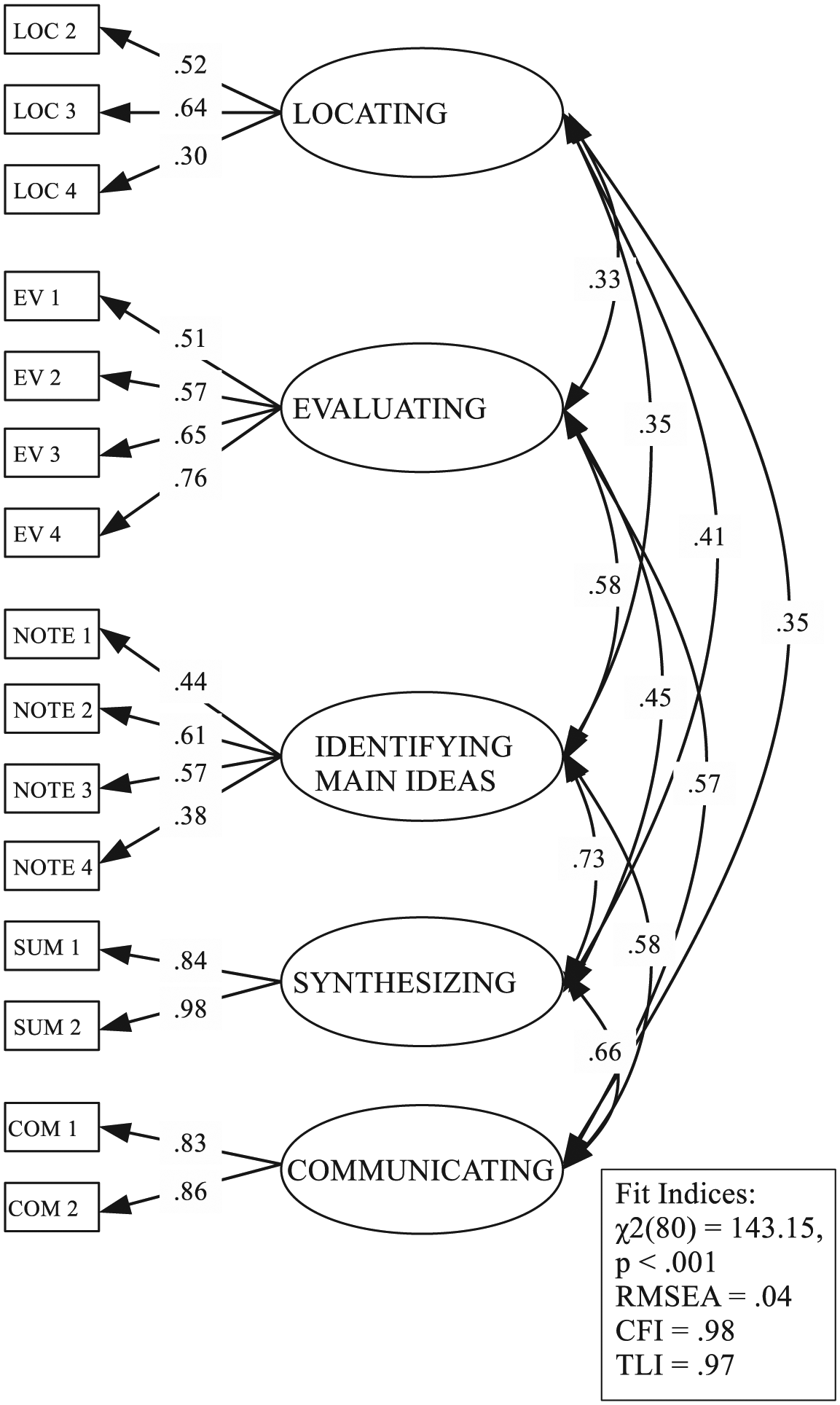
Five-factor measurement model of online research and comprehension, including standardized parameter estimates and fit indices.
As pointed out earlier, the academic, somewhat neutral, resource in our study included information that did not take a strong stance, whereas the commercial, somewhat biased, resource contained information that was one-sided. Consequently, Items EV1 and EV2 mainly required students to confirm the credibility of a resource, while Items EV3 and EV4 required students to question a resource’s credibility by identifying, for example, its commercially driven one-sided stance or by identifying a conflict with information from other resources. These results are consistent with work that indicates that evaluating the credibility of resources is often more complex than may initially appear and may be associated with both confirming and questioning resources (Klayman, 1995; Masnick & Zimmerman, 2009). As the existence of separate factors (Confirming Credibility and Questioning Credibility) seemed to be both statistically and theoretically acceptable, the six-factor measurement model of online research and comprehension was tested.
Results (see Figure 4) showed that the six-factor model fit the data very well. All goodness-of-fit indices, including the χ²test, fulfilled the criteria for a good model fit. Moreover, the χ²-difference test showed that the six-factor model had a significantly better fit than the five-factor model, χ2-diff (5) = 43.08, p < .001. Based on these results, the six-factor model of online research and comprehension was considered as the final model that best fit these data.
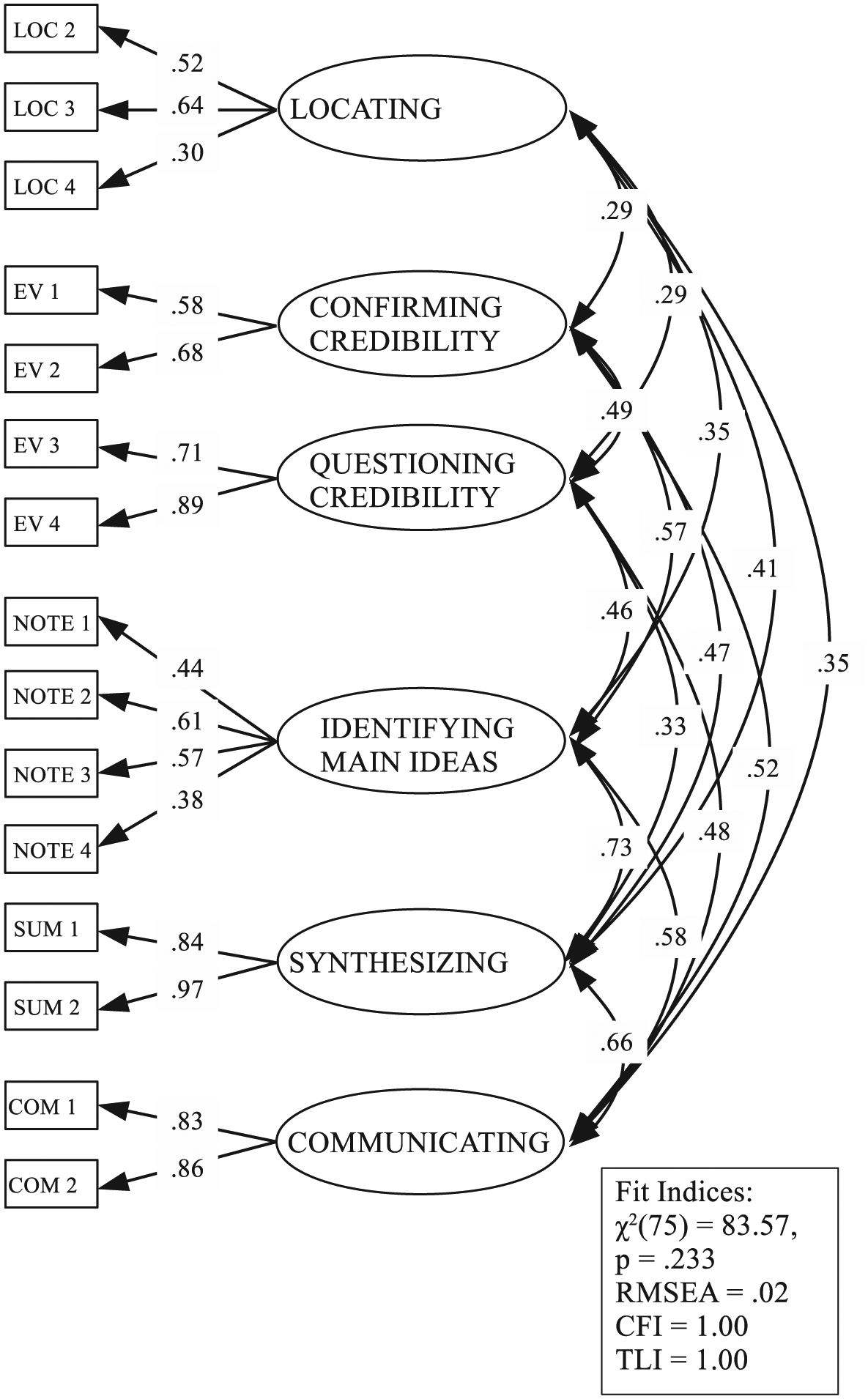
Six-factor measurement model of online research and comprehension, including standardized parameter estimates and fit indices.
A comparison of the three measurement models reveals that, by specifying the new factors to the model, additional interpretive power becomes available without substantial loss and, in some cases, with an increase in the relationships between the factors. The interpretations appear to be consistent with existing theory and research. Factor correlations, for example, appeared to differ in an interpretable direction for at least one of the new factors from Synthesizing. When the Identifying Main Ideas factor was specified in the five- and six-factor models, it had a higher correlation (r = .73) with the Synthesizing factor and a lower correlation (r = .58) with the Communicating factor. This makes some sense, suggesting that being able to identify the main ideas of an online resource contributes somewhat more to the prediction of synthesis, a more focused task, than the prediction of communication, which required students to also use email tools and appropriate discourse to compose their arguments for a particular audience. This gain in explanatory power did not appear to come at the expense of the overall relationship between Synthesizing and Communicating. In the four-factor model, the correlation between the Synthesizing and Communicating factors was .67. The correlation between Synthesizing and Communicating was .66 in both the five- and six-factor models, even though the Identifying Main Ideas factor appeared separately in the five- and six-factor models.
Separating critical evaluation into two factors, Confirming Credibility and Questioning Credibility, resulted in stability between relationships when compared with the four- and five-factor models. In the four- and five-factor models, correlations between Evaluating and Locating factors were .33. In the six-factor model, the correlations of Confirming Credibility and Questioning Credibility factors with the Locating factor were both .29. Thus, relationships with Locating did not change substantially when the two separate factors for Evaluating were specified in the six-factor model.
A similar pattern appeared for correlations with Communicating. In the four-factor model, correlations for Evaluation with Communicating were .57. In the six-factor model, the correlations of Confirming Credibility and Questioning Credibility with Communicating were .52 and .48, respectively. These associations also did not change substantially with the gain in explanatory power by adding additional components into the six-factor model.
The pattern was slightly different in relation to Evaluating and Synthesizing when both factors were expanded in the six-factor model. In the four-factor model, the association between Evaluating and Synthesizing was .52. In the six-factor model, correlations between Confirming Credibility with Identifying Main Ideas and Synthesizing did not change substantially, as they were .57 and .47, respectively. Correlations decreased substantially, however, between Questioning Credibility with Identifying Main Ideas and Synthesizing. These were .46 and .33, respectively. Thus, separating both Evaluating and Synthesizing into additional factors generally sustained the relationships for Confirming Credibility. For Questioning Credibility, however, the additional explanatory power, by adding factors, came at the cost of somewhat lower associations with the factors of Synthesizing.
Looking at all of the consequences, resulting from the additional factors in the six-factor model, results indicate that estimating two Evaluating factors and estimating separate Identifying Main Ideas and Synthesizing factors add important information to our understanding of online research and comprehension while generally sustaining the overall structure of the theoretical model.
Discussion
This study sought an optimal component structure for a theoretical model of online research and comprehension. The results are discussed in terms of contributions to theory, assessment, and instruction.
Theory
Factor analytic studies have the potential to clarify and refine theoretical models. Results show that students’ performance measured with the ILA assessment generally reflected the original theoretical constructs of online research and comprehension. The four measured component skills of locating, evaluating, synthesizing, and communicating information appeared as separate constructs with a good model fit. This suggests some support for the overall structure of the theoretical model. However, the five- and six-factor models showed even better fit by including two factors for each of the evaluation and synthesis components. This added additional complexity to the model by including six, not four, factors: (a) locating information with a search engine, (b) confirming the credibility of information, (c) questioning the credibility of information, (d) identifying main ideas from a single online resource, (e) synthesizing information across multiple online resources, and (f) communicating a justified and source-based position.
It seems that the evaluation of different types of resources may require somewhat different types of evaluation skills as the single factor, evaluation, separated into two factors that aligned with the two different contexts used to measure evaluation. An academic resource presenting facts in a neutral manner appeared to require confirmation of its overall credibility and thus its suitableness as a learning resource. A commercial resource with one-sided argumentation appeared to require questioning of its overall credibility. It is not clear from the results of this study if a wider range of resources, possibly requiring additional forms of evaluation, would separate into additional factors or coalesce back around a single factor. The moderately high correlation (r = .49, p < .001) between confirming the credibility of information and questioning the credibility of information suggests that there is some overlap in these skills. Two factors reflecting the different types of critical evaluation skills might be specific to younger students compared with expert readers (cf. Brand-Gruwel et al., 2005). Further studies are needed to explore whether these results hold in different disciplines (Goldman et al., 2016) and with a broader range of resources, and with older, more cognitively mature students (cf. Eccles, Wigfield, & Byrnes, 2003).
The synthesis component also separated into two factors, aligning with each synthesis task: identifying main ideas from a single online resource and synthesizing information across multiple resources. This is consistent with what Cho and Afflerbach (2017) have described as the dual processes involved in building multilevel coherence while reading digital resources. They argue that the process of building coherence within a single online text (in this case, taking notes from each online resource) is separate from that of building coherent intertextual relationships across multiple online texts (in this case, completing the final synthesis task).
These results also suggest that the dual processes may be interdependent. Identifying main ideas from a single resource and synthesizing information across resources were highly correlated (r = .73, p < .001). This interdependence may have at least two explanations. First, similar types of reading strategies may be needed when constructing meaning from a single resource and across multiple resources. For example, a reader may strategically generate inferences about connections while reading within a single resource as well as when reading across multiple resources. Second, the identification of main ideas from a single resource forms the basis for the synthesis of ideas across multiple resources (Cho & Afflerbach, 2017).
The high factor loadings on items designed to measure the ability to communicate on the basis of one’s research suggests these two items effectively captured the component skill of communicating via email as part of online research and comprehension. Notably, the communicating factor correlated with identifying main ideas from a single online resource (r = .58, p < .001) and synthesizing information across multiple resources (r = .66, p < .001). These associations suggest that success in previous phases of the task may have assisted students with communicating a position in their email, supporting conceptions about intrinsic relationships between reading and writing during online research and comprehension.
Taken together, the results appear to not only provide some support for the initial model but also suggest that additional complexities may be an essential aspect of any final model. The use of CFA by adopting the model-generating approach and comparing the models via the chi-square difference test was found to be feasible. This approach is useful for adjusting theoretically well-justified models and then comparing them against each other. In future studies, measurement invariance testing of the online research and comprehension model would be highly recommended as it reveals whether the constructs of the model were measured in the same manner within the different groups of students. This study found at least two of the areas to divide into separate factors when two different types of tasks were required for each. We note, however, the need to be cautious as the topic (food and health) is one subject in school learning at this level but it is only one of countless areas of learning. Also, as new technologies appear online and new task demands appear, adding complexity to an already complex context for reading, more complexities in models of online research and comprehension may be revealed.
None of the factors identified here, with the exception of identifying main ideas from a single online resource and possibly synthesizing information across multiple online resources, typically appear in traditional offline reading models. From a metatheoretical perspective, these results lead us to reconsider traditional models of reading developed from and for offline reading contexts. The results of this study suggest that theoretical models grounded in offline reading contexts are likely to ignore elements distinctive to online reading as well as the differential functioning of common elements during reading in online and offline contexts (Leu et al., 2015). This could lead us in inappropriate directions as we consider the design of curriculum, instruction, and standards for online reading.
The model that emerged in this study, developed from and for online reading contexts, includes a number of components that have not previously been identified as central to offline models, suggesting transformative possibilities as we envision reading in new ways for new times. Theoretically, it appears that we must begin to recognize both the distinctive nature as well as the central importance of the online informational contexts that now define our literacy lives (cf. Finnish National Board of Education, 2014; Fraillon et al., 2014; International Reading Association, 2009). Our findings suggest that it is problematic to simply adapt offline models to online contexts. It is better to develop theory from the reality that emerges from online contexts.
Results that diverge from offline models may also provide important direction for online theory development in additional areas such as multiple document comprehension (e.g., Bråten & Braasch, 2017; Britt & Rouet, 2012), multimodality (e.g., Smith, Kiili, & Kauppinen, 2016), and critical literacy (e.g., Lankshear & McLaren, 1993), and others. This study helps us to consider the problematic aspects of simply adapting offline theory to new, online contexts in these areas and the importance of developing new theoretical perspectives from within the many new, online literacy contexts themselves (see Leu et al., 2013).
Finally, these theoretical results may provide additional support for repositioning online reading to a central location in the language arts (see Kervin, Mantei, & Leu, 2018). It is no longer sufficient to continue to position online reading instruction as secondary, supplemental, and tangential to offline reading instruction, seemingly as an afterthought. Using online information to read, solve problems, and learn is now such an integral part of our lives (OECD, 2011) that it must become the central focus of the thoughtful preparation of the next generation. The model and components identified in this study may provide important initial direction to the changes required in classrooms. Such a repositioning of online reading instruction to a central position in our classrooms will severely test our ability to prepare students for literacy, learning, and life in this online age of information and communication, and we need a clear understanding of online reading to be successful.
Assessment
Results demonstrating a factor structure for an assessment generally similar to the theory behind it suggests a reasonable level of validity for that assessment (Rahman & Mislevy, 2017). This seems true for this instrument. Adding to its validity is that this was a performance-based assessment, seeking to replicate, as closely as possible, how individuals read to learn online, conduct research, and comprehend issues related to health. This approach may have advantages over assessments that use isolated, multiple-choice items (cf. Sabatini, O’Reilly, Halderman, & Bruce, 2014) as it allows the capture of a more integrated set of competencies associated with higher level thinking when reading to learn from online information. A simulation may have also increased students’ engagement in the task (de Klerk, Veldkamp, & Eggen, 2015).
With respect to measuring locating skills, the ILA assessment included a search engine designed to simulate a dynamic search environment in which students were able to formulate and revise queries that directly informed what was displayed on a subsequent search result page. This made it possible to compare students’ locating performance because they could all engage with the same set of online resources. Assessment designers seeking to authentically capture dynamic locating skills, while also holding constant some elements of the information space, might consider integrating similar features into future assessments.
Despite these benefits, our approach to designing the four locating items also introduced some complexities. First, we found that the two query-formulation tasks inconsistently measured students’ locating skills. Consequently, we decided to exclude one of the query-formulation items from the factor analysis. This was because it appeared that the query-formulation tasks required students to use different types of querying strategies; that is, a “topic + defining concept query” was useful for locating information about a specific topic (LOC2) but a “topic + source query” was more appropriate for locating information published by a certain author/organization (LOC1). While this created challenges for fitting the four items to a common locating factor, the varied difficulty levels of these two items, LOC1 being more difficult for students, also suggests that there might be some nuanced levels of locating skills related to query formulation in different contexts. Future assessments might include more items that necessitate both kinds of queries to more carefully explore this possibility.
Additional research is also needed to clarify whether or not locating tasks that involve query formulation and locating tasks that involve the selection of relevant links from the search results page measure different underlying abilities. Previous research (Cho & Afflerbach, 2015; Coiro & Dobler, 2007) found that searching tasks require prior knowledge of Web-based search engine protocols (i.e., formulating keyword searches, evaluating annotated search results) as well as inferential reasoning skills (i.e., making, confirming, and adjusting inferences in relation to context cues). However, less is known about the extent to which query-generating and link-selection skills overlap or separate into different factors involving slightly different sets of processes.
Finding a balance between ecological validity (authenticity) and standardization is a key issue in the design of performance-based assessments (Linn, Baker, & Dunbar, 1991). Reading in the authentic Internet environment involves a significant degree of student choice. There is, however, a need to limit these choices somewhat to compare students’ performance on a common, or standardized, task. This requirement resulted in two important limitations to the study.
First, as students’ performance was standardized by providing an identical question to each student, we were not able to measure one component of the theoretical model for online research and comprehension: identifying important questions. As online research and comprehension is a self-directed reading process, identifying important questions appears to not just influence the beginning of an online research and comprehension task but may also influence the process at various points as the reader revises, restructures, and reconstructs the question on the basis of new information that he or she acquires (see Cho et al., 2017). Future research needs to find creative solutions to embed this component into assessments without jeopardizing the comparability of students’ performance. Second, while the assessment was designed only to simulate the Internet, standardizing the task required us to hold some of the elements in the information space constant (e.g., resources that students eventually read, the sequence of the tasks, and prompts from the avatar).
All these design decisions compromised a part of the authenticity of online research and comprehension as a self-directed reading process where each reader creates a unique reading path in an unlimited information space. Consequently, this study is limited by having had to standardize the assessment task in these ways. We note, however, that compromises to authenticity also appear in standardized assessments of offline reading where students do not select their own reading material and typically read standard portions of limited texts while responding to a limited and fixed set of possible responses. More flexible assessment environments and more creative solutions to the ones used in this assessment are needed to more closely match authentic online research and comprehension.
In spite of these limitations, this study gives important direction for developing assessments of reading to learn on the Internet. In addition to including a search engine designed to simulate a dynamic search environment, another important aspect that has not yet been fully included in the international assessments is the synthesis of information from multiple online texts. Research on multiple document literacy (Bråten & Braasch, 2017; Britt & Rouet, 2012) has highlighted the importance of reading multiple texts representing different, even conflicting perspectives and voices, as well as the unique skills that are needed beyond the reading of a single text. Future assessments should also evaluate students’ abilities to handle information that is biased, prejudiced, or intentionally misleading, now needed in what some might call our “post-factual era.” As the present study showed, this might require additional skills in critical literacy with online information at least from younger students.
Instruction
The use of performance-based assessments, systematically aligned with instruction, can provide important support for teachers (Pellegrino, DiBello, & Goldman, 2016). This may be especially true with this assessment as the component skills appear in many nations’ standards (see Australian Curriculum Assessment and Reporting Authority, n.d.; Finnish National Board of Education, 2014; National Governors Association Center for Best Practices & Council of Chief State School Officers, 2010). This study found six specific components related to online research and comprehension that appear important for success in reading to learn from online information. Understanding the importance of these components may lead directly to the design of more effective instructional activities.
The six-factor model of online research and comprehension found in this study can also help clarify the similarities and differences between the skills associated with each factor. For example, knowing that questioning an author’s credibility requires different skills than confirming an author’s credibility suggests the need to more strategically sequence instruction around critically evaluating online resources. Students need both models and practice in considering what may cause someone to question an author’s credibility. To avoid superficial practices, such as making evaluative judgments only on the basis of domains (.edu, .org), students should be pointed back to the information itself to analyze the quality of an author’s claims about the topic under study in relation to his or her affiliation and level of expertise. Having regular opportunities to engage with challenging critical evaluation practices is likely to increase students’ ability to identify possible persuasive elements and one-sided arguments that call into question the credibility of many online texts (cf. Buehl, Alexander, Murphy, & Sperl, 2001).
Similarly, this study highlighted two separate but related skills that can inform instruction in effectively synthesizing ideas across multiple online texts. Like previous research (Cho & Afflerbach, 2015; Rouet, 2006; Spivey & King, 1989), our findings suggest that online readers need to first be able to determine the most important ideas within a single resource relevant to the task at hand. Then, they need to integrate these separate ideas from several resources to form cohesive explanations. It appears likely that working to integrate information across multiple and disparate resources may introduce new challenges for students more accustomed to reading logically structured learning materials, such as a textbook or a single article. Thus, instructional supports need to go beyond making sense of single texts to help students understand how multiple resources, especially from different perspectives, contribute to the overall understanding of a topic (Fisher & Frey, 2013; Hynd, Holschuh, & Hubbard, 2004).
Supplemental Material
Supplemental_Material_784640 – Supplemental material for Reading to Learn From Online Information: Modeling the Factor Structure
Supplemental material, Supplemental_Material_784640 for Reading to Learn From Online Information: Modeling the Factor Structure by Carita Kiili, Donald J. Leu, Jukka Utriainen, Julie Coiro, Laura Kanniainen, Asko Tolvanen, Kaisa Lohvansuu and Paavo H. T. Leppänen in Journal of Literacy Research
Footnotes
Acknowledgements
We are grateful to Sini Hjelm, Sonja Tiri, and Paula Rahkonen for their valuable work with the data collection and data management.
Declaration of Conflicting Interests
The author(s) declared no potential conflicts of interest with respect to the research, authorship, and/or publication of this article.
Funding
The author(s) disclosed receipt of the following financial support for the research, authorship, and/or publication of this article: This work was supported by the Academy of Finland (No. 274022).

References
Supplementary Material
Please find the following supplemental material available below.
For Open Access articles published under a Creative Commons License, all supplemental material carries the same license as the article it is associated with.
For non-Open Access articles published, all supplemental material carries a non-exclusive license, and permission requests for re-use of supplemental material or any part of supplemental material shall be sent directly to the copyright owner as specified in the copyright notice associated with the article.
