




Abstract
Drawing from sociological and economic analyses of gender and work, this column explores issues of occupational gender segregation, privilege, and devaluation. Comparisons are made with increased female achievement at all levels in postsecondary education. The questions are then raised: If cultural devaluation of women and activities remains persistent and widespread, what might be the implications for literacy researchers and literacy research organizations that are comprised mostly of women? How might such research be received and perceived by policymakers? The column concludes by advocating for increased attention to cultural beliefs in gender essentialism and the ramifications thereof to make meaningful contributions to literacy practice.
Over the past 40 years, literacy research organizations have experienced a dramatic shift in gendered membership from predominantly male to predominantly female. This demographic shift, sometimes called “feminization” of a field (Leathwood & Read, 2008), is part of a broader shift in postsecondary degree attainment, in which the number of women earning degrees at all levels has outpaced men. In fact, in 2014-2015, nearly 9,000 more women earned doctoral degrees than men (93,626 compared with 84,921; U.S. Department of Education, National Center for Education Statistics, 2016). In education, this is especially true, with nearly twice as many women attaining doctoral degrees as men (7,934 as compared with 3,838).
While the increased degree attainment for women—albeit largely White women—is laudable, such dramatic shifts also come with paradoxical costs, figurative and literal. When an occupation becomes predominantly comprised of women, research suggests the economic value of that field decreases and so does the salary (Mandel, 2013; Pan, 2015). Salaries are very real material attributions of cultural values placed on given occupations, and the cultural value attributed to women and activities largely associated with women remains quite low (Cohen, 2013).
I situate this column in the understanding that normative gender norms and beliefs undergird all organizational structures. Such gender norms and beliefs hinge upon patriarchal social structures and hegemonic masculinities that legitimize the subordination of women and marginalized forms of masculinities (Connell, 2005). As I will demonstrate from sociological and economic studies of gender, as the number of women in a given field significantly increases, corresponding privilege, prestige, and salaries decline (Cohen, 2013; England, 2010; Levanon & Grusky, 2016; Pan, 2015). Such challenges beg the question: What specific impact might such devaluations of positions associated with women have for literacy research organizations that are numerically dominated by women?
To address these concerns, I examine data from National Center of Educational Statistics for doctoral degree attainment in education and in literacy-associated specializations. I attend to issues of occupational segregation by gender and examine the question of the “feminization” of literacy research and the potential implications for women and men alike in such a field. Finally, I assert the need for literacy organizations to address the challenges derived from the gender imbalance. Nevertheless, it is not my intent to reify the gender binary to the exclusion of trans* and other gender nonconforming individuals, but rather to recognize the gender binary as a powerful socializing and disciplining force (Butler, 1990).
Structural Constructions of Gender
To say that gender is socially constructed is to recognize that cultural conceptions of gender change across time and context. Social constructivist arguments of gender likewise refute any notion of a universal form of masculinity or femininity; rather, gender intersects with and is influenced by a multiplicity of identity markers, for example, race, class, sexual orientation, age, ability. While most sociologists recognize that gender is socially constructed, they likewise acknowledge a persistent and widespread cultural belief in gender essentialism. Gender essentialism is the belief that women and men are fundamentally different in their capacities, interests, and skills (Charles & Grusky, 2011). Contemporary socialization of gender tends to associate women and men to different attributes and characteristics. Girls and women are frequently socialized to be more nurturing, caring, and communicative, making them seem more suitable for teaching, nursing, and other service work. From this perspective, men are understood as more commanding, decisive, and analytical, leading to jobs in engineering, science, and business. Mullen (2014) and Goldberg et al. (2012) note the contradiction within this stance: “While most people now support women’s access to all economic opportunities, they simultaneously expect men and women to pursue traditionally ‘male’ and ‘female’ jobs” (McGrew, 2016, para. 6). Because of gender socialization forces and these internalized belief systems, men and women tend to self-segregate within different fields of study (supply-side) and employers hire for positions based on the same assumptions (demand-side; Levanon & Grusky, 2016). As a result, gender segregation across professional fields and specializations remains strong (Charles & Bradley, 2009).
Gender, Degree Attainment, and Literacy Research
While literacy instruction has long been a traditional occupation for women (Charles & Grusky, 2011), research and academia had traditionally been the purview of men. In the past 40 years, however, across all academic areas, women’s educational attainments have shifted traditional trends. In 1969-1970, of the 59,486 doctoral degrees awarded, only 9.6% were awarded to women. By 2014-2015, women had overtaken men, with women earning 52% of all doctoral degrees (U.S. Department of Education, National Center for Education Statistics, 2016). Within the education field, an analysis of doctoral degrees demonstrates an even higher percentage of women, with women currently earning 67.4% of all doctoral degrees in this field (see Table 1).
Doctoral Degrees in Education Since 1970 Across Decades, by Sex.
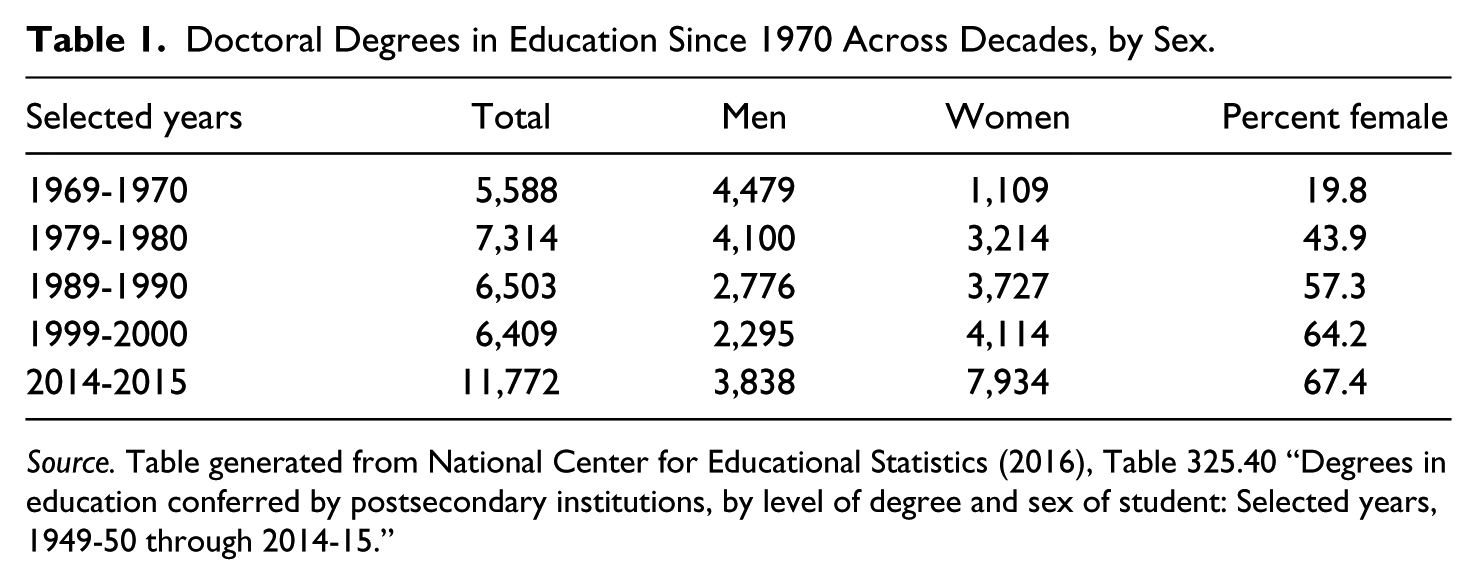
Source. Table generated from National Center for Educational Statistics (2016), Table 325.40 “Degrees in education conferred by postsecondary institutions, by level of degree and sex of student: Selected years, 1949-50 through 2014-15.”
Within literacy education, data for specialization areas suggest women earn between 83% and 90% of doctoral degrees for literacy researchers (see Table 2).
Doctoral Specializations in Education, 2011-2012, 2014-2015.
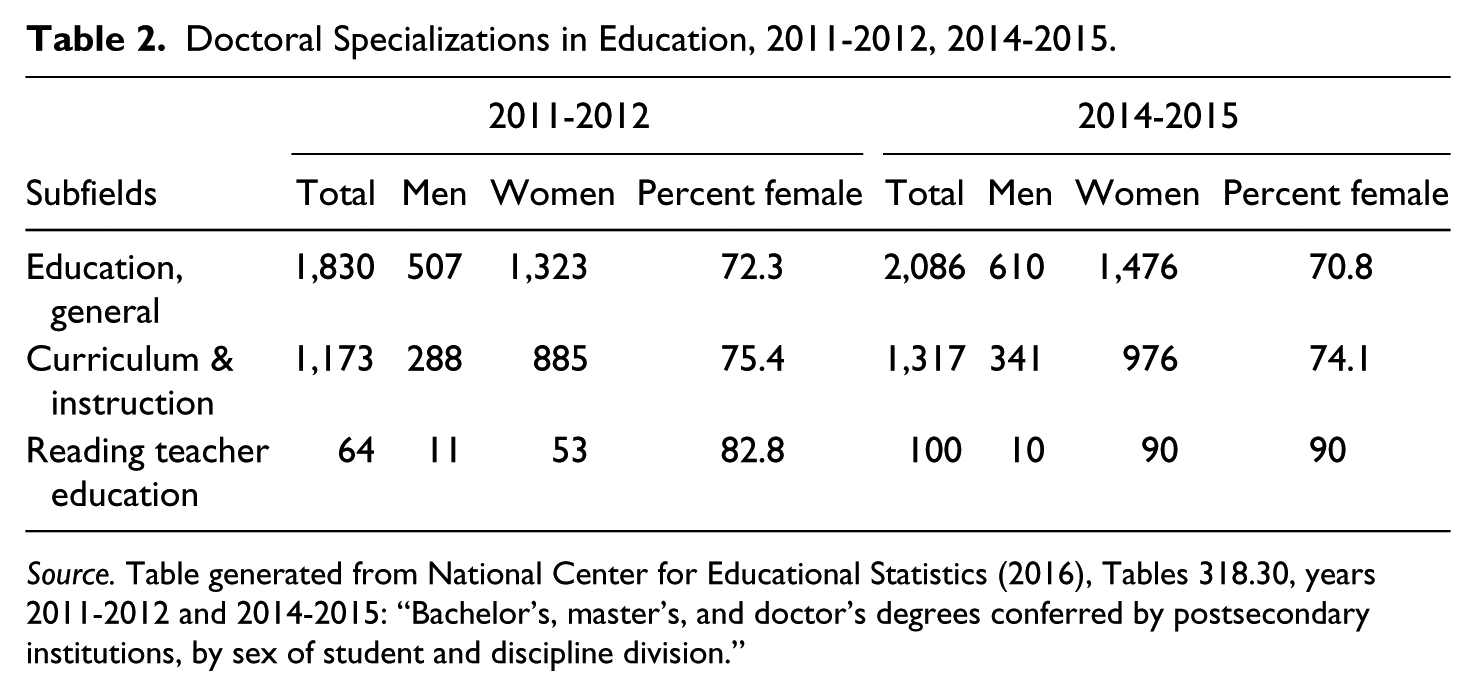
Source. Table generated from National Center for Educational Statistics (2016), Tables 318.30, years 2011-2012 and 2014-2015: “Bachelor’s, master’s, and doctor’s degrees conferred by postsecondary institutions, by sex of student and discipline division.”
While the National Center of Educational Statistics did not collect data for the specializations within major fields until recent years, the combined tables support the observed changes in numerical dominance of literacy researchers from men to women over these 40 years.
The increased feminization of doctorate programs is largely a White female phenomenon, however, fostered by Title IX and affirmative action (Yosso, Parker, Solórzano, & Lynn, 2004). Indeed, of the 93,626 doctoral degrees awarded to women in 2014-2015, the majority were awarded to White women. Black women earned less than 10% of all doctoral degrees awarded to women and just under 5% of the 178,547 total doctoral degrees awarded. Asian women and Hispanic women earned 11.6% and 6.7% of all doctoral degrees awarded to women and 6.1% and 3.5% of all doctoral degrees, respectively (U.S. Department of Education, National Center for Education Statistics, 2016). Data by gender, race, and specialization are not available to know how these trends play out specifically in educational fields, especially those common to literacy researchers.
The question of why more women than men are attaining advanced postsecondary degrees is challenging. England (2010) asserts that because there has been “little cultural or institutional change in the devaluation of traditionally female activities and jobs” (p. 150), women, particularly White middle-class women, sought to gain economic advancement through degree attainment and entrance into male-dominated occupations, for example, professoriate. Following more rigid cultural prescriptions around masculinities, men, however, have not entered female-dominated fields to the same degree (England, 2010).
Occupational Segregation, Literacy, and Higher Education
Although women have entered more male-dominated fields, both men and women tend to choose, or be directed into, fields and specializations that align with proscribed gender norms. This leads to a vertical segregation in which specializations (e.g., education) within a field (e.g., professorate) that are dominated by one gender and then are accorded differentiated resources and privilege (Levanon & Grusky, 2016). Even in male-dominated fields such as medicine, vertical segregation happens as women are often shuffled into lower paid and less-esteemed specialties such as gynecology and obstetrics, general practice, and pediatrics (Williams, Pecenco, & Blair-Loy, 2013). Likewise, the difference can be observed between full-time and part-time faculty, in which women are greatly overrepresented in part-time faculty, non-tenure-track, and contingent instructional staff positions (Curtis, 2011).
Ironically, occupational prestige derives in part from occupations being largely dominated by men (England, 2010; Pan, 2015). In fact, Pan (2015) documents occupational “tipping points,” in which “occupations rapidly feminize as the share of females in an occupation exceeds a critical threshold or range” (p. 368). At such tipping points, the numerical dominance shifts from men to women, resulting in a corollary decline in both salary and occupational prestige attributed to that field or specialization. Such a tipping point can be observed in Table 1 with a significant decrease of men by 33% earning doctoral degrees in education between 1980 and 1990. Pan (2015) contends when occupations hit such tipping points, occupational gender devaluation occurs.
Occupational gender devaluation derives from decreased salaries because women disproportionately work in those fields (Cohen, 2013; Levanon & Grusky, 2016). Beyond the entrance of women into a field, the reasons for such devaluation have been difficult for sociologists and economists to differentiate empirically, such as increased ability among men to protect their own privilege and discriminating practices of employers who profit from paying women less (Cohen, 2013). Salaries decline due to the entrance of significant number of women into a field, and occupational devaluation results from decreased salaries. The devaluation has a double disadvantage for literacy research and similar fields: lowered earnings because the field is currently dominated by women and lowered earnings because women tend to earn less than men (Hegewisch, Liepmann, Hayes, & Hartmann, 2010). Then when race/ethnicity is considered with gender, the “double disadvantage” increases exponentially, as Black women earn 83% of their White female counterparts and Hispanic women 69% (Niemi, 2017).
Following challenges facing occupational gender devaluation, higher education credentials may be just as subject to significant devaluation based on increased rates of female attendance and achievement. Drawing from patriarchal analyses of power and higher education, Niemi (2017), in her book Degrees of Difference, contends, “[T]he value of higher education credentials is diminishing in relation to women’s higher education success while at the same time white men are creating and strengthening a number of dominant, all-male exclusionary spaces,” and as a result, “it will matter much less what credentials women earn, and how well they earn them.” (p. 22)
Following similar exoduses of men from occupations when they reach significant tipping points with female entrance, Niemi (2017) argues that men may be choosing alternate avenues for economic mobility, for example, technology sector, rather than traditional means afforded by university credentialing due to the increasing dominance of women in all aspects of college achievement.
Feminization of Literacy Research and Implications for Policy
In examining the question of the numerical shift of men to women earning doctoral degrees in fields associated with literacy research, and thereby those who would participate in literacy research organizations, I have largely been pulling from economics and sociology of work to address the implicit challenge for organizations largely derived of women.
If occupational prestige and valuation both decline from a significant increase share of women in the field, where does that leave literacy researchers, both women and men? Furthermore, what impact does the devaluation hold in regard to the impact of that research among policymakers and other external constituencies?
In asking these questions, I do not want to suggest any challenge to the efficacy of the organizations, membership, leadership, or the research that is promulgated through these organizations. Likewise, I do not seek to reify the gender binary and perceived essentialist characteristics thereof; rather, I argue the need for literacy researchers and literacy research organizations to attend to the large body of research that acknowledges the pervasive, systemic cultural beliefs in such gender essentialism. To do otherwise would be detrimental to the overall well-being and future of literacy research organizations.
The economic impacts of the gender imbalance in postsecondary education and occupational gender segregation have been noted by universities and national policy centers alike (Hegewisch et al., 2010; McGrew, 2016). Niemi (2017) notes efforts by higher education providers to recapture such markets, as well as attract new nontraditional college attendees. “Higher education’s gender balance is necessary, it seems, for a healthy financial spreadsheet” (Niemi, 2017, p. 3). The Institute for Women’s Policy Research and Washington Center for Equitable Growth likewise note the economic ramifications of gender segregation in the workforce, as occupational segregation inhibits individuals from moving into occupations in which they could perform well and make meaningful contributions (Hegewisch et al., 2010; McGrew, 2016).Thus, integrating male and female-dominated jobs and closing the wage gap continue to be much needed strategies for economic advancement (Hegewisch & Hartmann, 2014).
Based on research related to occupational prestige and devaluation, power, and higher education, I call upon literacy researchers to attend to the persistent relevance of gender in contemporary society and to conceptualize innovative paths to reconcile the gender imbalance. As such, I offer the following suggestions:
First and foremost, literacy research organizations need to make gender and the repercussions of gender (re)visible to itself. One way of addressing the challenges brought on by the cultural devaluation of women will be for the newly approved Literacy Research Association Gender and Sexualities standing committee to create programmatic suggestions to the board to this very end. Other literacy research organizations should consider similar organizational recommendations as well.
Literacy research organizations need to be unapologetic about forwarding missions of gender inequity and literacy. Literacy research organizations should more actively align themselves with community activist groups, policy centers, and nongovernmental organizations (NGOs) whose missions foreground literacy work as central to economic development, community development, and personal empowerment. At national conferences, special invitations could be made to such organizations with a special plenary session devoted to informing literacy researchers of specific gendered literacy activities within local or international contexts.
Literacy research organizations need to actively recruit young male scholars, especially young men of color. Ironically, to increase the value of literacy research, more men need to (re)enter the field. Because of the cultural devaluation of fields and activities considered more “feminine,” men have little incentive and have shown almost no movement into female-dominated fields. As Pan (2015) notes, “Even if women continue to increase their advantage in overall graduation rates . . . if men and women do not increase their overlap in fields of study, educational attainment alone may not trigger more reduction in occupational segregation” (p. 896). Part of the challenge of encouraging more male scholars, especially male scholars of color, is the continuing generalized perception of literacy as reading (skills). Thus, literacy research organizations should work with their membership and targeted universities to market the diverse forms of literacy research conducted. Recent personal experience with a doctoral student clearly reinforced this need. “I didn’t know I could do this kind of research (in the field of literacy),” this young man said, impressed with the different kinds of literacy research he could pursue. Limited perceptions of literacy research can inhibit many new male scholars from considering the field.
The research in sociological and economic analyses of gender and work paints a despairing picture of gender essentialism in which women of all races and ethnicities continue to be viewed as less intelligent, able, and proficient than men. Increased educational attainment and accomplishments by women unfortunately have not changed these beliefs. Just as colleges and universities recognize the need for increased enrollments among young men for their fiscal well-being, I contend the literacy research organizations need the same degree of awareness. We need more male allies in the fight, and we need to give them more reasons to belong.
Footnotes
Declaration of Conflicting Interests
The author(s) declared no potential conflicts of interest with respect to the research, authorship, and/or publication of this article.
Funding
The author(s) received no financial support for the research, authorship, and/or publication of this article.