




Abstract
In this article, I use what Baszile terms critical autobiographical reflection to examine my experiences as a Black and Tamil American woman who engages in language and literacy research with Latinx adolescents. I describe my encounters with two types of research policing in which perceptions of my racial identity are used to challenge the “appropriateness” of my research. Then, I illustrate how my biographical journey as a multiracial woman has shaped how I envision the conception of community that is fundamental to my equity-focused work. Finally, I discuss that it was differences in racialized schooling experiences, not distinct ethnoracial identities, which had the potential to be the greatest barrier in my cross-racial dissertation research. Through this critical autobiographical reflection, I present a diverse representation of what it means to be a Woman of Color educational researcher and document how I enact what Paris conceptualizes as humanizing research.
My transition from high school teacher to educational researcher was fraught with anxiety and insecurity. However, the texts that I was assigned as a part of my doctoral coursework helped me to feel more comfortable with this new identity (e.g., Alim, 2004; Delpit, 2006; Emerson, 2001; Gould, 1996; Labaree, 2003; Pollock, 2005; Valdés, 2001; Zentella, 1997). They provided a way to envision myself as a researcher. For instance, the work of Valdés (2001) and Zentella (1997) showed me that engaging in a sophisticated analysis and being motivated by a strong sense of social justice were not mutually exclusive. In addition to these assigned texts, I independently sought out or reread both methodological texts and sections of books in which Women of Color 1 who are educational researchers in the United States described their research practices (e.g., Ball & Lardner, 2005; Foster, 1994; Kondo, 2001; Mendoza-Denton, 2008; Merriam et al., 2001; Mohan & Venzant Chambers, 2010; Valdés, 1996, 2001; Villenas, 1996). I used these texts to understand how these researchers navigated their multiple social identities in the unique racial context of the country in which I was born, was raised, and work.
The texts that I read usually described Women of Color scholars’ experiences of engaging in research with individuals with whom they identified racially, ethnically, culturally, or linguistically. For example, Villenas (1996) identified herself as a Chicana doctoral student whose research involved Latina mothers. Several of the researchers within Merriam et al. (2001) also describe their work in the United States that engaged populations with whom they share one or multiple social identities. For instance, Johnson-Bailey (an author in Merriam et al., 2001) discusses her research with Black reentry women. Similarly, Mohan and Venzant Chambers (2010) examined their work as multiracial researchers with multiracial participants. Reading the work of these scholars (and other Women of Color who are educational researchers) taught me how others worked through the intersections of their individual biographies and their research. Unfortunately, missing from this line of publications were stories of researchers like myself.
My research involves young people with whom I do not share many similar social identities. I am a Black and Tamil woman who on one branch of my family tree is the first person in her family to be born in the United States and on the other branch is the descendant of Africans who were enslaved in the United States. The young people whose voices and experiences I seek to amplify through my research are Latinx 2 adolescents who were raised in the United States with varying types of familial connections to recent waves of immigration. While the specific details of differences change according to the context of the particular project, our lived experiences can be interpreted as being worlds apart. These distinctions automatically place me in a dissimilar starting point in terms of identity and affiliation from most of the Women of Color researchers whose work I read. Given these differences, I have encountered distinctive types of obstacles in my journey as a researcher. Therefore, in this article, I engage in what Baszile (2006) describes as critical autobiographical reflection. Through situating an examination of my experiences as a language and literacy researcher within my life history, I “write myself, my struggle, my meaning into existence” (p. 89). I write the text about being a multiracial woman who engages in cross-racial research that I wanted to read as a doctoral student.
Research for People “Like Me”
Since I was in my doctoral program, I have been asked questions that reflect disbelief about the focus of my research. These questions are centered on why my research is not about “my community.” My research lies at the intersection of the study of bilingualism and adolescent literacy. Currently, the majority of my work focuses on the literacy practices and in-school literacy learning experiences of people who are Latinx and bilingual and who remain classified as English learners for all or most of their K-12 educational trajectory. Given the focus of my research, these impertinent question-askers want an explanation as to why my research is not about a topic that is connected to my personal educational experience. Interestingly, these individuals do not ask me about the nature of my educational experiences. They have preconceived notions about which topics someone who looks “like me” should care about. Their ideas about who I am and what type of research is appropriate for me are situated in their superficial understandings of broad ethnic, racial, cultural, and linguistic labels.
Notably, only a few academics have been bold enough to directly ask: “Why isn’t your research about [what I perceive to be] your ethnoracial community?” Instead, most of these academics find other ways to express their disbelief and urge me toward research they feel is more “appropriate” for how they understand my identities. Below, I illustrate the two most popular ways in which I experience what I have come to term research policing: the Latina Question and the Coded Comparative Study Suggestion. Whether explicitly or implicitly stated, these interactions reflect an understanding that the work of Researchers of Color should be limited to communities with whom they share a specific social identity. In these moments, perceptions of my racial identity are used to challenge the “appropriateness” of my research.
The Latina Question
Are you Latina?
No.
Then why are you interested in this research?
The first question is searching for an ethnic community connection that would justify the focus on this topic by someone with my physical appearance (see Figure 1). As the Latinx community is a racially diverse population, a person who asks this type of question does not attempt to guess my background based on my physical features. The first question allows them 3 to see whether my ethnicity will provide a reasonable justification for my research. When my response does not indicate that there is a requisite match, then they expect me to explain my concern for a group with whom I do not share an ethnic identity.
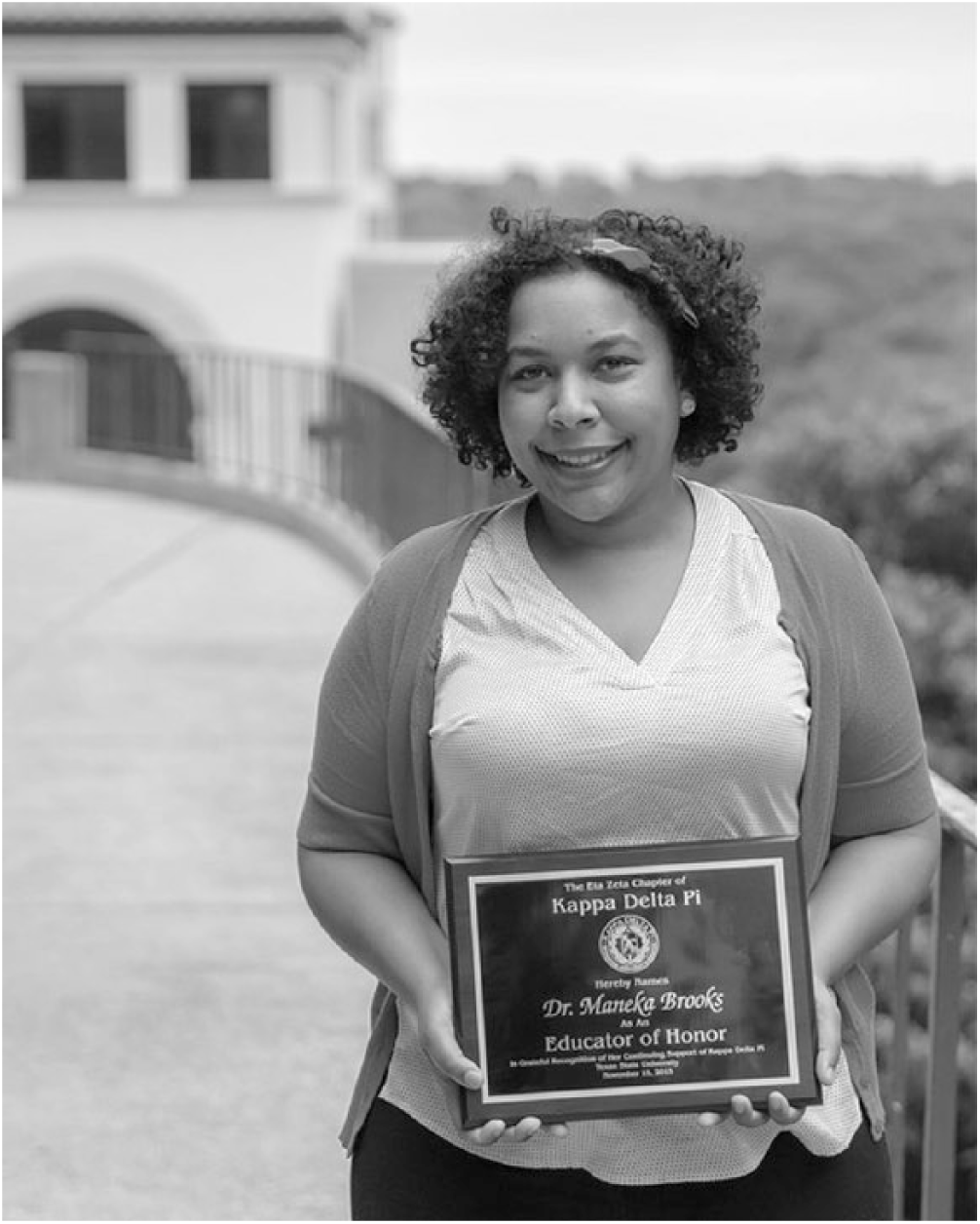
A photograph of myself in November 2015.
Coded Comparative Study Suggestion
The next interaction occurred more frequently when I was a doctoral student. During this time period, I was in more situations in which I was discussing research methodology with multiple audiences. This type of interaction usually begins with what appears to be an innocuous suggestion about research methodology.
Why don’t you do a comparative study with African Americans? It would make it have a wonderful connection to your community.
This initial methodological suggestion could add richness to my work and contribute to a unique perspective within the literature. However, the follow-up statement illustrates the underlying premise for the question. Unlike the Latina Question, in which the individual sought to interrogate my ethnic background, this person assigns me a particular racial identity. Then, they suggest a comparative study to facilitate the necessary “community” connection that would justify my research.
Miscellaneous Academics’ Assumptions About Community
The first few times that I experienced this type of research policing, it was shocking to me. Once these interactions became more commonplace, I started to think about the underlying assumptions about research and people “like me” that my conversation partners held. Eventually, I came to recognize two key assumptions. The first assumption is that by looking at me or asking specific questions related to race and ethnicity, they are able to determine who is a part of my community. The second assumption is that the language and literacy research in which I engage and my passion for educational equity should be limited to those whom they determine to be a part of my community. These two assumptions reflect a broader conception that people who belong to groups that are underserved by schools should conduct research that is connected to their personal experiences. Once I was able to identify these underlying ways of thinking, I came to recognize that I was not unique in being the target of this fallacy. I saw how these expected connections operate along lines of race/ethnicity, sexual orientation, language background, immigration history, culture, and their intersections for others in my social circles. For example, I have witnessed academics assume that because someone is an immigrant to the United States, her research focuses on immigrant students.
The types of interactions that I experienced were not described in my journey of reading about the experiences of Women of Color educational researchers in the United States. I contend that the previously described interactions with miscellaneous academics were specifically tied to the fact that I am a Black and Tamil woman who engages in research with Latinx students. This interpretation was reinforced by the fact that I was asked about making my research more appropriate to my “community” in situations in which White graduate students and professors who engaged in similar types of research were not. As a young researcher, the message that I received from these targeted questions was that White people could research whatever topic they want. However, my work as a Woman of Color should be limited to topics that others interpreted as explicitly connected to my personal experiences. In this next section, I describe how I negotiated these experiences because I want to provide a possible road map for others who may be dissuaded by attempts at research policing initiated by the miscellaneous academics they encounter.
Defining Community in My Terms
In spite of these explicit messages that my focus on bilingualism, Latinx students, and literacy was not “appropriate” for someone like me, I am now a tenure-track faculty member who recently completed a second research project about similar topics. However, it is important to acknowledge that my perseverance was not solely the result of individual will. It is also a reflection of the support of others. My dissertation advisor, Guadalupe Valdés, was (and still is) an unwavering advocate for me and my work. I am connected to a network of supportive senior faculty, fellow early career faculty, and graduate students I met in classes, at conferences, and through the National Council of Teachers of English Research Foundation’s Cultivating New Voices Among Scholars of Color fellowship and the Literacy Research Association’s STAR (Scholars of Color Transitioning Into Academic Research Institutions) mentoring program. In addition, I have the steadfast backing of my family and friends. Most importantly, the adolescents with whom I work find value in what I do (see Figure 2).
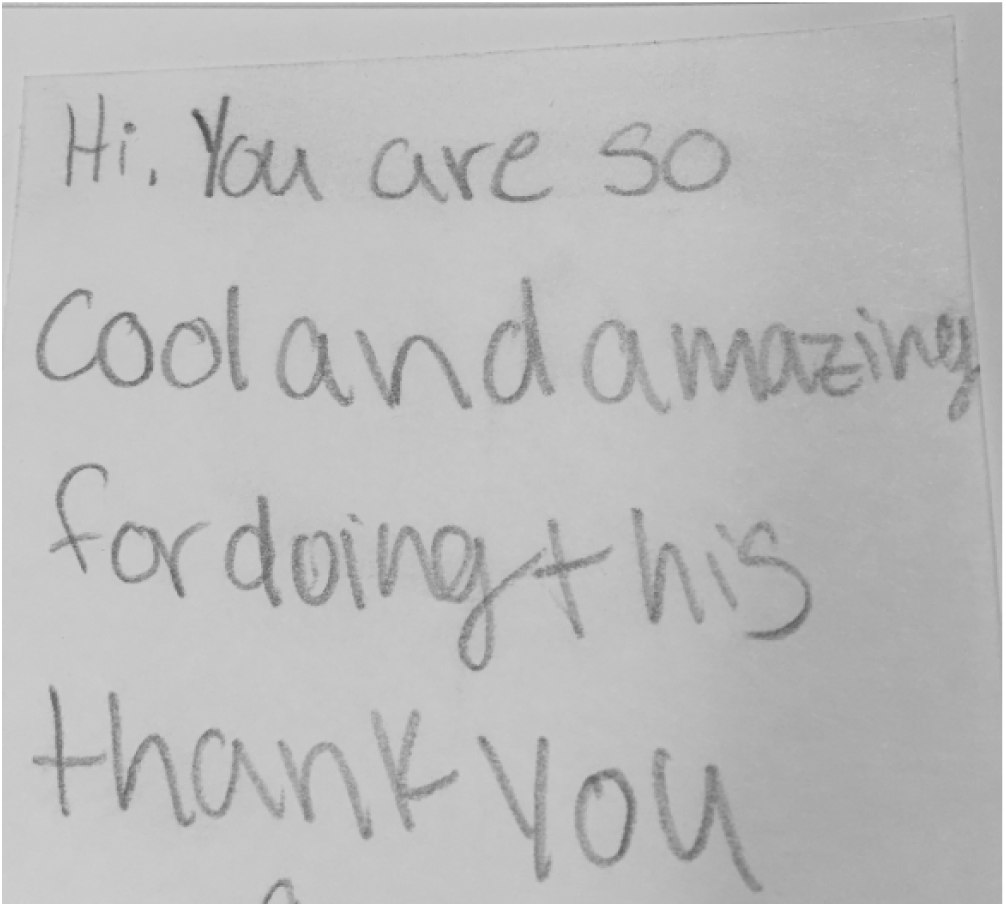
A note written from a research participant in postdissertation research.
It is not solely these external supports that have allowed me to continue on my desired trajectory as an academic. While I would like to share a valiant story about how I stood up for myself against these attempts at research policing, I did not. Instead of speaking out at that time, I decided that I was going to reclaim the word community on my own terms. Like those miscellaneous academics, I do think that my research should be about my community. However, my conceptualization of community is not merely a more socially acceptable way of talking about expectations for me to engage in race-matched research. My conception of community reflects my life history as a multiracial woman. Like other Women of Color researchers in education (e.g., Haddix, 2016; Kinloch, 2010; Willis, 2015), I explicitly situate my strength and commitment to fight for educational equity in both my individual and familial life histories. In the following section, I explain how I define community and why it is important to my equity-focused research.
Multiracial Me
I am a multiracial person who grew up in a household with parents who were raised in very different places than I was. My Black father is from Alabama. My Tamil mother was raised between England, Sri Lanka, and Zambia. My younger brother and I were not raised near a large number of extended family. We had a network of fictive kin; they were primarily immigrants or children of immigrants from Mexico, Central America, the Caribbean, South America, and Africa.
When my parents told stories to my younger brother and me about their childhood, they were so distant from our everyday reality that they seemed fictional. For instance, it was only after I entered college that I realized that my dad was not joking when he said that he picked cotton as a child. It was not until my maternal grandmother emigrated from Sri Lanka to the United States in the middle of elementary school that I had a conceptualization of what being Tamil meant. I remember thinking that my mom was White, then I thought she was Mexican, then I thought she was Indian, and finally I realized she was Sri Lankan. My first memory of being surrounded by people who looked like me was when I participated in a study-abroad program in Cuba. I remember marveling in the new feeling of looking “normal”.
Recently, I realized that religious institutions are another place in which many people find connections with others. I did not have this experience growing up. My brother and I were not raised with a particular organized religion. However, we were encouraged to learn about many faiths. We went to our friends’ religious ceremonies. By the time I was in high school, I had attended various ceremonies at synagogues, mosques, Hindu and Buddhist temples, and a variety of Protestant and Catholic churches. In these contexts, I was an outsider who respectfully participated in someone else’s traditions.
As an adult, I am part of a second-generation multiracial family. My husband is a White and Mexican American man who was born in Texas but spent his elementary school years in Mexico. Just like my mother and father, my husband and I were not raised speaking the same languages or practicing the same faith, nor were we born in the same region. I share these aspects of my background because my life history is fundamentally connected with the way I conceptualize community. My identification with others has never been based on a commonality of physical features, linguistic practices, religion, or other predominant ways in which human beings are commonly categorized. It was not a possibility to rely on these normative conceptualizations because I have always been in an environment in which those who were important to me did not share my life experiences or social locations.
As a result of my life history, I have had to cultivate a very broad conception of shared identities and experiences. The theme of shared experiences underlies many of the descriptions of community that I have come across in the existing research literature. These shared connections can be seen as being tangible or imagined (e.g., Kanno & Norton, 2003). Shared experiences can include professional endeavors. For example, Bertrand (2014) uses the term research community to invoke all of those who are involved in the production and dissemination of research. Shared experiences can interconnect in multiple ways. One of the participants in Kinloch’s (2010) book, Khaleeq, describes the city of Harlem as being a community with little communities in it” (p. 21). Among other features, Khaleeq highlights that community in this context can include shared space, shared beliefs, and shared interactions.
In my work as a researcher, I understand shared experiences between myself and my participants to be based on the experience of not fitting into a predominant narrative about who others feel we should be. For instance, an implicit dominant narrative that underscores the interactions between me and miscellaneous academics is that Researchers of Color should do research that is aligned explicitly with their personal identities. For the young people with whom I work, an explicit dominant narrative that guides their education is that low standardized English literacy test scores are evidence that they have yet to acquire English proficiency. Just as in my professional choices, I push back against dominant expectations for Researchers of Color, my research points out the flaws with the automatic assumption that these test scores are evidence that the students have yet to acquire English (e.g., Brooks, 2015, 2016a, 2016b).
The Intersections of Racialized Schooling Histories and Research
My interpretation of community has permitted me to sustain focus during my doctoral program and my first years on the tenure track. It has prevented me from falling prey to others’ attempts to discourage my research about topics of educational equity that related to Latinx students, bilingualism, literacy, and language proficiency. My conceptualization of community centers on how I see myself and my relationship to the world. Focusing on myself is a professional necessity as a Woman of Color navigating academia; however, centering myself in the research process is dangerous. There is the hazard of falling into what Milner (2007) terms color-blind and culture-blind research. He writes that this type of research “can potentially lead to the dangers of exploitation and misrepresentation of individuals and communities of color” (p. 392). If I am not careful, my expansive conceptualization of community can become a call to erase life differences between me and the participants in my research.
Importantly, as Milner and other scholars (e.g., Foster, 1994; Green, 2014; Mangual Figueroa, 2014; Martinez, 2016) have noted, limiting research to those individuals who share certain identities does not eliminate the dangers of color- and culture-blind research. All researchers must be cognizant of how differences in lived experiences can affect research. For example, Rodela (2014, 2016) talks about these tensions in her ethnographic work as a Chicana mother with Mexican and Guatemalan immigrant mothers. While acknowledging a shared experience of racialization and motherhood, she notes, “I also had to be reflexive of my social, economic, and cultural location during the research” (Rodela, 2016, p. 23). For those who seek to engage in research across boundaries that have material impacts on people’s lives (e.g., race/ethnicity, gender, etc.), there is a necessity for additional levels of self-awareness. In the next section, I provide an example of what this self-awareness looks like in a context where both the researcher and participants are People of Color; however, they do not share the same ethnoracial identity. Specifically, I draw from my dissertation research (Brooks, 2013), which was a multiple case study that examined the linguistic histories, in-school reading experiences, and individual reading practices of five English-speaking bilingual Latinas who had remained classified as English learners since kindergarten.
Two Experiences of Segregated Schools
The miscellaneous academics who engaged in research policing saw a chasm between me and the adolescents with whom I was working as attributable to our different ethnoracial identities and as too large to cross. They only saw a lack of community, and they wanted me to stick to what they perceived to be my own “kind.” In the context of my own dissertation research, I do not think the fact that I am not Latina had the potential to become the biggest barrier between the five young women and me. Instead, it was our disparate racialized experiences of formal schooling.
The majority of my K-12 education took place in a predominantly White private school that I attended on scholarship. When I attended more racially and socioeconomically diverse public schools, I was educated in Advanced Placement (AP) and honors courses where White middle-class and upper-middle-class students were overrepresented. Within this academic context, I flourished. The fact that I was successful did not mean that I did not have negative experiences attending these well-resourced schools. However, these negative experiences were of the kind in which failed attempts at being inclusive usually made it evident that I was culturally misunderstood and racially essentialized. A number of these experiences centered around racial spotlighting. Informed by the work of hooks, D. Carter (2008) writes that students described this experience as taking place when they were “positioned by White teachers and White peers as native informants” (p. 232). While I did not like the feeling of being a spokesperson for Blackness, I considered this role to be a normal part of “doing school.” It was not until I was an adult that I realized that my White classmates never had this extra burden. In spite of these negative occurrences, I still loved and felt very comfortable in school.
The five teenagers who were involved in my dissertation research experienced a different side of the ethnoracial and economic segregation of schools in the United States. They attended public schools in which Latinx students constituted the majority and in which most of the students were eligible for free and reduced-fee lunch. Racialized systemic neglect and the withholding of equitable resources characterized the majority of their education. For example, they attended middle schools that were overcrowded, understaffed, and underfunded. One teenager shared that remaining silent was the way she achieved good grades in middle school. Since the classes were overcrowded, she saw this strategy as an effective way to please teachers. Another adolescent shared how she did not have a permanent classroom teacher for her English language arts class in eighth grade. Instead, she had a series of substitute teachers. These young people’s experiences are not atypical for Students of Color in the United States (e.g., P. Carter, 2009; Darling-Hammond, 2013; Gifford & Valdés, 2006).
In the spectrum of racialized schooling experiences, my K-12 education could be characterized by “covert or everyday forms of systemic racism used to keep those at the racial margins in their place” (Kohli & Solórzano, 2012, p. 447). However, these types of experiences took place within very well-resourced schools. On the other hand, the teenagers with whom I was working experienced the brunt of systemic racism. As a result of our distinct racialized experiences of schooling, our affiliations with the institution of schooling and adults within schools often differed. For example, during a classroom observation, there was a substitute teacher who gave the students an assignment on which they could work individually or in small groups. During this work session, Eliza 4 (one of the focal students) asked me to come sit by her so that we could chat. Although I felt uncomfortable about disrespecting the substitute teacher, I decided to talk with her. However, I asked her to at least pretend that she was completing the assignment. When I told her that I felt bad about talking in front of the substitute teacher, she said, “Aw, Miss, he doesn’t matter.” Then, she stopped pretending to do her work and told me about her weekend plans and her family. I remained seated next to Eliza and listened to her talk.
During this interaction, I accepted Eliza’s invitation to talk because I saw it as her attempt to get to know me better. After all, I was an unfamiliar adult who had appeared in her classroom to ask her whether she wanted to participate in a research project. Once class was dismissed, there was another moment for me to sit back and interpret Eliza’s comment about the substitute teacher. I asked myself how I was to understand Eliza’s comment that the substitute didn’t matter. If I only looked through my experience of schooling, I could see her as a teenager with a penchant for challenging authority. Instead, I put my perspective to the periphery and examined this interaction within the history that Eliza had shared with me about her experiences with substitute teachers in middle school. Immediately, it became evident that Eliza knew something about schooling and substitute teachers that I did not. I never attended a school where temporary teachers were a primary way in which I was expected to be educated. She knew that they “didn’t matter” because substitutes frequently showed up for a couple of days as “babysitters” and then left. Nevertheless, I had to push my own perspectives to the side so that I could hear what she was saying.
Learning Through Differences
As an educational researcher, learning from Eliza and the four other focal students entailed shifting my personal ideas about schooling to the periphery. Over the course of my time with these five teenagers, I changed the way I carried myself in the classroom and interacted with young people. I did not ask the focal students or other young people in the classroom to put away their cell phones, stop copying other people’s homework, watch their language, focus on the academic tasks, or conform to the requests of authority figures (e.g., substitute teachers). I pretended not to see minor misbehavior, or when it was obvious that I saw them, I remained silent. While these interactions may seem small (and outside the realm of the actions in which a researcher should engage), they required that I explicitly choose young people over my affiliation to the rules and regulations of the institution of schooling. Instead of seeking to be another adult authority figure in the classroom who sought to shape their behavior, 5 I learned to understand their perspectives on the hows and whys of classroom life. I had to recognize my status as someone who did not understand because I had never been a student in that kind of institution of formal schooling.
Conclusion
In this critical autobiographical reflection, I highlighted how I have navigated two tensions that have characterized my experience as a multiracial researcher who engages in cross-racial research. In my life as a graduate student and early career academic, I have had to fight against research policing because certain miscellaneous academics thought that my research was not “appropriate” because it does not fit into their racialized understanding of who a Black and Tamil woman can be as a researcher. To advocate for myself to be a part of this conversation, I have had to center my vision of community and use it as a motivation to continue along the pathway toward my research-based social justice goals. At the same time, I have had to learn to put my worldview and accompanying privileges on the back burner to learn about the experiences of the Latinx adolescents with whom I work. This aspect of my research requires that I learn to take a step into the background and let young people lead. The journey of learning to balance centering myself and pushing myself to the periphery has been fundamental to my growth into a more confident and equity-focused scholar.
Using my personal ideas about community as motivation for engaging in research, while not using them as a tool of erasure, is fundamental to how I engage in humanizing research (Paris, 2011; Paris & Winn, 2014). Paris (2011) describes humanizing research as a “methodological stance which requires that our inquiries involve dialogic consciousness-raising and the building of relationships of care and dignity for both researchers and participants” (pp. 139-140). Being a Black and Tamil woman engaging in research with Latinx students requires that I think deeply about how our racialized experiences of schooling are distinct. This analysis reinforces the necessity of acknowledging that while all People of Color experience racial or ethnic marginalization, they do not experience this marginalization in similar ways or to the same extent. In conducting my dissertation research, I had to move from knowing this in theory to applying it on a day-to-day basis.
The previously described lessons are embedded in my life experiences as a multiracial woman who engages in cross-racial research. I decided to share these stories because it is important to have a multiplicity of narratives about the experiences of Researchers of Color overall, and Women of Color in educational research in particular. Specifically, this article was written for those Women of Color who do not fit into dominant narratives about what type of research people “like them” are supposed to do, and as a result their experiences are often unaddressed and unheard. I draw on the words of Delgado (1989) to situate why sharing these stories is important: “Storytelling emboldens the hearer, who may have had the same thoughts and experiences the storyteller describes, but hesitated to give them voice. Having heard another express them, he or she realizes, I am not alone” (p. 2437). To truly cultivate a diverse professoriate and diverse perspectives within language and literacy research, narratives about research experiences need to explore a broad range of understandings. This contribution represents my addition to the scholarship that offered me a lifeline as a doctoral student and still does as an early career researcher.
Footnotes
Acknowledgements
The author is indebted to Maribel Santiago for her insightful comments on multiple drafts of this article. She thanks Misty Sailors, Lamar Johnson, and the anonymous reviewers for their discerning feedback. Finally, she acknowledges the Literacy Research Association for funding the STAR Mentorship program that enabled her to find a home within this organization. Any opinions, findings, and conclusions or recommendations expressed in this article are those of the author and do not necessarily reflect the views of the individuals who are acknowledged above.
Declaration of Conflicting Interests
The author(s) declared no potential conflicts of interest with respect to the research, authorship, and/or publication of this article.
Funding
The author(s) received no financial support for the research, authorship, and/or publication of this article.
