




Abstract
Using qualitative methodology, this research examines how graduates of a K-5 dual language immersion program have experienced multiple and competing social, cultural, institutional, and political forces at play in complex processes that ultimately affect one’s mobilities of language, literacy, and learning. These students have now grown into adulthood, and the extent to which their past experiences as dual language students have affected their current language and literacy ideologies and practices is examined. As graduates experienced and internalized notions of Spanish as social, cultural, economic, and literacy capital, this likely contributed to current ideologies that greatly esteem bilingualism and biliteracy. The findings highlight that ideologies of language and literacy are neither static nor fixed, but over time, they have been molded and reshaped in a very fluid and lively process.
Keywords
Dual language programs have been the subject of considerable research because of their unique instructional approach. These programs provide literacy and content instruction to all students in two languages and promote bilingualism and biliteracy (Howard, Sugarman, Christian, Lindholm-Leary, & Rogers, 2007) while emphasizing interculturality and appreciation for different ways of being in and seeing the world (Baker, 2006). Many view dual language immersion models as producing high academic outcomes (Collier & Thomas, 2004) for both language minority and language majority learners, yet these programs and schools often find themselves at the heart of larger sociopolitical debates surrounding language and literacy. These ideological battles create a complicated and multilayered backdrop as families, teachers, administrators, and students at these schools find themselves “in the eye of the storm” (González, 2005) due to the contentious nature of historically constituted conceptions regarding language use. This article explores the ideological dimensions and mobilities of dual language learners’ “beliefs, feelings and conceptions about language structure and use” (Kroskrity, 2010, p. 192) with a lens toward understanding more deeply how linguistic awareness and consciousness are shaped and influenced by circulating discourses and social structures. Since the publication of Street’s (1984) paradigm-shifting text challenging autonomous models of literacy, literacy has increasingly been viewed as ideological in nature and situated within social structures. By arguing that literacy is dependent on everyday social context and social institutions and is inseparable from the political and ideological motivations that underlie it, Street claimed the meaning of literacy is constructed by the processes within which it is learned. This study examines the language and literacy ideologies of graduates of a dual language immersion program as they have grown into adulthood, and it informs work not only on dual language schooling but also on how embedding language and literacy in relationship to ideologies means understanding how literacy in two languages gets valued (or devalued) at multiple levels, and how it is imbued with complex social meanings. Because issues of dual language schooling and bilingual education have been fraught with divisive and contesting discourses, an ideological lens allows an examination of how conceptualizations of language and literacy are historically situated within particular locales and how language and literacy ideologies can be constructed as dynamic and active, not static, taking on different forms across multiple mediums and contexts.
For former students at Dalton (all names are pseudonyms), a K-5 dual language immersion school, issues of language, literacy, bilingualism, and biliteracy were at the center of an integrated learning environment; families, teachers, staff, and administrators endeavored to promote both Spanish and English in a supportive and linguistically rich context. From age 5, students at Dalton experienced the interfacing of beliefs, ideas, values, and systems of thinking through their shared language and literacy experiences. The students’ experiences as emergent bilinguals within the setting of this school were foundational for their long-term academic outcomes and their deep metapragmatic awareness of simultaneous linguistic experiences.
Beyond the specifics of this particular learning environment, broader questions of the “mobilities of learning” emerge as we consider how shifting linguistic and sociopolitical landscapes affect the construction of knowledge. Leander, Phillips, and Taylor (2010) capture the breadth and depth of these mobilities as they inquire:
How are the dynamically moving elements of social systems and distributions, including people themselves and all manner of resources for learning as well, configured and reconfigured across space and time to create opportunities to learn? These categories of inquiry . . . [expand] the conversation concerning sociocultural “learning environments” and opportunities to learn to one of “geographies of learning” and “mobilities of learning.” (p. 331)
Participants in this study, former students of Dalton, have built on a strong tradition of inquiry from their elementary school environment, allowing them to create “geographies” and “mobilities” of learning that have been “configured and reconfigured” as they have encountered and engaged with circulating discourses surrounding language, literacy, bilingualism, and biliteracy. How can the mobilities of learning environments for graduates of Dalton be captured and described? Years after those formative experiences, where are these students now? What happened after these students left this setting? The students have now grown into adulthood, and the extent to which their past experiences as dual language students have affected their current language and literacy ideologies and practices is examined.
As we encounter the fluidity of how resources for learning can be transformed across multiple landscapes, important questions arise concerning how retrospective analyses of previous learning environments have shaped students’ current lived experiences. This is particularly salient for students whose schooling experiences were intentionally structured to foster multiple and global perspectives in terms of bilingualism and biliteracy. This study attempts to capture perspectives and experiences of graduates of this dual language program to document their lived experiences as they reflect on their childhood, adolescence, and current lives. Using qualitative methodology, the following research questions are addressed:
Theoretical Framework
New Literacy Studies (NLS) is an overarching lens for this study, which incorporates concepts of language ideologies and forms of capital as subtheories to underscore and extend the NLS framework. These lenses are complementary in their emphasis on relationships of power and privilege inherent in language and literacy practices; together, a more expansive framework emerges that can more adequately capture the complex experiences of dual language graduates.
NLS
What has come to be called the NLS framework (Gee, 2008; Street, 1995) offers an alternative to a cognitive, individualistic, autonomous view of literacy, turning instead to a sociocultural view that foregrounds the social, cultural, historical, and institutional dynamics embedded in literacy practices (Gee, Hull, & Lankshear, 1996; Street, 2003). NLS scholars have called for an ideological approach, where literacy practices must be contextualized within contexts and power relations, which are socially and historically constituted (Luke, 2003; Street, 1999). Street’s (1984) distinction between autonomous and ideological models of literacy emphasizes ways in which the wider political, social, and ideological context should be part of our understanding of literacy where relations of power index even the very assumptions about literacy.
Ideologies can be considered as foundational belief systems shared by members of social groups; these shared beliefs are “fundamental” or “axiomatic” and are of a rather broad or abstract nature (van Dijk, 2006a). They are socially shared and are a form of social representation (van Dijk, 2006b), and as Hall (1995) further asserts, “the transformation of ideologies is thus a collective process and practice, not an individual one. Largely, the processes work unconsciously, rather than by conscious intention. Ideologies produce different forms of social consciousness, rather than being produced by them” (p. 90). As Gee (2008) has claimed, each of us “live[s] and communicate[s] with and through ‘ideology’” (p. 29). Gee brings together concepts of ideologies and discourses and positions ideologies in relation to cultural models, arguing these are “the ideology through which we see our worlds”; we are both “beneficiaries” and “victims” of ideologies in that sense because we speak a language and live within a culture (p. 29). Although there are differing lines of thought about how ideology can be theorized (Eagleton, 1991), the assumption here is that ideologies help coordinate actions in relation to interests of a particular group. They summarize who “we” are in relation to “they,” reflecting and constituting relations of power.
Language ideologies
Conceptions of language ideologies are similarly situated within an analysis of relationships of power and social position. Although there is scholarly variation in how the idea of language ideology is used as an analytical framework, Woolard (1998) identifies three strands that underlie the framework: (a) Language ideologies are conceptual, having to do with consciousness and subjectivities; (b) they originate from and are rooted in the social and the experiential; and (c) they are directly related to social, economic, and political positions of power. Language ideologies are implicit and sometimes unrecognized judgments of how language is used and valued and how speakers of the language are positioned within social and political landscapes and can make a difference in the resources available to the language users. González (2005) examines language ideologies in this same dual language school and emphasized “competing metadiscourses” surrounding the privileging of the minoritized language within a volatile and politically charged context, as well as children’s ideologies concerning the market value of English. Similarly, the hardening of anti-immigrant sentiments and English-only campaigns form an ideological backdrop to how language and literacy ideologies profoundly affect students and schools.
Capital
Language ideologies reflect a stance on the resources or capital available to and within language communities. Hence, literature related to economic, social, and cultural capital is pertinent to understanding how language ideologies can work within the acquisition and maintenance of power and certain forms of capital. Capital, in its most rudimentary form, describes how something can be translated into an asset, benefit, or advantage for an individual.
The notion of capital has been applied by critical theorists like Bourdieu (1986) and Luke (1996), describing ways in which particular social groups reproduce privilege through social and cultural capital. The concept has been used to describe the various cultural, economic, and social advantages ascribed to people or groups that privilege them in particular contexts. According to Bourdieu, social capital involves cumulative resources linked to social networks or memberships that serve to collectively benefit those within the group or network (Bourdieu, 1986). Stanton-Salazar (2001) uses the idea of social capital to highlight ways in which social relationships and properties associated with them, “when activated, enable them to accomplish their goals or empower themselves in some meaningful way” (p. 265). Similarly, cultural capital (Bourdieu & Passeron, 1977) can be described as “high status, cultural signals used in cultural and social selection” that are used to understand “how culture and education contribute to social reproduction” (Lamont & Lareau, 1988, p. 153). According to Bourdieu, social and cultural capital can be converted to economic capital, including academic and institutionalized gains. Ideological dynamics shape all forms of capital with respect to the value they hold in a social field (Bourdieu, 1991).
Drawing on Bourdieuian concepts of social, economic, and cultural capital, Compton-Lilly (2007) designates what she calls “reading capital.” This notion is an application of Bourdieu’s concept of capital, but it is used to “identify and explore the ways children are valued or not valued as readers in schools,” which “reveals how particular groups of people and individuals are favored in terms of their recognized success with reading” (Compton-Lilly, 2007, p. 115).
The concept of capital, then, can be a lens for understanding ways in which bilingual and biliterate practices are valued, recognized, and used to graduates’ benefit. Lam and Warriner (2012) expand on this concept, stating,
These bilingual skills or the ability to move across languages and cultures constitute a highly valuable asset when combined with other professional qualifications in a globalizing and transnational economy . . . [;] their literate cultural capital takes on different values depending on the rules of recognition and conversion in these fields. (pp. 192-193)
Considering the forms of capital in this way can nuance our understanding of how dual language graduates leverage and convert their bilingual and biliterate practices and proficiencies to their benefit.
Lenses for This Research
Ultimately, an NLS framework affords one the opportunity to look at how literacy practices are embedded in broader ideological contexts and are situated socially within institutions, power relationships, and intercultural perspectives. By understanding NLS through an emphasis on language ideologies and forms of capital, these frameworks capture how shifting language and literacy ideologies have influenced and been influenced by graduates’ bilingual and biliterate practices, and how graduates have moved across and through learning trajectories and have shaped and been shaped by mobilities of ideologies and circulating discourses.
The interconnectedness of language and literacy ideologies across space and time shapes the experiences of graduates. Both time and space are dimensions of social contexts (Compton-Lilly, 2014; Sztompka, 1993) that shape literacy practices, as ideological, political, and historical contingencies are embedded within our cultural engagements with texts. Although there are important spatial dimensions to this research that are highlighted in relation to context, the primary focus of this article is on issues of mobilities across time as graduates have moved from childhood to adulthood. Spatial dimensions inherent in this work are addressed more fully separately as part of a larger study, illuminating how graduates moved fluidly in and out of social fields and, through their participation in communities of practice, experienced increased opportunities for meaningful language and literacy practices and rich learning experiences (Granados, 2015).
Review of Literature
Language and literacy ideologies provide a compelling theoretical framework for studying communicative practices of dual language graduates by tracing notions of language use across time and within particular sociopolitical contexts. Within school settings, some research has suggested that holding both languages in equal status within the walls of the school can help students develop high proficiency in both languages (Cloud, Genesee, & Hamayan, 2000), although as Griego-Jones (1994) points out, children are still highly receptive to larger political ideologies related to languages. Relaño Pastor (2008) similarly documents competing language ideologies of preschool children where she examined how language ideologies are endorsed and countered in naturally occurring situations as young children process contested language ideologies. In one example from her study, a young boy initiated a conversation in Spanish, only to be silenced by a peer who exclaimed, “No Spanish, Jonas” (Relaño Pastor, 2008, p. 15). Although the teacher assured the student that Spanish was acceptable, this example illustrates the complexity of children’s conflicted ideologies as they engage in literacy-related tasks, negotiating how to operate and navigate multilayered linguistic landscapes.
Other research indicates how parental language ideologies about the marketability and desirability of English for future economic success are implicated in how parents view bilingual education, translating linguistic capital into economic capital. In Reyes’s (2011) study, 20 out of 20 parents maintain they highly support their children’s bilingualism, with maintenance of Spanish in the home. Many of the mothers contend they rely on the school system to teach their children both English and Spanish literacy skills. Some, however, insist that the two languages be kept separate, with Spanish in the home and strictly English at school, a setup they believe will give their children the greatest opportunities educationally and in their future career goals.
Previous studies have been conducted at the same school site as this study, and they have documented that although children’s language and literacy in both Spanish and English were supported and encouraged within the walls of the school, the prevailing negative and restrictive English-only ideologies of the state could not be ignored (González, 2005). In addition, these studies illustrate how children in one cohort become literate in both Spanish and English, though to varying degrees and with different outcomes (Smith, 2000; Smith & Arnot-Hopffer, 1998). The students’ biliteracy develops in different ways, along different paths, and through different experiences, underscoring the multiple contextual dynamics continually at play.
In a longitudinal study with students from this school site, Arnot-Hopffer (2007) followed three girls from elementary through middle school, examining their language and literacy development in Spanish and English. Her research highlights how the meaning-making processes of the girls occurred in complex ways and within different communities of practice. The girls are “incorporated into circulating and competing metadiscourses on biliteracy, bilingual education, and borderlands language practice” (Arnot-Hopffer, 2007. p. 128). One participant, Jessica, despite the fact that she spoke only Spanish at that time, told her kindergarten teacher (in Spanish) that she would eventually speak only English because she did not like Spanish much. Jessica predicted that by third grade, she would be speaking only English, even though Spanish was the language of her home. In Jessica’s case, there was no unilinear transfer of beliefs passed down from her parents or teachers. Even at the young age of 5 years, Jessica embodied and articulated contradictory language ideologies, linked to the larger consequences for Spanish speakers. Jessica was remarkably prescient, as this present study resumes the narrative of students at this school and provides the opportunity to document what has happened to them as they were caught in the nexus of dominant language ideologies and how, as Jessica foretold, many would eventually speak primarily in English in their day-to-day interactions. This literature suggests how language ideologies can reflect a view of English as a form of capital, a necessity for success and marketable skills in this country. Yet in some cases, historical punitive language policies have sought to erase Spanish in the schools. Such (at times opposing) language ideologies raise important questions regarding the linkages of language, learning, and lived bilingual and biliterate experiences. This study explores the complexities of how language and literacy ideologies both enable and constrain dual language graduates who were exposed to competing forces at a young age and throughout their lives, and how these graduates have come to understand their language, literacy, and ideological formations over time.
Method
The School Site and Neighborhood at Time Graduates Attended
Built in 1901, Dalton is one of the oldest schools in the southwestern city. Before even entering the schools’ walls, students immediately were presented with a sense of the school’s historical and cultural roots, as it displayed a large mural of an antiquated train that was the subject of local Mexican folklore. Dalton had become a bilingual magnet school in 1981. Participants in the present study were elementary students between 1992 and 2003, at a time when 65% of students came from around the city and the remaining 35% of students came from the neighborhood. The courts had mandated a desegregation order with the goal of achieving racial balance, but because of the large Latino population in the community, White students were given priority in school admission. For the older participants in the study, students from the larger community who chose the designation of “Hispanic” on the school district application form were put on a waiting list that often stretched for several years. Because of the popularity of the program, a lottery system was later put in place, which is how younger participants in the study were selected to attend Dalton.
At the time the participants were in the dual language program, the student body was 66% Latino and 23% White, with African American, Native American, and Asian American students composing the remaining 11% (Smith, 2001). The majority of teachers and staff were also Latino, and all were bilingual Spanish–English speakers. Despite the large number of Latino students, most children entered the school as English-dominant speakers with considerable knowledge of English (Smith et al., 2002). Under the dual language immersion program at Dalton, students from any language background received instruction solely in Spanish for kindergarten and first grade. By the time students reached the fifth grade, the curriculum was 70% Spanish and 30% English (Smith, 2000). This dual language curriculum model is still in place today at Dalton. In addition to its unique dual language immersion instruction, Dalton is and was known for its exceptional mariachi music and folklórico dance programs. More than 90% of students stayed after school for an extensive 2-hr after-school program where they participated in activities of their choice, such as music, dance, athletics, cooking, and even crochet.
Dalton is located in Barrio Amelia, one of the oldest neighborhoods in the city. Barrio Amelia was composed of primarily Mexican American families and lower socioeconomic status households (Smith, 2000). In past research at the school site, Smith (2001) outlines the ways in which students interacted with adult minority language speakers in the community through school-initiated events, including classroom participation by family members, field trips into the school neighborhood, and special community guests coming into the classroom. This connection between students and “historically accumulated” community knowledge and resources offered meaningful contexts to children’s language and literacy practices.
Participants
Participants in this study are graduates of this dual language school who have grown into adulthood and are now between the ages of 22 and 28. Participants are typically in college, recent college graduates, or just entering the job market and making critical decisions about their future. All the participants attended the dual language school during their elementary school years. While many went on to the same middle and high schools, others attended different middle and high schools and some even left the state. Some of the participants in this study were students in past research (e.g., Arnot-Hopffer, 2007; González & Arnot-Hopffer, 2002; Smith, 2000; Smith & Arnot-Hopffer, 1998), but some students who were involved in past research are not included in this study, and some participants in this study were not included in past research.
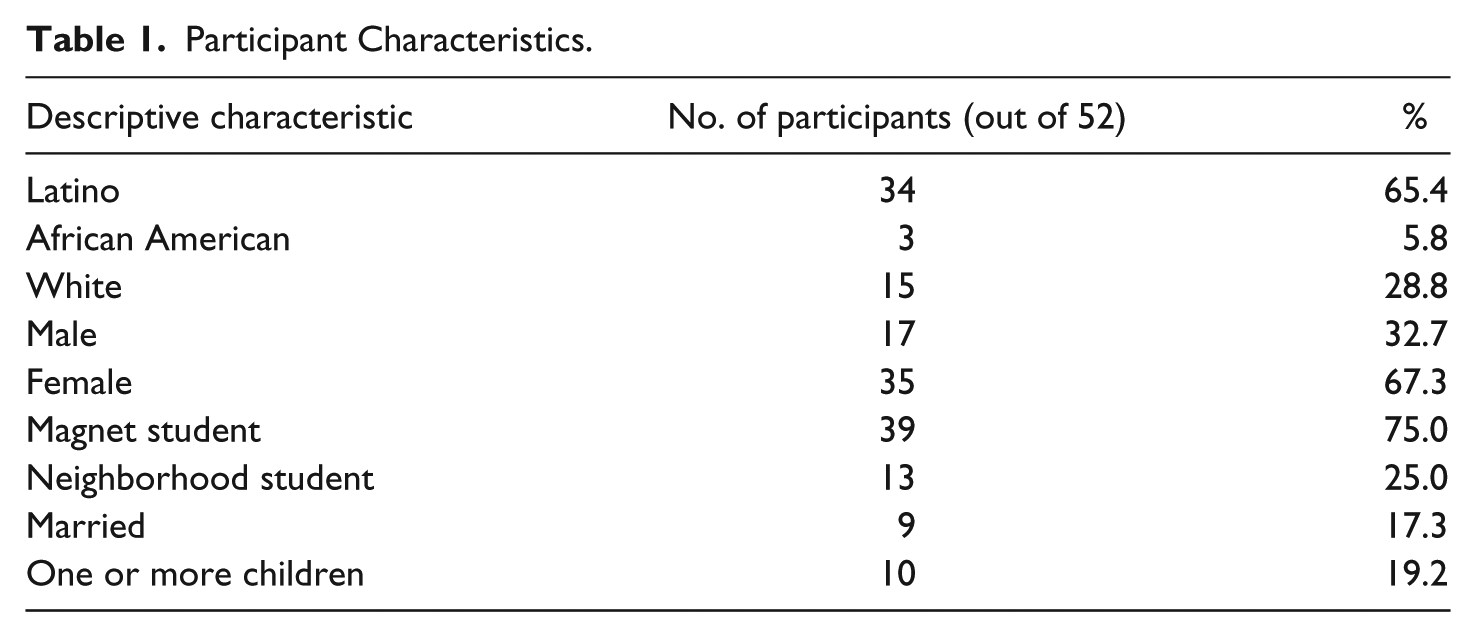
Participants were contacted through existing relationships to the researcher and extended social networks through the social media site Facebook. Graduates participated from their respective current locations, both locally and elsewhere. There are 52 participants in total in this research. Approximately 65% are Latino, 29% are White, and 6% are African American (see Table 1). Participants are 67% female and 33% male, and 75% were magnet students. In addition, 17% are married and 19% have one or more children.
Participant Characteristics.
All 52 participants contributed to an online discussion board. Of those, 10 participants who had contributed regularly to the discussion board were invited to join two separate focus group discussions based on their willingness to participate. Three participants were also selected as focal participants to further extend this research and gain deeper insight into the lives, language, and literacy of graduates. These three students were selected because each represents a uniquely different language and household background, each contributing a view to a larger picture of Dalton graduates’ language and literacy. Descriptions of the three focal participants follow.
Tara is from an English-speaking household and was a magnet student at Dalton. Her family background is Irish and German. After her sixth-grade year, her family moved to an affluent area in Southern California, where her exposure to Spanish all but disappeared. She holds a bachelor’s degree in sustainable agriculture and food systems and is beginning a master’s degree in the same field. She lived in Paraguay for 2 years as a Peace Corps volunteer and most recently worked as a third-grade teacher.
Julieta comes from a bilingual and bicultural household where she engaged in bilingual and biliterate practices on a daily basis. She, like the largest number of students in the school, is from a Latino middle-class household and is also a magnet student. She is heavily involved in mariachi, at times belonging to three different groups at once. Her mother has a very high level of Spanish and has served as a Spanish/English interpreter in the fields of medicine, law, and finance. Julieta likewise has developed a very high level of Spanish proficiency. She graduated with a bachelor of arts degree in psychology and currently works at a bank.
Jaime is the only participant of the three who comes from the neighborhood, Barrio Amelia. His primary caregivers were his mother and his grandmother. Though Spanish was the dominant language spoken by his caregivers, particularly his grandmother, Jaime nearly always chose to speak English, even from a young age. He comes from a household that reflects the demographics of the neighborhood, namely, Latino, working class, and low socioeconomic status. He completed some college courses, and though he never completed a formal degree, he now works as the director of a local animal shelter and oversees more than 100 employees. He, like Julieta, is also still heavily involved in mariachi and plays with a professional group. Currently, he lacks confidence in Spanish and avoids using it, but he describes how valuable he believes bilingualism is and wishes he had more confidence and proficiency in Spanish.
Researcher Positionality
My unique perspective stems from my role as a graduate of the same dual language immersion school, and having shared many of the same memories and experiences as the study participants. My father was born in Mexico and arrived in the United States at the age of 5 years. On my maternal side, I am a third-generation native of the southwestern city where the research took place. I come from a middle-class background, and like most graduates, I consider myself bilingual but English dominant. I am also in the same age range as participants, and many were my peers, acquaintances, or friends of my peers. One might assume my positionality as an “insider” as I am a bilingual native of the city, graduate of the same school, and peer of participants. However, in some ways, I was also considered an “outsider” as I was not from the barrio and my experiences were quite different from those of the students who grew up in Barrio Amelia, as is my socioeconomic status. My relationship with the participants perhaps increased a level of trust in terms of what they were willing to share. Throughout the course of data collection, I was able to relate to many of the participants’ recollections and experiences. In several interviews and conversations, I was familiar with terminology and nuances in remembrances, as well as unspoken descriptions and feelings. The collective shared memories of the sights and sounds of our school festivals as we entertained our parents with nostalgic mariachi music and the mutual unspoken understandings of our recollections about teachers, acquaintances, and events formed a communal tapestry that I embrace even now.
However, my “insider” positionality also provided certain challenges. I was concerned that participants might feel obligated to participate in the research at the risk of jeopardizing an existing relationship. To counter this, I insisted the research was completely voluntary and that graduates had every right to decline and it would not affect our relationship in any way. I also had to be careful not to assume or assign meaning because of my own experiences. I therefore made a consistent and conscious effort to take a step back to look at the whole picture, constantly engaging in a recursive questioning of myself as researcher to ensure that being “too close” was not having an adverse or partial effect on my interpretations. Although I adopted a dual role as researcher and participant, I reflectively drew on these theoretical lenses to understand complex and multilayered language and literacy processes among dual language graduates across time and space.
Data Collection
Three methods of data collection were employed in this study: an online discussion forum created through a social media group, focus group discussions, and interviews with three focal participants.
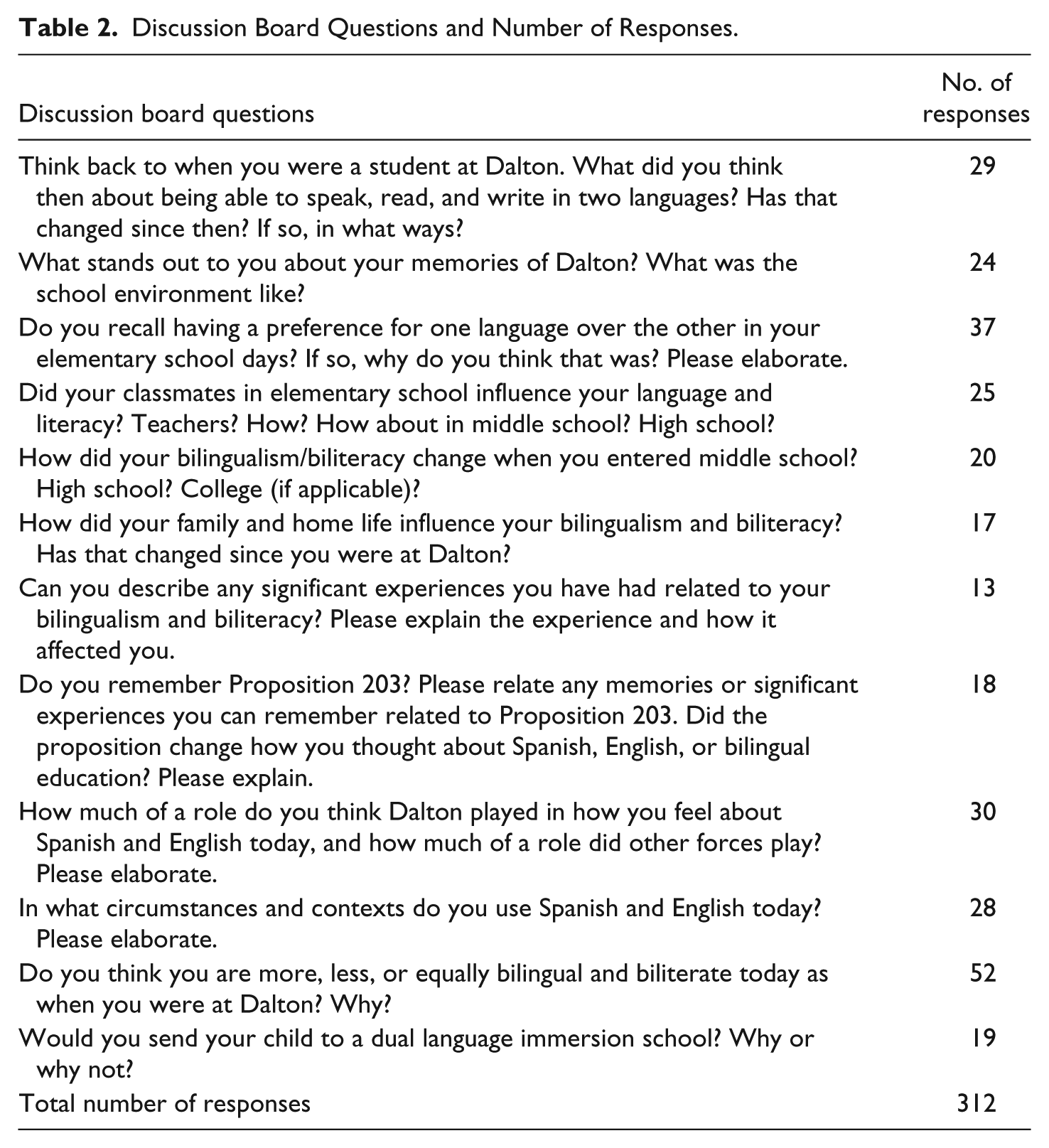
First, a social networking site, a Facebook group, was created for the purpose of this research (see Online Appendix A for a more detailed description of the social media site as a data collection tool). Participants were invited to join the Facebook group and encouraged to engage in conversations about past and present experiences related to their language and literacy. The first question I posted on the discussion board was, “Think back to when you were a student at Dalton. What did you think then about being able to speak, read, and write in two languages? Has that changed since then? If so, in what ways?” There were 29 responses to this question (see Table 2). Questions were posted periodically, and participants contributed as much or as little as they wished, some giving multiple answers to questions over the 5 months of data collection and others only posting once or twice. No specifications were given in terms of length requirements, number of postings, or types of responses to facilitate more organic responses. There was great variation in the length and detail of responses, but most ranged from a few sentences to a paragraph. The site became a useful medium to reach a larger number of participants in a modality that was familiar to and convenient for them (Lenhart, Purcell, Smith, & Zickuhr, 2010). The site also became a tool for participants to post relevant news articles, videos, and other digital media tangentially related to the topics at hand that the researcher did not specifically ask for, but which added an extra layer of richness to the data collection.
Discussion Board Questions and Number of Responses.
Second, 10 participants from the discussion board were invited to participate in two separate focus group discussions. These discussion groups were useful because they allowed for an environment where participants could express differing points of view and explore unanticipated issues in a socially oriented format (Marshall & Rossman, 2011). To foster a comfortable and relaxed environment that more closely resembled a conversation than an interview, participants were told they did not have to speak in any particular order. A list of questions was created that followed up on some points already raised on the discussion board or that were related to research questions. Examples of questions included the following: What are some memories you have of Dalton? How do you think Dalton made you feel about Spanish and about English? What happened to your language after you left Dalton? How was it different and how was it the same? Instead of adhering strictly to answering the questions, the conversation was allowed to flow naturally. Many of the participants already knew each other, and it was clear they felt comfortable sharing and discussing with one another in this setting.
The final step in the data collection process involved three one-on-one interviews with three focal participants. Taking direction from Seidman’s (2006) three-interview series process, this model placed the participants’ experiences in context through a deeper exploration of past and present experiences. The first interview focused on participants’ elementary school years. Examples of interview questions included the following: Why did your parents choose to send you to Dalton? What is your earliest memory of Dalton? What was the school environment like? The second interview focused on graduates’ experiences in adolescence. Sample questions included the following: Tell me what happened after you left Dalton. What was your middle school like? What type of role did language play during your middle school years? Do you think your perspective about being bilingual/biliterate changed when you moved from elementary school to middle school? What were you like in high school? The final interview explored focal participants’ post–high school and present lived experiences. Interview questions included the following: Tell me what happened after you left high school. How did you decide to pursue that path? How often and in what circumstances do you speak Spanish and English today? Did your experiences at Dalton influence the way you think about bilingualism and biliteracy today? If so, how?
Both focus groups and participant interviews lasted approximately 1 hr in length and were audiorecorded and transcribed verbatim to preserve the authenticity of the participants’ words (Marshall & Rossman, 2011). Informal field notes were also taken during focus groups and interviews, which were used to elaborate on any details that were possibly not captured by the recording (Emerson, Fretz, & Shaw, 2001), including facial expressions, gestures, and demonstrations of emotion that could only be captured in person.
Data Analysis
At the onset of the data analysis process, time was spent listening to each interview and focus group discussion while reviewing the transcripts. Notes were taken about initial impressions of the interviews and compared and added to the informal field notes taken during the interviews and focus group discussions. Each interview and focus group transcription was organized and numbered according to date and participant. Discussion group postings were consolidated into one document and organized according to the questions posted and participant responses by date. Discussion board postings were tallied according to how many postings were written by each participant. A total of 312 responses to 12 questions were posted on the discussion board.
Focus group conversations, interviews with focal participants, and discussion board postings were open coded by hand three times (Marshall & Rossman, 2011). On the first coding cycle, coding was conducted generally without predetermined themes or connections. On the second and third cycles, related open codes were combined and made more precise. Open codes captured generic, large ideas and were determined based on an informed and careful reading of the responses participants provided as guided by the research questions. For example, during a focus group discussion, one participant stated, “I didn’t realize I was getting a bilingual education, because naturally, that’s what I was living.” I open coded this statement with a ULI to indicate Unaware of Language Instruction. Other examples of open codes included Fluidity of Language (FL), Later Biliteracy (LB), Conflicting Perspectives (CP), Activism (A), and Parental Support (PS). After the third cycle, a total of 59 open codes had emerged (Marshall & Rossman, 2011).
Next, the 59 open codes were clustered according to emerging categories. Categories were determined based on patterns identified among open codes. For example, the open code “Unaware of Language Instruction” (ULI) was identified as being thematically linked to the open codes “Fluidity of Languages” (FL) and “Felt Normal” (FN). In each of these open codes, participants described how language and literacy practices in Spanish and English seemed to be an ordinary part of everyday experiences. These three open codes became clustered into the category “Spanish-as-Normalized.” The 59 open codes were eventually organized into a total of 17 categories. From the 17 categories, relationships among categories were identified based on a comparative analysis of proximal conceptual continuities as part of the iterative process of clustering codes relationally (Boyatzis, 1998). Examples of categories clustered together included “Spanish-as-Special,” “Spanish-as-Normalized,” “Spanish-as-Undesirable,” “Then and Now Ideologies,” “Ideologies of Others,” “Negative Language Associations,” “Advocacy and Global Awareness,” and “Issues of Diversity.” These eight categories were organized into the theme of “Language and Literacy Ideologies Across Time.”
Originally, the 17 categories were classified into five themes, which were then consolidated into three final salient themes that were conceptually guided by research questions: (a) Language and Literacy Ideologies Across Time, (b) Capital/Language-as-Resource, and (c) Communities of Practice (see Tables 5 and 6 in Online Appendix B for an extended example of the data coding scheme). The first two themes will be addressed in this article, although findings related to ideologies are given more extended attention. The third theme is addressed separately (Granados, 2015). All data sources were considered in identifying fit for the themes. Some data sources (e.g., focus groups) are not equally distributed across themes in the “Findings” section.
Findings
The following section is organized thematically. The first theme, “Language and Literacy Ideologies Across Time,” comprises several subtopics, which include graduates’ early ideologies (Spanish-as-Special, Spanish-as-Normalized, and Spanish-as-Undesirable); Proposition 203, a state proposition attempting to dismantle bilingual education; negative language associations held by graduates; and mobilities of ideologies describing how graduates’ current language and literacy ideologies have changed over time and across contexts. The second theme discussed is “Capital,” and subtopics include Spanish as social and cultural capital, Spanish as economic capital, and Spanish as literacy capital.
Language and Literacy Ideologies Across Time
Through the prism of a 15- to 20-year span, in the following sections, the “then” ideologies of graduates’ experiences as children are compared with the “now” ideologies of their present lives as sociocultural symbols and sociopolitical contexts have evolved.
Then: Graduates’ early ideologies
Three conceptualizations emerged as graduates recounted their reflective perspectives about language and literacy as children while at Dalton, and each conceptualization reflects unique language ideologies in regard to Spanish: Spanish-as-Special, Spanish-as-Normalized, and Spanish-as-Undesirable. Not all graduates’ responses reflected one of these three described ideologies; some were more complex, reflecting more than one, or alternate, ideologies.
Linguistic privilege: Spanish-as-Special
Graduates who exemplify this language ideology are all non-Hispanic, Euro-American (Anglo/White) students. Of the White participants, 10 out of 15 reflected this language ideology. These students discuss how their bilingual and biliterate proficiency gave them a sense of feeling “special,” compared with their monolingual peers. One graduate describes,
I was very proud to speak both languages. My family didn’t speak Spanish so I was really excited to have a “secret” language. I remember being really excited when my sister started at Dalton because it meant that I would have another person to speak Spanish to.
In this case, Spanish represented a form of communication that even the students’ parents were not able to practice, making the student feel extraordinary.
Another graduate recalls a similar sentiment:
I don’t remember questioning the validity of learning Spanish . . . I definitely liked learning Spanish and I think even as I got a bit older I still had some awareness or feeling of being kind of special for learning Spanish and being able to speak Spanish.
Another graduate similarly adds, “Yeah, I was aware of it, I guess. It was a cool thing, a special thing.” Finally, another graduate adds,
I would take a bus for like an hour and a half everyday, one way . . . And I felt so privileged to be there. I knew I had something that the other kids in my neighborhood, the ones who just went to the neighborhood school, weren’t getting.
Although a large number of students were “bussed” in as magnet students, it is only the White students who recall this sense of Spanish-as-Special. Students who made sense of their experience in this way did not question the validity of learning two languages. They accepted and embraced their bilingualism and biliteracy as exceptional processes by which they could further communicate in ways that their monolingual counterparts could not. These students did not feel the “threat” of a minority language; instead, Spanish was viewed as an asset that only complemented their English-dominant surroundings.
Language as everyday social practice: Spanish-as-Normalized
The largest number of graduates in the study, 19, embodied this language ideology. Students in this category are Mexican American from middle-class households, usually second and third generations, mirroring the dominant demographics of the school. These graduates discuss how both Spanish and English were held in such high regard by the school, teachers, and administrators that many students were even unaware that they were receiving any specialized form of instruction, and saw their instruction in Spanish and English as completely “normal.” In these cases, there was such fluidity of English and Spanish from households to the classroom that the students saw both languages as a part of everyday life. One student states,
When I was younger, I don’t think I ever really thought anything of it. It was kind of normal . . . and I think that was most of my schooling. You know, they made it seem really normal, I guess.
A number of students discuss how they were even unaware that they were part of a dual language immersion program. One student states, “I seriously had no concept that I was even part of a bilingual school. I thought all schools taught in English and in Spanish. That’s just what I had always known, and what my home was.” Another graduate recounts how her early literacy experiences were also normalized because of the congruence between home and school. She says, “And my mom was like ‘You learned to read in Spanish before you learned to read in English.’ And I was like ‘I did?’ It was just so normal.”
Graduates with a Spanish-as-Normalized ideology internalized a sentiment at a young age valuing both Spanish and English and the fluid translanguaging between the two languages. Though students may have experienced some of the prevailing negative language ideologies in the macro sociopolitical context, in their micro level of experience, they were able to negotiate Spanish and English with fluidity across contexts, perhaps in large part due to the value their parents, teachers, school staff, and administrators placed on Spanish and English bilingualism and biliteracy.
Stigmatization of language: Spanish-as-Undesirable
Students who held this language ideology were resistant to Spanish from a young age. Although these students often came from households with more Spanish prior to entering elementary school, perhaps of greater significance is the fact that these students were from Barrio Amelia, a lower socioeconomic area. One graduate describes resistance to Spanish even prior to entering school, describing how he “never answered in Spanish” if someone tried to engage him in Spanish dialogue. Sara, another student, recounts, “When I started Dalton . . . I did not want to learn Spanish. I remember being a really difficult student because I refused to learn the slightest bit of Spanish.” Another student recalls, “I remember being really reluctant to learn Spanish. I was around it all the time at home, so I guess I just didn’t want to speak it at school.” Perhaps a more extreme example comes from Valerie, an African American student, who recounts,
I remember rejecting Spanish a lot when it was first being taught to me. I remember I would have to go to the bathroom and because they always made you ask in Spanish, I never wanted to say it in Spanish, so I would just hold it.
The students from the local Barrio Amelia likely connected the Spanish language not only to the barrio but also to low socioeconomic status. These students viewed English as a way to depart from the barrio, out of limited economic resources, and to obtain a better job. It must be noted that not all barrio students held the Spanish-as-Undesirable language ideology. However, among the graduates, the Spanish-as-Undesirable ideology was only connected to students who came from Barrio Amelia or lower socioeconomic and Spanish-dominant households. Of the 13 graduates who come from Barrio Amelia, six held this ideology. The other seven students from Barrio Amelia held positive attitudes about Spanish and English, much like their middle-class peers.
This finding in relation to Spanish-as-Undesirable is consistent with research on biliteracy conducted by Moll (2014) at this same school site, where a 5-year-old Mexican American dual language student remarked (in Spanish) that she did not care for Spanish. She explained that if someone speaks Spanish, then “he [or she] has to be out on the street begging for food . . . because when he went to school he [or she] didn’t hear [understand] anything and then stayed a dummy” (Moll, 2014, p. 96). (See Lippi-Green, 1997, for a discussion of language as a means of discrimination.)
Interestingly, each of the three focal participants represents a different one of the three language ideologies described above. Tara, a White middle-class student, discusses her feelings of being “special” because of her proficiency in two languages. Even after she moved to California, she describes how her peers would ask her how she knew so much Spanish, and when she would explain her early schooling experiences, her peers would remark how “cool” that was. Julieta, a Latina middle-class student, describes the fluidity of her home and schooling language experiences, and how she was all but unaware that her schooling was even different. She relates what a normal transition it was to move between school and her household environment and that she did not truly take note of it until she attended an academically rigorous high school that lacked diversity in its student body. Jaime, coming from Barrio Amelia, showed reluctance to engage with Spanish from an early age. Although his surroundings and interactions with his caregivers were in Spanish, he always preferred English. Although his opinions and beliefs surrounding bilingualism and biliteracy have changed since then to be very positive in valuing both languages, his language use still reflects the young student who always felt more comfortable with and showed clear preference toward English.
Proposition 203
In 2000, the state of Arizona passed a proposition attempting to dismantle bilingual education except under certain restrictive circumstances. This was a turning point in the state with regard to language and education. In 2000, the graduates were in the second through seventh grades. Many students had different reactions, and some were more affected than others. For the older children, this proposition represented a critical juncture in their understanding of the deeper issues surrounding language. Until that point, many students recall being somewhat unaware of any debate surrounding bilingualism. The following anecdote by a graduate who was in sixth grade at the time of proposition sheds light on her experience:
My sister and I went to dance class and most of the girls there were Mexican but English speakers, like us, but they didn’t go to our school . . . [And] so my friend’s mom . . . was handing out these buttons with 203 with a slash through it, and so my friend’s mom went to give it to another mom, and she was Mexican . . . but she said “Oh no, I won’t take that.” And my friend’s mom was like “Why?” and she said “Because it hurts us,” saying that learning Spanish in schools hurts “us,” meaning Mexican-Americans, because . . . then the kids won’t be successful if they don’t learn English, you know the whole argument. And I remember being like (gasp) like totally shocked, because I had pictured . . . you know, misinformed politicians living up in northern Arizona or something. But then to see my friend’s Mexican mom who was against bilingual ed., it was literally the first time that I even knew that there was even another point of view . . . I think it made me more aware of those issues.
This example frames the polarization of language and community and that one cannot assume that language ideologies are coherent and bounded. The older graduates describe how they actively campaigned against the proposition, handing out buttons and standing on street corners with signs and chanting, “Hey-hey, ho-ho, 203 has got to go!”
When asked, “Did Proposition 203 affect how you thought about being bilingual and biliterate?” one graduate responded, “I think it made me more determined.” Instead of internalizing the negative discourse the state was trying to impose surrounding bilingual education, graduates were instead more influenced by the anti-203 and probilingual education discourse. For the younger students still in the dual language program when the proposition passed, many recall feeling relieved that nothing changed in their educational instruction; the school was able to find ways to maintain aspects of dual language education because of its magnet status and because many of the students were English speakers (an ironic requirement of the proposition). The proposition represented a critical and even transformative experience for bilingual graduates. Recognizing their own experiences with bilingual education and then faced with opposition, students came to rally in support of such programs, shaping their own beliefs about bilingualism and biliteracy and enacting direct advocacy in favor of bilingualism (see González, 2005, for additional discussion of Proposition 203).
Negative Language Association
Along with Proposition 203, graduates describe many other instances where Spanish was associated with a negative sentiment. In high school, many students chose to take Spanish classes to fulfill a foreign language requirement. Some graduates recount that Advanced Placement (AP) Spanish class was only offered every other year, and the timing of the class conflicted with mariachi, so students were forced to choose between the two. Students who chose mariachi (which were most) were forced to take French, Portuguese, or another foreign language. One White graduate describes that she was not allowed to enroll in the heritage Spanish class because of her ethnicity. She relates,
I had grown up in a bilingual school. I had traveled to Mexico every summer. I could totally keep up with everything in the class, but yes, my parents are White, and they even tried to talk to the school, but they still wouldn’t let me in [the heritage Spanish class], and I knew I would be bored in the other Spanish classes, so I just took French to fulfill the requirement. I was bitter.
The students describe how these experiences stood in stark contrast to the supportive language environment they had encountered in their younger years, and how off-putting this was for them. Many simply gave up formal Spanish courses until they reached college. Each of these experiences contributed to graduates’ understanding of and exposure to competing ideologies. Once students left Dalton, they were exposed to more stigmatizations of Spanish in their subsequent schooling.
Now: Mobilities of ideologies
Even though Spanish-as-Special, Spanish-as-Normalized, and Spanish-as-Undesirable as categories of ideologies have been identified, actual practices are much more nuanced and complex. Current literature highlights the multicompetencies of language users as they engage in dynamic bilingualism and translanguaging processes (García, 2009). Language use is never monolithic, and there is a range of variation in terms of how languages are both viewed and used in practice. Categories that emerged from the data are by no means fixed or bounded. For example, Jaime repeatedly expressed competing ideologies, which revealed both situational and temporal variations. Proposition 203 is another illustrative example of how some students went from a Spanish-as-Normalized ideology to Spanish-as-Special. Ideologies are shifting and fluid, often in response to broad sociopolitical contexts.
It is interesting to note that none of the graduates who recall resistance to Spanish as children continue to exhibit the Spanish-as-Undesirable ideology. Instead, they demonstrate overwhelmingly positive feelings toward their early schooling experiences and toward bilingualism and biliteracy in general. Sara, who describes her reluctance about and resistance to Spanish as a child, now holds a bachelor of arts degree in Spanish. She describes how she uses Spanish in her interactions with her family and in her employment and feels “overwhelmingly grateful now for my schooling and for the chance I had to learn both languages. I see my little brother now who didn’t go to bilingual school and it’s sad that he can’t talk to his family.”
Valerie, who refused to speak Spanish to use the restroom, is now an example of expansive bilingualism and biliteracy. Throughout her life, she has had multiple and varied opportunities to engage in Spanish communicative practices, from her involvement in more than one mariachi group, to several high-level Spanish courses in high school and college, to peer interactions and employment opportunities. Her friend says this about her: “Valerie speaks better Spanish than a lot of our Mexican-American friends.” Valerie, like many other graduates, indicates that she is more bilingual and biliterate today than she was in elementary school. Speaking of present day, she says, “I feel like I use Spanish all the time.”
Graduates who held the Spanish-as-Normalized ideology as children have since come to view their early language and literacy experiences as more than normal—rather, as exceptional.
The following excerpt from a focus group discussion captures this well:
I remember we couldn’t fathom why people would think [speaking Spanish] was bad. Like what’s wrong?
Yeah! We’ve been doing this [speaking Spanish and English] for how long?
It was just the norm to us.
Exactly.
Well it was the norm to us, but now we know it was a privilege. And now when I think about it, when I have kids, I have to put them in a bilingual school, like there’s no other way.
Another graduate who laments his language loss since leaving elementary school says,
Some people would tell me that it would really help me in the future, but I underestimated how much it would matter. I wish I had paid attention and practiced more when I was younger to try to absorb and retain it. Now, I practice as much as I can, especially with my tata [grandfather] and my dad.
The data revealed an overwhelming sentiment among graduates that over time, they have come to value and even cherish their early language and literacy experiences. Specifically, graduates have a sense of how bilingualism and biliteracy are valuable in relationships and in their employment. All 19 graduates responding to the question, “Would you put your children in a bilingual program like the one you attended?” said “Yes,” and some even added that they would only put their children in a bilingual program.
Capital/Language-as-Resource
Spanish as social and cultural capital
Social relationships as a marker for social capital are a rich source for analyzing linguistic practices. Many graduates describe interactions they have and connections they built with family members, particularly grandparents, who are Spanish speakers. One White graduate describes how her boyfriend’s grandparents speak Spanish, but he, even though he is half Mexican, never learned Spanish. She recounts how remarkable it is that she is the one who communicates with his grandparents. In fact, the grandfather told her how grateful he was to be able to speak with such a “great Spanish speaker,” because he is unable to do that even with his grandchildren.
Spanish also provides a way of building relationships in the workplace. One graduate worked as a server in a restaurant and describes how all of the cooks were Spanish speakers. As the only bilingual server, she was able to build relationships with them in ways that other employees were unable to do. Miranda, who comes from a Spanish-dominant household, recalls accruing a particular kind of social capital through relationships that were formed because of the school’s magnet status. Coming from Barrio Amelia, she describes feeling grateful to be going to school with “children of professionals,” because she believes that was to her benefit in terms of the type of education she received. Her mother, a young teen mom, was able to associate with middle-class mothers who Miranda says could guide her “inexperienced” mother in terms of Miranda’s education. She says,
I always considered it as a privileged school, as in professionals who know the importance of bilingualism, and they want a bright future for their children, they enroll their kids in the lotería, so it’s full of children whose parents are invested, and me coming from Barrio Amelia, it just set the standard for my education higher, I think.
Miranda felt that she and her mother acquired social capital because of the relationships formed surrounding the use of and instruction in Spanish. Miranda, however, did not recognize her own linguistic capital, and instead viewed herself through an ideological lens that marked her as less than her middle-class peers because of her parents’ nonprofessional status. Yet her own linguistic capital was a resource for the Spanish learners in her peer group, a resource she eventually came to appreciate.
Another White magnet student describes social and cultural capital in the larger community, exclaiming, “I’m accepted into the culture that I locally live in, because of the language.” She later goes on to say, “Now people assume I’m Latina . . . Everybody thinks that I am, and I have to be honest, but I’m Mexicana in my heart.” As part of their learning at Dalton, many children participated in the music program that used bilingualism and biliteracy as the foundation for its instruction. In this way, language, literacy, cultural identity, and music were all linked into one expansive learning environment. Mariachi music became a thread throughout many students’ lives, and thereby a form of capital, as students participated in both amateur and professional mariachi music experiences throughout their lives, and as such enjoyed many new friendships and increased social networks.
Spanish as economic capital
Many examples from the data describe ways in which graduates view their Spanish language and literacies as crucial in their economic interests. Graduates describe many instances where they use their Spanish in work settings. One graduate, a Latina magnet student who works as a bank teller, explains, “I’m the only teller that speaks Spanish, and so customers, they’ll like wait for my window because they look at my nametag because it says ‘Hablo Español’ on it, which is really funny because it makes me feel awkward.” Noemi, another Latina magnet graduate, works at a local clothing store at the mall. She remembers a recent semiannual sale, where large numbers of people from neighboring Mexico came up to take advantage of the sale. She describes how the line for her register was wrapped around the room and out the door, simply because she was the only Spanish speaker. Eventually, her manager asked the other (monolingual) employees at other registers to come over to help her at her register. After this experience, she recalls thinking to herself, “No wonder you hired me! You needed me!”
A Latino graduate from Barrio Amelia describes that as an employer, proficiency in two languages is something he looks for. He states, “I know firsthand how valuable it is to be bilingual. I manage two mid-scale hotels and employ over 50 employees, and as an employer, it is something I look for as a valuable quality when selecting candidates.”
Spanish as literacy capital
Though most graduates describe a prevalence of English in their day-to-day literacy use, there are many examples of graduates using their biliteracy to their advantage. As young children in school, several graduates recall having equal preference for Spanish and English in reading; in fact, some actually preferred Spanish because they found it phonetically easier. Students therefore had the advantage that they were able to check out books from libraries in either language and benefit from the Spanish literature in ways that monolingual kids were unable to appreciate. Graduates describe how presently they engage in reading of online articles in Spanish, particularly when a Spanish-speaking friend or relative posts a link online on a social media site. Some graduates have used their Spanish to translate documents, particularly in volunteer and work settings. One Latina magnet graduate states, “The skill of being bilingual has paid off for me especially my job because I can translate documents at the clinic, and I know that’s why they hired me.” In this case, Spanish becomes a form of literacy capital and economic capital. Most graduates have used their Spanish in their education after elementary school, enrolling in Spanish courses in different phases of their schooling. Of the graduates, seven have minors in Spanish, two have majors in Spanish, and one holds a master’s degree in Spanish. In these ways, Spanish has literally become a form of literacy capital through educational gains. Spanish-as-capital contributes to the graduate’s larger ideologies surrounding language and literacy in ways that further associate Spanish as a positive, valuable essence in their lives.
Discussion and Conclusion
Later Bilingualism and Biliteracy: Where Are Students Now?
Graduates have had multiple and varied opportunities to use their bilingualism and biliteracy across multiple domains throughout different time periods of their lives (Granados, 2015). When asked, 76.9% of graduates believed that today, they are more or equally bilingual and biliterate as when they were elementary students at Dalton, 17.3% of graduates believe they have experienced some language loss, and 5.8% believe they are more bilingual but less biliterate. The majority of graduates feel they have continued to grow in their bilingualism and biliteracy after leaving the school, and they describe wide-ranging opportunities where they have used both languages. Many graduates have participated in study abroad or volunteer programs in Spanish-speaking countries, were active members of mariachi groups, took upper-level Spanish courses in high school and college, and have engaged in many social interactions and built social relationships because of their bilingual and biliterate opportunities.
Their early education experiences still continue to influence graduates’ interpretation of signs and symbols, as Noemi describes,
Even now, it may sound so silly, but I’ll be like walking and I’ll see something [in English] and I’ll read it in Spanish, and I’ll be like “wait a minute, that doesn’t make sense, wrong language” (laughs) just because my brain automatically does that.
Despite high proficiency in two languages and varied opportunities to use Spanish, graduates describe a dominance of English in their daily interactions. Graduates reveal English is the language they use unless there is a purposeful reason for speaking, reading, or writing in Spanish.
Advocacy and global awareness
A large number of graduates demonstrate advocacy as well as high global and cultural awareness, as one Latino graduate recounts, “Some people somehow think it’s ‘un-American,’ and I mean, we said the Pledge of Allegiance every morning . . . We knew just as much of our country as we did our culture.” Many graduates have gone on to become Peace Corps fellows; others are very politically active, or have become involved in local nonprofit organizations and volunteer work, often working with nondominant populations, and have become activists for their respective causes. One White magnet graduate exclaims, “We have to be advocates!”
Graduates also confirmed increased sensitivity to issues of diversity and greater appreciation for people of diverse cultures and backgrounds. A White magnet student from an English-only household states,
I definitely think everything in our past leads us to what we are. Dalton was a big part of my past. If I had gone to a different school, I don’t know if I would have ended up where I am. Spanish and being bilingual was a huge part to take away for me, but I think it was also the bicultural aspect. It made me aware at a young age to be wary of generalizations/stereotypes.
Another Latino student expresses a similar sentiment, explaining,
I’m definitely more open-minded and my heart is more open because of Dalton . . . I think it’s shaped my world views and when things happen in the world or when I see things on the news, my reaction is rooted in the fact that I spent the first six years of my life in that bilingual and bicultural environment, and that affects my daily choices.
Issues of advocacy, increased global awareness, and sensitivity to issues of diversity and minoritized populations represent one significant piece of how graduates are affected by their early dual language schooling in present day.
Education and employment
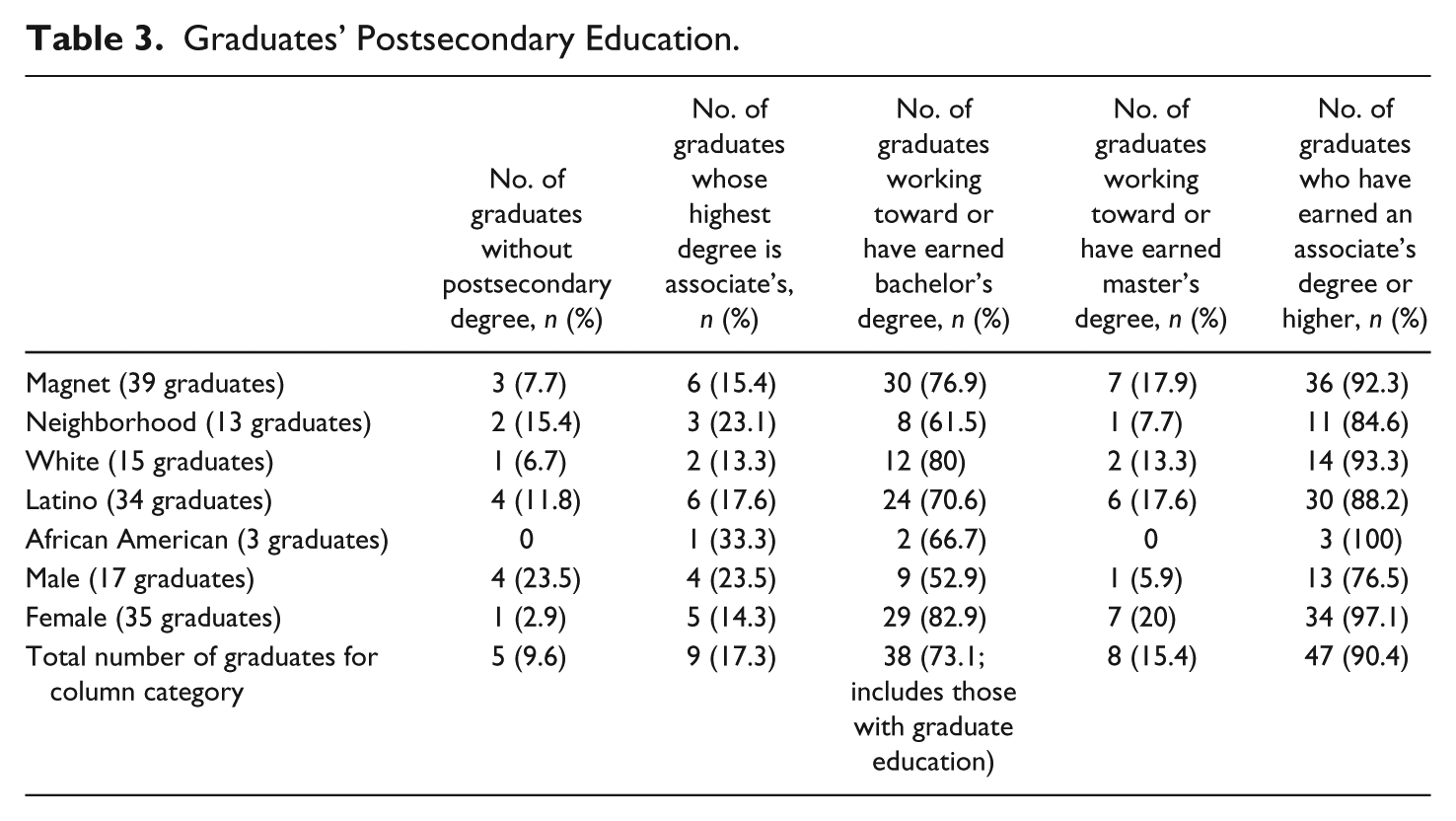
Today, 90.4% of graduates have earned at least an associate’s degree, and many have earned or are working toward undergraduate and graduate degrees (see Table 3). More specifically, 96% of graduates have attended some college, and all 52 earned a high school diploma. There is some research that shows students who are engaged in programs that encourage activism and critical consciousness have higher student achievement rates (Cabrera, Milem, Jaquette, & Marx, 2014). Collier and Thomas (2004) also provide data about how dual language programs are successful at closing the achievement gap with “astounding” results. Other research suggests students who remain connected to their cultures and are exposed to multilingualism and multiculturalism are more successful academically (Lipka & McCarty, 1994).
Graduates’ Postsecondary Education.
In addition, students have discussed how certain teachers and educators at the school were consistently described as “caring,” “supportive,” and “invested” and as having had “life-changing” influences on graduates. Jaime believes the “remarkable, highly qualified” educators at the school during his elementary school years came to the school precisely because it had a dual language immersion program. He observes,
I look at a lot of us [graduates] and there’s such a dynamic group of people doing incredible things, and we still have so much more to accomplish, and the one thing that we all share is Dalton, which is a bilingual institution, and I don’t think there’s a coincidence. I think there’s a correlation between that school setting as a foundation for setting us up for personal and professional success.
Perhaps the combination of having committed educators and positive early language and literacy experiences, as well as valuing of cultures and political activism and involvement in the states’ punitive language policies from an early age, is somehow correlated to graduates’ current educational success.
What is also significant when considering graduates’ current education and employment is that there are only slight differences in college attendance between magnet students and neighborhood students and across ethnicities. Dual language schooling may have served as an equalizer for postsecondary education. Thirty-six out of 39 magnet students (92%) and 11 out of 13 neighborhood students (85%) earned an associate’s degree or higher. For African American students, three out of three (100%) earned an associate’s degree or higher, compared with 88% of Latinos and 93% of White students. However, for graduate work, this equalizing effect appears to have dropped off. Of the eight students who went on to pursue graduate work, only one was from the neighborhood. It must be noted that because of the graduates’ age ranges at the time of the study, some of the younger graduates (and perhaps some older ones as well) may still go on to pursue graduate education, but they had not yet done so at the time the data were collected.
Gender also played a role in graduate educational outcomes. Of the five graduates who had not earned at least an associate’s degree, four were male. Males were also more likely to attend a community college to earn an associate’s degree (23.5%) compared with females (14.3%), who were more likely to attend a 4-year institution to earn a bachelor’s degree. Out of the eight graduates who went to graduate school, only one was male.
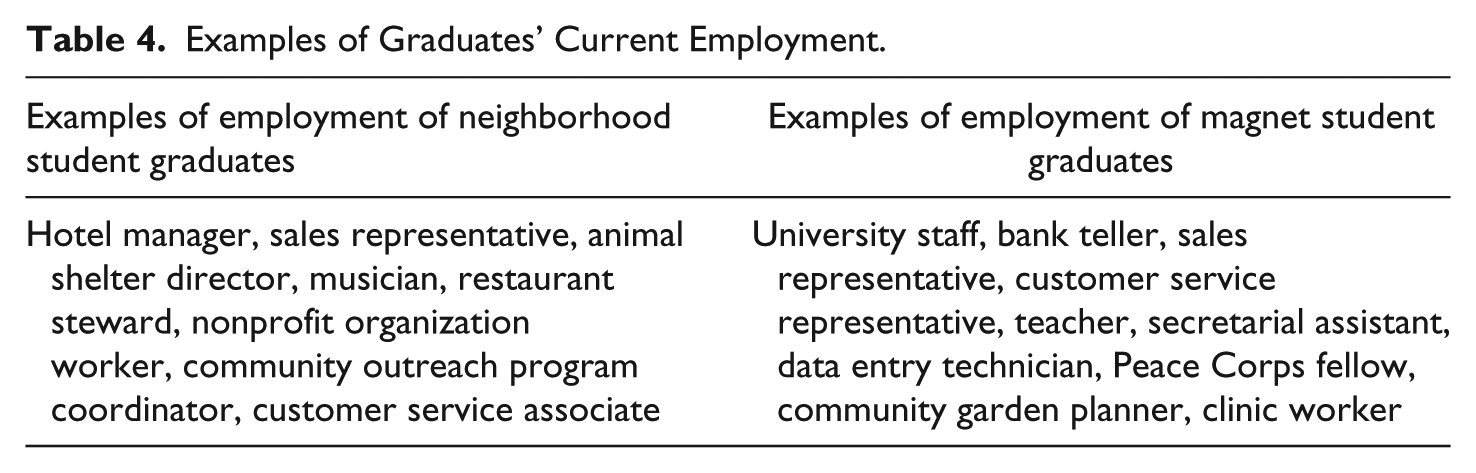
Many graduates are still taking student jobs and have not yet settled into careers or permanent employment, which is typical for this age group. There are no noteworthy differences between types of employment between neighborhood and magnet students (see Table 4). Given the fact that different ethnic backgrounds and class differentiation among magnet students and neighborhood students had little to no effect on graduates’ future education and employment, the data speak volumes about graduates’ potential capital, and about how long-term consequences may be linked to graduates’ foundation in dual language schooling. As both groups indicate involvement with the nonprofit sector, community outreach, and volunteer work, the data suggest graduates are more concerned about issues of community and collective value as opposed to individual endeavors. This can be considered a form of humanistic capital, one that benefits society as a whole through investment in long-term social missions and the common good. The dual language foundation fostered global awareness that is evident in graduates’ present-day attention to and investment in broader social issues.
Examples of Graduates’ Current Employment.
Complicating Ideologies and Capital Within an NLS Framework
Some literature on language ideologies as they relate to teacher beliefs underscores that the nature, function, and purpose of language are central to all aspects of teaching and learning (Richardson & Placier, 2001; Trujillo, 2005). Cadiero-Kaplan (2002) observes, “Literacy ideologies can allow us (teachers) to reflect on our beliefs about literacy and the curriculum materials and processes used and promoted in school” (p. 372). Past research at Dalton underscored this notion, as Moll and Arnot-Hopffer (2005) emphasize the reflection that led to what they term “ideological clarity” when approaching the bilingual/biliterate instruction of students. By “ideological clarity,” they emphasize how (bi)literacy ideologies that supported the consistent and systematic use of Spanish were promoted within the school and how the entire faculty demonstrated a wholesale commitment to upholding bilingualism and biliteracy.
When discussing how teachers’ language ideologies are constructed through narrative, Razfar (2012) notes that “ideologies in practice are less about categories of beliefs or cohesive partisan commitment and more about actors navigating and enacting difficult issues filled with tensions, contradictions, and multiple positionalities” (p. 78). Teachers must “negotiate the tension between their personal commitments to additive multilingualism and the pressures to engage in practices mediated by language ideologies of monolingualism and subtractive assimilation” (Razfar, 2012, p. 78). A language ideologies perspective is embedded in social practices and assumes an inseparable connection to larger historical and institutional practices (Kroskrity, 2010). As Gilmore (2016) argues, language ideologies are also embedded in educational policies. She notes,
The unmet challenges in developing successful programs for bilingual education, English language learners, and minority language speakers are not about the children and their lacking abilities but about our own language ideologies and the deep underlying doubt in children’s language competencies that are instantiated in the foundations of our educational institutions and policies. (p. 134)
In a telling example of how language ideologies play out in terms of educational outcomes, a recent newspaper article appeared detailing an audit carried out at Dalton in 2016 (Huicochea, 2016). The external evaluator of the dual language program cited the (ideological) pressure to perform well on the English state-mandated tests as a factor in diminishing students’ progress toward becoming fully bilingual and biliterate. The external evaluator claimed the “hyper-focus on students’ progress in English” compromised the goals of bilingualism and biliteracy (Huicochea, 2016). In this instance, teachers’ ideologies had shifted from the “ideological clarity” claimed by Moll and Arnot-Hopffer (2005) to a regimented ideological emphasis on English testing.
More recent work on language ideologies has reemphasized the shifting nature of language ideologies and how “inequities of power, race, and class are contested, resisted, and reshaped through shifting language ideologies, changing discursive practices, and sociocultural transformations that interrupt existing language hierarchies” (Gilmore, 2016, pp. 87-88). Attention to the “historiography of language ideologies” (Blommaert, 1999, p. 1), which is a diachronic view of how language ideologies change across time, has “advanced language ideological research . . . further capturing the dynamic character of language viewed against the historical flow of evolving sociocultural symbols and transforming power relations” (Kroskrity, 2010, p. 202). Lam and Warriner (2012), considering the mobilities of texts and practices in contexts of migration, argue, “It is important to recognize that nation-states still monopolize the means of coercive power within their borders, and adjudicate discourses of national loyalty, citizenship, language ideology, and language in education policies” (p. 195). As these children grew into adulthood, their communities of practice expanded and shifted, summoning ideologies that were at times fractured rather than a unilinear. Ochs (2009), in describing language within social life, argues that as children engage in multiple social words, they become
aware of social difference, and eventually are drawn into struggles for power. At the same time, they are influenced by ways of thinking, being, and (inter)acting that shift across contexts and transcend local boundaries, as traditional expectations dialogue with the effects of migration, hybridization, and globalization. (p. 545)
This study has emphasized how language and literacy practices of graduates of this dual language school have been enabled and constrained by the ideological spaces they have inhabited. Once issues of language already laden with macro-level beliefs and sociopolitical histories are added to an already “marked” literacy, language and literacy ideologies can mean understanding how certain practices are viewed as “deficient.” Spanish literacy now is devalued within the context of English-only mandates of dominant ideologies. However, despite the intricacies of language and literacy ideologies, graduates today have managed to take advantage of their bilingualism and biliteracy, have achieved educational successes, and hold overwhelmingly positive ideologies with regard to their Spanish language and literacy.
Understanding these processes through an NLS framework helps shed light on how there is no one universal way to understand literacy practices. Instead, this lens helps to uncover mobilities of learning across time and through practice. This research further highlights that ideologies of language and literacy are neither static nor fixed, but over time, they are molded and reshaped in a very fluid and lively process. As Arnot-Hopffer (2007) affirms, there are “multiple pathways to biliteracy,” and these extend across life spans with multiple outcomes, as with the participants in this study. Even so, what has remained constant among them is a deep and abiding commitment to language diversity, cultural pluralism, and advocacy. With these new insights, future researchers can begin to explore just how members who are perceived to be in the same social space enact ideologies differently and understand and gain capital in intricate ways. In this way, we can begin to understand the multiple and competing social, cultural, institutional, and political forces at play in complex processes that ultimately affect one’s mobilities of language, literacy, and learning.
Footnotes
Declaration of Conflicting Interests
The author(s) declared no potential conflicts of interest with respect to the research, authorship, and/or publication of this article.
Funding
The author(s) received no financial support for the research, authorship, and/or publication of this article.
Supplemental Material

Author Biography
References
Supplementary Material
Please find the following supplemental material available below.
For Open Access articles published under a Creative Commons License, all supplemental material carries the same license as the article it is associated with.
For non-Open Access articles published, all supplemental material carries a non-exclusive license, and permission requests for re-use of supplemental material or any part of supplemental material shall be sent directly to the copyright owner as specified in the copyright notice associated with the article.
