




Abstract
This study explored how an audience-focused writing curriculum mediated the literacy development of bilingual Latina/o first-grade students. Drawing on translingual theories of literacy and scholarship describing the role of audience and audience awareness in skilled writing, this study qualitatively documented and analyzed students’ writing and talk about writing for a variety of audiences. Analysis suggests that children both addressed, or responded to, their intended readers and invoked particular kinds of audiences. Children’s audience awareness influenced their use of language (Spanish, English or both), as well as rhetorical strategies and design choices. This study expands theories of audience to include linguistically diverse settings, and contributes to scholarship on asset-based pedagogies for literacy teaching and learning.
Among the critical issues facing teachers today is adapting to an increasingly multilingual student population. Many educators concerned about educational inequities perceive that the growing linguistic diversity in contemporary classrooms is a problem and that children who speak languages other than English at home are disadvantaged in learning to read and write (Escamilla, Chávez, & Vigil, 2005). However, there is also a substantial body of research in the sociocultural tradition exploring how bilingual and multilingual children might not be disadvantaged or “at-risk.” Rather, such children have useful insights into how language works that can be helpful for literacy learning (García, 2005; González, Moll, & Amanti, 2005; Martínez, Orellana, Pacheco, & Carbone, 2008; Orellana, Reynolds, Dorner, & Meza, 2003; Valdés, 2003). From this perspective, the problem is not children’s multilingualism, but rather the lack of pedagogies to build on these unique insights.
However, a number of systemic and ideological barriers impede the development of asset-based pedagogies. The dominant deficit paradigm (Valencia, 2006) posits that the disproportionate academic failure of working-class children of color is the result of cultural, cognitive, or linguistic deficits. The institutional labels of “limited English proficient” and “English learner” reinforce and are consonant with a deficit paradigm, framing the conversation about inequitable outcomes in terms of what students lack (English) rather than what they possess (multilingualism). Deficit perspectives also obscure children’s linguistic and cultural assets, leading teachers to remediate perceived shortcomings instead of leveraging strengths (Anders, Yaden, Iddings, Katz, & Rogers, 2016).
This study explores one asset-based pedagogical approach. It draws qualitative data from a design-based research (DBR) study in a first-grade classroom of bilingual Latina/o children. The purpose of the study was to describe how a curricular emphasis on audience might leverage a unique asset of bilingual children: their awareness of which language(s) to use in which contexts. The central question guiding the research design and analysis was, “How does an audience-focused writing curriculum mediate young bilingual students’ writing development?”
Theoretical Perspectives
This work is situated within two major theoretical frameworks. First, I draw on scholarship in rhetoric and composition theorizing the relationship between audience awareness and a writer’s ability to compose skillfully for a particular purpose and particular readers. Second, I use a translingual orientation to literacy to understand bilingual children’s writing choices in response to linguistically complex audiences.
Audience Awareness in Writing
The relationship between readers and writers is fundamentally a matter of how language serves to bridge self and other. As argued by Volosinov (1929/1973), a word is “precisely the product of the reciprocal relationship between speaker and listener, addresser and addressee” (p. 86). The immediate interactional context and the broader social milieu determine which words are available and which ones are appropriate for particular contexts and people. Part of writers’ development is learning to negotiate this complex web of relationships and understanding the expectations and demands of the listener or reader (Bawarshi, 2003).
Skilled writers need an awareness of potential sources of dissonance between what they mean and what the reader understands. This audience awareness requires perspective taking, whereby writers learn to distance themselves from a text and imagine how someone else might receive it. As theorized by Ede and Lunsford (1984), audience awareness consists of both the audience addressed and the audience invoked. The audience addressed is made of actual readers who already exist in the world with particular expectations. To reach these readers, writers need to anticipate and adapt their writing to the experiences, expectations, and conventions of readers. However, writers are not exclusively bound by the demands of their readers. Writers also invoke audience. Through composing, writers can guide readers to take on particular roles or orientations, suggesting a range of interests, conditions, and knowledge, which may or may not fit any existing reader. To both address and invoke audience skillfully reflects what Bawarshi (2003) termed rhetorical astuteness: the ability to critically analyze a rhetorical site of action and then write in ways that serve one’s audience and purpose.
Translingual Perspectives on Literacy
Traditional approaches to writing instruction in the United States have assumed that both writer and readers are linguistically homogeneous, and that languages or dialects outside a particular variety of English impede rather than facilitate communication (Escamilla, 2009). In contrast, a translingual orientation to literacy assumes communication across linguistic boundaries is normal and central to skilled writing (Canagarajah, 2013; Horner, Lu, Royster, & Trimbur, 2011; Otheguy, García, & Reid, 2015). Both writers and readers may be multilingual, and writers may need a wide spectrum of semiotic resources to be understood. Translingual literacy practices incorporate the multilingual–multimodal assemblages (Fraiberg, 2010) used by many writers in their everyday lives as they combine modes, registers, styles, and dialects in service of their communicative purposes. Drawing boundaries between named languages (e.g., English, Spanish) may not always be necessary or useful to these purposes (Otheguy et al., 2015).
A synthesis of these two theories—translingual literacy practices and audience awareness—provides insight into how classrooms might better cultivate the writing skills of bilingual learners. There is evidence that young bilingual children have an advantage in the perspective taking necessary for audience awareness, gained through interactions with speakers of varying linguistic preferences (Buell, Burns, Casbergue, & Love, 2011; Greenberg, Bellana, & Bialystok, 2013). Translingual theories of literacy also suggest that communication across linguistic difference is often enhanced by using multiple forms of semiosis. As young children approach writing from an “irrepressibly multimodal” (Rowe, 2013) perspective, we can expect that young bilingual children will engage in similarly expansive practices, but with linguistic repertoires that include more than one named language.
Finally, a translingual orientation to literacy adds nuance to Ede and Lunsford’s (1984) argument that skilled writing is neither entirely reader- nor writer-based. In a linguistically complex rhetorical context, both authorial intent and audience expectations contribute to what makes for an effective text, and language(s) work alongside genre to shape readers’ encounters with texts. Readers may possess different and even conflicting discourse patterns and linguistic preferences, which writers must learn to navigate.
Relevant Background
Early work on audience and writing theorized that the heavy cognitive demands of transcribing inner speech prevented writers from taking their audience into account, resulting in “writer-based” rather than “reader-based” texts (Flower, 1979; Tierney & Shanahan, 1996). Sommers’s (1980) foundational study of the revision processes of expert and novice writers indicated that although expert writers do not concern themselves with audience too early in the composing process, as they revise their writing, they
imagine a reader (reading their product) whose existence and expectations influence their revision process. They have abstracted the standards of a reader and this reader seems to be partially a reflection of themselves and functions as a critical and productive collaborator—a collaborator who has yet to love their work. (p. 385)
In contrast, novice writers tend to revise in a way that reflects an internalized audience of a teacher-reader, primarily concerned with compliance with rules such as “never end a sentence with a preposition.” The nature of the audience that writers experience and internalize seems to be a key factor in their writing skill and ability to make substantive revisions to their work.
Although early developmental theories of young children’s egocentrism suggested that they lacked the cognitive capacity for audience awareness, more recent research shows that given a permeable instructional context, responsive to children’s purposes, even young writers are able to write with an audience in mind (Anderson, 2008; Dyson, 1993). Rowe’s (1989) studies with children aged 3 and 4 showed the ways that they developed understandings of the functions and conventions of writing through social interactions around their writing. Children were able to consider the perspectives of peers who were not present, making authorial decisions on the basis of their classmates’ expected responses. Young children were more likely to demonstrate audience awareness when addressing actual readers, such as parents, than when asked to pretend for a teacher or researcher (Anderson, 2008; Frank, 1992; Kroll, 1978a). Given an authentic purpose and context, young children writing messages to their parents used a wide range of the kinds of rhetorical strategies that suggest audience awareness in adult writers (Wollman-Bonilla, 2001).
Most literature theorizing the role of audience awareness in writing focuses on monolingual readers and writers. However, studies of bilingual children’s speech suggest they possess a pragmatic awareness closely related to audience awareness in writing. Bilingual children as young as 2 can differentiate between their two languages, and choose which ones are most appropriate with which interlocutors (Genesee, Nicoladis, & Paradis, 1995). Bilingual children generally use the language(s) their interlocutors prefer or are most fluent in, often mixing languages when addressing other bilinguals (Genishi, 1981; Martínez, 2010; Sayer, 2008; Zentella, 1997). In the case of multiple addressees with differing preferences or abilities, children tend to favor the monolinguals. However, one of the strategies used by bilingual children to accommodate mixed crowds of bilingual and monolingual interlocutors is to use both languages together, with the intent to communicate in multiple modes and to multiple audiences simultaneously (Zentella, 1997).
Recent scholarship has explored the link between the linguistic skills described above and school-based literacy tasks. A number of researchers have documented the pedagogical value of inviting bilingual students to engage in translation, noting that it develops and displays metacognitive and metalinguistic insights relevant to literacy learning (Dworin, 2006; Jiménez et al., 2015; Puzio, Keyes, Cole, & Jiménez, 2013). Orellana and colleagues have likewise noted analogies between para-phrasing—the oral translation of written English texts that many students do for their families—and the summarizing and paraphrasing tasks often demanded by schools (Martínez et al., 2008; Orellana & Reynolds, 2008). However, one of the primary difficulties in leveraging students’ para-phrasing skills has been the lack of authentic audiences in school-based writing. Often, students write only for their teachers, and summary tasks require students to pretend that their teacher does not already know about the subject.
More recently, scholars have advocated for not only translation opportunities but also translingual ones, in which students are not required to produce texts entirely in one language or the other (Canagarajah, 2011; Michael-Luna & Canagarajah, 2007). Offering bilingual students the opportunity to write translingually facilitates their planning, drafting, and composing processes (Fu, 2009; Gort, 2006, 2012; Pacheco & Smith, 2015; Velasco & García, 2015). Collectively, these studies highlight the skills bilingual children possess and suggest the potential of linguistic flexibility and authentic audiences for leveraging such skills.
Method
Context and Participants
This study took place in Ms. Barry’s 1 first-grade classroom at Kimball Elementary, located on the outskirts of a large city in Texas. I chose to work with Ms. Barry because (a) she was highly regarded by local teacher educators and administrators, (b) she articulated an asset-based perspective on her students’ language practices, and (c) she expressed an interest in collaboration with a researcher as an avenue for professional growth. A White woman in her seventh year of teaching, Ms. Barry had a degree in bilingual/bicultural education and spoke Spanish fluently.
All of Ms. Barry’s students were of Mexican or Central American heritage and had been identified by the district as “English language learners.” At the time of the study, the school was in the first year of transitioning from an English as a second language (ESL) model into a bilingual program. Although kindergarten students had access to bilingual curriculum and instruction, the rest of the school followed an ESL model. The administration permitted teachers to use oral Spanish for clarification purposes, but emphasized that literacy should be taught only in English. However, the upcoming transition meant that Ms. Barry felt she had some “wiggle room” (Erickson, 1996) to use her professional judgment.
The Writing Workshop
Ms. Barry’s writing instruction was based on a process writing or writing workshop approach (Calkins, 1986; Graves, 1983). A typical writing lesson lasted between 20 and 45 min and usually consisted of a brief mini-lesson, followed by students writing in booklets for 10 to 20 min, and concluded by one or two students sharing their work with the class using the document camera and projector. During this sharing time, students often received feedback, typically compliments or questions, from peers and Ms. Barry. During writing time, Ms. Barry and I conferred with students about their work, either individually or in small groups. When students had completed a booklet, they either saved it in their writing folder to revisit later or put it in the class library for other students to read. During the course of the year, the class engaged in several audience-focused units of study, described below. When not participating in these units of study, students wrote on self-selected topics.
An Audience-Focused Curriculum
Before the start of the school year, Ms. Barry and I modified her existing writing curriculum to emphasize audience. The audience for whom students wrote included readers with different linguistic preferences, such as classmates, pen pals, family members, peers, and siblings. The yearlong curriculum is outlined in Table 1.
Audience-Focused Units of Study.
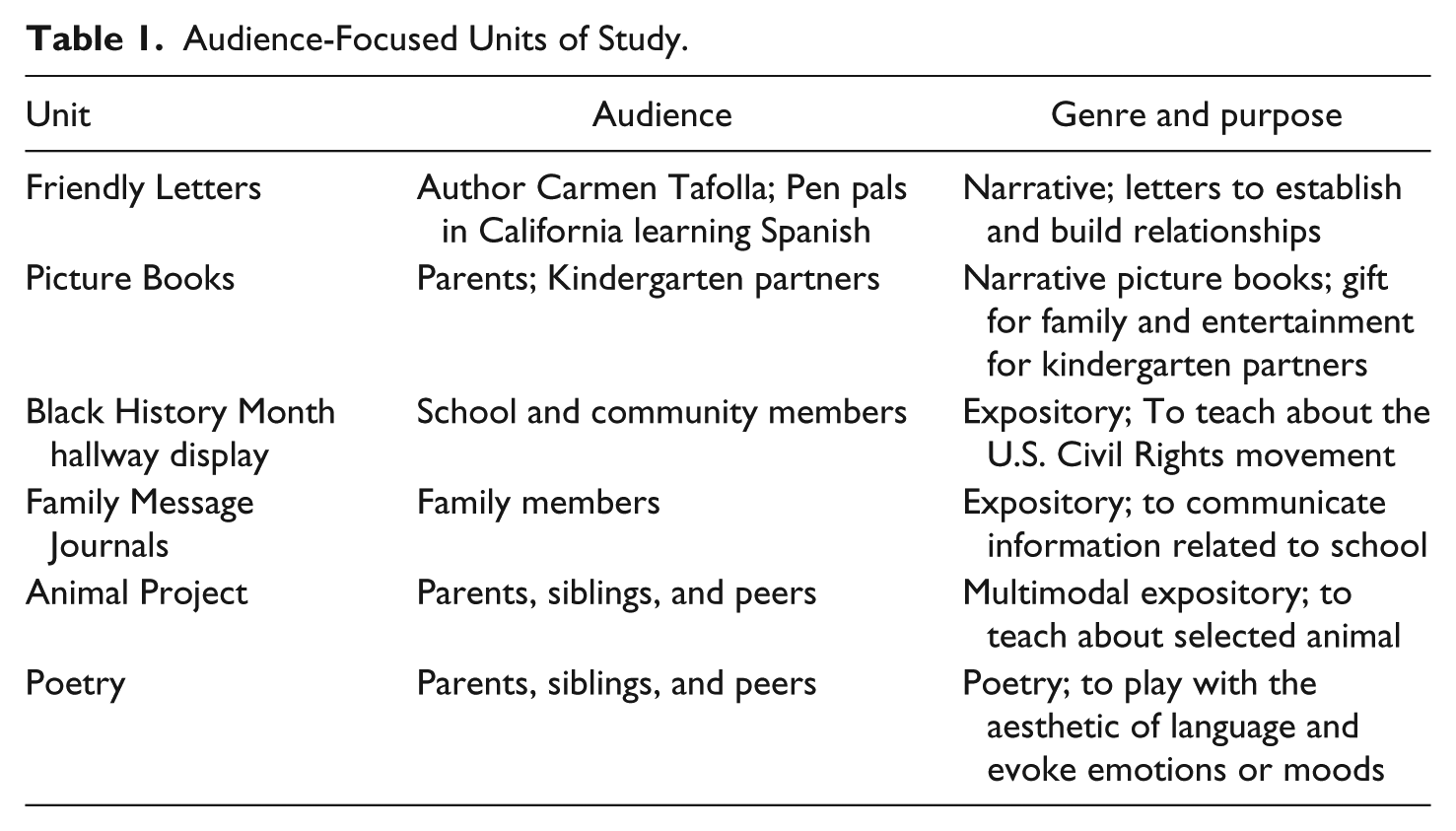
In between the audience-focused units of study, students wrote books on topics of their choice as part of the writing workshop routine.
Noting the established value of authentic audiences and interaction between young writers and their readers, we operationalized “authentic readers and audiences” as suggested by Purcell-Gates, Duke, and Martineau (2007):
Authentic purpose or function, for us, meant that the literacy event serves a social communicative purpose, such as reading for information that one wants or needs to know or writing to provide information for someone who wants or needs it. (p. 14)
As such, the following components were essential for each unit: (a) Students wrote for real readers, and (b) students were given the opportunity to interact with readers around their writing. For example, when students created a hallway display, their work was accompanied by sticky notes and an envelope so that community members could leave them feedback.
Data Collection and Analysis
The data were collected during a yearlong design study (Brown, 1992) that used qualitative approaches to data collection and analysis. I engaged in participant observation during the 2013-2014 school year and collected the following data. I took jottings in the classroom 2 to 3 times a week, for approximately 45 min each visit, and later expanded those jottings into detailed fieldnotes (Emerson, Fretz, & Shaw, 1995). In my expansion of jottings into fieldnotes, I added a number of analytic memos and observers’ comments (Saldaña, 2009), in which I hypothesized about how what I was seeing related to my research questions. A second data source was video recordings of my classroom observations (Erickson, 1992). Finally, I collected writing samples from all students in the class for each of the designed units of study.
Guiding both camera placement and my attention was purposive sampling (Merriam, 2009) of six focal children: Marta, Victor, Jesenia, Yamilet, Paco, and Kelsey. With Ms. Barry’s help, I chose students who were diverse along both an emergent/conventional continuum and a bilingual/biliterate continuum (Hornberger, 2003). In keeping with a translingual orientation (Canagarajah, 2013), I looked at these students’ writing processes alongside their written products across languages. This occurred both informally during classroom visits and more formally in a semi-structured retrospective interview at the end of the year. Informal interactions included asking questions such as, “Who is going to read this?” and “Are you doing anything special so that she or he will like it or understand it?” I also conducted semi-structured interviews with Ms. Barry at the end of each unit of study.
DBR entails a shift from “being a so-called participant observer to becoming an especially observant participant” (Erickson, 1996, as cited in Mehan, 2008, p. 82). As such, the researcher must take particular care to avoid unwarranted claims, triangulate data, and avoid premature conclusions. My analysis involved looking for patterns across multiple sources of data, as well as searching for disconfirming evidence or discrepant cases. I reduced the video data by creating activity logs in which I watched the recordings, wrote summaries of the kinds of activities occurring, and flagged relevant sections for close transcription and analysis. These activity logs were included in my corpus of data for coding, as were transcripts of the interviews with Ms. Barry and the field reports. All of these data were analyzed in three phases: data reduction and organization, initial coding, and focused/hypothesis coding (Glaser & Strauss, 1967; Saldaña, 2009).
My first round of coding considered linguistic dimensions of audience awareness (i.e., which language[s] children selected for which readers and why) and rhetorical dimensions (i.e., how children invoked and addressed audience). In my second round of coding, I refined these categories. For example, a key code from my first list was audience, meaning that children explicitly referred to their intended reader. In my second round of coding, I refined this into subcategories that seemed important, such as audience>revision and audience>language (see the online appendix for more detail). I also engaged in data display (Miles & Huberman, 1994), looking at focal students’ writing in the context of relevant patterns in other data sources. I looked across time for each focal student and compared focal students’ writing with that of the class as a whole. My analysis was ongoing until findings were supported by strong evidence (Miles & Huberman, 1994).
Findings
In the following section, I describe, interpret, and explain how writing for authentic audiences mediated children’s writing choices. First, I use a “telling case” (Mitchell, 1984) to illustrate one writer’s language choices across different readers. I note the ways in which she was representative of patterns in the class as a whole as well as ways in which she was atypical. Following this, I draw on data from all six focal students to see how students’ audience awareness related to their rhetorical decisions more broadly.
Language Choice and Audience Awareness
Over the course of the year, all focal students talked extensively about the linguistic preferences of their readers and composed in the languages they identified as being most appropriate for their intended audience. Looking at one student’s work across different readers serves to illustrate this pattern of linguistic responsiveness. Focal student Marta made consistently distinct choices when writing to particular readers, and she pointed to these readers as an influence on her decisions. Below, I present examples from Marta’s writing for her mother, her sister, and her pen pal, alongside writing aimed at her classmates and family more generally.
Marta described her family as an audience with mixed proficiency: Her older sister and father read in both Spanish and English, but her mother strongly preferred Spanish. When writing to just her mother, Marta consistently favored Spanish. I present one in-progress letter in Figure 1.
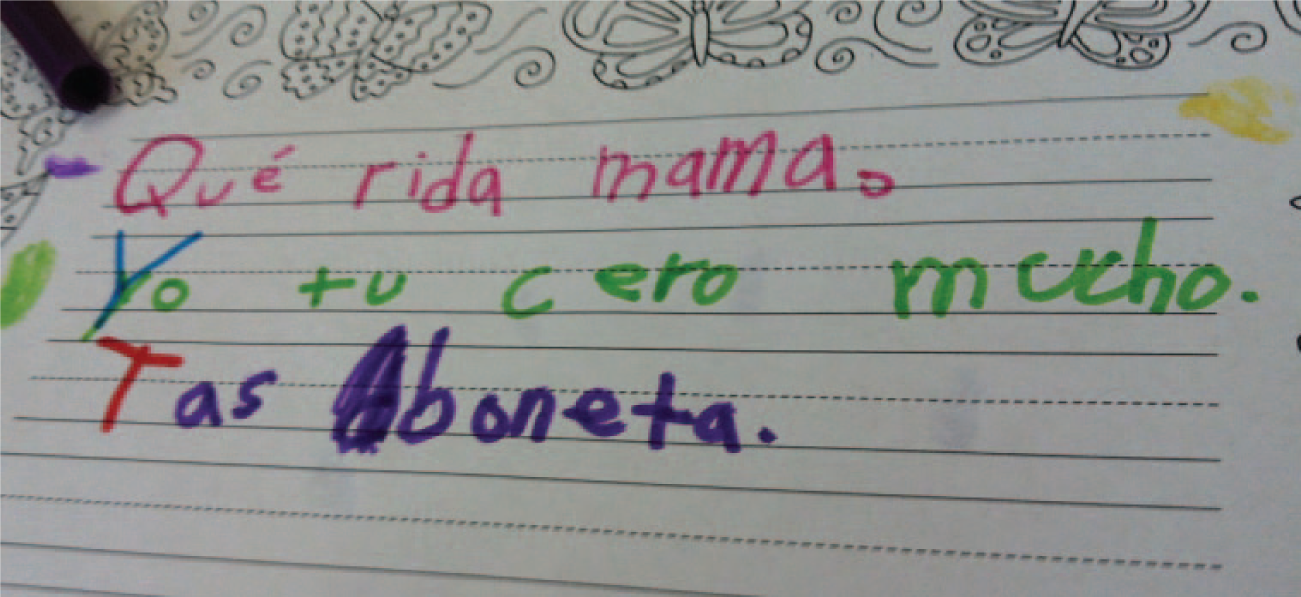
“Querida mamá, Yo te quiero mucho. Estás bonita.”
Composing entirely in Spanish, as Marta did here, required both effort and creativity, given that Marta had not received any formal instruction in Spanish sound–symbol relationships. Rather, she seemed to be drawing on her emerging understandings of English phonology, for example, spelling bonita as boneta. Elsewhere, this phenomenon has been described as “spontaneous biliteracy” (de la luz Reyes, 2012), analogous to how some monolingual children learn to read without instruction. This spontaneous biliteracy seemed to be related to the need to communicate to readers, such as Marta’s mother, who preferred Spanish. In such rhetorical contexts, Marta and her classmates usually wrote all or mostly in Spanish, extrapolating what they had learned about encoding from their instruction in English literacy.
In contrast, Marta’s writing for her older sister was primarily written in English. Ashley was in fourth grade at Kimball and actively involved in Marta’s education, often attending parent conferences to translate for their parents, and responding on their behalf in the Family Message Journal. This language brokering, a form of translingual practice (Orellana, Martínez, & Martínez, 2014), is visible in the following journal entry addressed to Marta’s sister:
Dear Ashley, It is going to be at 10:50–11:30. Will you come to my animal project? Tell my mom about the animal project for she can come too.
Here, Marta’s all-English letter to her sister invokes Ashley’s role as an interpreter, asking her to pass the message along, and presumably to translate it for their mother. Ashley’s messages to Marta were usually in English, suggesting that this was her preferred mode for written communication. Marta’s use of English for her older siblings was typical for the class, with most students composing mostly in English when writing for their older siblings.
When writing for other bilingual readers, the extent to which Marta used Spanish, and the ways in which she did so, seemed to be nuanced. For example, as part of the pen pal unit, Ms. Barry’s students exchanged letters with a class of first-grade students in California. These pen pals were students from an affluent school that offered enrichment Spanish classes. This both positioned these pen pals as potentially bilingual correspondents and illustrates differential patterns of access to bilingual education nationwide. Although affluent communities often demand, finance, and receive Spanish enrichment, bilingual Latina/o children in low-income schools such as Kimball are denied access to instruction in their home language (Callahan, 2015).
Reflecting their access to Spanish literacy instruction, all of the letters from the California pen pals included some text in Spanish, albeit in simple, patterned sentences such as the following: “El chile es rojo. The chili is red. El dulce es azul. The candy is blue.” Marta’s letter to her pen pal, transcribed in conventional spelling below, was primarily in English, with one Spanish sentence:
Dear Madison, What is your favorite food? Did you has a dog? Did your house have snow? Hello Kitty is my favorite cartoon. What is your favorite cartoon is? El libro es rosado. Love, Marta.
Here, Marta’s response showed a sensitivity to her partner’s linguistic abilities. Although Marta was still learning English syntax (e.g., “Did you has a dog?”), her letter was primarily in English, suggesting accommodation to a reader who spoke more English than Spanish. Marta’s final sentence (“El libro es rosado”) suggests an awareness of and responsiveness to her pen pal’s emergent Spanish abilities. Marta could and did use more complex syntax when writing in Spanish to fluent speakers. For example, a journal entry for her parents written around the same time period read, “Estamos haciendo un proyecto de animales. Mi animal es un caballo porque me gusta el caballo.” In contrast, the Spanish sentence Marta used when addressing her pen pal was short, simple, and echoed the present tense and simple structure of her pen pal’s Spanish. This was representative of letters that her classmates wrote as well.
The above examples describe the influence of a single reader. When writing to a larger audience, students experimented with a number of different translingual strategies, such as combining or alternating languages at the page or sentence level. Marta often wrote books with a sentence in English followed by Spanish translation: “I see the fireworks. Yo mire cohetes.” This kind of repetition echoes Canagarajah’s (2009) notion that multilingual writers “may also learn to build in more redundancy in their writing so that readers may recover meaning through multiple affordances” (p. 45). Marta herself noted that some of her intended readers “talked like this” (pointing at the English) and others “like this” (pointing at Spanish line). Marta was unusual in writing so frequently in parallel translation; most of her classmates made use of this technique only occasionally. This may relate to the time-consuming nature of translation, as Marta was a relatively fluent writer. This difference may also reflect a difference in her conceptualization of her audience, relative to that of her classmates. On several occasions, I heard Marta remark out loud that Ms. Barry had promised that they would take all of their writing home to their families at the end of the year. Consequently, Marta may have been writing all of her books with the awareness that her mother would at some point read them. No other student mentioned this year-end plan, and so Marta alone may have envisioned the circulation of her work over time in ways that called for the simultaneous use of two languages.
Rhetorical Astuteness and Audience Awareness
Audience addressed
All of the focal students consistently displayed the ability to imagine a particular reader or readers, and address the reader(s) in ways that extended beyond the choice of English, Spanish, or both. Over the course of the year, children wrote a number of texts that could be categorized as persuasive writing (see Durán, 2016, for further discussion of persuasive writing in students’ journals). As a genre, persuasive writing offers a window into a writer’s understanding of audience, as she or he must consider the perspective of the reader to alter it (Hays, Durham, Brandt, & Raitz, 1990). All of the invitations and journal entries students wrote for their families contained a high density of rhetorical moves suggesting audience awareness. The following journal entry from Kelsey represents a typical example:
Transcribed conventional spelling: Dear Mom, Tu puedes a ir a mirar mi proyecto por favor? Hicimos mucho trabajo. You hice mi mejor que yo pueda hacer. [Es de] un delfin. Si no sabes que hora, es 10:45–11:15 viernes, Abril 11. Love, Kelsey.
Here, Kelsey provided the time and date of the show, noting that this might be important to her mother (“If you don’t know what time it is . . . ”), as well as the context for her project (“It’s about dolphins”). She made a request for her mother’s presence, used the basic appeal of “please,” and followed it with a stronger emotional entreaty (“We did a lot of work. I did the best I could”). Addressing her bilingual mother, who read and wrote both English and Spanish, Kelsey made use of both languages together (“Dear Mom, Tu puedes a ir a mirar mi proyecto?”). In sum, Kelsey’s writing suggests that she wrote astutely, keeping her reader in mind. Her peers’ journal entries likewise all consistently addressed their audience through persuasive rhetorical strategies.
The nature of these rhetorical strategies varied across readers. When writing invitations to peers to attend an event, students highlighted the fun and interactive nature of the experience (“Do you want to learn and write about Martin Luther King?” “It’s gonna be great and fun!” “It’s gonna be awesome!”) When writing for parents, in contrast, students both used Spanish and appealed to parental pride: “Por fabor pueden a benir por que tus y jos asieron mucho travajo” (Please can you come, because your children did a lot of work). This kind of variability suggests an awareness of the difference between what child and adult readers might find persuasive or appealing.
Because young children’s authoring involves not only text but also talk, gesture, art, and dramatic play, audience awareness may be visible in nonlinguistic decisions such as which color marker to use (Kress, 1997; Rowe, 2013). Although writing for linguistically complex audiences offered students the chance to consider and manipulate language, students also used other modalities to reach their readers. Students appeared to be highly conscious of the aesthetics of their writing, and in particular, how their intended audience might respond to their visual composing choices. Indeed, these young writers seemed to be writing translingually in the sense of not only across languages but also beyond language, including design and color as part of their semiotic tool kit (Canagarajah, 2013).
Particularly when composing for individuals, students also chose colors carefully based on their readers’ known preferences: blue markers for a friend who liked blue and red and black for a sister who liked red and black. Much like the actions of the 2- and 3-year-old authors described by Rowe (1989), the intentional selection of colors seemed to reflect that children had internalized their audiences’ perspectives, drawing on this understanding of their readers even in their physical absence. This deliberate use of specific colors was most evident when children were composing pieces for individuals (as in pen pal letters and invitations), rather than groups (as in hallway displays); when writing for groups, students were more likely to more generally state that they were “making it beautiful” or “making it cool.”
Students’ knowledge of their readers provided them with important information that they later drew on as writers. As an example of how the curricular design provided for reader–writer interaction, during the poetry unit, students interviewed a partner in kindergarten and wrote an “occasional poem” 2 specifically for that student. In those interviews, students typically inquired about favorites—favorite foods, favorite numbers, favorite colors—and incorporated this knowledge into their poems. As an example of symbol weaving that included topic, text, language, and art, I present below a description of Jesenia’s discussion of the “occasional poem” she wrote for her buddy.
Jesenia reported to me that she had learned from the interview that her partner liked rosita, princesas, and papas. Her poem for her partner incorporated all of these elements into both the text and the illustration, as visible in Figure 2.
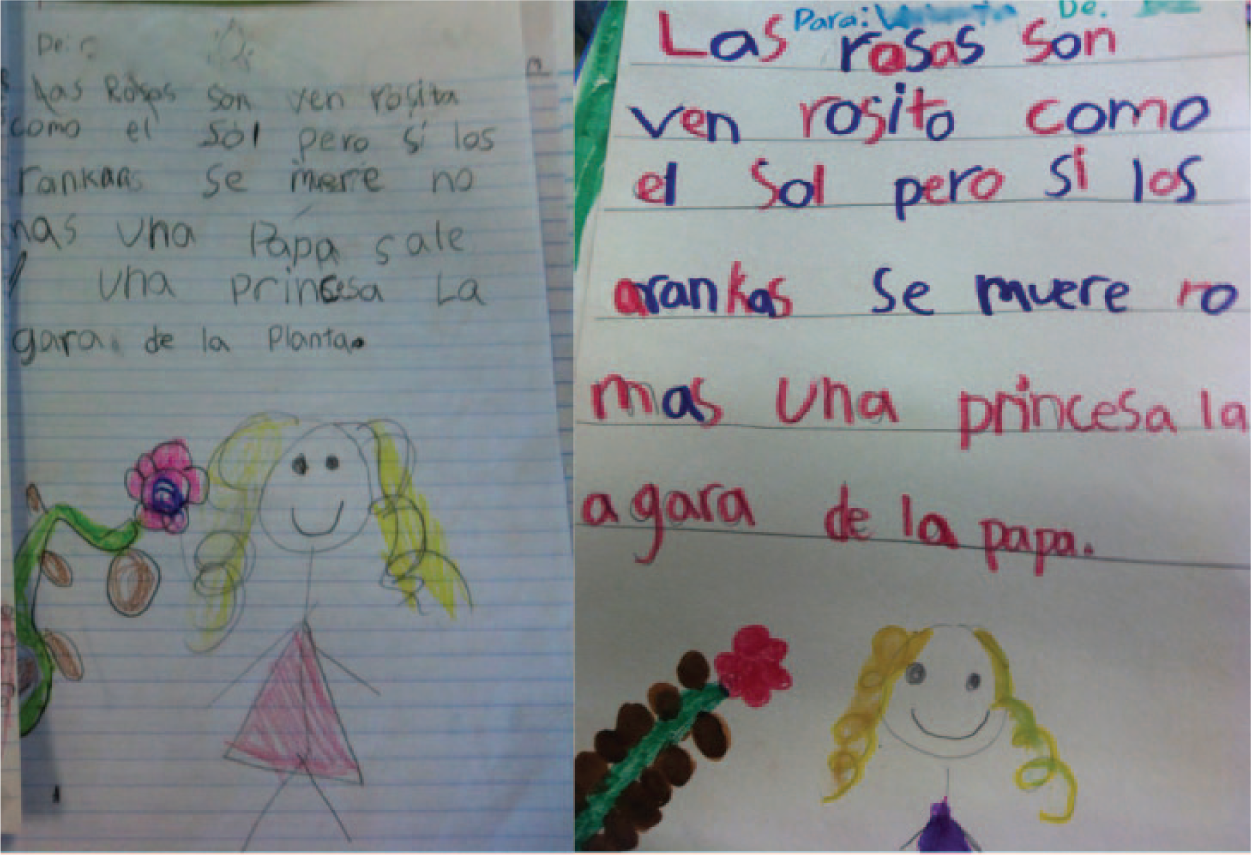
Jesenia’s occasional poem, first and final drafts.
Transcribed conventional spelling: De Jesenia. Las rosas son bien rosita como el sol pero si las arrancas se muere nomás una papa sala. Una princesa la agarra de la planta.
As I sat near Jesenia during her composing process, she also appeared to be composing with unusual deliberation, soliciting my help in deciding whether aggarar or arrancar was closer to the action she hoped to describe, and crafting a text that included all of her buddy’s favorite elements. For her illustrations, Jesenia drew heavily on her intended reader’s color preferences, coloring the princess’s dress pink as well as the rose. Her revision process included an amplification of the color pink in both text and art. Color served as a semiotic resource (Kress & van Leeuwen, 2002), both explicitly referenced in the text and used in her final draft to write the words themselves. Jesenia cited her conversation with her partner as a direct influence: “I told her what’s your favorite food and she said papas.” Jesenia’s switch to Spanish when revoicing her partner (“she said papas”) suggests that their spoken interaction informed her understanding of her partner’s linguistic preferences and her subsequent choice to write in Spanish. This awareness of partners’ preferences was visible in all of the focal students’ occasional poems.
Audience invoked
The examples presented above illustrate how students addressed their audience, responding to their readers’ stated or observed preferences. Students also invoked audience, envisioning particular kinds of circulation and reception of their texts. One such example can be seen in the following interaction, in which Victor discussed his book, A Book About Minecraft, based on the popular computer game. He explained to me the difference between this book and another book about Minecraft, which he had written earlier:
. . . They’ve got some weapons in there and they can shoot the people. And they will fight.
Ah. Who do you think is going to read this book?
Um, all of us.
Does everyone know about Minecraft? Is it that I don’t know because I’m old? Do all of your friends and classmates know about that?
Everyone knows about that.
Oh. (To Amanda across the table) Amanda, do you know about Minecraft?
(Shakes head) Huh?
Do you know about Minecraft?
(Shakes head) No.
(Looks at me, smiles, and shrugs)
Here, Victor described his intended audience as “all of us” and asserted, “Everyone knows about [Minecraft].” Unfamiliar with Minecraft and its associated terms (i.e., creepers, bases), I found his story hard to follow, and I wondered whether my confusion stemmed from my position as an adult, outside child culture. I inquired about his statement, suspecting that when he said “all of us,” he meant “all of us kids.” I was curious to what extent “everyone” was familiar with Minecraft, having seen some, but not all, of his peers reading, writing, and talking about it. Looking to his classmate Amanda across the table, I asked her whether she too knew about Minecraft, which she denied (“No”). Victor seemed surprised by this, and aware that this contradicted his claim that “everyone knows about that.” His final turn here, in which he looked at me and shrugged, seemed almost sheepish. He appeared to be aware that Amanda’s comment contradicted his own assertion that “everyone knows about that.” Kroll (1978b) argued that “powerful learning [about audience] occurs when children experience the failure or success of their words to communicate to peers” (p. 831). In other words, moments of cognitive dissonance such as this are how writers revise their understanding of audience.
I returned to talk with Victor about his book on my next visit, curious about what, if any, impact this conversation had had on his understanding of his audience. I discovered in this conversation that Victor had not made any revisions to his book based on his interaction with Amanda. However, when I asked my usual questions (“Who do you think might read this? What are you doing so that she or he will like or understand it?”), Victor’s answer had changed. Rather than stating that his intended audience was the class generally (“everyone”), he stated that that he thought his friend Derek would want to read it. Derek could often be seen reading a dog-eared Minecraft “how-to” manual, composing books and poems set in the world of Minecraft, and referencing Minecraft in his talk and play. He did indeed seem to be a reader who would appreciate and understand Victor’s work. What seemed to have changed for Victor was not the text that he was creating, but rather his vision of his audience. He seemed to have reoriented his work from “everyone” to those readers who were already positioned to understand and appreciate it. Here, he was not addressing his audience, in the sense of making his references more clear to those who did not already know about Minecraft. However, Kroll’s (1978b) argument that misunderstandings of audience could be generative for learning seemed to be true in a different way from what I would have anticipated.
Victor’s decision to revise his intended audience rather than his writing prompted me to seek out more information about Minecraft. I found that as I learned more about it, I understood more of Victor’s composing choices. In Figure 3, I present an excerpt from one of his Minecraft books. In a departure from his usual illustration style, Victor’s Minecraft series all featured boxy drawings with small, square-headed people.
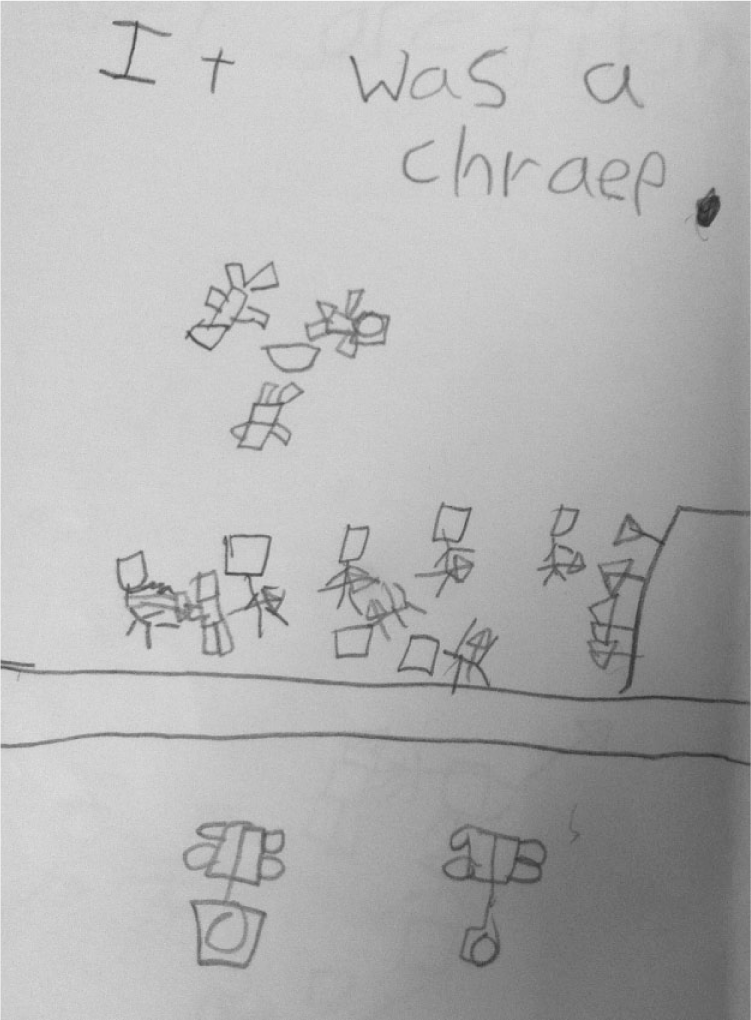
“It was a trap.”
Even with my rudimentary knowledge of the game, I was able to see that these square-headed figures echoed the game’s signature pixilated visuals. Although I had initially missed this visual allusion, I suspect his fellow Minecraft enthusiasts (such as Derek) had not. It seems that Victor was invoking audience (Ede & Lunsford, 1984), envisioning, writing, and drawing for a particular kind of informed reader, one positioned to understand and appreciate his references. His realization that not everyone shared a common set of knowledge did not mean that he provided additional clarification of background knowledge to adapt his work to “everyone.” Rather, he instead revised his ideas about the circulation of his text, with the intention of reaching a specific, informed reader. This highlights the agentive nature of audience awareness, in that writers need not always address “everyone” but rather imagine and create their desired readership.
Other focal students likewise invoked audience, often in ways that differed from my expectations as an adult reader. In the following fieldnotes excerpt, for example, Yamilet revised her book about Chihuahuas to create a particular kind of experience for her reader:
Yamilet reread her mini-book about Chihuahuas in preparation for sharing it later that week. As I sat next to her, she explained, “I was gonna erase it but didn’t have any time. Because I wrote it wrong.” I asked, “Do you want to erase it now?” Yamilet then erased the title from the cover of her book and added that she “didn’t want to write anything else ’cause then they gonna know what’s in the book, cuz I wrote what’s in the book.” She stated that she wanted it to be a surprise, and that’s why she was erasing what she had written on the cover.
What began as a decision to revise toward more conventional spelling (“I wrote it wrong”) seemed to evolve as Yamilet further considered how her readers might experience her book. Rather than rewriting the title more conventionally, she instead erased it altogether, with the goal of making the reading experience less predictable, and perhaps more memorable. When her readers read the “published” book, they found a blank title page, just as Yamilet had envisioned. During the event in which other students at the school were invited to Ms. Barry’s classroom, Yamilet predicted that her cousin would think her book was cool. Her cousin told me separately that he did, indeed, think it was cool, suggesting that Yamilet’s composing decisions had been effective, if unconventional.
In both of the examples above, Yamilet and Victor were envisioning a particular experience for their readers, and in both cases, the intended readers were bilingual. However, Victor’s book, aimed at his classmate Derek, was entirely in English, and Yamilet’s, aimed at her older cousin and “other students in the school,” was primarily in English. However, this did not necessarily imply inattentiveness to language. As mentioned earlier, only the kindergarten students at the school (such as Jesenia’s poetry partner) had experienced formal Spanish literacy instruction. When writing for older bilingual students, then, using primarily English was likely a linguistically appropriate choice, albeit one that reflected the ways the school contributed to language shift and loss (Wong Fillmore, 1991).
Discussion
At the start of the year, all of Ms. Barry’s students but one had been identified as “at-risk” based on the district-mandated literacy tests, which emphasized (English) letter naming, phonemic segmentation, and decoding nonsense words. Such limited and standardized measures of literacy frequently misrepresent children’s abilities as writers (Dutro, Selland, & Bien, 2013; Hopewell & Escamilla, 2014). In many classrooms, positioning students as “at-risk” might have led to an impoverished curriculum of decontextualized phonics skills (Cummins, 2007). However, Ms. Barry’s openness to translingual writing and her attunement to students’ linguistic skills allowed them to demonstrate the ways that they were gifted rather than deficient (Valdés, 2003).
In the data shared here, students displayed rhetorical astuteness as they chose and combined language(s) in nuanced ways. Similarly, children wrote using more than just language; they also used shape, line, and color to reach their readers. Although writing for real readers offered students the chance to think carefully about how they used language, students did not seem to separate the kinds of linguistic moves described above from the way they intentionally used other modalities to reach their readers. Indeed, these young writers seemed to be doing what Dyson (1990) labeled “symbol-weaving,” using language(s), talk, and art together in service of their goals as writers. Such translingual composing better prepares students for writing in the modern world than traditional English-only, paper-and-pencil literacy tasks do (Fraiberg, 2010; Zapata, Valdez-Gainer, & Haworth, 2015.
As someone interested in asset-based approaches and involved in the curriculum design, I was not an entirely objective observer. However, as argued by Fairclough (2001), “the scientific investigation of social matters is perfectly compatible with committed and ‘opinionated’ investigators (there are no others!), and being committed does not excuse you from arguing rationally or producing evidence for your statements” (p. 4). This meant intentionally seeking limitations of the curricular design, with the understanding that such limitations might be both theoretically and practically important. One of the most important modifications Ms. Barry suggested for future iterations of the curriculum was to make sure that children also had time to write outside these audience-focused units, to invoke their own audiences for their own unpredictable, undesignable purposes. Likewise, writing for peers did not always lead children to write more conventionally. Rather, as suggested by Dyson (1993), teachers may need to negotiate and balance diverse audiences and purposes.
In discussing students’ writing with them as they worked, I was also participating in the phenomena under study. Although there were a number of instances of students discussing their work in the absence of any adults, many of the examples of audience-related talk were in response to my questions. The more I asked these questions, the easier it seemed to be for students to answer. Buell et al.’s (2011) study suggests that conversations with young children about the intended audience for their writing scaffolds their ability to conceptualize their readers, with talk serving as a tool to externalize and extend their understanding of the task. These data further support that assertion. As illustrated by Victor, students were capable of revising their ideas about audience through talk. It is possible that regularly asking students about their readers should be considered a core aspect of the curriculum, and future iterations should more deliberately explore this. Consistently questioning students about their purposes and readers, as Ms. Barry and I both did, may have served to draw their attention to writing as a task that concerned purpose and audience, and not just form. Sommers’s (1980) work with older writers suggests that cultivating this understanding of writing as situated meaning making may influence whether the audience that students hold in mind as they compose is a curious collaborator or a punitive evaluator.
Implications
Writing instruction, when conceived of as a series of units with predetermined purposes, is likely to privilege the development of particular forms over the social goals of children (Yoon, 2013) or the development of rhetorical astuteness. Children, of course, are willing to bend those forms and genres to suit their purposes. However, this requires a teacher who is willing to co-construct curriculum with children, to make it permeable to their interests and goals, as well as to the language(s) and modalities such interests are expressed in (Dyson, 1993). As suggested by Ms. Barry, the designed curriculum itself was and should be complemented by anticipation that children will have unforeseeable purposes of their own for their writing, and that those too deserve space and time in the classroom.
However, I wish to highlight here the affordances of a curricular emphasis on audience for bilingual Latina/o children in particular, and for children who speak marginalized language(s) in general. One of the most remarkable findings of this study was the degree to which students were able to read and write Spanish texts, given that they had not received any formal Spanish literacy instruction. This spontaneous biliteracy (de la luz Reyes, 2012) suggests that by inviting students to write translingually and for bilingual readers, teachers can support biliteracy even in restrictive contexts. To help children develop rhetorical astuteness, teachers can provide a wide range of possible audiences and purposes for communication, encourage the use and development of a broad array of semiotic tools, and give children opportunities for sustained interactions with their readers to notice and analyze which of their tools best match the reader and context. This approach does not necessarily require the teacher to be bilingual, although Ms. Barry’s bilingualism certainly helped her in her efforts to model and respond to students’ writing. Moreover, this intentional leveraging of students’ linguistic knowledge is also relevant to monolingual children, who bring a variety of registers, dialects, and styles to the writing classroom.
There are some important limitations to these findings. Given the study design, it is not possible to make any causal claims about the relationship between the curriculum and students’ audience awareness or writing development. Nor does this study offer evidence that this particular approach to writing instruction is more or less effective than alternative ways of organizing instruction. Finally, it remains unknown to what extent the experience of these particular children can be generalized to other contexts. Rather, this study is exploratory. I have sought to “thickly describe” (Geertz, 1973) children’s writing processes and products within the context of the designed curriculum to inform future studies and to contribute to our collective knowledge about how schools can better support bilingual students. Further research is needed to fully understand the relationship between an audience-focused writing curriculum and bilingual students’ literacy learning.
Conclusion
This study illustrates one way in which teachers can “see difference in language not as a barrier to overcome or as a problem to manage, but as a resource for producing meaning in writing, speaking, reading and listening” (Horner et al., 2011, p. 303). Although most research on the role of audience awareness in writing has focused on monolingual writers and contexts, studies of bilingual communication suggest that audience might have an important and complex role in shaping bilingual writers’ development, and the findings of this study support this notion. This study extends current research by expanding theories of audience to account for linguistically complex contexts, by exploring audience as a design principle for organizing writing instruction, and by contributing to the development of translingual pedagogies for literacy instruction. To be a skilled writer in an increasingly complex world is to have command of and flexibly draw from a range of discourses, styles, registers, language practices, and rhetorical strategies. Writing for authentic and linguistically complex audiences gave children compelling reasons to draw from and refine a wide array of their linguistic repertoires. These children’s work and talk suggest that even at a very young age, they possess a great deal of rhetorical astuteness, developed by their lived experiences in linguistically complex communities. Our ability as educators to recognize this, name it as such, and build on it can open up new possibilities for their biliteracy and skill as writers.
Footnotes
Declaration of Conflicting Interests
The author(s) declared no potential conflicts of interest with respect to the research, authorship, and/or publication of this article.
Funding
The author(s) received no financial support for the research, authorship, and/or publication of this article.
Supplemental Material

Notes
Author Biography
References
Supplementary Material
Please find the following supplemental material available below.
For Open Access articles published under a Creative Commons License, all supplemental material carries the same license as the article it is associated with.
For non-Open Access articles published, all supplemental material carries a non-exclusive license, and permission requests for re-use of supplemental material or any part of supplemental material shall be sent directly to the copyright owner as specified in the copyright notice associated with the article.
