




Abstract
This qualitative study examined code-switching patterns in the writing-related talk of 6 emergent Spanish-English bilingual first-grade children. Audio recordings, field notes, and writing artifacts documenting participant activities and language use in Spanish and English writing workshops were gathered over the course of 6 months and analyzed for code-switching prevalence, form, content, and purpose in relation to the writing process. The percentage distribution of oral code switching across the two linguistic contexts suggests a sociolinguistic imbalance between the two languages, wherein English played a prevalent role in the creation of Spanish texts, but Spanish did not appear to have the same utility in the development of English texts. Four general categories of code-switching functions emerged, indicating emergent bilingual writers’ (a) evaluation and self-regulation skills, (b) sociolinguistic and sociocultural competence, (c) metalinguistic insights, and (d) use of code switching to indicate a shift in topic, person, or syntactic form. These findings intimate children’s capacity to exploit their developing bilingual linguistic repertoire for a variety of academic and social purposes and illuminate the potential of code switching as a cognitive and linguistic resource in the process of writing.
Code switching, or the alternation of two languages within a single clause, sentence, or turn (Poplack, 1980), is a complex, rule-governed use of language that “offers a unique opportunity for studying some of the more complicated aspects of bilingual speech” (Dearholt & Valdés-Fallis, 1978, p. 411). Although the phenomenon of oral code switching has been investigated in terms of its linguistic and social dimensions (e.g., Aguirre, 1985; Gumperz, 1977; Jacobson, 1990; Zentella, 1997), the use of code switching in writing and writing-related academic contexts has received less attention (Callahan, 2004). As code switching is considered an indicator of advanced bilingual ability in adults (Poplack, 1980; Zentella, 1997), it has the potential to indicate development of bilingual communicative competence in young children who are in the process of acquiring two languages. However, there is little evidence regarding how emergent bilingual children use code switching to support and extend their conversational and literacy goals in school.
This article presents findings from a qualitative study of code-switching patterns in the writing-related talk of emergent Spanish-English bilingual first-grade children. I use the term emergent bilinguals to describe children who potentially could develop dual language and literacy abilities if supported in their immediate environments, including home and school. The purpose of the study was to investigate children’s use of code switching in academic activities, with a particular focus on writing. Specifically, the study explored the role of code switching in the process of emergent bilingual writing through an examination of the incidence, form, content, and function (i.e., purpose) of young children’s oral code switches in each language. 1
Code Switching in Emergent Bilinguals
Code switching is the most distinctive behavior of bilingual speakers and an important component of the communicative competence of proficient bilinguals. Contrary to popular misconceptions based on deficit constructions of bilingual language practices, and bilingualism more generally (MacSwan, 2000), research demonstrates that code switching (a) is a sophisticated, rule-governed, and systematic communicative behavior used by linguistically competent bilinguals to achieve a variety of communicative goals (Gingràs, 1974; Pfaff, 1979; Timm, 1975); (b) is determined by a complex network of sociolinguistic variables and constrained by syntactic and sociolinguistic properties (Lipski, 1985; MacSwan, 2004; McClure, 1981; Poplack, 1980); and (c) increases in prevalence and complexity with more advanced bilingual development (Poplack, 1980; Toribio, 2001).
Research finds that young bilinguals can use their developing languages differentially and appropriately with different conversation partners from the earliest stages of productive language (Fantini, 1985; Genesee, 2001; Meisel, 2004; Paradis, Nicoladis, & Genesee, 2000). At about 3 years of age, young bilinguals begin to switch systematically between languages as a function of the participants, the setting, the message, and to some extent, the topic of conversation (Genesee, 2000, 2002; Genesee, Boivin, & Nicoladis, 1996). Young children demonstrate communicative flexibility and adaptability by using code switching as a vehicle for their social play (M. Reyes, 2001). Thus, as a natural and common discourse strategy, code switching becomes an important aspect of bilingual and biliterate development (Genesee, 2002; Gort, 2006; Kenner, 2004; Zentella, 1997).
With respect to linguistic form, switches can occur between utterances (intersentential) or within utterances (intrasentential). Evidence from studies of emergent Spanish-English bilinguals indicates that younger children show more code switching at the lexical level than older children (McClure, 1981; Zentella, 1997). Older children, however, seem to manipulate their linguistic codes for a wider variety of stylistic purposes and situational demands than younger children (Jørgensen, 1998; I. Reyes, 2004; Zentella, 1997), such as using code switching to convey the intended meaning more accurately (Halmari & Smith, 1994; Zentella, 1997). Research on the classroom interactions of older, elementary-age, emergent bilinguals growing up in multilingual contexts shows that language alternation is used to serve practical issues related to the management and completion of assigned class activities and to suggest a change of topic, of activity, or of discursive role (Unamuno, 2008). These findings suggest that as emergent bilingual children get older, their exposure to different social and linguistic experiences increases, and these experiences affect the development and use of more sophisticated discourse strategies, including code switching. Code switching, then, appears to be a complex skill that develops as part of emergent bilinguals’ communicative competence and increases as children gain more exposure to and develop more advanced bilingual proficiency. However, there is little research-based evidence about how young emergent bilinguals make use of code switching in academic contexts to extend their linguistic and literate repertoires for greater pragmatic and academic competence.
Theoretical Framework
The study is framed around two perspectives. The first is that in bilingual development, the two languages are integrated, and each language serves as a resource for the other. For bilinguals, linguistic experience is spread across two languages. Experience is encoded in either of two languages and can be expressed in one or both languages; information also can be represented by switching between the languages (Malakoff & Hakuta, 1991). Hence, bilingual learners naturally explore the connections between their two developing languages and practice code switching in their interactions with other bilinguals as a normal part of membership in their linguistic communities (Freeman, 2000; Gort, 2006, 2008; Hornberger, 2005; Martinez, 2010; Pérez, 2004). The second perspective highlights the role of talk and social interaction in the development of writing. Young children’s writing is often accompanied by talk and elaborates the meaning in early written language. Children generate their ideas and sustain their written voices through self-talk and interactions with others (Dyson, 2000). Thus, the prevalence of talk in, around, and about early writing provides a window into emergent writers’ language and thought processing.
Dichotomous Versus Unitary Views of Bilingualism
Although empirical evidence shows fundamental differences in the cognitive processes, language use, and metalinguistic awareness of monolinguals and bilinguals (Cook, 1991; Grosjean, 1982; Valdés, 2001), schools have historically promoted a monolingual view of bilingualism (i.e., bilinguals are defined as possessing nativelike competencies in each language; Gumperz & Cook-Gumperz, 2005). In reality, most bilinguals use one language more frequently for certain purposes and, thus, are likely to be differentially exposed to and develop distinct proficiency levels in certain domains in each of their two languages (Baker, 2006; Cummins, 1981; Lambert & Tucker, 1972; Romaine, 1989).
Strict language separation policies (i.e., sustained periods of monolingual instruction in each language) in many dual-language immersion programs suggest an ideological assumption that monolingual language use (in each language) by teachers and students fosters parallel proficiency in two languages in students. The language separation argument, based on language compartmentalization, implies that the goal of (second) language teaching and learning is coordinate bilingualism, in which the two languages form distinct systems in the mind (Weinreich, 1953, as cited in Cook, 2001). Dual-language education researchers thus argue that a language separation approach (a) provides learners the opportunity to produce extended discourse in which they must make their language coherent, accurate, and sociolinguistically appropriate (Lindholm-Leary, 2001; Swain, 1985); (b) gives students the opportunity to more fully develop two languages (Howard, Sugarman, Christian, Lindholm-Leary, & Rogers, 2007); and (c) helps combat “the natural tendency of minority language speakers to shift to the majority language” (Cummins & Swain, 1986, p. 108). Consequently, programs and teachers adopt the stance that (second) language learning should happen only through the target language; from this perspective, the nontarget language is not considered a resource in the acquisition process.
The coordinate view of bilingualism contrasts with that of compound bilingualism, in which the two languages form a single composite system. In this integrated view, each language plays an integral role in the bilingual developmental process; that is, the two languages are interwoven in the language user’s mind, and each language supports the other in further language development and use. Thus, two contrasting theories about bilingualism and the subsequent role of each language in its development emerge: (a) Bilingual development results from the addition of two separate competencies, or (b) bilingualism is understood as the development of a composite repertoire wherein the languages in contact interact and combine (Grosjean, 1982). In practice, perceiving bilingualism from a dichotomous (i.e., parallel monolingual) versus a unitary (i.e., bilingual) view leads to very distinct educational choices with regard to program structure and language allocation (e.g., language separation versus integrated language use or alternation). However, Cummins and others argue that the lack of research support for the monolingual instructional orientation guiding many dual-language immersion policies and programs raises questions about its effectiveness for bilingual development. Cummins (2005) asserts in this regard that
while extensive use of the target language within foreign/second language and bilingual/immersion programs is clearly a useful and important instructional strategy, it should not be implemented in a rigid or exclusionary manner. . . . Students’ [native language] is a powerful resource for learning and bilingual instructional strategies can usefully complement monolingual strategies to promote more cognitively engaged learning. (p. 16)
The Role of Oral Language and Interaction in Bilingual Writing Development
Oral language plays an essential supportive role in literacy learning (Clay, 1991; Dyson, 1983; Pinnel, 1980). Emergent readers and writers use their knowledge of language and its functions and structures as they engage with and learn about written language (Goodman, 1992). Early writing is surrounded by talk: Young children talk to themselves and to others as they engage in literate activities, using oral language to negotiate emerging understandings about written language (Dyson, 1990), to regulate and orchestrate the complex processes involved in writing (Parr, Jesson, & McNaughton, 2009), and to externalize their language, literacy, and thinking processes (Dahl, 1993). Writing-related talk also serves an executive function through which children can formulate a plan for what they might write next, rehearse ideas for writing (Clay, 1975), and evaluate what they have written (Dyson, 2006).
Children’s talk during composing further reveals and sustains the social relationships within which writing takes shape (Dyson, 2000). Britton’s (1970) metaphor of classroom writing occurring “afloat upon a sea of talk” (p. 29) suggests that talk links the teacher(s), young writers, and their writing, thereby supporting and sustaining writing and enabling connections. Interaction among participants can contribute significantly to the process of learning to write as it occurs through participation in joint activity and supports the social distribution and appropriation of literacy knowledge (Larson, 1995). For example, writing-related interactions may help students become critical readers who monitor their own strategies during writing (Calkins, 1986; McCarthey, 1994). Thus, writing-related talk is a means of communicating ideas, an important source of language and literacy learning, and an enactment of cognitive activity (Swain & Lapkin, 1998).
Similarly, language acquisition research has demonstrated that languages are developed through social interactions that provide access to comprehensible input as well as opportunities to produce comprehensible output and negotiate meanings (Krashen, 1982; Long, 1985; Pica, 1994; Swain, 1985). Within a social interactionist perspective to language and literacy learning and use, language and social interaction are tightly entwined, and the acquisition process is deeply embedded in the interactional context from which it stems. Related research in bilingual and biliteracy development highlights the importance of social interaction for learning, the cross-linguistic transfer of skills, and the embedded nature of language and literacy in children’s immediate and broader contexts (Gort, 2006; Manyak, 2001; Pérez, 2004). Interactional spaces where children can freely and purposefully use their two languages, and where they can observe the use of both languages being modeled by other speakers, are thought to support bilingual language and literacy skills (Gumperz & Cook-Gumperz, 2005). In these spaces, code switching can be interpreted as a strategy for the appropriation of a new language, a communicative strategy, and evidence of the development of multilingual competence.
The current investigation is thus premised on the assumption that switching between languages can serve as a resource for learning languages, participating in classrooms interactions among speakers with varying bilingual proficiencies and experiences, and engaging in academic and social activities. Through this framing, I examine the ways in which young Spanish-English emergent bilinguals draw on each language to accomplish their conversational and literacy goals within a dual-language immersion program. Specifically, the study addresses the following research questions:
What are the code-switching patterns in the interactions and self-talk of emergent bilingual first-grade children as they engage with writing in parallel English and Spanish writing workshops?
What functions do code switching serve in emergent bilinguals’ writing process?
Method
Description of the Study
The school
The study was conducted in an urban, culturally and linguistically diverse public elementary school in the northeastern United States. The school served approximately 300 students in kindergarten through fifth grade, including the highest percentage of English learners in the district (42%). The ethnic makeup of the student body was 53% Latino, 45% European American, and 2% African American. Forty-one percent of students qualified for free or reduced lunch.
The two-way immersion (TWI) program
The school housed a TWI program, a type of dual-language immersion education. The TWI model aims for a balanced mixture of English-speaking and native-speaking children of another language (in this case, Spanish). The presence of native speakers of both languages provides opportunities for all students to communicate with native-speaker peers of the two target languages (Christian, 1996). The focal program differed from the two major variants of the TWI model with regard to the distribution of languages, as children in this program were initially instructed in their (respective) native or dominant language (L1) for approximately 80% of the time and in the second language (L2) for the remainder of the time. 2 Children’s language proficiencies and home language practices at program entry determined program designation as either “Spanish dominant” or “English dominant.” As children progressed through the program, the amount of instruction in the L2 increased until delivery of instruction in the two languages attained parity by about fourth grade and remained equally distributed until Grade 5, the final year in the program. Students in the TWI program reflected the district’s cultural, linguistic, and socioeconomic diversity.
There were two classrooms per grade level, an English classroom and a Spanish classroom, between which students moved seamlessly in different group configurations throughout the day. The language of instruction in each classroom aligned with the classroom’s official language designation (i.e., instruction in the Spanish classrooms was conducted all in Spanish). At times, groups consisted of all Spanish-dominant students or English-dominant students (e.g., the Spanish speakers were grouped together for English as a Second Language [ESL] class, while the English speakers participated together in Spanish as a Second Language [SSL] class). At other times, students of both language backgrounds were integrated so that approximately half of the class was immersed in the L2 and the other half received instruction in their L1, giving rise to the program descriptor term two-way or dual immersion. The study was situated in the program’s first-grade classrooms.
The writing workshop
Writing Workshop (WW) was the schoolwide approach to writing instruction. This process-based approach stresses the notion of writing as a craft and engages writers in a number of individual and interactive stages to develop ideas and express them in writing (Calkins, 1986; Graves, 1983). In the first grade, WW originally was designed as a 45- to 60-minute period of the L1 language arts block during which students planned, drafted, revised, and published stories on self-selected topics. Children’s stories typically involved a personal narrative or recount of an event they had experienced and wanted to share with others. WW began with a class meeting during which the teacher offered a minilesson on an aspect of writing relating to students’ needs and/or interests. Students then reviewed their work from the previous WW session and discussed with a peer or the teacher their plans for proceeding that day. The students dispersed to the classrooms’ round worktables in groups of 2 to 3 to write, discuss, and illustrate their drafts, or to the carpet area in pairs to brainstorm ideas for a new story with a peer. Students who had prepared a draft for publication by engaging in peer and teacher-supported revision sat in the classroom’s computer area to type their finished stories. The teachers roamed the classroom as students worked, conferring with individuals, pairs, or small groups of students in support of their progress. During the last 5 to 10 minutes of WW, the group gathered once again in the carpet area to listen to a read-aloud of a published piece or to provide feedback for a story in progress.
Students participated in WW on alternating days as part of their L1 literacy block. The physical classroom in which the activity occurred (i.e., Spanish or English room) determined the language of instruction and, therefore, the target language of children’s writing products and talk. Although teachers consistently and systematically modeled the target language in their instruction and interactions with children, and encouraged the children to do the same, the children’s language use was much more flexible. WW was a highly interactive and collaborative setting where student-to-student, student-to-teacher, and student self-talk often accompanied writing. Beginning with the second half of first grade, WW became an integrated class when students who exhibited grade-level literacy skills in their dominant language were offered the opportunity to also participate in WW in their L2. 3
Participants
Six emergent bilinguals representing varied oral language and literacy abilities in Spanish and English served as focal participants for the study. The children included three native Spanish speakers who demonstrated early intermediate English skills (Lucy, Brian, and Katherine) and two native bilinguals and a native Spanish speaker who demonstrated stronger skills in English (Steven, José, and Barbara, respectively). On the basis of program criteria, Lucy, Brian, and Katherine were considered to be Spanish dominant at program entry, whereas Steven, José, and Barbara were classified as English dominant. 4 Steven and Barbara attended kindergarten in an English-only Head Start program prior to joining the TWI program at the beginning of first grade as English-dominant speakers. The other participants had been enrolled in the TWI program since kindergarten. All participants were of Dominican American heritage. Table 1 provides participants’ ages at the beginning of the study as well as their native, dominant, and home languages.
Participant Information
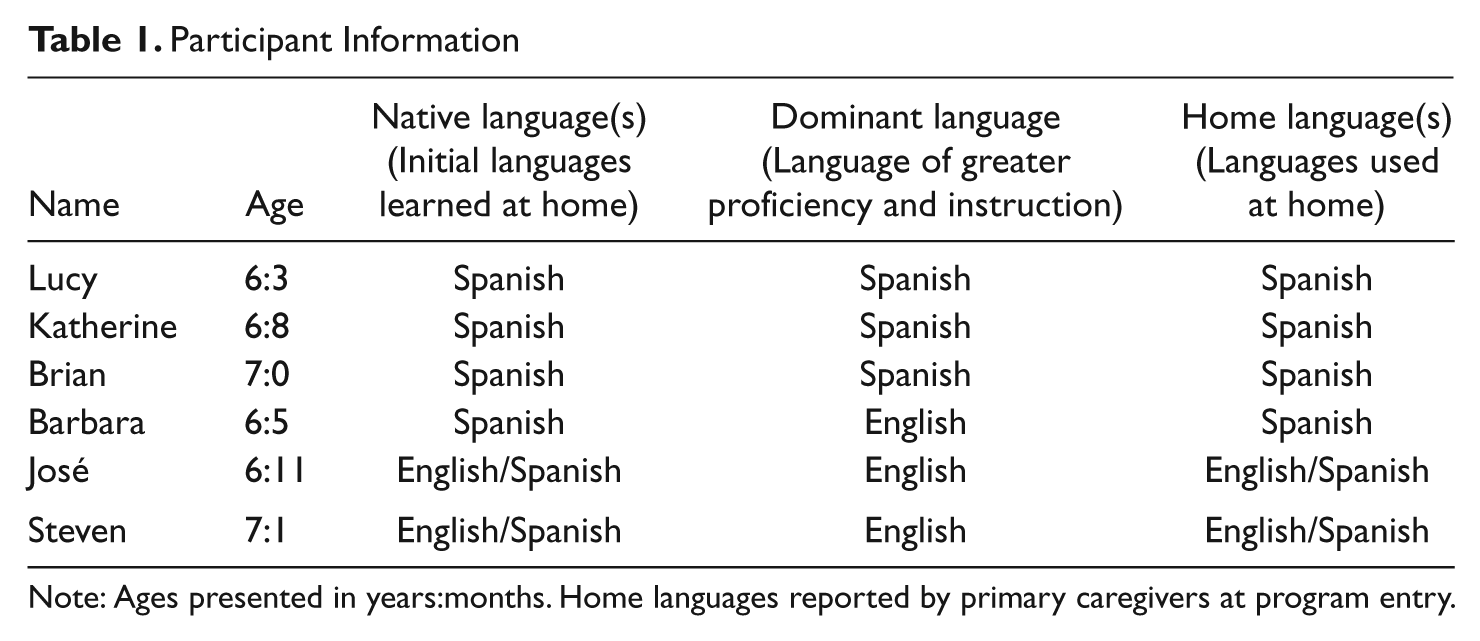
Note: Ages presented in years:months. Home languages reported by primary caregivers at program entry.
Data Collection
The data analyzed here were extracted from a corpus gathered as part of a larger ethnographic study looking at the development of emergent biliteracy in first-grade children in a Spanish-English TWI program (see Gort, 2006). During the second half of the academic year (January to June), two research assistants and I conducted 126 classroom observations in the two first-grade classrooms during WW. 5 We shadowed focal students as they developed stories and participated in regularly occurring WW activities, systematically collecting data three times per week for each focal child during the data collection period: either twice in Spanish WW and once in English WW or vice versa. During 45- to 60-minute classroom visits, we documented participant activities and language use through detailed field notes and audio recordings of student self-talk and interactions with peers and teachers. We photocopied participant writing artifacts across all stages of the writing process, including all drafts and related documents. The complete data set included field notes and corresponding audiotapes from 64 Spanish WW and 62 English WW classroom observations, and 247 writing artifacts. Table 2 specifies the distribution of classroom observations and writing artifacts across participants.
Distribution of Classroom Observations and Writing Artifacts Across Participants
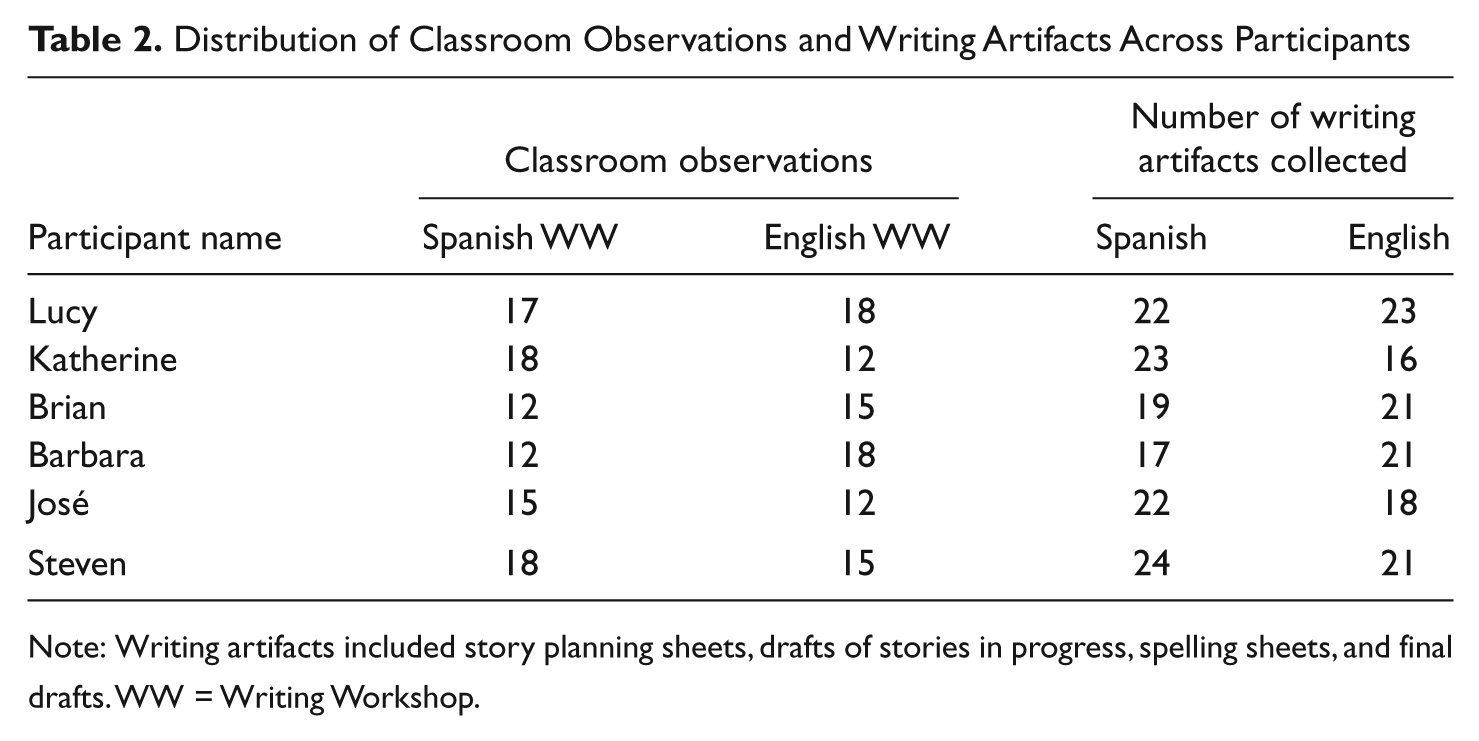
Note: Writing artifacts included story planning sheets, drafts of stories in progress, spelling sheets, and final drafts. WW = Writing Workshop.
Data Preparation and Analysis
Throughout the data collection period, two research assistants and I transcribed all classroom audiotapes verbatim in preparation for analysis. Field notes were integrated into the transcripts to contextualize the oral language data. A general review of the data suggested a considerable amount of redundant information with regard to children’s code-switching practices across the two WW contexts. Therefore, on the basis of criteria that sought to represent fairly equal amounts of data for each participant, including transcripts and related data sources that depicted various stages of the writing process, a subset of data was selected for in-depth analyses that included all data sources from two WW sessions in each language for each month of the data collection period per participant. This resulted in a corpus of 24 transcripts and writing artifacts (e.g., drafts at various stages, writing plans, spelling sheets) per participant.
Analysis of the transcripts and writing artifacts was qualitative and guided by the principle of triangulation. The main unit of analysis was the conversational turn, defined by Ellis (1994) as the point at which a speaker stops talking or is interrupted by another speaker’s turn. Oral code switches were identified and analyzed with regard to form, content, and function in relation to children’s writing process. To determine the extent of use and type of oral code switches by context, the total number of turns involving code switching between and within turns was counted separately for each classroom context and student language group. The following categories were used to identify and code each child’s turn involving code switching with regard to form, with examples to illustrate each category (code switch bolded for emphasis; translation to English included in parentheses):
Intersentential code switch (Spanish only): All phrases in one turn were Spanish (in English context).
Example (Brian, English WW):
Intersentential code switch (English only): All phrases in one turn were English (in Spanish context).
Example (Barbara, Spanish WW): “
Intrasentential code switch: Both languages were used within the same turn (in either Spanish or English context).
Example 1 (Steven, Spanish WW): “Ahora me faltan los trés más Example 2 (Katherine, English WW): “I only need two more pages and I can
The 217 turns meeting criteria for selection (i.e., representing an intra- or intersentential code switch) were further analyzed for content as well as communicative and/or literacy-related code-switching functions. The procedure was both deductive and inductive; there was a continual interplay between beginning with code-switching typologies from existing frameworks (e.g., Becker, 1997; McClure, 1981; Montes-Alcala, 2001; I. Reyes, 2004; Zentella, 1997) and checking those against the data, and starting with the data and moving toward grounded theory (Glaser & Strauss, 1967). Combining new data-based and existing typologies facilitated identification of the categories most relevant to emergent bilingual writers’ code-switching practices. These categories were examined in relation to contextual information in children’s talk, writing behaviors, and writing products. Triangulation of data from the multiple sources provided a comprehensive view of emergent bilingual oral code-switching behaviors, verified themes and patterns, and cross-validated regularities in the data.
In an attempt to present the most authentic interpretation of the setting, the classroom observations, and students’ oral language and written products, I shared the WW transcripts, corresponding writing products, and emerging themes and summaries of findings with the classroom teachers and other members of the research team throughout the data collection period. 6 These were approved with minor revisions.
Findings
The social nature of WW and the collaborative structures set up by the TWI teachers encouraged children to seek each other’s advice and support in the process of writing. Children engaged in lots of talk during writing—with peers, teachers, and themselves—to plan and monitor their work as well as to sustain their composing efforts. Emergent bilingual writers often alternated between their two languages in their writing-related talk, demonstrating the facility with which bilinguals can express their developing linguistic, metalinguistic, and metacognitive skills across two languages. Students’ talk also exemplified their ability to engage with academic tasks using their developing bilingual skills.
Incidence of Code Switching in Spanish and English WW
Students used more code switching in the Spanish classroom (185/217, or 85% of total code switches) than in the English one (32/217, or 15% of total code switches). With regard to form, students used more intersentential (English-only) code switches in the Spanish context (102/217, or 47% of total code switches) than intrasentential (mixed-language) ones (83/217, or 38% of total code switches). The reverse was true in the English context, where only 4 out of 217, or 2%, of code switches were Spanish only, whereas 28 out of 217, or 13%, were mixed language. The percentage distribution of student talk that included code switching across the two WW contexts is presented in Figure 1.
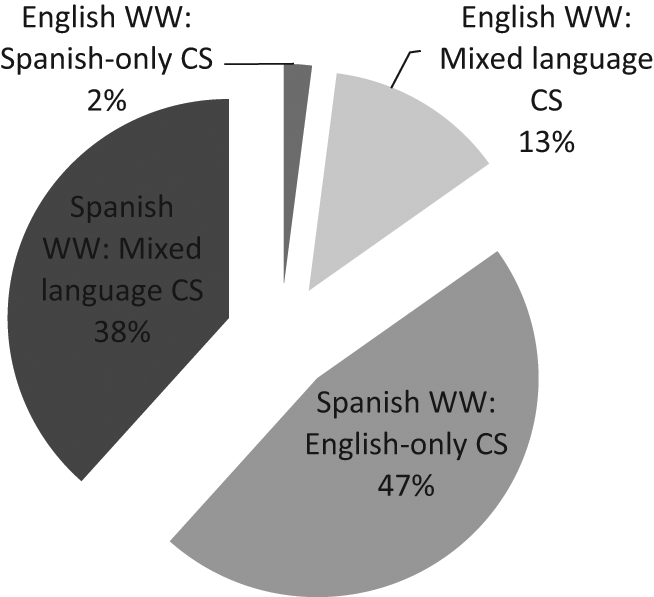
Percentage distribution of form of oral code switches (CS) by writing workshop (WW) context
Spanish-dominant students produced substantially more than half of the total number of code switches across the two WW contexts (134/217, or 62%). Fifty percent (109/217) of all code switches were produced by these students in the Spanish WW context, revealing a strong English (L2) influence on their L1 writing process. These writers also integrated their first language while composing in the English classroom, albeit to a lesser degree (25/217, or 12%, of total code switches). English-dominant students’ use of code switching reveals a different pattern, however. Although these students also drew from their developing bilingualism to support their writing process, their use of code switching mostly occurred in the Spanish WW context. Specifically, English-dominant emergent bilinguals produced 38% (82/217) of total code switches, but the majority of these involved using the L1 in the process of writing in the L2. Only 3% of total code switches represented these writers’ use of Spanish (L2) in the process of writing in English (L1). The percentage distribution of participants’ use of oral code switching across the two WW contexts suggests a sociolinguistic imbalance between the two languages, wherein English plays a significant role in the creation of Spanish texts for both English- and Spanish-dominant emergent bilinguals, but Spanish does not appear to have the same utility in the creation of English texts for either group of children (see Figure 2).
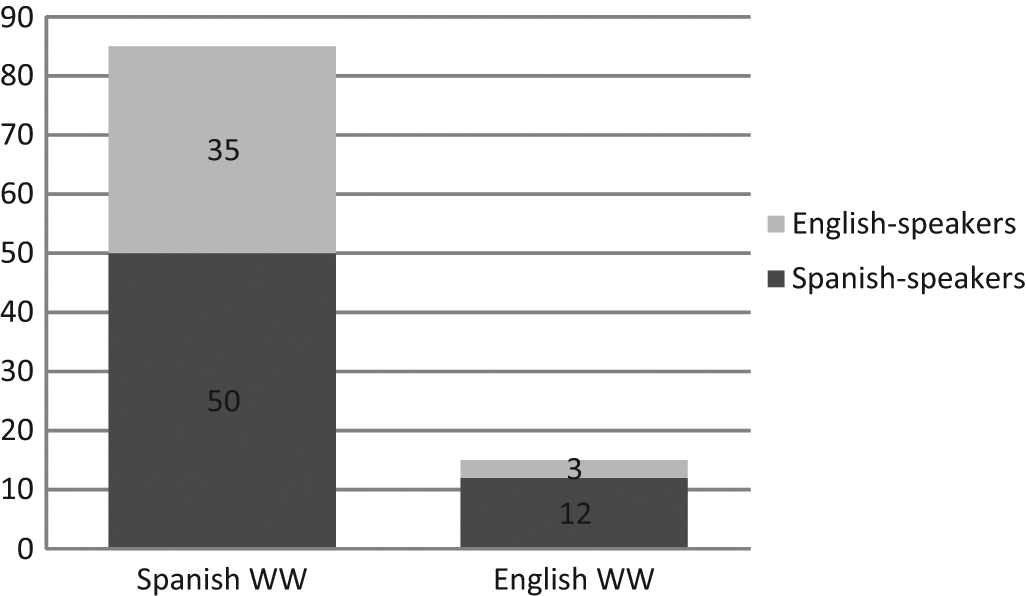
Percentage distribution of use of code switching by student language group, Writing Workshop (WW) context
Functions of Code Switching in Emergent Bilingual Children’s Composing Process
The analysis of oral code-switching patterns, as evidenced in children’s talk during the composing process, revealed that the use of code switching fulfills a variety of social, linguistic, and academic functions and that some instances of code switching accomplish more than a single purpose. Four general categories of code switching functions emerged, indicating emergent bilingual writers’ (a) evaluation and self-regulation skills, (b) sociolinguistic or sociocultural competence, (c) metalinguistic insights, and (d) use of code switching to indicate a shift in topic, person, or syntactic form. These categories are explained below (see the appendix for a detailed listing of code-switching categories, definitions, and examples from the transcripts). Table 3 reports frequency and percentage data for each category across participants and WW contexts.
Distribution of Code-Switching (CS) Functions Across Participants and Writing Workshop (WW) Contexts
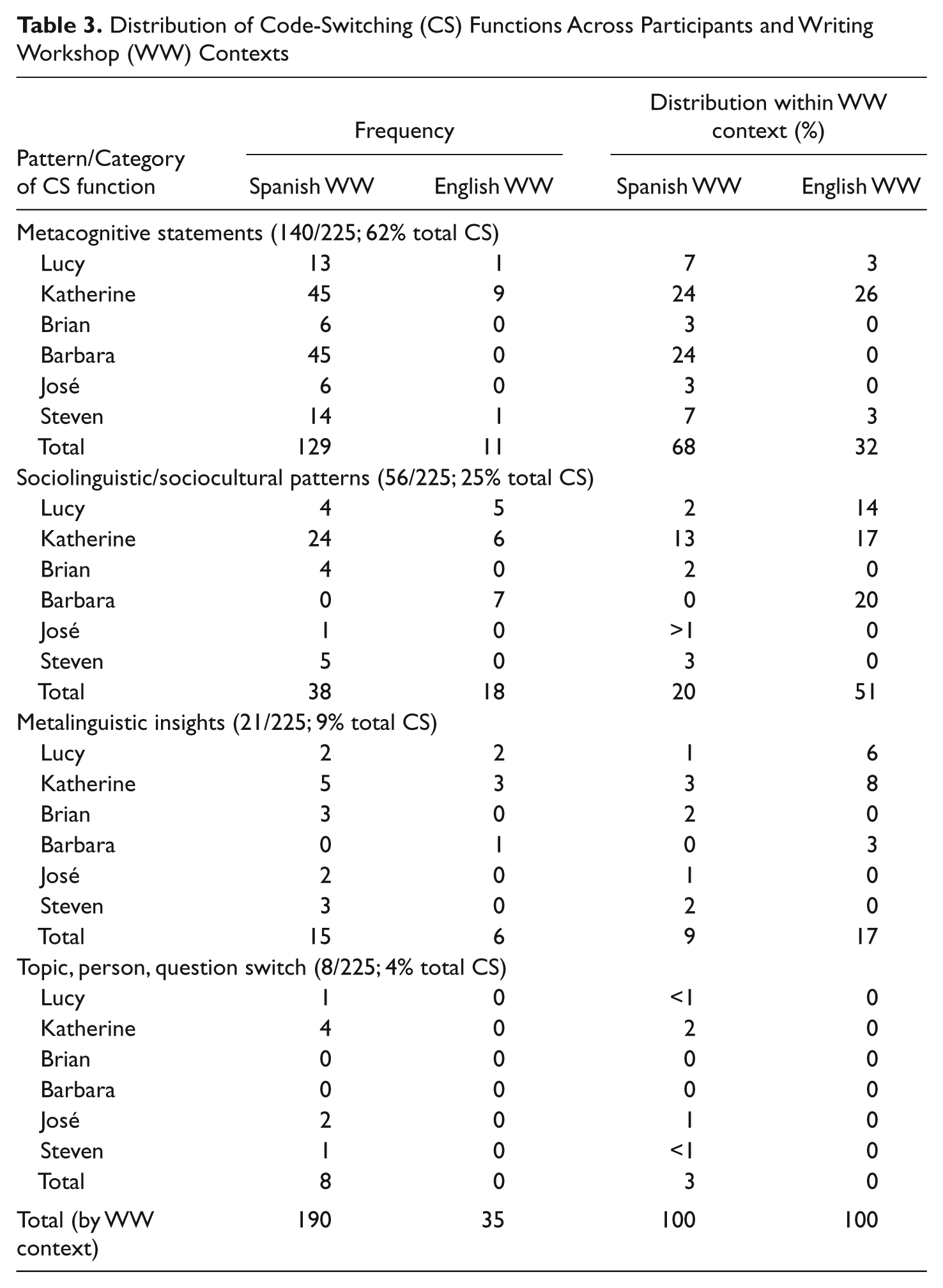
The majority of emergent bilinguals’ oral code switching (62%) involved a self-reflection, an evaluation, or regulation of children’s writing process or resulting products, revealing children’s writing-related cognitive processes. Code-switching patterns evidencing children’s developing sociolinguistic and sociocultural competence (25%) and children’s metalinguistic awareness (i.e., learner interest in and knowledge about the relationship between their two languages; 9%) were the next most prevalent. Together, these three categories accounted for 96% of oral code-switching uses across the two WW contexts. The remaining switches involved a change in code when learners shifted topic, referred to specific persons, or integrated questions within statements (4%). The percentage distribution of patterns of code-switching functions across WW contexts is presented in Figure 3.
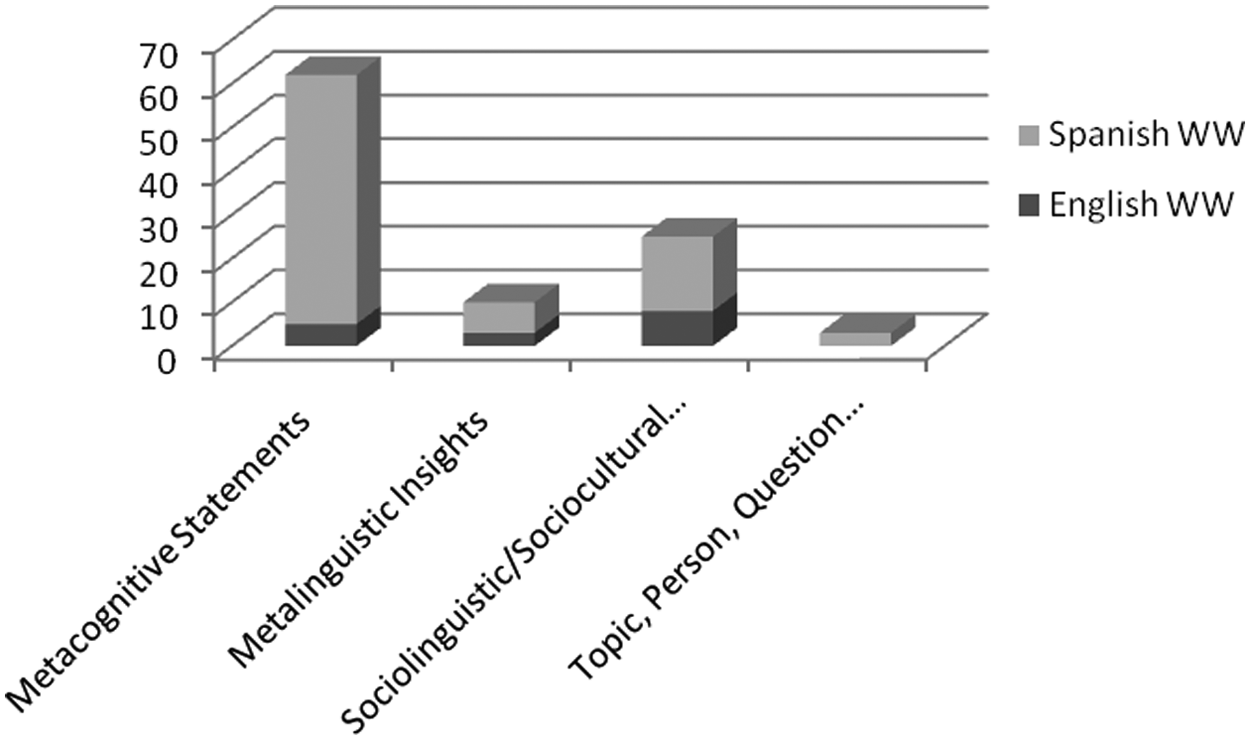
Percentage distribution of code-switching function patterns across Writing Workshop (WW) contexts
The sections that follow report the general character and trends within each broad category. No effort has been made to list all of the switches included in any grouping. Instead, representative examples are used to capture the essence of emergent bilinguals’ use of code switching in a given category. In all samples, code switches are in boldface type, field notes are presented in brackets, and English translations are in parentheses.
Metacognitive functions of code switching: Reflecting on, evaluating, and regulating writing in two languages
In support of their own and their peers’ composing efforts, emergent bilinguals drew on their dual-language repertoire most often for the purposes of reflecting on, evaluating, and/or regulating their own and their peers’ writing. In this section, I present an extended excerpt showcasing Katherine, a Spanish-dominant student and one of the most talkative participants, in the process of drafting a story that she had begun during a previous Spanish WW session. As Katherine reflected on the accuracy and effectiveness of her written language, she engaged in a series of iterative steps in which she integrated the use of English and Spanish to solve problems that emerged in the process. Katherine’s bilingual metacognitive statements reflect patterns observed across all participants, although the frequency of use of code switching for these purposes varied among them.
In the following example, as Katherine sits down to begin the day’s Spanish WW session, she turns to page 1 of her story in progress to reread what she had written earlier that week. Text on page 1 reads, “fui mos a le [sic] paseo de Museo de ciencias” (We went to the Museum of Science field trip).
[reading] Fuimos a el paseo de museo . . . (We went to the Museum [of Science] field trip . . .)
Voy a cambiarlo. Okay. (I’m going to change it. . . .)
De museo . . . I think I need to change that. (Of the museum . . .)
. . .
[Katherine rehearses alternative] para Museo de Ciencia.
[Katherine refers back to story plan where she had written initial ideas she might include in her draft]
¡O! Para el Museo de Ciencia. Porque mira, fuimos a el paseo para el Museo de Ciencia. (Oh! To the Museum of Science. Because look, we went to the field trip to the Museum of Science.)
[Katherine rehearses alternative] Fuimos al
. . .
Ah pués,
[Katherine returns to page 1 of story to finish introductory sentence; rereads page 1 silently]
. . .
Porque yo puse de.
[Katherine refers back to story plan]
[Katherine copies Museo de ciencis from plan, where she had previously erased Museo de ciencias on page 1; page 1 now reads, “fui mos a le paseo para Museo de ciencis.”]
The excerpt begins with a typical WW practice: (re)reading one’s work as a way to orient oneself to the task and the story in progress. As Katherine reviewed the work she had completed during the previous Spanish WW session, she noticed a problem in the first sentence with regard to her use of the Spanish preposition de. Although Katherine did not initially articulate what was wrong with what she had written, she did notice that something was not right. She switched to English to verbally express her recognition of this error (“That doesn’t work”) and then back to Spanish to state her intention to address the issue (“I’m going to change it”). Katherine continued to alternate between her two languages as she reflected on how she might address problems that arose in her writing (e.g., “I think I need to change that”), stated her planned course of action (e.g., “then when I erase”), rehearsed several alternatives to revise her “errors” (e.g., “para. . . ,” “para el . . .”), and evaluated the effectiveness of those alternatives (“That doesn’t make sense either”). 7
Katherine continued to work toward a satisfactory solution of the problem she had identified in her story through the use of code switching. In the iterative process of reflection, rehearsal of alternatives, and evaluation of an alternative’s effectiveness, she considered whether substituting the English referent of the focal destination being described, “Museum [of Science],” would provide an acceptable resolution. Katherine actively exploited her bilingual resources in this process, eventually arriving at the identification of the preposition de as the problem (e.g., “Porque yo puse de.
Sociolinguistic and sociocultural patterns in children’s oral code switching
Throughout the data, there was evidence that emergent bilinguals were developing sociolinguistic and sociocultural competence. The four subcategories in this area illustrate separate but related aspects of students’ cultural and linguistic awareness. These included (a) 9 switches representing common loan words and/or lexical items to which children had been exposed at a higher frequency in a particular language; (b) 36 switches indicating momentary inclination, with evidence that the child knew the word in both languages; (c) 4 stylistic switches characterizing particular emphasis of meaning; and (d) 7 culturally relevant discourse markers.
Use of loan words and Spanish-English hybrid terms
A small number of code switches revealed children’s knowledge of commonly used loan words and Spanish-English hybrid terms in their Dominican American community. Children integrated these terms naturally and easily into their talk and texts and discussed the nature of these bilingual, bicultural words. For example, Steven included the term day care in one of his Spanish stories, and after realizing his use of the English word in a Spanish story, he articulated the distinction between the English term and its Spanish equivalent, deiqueal, to Lucy.
En español es deiqueal [Spanish pronunciation], no
[Points to day care on page 3 of his story] Mira, tiene una e [letter name, Spanish] y deiqueal tiene ele [letter name, Spanish]. (Look, it has an e [letter name, Spanish] and deiqueal has an ele [letter name, Spanish].)
In his explanation, Steven applied standard Spanish phonological patterns based on the local Dominican American community’s standards of usage when referring to the Spanish term deiqueal, demonstrating an emerging understanding of socially and culturally appropriate uses of language. In addition to highlighting the phonological differences between the two words, Steven pointed out the spelling and graphophonemic patterns that distinguish the two words and qualify them as either English or Spanish (e.g., silent e at end of English version; final /l/ sound in Spanish version). Other examples of loan words and colloquialisms in children’s writing-related talk included mol (mall), cou (coat), and cucao (cookout). Although many of these terms have “standard Spanish” translations (e.g., güardería de niños for day care; centro de compras for mall), the translation equivalents did not represent commonly used terms in the children’s community.
Flexible use of bilingual lexicon
This category also included switches representing words that children knew in both languages but used quite flexibly between their two codes. Some examples from the Spanish WW include Brian’s use of English letter names (E-N) when spelling aloud the word en (in) and Steven’s integration of both Spanish and English terms for color and change in the same turn below.
[to José] La piscina . . . algunas veces se
This category also included lexical code switches of common conjunctions and connectors, such as porque and because, pero and but, and entonces and so, that mirrored typical bilingual speech patterns in the children’s Dominican American community. Representative examples include the following:
You put a silent e. I’m gonna put a silent e
La maestra dijo que
Stylistic switches and discourse markers
Last, a small number of code switches in this category indicated emphasis, stylistic uses, or culturally relevant discourse markers (e.g., “There!” “¡Ya!”). Examples of stylistic uses of code switching included children’s maintenance of language-specific titles (and corresponding pronunciation) for Spanish and English classroom teachers (e.g., Señora Lopez and Mrs. Dowling, respectively) as well as culturally appropriate names for family members (e.g., Tío [Uncle] Melvin, Abuela [Grandma]) and other culturally based referents that related to children’s social and cultural experiences within their bilingual, bicultural community (e.g., bodega [corner store], YMCA). That is, regardless of the classroom or language context in which the conversation transpired, children maintained the culturally and linguistically relevant reference and pronunciation for some terms, sometimes resulting in a code switch.
Metalinguistic functions of code switching: Translating, defining, and discussing words and word forms in two languages
Emergent bilingual writers also drew on their developing dual-language repertoire to discuss relevant vocabulary used in their drafts or found in environmental print, including cross-linguistic forms of equivalent lexical terms (i.e., translations), word meanings, and word forms. This iterative function of code switching, what Gibbons (1987) has coined “bilingual echoing” (p. 80), involved a variety of linguistic and paralinguistic strategies, including the repetition of words or utterances, either literally or in modified form, for different purposes (e.g., to emphasize, to ensure understanding of a target word, to explain or expand a concept, to verify and/or build vocabulary).
Repeating words in two languages
Emergent bilinguals offered translations for relevant terms in their writing-related self-talk and conversations with peers. Children rarely integrated these cross-linguistic repetitions into their texts, however. The following representative examples illustrate children’s attention to and integration of cross-linguistic equivalent terms throughout the writing process:
[to José] That’s airplane, but in Spanish it’s
[to Steven] Yo vi un alce. Un alce es un
[to Katherine]
Analyses of emergent bilinguals’ writing-related conversations suggest that these translation-related code switches served the multiple purposes of emphasizing and reinforcing knowledge of relevant lexical items as well as building and/or expanding children’s and their peers’ dual-language lexicon.
Defining and discussing target vocabulary, with code switching
Emergent bilinguals also used their developing dual-language skills to further elaborate relevant concepts and topics in their own and their peers’ writing:
[to Katherine] El que tiene los cuernos largos, como un
[to Steven] Ciempiés.
[to Lucy]
As illustrated by the examples above, young writers used code switching to expand on or embellish ideas, to define target vocabulary, and to contextualize explanations. Cross-linguistic reformulations, with new information added, served to clarify students’ intended message and were used as a strategy to develop their ability to negotiate meaning and understanding.
Discussing language forms, with code switching
Emergent bilinguals also used code switching to contrast language forms, as seen in the following examples:
[to Katherine; pointing to the word why? on the graphic organizer used to plan a new story] In Spanish that’s two words:
[to Brian; looking over at a big book in the reading corner whose title included the word animal] That’s in Spanish and English!
[checking whether the date stamp is set correctly] Mai [Spanish pronunciation] . . .
In the first example above, Lucy notices that the Spanish translation for the English term why consists of two words (por qué) and shares her observation with her tablemate. This reflection leads to a collaborative focused search for other similarly interesting differences between English and Spanish equivalent question words (e.g., what, when, how). In the second example, Lucy evidences cross-linguistic awareness and understanding through her observation that the word animal, a cognate in Spanish and English, is written exactly the same in both languages. In addition, she demonstrates dual-language decoding skills by accurately applying Spanish and English sound-symbol correspondence across the two languages. In the third example, Steven finds an unexpected English word in the Spanish classroom context when he notices that the date stamp tool includes only English terms for months. Initially assuming that the date stamp would include Spanish words (and supported by the program’s intentional and consistent language separation policy), Steven applies Spanish phonology to decode the English word May but quickly realizes that it is written in English. He then reflects on the difference between the Spanish and English versions of the word by articulating how the English term could be converted to its Spanish equivalent, mayo (i.e., by adding the vowel o at the end).
Using code switching to indicate shifts in topic, person, or syntactic form
A very small number of code switches signaled a change of topic, dialogue produced by others, or the integration of a question within a turn. The following examples illustrate these (infrequently observed) functions of code switching:
¡A! La mamá de Leslie
La maestra Lopez dijo que
Bajamos de la guagua. Entramos al museo.
Discussion
This study examined the incidence, form, content, and function of emergent Spanish-English bilinguals’ oral code switches. Findings support the view that code switching is not done because children are deficient or confused by their two languages; rather, they are living their lives in bilingual environments where alternating between two languages is an important and, at times, necessary element of communication. Furthermore, as children learned to employ strategies to express themselves in writing in two languages, they used these strategies across languages and frequently employed multiple cross-linguistic strategies. In this section, I summarize the main findings and interpret these findings using both social interactionist and integrated frameworks of dual-language and literacy development.
Students’ writing-related talk across and within Spanish and English academic contexts provided a window into the complex composing behaviors of emergent bilingual writers, including the alternation between, and integration and synthesis of, multiple linguistic codes to communicate ideas and experiences in writing. Code switching was found to be a useful and naturally occurring practice among both Spanish-dominant and English-dominant emergent bilinguals. These findings corroborate and extend previous research that documents the ways in which emergent bilinguals use two languages strategically and identifies code switching as an important aspect of bilingual and biliterate development (Baker, 2006; Genesee, 2002; Gort, 2006, 2008, 2011; Gumperz, Cook-Gumperz, & Szymanski, 1999; Kenner, 2004; Zentella, 1997).
Utility and Forms of Code Switching in the Creation of Spanish and English Texts
Emergent bilingual children in this study were developing oral and written language in Spanish and English at the same time and, thus, always had more than one set of resources available when writing. At some points in their writing process, children seemed to draw on both sets of linguistic resources at once, whereas at others, they switched from using one set to using the other. This switching, or integration of two linguistic systems, as evidenced in children’s writing-related talk, represents strategic uses of two languages to capture and detail their lives and experiences in multiple worlds. However, the hegemony of English in the wider U.S. society influenced children’s language use, as both groups of children integrated much more English in their development of Spanish-language stories than Spanish in their English-language stories. This meant that children’s bilingual resources were exploited more actively in some contexts than others.
All participants, regardless of home language background, used code switching in the Spanish WW. In this context, both Spanish- and English-dominant children adopted a bilingual mode for thinking and talking about writing. Their varied and complex code-switching practices reveal children’s developing facility with and proficiencies in each language as well as their ability to draw from each language to support their writing efforts. However, different patterns of language use were seen in the English classroom, where Spanish-dominant children used code switching in the act of writing but to a much lesser degree than in the Spanish WW. English-dominant emergent bilinguals rarely code-switched in the English classroom context. Students’ tendency to adopt a monolingual mode in the English setting provides some indication of the contrasting ways in which they might interpret the usefulness of code switching in the two linguistic contexts (i.e., Spanish might not have been seen as a resource for writing in English, whereas English played a prevalent role in the creation of Spanish texts).
Students’ code-switching patterns were not only quantitatively different; they also differed in quality. Code switches in the English WW were predominately intrasentential in nature. This meant that Spanish-dominant writers generally used English for talking about writing in the English classroom and included Spanish (L1) lexical items and phrases in some of their utterances. In the Spanish context, English played a significant role in the creation of Spanish texts for both groups of children and blended with Spanish within and between turns. This imbalance in code-switching patterns might reflect not only Spanish-dominant children’s shifting language preferences (Potowski, 2004) and their perceptions of the utility of code switching for Spanish versus English language academic tasks, but also their sensitivity to the dominance of English in the broader social context.
Functions of Code Switching in Emergent Bilinguals’ Writing Process
This study provides evidence that emergent bilingual children use appropriate communication strategies for specific purposes and situations. Participants used code switching strategically and responsibly for specific situations and purposes in ways that encompassed their developing knowledge of each language, their prior knowledge and experiences, their formal and informal ways of communicating and meaning making, and their developing bilingual and bicultural identities (Gort, 2008). This finding challenges the view that code switching is simply a sign of communicative incompetence or lack of proficiency in one or both languages (MacSwan, 2000; Zentella, 1997).
Code switching fulfilled a variety of academic functions, as emergent bilinguals resolved practical issues that arose in their writing through the use of two languages. Children used code switching for reflective, evaluative, and regulatory purposes to address problems across different domains of writing. For example, Katherine’s recognition and self-correction of a grammatical error illuminated the use of code switching to attend to structural surface features of writing. The availability of more than one language is part of a total communicative and literacy resource. Children drew on their developing bilingual repertoire to articulate their thought process in creating text and used bilingual talk as a problem-solving strategy to meet various form- and content-based challenges (I. Reyes & Moll, 2008).
Children integrated hybrid English-Spanish terms (e.g., deiqueal) in the development of Spanish-medium stories. These English-influenced “Spanish words” represent common colloquialisms within children’s Dominican American community, which they distinguished from their English equivalents (e.g., day care). Children’s use of culturally based terms and community-based colloquialisms illustrates their emerging sociolinguistic competence and suggests that emergent bilingual children’s development of biliteracy is influenced and mediated by their sociocultural contexts. That is, experiences in children’s immediate and broader environments contribute to dual-language learning and socialization (I. Reyes & Azuara, 2008). Code switching, then, served as evidence of children’s simultaneous experiences in and negotiation of two worlds, which are represented by different languages.
Emergent bilinguals also manipulated their developing languages as formal systems and used code switching as a metalinguistic resource to negotiate meaning and expand their vocabulary; to explain words, ideas, and concepts; and to explore and reinforce language forms. Clever discourse strategies, such as bilingual echoing, revealed participants’ growing bilingualism and interest in the structural characteristics of their two languages (Gibbons, 1987; Olmedo, 2003). Switching from one language to the other to discuss word forms and meanings helped students relate new linguistic and conceptual information to their existing knowledge; brought attention to morpho-syntactic, semantic, and orthographic differences between the languages; and supported the unfolding of meaning. As children differentiated between English and Spanish forms and word meanings in explanations and translations, they enhanced their metalinguistic awareness and engaged in higher-order, abstract thinking (Orellana & Reynolds, 2008). Such cross-linguistic interactions appear to provide bidirectional language and literacy learning opportunities (Gort, 2006, 2008, 2011).
Findings suggest that emergent bilinguals, therefore, have a wide linguistic, communicative, and cultural repertoire to support their conversational and literacy goals. They draw from this repertoire in strategic ways according to the contexts in which they participate and the relative value of the two languages in each context. Analyses revealed how, in spite of the dual-language program’s official policy of language separation, participants proved their capacity to exploit the linguistic repertoire they share. Within the highly interactive context of WW, children used code switching in their self-talk and interactions with peers as a legitimate strategy to engage in academic tasks. Both languages appeared to remain activated throughout the writing process as children tapped into their shared dual-language repertoire to address questions and solve problems they considered relevant for carrying out writing-related tasks. Through bilingual interactions, children scaffolded and transformed each other’s dual-language and literacy development (Gregory, Long, & Volk, 2004; Gutierrez, 2008).
Conclusion
This study adds to the research that proposes that bilingual children are constantly moving between two worlds and that living in two worlds simultaneously is partially manifested in oral language through code switching. As evidenced in children’s writing-related talk, cross-language switching supports the writing process but may result in nonstandard and/or mixed language. The findings are congruent with other studies that suggest that for young bilinguals, biliteracy is emerging in ways that are not commonly recognized in most school contexts (Escamilla, 2006; Gort, 2006, 2008, 2011; Kenner, 2004). Grounded in monolingual views of language development, commonly prescribed instructional practices in dual-language programs mandate the separation of the two languages to encourage and foster parallel development in each language. In practice, these institutional constraints might actually restrict possibilities for children’s multilingual potential. As Kenner (2004) argues, “the wider society tries to keep children’s worlds separate, with different codes for each context. Children, however, tend to integrate and synthesize their resources” (p. 59). From a bilingual perspective, code switching is interpreted as a sign of purposive language use through which the integration of multiple codes and scripts serves to support dual-language and literacy learning, produce a range of expressive effects, and accomplish particular intended meanings in two languages.
Footnotes
Appendix
The author(s) declared no potential conflicts of interest with respect to the research, authorship, and/or publication of this article.
The author(s) received no financial support for the research, authorship, and/or publication of this article.
Notes
References
Supplementary Material
Please find the following supplemental material available below.
For Open Access articles published under a Creative Commons License, all supplemental material carries the same license as the article it is associated with.
For non-Open Access articles published, all supplemental material carries a non-exclusive license, and permission requests for re-use of supplemental material or any part of supplemental material shall be sent directly to the copyright owner as specified in the copyright notice associated with the article.
