




Abstract
In this article, I share the ways in which New Literacies theory served as an interpretive lens to understand how the Internet as a cultural tool mediates the literacy actions of adolescents in English Language Arts classrooms. Data were drawn from a larger study in which students who were considered “at-risk” because of previous academic failure were given the opportunity to engage in digital writing events by classroom teachers who used digital writing frequently and in a variety of different ways in their instruction, ranging from collaborative writing using Google Docs to the use of Web 2.0 applications and multimodal projects. Findings revealed that writing with technology tools both enabled and constrained the literacy actions of the adolescent participants. Analyzing the learning context of these fourth and ninth grade classrooms through the lens of New Literacies theory informed my understanding of the ways in which technology infused the literacy curriculum and daily literacy practices that occurred in the literacy classrooms.
The National Writing Project (2010) defines digital writing as “compositions created with, and often times for reading or viewing on, a computer or other device that is connected to the Internet” (p. 7, emphasis in original). These compositions can range from basic word processing on one end of the continuum to multimodal text production using Web 2.0 interfaces on the other end. The term multimodal refers to the modes of meaning making (i.e., audio, visual, linguistic, spatial, and gestural) that are integrated to create electronic multimedia texts (Cope and Kalantzis, 2000). Examples of digital writing include, but are not limited to, creating podcasts, creating and modifying wikis, writing and managing blogs, writing fan fiction, writing and digitally illustrating graphic novels, and creating mash-ups of existing audio, video, and texts for novel purposes. Digital writing has less to do with the medium with which the writer uses to compose and more to do with the ways in which writing is changing in response to new technologies. Grabill and Hicks (2005) use the term “digital writing” to refer to a “changed writing environment” (p. 304) that is characterized by connectivity that allows writers to access and share writing via the Internet.
Writing in digital contexts has the potential to differ significantly from writing in traditional pencil and paper contexts, and thus, challenges narrow definitions of literacy. Whereas, traditional writing is characterized by being “static, linear, individually created, and print based,” writing with digital tools creates the potential for writing to be “fluid, dynamic, nonlinear, and often collaboratively constructed” (Curwood et al., 2013: 678). Even if digital writing is solely text-based, text in a digital environment has the potential to be far more dynamic than just black letters on a white page. Words in a digital space can change size and color and can be animated with movements to emphasize their meaning or sustain the reader’s attention.
Furthermore, traditionally written texts differ from digitally written texts in that digital texts are shared with audiences who may further alter the text (Husbye et al., 2012). Lankshear and Knobel (2008) refer to the alteration of existing text, images, and audio as remixing. While remixing is not a new idea, it was previously only accessible to those with sophisticated training and expensive equipment. Now, with advances in Information Communication Technologies (ICTs), adolescents can do it quickly and easily using the technology tools they already use in their daily lives. The idea of remixing or altering existing media has transformed understandings of writing for adolescents in a way that expands the meaning of writing beyond that of most adults. While writing for most adults refers to using letters to create words, writing for 21st-century adolescents often means also using images, sound, and video in addition to letters to express their ideas (Erstad, 2008). Writing in digital spaces gives adolescents access to both existing media forms as well as applications with which to create or remix new ideas.
The emphasis in digital writing research is on the ways in which the act of writing is changing in response to new technology tools. In Mind as Action, Wertsch (1998) explains that all human action is mediated by cultural tools that have the potential to constrain or enable action. For this reason, studies of digital writing need to be grounded in a theoretical framework that accounts for the ways in which new technologies serve as cultural tools to mediate literacy.
New Literacies represents both a field of inquiry as well as a developing theoretical perspective. Coiro et al. (2008) argue that the Internet creates new literacies that are distinct from traditional pencil and paper literacies, and thus deserves its own theoretical framework that accounts for the social practices and evolving contexts of the Internet and other ICTs, such as tablets and smartphones, in order to understand these new literacies practices.
In this article, I share the ways in which New Literacies theory (Leu et al., 2017) served as an interpretive lens for understanding the digital writing that occurred in two classrooms. In each classroom, students who were considered “at-risk” because of previous academic failure were given the opportunity to engage in digital writing events by classroom teachers who used digital writing frequently and in a variety of ways in their instruction. This analysis answers the question: how does the Internet as a cultural tool mediate the literacy actions of adolescents in English Language Arts classrooms?
Theoretical frameworks
New Literacy Studies grew out of the “social turn” of the 1990s—a movement within the literacy community in which scholars moved away from theories of literacy focusing on the internal processes of the individual mind and focused more closely on the influence of social interactions on our understandings of literacy.
Just as the New London Group’s (1996) theory of multiliteracies was influenced by the changing nature of working lives, so too was New Literacy Studies influenced by a new generation of capitalism that began to develop in response to global and technological changes. Gee (2000) argued that the old view of capitalism, in which “each individual, on an assembly line, […] did his or her bit or piece of the work process as an interchangeable cog in the machine, without knowing, or needing to know, the ‘big picture’” (p. 184), was ineffective for competition in a quickly changing marketplace that now required workers to be able to “continuously gain and apply new knowledge by understanding the whole work process in which they are involved, not just bits and pieces, and […] to proactively and continually transform and improve that work process through collaboration with others and with technology” (p. 185). This change in the demands of workers in many ways mirrors the movement from skills-based literacy pedagogies to pedagogies based on a New Literacy Studies framework. This framework rejects the view of literacy as an autonomous technical skill and sees literacy instead as an “ideological practice, implicated in power relations and embedded in specific cultural meanings and practices” (Street, 1995: 1).
Perhaps the most important tenet of New Literacy Studies is the idea that meaning does not rest in language, rather specific contexts give meaning to language. Gee (2000) explains, “any piece of language, any tool, technology, or social practice can take on quite different meanings (and values) in different contexts, and […] no piece of language, no tool, technology, or social practice has a meaning (or value) outside of all contexts” (p. 188). A key issue in New Literacy Studies, then, is to consider the social contexts of literacy experiences and to recognize that literacy rests not inside the individual as previous cognitive theories of literacy suggested, but instead is situated within social contexts in which the individual participates.
In Situated Literacies: Reading and Writing in Context, Barton and Hamilton (2000) define two key terms that have come to be used frequently in the field of literacy research. The first, literacy practices, refers to the ways written language is used within a culture in people’s daily lives. Barton and Hamilton (2000) emphasize that literacy practices should be understood “as existing in the relations between people, within groups and communities, rather than as a set of properties residing in individuals” (p. 8). The second term, literacy events, refers to activities in which people engage with literacy. They argue that the word event emphasizes the “situated nature of literacy, that it always exists in a social context” (p. 8).
Grounded in New Literacy Studies (Barton and Hamilton, 2000; Gee, 1990; Street, 1995), New Literacies theory (Leu et al., 2017) recognizes the need to consider the social practices and contexts of literacy events, but also stresses the need to account for the “new” ways in which people engage with literacy as a result of the growing influence of the Internet on our everyday lives. Lankshear and Knobel (2011) explain that the “new” in new literacies references shifts in both the technical ways we engage with literacy, as well as the changes in ethos we have toward literacy practices. Technical changes refer to post-typographic text such as the use of hypertext that integrates URLs, documents, images, sounds, and video, as well as many other practices resulting from the advent of mobile phones, digital cameras, new software programs and applications. Changes in ethos refer to mind-sets that value participation and collaboration over individual authorship.
New Literacies as a theory is still in its infancy. Leu et al. (2017) present a dual level theory that distinguishes between upper case and lower case theories of new literacies, with lower case theories consisting of minor theories that refer to a specific area of new literacies or new technology. They explain, “Every scholar who studies new literacy issues is generating important insights for everyone else, even if we do not share a particular lens, technology or context” (Leu et al., 2017: 4). However, they argue that a need exists for an upper case New Literacies theory that grows out of the lower case theories being generated. They called for collaboration by scholars on an uppercase theory of New Literacies that is informed by existing and still-to-be-developed lowercase theories of new literacies.
This dual approach to theory generation will allow researchers to continue to explore their niche avenues within new literacies while also contributing to a broader theory of New Literacies informed by the most recent research, allowing the theory to keep up with changes in technology. While suggesting that it was too early to explicate a complete theory of New Literacies, Leu et al. (2017) offer eight central principles that have been found to be common across emergent research on new literacies (see Table 1). Using these eight principles as a theoretical lens for understanding the contexts in which the participants of the present study were writing creates the opportunity to further develop and refine this emergent theory.
Eight principles of New Literacy theory.
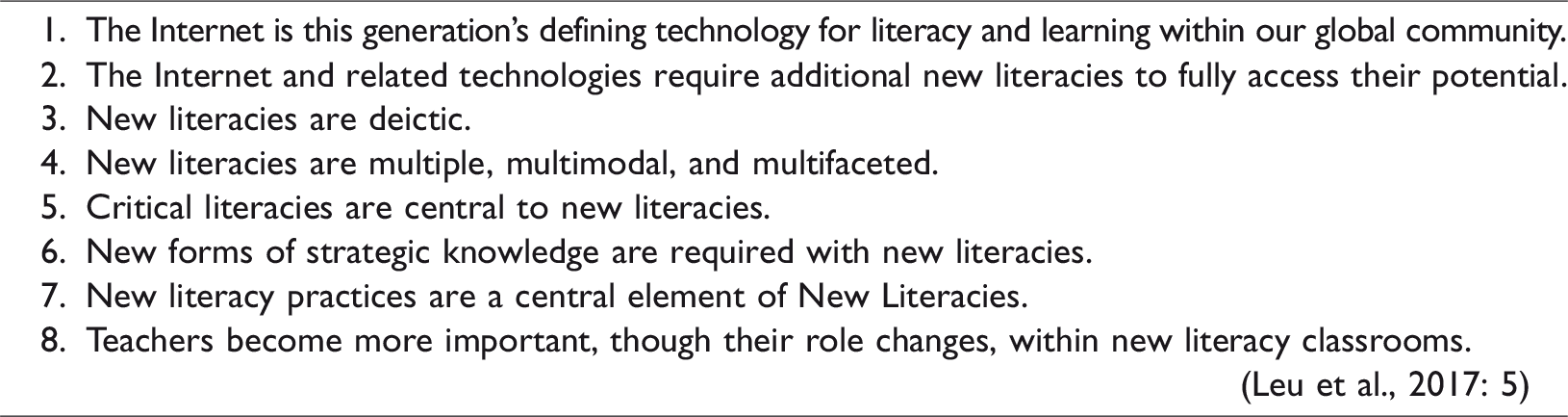
Originally published in 2004, this emergent theory is beginning to be used by researchers as a theoretical lens for studies of technology and learning (Hutchison and Beschorner, 2014; Lima and Brown, 2007; Stevens and Brown, 2011). New Literacies theory gives researchers a framework for understanding the ways the Internet and ICTs impact not only the literacy development of students, but also the social contexts of classrooms. It can also serve as a philosophical framework for learning with new technologies that can be used by classroom teachers to structure instructional practices that use the Internet and ICTs.
Methods
This theoretical analysis draws from data collected for a larger qualitative multiple case study that explored the ways in which adolescents who had previously experienced academic failure perceived themselves as writers when engaged in digital writing in their literacy classrooms (West, 2015). The study documented the experiences and perceptions of two fourth-grade students in a suburban elementary school, Jon and Jessi, and two ninth-grade students in an urban high school, Chris and Nicolasia, over a period of three months during the 2014–2015 school year.
Data sources included classroom observations, interviews, artifacts, and retrospective digital writing think alouds. The latter data source used video recordings from small digital cameras embedded in the frames of eyeglasses worn by students while composing digital texts. Immediately after the writing event, the videos were used to elicit a think-aloud discussion of the student’s writing process.
I analyzed data on the literacy practices, literacy events, and participant perspectives as it was collected throughout the study period using both deductive and inductive data analysis (Miles et al., 2013). I used the eight central principles of New Literacies Theory (Leu et al., 2017) as a deductive analytical framework to analyze the classroom environments in which the participants were engaging in literacy practices. This framework was used in conjunction with inductive pattern codes (Miles et al., 2013) that emerged from the data. Pattern codes can consist of categories or themes, causes or explanations, relationships among people, or theoretical constructs (Miles et al., 2013: 87). These pattern codes were used to understand the affordances and constraints of the technology tools participants were using to engage in literacy events.
Mrs. Jones’ and Mr. Matthews’ classrooms through the lens of New Literacies theory
For this theoretical analysis, I observed teachers and students engage in new literacies practices in order to understand how the Internet as a cultural tool mediates the literacy actions of adolescents in English Language Arts classrooms. In these classrooms, writing instruction was mediated through the use of the Internet and ICTs. Using New Literacies theory (Leu et al., 2017) allowed me to better understand the digital writing events observed in the literacy classrooms. Here, I share an analysis of the data in light of the eight principles of New Literacies theory and share examples of the ways in which they were enacted in Mrs. Jones’ and Mr. Matthews’ classrooms.
Internet as literacy technology
Grounded in New Literacy Studies’ emphasis on the socially and culturally situated nature of literacy practices, Leu and colleagues argue that the statistics of Internet access and usage indicate that the Internet is a dominant presence in our lives; and the Internet has become the most prevalent cultural tool with which we engage with literacy. According to the Pew Research Center (2018), 95% of teens in the United States have access to a smartphone and 88% have access to a desktop or laptop computer at home, with 45% of those teens describing their Internet usage on either a computer or cellphone to be “almost constant.”
Mrs. Jones used the Internet as the primary tool for literacy learning in her classroom. Technology use was integral to almost every activity in which students engaged. Mrs. Jones’ used Schoology (www.schoology.com) as a central hub for all literacy-learning activities she planned for her students. Even paper and pencil tasks were explained on the class Schoology website. When students missed instruction as a result of being pulled out of the room for intervention, Mrs. Jones directed them to the Schoology website to find assignments. In addition, both fourth-grade participants were frequently observed referring to the Schoology website before making their selections for the Daily 5 (Boushey and Moser, 2014). Students were engaged in an informational writing unit in which they used content on the website Wonderopolis (www.wonderopolis.org) as mentor texts to create informational texts in Google Docs and develop that text into infographics in Glogster (edu.glogster.com). This project demonstrates how the Internet was central to meeting Mrs. Jones’ goals of creating writing events that were authentic and collaborative.
The 2014–2015 school year also marked the first time that students took statewide literacy assessments using the Internet in James Madison Elementary School. Prior to the Partnership for Assessment of Readiness for College and Careers (PARCC) assessments, students took pencil and paper reading and writing assessments to demonstrate their mastery of literacy skills. This represents a significant shift in how literacy is assessed as new literacies practices are now tied to students’ ability to demonstrate mastery of traditional school literacy. Leu et al. (2017) argue “the Internet has become this generation’s defining technology for literacy and learning within our global community” (p. 5). The observational and interview data from this study demonstrate that the Internet was the defining technology for literacy learning in Mrs. Jones’ classroom community.
Mr. Matthews also used the Internet as the primary tool for literacy engagement in his classroom. All writing students produced during the study period was composed in Google Docs. The only assignments written by hand were PARCC vocabulary definitions and sentences that were completed each week. Mr. Matthews also used the learning management system Blackboard (www.blackboard.com) as a mode of communication and remediation for students. Mr. Matthews posted announcements as well as instructional resources, such as model essays.
However, although most schools administered the PARCC assessments electronically, Central High School did not. This means that while students were practicing for the PARCC assessments by writing in Google Docs on their laptops, they took the high-stakes assessments using a traditional test and answer booklet method. Therefore, although the Internet was the primary means of literacy engagement in Mr. Matthews’ classroom, the lack of technology infrastructure in the building to support the administration of the high-stakes assessments meant that students’ literacy skills were assessed using a tradition pencil and paper approach. This means that students did not have access to the electronic tools and resources that had previously enabled their literacy actions as writers when they were formally assessed on their literacy skills.
Internet requires new literacies
Engaging in new literacy practices still requires the use of traditional literacy practices associated with reading and writing print-based texts such as decoding and encoding text, comprehending and evaluating authors’ ideas and making inferences, as well as spelling, drafting, revising, and editing. However, Leu and colleagues argue that these literacy practices are not sufficient for taking advantage of the capabilities of the Internet and ICTs. Instead, traditional literacy practices serve as foundational practices from which new literacy practices need to be developed in order to effectively engage with and benefit from the full range of possibilities created by new technologies.
Using the Internet as a tool to engage in literacy actions requires students to not only have foundational literacies associated with traditional reading and writing in print contexts, but also to have additional literacies related to using and interacting within the platforms of various software programs. It also requires a functional understanding of the ways in which their devices work. This means that students must understand the technical aspects of using the cultural tools in order to accomplish their literacy goals.
A simple act, such as logging the title and author of a book on a reading list, can require far more knowledge than before and can become a constraint on completing a literacy action. Whereas, logging this information once meant that a student have knowledge of the location of a piece of paper, the ability to sharpen a pencil, and the ability to print letters, now using a website such as Biblionasium (www.biblionasium.com) means a student must know how to log on to a school network, navigate to a website, log on to that website, use a search engine to find a specific title and author, and, in some cases, manually enter the information if the title is not in the database. However, this additional work comes with affordances not offered by a handwritten list of books on a sheet of paper. Using Internet tools such as Biblionasium allows students to graphically display their reading progress and track their growth as readers through Lexiles, interact within a digital space to state their opinions and reactions to books, and receive electronic awards for their achievements.
For students to be able to take advantage of the affordances new technologies offer, they must understand how to use the functions of the programs and be able to interpret the symbology of those programs. During the retrospective digital writing think aloud, one of the fourth grade participants was explaining to me what he tried to do while giving feedback to a peer in her Google Doc: Jon: I tried to delete that word, that one… [pointing to screen]. Interviewer: The highlighted word that says “humans?” Jon: yeah, yeah. Interviewer: And what happened when you tried to do that? Jon: It put a line through it. Interviewer: Ok, what is, what do you think that line means? Jon: I don’t really know…. maybe someone blocked it…. I don’t know.
Most of the websites students used for literacy learning in Mr. Matthews’ classroom were password-protected websites that required unique usernames and passwords to access the activities and information. In a single class period, students might have to remember and correctly enter four sets of credentials, first logging onto the school network, then logging onto PowerSchool (www.powerschool.com), then logging onto Blackboard, and finally logging onto Google Docs to finally be able to begin working. This is more cognitively challenging than tearing a sheet of paper from a notebook as students did in traditional writing classrooms. Mr. Matthews explained that even though the technology department tried to keep students’ credentials consistent across applications, their usernames were “always going to be a little different and some of the systems allow them to change their passwords.” In the past, if a student was unable to find a piece of paper, Mr. Matthews could easily supply one. Now, if a student forgets a username or password, it becomes more cognitively challenging for the teacher to solve the problem as well.
Observational data also show that students were required to remember which websites were compatible with which web browsers in order to successfully use the features of the website. In multiple instances, Mr. Matthews reminded students that they were in the wrong browser for a specific web application and that they needed to close their current browser and reopen the website in a different browser. This means that students had to go through the same log in process in a different browser to get back to where they were in their writing process when they began experiencing difficulty. These challenges can constrain both students’ efficiency and motivation to successfully complete literacy actions.
New literacies are deictic
What it means to engage in new literacy practices transforms as new technologies and ICTs are developed. New technologies lead to new social practices and new literacy practices at a much quicker pace than ever before in history because of the instantaneous nature of the Internet. As the cultural tools we use to engage in literacy actions change, so too do the ways we understand and define literacy practices and literacy events.
In the fourth-grade classroom, there was evidence that the ways technology changes our literacy practices also changes the ways in which we use language to talk about writing. Leu et al. (2017) explain “new technologies regularly and repeatedly transform pervious literacies, continually redefining what it means to become literate” (p. 5). As Mrs. Jones talked about writing with her students, she directly addressed the way our discussion about the writing process has changed in light of the technology she and her students used during writing events. During the first observation, when Mrs. Jones was discussing the revisions students should make to their opinion writing when evaluating their work against the 6 Traits rubric, she said “we call them drafts, but you don’t really have different papers, just several revisions.” Using technology tools to draft writing means that writers make changes to their writing on both micro and macro levels with each read through the electronic document. Therefore, rather than having a series of drafts, or improved copies of the text that demonstrate changes over time, as was the case when writing was taught using only paper and pencils as tools, students now have a “history” of individual changes within a single document that are recorded by the Google Docs program. This example demonstrates how the language we use to talk about writing needs to adapt to the changing nature of writing in a digital space.
New literacies are multiple, multimodal, and multifaceted
Leu and colleagues argue that the changing nature and affordances of texts on the Internet over traditional print texts allow for meaning to be represented through more complex combinations of modalities. They also argue that the Internet and ICTs offer multiple tools for meaning construction, so that new literacies practices include the ability to use a variety of technology tools and to select the most appropriate tool for the context.
Writing in a digital context creates the opportunity for students to integrate multiple modalities of expression. When students in Mrs. Jones’ class were creating their infographic posters in Glogster, the Internet tool enabled students to not only include texts and two dimensional images as is common in traditional writing events, but also audio, video, and hyperlinks to other websites. Leu et al. (2017) argue that the integration of multiple media formats “challenge[s] our traditional understandings of how information is presented and shared with others” (p. 6).
Having access to these additional modalities for meaning expression also opens up opportunities for students to express their ideas in rich and complex ways. However, other constraints can serve to limit the modes of expression available to students. When students were working in Glogster, Mrs. Jones instructed them not to use video in their posters because all 50 files from James Madison Elementary School’s fourth-grade students and all 50 files from the partner elementary school’s fourth-grade students were going to be stored on the same server and there was not room to store 100 large files. This technological limitation constrained the literacy actions available for students working in Glogster in this particular writing event.
Using the Glogster platform to create these multimodal texts also required students to think about the nonlinear ways in which their writing would be read and how readers would assimilate the various forms of information they presented. This becomes increasingly important as the PARCC assessment also requires students to assimilate information from a variety of multimodal sources on a given topic. Mrs. Jones explained her understanding of the students’ tasks on the Performance-Based Assessment in this way: We’re seeing that they have to read from the Internet, they have to read from a magazine article, they have, in fourth grade, they have to watch a media presentation, and take all those ideas, form their own opinions or statements and then write about it.
Leu and colleagues emphasize that in the 21st century, literacy includes the ability to effectively select, from the numerous options available on the Internet, the tools and forms of modality that best meet their literacy and communication needs. Mrs. Jones’ approach to instructional planning exemplifies this aspect of New Literacies theory. In discussing her decision making process in working with both the other fourth-grade English Language Arts (ELA) teacher, as well as the district technology specialist, she emphasized that they did not want to choose the technology tool until they had established their goals for the informational writing instructional unit. Only after they had carefully considered their goals for the instructional unit did they start looking at available technology tools that could meet those goals. Mrs. Jones was passionate in explaining her position on selecting tools: I totally can’t stand that, so…. And that’s always been my thing, but most people aren’t comfortable with it – it’s choose a tool first and then we’ll build our lesson around it. Well that doesn’t work for me. So when we presented to her, we were thinking of like a webpage or something, more like a…. not Moodle but…. I haven’t used it [….] and I didn’t feel comfortable with it, but I was fine if that’s what she suggested. I met with her again, she happened to pop in and I was telling her “ok, now I’m getting to the point, I really want to choose my tool.” And when I showed it to her, what they were doing, she goes “I think then you’re best with Glogster.”
During one observation, Mrs. Jones was in the process of creating a poster of technology tools, a “Student Tool Belt” that included the categories of Information Management, Content Creation/Presentation, Collaboration, and Communication with the Internet tools students had available to them, such as Schoology, Glogster, Google Docs, and Gmail, listed under the categories. This is an example of how Mrs. Jones was modeling for students how to select the appropriate tool for their tasks—an important skill that they will need to acquire as they become more independent in their learning and are given a wider range of tools to choose from to meet their academic demands.
Because Mr. Matthews’ students used Google Docs strictly for word processing, and because they were engaged in writing practice essays for the PARCC assessments, which required a very structured writing style, there was little evidence of this principle observed in the ninth-grade classroom context. The strict requirements for the writing students produced did not allow for the integration of multiple modalities of expression. Furthermore, students were not given options to select from multiple technology tools to accomplish their writing goals. Google Docs was used as the sole tool for text production and students did not move their text into any other platform for presentation purposes.
However, Mr. Matthews did speak of a hope to use Google Sites in the Harlem Renaissance project he was planning for fourth quarter: They can actually take their learning and put it up in a more publically accessible forum. I don’t know if the sites are actually available outside of the [district] network, but at least for their peers within the network, […] they could share the results of whatever research that they would do.
Critical literacies are central
The open nature of the Internet allows for anyone to contribute content. This means that it is more important than ever before for users to learn to engage in critical thinking and analysis in order to identify the “political, economic, religious, or ideological stances that profoundly influence the nature of the information” (Leu et al., 2017: 6).
The open nature of the Internet also means that anyone can contribute information regardless of his or her expertise or lack of expertise on the subject matter; and people with highly biased perspectives can and do post-biased information. Mrs. Jones used the James Madison Elementary School’s Symbaloo page to scaffold students’ use of the Internet to search for information. When students began researching topics for their informational writing, she used her laptop and the LCD projector to show students the school’s Symbaloo page. She explained to students her purpose for having them use the Symbaloo page to conduct their Internet searches by saying “I just think there is a lot of information here to start. If you are still finding you can’t find the answers to your questions then you can extend into the Google world.”
Mrs. Jones also often reminded students that they must be responsible users of the Internet. She reminded students that they signed an Acceptable Use Policy that outlined the rules for computer use at school. She also reminded students of an example of a student losing his Chromebook as a consequence for accessing an inappropriate website. Students must pay critical attention to the information they consume as well as produce on the Internet, not only to ensure that they are acquiring credible information, but also to ensure that they are being good citizens in a digital environment.
Giving students access to texts outside the classroom walls presents challenges for teachers who are responsible for the activities and behaviors of students in the classroom. In order to monitor the websites students accessed, Mr. Matthews was given a program that allowed him to view thumbnails of each of his students’ computer screens. He explained that prior to having access to this software, there were instances of some students accessing inappropriate websites. The use of this computer program facilitated Mr. Matthews’ ability to monitor students’ behavior to ensure that they were adhering to the social expectations for responsible behavior in the classroom. However, it also tethered him to his desk and constrained the extent to which he could interact with individual students to support their writing process.
New forms of strategic knowledge
The nonlinear nature of the Internet afforded by hypertext technologies means that users must learn to negotiate multiple navigational pathways in order to access information. A complex networked environment has replaced the straightforward nature of information presentation in print-based texts and users must develop strategies for reading comprehension within this new environment. These strategies include (1) approaching online reading tasks with a problem-solving mind-set; (2) navigating search engine results and developing criteria for determining relevance of possible online texts according to the reading purpose; and (3) monitoring comprehension of chosen online texts and the relevance of the reading path through multiple interconnected online texts to the reading purpose (Coiro, 2011).
I observed multiple instances in which both fourth-grade participants interacted with their Chromebooks in ways that suggested they had not developed the strategic knowledge necessary to efficiently access information and accomplish tasks using the Internet. In one instance, the fourth-grade participant, Jessi, was observed navigating quickly between multiple websites without appearing to accomplish her tasks. She first began by scrolling through the news feed on the class Schoology website for approximately 3 minutes. Then she navigated to Biblionasium for approximately 30 seconds, then she briefly went to a typing practice website for 20 seconds, then she went back to Schoology. A minute later, she navigated back to Biblionasium and started entering information about the book resting on her desk next to her Chromebook. Three minutes later, she returned to the typing website for approximately 30 seconds before navigating back to Schoology. In this instance, the options for independent activities coupled with the numerous websites used to accomplish those activities appeared to be a source of distraction for Jessi. Although she may have accomplished entering the title and author of her book into the Biblionasium website, she did not make efficient use of her class time.
In several instances, Jon was observed conducting Internet searches on his topic and then interacting with the search results in a way that did not appear to accomplish his goal of finding information. After the search engine displayed the results of his search, he was observed scrolling through the results too quickly to be able to read any of the text in the results list. He then clicked to another search engine that was open in another tab and interacted with that website in a similar fashion. A week later, when I observed him continuing to search for information on his topic, I observed that one search returned 706 results, indicating that the words he searched were retrieving more hits than he could reasonably manage to sort through. This suggests that it would be beneficial for Jon to develop more strategic knowledge of how to conduct an Internet search using specific words that will help him retrieve a manageable amount of information.
In the ninth-grade classroom, I observed several instances in which one of the participants, Nicolasia, made adjustments to the formatting of her Google Doc without apparent reason or purpose. In the middle of drafting her argumentative essay, she changed the alignment of her document from left-aligned to center-aligned. Then after a few minutes, she changed it back to left-aligned. Later in the observation, she changed her font multiple times.
Drafting on a computer gives students far more formatting options than writing using a pencil and paper method, but students must learn to be strategic in using these added features in ways that are appropriate for the writing task. In the final interview, Mr. Matthews opened one of Nicolasia’s essays to review before talking about her as a writer. When he saw that she had submitted her essay in a cursive font, he commented that it was a challenge to get them to use appropriate formatting, and explained that students “want to use all these fancy fonts, and then when you have to read a hundred and fifty of them it gets to be really difficult.” This means that students must also develop strategic knowledge of the purposes for and meanings associated with various options available to them when writing digitally.
New literacy practices are central
New digital technologies create the capabilities for new ways of constructing, sharing, and accessing content that translate into the development of new literacy practices, which will require new social practices to be developed in classrooms, as the knowledge and expertise will rest in the students as well as the teacher. Rather than viewing students and teachers as expert or novice technology users, New Literacies theory recognizes that each person in the classroom, student or teacher, will bring ever-developing knowledge of various technologies and ICTs. This means that new social practices involving sharing knowledge and expertise are necessary for the development of new literacy practices.
Engaging in literacy events on the Internet requires students to develop new literacy practices for constructing, sharing, and accessing content in ways that have already been discussed in previous sections. It also requires students to develop new social practices and social learning strategies as they learn with technology. Rather than the teacher being the expert of all things in the classroom, learning on the Internet requires teachers to allow students to share their expertise in using the Internet and ICTs.
Students in Mrs. Jones’ classroom were consistently observed interacting with their peers to give and receive help. Mrs. Jones instilled this collaborative ethos in students by actively encouraging students to help each other to solve their technology problems with statements such as, “Is there anyone who would like to help [student name] with her problem with editing on Glogster?” and “If you’ve successfully logged in, please help those who haven’t yet.” As students interacted, she also actively taught students how to give assistance in a way that facilitated positive social interactions and allowed the student receiving help to also develop new expertise from the interaction. Mrs. Jones instructed students to act as a shadow and coach the student they were helping, rather than taking over the computer and doing it for the student. During workshop periods in which students were assisting each other, Mrs. Jones was heard saying “try to stay off it and try to let him do it, as a coach.”
Mrs. Jones emphasized in interviews that she saw her role in the classroom as a writing teacher, not a teacher of the technology tool being used to accomplish the writing task. She explained her rationale for having students and technology support staff provide assistance to students, rather than providing assistance herself: Those kids who are feeling really confident and kind of jumped in ahead, I’m using them as the peers to help other students. I have rarely helped kids with Glogster because that is a tool, that’s not what my job is here. I’ve been still working in Google Docs with kids, still talking 6 Traits with kids, and not talking the tool. I refuse to talk the tool. I just… as soon as I do once, I get soaked up into it, “Oh, why don’t you try this.” The frustration is… a couple of kids, the screens are too small, I do tech help tickets, I don’t say “oh I think I can figure that out” where a couple of years ago I would have said “Oh gosh, it’s not working, what are we going to do?” and we’d all shut down [laughs] then I’d go “I’ll figure it out for you” and then I’d go to ten people. I’m not doing that anymore.
The social learning that Mrs. Jones fostered in her classroom also helped the students in her class develop more confidence as technology users. The following exchange demonstrates how learning in a classroom that emphasizes social learning benefited Jessi: Interviewer: Does it look like [Glogster] will be easy to figure out how to use? Or what do you think about that? Jessi: Yeah, it will kind of be easy for me. Interviewer: Ok. Why do you say it will kind of be easy for you? Jessi: Because I don’t really sometimes understand, so sometimes my friends help me.
Social interaction permeated everything students did in Mr. Matthews’ classroom, regardless of whether or not the interactions were sanctioned by the teacher. While students were observed interacting with their peers to give and receive technology help, they were also observed engaging in interactions that were counter to accomplishing the goals that Mr. Matthews established for each class period. For the most part, Mr. Matthews did not encourage a collaborative ethos in students’ writing process in the ways that Mrs. Jones did. It is important to note that Mr. Matthews was attempting to structure the class writing time to mirror the environment in which they would write on the PARCC assessment. Therefore, he emphasized that students were “expected to work independently and quietly.” However, throughout the observations, students engaged in social interactions during their writing process, and for the most part, Mr. Matthews allowed students to talk as they wrote or selectively ignored social interactions as long as they were not disruptive to the rest of the class.
There were two instances in which Mr. Matthews elicited the technology expertise of a student who was finished with his essays to help other students accomplish a technology-related task. First, Mr. Matthews asked a student to help another student who was absent earlier in the week to create a folder in Google Docs. Then, a few weeks later, Mr. Matthews asked a student to help Nicolasia adjust the brightness of her screen on her laptop so that she could more easily view it. In this last instance, Mr. Matthews coached the student giving help when his first attempt failed to solve the problem, using it as an opportunity to teach both students how to make adjustments to the brightness of the laptop screen.
Teacher role changes
Teachers are no longer dispensers of literacy skills, but now orchestrators of learning contexts. Taking on the role as a guide within the learning context of the Internet requires teachers to thoughtful plan for the ways in which students will engage with the Internet, as well as be willing to embrace the fact that some students will be more literate with certain technologies than the teacher. Their role will require active engagement with changing, complex contexts and a willingness to become learners alongside their students.
Mrs. Jones’ stance on offering assistance with technology tools is one example of how her role has changed in her classroom as her technology use has increased in her literacy instruction. The ways in which she used Symbaloo to orchestrate the workshop portion of the literacy curriculum are also a prime example of how she acted as a guide to create ways for students to engage in literacy learning mediated by the Internet and served to coach them through those experiences.
Mr. Matthews’ assertion of authority and management in his classroom was mediated through the use of technology. There were several instances in which he interacted with students through technology rather than face-to-face. For instance, when Mr. Matthews was using the software program to monitor the students’ computer use by viewing thumbnails of the laptop screens, he saw that one student had activated the webcam of her laptop. He opened a chat window and sent her a message to redirect her behavior rather than calling across the room to her or physically getting up from his seat and walking to her desk to speak to her. At another point later in the period, there was a group of students who were off-task. Mr. Matthews said to the students, “I would suggest you check your grades in PowerSchool.” In this instance, he used the electronic grade book as a tool to redirect students back to the assigned task.
Findings
Analyzing the learning context of these fourth- and ninth-grade classrooms through the lens of New Literacies theory informed my understanding of how the Internet as a cultural tool mediated the literacy actions of adolescents in Mrs. Jones’ and Mr. Matthews’ classrooms. Both Mrs. Jones and Mr. Matthews used the Internet as the primary means for literacy learning in their classrooms. Technology use was integral to almost every activity in which students engaged. In Mrs. Jones’ classroom, working in Glogster created the opportunity for students to integrate multiple modalities of expression and required students to think about the nonlinear ways in which their writing would be read. However, the strict requirements for the writing students produced in Mr. Matthews’ classroom to prepare for the PARCC assessments did not allow for the integration of multiple modalities of expression that are an affordance of Internet-based writing. Mrs. Jones instilled a collaborative ethos in her students by encouraging them to interact with their peers during their writing time to give and receive help. Social interaction permeated everything students did in Mr. Matthews’ classroom even though Mr. Matthews encouraged quiet, independent writing in order to mirror the environment in which students would write on the PARCC assessment.
Throughout these writing events, the Internet as a cultural tool both enabled and constrained the adolescent participants to complete literacy actions. To better understand how the Internet mediated the literacy actions of the participants in this study, I had them wear a small digital camera located in the frames of costume eyeglasses commonly sold as “spy glasses.” This was done in order to document their point of view during a digital writing event in which they were producing text. Each participant and I viewed the video together in an interview immediately following the writing event to elicit a think-aloud discussion of his or her writing process. I also interviewed participants about their preferences for writing using traditional pencil and paper processes compared to working on a computer. In this section, I discuss affordances and constraints participants experienced when engaged in digital writing using the Internet as a cultural tool. Figure 1 illustrates the major findings of the cross-case analysis in terms of the how the Internet as a cultural tool enabled and constrained the literacy actions of adolescents in English Language Arts classrooms.
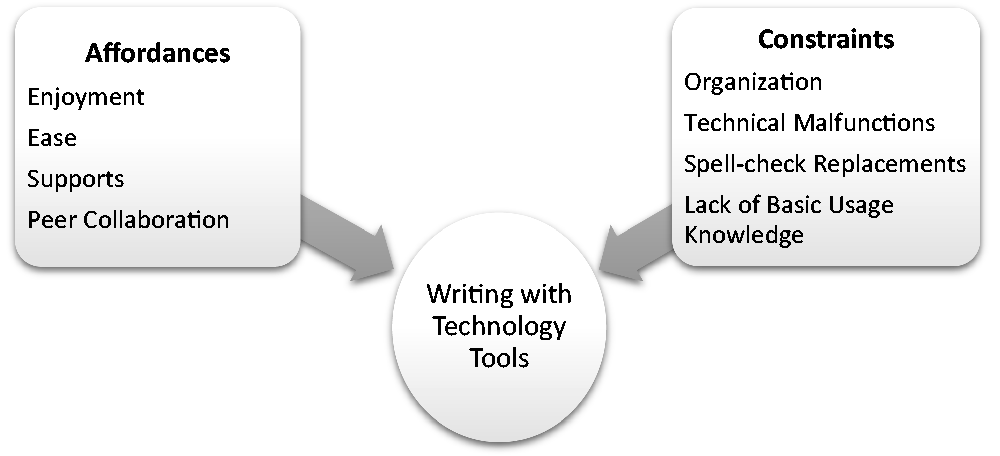
Affordances and constraints of writing with technology tools.
Affordances of writing with technology tools
When I asked each of the four adolescent participants what their preference would be if they were given the choice to write with paper and pencil or with technology, they all indicated that they preferred writing on a computer. The affordances they identified for writing with technology included the level of enjoyment and ease they experienced while writing, the features they believed provided support to help them accomplish tasks, and the features built into the digital programs that facilitated peer collaboration.
First, the adolescent participants in this study preferred writing with technology because they perceived the experience to be more enjoyable and easier than writing with pencil and paper. For these participants who have been deemed “at-risk” because of their prior academic performance, and for the fourth-grade participants who have been labeled as “reluctant” writers, identifying a tool through which they can write as easy and fun is an important step toward developing positive identities as writers and as students.
When I asked Jon why he preferred writing on a computer, he said, because “it’s more fun.” He explained that using technology makes school easier because “It’s just not as hard as on paper,” but he would not elaborate on reasons to support this claim. He also expressed a preference for a computer over a tablet, such as an iPad, for working in Google Docs because on a computer “it just has it right here.” He explained that it was easier to type on a keyboard and be able to look at the screen than to type on the screen of a tablet that is used both as a screen and a keyboard simultaneously.
Chris also perceived writing in Google Docs to be easier than writing on paper because he believed that it allowed him to keep his writing more organized. He explained: With the laptops and stuff it make it better so, ‘cause like writing can be difficult for some people, […] but typing it helps me keep organized and then I can go back and make corrections instead of erasing and making all these marks on my paper […] and having it all messy.
Jessi also preferred writing on computers because, she explained, “It’s pretty fun […] and you can like look up the dictionary or [pause] YouTube or videos.” In a later interview, Jessi explained that what she liked most about writing with technology was that she was able to “learn about new things and you get to write what you really want to write.” Jessi’s comments seemed to suggest that because the computer offered her a broader range of information than what was available in print in her classroom, it also afforded her a broader scope for selecting topics that she cared to write about.
Second, the adolescent participants in this study preferred writing with technology because they believed the technology tools provided them additional support to help them accomplish tasks beyond what was possible in traditional pencil and paper writing events. The teachers also identified resources that they believed facilitated the writing process for students who struggle with writing. The use of these resources has the potential to help adolescents who have struggled with writing in traditional writing events experience success as writers in a digital context.
The availability of resources such as spell check can allow students who struggle with spelling to develop their voices as writers by allowing them to use the words they want to use instead of relying solely on the words they feel confident they know how to spell. Nicolasia explained, “What I like most about writing with technology is I can’t really spell anything wrong because there’s autocorrect there, and because you can always like go back and just delete instead of erase.” In discussing Jon’s use of technology in her class throughout the year, Mrs. Jones noted that engaging in digital writing allowed Jon to attempt words that he would not have attempted before because of his limited spelling vocabulary.
Jessi also indicated that it was “fun” to edit on a computer because “they tell you the right words.” When Jessi was wearing the video-recording eyeglasses in preparation for the retrospective digital writing think aloud, the camera captured the Google Docs program highlight a misspelled word in red (see Figure 2).
Jessi’s Retrospective Digital Writing Think Aloud (RDWTA screenshot showing a misspelled word highlighted in red.
Within seconds of the program highlighting the typed word in red, the movement of the video camera and the captured images indicates that Jessi moved her focus to the right of the screen where suggested spellings were offered for the misspelled word (see Figure 3).
Jessi’s RDWTA screenshot showing the spell check feature.
During the retrospective digital writing think aloud, we watched the video together, and I asked Jessi questions about what the camera in the eyeglasses she wore recorded. I asked Jessi to tell me what she was doing on the right side of the screen. She explained, “That was our tools and there’s spelling in it and it tells you the right words, what to write.”
For Nicolasia and Jessi, rather than seeing the instances in which the computer program identified errors in their writing as negative experiences, they perceived the instances as beneficial supports that helped them communicate their ideas. Given that both Nicolasia and Jessi also placed significant emphasis on their teachers’ responses to their writing and, for Jessi her teacher’s perception of her as a student, having a technology tool that fixes errors before they are recognized by a teacher evaluating the writing is a significant affordance for these two adolescents.
In addition to the benefits of the revision tools, Chris identified the organizational structure of Google Docs as an important support for him as a writer. He explained: Chris: Keep it organized. I really don’t have no dislikes about it ‘cause like it’s real like supportive. I mean but sometimes, the only probably disadvantage is like if you don’t title your documents, like you can get them confused and mixed up and it can be a messy situation, but like, if you smart enough to keep it titled and everything, and keep it in the correct folder, then yeah, it kind of helps organization. Interviewer: You said that it was supportive, what do you mean by that? Chris: Like as far as supporting what I mean, like it kind of goes with the organization, like it support, it like supports you to keep it organized, like you need to keep all your stuff organized, you put it in one folder for one class, and then you change it and put it in another folder for another class. It’s real supportive.
The teachers also indicated that the technology tools provided them additional support to help their students accomplish tasks beyond what was possible in traditional pencil and paper writing events. Mrs. Jones indicated that she used the revision history tool in Google Docs to track the changes her students made to their writing. She explained that this allowed her to see how students integrated the feedback she had given them on drafts in progress and to determine any additional feedback she might need to give based on the revisions.
Mr. Matthews explained that when students completed assignments on paper, he often had instances in which students forgot to write their names on their papers and, therefore, did not receive credit for work that they completed. When students submit assignments through Google Docs, he explained, “At least with Google Docs I don’t have to wonder whose paper it is. Now I still have to get on them about not putting it on their paper, but at least it’s tied electronically to their name.” For students who are “at-risk,” not receiving credit for work that was completed can negatively impact the effort they are willing to put forth in future writing events. This was evident in an experience Nicolasia shared about her teacher losing her writing and then finding it after it was too late for the grade to count.
Third, the adolescent participants in this study preferred writing with technology because of the features built into the programs that allowed for peer collaboration. For the two fourth-grade participants writing in a classroom in which the interactive features were used as an integral part of the writing process, the ability to receive feedback within their documents from their peers was an important source of support and motivation for these adolescents. Jon indicated that he received support from his peers in Mrs. Jones’ classroom both in the comments left in his Google Docs, as well as through Gmail when peers sent “some ideas to help” him.
During the retrospective digital writing think aloud, Jon demonstrated the way he and his peers in Mrs. Jones’ class used Gmail to send other students’ access to their Google Docs for peer feedback. During the writing event, he reviewed comments written by his peers and marked them as resolved after making changes to his document. He also opened documents emailed to him by his peers and reviewed their writing.
Mrs. Jones identified the use of technology as a motivating factor in Jon’s perseverance with the informational writing unit. She explained that working in Glogster “pushed him to want to do more and elaborate a little bit more because he wanted to show through the technology that he knew more than he put down in text.” By using the features in Google Docs for peer collaboration, students in Mrs. Jones’ class had the opportunity to receive feedback from their peers throughout the writing process to sustain that motivation.
Constraints of writing with technology tools
During interviews, the adolescent participants discussed what they perceived to be constraints to accomplishing their academic tasks when writing with technology tools. These constraints were mostly associated with technical aspects of using the technology tools. Chris did not perceive many disadvantages to writing with technology. However, he did mention the importance of titling documents in order to avoid getting “them confused and mixed up” and resulting in “a messy situation.” When I asked Nicolasia what she liked least about writing with technology, she identified experiencing frustration when the computer “freezes” or does not respond appropriately to the commands she enters. She explained: Like I think it was yesterday, I was in class and I was trying to go back so I could like write my definitions for my vocabulary list, I was trying to go back and it was like “EHH,” like, “EHH, nope” it stayed on the page, like so I had to retype something in and go back and it kept doing it over and over again.
However, over the course of several observations and analysis of artifacts, I observed that the spell check feature in Google Docs created a significant constraint for Jon’s ability to express meaning in his writing. When Jon was researching his topic of dogs’ communication, he took handwritten notes from the websites he used as sources of information. Figure 4 shows the notes he took in preparation to write a paragraph about behaviors and games.
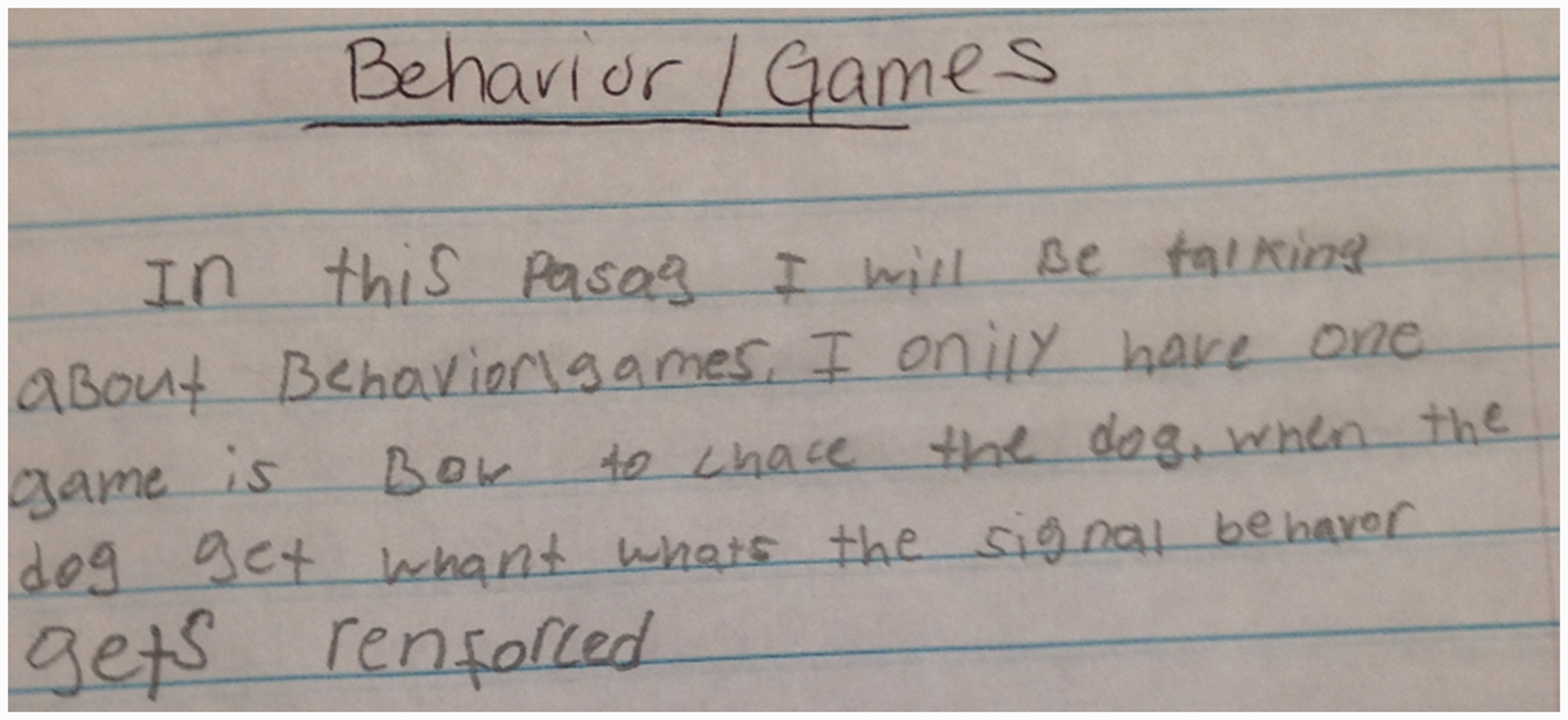
Jon’s behavior/games notes.
The last sentence reads, “when the dog get whant whats the signal behavior gets renforced.” When Jon began drafting in Google Docs we can see that some of the spelling errors in the sentence were fixed, either as a result of Jon typing the words correctly when he entered them into the Google Doc, or as a result of the spell check feature offering suggestions to fix the errors. However, as you can see in Figure 5, one of the misspelled words, “renforced” was replaced with “rainforest.”

Jon’s behavior/games paragraph.
When I returned to Mrs. Jones’ classroom a week later, this paragraph had been removed from the document and a paragraph on behaviors and games never reappeared in his Google Doc. When Jon recomposed his writing in Glogster, the details about reinforced behavior resurfaced. He wrote: “when the dog gets what it wants the behavior gets renforesd.” Although the word was spelled incorrectly, the sentence retained it meaning, unlike in the early Google Doc draft.
As it turned out, Jon recomposed multiple times in Glogster. At the end of the class period in which I first observed him recomposing, I approached Jon and asked if there was a way that he could share with me what he had accomplished on his Glogster that day. He told me that when he shut his computer it did not save and he lost everything he had done. He showed me a new Glogster poster he was creating that just had a speech bubble in the center with no text (during member checks, Jon clarified that he did add new text in the speech bubble). The Speech Language Pathologist overheard our conversation and sat down next to him and commented to me that she did not know what a Glogster was. Jon replied, “I don’t either.”
Although working in Glogster gave Jon an additional opportunity to compose text to construct meaning about his topic of dogs’ communication, the incident of him losing his work as a result of not understanding how to save in Glogster is also an example of the types of frustrations that students experience when writing using technology and not having a solid understanding of how to use that technology. The teacher indicated that she did not help with the technology tool, and relied on other students to provide support. However, the loss of his work on the day I observed was based on Jon not understanding how to save. Experiences such as this could have serious consequences for Jon’s motivation to write using technology in the future.
Discussion
New Literacies theory (Leu et al., 2017) was a useful framework for evaluating the applications of technology in literacy instruction in each of the English Language Arts classrooms. Leu and colleagues emphasized that this is an emergent theory that is still under development. This study demonstrates that the principles they put forth were effective for analyzing learning contexts mediated by technology tools. By analyzing the classroom contexts according to each of the eight principles, I was able to develop a nuanced understanding of the learning environments in which the adolescents’ literacy experiences occurred in this study. I was also able to identify important differences between contexts in terms of the ways in which technology-usage mediated the literacy instruction in each learning environment and constrained or enabled students’ literacy actions. Although this theory has been used by researchers as a theoretical lens for studies of technology and learning (Hutchison and Beschorner, 2014; Lima and Brown, 2007; Stevens and Brown, 2011), I was unable to identify any published studies in which a learning environment was explicitly analyzed according to each of the eight principles within the report of the research.
In conducting this analysis, I found that the principles of this theory were generally consistent with what I observed in each classroom. For instance, the Internet was the primary means of literacy engagement in both English Language Arts classrooms, and using the Internet required students to develop new literacies in order to take full advantage of the affordances of their Internet-mediated literacy practices. There was also evidence that the influence of technology on writing instruction was changing the language that Mrs. Jones used to talk about the writing process and the options for revision using technology tools that Mr. Matthews hoped to use with his students.
However, rather than being able to make the blanket claim that new literacies practices are inherently multimodal, I found that the extent to which the new literacies practices students engaged in were multimodal was largely informed by the parameters of the writing assignments students were completing within the digital environment. The adolescents in the study demonstrated various levels of engagement in critical literacy practices, with the ninth grade students demonstrating more reflection on critical literacy issues, such as, in Chris’ case, the extent to which personal information should be shared through social media. Finally, the use of technology in writing instruction caused the teacher’s role to change in both the fourth and ninth grade classrooms.
Based on the findings of this study, there is an extension of the theory that I believe would advance the application to a broader range of literacy contexts and draw a stronger link between New Literacies theory and writing instruction. First, Leu and colleagues explained, “New forms of strategic knowledge are required with new literacies” (2017: 6). In their explication of this principle, the focus is primarily on the strategic knowledge readers need to navigate hypertexted websites in order to comprehend texts in a complex networked reading environment. In my analysis of the writing events of the participants in this study, I found that this principle could also be applied to the Internet-mediated behaviors of writers. There were multiple instances in which the adolescent participants interacted with their laptops in ways that suggested they had not developed the strategic knowledge necessary to efficiently access information and accomplish tasks using the Internet to inform the texts they were producing.
I also found that the adolescents would have benefited from developing additional strategic knowledge of the purposes for and meanings associated with various options available to them when writing digitally. There were several instances in which the adolescents made adjustments to the formatting of their Google Docs without apparent reason or purpose, and in the case of Nicolasia, her formatting decisions negatively impacted Mr. Matthews’ perception of her as a writer. Further explicating this principle of the theory to consider the strategic knowledge of writers would serve to expand the range of research contexts in which the theory could be applied.
Footnotes
Declaration of Conflicting Interests
The author(s) declared no potential conflicts of interest with respect to the research, authorship, and/or publication of this article.
Funding
The author(s) received no financial support for the research, authorship, and/or publication of this article.