




Abstract
Studies suggest that individuals with a parent who attended college or a university are more likely to attend themselves. Scholars have also argued that academic success at the highest levels requires the acquisition of a large vocabulary and fluency in multiple discourses, and that forming habits of reading various kinds of texts outside of school may be necessary. Using interviews with 40 individuals who completed advanced degrees and whose parents did not attend college, this study examined factors that may have influenced their independent reading habits. We found that each of our participants developed strong habits of recreational reading and was motivated at least in part due to relationships with various sponsors of literacy, including parents, grandparents, siblings, friends, neighbors, librarians, teachers, and church members. Social challenges to recreational reading were also noted by participants, including the challenge of learning to code switch with family members and others.
Investigation into why some people attend and succeed in an institution of higher learning beyond high school, whereas others do not, has been a persistent topic in sociological and educational research. Research into variations in educational achievement began more than 50 years ago, such as with the work of Sewell and colleagues (Sewell, 1971; Sewell, Haller, & Straus, 1957; Sewell & Shah, 1968), who found that family structural positions and the influence of significant others affected the levels of educational aspiration, which in turn affected educational attainment. Research also found differential educational opportunities available to students, including a high degree of difference in school quality available to various groups (Apple, 1995, 2004; Darling-Hammond, 2010; Knoester, 2011, 2013; Knoester & Au, 2015; Rothstein, 2004; Valenzuela, 1999). Other scholars have noted the impact of financial aid and affordability of higher education on individuals’ ability and decisions to attend and stay in a college or university (Crowley & Knoester, 2012; Goldrick-Rab & Roksa, 2008; Nora, Barlow, & Crisp, 2006). Still, many complexities involved with various educational pathways remain poorly understood. While research has focused primarily on the dominant role of tangible resources in explaining the intergenerational transmission of educational attainment, recent research has also considered the role of values, identities, and habits in explaining these patterns.
For this study, we chose not to focus on whether parents’ social class and educational levels shape the lives of their children, as research has consistently shown to be the case (Attewell & Lavin, 2007; Morgan, Alwin, & Griffin, 1979). Rather, we chose to inquire into how family educational values and practices may shape children’s lives, and how other relationships and experiences may influence individuals’ educational values, identities, habits, and accomplishments over time. We examine selected individuals’ perceptions of their own life histories, with a particular focus on the development of literacy habits and reading interests outside of school.
The present study builds on work conducted by scholars in education, sociology, and psychology who have examined the lives of first-generation college students, the early formation of reading habits, social aspects of reading, family relationships, literacy sponsors, and identity development (Attewell & Lavin, 2007; Bus, 2001; Bus & van Ijzendoorn, 1988a, 1988b, 1992; Brandt, 2009; Compton-Lilly, 2003, 2007; Cope & Kalantzis, 2000; Cushman, 2006; Gee, 1996; Grimes & Morris, 1997; Krashen, 2004; Suitor, Plikuhn, Gilligan, & Powers, 2008). These scholars have suggested that social factors and identity development, apart from reading ability, social class, or parents’ levels of educational attainment, affect the literacy development and school success of children.
The current study builds on important ethnographic research conducted on the literacy development of children and adults (Heath, 1996, 2012; Lareau, 2000, 2011; Purcell-Gates, 1995, 1996; Taylor, 1988; Taylor & Dorsey-Gaines, 1988). These scholars have vividly described aspects of how children and adults from various cultural groups have used literacy in their daily lives, expanding the definition of literacy far beyond merely decoding texts found in books, but describing the many ways people from diverse backgrounds encode and decode written symbols to accomplish goals related to various daily challenges.
However, while much of the literature cited above illustrates the class and cultural differences in literacy usage, we would argue, following Apple (2004), that while class analysis in educational research, including the study of reproduction of inequalities from one generation to the next, is crucial, this work can over determine the correlation between unequal power relations and educational outcomes. It is therefore not enough to describe class differences in literacy practices. We must also pay close attention to individuals, such as those in this study, who are first in their families to attend tertiary education and who advance to acquire graduate degrees. These individuals “defy the odds” in particular ways, and their stories may inform educators and others interested in interrupting the reproduction of inequalities from one generation to the next.
To conduct this research, we turned to promising practices that have been found linked to long-term academic success but have not been investigated specifically in relation to students whose parents did not attend college. The practices to which we refer are what Krashen (2004) named “free voluntary reading,” Klauda and Wigfield (2012) called “recreational reading,” and still others refer to as “independent reading” (Brozo & Hargis, 2003; Ivey & Broaddus, 2001), or choosing to read on one’s own time. Krashen, among others (Gee, 1996; Hart & Risley, 2003), argued that academic success at the highest levels requires the acquisition of a large vocabulary and fluency in multiple discourses, and that forming habits of reading various kinds of texts outside of school may be necessary to succeed in school at the highest levels. The development of habits associated with free voluntary reading or recreational reading is complex, however, and deserves closer examination. This study inquired into whether those who acquired advanced degrees, and whose parents did not attend college or university, developed habits of free voluntary reading in childhood, and how these processes may or may not have developed over time.
In our analysis, we draw on Brandt’s (1999) theory of sponsorship of literacy, which is an individual, institution, or community who supports or hampers opportunities for literacy learning in the lives of individuals. Brandt (2009) defines sponsors of literacy as “agents, forces, and institutions that stimulated people’s literacy for their own economic or political or cultural advantage” (p. 10). We find this concept useful as our participants reported a variety of individuals who served as the primary literacy sponsors in their lives, or who served as primary models of reading, encouraged reading, and facilitated literacy development in their lives. These literacy sponsors included mothers, fathers, grandparents, siblings, peers, teachers, professors, babysitters, librarians, church members, and neighbors. We argue that literacy learning is part of a process of cultivating relationships. We view the cultivation of relationships as more similar to J. Bowlby’s (1988, 2005) theory of attachment—a basic human need—than to, as Brandt theorizes, economic, political, or cultural advantage, which we view as a reduction to an exercise in power that may explain why sponsors become involved, but not necessarily how those being sponsored are motivated to do so.
Therefore, another body of research that we draw on in our analysis was conducted by literacy scholars working in the attachment theory tradition(s). For example, studies conducted by Bus and colleagues (Bus, 2001; Bus et al., 1997; Bus & van Ijzendoorn, 1988a, 1988b, 1992) suggest that children’s engagement with reading at a young age seems to be enhanced by a strong primary attachment with their mothers or vice versa. These scholars have used the “strange situation” test of primary attachment, which involves close observations of an infant and his or her mother, developed by Ainsworth and colleagues (Ainsworth, Blehar, Waters, & Wall, 1978; Ainsworth, 1979) to show that a stronger attachment is often accompanied by frequent shared reading. This could be interpreted to mean that shared reading helps create a strong attachment, or that a strong attachment helps encourage reading. These studies point to the powerful connection between shared reading and the cultivation of important relationships. Little research has been conducted in the attachment theory tradition(s) on the literacy development of children in middle childhood and adolescence, and in their cultivation of secondary attachments. However, some research has been conducted on the importance of building secondary attachments, whether the primary attachment for a child is strong (Ainsworth et al., 1978; Bergin & Bergin, 2009; R. Bowlby, 2008; Cozolino, 2013). The present work contributes to this field.
Finally, we draw on the work of Gee (1996), who has theorized the concept of primary and secondary discourses, which are “ways of being in the world, or forms of life which integrate words, acts, values, beliefs, attitudes, and social identities, as well as gestures, glances, body positions, and clothes” (p. 127). Gee’s understanding of identity helps explain how individuals in our study engage with literacy among peers, teachers, and others outside of the family.
Method
This study utilized qualitative methods to inquire into childhood literacy practices of first-generation college graduates who also obtained advanced degrees. We chose to focus on individuals who acquired graduate degrees as this is one definition of “academic success”—longevity in educational institutions. While first-generation college students are another important group and a common focus for educational research, we chose to focus on those who had received advanced degrees as these individuals can be fairly assumed to have successfully completed a 4-year degree, and were admitted to and graduated from at least one additional degree program.
Using a snowball sampling technique (Bogdan & Biklen, 2004) and based on recommendations within our immediate communities located in a midsize city in the Midwestern region of the United States, 40 participants were recruited for interviews. They met the following criteria: (a) their parents did not attend college or university prior to the participant’s own attendance, and (b) they completed college and an advanced degree beyond a bachelor’s degree. Participants were almost equally divided between men and women, ranged in age from 26 to 67, and were diverse in regard to race and ethnicity (see Table 1).
List of Participants.
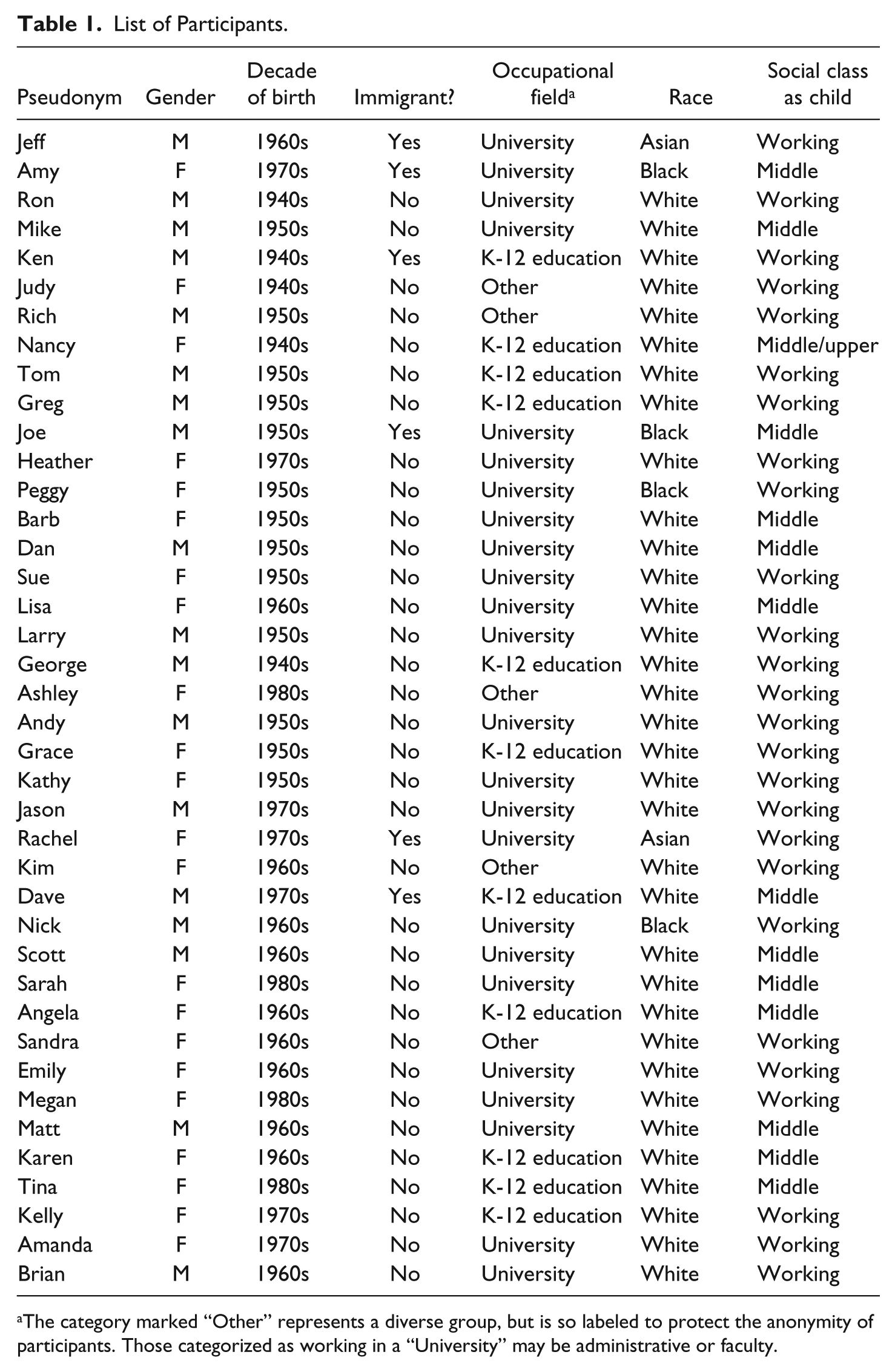
The category marked “Other” represents a diverse group, but is so labeled to protect the anonymity of participants. Those categorized as working in a “University” may be administrative or faculty.
Interviews with participants lasted between 1 and 2 hr, depending on the degree of detail participants offered in their responses, and were conducted in either one or two sessions to fit schedules of participants. Participants were asked to reflect on their childhood, adolescent, and adult familial, social, and academic experiences; reading habits throughout their lives; and interpretations of factors that encouraged or discouraged their independent reading preferences and habits and their general commitment to academic success over time.
Particular attention was paid during interviews to habits of independent and social or group reading throughout the life course, availability of reading material and support for reading at home and school, experiences in school that fostered or hindered reading habits, and social supports and tensions that participants may have encountered as they experienced academic success. Reading was defined broadly, and we specifically asked participants about their practices with a range of reading materials not always considered or volunteered as “reading” such as church materials, comics, Internet websites, mail, magazines, and music. We inquired into habits, attitudes, supports, and social milieus that allowed our participants to achieve academic success as defined by completion of an advanced degree. Questions were designed to allow participants to describe their particular pathways in reading and to academic success.
Full transcripts were made of each interview. These transcripts were uploaded into NVIVO9 software for qualitative research; data were iteratively coded for patterns and categories, grounded in the data. Using a consensus approach, based on Borkan’s (1999) “immersion-crystallization” method for analyzing qualitative data, we compared codes for agreement. Any codes not in agreement were discussed until we came to consensus. The data in each of the 53 codes were then placed in the following categories: Avid Readers, Sponsors of Literacy, Talking about Reading, Shared Reading as Religious and Community Practice, The Challenge of Code Switching, and Additional Challenges to Reading and Academic Success. Data from the short-answer questions were analyzed using SPSS software to create cross-tabs to better view patterns in the data.
One of the benefits of using an interview method was that we were able to inquire into hard-to-quantify descriptions and characterizations of particular relationships and experiences that may have contributed to participants’ academic success. We also saw the retrospective nature of life history as a strength, allowing us to focus on interpretations of meaningful events in the lives of participants, rather, for example, than focusing on snapshots such as test scores, surveys, or brief observations. Our selection of first-generation graduates with advanced degrees as participants meant that we could focus on stories of an individual and retrospectively explain possible predictors for academic success. This differs from the more common method of using socioeconomic status as a proxy measure for predicting future educational achievement. These methods also had limitations, of course, which are discussed in the conclusion section. In the following section, we provide an overview of our findings, along with examples of quotations from interview participants.
Findings
Avid Readers
Upon analyzing the data, several patterns were striking. Thirty-four of our 40 participants reported a love for reading, and 29 described themselves as “avid readers.” All participants reported that reading currently served an important role in their lives. Those who reported that they did not “love reading” mentioned its association with work, and nevertheless said that they read a substantial amount for work, or they only considered “book reading,” as opposed to reading of other materials, when determining whether they considered themselves “avid readers.” These findings were not surprising and are consistent with what other scholars have found, which is that the amount of independent reading students conduct correlates with reading achievement and long-term success in school (Anderson, Fielding, & Wilson, 1988; Krashen, 2004, 2006). The responses of those who said they were not avid readers are also interesting, as these participants reported heavy work-related reading habits.
For example, in a response typical of those who self-identify as an avid reader, one participant, Ashley, stated, “I read voraciously and everything. You know, books, pamphlets, magazines, abstracts. I read all kinds of things.” Ashley elaborated on how reading helped form her identity:
When I was a kid, reading was part of my identity and how I saw myself, because my in-person books distinguished me from others . . . We lived in a very small town, so we would go into town to get groceries and stuff, and I would always make my mom—from the time I was nine or ten—drop me off at the library so I could spend time picking out books . . . I tend to collect friends who also enjoy reading a lot, whether current literature or popular books, or scientific books.
Many participants (22) reported that they loved reading or being read to from a very early age. For example, Megan, when asked when she first became interested in reading, said,
I think it’s one of those things that . . . very early on in life, books were always present. We read every night before bed and then I remember as a kid just sort of locking myself in my room and reading a book a day, or more than that, you know, if I found a series that I really liked and it’s just sort of something that I’ve continued.
Other participants (11) reported being reluctant to call themselves “avid” readers but noted that reading played an important part in their lives. Upon being asked if he was an avid reader, Dan replied, “I don’t think I would say avid reader, no.” Yet, when asked to talk more about himself as a reader he responded,
Mostly it involves, you know, current events, newspapers, news events online, staying up with some professional materials online. I would say that’s probably the bulk of it right now. Very occasionally I will get hooked into a book but it’s really kind of rare when I do that, and it’s probably been years since I read a book cover to cover.
Dan seemed to consider “avid reading” as the reading of books only, even though his recreational reading was habitual. Sarah, among others, described an evolution in her reading practices:
I want to start by saying I come from a very working class family, my mother worked nights; my father worked long hours at a factory. I remember [them] putting us to bed and reading us a story, but not consistently, never pushing a love of reading . . . In high school I still wasn’t a reader . . . I was an athlete and was really consumed by that. Did okay—did more than okay in school—but that wasn’t my focus. Once I went to college . . . I ended up meeting a particular professor who really changed my life. And this was the pivotal moment for me. He introduced me to certain authors, certain books, and it opened up a whole world to me that I didn’t know existed, that I didn’t know I was any good at, but I didn’t know I had any place in. And ever since then I have just been a voracious reader, fiction of all sorts, [and] nonfiction, of course, as an academic.
In these statements, it is possible to see a variety of attitudes toward reading, but all within the range of regular or strong habits of recreational reading. But how did they become so? We turn next to data and analysis of how these individuals became regular readers, and we suggest possible motivating factors in these developments.
Sponsors of Literacy
We asked participants to name primary influences on their habits of reading at home, at school, and elsewhere. Brandt (1999) theorized that a “sponsor” of literacy is an individual, institution, or community who supports or hampers opportunities for literacy learning in the lives of individuals. Participants listed parents and grandparents as early influences on their reading habits. Overall, we found that, even as participants’ parents had not attended college, 26 participants said one or both parents were a model of reading for them. In addition, 21 respondents said that a parent read to them at night before bed, and 23 said someone in their home (including siblings or grandparents) read aloud to them at night or at other times. Thirty-four participants reported that they attended church services on a regular basis when younger, suggesting that church leaders and members also may have served as sponsors of literacy.
Reporting his mother as his primary sponsor of reading, Ron recounted the following when asked if anyone read to him before bed:
Oh yes, my mother did. My mother worked two jobs and was gone for much of the day, and until I got into first grade I was entrusted to the care of my grandmother, who came over on the boat, and she didn’t speak English very well, and she certainly did not read to me, really. But when my mother would go off to work, she would often ask, “What do you want me to bring you?” and I would always say, “A book.” My mother and I would read to each other, and, of course, I was like all kids, I would memorize the stuff so I could pretend that I was reading too. My mother read to me, even though she never graduated high school.
Another participant, Jeff, mentioned a local librarian as a strong contributor to his literacy development. When asked where he found reading materials, he responded,
The nearest library wasn’t that near my house, but there used to be a mobile library that came by once a week. And after a while they got to know me, the librarians there, and they allowed me to take more books than normal because I would finish them; sometimes I would finish one book in the same day.
Still another participant, Amy, noted the strong role that an older sibling played in her literacy development:
My brother, who was fluent in reading, read books aloud to us (other siblings). So in the evenings, like when we were waiting for dinner, or when we went to our grandmother’s house in the rural area, and we needed a flashlight, he’s the one who used to read the book. But he didn’t read it orally, like the way you take a book and read. He used to read the book then tell us the story. So he used to tell us, “Wait, wait, wait, let me read the next five pages!” He’s a fast reader, by the way. So then he could tell us, “Okay, this is what James Bond is doing now. Then he left, then he did this, then he did this,” and we are all waiting. Are you fascinated? We were all waiting in anticipation, “What happened next?” Then he’d say, “Wait, wait, let me read!” So that way I was able to get a glimpse of the James Bond novel.
These findings are interesting for a number of reasons. As Compton-Lilly (2003) has argued, a common myth persists that low-income parents and parents who have not attended college do not value education or reading. Our data suggest that for a majority of our participants (26), their parents were the most active sponsors of literacy with their children. Still, a large number of participants did not name parents as primary sponsors or influences on their literacy development, but rather, others. These participants merit careful consideration as reason would suggest that the most vulnerable students in school are those whose parents, generally the most consistent caretakers in a child’s life, did not teach or model reading, and therefore these children would have to depend on a literacy sponsor aside from their parents. These other sponsors, including grandparents, teachers, librarians, siblings, friends, adult neighbors, and so on, were likely pivotal to our participants’ success in reading and in their long-term school success (Heath, 1996; Knoester & Plikuhn, 2015; Taylor, 1988). We turn next to an analysis of how these various relationships may have come to involve literacy.
Additional Social Aspects of Reading
As indicated above, our data provided many examples of ways in which reading involved social aspects, such as reading aloud to one another or choral reading as part of a group activity, even after individuals learned to read on their own, as well as sharing reading materials, recommending books, and talking about books. As Brandt (2009) and others (Cope & Kalantzis, 2000; Gee, 1996; Knoester, 2009, 2010, 2012a) have argued, literacy practices can be viewed as part of the strategic cultivation, deepening, or maintaining of relationships with family members, friends, and others, and this relationship building is often a strong motivator for many everyday activities and practices, including free voluntary reading. Following J. Bowlby (1988, 2005), cultivating relationships is a primary human motivator, and some relationships, especially, but not exclusively parent attachments, may involve shared reading or talking about reading (Bergin & Bergin, 2009; Bus, 2001; Bus & van Ijzendoorn, 1988a, 1988b, 1992).
A deeper understanding of the social aspects of literacy practices may be crucial to knowing how and why individuals create habits of reading. In using the word “strategic,” we assume that individuals have agency and prefer to cultivate relationships with particular individuals and not others. For example, Amy said, while referring to the story about her brother reading aloud, “I miss those days.” This statement implies to us that this tender memory was rich with meaning because of the relationships she enjoyed with her siblings, not merely because she enjoyed the reading, which facilitated those relationships. Two additional examples of social practices connected to reading emerged from the data analysis and are discussed in the following two sections.
Talking about reading
Twenty of our participants reported that they remember talking with family members about what they read after they knew how to read independently, and 18 reported that they talked with friends about what they read as a child.
For example, when asked whether she talked about books with her family members or friends, Sue replied,
We all talked about the different things that we were reading, and exchanged books and went to the library together. That was our little library—our friends group—because that’s what you did then. So yes, we did . . . what you were reading, and if you liked it or didn’t like it, that stuff. We only ran around with people who liked to do what we liked to do, so we always had support, and parents always supported us . . . My parents encouraged us to do that because it would keep us busy, and because the books were free and available at the library. And talking about reading, we did share, [such as saying] “I read a book about . . .” but it wasn’t a controlled discussion of anything. It was just, sometimes, “I read this really good book . . .”
Joe recalled,
[My brother] was into science fiction, so I started reading science fiction, so he really had, in terms of my independent reading, I was really influenced by him.
We chose to ask participants specifically about comic books as participants did not volunteer comic books as an example of their reading interests, perhaps because comic book reading is not typically encouraged in school (Krashen, 2004). Yet when directly asked about comic books, Joe mentioned that he spoke regularly with friends about them: “Yeah, we talked about comic books, because we’d swap them.”
Talking about what was being read among friends also carried into adulthood. For example, when asked whether she exchanged book recommendations with friends as an adult, Sarah replied with a response typical of those we interviewed:
Yeah, I do ask friends and colleagues. I have a particular friend who is kind of a reading buddy and we share books. She’s someone who’ll come to me and say, “I just read this, you have to read it,” and give me the book. So there’s a lot of that. I also keep an ongoing list of books that I need to read.
These findings are consistent with previous research conducted by the first author (Knoester, 2009, 2010), among others (Appleby & Conner, 1965; Hepler & Hickman, 1982; Manning & Manning, 1984; Short & Pierce, 1990), noting the social aspects of reading, which is traditionally assumed to be a solitary activity for older children and adults.
Shared reading as religious and community practice
Thirty-four of our participants reported that they attended church on a regular basis as a young child and took part in other religious practices. This is a striking number, as polling organizations have found that weekly church attendance in the United States is as low as 17.7% and only as high as 40%, depending on the polling organization (Barnes & Lowry, 2013; Newport, 2013). The high level of childhood church attendance reported by our participants might merely reflect the geographic and cultural area of the Midwestern part of the United States, where much of this research was carried out, but it is hard to escape the fact that religious practices generally include a substantial amount of shared reading (Haight, 2002; Knobel, 1998).
For example, when asked about church attendance as a child, Tom replied, “Every Sunday, without fail.” And when asked whether literacy development was involved with church attendance, many participants noted songs and readings included with the church services. However, several participants also noted the literacy aspects of church classes for children, called Catechism or Sunday school. For example, Tom responded, “Yes. So we did the Catechisms. Those were classes, and we brought the prayer books and stuff. So we had a bit of work from there. After this some of my reading buddies were with me in Catechism.” Tom also noted the rich exchanges that took place at his Catechism class:
Yeah, Catechism . . . I’d always end up arguing with the minister about whatever doctrine [we were reading] because I didn’t see much use to that whatsoever and he thought it was almost like the word of God, which was his role. And I wasn’t obnoxious; I wasn’t, like, someone who was mean or whatever. I just wanted to have a healthy discussion about how important this dogma was and that kind of thing.
Ken reflected on being read the Bible at home:
I remember my mom in particular, not my dad so much, but my mom reading me Bible stories in [my first language]. So I definitely loved hearing stories, and they always read Bible stories to me, and so that was something that really stuck with me.
Judy noted that reading devotionals in her family was a daily activity, and that this habit developed for her into writing devotionals, even as an early adolescent, and sending these original devotionals to a publisher and having them published along with devotionals written by adults, including ministers, gaining positive attention from family members and others. These powerful testimonies illustrate both the literacy aspects of religious observance, and the social interactions and relationships imbedded within or involved with these practices.
Social Challenges to Reading and Achieving Academic Success
Many of our participants faced challenges as they experienced academic success, including social pressure not to read or talk about books, or to learn to “code switch” when talking with professional colleagues as opposed to family members. Our interviews provided insight into complications, or social situations individuals had to overcome to continue reading and reaching long-term academic success. Perhaps because reading is often connected to the cultivation or maintenance of important relationships, the most significant challenges faced by our participants were situations in which reading or academic progress represented threats to particular relationships. A substantial portion of participants (18) reported that their love for reading and/or academic success caused strain in their relationships that were important to them, sometimes leading to difficult circumstances, such as ending particular relationships. In the case of our participants, they generally chose reading and academic success rather than maintaining a relationship with someone who discouraged these practices. For example, Amy noted that reading came with social consequences:
Because I loved to study, [high school peers] declaimed me as a “book worm,” and this came with a negative connotation. Those who liked to read were also called “chops,” like you’re chopping too much wood. So sometimes you really don’t want to be seen reading too much because it wasn’t something that was praising you, it was negative. But that was the gang.
Another participant, Peggy, recalled resentment from peers for her academic success:
I think there was a certain amount of resentment over the attention, resentment over the grades, the sort of holding up one set of students as an example to another set, so, sort of the same thing I was saying with my sister, “Why can’t you be more like? . . .” which would create all kinds of issues with fellow students.
As a result of situations like this, a small number of participants reported that they intentionally pretended to be bad students in an attempt to avoid castigation from peers.
The challenge of code switching
A large number of participants (29) reported that once they had attended college for a period of time, they faced the challenge of learning to “code switch” while speaking with family members or childhood friends in adulthood as compared with college-educated peers or professional colleagues. “Code switching” was described to our participants as using a substantially different vocabulary when speaking with one group as compared with another. As we discuss toward the end of this section, this practice represented not only a challenge but also an opportunity. For example, when asked whether she “code switched,” Peggy replied,
All the time. Absolutely . . . I mean, when I’m at home, it’s a different level of discourse. We’re not talking about big, important, weighty kinds of topics. I’m not having the sort of professional conversations [I have] with colleagues. We’re talking about, you know, other family members or, you know, the TV, or what we’re gonna have for dinner, whatever it might happen to be. But I think it also has a little bit to do with . . . this notion that . . . you think that you’re better than everybody else if you talk a certain kind of way . . . using quote-unquote big words, and that sort of thing. So it just really makes life a lot less complicated to, as you say, code switch.
Another participant, Nancy, shared the following struggle when asked if she code switched:
Yes. I try not to be patronizing and I try not to talk down to people, like my brother, for example. He says, “You’ve been in academia too long, blah blah,” when we get into political discussions. [He will say] “What the hell is no child left behind, what the hell is that, man?” And, you know, I’ve often said to him, “The way you think politically and our world views, how did we grow up in the same family?” And so I just try to use, I think, simpler vocabulary because frankly, what annoys me is people in our profession, we get caught up in jargon . . . You know, jargon is a way of excluding people who are not in your discipline. Why exclude them, why not pull them in?
Those who reported that they did not code switch also mentioned that this sometimes led to trouble. Sandra, for example, said,
No. Maybe I need to, but I don’t. I often get hassled about that. It was over graduation weekend, having a conversation with somebody, and they called me out on it, saying, “Oh my gosh! You’re using your . . .,” and it was in kind of a fun-loving way but sometimes I think I maybe need to do that. No, I don’t, and it’s because it’s who I am; this is it, you know?
If participants had used reading as a way to cultivate important relationships, particularly within the family, there could be a strong motivation to code switch to maintain relationships that might be threatened.
Powerful aspects of code switching
Learning to code switch is clearly a challenge, but it could also be understood as a valuable skill, and useful in many circumstances outside of maintaining relationships with family and childhood friends, while also developing a situated discourse valuable in an academic or professional setting. For example, educators and others working in multicultural settings might use code-switching abilities to develop relationships and trust among individuals and groups with diverse cultural assumptions and discourses. This conception is consistent with Gee’s (1996) theory of bi-discoursality, recognizing the power of the ability to cross cultural boundaries with deep knowledge in multiple discourses. Apple (2012) also refers to the importance of educators and scholars to “speak in different registers,” to communicate with multiple audiences (p. xiii).
Additional Challenges to Reading and Academic Success
Participants reported other reasons they did not read more when they were young. These included a lack of access to interesting reading materials, household chores, lack of direction or models of reading, lack of quiet places to read, lack of interest in reading, a requirement to turn off the lights and sleep at night, lack of electricity, and violence or turbulence in the home. In one example, Amy explained why she did not read more as a child:
My mother needed certain things done; then there was the homework. Sometimes we didn’t have electricity at night so you could only read when there was light. So that was hard during the periods where there wasn’t electricity. And we had set exam periods at the end of the semester, so my mother did not want to see a book that did not pertain to arithmetic or languages during exam periods, so we didn’t read at that time. And since we were a big family, cooking a meal was a labor in and of itself.
Another participant, Joe, noted the difficulty of reading, especially when “there was family friction, conflict, abuse, you know; Dad was an alcoholic.” So it was at times quite difficult for some of our participants to read in the home. Nevertheless, despite these challenges, our participants were able to develop strong independent reading habits.
Discussion
These findings provide further insight into the experiences of individuals who have defied the odds in terms of achieving graduate degrees when their parents had not attended an institution of higher education. We found that these individuals each developed strong habits of independent reading and were able to name specific models or sponsors of reading in their lives. Krashen (2004) and Brandt (2009) have provided important theoretical groundwork for understanding the important roles of free voluntary reading and literacy sponsorship, respectively, in the development of long-term academic success.
Although these theoretical concepts are useful in understanding how literacy development might occur, our findings also challenge these theories. For example, although Brandt (2009) theorized how literacy sponsorship involves individuals, such as parents, teachers, or institutions, who also benefit from the literacy development of the (usually younger) individual, what is missing from this conception is a focus on the knowledge and strategic maneuvering of the individual himself or herself. In other words, the theory does not account for how individuals who are drawn to free independent reading seem to do so as part of the strategic cultivation of particular relationships. In addition, Krashen (2004) contributed important research and analysis about how children develop literacy skills, his notion of “free voluntary reading” is perhaps misleading, as it may imply that motivation to read is the result of individuals acting alone, and does not take place as part of the development of social relationships, or that relationships with institutions, such as libraries and churches, are not solitary but interdependent.
Our understanding of independent reading, as part of a process of cultivating various kinds of relationships, contrasts with the more hegemonic behaviorist notion of younger individuals as blank slates, or understood in deficit terms, who merely react to the will of the parent or teacher, or in concert with a cultural norm (Knoester, 2010; Kohn, 1999). In fact, a large group of individuals from working-class families and from households where the parent(s) did not attend college do not develop robust habits of free voluntary reading, where their vocabulary increasingly expands, as this can be a challenging process. The notion that the participants in our study developed habits of independent reading to such a degree that they were capable of completing an advanced degree indicates that they made particular choices, not that they were merely passive recipients of literacy sponsorship. These individuals seem to have become involved with relationships with parents, siblings, peers, grandparents, teachers, and others that involved not just reading but crucially—talking about reading—socializing around concepts found in books and in other literature, among other shared practices.
One body of research that may be beneficial in this regard has been conducted by literacy scholars working in the attachment theory tradition(s) (Bus, 2001; Bus et al., 1997; Bus & van Ijzendoorn, 1988a, 1988b, 1992). This research suggests that the cultivation of secondary relationships, including relationships with peers, teachers, and other caring adults, for example, is a strong motivator for older children, and that children are highly selective about those with whom they may form a secondary attachment (Ainsworth et al., 1978; Bergin & Bergin, 2009). These scholars do not argue that literacy can be a way to create that attachment, but upon analyzing data from our study, and following the work of Bus and colleagues (Bus, 2001; Bus et al., 1997; Bus & van Ijzendoorn, 1988a, 1988b, 1992), this appears to be the case. The importance of the connection between affectionate relationships and literacy development can also be understood within Gee’s (1996) theoretical construct of discourses. In outlining his theory of primary discourses, or understandings and ways of being that are naturally part of our family or home culture, and secondary discourses, which are public ways of being, Gee differentiates between “acquisition” and “learning.” Individuals acquire a primary discourse, which is largely subconscious, while learning, “involves conscious knowledge gained through teaching” (p. 138). In other words, learning is more difficult than acquisition. When independent reading is viewed through this lens, it is possible to see that sharing books and other literacy practices among people who are emotionally bonded may be a key difference between acquisition and learning. When someone is asked to read for work or at school, for example, by someone who does not share a trusting or caring relationship, the task may become much more arduous, which may decrease its chances of success. Our research suggests that the 40 individuals in our study, all first-generation college graduates with a graduate degree, created attachments with individuals who, in turn, assisted the individuals’ literacy development. If educators and others are interested in better understanding how motivation to independently read develops, then understanding the motivation to cultivate relationships—and how this process might involve reading—is a promising area in need of additional insight.
Implications
The implications of this understanding of literacy engagement are worthy of careful attention. Strategic development of relationships should be seen as a central motivator for children, and these relationships should be encouraged and facilitated to involve literacy practices.
How can we better understand the cultivation of secondary relationships? We might begin by focusing on particular kinds of relationships, such as peer relationships. One popular author, C. S. Lewis (1988), once asserted, “Friendship must be about something, even if it were only an enthusiasm for dominoes or white mice. Those who have nothing can share nothing; those who are going nowhere can have no fellow-travellers” (p. 66). That “something” might be found in literature. As peers, or friends, cultivate relationships, they may or may not use books or other literature, but educators and other caring adults might structure educational and home settings, so that literature is more likely to be used in these relationships. Educators and parents may, therefore, choose to encourage book clubs, social gatherings around books, stock their classrooms and homes with a wide range of engaging reading materials, and allow students to choose books they read, as they must mobilize their knowledge and identities to cultivate relationships of their choice (Daniels, 2002; Knoester, 2009, 2010; Short & Pierce, 1990).
Furthermore, educators should position themselves as someone with whom students would want to cultivate a caring relationship, even after the child has left their care, rather than merely as an authority figure (Cozolino, 2013; Noddings, 2013). We were struck by the fact that only nine of our 40 participants listed a teacher as a model or sponsor of literacy in their lives. We were left to wonder why this might be. Might it be that individuals assumed that teachers would model reading, so why bother even mentioning it? Or was it because teachers did not present themselves as respected and trustworthy models in the lives of individuals, who encouraged the development of a caring and respectful relationship that would attract, rather than cause resistance, and that involved reading? Or might it be that sponsors of literacy that made the most impact on participants’ lives were those that had a much longer-term relationship with the individual, rather than the typical 9 months that a teacher plays a central role in a student’s life? These crucial questions require additional research, but Bergin and Bergin (2009), who analyzed attachments between students and teachers in middle childhood and adolescence, found that teachers who demonstrated sensitivity and conducted warm and positive interactions with students were more likely than those who were more coercive in their teaching methods to create strong attachments with students. Following our discussion above, we would also argue that teachers should thoroughly assess their particular students, not only in terms of ability and knowledge, but in terms of interests in particular bodies of knowledge so teachers might find activities and reading materials, even if considered “juvenile,” that can enrich their discussions with students, so stronger attachments are more likely (Knoester, 2012a; Meier, Knoester, & D’Andrea, 2015).
Conclusion
Our data and analysis suggest that our participants, 40 individuals who completed advanced degrees and whose parents did not attend college, developed habits of recreational reading at some point in their lives and were motivated to do so at least in part due to relationships with sponsors of literacy that included parents, grandparents, siblings, friends, neighbors, and church members. Our participants described their relationships with these individuals and how literacy played a part in them. They also described struggles they sometimes endured with literacy development and how academic success sometimes caused tension in the relationships they formed in childhood. We theorized that the strategic cultivation of particular relationships is a central motivator in people’s lives, and that relationships involving literacy development may have helped foster long-term academic success for participants in our study.
This work contributes important new data and analysis to the professional knowledge base relative to the impact of family of orientation, identity, and academic contexts on literacy and educational attainment. These are areas of crucial importance to educators, parents, and others, as academic achievement gaps persist along socioeconomic lines and contributing factors remain poorly understood. What can educators and scholars learn from first-generation graduate school graduates? Using qualitative methods, this inquiry provided detailed descriptions and analysis of the challenges, opportunities, and strategies drawn from the life histories of graduate school graduates who can be understood as having “overcome the odds.”
We also want to make clear that our purpose in conducting this research is not to suggest that college attainment is or should be the educational aspiration for all children. While long-term educational achievement is the goal for many, the costs of attending a tertiary school, family and financial responsibilities, and many other factors make attending a college or university an undesirable or unpractical goal (Crowley & Knoester, 2012; Knoester, 2012b; Plikuhn & Knoester, 2015; Stich & Freie, 2015). Still, results of this project will be of interest to researchers and practitioners who study and practice education, literacy teaching, and addressing the challenges of first-generation college students who aspire or could benefit from attending college or a university. In addition, this research may be of interest to policy makers and administrators at schools and universities who desire greater insight into the unique population of first-generation college/graduate students.
We realize that this study is not conclusive. Limitations to this study include the following: (a) small sample size. This is a small and particular sample, so the patterns and trends we see in the data are not generalizable to all first-generation college students or students whose parents had not attended college. For example, although diverse, our research participants do not represent the demographic diversity of the United States or any large group of people. Furthermore, our list of participants is disproportionately skewed toward those working in K-12 and higher education fields, and it does not include participants who described their childhood living situation as “poverty” or “homelessness.” Rather, all of our participants reported having a working parent. We realize that this economic situation may be related to the individuals’ ability to find academic success, although that was not the focus of this study. (b) Several of our research participants attended elementary school several decades ago, so memories may have been fragmented, and problems facing children, teachers, and parents may be qualitatively different today. (c) Furthermore, as this study depends on interviews rather than observations, we relied not on observed behaviors but on participants’ self-understanding, or stories they tell about their literacy development. These stories may be influenced by cultural stories and understandings, which can be misleading (Compton-Lilly, 2003).
As mentioned at the start of this article, we see ethnographic descriptions of reading behavior of children as important forms of research. Yet, one of the limitations of these studies is that they rely on class analysis to determine or speculate about the future. The present study “looks backward” at the lives of those who have completed advanced degrees, which we believe is an important contribution. What may be necessary is a combination—longitudinal ethnographic work over multiple decades that views diverse participants at various stages of literacy development, an extremely difficult task, but something Heath (2012) has conducted, for example. Because this study specifically looked at first-generation college graduates, the results of this study may not be helpful for the graduates whose parents have completed college or for understanding the reading habits of individuals who did not attend an institution of higher learning. We cannot be certain, for example, whether the challenges noted above by our participants were less intense for those whose parents did attend college, or whether advanced degree-holding individuals whose parents did attend college read more or less than the participants in our study. Nevertheless, given the degree to which our participants read on a recreational and social basis, it is reasonable to conclude that, consistent with other scholarship in this area (Anderson et al., 1988; Krashen, 2004, 2006), this reading played a significant part in preparing our participants for long-term academic success. Furthermore, the social aspects of reading may have been crucial to this development (Knoester, 2009, 2010).
More research is needed on these crucial topics, including investigation into the following questions: (a) Does this sample represent the larger population of individuals with advanced degrees whose parents did not attend college? (b) How might we better characterize the various forms of relationships that individuals cultivate with others, beyond “primary” and “secondary” attachments? For example, how might the cultivation of an age-peer friendship look different from the cultivation of a friendship with a teacher or other caring adult? Might the cultivation of an “imagined” relationship—such as with a celebrity—motivate a child to read? (c) In what ways might the simultaneous cultivation of two different kinds of relationships, such as with a peer and a parent conflict at times? How might such a conflict be overcome? (d) In what ways should the rise of social media, including texting and Facebook, be understood as relationship-driven literacy practice(s)? How might the use of these practices affect the literacy development of those who use them?
It is not surprising that a growing number of studies in literacy, sociology, psychology, and education have focused on the social aspects of development and education as these studies, including this one, have uncovered promising new directions for future inquiry.
Footnotes
Acknowledgements
We would like to thank our research assistants, Elizabeth Reis and Julie Clark, who were especially instrumental in completing the transcriptions of our interviews.
Declaration of Conflicting Interests
The author(s) declared no potential conflicts of interest with respect to the research, authorship, and/or publication of this article.
Funding
The author(s) disclosed receipt of the following financial support for the research, authorship, and/or publication of this article: This research was supported by two grants based at the University of Evansville, an Alumni Research and Scholarly Activity Fellowship (ARSAF) and an Arts, Research, and Teaching (ART) grant.