




Abstract
This qualitative study, based on data from an ongoing after-school literacy and songwriting initiative, examines the multiliteracy practices of Noriah Rose and Koral, Black adolescent girls, and their socially situated meaning-making and sharing about loss. Specifically, we asked, “In what ways do youth grapple with complicated meanings of loss as they share creative and artistic songwriting practices?” We build upon interdisciplinary framings in literacy and social science research to advance new theoretical understandings of literary practices of remembrance, highlighting the public sharing of independently authored digital compositions across various audiences through song. We conceptualize youths, enacting literacy practices of remembrance, as demonstrating three socially situated stances of sharing: evoking a passed-on narrative complicating temporality and permanence, historicizing artistic cultural expression, and demonstrating mutual sharing and stewardship of loss. We argue that various communities supported youths’ meaning-making about loss, and we offer implications for teaching, research, and practice.
Keywords
The song titled “Air I Breathe” [online content] concluded, and Jennie, a teaching artist in an after-school literacy-and-songwriting initiative, pivoted in her seat on the couch to ask a question of youth songwriter Noriah Rose.
“Noriah, what did you do on this track?”
Noriah held the microphone confidently in front of her. Turning toward an audience of friends, family, peers, and community members gathered at the Community Music School in Detroit for an end-of-semester Open-Mic Listening Party on a mid-December Monday night, she shared, Well, with this track in particular, I had to think about things that were going on in my life at a certain time, and so I really wrote it about my sister who passed three years ago, and my biological mother who passed two years ago, and it was about how reflecting on different things, the different moments that were very central, significant, and you always want to remember about that person.
For Noriah and Koral, Black adolescent girls participating across the 2016–2017 academic year in the Verses Project, an after-school songwriting initiative, sharing original songs they wrote and recorded offered space for reflective moments of loss that linger, the passing of loved ones as broadened stories intimately told.
Noriah and Koral, high school juniors, were among 24 of 30 returning participants from the previous spring 2016 or summer 2016 semesters of Verses. In those earlier semesters, teaching artists—professional songwriters, musicians, and poets—led Noriah, Koral, and their classmates in literacy activities including responding in composition notebooks with poetry and prose to writing prompts and using GarageBand to make instrumental music on iPads. Now, to encourage the students’ growth and extend their prior class experiences, teaching artists challenged Noriah, Koral, and several peers to create and share songs in bands with classmates, and in addition to share original songs they wrote and recorded on topics of their choice. In this manuscript, we analyze Noriah’s and Koral’s sharing of original songs they wrote about loss, which they shared publicly across varied contexts, including in performances at the Open-Mic Listening Party in December (Hess et al., 2019).
Dutro (2008) asked English teachers and literacy scholars to consider, in affirming the varied lived experiences of youth, that “hard stories, offered up in response to a textual encounter, require re-visioning the classroom as a space of testimony and witness” (p. 424). In highlighting Noriah’s and Koral’s sharing of songs they wrote and produced about loss, specifically the death of family members, we build with Noriah’s comment to an audience of peers that sharing allowed her “to get this feeling out.” Moreover, Noriah and Koral, through sharing their songwriting, provide a compelling and timely rendering of what it may mean to extend understandings of youths’ sharing of loss as salient and present, at a time when one in 20 children in the United States experience the death of a parent before age 18 (Townsend, 2018). We furthermore examine Noriah’s and Koral’s sharing in the midst of media reports—online, through social media, in print, and televised—centering on events affecting the educational lives of youth: suicide, gun violence in contexts of school shootings and racialized incidences of police brutality, and the separation of families in the context of current enactments of immigration policy (Johnson et al., 2017; Jordan, 2019).
Moreover, we focus on Noriah’s and Koral’s public sharing of songs they wrote and produced about loss as a purposeful restorying of popularized media narratives that position and reify relational aspects of Black adolescent girls and schooling through a lens of criminalization, marginalization, erasure, and violence (Butler, 2017; Epstein et al., 2017; Morris, 2016). In conversation with and response to such situating factors, scholars across disciplines have called for more nuanced examinations of students confronting and navigating loss as daily lived experiences (Howard, 2016; Kirkland, 2016). Yet conversations about loss have only recently gained nuanced attention in English classrooms and research communities (Frow & Filak, 2017; Shafer, 2017). Specifically, in our inquiry, we ask, “In what ways do youth grapple with complicated meanings of loss as they share creative and artistic songwriting practices?”
Framing Literacy Practices of Remembrance
We analyze Noriah’s and Koral’s public sharing of original songs they wrote and produced about loss through what we conceptually frame as literacy practices of remembrance. To construct this frame, we draw upon theory and relevant literature from interdisciplinary fields of study. Specifically, we bring together social science research extending socially situated lensings of loss (Neimeyer et al., 2014); research framing communal sharing involving experiences of mourning in African American communities (Holloway, 2003); literacy scholarship centering literacy practices of Black adolescent girls (Haddix et al., 2016); and research that examines writing and songwriting about loss. We conceptualize Noriah and Koral, enacting literacy practices of remembrance, as demonstrating three socially situated stances of sharing: evoking a passed-on narrative complicating temporality and permanence, historicizing artistic cultural expression, and demonstrating mutual sharing and stewardship of loss (see Table 1).
Literacy Practices of Remembrance Demonstrating Multiple and Varied Socially Situated Stances of Youth Sharing.
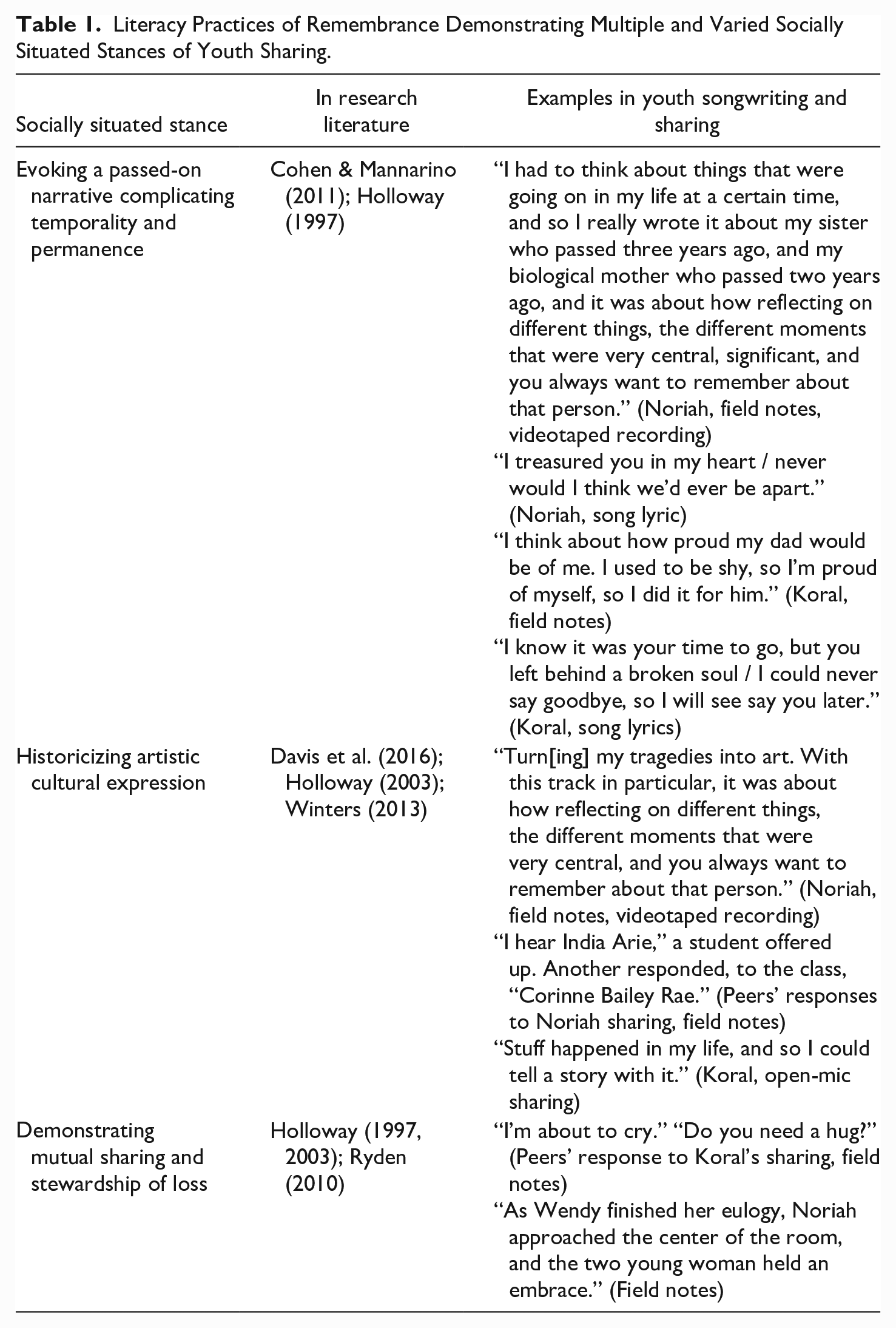
In affirming and building meanings of literacy practices of remembrance, underscored in socially situated stances, we make an epistemic contribution to our field by considering culturally relevant responses to loss, advance literacy research focusing on lived experiences and literacy practices of Black girls, and highlight the importance of providing opportunities—beyond single, isolated writing tasks or events—for ongoing processing and meaning-making about topics that are important to youth.
Across the following sections, we place theoretical understandings in conversation with empirical studies to reinforce our framing of literacy practices of remembrance, as explicated in Table 1.
Extending a Socially Situated Lensing of Loss
Neimeyer et al. (2014) frame loss as not merely “a private and dispassionate cognitive process” (p. 486). Expressions of loss through mourning and meaning-making of loss are intricately connected as contemplating the deceased’s life, death, and postmortem status takes place both privately and publicly within the broader community processing a loss (Neimeyer et al., 2014). In countering Western cultural assumptions viewing mourning predominantly as a private process (Neimeyer et al., 2014), we theorize literacy practices of remembrance as the ongoing work of rendering visible frameworks in literacy research that intentionally “name beyond erasures” (Paris, 2019, p. 220). In literacy practices of remembrance, we affirm and extend the varied onto-epistemologies and lived and felt experiences of youth and communities of color (Beucher et al., 2019; Pérez & Saavedra, 2017; Wandera, 2019; Watson & Beymer, 2019). Specifically, we understand Noriah’s and Koral’s public sharing of loss as a situated, communicative activity to highlight a communal, literate experience of sharing expressed across the lives and lived experiences of African American communities (Holloway, 1997, 2003).
Communal Sharing Involving Experiences of Mourning in African American Communities
Holloway (2003) theorized mourning practices in African American communities as those in which “singular stories and memories drift toward, are shared, and are finally echoed within community narratives” (p. 3). Holloway furthermore examined mourning as historically expressed across time and genre through interviews and analysis of photographs, community murals, literature, and music. As Holloway observed, “the twentieth century’s literature and film, its visual arts and music (from early era spirituals to latter-day rap), and its contemporary street-corner memorials consistently called up a passed-on narrative” (p. 6). We gesture to songs authored and shared by Noriah and Koral as continuing that narrative. Such commemorating, celebrating, and observing of loss further resonates in bereavement discourses such as eulogy, offering forward public expressions of loss and the disclosure of feelings associated with loss through songs, poetry, and anecdotes (Davis et al., 2016). Eulogy as bereavement discourse thus achieves two rhetorical functions: creating room for the eulogizer to console herself and her audience, and paying tribute and giving honor to the deceased (Kunkel & Dennis, 2003). Moreover, eulogies as relational performances provide individuals with communicative tools to discursively reform social identities following the death of a loved one (Davis et al., 2016).
Centering Literacy Practices of Black Adolescent Girls
Noriah and Koral extended their varied identities as Black adolescent girls through literacy practices of remembrance as they shared songs as an enactment of socially situated multiliteracies (New London Group, 1996)—songs that traveled within and across varying geographies such as home, schooling contexts, and communities (Avila & Pandya, 2013). Sealey-Ruiz (2016) compelled English educators and literacy researchers to “take stock of what we are doing for and with Black girls, and what still needs to be done in our school communities to support them socially and academically” (p. 295). Price-Dennis further historicized Black girls’ literacies as complex, fluid, and crossing registers and modalities, noting, “I don’t think that they are recognized for the sophistication and the savvy of what we do as literate people in our society” (as cited in Haddix et al., 2016, p. 383). In examining three units of instruction in a multilingual and multicultural classroom with fifth-grade students, Price-Dennis (2016) discussed how Black girls developed critical literacy practices across digital spaces to highlight how digital tools can be used to examine and explore social issues, demonstrate learning across modalities, and promote agency in alignment with navigating multiple and varied identities.
Price-Dennis (2016) further argued, “Black girls’ literacies are multimodal and embody a critical stance that fosters dexterity across genres, platforms, audiences, and registers” (p. 340). Moreover, Muhammad and Haddix (2016) asserted that Black girls’ digital literacy practices demonstrate “new media platforms for Black girls and women in which they enact and document self-definitions” (p. 305). Butler (2016), examining the “collective biography art-making practices” (p. 314) of four female students, further sought “to push the field of youth literacies to make space for the artistic knowledge production of girls of color” (p. 314). We extend these socially situated meanings in Noriah’s and Koral’s public sharing of their digital multimodal compositions across varied contexts, as they called on iPads, the application GarageBand, and the online music-sharing site SoundCloud to facilitate their literary practices of remembrance in response to loss following the passing of their family members.
Writing and Sharing About Loss
Shafer (2017) challenged teachers to take up death as an acceptable writing topic and to move in an academic writing assignment beyond essays “to invite poems, songs, letters, or even stories” (p. 35) about death. Clark (1993), examining the benefits to coping derived from conversational interactions, noted that creating a coherent narrative from a troubling or chaotic event can make the event more understandable and accessible. Winters (2013) pointed to a similar example in contemporary music, examining songs by rappers Grandmaster Flash, Ghostface Killah, and Jay-Z as building on “the category of mourning to underscore themes of loss” (p. 9). Noriah and Koral, sharing songs they individually wrote about loss with a community of peers in Verses, exemplify what Cohen and Mannarino (2011) described as grappling with “what has been lost through the death” and “preserving positive memories” (p. 123) as individuals share songs or compose poems in socially situated ways.
Examining this socially situated sharing of Noriah’s and Koral’s songs about loss furthermore involves considering the role of audience as central. As Batzer (2016) argued, attending to audience when writing about pain encourages a community’s access to events and knowledge that were previously private. Ryden (2010) argued that a writer sharing a personal confession with others becomes vulnerable, yet an audience can embrace the story as its own in taking up the responsibility to make meaning “through rhetorical listening and cathartic recognition” (p. 259). Particular to schooling contexts, Batzer (2016) noted, teachers in their ongoing work of promoting a strong classroom community may provide a foundation for students to recognize and confront pain.
Songwriting as Extending Literacy Practice
Particularly within and beyond schooling contexts, the urgency of aesthetic experiences of songwriting extends students’ “in-school engagement and achievement” (Weinstein, 2007, p. 270), as youth writing songs draw from issues of personal importance and share with audiences such as family members (Kinney, 2012). In conceptualizing Noriah’s and Koral’s work as literacy practices of remembrance, we thus build with scholars who highlight such multiliteracy practices of youth of color, in varying community and schooling contexts, that affirm complex identities and experiences that are urgent in their lives (de los Rios, 2019; Guzzetti & Gamboa, 2004; Watson, 2016; Williams, 2013). For example, Hess et al. (2019) examined how the performance space of open mic in Verses supported academic literacies of youth of color and reflected a broader theme of “sharing as an act of bravery” for youth of color. Hill (2009) taught and analyzed high school students’ writing activities in a literature course focused on hip-hop and found that youth “produced a practice of ‘wounded healing’, in which people bearing the scars of suffering shared their stories in ways that provided a form of release and relief for themselves and others” (p. 248). Taken together, in examining scholarship across socially situated lensings of loss, communal sharing involving experiences of mourning in African American communities, literacy practices of Black adolescent girls, and research that examines writing and songwriting about loss, we advance Noriah’s and Koral’s literacy practices of remembrance.
Modes of Inquiry
Our qualitative inquiry draws from our broader learning with and from youth in the Verses Project, a weekly after-school literacy-and-songwriting initiative at the Community Music School Detroit.
Context and Data Sources of the Broader Verses Project
We developed Verses with a music-education faculty member as an interdisciplinary literacy and music-education collaboration. A 15-week pilot began in spring 2016, and Verses continued with weeklong camps in the summers of 2016, 2017, and 2018. The 15-week semesters continued in each of the 2016–2017, 2017–2018, and 2018–2019 academic years. In total, more than 200 fifth- through 12th-grade youth from 46 schools and 22 metro area communities, including 98% youth of color, have participated.
We conducted 28 total participant observations of teaching activities during the 2-hr Verses class: 15 in spring 2016, six in fall 2016, and seven in spring 2017. Matt wrote field notes for each observation, focused on youths’ and teaching artists’ interactions, teaching activities, students’ positioning and movement across the classroom space, and youths’ sharing of their songwriting across time. Matt additionally conducted three semi-structured, 30-min focus-group interviews, each including five to seven youth songwriters. We asked youth to discuss their creative activities involving music, including how they selected songwriting topics, and their experiences sharing alongside their peers in songwriting groups. We collected more than 200 multimodal artifacts, including photographs of teaching activities, youths’ journals featuring song lyrics and documenting students’ songwriting processes, videotaped recordings of youth sharing their work in front of varied audiences, and 32 songs authored and performed by youth and posted to SoundCloud.
The instructional design of Verses allowed for teaching artists to scaffold students’ already-present multimodal literacy skills and talents. For example, teaching artists led students in generating lyrics for songs by responding to writing prompts, learning new approaches to music production using GarageBand, and applying their learning to record songs they had authored both in and outside of the Verses class (Hess et al., 2019).
Data sources for the current inquiry
In the current inquiry, we highlight the sharing over time of Noriah’s and Koral’s songs, which they authored independently and shared publicly following teaching artists’ challenge to them and several of their peers to compose and share original songs on topics of their choice.
We draw on eight such instances of sharing across the collected data, including six observations in fall 2016 and two observations in spring 2017. Of those eight observations, four instances of public sharing took place informally during open mic with peers or teaching artists during Verses (three in fall 2016, one in spring 2017). Three instances of public sharing took place during open-mic performances in Verses in fall 2016, in front of family and various community members. One public sharing took place during open mic in spring 2017, as Noriah shared songwriting practices with preservice teachers in a songwriting workshop she led with two peers in Vaughn’s secondary English methods class on a university campus.
Data sources for this inquiry also included lyrics that Noriah and Koral wrote outside of class in fall 2016, Noriah’s and Koral’s in-class journal writing in fall 2016 (six journal entries total), youths’ recordings of songs in a music-studio setting, and participants’ reflections on songwriting processes in a focus-group interview.
Reflexivity and positionalities
We purposefully acknowledge tensions in sharing Noriah’s and Koral’s writing about loss to a wider audience. For both authors, preparation of this manuscript has offered great challenge. Collectively, we seek to honor the work of Noriah and Koral, yet the subject matter is heavy, and across researcher memos, texts to one another, multiple informal conversations, and shared notes within manuscript drafts, we have expressed the responsibility and weight we feel in stewarding and attending to the deeply personal work Noriah and Koral shared across multiple public audiences during the 2016–2017 academic year (Tuck, 2009). Youth participants gave permission for their work throughout Verses to be shared in teaching and research. However, we purposefully and intentionally did not interview Noriah or Koral to directly inquire about specific experiences leading to the loss of their loved ones. We center on youths’ own sharing about loss in their writing and public sharing as they reflected on multiliteracy practices of songwriting in the after-school community context of Verses, and as Noriah and Koral presented their work to additional outside audiences.
We first presented a draft of this manuscript at the 2017 Literacy Research Association annual conference, in a session with scholars who also focused on loss. After presenting, we walked the corridors of the conference hall with renewed, fresh consideration for how, in analyzing Black adolescent girls writing about loss, we may simultaneously affirm already-present contributions that youth bring to the literacy-and-songwriting initiative (Watson, 2018). That is, in moving forward to publication, we grapple with and are mindful of what it may mean to write about Black adolescent girls publicly sharing about loss. We are urged, as Muhammad and Haddix (2016) noted, calling back to Alice Walker and Zora Neale Hurston, to “demand the seeing and knowing of Black girls and women’s lives in varied and heterogeneous ways while at the same time calling for a collective vision and aspiration for their humanity” (pp. 302–303). Moreover, as a White man and a Black man, we draw upon Adu-Poku’s (2001) contextualizing of working in “productive alliance” toward “collective action” (p. 166) in building on the work of scholars considering the multiple and varied literacy practices of Black girls.
Data Analysis
We analyzed data from field notes, transcripts from video recordings of public sharing at open mic and in a focus-group interview, lyrics and writing generated in journals, and lyrics for the girls’ recorded songs. We revisited the girls’ songs, listened to them, and later rewatched videos of Noriah’s and Koral’s public sharing. We noted features of voice work such as vocal layering, informed by Shepherd’s (1991) notion of resonance, especially to underscore how combined vocal stylings worked as a semiotic resource supporting “the expression of a new kind of identity” (van Leeuwen, 2009, p. 81). However, given the primacy of Noriah’s and Koral’s meaning-making and sharing about loss in the above compiled data, our analysis primarily involved seeking to understand the interplay of textual, relational moments of youths’ sharing.
As an initial, collaborative reading of combined textual data, we employed in vivo coding (Saldaña, 2015) in a Word document that had all textual data sources organized by type (i.e., field notes, interview transcripts, etc.). We coded 89 incidences associated with loss (e.g., “heart was broken,” referenced in Noriah’s journal, and “a piece of music that helped me recover,” described by Noriah during open-mic sharing). We then grouped the 89 codes into 18 categories, such as “tragedy of loss,” “personalizing loss,” “remembering/remembrance,” “rendering voice,” “emotions in response,” “reflecting on artistic practice,” and “support for sharing.” We next collapsed categories into two themes broadly focused on the personal and the public in sharing about loss. Thus, one theme focused on Noriah’s and Koral’s personal processing of loss and included categories such as “music as healing/music as reviving” and “remembering/remembrances.” The second theme focused on collaborative, peer-based considerations of loss and included categories such as “support for sharing” and “reflecting on artistic practice.”
As we drafted preliminary findings based on the themes, we sought to further connect the data (see, for example, Table 1, column 3) to the three socially situated stances of sharing (column 1) and the relevant research literature (column 2) to analyze Noriah’s and Koral’s words and music about loss with audiences new and familiar as a literacy practice of remembrance. In this way, we further developed socially situated meanings of loss as a “theoretical code” in which “all categories and concepts now become systematically integrated around the central/core category, the one that suggests a theoretical explanation for the phenomenon” (Saldaña, 2015, p. 250). That is, our analysis reinforced and extended understandings that center the literacy practices of Black adolescent girls, their writing about loss, and their communal sharing; we describe this further in the “Findings” section that follows.
Findings
In October, during the open-mic portion of class as youth read poetry, performed rap lyrics, or shared popular and original songs in progress, Noriah sang, Sometimes I never find the words to describe the way I felt when I looked in your eyes And how my heart jumped out my chest as I anxiously awaited for the next The moment to say how much, how much I loved you The moment to say that I, that, I need you The moment to tell you, I will always be there The moment to say how much, how much I cared I treasured you in my heart, never would I think we’d ever be apart Words can’t explain what you mean to me Your love to me is the air that I breathe The air that I breathe The air that I breathe At night I sometimes cry, when I think about those eyes that made me feel alive But that pain that I feel is at times so unreal I always put on a mask just to mask a wound that ain’t never healed I treasured you in my heart, never would I think we’d ever be apart Words can’t explain what you mean to me Your love to me is the air that I breathe The air that I breathe The air that I breathe
Later, during the Open-Mic Listening Party concert that closed the semester, Noriah shared publicly about the story of her loss based on work she initially authored independently. Noriah recalled to Jennie, friends, family, and community members that she specifically chose to write a song about loss because “I had to think about things that were going on in my life at a certain time.” Noriah’s and Koral’s songs, which they authored independently and then shared through open-mic performances with the broader Verses community, allow us to examine the power of individuals gathered together to contemplatively consider loss, both personal and universal, as passed-on narrative (Holloway, 2003). For example, Noriah, across initial independent writing and later public sharing of the song that would become “Air I Breathe,” called upon varying aspects of the after-school Verses curriculum, such as responding to journal prompts and sharing during open mic, to render varied meanings of voice and to express loss. In journal entries that Noriah wrote, and then independently developed into songs, ideas of lament and reverberation surface. Engaging songwriting practices across material artifacts of journal prompts and open mic underscored these practices as affective, embodied texts that carried forward relational meanings. Complicating lament as reverberating and this underscoring of memory and lived experience as ongoing, expressed both with sorrow and joy, purposefully extends and renders inseparable social, discursive perspectives and practices of mourning in African American communities (Beucher et al., 2019; Zembylas, 2015). In “Air I Breathe,” shared publicly, Noriah demonstrated that on her own she had explored multiple rhyme schemes in a series of verses she had authored in her journal, processing the death of loved ones as reflecting upon an indelible life event. Reminiscing on the loss of her sister, Noriah recounted her sister’s passing as sensory, lingering: The sound of your voice haunts my memory A beautiful brown baby at night is all I see. The night that you left, the visions won’t escape It was almost if the devil himself appeared in a cape.
Noriah, writing further in response to her loss, noted, 11 months later, tragedy struck again I hear my grandma gasp and cry I learn my mother is no longer alive.
She additionally shared across pages of her compositional notebook a lamentation for how her mother’s passing carried complicated meanings of loss: “And I hate the fact that in my mind, your face has begun to fade.” Collectively, Noriah’s reflections extend Holloway’s (2003) juxtaposition of a “sustained lament for the disappeared body” (p. 33).
In processing loss through public sharing, Noriah constructed meanings in words to convey movement toward song, representational of her reflective journal writing. For example, when asked during Verses to journal about a hero, Noriah wrote, and then later shared with peers: “Life saver. [A] hero can be a thing as well. Music is my hero, part of my life since two. With tragedy, music helps me recover. It revived me, so music is my hero.” In her journal, Noriah further recounted the ways she drew upon music toward healing: “At night I wake up the neighbors singing away the blues.”
In composing and sharing her bereavement discourse (Davis et al., 2016), in support of literacy practices of remembrance, Noriah brought forward thoughts and ideas she had drafted across the semester, turning words into song to compose the couplet: my heart was broken, my mind filled with fear as I rehearse the lines spoken when you were here.
This specific lyric did not appear in the final version of “Air I Breathe.” Yet Noriah’s reflective process eventually led her to express, and share, as the opening line of her song: Sometimes I never find the words to describe the way I felt when I looked in your eyes.
That is, while the lyrics publicly shared in “Air I Breathe” differ from Noriah’s written journal reflections recounting feelings experienced of processing losses, journaling events of daily life served as anecdotes, a catalyst, and a genesis for the composition of “Air I Breathe.” Specifically, Noriah was emboldened, as she shared weeks later with Jennie during the Open-Mic Listening Party, to “turn [her] tragedies into art.” Noriah recounted to Jennie, “With this track in particular, it was about how reflecting on different things, the different moments that were very central, and you always want to remember about that person.” Noriah echoes back to her earlier reflective journal writing as a narrative passed down, and she shares that while certain memories began to fade, a song becomes a permanent, artifactual reminder and remembrance (Pahl & Rowsell, 2010).
Socially Situated Sharing Across Audiences—Passed-On Narratives
We specifically call attention to Noriah’s composing and sharing of “Air I Breathe” as layered, and reverberating outward, from journal writing to words as a song shared with varied audiences as communities across time. With each public performance and reairing of the songs across fall 2016 and spring 2017, Noriah evoked new meanings of loss as literate practice. “Air I Breathe” unfolded as revitalizing in the midst of loss.
For example, on a Monday in October, during open mic at Verses, Noriah shared “Air I Breathe” for the first time: Words can’t explain what you mean to me Your love to me is the air that I breathe The air that I breathe The air that I breathe
Jennie, a teaching artist, asked Noriah, “Can you tell us a little bit about your song?” Noriah looked across the room of peers sitting at tables and desks, and began, “This was originally a love song. My younger sister passed four years ago, and my biological mother, when she passed three years ago. I turn my tragedies into art, so, you know . . .”
Classmates and teaching artists grew still, observing the space, and then Noriah’s peers interjected a mutual sharing and stewardship of loss through their interpretations of artists whose work Noriah evokes.
“I hear India Arie,” a student offered up.
Another responded, to the class, “Corinne Bailey Rae”—recalling the singer-songwriter who composed words and music as literacy practices of remembrance, having lost her husband to an accidental overdose and her grandfather in a boating accident while her aunt witnessed the event from the shore (Maerz, 2010).
Jennie shared, in response and in conversation with Noriah and peers, “Let your music be the voice you have out there—you have a true talent. I like it. The beauty you possess.” Jennie then prompted Noriah to share further: “Can you tell us about your process?”
Noriah said, “I had what I had in my [head], but I wanted to get it from my head out.” In reflecting on her songwriting process as informed by lived experiences, Noriah had previously shared with peers during a focus-group interview, Music really, it helps you let go of your emotions. . . . I go through a lot myself, but I listen to someone else’s problems and that will give me an idea for a song and when they hear my song they are like, that is what I was going through and it helps them get it out and, uh, nobody needs to keep their feeling bottled up inside of them, so matter what feeling it is, happy, sad, whatever. When a lot of people hear my song, they are like, that’s relatable to what I was just going through.
“Air I Breathe” reverberates as an introspective prompt and bereavement discourse unfolded through songs, poetry, or varied genres, offered by Noriah for listeners to process their own personal understandings of loss within the broader contexts of a universal event, personally experienced (Davis et al., 2016; Winters, 2013). As Swales (1990) noted, the role of genre allows for doing work in the world. Noriah in this way, in describing her work as “originally a love song,” extends the meanings of loss as a literate practice through songwriting, aligning with the work of professional singer-songwriters such as Bailey Rae. “Air I Breathe” furthermore expands the connotations of romantic love associated with a popular ballad; the song unfolds and may be understood as highlighting love shared between mother, child, and siblings.
“Air I Breathe” thus serves as a recorded remembrance, a eulogy underscoring memory as not forgotten, so that the song does live on. Even in the act of recording and sharing, the song emerges with material and discursive tones, reflected in this moment in time and yet having a chance to be taken up, to be replayed across varied contexts, in new, differing ways (Beucher et al., 2019). In this remembrance, there are felt, affective meanings; there is the emotional resonance evoked in Noriah’s performance and sharing of the song and understood by each member of an audience—some of whom she may not know—who therefore also participate as “Air I Breathe” resonates outward. This process of sharing allows Noriah “to get this feeling out.”
In this way, Koral also used songwriting processes to make meaning and urge forward voice as she shared of her loss. Koral, on a late October afternoon, stood in the performance space of the first-floor multipurpose room, before a predominantly White audience of graduate students in education and university faculty. The audience had attended Verses during a visit to a public high school and cultural landmarks in Detroit.
Koral shared that she had composed her song in thinking of her father, “who passed away from brain cancer in 2013, ’cuz every little girl needs her daddy.” Koral then turned from the audience, took a sip of water, and sang: You filled my heart with so much love There is no man I put above I see you in my dreams I wonder what you took my king I will never let you go, I will never let you go I will never let you go, my life is not the same But who is there to blame? I’m still in disbelief, most days I find it hard to speak I will never let you go, I will never let you go I will never let you go You are the missing puzzle piece, without you I’m just not complete I know it was your time to go, but you left behind a broken soul I could never say goodbye, so I will see say you later
Koral drew her song to a close. The audience remained quiet for this moment, then Jennie asked, “Anyone have a question for Koral, a returning student, about her practice?” A professor from the visiting delegation interjected, “Just a comment: unbelievable.”
The professor’s statement lingered, followed by more silence. In reflecting on the vulnerability of Koral’s sharing an inherently personal event with an audience through song, Will, a teaching artist, reminded the gathered audience of Koral’s peers in Verses and visiting educators that open mic was a “safe space, even for strangers, when strangers [are] present and we share hard things.”
Koral, expressing in her song her personal experiences of loss, as had Noriah, shared work that reverberated feelings of dismay following loss, underscored in the song lyric, “I’m still in disbelief / most days I find it hard to speak.” In grappling with loss rendered as songwriting and sharing, Koral establishes a space for processing things she finds difficult to say in daily interactions about her father’s passing. Song, for Koral and Noriah, becomes artifact and a means of never letting go of memory surrounding loss.
As the fall 2016 semester approached its close, youth finished up song lyrics and worked with teaching artists in classrooms redesigned as studio-recording spaces, anticipating the end-of-semester Open-Mic Listening Party. Koral finalized her lyrics, titling her song “I Will Never Let You Go,” [online content] and assisted by Conrad, a teaching artist and producer, she recorded her song.
The following semester, in mid-January 2017, a class of new and returning youth artists began their songwriting process. In front of a new audience and community, Koral used the space of open mic to share her recorded song.
Will addressed the new cohort from the front of Room 205: “Clap your hands for Koral coming up to the stage!”
Koral received the enthusiastic applause of her peers, as Will asked, “Can you tell me what’s this song’s about?”
Koral looked out across the room, and shared that she wrote and produced the song “last semester about my father passing away.” Echoing her sharing of the song at the October open mic, Koral again turned from her audience for a moment and wiped away a tear. “I wrote this song for my dad,” she said. “I really miss him.”
The recorded song finished playing; Koral returned to her seat. Azalia, a returning student, encouraged Koral to stand back up.
Will, affirming Azalia’s request, asked Koral, “How long did it take you to prepare . . . to play and sing?”
Koral responded, “I just did it.”
Students began to vocalize responses to Koral’s work, a call-and-response reflective of the participatory and performative aspects of a Black funeral service (Holloway, 2003)—“I'm about to cry.” “Do you need a hug?” “I like the riffs” in the song. Will asked Koral to further reflect on her artistic composition: “This is a personal song. What goal did you have for yourself?”
Koral shared, “My goal, just do . . . ”—her voice trailed off. Then she asserted, Stuff happened in my life, and so I could tell a story with it. I think about how proud my dad would be of me. I used to be shy, so I’m proud of myself, so I did it for him.
Koral, across her public performances of “I Will Never Let You Go,” shared similarly, but in different ways than Noriah had. She reflected strength in this way, as wanting to make her father proud. Koral’s song provided a means for her to publicly share that she will “never let” her father go. Song as a material and discursive artifact and literacy practice of remembrance resulted in an indelible creation.
Socially Situated Sharing of Loss: Coda
Two weeks later, on a Monday morning in February, Noriah and two peers, Chante and Kareem, Black youths from Verses on their first visit to a college campus, took up roles as guest instructors in Vaughn’s secondary English methods class. Chante, Kareem, and Noriah took turns introducing preservice teachers to approaches undergraduate seniors may draw on as future English teachers: Kareem designed and taught a music-production lesson, Chante taught poetry, and Noriah shared her songwriting.
Standing behind a lectern in the university classroom, Noriah told the preservice teachers, “I have more than 200 songs.” She continued, I wrote a song about the loss of my little sister and biological mother, back to back, and so much love I had for them, and what I couldn’t get out. It was a way to get out the rest of the feeling that I had—telling that story to you directly, but I could sing it instantly. It was like a form of therapy.
Emboldened through past experiences of sharing and the awareness of audience that comes with personal writing shared as public performance, Noriah then introduced the literacy-and-performance space of open mic to this new audience.
Wendy, the only Black female student in the class, entered into the space with her own sharing of loss. She told her peers that 3 days later, she would eulogize her father at his upcoming memorial. She stated, “My dad’s eulogy is on Thursday and I wanted to try it out on you guys. Sorry this is a drastic turn. Sorry if I cry, it’s going to happen.”
Wendy began: “I’ve only known my dad for 21 years.” She shared of she and her father enjoying Netflix and DVDs, and his wearing two sweaters when the house was 77 degrees. She stated, “There is no way to deal with loss.”
As Wendy finished her eulogy, Noriah approached the center of the room, and the two young women held an embrace.
Discussion
The work of Noriah and Koral enacting literacy practices of remembrance bears important considerations for literacy researchers, teacher educators, and classroom teachers. We build with literacy researchers focusing on the lived experiences and literacy practices of Black girls (Butler, 2016; Muhammad & Haddix, 2016; Price-Dennis, 2016; Sealey-Ruiz, 2016) and highlight how independently writing, producing, and publicly sharing songs about loss offers new understandings of youths’ multiliteracy practices across topics that are important to the educational lives of youth, but that are not commonly addressed in schools (Dutro, 2008; Howard, 2016).
In light of increasing incidents of loss in the lived experiences of youth, Noriah’s and Koral’s practices align with prior research highlighting writing and songwriting in helping individuals to process and share about loss (Batzer, 2016; Ryden, 2010; Winters, 2013). Particularly, we understand songwriting as a multimodal communicative system that has historically and broadly been used to support individuals and communities in negotiating loss. Verses provided an avenue to engage in meaning-making about loss as Noriah and Koral were tasked to create a song on their own. They engaged in self-exploration to make sense of thoughts and feelings regarding the passing of loved ones (Kunkel & Dennis, 2003). We see Noriah’s stance-taking in generating songs, publicly shared, as aligning with Wallace’s call, in Holloway (2003), to “never, never hang up your harp. It is the sign and symbol of your dignity and endurance, your capacity to last still longer and conjure a song in the midst of your storm” (p. 190). We see loss as such literate practice as Noriah reflected in her journal, “With tragedy, music helps me recover. It revived me”; as she shared with peers in a focus group, “Music really, it helps you let go of your emotions,” and when she told university students during a classroom open mic, “I wrote a song about the loss [as] a way to get out the rest of the feeling that I had. . . . I could sing it instantly. It was like a form of therapy.” That is, in the broader context of sharing in Verses, Noriah drew upon individual compositional practices, journaling, and lyric generation to eulogize the loss of her mother and sister through song (Davis et al., 2016).
In further support of youths’ art-making practices (Butler, 2016), we consider how recorded songs allowed both Noriah and Koral to share work with varying audiences that moved sharing from personal writing in support of processing loss to broader public sharing. Noriah and Koral, in the act of recording and producing songs about loss using different modes, including instruments, voices, and the iPad GarageBand application, called upon additional semiotic resources to process loss. For example, in moving penned lyrics from a composition notebook to a song, Noriah used GarageBand to produce a multilayering of her voice as she recorded the song. First, Noriah taped herself playing piano chords she had composed at home on a keyboard. Then, assisted in Verses by Conrad, a teaching artist and producer, she mixed in digitized instrumental strings in a loop. This technique created a self-harmonizing, resonating effect, allowing for additional expressions of meaning (van Leeuwen, 2009) that might not be realized if Noriah’s practices were limited to the sharing of loss through writing alone. The resulting nuanced expression of mourning allows Noriah to visit with her own loss, to self-harmonize. To the listener, the song lyrics rendered the song as if performed by more than one voice, as a duet, with Noriah simultaneously calling out and also urgently responding, evoking a wistful conversation between daughter, and mother, and sister, passed on.
Youths’ literacy practices of remembrance suggest the importance of engaging in socially situated meaning-making and literacy practices about loss. Noriah’s and Koral’s songwriting and pubic sharing as literacy practices of remembrance allowed youths to build on feelings associated with the passing of loved ones to establish connections with others, such as classmates, preservice teachers, and visiting university professors, as youths presented their songs. Collectively, the interplay between personal and universal aspects of loss resulted in Noriah’s and Koral’s work being taken up in different ways as songs were shared (Batzer, 2016). For example, when Koral sang about experiences following the loss of her father in front of visiting university scholars, one professor reflected, “Unbelievable,” followed by silence from the audience as Koral shared an inherently personal event publicly, in turn prompting listeners to consider their own responses to experiences with loss. In this moment, Koral’s personal confession, shared through song, allowed the audience to embrace Koral’s sharing about loss “through rhetorical listening and cathartic recognition” (Ryden, 2010, p. 259).
At other times, sharing resulted in tears from Koral and responses from audience members noting that they too might cry. We see practices of call-and-response in Noriah’s and Koral’s sharing and their peers responding, extending Holloway’s (2003) framing of mourning as informed by such cultural practices of African American communities as “call-and-response and the performative and participatory dimensions of the Black funeral service” (p. 175). Holloway historicizes such practices in the context of funeral traditions in West African communities and jazz funerals in New Orleans in contemporary African American contexts. This socially situated sharing provided forms of “release and relief” (Hill, 2009, p. 248) for Noriah and Koral and for multiple and varied audiences. Noriah’s and Koral’s stories, shared through song and testimony, emerged as “passed-on narrative” (Holloway, 2003, p. 6) to broader communities. Moreover, in recounting the effect of her work, Noriah positioned her songwriting as relatable to what others might be experiencing in their lives. We understand this stance-taking as fully realized in Noriah’s exchange with Wendy. In Noriah providing space for Wendy to share the eulogy she had prepared to present at her father’s upcoming memorial service, we recall that, as Holloway (1997) observed, “the urge to tell past the passing on is the legacy of a mourning story—these stories that require our telling and our retelling” (p. 36).
While “Air I Breathe” and “I Will Never Let You Go” were not intentionally composed as eulogies, we understand these songs as taking on that distinction. In sharing songs they wrote and produced about loss, youth were able to mitigate their loss publicly, bringing coherence to a discomforting life event (Kunkel & Dennis, 2003). For Noriah and Koral, sharing their songwriting evoked an emotional resonance (Neimeyer et al., 2014) as they narrated, through song, their feelings in response to loss. In this way, Noriah’s and Koral’s songwriting, publicly shared, draws urgent attention to theorizing felt expression through frameworks that assert possibilities of “racialized students’ literacy practices” in extending the meanings of the interplay of affect and materiality (Beucher et al., 2019, p. 473). Noriah’s and Koral’s sharing across audiences demonstrates how as youth processed loss, they composed threads of connection across experiences of tragedy, perseverance, and risk-taking that emboldened relational forming of community learning (Neimeyer et al., 2014). That is, youths’ literacy practices of remembrance purposefully extend meanings of mourning as also commemorating, as socially situated, as observing and remembering lives and lived experiences in African American communities (Holloway, 2003). Ultimately, youths’ sharing traveled from the personal to the public, and through communal sharing extended literacy practices of remembrance across time, place, and audiences.
Implications
Examining youth sharing original songs they wrote about the loss of family members as literacy practices of remembrance holds implications for literacy researchers, teacher educators, and classroom teachers. First, this work considers possibilities for building on topics that are meaningful to youth, including topics that are not often written about in traditional school settings (Frow & Filak, 2017; Shafer, 2017). While we focus on an after-school initiative, our learning with and from Noriah and Koral has the potential to contribute to scholarship that promotes addressing the topic of death in school (Anderson & MacCurdy, 2000). While many educators express hesitancy in discussing personal topics such as loss in classrooms (Shafer, 2017), and school district policies may limit the discussion of topics such as death in schools, Noriah and Koral model for educators the benefits of public sharing in social and academic spaces. Our hope is that teachers will create space for such sharing, as the context of community supported youth to meaningfully process loss personally and collectively. We urge literacy researchers, teacher educators, and classroom teachers to make loss visible and present in the space of literacy education.
Second, we examined how youths’ writing and production processes, scaffolded over time—from choosing the topic to writing individual songs, followed by production, and culminating in public sharing—allowed us to gain insight into varying aspects that supported youths’ meaning-making about loss. For example, Noriah’s work across her composition journal—from exploring rhyme couplets to generating lyrics to producing her song—highlights the importance of allowing for ongoing processing and meaning-making about topics that are important to youth rather than relying on single, isolated writing tasks or events in classroom spaces.
Third, considering the number of times Noriah’s and Koral’s work was shared in front of varying audiences, we advocate for inclusive spaces of sharing. To support multiple and varied audiences, in school-based settings, English teachers might pair with music educators or social studies teachers to harness the potential that each discipline has for meaning-making about loss and supporting the creation of artifacts, such as recorded songs, as literacy practices of remembrance. For sharing with audiences outside of school, teacher educators, educational researchers, and community-engaged collaborators may follow youths’ initiative to create spaces for youths who are willing to share their experiences with difficult life events. Furthermore, as we share in a manuscript considering the roles of open mic, what Mirra et al. (2015) described as “pedagogies of relationships” “emerged between youth and accomplished teaching artists, easing some of youths’ apprehension, particularly about performing, and facilitating youth trying new ways of asserting themselves publicly” (Hess et al., 2019). Thus, we consider how youth may meaningfully lead our considerations of what may be expressed, and what is less heard.
Fourth, in our understanding of literacy practices of remembrance, we see Noriah’s and Koral’s multimodal, digital, and interdisciplinary compositions that blend writing, singing, performance, and production as reinforcing multimodal multiliteracy practices. Whereas traditional school models of literacy practices might solely center a reflection on loss through a written assignment such as journaling, youths’ use of iPads, vocal recording, and musical instruments to record songs provided a social-semiotic lens (Kress & van Leeuwen, 1996) for meaning-making about loss, such as Noriah’s layering of her voice through recording and production processes. Therefore, we advocate for multimodal approaches to process loss in school.
Finally, we recognize from our study the roles of varied mediators—from teaching artists, to technology (via the GarageBand application), to youths themselves—in helping youth process loss. We see, for example, the interaction between Noriah and Wendy as a hopeful and encouraging crescendo of Noriah’s sharing about loss across audiences. Similar encounters might take place within formal K–12 schooling experiences as youth confront loss across their daily lives. Ultimately, we glimpse possibilities in our work of affirming the potential to embrace topics youth name as meaningful, including loss, enacted through literacy practices within and beyond school.
Supplemental Material
915518_Trnaslated_Abstracts_Deroo – Supplemental material for “Air I Breathe”: Songwriting as Literacy Practices of Remembrance
Supplemental material, 915518_Trnaslated_Abstracts_Deroo for “Air I Breathe”: Songwriting as Literacy Practices of Remembrance by Matthew R. Deroo and Vaughn W. M. Watson in Journal of Literacy Research
Supplemental Material
Air_I_Breathe_(Mastered) – Supplemental material for “Air I Breathe”: Songwriting as Literacy Practices of Remembrance
Supplemental material, Air_I_Breathe_(Mastered) for “Air I Breathe”: Songwriting as Literacy Practices of Remembrance by Matthew R. Deroo and Vaughn W. M. Watson in Journal of Literacy Research
Supplemental Material
I_Will_Never_Let_You_Go – Supplemental material for “Air I Breathe”: Songwriting as Literacy Practices of Remembrance
Supplemental material, I_Will_Never_Let_You_Go for “Air I Breathe”: Songwriting as Literacy Practices of Remembrance by Matthew R. Deroo and Vaughn W. M. Watson in Journal of Literacy Research
Footnotes
Acknowledgements
We want to explicitly acknowledge the immense contributions that the teaching artists and mentors made to The Verses Project. The research team learned a great deal from their curriculum and pedagogy.
Declaration of Conflicting Interests
The author(s) declared no potential conflicts of interest with respect to the research, authorship, and/or publication of this article.
Funding
The author(s) disclosed receipt of the following financial support for the research, authorship, and/or publication of this article: This work was generously funded by the Marshall Mathers Foundation and Carhartt who made the Verses Project and our research possible.

References
Supplementary Material
Please find the following supplemental material available below.
For Open Access articles published under a Creative Commons License, all supplemental material carries the same license as the article it is associated with.
For non-Open Access articles published, all supplemental material carries a non-exclusive license, and permission requests for re-use of supplemental material or any part of supplemental material shall be sent directly to the copyright owner as specified in the copyright notice associated with the article.
