



Abstract
Learner engagement has been the focus of a growing amount of research in recent years both in general educational psychology and the field of second language acquisition (SLA). However, while recent contributions on learner engagement in language classrooms have provided valuable insights, the field is still only at the early stages of understanding the complexity of the concept and creating a strong empirical evidence base. This study is intended to contribute to our current understanding by investigating both learners’ and teachers’ perceptions on what might prevent motivated second language (L2) learners from engaging with language learning in and out of classrooms. A total of 39 learners and teachers were interviewed in two countries, England and Finland, and the results indicate a variety of potential reasons for motivated learners’ disengagement, including disengaging classroom tasks and activities, the challenge of language learning, as well as competing priorities in learners’ lives. These findings point to potential practical ways of ensuring that learners’ motivation translates into engagement.
I Introduction
The rapid technological developments and changing educational landscape of the 21st century mean that learners are facing an ever increasing and constant flow of information and numerous competing distractions which provide a new challenge for successful learning. From a practical perspective this means that traditional notions such as motivation might not be enough to explain learner success. As Dörnyei (2020) suggests, in this new educational landscape, even strong motivation can be hijacked by various distractions, suggesting that there is a need to ‘ensure students’ positive disposition is realised in action’ (p. 57).
The concept of ‘learner engagement’ may offer a solution to some of these challenges posed by this new educational landscape. Characterized as ‘one of the hottest research topics in the field of educational psychology’ (Sinatra, Heddy, & Lombardi, 2015, p. 1) and even suggested to be ‘defining of all learning’ (Hiver, 2022), learner engagement is often considered as the outward manifestation of motivational sources (Skinner & Pitzer, 2012). Thus, exploring engagement may allow us to explore the mechanisms of motivation being converted into positive learning behaviour by means of cutting through distractions, thereby providing a more robust framework for education.
While recent research contributions in educational psychology and the field of second language acquisition (SLA) have begun to explore various aspects of learner engagement, they have tended to focus on the positive side of engagement (Henry & Thorsen, 2018), for example, exploring how engagement can be influenced, increased, or supported once the learner is engaged. Moreover, the studies that have addressed learners’ disengagement have tended to focus on one aspect of the classroom, such as disengagement in specific types of tasks (e.g. Aubrey, King & Almukhaild, 2020), rather than lack of engagement in learning more broadly. Indeed, less is known about when and why the system breaks down, that is, situations when engagement does not happen even if we would expect it to or when engaged learners begin to disengage from learning overall. Yet, such investigation could potentially provide critical insight into the concept and the mechanisms that generate and support it. This study begins to address these issues by investigating both learners’ and teachers’ perceptions of what may prevent motivated learners from engaging in language learning in and out of classrooms.
II Review of literature
Student engagement was first discussed in education in the 1980s when it was often considered in relation to preventing student boredom, alienation and dropping out (Finn & Zimmer, 2012). Since then, researchers have maintained a strong interest in the concept and the focus on engagement has evolved from an explanation of school drop-out and completion into a multidimensional phenomenon that acknowledges that students learn across academic, socio-emotional, and behavioural domains (Reschly & Christenson, 2012). The scholarly interest in engagement as a concept is reflected in the multiple theories and conceptualizations developed in the past two decades, many of them focusing specifically on the relationship between motivation and engagement (e.g. Christenson, Reschly & Wylie, 2012). This interest is also evident from a number of comprehensive publications addressing both theoretical and practical aspects of engagement that have appeared in the past few years in educational psychology in general (e.g. Fredricks, Reschly & Christenson, 2019) and in the domain of SLA in particular (e.g. Hiver, Al-Hoorie & Mercer, 2021; Mercer & Dörnyei, 2020).
While the field of language learning and teaching can build on the theories and conceptualizations developed in educational psychology, researchers have also begun to address the definition and domain-specific features of engagement in second language (L2) learning. Overall, the foundation for the current interest in learner engagement in L2 can be seen as originating from L2 motivation research on teaching/learning context, process and temporality and task-level motivation (Mercer, 2022). One of the first scholars to define the term in relation to language learning, Storch (2008) used the phrase ‘engagement with language’ to refer to the quality of learners’ metatalk during a text construction task. Building on her research, Svalberg (2009) introduced the concept of ‘engagement with language’ more formally, defined as a ‘cognitive, and/or affective and/or social state and process in which the learner is the agent and language is object, and may be vehicle (means of communication)’ (p. 3). In other words, the notion concerned ‘learners thinking and talking about language, its forms, functions and how it works’ (Svalberg, 2021, p. 39). Despite these beginnings, the majority of the research in engagement in the field of language learning to date has focused on task engagement (Sang & Hiver, 2021). For example, an influential review by Philp and Duchesne (2016) explored engagement as a multidimensional construct in the context of task-based interactions, highlighting examples of various dimensions of engagement during task completion in language classrooms. Recent contributions to the L2 engagement research in this vein have built on the focus on engagement with language and tasks, and expanded the field by including considerations of wider engagement such as classroom environment and engagement (Sulis & Philp, 2021), disengagement and disaffection (Henry & Thorsen, 2018), engagement from learners’ perspective (Mercer, Talbot & Wang, 2021) as well as exploration of methods and definitions of engagement in L2 (Hiver, Al-Hoorie, Vitta & Wu, 2021). For a comprehensive compilation of recent contributions on student engagement in language classrooms, see an edited volume by Hiver, Al-Hoorie and Mercer (2021). The present study similarly contributes to the field by moving beyond the focus on engagement in L2 tasks and investigates engagement more broadly in L2 learning.
1 Engagement as a behavioural concept with underlying affective and cognitive facets
Most conceptualizations view engagement as a multidimensional phenomenon. These models of engagement typically involve two, three or four subtypes, usually consisting of some kind of cognitive, affective, and behavioural elements (Reschly & Christenson, 2012). The conceptualization of engagement in this way was advanced notably by Fredricks, Blumenfeld and Paris (2004) in their seminal article, which described engagement as a multidimensional concept including three components:
behavioural, focusing on the idea of participation and involvement in academic and social or extracurricular activities;
emotional, referring to students’ affective reactions in the classroom including interest, boredom, happiness, sadness, and anxiety; and
cognitive, drawing on the idea of investment, self-regulation and being strategic, and including thoughtfulness and willingness to make an effort to master skills and understand complex ideas.
These core constituents are sometimes complemented by other dimensions, such as:
a social dimension, that is, listening to each other and drawing from each other’s expertise and ideas (Philp & Duchesne, 2016; Svalberg, 2009), as well as
agentic engagement, defined as learner’s proactive contribution to the instruction they receive (Reeve, 2012).
As the current study discusses engagement in relation to motivation, in order to create sufficient distinction between the two concepts, engagement will be conceptualized as an ultimately behavioural concept with underlying cognitive and affective elements. Focusing on engagement in this manner provides two benefits. First, it offers a clear distinction between motivation, defined as the energy or drive that is relevant to learning, and engagement, defined as the behaviour that reflects this energy or drive (Martin, Ginns & Papworth, 2017) or energy in action (Skinner & Pitzer, 2012). In other words, engagement can be viewed as a manifestation of motivation (Martin, Mansour & Malmberg, 2020). For example, Reeve (2012) suggests motivation is something private and unobservable, while engagement is the observable behaviour. Indeed, many scholars would agree to viewing engagement in reference to action (Lawson & Lawson, 2013), and many see motivation as the precursor of this action (Christenson et al., 2012).
Second, adopting such a behavioural perspective allows us to avoid any confusion or overlap between motivational and engagement-specific constructs. Without a sufficiently clear demarcation, the cognitive and affective dimensions of engagement cannot be separated unambiguously from other psychological constructs such as attitudes, self-regulation and emotions; for example, a recent study by Hiver, Al-Hoorie, Vitta and Wu (2021) found that many indicators of engagement used in L2 research featured overlapping notions, resulting in unnecessary complexity.
It is important to acknowledge that focusing on engagement as a primarily behavioural concept albeit with underlying affective and cognitive aspects does recognize the interwoven facets that define the nature of the concept. Because engagement is goal-directed and purpose-driven, it cannot be regarded merely as general action (Hiver, Mercer & Al Hoorie, 2021), and one may rightly argue that it is the interaction between the different dimensions, rather than their isolation, that reflects the true potential of engagement (Zhou, Hiver & Al-Hoorie, 2021). The cognitive and affective precursors of behavioural engagement are also necessary to exclude cases when someone merely ‘goes through the motions’, that is, engages in superficial pretence-behaviour without any cognitive or emotional investment.
2 What facilitates engagement?
Past research has shown that engagement can be facilitated by a variety of factors. These can generally be categorized as personal, individual or internal variables, that is, stemming from the self (e.g. self-efficacy), and social, contextual or environmental variables, that is, stemming from social context (e.g. interactions with teacher; Mercer & Dörnyei, 2020; Oga-Baldwin, 2019; Skinner & Pitzer, 2012; Wang & Mercer, 2021). These factors are also seen to interact with each other in complex ways, for example, Skinner and Pitzer’s (2012) model rooted in Self-Determination Theory suggests that teachers, parents, peers, and the nature of academic work support learners’ engagement through self-related concepts of relatedness, competence and autonomy by fulfilling these psychological needs. Overall, such factors are seen as a powerful influence on engagement in that they can create ideal conditions for initiating learner engagement or alternatively cancel out even the best efforts to learn (Mercer & Dörnyei, 2020).
Recent studies in SLA have provided a more nuanced look into the various factors influencing engagement. For example, Wang and Mercer (2021) suggest a concept labelled ‘willingness to engage’ (WTE), a precursor state of actual engagement, emerging from the interaction of intrapersonal and social or contextual factors. In this psychological state, motivation and other factors such as self-efficacy, facilitative beliefs and behavioural strategies come together, forming the beginnings of the engagement process (Mercer, 2022). Findings from recent studies investigating task-engagement further suggest that learners’ engagement in activities is influenced by the factors such as nature of the tasks (Dao, 2019; Phung, 2017; Qiu & Lo, 2017). Finally, a recent study by Mystkowska-Wiertelak (2020) found that language teachers generally saw the reasons for engagement or disaffection as stemming from qualities, attitudes, mindset or previous experiences of the learner, and the immediate learning context. However, it is not always clear whether the factors influencing engagement do so directly or whether they exert their impact on motivation, which in turn manifests itself as engagement. Thus, more research is needed to investigate the factors influencing engagement while specifically accounting for the learner’s motivation and treating the concepts as a unified notion.
In addition, while the studies discussed above provide a useful insight into some of the factors that might generate or facilitate engagement in language learning, they do not explain why motivation does not always result in active participation in learning. As suggested previously, these studies focus on the positive side of engagement and do not provide insight into the system when it breaks down. Some recent studies have begun to directly address learners’ disengagement with various aspects of the classroom. One such study was conducted by Aubrey et al. (2020) who explored factors that contribute to learners’ engagement and disengagement during task completion in language classrooms. Their findings show that while task-level factors, such as task design, were the most common contributor towards engagement with the task, learner-internal factors, such as attitudes towards learning the language, were more important influencers of disengagement than engagement. While this provides a useful insight into learner disengagement, the focus is on specific aspects of the classroom and less is known about what contributes to the lack of learners’ engagement with L2 learning overall.
To address the gaps highlighted above, the purpose of this exploratory study is to investigate what might prevent engagement for motivated learners from both learners’ and teachers’ points of view and highlight commonly reported factors in these contexts. Such an approach will a provide a unique insight into engagement by considering it simultaneously from both learner and teacher perspectives. Exploring why motivated learners might not engage in learning offers valuable theoretical and practical benefits. From a theoretical perspective, the findings will further our understanding of the relationship and processes between motivation and engagement, an area where empirical work is lacking (Mercer, 2022). By specifically focusing on the lack of engagement for motivated learners, the findings will also provide a novel insight into the mechanics of what makes learning experiences or contexts engaging, previously suggested as a new priority for research (Hiver, 2022). From a practical perspective, the findings of the exploration will provide strategies for classroom practitioners to complement their approaches of motivating learners and ensuring this motivation is realized in action.
More specifically, this study aims to answer the following questions:
What do motivated language learners perceive as the reasons for not engaging in learning?
What do language teachers perceive as the reasons for their motivated students not engaging in learning?
III Methods of the study
1 Participants
Overall, 39 teachers and learners from two countries (Finland and England) were interviewed about their perceptions and experiences of what might prevent motivated learners from engaging in language learning. The study included both teachers and learners in order to gain a comprehensive insight into the reasons from both perspectives, and the two countries were selected to broaden the range of the language learning contexts and target languages. Interviews as a method were chosen as they were considered to more broadly capture teachers’ and learners’ perceptions and experiences of situations when engagement did not occur.
a Learners
A total of 18 learners were interviewed in Finland (n = 3) and in England (n = 15). Most of them (n = 14) were secondary school students (studying towards their GCSEs and A-levels in foreign languages in England and studying languages in upper secondary school ‘lukio’; aged 16 to 19 years in Finland). The sample also included four university students in England, who had a history of learning languages in secondary school as well as completing language courses at university level. Most learners interviewed in England (n =14) spoke English as their first language. In Finland, all learners were studying English and Swedish, and two of them had also studied other languages (Spanish, German and Danish). In England, learners were most commonly studying French (n = 12), followed by German, Italian and Spanish (n = 5, 4 and 2 respectively).
As the purpose of this study was to explore barriers to motivated learners’ engagement in particular, it was vital that all the learners could be classified as sufficiently motivated. For this reason, learners were invited to take part in the interviews on the basis that they had specifically chosen to study the target language and thus could be considered to be motivated in their current language course. In addition, learners were asked about their reasons for and interest in studying languages to further evaluate their current language learning motivation. Inevitably, there were some differences between the learners, their motivation ranging from genuine enjoyment of learning to more instrumental reasons for learning, such as the language helping them in their future career. This study also acknowledges that motivation is dynamic and may change from situation to situation. However, as the context of the interviews related to the students’ current language learning and the barriers for engagement were discussed explicitly in connection to their desire to learn (i.e. asking why they did not participate despite wanting to learn), the situational ebbs and flows of motivation were not considered a challenge in this study. In sum, all learners were deemed to be sufficiently motivated to participate in the interviews.
b Teachers
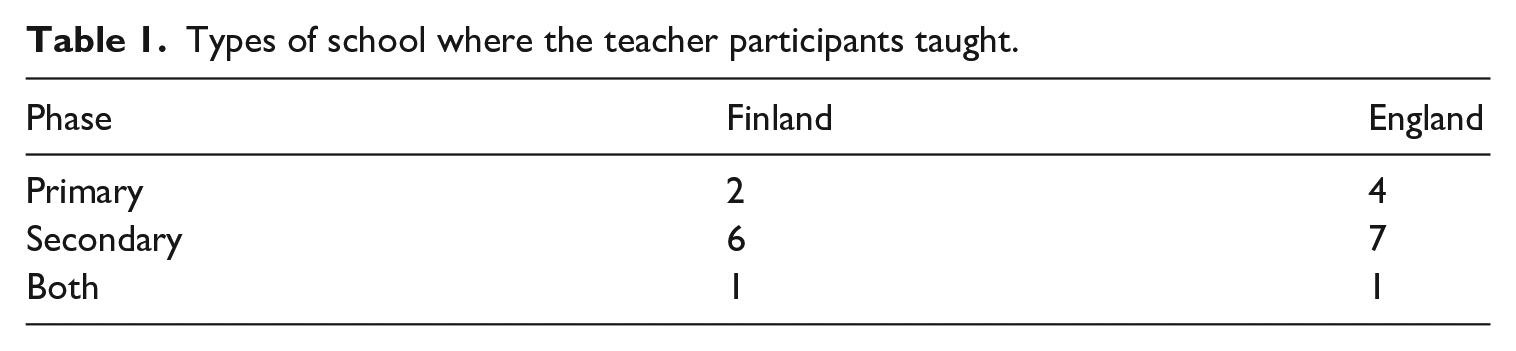
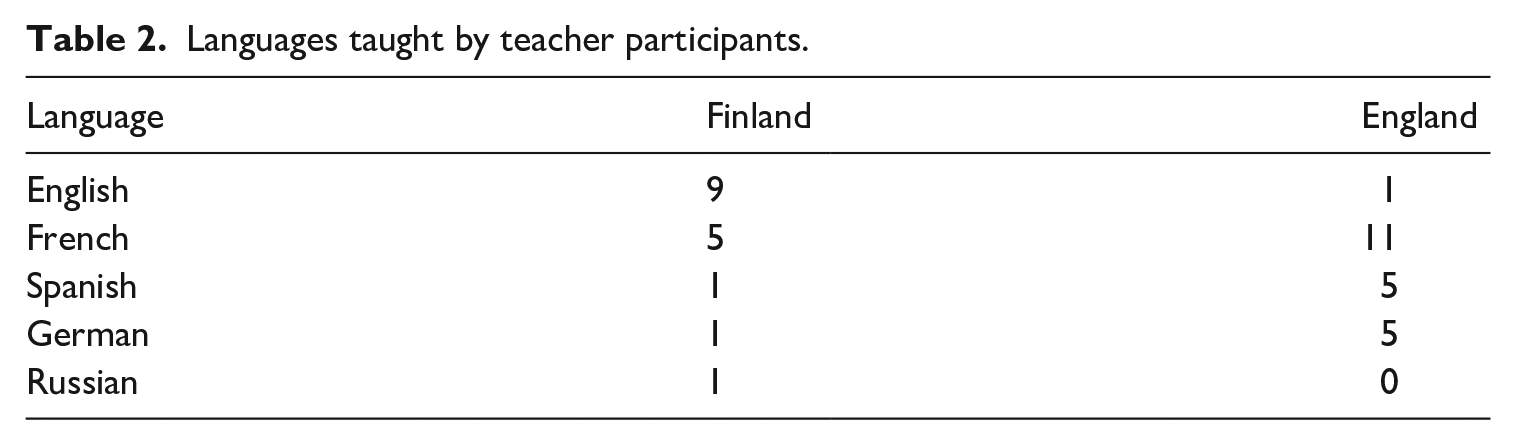
A total of 21 teachers from primary and secondary schools in Finland and in England were interviewed. Tables 1 and 2 present details about the type of schools and taught languages associated with the participants. All teachers were actively teaching in a school at the time of the interviews. All but one teacher interviewed in England currently teach French. In Finland, all teachers currently teach or have previously taught English; two teachers who also teach Swedish were asked to not primarily draw from that experience due to the context of Swedish in Finland as a second national language being potentially different to teaching other languages.
Types of school where the teacher participants taught.
Languages taught by teacher participants.
2 Instruments and procedures
The learners were recruited via the researcher’s personal connections, social media and the union of upper secondary school students in Finland. Due to the international Covid-19 pandemic, recruiting learners was more difficult than initially anticipated, and in the later stages of the interviewing, learners were offered a £10 voucher as a thank you for their time to encourage participation. The teachers were recruited mostly from various facebook groups targeted for professional language teachers. Some teachers in Finland were recruited through direct invitations to take part sent to headteachers in three major cities.
All teacher interviews took place in autumn 2020 and student interviews in winter/spring 2021. All were conducted virtually via Microsoft Teams or Zoom. A total of 596 minutes of interview data was recorded from teachers (on average 28 minutes per interview) and 475 minutes from learners (on average 26 minutes per interview). Participants in Finland were interviewed by the author in Finnish and participants in England in English. One Finnish teacher participant was interviewed in English as their choice of language. Semi-structured interview guides were produced in English and translated into Finnish by the author (for the interview guides, see Appendix 1). Due to the exploratory nature of the study, the interview guides were kept as open-ended as possible to allow the emerging discussion to direct the interview. Translating the term ‘engagement’ into Finnish was more challenging than expected as there was no readily available term used in the context. The term referring to overall school engagement (kiinnittyminen) was rejected on the grounds of it stemming from the word ‘to attach’ and therefore evoking wrong connotations in the interviews. The term sitoutuminen (‘commitment’, ‘engagement’) was considered to better reflect the original term in this context. An academic in Finland was informally approached for their view on the translated term and the use of the term was finalized. All the Finnish interviews were translated by the author and any data is presented only in English in this article. Excerpts from participants in the text are presented with a code identifying whether the quote comes from a learner (L) or teacher (T), from Finland (FIN) or England (ENG) and the languages they learn or teach (EN for English, DE for German, FR for French, ES for Spanish, IT for Italian, RU for Russian and SV for Swedish).
3 Data analysis
Interviews with participants were recorded and transcribed using Otter and Microsoft Word dictation and double-checked for correct transcription. The data was analysed thematically, following a process of familiarizing oneself with data, generating initial codes, searching for themes, reviewing themes, defining and naming themes and providing an account for data/reporting, as outlined by Nowell, Norris and White (2017), who developed this process to increase trustworthiness of qualitative analysis. More specifically, a bottom-up approach was adopted and themes were coded inductively. Each interview was initially coded for all potential reasons for lack of engagement after which a second round of coding was used to re-examine these. This included using the context to double check the learner is genuinely referring to lack to participation (action), rather than simply lack of motivation in the specific situation. The final codes were then grouped into themes. The most commonly mentioned themes were then selected for further review and defined. These were then named and finalized.
IV Results
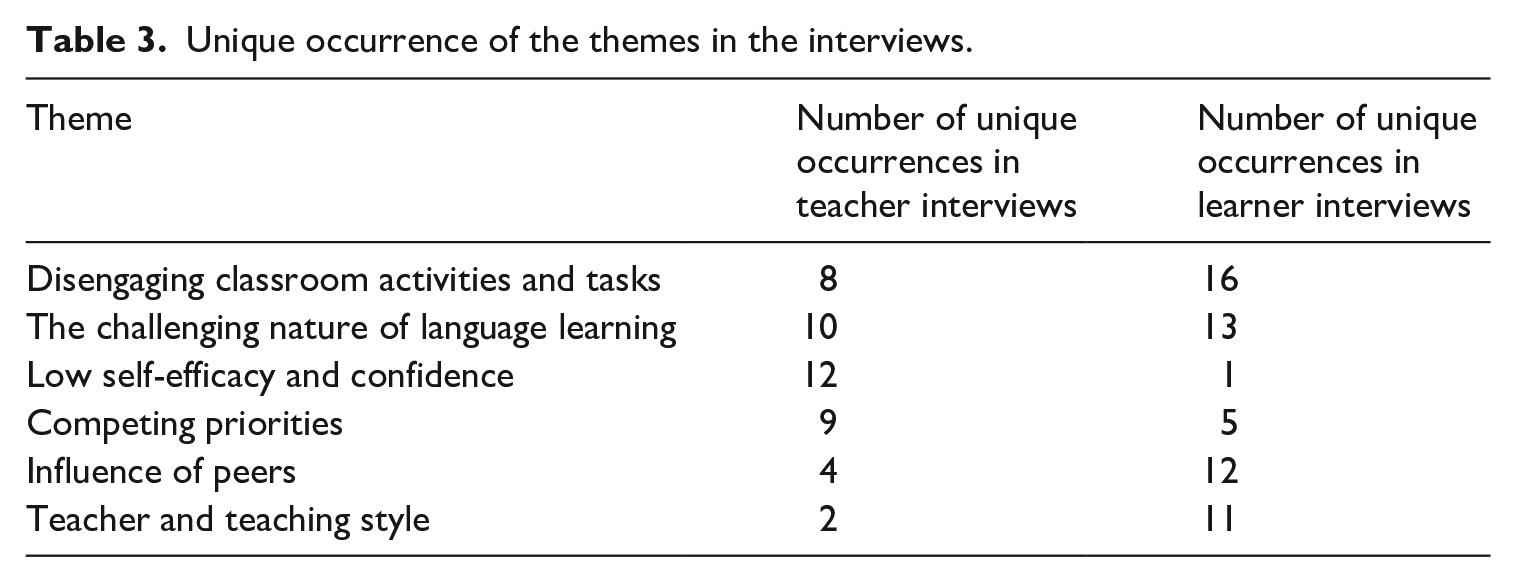
Six themes emerged from the interviews regarding what might prevent motivated learners from engaging in language learning: disengaging classroom activities and tasks (Theme 1), the challenging nature of language learning (Theme 2), low self-efficacy and confidence (Theme 3), competing priorities (Theme 4), influence of peers (Theme 5) and teacher and teaching style (Theme 6). Table 3 presents their unique occurrences in the interviews, and the next sections will describe and discuss their specific content. Please note that some themes may have emerged several times in the same interview, but their frequency was only recorded once per interview.
Unique occurrence of the themes in the interviews.
1 Disengaging classroom activities and tasks
A key theme emerging from the interviews, most commonly raised by participants across contexts, relates to the classroom activities and tasks negatively influencing motivated learners’ engagement. Overall, this theme emerged from 24 interviews, and it was particularly evident from the learners (n = 16), many of whom suggested they may not engage in learning because of boring, uninteresting or irrelevant materials, topics and themes. The following quote offers a good representation of such views, indicating that the dull and repetitive nature of the tasks can cancel out any engagement in learning: Well, in our class as well, a lot of the tasks we get are quite tedious . . . Some repetition when you’re doing the activities. And sometimes, you know, you look at something and just think, I don’t want to do this today. (L11 – ENG – ES)
Some learners linked disengaging classroom activities and tasks specifically to a focus on exams. For example, one learner highlighted that ‘having to do a lot of exams and things . . . I think you lose a bit the just the simple enjoyment of speaking a language that is not yours’ (L4 – ENG – EN/DE/IT). Another suggested they would rather learn to speak the language than ‘tick boxes of an exam board’, pointing out that ‘it wasn’t so much that [teachers] were teaching us how to speak it. They were teaching us how to pass an exam . . .’ (L3 – ENG – FR/IT/DE). Some learners even admitted that because of the exam-focused nature of their course, they were not engaging in learning beyond what was required for their exam, despite their initial motivation. For example, a motivated learner of French who initially stated their language goal as being able to communicate in the L2 described their learning approach as follows: I’m now learning a bunch of set . . . phrases . . . So, I just learn a bunch of them so I don’t need to conjugate the verbs and just like writing the phrases out to get the marks. (L2 – ENG – FR)
Tasks and activities in the classroom were also perceived as disengaging if they were too challenging or not challenging enough. For example, one learner highlighted ‘dreading’ listening exercises and finding tasks sometimes so demanding that they negatively impacted on their engagement in class: But it’s when you have to summarize and then pick out the sentences that are true. And then you can’t figure out which ones are true. Because they all seem quite similar . . . And then you just pick whatever, like ‘that will do, I don’t really care anymore’. (L8 – ENG – FR/DE)
On the other hand, a lack of challenge in classroom tasks can be equally disengaging. As one learner summarized: ‘it’s good to have a balance because . . . if it’s too easy, or it’s too hard, people just aren’t going to engage properly’ (L7 – ENG – DE). Indeed, some learners felt they stopped engaging when they had understood or learned the topic practised in class.
The teachers interviewed focused mainly on the lack of a challenge in activities which disengaged advanced learners in particular. Learners feeling they already know the language well enough and hence not engaging in further learning was a common sentiment among some of the teachers. This emerged primarily from the interviews in Finland, where many learners use English in their everyday lives. It reflects the situation in Sweden, where Henry (2014) suggests many young people believe they learn as much from their free time activities involving English as from classroom instruction. This barrier was exemplified by two of the teachers describing their students’ attitudes as ‘I’m already so good in English that I don’t need to study it anymore’ (T13 – FIN – EN/RU) and ‘I’m such a virtuoso, that I don’t need to . . . do this’ (T17 – FIN – EN/SV/DE). The problem caused by this attitude is aggregated for learners who have inaccurately assessed their own proficiency; for example, one of the teachers highlighted that: . . . Students’ ability to analyse the language, what their language proficiency is and what the language proficiency means [is skewed], so it’s easily a little like ‘well I know English, I don’t need to do this because I already know it’. Then they start to learn some complex passive clause and [realize] maybe it wasn’t all that easy after all. (T20 – FIN – EN/FR)
2 The challenging nature of language learning
Perhaps unsurprisingly, the challenging nature of language learning overall emerged as another central theme regarding what might prevent motivated learners from engaging in language learning (n = 23). The challenge was summarized by one of the learners as ‘I know that however good I get, I’ll never be perfect. And that’s not because I haven’t practised enough’ (L9 – ENG – FR), while another spoke about their experience of finding learning difficult as: Sometimes when it gets really difficult, you just feel like you don’t want to keep going. Because it’s quite tiring. It’s quite hard because you know that you’re getting everything wrong. (L12 – ENG – FR)
Similarly, one of the teachers highlighted the challenge of learning as a barrier for engagement as: Every time that you think that you cracked something in languages . . . There’s an opportunity for a setback . . . It’s so challenging that even the most motivated . . . There will always be something that catches them out [in] every single lesson. (T3 – ENG – FR/DE)
Interestingly, some of the primary school teachers in England linked the perception of learning being hard to a lack of resilience and highlighted that the demanding nature of language learning can be particularly relevant for those with higher ability as they are not used to having to struggle sometimes to achieve goals: Sometimes motivated pupils [with higher ability] don’t like it if they find it hard, they switch off quite easily, they don’t have the resilience [that] some less able pupils have because they’re not used to finding it difficult. (T9 – ENG – FR)
The demanding nature of language learning was particularly evident from the comparisons learners and teachers made between languages and other subjects. For example, learners described learning other subjects as easier to learn because you can finish one topic, leave it, and revise later, whereas in languages you have to constantly keep studying. Learners also saw languages harder compared to other subjects as you are ‘starting over completely’ (L12 – ENG – FR), having to learn not just the subject matter but a whole new system of communication and culture: ‘there is more to it in the language, than there is just any other subject’ (L12 – ENG – FR). In addition, teachers spoke about learners comparing their progress in languages to other subjects as a potential barrier; for example, one teacher suggested that ‘the instant gratification . . . It’s easier to get that in other subjects’ (T3 – ENG – FR/DE).
The perceived difficulty of L2 learning may also originate from the learners originally having unrealistic expectations: when they discover the reality, they can easily disengage. One teacher also suggested that comparisons to peers with higher language aptitude might also be a source of losing the momentum: I feel that many children, especially in situations where they have difficulties, don’t understand that unfortunately they have genetics . . . that for them it would require a lot of work then . . . they look at a friend who maybe has the readiness [to learn faster] and realize that ‘hey, they are let off so easily, so I have to be let off easily too’. (T14 – FIN – EN/SV)
3 Low self-efficacy and confidence
Closely related to the challenge of language learning, the most common theme emerging from the teacher interviews (n = 12) linked to their perceptions that students feel like they are not able to master the language, that is, students having low self-efficacy. Many teachers (n = 8) also spoke about motivated students who lack confidence in language learning and perceive themselves negatively as language learners. This was highlighted as a barrier for their engagement by one teacher as: ‘[if] they feel that they can’t [learn the language], they don’t try’ (T2 – ENG – FR/DE). One teacher also highlighted that self-efficacy is not just a barrier but also supports engagement, suggesting a strong link between the concepts. They summarized the importance of confidence and self-efficacy as: I think honestly . . . the feeling of confidence, and self-efficacy . . . it’s the most important thing. And actually, [by supporting these] we get some of the weakest students in our school [to be] the most engaged in language learning. (T5 – ENG – ES/FR/DE)
The interviews also provided an indication of the potential reasons for the feelings of not being able to master the language. Sometimes, this may relate to lack of a sense of success that prevents engagement in learning. When motivated learners make an effort and engage, yet do not achieve feelings of success, they will inevitably disengage, as one teacher suggested: ‘And the students that don’t succeed in it, I can see them as soon as they get test results. Almost like “that’s it, I’ve decided I’m not going to try hard at this anymore” ’ (T3 – ENG – FR/DE). Evidently, not achieving feelings of success as a barrier for engagement will in turn result in lack of learning, resulting in even fewer feelings of success and thus forming a vicious cycle.
4 Competing priorities
Competing priorities in learners’ lives and having to constantly prioritize their subjects and interests also emerged as a barrier for motivated learners’ engagement (n = 14). Put another way, learners may not engage in learning because of the ongoing competition between various subjects and interests. Prioritization between different subjects having a negative impact on engagement was especially prominent: So, when you’re trying to revise for, like three other subjects . . . When you’ve got everything else going on as well. With Spanish, it’s difficult to motivate yourself, to put the time in for that language when you’ve got other priorities to be dealing with. (L11 – ENG – ES). There’s so much pressure on [learners] to succeed in maths and English that it definitely carries across into other subjects, like they will spend more time on the ‘most’ important subjects than they will on others, even if they’re motivated to do it and they enjoy it. (T3 – ENG – FR/DE) The big problem in upper secondary school is that . . . you need to complete 75 courses [so] should one study more history? Or more physics? Or more French? So, they compete . . . The student who aims for political science or student who aims for medical school has to think very carefully what is worth studying. (T20 – FIN – EN/FR)
Some of the teachers (n = 4) also spoke about competing and fluctuating interests in their students’ lives. For example, one teacher in Finland suggested this might be the case for the younger learners in particular: ‘In theory children’s interests change too’ (T14 – FIN – EN/SV). The learners in secondary schools similarly spoke about the competing interests in their lives, for example, one highlighted that language learning is still an ‘academic’ activity and sometimes they simply have other interests that compete for their time, even if they know they should be learning the language. They summarized the competing interests as ‘I have friends who are artists and studying art, but that doesn’t mean that they spend all their free time painting, just because it’s a lot to do. Like, it’s just a big task’ (L9 – ENG – FR).
5 Influence of peers
It is interesting to note that while the influence of peers was only mentioned by a few teachers (n = 4), it was one of the themes referred to most frequently in the learner interviews (n = 12). Perhaps unsurprisingly to anyone who has been inside a language classroom, many motivated learners reported disengagement because of a fear of making mistakes in front of others. This related particularly to areas of language where the learner feels less confident. The influence of peers on engagement may also be linked to how the learner perceives the expectation of others related to their own ability. For example, one student in Finland highlighted that they are less likely to put their hand up in English classes than in Swedish classes because: It has been studied for so long and everyone kind of expects you to be good at it so there is much more pressure to fail but I think Swedish on the other hand is somehow like, everyone knows I don’t know it so for me it’s easier to fail and kind of just give it a go, but English is different. (L17 – FIN – EN/SV).
The influence of peers also related to the pace of the learning set by classmates. While one learner recalled a time the pace of teaching was too fast for them to engage because of a more advanced peer, more often these motivated learners spoke about times when the pace of learning in the classroom was too slow for them working at a higher level than their peers and thus negatively impacted on their engagement. This was particularly evident from A-level students in England who recalled their GCSE classes where groups are often mixed in ability and motivation, which may result in disruptions and a slow pace, making the motivated learners bored and disengaged: I didn’t really like the class as much . . . they [would] just mess around so lessons would go a lot more slower. So, I actually got a lot more bored in those lessons of GCSE, because I worked through the work really quickly, cause I was at a high level. So, I kind of just ended up sitting there getting bored, because I didn’t really know what to do. (L14 – ENG – FR)
Peers in groups with mixed ability and motivation were also a source of disengagement for motivated learners who did not want to stand out too much. Some learners described feeling ‘ashamed to try because it meant that I would do well. And then people would point [that] out . . . It made me want to not try as hard so I didn’t stand out as much’ (L6 – ENG – FR/ES/IT/RU), and engaging less to avoid looking ‘too enthusiastic, because I thought people would think I was kind of a bit weird for liking languages’ (L13 – ENG – FR/DE). Indeed, some learners highlighted the benefit of groups where all learners work towards similar goals. For example, one learner described the benefits of their smaller group studying towards their A-level as ‘. . . nobody’s going to kind of judge you. We’re all there for the same reason . . . Let’s try and get . . . better at the subject’ (L13 – ENG – FR/DE).
6 Teacher and teaching style
Interestingly, while virtually none of the teachers (n = 2) talked about the negative impact of teaching style on motivated learners’ active participation, many learners (n = 11) highlighted the critical role of this factor. This was summarized by one of the learners as ‘I think [engagement] definitely depends on the teacher and the way you’re learning . . . I just think that is so defining’ (L9 – ENG – FR). Some learners recalled examples of teachers as reasons for them not engaging. For example, one learner described such teachers as ‘quite serious’, ‘didn’t seem to enjoy the language’ or ‘didn’t seem that engaged with it themselves, which then kind of rubbed off on people in the class’ (L13 – ENG – FR/DE). Another learner highlighted that: It’s just, sometimes certain teachers . . . are a little bit boring. And I know that every teacher and everyone has different teaching styles. And it can’t always be fun. But I think especially of languages, teachers usually do it so like, ‘this word is this’ or ‘let’s translate this’ and it’s nothing very engaging. (L15 – ENG – FR)
Some learners highlighted the importance of building a connection with the teacher. For example, one learner suggested that they did not engage in class because their teacher did not inspire them, however, this was not seen as a sign of a bad teacher but was related to missing a personal connection with the teacher: ‘she hasn’t inspired me as much, which isn’t her fault . . . I just haven’t kind of felt that kind of connection with her over languages’ (L9 – ENG – FR). Similarly, another learner felt they were less engaged in class because they only met the teacher once a week and it ‘wasn’t enough to . . . get involved in her lessons’ (L12 – ENG – FR).
V Discussion
This study set out to explore teachers’ and learners’ perceptions of why motivated learners might not engage in language learning. The findings have shown that disengaging classroom activities and tasks, the challenging nature of language learning, low self-efficacy and confidence, competing priorities, influence of peers and teacher, and teaching style might prevent motivated learners from engaging in learning. This section will first address these findings in relation to earlier research before specifically addressing some of the most interesting findings emerging from the interviews.
Overall the findings of this study can be broadly grouped into two clusters: one relating more directly to the classroom environment (disengaging classroom activities and tasks, influence of peers, and teacher and teaching style), and the other to the learners themselves (the challenging nature of language learning, competing priorities, and low confidence and self-efficacy). While it is important to acknowledge that the factors in these categories are likely to be interconnected and also influenced by each other, this categorization reflects the social/contextual and personal facilitators of engagement identified in previous research (e.g. Mercer and Dörnyei, 2020; Skinner & Pitzer, 2012; Wang & Mercer, 2021). The findings of this study indicate for the first time that such factors not only support engagement but may in fact prevent motivation from translating into action.
More specifically in relation to previous bodies of research, the findings of this study corroborate many previous findings in the field while simultaneously offering new insight into them. In particular, the classroom related factors, such as the importance of meaningful and interesting tasks (see, for example, Ainley, 2012; Dao, 2019; Phung, 2017; Qiu & Lo, 2017) and influence of peers and teachers (see, for example, Juvonen, Espinoza & Knifsend, 2012; King, 2013; Mercer & Dörnyei, 2020; Pianta, Hamre & Allen, 2012; Sulis & Philp, 2021), have been highlighted by other researchers, both in SLA and general educational psychology as important for engagement. However, an important perspective emerging from this study is that such factors not only facilitate engagement in language classrooms but may in fact cancel out even a strong motivation to learn.
It is also interesting to note that while many of the factors identified in this study, such as the challenge in language learning and low self-efficacy, have also previously been established in L2 motivation research, the findings provide a new insight into these concepts. For example, self-efficacy has been recognized as closely linked to motivation (see, for example, Piniel & Csizér, 2013) but the present study indicates that it may also prevent engagement for those learners whose motivation has initially not been negatively affected by low self-efficacy. Similarly, it is known that the perception of languages as a difficult subject has a negative motivational impact on learning them in the UK (Coleman, Galaczi & Astruc, 2007). However, the interviews suggest that such perception of difficulty is not just demotivating but also disengaging and potentially posing a risk even for the most motivated language learners. This study also provides evidence that this factor is similarly of relevance for students studying languages in Finland.
In addition to how the findings relate to and expand on previous research, some emerging findings are worth a specific mention. First, while the study design did not allow a systematic comparison of teachers and learners, the various languages learned and the various countries, some of the patterns emerging from the interviews are worth noting. Perhaps most interestingly, all the factors related directly to the classroom environment surfaced more strongly from learners. This might indicate that the teachers interviewed preferred not to attribute learners’ lack of engagement directly to the classroom environment as they may feel responsible for creating an engaging learning context. However, it is also possible that teachers generally viewed engagement as stemming from the learners themselves, rather than a construct highly influenced by the context, and might therefore not allocate enough resources to ensuring the classroom environment does not negatively impact on their motivated learners’ engagement.
Second, it is also interesting to note that while teachers discussed learners’ low self-efficacy and lack of confidence, linking them to lack of feelings of success, this did not emerge from the learners. Many learners highlighted the difficulty and frustrating nature of language learning as a factor preventing their engagement but only one learner directly spoke about their lack of confidence in learning. It is possible that the learners interviewed did not want to recall the times they have felt they did not succeed or lacked confidence. Future research could explicitly explore the role of feelings of success for learner confidence and engagement from both teachers’ and learners’ perspectives.
Finally, the role of English as an L2 compared to other languages also deserves a specific mention. The lack of challenge in classroom tasks and activities emerged almost exclusively from English teachers in Finland where many learners use English in their life outside the classroom and may therefore feel they already know the language and disengage in class. However, some of these learners may have inaccurately assessed their own proficiency, thus risking a lack of learning. The role of English was also highlighted by one of the Finnish learners in relation to the fear of making mistakes in front of their peers. As learners in countries like Finland are constantly exposed to the language both in and out of school, there may be a perceived expectation of high proficiency, which causes less confident learners to disengage. These findings indicate that some factors preventing engagement for motivated learners might be specific to certain contexts and languages learned. Overall, the differences in barriers for engagement in various learning contexts deserves more systematic exploration in the future.
1 Theoretical implications
From a theoretical perspective, the findings of this study contribute significantly to the growing evidence base on L2 engagement. Most crucially, they provide a critical new insight in the relationship between motivation and engagement by exploring the factors that may hinder the process of motivation turning into action. They support the conceptualization of motivation as the antecedent of engagement, and show that a variety of concepts, both internal and external to the learner, play a role in this process. Perhaps the greatest contribution of this study is to provide an in-depth look into the mechanics of the relationship between the concepts. The findings highlight the complexities of the relationship and caution against the assumption that motivation always results in active participation.
Mapping the barriers that impact on engagement of motivated learners specifically also provides more information about the contexts and environments that are important for meaningful learning. While these should not be considered a finite list of potential barriers to engagement, the findings of the study provide a first step into larger scale, more systematic explorations of motivation and engagement as a unified notion.
2 Practical implications
From a practical perspective, the six factors identified as barriers for motivated learners’ engagement can inform us how to translate motivation into action and protect learners’ engagement. They can also be used to create specific engagement strategies for practitioners to complement ones they use to motivate their learners. For example, such strategies could focus on supporting motivated learners to develop resilience or grit to overcome times when learning is too challenging, or to navigate competing priorities, alleviate feelings of boredom, anxiety and frustration that may arise from the learning environment, and develop a sense of self-efficacy and boost confidence when needed. Similarly, practical strategies could address creating a classroom atmosphere that promotes positive rapport between the learners themselves and the teacher, while ensuring the different abilities and motivations in the classroom are acknowledged to ensure engagement. Such strategies could be modelled based on existing motivational strategies (e.g. Dörnyei & Csizér, 1998), for example, designing activities that are relevant to learners’ lives and interests, building rapport between the students and the teacher, and differentiating activities to ensure that all students are learning at an appropriate level and experience feelings of success.
VI Conclusions
The findings presented in this article have shown that there are multiple factors that may prevent learners’ motivation from turning into active participation. As such, they further our theoretical understanding of the relationship between motivation and engagement in language learning, while also offering a wealth of information on how to ensure learners’ motivation is realized in action.
There are some limitations in this study. First, the interviews asked learners and teachers to recall times when engagement did not occur more generally, rather than in specific situations. Thus, these might not capture barriers that are situation specific. Other methods such as observations and stimulated recall interviews could be used in the future to explore the situation-specific barriers in more detail. In addition, some limitations arise especially from translation of the word for ‘engagement’ and bilingual methodology. While the term was carefully used during the interviews and explicitly defined in some cases, the nature of the concept used in everyday parlance may have caused participants to view it in slightly different ways. Finally, while the research was carried out by the author who has a native-like proficiency in both languages used in the study, the use of two languages may have influenced some of the nuance in data analyses and interpretation.
More research is needed to explore the relationship between motivation and engagement further. Future studies could investigate the themes emerging from this study in larger, more systematic ways and explore how the factors themselves interact in various contexts and exert their influence on the engagement of motivated learners. This could also focus on how the contextual and personal factors shape each other and the role this in preventing learners’ motivation from turning into action. Research is also needed to establish their relative importance in various contexts and for various types of learners.
The findings of the study may indeed offer solutions for some of the challenges brought on by the changing educational landscape of the 21st century. At the same time, they highlight the complexity of the relationship between motivation and engagement, and the importance of exploring the mechanics of this relationship in more detail. By doing so, we can better ensure that all of our learners’ motivation is realized in action.
