




Abstract
The purpose of this study was twofold: to create a measure of morphological awareness with college students and to examine effects of morphological awareness on literacy abilities. Three morphological awareness measures, and spelling, word reading, and sentence comprehension tasks were administered to 214 undergraduate college students. Item Response Theory analyses generated a 24-item, validated morphological awareness measure. Path analysis revealed that morphological awareness was a strong predictor of spelling with a standardized path coefficient of .77, and a moderate predictor of word reading and sentence comprehension, with standardized path coefficients of .62 and .58, respectively. Both spelling and word reading were partial mediators of relations between morphological awareness and sentence comprehension. The standardized indirect effect of morphological awareness on sentence comprehension was .38 through spelling and .13 through word reading. A valid morphological awareness measure now exists for use with college students. Morphological awareness is a stronger predictor for spelling than for word reading and sentence comprehension.
Morphological Awareness and Literacy in College Students
In this study, we constructed a valid measure of morphological awareness for use with college students and used that measure to examine effects of morphological awareness on students’ literacy abilities. Morphological awareness is the conscious ability to think about and manipulate morphemes in words (Carlisle, 1995; McBride-Chang, Wagner, Muse, Chow, & Shu, 2005). Morphemes are the smallest meaningful parts of language and words. Complex words are created by combining morphemes in different ways. When affixes (e.g., s, ible) are combined with base words (e.g., dog) or roots (e.g., cred), multimorpheme inflected words (e.g., dogs) and derived words (e.g., credible) are created. One aspect of morphological awareness (i.e., derivational morphological awareness) is the ability to recognize relations between base words and derived words (e.g., fun-funniest; Tyler & Nagy, 1989).
There is a growing body of evidence that morphological awareness contributes to literacy skills of elementary, middle, and high school students (e.g., Apel, Wilson-Fowler, Brimo, & Perrin, 2012; Carlisle, 2010; Wolter, Wood, & D’zatko, 2009) and increases in importance across school years (Nagy, Carlisle, & Goodwin, 2014). For example, in adolescents, morphological awareness is moderately to strongly predictive of both reading comprehension and spelling abilities above and beyond phonemic awareness measures (Nagy, Berninger, & Abbott, 2006).
The increased influence of morphological awareness on reading and spelling abilities may be partly explained by increased exposure through school years to more abstract and complex language of academic settings (i.e., academic language; Nagy & Townsend, 2012). More than 50% of words encountered in text beyond third grade are multimorphemic words that are adopted from Latin and Greek and can be categorized according to spelling patterns preserved from original languages (Anglin, 1993; Moats, 2010; Nagy & Anderson, 1984). They typically are organized around roots (e.g., ject; phono) joined with prefixes (e.g., re), suffixes (e.g., ion), and/or other roots (e.g., graph) to form multimorphemic words (e.g., rejection; phonograph); these complex words are often the content words of academic language that are found in discipline-specific areas of study, such as math, philosophy, literature, and the sciences.
To correctly read and spell many of the multimorphemic words encountered in text, it is necessary for the reader or writer to recognize that joining morphemes follows morphemic principles, and not traditional letter–sound correspondence principles (Nagy et al., 2014). For example, a writer who is attempting to spell the word instruction must learn when joining the base word instruct with the suffix ion, the final t sound changes to a sh sound and its part of speech changes from verb to noun. This morphemic principle applies to most base words ending in ct (e.g., construct, reject). Similarly, when reading or writing the word operation, it is important to learn the addition of the ion suffix requires the silent e be dropped in the base word operate modifying the base word’s spelling.
In addition to word-level meaning, readers must rapidly recognize how words in phrases, clauses, and sentences relate to each other. Written academic language contains a higher proportion of complex clauses in sentences than conversational spoken language (Eisenberg, 2006). Grammatical cues provided by multimorphemic words may be particularly helpful when readers attempt to construct meaning from complex clauses in sentences. For example, the use of nominalization (i.e., when adjectives or verbs are turned into nouns by adding a noun suffix) can make text comprehension more challenging (Nagy & Townsend, 2012). Readers with stronger morphological awareness may be more likely to recognize the transformation of a verb or adjective to a noun, thereby increasing the accuracy and automaticity of comprehension of the overall sentence.
Theoretical Framework
Theoretically, the essence of the connections between morphological awareness and literacy may be explained by Perfetti’s (2007) Lexical Quality Hypothesis, in which representations of words are stored in a mental lexicon. These stored representations develop over time and include specific information about a word’s meaning, pronunciation, and spelling. For example, a lexical representation of the base word reject might include knowledge that it contains six sounds (i.e., phonological knowledge), that each sound is represented by a specific letter or combination of letters (i.e., orthographic knowledge), and that the word contains two morphemes (i.e., morphological knowledge). With multiple exposures to information provided by these underlying linguistic processes, the printed word reject becomes consolidated in the mental lexicon into one solid lexical representation, together with the above underlying linguistic knowledge.
Although it is not clear how multimorphemic word representations are stored in the mental lexicon, some theoretical models suggest multimorphemic words are stored as entire words, as well as each of the individual morphemes (Schreuder & Baayen, 1995). As familiar morphemes become available to access in the mental lexicon, the load on working memory is reduced and cognitive resources are freed to make connections to new multimorphemic words. Multimorphemic words belong to morphological families, which share one or more morphemes (e.g., Moats, 2010; Nagy & Townsend, 2012). Therefore, wider connections can be activated to related words within shared morphological families. Thus, a reader encountering the word rejection might activate linguistic knowledge stored of the full word, its morphemes (e.g., re, ject, ion), and related words (e.g., rejectability).
Perfetti’s (2007) hypothesis further suggests the quality of lexical representations will differ for different readers. Individuals with strong underlying linguistic awareness may have higher quality lexical representations due to strong and accurate integration of these underlying linguistic processes and more frequent encounters with multimorphemic words (Goodwin, Gilbert, Cho, & Kearns, 2014). Stronger links may contribute to more automatic and accurate word retrieval by activating the word’s linguistic information with greater efficiency. Stronger representations might also help readers to learn or spell unfamiliar multimorphemic words by activating knowledge of more familiar morphemes.
Conversely, individuals with weaker lexical quality may have partial or inaccurate representations of multimorpheme words and/or weaker awareness of any one or combination of the underlying linguistic processes. When encountering less familiar, multimorphemic words, readers with weaker morphological awareness may draw more heavily on phonological or orthographic awareness to decode multimorphemic words. Because many multimorphemic words do not follow traditional letter to sound correspondences, the resulting pronunciation may be inaccurate and may lead to inaccurate comprehension of word meaning or lack of automaticity with comprehension of the word meaning.
Cognitive resources may be overloaded as readers attempt to read multimorphemic words within text using poor-quality lexical representations. Fewer resources would then be available to meet other complex demands that occur in the process of understanding sentence or discourse-level text (e.g., integration of background knowledge with text), which might result in poor text comprehension (e.g., Hoover & Gough, 1990). Reciprocally, readers with poor understanding of text are likely to read less and not have adequate exposure to written words (Stanovich, 1986). Fewer experiences with words in text leads to fewer opportunities to form connections between sounds, letters, and meanings, thus resulting in lower quality lexical representations (Goodwin et al., 2014).
Poor lexical representation obviously affects spelling, forcing individuals to draw on underlying phonological and orthographic knowledge, which may or may not be strong and may or may not lead to accurate representations. Weaker morphological awareness may result in lack of understanding of morphemic principles that guide spellings of many multimorphemic words (Ehri, 2000). It may be that spellers would then draw on traditional sound to letter or letter pattern correspondences when spelling multimorphemic words, which may result in inaccurate pronunciations. In turn, inaccurate pronunciations may result in production of inaccurate letters or letter patterns. Weaker orthographic awareness may result in inaccurate attempts to apply rules that govern correspondences between sounds and letters or letter patterns, thus resulting in imprecise spellings. Without the ability to automatically draw upon accurate underlying morphological knowledge, more resources may go to sounding out words, mapping appropriate letter patterns to sounds, and attempting to retrieve meaning when spelling words.
The quality of lexical representation then likely affects students’ morphological awareness, or the ability to think about their stored morphological knowledge. Poorer lexical representations necessarily lead to poorer morphological awareness, resulting in poorer reading and writing abilities. A small number of researchers have examined contributions of morphological awareness to reading and other literacy-related skills in college students.
Contributions of Morphological Awareness to Literacy in College Students
Very few studies examined morphological awareness skills of college students (Deacon, Parrila, & Kirby, 2006; Gaustad & Kelly, 2006; Guo, Roehrig, & Williams, 2011; Kaye, Sternberg, & Fonseca, 1987; Kelly & Gaustad, 2007; Leikin & Hagit, 2006; Mahony, 1994; Schiff & Raveh, 2007). Of these investigations, only three measured morphological awareness abilities of college students with typical language skills and examined relations between morphological awareness and reading abilities (Guo et al., 2011; Leikin & Hagit, 2006; Mahony, 1994). Other studies examined morphological awareness abilities of deaf college students (Gaustad & Kelly, 2006; Kelly & Gaustad, 2007) or focused on the unconscious use of morphology, which is not the focus of this investigation (Deacon et al., 2006; Kaye et al., 1987; Schiff & Raveh, 2007).
Mahony (1994) examined the relation between morphological awareness and reading comprehension in 26 native English-speaking, undergraduate college students. The measure of reading comprehension was the verbal Scholastic Aptitude Test (SAT), which, Mahony (1994) claimed, was an indirect measure of reading comprehension. Morphological awareness was measured using four tasks, three of which were administered in writing. The first task consisted of 27 written sentences representing a cloze task (e.g., The cost of ____ keeps going up.). Participants selected a word from an array of four multiple choice answers, all of which were derivations of the same stem (e.g., electric, electrify, electricity, electrical). The second task was nearly identical. However, the choices for the cloze task consisted of nonsense words made up of nonsense stems and real suffixes (e.g., The meeting was highly _____ and invigorating; loquarial, loquarify, loquarialize, loquarianism). These first two tasks appeared to require participants to consider syntactic aspects of words to complete the sentences.
The third task, a measure of relational morphological awareness, consisted of 42 pairs of written words, 25 of which were related morphologically (e.g., happy-happiness) and 17 of which were not related (e.g., sin-syntax). Participants determined whether word pairs were semantically related. The fourth task required reading aloud three sets of seven sentences. Within each set, each sentence contained a nonsense verb stem including a silent letter (e.g., pemb). Across these sentences, the nonsense verb stem was presented in one of seven forms: the infinitive (i.e., pemb), three inflectional forms (i.e., pembs, pembed, pembing), and three derivational forms (i.e., pember, pembive, pembation). Correct responses required participants to recognize and pronounce the silent letter in the derived words and to maintain the silent letter when producing the inflected words. Mahony’s (1994) results suggested the second and fourth tasks significantly correlated with students’ SAT scores (rs = .34 and .37, respectively).
Leikin and Hagit (2006) examined whether morphological awareness predicted word reading in 42 male, Hebrew-speaking, college students, half of whom were diagnosed with dyslexia. To measure morphological awareness, the investigators administered three morphological awareness tasks. First, the morphological production task required participants to verbally generate in 30 s as many words as possible within the same word family or affix family as a given target word. For example, in English, responses for the word family task when given the word comfort might include the morphologically complex words comforting, comfortable, discomfort, and uncomfortable. Examples of responses in English for the affix family task when given the affix ion might include the words recognition, decomposition, and falsification. In the second verbal task, participants decided whether pairs of words were morphologically related (e.g., clumsy-rainy). The third task was presented both verbally and in print. In this task, participants were given a sentence containing a nonword (i.e., a nonsense root word with a real affix) and asked to change the nonword into a verb to fit the sentence. Leikin and Hagit (2006) created a composite score based on the three tasks. They measured word reading using a word recognition task. The composite for the three morphological awareness tasks predicted 8% of variance in word reading in both groups of students after controlling for phonological awareness. Furthermore, students with dyslexia scored significantly lower on all three tasks than students with typical skills.
Guo et al. (2011) used structural equation modeling to examine relations between morphological awareness, syntactic awareness, vocabulary, and reading comprehension in 155 college students. Vocabulary was measured using standardized tests of receptive and expressive vocabulary. Morphological awareness was measured using a verbal nonsense word sentence completion task that was modified from a measure created by Berko (1958). The modified task examined inflected morphological awareness of plurals, verb tense, the comparative er, and superlative est. Syntactic awareness was measured using an 11-item questionnaire. Reading comprehension was examined using two standardized measures requiring participants to silently read passages and answer multiple choice questions. Researchers found morphological awareness positively correlated with reading comprehension (r ranged from .23 to .28, p < .01), and directly predicted both vocabulary (standardized path coefficient = .18, p = .048) and reading comprehension (standardized path coefficient = .16, p = .049). Furthermore, vocabulary knowledge independently contributed to reading comprehension above and beyond contributions of morphological awareness, and syntactic awareness indicating morphological awareness and vocabulary were separable abilities.
The above three studies had limitations. Mahony’s (1994) sample size was small, and statistical analyses did not include regressions. A stronger model would include a larger sample size, and use of regression would allow for exploration of the predictive ability of morphological awareness tasks. Although Leikin and Hagit (2006) used regression, their sample did not include females and lacked generalizability to the college population. In addition, the timed verbal morphological production task may have been more a measure of vocabulary and/or working memory rather than explicit morphological awareness as it did not tap into explicit awareness of relations between base words and affixes. Furthermore, there are differences in morphology between Hebrew and English (Leikin & Hagit, 2006). In contrast to English, Hebrew morphology is non-concatenative; thus, unlike English, affixes and roots may not be combined sequentially. Morphological awareness studies in Hebrew may not generalize well to English-speaking, college students. Guo et al. (2011) included only English-speaking participants; however, it is not known whether participants were all typically developing. Furthermore, the measure of morphological awareness examined awareness of inflected morphemes, not derived morphemes. Potentially, a measure of derivational morphological awareness would provide a more valid examination of college students’ abilities given the prevalence and nature of academic language in college text.
In addition, none of the investigations examined the relation between morphological awareness and spelling or sentence comprehension in college students. Like reading comprehension, spelling and sentence comprehension are important for success in academia and in real life (e.g., Apel & Masterson, 2001; Kintsch & Rawson, 2007; Mehta, Foorman, Branum-Martin, & Taylor, 2005; Scott, 2009).
One final limitation involves the reliability and validity of the tasks used to measure morphological awareness. The measures used in previous studies were developed according to the theoretical framework of classic test theories. Neither Mahony (1994) nor Leikin and Hagit (2006) reported measures of reliability for their morphological awareness tasks. Although Guo et al. (2011) provided a measure of internal consistency (.87), the measure was calculated using only 16 of 36 items. Thus, internal consistency might differ if all 36 items were included. Without indication of reliability, it is unclear whether findings would be obtained again (Kline, 2005). Thus, it is critical to develop a reliable and valid measure of morphological awareness for college students to determine relations between morphological awareness and literacy abilities. Item Response Theory (IRT) is a framework for measurement shown to produce reliable and valid measures and provides useful information about tasks and items that comprise the measure (Petscher & Schatschneider, 2010; Schatschneider, Francis, Foorman, Fletcher, & Mehta, 1999).
Although classic test theories have been used traditionally to establish reliability and validity of test scores, there may be limitations to developing measures using these theories. IRT offers a more comprehensive approach to establishing reliability and validity and addresses limitations of classic test theories. One major difference between classic test theories and IRT is the level at which data are analyzed and interpreted (Petscher & Schatschneider, 2010). Classic test theories address total test scores and are based in true score theory. They measure the degree to which scores are free from error and can be described with a single index. In contrast, IRT focuses on features of items themselves. Responses to items are connected to the individual’s ability. Information provided by IRT allows test creators to select an adequate number of items providing the most information across a broad range of ability levels.
Despite heightened importance of morphological awareness in later school years, the nature of academic language, and theoretical impact of the quality of lexical representations to reading and writing, little is known about the connections between morphological awareness and literacy abilities in college students. Yet, much learning in college occurs through advanced reading and writing using text (Shanahan & Shanahan, 2008). Furthermore, there is greater demand on colleges to adequately prepare students for professional employment and to provide opportunities to economic mobility (Center for Community College Student Engagement, 2012). Most states have implemented college and career readiness and anchor standards for reading, writing, speaking, and listening (National Governors Association Center for Best Practices & Council of Chief State School Officers, 2010). All students entering college are expected to demonstrate a variety of literacy skills.
With increased focus on the importance of a high-quality college education for all, increased numbers of underprepared students are enrolling in college classes (e.g., Pacello, 2014; Rose, 2012). Many colleges that enroll high numbers of underprepared students report low rates of graduation and persistence (e.g., Lynch, Engle, & Cruz, 2010; Pacello, 2014). Lack of literacy abilities is one factor that contributes to low persistence rates. In fact, there are some data to suggest more than 75% of community college students and more than 50% of college students are “non-proficient” in necessary literacy skills to succeed in college (American Institutes for Research, 2006; Holschuh & Paulson, 2013).
Developmental literacy classes are offered by some colleges to increase underprepared students’ success in college (Pacello, 2014), and the demand for developmental classes is growing (Center for Community College Student Engagement, 2012). Furthermore, the greater the length of time required to complete developmental classes, the more likely underprepared students are to drop out of college. One solution is to develop developmental literacy courses that accelerate students’ progress (Holschuh & Paulson, 2013).
It may be that morphological awareness instruction for underprepared students in developmental literacy classes offers one efficient and different approach to increasing literacy abilities. As a guiding theoretical framework, Perfetti’s (2007) Lexical Quality Hypothesis suggests stronger morphological awareness skills lead to stronger lexical representations, which, in turn, result in stronger word reading, spelling, and sentence comprehension.
Current Study
Despite accumulating evidence of the important influence of morphological awareness on literacy skills in elementary, middle, and high school students, a few studies have investigated morphological awareness abilities of college students. Given high demands for adequate literacy ability at the college level, and increasing numbers of underprepared students entering college (Pacello, 2014), it is important to investigate factors that contribute to literacy skills. Morphological awareness may be one underlying linguistic ability that predicts college students’ literacy skills. If morphological awareness skills are predictive of literacy abilities, we will have data to guide intervention studies for at-risk college students.
In two studies investigating college students’ morphological awareness skills, reliability and validity measures were not reported for morphological awareness measures used. Without measures of reliability and validity, it is not known whether tasks actually measure what authors claim to measure and whether findings are generalizable. Given limitations of classic test theories, IRT analyses may provide a framework to create a stronger measure. Thus, the purpose of this study was twofold: (a) to create a morphological awareness task with reliable and valid scores to be used with college students, and (b) to determine whether this measure predicted spelling, word-level reading, and/or sentence comprehension in the college population.
Method
Participants
A total of 214 undergraduate college students enrolled at a research-intensive university in Southeastern United States participated and were part of a larger study investigating literacy and literacy-related skills of college students. The primary investigator recruited across a 4-week period in person in 17 classrooms that encompassed introductory-level (e.g., Introduction to Communication) to senior-level (e.g., Methods in Social Research) courses in eight departments.
A total of 282 participants were screened via email or telephone. Participants were excluded if they reported one or more of four exclusionary criteria: (a) uncorrected hearing or vision problems; (b) current or previous enrollment in speech, language, or learning services (with exception of enrollment in services for speech sound disorders in elementary school); (c) a primary language other than English; or (d) current or previous receipt of academic accommodations from the university center for students with disabilities. On completion of testing, participants received their choice of a US$25 gift card to a local restaurant or coffee house.
The participant group was composed of 143 females (67%) and 71 males (33%) with a mean age of 21 years and a range of ages from 18 to 35 years. Class standing included 33 freshman (15%), 49 sophomores (23%), 68 juniors (32%), and 64 seniors (30%). The self-reported racial and ethnic mix of the sample was 58% Caucasian, 8% Spanish American, 23% African American, 2% Asian American, 7% mixed, and 2% Other. Grade point averages and majors were self-reported. Grade point averages ranged from 1.3 to 4.0 with a mean of 3.11. Forty-seven majors were reported.
Procedures
Each participant was tested in one 90-min session consisting of a group session lasting 80 min and an individual session lasting no more than 10 min. Testing occurred over a 3-week period during summer semester. Testing groups ranged from three to 12 participants. Responses to individual testing were recorded on digital recorders to calculate task scoring reliability. Prior to testing, participants signed and submitted consent forms approved by the local institutional review board.
Measures
Participants first completed a questionnaire regarding demographic information. Next, a battery of tasks was administered to measure participants’ morphological awareness, spelling, word reading, and sentence comprehension abilities. Tasks were presented in the order set forth below so that responses on tasks administered at the end of the test battery did not influence responses on tasks that were presented earlier. All tasks were administered in group format except for the word reading task administered individually.
Spelling
The Test of Written Spelling–Fourth Edition (TWS-4; Larsen, Hammill, & Moats, 1999), Form A, was administered to measure ability to spell words to dictation. The TWS-4 was standardized on students first through 12th grades; thus, raw scores were used in all analyses. Participants wrote 50 words after verbal presentation of each word in isolation, followed by its use within a sentence, and a second repetition of the word. Responses were scored as correct or incorrect. The administrative manual reports Cronbach’s coefficient alphas of .94 overall and .96 for 18-year-olds. Concurrent validity with other standardized spelling tasks was reported to be .88. Cronbach’s alpha coefficient for this sample was calculated and judged to be adequate at .90 (Nunnally, 1978).
Morphological awareness
Morphological awareness ability was assessed using three tasks found to relate to, or predict, college or adolescent students’ reading or spelling abilities (Leikin & Hagit, 2006; Mahony, 1994). These included a Relatedness Task, a Nonword Sentence Completion Task (NWSC), and a Real Word Sentence Cloze Task. Items for these tasks were either adapted from previously used tasks or created by the researcher. The items also were chosen based on level of phonological and orthographic transparency and frequency of appearance in text.
Previous research provides evidence that literacy skills may be influenced by two aspects of morphologically complex words. First, literacy skills may be influenced by phonological or orthographic shifts from a base word to its derived form (Carlisle & Stone, 2005). Morphologically complex words that contain shifts in both phonology and orthography are more challenging to read; words that contain no shifts between base, and derived words are easier to read (Carlisle & Stone, 2005). For example, when the base word mature shifts to the derived word maturation, both phonology and orthography of the base word change (i.e., a two-shift item). Hence, the word maturation is considered more challenging to read than morphologically complex words containing no changes between the base word and its more complex related word. For example, when the base word suit shifts to the derived word suitable, there are no changes in phonology or orthography between the base and derived words (i.e., a no-shift item). Thus, the derived word suitable is considered easier for a reader. Other morphologically complex words contain only one change from base to derived word. The change may occur in phonology, such as when the vowel sound in the base word sign shifts from a long to short vowel during the creation of the morphologically complex word signature. There also may be a shift in orthography, such as when the base word pity becomes piteous. In this case, the letter y changes to i (i.e., one-shift items). These one-shift items are considered more challenging than no-shift items and less challenging than two-shift items (Carlisle & Stone, 2005). To ensure a range of item difficulty on the morphological awareness tasks, the two morphological awareness tasks that targeted real words (i.e., Relatedness Task and Derivational Suffix Task [DST]) were constructed to include an equal number of no-shift, one-shift, and two-shift items.
Second, there is evidence that literacy abilities may be influenced by measures of frequency of appearance of words in text. Word frequency serves as a proxy for a reader’s familiarity with words. Many investigators report frequency using a standard frequency index (SFI; that is, a measure of how often a word appears in a specific corpus). Words with an SFI of 60 or more occur more frequently (i.e., 100 times per one million words; Kucera & Francis, 1967) than words with an SFI of 40 or less (i.e., 1 time per one million words).
Several investigators provide evidence that the ability to read morphologically complex words is influenced by the average frequency with which a base word appears in morphologically complex words (i.e., average family frequency [AFF]; Carlisle & Katz, 2006; Ford, Davis, & Marslen-Wilson, 2010). For example, the base word operate appears in 20 morphologically complex words (i.e., family size) that range in frequency from 13.2 SFI (inoperable) to 56.9 SFI (operation), with an AFF of 38.55 SFI; AFF was calculated by summing the SFI for each word in the family of the base word and dividing by size of the family. Derived words with higher AFF (i.e., 50 SFI or greater) were read with higher speed and accuracy than derived words from families with smaller AFF (i.e., 42.7 SFI). To minimize potential effects of frequency of appearance of target items and to include target items with an appropriate difficulty level for college students, items for two of the morphological awareness tasks (i.e., Relatedness Task and DST) were selected that had an AFF of between 30 and 40 SFI. SFI data were obtained from the Educator’s Word Frequency Guide, a word frequency database of more than 17,000,000 words taken from a range of reading materials designed for school-age children through adulthood (Zeno, Ivens, Millard, & Duvvuri, 1995).
Relatedness task
The first morphological awareness task, the relatedness task, was adapted from Mahony (1994). Specifically, eight of the target items were taken from Mahony (1994); the remaining 28 target items were created by the primary researcher to ensure balance in transparency levels. Participants were presented with 36 word pairs (e.g., spatial-space) in writing at the same time the examiner read the word pairs aloud, and were asked to determine whether the second, smaller word was related semantically to the first, longer word.
One half of the word pairs were semantically related (true relations), and one half were not related semantically (false relations). Six of the items with true relations (e.g., creature-create) and six of the items with false relations (e.g., infinitesimal-infant) were two-shift items. Six of the items with true relations (e.g., murderous-murder) and six of the items with false relations (e.g., entanglement-angle) were no-shift items. Six each of the items with true and false relations were one-shift items. Three of the true relations (e.g., piteous-pity) and three of the false relations (e.g., whaler-wail) shifted in orthography only; three of the true relations (e.g., health-heal) and three of the false relations (e.g., numbers-numb) shifted in phonology only.
For word pairs with true relations, the AFF ranged from 29.95 to 41.5. For word pairs with false relations, the AFF ranged from 30.39 to 44.12. Word pairs with true relations came from the same word family and, thus, had the same AFF. In an attempt to equate the AFF of items with true relations and items with false relations (e.g., pearly pea), false word pairs were selected only if the difference in AFF SFI between the paired words was less than four SFI. For example, the AFF for entanglement was calculated to be 34.25 and the AFF for angle, its falsely related item, was 35.25. Thus, the difference in AFF was one SFI. An independent-samples t test revealed no significant difference in AFF for words with true relations (M = 35.84, SD = 3.36) and word pairs with false relations (M = 35.95, SD = 3.36), t(70) = .127, p = .84. Directions and four examples were presented both verbally and in print. Participants responded by circling either “yes” or “no.” Items were scored as correct or incorrect.
DST
The DST was based on tasks created by Carlisle (1988, 2000). Eleven of 36 items were adapted from Mahony’s (1994) real word, multiple choice, sentence completion task. The remaining 25 items were created by the primary researcher. In this 36-item task, participants read a base word (e.g., act) and an incomplete sentence (e.g., The secret police arrested the ___ before he could give his speech.) and were asked to complete the sentence using a form of the word provided. AFF ranged from 31.65 to 40.1 SFI. Base word frequency for the items ranged from 34.5 to 63.9 SFI; derived word frequency ranged from 22.1 to 53.6 SFI. The task included 12 two-shift items, 12 one-shift items, and 12 no-shift items.
Finally, every effort was made to include target items for a variety of grammatical categories. The two-shift items contained six nouns and six adjectives. The no-shift items contained three nouns, four verbs, and five adjectives. The single-shift items contained four adjectives and eight nouns. Directions and four examples were presented both verbally and in writing. Correct responses were correctly spelled words.
NWSC
The NWSC was based on Mahony (1994); all items were taken from Mahony’s nonsense word task. Participants read 27 incomplete written sentences (e.g., They presented the highly ____ evidence first). Participants chose the best option to complete the sentence from an array of four possible nonword choices that varied according to the suffix (e.g., credenthive, credenthification, credenthicism, credenthify). All nonwords were composed of a nonsense root or base word combined with a real suffix. Nine of the targets were nonsense noun derivatives, nine were nonsense adjective derivatives, and nine were nonsense verb derivatives. Directions and one example were presented both verbally and in writing. Responses were scored as correct or incorrect.
Sentence comprehension
The Test of Silent Reading Efficiency and Comprehension Form A (TOSREC; Wagner, Torgesen, Rashotte, & Pearson, 2010) served as a measure of sentence-level reading comprehension. Participants read as many sentences as possible in 3 min and indicated whether each sentence was logical by circling “yes” or “no” beside each sentence. Responses were scored as correct or incorrect in accordance with the administrative manual. Raw scores were calculated and used in the analyses. Pilot normative data for this test were obtained from a sample of 66 undergraduates at a southeastern university. Alternate form reliability was reported to be .79. Validity was measured by calculating the correlation between the TOSREC and the Test of Word Reading Efficiency, Second Edition (Torgeson, Wagner, & Rashotte, 2011) and was reported to be .77.
Word reading
Participants were tested individually and read aloud all 50 target words taken from the TWS-4, Form A. Thus, participants read aloud the same 50 words they spelled. Responses were recorded and scored as correct or incorrect. Responses were scored as incorrect if they varied from the pronunciation key contained in the TWS-4 administrative manual or if participants did not attempt to read aloud target items. Cronbach’s alpha coefficient was calculated and judged to be adequate at .71 (Nunnally, 1978).
Reliability for Scoring
Reliability for scoring across the six tasks was determined by inter-rater agreement using 20% of the sample. Across the tasks, inter-rater agreement ranged from 99% to 99.99%.
Statistical Analyses
To accomplish our first purpose, IRT analyses were used to modify and validate the final morphological awareness measure. Difficulty and discrimination measures, together with the Item Characteristic Curve (ICC; that is, a representation in graph form of the relation between ability and the probability of obtaining a correct response), for each item contained in the three morphological awareness tasks were examined. It was hypothesized that a valid and reliable measure of morphological awareness would be created using IRT analyses and that the measure would provide maximum information and discrimination using a minimal number of items.
To answer our second question, a path analysis was conducted using Mplus 6.0 (Muthén & Muthén, 2010) Weighted Least Squares Multivariate estimator to determine direct and indirect causal relations between the latent, validated morphological awareness measure, spelling, word reading, and sentence comprehension. It was hypothesized that the latent morphological awareness measure created using IRT analyses would predict spelling, word reading, and sentence comprehension. It was further hypothesized that spelling would be a stronger predictor of sentence comprehension than word reading. The act of spelling is productive and requires explicit attention to changes in letters, meaning, and sound when joining morphemes. Thus, spellers may generate rules for the sophisticated changes that occur as different multimorphemic words are created. The rules may be applied in patterns when spelling and reading both familiar and less familiar multimorphemic words. Redundant application of the rules likely strengthens lexical representations and allows for more automaticity in retrieving meaning when spelling and reading complex words.
Results
In all, 214 college students with no known language, hearing, vision, or academic difficulties were administered six tasks to measure spelling, word reading, morphological awareness, and sentence comprehension abilities. Descriptive statistics for each measure is shown in Table 1.
Means, Standard Deviations, and Range of Morphological Awareness Tasks, Spelling, Word Reading, and Sentence Comprehension Measures.
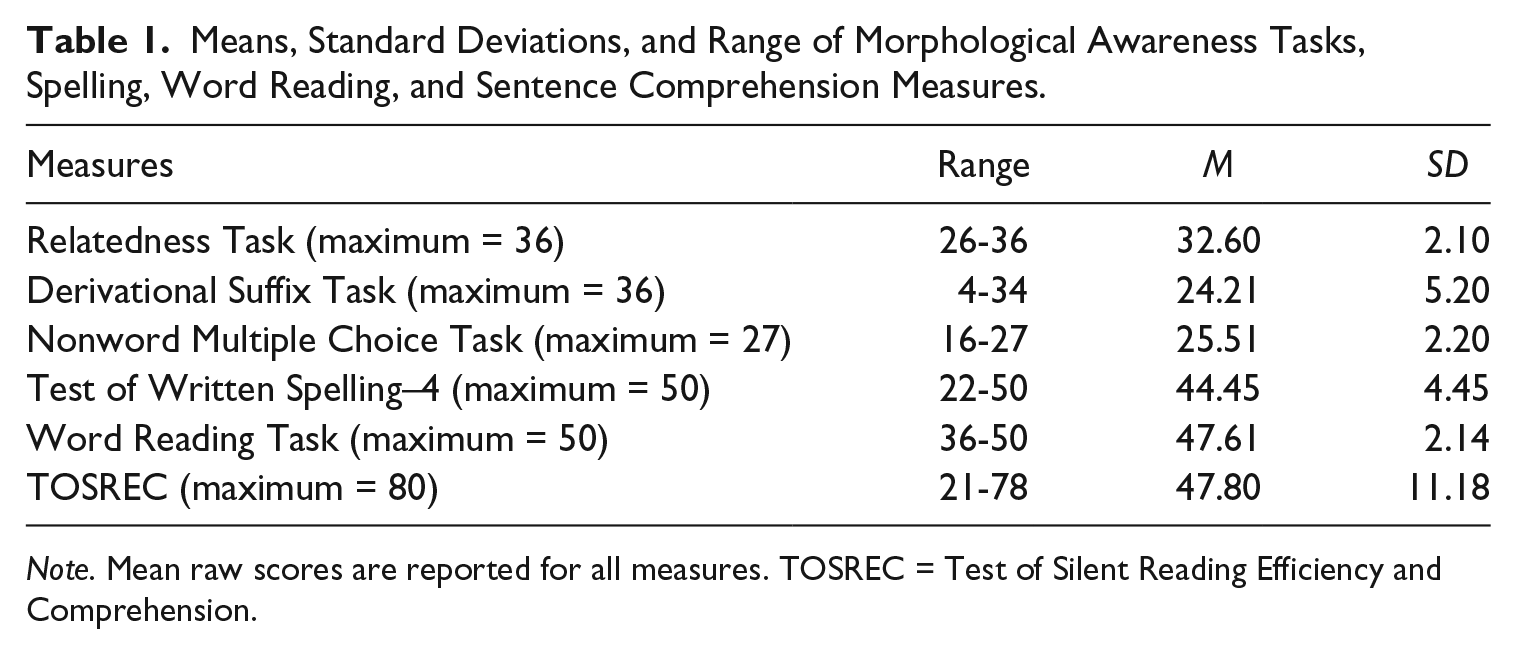
Note. Mean raw scores are reported for all measures. TOSREC = Test of Silent Reading Efficiency and Comprehension.
Question 1: Creation of a Reliable and Valid Morphological Awareness Measure
IRT was used to obtain a morphological awareness measure that contains items that will produce reliable and valid scores. Initially, items with difficulty parameters in z score units of less than −3.0 and greater than 3.0 were removed, resulting in a larger set of items with difficulty parameters ranging from −2.840 to 1.505 (Petscher & Schatschneider, 2010). Items with discrimination values of less than 0.0 and greater than 2.0 also were removed, resulting in discrimination values of 0.36 to 1. Final items were removed based on a visual scan of the ICC for each of the remaining items. After item removal, the morphological awareness measure was reduced to 24 items (see the appendix). Difficulty and discrimination parameter estimates for the final 24 items are presented in Table 2.
Difficulty and Discrimination Parameters of Final Validated Morphological Awareness Target Items.
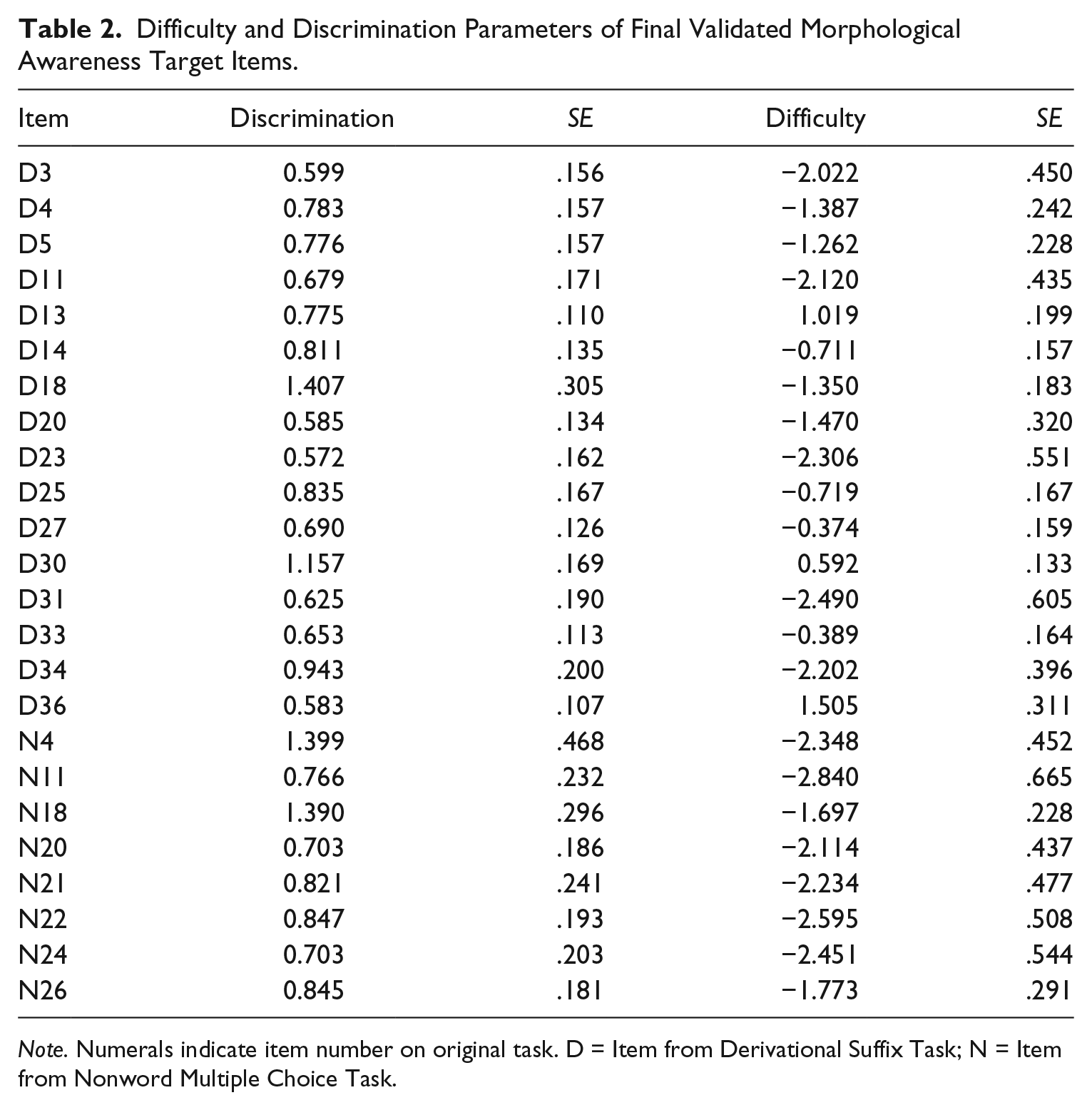
Note. Numerals indicate item number on original task. D = Item from Derivational Suffix Task; N = Item from Nonword Multiple Choice Task.
In addition, a graphical depiction of the parameter estimates for the final 24 items (i.e., ICC) is contained in Figure 1. Each curve represented one item and provided information about the item’s difficulty and discrimination abilities. An examination of the slope of each curve in relation to the slopes of the other curves indicated all of the items measured the same underlying ability. The Test Information Function Curve (i.e., the sum of the item information curves) is represented in Figure 2. It provides an overall visual depiction of the location along the ability continuum at which the morphological awareness measure was most precise (Reise & Waller, 2002).
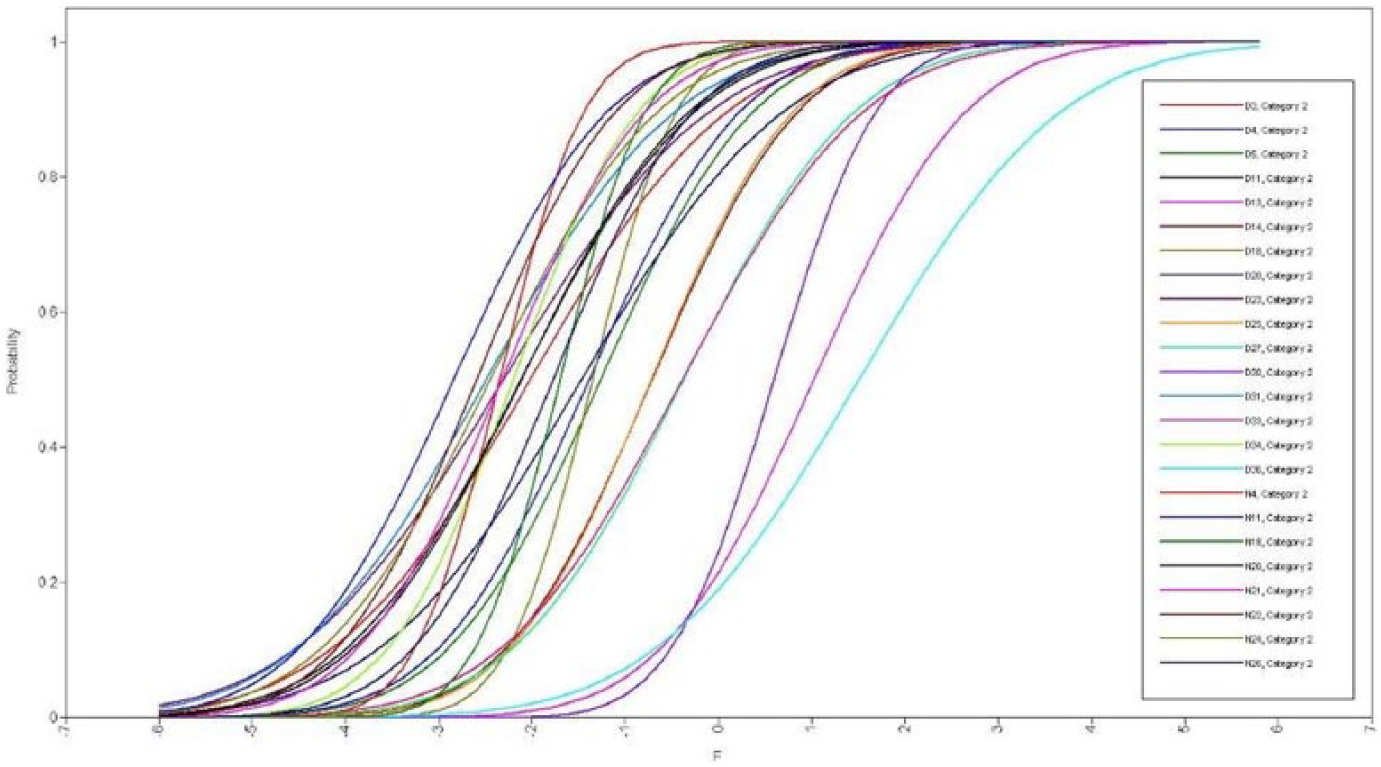
Item characteristic curves for final 24 items on validated morphological awareness measure.
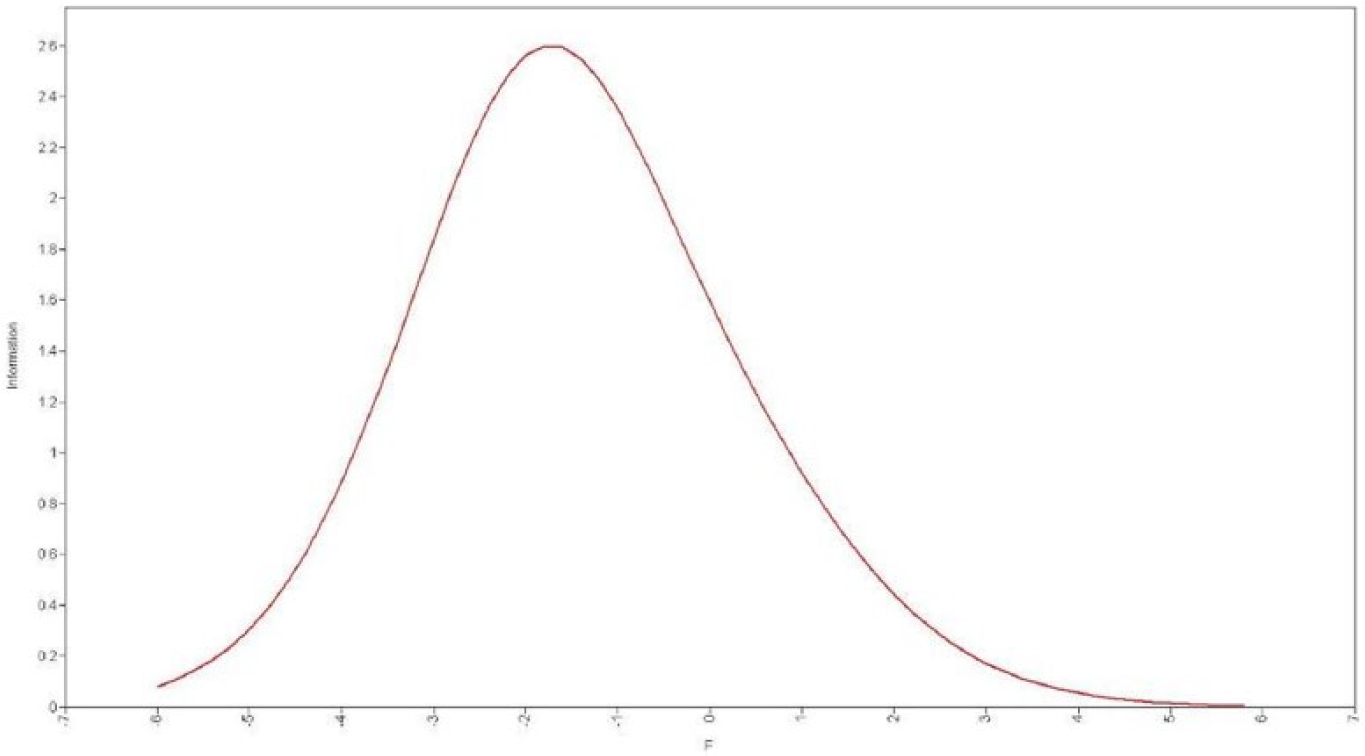
Test information function curve for final morphological awareness measure.
Question 2: Causal Effects of Morphological Awareness on Literacy
To determine direct and indirect effects of morphological awareness ability on spelling, word reading, and sentence comprehension, a path analysis was conducted. The proposed model yielded a chi-square value of 358.08 (df = 323, p = .09), comparative fit index (CFI) of .97, and root mean square error of approximation (RMSEA) of .02; all three of the fit indices provided evidence of a good model fit. The resulting standardized path coefficients and standard errors are presented in Figure 3.
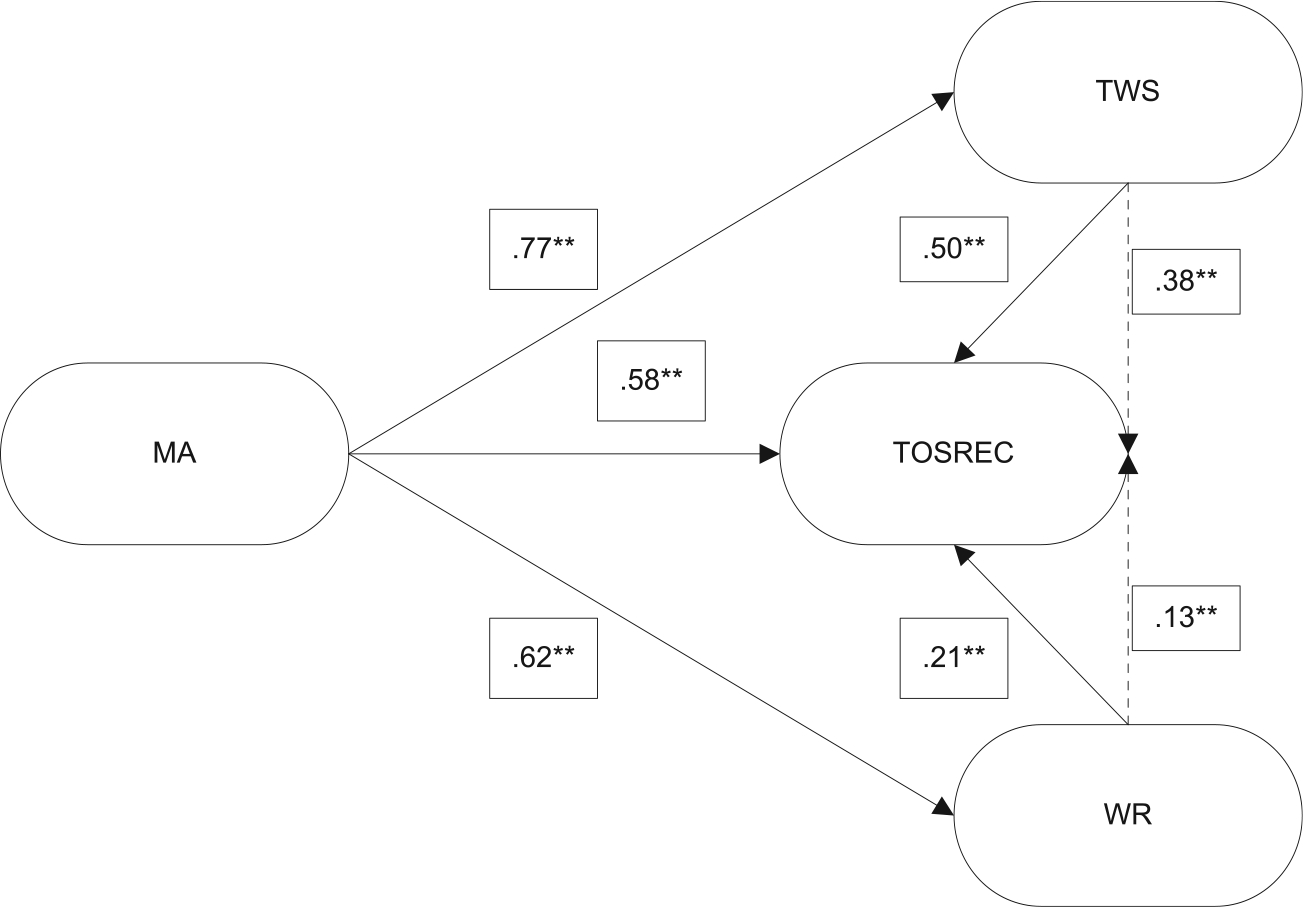
Standardized path coefficients for path analysis model.
Direct effects
Morphological awareness significantly explained 59% of variance in spelling (B = .77, p < .001), 38% of variance in word reading (B = .62, p < .001), and 33% of variance in sentence comprehension (B = .58, p < .001). After controlling for word reading, spelling predicted 25% of variance in sentence comprehension (B = .50, p < .001). After controlling for spelling, word reading predicted 4.4% of variance in sentence comprehension (B = .21, p = .004). Thus, morphological awareness ability had a direct and strong (Cohen, 1988) influence on students’ spelling abilities, a direct and moderate effect on word reading abilities, and a direct and moderate effect on sentence comprehension abilities. Furthermore, it was a stronger predictor of college students’ spelling abilities than of their word reading abilities.
Indirect effects
The total indirect effect of morphological awareness on sentence comprehension through spelling was .38 (p < .001). The total indirect effect of morphological awareness on sentence comprehension through word reading was .13 (p < .001). Using descriptors proposed by Mathieu and Taylor (2006) on a scale of complete, perfect, and partial mediators, both spelling and word reading were partial mediators of relations between morphological awareness and sentence comprehension (Preacher & Kelley, 2011). However, spelling was a stronger mediator of the relations between morphological awareness and sentence comprehension than word reading.
Discussion
In this investigation, we sought to create a reliable and valid measure of morphological awareness for the purpose of determining its direct and indirect influence on spelling, word reading, and sentence comprehension abilities in typically developing college students. We hypothesized that a reliable and valid morphological awareness measure could be created using IRT analyses and that morphological awareness would predict spelling, word reading, and sentence comprehension. The results of this study confirmed both hypotheses.
Question 1: Creation of a Reliable and Valid Morphological Awareness Measure
Using IRT, we created a calibrated measure of morphological awareness, thus adding a new measure to the literature base for use with the college population. The measure is unique in several respects. First, it is the only morphological awareness measure to be created using IRT analyses to select items for college students. Most researchers used classic test theory to develop measures and to evaluate difficulty of items and internal consistency of measures (Petscher & Schatschneider, 2010). IRT offers a different approach to establishing the validity and reliability of measures. One advantage of IRT is that it allows for the creation of a more precise scale than classic test theory (Petscher & Schatschneider, 2010). On our final, validated morphological awareness measure, 24 of 99 original items were retained. These retained items provide good discrimination and difficulty estimates for college students, thereby addressing reliability and validity concerns related to the measurement of morphological awareness.
Second, the final, validated morphological awareness measure includes items taken from two different types of tasks, the DST and NWSC. Sixteen of the original 36 target items from the DST were retained. This type of sentence cloze task was used in a number of different investigations with elementary-age children (Apel & Thomas-Tate, 2009; Berko, 1958; Carlisle, 1988, 1995, 2000; McCutchen, Green, & Abbott, 2008) and adolescents (e.g., Nagy et al., 2006). The DST had not been used previously with typically developing college students; this was the first investigation with college students to include a sentence cloze task requiring production of the correct response rather than recognition from an array of choices. Furthermore, it was the first to include items within a specified AFF range that systematically varied according to type and number of shifts between base and derived words (i.e., two shifts, one shift, and no shift). The 16 DST items retained included a range of items from all three shift categories; five were two-shift items (e.g., muscle-musculature), four were no-shift items (e.g., odor-odorous), and seven were one-shift items (e.g., logic-logician).
Previous research with younger students (Carlisle & Stone, 2005) suggests there is a hierarchy of difficulty when reading multimorpheme words (i.e., no-shift items are easiest, and two-shift items are the most difficult). However, difficulty parameters of the DST items obtained through the IRT process indicated a variety of shift types among the easiest and most difficult items. Thus, there may be other explanations for the relative difficulty level of target items on the DST with an AFF of 30 to 40 SFI in this population. We did not control for complexity of the sentence structure of the DST, yet it is known that complexity of sentences influences comprehension (Kintsch & Rawson, 2007; Scott, 2009). There may be aspects of the syntax of sentence prompts or other characteristics of derived words (e.g., frequency of suffix, base word, or derived word) that contribute to the difficulty level of target items. These factors remain to be investigated.
The final morphological awareness measure also included eight of the original 27 items from the NWSC. The NWSC is a multiple choice, sentence completion task that uses real affixes combined with nonsense base and root words. This type of task has been used in a number of investigations with elementary-age children (e.g., Singson, Mahony, & Mann, 2000) and high school and college students (Mahony, 1994). The retained items included a range of noun, verb, and adjective responses; two were nouns, two were verbs, and four were adjectives.
None of the original 36 target items from the third task, the Relatedness Task, was retained in the final morphological awareness measure. All items on this task displayed low discrimination parameters (i.e., discrimination estimates were less than .5 and, thus, nondiscriminatory) and/or low difficulty parameters (i.e., difficulty estimates were less than −3 and, thus, too easy) and were removed during IRT analysis. This indicates the Relatedness Task is not a valid measure of morphological awareness at this student ability level, thus corroborating suggestions from other investigators that the Relatedness Task is not a useful measure of this construct (Carlisle, 1995; Carlisle & Fleming, 2003; Katz, 2004; Mahony, 1994). This was the only task that did not involve syntactic constraints; both the DST and the NWSC required sentence completion. Our findings suggest, then, that sentence-level tasks best capture morphological awareness in college students.
Third, 24 items on the final validated measure represented a range of difficulty levels and discriminated among high and low performers. However, the measure best predicted morphological awareness abilities for college students who are 1½ standard deviations below the mean. Because our measure did not predict equally well across a range of ability scores, it may be best to separate those who perform at or above 1½ standard deviations below the mean (i.e., within typical limits) and those who fall below 1½ standard deviations below the mean (i.e., below typical limits). The final validated measure may be a useful tool for clinical purposes to screen college students who are struggling academically and to provide preliminary information about morphological awareness abilities. It is desirable to develop measures that capture students who are notably (i.e., less than 1 ½ standard deviations) below the mean. The process of item- and ability-level analysis using IRT has provided a tool that may demarcate college students with adequate morphological awareness abilities from those with poor morphological awareness abilities; however, this also remains to be investigated.
Question 2: Causal Effects of Morphological Awareness on Literacy
Path analysis was conducted to determine relative strength and direction of the validated morphological awareness measure on spelling, word reading, and sentence comprehension. Both direct and indirect effects were examined.
Direct effects of morphological awareness on spelling and word reading abilities
The validated morphological awareness measure directly predicted 59% of participants’ performance on the spelling task and 38% of performance in word reading. To date, no investigations of college students have used a reliable and validated latent morphological awareness task to predict literacy abilities. In addition, no investigations of college students have examined predictive ability of morphological awareness for spelling. Thus, this study extends research findings from investigations with middle school and high school students (e.g., Nagy et al., 2006) to college students that morphological awareness is a strong predictor (Carlisle, 1988) of spelling abilities.
Turning to the predictive ability of morphological awareness for word reading, our findings mirror and support findings from Leikin and Hagit (2006) that morphological awareness is moderately predictive of word reading ability in college students. Leikin and Hagit (2006) found that morphological awareness significantly predicted 39% of Hebrew-speaking, college students’ word reading abilities using regression analyses. Our findings are almost identical despite differences in the morphological structure of Hebrew and English, the tasks used, and the type of statistical analyses conducted; thus, the consistency of findings across both studies provides a stronger basis of support and generalization for the utility of morphological awareness to predict word reading.
Morphological awareness may be predictive of spelling and word reading because when spelling and reading morphologically complex words, spellers and readers tap into their knowledge of morphemes. Consistent with Perfetti’s (2007) Lexical Quality Hypothesis, repeated encounters in print with morphemes in multimorpheme words likely reinforce quality of lexical representation for those morphemes. Because the same morphemes appear in different multimorpheme words (e.g., the morpheme muscle may appear in the multimorpheme words muscular, musculature, muscly, and overmuscled), readers and spellers of these multimorpheme words may have multiple opportunities to bond the underlying phonological, orthographic, and morphological properties into a high-quality lexical representation. In turn, the higher quality of the lexical representation likely increases accuracy and efficiency of access to those morphemes for spelling or reading multimorpheme words that contain those familiar morphemes.
Our findings suggest that college students’ ability to consciously think about and manipulate morphemes in words predicted larger variance in spelling abilities than word reading abilities. Our findings mirror Nagy and colleagues (2006) who found a similar difference in the predictive nature of morphological awareness for spelling and word reading in younger students; sixth- and seventh-grade students’ morphological awareness abilities predicted a larger amount of variance on a spelling task than on a word reading task.
The differences in the ability of morphological awareness to predict spelling versus reading may be due, in part, to differences in the task demands involved with these two literacy tasks. The spelling task required participants to produce an accurate and complete representation of the words spelled, including detailed information of the phonological, orthographic, and morphological structure of the word. When spelling multimorpheme words, spelling rules often govern orthographic and phonological changes that must occur to the base morpheme when adding suffixes (Nagy et al., 2006). For example, when adding the suffix morpheme ive to a base morpheme that ends with a silent e (e.g., create), the rules of English orthography require omitting the silent e (e.g., creat_ive). Repeated encounters of this spelling rule as it occurs in other multimorpheme words that follow the rule may facilitate the depth of integration of morphological, orthographic, and phonological details necessary to produce accurate spellings of multimorpheme words. Alternately, the word reading task required participants to match printed words to detailed lexical representations previously stored; matching a printed word to a stored lexical representation of a word that is only partially accurate may be sufficient for word reading (Ehri, 2005). For example, successful recognition of the stored lexical representation of the multimorpheme word creative may not depend on explicit awareness that the orthography of the base morpheme create changed. Thus, demands of producing words in the spelling task may have tapped more into the need to consider morphological characteristics of words than was required by the reading task.
Effects of morphological awareness on sentence comprehension
Morphological awareness directly and moderately predicted 33.6% of variance in sentence comprehension. Furthermore, there was a significant and partial indirect effect of morphological awareness on sentence comprehension through spelling and word reading. No other investigators have examined the direct influence of morphological awareness on sentence comprehension abilities or examined mediating effects of word-level literacy skills on relations between morphological awareness and sentence comprehension in college students. Thus, this information contributes new knowledge to the research base.
Direct effects of morphological awareness on sentence comprehension
Morphological awareness was moderately and directly predictive of college students’ ability to understand written sentences. Mahony (1994) conducted the only investigation with college students of the relation between morphological awareness and an indirect measure of reading comprehension at the text level (i.e., SAT scores). Our finding for sentence comprehension is consistent with, and expands on, Mahony’s (1994) finding of a positive correlation between morphological awareness and an indirect measure of text-level comprehension, thus lending strength to previous findings.
There are two possible explanations for the direct influence of morphological awareness on sentence comprehension. First, it may be due to participants’ abilities to use their conscious awareness of morphemes in morphologically complex words to understand the meaning of these more complex words in sentences. An increased understanding of the meaning of complex words likely facilitates better understanding of the overall meaning of the sentence. Second, like the sentence comprehension measure, all items on the morphological awareness measure involved sentence-level responses, thus drawing on syntactic knowledge. Completion of both the morphological awareness task and the sentence comprehension task may have drawn similarly on syntactic cues provided by sentence context and the awareness of grammatical meaning provided by the addition of affixes.
Indirect effects of morphological awareness on sentence comprehension
Both spelling and word reading mediated relations between morphological awareness and sentence comprehension; thus, morphological awareness had a significant, indirect effect on sentence comprehension, with spelling having a stronger effect on sentence comprehension than word reading. Results from this path analysis provide new insights into links between morphological awareness and sentence comprehension of college students. Findings provide initial evidence for the mediating role of spelling and word reading between morphological awareness and the ability of college students to understand sentences.
However, spelling ability was a stronger transmitter of the effect of morphological awareness on sentence comprehension than word reading ability. This may be because higher quality lexical representations developed through the more stringent act of spelling than reading promote more efficient retrieval during sentence reading of words from the mental lexicon. In turn, cognitive resources are likely freed up to meet other linguistic demands of sentence comprehension, such as extracting and integrating meaning.
Limitations
There are several limitations to this investigation that lead to suggestions for future investigations. First, the statistical path analysis conducted assumed a unidirectional model of influence from morphological awareness to spelling and reading words to understanding sentences. However, it may be that relations between these variables are more reciprocal (e.g., morphological awareness may influence and/or be influenced by the ability to spell and read words; Kemp, 2006). Thus, statistical analyses may not reflect the complexity of relations among variables. Future researchers could investigate the nature of relations between morphological awareness and literacy abilities using more sophisticated statistical analyses accounting for nonlinear relations.
Second, the morphological awareness measure was concurrently calibrated and validated in the same sample of 214 participants. Although there is no agreed on sample size necessary to calibrate measures using IRT, more stable parameters might have been obtained using a slightly higher sample size (Petscher & Schatschneider, 2010). With a greater sample size, the morphological awareness measure could have been calibrated using one half of the sample, and then validated using the remaining one half of the sample.
Third, three types of morphological awareness tasks were administered in this investigation. Other types of tasks that have been administered with younger students were not included in this study. Possibly, tasks used in the present study were not tasks that captured potential, different underlying dimensions of the construct. Future studies could investigate the underlying nature of morphological awareness with different tasks.
Fourth, morphological awareness was the only linguistic awareness skill investigated. It may be useful to examine the influence of morphological awareness simultaneously with other linguistic (e.g., vocabulary, word reading) and linguistic awareness (e.g., syntactic awareness) skills to obtain a clearer picture of the unique variance each may contribute to sentence or discourse-level reading comprehension. However, there is preliminary evidence to suggest that morphological awareness predicts unique variance separate from syntactic awareness (Guo et al., 2011), vocabulary (Apel & Thomas-Tate, 2009), and word reading (Kirby et al., 2012).
Finally, participants spelled and read the same set of 50 words taken from the TWS-4. Testing order was set such that participants spelled words at the beginning of the testing session and read words 80 min later at the end of the testing session; multiple tasks were administered in the interim. However, it is possible participants’ performance on the word reading task was facilitated by the spelling task; the process of spelling may have contributed to development of a stronger lexical representation of the word, which, in turn, may have increased recognition of the word during the word reading task. Thus, our findings may reflect a weaker effect of morphological awareness on word reading due to decreased variance on the word reading task.
Conclusion
This investigation has fulfilled several purposes. First, we created a validated and reliable measure for morphological awareness for use with college students. Second, findings yielded new information about the influence of morphological awareness on college students’ literacy abilities. One potential clinical application of the findings is instructional in nature. Although further research is needed, the validated morphological awareness measure may be used preliminarily to determine whether college students have morphological awareness abilities that fall within or outside typical expectations; performance on this measure might be useful in guiding instructional decisions for college students who are enrolled in developmental literacy classes. Findings also suggest efforts to increase college students’ morphological awareness abilities likely are necessary for increasing the ability to spell words, read words, and understand sentences, and that spelling is a stronger mediator of relations between morphological awareness and sentence comprehension than word reading.
Further research is needed to understand the more detailed nature of relations among morphological awareness, spelling, word reading, and sentence comprehension abilities. This study investigated morphological awareness using items within a limited AFF range (i.e., from 30 SFI to 40 SFI). Future research could address whether literacy abilities are more heavily influenced by other ranges of AFF and/or different measures of frequency, such as base word frequency or affix frequency. More specific information about factors that influence relations between morphological awareness and literacy may facilitate refined measures of morphological awareness and provide more direction for efficacy studies of clinical assessment and intervention protocols. Finally, we created the first reliable and valid measure of derivational morphological awareness for use with college students. Future research should investigate the usefulness of this measure for assessment or instruction with college students struggling with reading and writing.
Footnotes
Appendix
Declaration of Conflicting Interests
The author(s) declared no potential conflicts of interest with respect to the research, authorship, and/or publication of this article.
Funding
The author(s) received no financial support for the research, authorship, and/or publication of this article.