




Abstract
This study examines how bilingual second-grade students perceived of their reading competence and of the work of reading in two contrasting settings where texts were regularly discussed: a monologically organized classroom (MOC) and a dialogically organized classroom (DOC; as determined by prior analysis of classroom discourse). Interview data revealed that, while every student in the DOC came to describe herself or himself as a good reader by the end of the year, many low-achieving readers in the MOC no longer saw themselves as good readers. Findings further indicated that students in the two classrooms conceived of epistemic reading roles in contrasting ways. In the MOC, students viewed reading as about getting the text’s intended meaning and expressed concern about potentially giving wrong answers. They emphasized the teacher as a provider of information, placed importance on external achievement markers, and saw good reading as a matter of being smart. In the DOC, students saw themselves as agentive makers of meaning who generated ideas and questions. They spoke of a social responsibility to help others (including both peers and teacher) better understand the text. They saw discussion with peers as a way of helping further their own textual understandings, and the teacher as someone who sought to understand and learn from student textual perspectives. In light of existing self-efficacy literature, these findings suggest that student beliefs about epistemic roles, mediated by the predominant nature of classroom discourse, could play an important role in shaping students’ perceived reading competence.
Keywords
How students perceive of their own ability matters considerably to their academic achievement, to their persistence and motivation in school-related tasks, and even to college and career decision-making (Bandura, Barbaranelli, Caprara, & Pastorelli, 2001; Guthrie, Coddington, & Wigfield, 2009; Usher & Pajares, 2008). Negative self-beliefs about reading ability are particularly destructive, as these can spur students to disengage from reading for fear that perceived weaknesses will become public, potentially fueling a vicious cycle where students lose experiences with texts that could strengthen both their confidence and the very abilities they feel they lack (Hall, 2009). Conversely, positive reading self-efficacy beliefs appear to move students toward habits of heart and mind that make them “lifelong readers” who want to read for various aesthetic and utilitarian purposes (Guthrie et al., 2009, p. 320).
Self-perceptions of ability are powerfully shaped by experience (Hall, 2012; Usher & Pajares, 2008), and yet, for all the apparent malleability, schools have not yet harnessed effective ways to support students’ perceptions of their reading ability across time. To the contrary, children’s perceived reading self-efficacy generally declines between the ages of 8 and 12, even as actual reading achievement improves (J. Smith, Smith, Gilmore, & Jameson, 2012). The kind of instruction students receive has been hypothesized to play a major role in this decline, as it does in other subject domains such as mathematics (Usher, 2009).
Yet, nearly all studies examining sources of children’s self-efficacy beliefs have been short-term quantitative studies (Usher, 2009); none have focused on the reading self-efficacy beliefs of students from culturally and linguistically diverse backgrounds (Fry & Center, 2007). While potentially helpful in identifying individual high-leverage teaching practices, these existing studies do not give a well-rounded picture of how students form beliefs about their reading abilities in naturalistic classroom settings, where students, after all, are learning to play certain kinds of academic roles in relation to the text and each other—roles largely mediated by classroom discourse (Nystrand, 1997; Nystrand & Graff, 2001).
In most reading classrooms, there is pervasive emphasis on transmission of understandings, and students primarily answer known-answer questions; Nystrand (1997) described such teaching as monologically organized. In such classrooms, teachers typically initiate (I) with questions, students respond (R), and teachers evaluate (E) responses (Mehan, 1979). This IRE discourse pattern has a strong historical legacy, and remains the “default pattern” in classrooms (Cazden, 2001, p. 53) even during discussions (Nystrand & Gamoran, 1991). In monologically organized classrooms (MOCs), the teacher poses questions and offers textual explanations that steer students toward teacher-sanctioned answers; consequently, discourse is teacher-dominated. Students, in turn, typically seek teacher confirmation that they have correct textual understandings, and seldom dialogue directly with each other.
Other classrooms, notably rarer, emphasize constructing understandings through dialogue; the students and teacher talk through ideas together. Nystrand (1997) described such teaching as dialogically organized instruction, where the teacher eschews the traditional evaluative role seen in the IRE pattern of interaction. Instead, she or he often asks authentic questions, values divergent student responses, and follows up on responses to encourage the group to explore ideas further. Students in these classrooms grapple with text through conversation with other students, often examining the merits of competing hypotheses and contributing in ways that shape the direction of the dialogue (Aukerman, 2007, 2013; Christoph & Nystrand, 2001).
The dichotomy between dialogically and monologically organized teaching is anything but absolute: According to Nystrand (1997), classrooms are inevitably dialogic in the sense that differing voices take part. But teaching can either make that multiplicity central to how learning happens, through allowing knowledge to build from the interaction of voices, or it can suppress multiple perspectives by emphasizing recitation of a single perspective, that of the teacher. While nearly all classrooms are monologically organized sometimes, far fewer make regular space for multiple student perspectives to refract during text discussion (Applebee, Langer, Nystrand, & Gamoran, 2003; Nystrand, 1997).
Clearly such spaces matter pedagogically. Students in dialogically organized classrooms (DOCs) engage in longer turns at talk overall; they enjoy discussing ideas more; they demonstrate greater learning gains; and they use more sophisticated argument schemas than students in MOCs (Nystrand, 1997; Reznitskaya & Gregory, 2013). In addition, the differing epistemic roles students adopt in MOC versus DOC extensively shape students’ beliefs about literacy (Johnston, Woodside-Jiron, & Day, 2001). However, we could locate no studies that specifically examined the relationship between classroom discourse patterns and students’ reading ability self-perceptions.
We wondered, then, whether students in classrooms with different epistemological orientations and classroom discourse might also show differences with respect to their perceived reading abilities. Would bilingual second-grade students in a MOC come to see their reading abilities differently than those in a DOC? Would their beliefs about reading, classroom participation, and instruction also differ in ways that illuminated any such differences? Our cross-case study was able to answer both questions strongly in the affirmative. When we compared beginning- and end-of-year student interview data from two transitional bilingual classrooms we observed during Spanish-language text discussions over the course of a school year, we found that every student in the DOC came to describe herself or himself as a good reader. In the MOC, by contrast, many low-achieving readers no longer saw themselves as good readers by the end of the year. Moreover, students in these two classrooms described starkly different roles for themselves as readers in relation to the text, their teacher, and their peers. They ultimately held different visions of what it meant to read.
Theoretical Framework
To set the stage, we review four bodies of literature: research on self-efficacy beliefs, particularly in the domain of reading; research on sources of perceived reading ability; research on the relationship between epistemic beliefs about reading and classroom pedagogy; and research on linguistically diverse students and text discussion.
Self-Efficacy Beliefs and Reading
Even in first grade, children are capable of assessing their own abilities, both when looking across disparate areas of performance (e.g., math competence vs. sports competence) and when looking within subject realms, for example, when self-assessing spelling, reading, and writing competence, respectively (Wilson & Trainin, 2007). Yet such self-assessments do not neatly map onto academic performance. At times, children who perform as high achievers on comprehension tests can nonetheless see themselves as poor readers, and vice versa (Hall, 2012). At the same time, student beliefs about what it means to be a good reader may not align with what teachers, researchers, and assessments typically evaluate, particularly in younger children (Henk & Melnick, 1998). Even peers in the same class do not always share the same views of what it means to be a good reader (Borko & Eisenhart, 1986). Thus, it is important to better understand what children themselves mean when they describe themselves as “good” or “bad” readers.
Even though student beliefs about their abilities may not always exactly match conventional conceptions of competency and/or student academic performance, these beliefs may affect strongly how children act as learners. While by no means the sole determinant (Schunk & Zimmerman, 2007), perceptions of ability are strongly linked to motivation, future academic achievement, and even career choices (Bandura et al., 2001; Usher & Pajares, 2008). These patterns hold true within the specific domain of reading. Children with high reading self-efficacy beliefs do better on tests of reading achievement (Barkley, 2006; Liew, McTigue, Barrois, & Hughes, 2008; Mucherah & Yoder, 2008). The effect of self-efficacy beliefs is more pronounced among students considered lower achievers overall (Shell, Colvin, & Bruning, 1995) and holds true for students reading in a second language (Sani & Zain, 2011).
Students with more positive views of their reading abilities read more frequently (Henk & Melnick, 1998) and even engage differently in classroom reading-related activities. In one study, low-achieving adolescent readers who nonetheless saw themselves as good readers discussed texts in ways similar to high-achieving peers with high reading self-efficacy, whereas higher achieving readers who saw themselves as poor readers discussed texts in ways corresponding to those of lower achieving, low-self-efficacy peers (Hall, 2012). M. Smith and Wilhelm (2004) found that boys embraced activities—including literacy activities—in which they saw themselves as competent, but roundly rejected activities where they felt incompetent. Even among college students, lower reading self-efficacy beliefs have been associated with shallower approaches to studying (Prat-Sala & Redford, 2010). These findings suggest that students who see themselves as good/poor readers may engage in reading practices and/or avoidance behaviors that subsequently shape reading performance, even if that effect is not immediate.
Sources of Perceived Reading Ability
There is a paucity of research examining sources of self-efficacy beliefs, and nearly all of what does exist “has been quantitative in nature and has targeted the self-efficacy beliefs of high school and college-aged students in predominantly White settings” (Usher, 2009, p. 276). Several decades ago, Bandura (1997) proposed a theory suggesting that four principal factors mediate self-efficacy beliefs: mastery experiences (prior experiences of success), vicarious experiences (observing/reflecting on others’ experiences), social persuasions (feedback from others), and emotional and physiological states (e.g., arousal, anxiety, and mood). Subsequent research has offered the most empirical support for mastery experiences as a source of self-efficacy beliefs (Britner & Pajares, 2006); there is limited evidence for the other proposed factors as well (Usher, 2009; Usher & Pajares, 2008).
Existing research has also established that “the criteria children use to make ability judgments can be influenced by the type of instruction they receive” (Henk & Melnick, 1998, p. 60); for example, the level of caring students perceive their teacher to exhibit positively affects the mathematical self-efficacy beliefs of English Learners (Lewis et al., 2012). Several short-term intervention studies in reading found that strategy instruction and/or teacher modeling can improve students’ self-efficacy beliefs (McCrudden, Perkins, & Putney, 2005; Schunk & Zimmerman, 2007), although effects are not always lasting (Van Keer & Verhaeghe, 2005). We were not able to locate any research in bilingual or monolingual settings examining the relationship between regularly occurring instruction and students’ perceptions of themselves as readers. Moreover, aside from a few studies that specifically considered program model (e.g., dual immersion) as the mediating variable (Lindholm-Leary & Borsato, 2005; Ma, 2010), the relationship between naturalistic instruction and self-efficacy for emergent bilinguals remains unexplored.
Epistemic Beliefs About Reading and Classroom Pedagogies
Drawing on constructs from reader response theory (e.g., Rosenblatt, 1978), Schraw and Bruning (1999) distinguished between adult readers’ models of reading and linked these to self-efficacy beliefs in reading. They empirically established that some readers hold transmission beliefs, which emphasize “an objective, decontextualized understanding of the text and author that corresponds to knowledge transmission” (Schraw & Bruning, 1999, p. 288). Others hold transaction beliefs, which highlight agentive roles for readers and assume “a personalizing understanding of the text based on their own goals and knowledge” (Schraw & Bruning, 1999, p. 288). Schraw and Bruning determined that adult readers who perceive reading as transmission have lower self-efficacy (as well as lower propositional recall) when compared with readers who perceive reading transactionally. Furthermore, they noted that the developmental pathways by which transactional beliefs develop remain unclear. Indeed, they speculated that most readers who adopt transactional beliefs about reading do so “late in their academic careers and often only after major intellectual upheaval” (Schraw & Bruning, 1999, p. 299).
Some scholarship has examined how instruction might facilitate change in adult epistemologies (Palmer & Marra, 2008), but few studies have compared differing elementary classroom contexts to see whether they foster beliefs about reading that reflect more of a transmission or more of a transactional view. One exception is a study by Johnston et al. (2001), which found that students in a monologically organized, “received knowing” classroom—whose teacher enacted transmission views of reading and instruction—tended to adopt a fixed view of knowledge, and saw themselves and peers as recipients of knowledge. Conversely, students in a more dialogically organized, “constructed knowing” classroom—whose teacher enacted transactional views of reading and instruction—appeared more likely to see themselves and peers as agentive constructors of knowledge and understanding.
Linguistically Diverse Students and Text Discussion
With the value of native-language reading instruction firmly established (e.g., August, Shanahan, & Shanahan, 2006), an important next step for researchers of bilingual education is answering more nuanced questions about additional high-leverage practices for teaching bilingual learners, particularly in the domain of literacy. There is mounting evidence that text discussions can help linguistically diverse students develop second-language literacy skills (Kong & Pearson, 2003; van den Branden, 2000). The few studies that have looked at discussion in bilingual classrooms also suggest that bilingual students benefit from primary-language discussion of text (Battle, 1995; Moll & Whitmore, 1993). Despite these findings, students from linguistically and culturally diverse backgrounds are offered few opportunities to construct meaning through in-depth text discussion. They receive predominantly skills-based reading instruction (Au & Raphael, 2000; Valdés, 1998), and recent accountability measures may have exacerbated this trend (Pacheco, 2012). We found no studies examining bilingual readers’ perceptions of reading ability, nor on how these perceptions develop in differing native-language discussion contexts.
Thus, we wondered how bilingual classrooms with contrasting instructional approaches might enact reading discussions, and how these contexts might relate to how students saw themselves as readers and the act of reading. In this study, we examined whether students came to perceive their reading ability differently in an elementary classroom enacting monologically organized instruction versus in one enacting dialogically organized instruction. In line with other work (e.g., Borko & Eisenhart, 1986; Henk & Melnick, 1998), we use the term perceived reading ability to mean the extent to which a student self-identifies as a “good reader” in whatever way that she or he understands that term (Henk & Melnick, 1998; Schraw & Bruning, 1999).
To understand how students conceptualized what good readers do, we also examined how students understood the epistemic roles of the students and the teacher during reading in the two classrooms. We rely on the term epistemic roles to capture range and variation in the ways students envisioned (a) what they needed to do during reading to be successful (students’ roles vis-à-vis text), (b) public participation in dialogue about text (students’ roles around text vis-à-vis the teacher and other students), and (c) the teacher’s motives and work during dialogue about text (the teacher’s role vis-à-vis the text and the students). In the context of two second-grade bilingual classrooms, one monologically organized and one dialogically organized during reading comprehension instruction, we asked the following questions:
To what extent did students identify as good readers?
How did students describe what it meant to be a good reader?
How did students describe reasons for participating (or not) in discussion about text?
How did students describe their teacher’s role in discussion about text and the teacher’s reasons for having these discussions?
Method
Classroom Context
Demographically similar settings
The data for this cross-case comparison study come from a larger study examining Spanish-language reading instruction across a full academic year in two second-grade Spanish–English bilingual classrooms located in different schools in the same district. In one of them, reading discussions were typically monologically organized; in the other, reading discussions were typically dialogically organized.
For the purposes of cross-case comparison and theory building (Eisenhardt, 1989), the classrooms were selected because they resembled each other in many ways, but provided maximum contrast in the aspect of instruction under study: discourse patterns during reading discussions (described below). The two schools were in adjacent high-poverty neighborhoods in a large California city; most students received free or reduced lunch (MOC school: 90%; DOC school: 87%). Both schools served primarily Latino students (most with Mexican backgrounds) and followed the same transitional bilingual program model (with English-only instruction starting in third grade). The 20 students in each classroom were native Spanish speakers and, with one exception, had previously attended bilingual programs. Spanish reading performance, as measured by the district-created fall benchmark assessment, was low in both classrooms, with 83% of MOC students and 93% of DOC students scoring below the 75% mastery threshold for reading. There were no students who exceeded 85% (“Above Benchmark”) in either class. Almost half the students in each class were classified as Intermediate speakers of English (MOC: 44%; DOC: 40%) according to the fall California English Language Development Test (CELDT), with the second largest group being Early Intermediate (MOC: 26%; DOC: 33%).
The teachers were both experienced, bilingually certified teachers held in high regard by their administrators. Esther Lawson (MOC), a European American, had 6 years of teaching experience, and Max (DOC), a Puerto Rican American, had 27 years of teaching experience. (Max requested that we use his real first name; all other names are pseudonyms.) Each identified as a strong believer in bilingual education and appeared warm and well liked (neither ever raised his or her voice; students from prior years’ classes often sacrificed recess to visit them). Both taught language arts in Spanish and based reading instruction around the district-mandated Spanish-language basal text, Foro Abierto (Abarca & Domínguez, 2003). In each school, students were divided by English proficiency among multiple teachers for 30 daily minutes of English Language Development. The instruction during this time focused primarily on oral language and grammar, with little discussion of connected text. Although students read and discussed texts in English in their regular language arts period a few times near the end of the school year in each class, these discussions were the exception. More than 95% of all teacher and student talk during every other text discussion took place in Spanish.
Contrasting classroom discourse
We observed a number of classrooms before selecting the two that became the focus of our study here; during this selection phase, we set out to identify two classrooms that, while sharing many other demographic and curricular similarities, appeared to regularly engage in monologically and dialogically organized text discussions, respectively. Following Nystrand (1997), we believe that no instruction—indeed, no dialogue—will be purely monologic or dialogic. Both tendencies come into play in all classrooms, but analysis of discourse makes it possible to identify predominantly monologic and dialogic discourse patterns.
After data collection was complete, we conducted in-depth analysis of all teacher discourse moves during 10 discussions of the same basal stories. That analysis, described in full elsewhere (Aukerman, Chambers Schuldt, & Johnson, 2012), examined discussions from varied points in time across the data collection year, always on the weekday where the most text discussion took place according to both teacher self-report and our observations. This analysis confirmed that Esther’s text discussions were primarily monologically organized (as was the great majority of daily instruction), while Max’s text discussions were generally dialogically organized (though some other instruction, such as phonics teaching, was more monologically organized). We found that teacher talk differed not only in percentage of total talk (MOC: 81%; DOC: 44%) but also in the quality of the talk detailed below. While we do not believe that these are the only differences between these classrooms, they do illustrate highly contrasting approaches to discussions around text. See Table A1 in the online supplement (available at: jlr.sagepub.com) for a more complete comparison of discursive differences.
In the MOC, Esther posed convergent questions, evaluated student responses, and presented information to the students directly (either by explicitly telling or by answering students’ questions), as seen in the typical exchange below. (All exchanges took place in Spanish but are translated here due to space considerations. See the online supplementary materials (available at: jlr.sagepub.com) for complete dialogue in Spanish.)
Martin Luther King was fighting. For what?
(Consuela provided an inaudible response, which the teacher asked her to repeat.)
So that the African Americans . . .
(Consuela trailed off. There was a pause.)
So that the African Americans . . . (3 second pause) Who can finish Consuela’s sentence? So that the African Americans what? What did Martin Luther King do? What was he fighting for? Elena?
So that everything would be fair.
Okay. So that everything would be fair for the African Americans because up to this time period, everything wasn’t very fair, right? (MOC)
Esther frequently encouraged students to make textual connections that drew on their personal experiences and culture; she shared her own connections; and she prompted students to use a variety of strategies and skills (e.g., making predictions, identifying main idea). In addition, she sought to help students put skills that they practiced to use to improve their reading. For example, she told us she wanted students to know “what is a Venn diagram for, why do we use it, why is that important, how is that going to help us in our independent reading and how is it going to help us on the test.” Esther also read the text aloud during the most discussion-intensive day of the week, which was not the case in Max’s classroom.
The DOC teacher, Max, used far fewer convergent questions and evaluations, and spent little time directly conveying information to students. Instead, he focused on eliciting and understanding student ideas. For example, he frequently engaged in uptake, a form of question that solicits elaboration on and evidence for student ideas (Nystrand, 1997), and he regularly invited students to respond to peer ideas. Here is a typical exchange:
And here [in the photo] is a White person and here is a Black person.
But, but I want to know a little more about what you are saying, Alfredo. I didn’t understand you. Tell me more about what it’s saying, this photo.
(inaudible) that his friends were also angry because they changed the rules, and here is a White person, and here is a Black person.
So, you are saying that the friends of, of, of Martin Luther King were angry because they changed the rules?
Yes.
What do you all think of that? (DOC)
When Max described his goals for his students, he focused on student ideas over correct answers, saying,
I want my students to talk. I want my students to share. I want my students to argue with each other. Um, and that isn’t going to happen if they know that I’ve got the answer and if Mr. Max’s answer is the one they’re supposed to be fishing for.
The analysis of discourse patterns during reading instruction provided strong evidence that these two classrooms were consistently monologically and dialogically organized during text discussions. As in other cross-case analyses of teachers’ instruction (e.g., Dooley & Assaf, 2009), these classrooms were complex environments with other potentially salient differences. However, given that discourse mediates many aspects of learning, we elected to focus on contrasting discourse patterns during text discussions to understand how these might relate to students’ reading self-perceptions.
General reading curriculum and grouping
Both teachers devoted regular time to word study, vocabulary, and comprehension. Each conducted text discussions with the whole class at least weekly, but they also organized their students into homogeneous groups for part of their reading instruction within the first month of school, based primarily on the teacher’s assessment of student decoding proficiency. Esther’s classroom had four groups, and Max’s classroom had two; neither teacher referred to groups as “high” or “low” to the students themselves. (Tables A2 and A3 in the online supplement (available at: jlr.sagepub.com) provide further information about these groups and additional information about reading instruction in each class.) We used these groupings to determine whether there were differences in perceived reading self-efficacy between students who had been identified by their teacher as stronger or weaker readers early in the year. To make fair comparisons between the classes, we categorized MOC students in the two higher groups together as the “high group” (n = 10) and MOC students in the lower groups together as the “low group” (n = 8). (Two MOC students received their reading instruction from a special education teacher; they are not included in our study.) Subsequent references to “high” and “low” groups refer to these groupings in the MOC class and to the two DOC groups (high group: n = 11; low group: n = 9).
Data Sources
To maximize the amount of time we could spend in each classroom, we observed each classroom intensively over 1 school year (the DOC classroom in the first year, the MOC classroom in the subsequent year). In each classroom, we collected audio and video recordings and fieldnotes at least once weekly between October and June, with the exception of several weeks in April devoted exclusively to standardized testing. We also conducted formal interviews with every student twice and with each teacher 3 times. The primary data for this study come from individual interviews conducted at the end of the academic year with each student for whom we had student and parent permission to interview (MOC: n = 18; DOC: n = 15). We also drew on data from interviews conducted near the beginning of the year as a point of reference. We conducted interviews about perceived reading competence rather than administering surveys because of the lack of validated survey instruments for Grades 3 and below (e.g., Henk & Melnick, 1995). Given our interest in understanding potential variation in children’s conceptualizations about what it meant to be a good reader, semistructured interviews also best enabled students to “elaborate on those experiences that have been most salient to them” (Usher & Pajares, 2008, p. 760).
Each student was interviewed in Spanish by one of the two researchers. The interviewers, both European American, were proficient in Spanish, though not native speakers; they were a familiar classroom presence by the time interviews were conducted. Interviews followed a semistructured protocol (see the appendix), with the interviewer often following up on responses to request elaboration and clarification. Interviews were typically conducted over several sessions due to scheduling constraints and the potential for student fatigue. They lasted between 36 and 78 min, with an average of 51.5 min of interview time per student. All interviews were audio recorded and transcribed. For this study, we analyzed responses to seven questions about what it meant to be a good reader and the nature of reading instruction.
Through piloting, we found, as Henk and Melnick (1998) did, that students responded “more freely and in greater detail” (p. 65) when we asked them first to identify good readers among their classmates, and then moved to questions about their self-perceptions as readers. We used a similar technique when probing students’ participation in reading discussions and reasons for doing so. In line with other studies (Borko & Eisenhart, 1986; Henk & Melnick, 1998), we opted for specific questions (e.g., Are you a good reader? Why do you think so?) rather than more abstract questions (e.g., What kind of reader are you?) because these yielded more complete and productive responses.
Data Analysis
Every student for whom we had permission to interview responded to each interview question. After initial open coding of these responses (Strauss & Corbin, 1998), we established descriptive codes to categorize them, then applied these to all interview transcript data, using Dedoose (Sociocultural Research Consultants, 2013). Some students’ answers focused on a single topic, but often students offered answers to a single question that incorporated several different topical responses (defined by us as each component of an answer that was topically distinguishable from other points the student had made). For example, students often described several different behaviors of good readers, noting that good readers read quickly and read a lot. Each of these was counted as a separate topical response. In cases where students mentioned the same topical response multiple times, a topical response was only counted once for each student.
We also grouped these specific codes into larger thematic codes. For example, we grouped topical responses related to reading speed and reading accuracy into a larger code called “competence indicators.” In the occasional instances when students volunteered responses that applied to a later question before it had been posed, we included the codes for the question to which they applied. For example, if students responded to our question about who was a good reader by self-identifying as one, we coded these responses together with responses to the direct question about whether students saw themselves as good readers. Upon finalizing codes, each of us independently reviewed every coded excerpt, with 98% interrater agreement. Remaining discrepancies were resolved through discussion.
We then analyzed the data for patterns within and between classrooms, which, in keeping with Henk and Melnick (1998), we defined as at least 20% of students in a single classroom offering a topical response to a question that fell within the same code. To understand the distribution of responses for students in each classroom, we calculated the percentage of students out of the total number interviewed in each classroom (MOC: n = 18; DOC: n = 15) for each code, rather than the percentage of topical responses, which would have overrepresented the thematic perspectives of more garrulous students. Thus, while students may have provided multiple topical responses that fell within a single code, we counted each student only once per code to calculate percentages. For example, while Ramón provided two topical responses by describing that good readers both read quickly and read a lot, his responses were only counted once in calculating percentages for the larger “competence indicators” category. Topical responses failing to fit any larger pattern were categorized under “other.” These were revisited after coding to verify that they were indeed idiosyncratic, and that no patterns had been overlooked. Total topical responses are provided for each question as a point of reference.
Findings
In the following section, we unpack students’ perceptions of what it meant to be a good reader by first exploring students’ descriptions of good readers as they related to other students in the classroom and themselves, and then by examining their descriptions of what readers do. We specifically consider students’ perspectives on three epistemic roles in textual discussions: students’ roles vis-à-vis the text, students’ roles vis-à-vis others (including teacher and peers), and the teacher’s role vis-à-vis the text and the students.
Who Is a Good Reader?
When asked to name students in their class who were good readers, a similar percentage of students in each class were identified by at least one peer as a good reader (MOC: 60%; DOC: 65%). We then looked at how frequently individual students were mentioned by their classmates (peer mentions). In particular, we examined what percentage of the total peer mentions (MOC: n = 46; DOC: n = 34) were students in the high reading group versus in the low reading group. We found that MOC students were more likely to mention peers in the high group than the low group. In the MOC classroom, students in the high group received a full 78% of peer mentions. The top-mentioned two students, both in the high reading group, received 48% of the total mentions between them. In short, MOC students attributed high ability to a narrower range of students and were more likely to see students as good readers who had also been originally identified that way by the teacher.
DOC students, however, were only slightly more likely to mention peers in the high group than in the low group. Only 55% of peer mentions were of students in the high group. In fact, the student with the most overall peer mentions (18%) was in the low group, as were fully half the students who received three or more peer mentions. Although these figures indicate that, as in the MOC, certain peers were more likely to be seen as good readers than others, the students identified by their peers as good readers were not necessarily the ones who had been initially considered stronger readers by their teacher. Indeed, the distribution of peer mentions was wider overall.
We also sought to determine whether students changed in their self-perceptions of their reading ability over the course of the school year by comparing interview data from approximately 6 weeks into the school year to end-of-year responses. All but two of the DOC students (86%) already identified as a good reader in the fall. The remaining students, both from the low group, were equivocal then; by the spring, they answered confidently that they were good readers. Thus, 100% of both high and low reading group DOC students saw themselves as good readers by the end of the school year.
In contrast, MOC students had a wider range of responses in the fall: 50% identified as good readers, 44% identified equivocally, and one student (6%) described herself as not a good reader. By year’s end, half the MOC students still saw themselves as good readers, but only 17% were equivocal, while 33% did not see themselves as good readers. When we examined these responses by reading groups, 50% of students in both groups initially identified as good readers. By the spring, there was a divergent pattern between the two MOC reading groups, with 70% of students in the high group but only 25% of low group students identifying as good readers in the spring: The number of students in the low group who responded with an unequivocal “No” to the question, “Are you a good reader?” quadrupled.
Of course, the differences in reading ability self-perceptions between the classrooms already present by October raise additional questions about whether classroom instruction that students had already received in those first 6 weeks might have begun shifting self-perceptions of reading ability before our interviews. This aligns with strong empirical evidence from other studies that even short-term exposure to specific kinds of instruction affects children’s self-efficacy beliefs (e.g., Hall, 2012). In any case, given that the reading self-beliefs of children in the low groups moved in opposite directions in the two classrooms, the relationship between classroom discourse patterns and students’ perceptions of their reading abilities is worthy of further examination.
What Do Good Readers Do?
In both classrooms
We then explored what it meant to be a good reader from students’ perspectives. Drawing on a total of 118 topical responses (MOC: n = 66; DOC: n = 52) regarding what good readers did in relation to the text, other students, and the teacher, we looked for patterns both within and across classrooms. Our findings are summarized in Table 1; we elaborate on each category below.
Student Explanations of What Good Readers Do.
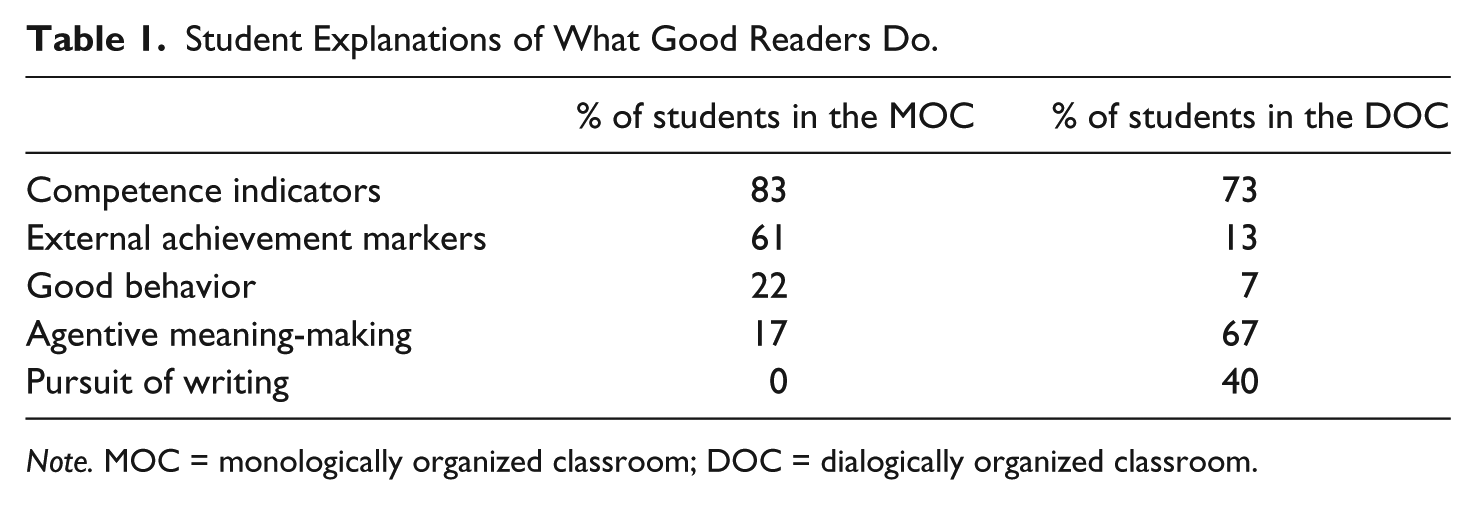
Note. MOC = monologically organized classroom; DOC = dialogically organized classroom.
The main overlap between the classrooms was in students’ attention to competence indicators. This category included all comments about their own or others’ reading proficiency that could be observed and evaluated by the students themselves, that is, reading without errors, reading quickly, and reading a lot. Students related being a good reader to reading accuracy (MOC: 44%; DOC: 27%) and reading fluency/speed (MOC: 22%; DOC: 27%). Dora spoke of both of these in one breath:
And how do you know that you are a good reader?
Well, my parents said that, because sometimes when I read a book, I read quickly and don’t get stuck on the words. (MOC)
Moreover, students in both settings saw amount of reading as important; reading a lot and reading long books were highlighted as markers of good reading (MOC: 33%; DOC: 33%).
In the MOC
We identified differences in what students in each classroom identified as important to being a good reader. MOC students tied being a good reader to external achievement markers, which included test performance and designated reading level. Many of them highlighted the importance of taking tests and doing well on these (MOC: 33%; DOC: 13%). Similarly, students frequently mentioned comparative measures of reading ability, such as being at an advanced reading level as determined by Accelerated Reader (Renaissance Learning, 2012), as a mark of a good reader (MOC: 44%; DOC: 0%). Octavio was asked to elaborate on a statement he had made about two peers he had identified as good readers because they read “fast”:
What does Miguel, or Samuel, do? What do they do when they read? How do you know they read fast?
Because they are at a higher level than me . . . And Samuel is the highest. (MOC)
Here, although Octavio began with a competence indicator (reading speed), he followed up by linking this idea to a reading level, a marker of external achievement.
In addition to markers of external achievement and the previously mentioned focus on competence indicators, the one other category that students in the MOC regularly related to being a good reader was having good behavior (MOC: 22%; DOC: 7%). For example, Baltazar explained that Samuel was a good reader because he “reads well and doesn’t play” (“lee bien and no juega”); playing during reading was bad, he said, “because they have to respect the teacher’s orders” (“porque tienen que respetar las ordenes de la maestra”; MOC). In regard to students’ roles vis-à-vis the teacher, being a good reader in the MOC was linked to doing what the teacher asked.
In the DOC
In the DOC, students emphasized agentive meaning-making (MOC: 17%; DOC: 67%). Drawing on transactional approaches to reading in which readers are seen to construct understandings of the text (e.g., Schraw & Bruning, 1999), we defined agentive meaning-making as any process or activity related to actively making sense of text, including thinking about ideas, examining pictures and text, and reading slowly to understand. Several students pointed to the importance of thinking about the text and having ideas about it (MOC: 0%; DOC: 27%). For example, after Rogelia had identified two peers as good readers, she explained how she thought they tackled text:
And what do they do when they read it?
They think.
They think how or think about what?
They think about what the story will be about. (DOC)
DOC students discussed other ways that readers could act on text to be good readers. They regularly mentioned that good readers engage with the text by examining the pictures and/or the words (MOC: 11%; DOC: 27%). As Dalia explained, good readers “sometimes look at the pictures because sometimes when you look at the pictures, it gives you more information than the words” (“a veces miran a los dibujos porque a veces cuando miras a los dibujos te da más información que las palabras.”) They mentioned other strategies good readers used to improve their reading such as slowing down, rereading a text multiple times to practice, and working through difficult words (MOC: 6%; DOC: 20%).
Finally, DOC students often mentioned the pursuit of writing: According to them, good readers write a lot and/or generate rich writing (MOC: 0%; DOC: 40%). As Emilia put it, “Everyone who writes books is a good reader. When they read a book, they get ideas about that book and they can also write a book” (“Todos los que escriben libros son bien [sic] lectores. Cuando leen un libro tiene ideas de ese libro, y ellos también pueden escribir un libro”; DOC). Emilia and several peers in this classroom linked both reading and writing to the exploration of ideas; as such, being a good reader was connected to writing.
How Do Students Explain Their Own and Each Other’s Reasons for (Not) Speaking During Class Discussions?
Because we wanted to understand how students were conceptualizing epistemic roles as readers vis-à-vis the teacher and other students, we posed questions that asked them, first, to identify those in the class who spoke a lot during discussions, as well as those who spoke less, to set the stage for the next questions that probed the reasons students attributed to how much their peers spoke in discussions. We then asked whether they liked to speak during discussions, and why. These questions were intended to document neither actual participation patterns nor the referenced peer’s reasons for speaking (or not speaking) during discussions. Rather, the responses served as windows into the students’ own perspectives on teachers’ and students’ roles in reading discussions. The data described here are drawn from a total of 225 topical responses (MOC: n = 119; DOC: n = 106).
We did not find notable differences in the percentage of peers identified as talkers or nontalkers between the two classrooms, but did find they explained their peers’ feelings about talking differently. We also saw a striking difference between the two classrooms in how many students told us they enjoyed talking during discussions. In the MOC, 22% of students told us they enjoyed talking during discussion; another 28% described liking to share some of the time (but not all of the time). The other 50% told us they did not like to share at all. In the DOC, 60% of students said they enjoyed talking during discussion, and 27% described liking to talk some of the time. Only 13% of the students said they did not like to speak at all during discussions. We explore the reasons students attributed to their and their peers’ participation below.
In both classrooms
When we looked at how students thought about each other’s and their own participation vis-à-vis the teacher and other students, we found little overlap between classrooms. The only common pattern was attributing peer reticence to those students being nervous or embarrassed about speaking (MOC: 33%; DOC: 20%). Pedro, for example, explained another student’s reluctance to share by saying “probably because he’s embarrassed” (“a lo mejor porque tiene pena”; MOC). MOC students also expressed this as a reason for preferring not to speak themselves (MOC: 22%; DOC: 7%). Not all students further explained why they felt this nervousness but, for those who did, their nervousness appeared related to a fear that their response would be incorrect, for example, “I feel bad because sometimes I get things wrong” (“Me siento mal porque a veces me saco cosas mal”; Octavio, MOC).
The pattern of attributing one’s own limited verbal participation to nervousness was not the case in the DOC. In the case of the sole DOC student who expressed nervousness about speaking, his primary concern appeared to be whether other students would agree. Gabriel described, “Sometimes, I say something and people say no and it makes me nervous” (“Yo alguna vez digo una cosa y personas dicen que no y me pongo nervioso”; DOC). When the interviewer asked him what typically happened then, he went on to explain, “And then some people agree with me and I don’t feel nervous anymore” (“Y luego unas personas están de acuerdo conmigo, ya no me pongo nervioso”; DOC). What appeared to be important to Gabriel was that he not be the only one representing a particular take on the text; as long as some other students turned out to share his position, he became comfortable speaking.
In the MOC
When MOC students talked about their roles vis-à-vis the teacher and the text, they placed an overriding emphasis on correctness and knowledge. This was the case for why they themselves either did or did not like to speak (MOC: 67%; DOC: 7%), as well as why they said peers may or may not like to speak (MOC: 61%; DOC: 7%). A full 89% of MOC students mentioned correctness and/or knowledge at least once in reference to the extent of their own or their peers’ verbal participation. Both their own preference for verbal participation and that of peers was most frequently attributed to students’ knowledge, smarts, and good memory. For example, Adilene explained that Samuel talked a lot because “he is the most intelligent in the s- [appears to start to say school] . . . in the, in the class” (“es el más inteligente de la es . . . de la, de la clase”; MOC). MOC students also tied to willingness to talk to their level of confidence that they would be right. For example, Baltazar said that he only sometimes liked to share answers, specifically, “when they’re easy” (“cuando están fáciles”; MOC).
Similarly, MOC students regularly explained peers not talking by saying that such students did not know, understand, or remember what they were reading, for example, “he barely remembers about the books” (“a él casi no se recuerda de los libros”; Leticia, MOC). They also described their own reluctance to participate in terms of not knowing the answer or not having personal connections to share. For example, Elena described that she did not like to share because “I don’t have that many connections” (“no tengo tantas conexiones”), as well as because “sometimes I’m thinking and thinking, and I say, is this it? No, that’s wrong. I think and I think and I don’t remember” (“a veces estoy pensando y pensando, y digo ¿será con este? No, está mal. Y pienso y pienso, y no me acuerdo”; MOC).
In the DOC
Students in the DOC described reasons for participation in discussions in terms of transforming understandings, having ideas to share, being interested in the conversation, and as a matter of personal preference. We discuss each of these in turn.
Transformation of understandings
DOC students frequently described their participation as a resource to others and as an opportunity to use peer ideas as a resource to facilitate their own understandings (MOC: 11%; DOC: 53%). Some said they enjoyed talking because it gave them the opportunity to convince others of their textual interpretation or to help others understand the text better. For instance, Emilia told us, “I like to have a discussion, um, because when I have discussions, I always have to resolve them, and I like to help people” (“me gusta tener una discusión porque, um, porque cuando tengo discusiones, siempre las tengo que resolver, y me gusta ayudar a la gente”; DOC). For these students, there was a real purpose for talking: They had the opportunity to change how other students were thinking about the text.
DOC students also described talk as a means by which students could help themselves come to understand the text differently, “because it gives you lots of ideas” (“porque te da muchas ideas”; Marisol, DOC). Similarly, Hector recalled a time that he posed a question to get clarification from others: “Then I can talk and say, like, this, if, um, ‘In Frog and Toad, they, they climbed a mountain, and then, and then I don’t know why the rocks fell down’” (“Entonces yo puedo hablar y digo, como, así, si, um, ‘En Frog y Toad e, ellos, ellos subieron una montaña, y luego, y luego no sé por qué se cayeron las rocas’”; DOC).
Having ideas
In addition, DOC students regularly told us that other students who said a lot during discussions thought hard and had ideas (MOC: 0%; DOC: 20%). Dalia, for example, explained why she and other peers liked to talk by saying,
Because we get a lot of ideas.
Why?
Sometimes our mind works like a machine.
It works like a machine? Can you explain? I don’t know what that means.
Like if you make a copy of an idea and then you make a copy of another idea. (DOC)
Students conversely attributed peers not talking to them not having as many ideas to share (MOC: 0%; DOC: 27%), although only one DOC student explained her own reasons for (sometimes) not wanting to talk this way.
Interest and preference
A number of DOC students also attributed their peers’ (MOC: 0%; DOC: 27%) and their own (MOC: 0%; DOC: 33%) frequent verbal participation to seeing discussion itself as interesting and enjoyable and/or simply liking to talk. For example, Eduardo described his peer Valentín as participating “because he likes to discuss with his friends” (“porque le gusta discutir con sus amigos”; DOC). And Valentín independently confirmed that the give and take appealed to him, particularly when he could convince others: “Sometimes, uh, uh, I like to say things that, that are happening, and sometimes, uh, I like when they agree with me” (“A veces ah, ah me gusta decir cosas lo que, lo que está pasando, y a veces ah, a mí me gusta cuando están de acuerdo conmigo”; DOC). DOC students regularly attributed peer talking to simple preference. For example, Rafael described that Ramón participated in discussions “because he likes to talk and talk and talk and talk and talk” (“porque le gusta hablar y hablar y hablar y hablar y hablar”; Rafael, DOC). Similarly, DOC students were likely to describe peers who did not speak as quiet because they preferred to talk less (MOC: 17%; DOC: 27%).
How Did Students Describe the Teacher’s Role?
To better understand how students understood the task of discussion during reading instruction, we explored the ways students described the teacher’s role vis-à-vis the text and the students: We asked what their teacher did and said during discussions. The data are drawn from 74 topical responses (MOC: n = 32; DOC: n = 42).
In both classrooms
In both settings, students regularly described their teacher as managing the discussion, a category that encompassed calling on students as well as monitoring their behavior and work (MOC: 33%; DOC: 33%). For example, Eduardo told us that “if we are, like, talking very loud, he says to stop” (“si estamos, como, hablando muy loud, dice to stop”; DOC). Other students, particularly in the DOC, emphasized the teacher as someone who gave students turns at talk. Finally, a few MOC students explained that their teacher checked to see if students were doing what they should be doing, for example, “to see if we are doing a good job” (“a ver si estamos haciendo un buen trabajo”; Elena, MOC).
In the MOC
In regard to the teacher’s role vis-à-vis the text, MOC students regularly noted that the teacher read the text (MOC: 44%; DOC: 13%). As Josué put it, “Sometimes she, she, she reads a part and sometimes she reads it all” (“Algunas veces la, las, los lee una parte y alguna vez las lee todo”; MOC). MOC students also regularly mentioned that their teacher provided information to them (MOC: 33%; DOC: 13%) such as background information about a story or help with a particular word, as Baltazar described, “Como si no entendemos una palabra” (“If we don’t understand a word”; Baltazar, MOC).
In the DOC
DOC students frequently noted that the teacher probed their thinking (e.g., the teacher asked questions, solicited student perspectives/questions, or checked his or her understanding of student perspectives; MOC: 6%; DOC: 67%). Many DOC students reported that the teacher asked them questions. Ramón told us, “He just listens to the children to hear what they said, he asks them questions” (“No más escucha a los niños a ver qué dijeron, le haces preguntas [sic].”) He went on to explain,
First the children, uh, do something, then the teacher asks them a question.
The, the children say something. Say what?
Uh, what happened in the story.
Oh, they say what happened in the story?
And Mr. Max asks them questions about their idea. Mr. Max asks questions about the children’s ideas. (DOC)
Ramón’s answer revealed an emphasis that was common among DOC students; they appeared to believe that the teacher was interested in their ideas. In no cases did they mention the teacher questions as connected to evaluating student understanding.
The other reported teacher emphasis unique to the DOC was attending to student thinking through not talking, listening instead to student ideas, and/or writing student ideas down in a notebook (MOC: 6%; DOC: 40%). Rosita described her teacher during discussions this way:
He starts listening to what, what we’re talking about. And also because, um, because, also because, and also because he, he also is interested, in what we’re talking about.
Why do you think Mr. Max is interested in what you are talking about?
Because he always, when we’re talking, he . . . always starts to write like in his, in his, in his book where he writes, and he puts down what we’re saying. (DOC)
From Rosita’s perspective, her teacher listened and noted down what students were saying because he found it interesting.
How Did Students Describe the Teacher’s Reasons for Having Discussions?
To understand how students envisioned the teacher’s expectations for their role vis-à-vis the text and other students, we also asked, “Why does your teacher want you to talk about stories?” As seen below, there were no areas in which MOC and DOC students substantially overlapped in describing their teachers’ reasons for having discussions. The data are drawn from a total of 57 topical responses (MOC: n = 20; DOC: n = 37).
In the MOC
MOC students most frequently indicated that their teacher held discussions so that they would learn specific content from the stories they read (MOC: 56%; DOC: 13%). For example, Reyna described the reason her teacher wanted her to read this way:
To learn more.
To learn more. How can you learn more if you are talking about the stories?
Mmm. Learn about the people who had died before we were born. (MOC)
Reyna, like many of her classmates, placed primary emphasis on content-oriented, efferent reading (Rosenblatt, 1982); this emphasis was the only one that appeared with regularity in the MOC.
In the DOC
DOC students most frequently explained their teacher’s reasoning for discussions in terms of supporting the students’ and/or the teacher’s understanding of the text (MOC: 0%; DOC: 67%). Hector was among those who said that understanding what the author meant could be confusing, and that his teacher wanted the class to discuss: “well, because, like, if you, if you don’t know about what they [the authors] are talking about, then, then you can talk with them [classmates] about if it’s like that” (“porque como si no, no sabes, pues, de lo que están hablando [los autores], ent, entonces pue, puedes hablar con ellos [otros en la clase] si así es”; DOC). Twenty-seven percent of the DOC students made such comments that suggested that their teacher wanted them to clarify the meaning of the text with each other; not a single MOC student did so.
DOC students also told us their teacher asked questions so that he himself could better understand the story (MOC: 0%; DOC: 40%). Emilia, addressing her interviewer, puts it this way:
And if you were my teacher, you’d ask me questions . . . you tell me that, “I don’t understand this book,” and because of that, you want me to help. And I say, I say this or that. I tell you so you understand (“Y como si tu eres mi maestra, me dices preguntas. Me dices que es que ‘No lo entiendo este libro’ y por eso quieres que me ayudes y yo te digo esto o algo así. Y te digo para que la entiendas”). (DOC)
Emilia saw the teacher as someone who benefited from the students’ explanations about what the text might mean.
Similarly, some DOC students felt that their teacher held discussions because he found their ideas interesting (MOC: 0%; DOC: 20%) or found discussions themselves to be of interest (MOC: 0%; DOC: 20%). As Rafael quite simply explained it, “He likes discussions” (“Le gustan las discusiones”; DOC).
Discussion
The primary goal of our study was to better understand how primary-grade students in MOC and DOC came to perceive their reading ability and how they understood epistemic roles related to reading. The changes we observed in students’ perceptions of reading ability from the beginning to the end of the year between these two classrooms are concerning, particularly given the fact that students in primary grades are generally likely to have positive views of their reading abilities, and that students’ perceptions of their reading abilities typically fall further as students move toward middle school (J. Smith et al., 2012; Stipek, 1993). Indeed, a few students who currently self-identified as good readers in the MOC confided that they expected that, when reading material got harder in the future, they would not be good readers anymore.
We acknowledge that, even in classrooms with as many similarities as these two settings, no single facet of instruction is likely to be the sole determinant of classroom differences in student self-perceptions of reading ability. Factors such as the teacher’s ethnicity, gender, or other differences could play a role; indeed, all cross-case comparisons, including multicase studies, have analogous limitations (Shively, 2006). However, given the power of language as a tool for mediating learning (e.g., Gutiérrez, 2001), the discourse patterns in these classrooms are likely to have played a major (albeit not necessarily exclusive) role in generating the sharp differences between classes in how students saw themselves as readers. We believe that other cross-case differences unconnected to classroom discourse cannot adequately explain differences in student epistemologies we uncovered. Those epistemological differences, in turn, can both plausibly and powerfully account for differing student perceptions of their reading abilities when examined in light of what we know about self-beliefs and epistemologies from existing literature, as we outline below.
The Reader’s Role Vis-à-Vis the Text
The differences we identified here are analogous to differences in models of reading that Schraw and Bruning (1999) identified among adult readers. MOC students saw reading as transmission, whereby “meaning flows directly from author to reader without changes in meaning” (Schraw, 2000, p. 96); by contrast, DOC students embraced a transactional view, where readers actively interpret text (Schraw, 2000). Our findings suggest that children are capable of adopting a transactional view of reading at an earlier age than Schraw and Bruning hypothesized, and also that such a view may contribute as much to strong self-efficacy beliefs in young readers as it does in adults.
The Reader’s Role Vis-à-Vis Peers and the Teacher During Discussion
Just because DOC students saw reading as about thinking and generating ideas did not mean that the students saw textual meaning as a free-for-all where any idea was equally valid. Instead, they saw it as their social responsibility to help other students with their interpretations by explaining ideas that were defensible and textually consistent (cf. Reznitskaya & Gregory, 2013). We wonder whether such an orientation might contribute to students’ sense of self-worth because being in a position of helping or convincing other students may be experienced by some students as mastery (Bandura, 1997). Similarly being able to facilitate the teacher’s understanding, another important role DOC students frequently adopted, might well be seen by students as evidence that they are good readers.
MOC students did not articulate any particular role for themselves vis-à-vis their peers during discussion, perhaps because the teacher was their primary interlocutor in that setting. And MOC students were more likely to perceive their responsibility toward the teacher in terms of good behavior. Such an orientation might not lessen their perceptions of reading ability but seems unlikely to strengthen it.
Resources Identified for Further Developing Textual Understanding
For MOC students, developing better textual understanding depended on help from the teacher. DOC students had a more agentive view (cf. Santori, 2011): They saw good reading as linked to things that students could undertake themselves, from rereading a text to examining images present in the text. DOC students also saw participation in discussion itself as a resource for further developing their textual understandings, because discussions were a place to raise questions, try out ideas, and get ideas from peers. We wonder if hearing other students raise questions and modify ideas might help students feel, via vicarious experience (Bandura, 1997), that having questions and uncertainties and even ultimately untenable textual ideas is par for the course rather than a sign of failure.
Importance of External Achievement Markers
While DOC students did not mention these, MOC students were highly attuned to achievement markers, what Ames (1992) has called performance goals. When learners focus on such goals, “ability is evidenced by doing better than others, by surpassing normative-based standards, or by achieving success with little effort” (Ames, 1992, p. 262); failure is typically attributed to lack of ability. It is important to note that discourse during discussion may not have been the only factor causing students to emphasize these. For example, the Accelerated Reader program (Renaissance Learning, 2012) sporadically used in the MOC classroom provided public information about leveling—based on assessments where correct answers to test questions are required (cf. Mallette, Henk, & Melnick, 2004).
Because MOC students saw these markers as evidence of good reading, students who ranked less well may have come to see themselves as less competent, particularly in the absence of having identified ways of engaging in agentive meaning-making to become more competent. Thus, while a performance goal orientation may have actually bolstered students’ perception of their reading abilities in the high group, it appears to have been detrimental to students’ self-perceptions in the low group.
Teacher’s Responsibilities Vis-à-Vis the Text and Students
Because MOC students saw the teacher as a major provider of information about the text, they may have seen the teacher, rather than students, as in a position to know what the text really meant. By contrast, DOC students described the teacher as someone who wanted to understand their perspectives, perhaps helping students see their textual ideas as important.
Prevalent Described Teacher and Student Affect During Discussion
In the DOC, the teacher was perceived as someone who both enjoyed discussion and was interested in it, likely communicating to students that their ideas were important, as well as modeling for the students a way of being in conversation with others about a text. DOC students reported entering into discussions with similar relish, with most of them saying they liked to share at least some of the time.
In the MOC, teacher affect was not described, and the main student affect described was concern about getting the right answer. Given Bandura’s (1997) findings that observing and reflecting on others’ experiences contribute to one’s own self-efficacy, observing students provide answers that were evaluated as right and wrong might contribute to feelings of incompetence in peers who also had a “wrong answer” (even if they had not been the one to supply it).
Distribution of Perceived Peer Reading Competence
In the DOC, peer mentions of who was a good reader were relatively widely distributed. Most MOC students who were named as good readers, by contrast, were ones judged by their teacher to be good readers. We wonder whether MOC students may have had a relatively fixed view (Dweck, 2007) of reading ability; if so, we hypothesize this may mean that students in the low group may have been less likely to perceive “room at the top” for them to also be good readers.
How Peer Talk and Silence Are Perceived
MOC students who were perceived to say little were also perceived to know less. Because so many students preferred not to talk, we wonder whether this perception may have contributed to how students saw themselves in relation to peers. In the DOC, there did not appear to be an ability-related stigma attached to participation, and no particular assumption that students who talked more were better readers. Although having ideas was still seen as important (and preferable to not having as many ideas), the emphasis was on thinking rather than on correctness.
Conclusion
In the domain of reading, most research related to improving students’ sense of self-efficacy has focused on intervention studies that target particular instructional techniques such as comprehension strategy instruction (e.g., McCrudden et al., 2005; Schunk & Zimmerman, 2007). We propose that the overall classroom culture, that which Nystrand and Graff (2001) have called the classroom ecology, may be even more important in shaping how students see themselves as readers and what it means to do the work of reading. In their study of the development of argumentative writing, Nystrand and Graff found that the quality of classroom interaction, mediated through discourse (cf. Johnston et al., 2001), played a leading role in the writing students eventually produced: Monologically organized discussion patterns were inimical to students learning to write argumentatively. Nystrand and Graff suggest that, absent a classroom ecology where student ideas play a substantive role, a focus on particular instructional techniques is unlikely to develop student epistemologies conducive to argumentation. They point out,
Participant roles in classrooms are also epistemological. The questions teachers ask, the tests they give, and the responses they make to student answers, writing, and so on all establish what counts as knowledge in their classrooms. (Nystrand & Graff, 2001, p. 491)
Our study provides solid evidence that even primary-aged students are learning what counts as knowledge and what counts as reading in different ways depending on the ecology of their classroom. Differing classroom beliefs about reading, in turn, related to the extent to which students in the two settings came to hold views of themselves as capable readers. Particularly troubling was the drop in how low-achieving students in the MOC perceived their ability as readers. Because this study was not designed to map self-perceptions of reading ability onto differences in assessed reading performance, we cannot know for certain how achievement outcomes for these students were affected by such changes in self-perception. However, previous research has firmly established that students with high reading self-efficacy beliefs perform better on reading comprehension tests (Barkley, 2006; Liew et al., 2008; Mucherah & Yoder, 2008), and specifically that low achievers with positive self-efficacy beliefs perform better in reading than low achievers who have negative self-efficacy beliefs (Shell et al., 1995). Taken together with those findings, our study raises questions about the extent to which changes in self-efficacy beliefs precipitated by the nature of classroom discourse might have long-term effects on achievement—questions we hope future research will answer.
Because this study is the first to examine bilingual Spanish–English classrooms as a context both for the development of self-efficacy beliefs about reading and for an exploration of children’s epistemic beliefs about reading, there are several implications that are of particular import to researchers and teachers of bilingual students. First, the study adds to nascent bodies of research supporting the premise that students’ self-beliefs about ability in bilingual classrooms, as well as their epistemic beliefs about reading, may indeed be shaped by the kinds of instruction they receive. We hope our work will encourage additional research on how varied instructional forms in bilingual classrooms might support or inhibit students’ self-efficacy beliefs and their reading development.
Second, our findings suggest that if we want bilingual students to see themselves as strong readers, it may not be enough to provide a classroom environment in which they are encouraged to draw on their primary language, personal backgrounds, and cultural knowledge as they discuss text. In both of these classrooms, students were encouraged to discuss texts in Spanish, and not a single student mentioned language difficulties in explaining their self-beliefs about reading or feelings about speaking up in class. The MOC teacher also described being committed to helping students to make personal connections from their own experiences, and we consistently observed these opportunities during her discussions. Yet, these practices of inviting students to make use of their home language and share their experiences did not in and of themselves add up to a discursive environment where students believed that their thinking (rather than correctness) mattered. Given the dominant monologic discourse pattern in that classroom during discussions, the dialogue ultimately failed to “authenticate, integrate, and connect the classroom literacy practices to the practices of the students’ various communities” so that “students’ language and cultural knowledge become tools for learning” (Gutiérrez, Baquedano-López, & Turner, 1997, p. 373).
The rich potential of drawing on students’ own cultural and linguistic resources may be considerably weakened if such resources enter classroom discourse only as passing connections or as conduits for right answers. Classroom ecology matters. We argue that a deeper valuing of students’ sociolinguistic resources can take place when the varied ideas students bring to the table, crucially shaped by those resources, come to shape the direction of dialogue about text—as is the case in dialogically organized text discussion.
We close with a few additional research directions that may be of importance to both monolingual and bilingual classroom settings. If classroom ecology plays an important role, then future investigations of reading self-efficacy should move toward more naturalistic studies that examine differences in student self-beliefs and epistemologies across a wider range of instructional settings. Moreover, this study highlights the need for better understanding the chronological development of perceived reading ability, both within and across MOC and DOC settings, as well as in primary- and second-language instruction with students from a variety of linguistic and cultural backgrounds. In addition, given that classroom discourse remains overwhelmingly monologically organized (Applebee et al., 2003; Nystrand, 1997), intervention studies of professional development around dialogic classroom discourse are also needed to determine how teachers (particularly those serving bilingual populations) might learn to foster more dialogic classroom ecologies. Such studies should be designed in ways that capture whether and how such teacher learning plays a role in students’ beliefs about reading and about themselves as readers.
Finally, we worry that the current emphasis on standardized achievement test results may put enormous pressure on teachers to organize instruction in ways that minimize opportunities for authentic dialogue about student ideas (cf. Pacheco, 2012), despite increasingly robust evidence that dialogically organized instruction may support reading achievement (Reznitskaya & Gregory, 2013; Wilkinson & Son, 2011). Particularly for children from socioeconomically disadvantaged backgrounds who are learning English, the instructional emphasis is often on helping students make gains through skills-based direct instruction (Duran, 2012; Stockhard & Engelmann, 2010; Valdés, 1998) and/or providing students background information that they are believed to lack (Schickedanz & Collins, 2012). However well intentioned, we wonder whether such instruction may be prone to fostering classroom ecologies where students are positioned passively, and a transmission view of reading (Schraw, 2000; Schraw & Bruning, 1999) is reinforced. If so, students in such classrooms (particularly lower performing students who are arguably most in need of support) may be at greater risk of coming to see themselves as poor readers over time.
Equally importantly, our study indicates that students form fundamentally different ideas about what it means to read and what roles they should play as readers based on the instruction they receive (cf. Borko & Eisenhart, 1986; Henk & Melnick 1998). As Freebody, Luke, and Gilbert (1991) have argued, reading comes to assume different sociocultural significance when embodied through different reading practices. We argue that the agentive, transactional roles as readers that students in the DOC took on represent a relationship toward text that educators would do well to foster: Classrooms should produce readers who believe that their own and each other’s thinking matters. And, while we believe that it is important for all students to see reading as an active process of making meaning, it may be particularly vital for students from linguistically and culturally diverse backgrounds, whose thinking about text historically has too often been devalued (Willis, 2008). Thus, we propose that fostering DOC reading cultures—and other forms of instruction that researchers come to learn may matter in fostering high self-efficacy beliefs and transactional beliefs about reading—may be a particularly urgent goal in bilingual settings. We argue that classrooms in which teachers orient students toward dialoguing about student textual ideas rather than right answers may allow students to develop more robust views of what it means to read and, ultimately, maintain more confidence in themselves as readers.
Footnotes
Appendix
Interview questions (see online supplement (available at: jlr.sagepub.com) for questions in Spanish)
Declaration of Conflicting Interests
The author(s) declared no potential conflicts of interest with respect to the research, authorship, and/or publication of this article.
Funding
The author(s) disclosed receipt of the following financial support for the research, authorship, and/or publication of this article: This study was supported by the Spencer/National Academy of Education Postdoctoral Fellowship.
Author Biographies
References
Supplementary Material
Please find the following supplemental material available below.
For Open Access articles published under a Creative Commons License, all supplemental material carries the same license as the article it is associated with.
For non-Open Access articles published, all supplemental material carries a non-exclusive license, and permission requests for re-use of supplemental material or any part of supplemental material shall be sent directly to the copyright owner as specified in the copyright notice associated with the article.
