




Abstract
Teachers often resist discussions about racism in the classroom, yet it is a topic that is frequently addressed in multicultural literature. This study examines teachers in a graduate reading program (N = 58) who used picture books reflecting African American heritage with elementary school children in a summer reading practicum. Prior to teaching children, a subset of these teachers participated in a course that addressed issues of racism, allowing for an investigation of a course effect on teachers’ comfort level with the literature and their addressing of themes that surfaced in the books. Qualitative and quantitative methods were used to analyze questionnaires, planning forms, lesson evaluation forms, and transcripts of teachers using the books to test the hypothesis of a course effect and to identify the range of variation in teachers’ ways of using the literature. The teachers in both “course” and “comparison” groups tended to focus on the perspectives, feelings, and traits of the story protagonists when creating discussion questions and after-reading projects for students. Course teachers focused on the activism of Black protagonists significantly more often than comparison teachers did, although participants of both groups did not tend to represent racism as a system of White advantage. These findings suggests that literacy education programs can have an impact on teachers’ ways of using multicultural literature, but to teach in critical and transformative ways, they will need programs that strengthen their understandings of constructs such as structural racism and help them facilitate thoughtful inquiries of this concept when using multicultural literature with children.
Thoughtful discussions about multicultural literature are compromised if teachers either ignore or gloss over controversial topics such as racism that frequently surface in this literature. Research finds that teachers tend to avoid talking about racism when sharing literature with children (Copenhaver, 2000) and, in doing so, leave them with shallow and incomplete understandings of the issue (Polite & Saenger, 2003). Little is known about how teachers identify and discuss this issue when they use literature with children and how teacher education programs can support them in this process. To address this gap in the knowledge base, we examined how teachers planned to use picture books that reflected African American heritage within a summer reading program and examined some of these teachers’ ways of discussing racism with children. We also looked at how a course in their teacher education program may have played a role in helping teachers address racism when using this literature.
In the United States, racism has long been institutionalized through policies and practices that privilege Whites and disadvantage people of color (Tatum, 1997). Therefore, it is defined as a structural problem of power and social control, and not simply a problem involving acts of meanness between people of different racial groups. Structural racism often operates tacitly and is generally measured in differential access to resources and opportunities for advancement. For example, Black and Hispanic children are about 3 times more likely to be poor than White children (U.S. Census Bureau, 2010), limiting their access to quality health care and education and making it less likely that they will be able to realize their fullest inborn potential. As such, structural racism continues to be a significant social problem in the United States.
If the goal of schooling is to produce critically literate citizens who can serve the democratic ideals of a nation (Giroux, 1998), then deliberate conversations around structural racism are necessary to solving this problem. Teachers can make race visible in the classroom by having students critically discuss literature that addresses this issue (Greene & Abt-Perkins, 2003). It is important then to ask how they facilitate these discussions and what teacher preparation programs can do to help them address racism through literacy events such as book discussions. This is an area of concern to us since discourse about racism is rare in most classrooms. According to Polite and Saenger (2003),
The most pernicious and pervasive silence in primary school classrooms is the silence surrounding the subject of race. Where there is not silence, there is often a complacent orthodoxy purporting that, since Rosa Parks and Dr. Martin Luther King, Jr. changed the world, everything is just fine. (p. 275)
Within these silent classrooms, the realities and consequences of racism are left unproblematized, contributing to its normalization within society. Yet it is possible to invite student inquiry about racism through the use of literature, even with young children. In her book Black Ants and Buddhists: Thinking Critically and Teaching Differently in the Primary Grades, Mary Cowhey (2006) describes how she addresses serious issues such as racism with her racially diverse first and second graders, through picture books that include From Slave Ship to Freedom Road (Lester, 1998), Harriet and the Promised Land (Lawrence, 1997), and Dear Benjamin Banneker (Pinkney, 1994). Cowhey provides examples of how the students in her “peace classroom” transacted with these books through text-to-text, text-to-self, and text-to-world connections (Keene & Zimmerman, 1997) and how they drew from these transactions to investigate the history of racism in the United States and how racism is constructed today. What is not well known is how teachers like Cowhey grow to use literature in these ways and how teacher education programs can support this growth.
This study explores how teachers who participated in a reading specialist graduate program that emphasized issues of social equity address issues of race and racism while using picture books with elementary school children in a summer literacy program. The picture books were set within two epochs of African American history—the antebellum and the civil rights periods. These books constitute a subset within the larger category of “multicultural literature,” so we frequently refer to them as African American heritage (AAH) picture books. Specifically, this study explored two questions: (a) “How did teachers address issues of race and racism when they used these books in a summer reading program?” and (b) “What factors, including a graduate course, shaped their ability to focus on these issues?”
The Problem of Facilitating Discussions About Racism
Studies that center on children’s transactions with multicultural literature, and specifically AAH literature, tend to focus on the upper elementary and middle school grades (Beach, 1997; Brooks, 2006; Desai, 1997; Diaz-Gemmati, 1995; Dressel, 2005; Enciso, 1997; Moller & Allen, 2000); relatively few studies focus on the early grades (Copenhaver, 2000; Rogers & Mosley, 2006; Sims, 1983, Sipe & Daley, 2005; Sipe & McGuire, 2006; Walker-Dalhouse, 1992). A few of the studies highlight the critical role that teachers play in fostering discussions about racism, including their ability to actively listen to students’ responses and reflect on them, employ open-ended questioning techniques, and help children critically scrutinize storybook language and illustrations (Moller & Allen, 2000; Rogers & Mosley, 2006). One study finds that fourth and fifth grade students were directed to “talk back” to the text Maniac Magee (Spinelli, 1990) by specifically scrutinizing the author’s representation of Black and White characters (Enciso, 1997). In another study, a teacher helped fourth grade girls engage in a provocative discussion about racism by selecting literature that addressed this theme explicitly, using literature circles to structure the discussion (Daniels, 2002), setting clear parameters for communicating respectfully, and interceding when children did not know how to respond to racially charged vocabulary (DeNicolo & Fránquiz, 2006).
From this research, it appears that students across grade levels have the capacity to grapple with the issue of racism when teachers scaffold toward this goal. Several studies, however, reveal teachers’ uneasiness about facilitating discussions about racism (Desai, 1997; Moller & Allen, 2000), and teachers have found it difficult to mediate heated discussions among students around the issue (Diaz-Gemmati, 1995; Spears-Bunton, 1990). Diaz-Gemmati (1995) described how difficult it was to diffuse the tensions that surfaced when her culturally diverse class of eighth graders discussed the novels Roll of Thunder, Hear My Cry by Mildred Taylor (1976) and To Kill a Mockingbird by Harper Lee (1960). These discussions left her emotionally depleted, but she found that they helped to challenge some students’ perceptions about racism and cultural differences.
Moller and Allen (2000) described the discomfort expressed by Karla Moller, an experienced teacher and participant observer in the study, who led a small group of African American fifth grade girls in reading Mildred Taylor’s (1987) The Friendship. In the discussion of this story, the girls reacted to the racist acts that surfaced in this book by describing incidents of racial discrimination in the media and in their own lives, including frightening stories about the Ku Klux Klan. Most of the girls contributed to these conversations, but they also resisted them at times when they became more aware that the KKK still operated to threaten people of color. The girls also recognized that Moller’s Whiteness would protect her from this hate group. Both authors of the study reflected on Moller’s difficulty facilitating discussions that highlighted the racial differences between herself and her students. The authors write in their report of the research,
Although she was a seasoned teacher who was knowledgeable about the field of reader-response, multicultural literature, and literature discussion groups, Karla [Moller] still caught herself off balance by the raw intensity of the discussions, sometimes instinctively comforting the students and other times at a loss for any words that could possibly ease or even adequately address their pain or fear. (p. 175)
In another study, teacher–participant observers Melissa Mosley and Rebecca Rogers helped a racially mixed group of second graders discuss and critically analyze texts that reflected AAH (Rogers & Mosley, 2006). These texts discussions helped to raise children’s understanding of racism as a structural problem of White power and privilege. In a reflecting on her work with the children, Rogers recalled that she had missed some opportunities to interrogate children’s understandings about racism by using distancing phrases such as “let’s keep reading and thinking about this” (p. 479).
These researchers’ attempts to engage children about issues of racism were prompted by their desire to raise children’s understandings about racism as a structural problem of White advantage. Their uneasiness about facilitating these conversations stemmed from having to admit their own privileged status as Whites. Conducting these conversations with children of color proved to be challenging for these White researchers, even though they understood that these discussions were an essential component of antiracist teaching.
Given these experienced researchers’ difficulties engaging students in conversations about racism, it is not surprising that teachers tend to avoid using literature that contains this theme. Many fear that students, parents, administrators, and members of the community might disagree with their literature selection (Stallworth, Gibbons, & Fauber, 2008) or the way they handle discussions of these texts. According to Copenhaver (2000), fear of the unknown prevents many teachers from entering into direct discussions about race with children:
When children talk about race—when they are truly invited to share their understandings, wonderings, and observations—there is indeed a risk that children will speak what is often unspoken. In interviews, even the teachers who introduce these books comment that they, too, worry about how others will perceive them and about how what they say will be interpreted by children as they go home to share with their parents. (p. 15)
Copenhaver further found that the White first graders in her classroom tended to withdraw from discussions of picture books with African American themes, yet her African American students responded enthusiastically. She concluded that children’s understandings of this literature are dependent on the teacher’s knowledge about cultural issues and ways of structuring literature response discussions:
Although African American literature has the potential to foster the conversations that could help children create understanding, supportive, harmonious cross-cultural communities, children’s responses in my studies suggest that teachers carry a considerable burden as they encourage students to talk about these books. (p. 14)
These studies suggest that exposing children to AAH literature may not produce the desired outcome of helping them interrogate racism in thoughtful ways. The research suggests that it takes a teacher who is willing to explore the topic with students, even if the discourse it produces is risky and uncomfortable. The question that cannot be addressed through these studies is how teachers grow in their ability to facilitate these conversations. Studies suggest that teachers need more support if they are to help children critically transact with multicultural texts (Beach, 1997; Diaz-Gemmati, 1995; Moller & Allen, 2000; Spears-Bunton, 1990), but it is unclear what this support should look like and how it should be delivered within the context of the teacher education program.
The Problem of Teacher Education
Research finds that preservice teachers (PSTs) tend to resist controversial subjects such as racism when they plan literacy lessons, even when they have been shown how to do so (Apol, Sakuma, Reynolds, & Rop, 2002). Apol and her colleagues (2002) documented the reactions of a predominantly White group of PSTs after they were shown how to critique historical novels and picture books, some of which offered inaccurate and sanitized versions of the Japanese–American conflict during World War II. Course instructors modeled for PSTs how to scrutinize the historical accuracy of texts, interrogate authors’ motivations and perspectives, and locate and discuss the controversial issues these stories contained. After these demonstrations, PSTs described how they would select tests and design future lessons around these texts. Many favored the more sanitized stories for children and preferred arts and crafts projects for literature response experiences, thus avoiding critical discussions about the historical accuracy of texts and the serious issues these stories raised.
The authors speculated that PSTs’ tendency to take an uncritical stance when selecting and using multicultural literature was linked to a variety of factors, including (a) their limited vision of what it means to respond to literature, (b) an oversimplified understanding of reader response theory that emphasizes personal response over critical response, (c) a lack of familiarity with the subject matter including the historical and cultural issues related to the Japanese–American conflict during World War II, and (d) a tendency to see their teaching roles as protecting children from images and conversations that they believe would make children frightened, angry, or sad. These findings suggest that PSTs’ understandings of multicultural texts and their ability to help children respond to them critically require a thorough understanding of reader response, critical literacy, and the subject matter.
The Apol et al. (2002) study is consistent with other research that shows that most PSTs do not tend to focus on issues of equity and social justice when using texts (McDaniel, 2006). Although the PSTs that McDaniel (2006) studied found critical literacy to be an interesting perspective, they did not tend to teach in accord with this perspective and instead resisted talking to children about sensitive issues such as racism. Examining PSTs’ ability to reflect on issues of equity, social justice, and critical literacy, Leland, Harste, and Youssef (1997) found that a relatively small percentage (12%) of PSTs who participated in an on-site professional development school–university program focused on issues of equity and social justice while writing reflective journal entries. Most of these entries focused on learning and schooling issues rather than issues related to politics, equity, or diversity that affect children’s access to learning and education.
Very few studies have looked at PSTs’ ability to think about and discuss serious issues of equity and social justice with children, including only a few of the 82 studies included in a meta-analysis of reading teacher education (Risko et al., 2008). Some studies’ focus was PSTs’ knowledge of literature response (Fox, 1994; Wolf, Carey, & Mieras, 1996), but none of these studies focuses on PSTs’ ability to engage children in conversations about socially significant issues such as racism when they use multicultural texts.
What is clear from these studies is that a gap exists between those who resist focusing on issues such as racism when they use literature with children and those who believe this emphasis is essential to antiracist teaching. One element that separates these two groups is the latter group’s acknowledgment that structural racism is a problem of White power and privilege and that schools are complicit in reproducing the existing social order through texts and talk within classrooms (Rogers & Mosley, 2006). The research literature is less clear, however, about how teacher education programs can help teachers discuss these issues with children through literature.
To explore the relationship between teachers’ ways of addressing racism and the teacher education program, we draw from three key perspectives: critical literacy (Dozier, Johnston, & Rogers, 2006; Freire, 1970), critical sociocultural theory and discourse analysis (Lewis, Enciso, & Moje, 2007; McIntyre, 1997; Van Dijk, 2001), and perspectives on teacher growth in racial awareness (Ball, 2009; Jenks, Lee, & Kanpol, 2001; Lazar, 2004, 2007; Milner, 2006).
Theoretical Perspectives
Exploring Teachers’ Awareness of Racism
Teachers’ use of AAH literature is linked to their own racial-cultural awareness and their seeing of themselves as agents who teach in ways that disrupt the status quo (Grant & Sleeter, 2003; Jenks et al., 2001; Paris & Ball, 2009). Jenks et al. (2001) present three dimensions of sociopolitical philosophy that inform teaching practice: (a) conservative multiculturalism, (b) liberal multiculturalism, and (c) critical multiculturalism. Conservative multiculturalists claim to support equality and inclusion but actually enforce conformity and assimilation. The expectation is that “culturally different” children should acquire mainstream values, knowledge, and skills so they can function successfully in society. Liberal multiculturalists recognize and celebrate diversity but tend not to focus on the issues of power, privilege, and control that work to privilege some and disenfranchise others. Critical multiculturalists, on the other hand, deliberately focus on these issues. They believe that educational equity can be achieved only if they expose power relationships in society and work to dismantle educational practices and policies that advantage some at the expense of others.
Research indicates that racial awareness can be learned through thoughtful study of the issue, self-reflection, and direct engagement with those who have been affected by racist practices and policies (Howard, 1999; Lazar, 2004, 2007; Willis, 2003). This can be very challenging for those who maintain a “color-blind” orientation that denies the significance of racism in contemporary society or who resist exploring these issues. Extensive work in racial awareness is often required to dismantle these views. Lazar (2004) traced how White PSTs who held these views moved from fundamentalist orientations of racism (lack of acknowledgment and responsibility regarding racial inequities) to integrationist orientations (acknowledging inequities but not knowing what to do about it) over the course of one semester, although very few were able to exhibit transformative orientations toward racism (acknowledging and taking responsibility for racial inequality through continued learning and self-scrutiny). While other studies have examined teachers’ growing awareness of race and culture in relation to literacy instruction (Kidd, Sanchez, & Thorp, 2008; Lazar, 2004; Lazar, 2007), we are not aware of research that examines how teachers’ racial knowledge translates to using literature with children.
Critical Literacy
Critical literacy is an educational movement that encourages teachers to scrutinize curricula and texts from the perspective of social equity to effect social change (Heffernan, 2004; McDaniel, 2006; Vasquez, Muise, Adamson, Heffernan, & Chiola-Nakai, 2003). Stevens and Bean (2007) describe the features of critical literacy that can guide these kinds of transactions. The first is the acknowledgment that texts are representations of reality, created by authors who decide on what to include and what to exclude. Therefore, authors’ motivations and choices are subject to critique. Second, teachers operating from a critical literacy perspective encourage debate about text themes, especially in terms of what they mean for one’s access to power. Third, teachers invite a close examination of texts, including word choice, tone, illustrations, book design, and how these elements work together to convey certain messages. Finally, critical literacy involves both deconstructing texts in the ways we have discussed and reconstructing them to extend readers’ understandings of social issues. In other words, readers might rewrite texts from an alternative perspective or find other texts that privilege different points of view. These ways of examining texts can bring children closer to constructing understandings about serious social issues such as structural racism, the ways that individuals have confronted it, and how authors choose to present this heritage.
A critical discussion of racism in children’s literature focuses not just on the central problem of racism but also on identifying the characteristics of story characters who work to preserve or dismantle racism. A critical analysis of storybooks might include identifying how the story language and illustrations work together to convey structural racism, how some characters are complicit in racism, how some attempt to dismantle it, and how authors choose to represent these ideas. A research lens that can be used to examine how teachers use language to plan instruction and facilitate critical book discussions is critical discourse analysis.
Critical Discourse Analysis and White Talk
Critical discourse analysis (CDA) has been used to examine children’s growing understanding of racism in relation to reading AAH literature (Rogers & Mosley, 2006). The aim of CDA is to make transparent the ways in which social dominance and inequality are reproduced or resisted by talk and texts. The research focuses on identifying relationships between the micro (discourse, use of language) and macro (dominance, inequality) levels of the social order (Van Dijk, 2001). Relevant to this study, the selection of literature in a classroom and the ways teachers facilitate discussions of these texts can ultimately affect children’s attitudes and their capacity to act (or not to act) in dismantling racism.
In particular, White talk is identified as a discourse type used by White teachers to insulate them from “examining their/our individual and collective roles(s) in the perpetuation of racism” (McIntyre, 1997, p. 45). McIntyre (1997) suggests that “White talk” is characterized by speech tactics that allow Whites to avoid the difficult task of examining their own and other Whites’ complicity in racism. While facilitating discussions about racism with her White university students, McIntyre found it difficult to direct these students to discuss Whiteness in relation to privilege and social dominance. They tended to define racism in terms of racial prejudice and discrimination and not within a context of power relationships that work to advantage Whites and disadvantage people of color. Instead of seeing White complicity for racism, they saw racism as a problem that victimizes Whites and defended this position with their own “White-as-victim” stories. Furthermore, they minimized the marginalization of people of color in the United States by generating “exception to the rule” stories about people of color who have “made it.” These students also resisted a critical analysis of the consequences of racism for both people of color and Whites.
McIntyre (1997) described specific features of “White talk” to include “derailing the conversation, evading questions, dismissing counterarguments, withdrawing from the discussion, remaining silent, interrupting speakers and topics, and colluding with each other in creating a “culture of niceness” that made it difficult to “read the white world”” (p. 46). McIntyre’s findings support the notion that White teachers can perpetuate structural racism through their language (both verbal and nonverbal) and how they select texts and discuss these texts in classrooms (Rogers & Mosley, 2006; Van Dijk, 2001). Teachers’ awareness of racism is a key factor in how they use language and texts.
This study rests on the assumption that strengthening teachers’ knowledge of structural racism will help them address the problem of “White talk” and its avoidance of structural racism when they teach. Our review of the literature indicates that teachers can grow in their understanding of racism as a structural problem, but we could not locate literature that specifies how this understanding translates to instructional practice. This study explores the assumption that teachers’ knowledge of structural racism translates to a more deliberate emphasis on the problem when they read and discuss literature with children, a pedagogical choice that is consistent with a critical literacy perspective. To test this assumption, we examined teachers’ written lesson plans and reflections of their teaching through the lens of CDA. We also used CDA to examine the ways teachers facilitated discussions about racism with children when they used books that reflect AAH in a summer literacy program.
Method
Setting and Participants
The study was conducted at a university situated in the mid-Atlantic region of the United States at the border of a large low-income, urban community and an affluent, primarily White community. The university offered a 5-week summer literacy program to area school children, and this program also served as the six-credit practicum for the reading specialist program. Of the 61 teachers who were enrolled the practicum, 54 agreed to participate in the study, and 51 of the participants were women. Virtually all the teachers described themselves as White, with the exception of 1 who did not indicate a racial/ethnic affiliation and 1 who identified as African American.
About 60% of the teachers participated in a course during the previous fall semester that addressed issues of race and racism. The course, Sociology of Literacy, was one of several variables that were considered when examining teachers’ ways of facilitating literature response discussions and designing response experiences. Those who took the course were all between 22 and 28 years old and therefore were considered to be beginning teachers, whereas about 45% of those who did not take the course were older, the oldest being 56, and they had varied levels of teaching experience. The practicum course was not taught by either author but was being conducted for the benefit of the teachers and not as a formal research study. The teachers were told that their participation in the study was voluntary and that their use of the literature would not be attached to any grade for the course.
The Sociology of Literacy Course (Fall 2007)
The Sociology of Literacy course focused on the multiple factors that affect literacy achievement (teacher attitudes, classroom discourse, home–school participant structures, etc.) and the broader social factors that also affect literacy achievement (political, cultural, economic, historical). Teachers studied structural racism as it related specifically to literacy achievement by reading and responding (in writing and discussion) to several books and articles (Compton-Lilly, 2004, 2007a, 2007b; Delpit & Dowdy, 2002; Dozier et al., 2006; Gonzalez, Moll, & Amanti, 2005; Ladson-Billings, 1994; Lazar, 2004; Nieto, 1999). Students were also asked to look within themselves to inquire about their own backgrounds, attitudes, and ideologies in relation to these issues and to compare their own access to language and literacy to that of the youngsters whom they tutored in the course (i.e., mostly students of color who lived in the urban community that surrounded the campus).
Althier, a White teacher educator, taught this course in the fall of 2007. She has taught and modified this course since 2004 in response to her students’ understandings about children in high-poverty communities. Althier found this course and other components of the teacher education program to be instrumental in helping teachers see children’s literate capacities (Lazar, 2007). When she taught the course in the fall of 2007, she devoted one class period to AAH books that reflected African American history and the themes that often surface in this literature. Using a PowerPoint presentation, she shared plot summaries of 20 books and asked students to identify themes across them. Students identified messages of overcoming racism, courage, resistance, family unity, community solidarity, religion, literacy and education, and celebrating heritage. Althier then invited teachers to work in pairs to read two books of this genre, identify messages within them, and discuss the significance of using these books with children.
Summer Literacy Program (Summer 2008)
Teachers in the summer literacy practicum were assigned to teach either two or three children, between the ages of 6 and 13. Within these small groups, teachers conducted assessment-based lessons that focused on improving students’ comprehension and writing abilities. The children were typically referred to the summer program if they had difficulty with literacy, although some children participated because their parents felt it was an enriching experience. The mean age for children participating in the program was 9 years old. Approximately three quarters of the children in the program were African American, and the rest were White.
The Literature
Teachers were encouraged to use texts that reflected their students’ culture and heritage (Au, 1998), and several multicultural texts were made available for them during the summer. For this study, we focused on teachers’ use of three texts that reflected AAH: The Story of Ruby Bridges (SRB; Coles, 2004), Dear Benjamin Banneker (DBB; Pinkney, 1994), and Freedom Summer (FS; Wiles, 2005). All are picture books recommended for children ages 6 to 10 (first to fourth grade), although we felt the thematic sophistication of the books justified their use with fifth and sixth graders as well. This book set included a female protagonist (Ruby Bridges), a male protagonist (Benjamin Banneker), and a cross-cultural friendship between an African American boy (John Henry) and his White friend (Joe).
Literature is culturally authentic insofar as it captures the essence of a group’s heritage, experiences, perspectives, language, and other dimensions of culture (Bishop, 2003, 2007), and so we felt it was important to choose tests either written or illustrated by African Americans. All of the texts used in the study were illustrated by African Americans. Illustrators George Ford (SRB), Jerome Lagarrigue (FS), and Brian Davis Pinkney (DBB) are all recognized for their excellence in book illustration. SRB and FS were written by White authors (Robert Coles and Deborah Wiles, respectively); DBB was written by Andrea Pinkney, an African American. These three books exemplify the general characteristics of quality African American children’s literature in that they include memorable characters, exciting plots, vivid and well-crafted language, significant themes, and realistic illustrations (Hefflin & Barksdale-Ladd, 2001). Yet like all texts, these books can and should be scrutinized according to standards of authenticity (Bishop, 2003; Harris, 2003) and historical accuracy (Hefflin & Barksdale-Ladd, 2001). For instance, Cole’s The Story of Ruby Bridges could be considered less authentic and accurate than Bridges’s (1999) Through My Eyes, which is autobiographical and filled with photographs of the era as well as details about the historical context of racial segregation. Bridges’s book, however, is recommended for more mature readers than those served in the summer reading program.
The three books addressed themes commonly found in African American literature including structural racism, AAH, and racial pride (Brooks & McNair, 2008; Vaughn-Roberson & Hill, 1989). Specifically, these three books contained the following themes: (a) an African American protagonist who confronts racism through some combination of factors, including courage, family–community solidarity, intellect, and creativity, (b) White characters who are complicit in the central story problem of structural racism, and (c) a complicated picture of Whiteness in that a few White allies take risks to support African Americans. We refer to these as the primary study themes in this article.
SRB is an biographical account of Ruby Bridges, one of a handful of youngsters to integrate schools in the South in the 1960s. Recognizing that schools for Blacks and Whites are separate and unequal, a federal judge orders that Ruby attend Franz Elementary School in New Orleans. Ruby endures the taunts and protests of angry Whites as she enters school each day, and then tolerates the isolation of being without the company of classmates because White parents prevent their children from attending school with her. Ruby’s calm demeanor in the face of these indignities marvels her teacher, Ms. Henry. Through the strength of her family and her unwavering faith in God, she perseveres in school and does well. Later in the school year, Ruby is joined by two White boys whose parents are tired of them getting into mischief and later is accompanied by more students as parents gradually give up their protests.
FS is a fictional account of Joe and John Henry and how they challenge racial segregation through the bonds of their friendship. Jim Crow laws prevent John Henry from doing things that Joe can do, such as enter the front door of Mr. Mason’s general store and swim in the town pool. The Civil Rights Act becomes law, allowing Blacks equal access to public places. The boys rejoice as they anticipate the opening of the town pool to everyone in the town. When they run to the pool, they find that a work crew, including John Henry’s brother Will, was sent to fill it up with tar. Joe realizes that despite the passage of the Civil Rights Act, old prejudices remain in his community. The story ends as both boys join together and enter the front door of Mr. Mason’s store.
DBB is an autobiographical account of the accomplished scientist and mathematician, Benjamin Banneker. The book is set in the late 1700s, and Banneker is born free at a time when slavery is a way of life for most African Americans. A curious child, Banneker spends many hours observing the sky and begins to ask questions about the moon, stars, and sun. As an adult, he works long hours on his tobacco farm, studies astronomy at night, and eventually produces an almanac based on his calculations of celestial movements. White printers refuse to publish it because they do not believe he could do the kind of scientific and mathematical work necessary to produce one. He works day and night to create another, and with the help of an abolitionist group, he finally publishes it. Slavery prevents many Blacks from being allowed to read Banneker’s almanac, so he writes a letter to Secretary of State Thomas Jefferson and argues that slavery is inconsistent with Jefferson’s words in the Declaration of Independence that “all men are created equal.”
Although all of these books address structural racism, they are distinct in the ways African American activism and White complicity are expressed. Benjamin Banneker’s challenges to racism in DBB are overt compared to the actions displayed by the African Americans in the other two books. Banneker’s deeds include pointing out the hypocrisy of slavery through a direct challenge to Thomas Jefferson and the labors he engages in to prove the intellectual capacities of those his race. In contrast, Ruby Bridges complies with the judge’s order to integrate Franz Elementary School and in doing so displays activism through her ability to tolerate and even forgive her tormentors. John Henry in FS shows activism at the end of the story when he demands to buy his own ice pop, but this theme is presented tacitly and could easily be overlooked by teachers and children alike.
Study Design
Since very little is known about how teachers use AAH literature with children, and what research has been done finds teachers reluctant to talk about racism with children, we explored how teachers approached this issue while using these books and examined how factors, including the Sociology of Literacy course, may have shaped their ways of using this literature. The aim of the study was to learn about the limitations of the course and the graduate program to make sound recommendations regarding the use of these books within teacher education and professional development programs. We employed a qualitative research design to explore and describe teachers’ instructional plans and teaching behaviors. Qualitative methodology allowed us to construct original analytic categories from the data to explain the typical and atypical ways teachers used literature and directed their students’ attention to the primary study themes (Strauss & Corbin, 1990).
Study participants were asked to use these books during the summer, on 3 separate days, across at least 3 weeks. Althier gave them a brief description of the books and asked that they design before-, during-, and after-reading experiences around the books to enhance children’s understanding of the themes contained in them. For the after-reading experiences, she encouraged teachers to create discussion and writing experiences for the students. She did not identify the three themes discussed above, nor did she discuss how to approach the primary themes of these books since the main purpose of the study was to see how teachers designed and carried out instruction independently. All teachers, whether they chose to participate in the study or not, were asked to complete lesson planning and evaluation forms for these lessons (explained below). These forms were included in the data corpus. To mask teachers’ participation in the course, teachers were asked not to include their names on these forms but rather to use identification numbers. Finally, she invited all of the teachers to audiotape their lessons as they used the books with the children. Five teachers agreed to do this.
Data Sources and Analysis
Planning forms
Prior to using the books, teachers filled out a “planning form” describing (a) prereading experiences to help prepare children for the book, (b) discussion questions or prompts they would use while reading the book aloud, and (c) after-reading experiences to extend some themes of the book. Teachers were asked to refer to these plans when they used the books with children. The return rate for the planning forms was 96% for SRB (n = 50), 100% for FS (n = 52), and 96% for DBB (n = 50). These forms were used to look at anticipated teaching as opposed to actual teaching, based on our assumption that teachers’ plans may be different from actual teaching practices. We considered these forms to be indices of how teachers read and interpreted the books, what they considered important to share with children, and how they intended to direct children’s attention to the issue of racism in their lessons.
One goal in analyzing the planning forms was to account for total distribution of questions across the group of teachers and to describe the range of variation in the types of questions and prompts teachers planned to use with students (Erickson, 1990). In preparation for analysis, all of the questions that teachers included on their planning sheets for each book were placed in a Word document and numbered. Each intern’s identification number was included in the same row with the questions. The planning forms contained 211 questions for SRB, 222 questions for FS, and 210 questions for DBB, for a total of 643 discussion questions. Althier read the questions and coded them according to their potential to direct children to consider particular ideas. Two major categories emerged from coding that were common to all of the three books: (a) characters’ perceptions, feelings, actions, and traits and (b) the story problem (directing children’s attention to racist acts that presented themselves as obstacles for the protagonists). After establishing these initial codes, a graduate assistant was asked to identify questions in these categories after being given explanations of these categories and two sample questions. The interrater scoring resulted in relatively high levels of agreement regarding these two question categories: 87.0% for SRB, 85.0% for FS, and 86.5% for DBB. We also calculated the percentages of these two question categories relative to the total sample.
Once these question categories were established, we applied a forced coding strategy (Charmaz, 2006) to identify questions that had the potential to direct children’s attention to the primary study themes (Black activism, White complicity, White allies). Analysis of questions in FS, for instance, involved looking at the larger category of “John Henry’s character” to see whether any of these questions focused specifically on John Henry’s activism (i.e., his ability to challenge Jim Crow norms of the community and enter the front door of Mr. Mason’s store). We calculated the percentages of questions within these categories in relation to all of the questions generated for a given book. These calculations provided a picture of the relative proportion of typical and atypical question types that were written for each book.
The coding of the discussion questions was done “blind” (i.e., without the coders knowing whether the teachers had or had not taken the Sociology of Literacy course). We then used the fall 2007 semester course class lists to separate the responses into two groups: those from teachers who had and teachers who had not taken the course. Next, we calculated the percentage of questions written by the teachers in each group that directed children’s attention to the primary study themes of racism and then used Phi correlations to see whether the percentages for the two groups were significantly related to their having participated in the course and used Cohen’s (1988) effect size standards (very small, small, medium, or large) to interpret them.
Teachers’ plans for after-reading projects were also coded for themes. Many of the after-reading projects that teachers created focused on story characters’ perspectives, feelings, and traits. Another category emerged from these data that focused on story characters’ efforts to dismantle racism and the historical significance of story characters’ actions (this category we called “activism” represented a minority of the cases). We calculated the percentages of projects developed by course and comparison group teachers that aligned with these two categories and used Phi correlations to see whether the differences were significant, and then we used Cohen’s effect size standard to interpret the results. Both of these categories were further subcoded to reveal the kinds of projects that teachers designed for students.
Evaluation and reflection forms
Immediately following each lesson, teachers were asked to complete an evaluation form. This form is distinguished from the planning form in that it required teachers to identify themes they believed they emphasized when they used the books. We used an open coding system to label the themes teachers believed they had emphasized with students. Most statements were coded with more than one of these labels: personal attribute (characters’ traits such as persistence, courage), racism (central story problem), activism (actions taken to overcome racism), White complicity (White characters’ role in racist acts), and equality as a societal goal.
Our goal was to look at trends in teachers’ reported use of all three books, but we found that some teachers did not turn in an evaluation form for each book, resulting in a lower participation rate of 60% for this data set. We were cautious about building assertions from these data and used them primarily to confirm or disconfirm findings in the other data sets. We also examined the language teachers used to describe the themes they emphasized through the lens of “White talk.”
Audiotapes
Five of the teachers volunteered to audiotape all three lessons, resulting in 15 taped lessons. Three of these teachers had taken the Sociology of Literacy course; two were male (Mike and Brendan) and one was female (Rachael). Of the two who had not taken the Sociology of Literacy course, one was a teacher named Margaret who worked in a suburban district and the other was an experienced teacher who served primarily African American children in an urban district (Kelly). These teachers were asked to record their lessons using audio recorders. These tapes were transcribed, resulting in 192 pages of text.
Analysis of these data involved multiple readings of the transcripts. Althier and a graduate assistant independently read each transcript while referring to the picture book used during the lessons. Together, they examined the transcripts to find instances of conversation that aligned with the three primary study themes. The transcripts did not include many instances where teachers directed children to approach the issue of Whiteness (both White complicity for racism and the role of White allies), but there were occasions where teachers led discussions about story characters’ acts of resistance or efforts to challenge systems of racial oppression. These we labeled as “activist.”
Aligned with McIntyre’s (1997) description of “White talk,” we identified instances in the transcript where teachers either missed or avoided opportunities to facilitate discussions about racism. We searched for other themes to explain how teachers approached racism, and these were identified as being either congruent with McIntyre’s analysis of “White talk” or alternative to it. Patterns of talk about racism were identified for each transcript. We then selected specific instances in the transcript to represent typical and atypical examples from the data corpus.
Building assertions
Assertions that emerged from the qualitative analysis were based on the degree of consistency across data sets, accounting for both typical and atypical trends within each set (Erickson, 1990). First, we looked at trends across teachers’ plans, comparing their discussion questions with the after-teaching experiences they designed. We then looked at consistencies between teachers’ plans (which represented most of the participating teachers) and how teachers actually used these books in their lessons, based on the transcripts of the teachers who recorded their lessons. The goal at this point was to extract evidence from each data set to warrant our assertions. In this phase of analysis, we returned to the discussion questions to look for instances of “White talk” to make an assertion about the presence of this language form across two data sets. Comparing teachers’ plans to what they actually did yielded several strong assertions about where teachers directed children’s attention when they used the books, how they approached racism, and the degree to which the course shaped teachers’ ways of using these books.
Results
Teachers’ Ability to Address Racism
Our findings indicate that a greater percentage of teachers who took the course addressed racism explicitly, but we did not find especially significant differences between the two teacher groups in the ways they addressed racism. Rather, the course was one of several variables that shaped teachers’ ability to design lessons and facilitate discussions about the topic. We found that few of the teachers planned lessons or facilitated discussions from a critical-transformationist perspective that involved, in part, approaching racism from the position of White power (Jenks et al., 2001). The discussion is framed around three experiences: planning for instruction, facilitating discussions during read-alouds, and evaluating the lesson.
Planning for instruction
Our analysis of the planning forms suggests that all of the teachers tended to focus on the perspectives, feelings, and traits of the protagonists in each of the stories when they created discussion questions and after-reading projects for their students. Nearly all of these “perspective-trait” questions focused on how characters dealt with the challenges they faced because of racial prejudice and the characteristics they possessed to cope with the problem. For the two picture book biographies (SRB and DBB), teachers wrote questions that focused on Ruby Bridge’s courage, faith in God, dignity, and resilience and Benjamin Banneker’s determination, scientific curiosity, intelligence, and motivation. Of those who wrote questions about the characters in FS, approximately half focused on the perspectives and traits of John Henry and half focused on Joe. A smaller percentage of questions surfaced in the data that invited children to consider the impact of racism from the perspectives of characters, reflecting a reader-response orientation, such as these for SRB: “How would you feel if you were Ruby?” and “Would you have reacted the same way as Ruby?”
Related to questioning students about characters’ perspectives, feelings, and traits, a smaller percentage of teachers planned to ask students about the challenges Black protagonists faced because of racism. About 17% of all questions related to the challenges Black protagonists faced because of racism, which is a surprisingly low percentage given the explicit address of racism in these books. Course teachers wrote proportionately more of these questions than did comparison teachers, although this difference was not statistically significant. Three quarters of the 44 questions for FS focused on why John Henry was barred from either the town pool or Mr. Mason’s store, and almost half of the 38 questions for SRB focused on why White protesters tried to prevent Ruby from attending Franz Elementary School.
Of the 27 questions written for DBB, most focused on Banneker’s inability to get his almanac published. Relatively few focused specifically on why White scientists underestimated Banneker’s scientific and mathematical abilities. This was surprising given that author Andrea Pinkney (1994) stated this was Banneker’s major obstacle twice in the text. Pinkney wrote,
There were many White scientists in Benjamin’s day who taught themselves astronomy and published their own almanacs. But it didn’t occur to them that a Black man—free or slave—could be smart enough to calculate the movements of the stars the way Benjamin did.
A few pages later, Pinkney addresses the problem once again, writing, “Benjamin couldn’t find a publisher who was willing to take a chance on him. No one seemed to trust his abilities.”
Most of the questions in this category did not specifically frame racism as a structural problem. Nor did the questions address the historical antecedents of slavery and forced segregation or the role of Whites in racial oppression. Only 1 of 643 questions, written for FS, was structured to prompt a thoughtful discussion about structural racism: “Who is more likely to become a fireman and why?” Responding to this question might involve addressing the restrictions on John Henry’s opportunities as a result of Jim Crow laws and, comparatively, Joe’s advantages as a White person.
Very few teachers named Whites as complicit in racism in their discussion questions, accounting for only 1.7% of all the questions planned for discussion. Questions for SRB named the White racists who protested Ruby Bridges’s attempts to enter Franz Elementary School (e.g., “Why did Whites protest when Ruby went to school?”). For FS, questions focused on the reluctance of Whites to follow the new civil rights legislation that allowed Blacks access to public facilities (e.g., “Why do you think White people did not want Blacks to have the same rights?”). For DBB, these questions focused on the White scientists and publishers who doubted Banneker’s abilities: “Why didn’t it occur to the White scientists that a Black man could be smart enough to calculate the movements of the stars?” and “Why wouldn’t White scientists think a Black man could write an almanac?” Other questions were directed at White publishers: “Why would Goddard and Hayes not publish his book?”
A few teachers asked students why Whites did not want African Americans to have the same rights that they had. Only 6.53% of all the discussion questions focused on Black protagonists’ activism. The following are examples of these questions: “How did Ruby help shape American history?” “Why does John Henry want to pick out the ice pop himself?” and “What did Banneker’s almanac mean for African Americans?” Teachers tended to write more of these questions for DBB, which is consistent with the nearly constant focus on Benjamin Banneker’s activism in this book. Pinkney (1994) highlights Banneker’s activism numerous times in the book, beginning with the following:
Benjamin wanted to prove folks wrong. He knew that he could make an almanac as good as any White scientist’s. Even if it meant he would have to stay awake most nights to do it, Benjamin was determined to create an almanac that would be the first of its kind.
In addition to statements like these, Banneker’s correspondence with Thomas Jefferson constitutes a major part of DBB, with at least eight text and illustration pages devoted to this exchange. In contrast, John Henry’s activism in FS is presented more subtly. Near the end of the book, John Henry insists on picking out and buying his own ice pop, and the next page features the two boys entering Mr. Mason’s store. John Henry’s gesture of defiance is no less significant than Banneker’s, but it may have been less obvious to teachers given the limited attention to it in the book. In SRB, Ruby Bridges’s activism is displayed by her ability to endure the anger of White protesters, but because she was a child whose fate was determined by adults, teachers may not have equated her actions with activism as much as they did Banneker’s.
Finally, within this group of questions, there were those that focused specifically on how these characters’ actions influenced the lives of other African Americans. For DBB, for instance, teachers wrote the following questions: “How did Benjamin Banneker inspire other African Americans?” and “How did Benjamin Banneker’s letter to Thomas Jefferson influence slavery?” Of the 42 questions, 12 were of this type, and course teachers wrote 83.3% of these. These data show that course teachers were more likely to direct to students’ attention to the significance of these characters’ actions within the scope of American history.
In general, teachers wrote very few discussion questions that focused on the actions and perspectives of White allies (13 of 643, 2.02% of total), and course teachers wrote 77% of these (10 of 13). For SRB, five questions directed students to consider how Ruby Bridges’s teacher, Ms. Henry, supported Ruby (“Why did Ms. Henry keep asking Ruby how she was?”). Only one question focused on the judge’s decision to integrate schools (“Why did the judge decide to send Ruby to school with White children?”). For FS, two teachers wrote questions focused on Joe’s realization that racism has a devastating effect on his best friend John Henry: “Why does Joe want to see the town with John Henry’s eyes?” and “Why are Joe’s ideas starting to change at the end?” No teacher wrote questions that focused on Joe’s actions as a result of this knowledge. For DBB, five teachers asked questions that focused on James Pemberton, the White president of the Pennsylvania Society for the Abolition of Slavery. These questions include the following: “What does it tell you about Pemberton’s character since he helped to publish (Banneker’s) almanac?” and “Why did Pemberton want to help Banneker? How did the abolitionists help Banneker?” Although all of these questions had the potential to direct students’ attention to the ways these White characters supported Black protagonists, there was no evidence that teachers actually identified these characters as White allies in a context of structural racism.
Analysis of the discussion questions provides insight into teachers’ decisions about what to focus on when reading these books aloud to students. All of the teachers tended to focus on the perspectives, characters, and traits of the primary story characters and, to a lesser extent, acts of racial discrimination that Black protagonists endured. Only a few teachers in either group tended to name Whites as those who committed racist acts. In fact, we provide evidence later that teachers tended to use “White talk”—language that insulates Whites from the culpability of racism.
In other categories of questioning, we found significant differences between course and comparison teachers. Proportionately more course teachers focused on the activism of the Black protagonists and on the roles of White allies in their lesson planning. These findings are consistent with those based on an analysis of teachers’ plans for after-reading projects, which we discuss next. After-reading projects represent teachers’ decisions about what they wanted children to focus on following the read-aloud event. In contrast to the questions, which had the potential to focus children’s attention on multiple story elements, the after-reading projects reflected teachers’ attention to a particular message within these stories.
Almost all teachers created after-reading assignments that involved having children respond to the books in writing. They varied in design and included responding to some aspect of a character, communicating directly with a story character, or assuming the perspective of a story character. Most teachers focused on characters’ perceptions, feelings, and traits when designing after-reading projects, with most projects of this type created for SRB (68.0%) and the least for DBB (30.76%). There was a significant difference between course and comparison teachers’ focus on activism. Similar to the discussion questions, projects labeled “activist” were those that focused on the significance of characters’ actions in dismantling or subverting racist structures. Table 1 shows that course teachers designed 26.08% of these projects, whereas comparison teachers designed just 4.83%, reflecting a statistically significant difference between the groups (Phi correlation = .27, p < .001) and a medium effect size. It also shows that proportionately more teachers designed activist-oriented projects for DBB (25.0%) than for the other two books (SRB = 12.0%, FS = 15.38%), which is consistent with the higher proportion of discussion questions focusing on activism for DBB. Notice also that activist-oriented projects constitute a much smaller percentage of the total number of projects (17.76%) designed by teachers, relative to those that focused on characters’ perceptions, feelings, and traits (50.0%).
After-Reading Experiences That Center on Activism
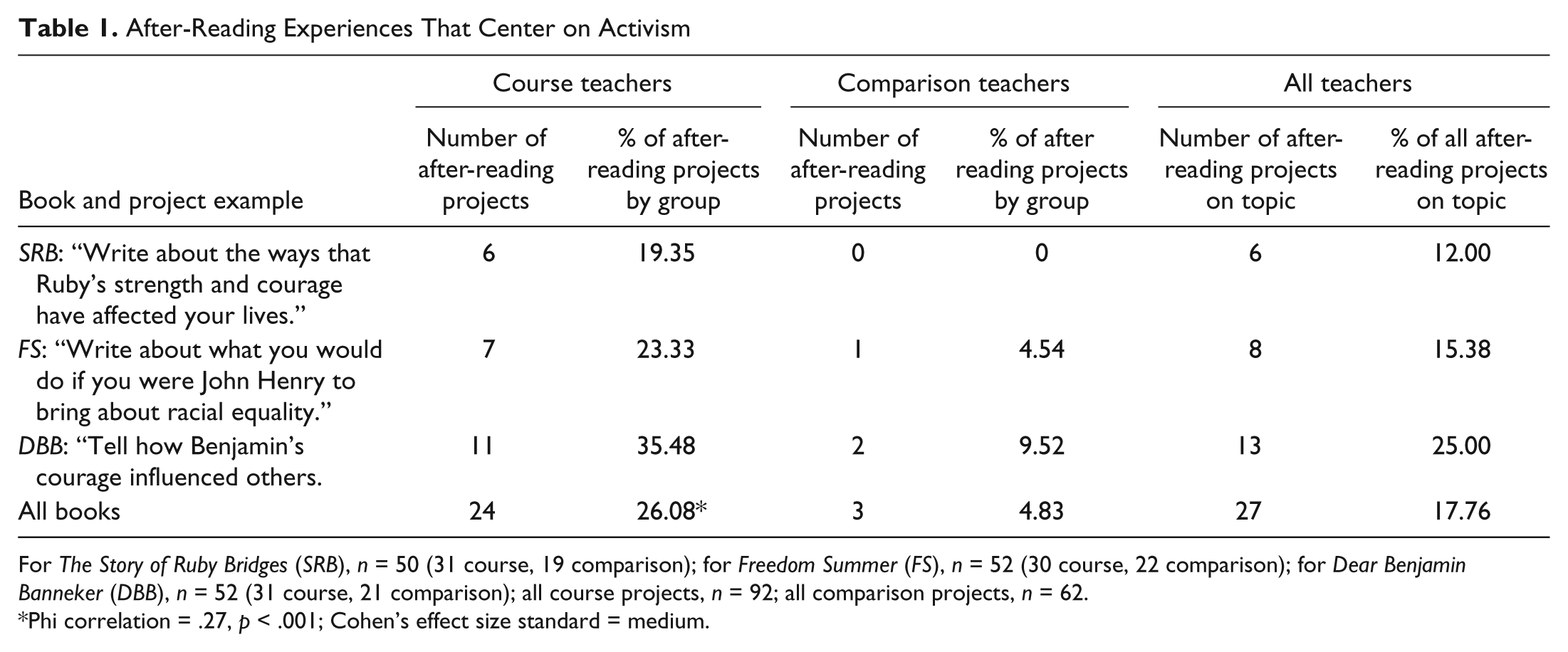
For The Story of Ruby Bridges (SRB), n = 50 (31 course, 19 comparison); for Freedom Summer (FS), n = 52 (30 course, 22 comparison); for Dear Benjamin Banneker (DBB), n = 52 (31 course, 21 comparison); all course projects, n = 92; all comparison projects, n = 62.
Phi correlation = .27, p < .001; Cohen’s effect size standard = medium.
Most of the after-reading projects required students to reflect on the significance of the story character’s actions (Table 1; see SRB and DBB) or having students take the perspective of one of the characters (Table 1; see FS), and others constructed virtual writing experiences that invited students to communicate with story characters about the significance of the story activist’s actions (“Write to Banneker thanking him and explaining why you think what he did was important for African Americans.”). A few teachers invited students to apply an activist stance to contemporary problem of their choosing and not necessarily related to racism (“It’s important to take a stand that you believe in. Select an issue that is important to you and write to an appropriate person who you believe can help you make a change.”).
Only five teachers, four who took the course and one who did not, designed after-reading projects for DBB that involved having students address racism as it is manifested today. One teacher created the following project for FS: “Students will read the Birmingham Pledge that states tolerant beliefs and actions to promote acceptance of all. Then create your own pledge.” Another teacher designed this project for DBB: “Google the Society for the Abolition of Slavery. What do you find? Find out what we can do today to continue fighting the problem of racism.” One of the course teachers planned to ask students to write an essay on whether the words “life, liberty, and the pursuit of happiness” could be applied to all people today. These kinds of questions reveal teachers’ ability to use this literature to relate historical and contemporary forms of racism.
Relatively few teachers designed discussion questions and after-reading projects that recognized Black protagonists’ activism, applied the theme of activism to a contemporary problem, or extended the theme of activism into authentic social action projects. These teachers took the course, but their small numbers do not indicate a course effect. Next, we examine how teachers discussed racism and particularly how they positioned story characters in relation to the problem.
Discussions during read-alouds
Although some of the teachers created questions that could lead to discussions about why racial discrimination existed, transcripts of the five teachers who volunteered to tape their lessons reflect variations in teachers’ attention to structural racism and story characters’ ability to dismantle it. To show this, we will contrast two of the teachers—Mike, who took Sociology of Literacy course, and Margaret, who did not. Transcripts show that Mike was much more deliberate in pointing out structural racism and characters’ efforts to confront it than Margaret was, although we hesitate to attribute this difference to the course since these teachers represent a small percentage of the entire group, and we further recognize that multiple factors played a role in these teachers’ ways of facilitating book discussions.
Applying CDA to these conversations allowed us to identify both the possibilities and limitations of teachers’ questions and their capacity to direct children’s attention to the problem of structural racism and story characters’ ability to confront it. The excerpt below shows Margaret reading FS to two students, an African American second grader named Racine and a White third grader named Ashley. Just as Margaret came to the end of the story when Joe and John Henry were deciding to enter Mr. Mason’s store, she invited students to predict what might happen.
Margaret: Okay, who wants to share their prediction what you think is going
to happen? Ashley do you want to try?
Ashley: No, I’m not done yet, I wanna fix something [erases a mark on her 4 paper].
Margaret: Racine while Ashley is fixing that, do you want to share what you 6 said?
Racine: Okay. I think they will try to make a difference.
Margaret: A difference? What kind of a difference do you think they are 9 going to try to make?
Racine: A difference of their color and try to make everything like Martin 11 Luther King did.
Margaret: Hmm, okay. Tell me one way that you think they could make a 13 difference.
Racine: They could tell their parents to start a boycott.
Margaret: Start a boycott? Yeah. Okay, Ashley do you want to tell us now?
Ashley: I think the boys are going to go and get popsicles but this time both
boys go inside.
Margaret: Both boys go inside. Should we read to find out what happens?
Okay.
Margaret chose to ask a prediction question (lines 1–2) at the page where John Henry decides to buy an ice pop himself and Joe agrees to join him to enter Mr. Mason’s store. This prompted Racine to predict that the boys will make a difference (line 7). Notice how Margaret pressed the girls to explain what kind of difference they will make (lines 8–9), to which Racine commented the boys will make “a difference of their color,” and related the boys’ action to Martin Luther King, Jr.’s acts of nonviolent resistance (lines 10–11). Racine’s comment was insightful, yet Margaret ignored it and instead nudged the girls to consider how the boys’ actions could make a difference. In return, Racine predicted that the boys would tell their parents to boycott the store (line 14). Again, Racine delivered a solution that, without naming it so, is similar to Martin Luther King, Jr.’s decision to lead the Montgomery bus boycott. Although a reasonable prediction for the story, Margaret glossed over it by directing Ashley to predict what might happen next (line 15). After reading the end of the story, including the part where both boys enter Mr. Mason’s store, Margaret asked students to evaluate the boy’s decision.
Margaret: Okay. Did Joe and John Henry make the right decision when they
walked into the store together? Why or why not?
Ashley: I think they made the right decision because they could have wanted
to change something instead of making a boycott.
Margaret: Okay. Why do you think Joe says, “I want to see this town with
John Henry’s eyes?”
Ashley recognized the boys’ activism when she said that their entering the store might “change something” (lines 3–4). Instead of exploring this idea further, and clarifying what Ashley meant when she used the term “change something,” Margaret chose to move on to the next discussion question (line 5). The transcript shows that although Margaret’s invitation to predict the story ending prompted students to address activism in this story, she missed some key opportunities to linger on Racine’s important contributions to the discussion—specifically, the link between the story characters’ activism and the acts of resistance and subversion displayed by Martin Luther King, Jr. during the civil rights era.
Margaret did, however, prompt her students to consider the similarity between the characters Joe and John Henry in FS and Ruby Bridges after she finished reading SRB. After Margaret finished reading the Afterword to SRB, the girls asked if the events in the story actually happened, and Margaret confirmed this. She then directed students to think about how the characters in the two books acted to make a difference.
Margaret: It is real. She’s a real girl. That one little girl was what? What did
she get to do?
Racine: She got to be a businesswoman and go to a White school.
Ashley: She stood up for herself.
Margaret: She stood up for herself that’s right. Remember in the other story
we read about John Henry and the boy Joe? They wanted to make a what?
Racine: A change.
Margaret: A change or difference and in this story . . . did somebody actually 9 make a difference?
Both girls: Yes.
Margaret: Yeah, who did?
Racine: Ruby, only one little girl had encouraged herself to do what she
wanted to do and make a difference of a change.
Margaret: So just like the question we asked earlier, can one person change
the minds of many?
Both girls: Uh huh.
This exchange shows that Margaret directed her students’ attention to how the story characters in the two books worked for change (lines 1-2, 8-9, 14-15), and specifically how Ruby acted to “change the minds of many.” Racine’s comment in lines 12–13 reflects her understanding that Ruby’s actions were significant. Margaret did not, however, prompt students to discuss what specifically changed as a result of these characters’ story actions and that the story characters in these two books acted to dismantle Jim Crow laws.
In contrast, Mike addressed how the story protagonists challenged racism by directing students’ attention to the characteristics of the primary story characters and their impact on racial equality, and he invited students to consider how they would respond if faced with similar dilemmas. He did not, however, direct students to discuss why story characters needed to dismantle racist practices or consider how acts of racism occurred within a system White advantage. Also, even though he deliberately addressed how activists work to overcome racist acts, he framed racism as a problem confined to the past.
Mike worked with 2 sixth grade African American boys, Deshawn and Rasheem. When Mike finished reading the last page of SRB, he asked students if they would have forgiven the mob if it tried to deny them a right to an education. Both boys responded that they would have refused to attend the “White school” as Ruby did. The conversation (below) continued with Mike pressing the students to discuss the significance of Ruby Bridges’s actions for public schooling, both then and now:
Mike: You wouldn’t want to go? You wouldn’t want to put yourself through
it? What about you Deshawn?
Deshawn: Um, I woulda went to another school.
Mike: You would have gone to another school? Okay, so what does that say
about Ruby a little girl all by herself, how did she influence a nation with
her sticking to it? How did that influence things? Deshawn, you hinted on it
earlier. Her going to this school and her not letting those things affect her . . .
what do you think was the result of that? What came of that? That she made
it through. What was the end result?
Deshawn: She influenced the country.
Mike: She influenced the country. How? Because she made it through what
happened? What do you think happened?
Rasheem: Then everybody else wanted to make it through.
Mike: Then everyone else wanted to make it through, good. They all wanted
to follow in her lead, in her footsteps. Until when? What was the final result?
What do we have now?
Deshawn: Now we have Black and White schools together.
Mike: Good so everyone is together in school. And it’s more than just Black
and White.
Deshawn: Exactly.
Mike: Indian, Asian, different religions. Okay, so. . . .
Deshawn: So even the Black people, everyone wanted an education.
Mike: Right, so everyone has rights to an equal education good. That’s important.
In this exchange, Mike was able to help students see that Ruby Bridges’s actions led to school integration. He directed students to identify the impact of Ruby’s actions in lines 4–9, and he again directed students to tell how she made a difference in lines 11–12. Mike’s prompting is different from Margaret’s since she did not invite her students to expand beyond the idea that Bridges and the boys in FS wanted to “change something.” At no point in the discussion, however, did Mike help the boys understand why school integration was necessary from the perspective of racial equality.
Also, Mike invited his students to relate Ruby Bridges’s activism to school integration today (line 16), but he did not point out that although public school integration is the currently law, de facto segregation has largely replaced forced segregation, creating nearly apartheid-like public schools where students of color in high-poverty urban communities tend not to go to school with their White peers (Kozol, 2005). The irony here is Mike’s students attended urban schools that were highly segregated. They did not raise this point, nor did Mike prompt them to consider this. In fact, Deshawn agreed when Mike said that “everyone is together in school.” By failing to interrogate the realities of segregated schooling today, the group was unable to move toward an understanding of how structural racism operates today.
While discussing FS, Mike invited his students to comment on the courage it took for the boys to enter Mr. Mason’s store at the end of the story, which led to a conversation about whether they would be able to take such a risk:
Mike: So, did it take courage for them to do what they did in the end? Would
you have had the courage at that time to have a friend of a different race . . .
if it was looked down upon?
Rasheem: I wouldn’t want a friend of a different race.
Mike: Yeah? Why not? Even if he had the same interests as you?
Rasheem: Cuz its putting yourself in danger.
Mike: It’s putting yourself in danger?
Rasheem: If you went into an all White neighborhood where there’s
racism and most of the people were racists and you’re hanging out with them
around their neighborhood then it’s not safe.
Mike: It’s not safe. What do you feel Deshawn?
Deshawn: I would have done what they did?
Mike: You would do what they did?
Deshawn: Yeah.
Mike: Okay.
Deshawn: I woulda stuck with what I believe in.
Mike: You would have stuck with what you believed in? It’s a lot different
now though isn’t it?
Deshawn: Yeah.
In lines 1-3, Mike focused his questions on the courage exhibited by both boys to enter the store and have a friend of a different race. Note how both of these questions fit with previous findings that teachers tended to favor personal response questions that prompted students to relate to the feelings and traits of story characters. Rasheem declared that he would not want a friend of a different race (a White friend; line 4). It is unclear whether Rasheem spoke in the present or if he placed himself within the context of the story. Mike pressed him to explain (line 5), at which point Rasheem indicated that it would be dangerous to have a friend of a different race (implying a White friend) in line 6, and he explains why after Mike prompted him to clarify (line 7). Again, Rasheem’s explanation that “it is not safe” to go into White neighborhoods where “there’s racism” suggests that he refers to his own situation in the present and not the story. He then switched to the past tense in line 9 when he said “people were racists.” Instead of pursuing whether Rasheem discussed the past or the present, or what Rasheem’s experiences might have been regarding friendships with Whites, Mike repeated what Rasheem said, “It’s not safe,” and immediately turned to solicit Deshawn’s view (line 11). Deshawn responded by lifting his voice when he said, “I would have done what they did?” Deshawn’s use of an interrogative statement made it unclear whether Deshawn was convinced by his own words. In lines 14 and 16, Deshawn confirmed that he would have entered the store.
Mike then affirmed Deshawn’s decision to enter the store (line 17) but switched the focus of the discussion by asking, “It’s a lot different now though, isn’t it?” Similar to the previous discussion, Mike’s question reflected a stance he appeared to be taking with the boys that racism is a problem of the past. This is despite the fact that a few moments earlier Rasheem may have projected his own fears about befriending Whites and visiting White neighborhoods. Rasheem’s admission to his White teacher that he may have been afraid to enter White neighborhoods is significant in terms of Mike’s ability to invite uncomfortable discourse about racism, but he did not take advantage of the opportunity to explore contemporary racism that Rasheem offered.
These teachers directed children’s attention to how story characters confronted racism in different ways. Margaret prompted students to talk about the activism of the boys in FS but missed opportunities to investigate what had changed in the community and how the characters related to Martin Luther King, Jr., even when the opportunity presented itself. Mike also focused the activism of story characters and took an additional step to connect these characters’ actions to advances in racial integration, but he missed opportunities to help his students think about racism as a structural problem in history and in contemporary times. Both teachers stopped short of discussing the antecedents of the racist acts presented in these books—that characters challenged systems of White advantage because they had long been denied equal rights and acted to change these systems not only for themselves but for the benefit of others. In addition, neither teacher related the problems experienced by the story characters to contemporary problems of structural racism, and in fact Mike perpetuated the notion that the goal of racial equality has been achieved. They therefore did not approach discussions from a critical-transformationist perspective.
An examination of all of the transcripts revealed that the three other teachers (Brendan, Rachael, Kelly) addressed racism more deliberately than Margaret did. Of interest, Kelly did not take the course, yet her transcript shows that she attended to the issue of racism quite deliberately. She often added to stories by importing her own knowledge of African American history. When she read FS aloud, for instance, she pointed to the illustration of the sign marking the segregated pool, “Private Pool, Members Only.” She read the sign aloud and asked students what they thought this meant. One of the African American girls in her group said, “It means for White folks.” Later on in the discussion, Kelly asked students why John Henry was barred from entering the front door of Mr. Mason’s store, and then provided students with some historical context for this scene: “Black people usually weren’t allowed to go in through the front door. A lot of times they made them go into the back door, if they were allowed at all.” These occasional footnotes were not followed by invitations to discuss the history of racism with students, however, yet they demonstrated her willingness to go beyond the text to address the racist acts reflected in the story setting. In a poststudy follow-up interview, we found that Kelly had spent 22 years teaching primarily African American children in an urban school district and that she had often used literature that reflected her students’ heritage.
Across the transcripts, there were only a few instances where teachers directed students’ attention to the few Whites who supported the actions of the Black protagonists, and none of the teachers specifically discussed the societal impact of these White allies. While discussing SRB, Margaret focused on Ms. Henry very briefly when she asked, “Why did Mrs. Henry continue to teach Ruby when she was the only student?” In response, her student Ashley said, “Because she got the job as teaching, but she really became to like Ruby.” There was no additional discussion about the professional or social risks Ms. Henry may have taken to teach Ruby, and none of the other teachers directed their students’ attention to this character’s role.
Evidence of “White Talk”
We found evidence of “White talk” across the lessons and transcripts. Recall earlier that teachers tended to refrain from identifying Whites as racists. As stated earlier, “White talk” is characterized as that which insulates Whites from owning responsibility for racism (McIntyre, 1997). One of the ways that Whites do this is by not identifying that those who engage in racist acts are White. We found this kind of language in the discussion questions, transcripts, and evaluation forms. For example, questions such these for FS were typical: “What do you think the townspeople thought of their friendship?” “Why did they fill the pool when the new law was passed?” and “How do you think other people in town treat John Henry at the store?” For SRB, we found the same pattern of questioning: “How do you think the other students felt about Ruby?” and “What do the people do when Ruby gets to school?”
Using words such as townspeople, they, and other people instead of Whites or White people is an example of “White talk” in that White complicity for racism is masked. For the Benjamin Banneker book, teachers chose to use the specific names of the White racists in their questions: “Why wouldn’t Goddard or Hayes publish Banneker’s almanac?” About half of the questions that would direct children to the story problem in SRB specifically implicated Whites: “Why did the Whites protest when Ruby went to school?” Relatively few teachers, however, wrote these types of questions for all three books.
The evaluation forms and transcripts provided additional evidence of the presence of “White talk” among the teachers. When teachers were asked to reflect on what they thought children learned from their lessons, many wrote statements expressing that African Americans were victims of racist practices but did not identify who was responsible for this: “African Americans at this time were not treated fairly and it was very brave for Ruby to act the way she did considering the circumstances,” “African Americans have not been treated right in history,” and “Although the law was passed, Blacks still weren’t viewed as equal.” Through these passive comments, teachers avoided mention of White complicity for racism. There was also evidence that teachers’ statements minimized the degree to which Blacks were victimized by their oppressive status: “Segregation affected everyone, Blacks and Whites” and “People sometimes experienced racism.”
Another tendency was to claim that the racist practices identified in these books were confined to that period in history only: “There was a time when White people did not like Black people,” “At one time, Black people did not do things with White people, but now we all live how Dr. MLK wanted us to,” and “There was a law about segregation between Black and White people, but now the law changed and it is desegregation.” These statements are consistent with our finding that teachers tended not to draw children’s attention to racism today. Also, a few teachers embellished the role of Whites as allies: “Even though racism and segregation existed many White people were friends with Black people and helped to fight for equality as well.” Although these statements were intended for us and not directed at students, they nonetheless reveal a mind-set that resists the notion of White responsibility for racism.
These data reveal an overall tendency to avoid or gloss over critical discussions of race and racism, including issues of White culpability and advantage. These findings are consistent with those from other studies that indicate teacher resistance to these topics (Apol et al., 2002; Rogers & Mosley, 2006). Also consistent with previous research (McDaniel, 2006) is the finding that teachers excluded other elements of critical literacy in their lesson planning or their story discussions, such as investigating the motives of the book authors or the authenticity of the story characters and plots.
Discussion
We set out to find out how a group of teachers used picture books that addressed AAH with children in a summer literacy program and how the graduate program may have shaped their ability to address the issue of racism contained in these books. Teachers in this study favored personal response transactions that focused children’s attention on the perceptions, feelings, and traits of the primary story characters who confronted problems that were rooted in racism.
Although a higher percentage of course teachers focused on the activism of Black protagonists in their lessons, we have little evidence to support the claim that teachers in either group situated these story problems within the larger construct of structural racism. Although some teachers called students’ attention to the racist acts in the books, they tended not to frame racism as a problem of White power or mention that White maintenance of material wealth and social capital means limiting such access to people of color. By keeping the focus on story problems as “racist acts,” or, as Tatum (1997) notes, “acts of meanness,” the larger impact of structural racism as a system of White power was obscured. The Black protagonists in these stories not only confronted acts of racial discrimination but also disrupted underlying systems of oppression. Ignoring this accomplishment reduced the significance of these characters as activists. Furthermore, glossing over the actions of White characters not as individuals but as White people who took personal, social, and economic risks to support Black characters denies children the opportunity to construct understandings about the capacity of Whites to change racist structures.
The inclusion of talk that reduced White responsibility for racism and the failure to link these stories with contemporary racism illuminate the relationship between the micro (language in schools) and the macro (the problem of racism) levels of the social order (Van Dijk, 2001). We recognize the potential of some teachers’ directives to promote activist stances among students, but without establishing the need to enact these stances in contemporary times, the language of activism was reduced to a mere exercise. Most teachers’ inability to connect these stories with the continued presence of racism confined the problem to history and prevented inquiries about how the lessons learned in heritage literature could be used to inform the current problem of racism. Our findings suggest that although structural racism is addressed in this literature (Bishop, 2007; Brooks & McNair, 2008), it may not be explored in the classroom, even when teachers have been exposed to the concept through university coursework.
Emerging from these findings are typical–atypical patterns of focus on racism when using multicultural or heritage literature. Teachers most typically focused on story characters’ perspectives, feelings, and traits, primarily from a personal perspective (“How do you think Ruby Bridge’s feels?” “What do you admire about Benjamin Banneker?”). Conversely, least typical were patterns of discussion in which issues of social inequality and power were explicitly addressed (“Who is more likely to become a fireman and why?”). Between these extremes, we uncovered more nuanced attention to racism that varied from personal or noncritical transactions with literature (more typical) to more critical (least typical) transactions. These are represented in Figure 1.
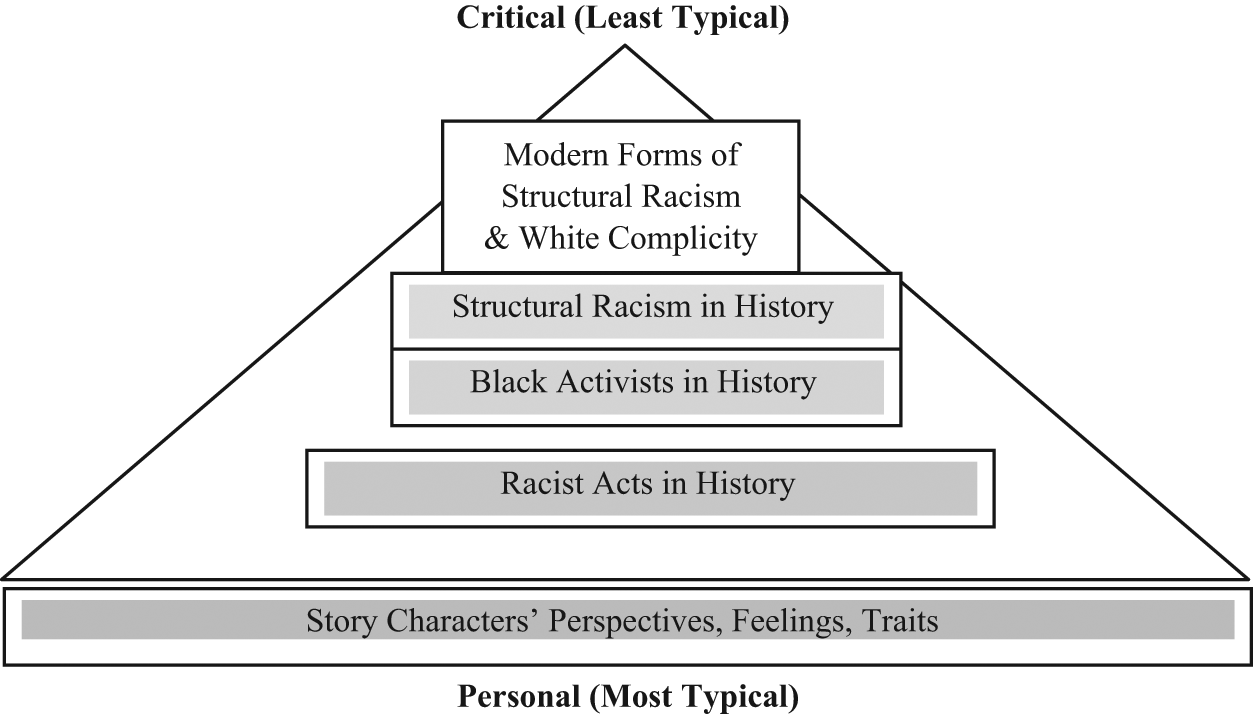
Relative to emphasizing story characters’ perspectives, feelings, and traits, we considered teachers’ attention to racist acts a step toward teaching critically (as indicated by the placement at the foundation of the figure). A smaller percentage of teachers directed students’ attention to the role of Black activists (shaded light gray). Evidence indicates that the course played a role in teachers’ attention to story characters’ ways of challenging racism, aligning with a more evolved focus on racism than highlighting the racist acts in the books. Only a tiny fraction of this group, however, focused children’s attention on White racists, contemporary forms of racism, and racism as a structural problem (white box)—all areas of focus that align with critical approaches to teaching literature. This indicates that the overall impact of the course on strengthening teachers’ capacity to discuss racism in critical ways was limited.
We could not link lesson planning and teacher reflection patterns to the actual ways they facilitated discussions because of the limited number of taped lessons in the sample. However, the transcripts showed how a handful of teachers actually approached the topic, revealing some distinctions between teachers’ ways of facilitating these discussions and raising interesting questions about the factors that may have played a role in them. For instance, Mike was more deliberate than Margaret in discussing issues of race. His students were also older, so he may have believed they were mature enough to engage in these discussions. Margaret, on the other hand, taught second and third graders who she may have felt were too young to explore these issues, reflecting a tendency toward “protectionism” that has been previously described in the research (Apol et al., 2002). Future inquiry in this area requires asking teachers how they feel about addressing the topic with children of different ages.
We also wondered about the racial composition of the student groupings and whether this may have played a role in teachers’ address of racism. Our transcripts indicate that the African American boys with whom Mike worked were actively engaged in conversations about racism when discussing the stories. The boys may have prompted Mike’s more deliberate exploration of the topic. Margaret worked with a racially mixed pair, Racine (African American) and Ashley (White). Racine took a much more active role in the story discussions, making important historical connections to Ruby Bridges, whereas Ashley took a less active participation role. It could be that Margaret sensed this discrepancy and therefore refrained from exploring the topic to raise Ashley’s engagement level.
The transcripts raise important questions about how racially similar or racially diverse groupings within classrooms shape teachers’ ways of addressing racism. They also raise questions about whether group or class size affects teachers’ ability to facilitate these discussions. Conducting these discussions with smaller groups gives each student more talking opportunities, but at the same time they may place an uncomfortable burden on students to respond even when they have not formulated opinions. It is also necessary to examine how involved the teacher should be in directing these discussions, as research indicates that robust conversations about race can happen in peer-led discussions if students are provided with some guidelines for respectful communication and are invited to examine specific issues (DeNicolo & Fránquiz, 2006).
In addition, genre selection may have inhibited discussions of contemporary racism. These books selected for the study, all set in historical times, may have communicated that racism is something in the past. If the teachers were given texts that centered on racism as it is manifested today, they may have explored the topic with children. It may be, however, that even when teachers use books that show racism as a contemporary problem, they may resist or gloss over the topic, especially if they are uncomfortable or unfamiliar with it. Recall that it was Rasheem who made a provocative statement about contemporary racism that his teacher, Mike, overlooked. An important area of inquiry would be to use books set in modern times to examine how teachers facilitate discussions about racism.
It may also have been the case that the limits imposed on teachers to discuss these books in just three classes could have constrained their explorations of racism. Future inquiry should involve looking at book discussions in the context of class sessions over an extended period of time.
Finally, teaching experience surfaced as a factor. Even though Kelly did not take the course, her considerable experiences teaching African American students could have accounted for her ability to deliberately focus on the issues of race when she used the books.
From these data, we believe teachers’ ways of addressing racism can be situated in or explainable by factors associated with the task: reading historical fiction, having only three instructional sessions to use the books, and using books with students of grades and abilities. Teachers’ ways of facilitating discussions could also have been determined by the participants involved in the task: the racial and cultural characteristics of the readers and the professional experiences of the teachers. Research that accounts for these factors and includes taped accounts of several teachers would yield more precise findings about the range and variation of the ways teachers address racism and the impact of the teacher education program on their ability to do this.
Our findings also raise another issue regarding teacher knowledge and the kinds of teacher knowledge that count in this kind of pedagogy. Most of the teachers avoided issues of racial oppression and White complicity when designing lessons and teaching students. It is important to point out that being exposed to these concepts in the course did not mean they solidified their understandings of these concepts or that they fully accepted them. There is also the possibility that teachers understood these concepts well but lacked the ability to translate these understandings into instructional conversations with children.
Our findings suggest that addressing concepts such as racism, power, and privilege in the teacher education program will not mean that teachers will be able to identify these concepts in the literature they use, plan thoughtful discussions about these concepts, or press students to talk about them in the classroom. They might, however, if the study of these concepts is made relevant through personal reflection and if they are given multiple opportunities to emphasize these while using literature with children. Helping teachers solidify their understandings of racism may require much more explicit attention on how racial oppression has worked in their own lives. For White teachers, tracing the history of White privilege in one’s family could lead to stronger awareness about the nature of structural racism. For teachers of color, such reflection might mean focusing on family stories about being aware of or denying White dominance. Inserting these kinds of experiences into literacy education curricula may move teachers one step closer to identifying racism as a structural problem when they use literature, thus disturbing the normalization of racism through explicit antiracist teaching.
Focusing on the growth of the course teachers allows us to situate teachers’ awareness within the paradigm of multicultural awareness discussed by Jenks et al. (2001). These teachers more deliberately focused students’ attention on racism, and particularly Black activism, but like the comparison teachers, they tended to avoid focusing students on the reasons why structural racism existed within a sociohistorical context and how it is manifested today. What emerges from these findings is a snapshot of teacher growth that is somewhere beyond the state of liberal multiculturalism outlined by Jenks et al., but not yet reaching a critical multiculturalist state where issues of power, privilege, and control are addressed. The evidence suggests that only a few of the teachers reached this most evolved state. Many other teachers showed a willingness to address racism, reflecting their identities as risk takers who had the potential to move beyond this state to use literature for social justice aims. Our findings confirm that crossing this threshold from the liberal to the critical is extremely difficult for teachers, requiring a deliberate address of the issue in teacher education, and specifically literacy education curricula.
Research suggests that critical discussions of multicultural literature may be compromised by teachers’ lack of knowledge about historical events (Apol et al., 2002; Stallworth et al., 2008). Both the course and using books in teaching resulted in increased knowledge of racism and AAH. Yet the historical knowledge gained in the course did not necessarily help teachers address racism or frame it as a structural problem when they used the literature with children. We believe this could be better achieved by relating the literature to actual historical events in a course. For example, in using SRB, teachers could invite inquiries about the history of school integration such as the Little Rock Nine and stories related to nonviolent resistance movements during the civil rights movement such as the Greensboro lunch counter sit-ins, the Montgomery bus boycott, and the marches in Selma, Alabama. Similarly, the judge in SRB, J. Skelly Wright, could be compared to James Zwerg (one of the Whites beaten for taking part in the Freedom Rides) and James Chaney, Michael Schwerner, and Andrew Goodman (White civil rights workers killed for investigating a Black church burning).
Linking picture books to history would help teachers connect racist acts contained in books to patterns of racism across history, and this would help them contextualize story events in a way that further communicates the significance of Black and White activism. Teachers’ ability to talk about this literature in accurate, candid, and thoughtful ways also depends on teacher education programs that address the intersection of sociology, literature, and pedagogy. Specifically, there is a need to model close readings of literature to identify how the story language and illustrations work together to show structural racism, Black activism, White complicity, and the complicated nature of Whiteness. There needs to be room in the teacher education program to support teachers’ construction of lessons around these books from the perspective of critical literacy and to nurture their ways of facilitating discussions with children about these books in practicum settings. They will need many more explicit models of how teachers apply a critical literacy stance to their use of literature.
Within such a program, teacher educators and teachers who have successfully facilitated critical conversations about literature could model how to scrutinize story language and illustrations for consistency and authenticity and how to find out more about the authors and illustrators and their motivations for producing the work. They can investigate whether these stories are told from an “insider’s” or an “outsider’s” perspective and whether characters’ experiences are validated or exploited (Louie, 2006). They also need to explore how different kinds of discussion prompts and extension experiences can help children read, interpret, and scrutinize literature through the lenses of racism, power, and privilege. Including these investigations in the teacher education program would help create teachers who not only are more willing to use this literature and address racism but also, most importantly, would use it to help their students see the significance of this heritage and their own roles in confronting difficult social problems such as racism.
Conclusion
This study highlights the challenges and possibilities of helping teachers facilitate critical book discussions about racism with children. Taking a course that addresses issues of race and racism was effective in helping teachers address themes of Black activism more deliberately, but the study exposed teachers’ inability to address racism as a system of White power. This finding is important in light of research that suggests that teachers have difficulty using texts that address controversial issues such as racism in the classroom (Copenhaver, 2000). We stress, however, that teachers should not be faulted for this finding. Rather, we agree with Stallworth et al. (2008), who suggest that teachers do not intentionally subvert the notion of diversity in the curriculum. It is instead the case that they are
[t]eaching in an era of mandates, standards, inadequate funding, and high stakes testing with the pressures of censorship and with their own cultural encapsulation. If some revisions are to occur, involving ourselves as teachers and learners in conversations at all levels is one starting point. (p. 487)
This study supports more collaborative involvement between teachers and teacher educators to help teachers use literature in ways that are truly transformational. Children need to understand the underlying reasons why story characters faced racial discrimination, how Black activists were truly transformative, how racism exists today, and how Whites and people of color have and still can come together to confront the problem.
These ways of using multicultural and heritage literature are necessary. Racism is a problem that has not yet been solved, and the fact that it is often less blatant today than in decades past makes it that much easier to deny its existence. It will take an educated population of teachers who can identify the problem of structural racism in literature, recognize the significance of those who have successfully challenged the problem, and direct children’s attention to what they can do today to continue to combat racial inequality. This will require a more focused dedication to raising teachers’ awareness of structural racism and ways of using texts to address this issue. Until this happens, there is a risk that students’ understandings of race and racism will be distorted in the classroom. This should be of concern to all teacher educators and teachers who are responsible for enhancing children’s understanding of texts and creating socially transformative classrooms.
Footnotes
The author(s) declared no potential conflicts of interest with respect to the research, authorship, and/or publication of this article.
The author(s) received no financial support for the research, authorship, and/or publication of this article.
References
Supplementary Material
Please find the following supplemental material available below.
For Open Access articles published under a Creative Commons License, all supplemental material carries the same license as the article it is associated with.
For non-Open Access articles published, all supplemental material carries a non-exclusive license, and permission requests for re-use of supplemental material or any part of supplemental material shall be sent directly to the copyright owner as specified in the copyright notice associated with the article.
