




Abstract
Workshop pedagogy is a staple of writing classrooms at all levels. However, little research has explored the pedagogical moves that can address longstanding critiques of writing workshop, nor the sorts of rhetorical challenges that teachers and students in secondary classrooms can tackle through workshops. This article documents and analyzes the work that two high school educators do to organize a writing workshop around the writing and performance of spoken word poetry. Through a qualitative case study of a four-week spoken word poetry unit, we present features of the unit that both align with tenets of traditional workshop pedagogy and focus that pedagogy on the social and cultural situatedness of literacy. We show that the teachers in this case organized the classroom as a strong discursive community (Matusov, 2007) characterized by collective engagement with a genre, anticipation of a real audience, and renegotiation of classroom authority. We then analyze two discussions that arose during the unit in order to explore how students and teachers grappled with key dilemmas at the heart of writing well: how to shape one’s text and message for an authentic audience, and what role(s) teachers and peers should play in students’ writing. The analysis suggests that engagement with critical literacy practices like spoken word poetry can leverage writing workshop in ways that highlight the cultural and political dimensions of literacy pedagogy. We conclude by discussing how the communicative dilemmas that arose in this classroom relate to common goals of literacy curriculum, teaching, and research more broadly.
This article documents and analyzes the work that two high school educators do to foster rich literacy learning in their English classroom. The teachers in the classroom we studied engaged students in spoken word poetry using a critical approach to writing and performance workshop pedagogy that was particularly well suited to help youth address powerful cultural, political, and rhetorical challenges: how to give and receive feedback while working in a particular genre to write for a real audience, all without sacrificing what they want to say. Drawing on the work of literacy scholars who have examined the potential of workshop pedagogies (e.g., Dressman, 1993; Lensmire, 1994; Lewison & Heffernan, 2008) and, more recently, scholars who have explored the potential of spoken word poetry for fostering particular sorts of critical inquiry in literacy classrooms (e.g., Fisher, 2007; Low, 2011), we argue that these sorts of rhetorical challenges are at the heart of learning to write well, developing a “voice” as a writer, and engaging deeply with multiple genres and audiences.
The initial literature on writing workshops was rightly critiqued over 20 years ago (Dressman, 1993; Lensmire, 1994; McCarthey, 1994) for being overly individualistic in its treatment of writing processes and for its lack of attention to the social, cultural, and authority dynamics involved in pedagogy and classroom interaction. Since then, a wide variety of workshop pedagogies remain a staple of K-12 English Language Arts classrooms, but little research has examined particular forms of writing workshop that represent answers to those researchers’ critiques. In addition, as most scholarship on workshop pedagogy has been situated in elementary school classrooms, little work has examined workshop pedagogies that engage older students in generative complexities such as the social, cultural, and political dimensions of writing. By analyzing key features of the teachers’ approach and then exploring two significant pedagogical moments that emerged within their particular workshop structure, we aim to illustrate how critically oriented writing workshops focused on dynamic genres such as spoken word can be powerful pedagogical contexts through which the rhetorical, persuasive, and ethical dimensions of writing come to life for high school students through dialogue.
Rethinking Writing Workshop Through Spoken Word Poetry
Advocates of workshop pedagogy (Atwell, 1998; Calkins, 1994; Graves, 1983/2003; Murray, 2003) have long celebrated the learning benefits that are thought to come from promoting writing as a crafting process; creating regular classroom time for ongoing writing projects; giving students choice over the topics, genres, and audiences for their writing; and renegotiating student and teacher roles to support students’ independent writing processes. In the participation framework (Goffman, 1981) of the workshop, students are positioned as decision makers and authors, while peers and teachers serve as resources for writers as they craft pieces for presentation or publication either in presentations or portfolios shared in class or as submissions to external venues and audiences.
In the 1990s, as writing workshops became more commonplace in primary and secondary English classrooms, a wave of scholarship challenged some of the assumptions underlying the pedagogy and the uncritical descriptions of how workshops unfold in classrooms. Two of these challenges are most relevant for the case we present in this article, and while they were made some time ago, we argue that they have not been fully engaged by literacy research in secondary classrooms, especially at a time in which the range of genres considered to be academically valuable may be narrowing. One key critique argued that the individualistic approach inherent in writing workshop often fails to make public the cultural norms and tools that make writing effective (Cope & Kalantzis, 1993; Deshon, 1997; Dressman, 1993); in such a setting, students might thrive if they are already experienced at writing individually. They are drawing on dominant, school-based stylistic and genre repertoires, and crafting language for an abstract or unknown audience—but those whose communicative practices differ from these remain at a disadvantage (Delpit, 1995; Gee, 2012). In short, the argument was that when workshop pedagogy “lionizes lone wolves” (Dressman, 1993), it curtails a deeper engagement with the cultural resources, constraints, and conflicts that are at the heart of writing (Bomer & Laman, 2004).
A second line of criticism has focused on the implicit assumption that workshop pedagogy offers an unproblematic forum for the student-writer’s “voice,” that is, the writer’s personal views and experiences crafted for audiences and genres of the writer’s choosing. Critics have charged that traditional workshop pedagogy’s emergent (McCarthey, 2007) or expressivist (Faigley, 1986; Snaza & Lensmire, 2006) theory of composition ignores cultural and political dimensions of classroom interaction and writing for an audience. A pedagogy built around giving students freedom over how they reveal themselves in writing does not adequately account for how strongly the classroom writing environment is mediated by, among other things, teacher norms for acceptable writing (McCarthey, 1994) and social relations among students that are inflected by social status, race, and gender (Christianakis, 2010; Henkin, 1995; Lensmire, 1994; Rowe, Fitch, & Bass, 2001). In rejecting overly individualist and expressivist notions of writing, some of these critics called for a pedagogy that more strongly emphasizes peers and teachers responding to or challenging the perspectives that students express in their writing (Kamler, 2001; Lensmire, 1998). This sort of approach takes composition to be a social and cultural process characterized by the struggle to make sense of diverse perspectives and to address and anticipate one or more audiences (Bakhtin, 1984; Juzwik, 2004; Snaza & Lensmire, 2006), taking group dialogue and debate as resources for a writer’s development.
Despite the pervasiveness of a wide variety of workshop pedagogies in practice, there is a need for literacy research that reframes workshop pedagogy to explicitly address the critiques that scholars have raised. This case study of a high school writing unit focused on spoken word poetry is well suited to both maintain key theoretical goals of traditional writing workshop and address some of the critiques above. First, the inclusion of spoken word poetry pedagogy in school curricula can be seen as answering a call made by literacy educators and researchers that popular cultural practices and non-dominant language varieties be engaged directly in schools (Gustavson, 2007; Hull & Schultz, 2002; Lee, 2007). It is one way in which some teachers challenge the narrow cultural and institutional conventions of schooling to construct a space for engagement with a diversity of cultural forms, especially ones that connect to non-dominant cultural practices like traditions of African American oral performance and hip hop (Duncan-Andrade & Morrell, 2008; Dyson, 2005; Fisher, 2007; Kinloch, 2005; Low, 2011). Researchers who have celebrated the pedagogic potential of spoken word poetry, like those who celebrate writing workshop, often do so with reference to helping “young people learn to craft their own voices” (Jocson, 2006a, p. 254) as culturally dominant and non-dominant language practices are taken up as rhetorical tools.
A writing workshop focused on spoken word poetry also aligns with a growing shift away from unbounded student choice in writing workshop toward reading and writing pedagogy organized as a group genre study (Fleischer & Andrew-Vaughan, 2009; Lattimer, 2003; Whitney, Ridgeman, & Masquelier, 2011). A genre study approach to writing pedagogy variously involves whole-class attention to a single written genre, juxtaposition of several genres, student exploration of an unfamiliar genre, and/or formal study of “school” genres such as timed essay tests. Focusing a class on the rhetorical features of writing in a single genre offers a possible alternative to both lines of critique on writing workshop discussed above, as genre study (a) can be built around explicit—and perhaps also critical—analysis of genre features and writing strategies, and (b) offers opportunities for community building around the development of texts, as opposed to socially mediated peer response to an individual’s “personal” writing (Lensmire, 1994). Jocson’s (2008) study of June Jordan’s “Poetry for the People” spoken word curriculum, for instance, describes workshops as community-building discussions of craft among students and teachers, as the group analyzes model texts and student drafts to examine the topics, language, and poetic devices common to the genre.
In addition to resonating with traditional workshops’ emphasis on valuing youth language and answering a call for explicit whole-class engagement with a shared genre, spoken word poetry comes with another defining feature that, as we come to argue below, introduces new opportunities and generative tensions for teachers and students: Spoken word poetry is overtly political. Indeed, the genre foregrounds issues of cultural identity, forms of racial and economic oppression, and the right to self- and community-definition and advocacy (Camangian, 2008; Fisher, 2003, 2005; Jocson, 2005, 2006b). Researchers and educators who study and promote youth spoken word often do so with a commitment to helping youth “find their critical voice” (Camangian, 2008, p. 48). The focus on “voice” in spoken word poetry, however, is less about individual, unique expression, and more about writing and performance as a form of social and political participation (Snaza & Lensmire, 2006). The political tradition of spoken word poetry resonates with critical writing pedagogy that theorizes writing as social action and calls for writing pedagogy to emphasize engaging social issues and seeking change (Christensen, 2000; Early, 2006; Kamler, 2001; Lewison & Heffernan, 2008).
Looking across the pedagogical goals reviewed above, we see potential in a form of writing workshop that takes a socially engaged literacy practice like spoken word poetry as a shared genre for a classroom community to read and write. At the same time, we see several tensions raised by such a pedagogy that teachers need to navigate for, or perhaps with, their students. First, how do teachers, youth writers, and their peers balance an interest in writers’ individual expression with other interests that are specific to the spoken word genre, such as energizing an audience and seeking social change? Second, at a time when “genre study” is often limited to scaffolding formulaic production of the sorts of texts found on state tests and rarely involves students in critique of texts or writing for social action (McCarthey & Ro, 2011), how do teachers organize meaningful audiences and purposes for a genre that is defined by social participation and action? Third, we take seriously Lensmire’s (1998) charge that both critical pedagogy and writing workshop . . . share at least one serious weakness: neither has come to grips with what conflict among voices—conflict generated among students, between teacher and students, and within individual students—means for the actual production of speech and writing within classrooms. (p. 271)
Exactly what roles, then, do teachers and peers play as writers engage with a critical literacy practice like spoken word poetry?
By emphasizing such questions, we join literacy researchers who have begun to examine the sorts of conflicts and tensions that arise as youth and teachers take seriously the reading and writing of engaging genres (Alim, 2011; Hill, 2009; Low, 2011; Weinstein & West, 2012). There is a need for more work on the dilemmas that arise for teachers and students as they navigate their social roles in classrooms and come to decisions about what to say and how, as well as the sorts of teaching moves that support productive engagement with those dilemmas.
Our goal in this article is to contribute to innovative literacy research and pedagogy by exploring how two teachers enacted writing workshop pedagogy around performance poetry and created a productive pedagogical space where both teachers and students had to grapple with fundamental issues of language, genre, and audience. Our analysis was guided by the following questions: (a) What pedagogical strategies did two teachers use to organize a writing and performance workshop? (b) How did these strategies help youth to collectively engage dilemmas at the heart of crafting spoken word poems for an audience? By presenting key features of the pedagogical design in this classroom and tracing some of the dilemmas and complexities that the instructional unit invited, we hope to contribute to research that helps literacy educators and researchers design opportunities for youth to navigate issues that come out of writing and communicating in authentic ways.
Study Context
The analysis in this article is based on a qualitative study of a high school English classroom in an urban arts magnet high school located in a midsized Northeastern U.S. city. The study documented the collaboration between Rochelle, an African American teaching artist and performance poet in her 30s, and Tim, a middle-aged White high school English teacher, and their use of spoken word poetry with a diverse group of 11th-to 12th-grade students. At the time of the study, Tim and Rochelle had been working together for 5 years, supported by a series of small grants and district contracts that funded Rochelle as a teaching artist in the district. The second author, Annie, was a faculty member at a local university, and hearing of Tim and Rochelle’s work and partnership, began sitting in on their co-taught units. The first author, Burke, was a doctoral student in charge of data collection during the unit on which we focus here. As literacy researchers and educators, we began this ethnographic work with an interest in understanding how these two teachers worked together, how the teachers’ work of organizing a public poetry slam affected the teaching and learning that took place in the classroom, and how literacy practices were constructed and supported in the context of a spoken word poetry unit in high school. As data collection and analysis proceeded, we came to a more specific focus on documenting and interpreting moments of high-energy discussion, debate, and decision making in the classroom. Our method section will discuss this focus in more detail.
In this article, we draw on data collected during a 4-week pedagogical unit on performance poetry in one of Tim’s 12th-grade classes, conducted during the spring of 2008. 1 The class was called Advanced Fiction and Poetry, an English course for creative writing “majors” at the school that Tim organized as a yearlong series of genre studies. There were 22 students in the class for the performance poetry unit, one of whom was joining the class just for this unit (with permission from his music teacher) because of his strong interest in spoken word poetry. The class included 17 females and 5 males; 10 students were African American, 10 were White, and 2 were Latino/a. Roughly, one third of the class self-identified as having had prior out-of-school experience with spoken word poetry and poetry slams.
The theme that the teachers named as guiding the unit was “poet as agent of social change.” This framing, consistent with broader cultural practices of performance poetry, informed the teachers’ choices about model texts and video performances, brainstorming prompts, and processes of drafting and revising students’ poems and performances. The unit culminated with a poetry slam, an Olympic-style competition in which poets performed for a live audience of their peers and teachers, competing for the highest scores. The design of a public slam as part of this unit was essential for the roles and responsibilities that students assumed in class, as we will demonstrate in our findings and discussion below.
Methods
Data collection for this study was designed to capture the pedagogical and interactional work of the 4-week unit from start to finish. Burke observed and video recorded each of the 90-min block classes that met every other school day for 4 weeks, as well as the two rehearsals for the final poetry slam and the slam itself. We conducted two rounds of semi-structured audio-recorded interviews with each teacher, one immediately before the unit and one immediately after, and we also asked students to talk about their perspectives on the unit, the classroom, and spoken work poetry in two audio-recorded focus groups at the end of the unit. Finally, we collected written artifacts, including texts used by the teachers early in the unit, students’ writing journal entries, drafts of students’ poems with written peer feedback, and copies of final drafts that students planned to perform at the poetry slam.
We took an inductive, grounded theory approach (Charmaz, 2006) to analysis to develop categories that helped us identify teacher moves and design decisions that characterized the unit. Because Tim and Rochelle explicitly described the unit as a performance poetry “workshop,” and there was frequent peer and teacher feedback on drafts of poems and performances, we also turned to literature on workshop pedagogy for concepts that could inform analysis. For example, we paid particular attention to how the teachers constructed and facilitated writing as a process, and how classroom routines and forms of teacher–student interactions defined student and teacher roles in the classroom. We sought to characterize the kind of feedback teachers and students gave to authors, and how this feedback related to practices of spoken word. Based on our observation data and analysis, we then composed an ethnographic portrait that highlights some of the teachers’ key pedagogic strategies as well as key dimensions of the unit’s design that we found to be central to how students engaged with, and learned through, spoken word poetry.
In a second line of analysis, we focused on identifying and understanding the nature of key conflicts or dilemmas that arose in the class. These were important for our study for two reasons: First, we were interested in dilemmas because of our interest in how writing pedagogy and literacy learning were constructed through engagement with this genre in school, a process that sociocultural literature had led us to believe would have important tensions at its core. Second, in our observations of this unit, we noted several occasions when students and teachers engaged in extended and lively debates about how real or imagined audiences should or would shape the texts that a writer/poet/performer composes. These discussions were not explicitly planned stages or routines within the unit, and they were interesting to us at first because they arose as whole-class discussions seemingly spontaneously, engaging nearly every student in class in discussion, and sometimes in heated debate. But as our analysis of the teachers’ pedagogical moves developed, we returned to these incidents as potentially rich sites for understanding how teachers and students work out authentic dilemmas for writers and audiences. Heeding calls from researchers to pay more attention to the complexities of innovative literacy pedagogy—the “moments when things [do] not ‘work’ according to plan” (Low, 2011, p. 25)—and the emphasis within dialogic pedagogy to consider the conflict-ridden nature of youth developing a “voice” as writers in schools (Lensmire, 1994), we focused on the two extended classroom debates that went on for the longest periods of time. In each case, we sought to identify what sort of dilemmas (if any) were at the heart of the class’s discussion, what prompted those dilemmas, how participants defined the stakes of the dilemmas, what roles students and teachers took on during the discussion, and how the discussion related to the pedagogical moves we had identified in our earlier analysis.
Below, we represent our findings from these two analytic strands. First, we characterize the spoken word unit in terms of the key pedagogical features we identified, along with brief discussions of how those features support or extend writing workshop pedagogy as conventionally defined. We then focus on two classroom episodes, each of which, we argue, represents a moment of practice in which teachers and students fruitfully struggle with an oft-cited goal of workshop pedagogy and contemporary curriculum standards: shaping writing for an authentic audience and purpose.
Portrait of a Writing and Performance Workshop as a Strong Discursive Community
In this section, we present several aspects of the instructional design of this unit that we recognize as a form of critically oriented writing workshop. Unlike traditional workshop pedagogy, which is often built around student choice and autonomy, we argue that the teachers’ pedagogical moves contributed to what Matusov (2007) calls a “strong discursive community”: a collaborative space in which students and teachers read, write, and make meaning with attention to the rhetorical tools and cultural and political implications that are inherent in a given communicative practice. Collective engagement with these tools and issues makes the discursive community a space in which students resist “rely[ing] upon either their own often uninformed, capricious, and poorly developed opinions shaped by the invisible authority of social traditions or upon voices of the external authority of expert texts or the teacher” (p. 218). Instead, members of the community test their ideas by addressing and answering each other, bringing various perspectives into productive conflict as a way of strengthening members’ views and communicative choices (Bakhtin, 1984; Juzwik, 2004; Morson, 2007). The following pedagogical moves by Tim and Rochelle constitute a balance between the student-centered aspects of workshop pedagogy and the collective, reflective engagement of a discursive community that some critics of workshop pedagogy have called for (Cope & Kalantzis, 1993; Deshon, 1997; Dressman, 1993).
Crafting Spoken Word Through Writing and Performance Workshops
Rochelle and Tim both described the spoken word poetry unit as a workshop. The unit began with Rochelle presenting model spoken word poems that the group analyzed together. Students kept a journal in which they responded to prompts given by Tim and Rochelle, expanded prompts or their own ideas into draft poems, and reacted to models that included live performances by Rochelle, video clips of students and professionals performing, and performances that arose during the film Slam, which was screened in class. As Tim explained, this first half of the unit constituted a “generative phase” focused on “coming up with ideas [about] what’s important to talk about,” as well as defining the “poet as agent of social change” theme of the unit. Whether or not students planned to perform on stage in the school poetry slam, they followed through on brainstorming and drafting at least one “page poem.”
From there, the class moved into what Tim called “the second phase,” which included brief lessons and extended peer response sessions devoted to “the craft of writing” and the crafting of performances. Tim reflected that “we really got it right putting the horse before the cart, in that the ideas comes first and then the crafting comes later when you’re invested in the idea.” In this phase, class time focused first on peer response workshops that saw students annotating each other’s drafts with reactions and suggestions and then discussing those reactions orally. Next, as page poems developed into advanced drafts, students interested in performing in the school slam practiced expressive readings of their poems while standing at the front of the room. Rochelle took the lead in coaching the class through experimenting with vocal and physical performance strategies and discussing students’ practice performances in terms of their use of these techniques. In this way, performances were textualized (Bloome & Egan-Robertson, 1993), made into objects for reflection and analysis by the class. Model performances from the first half of the unit, along with mini-lessons and students’ in-class rehearsals, served as resources for other students to consider incorporating into their own performances.
Tim and Rochelle both referred to the performance workshop as coming after the writing workshop, and the final week of the unit did indeed seem to treat the students’ language choices as having already been made, while the focus turned to memorization and performance technique. But we also observed that the third week of the unit involved students performing expressive readings of the printed drafts they had in their hands, receiving feedback on both vocal expressiveness and their poems’ content, and returning one or two class meetings later having made changes to both. In this respect, there was a period of overlap between the process workshop of printed texts and the crafting and revising of vocal and physical performances. Perhaps not surprisingly, both energetic discussions of communicative dilemmas that we present below emerged during this third week of the unit, when late-stage textual revisions and initial drafting of performances were unfolding simultaneously.
Organizing an Audience and Purpose: Poets as Agents for Social Change
The iterative process of crafting texts is in many ways a mainstay of workshop pedagogy. But unlike traditional workshop pedagogy, which gives individual students choice over genre, audience, and purpose, Tim and Rochelle’s collaboration framed the class’s work around a shared genre, audience, and purpose. As some critically oriented writing research has suggested, this sort of collective genre study is a way to sidestep the worst tendencies of an individualistic writing workshop: students working together with varying degrees of success, writers made vulnerable by the expectation that they share deeply personal writing, and teachers failing to critically engage with students’ work (Lensmire, 1994). In addition, as we will show, Tim and Rochelle’s work to organize a performance venue and a larger trajectory for youth spoken word artists also fostered a seriousness of purpose that helped generate the rich discussions that we analyze below.
Tim described the unit theme, “poet as agent of social change,” as an “underpinning” and a “guiding principle” that helped him and his students to “plug that critical eye in.” In taking writers to be agents of social change, Rochelle saw an opportunity for the spoken word unit to connect students’ experiences—often about friends, relationships, cultural identity, and forms of local and societal injustice—to a genre that then connected them with an audience. She described this work as connecting some dots for them. They see a lot of stuff as really isolated situations, like “this is my life and this is what’s happening to me and nobody knows what’s happening to me and what my life is like.”
Through her work as a teaching artist in Tim’s class and in many other high school classrooms in the city, Rochelle routinely saw students whose out-of-class writing about personal and community struggles was prolific but also “very closeted.” She commented, The first day in every classroom, every high school classroom I’m in, I get at least one kid that stays and has a notebook full of poems, just a notebook full of poems and raps and thoughts and whatever. And it’s a whole notebook that’s tucked down in his book bag—and I’m saying “his” because it’s usually a male student—and he doesn’t know what to do with it. Doesn’t really do anything with it.
For Rochelle, the unit provided a way for students to “do something” with personal writing, first by inviting it into the classroom, and then by developing it in light of the larger frame of social change and—for those who opt to perform their poetry at the end of the unit—the poetry slam judges and audience. The year of our study, Tim and Rochelle decided for the first time to make the school-wide slam an evening event, a change that they expected would enable better attendance by parents and community members, even if it also meant less of a presence from fellow students and their teachers. While the event was free of charge, Tim had tickets printed, and he engaged students in discussions about whom to invite; a discussion about whether to formally invite the district’s new Superintendent of Schools led to a flurry of guesses from students about how that official would react to their language and political stances.
While the school slam was the forum and audience toward which Tim and Rochelle explicitly oriented the class’s work in the unit, as one of us has argued elsewhere (O’Connor & Allen, 2010), Rochelle’s work in English classes and after-school settings around the city constituted a form of organizing work that constructed a longer trajectory for students who took a particular interest in spoken word poetry. Students in our study site who placed highest in the school-wide poetry slam were invited to represent the school in a citywide competition among urban and suburban high schools. In turn, individuals who placed highest in the citywide slam were invited to represent the city at regional and national Youth Speaks poetry slams. This “city team,” led and coached by Rochelle, would spend considerable time performing and fundraising around the community in an effort to prepare for future slams and cover the costs of travel and lodging to those events. This study does not follow that longer trajectory in detail, but the teachers and students in our study were well aware of it; two students in the class had participated in the city team the year before, and their growing expertise as performance poets was a resource for all of the students during discussions and writing and performance workshops. Although many of the students in Tim’s class opted not to perform in the school-wide slam, and some told the class that they neither expected nor intended to be part of the school team in the upcoming citywide slam, this trajectory beyond the unit and school validated the potential for poets to effect social change by bringing their perspectives to an ever larger audience. While writing for an “authentic audience” is a mainstay of workshop pedagogy, by focusing on a rich out-of-school youth literacy practice as a shared genre for this unit, the teachers and students in this study were able to leverage a particularly rich set of performance opportunities—and work together as a discursive community with those particular performance contexts in mind.
Redistributing and Critiquing Authority
Tim’s work organizing a performance venue in school, and Rochelle’s work around the city developing a larger trajectory for youth spoken word artists, influenced their classroom roles in ways we will explore more deeply in the next section. Both had an explicit stake in the public youth performances they were sponsoring, but they also shared a commitment to reshaping the English teacher’s traditional, authoritative role in the classroom, a commitment at the heart of workshop pedagogy (Elbow, 1973/1993) and Matusov’s (2007) notion of a strong discursive community that is not dominated by authoritative discourse (Bakhtin, 1981). Tim saw the spoken word unit as a particularly appropriate opportunity to cede some of the control and expertise he saw himself as typically bringing to the classroom. As he frequently emphasized, “Probably the farthest thing from my natural inclination or reference point is performance and spoken word poetry. That’s not me. It’s a stretch.” In fact, his passion as a writer happened to be haiku, a genre he introduced to his creative writing classes immediately following the spoken word unit as a way to juxtapose notably different poetic genres and consider their affordances and limitations. Despite his relative unfamiliarity with spoken word, Tim saw value in the genre as a way to help him “acquire a language which is on the edge” and “authentic to the kids,” because “with the acquisition of language comes an understanding [that] ties directly into the kids I deal with, what they are thinking and feeling.” He hoped to promote “energy and enthusiasm in the classroom” by “making it permissible for them to use language that’s authentic” and “giving them permission to speak their minds” through poetry.
These two commitments—to gain insights into students through language and make these perspectives a central focus in the English classroom—necessarily reframed Tim’s role as the teacher that his students work with all year. Tim was quick to emphasize that this process was not always comfortable for him: “[In this unit] I give up the seat in front, which feels pretty cool, but also threatening. I always go into this with trepidation. I’m never completely at ease.” He described engagement with spoken word as a process that “draws me out of hiding. . . . The tendency, I think, in teaching is to go into hiding, to find a comfort zone.” By partnering with Rochelle, Tim managed to recast his typical authoritative role while still providing students explicit coaching in the genre, a form of support that critics of workshop pedagogy have found lacking in other settings (Cope & Kalantzis, 1993; Deshon, 1997; Dressman, 1993).
For Tim, organizing a classroom that values youth language and perspectives involved working against an institutional culture of schooling in which authoritative discourse figures strongly. In speaking to us about the fit between his teaching and school-level and district-level administration, Tim positioned himself somewhat precariously. On the one hand, he acknowledged that the administrators in his arts magnet high school were welcoming of creative expression and performance, likely more supportive than what many other teachers experience, and that neither Rochelle’s involvement in the unit nor the school poetry slam could proceed without administrative support. On the other hand, he lamented both a wider ideological entrenchment in educational institutions and, in particular, an adversarial relationship that he perceived between administrators and students in his school. Tim’s irreverence toward business as usual in school was visible in a printout he kept on his classroom bulletin board next to drawings by his young children. The printout satirized educators and administrators who, upon realizing they are metaphorically “riding a dead horse” in their approaches to schooling, refuse to “dismount,” and instead, attempt a number of less productive strategies, including “buy[ing] a stronger whip,” “appointing a committee to study the horse,” and “promoting the dead horse to a supervisory position.” He asserted during several class periods and in interviews that school administrations often “treat our clients, our children, as the enemy. They treat them that way. It’s horrible. Horrible. Undignified.” During one class period, after an administrator interrupted a student’s practice performance to demand that three tardy students come with her to the main office, students began quietly discussing the authoritarian tone they associated with administrators, likening it to “Stalinist Russia.” Tim and Rochelle joined these spontaneous discussion groups, echoing the students’ outrage. Their decision to join the students in discussing the incident was emblematic of the critical perspective they advocated with the unit theme of “poet as agent of social change”; frank discussions about the workings of power in school affirmed their commitment to the classroom as a space where students could name sources of perceived injustice or control.
In this reflective and supportive classroom workshop space, students were encouraged to take an honest and impassioned stand on social issues, injustice, personal experience, and other topics of relevance. In their poetry, students took on the imagined perspectives of people from drastically different life circumstances, meditated on their status as youth and on possible futures, explored the dynamics of family and romantic relationships, and critiqued the structures and expectations they encounter in school. Exploring these topics in writing—and sharing those efforts with peers and teachers—required a safe, welcoming classroom space. While both adults sometimes curtailed talk that they considered off-task and exhorted individual students to meet particular assignment deadlines, not once did we hear Tim or Rochelle characterize the subject matter, tone, or uses of language in students’ poetry—or their discussions, questions, challenges, opinions, or suggestions—as inappropriate for the classroom. Indeed, it was the role of the classroom as discursive community to hear and respond to students’ poetry.
While we argue that the strategies and orientations that we discussed in this section contributed to a particularly productive sort of classroom community, by no means did the welcoming of students’ voices and perspectives make for harmonious dialogue or simple resolution of tensions. Over the course of the spoken word unit, the teachers’ pedagogical designs and commitments provided the context for complicated, meaningful discussions about the responsibilities of writers, collaborators, and agents of social change. To move toward a deeper analysis of these complexities, and to examine how this sort of discursive community engaged these tensions productively, we present analyses of two classroom episodes in which the work of the unit got complicated for students and teachers.
“Rochelle and I Go Round With This Each Time”: Anticipating a Live Audience
As we indicated above, both the presence of a live audience and the nature of the slam as a competition required that students orient their writing and performance choices toward that imagined audience of peers, teachers, parents, and other community members. During writing and performance workshops in the classroom, the teachers and students served as a proxy for that audience, and as a result, they had to negotiate tensions between creating a space that was open and honoring of students’ poetic expressions and crafting poems and performances that were both compelling and “appropriate” for the audience of the poetry slam. Tensions like these were complex and important enough that they brought out differences of opinion that had to be negotiated within the classroom—including differences of opinion between the two teachers. In this section, we focus on one extended classroom discussion in which Tim, Rochelle, and the students explicitly discussed the dilemma that writers face in deciding how an institutional/cultural context impacts the crafting of voice in performance. We argue that, in this episode, the teachers used an opportune moment to highlight and dramatize their different roles and positions—as a public school teacher and poet/activist/teaching artist—as well as the cultural and institutional setting of the slam, and that doing so was a way to help students think about the rhetorical and political contexts in which writing and performance take place.
Much of what made this unit and the others that Tim and Rochelle taught together so engaging for students, and interesting to us as literacy researchers, was the synergy of their teaching partnership. Both educators commented on their shared commitments but also on the differences they brought to the unit. Having worked with Rochelle for several years, Tim described their professional relationship in this way: It’s like a marriage. And I mean that respectfully. I think that after the initial thrill of setting up a partnership, you get down to the nitty gritty, the hard work. And part of that is understanding one another’s goals, becoming accustomed to or comfortable with one another’s teaching styles, making room for difference. Rochelle and I come from vastly different backgrounds, we have different takes on the world, so it makes necessary a lot of dialogue and sometimes negotiation as to what we present to the kids and how we do that.
Indeed, there were several times during the unit when Tim talked to the students about a pedagogical choice or a structural feature of the unit in terms of a perennial struggle he had with Rochelle. Late in the unit, when telling his students that the selection of judges at the school poetry slam would vary from the random selection of judges typical of most slams, Tim prefaced his explanation with “Boy, if you really want to see me and Rochelle lock horns,” and then went on to explain that he insisted on reserving a place on the judges panel for a school administrator and a representative of the university that helped fund Rochelle’s work in schools around the city.
Another such negotiation emerged in the midst of a performance workshop during the 2nd week of the unit, when an African American male student named Robert, who was an experienced slam poet, stood in front of the classroom and performed a poem titled “Time.” This is how the poem began and ended: Time is a bitch. A certified bitch, Make you want to murderize bitch, And I’d never say that about a lady. But time is way past shady. She’s supposed to be my baby, but daily, time is trying to run away from me. Damn, I guess I shouldn’t have wasted so much of her. . . . Skin on my chest peeling back so my heart can drop to the floor. She don’t even love me anymore. I guess, technically, she’s a whore, But more accurately, Time is a bitch.
Sitting at desks set up in a U-shape, with Robert up front, the class began to offer feedback about the poem’s content and Robert’s performance choices. One White male student, Kevin, who had less experience with slam poetry, raised a question as a point of clarification about the use of “swearing” in Robert’s poem and the rules about such language in the slam: “I don’t know what the rules are for performance poetry at the slam. I mean the swearing works, but I don’t know.” Rochelle and Tim, who had been sitting at student desks in opposite corners of the classroom, both responded immediately and energetically. Below is a transcript and description from the videotape: Hell yeah, we don’t do censorship, I mean it’s really all about doing the poem justice. Let me jump in here. Uh, um, errr (sounds of cutting herself off, being playfully dramatic in holding herself back). No, no, well I gotta, no: Do we have to do it, right, yet, now? We’re still in draft form. Do we have to talk about this yet? No, I need to get this off my chest. Okay the censorship thing. Now we’re not going to get into a long discussion. (3.0) Let me come up here (walks from back of the room to the front and sits on the teacher’s desk; several students laugh). You’re gonna see. (Standing, walking toward center-front where Tim is) Do I need to get up too? (Sits next to Tim on the teacher’s desk; crosses her arms; students laugh). Fight! Now you’re going to see the proverbial rock and a hard place, which as a classroom teacher I’m between. I need you to understand this. And I don’t say this, I don’t say this lightly. Rochelle and I go round with this each time.
In this exchange, Tim and Rochelle were dramatizing for students their different professional backgrounds and institutional positions as a way to bring up issues of what Rochelle framed as “censorship.” Tim and Rochelle usually had a friendly and comfortable dynamic in the classroom, but in the above exchange, they physically enacted the tension between encouraging a poet’s language choices and expecting the poet to alter that language in deference to the audience. Rather than covering up or hastily resolving the moment of disagreement (“Do we have to do it right, yet, now?”), the two instructors brought this dilemma to the students publically.
In dramatizing different possible perspectives on the dilemma, Tim and Rochelle came to Kevin’s question about “the rules” and how and when such considerations should figure into a student’s process from their respective roles as teacher in a public high school and an arts educator doing a residency in the classroom for this unit, and these roles guided their different initial orientations toward how to deal with student work that might be taken as less than “appropriate” for a school performance. For Tim, offending school or city administrators, either directly or through negative reactions from audience members, had high stakes for his security as a school employee, as he explained a moment later: (Pointing at Robert) I’m okay with it. I think this poem, I don’t think it’s gratuitous, I don’t think it’s slanderous, and I’m willing to take the risk, but you got to understand, as a representative of a public, what, institution, where there’s going to be a public performance, I stand to lose. So you’ve got to be sensitive of that. I don’t want to lose my job.
A few minutes later, after Rochelle and several students spoke about their own ethics of decision making about language use, Tim referred to a former student who, at a prior year’s poetry slam, “got up on stage in front of a mixed audience and read a very sultry poem” after which people walked out of the audience . . . and we were threatened with loss of our jobs over that incident. And if you think I’m kidding, you check, go to the Internet. There are teachers who have lost their jobs over lesser offences.
By bringing this personal and professional risk to the students, Tim enlisted them in staging a performance that would not raise the kinds of concerns that could provoke members of a “mixed audience” to walk out and thus provoke a response from administrators with implications for his job security. He also introduced ethical criteria for provocative language, describing Robert’s language choices as neither “gratuitous” nor “slanderous,” before concluding that, in this instance, he was “willing to take the risk.”
In returning to the issue a minute later, Tim again called attention to the risks he takes advocating for the poetry slam and the spoken word unit, pointing to an archive that he has constructed of fellow educators’ responses to spoken word poetry in school: I keep on file the cautionary notes I get from some administrators and a couple of teachers in this building, who have been present at the slam and have written me negative comments. They have concerns about substance and language. But I also ask other teachers to write me affirmations, and I keep all of those in case I have to defend it. The affirmations outweigh the negatives ten to one. You need to know that, I mean we’re usually right on target. But you guys understand where I’m coming from? I mean I’ve got to work for a few more years, I’ve got a kid in kindergarten, you know what I mean?
Here, Tim connected the class’s collective decision making about “substance and language” to an ongoing dialogue constructed through written responses to the slam. In referring to the file of “cautionary notes” and “affirmations,” Tim contextualized the ongoing dialogue between his class and their audience, and situated that dialogue in a longer history of working to protect and maintain the slam as a performance space for students at the school.
The timing of Tim’s comments is significant. While he drew attention to the high stakes his students’ language choices could have for his career, Tim chose to bring this up the moment that a class member first asked about the political implications of a poet’s language choice in response to a poem being offered as a possible performance in the poetry slam. Tim did not, for instance, choose to raise this concern at the outset of the unit, when students were brainstorming topics, examining model poems and performances, and developing early drafts of their own poems. Rather than limiting possibilities for student writing at the beginning of the unit, Tim allowed this dilemma of poetic voice to emerge from students’ work, and then charged his students to be selective about which of their ongoing set of draft poems they would choose to perform in the public slam: “We’ve told poets, if I can’t abide by it, if we can’t live with it here, there are places for it. Don’t sacrifice your poem. There are places down the road.” That said, the ongoing workshop process left him and Rochelle with different beliefs about when the right time was to charge students with considering the political implications of their choices; “We’re still in draft mode,” Rochelle argued. Nonetheless, Tim took a student’s question as a teachable moment.
Building on Tim’s point that students as poets should select from among their work to match a given performance context, Rochelle elaborated further that performance poets regularly shape their poems and performances in dialogue with their intended audience. She explained to the class, Professionally speaking, as a performance poet myself, I get paid to perform poetry, and so I’m in a similar position even with my own work, where sometimes I have to—no all the time, I have to consider my audience. . . . Ultimately I do want my work to connect out there to the people I’m presenting it to. So as a poet, you’re going to have to take all those things into consideration because it’s not just you and your poem up there. We keep talking about that two-way dialogue. Well, if this dialogue is offending your audience, or if they’re just getting kind of distracted, like . . . the shock value of the fact that you’re up on stage in school, you know, saying “fuck,” is like “oh ye:::ah” (waving arms, as if in celebration). They didn’t even hear the line. . . . they’re not hearing the poem, they’re just so happy you’re up there defying administration by swearing.
Rochelle and Tim were united in their position that, as Rochelle later put it, “Ultimately we’re responsible for the show that ends up on stage.” Tim characterized his students as answerable to their audience, particularly as high school students performing at school, with implications for the teachers who promote their work. Rochelle recontextualized these issues in terms of broader genre of spoken word, and of poets, characterizing all poets as answerable to their audiences, given that poets “want [their] work to connect out there to the people,” and to the best parts of their audience members. And in the context of their high school, Rochelle charged the students with considering how the word may be taken up by youth in the audience who “didn’t even hear the line . . . they’re just so happy you’re up there defying administration by swearing.”
In articulating and enacting those different perspectives, Tim and Rochelle made visible a moment of “conflict among voices” of the sort that Lensmire (1998) has called for more research to examine. They used a student’s passing question about a likely low-stakes language choice to enact a dilemma that authors may face whenever addressing a real audience: a tension between the importance of individual expression indexed in Rochelle’s “hell yeah, we don’t do censorship” and the political stakes of speech indexed by Tim’s “I stand to lose.” They situated their students’ writing choices as inextricable from the political contexts of their performances, the meanings that others make of their words, and the strategic work that Tim and Rochelle do to keep performance poetry alive in schools.
Tim and Rochelle’s responses also enacted an alternative to the authoritative discourse often associated with teachers. Although they each began with a definitive response to Kevin’s question about “the rules” for language use in the poetry slam, they then took turns elaborating their reactions to the question of “censorship” as a set of decisions to be made amid conflicting factors. They sought no final consensus or singular answer to the question of appropriate language, and implicitly rejected Kevin’s assumption that there would be “rules . . . at the slam” for teachers to provide. Instead, Tim and Rochelle reframed the question as a dilemma that was central enough to writing in the genre that the two teachers “go round with this each time,” and they implicitly handed over to the classroom community the responsibility to wrestle with the consequences of their writing and performances. We see this as a form of making visible the communicative resources required to write within a genre (Dressman, 1993), but following Lensmire’s (1998) attention to conflict that arises between voices or within an individual, we emphasize that the important move being illuminated in this episode is less a rule of thumb for writers than an internal struggle at the heart of writing well.
For his part, Robert made numerous changes to the wording, structure, and performance of “Time” in the weeks between this episode and the school poetry slam. Because it was central to the poem’s metaphor, Robert chose to keep the “time is a bitch” refrain in his poem, though after the class’s discussion of the word “bitch” serving an important purpose in the piece and a later discussion about the poet’s responsibility not to undercut that meaning in his performance, Robert revised his delivery of the first line from shouting the word “bitch” to emphasizing the word “time” with volume and a 2-s pause after it. While space prevents a more complete treatment of Robert’s writing and performance revision process, below are the first five lines of his poem in early and final form:
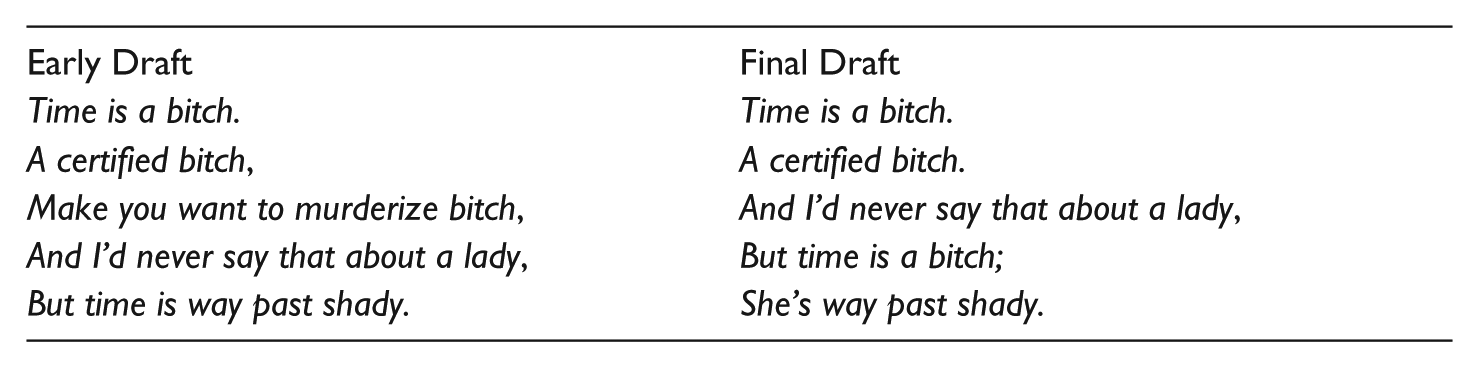
Here and throughout, Robert’s revision included changes to words, images, rhythms, and vocal performance strategies based on classmates’ assessments of how audience members were likely to respond to those writing choices and how they themselves responded.
“Is It Poetic? Is It Slam?” Response and Coauthorship in the Discursive Community
Exploring a shared, critically oriented genre as a discursive community meant grappling with complex ethical and political issues. As discussed in the previous section, the youth-centered nature of spoken word poetry and the safe and inviting workshop in the classroom came into tension with the responsibilities and stakes attached to a public audience at a school poetry slam, raising questions about the poet’s responsibility to herself and her audience, questions with which even the teachers visibly struggled. In this section, we analyze a tension that emerged when one student’s uptake of “poet as agent of social change” generated several simultaneous threads of discussion related to what he had chosen to say. We continue to argue that revising writing workshop through genres and audiences that are authentic to youth can address important critiques of traditional workshop pedagogy. At the same time, such work has the potential to confront students and teachers with rich questions at the heart of writing that can take the form of tensions or dilemmas for the discursive community to explore together.
During an early performance workshop in the third week of the unit, Brian, a White 12th grader, shared a draft of a poem that he titled “True Story.” The story in question concerned the widely reported 2006 incident in which a Saudi Arabian woman was assaulted and raped by a group of men and then herself sentenced to 6 months in prison and “200 lashes” for being in a car with a male non-relative when the attack occurred. Outraged by the incident, Brian wrote about the case ironically using the conventions of a fairy tale in his poem, titling the piece “Little Black Riding Burka.” The poem laid out a narrative of the title character going on an outing with her “Sheikh charming” and being attacked by a pack of “big bad wolves.” While not gratuitous in its detail of the assault, Brian’s poem was unflinching and sweeping in its blame of the society, courts, and of “Islam” itself for treating the victim so inhumanely. At the end of the poem, Brian broke from the fairy tale storytelling convention and ended his poem with commentary about what he took to be the incident’s wider significance. This ending, and the class’s initial responses, are excerpted below: Little Black Riding Burka was sentenced to six months and two hundred lashes because she had the courage to accuse seven men of raping her. Because all the repressed sexual desires of her chained-down society were let loose in a lethal cocktail of outrage, alleged righteousness and stifled urges. Because this is Islam saying to the world: down with the naysayers, up with the gangbangers, fuck women’s lib and you can take any infidel notions you have of human rights straight to hell. Because deep down, the men in charge of religion are afraid of what’s behind the burkas. They’re afraid of losing their choke-hold on the ones who have given them their power for fifteen hundred years. And now organized religion, with its adherence to the irrelevant codes of long-dead men, has wrapped its women up so tight in the suffocating folds of false moral guidelines that they forget to look behind the veil, and notice that Little Black Riding Burka is crying. (Applause) That was crazy. (To the class) Feedback. (To Brian) Stay up there and get your feedback. By the way, that is a true story. Stay up there and get your feedback. Mmm. That was awesome. Oh my god. Feedback. Go. Nicole. Okay, so yeah you had a good story, and did it like yeah, here’s the story of little bla bla bla, you know, it was like a light tone and then it got heavier and heavier and heavier. Well clearly, based on this true story. One person at a time, one person at a time. Then like the end got like super poetic, the language and stuff, especially those lines where you talked about the folds and stuff like that. Others? Over here some, okay go ahead Gina. Just, um, the Islam line, um, could I hear it again? (Searches poem) Towards the end? Yeah. Because this is Islam saying to the world? Yeah. (Several students and Tim add “yeah” or “hm”) Gina, I think you and I are thinking the same thing. Me too. I was thinking something too. Give your response. I understand what you’re saying. I understand that this is the culture and this is a religion and these things happen and they’re let happen and this woman is not believed. And I understand that and I really like this piece. Just the fact though that you’re wrapping it up into Islam might offend. It’s arguable though because it’s kinda harsh and it is, it’s really difficult because you want to make a point and you don’t want to label an entire anything, an entire religion, an entire society. Right. But at the same time, any society like ours has these tremendous flaws, but any society that would let something like this happen and in a legal system let it go even more than unpunished, punishing the wrong side. But you’re suggesting that doesn’t happen in our society. No I’m saying it does. (Several students begin to speak at once)
We want to begin by pointing out two ways that Brian’s poem is emblematic of the kind of work students do in this unit. First, his poem constituted an example of a student appropriating the ethos and role of “poet as agent of social change” put forth by the teachers. Encouraged to write about issues that mattered to them, Brian chose a tragic story from the media that struck a chord in him, allowing him to take up this position of “poet as agent of social change”: He offered a portrait of injustice and called out the sources of blame he attributed to these events. Second, in this poem, Brian appropriated a strategy that had been modeled early in the unit: writing and performing poems that explored the perspectives of people different from oneself. During the 1st week, Tim and Rochelle introduced students to a variety of page and performance poetries, an example of which was Patricia Smith’s (1992) “Skinhead,” in which a female African American poet explores the life history and beliefs of a male White supremacist by taking on that character’s persona in her poem. It was not unusual for students in Tim and Rochelle’s classes to write and perform poems that explored the perspectives of other people, and several students in this unit had developed poems that created characters to envision the world through their eyes and challenge an audience to empathize with them. While Brian’s poem was not written or performed in the first person, he was experimenting with writing about people different from himself in his poetry.
In the exchange that followed Brian’s reading, the whole-class feedback session began with comments from Nicole that praised Brian’s ironic turn on fairy tale conventions, the emotional work of a shifting tone, and his metaphor “wrapped . . . in suffocating folds.” In these early moments, Nicole and Kevin responded to the vivid ways in which Brian took a political stand against a violent injustice.
Once Gina, a White female student with some previous experience competing in poetry slams, drew attention to the phrase “this is Islam saying to the world,” a much different line of debate emerged, one that would generate vigorous discussion for the next 25 min. Gina’s claim that the way Brian was “wrapping up” his outrage in Islam “might offend” invited Brian to step into the perspective of his poem’s eventual audience. We note that Gina did not claim that she herself was offended, nor did any other student in the discussion that followed, though Rochelle came close at one point. Gina was asking Brian to consider the negative responses that his work in its current form might engender, and make decisions about his work based on that anticipated response. At the same time, Kevin’s response to Gina, “It’s arguable though because . . . any society that would let something like this happen . . .,” introduced a second strand into the discussion: a question as to the validity of Brian’s political claims, regardless of whether they were potentially offensive. Rochelle’s response of “But you’re suggesting that doesn’t happen in our society” then challenged Kevin and Brian’s framing of Islam as to blame for the injustice, seemingly cautioning these two non-Muslim American males about passing judgment on a religion and culture that is not theirs, when there is plenty of injustice to name in “our society.”
In the ensuing discussion, then, the class was engaged in two simultaneous pursuits that relate to the development and politics of writing for an audience: First, they were exploring how persuasive Brian’s position was to the discursive community, and second, they were considering the consequences of the political position he might choose to take in front of the anticipated audience at the poetry slam. The first strand of discussion led the class in several directions, the substance of which we will describe briefly. Soon after the excerpt above, Rochelle elaborated on Gina’s concern: “When you actually tie that specifically to Islam, that’s what you’re saying. It’s very self-righteous, and it’s drawing the presumption that this is the only place that happens.” Robert, whose poem initiated the discussion in the previous section, added, You got to realize that, as a member of our society and not the society you’re speaking of, as a member of our culture not a member of their culture, it might be taken, it’s most likely going to be taken and reacted to defensively.
The implication that Brian was overstepping his perspectival bounds in this piece, inherent in Gina, Rochelle, and Robert’s responses, initiated a debate among the students and teachers comparing Islamic law in Saudi Arabia (“their culture,” to use Robert’s words) and the legal foundations and freedoms of the United States (“our culture”). Several students debated incidents and patterns of oppression in the United States in an apparent effort to weigh whether there was a categorical difference between Saudi Arabia and the United States, and between Islam and Christianity or Judaism. Tim asked Brian and the class whether, given the variety of ways that people understand and practice religion, it would clarify Brian’s critique to replace “Islam” with “radical Islam” in the line that Gina had challenged. Brian resisted such a change: I don’t think it is radical Islam, because the interpretation of this is based on Islamic law, the Sharia, which is not really radical. That would be a misnomer. . . . The whole poem is about what happens in Islam. So I can either say Islam or I can’t; it’s still going to have the same connotation.
As the discussion continued, some students defended Brian’s cultural indictment by claiming that anyone living in Saudi Arabia who lets such forms of violence and punishment stand is accountable. Others replied by applying the same argument to injustices perpetrated in the United States, and pointing out that Brian’s implied contrast between “Islam” and other religions/cultures was hypocritical. This reasoning led to discussions of abuses or scandals in the United States that made national news and whether public outcry about injustice was the exception or the rule in the United States. Some students distinguished the religious influence on Saudi Arabian law from the separation of church and state in the United States, while Rochelle and several students replied that there is indeed a religious basis for many laws in the United States and gave several examples.
The second strand of discussion, which overlapped the first and then eventually took over the class’s focus, considered the ethics of Brian’s relationship with his poetry slam audience. The emerging critique of Brian’s poem alarmed several students, who advocated for Brian’s right to speak his mind on stage and offer a potentially unpopular view. In considering the fit between Brian’s poem and the poetry slam, two students argued that provoking a response from the audience, even a negative one, is part of the process of social change that is at the heart of the unit. Kevin claimed that if there’s subject matter that’s socially shocking to people like us in this classroom, and clearly we have different views amongst ourselves, if [the poem] gets rises out of people in different ways and in powerful ways, then it’s doing exactly what the intent is for social change.
Erica, an African American student who was relatively experienced with performance poetry, added, “If this is bothering some people . . . then they need to talk about it, because this is why we do this. We need a reaction.” These students signaled the value they attached to a genre and the unit theme that makes it permissible to challenge an audience, and they identified Brian’s poem as a text that provoked “different views among ourselves,” and they therefore expected “different” and “powerful” reactions from an audience.
In these strands of discussion, teachers and students are struggling to define collectively their roles within a messy sort of classroom practice. Was this a workshop, in which students’ individual perspectives were all to be honored equally? Was it a mock poetry slam, in which youth’s strongly worded political perspectives were the most important to bring to the microphone? Was it an English-class project, whose culminating presentation needed to be palatable to the public? And what if it was all of these? Where the episode presented in the previous section was launched from a question about “the rules at the slam,” this episode implicitly explored, among other things, a question about the rules (or, more accurately, roles) in the classroom.
Indeed, a third conversational strand quickly emerged, a meta-discourse in which students and teachers reconsidered their own role in Brian’s development. Nicole, an African American female student poet with several years of experience writing and performing spoken word poetry, argued for a limit to how forcefully the class pushed Brian to reconsider the content of his poem: I’m not saying that the line is right, and I’m not saying it’s wrong. But at the same time, slam poetry allows you the outlet to say whatever you want, whether it’s politically correct or politically incorrect. . . . that’s really not our choice or our option of saying, oh, well, you can’t get on stage and say something like that. Because then I do feel like we are censoring his words. I’m not saying [Brian] is right, but I’m saying if we’re forcing him to say another opinion or find a way around it, it’s like you’re changing his work.
Nate, a White male student, suggested another way of understanding the function of the debate over Brian’s poem: “We’re trying to protect him, and he doesn’t want to be protected.” Rochelle, while asserting that she was in favor of students “exploring sensitive issues” in their performance poetry, resisted concluding that Brian’s poem was therefore impervious to revision in terms of the relationship he was establishing with his audience: “I think this is a dialogue about content, which is what we’re doing, giving feedback to the poet about the content and how we receive the content.”
As perspectives like those of Nicole, Nate, and Rochelle came into contact, the class was essentially sketching out the boundaries of their responsibilities to each other: finding ways to avoid the infringement of “censoring” or “changing his work” and not “protecting” a poet from inviting an audience’s response, while also making explicit “how we receive the content.” Rochelle then went further, seeming to translate her interest in open dialogue between poet and classmates to a similar dynamic between poet and slam audience: Part of this process, as we bring these poems through to the final format, is questioning whether or not this is a slam poem and worthy of the slam stage. . . . that line [about Islam] might sound like that’s really just your personal, you just putting your opinion out there, not necessarily very poetically, to indict a religion. . . . This is a process we’re going through to create a performance poem, and not necessarily a speech or a, what do you call it when preachers preach? A sermon. A sermon.
Rochelle then challenged Brian to consider strategically whether or not you’re doing the work justice by, in the end, indicting a religion very literally in the poem, and whether or not that’s as effective as painting this picture of . . . a true story that happens within a culture.
Here, Rochelle marked Brian’s turn from evocative storytelling to provocative indictment as a shift in genre away from how she viewed performance poetry and toward genres characterized by, in Bakhtin’s (1981) terms, monologic, authoritative speech, the sort of speech common to sermons or speeches that might leave audience members thinking, “You know, that’s not what I’m here to see or hear.” She indexed this sort of distinction again moments later when she asked the class, rhetorically, “Is it poetic? Is it slam?” For our part as analysts of spoken word poetry in school, we are not arguing that the genre is, by definition or even in ideal terms, more or less dialogic than a sermon or a speech. But we see in Rochelle’s emphasis on the “process we’re going through to create a performance poem” a commitment to the class’s role in challenging and shaping each student’s voice—“we . . . create a performance poem.”
This shift from Brian and “his work” to a class collectively creating a performance poem echoes the vision of genre study that Lensmire (1994) has called for; rather than taking up the traditional workshop emphasis on students’ personal expression through choice, the unit theme reframed the class’s work as a collective effort to help poets be rhetorically effective in the genre that the entire discursive community was studying. In this context, there is a role for teachers and peers to challenge the views in students’ writing, and the diverse audience in the upcoming slam helps legitimize bringing together students’ and teachers’ quite different responses. By the time the bell rang to signal the end of class, and as Tim told the students to “give yourself some snaps today. Wow. My brain is going a hundred miles an hour. You guys are brilliant,” Brian was left to make sense of the careening 25-min response to his work. The class was divided over how accurate it was for Brian to indict religious doctrine for judicial structures or acts of violence, and they were further divided over what sort of distinction there might be between institutionalized oppression in Saudi Arabia and equivalent oppression in the United States. Some of his classmates had welcomed the poem’s potential to provoke varied responses, including outrage, in an audience, others had cautioned him against offending his audience, and Rochelle suggested that the draft in its current form was a missed opportunity to invite thought through a vivid story rather than imposing an interpretation by sermonizing.
By the night of the final poetry slam, Brian chose to remove the long indictment of Islam that ended the early draft of his poem. In announcing his decision to the class the day before the slam, Brian explained that his views about Islam had not changed, but that he had decided that the poem would be more powerful if the ironic fairy tale conventions framed the poem from start to finish. In place of the long excerpt from the end of his early draft shared above, Brian focused his final lines on the assaulted woman’s vain attempt to seek legal recourse, letting a familiar fairy tale ending in the final line register as bitterly ironic: So she stopped Dreaming And pressed charges. But the judge who heard her case Sentenced her to six months in prison And two hundred lashes. And they all lived happily ever after.
Discussion
As most literature on workshop pedagogy is situated in the primary grades, little research has examined the sorts of productive rhetorical challenges that teachers and students at the high school level might take on in writing workshop. Although the broad principles of traditional workshop pedagogy ostensibly make room for the sorts of collaborative, critical engagement with a popular genre that we document in this article, so too do far less collaborative and far less critical practices proceed under the moniker of “workshop” (Christianakis, 2010; Donnelly, 2010; Henkin, 1995; Lensmire, 1994, 1998; McCarthey & Ro, 2011; Rowe et al., 2001). This study helps address the need for research that examines the sorts of pedagogical choices that foster particularly engaged classroom communities and engagement with rich, complex issues at the heart of writing.
In this article, we have presented a portrait of two teachers’ pedagogical choices in designing a spoken word poetry writing workshop. We have shown how the class’s focus on a common genre, the teachers’ work to organize an authentic audience and longer trajectory for poets, and their interest in resisting teacher-centered authoritative roles in the classroom helped constitute the classroom as a strong discursive community (Matusov, 2007). We see these strategies as usefully addressing several long-standing critiques of workshop pedagogy. First, they make communicative tools and practices more visible to students than is possible when students retain choice over the genres and purposes for writing that they pursue individually (Dressman, 1993). Second, they invite teachers and peers to challenge each other’s work critically, putting into dialogue both their responses to the ideological content of students’ writing (Kamler, 2001; Lensmire, 1994) and their norms or expectations for good writing in the genre (McCarthey, 1994). Exploring a genre as a community, one in which teachers are active participants but not dominant authorities, has the potential to mitigate some of the social positions and risks that have limited peer interaction in some traditional workshops (Christianakis, 2010; Henkin, 1995; Lensmire, 1994; Rowe et al., 2001), as the emphasis shifts from the vulnerable sharing of (often) personal writing in disparate groups to a collective effort to be effective in a genre.
In addition to answering these established limitations of much writing pedagogy, we found evidence that Tim and Rochelle’s work to organize a public poetry slam and connect it to a citywide infrastructure of spoken word competition helped focus the class’s work together, as students and teachers strategized about writing and performance choices with the upcoming live audience in mind. Crucially, this work did not breed consensus; instead, we found that the most sustained and animated interactions during the unit centered on several dilemmas at the heart of this critically oriented instantiation of writing workshop. We have focused on two such dilemmas in this article, one about how writers and performers make rhetorical and political decisions with their audiences in mind, and another about what roles members of a response community such as a workshop classroom can or should take on in the development of each other’s work. Performance poetry and poetry slams can make visceral the responsibilities of student poets to be simultaneously “true to the poem,” “appropriate” to a school context and audience, and agents for social change. The explicit social and political engagement at the heart of spoken word poetry invited students to name injustices and to bring emotion and energy to their poetic response, an invitation that sometimes leads students to draft readings of the world that marginalize or offend others. In exploring these challenges as a discursive community, the teachers and students weighed possible perspectives and the real political stakes of various authorial stances. Students not only engaged and supported each other but also argued over what is true and fair to say. They struggled to take responsibility for their interactions with their audience(s) and to make decisions about those performances on that basis, all without losing hold of their commitment to spoken word as a genre that invites youth to speak their mind in language of their choosing.
In some ways, Tim was uniquely positioned to experiment with pedagogy like the spoken word poetry unit because of his position as a teacher of upperclassmen in a creative arts magnet high school. In this school context, public performance in a range of genres is not unusual, and students frequently engaged in drafting, responding to, revising, and sharing creative work. And Tim’s productive and long-term collaboration with a talented teaching artist like Rochelle was a luxury and a resource that few teachers have. Nonetheless, as a public school teacher, Tim found that the promotion of youth voice through this genre involved risks for his professional relationships. He both acknowledged these institutional tensions publicly with students and worked to protect the tradition of the slam in the school by inviting students into the task of writing and performing poems in ways that would help allow the classroom unit and the public slam to continue.
We see evidence in Tim and Rochelle’s class that the tensions inherent in promoting youth voice in school are generative opportunities for teaching and learning, particularly when teachers and students confront those tensions as a reflective community. It is, of course, often difficult for teachers and schools to build out-of-school genres, dialogue, and authentic audiences into the heart of educational practice, given the current national educational priorities of standards and high-stakes assessment. We argue, however, that the complexities and opportunities that arose in the English class we studied here have implications for genres beyond spoken word, and for teachers and contexts beyond an arts magnet school. Case studies of innovative practice can offer researchers and practitioners new models for organizing curricula that value youth’s language and experience as resources for learning, and for enacting workshop pedagogy in ways that promote group engagement with genres and audiences, opening up different roles for teachers and students in each other’s learning. In that context, class discussion in the upper secondary grades can be oriented toward raising and weighing the rich dilemmas about speaking and being heard that have real stakes for youth, audiences, and teacher–sponsors. These conversations can explore ethical questions about who youth are and might become, what they choose to say, how they position themselves in relation to their audiences, and the role of adults in mediating these processes. By understanding youth “voice” in writing as less a matter of individual expression or mere participation in opportunities to be heard, and more as a process of struggle over possible communicative choices and the stakes of being in dialogue with real audiences (Snaza & Lensmire, 2006), educators and researchers might expect these ethical questions or dilemmas to surface and consider what sorts of pedagogical moves support engaging with them visibly and safely.
With that in mind, this study leads us to pose two questions for literacy researchers and educators. First, how can educators organize authentic audiences for students’ writing and speech and then collaborate with students to consider the writers’ relationships with, and responsibilities to, that audience as a fundamental part of a meaningful communicative process? Of course, identifying an authentic audience has long been a goal for effective writing instruction, but we wish to emphasize the organization and leveraging of public audiences, beyond the classroom and school, as an important way to make students’ writing—and revisions within a discursive community—meaningful. Public performances such as slams, grant competitions, or local government meetings feature the kinds of audiences for whom young writers and their teachers can write with real potential contact and consequence.
Second, how are educators who are invested in critical literacy prepared to respond when youth bring up views or discourses that are unpopular or even offensive in their work, and what kind of discursive community best engages moments of conflict skillfully? This question is an enduring but important challenge for teachers in public schools. Our initial answer, based on this work, is to make not only the formal and functional features of writing a focus of work with students, but to build into workshop pedagogy a communal consideration of the cultural, political, and social implications of engaging with a variety of genres and purposes. Designing pedagogy for this sort of discursive community will likely require striking a balance between constraints that help maintain a safe and inviting classroom community and the risky invitations to youth writers and speakers that run students headlong into the sociocultural perspectives enacted in diverse forms—and the stakes of voicing them. More work needs to examine these sorts of challenging communicative dilemmas as particular affordances of workshop pedagogy that is practiced in the upper secondary grades.
Although our contemporary political context continues to narrow the genres and skills that are privileged in English classrooms while raising pressure on teachers to prioritize them, our hope is that an expanding body of work on both dialogic engagement in classrooms (Fecho & Botzakis, 2007; Juzwik, Borsheim-Black, Caughlan, & Heintz, 2013) and struggling to engage rich out-of-school literacies in school (Alim, 2011; Hull & Schultz, 2002; Low, 2011) will build momentum for supporting these forms of engagement at the institutional level. In addition, despite how distant genres such as spoken word or slam poetry might be from what is prioritized in many schools today, there are many potential connections to be made to concepts and goals named in the Common Core State Standards, and as those standards take hold nationally, now is a critical time for researchers to build evidence for engaging and innovative pedagogies that resonate with the standards’ mandates without sacrificing relevance or complexity (Hinchman & Moore, 2013). Based on our study of Tim and Rochelle’s classroom, we believe that making these connections and building pedagogy around them carry enormous potential for engaging youth and helping them do the complicated work of developing as writers.
Footnotes
Declaration of Conflicting Interests
The author(s) declared no potential conflicts of interest with respect to the research, authorship, and/or publication of this article.
Funding
The author(s) received no financial support for the research, authorship, and/or publication of this article.