




Abstract
Through this international cross-case analysis of ethnographic literacy practices data, we investigated two questions: (1) In what literacy practices do adults with limited or no schooling engage for personal fulfillment? and (2) What do these practices reveal about the nature of literacy for individuals who are often characterized as illiterate? Data came from 92 participants across 13 case studies from Africa and the Americas in the Cultural Practices of Literacy Study database. We queried the database to identify (a) the social activity domains in which participants read or wrote, and (b) their purposes for doing so, then narrowed our analysis to practices related to personal fulfillment (i.e., practices that were clearly for themselves and/or for personal expression, self-understanding, and/or identity). We categorized purposes into themes, contextualized the practices within the original ethnographic data, identified participants representing “rich cases”, compiled participant portraits, and developed coding schemes to examine data for patterns. Participants across worldwide contexts read and wrote for a variety of personal purposes, including coping with life, facing problems, or escaping their daily realities, or for entertainment. Practices often connected with spiritual or religious life domains or with participants’ attempts to make sense of their lives. An important theme across practices and contexts was participants’ marginalized status, reflecting the ways in which practices connected with other aspects of context. Our findings challenge current understandings of the ways in which those assumed to be illiterate or low-literate practice literacy, suggesting implications for redefining functional literacy and for adult literacy instruction.
Nina, a Nicaraguan immigrant to Costa Rica who may or may not have entered the country legally, was orphaned as a youth and raised by her father’s family. As a result, she had limited opportunity to go to school: “I don’t remember ever being at school or college. I didn’t study at all" [Purcell-Gates, 2006]. 1 Despite having had no opportunity to go to school, Nina engaged in a variety of literacy practices on a regular basis. For example, she read texts that came home from her children’s schools, and she wrote grocery lists—“with my poor handwriting. Not very clear, but I do it”—and letters to two of her daughters who still lived in Nicaragua.
Religion was an important part of Nina’s life that shaped her literacy practices. She recalled, “My mother was a religious person, she followed the gospel. What I remember is that we went to church. That is what she used to visit the most. In my childhood, I remember her as a religious person.” In addition to magazines circulated by Jehovah’s Witnesses, Nina herself regularly read “songs and prayers and things like that . . . We may even get a dictionary, so that’s what I read.” When asked what her favorite part of the Bible was to read, she replied The psalm book, Mateo, the Romans, those are the books I like the most. And the Genesis, the story of Abel and his brother, all of that. That is what I like to read and discover. And I like the psalm book because of David communicates with God. So that is why, because of David’s prayers. Job’s book is filled with great stories . . . Those are the parts that I like reading the most. Well, the whole Bible is very nice, right, but there are better parts.
When asked what she did if she encountered a word that she did not know, Nina explained, Well, sometimes I ask my children, because they read very well. I ask them to explain that word to me . . . The dictionary has words that are in the Bible, so if I don’t understand them I use the dictionary. I look for them there.
Later, she explained that she had read the Bible “many times, yes. The thing is that there are words I remember and words I forget. Because as a woman at home I have many duties and then the children, so I am always busy.” She indicated that, in fact, she had memorized some of these parts of the Bible. However, Nina also explained that “it’s not about the religion, but about what I feel in my heart when I study, read and learn more.”
These segments of Nina’s interview illustrate not only the importance of religious reading in her life, but also the importance she placed on learning and study. Indeed, she insisted that her purpose in this type of reading was not about religious observance, but rather about the deep value that pursuing knowledge held for her. Clearly, she also was able to use reading and writing for meaningful purposes, such as studying the Bible and writing letters to her daughters. Yet, she did not view herself as a literate person; she described herself as knowing how to read a little, but not knowing how to write: “I can only read. I don’t know how to write real well, because I didn’t go to school when I was young.” In fact, she explained, I really learned how to read with the Bible . . . Overall, I skim through. I discover the word of God in it and I learn that way . . . I always read in the search of Jesus’ wisdom, so I can get closer to God through the words.
When the researcher directly asked Nina if she had used the Bible as an instrument with which to learn to read, she replied, “At the beginning I did. About 10 years ago, I converted to the word of the Lord. I didn’t know how to read, so I asked God to give me the wisdom to discover his writing.” Nina’s perceptions about her literate abilities are not surprising, given her experiences. She clearly associated literate ability with schooling; indeed, her perception reflects common discourses about literacy. Nina viewed herself as a poor reader and an even poorer writer, which she directly attributed to her inability to attend school. She ascribed what little literate ability she felt she had to the grace of God. Like many adults with limited or no schooling, Nina believed herself to be essentially non-literate, despite the fact that she engaged in many literate practices, and despite the fact that these practices clearly held an important place in her life.
In this manuscript, we present a cross-case analysis of ethnographic data related to literacy practices of adults from multiple worldwide contexts who, like Nina, have limited or no formal schooling. We designed this analysis to investigate two questions: (a) In what literacy practices do adults with limited or no schooling engage for personal fulfillment? and (b) What do these practices reveal about the nature of literacy for individuals who are often characterized as illiterate? In narrowing our analysis to practices related to personal fulfillment, we focused on literacy practices in which participants engaged that were clearly for themselves and often also related to personal expression, self-understanding, and/or identity. These practices stand in contrast to those that are for more obviously instrumental purposes and which often are assumed to be the extent of literacy practices for adults with limited or no formal schooling. In contrast to other ethnographic studies of situated literacy practices in which a single community or context is investigated, we examine literacy practices data across a variety of worldwide contexts. As Miles and Huberman (1994) suggest, cross-case analyses allow researchers “to see processes and outcomes across many cases, to understand how they are qualified by local conditions, and thus to develop more sophisticated descriptions and more powerful explanations” (p. 172). Examining this particular set of literacy practices using data from multiple international cases not only provides for a more in-depth understanding of the phenomenon, but it also suggests the breadth and importance of the practice worldwide. By examining literacy practices related to personal fulfillment, our findings challenge current understandings of the ways in which those assumed to be illiterate or low-literate practice literacy, suggesting implications for adult literacy instruction.
Functional Literacy
Much of the early research conducted within a social practice theoretical framework explored literacy within communities, like Nina’s, that were traditionally thought to be uneducated, low literate, or even illiterate (e.g., Heath, 1983; Street, 1984). Although these studies challenged—and continue to challenge—notions of illiteracy and low literacy, national and international discourses still characterize entire groups as low literate or illiterate, often calling on the concept of functional literacy to describe the perceived abilities of these groups.
In the United States, functional literacy typically means “using printed and written information to function in society, to achieve one’s goals, and to develop one’s knowledge and potential” (Baer, Kutner, & Sabatini, 2009, p. 3). Internationally, a person is considered functionally literate if she or he can engage in all those activities in which literacy is required for effective functioning of his (or her) group and community and also for enabling him (or her) to continue to use reading, writing and calculation for his (or her) own and the community’s development. (United Nations Educational, Scientific and Cultural Organization [UNESCO], 2005, p. 22)
These definitions explicitly reference the contextual nature of literacy, and they also implicitly suggest that literacy goes beyond using reading and writing in the performance of everyday tasks to include reading for personal purposes, such as developing “one’s knowledge and potential.” Indeed, the UNESCO report further explains that functional literacy references “the whole range of people’s functions, whether as citizens, as producers, as private householders . . . or as individuals seeking answers to the questions they ask themselves about the physical, social, moral and intellectual world in which they live” (United Nations Educational, Scientific and Cultural Organization [UNESCO]/United Nations Development Programme [UNDP], 1976, cited in Yousif, 2003). However, these personal purposes for literacy are often overlooked in favor of practices that are assumed to be more “practical,” such as reading and writing related to work and family obligations.
In addition to overlooking personal purposes for engaging in literacy, functional literacy is often equated with particular basic skills or grade-level reading attainment, despite the fact that neither definitions of functional literacy nor assessments of adult literacy, such as the National Assessment of Adult Literacy (NAAL), were ever intended to do so (Stites, 2000). For example, two national reports, Key Concepts and Features of the 2003 National Assessment of Adult Literacy (White & Dillow, 2005) and Basic reading skills and the literacy of America’s least literate adults (Baer et al., 2009), inappropriately conflate functional literacy with basic literacy skills.
Both popular conceptions of functional literacy and governmental applications (or misapplications) of functional literacy constructs have significant consequences: As St. Clair and Sandlin (2004) argue with respect to the United States, “To be considered illiterate in contemporary America is not just to struggle with reading and writing—it is to be deemed unworthy, unproductive, a bad parent, and deserving of remarkably high levels of domestic intervention” (p. 48). Furthermore, they note that “illiteracy, and the associated judgments on the moral worth of individuals, have also been used as a justification for denying social and civil rights to certain groups” (p. 48). The implications of these discourses can be seen historically in literacy tests that were used to disenfranchise African American voters in the United States and currently in immigration policies that deny citizenship to legal residents who do not speak English or who cannot read or write in that language. How we think about literacy clearly matters, and understanding what real people do with texts therefore is essential to providing an accurate understanding of literacy. Equally importantly, going beyond individual case studies to understanding the global scope of particular literacy practices is essential to this accurate understanding.
Theoretical Framework and Literature Review
Sociocultural approaches to literacy, grounded in Vygotsky’s (1978) work, have long played an important role in the field of literacy. Much of the groundwork for sociocultural theories of literacy originated in adult, family, and community literacy research (e.g., Barton & Hamilton, 1998; Heath, 1983; Purcell-Gates, 1995; Street, 1984) that was concerned with Understanding the ways in which people use literacy in their everyday lives, finding ways to make literacy instruction meaningful and relevant by recognizing and incorporating students’ out-of-school ways of practicing literacy, and decreasing achievement gaps for students whose families and communities practice literacy in ways that may differ from those in the mainstream or in positions of power. (Perry, 2012, p. 51)
Because sociocultural perspectives emphasize practices rather than basic literacy skills, Street and Leung (2010) note that The question this approach raises . . . is, then, not simply that of the “impact” of literacy—to be measured in terms of a neutral developmental index—but rather of how local people “take hold” of the new communicative practices being introduced to them. (p. 305)
As a result, literacy researchers working within sociocultural perspectives often provide richly contextualized descriptions of literacy practices within specific groups or settings. These studies have the ability to raise important issues; examining literacy practices in isolated contexts, however, is insufficient toward goals of understanding broader patterns related to literacy learning and use. The international, cross-case nature of this analysis can contribute to these understandings in ways that single ethnographic case studies cannot.
Literacy as a Social Practice
Our work is situated within one particular sociocultural theoretical strand: the social practice view of literacy. In this model, reading and writing are aspects of social activity, fully situated within social and cultural contexts and within power relationships (Barton & Hamilton, 1998; Street, 1984). In contrast with what Street (1984) termed the autonomous model of literacy, in which literacy is assumed to be a set of neutral, decontextualized skills that are universally applicable, the theory of literacy as a social practice is an ideological model of literacy, which “entails the recognition of multiple literacies, varying according to time and space, but also contested in relations of power . . . and asking ‘whose literacies’ are dominant and whose are marginalized or resistant” (Street, 2003, p. 77).
The term practice is an essential component of this view of literacy. That is, rather than viewing literacy as something one has, social practice models view literacy as something one does with reading, writing, and texts in real-world contexts, including why they do it. Literacy practices involve more than actions, however; they also connect to and are shaped by attitudes, values, feelings, relationships, power structures, and other contextual aspects (Barton & Hamilton, 1998; Purcell-Gates, Perry, & Briseño, 2011). The term social is also a key aspect of this theoretical perspective. According to Barton and Hamilton (2000), social relationships are a crucial element of literacy practices, as practices “are more usefully understood as existing in the relationships between people, within groups and communities, rather than as a set of properties residing in individuals” (p. 8).
One difficulty of the social practices perspective on literacy has been that the connection between observable literacy events (Heath, 1983) and unobservable literacy practices (Barton & Hamilton, 2000) has been nebulous and under-theorized. Purcell-Gates et al. (2011) offer a theoretical model of a literacy practice that more clearly connects these two constructs. This model represents nested layers of context centered around observable literacy events. The literacy event begins with the participant’s intent for reading or writing, which is then encompassed by the text itself. The text and the participant’s function for reading or writing—or, in other words, her immediate communicative intent—mediate the participant’s purpose for engaging in the observable event. Larger domains of social activity shape this immediate social goal, and they are in turn shaped by other contextual layers, such as power relationships and other social structures.
This model of literacy practices shows the ways in which literacy is “socially situated, socially semiotic, multiple, and as mediating social lives” (Purcell-Gates et al., 2011, p. 441). Yet, if we understand literacy practices as fundamentally social and situated within social relationships, where does that leave literacy practices that are deeply personal, literacy practices of or for one’s self? How do individual, personal practices fit within a model that emphasizes the social? One answer to this question comes from Barton and Hamilton’s (2000) assertion that literacy practices are “purposeful and embedded in broader social goals and cultural practices” (p. 8). Purcell-Gates et al. (2011) extend this assertion by emphasizing that individual literacy events, such as keeping a journal, mediate social activity and that people therefore use “literacy behavior to mediate their lives” (p. 449). An individual may be engaging in a solitary, personal practice, but as this analysis will demonstrate, the practice may be connected to larger social and cultural goals, such as educating oneself, leaving a mark on the broader world, or seeking a connectedness with God and human kind.
Adults’ Personal Literacy Practices
The many ethnographic studies that have documented literacy practices within specific marginalized communities (e.g., Barton & Hamilton, 1998; Barton, Ivanič, Appleby, Hodge, & Tusting, 2007; Daniell, 2003; De la Piedra, 2010; Purcell-Gates, 2007) have demonstrated that people use literacy in multiple meaningful ways and that “adults with difficulties reading or writing are not empty people living in barren homes waiting to be saved and filled up by literacy” (Barton & Hamilton, 1998, p. 161). In addition to using literacy for everyday family and community functioning, individuals in the researched communities use literacy for fulfilling more personal goals, including spirituality or religion (Heath, 1983; Street, 1984), “leisure and pleasure” (Barton & Hamilton, 1998, p. 129), and “making sense of life around them and their own identity” (Barton et al., 2007, p. 71). Indeed, many of the areas of life commonly mediated by literacy that Barton and Hamilton (1998) documented—organizing life, personal communication, private leisure, documenting life, sense making, and social participation—seem to align more easily with personal literacy practices than they do with typically functional or instrumental purposes.
Literacy for spiritual purposes has been a common theme among Western vernacular literacy practices since the Middle Ages, when Margery Kempe and other mystics wrote about their spiritual experiences in the common tongue instead of in Latin (Perry, 1998). Indeed, the desire to read the Bible in the vernacular was a major factor in the Protestant revolution, and religious institutions have continued to play an important role in sponsoring literacy development worldwide (Brandt, 2009; Christoph, 2009). More recent research also has documented the importance of religious or spiritual purposes for engaging in literacy. For example, in their description of a Freirean-based adult literacy class for poor women in rural El Salvador, Purcell-Gates and Waterman (2000) noted that “one of the most important desires held by almost every student was to be able to read the Bible” (p. 83). De la Piedra (2010) similarly investigated the self-generated literacy practices of Spanish-literate Quechua speakers in Peru and found that religious purposes motivated these participants to become literate in Quechua.
Literacy practices related to making sense of one’s life and experiences are less understood than literacy for spiritual or religious purposes. According to Barton and Hamilton (1998), sense making involves meaning making on both large and small scales: “Sense making is motivated by the search for meaning and problem solving, either in a short-term, instrumental way or in a longer-term exploration of patterns in life-events of a broader, more philosophical kind” (p. 231). Horsman (1990), for example, studied Canadian women who returned to school to earn high school equivalency degrees or other career-oriented certification. She reported that the women “sought the challenge of a broader world than that in the house” (p. 104): one woman stated, “I’m even feeling better just learning, having something else in my mind besides the everyday” (p. 105). Daniell (2003) similarly explored this kind of sense making in her study of the private and personal uses of literacy among six women in an Al-Anon group. She documented literacy practices the women used to enhance self-awareness. The Al-Anon women were coping with life challenges over which they had little control, and Daniell identified the women’s preference for the aesthetic quality of literacy practices and a joining of literacy practices with their personal spiritual awareness. In addition, for the six women in the Al-Anon group, reading was “both an individual and a communal activity,” as much of their reading and writing was intertwined with their conversations with one another.
Much of the research investigating adults’ personal reading or writing has occurred in the context of formal adult literacy instruction (e.g., Barton et al., 2007; Horsman, 1990; Houp, 2009; Purcell-Gates & Waterman, 2000). Other research has focused on the practices of adults who have substantial levels of formal schooling. For example, Daniell’s Al-Anon participants were mostly high school or college graduates (one had a GED) living in or near a college town in the United States, and they therefore may have enjoyed easier access to texts both in their ability to interpret and produce written words as well as in their ability to obtain written work and writing tools. Given these gaps in the field’s knowledge, a greater understanding of literacy in everyday, out-of-school contexts is needed. In addition, as Daniell (2003) rightly noted, most of the existing research that documents the literacy practices of specific communities, marginalized or otherwise, is still comprised of “little narratives” (p. 4)—that is, individual qualitative case studies. Although each of these individual narratives adds insight to our overall understanding of the nature and function of literacy, the findings are necessarily limited by the scope of the individual studies. Examining literacy across multiple contexts around the world, therefore, is needed order to better understand specific literacy practices.
Method
Analyzing data across multiple case studies offers a number of benefits, according to Miles and Huberman (1994), including enhanced generalizability of and added confidence in findings: By looking at a range of similar and contrasting cases, we can understand a single-case finding, grounding it by specifying how and where and, if possible, why it carries on as it does. We can strengthen the precision, the validity, and the stability of the findings. (p. 29)
Rigorously designed cross-case analyses, thus, allow for “reconciling an individual case’s uniqueness with the need for more general understanding of generic processes that occur across cases” (p. 173). Miles and Huberman describe two different approaches to cross-case analysis: case-oriented strategies and variable-oriented strategies. In a case-oriented approach, “a theoretical framework is used to study one case in depth, and then successive cases are examined to see whether the pattern found matches that in previous cases” (p. 174). This method facilitates close examination of “specific, concrete, historically-grounded patterns” that may extend to a small number of other cases, but is limited by its particularistic nature. Variable-oriented strategies, in contrast, involve researchers looking for themes that cut across a variety of cases to offer more robust findings that might be more widely applicable. Because each approach has benefits and drawbacks, Miles and Huberman note that mixing both case-oriented and variable-oriented strategies is optimal. In this analysis of personal literacy practices, we have utilized a mix of both approaches, examining 13 case studies as entities (including closely examining individual participants within those cases) before moving to understanding themes across the case studies.
We analyzed literacy practices data from the Cultural Practices of Literacy Study (CPLS) database, described below, focusing on adult participants (individuals above the age of 18) who had either minimal or no schooling. Table 1 presents information on the CPLS case studies included in this analysis. The 13 case studies include 5 case studies from Oaxaca, Mexico [Clemente, 2008a, 2008b, 2009; Gopar, 2009; Zaraté, 2009]; two cases of communities in Vancouver, Canada [CPLS, 2008; Moayeri, 2007]; two studies of immigrants in the United States [Perry, 2006; Purcell-Gates, 2004]; and studies in Puerto Rico [Mazak, 2003], Bolivia [Gates, 2007], Uganda [Tembe, 2007], and Costa Rica [Purcell-Gates, 2006]. We purposefully selected these CPLS cases from the 24 currently included in the database because these cases included participants who reported limited primary schooling or no schooling whatsoever; the remaining 11 cases were excluded from this analysis because they did not include this type of participant. In addition to representing a range of marginalized people in worldwide contexts including Africa, Central America, North America, and South America, several of the cases also represent multilingual, multi-ethnic contexts, as well as contexts in which cross-border migration was an important factor.
Case Studies Included in This Analysis.
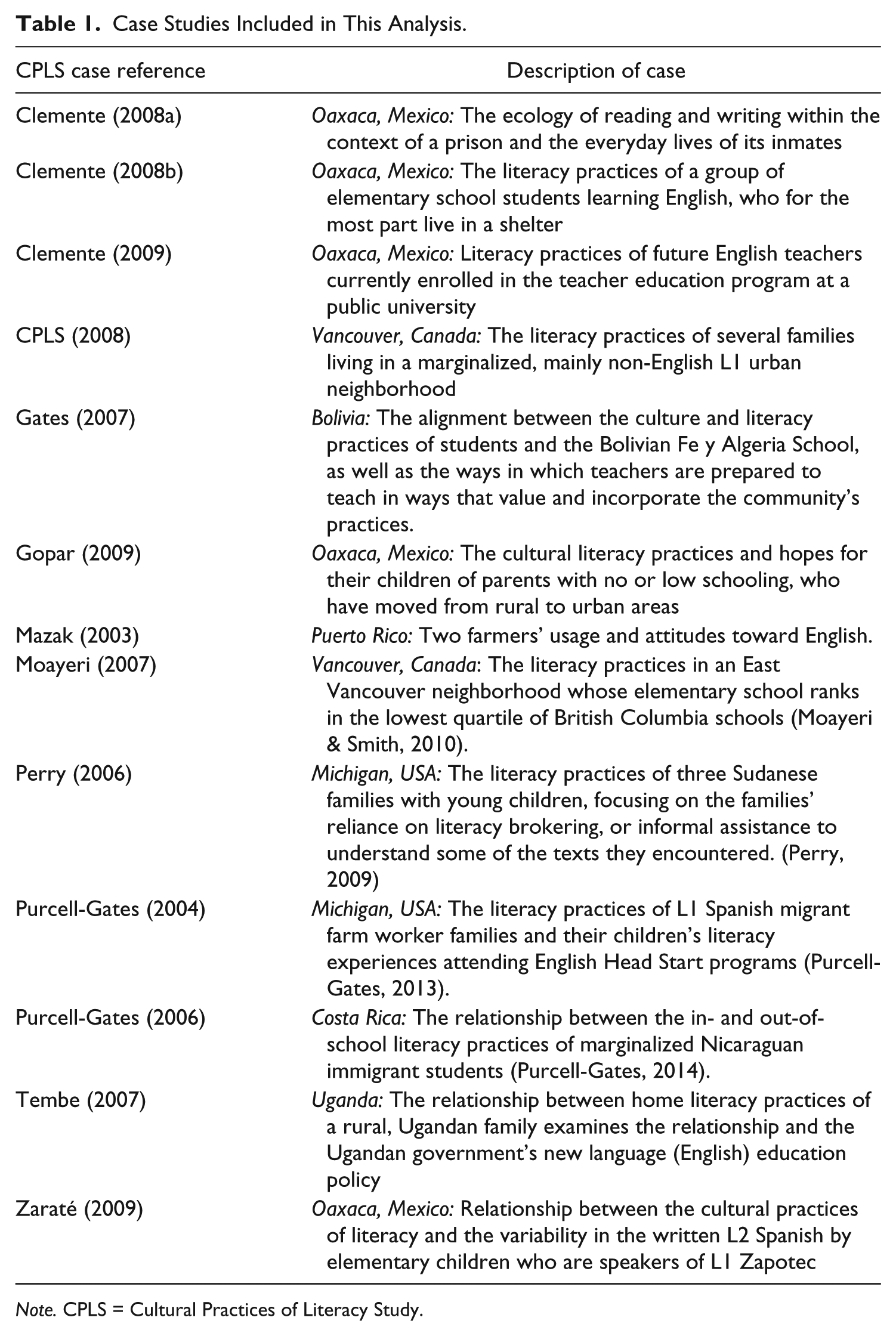
Note. CPLS = Cultural Practices of Literacy Study.
When we initially explored the data, we began with a broad research question related to functional literacy: In what social activity domains, and for which purposes, do adults with limited or no schooling read or write? However, through the course of our exploration of the data, we focused on participants’ literacy practices that were clearly for themselves and not to accomplish an outside task, that is, practices related to personal fulfillment, personal expression, self-understanding, and identity for participants. Thus, our final research questions became In what literacy practices do adults with limited or no schooling engage for personal fulfillment? What do these practices reveal about the nature of literacy for individuals who are often characterized as illiterate or low-literate?
The CPLS Study
The CPLS is a large ethnographic project under the direction of Kristen H. Perry (see http://sites.education.uky.edu/cpls/), with Victoria Purcell-Gates as director emerita. CPLS serves two main purposes: (a) the collection of ethnographic case study data on the ways that literacy is practiced within specified cultural contexts, and (b) the creation of an expanding database using these data for future cross-case analyses of literacy practice. Our primary focus is on communities that have been historically marginalized in society. We have conducted, sponsored, or collaborated on 24 case studies that are part of our searchable database. For more information on CPLS’s theoretical grounding, the common methodology used across cases, and the development of the database, see Purcell-Gates et al (2011).
The CPLS database allows each individual case study to maintain its layered complexity and therefore be understood on its own terms, in addition to supporting principled cross-case analyses. To facilitate this complex task, we have included two types of data in the CPLS database: (a) the original case study data and (b) the “flat” database. The case study data are contained digitally within individual Atlas.ti Scientific Software (2007) hermeneutic units, which include all of the collected data for each case—researchers’ field notes, interview transcripts, scanned artifacts, photos, and memos. To this hermeneutic unit, we also add any other accounts of researchers’ interpretation of the data, such as final reports and conference presentations. The flat database begins as an Excel spreadsheet that is imported to our searchable web interface, for data mining and descriptive analysis. This database contains codes that serve data management and descriptive purposes, as well as conceptual purposes with theoretically based codes. Within the main part of the database, we have used a code string with nine code types for each identified literacy event (instance of a person reading, writing, or listening to text) including codes for text type, social activity domain, and function and purpose for reading or writing that text. Descriptions of both the descriptive and theoretical codes can be found in Purcell-Gates et al. (2011).
It is important to be clear about what the CPLS database can and cannot do—that is, the types of analyses that the database supports or does not support. Because CPLS researchers relied heavily on self-report data from participants (including reports of what others were doing), and because our interview and observational protocols did not provide exhaustive descriptions of literacy practices for a given participant or in a given community, we provide general descriptions or portraits of literacy for participants and communities. Many factors likely affected the nature of the literacy practices data that researchers could collect, such as participants’ necessarily faulty memories and what they felt like sharing. Although we could confirm focal participants’ descriptions observationally, there was no way to confirm practices described for non-focal participants (see below for discussion of types of participants). Our choice of ethnographic designs for the studies meant that we did not collect data on literacy practices that was exhaustive nor included “counts” of text types or frequencies of how often they were used. Thus, one cannot draw conclusions about frequency of particular literacy practices or perform statistical analyses or comparisons between cases. However, because interviews and observations were completed within the participants’ natural environments, surrounded by their personal materials and artifacts, and often even interrupted by ordinary interactions with their family and daily events, these descriptions contain intimate understandings of the intersection of literacy practices with the everyday lives of participants.
Participants
The CPLS database contains data from two types of participants: focal participants and non-focal participants (all names are pseudonyms). Focal participants directly participated in data collection for a given case study; that is, they participated in a semi-structured interview about their literacy practices and also may have taken part in participant observations. Non-focal participants, in contrast, did not directly participate in data collection, but had literacy practices that were described by focal participants or were themselves observed in public, community contexts. Because we asked focal participants about the literacy practices of those in their family, non-focal participants typically were the parents, siblings, or other kin of focal participants, although they also could have been part of the broader community. Including non-focal participants in the analysis offers a richer, more contextualized understanding of the literacy practices of focal participants as well as potential analyses that focus on family literacy practices.
Data from 98 individuals, both focal and non-focal participants, were included in this analysis. Table 2 illustrates the distribution of participants across the 13 case studies; note that a particular case may include as few as 1 and as many as 22 participants, both focal and non-focal, who met the inclusion criteria. According to the CPLS protocol, participants have “some primary school” if they did not complete elementary or primary schooling, defined as less than an 8th-grade education or its international equivalent. Thus, participants in this analysis may have had no formal schooling whatsoever, or they may have attended school for as little as 1 year or as many as 7 years. This method of selecting participants represents one limitation of the analysis, due to the broad range of years of schooling; the literacy practices of a participant who had 7 years of schooling likely will look very different from one who has only 1 year of schooling. However, it is not possible to identify a more specific range of schooling, given the ways in which demographic data about educational attainment were collected and added to the CPLS database: Given information about a participant’s level of schooling, researchers checked off a box that indicated a range of schooling, and the project defines “some schooling” as 1 to 7 years of primary education.
Focal and Non-Focal Participants and Their Corresponding Case Studies.
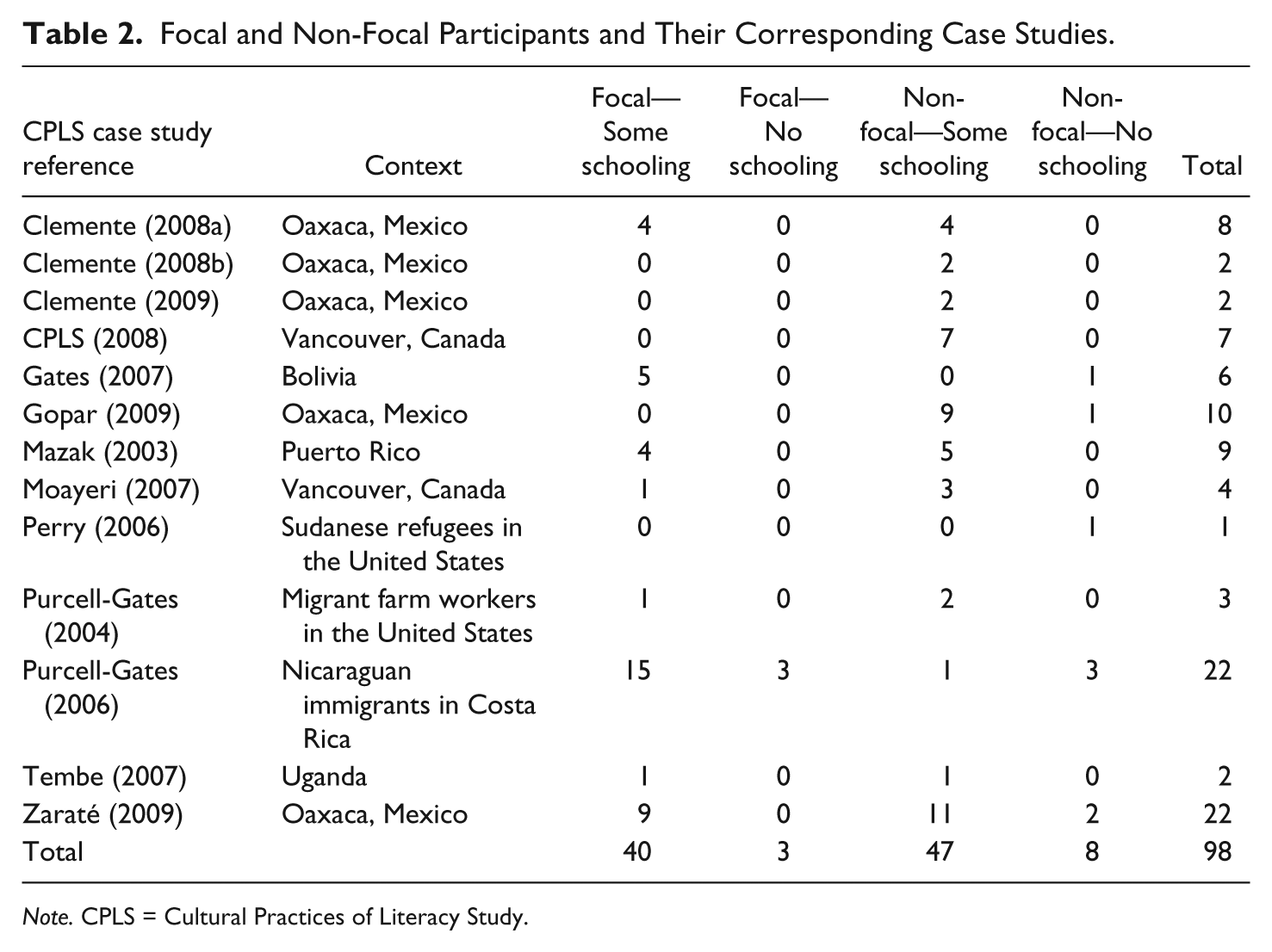
Note. CPLS = Cultural Practices of Literacy Study.
Recognizing that several years of primary education is often ample to develop significant literacy abilities, yet wanting to reach our aim of seeking to identify individuals with limited literacy, we worked to mitigate the limitations of this widely inclusive grouping. One way we did this was by looking closely at participants’ statements about their education levels in their transcribed interviews. Many participants specified their levels of schooling or made statements about their literacy abilities, allowing us to make decisions about whether to retain them in the sample. For example, a participant who had 6 years of primary schooling but who indicated significant struggles with reading and writing was retained in the sample; other participants who technically reached that level but with significant gaps or interruptions in education also were retained. In contrast, a participant who attained a similar level of schooling but reported always being at the top of the class and only leaving school because her parents could not afford the fees was eliminated from the sample, because she did not fit our concept of low literate. In this way, we mitigated some of the limitations of having such a wide-ranging category for level of schooling attained.
Data Analysis
For this analysis, we first searched the CPLS database for all literacy events in which adult participants with little or no schooling engaged, limiting the results to the social activity domain and the purpose for which they read or wrote. These search parameters offered a description of the reading and writing done for a variety of purposes in participants’ daily lives. Initially, we limited the search to only focal participants. However, it became clear that expanding the search to include non-focal participants would provide a richer, fuller description of the literacy practices in which low-literate adults engaged in these contexts.
The initial analysis provided a general overview of the literacy practices of adults with limited or no formal schooling across the CPLS database. We queried the database to identify both (a) the social activity domains in which these participants read or wrote, and (b) the purposes for doing so. We compiled complete lists of both social activity domains and purposes, including categorizing the purposes by domain, and then began to read through these lists for domains and purposes that stood out to us for some reason. For example, we initially focused on domains related to entertainment and spirituality, because these seemed to describe literacy practices that were outside the realm of typical conceptions of functional literacy.
Turning our attention to purposes instead of domains proved to be a more useful way of examining the data, and we listed all of the purposes for reading/writing for all participants, highlighting ones that stood out to us as unexpected. Each of us performed these initial read-throughs separately, before comparing notes, then resolved any differences and created final lists of purposes to be included in the analysis. We categorized these highlighted purposes into several themes or areas, some of which overlapped with domains: (a) literacy-related purposes (e.g., “to help children read”), (b) spirituality (e.g., “to thank God”), (c) entertainment (e.g., “to imagine cooking different dishes”), (d) personal/artistic expression (e.g., “to reflect on life and personal relationships”), and (e) community participation (e.g., “to organize a social event”). At this point, we noticed that the theme of literacies for personal fulfillment crossed several of these categories and social activity domains. Because personal fulfillment was a less expected literacy practice, we sought understanding about how this theme shaped literacy practices for these individuals who are often described as low literate. We listed all of the texts that had been read or written with respect to these literacy events and developed separate lists of purposes for reading and writing.
Literacy practices data from the CPLS database cannot be used in isolation from the contextual data provided in the Atlas.ti hermeneutic units. To contextualize the identified literacy practices, we returned to the original data. Because many of the literacy events in question occurred within cases based in Oaxaca, Mexico, in which the data were recorded in Spanish [Clemente, 2008a, 2008b, 2009; Gopar, 2009; Zaraté, 2009], we asked a native Spanish-speaking member of the CPLS team to translate the identified literacy events and also provide English overviews of each participant and his or her context. We delved into the contextual data by first identifying participants within each case study for whom multiple relevant literacy events had been selected; these participants represented rich examples in that they reported reading or writing (or were observed to have done so) for a variety of purposes related to personal fulfillment. To understand how these literacy practices were contextualized, we read each participant’s interview transcript and any additional field notes that were associated with that case and then compiled a narrative “portrait” of that participant, which included (a) the participant’s background, including any formal schooling experiences they had; (b) a description of their overall literacy practices; and (c) any statements they made about their own abilities or beliefs/values related to literacy.
Once these individual participant portraits were developed, we read through them several times to develop codes and categories for further analysis and loaded them into a new Atlas.ti hermeneutic unit for coding. Examples of new code categories included literacy statements (e.g., dislike of reading), dealing with life (e.g., escape/distraction or facing problems), and prioritizing personal literacies (e.g., making time or spending money). Once this final level of coding was completed, we were able to examine the data across participants and across cases for further patterns.
In keeping with Miles and Huberman’s (1994) suggestion to mix case-oriented and variable-oriented approaches to cross-case analysis, we will present our findings in a way that highlights our use of both strategies. Each major theme will be introduced using a rich portrait of a participant from one of the included case studies that highlights an important theme that we identified across cases; it is important to note that this individual portrait is of one participant from a larger case study, rather than being the entire case itself. We selected the particular individual participant portraits because they were exemplary with regard to the theme that was identified across all of the included cases. Following the individual portrait, we will incorporate data from other cases to illustrate how that theme is instantiated across cases.
Findings
Through our analysis, we identified several patterns related to the deeply personal literacy practices of participants across the 13 cases taken from the CPLS database. One major theme, coping with life, illustrated the ways in which participants used texts and literacy practices as a way of dealing with the difficult life circumstances that they faced. For some, literacy practices were a way for them to directly face problems, whereas for others, those practices provided a much-needed escape from their daily realities. Many of these practices connected with spiritual or religious domains of activity or with participants’ attempts to make sense of their lives. Another major theme had to do with entertainment, or what Barton and Hamilton (1998) referred to as literacy practices for “leisure and pleasure.” Across all of these themes ran a strong undercurrent related to participants’ marginalized status, reflecting the ways in which their practices connected with other aspects of the contexts in which they lived.
Coping With Life
Literacy practices served an important function in helping CPLS participants across cases cope with the difficult aspects of their lives. Although most of the case studies in the CPLS focus on marginalized communities, adults with limited or no formal schooling in these contexts were often especially marginalized. These participants described lives that were challenging and characterized by daily struggles to make ends meet and care for their families. Participants, thus, often engaged in literacy practices of and for the self as a way to either escape their daily realities or to cope with them. For example, one Zapotec-speaker in Oaxaca noted that she read the Bible, newspapers, and magazines as a way of passing the time [Zaraté, 2009]. She explained that she read to be entertained and relaxed and to be distracted from her everyday problems. In the following sections, we highlight participants from two different cases: Raúl from Mexico [Clemente, 2008a] and Claire from Vancouver [Moayeri, 2007].
Raúl: “My mind goes far away.”
Raúl was imprisoned in Oaxaca, Mexico; prior to his imprisonment, he had been a street cleaner [Clemente, 2008a]. Raúl had completed some elementary school, had good memories from his schooling, and noted that he was good with math. He stated a belief in taking advantage of all of the learning opportunities life offered; thus, he was working on classes through videos and distance programs in prison to become a skilled tailor. In addition to positive memories of school, Raúl also held a positive literacy perception of himself: he had had many books in his home, recalled reading comics as a child, and described his parents, Godparents, and friends as readers. Raúl seemed to equate reading and writing with learning.
Much of Raúl’s interview focused on the ways in which literacy shaped his life in prison. It might be rather more accurate to say that literacy connected him to his life outside of prison: Raul’s deeply personal literacy practices appeared to provide him with a metaphorical escape and with the means to cope with the challenges of prison life. For example, Raúl explained that it had become almost impossible to talk with his daughter over the phone because she cried every time she spoke with him. However, she had once written something for him, which he had framed and pinned to the wall of his cell. He read those words every day, claiming they made him stronger. Raúl also described reading any other text he could get hold of in the prison.
Writing provided an even more powerful coping/escape mechanism for Raúl. His job within the prison was to sew soccer balls together, and when no one was looking, Raúl wrote poetry and messages inside the balls, all of which came from his own personal inspiration (see Figure 1).
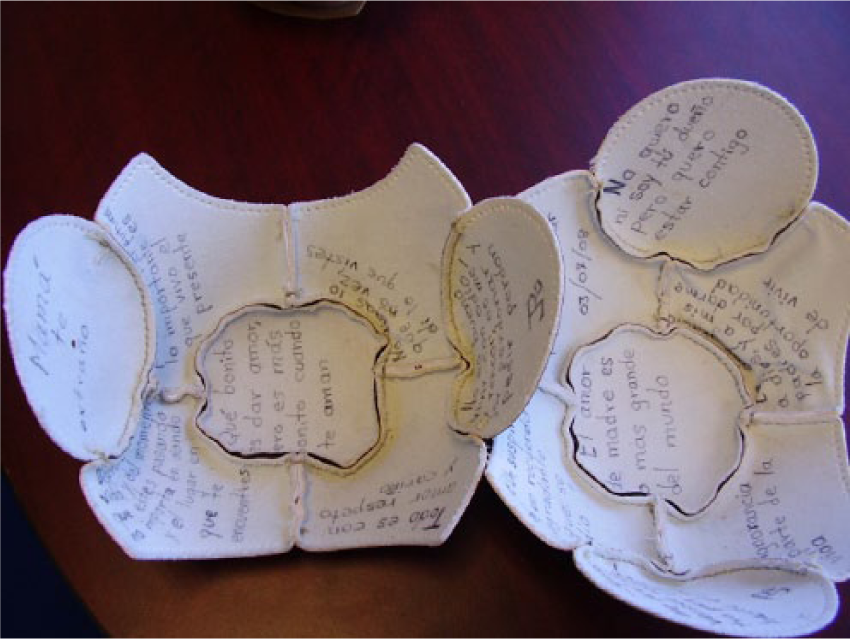
Raúl’s poetry and messages written inside soccer balls he sewed.
When the researcher asked Raúl about this writing, he explained that he often thought about his children and other good things: I think about many different things . . . my mind goes far away. I get out of here, of this place where I am now. When I write I do not feel I am in prison anymore. I think about nicer things regardless of who is next to me, who is looking or who criticizes me, who teases me or who mocks me or talks about me. I don’t care about that because my mind is not there anymore and I don’t hear . . . the bad words they say to me. When I come back, that’s when I start to see the reality and how we are and how we do not strive to be better and move forward.
Raúl’s words show the power that a personal literacy practice held for him to cope with what must have been a very difficult situation. His writing represents a clear example of a literacy practice that is truly of and for the self: Raúl wrote his poems and messages inside the balls, and it was unlikely that anyone would ever see them. Nevertheless, Raúl was driven to cast inspiring messages to the world outside his prison walls.
Coping with incarceration
The theme of jail, detention, and other incarceration cropped up frequently across cases in this analysis. Of course, one of the case studies was performed in a jail in Oaxaca [Clemente, 2008a]; naturally, incarceration was an important theme in that case. However, jail/detention was mentioned by participants in other cases as well, including Claire [Moayeri, 2007], whose portrait appears next. For many of the participants in the Oaxacan prison [Clemente, 2008a], literacy was a means of coping. One prisoner mentioned that he read many books across a wide range of interests, including history, Spanish, politics, math, sexuality, human physiology, and health. Another discussed being part of a reading group with prison mates, although we do not have details about what that group read. This same participant also enjoyed writing; when he had the time, he wrote poems and songs in his cell, some of which described his experiences in prison and the reasons why he was there. Thus, for Raúl and other prisoners, literacy practices of and for the self provided a metaphorical escape from the confines of prison. As one incarcerated Oaxacan participant explained, reading kept his mind busy with “productive things.” Reading books or messages from loved ones and writing poetry, songs, and inspirational messages appeared to help these prisoners focus on the positive and develop a sense of themselves as humans with agency.
Claire: “I’m trying to get a book together.”
Claire was a First Nations woman who lived in Vancouver, Canada [Moayeri, 2007]. Like other participants in this analysis, Claire’s life was extremely difficult; for her, literacy practices of the self represented a mechanism by which she made sense of her past and moved forward. Claire had spent part of her childhood in one of the notorious residential schools for First Nations children, was in juvenile detention as a teen, and also was incarcerated as an adult. As Claire explained, her schooling was brief and frequently disrupted: My education didn’t go too far . . . We were sent to residential school. I was only in school I think for half a year, in grade one . . . and then they took us to the residential school . . . After my mom took us out from the residential school . . . I was only at home with her for a month and a half before they put me in a, what do you call that, detention hold when I was twelve . . . I’d go to school for a while and then from there I ran [away] and that was it.
Claire spent time living on the streets, and her five daughters were taken away from her “because I never had any parenting skills.” She added, All I did was drink out there [on the streets] and whatever. And then I ended up, like, I was going in and out of jail too much, so I just figured while I was in there, I’d do something
toward furthering her learning. At the time of her interview, Claire appeared to have turned her life around: She had a young son who was living with her at home, she volunteered as a cook at a day care, and although she was not currently enrolled in any educational programs, she explained that she was “trying to educate myself, that’s why I have the dictionary and some books, because I quit school a long time ago.” Claire showed her interviewer certificates she had earned while in jail, including one for Bible studies and another for a “change-your-life seminar.”
Despite her efforts at self-education, Claire felt she struggled with literacy. Reading had been very difficult for her in school: “I sometimes couldn’t say the words. . . . It was hard for me to read.” Now, she sometimes needed help in understanding documents the government sent her regarding her time in the residential schools. She explained, Actually, I just got one here yesterday . . . for the residential school . . . Uh, I read a bit of it yesterday. Well, I had to phone my niece up last night to ask her what, and I told her I didn’t understand too much of it.
Claire also preferred to rely on oral language to get information, such as making phone calls to “the dentist or something where, what if [my son] gets sick, like where, which doctor I can take him to, that sort of thing,” or stopping in to get information on the “school over here, because I might try it . . . I stop in there when I’m on my way to take [my son] to school.” Indeed, she had learned about the school via word of mouth from a friend: “There’s this girl I know, goes to that upgrading school upstairs at . . . the library . . . She’s the one who told me about that, so I’m going to go see how it is.” Claire’s use of oral language to gain information contrasted with her clearly purposeful use of oral language as part of her spiritual practice and First Nations identity. Oral traditions were especially important to Claire’s spiritual practice. She explained, “In our tradition, like things are not supposed to be written down . . . so if some other person like you, if you need to know about our spirituality, you’ll have to go there and experience it for yourself.” For Claire, then, oral language played an important role in her life, both as a means of accomplishing everyday tasks and as a significant part of her heritage and spiritual self.
Despite her perceived literacy difficulties and her preference for oral language, Claire engaged in a wide variety of deeply personal literacy practices. She enjoyed reading both novels, such as those by Stephen King, and non-fiction books for relaxation. She showed the interviewer several self-help books that she was reading, including The Art of Selfishness (Seabury, 1983) and Feel the Fear . . . and Do It Anyway by Susan Jeffers (2006). Claire also wrote a great deal for predominantly personal purposes, although she only described herself as writing “a little.” In addition to keeping a diary, she wrote poetry that was grounded in her personal experiences. Claire showed a large sheaf of poems to her interviewer, who noted that at least one of Claire’s poems was on the topic of “the path to healing.” “All of this,” she explained, “was like the life I was living on the street and all that.” Her writing also used First Nations imagery and her “Indian name,” which Claire explained had been given to her by a tribal elder in a sweat lodge. In fact, Claire had been writing poetry for years—“I started way back in 1992 or 1993”—and she was “trying to get a book together” of these poems. She had typewritten her poems until her typewriter had broken, and the rest were handwritten. These challenges, and the fact that she only had one copy of her poems, did not deter Claire: “I’m going to try and get this published.”
Although Claire reported using oral language in part because she had difficulty with some everyday literacy tasks, such as making sense of government documents, literacy practices clearly represented an important tool in facing the challenges of her life. She purposely read to understand and improve herself, and she engaged in a great deal of writing that represented both her identity and the attempt to make sense around her extremely difficult life experiences. Although Claire hoped to make her writing public, this writing, like Raúl’s soccer ball poetry [Clemente, 2008a], represented literacy that was clearly of and for the self.
Facing problems
Other participants across cases also used literacy as a means of facing their problems. For example, one Oaxacan man explained, I read the Bible, because it talks about a lot of things . . . I read it because it helps me, with all the problems right now that need a solution. It helps me to understand what is going on, have respect to people and see what is good in them and then be able to interact with them. The Bible helps me face my problems, and to be in peace with the people who surround me. [Clemente, 2008a]
A woman in the same context similarly explained that reading the Bible helped her extend prayers to her children that might protect them from problems.
Participants also explained that, like Raul and Claire, writing was an important way of coping with problems. One Oaxacan woman described a particularly challenging life in which many of her family members had died. Although she felt she was a poor writer, she nevertheless kept a journal that attempted to make sense of these terrible experiences: I sometimes write. I have a small notebook, but I do not write on it every day. But I do write. Sometimes I write my name, and I write why did that happen to me? Why did that happen to us? Why me, why do I not have my brothers anymore? Why did my brother die? I have my little notebook but as I say, I do not write well, but I write small bits, I write letters, I write about things that happen to me, about my brother and my mom and why we cannot be happy, why God took my brother away from me. [Zaraté, 2009]
This Oaxacan woman’s belief that her personal writing was not “real” writing was echoed by many participants across cases. For example, one Nicaraguan woman in Costa Rica explained that “sometimes when I feel stressed out, I write down about what’s going on in my life, things I would like to improve and offer to my children. Silly things” [Purcell-Gates, 2006].
We found it to be very interesting that participants would belittle this type of writing that was deeply personal and so clearly meaningful to them. Because the focus of CPLS interviews was on capturing overall literacy practices, there was little opportunity to follow up on these kinds of comments. Thus, we can only speculate as to why participants felt that this type of writing was “silly.” Perhaps they saw it as somehow different from the work of “real” writers or from the academic writing that some of them may have experienced in schools or observed others engaging in. Perhaps they felt that their writing abilities were not good enough to be considered real writing. Or perhaps they felt it was selfish to take time for themselves. No matter the reason, however, what is significant is that these participants felt the need to qualify their personal writing as somehow lesser, and because literacy practices are connected to beliefs, values, and attitudes, these statements provide insight into the practices themselves.
Enjoyment
A final type of literacy practice for the self that was important across many contexts was the practice of reading for enjoyment, relaxation, or fun. Literacy practices in this category sometimes were similar to or overlapped with practices for purposes of escaping from or coping with the difficulties of life. These practices were particularly interesting to us, because many participants carved out time from their otherwise busy lives to find time to read or write, whereas others scrimped and saved to be able to purchase texts to read for enjoyment. A Bolivian woman, Catalina [Gates, 2007], represents a rich portrait for this theme.
Catalina: “Because they are funny.”
Catalina, like many participants, had a challenging life. She grew up in a home with parents who were illiterate 2 : “My mother didn’t know how to read and write. I didn’t meet my father because he is dead” [Gates, 2007]. However, Catalina herself was able to attend school until almost the sixth grade. Following this, she “wanted to study hairdressing and she was studying when she was a kid, a teenager.” Catalina got married young and was pregnant very quickly, and “I couldn’t finish those studies of hairdressing, either.” At the time of her interview, Catalina was a housewife who stayed home to care for her children.
Like many participants with limited schooling, Catalina held a rather mixed perception of her own literacy. She thought of herself as a poor reader and writer, yet she also found reading to be enjoyable. When the researcher asked how she felt about reading and writing and whether she found them useful or enjoyable, Catalina replied, Yes, of course I find it useful, and I enjoy reading. I like reading, but I do not have that much knowledge, and I cannot write so well or read so well. Especially when my kids bring home homework, I cannot teach them. I cannot help them in that level, so I go to a friend of mine at the university, and he helps me teach me a little bit, so I keep it in my head for the next time to help them.
Catalina appeared to equate literacy skills with knowledge, and like many CPLS participants with limited schooling, she struggled with some everyday literacy practices that were important to her, such as helping her children with their studies. Yet, Catalina clearly valued literacy and sought resources, such as her friend at the university, who could provide support. And she, like many participants, sought ways to improve her abilities: What I want is to have a better handwriting, because I didn’t finish school . . . and my handwriting is not very good, so I would like to improve it. I am practicing myself to have a very [nice] handwriting.
In fact, despite viewing herself as a poor reader and writer, Catalina not only was literate in Spanish, she also could “read Quechua a little bit.”
Catalina’s routine literacy practices supported her statement that she found reading to be both useful and enjoyable. She participated in Bible study groups through her church and also described reading while watching TV: “I always read when I watch television, because the film comes in English and the subtitles come in Spanish, so I read it almost all the time.”
Interestingly, the cost of particular texts was a theme reflected throughout her interview, suggesting that Catalina made careful choices about what she read partly on the basis of expense. She explained, for example, that she read tabloid newspapers in part because they were cheaper than “regular” newspapers: We have a regular newspaper . . . and then there is another very cheap newspaper called Gente or Extra, and it is really—well, it is one boliviano, which is cheap, but the news is not news. They are, well, yellow news.
When the researcher questioned what this meant, the translator explained that the news reported in these papers was mostly sensationalized crime stories. Catalina added, “There is a guy who comes by on a bicycle offering all these kinds of newspapers, and I always buy it every day.”
Cost was also a theme for another text that Catalina regularly read, a Chilean comic called La Condorito. An excerpt of Catalina’s interview transcript is illustrative:
They are very old, again all these magazines she is talking about are very old. As they are very old, they are sold for 30 cents, not even 50 cents. But they are very old, but anyway we read, no?
And she just does this for herself, for entertainment for herself?
All my four kids are here, no? So I feel by myself very alone, so what I do while I’m cooking, while I’m preparing my vegetables and everything, I start reading these magazines and jokes. I like them because they are funny.
Catalina’s explanation for why she reads these texts is somewhat unclear. One interpretation is that she feels lonely during the day while her children are at school; another is that she seeks some personal quiet time away from the business of caring for four children. Either way, Catalina’s purpose is clear—she read for enjoyment, because she sought the humor.
Humor played a role in another of Catalina’s regular literacy practices. She explained that she enjoyed solving word puzzles in the newspaper: “I also like to fill out the answers of those funny questions in the newspapers, and also the crossword puzzles.” When the researcher asked, “I see, like little quizzes?” Catalina affirmed this, “Yes, but funny ones—very funny ones.” Catalina’s repeated references to reading things that were funny, coupled with her explanation about reading when she is alone, help to illustrate the importance of this reading for her. Catalina is not simply reading because she likes to read; her reading and her particular choice of texts are a purposeful way to gain pleasure from life.
Entertainment and relaxation
A variety of practices exist in any context that might help individuals cope with difficulties, escape their problems, or simply relax and enjoy themselves. What seems significant is that Catalina and other participants purposefully selected personal literacy practices as a tool to accomplish those goals. Reading and, less frequently, writing for purposes of relaxation was a strong thread throughout our data across contexts. This finding should not be surprising, in part because literacy practices for relaxation purposes was something that all CPLS researchers investigated through the common interview protocol. Yet, we were nevertheless surprised that so many participants with limited or no schooling read for this purpose. We assumed—clearly erroneously—that these participants would not engage in these types of literacy practices, given their backgrounds and contexts.
All of the highlighted participants—Nina, Raúl, Claire, and Catalina—engaged in reading or writing practices that they clearly found to be entertaining and/or relaxing or an enjoyable way to pass the time, as did many others across cases. One woman in Oaxaca explained that for entertainment and relaxation she read “storybooks or texts that she can understand and be distracted from everyday problems” [Zaraté, 2009], whereas an Oaxacan male prisoner similarly stated that he read to entertain himself and relax [Clemente, 2008a]. Reading or writing to pass the time was an interesting theme, indicating that participants found literacy to be a useful tool. A Nicaraguan woman explained, “Well, on my free time, I like to read the Bible, and I like to write down notes about everything I read in a chapter. That’s how I pass my time” [Purcell-Gates, 2006]. Clemente [2008a] noted that a prisoner “writes poems to kill time. Sometimes he finishes them and sometimes not, and they are not for anybody in particular, just to relax himself.”
When asked what they read or wrote for entertainment or relaxation, many participants immediately stated that they read the Bible for this purpose. Given that the Bible might be the only accessible text in some contexts, this finding is not necessarily surprising. What is important, though, is that participants appeared to be reading the Bible for purposes that went beyond religious ritual or obligation; that is, they found reading the Bible to be a meaningful way to spend their free time. One Oaxacan researcher noted that a female participant “has a prayer book, and she reads that to relax and pass time” as well as “to extend prayers to her kids and protect them from problems” [Zaraté, 2009]. This woman clearly differentiated the purposes for which she reads her prayer book: One function was practical, to pray for protection, whereas the other was a deliberate choice for spending her free time. A Nicaraguan man also read the Bible for pleasure and similarly distinguished this practice from religious obligations: “I actually almost never go to church. I mean, we attend the Evangelic Christian church, but we seldom go” [Purcell-Gates, 2006].
In addition to reading the Bible, many participants, especially Nicaraguans living in Costa Rica and Bolivians, explained that they also liked to read the newspaper for entertainment and relaxation. For example, a researcher noted that one Bolivian woman read newspapers like La Gente, Extra, and Opinion: She likes to . . . take a rest and take a break from the housework. She reads the news, sports, and does some of the puzzles and cartoons. She also likes to read the Reader’s Digest. She especially enjoys the biographies of singers and reads about famous weddings and things like that. [Gates, 2007]
One Nicaraguan stated that her favorite part of the newspaper was the horoscope predictions, whereas another, like Catalina, liked reading tabloid newspapers for entertainment. However, this participant also said, “It’s not good to read this a lot . . . it exaggerates in everything it says!” [Purcell-Gates, 2006]
Discussion
We have highlighted the importance of specific, personal literacy practices in the lives of four particular participants in different contexts and shown how those practices also occur across worldwide cases. Here, we turn our attention to discussing important themes that we identified in our cross-case analysis, as well as discussing the ways in which cultural differences across cases might have influenced the themes. These themes include the continued importance of oral traditions, practical considerations that shaped personal literacy practices for participants, and the ways that participants’ perceptions of themselves also may have shaped these practices. Finally, we discuss implications of these findings for understandings of literacy and for adult literacy instruction.
Oral Traditions
Just as with Claire, many participants across cases indicated that they relied on oral practices and that, in many cases, oral traditions were still very important to them. For example, one Nicaraguan woman indicated that she kept her grocery lists in her head and that she talked to others to learn new information [Purcell-Gates, 2006]. A Sudanese refugee described the importance of oral storytelling: Nighttime, we come together . . . My mom, she’s sitting, and we sit round to her, and she say a story for us. So like to say stories . . . all stories about the grandma and grandpa. Long stories, she always liked to say. Just we listen to her, and we are tired because of it! [Perry, 2006]
Participants’ reliance on oral language strategies aligns with other research investigating adults with limited literacy (e.g., Fingeret & Drennon, 1997; Purcell-Gates, 1995).
Although the importance of oral traditions was clear across contexts, the nature of those traditions was mediated by individual cultural context. Although some individuals may rely on oral strategies because their literacy skills are not sufficiently developed, participants’ comments indicate that certain oral language practices hold deep and particular meaning in their specific communities, such as storytelling, passing along family history, or engaging in religious experiences. This reliance on oral language also may be a common response in communities that have a history of oppression by other groups. White-Kaulaity (2007), for example, notes that active rejection of the written word has been common in Native American (or Canadian First Nations) communities: Because the written word was so often used to discredit Native American culture or rob us of our rights, writing and reading are considered by some to be “white man’s” activities. Oral tradition is much more valued in Native communities. (p. 561)
White-Kaulaity argues that this rejection may be particularly strong for those, like Claire, who were educated in the oppressive residential schools: “The history of Indian education indicates that instruction in the white man’s reading and writing came with damaging practices of indoctrination, assimilation, and colonization” (p. 561).
For some, oral practices may be purposefully maintained without a need to incorporate written texts. As White-Kaulaity (2007) notes of Native Americans, “They are masters of oral literacy. Unless there is a specific purpose, they choose not to bother with print literacy” (p. 560). For others, literacy practices of the self may be a natural textual addition to the existing oral practice. Such new literacy practices may be especially important for those who are separated from their roots and families of origin, such as the participants in this study who were immigrants or were incarcerated. What is important here is the emphasis on purpose, indicating the agentive ways in which participants, regardless of context, choose which literacy practices are meaningful in which to engage.
Practical Considerations
Another theme throughout the data was that the circumstances of participants’ lives often constrained their literacy practices in specific ways. When asked about reading or writing, participants often explained that their lives were occupied by the requirements of family survival, and they had little time to read or write as a result. For example, when asked if she read novels, one participant explained, A little, not always, because I come home very tired. I work in two houses, and I get home very tired at night . . .. It’s a long way. I need to take two buses down this avenue and then walk here . . . We get home almost at seven; it’s very hard. [Purcell-Gates, 2006]
She then described the responsibilities she had in caring for her son who was developmentally delayed and needed extra care. Having little time for literacy was frequently mentioned by Nicaraguans living in Costa Rica [Purcell-Gates, 2006], the case that also held the largest number of adults with limited or no schooling, although one Bolivian woman also noted that she had little time to read much beyond the Bible because she had to take care of her own household in addition to working as a baker [Gates, 2007].
Despite these struggles, many participants described carving out precious time for literacy practices. One Nicaraguan woman said, “I read the Bible a lot, but I do it at night because during the day I really don’t have the time,” whereas two others described reading newspapers or the Bible the first thing in the morning before work [Purcell-Gates, 2006]. Given participants’ daily challenges in these contexts, carving out specific time to read or write suggests they felt these practices were important.
Many participants, especially Nicaraguans living in Costa Rica [Purcell-Gates, 2006], referenced the high costs of buying reading or writing materials, an important theme also highlighted in Catalina’s [Gates, 2007] portrait. When asked about reading the newspaper, one woman explained that she did not read it because “it costs a lot of money and I don’t, can’t afford that. It’s an unnecessary luxury” [Purcell-Gates, 2006], whereas another said, “Well, we don’t buy it. I read it at work, when people leave it there and I find it the next day. I skim through it, and if I find something interesting I read it” [Purcell-Gates, 2006]. If something interesting was happening, she would bring the newspaper home for another family member.
Other participants described particular personal literacy practices as being cost-effective or a good investment. One Nicaraguan woman explained that she wrote letters to family members instead of calling “because it is cheaper . . . Each phone card is ₡1,000 or ₡2,000, and with ₡1,000 you cannot speak for very long, so you need to keep on buying cards. It is much better to write” [Purcell-Gates, 2006]. Another woman in the same context described being in debt for purchasing books and notebooks for her children: I owe money right now because I have not paid for them yet . . . They cost me ₡20 thousand. I am paying for them in installments because I can’t do it any other way, and they needed them because they were getting low grades . . . These are the notebooks they use now for homework and for their stuff. [I am] poor, but I do what I can for them. [Purcell-Gates, 2006]
These women’s comments suggest that money is part of participants’ careful decision-making about specific literacy practices.
Practical considerations necessarily play a role in any person’s decision about whether to engage in a specific literacy practice; such practical considerations are not limited to adults with limited or no schooling. These examples, however, highlight aspects of practices that may be hidden in other contexts. As our analysis across international cases suggests, individuals must balance the realities of their daily lives with practical considerations like time and money to make decisions about reading and writing in general. These considerations may take on even greater significance when participants consider deeply personal literacy practices, which they may or may not perceive to be as essential to their everyday lives.
Literacy Perceptions and Goals
Participants’ perceptions of their own literate abilities were another clear theme throughout the case studies. Despite how much they valued the meaning they gleaned or created through literacy practices, participants’ perceptions were often rooted in discourses separate from their own current life experiences. Moreover, these perceptions often appeared at odds with participants’ actual practices.
CPLS participants in this analysis frequently made clear statements about their literate selves. Individuals across differing case contexts often stated that they read and wrote very little in their lives but, on further exploration, did engage in everyday literacy practices. For example, a Nicaraguan woman insisted that she did not know how to read or write—“nothing at all”—but then added, “Well, I read, but not like you. I don’t write at all…For example, if I see a sign I read it, but word by word and I try to put them together. But I can’t read well” [Purcell-Gates, 2006]. Formal schooling—or the lack thereof—connected with many participants’ negative literacy statements. One Nicaraguan woman had no formal schooling, and neither had her parents, although all of her siblings went to school. She explained, “All of them know how to read and write. I couldn’t go to school . . . They all went to school; I am the one who does not read or write” [Purcell-Gates, 2006]. For those with some formal schooling, their negative literacy perceptions often appeared to result from struggles in school. One Oaxacan woman explained that she did not see herself as a bright person: “My head is not good. I could not learn” [Zaraté, 2009]. The researcher in this case noted that “all her comments are followed by something like ‘I do not write very well’ or ‘I cannot understand many things.’” In some contexts, difficulties with literacy may have been the result of migration or disrupted schooling. One Nicaraguan woman explained that she had had difficulties in school when she immigrated to Costa Rica: “I went to school and I studied, but it was hard for me, because school here [in Costa Rica] and in Nicaragua is very different” [Purcell-Gates, 2006]. An Oaxacan participant’s negative literacy perception was directly related to family attitudes: as a child, his brother would take away the books he was reading and insist that he was wasting his time [Clemente, 2008a]. Statements like these indicated that participants often did not see themselves as readers and writers; yet, many nevertheless engaged in the literacy practices of the self that we have documented.
Although participants in a variety of cases had carried negative literacy perceptions since childhood, it was also clear that such perceptions were not always static or were mixed. For one Oaxacan prisoner, the distinction between writing in school and writing for himself made all the difference: “At school, you do what the teacher says, and now I write whatever I want, what comes to mind” [Clemente, 2008a]. For others, positive literacy perceptions were directly associated with learning and schooling. When asked about literacy practices in her family of origin, one Nicaraguan woman said, “I don’t remember they read anything at all. They didn’t read . . . The one who read a lot was me, because I was at school and I liked to read books” [Purcell-Gates, 2006]. Several participants in very different contexts had taught themselves to read and write; much of this self-teaching was associated with reading the Bible, as it had been for Nina. A Sudanese woman who had completed primary schooling described her own mother, who had no schooling at all but had taught herself to read the Nuba language. She could not understand how her mother or other older people in the Nuba Mountains region of Sudan had learned to read and write without formal schooling: I’m confused about how the old people they know how to read the Bible, because in my country, they’re not—I don’t see they teach us Nuba Mountain language. But my mom, even she don’t read, but she know how to read [the Bible]. I don’t know. [Perry, 2006]
One Nicaraguan man had some limited schooling, as had his parents before him. When asked about his childhood and his parents’ literacy practices, he explained, “Well, my father, he never read, he never had a teacher. He learned how to read the Bible. The Bible taught him gradually because he was interested in God. So he learned, and he reads and writes very well” [Purcell-Gates, 2006]. Reading for religious purposes is an important motivation for many to learn to read (e.g., de la Piedra, 2010; Purcell-Gates & Waterman, 2000), and this was certainly a trend in our findings. However, it was also clear that cultural context played a role in shaping religious motivations to become literate; developing religious literacy practices was important in Christian contexts, such as Mexico, Nicaragua, and parts of Sudan, whereas Claire [Moayeri, 2007] made it very clear that spiritual literacy practices were inappropriate among Canadian First Nations. Nevertheless, coupled with findings about the continued importance of oral practices, these findings about participants’ literacy perceptions suggest that reading and writing for personal purposes—as opposed to more typically instrumental purposes—may have been what impelled many of them to become literate in the first place.
Indeed, many participants across cases described literacy goals that were related to personal purposes. For example, one Oaxacan prisoner was motivated to learn English so that he could communicate with family members who lived in the United States [Clemente, 2008a], whereas an indigenous Oaxacan thought that both children and adults in his community might be interested in taking Zapoteco writing workshops [Zaraté, 2009]. Similarly, a Nicaraguan in Costa Rica said that if a community literacy class were offered, she would like to attend “to learn more and be someone in life, even if I’m old” [Purcell-Gates, 2006]. For these participants, improving language and literacy skills was not necessarily about work, family care, or other purposes of “survival.” Rather, their motivations appeared to be more personal, related to identity, self, family, and community.
Implications
In this cross-case analysis, we sought to understand both (a) the literacy practices in which adults around the world with limited or no schooling engaged for personal fulfillment and (b) what these practices reveal about the nature of literacy for individuals who are often characterized as illiterate or low literate. CPLS data reveal that adults in various marginalized contexts who have limited or no formal schooling engaged in several literacy practices that were of and for the self, including reading and writing practices related to coping with or escaping from difficult life circumstances, personal development, and entertainment or relaxation. Although many of these participants perceived themselves as poor (or even non-) readers and writers, these findings challenge dominant stereotypes that conflate limited schooling with illiteracy, illustrating that adults worldwide used literacy for purposes that went beyond the supposed necessities of everyday life. Instead, participants carved out time from busy days or scrimped and saved money to engage in practices that held personal meaning, practices that were not, on the surface, about the effective functioning of the family or the community. Many of these practices were hidden, figuratively (e.g., practices that interviewers had to push to uncover) or literally (e.g., Raúl’s messages inside soccer balls [Clemente, 2008a]). And, although these practices often held important meaning for participants, they often belittled themselves in describing the practices as “silly” or somehow not legitimate reading or writing.
Revisiting “functional literacy.”
One important implication of these findings across international cases is that current assumptions about literacy and adults with limited or no schooling must be challenged. Dominant discourses, as St. Clair and Sandlin (2004) noted, characterize adults with limited schooling and/or presumed low levels of literacy as unworthy, unfit, and unproductive—as somehow lesser. These discourses also assume that such adults need specific educational interventions to develop particular literacy skills that will help them “function” better as productive members of society; indeed, these discourses are echoed even in U.S. K-12 schooling contexts that currently focus on generating students who are “college and career ready,” in which the nation’s economic vitality is viewed as paramount.
Recall that functional literacy is typically defined as “using printed and written information to function in society, to achieve one’s goals, and to develop one’s knowledge and potential” in the United States (Baer et al., 2009, p. 3), while it is internationally defined as engaging in all those activities in which literacy is required for effective functioning of his (or her) group and community and also for enabling him (or her) to continue to use reading, writing, and calculation for his (or her) own and the community’s development. (UNESCO, 2005, p. 22)
These definitions leave open a wide variety of literacy practices, including those in which individuals may engage for purely personal purposes. However, perhaps as a result of dominant discourses that privilege economic functioning, personal or individual aspects of functional literacy have been overlooked or subsumed in favor of literacy practices that are connected to more economically defined functioning and development. As Houp (2009) argued, societal motivations for “literacy as a religious moral gave way to literacy as a democratic moral. All the while, official definitions and policies concerning literacy continue to favor economic productivity” (p. 699). More importantly, these definitions ignore individual goals and focus on societal goals, reflecting Brandt’s (2009) assertion that “people throughout history have acquired literacy pragmatically under the banner of others’ causes” (p. 27).
Another reason that the personal/individual development aspects of these definitions may have been overlooked is that these practices—unlike practices that lead to economic or community development—may be difficult to measure, in part because they are often so hidden, but also because there is little incentive to find ways to measure that which is not valued. Literacy education initiatives tied to these definitions of literacy must meet increasing demands of public accountability, which means that organizations that support literacy development also must increasingly focus on “measurable” (i.e., economically valuable) outcomes.
The results of this analysis of 13 cases of literacy practice around the world complicate and challenge traditional constructs of functional literacy. Increasing the ability of adults with limited or no formal schooling, or those who have limited literacy skills, to support the economic development of themselves, their families, and their communities is certainly an important goal, particularly for adults who seek this kind of change in their lives. However, there also exists a clear need to revisit—and perhaps rethink, redefine, or even reject—current constructs of functional literacy. The literacy practices of and for the self that we have described in this analysis go beyond dominant notions of what functional literacy implies; these practices suggest that what is considered to be “functional” extends beyond day-to-day economic survival to include the survival, functioning, and development of the individual, personal self. Just as literacy is a tool that supports everyday practices that enable adults to provide for themselves and their families, it is also a tool that adults worldwide use to support their own inner functioning—that is, to contribute to spiritual or psychological growth, to develop a sense of identity or heritage, to confront or escape difficult circumstances or experiences, and to relax and seek pleasure in solitude. Indeed, for some individuals, this type of literacy may be foundational for other types of functioning. For individuals like Claire [Moayeri, 2007] and Raúl [Clemente, 2008a], engaging in literacy practices of the self may provide the inner strength to confront the difficult circumstances of their lives and become contributing members of society.
Functional literacy as a construct may not be something that can be absolutely defined; rather than thinking of functional literacy as a set of measurable literacy skills or predetermined practices (e.g., filling in job applications, reading medicine labels, and other practices that are tested in standardized basic literacy assessments), functional literacy should be thought of as always contextualized. Functional literacy should be defined by considering questions such as the following: Which literacy practices are needed? In which context? For whom? And, for what purpose(s)? What is functional would then look different for different individuals in different contexts, and emphasizing purpose may be paramount.
Adult literacy instruction
In addition to revealing the importance of revisiting definitions of functional literacy, the findings of this study offer implications for adult literacy education. In this era of educational accountability, adult literacy programs are affected by the same accountability expectations that are currently driving K-12 instruction (e.g., Chisman, 2011). These expectations prioritize economically based demands for “college and career readiness” at the expense of other educational goals and purposes, such as preparing citizens for democratic participation or development of arts and humanities; even colleges and universities are expected to consult with businesses to find out what qualities those businesses desire in graduates. At a more micro level, adult literacy educators themselves often make assumptions about what students “need” to learn without input from the students themselves (Fingeret & Drennon, 1997). As Horsman (1990) found in her study of Canadian women, “programs are often directed at teaching women ‘functional’ tasks, rather than striving to enhance the meaning in their lives” (p. 105).
A reconsideration of definitions of functional literacy also calls for reconsidering the content of adult literacy instruction. As Houp (2009) notes, one fundamental question for adult education is, “To what degree can the pursuit of programmatic goals accommodate and build on students’ lives, personal goals, and interests, particularly as these interests relate to writing and the desire to make meaning of important experiences?” (p. 698). The significance of personal literacy practices to participants around the world suggests the importance of including these kinds of practices in adult literacy programs. Considering adult learners’ individual goals for learning has always been important (e.g., Houp, 2009; Purcell-Gates & Waterman, 2000), yet increased attention should be paid to considering adults’ goals for personal, inner development alongside other goals related to career development or credentialing. Educators can support learners’ goals toward spiritual and psychological development as well as explorations of identity and family or cultural heritage. Even adult learners who do not initially have specific goals toward personal development may be invited into literacy practices of the self; adult literacy development includes not only new skills but also the development of new literate practices (Daniell, 2003; Fingeret & Drennon, 1997; Purcell-Gates, Jacobson, & Degener, 2004), including reading and writing for the inner self. Thus, adult literacy programs and educators can support the development of new literacy repertoires that go beyond what is assumed to be “basic,” “functional,” or “instrumental.”
In addition to traditional literacy skills development, adult literacy programs can open up spaces for development of personal literacy practices through classroom routines, such as starting or ending each class session with journaling, free-writing, or free reading time. Programs may set up fiction book clubs or non-fiction reading groups around specific topics of interest to learners, such as spirituality, faith, recovery, or self-help. Writing groups, poetry cafes or slams, and publication and distribution of adult learners’ poetry, memoirs, or essays can also encourage development of personal literacy practices. In addition to using students’ own words and experiences to powerfully support adult language and literacy development (Purcell-Gates & Waterman, 2000), these instructional practices may also support participants’ attempts to “re-story” (Houp, 2009) or otherwise make sense of their lives.
Footnotes
Declaration of Conflicting Interests
The author(s) declared no potential conflicts of interest with respect to the research, authorship, and/or publication of this article.
Funding
The author(s) received no financial support for the research, authorship, and/or publication of this article.