




Abstract
We used metastudy and metasynthesis techniques to conduct a discursive review of 101 recent publications on the topic of adult functional literacy (FL). Our purpose was to understand the ideologies shaping current definitions and conceptualizations of FL, as well as how and why FL is researched and assessed as it is. Using discursive review techniques, we analyzed instances of legitimation, dissimulation, reification, and “ofcourseness” to explore the ideological underpinnings of the field. Close analysis of three passages related to theory, research, and assessment illustrates ideological patterns in what “counts” as FL. These patterns are grounded in ideological divisions between cognitive and sociocultural perspectives on FL—the effects of which we traced through our findings on what “counts” as FL, the logics of inquiry that undergird the field, and the ways in which these ideologies shape adult literacy assessment. Our discussion considers the larger implications of these ideologies: What is legitimated or reified, and what is ignored, dismissed, or subsumed, by these ways of conceptualizing FL? We offer future directions and raise important questions that arise from these conclusions.
Ideologies have always undergirded literacy paradigms (e.g., Auerbach, 1991; Janks, 2010; Pearson, 2004; Scribner, 1984; Street, 1984). In 1984, Scribner identified three metaphors reflecting ideological perspectives on literacy: adaptation (i.e., functional competencies), power (e.g., the relationship between literacy and group advancement), and state of grace (i.e., special virtues and intellectual abilities). While each metaphor only partially represented the myriad uses of literacy and the complex factors contributing to it, by 2010 Janks observed that perspectives on literacy had been reduced to the “literacy wars” binary. Debates regarding literacy’s definition go beyond academic significance: As Woodside-Jiron (2004) observed, “a seemingly small assumption grows up to mandated teacher practices and instructional materials” (p. 180).
Ideological perspectives, however, typically are hidden. In a recent content analysis of literacy journals, Parsons, Gallagher, and the George Mason University Content Analysis Team (2016) found that 76% of articles did not explicitly name theoretical perspectives (one manifestation of ideology) driving their literacy research. The implicit nature of most frameworks reflected “thought collectives,” paradigms representing “assumptions held by groups of scholars within the same discipline” (p. 476). Yet, the authors found that sociocultural, cognitive, and new literacies were the most common explicit frameworks in literacy research, suggesting that the field does not share a common set of assumptions. In fact, they concluded the field is “fragmented” (p. 476)—literacy research represents not one paradigm, but many.
Research also reflects particular ideological perspectives on adult learners themselves, and researchers often characterize low-literate adults in ways that may be infantilizing or even dehumanizing (Belzer & Pickard, 2015). St. Clair and Sandlin (2004) similarly argued that literacy and education policies have positioned low-literate adults as lacking “the personal characteristics of hard working, upstanding citizens” (p. 47). Thus, examining ideologies in literacy research becomes imperative.
To understand the ways in which “a seemingly small assumption grows up” (Woodside-Jiron, 2004) in adult literacy, we focus our ideological critique upon the construct of functional literacy (hereafter FL). The construct of FL matters, in part because of its applications in so many sectors of U.S. society. During World War II, the army coined the term functional literacy to indicate the ability to use written instructions to adequately perform basic military functions (de Castell, Luke, & MacLennan, 1981). U.S. legislation initially conceptualized adult education in relation to employment (A. D. Rose, 1994); hundreds of thousands of Americans deemed functionally illiterate were believed to be “a threat to national security, a drain on America’s industrial productivity, and a general waste of human talent” (Sticht, 2002, p. 53). More recently, the burgeoning field of health literacy has warned that low-literate adults have difficulty in following medical prescriptions (Mikulecky, Smith-Burke, & Beatty, 2009; Parker & Schwartzberg, 2001; Witte, 2010), are less likely to be vaccinated (Bennett, Chen, Soroui, & White, 2009), are more likely to be hospitalized (Baker et al., 2002), and have health care costs that are quadruple those of the general population (Witte, 2010).
Fluctuating conceptualizations of FL reflect assumptions of particular sociohistorical moments, views about literacy’s purpose and values (Scribner, 1984), and views about society (Auerbach, 1991). Long associated with levels of educational attainment (Boudard & Jones, 2003; Mohadjer et al., 2009; Wagner, 2008), FL originally was defined in the United States as the amount of education required for entry-level employment. In 1947, the Census Bureau used the term functionally illiterate for adults with fewer than 5 years of schooling, raising the level to sixth grade in 1952. By 1960, eighth grade was the standard for FL, moving to high school completion by the late 1970s (Stedman & Kaestle, 1987). Yet, correlations between literacy levels and education are entangled with contextual factors (Scribner, 1984; Scribner & Cole, 1981), such as life circumstances (Hautecoeur, 2000; Wallendorf, 2001) and socioeconomic factors (Olson, Smyth, Wang, & Pearson, 2011). Moreover, being educated does not necessarily mean that one is functionally literate (Parker & Schwartzberg, 2001; Perry, 2009), nor does being unschooled equal being illiterate (Perry & Homan, 2014; Scribner & Cole, 1981). Although many definitions of FL strive to be clear-cut, objective, and value-free, it is worth recalling Auerbach’s (1991) assertion that such definitions do not exist.
The variety of stakeholders in FL (e.g., the military, health care, the workforce) indicates its importance, as well as the difficulty of achieving consensus regarding what FL is—let alone how to teach or assess it. Paradigmatic differences, thus, are not just fodder for intellectual debates (Scribner, 1984); they have real implications for real people. Specific terms reflect the beliefs and values of those in power, yet they “are presented with such authority and ofcourseness that we tend to pass over them” (Woodside-Jiron, 2004, p. 185). It is crucial to probe perspectives’ underlying assumptions, to question who may be advantaged or disadvantaged by particular conceptualizations, to critique the ways in which paradigms become reified, and to analyze paradigmatic influences upon policy, practice, and assessment. We therefore explored ideologies at work in recent adult literacy scholarship in the United States, as well as how these ideologies may shape logics of inquiry. We critically reviewed literature regarding FL published between 2000 and 2016, analyzing current definitions and conceptualizations of FL to examine what “counts” as FL and how (and why) FL is conceptualized and assessed as it is. Our purpose is to disrupt the “ofcourseness”—the taken-for-granted assumptions—undergirding adult literacy research.
Frameworks
Our work is shaped by epistemological assumptions that knowledge, knowledge production, teaching, and learning are always situated within particular belief systems and power relationships (Auerbach, 1991; Freire, 2001; Janks, 2010). Following Sandelowski and Barroso (2007), we undertake a discursive reading based on the assumption that all scholarship results from language and other social practices (i.e., discourses) involving researchers, research participants, and reviewers of research reports. Research findings are viewed, not as data-based truths, but rather as historically and culturally contingent social products of unique encounters between reviewers and texts. (Sandelowski & Barroso, 2007, p. 238)
All research (including ours) is guided by particular discourses and assumptions that may or may not be explicit.
Our assumptions align with the sociocultural turn in literacy studies (e.g., Heath, 1983; Scribner & Cole, 1981; Street, 1984), which showed that literacy is a social and cultural phenomenon (Scribner, 1984). Street’s (1984, 2003) work highlighted the ideological aspect of literacy in contrast to the “autonomous” model. Autonomous conceptions view literacy as an independent cognitive or technical skill, without consideration of social context. Those who adopt ideological models of literacy (including us) assume that literacy practices are intimately connected to power structures, and that different practices are associated with different contexts. Knowing that literacy is ideological is insufficient; it is important to examine how and why ideologies operate with respect to literacy, what counts, and whose perspectives are valued (Auerbach, 1991).
Ideology, however, is a messy and imprecise construct (Blommaert, 2005). Following Thompson (1987), we define ideology not as a particular set of ideas, but rather as a process that maintains asymmetrical power relationships. Studying ideology means investigating “the ways in which meaning serves to sustain relations of domination” (p. 519). Thompson identified modes through which ideologies operate: legitimation, in which particular systems are represented as “just and worthy of support” (p. 521); dissimulation, in which “relations of domination are concealed, denied, or obscured” (p. 521); and reification, which represents “a transitory, historical state of affairs as if it were permanent, natural, outside of time” (p. 521). To these guiding concepts for the discursive review, we added Woodside-Jiron’s (2004) concept of ofcourseness. Although these categories likely are not exhaustive of all modes of ideological operation, they were a useful starting framework.
Adopting an ideological model of literacy does not exempt us from assumptions. We purposefully compiled a research team that drew upon different sides of the “literacy wars” binary in recognition of the fact that all theoretical and research paradigms have affordances and limitations. Perry’s research is framed within the theory of literacy as social practice, focusing upon what adults do with literacy, as well as associated values, attitudes, beliefs, and social relationships (Barton & Hamilton, 1998; Perry, 2012; Purcell-Gates, Jacobson, & Degener, 2004). Shaw’s research with adult readers draws upon various cognitive theories focused upon complex mental activities (Tracey, Storer, & Kazerounian, 2010). Ivanyuk uses sociocultural perspectives to frame her emerging research in adults’ English language development, whereas constructivist perspectives guide Tham’s research in tutoring of striving readers. Bringing together different perspectives and using a critical lens (Janks, 2010) allowed us to better question the ideologies that might undergird the current body of FL scholarship.
Method
This discursive review represents part of a larger exploration of recent FL literature. Other analyses focused on who researches FL (Shaw, Perry, Ivanyuk, & Tham, 2017) and current trends in the field (Perry, Shaw, Ivanyuk, & Tham, 2017). Here, we apply methods of both metastudy (Thorne, Jensen, Kearney, Noblit, & Sandelowski, 2004) and a discursively oriented metasynthesis (Sandelowski & Barroso, 2007). Our focus upon definitions, theoretical frameworks, and the methodologies used in FL research represented a metastudy approach, while interrogating the literature as “historically and culturally contingent social products” (p. 238) represented metasynthesis.
Sources for Review
We searched seven electronic databases (Google Scholar, Education Resources Information Center [ERIC], PsychInfo, Academic Search, Education Full Text, JSTOR, and ProQuest) using a combination of terms common in FL scholarship (FL, functional illiteracy, adult basic literacy, adult basic literacy skills, workplace literacy, family literacy, health literacy, assessment, policy, and theory).
Our selection criteria included (a) date of publication, (b) type of learner, (c) national context, and (d) type of source. To focus on current literature, our first search conducted in 2014 limited sources to the 2000 to 2014 date range, which provided “temporal relevance” for the phenomenon (Sandelowski & Barroso, 2007). To update the review and include results from the Program for the International Assessment of Adult Competencies (PIAAC), we repeated the search process in December 2016.
We limited sources to those involving adults or adolescents who have left school. Because English learning was outside the scope of our inquiry, we only included sources discussing adult English learners if they also included discussion of adult literacy. We eliminated sources focused on countries outside of the United States, but kept sources that discussed U.S. research and policy among those of other countries. Although this focus limits the scope of our synthesis, we set this parameter for conceptual and pragmatic reasons. Literacy is a complex phenomenon in which context matters; rather than trying to make sense of FL across myriad international contexts, limiting our search to one (albeit highly complex) context allowed for a more in-depth understanding. Pragmatically, limiting our search to U.S. sources winnowed the results to a manageable number, better facilitating a “sufficiently exhaustive search” within clearer parameters (Sandelowski & Barroso, 2007).
We included three types of literature: (a) peer-reviewed publications, to indicate FL as it is currently used in scholarly dialogues; (b) reports from government agencies, for applications of FL in policy contexts; and (c) books, for extended treatments of FL research or theory. While our decision to exclude “fugitive literature” (Sandelowski & Barroso, 2007), such as unpublished dissertations and non-peer-reviewed pieces, may introduce publication bias into our synthesis (e.g., literature that aligns with particular perspectives on “what counts,” both conceptually and methodologically, may be more likely to be published), it reflects our intention to analyze the definitions, theories, and ideologies that may be legitimated or reified (e.g., those that are published). We eliminated many published pieces on adult literacy that were written by or for practitioners, but included research on instructional interventions related to FL’s construct.
To the 90 sources obtained in 2014, we added 11 published between 2014 and 2016. These 101 sources included 92 journal publications, eight governmental reports, and one book. These sources comprised 47 empirical studies, five reviews, 32 theoretical or position pieces, and 19 “other” sources representing topical overviews, editorial introductions to special issues, essays, or governmental reports. White (2011b) was the only book published on the topic of FL, a compilation of several related studies. One source, Hautecoeur (2000), counted as both a theoretical piece and an “other” introduction.
Review Procedure
Our review involved four phases: (a) using an analytic review template to identify key information from sources, (b) developing a spreadsheet, (c) examining trends across sources, and (d) applying discursive analysis to identify ideologies. We maintained an audit trail (Sandelowski & Barroso, 2007) to account for procedural and interpretive decisions and to enhance negotiated validity in which research teams defend their viewpoints while also indicating willingness to abandon viewpoints that are no longer defensible (Sandelowski & Barroso, 2007).
Template
We based our analytic template upon the work of Rogers and Schaenen (2014) and Compton-Lilly, Rogers, and Lewis (2012). Categories included in the template (see Online Supplement 1) were derived from our research interests in the definitions/conceptions of FL, theoretical frameworks, research methods, and key ideas that might reflect the current body of FL knowledge. Weekly, the authors read the same four sources from the pre-2014 sample. One author completed the template for a given source, then all authors reviewed the form and discussed changes. For the updated sources, Perry and Shaw repeated this process.
Spreadsheet
To facilitate metastudy (Thorne et al., 2004), we created a spreadsheet of data from the templates using categories for key literacy terms, text type, methodology, theoretical framework, and definitions of FL. We analyzed patterns in FL definitions, as well as the theories and methodologies that grounded FL conceptualizations. We noted whether a source’s definition of literacy was drawn from one of the four “official” definitions of literacy (see Online Supplement 2; National Literacy Act [NLA], 1991; Organisation for Economic Co-Operation and Development [OECD] & Statistics Canada, 2000; U.S. Department of Education [USDE], National Center for Education Statistics, 1992; United Nations Educational, Scientific, and Cultural Organization [UNESCO], 1978), derived from some other definition, or included no definition. We categorized theoretical frameworks in three ways: (a) as explicit theories when authors clearly outlined their frameworks, (b) as implicit theories when authors briefly mentioned a theory (or a researcher identifiable with a specific tradition) but did not provide an explicit framework, and (c) as none when sources entirely omitted discussions of theories. Methodologically, we categorized empirical research as broadly qualitative or quantitative.
Thematic analysis
To examine conceptualizations of FL, we analyzed sources’ key ideas, implications, and future directions. We compiled a Word document for the data from the “key idea” section of each template included in the pre-2014 analysis. Perry and Shaw individually coded the key ideas by topic, then collaboratively refined the codes. We did not calculate interrater reliability because of its contested nature in this kind of qualitative analysis (Sandelowski & Barroso, 2007). Because “the most important factor optimizing the validity of research integration studies is not the standardization of judgments, but rather the explication of the many judgments required to conduct these studies and to produce research integrations” (p. 230), we instead adopted a “think aloud” strategy to resolve discrepancies and achieve conceptual congruence in coding. Ivanyuk analyzed the sources’ implications and Tham analyzed future directions. Perry and Ivanyuk repeated this process for the 11 sources in the updated sample.
Ideological analysis
To analyze ideologies, we asked questions of the patterns identified in the spreadsheet and thematic analyses. We looked for instances of legitimation, dissimulation, reification (Thompson, 1987), and ofcourseness (Woodside-Jiron, 2004) within and across the sources. As analytic categories, these modes are not exhaustive. Yet, they provide insight into the ways texts use linguistic techniques toward particular ideological ends (Janks, 2010). Using these modes enabled us to perform a discursive reading (Sandelowski & Barroso, 2007) of the literature: What “counts” as FL? What is legitimated or reified in the current scholarship? What is taken for granted (ofcourseness)? What gets ignored, dismissed, or subsumed?
Findings
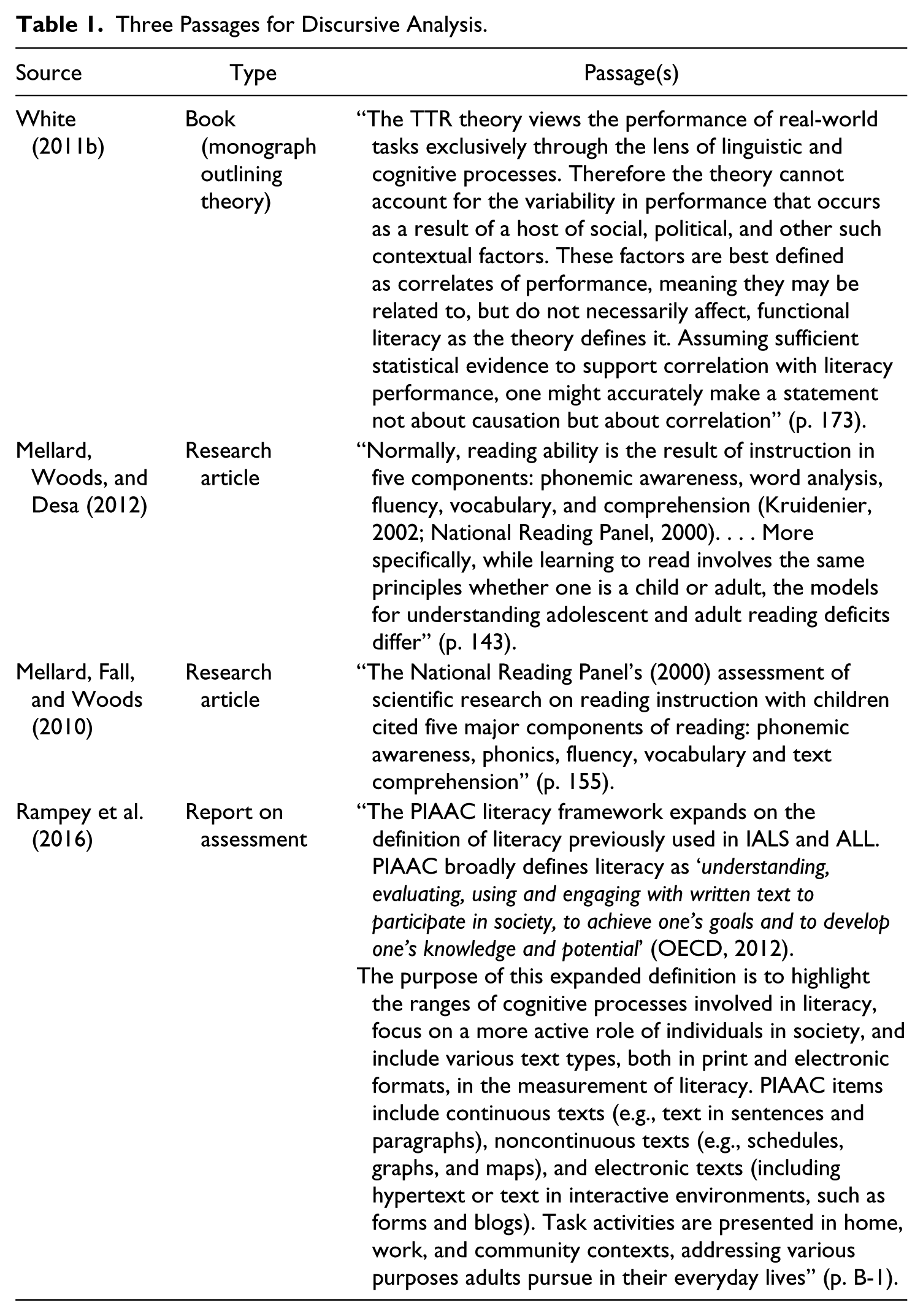
Our analysis allowed us to identify patterns in what “counts” as FL, the logics of inquiry shaping FL scholarship, and the ways in which FL is assessed. In each section, we will briefly share the results of our meta-analysis (see Online Supplement 4 for tables and a fuller discussion), delve deeply into discursive analysis of specific passages, and connect these analyses to other patterns. Passages represent White’s (2011b) book outlining her theory of adult FL; Mellard, Fall, and Woods’ (2010) and Mellard, Woods, and Desa’s (2012) research into adult reading; and Rampey and colleagues’ (2016) discussion of the PIAAC’s literacy framework (see Table 1).
Three Passages for Discursive Analysis.
What “Counts” as FL?
A variety of definitions of literacy occurred across the current FL literature—when the concept was defined at all. For approximately 22% of the sources, what “counts” as FL is driven by four official definitions of literacy (NLA, 1991; OECD & Statistics Canada, 2000; UNESCO, 1978; USDE, National Center for Education Statistics, 1992) that appear to guide adult literacy policy, assessment, and instruction. These definitions appear to take a broad view of what “counts.” All use the term literacy, although the National Adult Literacy Survey (NALS), the NLA, and UNESCO include some form of the word function in relation to literate activity. To our surprise, 45 sources did not define FL, although some sources did define related terms. What seems significant is that over a quarter of sources did not define any literacy-related terms. There also was no consistency in how the construct itself was labeled: Authors used literacy, functional literacy, adult basic literacy, adult basic skills, literacy, or reading practices to refer to the same construct.
Sources adopted different approaches to the “what counts” question, depending on perspective. From a cognitive standpoint, what “counts” as FL is clear: skills and strategies. Many sources began with basic literacy skills as defined by the National Reading Panel (NRP; 2000) and its report based on research conducted with children, including decoding and word-recognition skills, vocabulary, comprehension, and fluency (e.g., Mellard et al., 2010; Mellard et al., 2012; Mellard, Woods, & Lee, 2016; White, 2011b). Some investigated skills with respect to adult spelling (e.g., Talwar, Cote, & Binder, 2014) or morphological awareness (Fracasso, Bangs, & Binder, 2016; To, Tighe, & Binder, 2016). Only a few sources, including White (2011a, 2011b) and Falk (2001), viewed basic reading skills as insufficient, although necessary, in conceptualizing FL.
Sociocultural and critical perspectives reside on a continuum (Perry, 2012), what Street (2003) termed “wider strands of social-critical work” (p. 81). Sociocultural theories often address issues of identity and power relations, although perhaps not to the same degree as critical theories. Sociocultural sources argued that FL is heavily dependent upon social contexts, individual purposes, and cultures. What “counts” is what real people do with texts in the world—their practices. These sources argued for the importance of focusing on accomplishments, rather than assuming deficiencies (Hull & Schultz, 2001). Critical sources discussed the ways in which personal and community development and empowerment are essential components of literacy (Bernardo, 2000; Hanemann, 2015; Ntiri, 2009; Perry & Homan, 2014; Schneider, 2007; Valdivielso, 2006). Reflecting Scribner’s (1984) “literacy as power” metaphor, these sources perhaps implied that “not to be literate is a state of victimization” (p. 12).
Ideological modes in what counts
All three passages (Table 1) illustrate tensions between cognitive and sociocultural perspectives, and discursive analysis uncovers the ideological modes sustaining the cognitive perspective’s dominance. All three passages, for example, use dissimulation—concealing, obscuring, or denying relations of domination—yet they often hide this dissimulation behind a veneer of transparency. Dissimulation represents processes in “a way which effectively veils the social relations of which they are part” or “in terms that highlight some features at the expense of others” (Thompson, 1987, p. 521). For example, White is quite up-front about what counts (linguistic and cognitive processes), while also acknowledging that contextual factors exist. She dissimulates by referring to “real-world tasks” but subsequently rejecting any “potential” contextual factors as “correlates” that are irrelevant to real-world tasks. Even with “sufficient statistical evidence,” these factors could not possibly be causal (i.e., important).
Similarly, Mellard and colleagues (2010) reinforced cognitive theoretical frameworks. Their dissimulation also is hidden, both because these authors openly challenge the dominant NRP framework’s appropriateness, and because their publications are more likely to include explicit theoretical frameworks than other cognitive sources (Mellard and colleagues authored three of the eight explicit cognitive sources). Unlike White, sociocultural factors never appear in Mellard and colleagues’ discussion. The authors claim that “normally, reading ability is the result of instruction in five components” (Mellard et al., 2012, p. 142), without acknowledgment that adult reading ability may be affected by contextual issues, such as access to quality instruction or reading materials (e.g., Perry & Homan, 2014; Schneider, 2007).
Rampey and colleagues’ (2016) explanation of the PIAAC similarly highlights some processes at the expense of others. The authors say they are using a “definition of literacy,” obscuring the fact that the described processes are reading processes. Their definition, “understanding, evaluating, using and engaging with written text,” certainly could include writing, but the task activities and cognitive processes described are exclusively related to reading. Highlighting “cognitive processes” as the first element underscores cognition as the primary factor in their definition, while focusing on “a more active role of individuals in society” similarly legitimates the individual, rather than society.
Syntactic devices often indicate ideological modes (Thompson, 1987). Reification, for example, often involves nominalization and passivization, which effectively “delete actors and agency” (p. 526). White’s statement that contextual factors “are best defined as correlates of performance” disguises her agentic role in developing the theory. By stating that “PIAAC broadly defines” literacy and “the purpose of this expanded definition is to highlight the ranges of cognitive processes,” Rampey and colleagues place agency within the definition itself, rather than the researchers who created it.
The underlying ofcourseness in these passages seems to be that context is irrelevant or, at best, “a distracting variable whose influence must be minimized” (Hamilton & Barton, 2000, p. 382). Yet, decades of research have shown that culture and context shape literacy and cognition in fundamental ways (e.g., Barton & Hamilton, 1998; Heath, 1983; Rogoff, 2003; Scribner & Cole, 1981). Indeed, context’s role was a major recurring theme as sources discussed “contextualized skills” or the ways skills are applied in specific contexts (e.g., Bernardo, 2000; Falk, 2001; Guadalupe & Cardoso, 2011). Hanemann (2015) noted that “basic skills are packaged into ‘literacy, language and numeracy,’ ‘skills for life’ . . . or ‘essential skills’” (p. 309). Focusing upon “skills for life” reflects Scribner’s (1984) metaphor of literacy as adaptation in which literacy’s “survival or pragmatic value” is emphasized (p. 9). Such conceptualizations imply that all lives, in all contexts, require the same skills. Dissimulation implies that skills are the emphasis in “contextualized skills,” while context is subsumed into the larger, more legitimate role of skills. Other research investigated adults’ compensatory literacy strategies in particular settings (Adkins & Corus, 2009; Cuban, 2006; Lynch, 2009; Ozanne, Adkins, & Sandlin, 2005; Perry, 2009; M. Rose, 2003; Viswanathan, Rosa, & Harris, 2005; Wallendorf, 2001). Although the strategies allowed adults to be successful, their designation as “compensatory” denies legitimacy to these skills, thus reifying a particular set of skills as “literacy.”
These examples illustrate ofcourseness, what the field takes for granted: (a) The only important factors in explaining performance of real-world literacy tasks are cognitive processes, and not the world in which those tasks are performed, (b) The individual, rather than the context, is the focal point for understanding processes, (c) Earlier conceptualizations, although in need of update, nevertheless provide reasonable and legitimate foundations.
Logics of Inquiry
The ofcoursenesses identified in what counts as FL also lead to particular logics of inquiry, exemplified by connections between theoretical frameworks and research designs. Findings related to logics of inquiry underscore the importance of interpreting discursive analyses with respect to the sociohistorical context to understand ideologies (Thompson, 1987). Education research is within an era of “what counts,” particularly defined by the What Works Clearinghouse (WWC), which provides “educators with the information they need to make evidence-based decisions . . . from high-quality research” (Institute for Education Sciences, n.d.). WWC narrowly defines “high-quality” research as that which involves particular statistical methods; their ratings determine a study’s legitimacy. The reification of the WWC research paradigm “became officially codified” (Pearson, 2004, p. 227) by the reports from the NRP and the National Academy of Science’s Committee on Preventing Reading Difficulties.
This context likely explains why 31 of the 47 empirical research sources used quantitative designs connected with particular theoretical frameworks. Figure 1 indicates important findings from our meta-analysis (for additional details, see Online Supplement 4). Cognitive orientations were most common, although most cognitive sources did not explicitly name their framing theories. Cognitively oriented researchers overwhelmingly adopted quantitative designs. Sociocultural theories were better explicated, whereas critical theories were less explicit. The majority of sociocultural and critical research studies used qualitative designs. Some sources included multiple (cognitive and sociocultural or critical) theories. Theories unrelated to literacy also occurred, often in sources on applied topics such as health literacy. Perhaps reflecting their theoretical diversity, these studies were evenly distributed between quantitative and qualitative designs. A third of our sample included neither an explicit nor implicit theoretical framework. Almost half of these sources were theoretical or position pieces—sources that, given their very nature, should offer a clear theoretical stance.
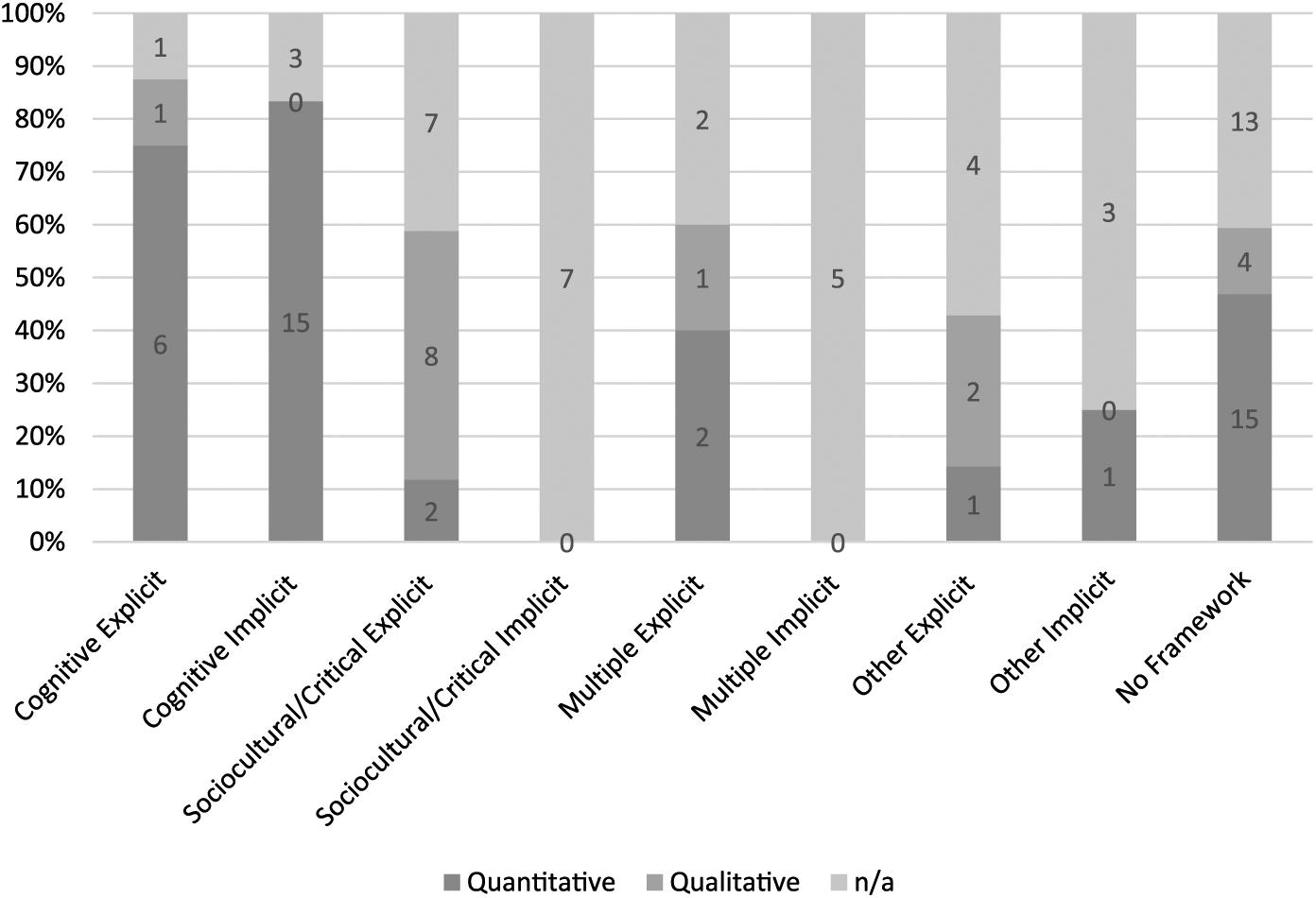
Methodological percentages by theoretical framework.
Ideological modes in logics of inquiry
Mellard and his colleagues’ research—five of the 101 sources in our review, representing a decade of publications—illustrates the ways in which ideologies influence logics of inquiry. Their publications represent quantitative research studies funded by federal grants. Although most cognitive sources implicitly drew upon the NRP’s framework, Mellard and his colleagues (2010) explicitly referenced it. Unlike other cognitive sources, they questioned whether models developed through research conducted with children apply to reading processes in adults. Findings from their study showed that existing, child-based reading models do not accurately describe adult literacy learners.
Framing the problem as grounded in the cognitive processes highlighted by the NRP report sets up both legitimation and reification of quantitative logics of inquiry. Mellard and colleagues’ reference to the NRP’s five components as “normally” (Mellard et al., 2012, p. 142) contributing to reading ability signals the underlying ofcourseness behind their work: This is a set of beliefs assumed to be standard. Further legitimation occurs when the authors refer to the panel’s “assessment of scientific research on reading instruction with children” (p. 155). Although the authors ultimately conclude that this model is inappropriate for adults, their reference to “scientific research” and a national panel implies worthiness of the underlying framework. Stating that “such models do not fully satisfy the need for intervention research and development for adults with low literacy” (p. 154) suggests that the models at least partially satisfy those needs.
White similarly deploys legitimation: By “assuming sufficient statistical evidence,” she presents dominant systems as “just and worthy of support” (Thompson, 1987, p. 521) by implying that only quantitatively confirmed contextual factors would be valid. In claiming that “one might accurately make a statement not about causation but about correlation,” White eliminates herself as the agent and implies that everyone would come to the same conclusions. This claim reifies cognitive and quantitative paradigms by presenting them as natural and obvious (Thompson, 1987), ignoring the fact that researchers often uncover contextual processes through nonstatistical methods.
Rampey and colleagues suggest that their conceptualizations make PIAAC more current and responsive to context “in the measurement of literacy.” The authors’ statements suggest that PIAAC is now more valid as a universal and standardizable assessment of literacy. “Measurement” reifies quantitative approaches, yet there are many ways to assess adults’ literacy performance, and other methods may better evaluate the ways in which adults use “written text to participate in society, to achieve one’s goals and to develop one’s knowledge and potential” (OECD, 2012). Yet, the authors’ acknowledgment of the need for an expanded framework, and the inclusion of newer texts and task activities (e.g., electronic texts), highlights the dynamic and situated nature of literacy—the very things that make it so difficult to measure.
These authors collectively reify one definition of “scientific research” (the government’s), without acknowledgment that (a) what counts as quality scientific research differs across epistemological paradigms; (b) this definition is historically, culturally, and socially situated, rather than universal; or (c) “non-scientific” research may also contribute valuable knowledge (Pearson, 2004). Not only do cognitive theories dominate “what counts,” but these theories also align with the quantitative research designs that dominate empirical work, as well as those sanctioned by the U.S. government. This finding exemplifies ideological rationalization, in which “a set of institutional arrangements which privilege certain groups are presented as serving the interests of all” (Janks, 2010, p. 37). The implicit nature of cognitive frameworks suggests that FL researchers take cognitive theories for granted, perhaps assuming their theoretical framework is a universal explanation.
Viewing literacy as plural, situated within sociocultural contexts, and dynamic implies that the phenomenon of FL is complex, and that context and perspectives matter. These assumptions may lead to logics of inquiry opposite those of cognitively oriented sources. Rather than assuming a common understanding, socioculturally oriented researchers in our sample appear to believe that explicit statements of theory are necessary (Figure 1). Sociocultural and critical assumptions lend themselves to qualitative explorations of FL, which are assumed to be better suited to exploring nuanced, messy, human contexts. Although these logics of inquiry may not succumb to the same ofcoursenesses of cognitive and quantitative paradigms, they may be at similar risk of ideological legitimation through narrativization in which stories are “used to naturalize socially interested constructions of the world” or “presented as embodying universal timeless truths” (Janks, 2010, p. 37).
Although scholarship that crosses the cognitive/sociocultural divide appears to be increasing, multidimensional theories are not being taken up in research. Yet, these sources still used either a quantitative or a qualitative design aligned with one theoretical perspective. No empirical sources used mixed methods that might align with a more theoretically complex perspective (Figure 1).
Parsons et al. (2016) concluded that “it might be unnecessary for scholars to explicate the theoretical perspective they are working from because it is shared among the thought collective” (p. 497). Given the greatly varying conceptualizations of FL and the diverse theoretical frameworks represented, we disagree: Their conclusion represents an instance of reification through naturalization in which “socially constructed realities are presented as natural and inevitable” (Janks, 2010, p. 39) and represents the fundamental ofcourseness that characterizes much FL scholarship—assumptions that theoretical perspectives and the construct of FL are clear, obvious, and shared by others.
Why Is FL Measured or Assessed as It Is?
Ideologies at work in recent FL scholarship are reflected in discussions of assessment, such as the International Adult Literacy Survey (IALS), National Assessment of Adult Literacy (NAAL), the Adult Literacy Supplemental Assessment (ALSA; given to adults who could not complete NAAL tasks), and PIAAC. Earlier patterns identified in theoretical frameworks and methodologies appeared amplified: Cognitive, quantitative frameworks dominated, with an even greater level of implicit ofcourseness (see Online Supplement 4).
Ideological modes in assessment
Rampey and colleagues (2016) legitimate PIAAC’s framework by explicitly connecting it to prior cognitive assessments (IALS and Adult Literacy and Lifeskills Survey [ALL]), and by referencing the OECD definition. Their “focus on a more active role of individuals in society” (p. B-1) implies that PIAAC accounts for sociocultural contextual factors and that individuals are active agents. But active agents toward what purpose? Moreover, what about society’s impact on individuals? The social processes contextualizing individuals’ “active roles” thus are concealed.
The statement that PIAAC’s task activities “are presented in home, work, and community contexts, addressing various purposes adults pursue in their everyday lives” (p. B-1) appears to address the critique that the assessment does not account for context. Yet, such statements assume that the “purposes adults pursue in their everyday lives” (p. B-1) are universal and can be standardized in international assessment. Similarly, the authors describe various real-world texts used in PIAAC, concealing the assumption that these texts and their use are universal, rather than socially and culturally situated. Socioculturally and critically oriented scholars (e.g., Boudard & Jones, 2003; Valdivielso Gomez, 2000) strongly disagreed with claims that the skills required for literacy hold across different cultures (e.g., Darcovich, 2000) or contexts (e.g., Berkman, Davis, & McCormack, 2010), and claimed that the assessments erased the diverse, meaningful ways in which literacy is used (Hamilton & Barton, 2000). If culture is an important determinant of literacy use, then what makes an assessment appropriate in one context might not transfer to another (Bernardo, 2000).
Sources discussing assessments seemed particularly likely to conceptualize FL as basic skills, with greater attention paid to decoding and word recognition than to comprehension. For example, ALSA participants were asked to read at most a sentence or two, often only requiring identification of a word or letter (White & Dillow, 2005). PIAAC appeared to place greater emphasis on comprehension, although focused upon choosing the correct word to complete a sentence (Rampey et al., 2016).
Highlighting basic skills at the expense of other factors also aligned with conceptualizing FL as involving levels. Hanemann (2015) suggested that conceptualizing literacy as a continuum of proficiency levels “postulates that there is no definite line between a ‘literate’ and a ‘non-literate’ person” (p. 299). However, this does not appear to be the way that assessed levels are treated in practice. Many sources assumed that there is some identifiable cutoff score below which an adult is not considered to be functionally literate; Rampey and colleagues (2016), for example, noted that the lowest level on the PIAAC is “Below Level 1,” which implies that Level 1 might be the lowest level of assumed literacy.
Despite their critiques, sociocultural and critical scholars offered little in the way of alternatives for assessing FL. The IALS design team attempted to reconcile cognitive skills and sociocultural practices perspectives by using an intermediary model of literacy “where it was assumed that there is universal literacy that is ‘valid across time and across population groups,’ and that there is also culturally specific literacy” (Boudard & Jones, 2003, p. 201). While critics might question whether this can be accomplished at all, Boudard and Jones’s statement represents the only instance in our findings where assessments addressed diverse theoretical perspectives.
The ideologies at work show why FL is assessed in the ways it is. Cognitively identified components, particularly basic skills, have been endorsed in official government reports (e.g., Baer, Kutner, Sabatini, & White, 2009; Kutner, Greenberg, Jin, & Paulsen, 2006; Mohadjer et al., 2009; White & Dillow, 2005) and associated with quantitative ways of measuring FL. What “counts” as FL is that which can be counted. Sociocultural and critical emphases on culture, context, practice, and power, in contrast, do not lead to conceptualizations of FL that are easily standardized or measured across contexts. These perspectives, thus, have been limited to the role of critiquing the dominant paradigm.
Discussion
We (naively) hoped our review would offer a clear path for conceptualizing FL. Deeply investigating the “methodological, disciplinary, and theoretical underbelly” of a field often limits abilities to make definitive claims (Thorne et al., 2004, p. 1357). Moreover, if knowledge is only ever partial, so, too, are our claims. Our methodological decisions limited the scope of any claims we might make. Excluding unpublished literature made sense for understanding what the field legitimated but also made it less likely that we could uncover less-dominant perspectives. Our claims about “the field” similarly are restricted to certain portions of the field, given our exclusion of literature related to international perspectives or general instruction, and our choice of theoretical lenses. Rather than exhaustive or conclusive, our discursive review is a beginning. A more complete understanding of FL can be addressed through syntheses that take up where ours left off—by analyzing international and practitioner perspectives, reviewing “fugitive” literature, and adopting alternative analytical frames.
Here, we attempt to disrupt traditional notions of “what counts” by exploring the ideologies’ larger implications: specifically, what is legitimated, reified, ignored, or subsumed by these conceptualizations of FL. While we focus upon research, research also affects policy, practice, and learners. Our analysis also raises new, important questions.
What Counts?
Silences in FL scholarship speak volumes about ideologies; they indicate what “counts,” what is reified, and what is legitimated. Nearly half the sources in our sample—including most empirical studies and a third of theoretical pieces—did not define the construct of FL. This absence represents a clear example of Woodside-Jiron’s (2004) concept of ofcourseness—as everyone knows what FL is, there is no need to define it. Approximately one in five sources relied upon an “official” definition of literacy; only parts of these definitions are taken up in recent scholarship, while much was dismissed or subsumed. Because official definitions are written broadly, perhaps attempting to capture the complex diversity of literate practice in adults’ lives, much should “count,” including both reading and writing of text. Yet, reading is clearly privileged—an instance of highlighting certain social processes at the expense of others (Thompson, 1987). Writing was glossed over or entirely absent: Only 11 of 101 sources had any key ideas related to writing, and only five of these (Craig, 2001; Kazemek, 2003; Perry & Homan, 2014; M. Rose, 2003; Schneider, 2007) offered substantial explorations of writing beyond mentions of “reading and writing.” FL appears to be reified as reading, while writing is ignored.
All four official definitions situate literacy use within the individual. However, international definitions (OECD/IALS and UNESCO) indicate that literacy is necessary for community functioning. This difference illustrates the United States’s privileging of individual skills, practices, and purposes for literacy; family or community purposes are not, apparently, worth mentioning. The privileging of individual purposes is reflected in the fact that only a handful of our sources addressed family, community, or citizenship, and is also reified by dominant cognitive frameworks. These absences indicate what is taken for granted—the ofcourseness of how FL is conceptualized.
Not only do cognitive theories ground much FL research, but they are also reified in FL scholarship. Moreover, “basic skills” dominates the cognitive perspective. A parallel trend, according to Pearson (2004), appeared in the 1990s, emphasizing both code-based aspects of learning to read and quantitative methods for researching literacy. Codification of the NRP, particularly decoding and word recognition in FL research and assessment, represents the culmination of this ideological legitimation. What the field largely overlooks is the fact that the NRP’s report was focused upon research on children. Assumptions that theories or research findings transfer from children to adults seem largely unquestioned. Only a handful of sources in addition to Mellard and colleagues (2010) explored the appropriateness of these frameworks for adults (see Fracasso et al., 2016; Greenberg, 2013; Talwar et al., 2014; To et al., 2016). Despite findings that child-based frameworks do not fit adults, assessments and leveling systems remain grounded in the NRP, reflecting assumptions that literacy is universal.
The legitimation and reification of cognitive perspectives leads to privileging of quantitative, indeed experimental, ways of approaching FL research and assessment—and vice versa. Quantitative approaches seek to identify, measure, and compare variables, such as basic skills, while also seeking to control for context and bias. Thus, the predominance of quantitative designs reifies cognitive, skills-based conceptualizations—measurable aspects of FL are the only ones that “count.” Randomized field trials in medical research are often extolled as an ideal model for education research (Pearson, 2004). Yet, medicine employs a wide range of methodologies prior to randomized trials, a fact conveniently overlooked by the dominant perspective.
Despite these ofcoursenesses, literacy is a contested construct (Auerbach, 1991; Janks, 2010; Street, 1984), and applications of FL reflect the diversity of perspectives in the field. The question of what counts as FL reflected the broadly cognitive and sociocultural stances of the recent “reading wars” (Janks, 2010; Pearson, 2004), indicating that this struggle is still thriving in adult literacy research. Where does this leave the construct of FL and scholarship in adult literacy in the United States? We concur with Ntiri (2009) that “there is not yet a definition suitable and appropriate for all of the contexts in which people think about literacy” (p. 98). The diversity of perspectives highlights the importance of understanding FL’s ideological dimensions. Indeed, if “literacy is not literacy is not literacy” (Hull & Schultz, 2001, p. 583), literacy scholars have a responsibility to make explicit the assumptions, definitions, and frameworks that undergird their work, in contrast to Parsons et al.’s (2016) assertion.
Why Does It Matter?
Conceptualizations of FL reflect ideological influences from academic research, national and organizational agendas, social and cultural contexts, and personal experiences (Belzer & Pickard, 2015; Bennett et al., 2009; Scribner, 1984; St Clair & Sandlin, 2004). Legitimation often involves a process of universalization in which one set of institutional arrangements “are presented as serving the interests of all” (Janks, 2010, p. 37). White’s publications (2011a, 2011b, 2012; White & Dillow, 2005) illustrate the importance of analyzing sociohistorical contexts with respect to ideology; her work shows connections between what counts, logics of inquiry, and assessment. White works for the USDE’s National Center for Education Statistics, where she also directed the NAAL assessment. She published widely in adult literacy, including four of our 101 sources, and is listed as the project officer on other governmental reports of adult literacy research (Baer et al., 2009; Kutner et al., 2006; Mohadjer et al., 2009). White is, therefore, intimately connected with defining “what counts,” determining how adults get assessed, and perhaps even determining who gets research funding; she is intimately connected with the system that seeks to maintain control.
Ideological modes determine what counts and also position adult learners in particular ways. Deficit perspectives undergird much reporting of literacy scores and their assumed social consequences (St. Clair, 2015). For example, Prins, Monnat, Clymer, and Toso (2015) used initial findings from PIAAC to claim a relationship between literacy scores (levels) and better health. However, St. Clair (2015) argued for caution in interpreting PIAAC results because the OECD often associates basic skills with economic outcomes without actual evidence, and “from this simple assertion it is a small step to the view that people who do not demonstrate high levels of foundational skills are letting the side down, and even undermining the success of the United States” (p. 41). Such discourses blame the victim and ignore systematic reasons for lower achievement among marginalized groups. Adult learners clearly are disadvantaged by these ways of conceptualizing and assessing FL. Adult literacy researchers and practitioners, then, have a duty to ask, “Why are adults being positioned in this way through FL assessment, and who benefits from these conceptualizations and positionings?”
We have begun to fundamentally question the construct of FL. What might the descriptor functional imply when attached to the construct of literacy? Is it even necessary? What benefits might the descriptor offer researchers, practitioners, and policy makers, and in what ways might it be limiting or problematic? For example, instead of asking, “How do adults use literacy in functional ways?” the dominant paradigm appears to ask, “Are adults functionally literate?” This question leads to dichotomous thinking (e.g., Guadalupe & Cardoso, 2011; Liddicoat, 2004), and perhaps assumptions that low-literate or unschooled adults could not possibly be using literacy in functional or meaningful ways. Labeling adults as functionally literate—or worse, illiterate—carries with it significant social consequences (Janks, 2010; St. Clair & Sandlin, 2004). Many scholars in adult literacy, as well as in workplace literacy, health care, and family literacy, have called for the field to reject this binary with its deficit perspectives and instead view literacy as multidimensional and situated. While acknowledging the real literacy struggles that many adults face and the impact of those struggles, these scholars warn of the dangers inherent in positioning adults as “only” functionally literate. We agree with St. Clair and Sandlin (2004) that the field’s main challenge involves finding ways to meaningfully describe literacy “without either collapsing to a single measure or ascribing blame or deficit” (p. 58). Adult literacy researchers must rely upon a broad range of theoretical perspectives as well as ensure the field “privileges all of the empirical and theoretical methodologies that characterize the scientific disciplines” (Pearson, 2004, p. 234).
We also must help practitioners, policy makers, and other stakeholders understand the implications of various literacy paradigms and the real effects they can have on teaching, learning, and learners—the ways that assumptions “grow up” (Woodside-Jiron, 2004, p. 180). For example, continued references to the NRP framework, despite research showing that literacy differs in children and adults, may have serious implications in practice, perhaps encouraging child-based teaching practices that would be inappropriate for adults (Belzer & Pickard, 2015).
Addressing St. Clair and Sandlin’s call will also require that adult literacy researchers carefully examine the ideological assumptions that shape our work, particularly those that may be hidden or taken for granted. All stakeholders must examine existing and future research, policies, and practices to identify the underlying ofcoursenesses: What has been reified, legitimated, or dissimulated? We urge adult literacy researchers, policy makers, and practitioners to question the ideological dimension of viewing literacy or learners as “functional.” What does the word functional add as a descriptor to the concept of literacy? What are the ofcoursenesses behind this term? What might be reified or legitimated by describing literacy as functional, and what might that modifier ignore or dismiss? These examinations also should be extended: Who benefits from viewing adult literacy in terms of functionality, and who might be disadvantaged by this perspective? What particular view of the social order might this imply? These ideological assumptions affect not only instruction and policy but also the lives of the adults who live, work, and play in a literate world.
Footnotes
Acknowledgements
We wish to sincerely thank the editors and the anonymous reviewers of this article for their excellent feedback.
Declaration of Conflicting Interests
The author(s) declared no potential conflicts of interest with respect to the research, authorship, and/or publication of this article.
Funding
The author(s) received no financial support for the research, authorship, and/or publication of this article.

References
Supplementary Material
Please find the following supplemental material available below.
For Open Access articles published under a Creative Commons License, all supplemental material carries the same license as the article it is associated with.
For non-Open Access articles published, all supplemental material carries a non-exclusive license, and permission requests for re-use of supplemental material or any part of supplemental material shall be sent directly to the copyright owner as specified in the copyright notice associated with the article.
