




Abstract
The purpose of this study was to examine how oral vocabulary instruction was enacted in kindergarten. Four days (12 hours) of instruction were observed in 55 classrooms in a range of socio-economic status schools. All instruction was coded for evidence of vocabulary instruction for a total of 660 hours of observation. Results revealed that teachers explained word meanings during “teachable moments” in the context of other instruction. Findings revealed one-time, brief word explanations, unsystematic word selection, and minimal time devoted to subject areas, such as science and social studies, in which word explanations were most dense. Teachers serving in economically advantaged schools explained words more often and were more likely to address sophisticated words than teachers serving in economically disadvantaged schools. These results suggest that the current state of instruction may be contributing to rather than ameliorating vocabulary gaps by socioeconomic status.
There is now overwhelming evidence demonstrating that children’s oral vocabulary development is essential to their long-term reading comprehension (Ricketts, Nation, & Bishop, 2007; Sénéchal, Ouellette, & Rodney, 2006; Snow, Burns, & Griffin, 1998). The size of a person’s vocabulary is one of the strongest predictors of reading comprehension (Stahl & Nagy, 2006). According to Anderson and Freebody’s (1981) knowledge hypothesis, words contribute to the development of concepts. Therefore, it is not just the knowledge of word meanings per se that makes one a better reader but the rich interconnected knowledge of concepts these words represent that truly drives comprehension. Nagy (2005) has argued that the relationship between vocabulary and reading comprehension is bidirectional with a large vocabulary contributing to reading and reading contributing to a large vocabulary. By fourth grade, children with limited vocabulary knowledge are likely to “slump” in reading comprehension (Chall & Jacobs, 2003) and will often continue to struggle as readers throughout their schooling (Catts, Adlof, & Weismer, 2006; Cunningham & Stanovich, 1997; Stanovich, 1986), indicating the need for attention to vocabulary well before children reach this point.
The well-established connection between vocabulary knowledge and reading comprehension (Stahl & Fairbanks, 1986) is supported by evidence from both concurrent (e.g., Ricketts et al., 2007) and longitudinal studies (e.g., National Institute of Child Health and Development Early Child Care Research Network, 2005; Storch & Whitehurst, 2002). These findings have been replicated in Great Britain and Canada (Muter, Hulme, Snowling, & Stevenson, 2004; Sénéchal et al., 2006), with both English-and French-speaking children (Sénéchal et al., 2006), and in the reading disabilities literature (Catts et al., 2006). In short, a strong vocabulary base is associated with reading performance (Biemiller, 2006; Hirsch, 2003).
Given this relationships, over the past decade, consensus documents from the fields of literacy and early childhood have acknowledged the importance of addressing vocabulary in teaching young children (e.g., National Early Literacy Panel, 2008; National Governors Association Center for Best Practices, Council of Chief State School Officers, 2010; National Reading Panel, 2000; Snow et al., 1998), yet we have limited knowledge about whether and how vocabulary instruction is enacted at the start of school. Observational studies have recorded only limited attention to print vocabulary for students in upper elementary and middle school classrooms. In her classic study of reading comprehension, for example, Durkin (1978-1979) found that teachers dedicated less than 3% of the reading period to instruction, review, and application of word meanings. More recent studies provide converging evidence of these findings. Observing reading lessons on 3 consecutive days in 28 fourth-grade classrooms, Blanton and Moorman (1990) reported only 6% of the time spent on vocabulary development. Moreover, they found that 212 of the 380 vocabulary events observed involved introducing students to a dictionary definition of a word. Based on observations during reading lessons in 6 fifth-grade classrooms, Watts (1995) found that vocabulary was addressed mainly as a prereading activity to teach necessary word meanings for a particular text. Similarly, Scott, Jamieson-Noel, and Asselin (2003) in their analysis of Canadian middle school classrooms found that more than 40% of the time devoted to vocabulary was spent on copying definitions. Teachers did much mentioning and assignment, but little actual teaching of new vocabulary. Although these results address students in the upper grades and print vocabulary, it does not forebode well for the prevalence of oral vocabulary instruction in the early years of formal schooling.
Studies repeatedly find that children from lower socioeconomic status (SES) backgrounds may enter school with more limited vocabulary knowledge than their middle class peers (Farkas & Beron, 2004; Hart & Risley, 1995; Hoff, 2003). These differences do not disappear as children move through school; they have been documented at the elementary school and middle school levels as well (Biemiller & Slonim, 2001; Chall, Jacobs, & Baldwin, 1990). By fourth grade, 73% of children scoring below the 25th percentile on vocabulary on the National Assessment of Educational Progress (NAEP) were eligible for free and reduced price lunch (National Center for Education Statistics [NCES], 2012). Unfortunately, students from low-SES backgrounds are likely to attend low-performing schools with highly inexperienced teachers (Education Trust, 2004; Lee & Burkam, 2002; Reardon, 2011). In particular, there is evidence that children from low-SES backgrounds may experience lower quality literacy instruction in their elementary schools (Duke, 2000). Therefore, it is critical to gain a better understanding of how vocabulary instruction is implemented across schools serving children from different economic backgrounds.
There is a clear need to understand how oral vocabulary instruction is enacted early on in school and whether such instruction is equitable across socioeconomic circumstances for children who are just beginning their formal schooling. This study focuses on kindergarten as a critical year for early language and literacy instruction. National data (NCES, 2011) indicates that 95% of 5- and 6-year-olds are enrolled in school compared with only 57% of 3- and 4-year-olds. Therefore, while kindergarten is not officially required in many states, the vast majority of children do begin their formal schooling in kindergarten when they are 5 years old.
The purpose of the present study was to examine vocabulary instruction in 55 kindergarten classrooms, representing low, middle, and upper-middle-class schools. Specifically, our goal was to examine the extent of vocabulary instruction and the pedagogy used in teaching vocabulary to kindergartners in these schools. If we are to ensure that all children receive high-quality oral vocabulary instruction, it is imperative to understand the current state of daily practice in typical classrooms settings.
Theoretical Framework
Young children learn vocabulary primarily through incremental exposure to the oral language of adults in their environment during informal conversations and shared book reading (Beals & Tabors, 1995; Huttenlocher, Haight, Bryk, Seltzer, & Lyons, 1991; Nagy & Scott, 2000; Sénéchal, & LeFevre, 2002). The quality of young children’s oral language environment at home (Hoff, 2003; Weizman & Snow, 2001) and in early childhood settings (e.g., Dickinson & Porche, 2011; Dickinson & Smith, 1994; Dickinson & Tabors, 2001) predicts their vocabulary development. However, as children enter school, there is a particular concern that they learn the academic vocabulary that is necessary for comprehension of school texts and participation in academic conversations across the content areas (Baumann & Graves, 2010; Snow & Uccelli, 2009). Academic vocabulary is considered to play a key role in the academic language that children need for school success (Nagy & Townsend, 2012). Studies have focused on explicit vocabulary instruction in early elementary school as a means for ensuring that all children begin to learn the academic vocabulary they will need for school-based language and literacy demands (e.g., Beck & McKeown, 2007; Coyne, McCoach, Loftus, Zipoli, & Kapp, 2009; Silverman, 2007). The concern is that children who do not learn academic vocabulary will struggle with comprehension by the upper elementary grades (Chall et al., 1990) and explicit vocabulary instruction provides an efficient method for ensuring that all children learn a subset of these essential academic words (Nagy & Scott, 2000).
Therefore, the purpose of explicit vocabulary instruction is to support and not supplant the incidental learning that takes place in a high-quality oral language environment. For example, Graves (2006) has recommended that a strong vocabulary program should include wide reading, promoting word learning strategies, and word consciousness in addition to teaching of individual words. Neuman and Wright (2013) have recommended that in addition to explicit instruction of specific words, for young children, a strong and developmentally appropriate program should include read alouds, opportunities for whole group, small group, and one-on-one discussions and extended talk surrounding play and content area investigations.
Growing evidence from meta-analyses of intervention studies indicates that vocabulary instruction can improve young children’s vocabulary knowledge and later comprehension (Elleman, Lindo, Morphy, & Compton, 2009; Stahl & Fairbanks, 1986). In their meta-analysis, the National Early Literacy Panel (2008) analyzed 19 oral language intervention studies for children from birth through age 5 and found moderate effects for interventions specifically addressing oral language skills. In addition, the authors examined 16 shared book-reading interventions and again found moderate effects for children’s vocabulary and more broad-based oral language measures. In a meta-analyses of 67 vocabulary interventions targeting prekindergarten and kindergarten children, Marulis and Neuman (2010) found an overall effect size of .89. In other words, oral vocabulary instruction in which teachers help children to learn word meanings and their related concepts, enabled young children to gain, on average, almost one standard deviation on vocabulary measures. In particular, those studies that included explicit vocabulary instruction (i.e., deliberate teaching of the meanings of individual words) had higher effect sizes than interventions that relied only on implicit word learning opportunities (i.e., exposure to words through read alouds and activities without explicit teaching of their meanings). In a second meta-analysis, these authors found an overall effect size of .87 for vocabulary interventions targeted to young children (i.e., prior to conventional reading) who were at-risk for reading difficulties (Marulis & Neuman, 2013). Together, these findings have led to research-based recommendations that explicit teaching of vocabulary should be a part of language and literacy instruction beginning at the start of school (Beck, McKeown, & Kucan, 2002; Graves, 2006; National Governors Association Center for Best Practices, Council of Chief State School Officers, 2010; Neuman & Wright, 2013; Stahl & Nagy, 2006).
Research-Based Features of Vocabulary Instruction
Recent studies (e.g., Coyne et al., 2009; Silverman, 2007; Silverman & Crandell, 2010) have generated an increasing consensus on the characteristics of instruction that promote children’s vocabulary development in kindergarten. Providing children with explicit explanations of systematically selected words, discussing word meanings in various contexts, and creating multiple opportunities for children to use and review word meanings improves receptive and expressive vocabulary development.
Amount of Instruction
A question that has received much attention in the research literature is, “How many vocabulary words can be taught in a typical school year?” (Nagy & Hiebert, 2010). Although it would be impossible to teach all necessary vocabulary words through direct instruction, one well-cited estimate for the number of vocabulary words that children can be plausibly taught is 400 words per year of school (Nagy & Anderson, 1984), which in a typical 36-week school year would amount to approximately 11 words per week of school. However, there is a range in estimates for the number of vocabulary words to teach. Biemiller and Boote (2006) have suggested teaching 1,000 words per school year to ensure that children actually learn 40% or about 400 of these words. This would require teaching about 28 words per week in a typical 36-week school year. Beck and McKeown (2007) have argued for teaching fewer words with greater intensity. For example, in studies of rich instruction, these authors recommended teaching approximately 6 to 10 words each week. Therefore, the discussion has centered on the issue of breadth versus depth, with Biemiller advocating that students develop a breadth of vocabulary while Beck favors in-depth learning of more sophisticated vocabulary words.
Systematic Word Selection
Recently, there is a growing consensus that words for explicit instruction should be appropriately challenging to support long-term comprehension (Nagy & Hiebert, 2010). For example, Beck et al. (2002) recommended teaching Tier 2 words—words that are known by mature, literate, language users and found across a variety of domains (i.e., coincidence, absurd, industrious). Biemiller (2006) suggested that words should be selected by age of acquisition, moving children toward more complex words as they become word conscious. Weizman and Snow (2001) used the term sophisticated words to refer to words outside the 3,000 common words on the Dale–Chall list (Chall & Dale, 1995). They found that the density of low-income mothers’ use of sophisticated words, as well as instructive interactions around these words, predicted their children’s vocabulary scores in kindergarten and beyond. Although each approach may have its unique strengths and limitations, the renewed interest and focus on systematic selection of words is designed to help promote children’s development of the academic vocabulary they need for school.
In-Depth Instruction
Another characteristic that appears to impact vocabulary development is children’s depth of processing words (Stahl & Fairbanks, 1986). For example, learning the nuances of a word’s meanings in a variety of contexts may promote greater depth of vocabulary learning than learning the word only in a single context (Stahl & Fairbanks, 1986; Stahl & Nagy, 2006). Beck et al. (2002) used the term rich vocabulary instruction to describe teaching that includes explanations of word meanings in child-friendly language, use of the word in a variety of contexts, opportunities to explain appropriate and inappropriate uses of the word, as well as review. They found that children who received rich instruction of challenging words learned significantly more words than children in a control group (Beck & McKeown, 2007).
Silverman (2007) has argued that it is the multidimensional features of vocabulary instruction that may promote depth of processing. In addition to explicit word explanations provided by the teacher and contextual instruction, she developed an intervention in which kindergartners were actively engaged in more decontextualized analysis of word meanings (i.e., comparing and contrasting words or thinking of antonyms and synonyms) after the book was read. Similar to Beck and McKeown, she found that children engaged in multidimensional teaching learned more words than others who had discussed word meanings only in the context of a specific book.
Likewise, Coyne and his colleagues (2009) found that extending instruction to include multiple opportunities to interact with target words outside the context of the story enhanced depth of processing and word learning for kindergartners compared with embedded instruction where words were explained only in the immediate context. Studies have shown that when oral vocabulary instruction is challenging, conceptually based, and multidimensional, at-risk young children (e.g., low-income; dual Language Learners; special education) can make such gains in vocabulary knowledge as to narrow and in some cases, close the gap with same-age peers (Coyne, McCoach, & Kapp, 2007; Neuman, Newman, & Dwyer, 2011).
These and other studies highlight the importance of a related feature of in-depth instruction—repetition. Single exposures to word meanings might provide children with an initial exposure, a fast mapping of a term to establish some baseline information about a new word (Carey, 1978). However, deeper vocabulary knowledge is developed through repeated exposure to a word in conjunction with information about its meaning (Booth, 2009). Studies suggest that word learning is incremental and that it requires multiple exposures in meaningful contexts for a child to learn the meaning of a word (Nagy & Scott, 2000; Stahl, 2003). For example, Biemiller and Boote (2006) found that young children exposed to repeated readings of a text with a single word explanation for each target word, learned 22% of new words. On the contrary, when teachers provided two additional reviews of each word’s meaning, children learned 41% of the target words, almost double what was learned with only a single explanation. Neuman and Dwyer (2011) found that Head Start preschoolers could retain challenging academic vocabulary words (e.g., habitat; camouflage) when instruction included particular attention to reviewing word meanings and practice. Together, these studies suggest that single exposures to word meanings may not be sufficient if the goal is to accelerate children’s vocabulary development.
Contexts for Instruction
Read alouds have been the most studied context for teaching vocabulary to young children (Bus, Van Ijzendoorn, & Pellegrini, 1995). There is now a large corpus of research showing that young children learn words through listening and interacting with storybooks (e.g., Dickinson & Smith, 1994; Elley, 1989). Nevertheless, recent studies have begun to question whether incidental vocabulary exposure through book reading may be substantial enough to significantly boost children’s oral vocabulary development (Beck & McKeown, 2007). Several meta-analyses (Mol, Bus, & deJong, 2009; Mol, Bus, deJong, & Smeets, 2008), for example, have reported only small to moderate effects of book reading on vocabulary development. Examining the added benefits of dialogic reading, an interactive reading strategy on children’s vocabulary growth, Mol and her colleagues (2008) reported only a medium effect size for 2- to 3-year-old children. Furthermore, these effects were reduced substantially to negligible effects when children were 4 to 5 years old or when they were at-risk for language and literacy impairments.
In addition to read alouds, researchers have begun to focus on providing oral vocabulary instruction as part of content area learning for young children (Wright, 2014). Marzano (2004) has argued that opportunities for vocabulary instruction in school may have previously been underestimated because the focus has been on general word learning during language arts instruction and not the words in key content areas. Evidence from intervention studies with young children (French, 2004; Leung, 2008; Neuman et al., 2011) supports this view, with studies finding increased vocabulary development as well as conceptual learning when vocabulary is taught within science and social studies lessons and activities. Therefore in this study, we look across all content areas in the school day to understand the extent of oral vocabulary instruction across instructional contexts in kindergarten.
Study Goals
The early years of schooling provide a critical opportunity to enhance children’s vocabulary development, and consequently one would expect to see an intensive focus on oral vocabulary instruction in kindergarten. Yet, at present, we have little knowledge about daily vocabulary instruction in kindergarten and whether it is equitable across socioeconomic populations being taught. Therefore, this study examines how oral vocabulary instruction might vary in classrooms serving children from different SES backgrounds. Specifically, we asked the following research questions:
Our objective was to better understand how vocabulary instruction was enacted across a large number of classroom settings in kindergarten. As vocabulary is central to children’s early literacy skills, it is imperative to gain a better understanding of the amount, quality, and conditions of oral vocabulary instruction in typical classroom settings.
Method
Participants
Kindergarten teachers from 55 schools representing a range of SES communities in a large Midwestern state were recruited to participate in this study. Schools within 60 miles from a major metropolitan area were sent an invitational letter explaining our interest in observing typical instruction in kindergarten classrooms. We contacted school administrators and, with their permission, teachers were invited to participate. A total of 55 teachers from 46 schools agreed to participate. In 9 schools, we recruited 2 teachers; however, in the majority of schools, we recruited 1 kindergarten teacher per school. Approximately one third of the teachers (n = 21) were recruited from schools with a high density of students receiving free and reduced lunch (i.e., greater than 50% of students), identified by The Condition of Education as high-poverty schools (NCES, 2013), one third (n = 17) from more economically diverse schools (i.e., greater than 25% to 50% of students on free and reduced lunch), and a third (n = 17) from more economically advantaged schools (i.e., 25% or fewer children receiving free and reduced lunch). Teachers taught across school sector including traditional public schools (73%), charter schools (22%), and private kindergartens (5%) and across 16 different school districts. Table 1 describes the demographic characteristics of the kindergarten teachers in this study.
Characteristics of Teacher Sample by School Free and Reduced Lunch Status (N = 55).
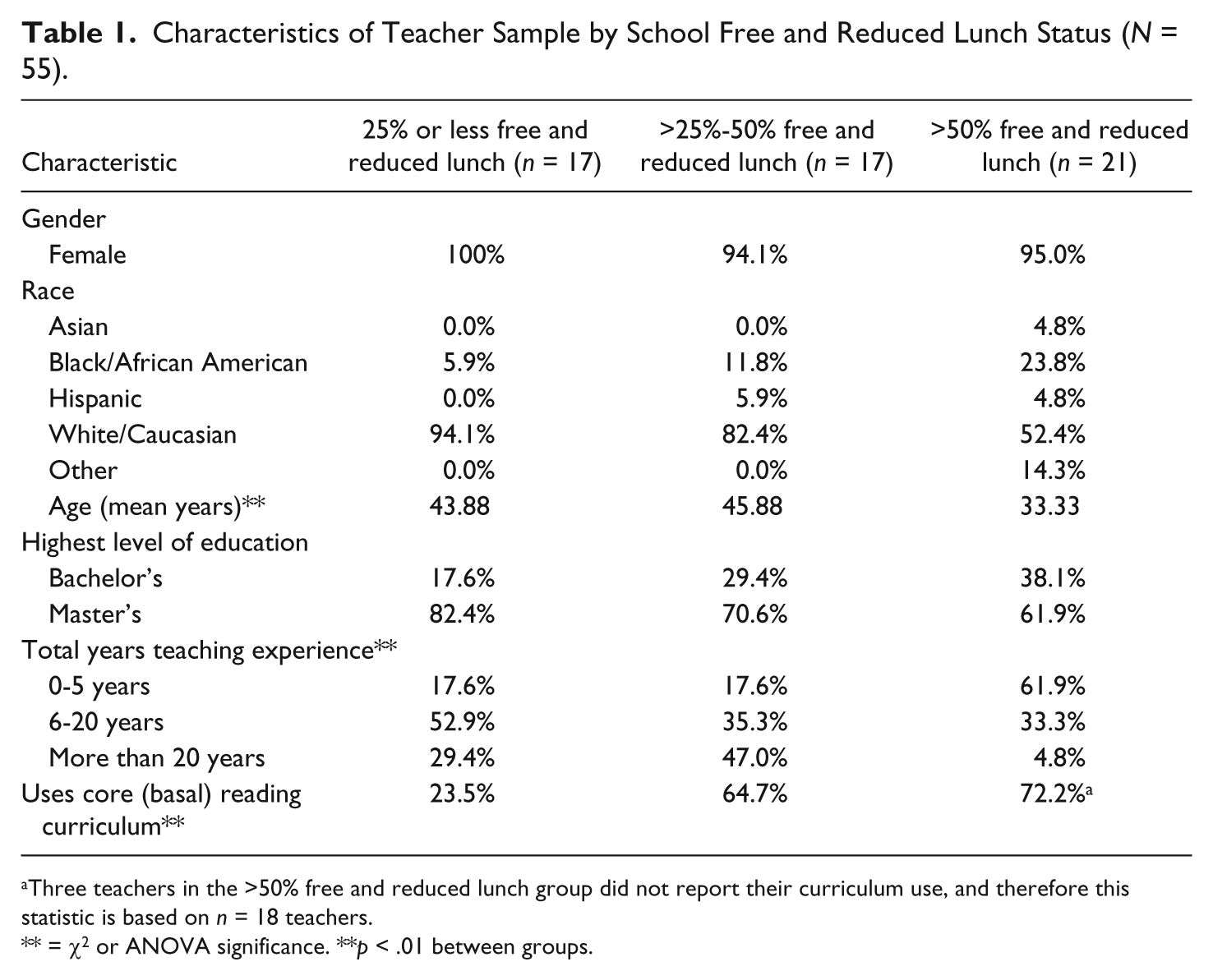
Three teachers in the >50% free and reduced lunch group did not report their curriculum use, and therefore this statistic is based on n = 18 teachers.
= χ2 or ANOVA significance. **p < .01 between groups.
Teachers serving in the high-poverty schools were significantly more likely to be younger and less experienced than their peers working in more economically advantaged schools. Teachers serving in economically advantaged schools were significantly less likely to report using a core (i.e., basal or comprehensive) reading curriculum.
Procedures
Designing the observation protocol
We began this study with preliminary observations of local kindergarten classrooms. These initial visits were to help us better understand the nature of vocabulary instruction in kindergarten. We did not restrict the visits to periods of language arts instruction. Rather, the goal was to focus on how oral vocabulary instruction might be enacted in any subject area.
The first author and a research assistant in education visited six classrooms in traditional public schools (n = 4), charter schools (n = 1), and private schools (n = 1) to see a range of instruction. None of these classrooms were included in the present study. We observed for the full school day and took thorough qualitative field notes on any behaviors or statements on the part of the teacher or children that might constitute vocabulary instruction. After each observation, we met to discuss our findings and narrow our definitions before returning to the field for further observation. All together, we spent 60 hr in six classrooms over a 4-month period to pilot, revise, and refine the observation protocol used in this study.
During these initial observations, we began by looking for vocabulary lessons as described in previous research with older students (e.g., Scott et al., 2003) where researchers found sustained periods of time and activities focused on vocabulary development. However, unlike in previous studies with older students, there appeared to be no specific time periods for vocabulary lessons or activities in these kindergarten classrooms. Vocabulary was not listed as an objective in lessons or listed on a daily schedule. We did not see sustained vocabulary lessons during the language arts block or at other times during the day. Teachers did, however, briefly discuss the meaning of words with children at various times throughout the day. These interactions about the meaning of words were not confined to a literacy block or a read aloud time. All discussions of word meanings were teacher-facilitated interactions. While a child might ask a question about the meaning of a word, it was the teacher who provided meaning or facilitated the determination of the word’s meaning.
Based on these observations, we made several decisions in designing our observation protocol for this study. We decided to observe and record vocabulary instruction for a 3-hr period beginning at the start of the school day. Many kindergarten classrooms in this state were a.m. or p.m. 3-hr days, so this observation period would constitute the entirety of the school day in those classrooms. Observing only during a literacy block or read aloud period, for example, might not capture the rich vocabulary instruction in content areas like science or social studies. Furthermore, as vocabulary instruction seemed to occur intermittently, strategies like momentary time sampling, typically used in early childhood observations (e.g., Neuman, 1999), might underestimate instances of vocabulary instruction. Rather, it was clear that we needed to watch and listen to the teachers’ words throughout the kindergarten day if we hoped to capture all episodes of vocabulary instruction in a typical classroom. Consequently, we decided to audio-record and simultaneously observe for 4 days in kindergarten to capture all vocabulary instruction as it occurred.
As our initial qualitative observations had revealed no set times designated for vocabulary instruction or vocabulary lessons, we focused on capturing all observable verbal interactions throughout the day that focused on discussion of word meanings. We referred to these interactions as vocabulary episodes. Observers were trained to record discourse that met our definition of a vocabulary episode: An interaction where the teacher provides the child(ren) with the meaning of a target vocabulary word or helps to determine the meaning of a target vocabulary word. For example, if the teacher said “A cube has six sides that are square,” this would be identified as a vocabulary episode. We recorded any words that the teacher chose to discuss throughout the day and did not limit our observation to vocabulary episodes that might be part of read alouds, reading lessons, or a particular basal program. Furthermore, we included vocabulary episodes that were in the form of a “child-friendly” definition, or a clear rephrasing. They could be long or short interactions, synonyms, antonyms, category membership, or examples to give meaning to a target word. We also included questions or prompts used by the teacher to elicit children’s explanations of word meanings. Each vocabulary episode was defined to be an identifiable target word clearly associated with conversation about its meaning. Table 2 includes sample vocabulary episodes that were included for this study.
Sample Vocabulary Episodes.
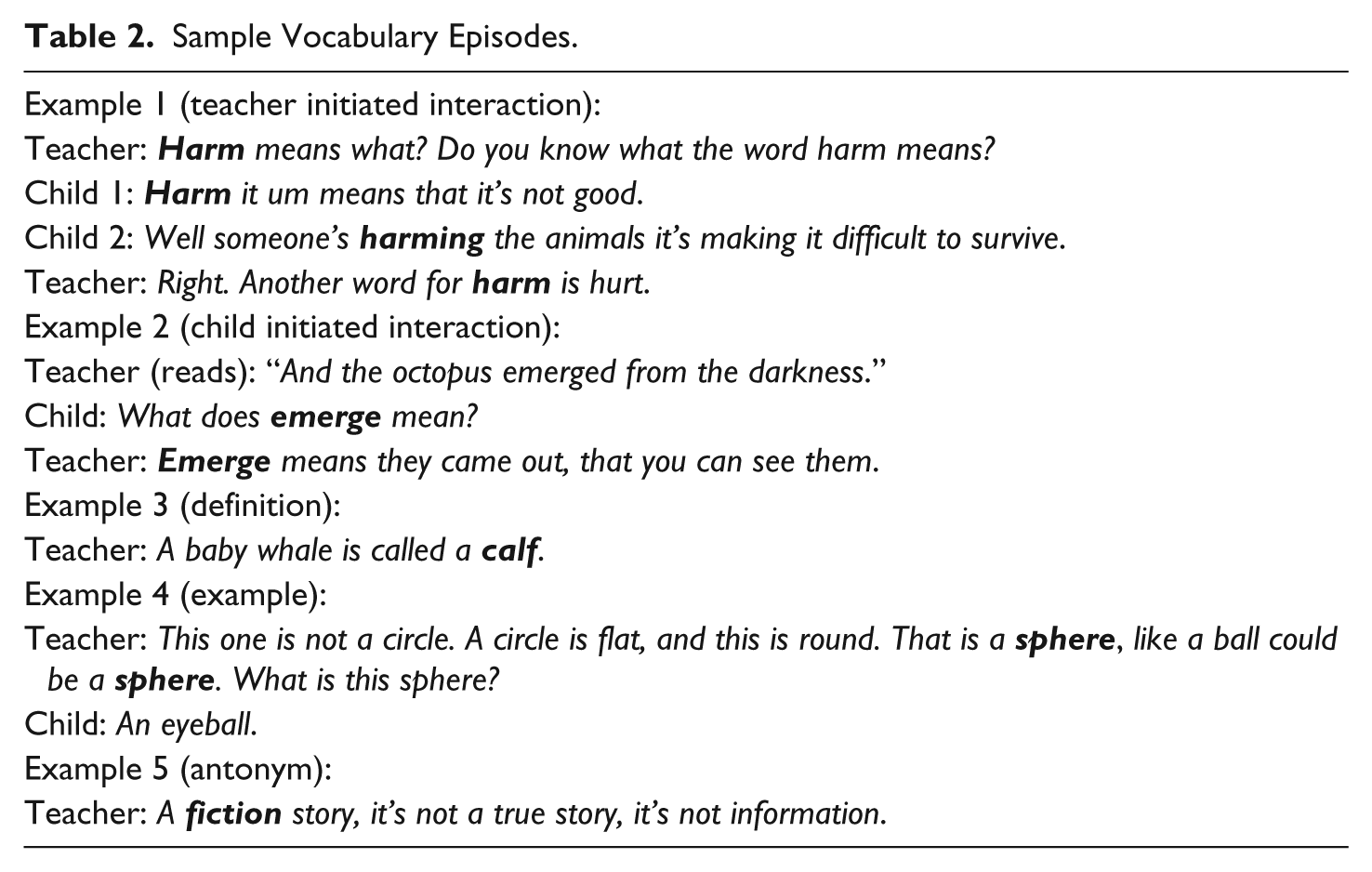
Finally, we created a code to account for any dedicated vocabulary “lesson” if such an event might occur (e.g., this would include an instructional activity specifically targeted to learning the meaning of words or a word). However, consistent with our pilot observations, this code was never used across all observations in this study. Rather, what we found were brief vocabulary episodes—short, focused, definitional phrases to identify words in context. Consequently, given that the vocabulary content code was not evident in any of these observations, we focused our efforts on understanding the quantity and quality of the vocabulary episodes that were observed.
Observer training and reliability
Prior to the start of the study, we trained 10 graduate students in education on the observation protocol that we had developed. All observers had prior experience in classrooms as preschool teachers, elementary school teachers, or school administrators. Observers attended a full-day training given by the authors that included a review of the codebook, definitions of vocabulary episodes, as well as additional codes to be used. Observers practiced coding using written scenarios and videos of kindergarten classrooms. Following training, all observers completed a certification test where they were expected to code a 20-min video of classroom activity. Observers were expected to identify and record at least 95% of the vocabulary episodes identified by the trainer to proceed to field training. All observers met this criterion.
After completing this certification test, each observer completed training in a real kindergarten classroom with an expert observer (i.e., doctoral students who helped to design the protocol). For the first half of this observation, the research assistant and expert observer coded side by side. The expert observer then answered questions and clarified points of confusion. For the second half of the observation, the research assistant completed the observation independently from the expert to determine reliability. Research assistants were expected to match expert coding at a 95% level to begin collecting data for the study. One research assistant did not achieve this level of agreement; following additional training, she met the criterion.
To prevent drift in identifying vocabulary episodes, we conducted additional reliability checks midway through field observations. Once again, an expert observer accompanied each research assistant on a school visit and conducted a side-by-side observation to ensure that research assistants maintained a 95% match with our own identification of vocabulary instruction. All observers met this criterion.
Observation protocol
During each visit, the research assistant would position herself in an area of the room that would be as unobtrusive as possible, while being able to observe instruction. All teacher language was audio-recorded throughout the observation. At the same time, the observer took notes on a laptop computer. To audio-record all language, teachers were asked to wear a small clip-on microphone, which was amplified through an earpiece worn by the research assistant. This amplification allowed the observer to hear and observe all activity without causing any interruptions to regular instruction. These audio-recordings were used by the observers after the completed observation to ensure accurate transcription of each vocabulary episode that took place during the observation period. See online supplementary Appendix A for a sample-completed observation protocol.
As they watched and listened to the teachers’ instruction, observers kept a running schedule for the day, marking the start and end time as teachers moved children through different activity settings (i.e., whole group, small group, centers). Observers also recorded the content of each activity and took brief descriptive notes as lessons changed throughout the day. In this way, for each vocabulary episode, we could keep track of the content that the teacher was addressing when the episode occurred. Content areas were broadly defined based on the teacher’s schedule and the preliminary classroom observations. These included reading and writing instruction, read alouds, mathematics, science, social studies, and morning meeting. While read alouds are usually considered to be part of language arts instruction, we asked observers to record these separately because of their particular salience in this study. Observers also coded times when teachers facilitated other types of activities in the daily schedule including transitions and work stations as well as other for times not included above (e.g., snack).
An observation was terminated when a teacher, along with her students, left the classroom for recess or for a subject not taught by the classroom teacher (e.g., library; music), and resumed once again when they were back in the classroom. In total, observers spent 660 hr in kindergarten classrooms.
Classroom observations
As our goal was to understand typical daily instruction, we visited each classroom 4 times between February and May of 2009. Previous studies using data from multiple observations have found that three to four observations are adequate for capturing a representative snapshot of typical classroom instruction (Al Otaiba et al., 2008; Connor, Morrison, & Petrella, 2004). We asked to observe a typical day in kindergarten classrooms. Teachers were not told about the specific focus on vocabulary instruction, but rather that we were interested in observing regular, daily instruction in kindergarten.
Visits were scheduled with the teacher in advance to avoid special field trips, assemblies, or programs and lasted for a 3-hr period beginning at the start of the school day. We selected a 3-hr period because this typically encompassed the entire school day for a.m.-only or p.m.-only kindergarten classrooms. We collected a total of 12 hr of observational data for each teacher.
Additional Data Sources
Kindergarten teacher questionnaire
All teachers were asked to complete a demographic survey detailing their background characteristics, teaching experience, and the curricula they used in their classrooms. Surveys took 10 to 15 min to complete.
Publicly available data
Data on percent free and reduced lunch for each school were retrieved online from the state government website.
Coding and Analysis of Observational Data
For each observation protocol, we began by counting the number of vocabulary episodes and the number of words addressed during each observation. We examined variability in the quantity and range of vocabulary instruction, averaging across the four observations to understand the extent of vocabulary instruction on a typical day across the sample. We also examined variability in the number of vocabulary episodes and words addressed across observations. We used ANOVAs to determine whether the quantity of vocabulary instruction differed across kindergarten teachers serving in the highest poverty schools (n of teachers = 21), in schools that were economically diverse (n = 17), and in the most economically advantaged schools (n = 17) based on school free and reduced lunch percentages. 1 ANOVA was appropriate because we purposely recruited our sample to compare across these three groups. Given significant difference by school SES in both core curriculum usage and teachers’ years of experience, we examined whether these factors were related to the range of vocabulary episodes and words addressed.
We coded each word addressed during vocabulary episodes using three measures that rate the difficulty of target words for young children and used ANOVA to compare word difficulty across teachers serving in different SES schools.
Dale–Chall list
Used in previous research (Dickinson & Porche, 2011), the Dale–Chall list (Chall & Dale, 1995) includes 3,000 words known by fourth graders as well as derivationally inflected forms for a total of 7,875 common words. Words not on the list are considered sophisticated words. Parents’ explanations of these sophisticated words to kindergartners in their homes (Weizman & Snow, 2001) and teachers use of these words in preschool (Dickinson & Porche, 2011) have been shown to predict children’s vocabulary and reading comprehension outcomes.
Words worth teaching list
This list, developed by Biemiller (2009), rates root words based on children’s age of acquisition. Words are categorized on the following scale: (1) Easy: known by most children at the end of Grade 2; (2) words to teach before second grade, which are known by 40% to 80% of children by the end of second grade; (3) words to teach before Grade 6, which are known by 40% to 80% of children by the end of sixth grade; and (4) difficult words, known by fewer than 40% of children by the end of Grade 6. Each target vocabulary word found on this list was coded accordingly. If the word was not included on the list, it was not rated.
Word tier
Using the heuristic developed by Beck and her colleagues (Beck et al., 2002), vocabulary words were rated by tier: Tier 1 words are considered basic, learned without instruction (e.g., baby, happy, walk); Tier 2 words are known by mature language users and found across a variety of domains (e.g., coincidence, absurd, industrious); and Tier 3 words are more difficult content-specific words (e.g., peninsula, refinery). Because no list is available, the first author and an additional research assistant independently assigned a tier to each vocabulary word; interrater reliability based on 25% of the data was acceptable (Cohen’s κ = 0.78). All disagreements were resolved jointly.
We next examined the transcribed vocabulary episodes focusing on the length and patterns of interactions used to teach vocabulary. Here the goal was to understand whether vocabulary episodes were brief or more extended discussions of word meanings. As in previous research (e.g., Dickinson & Smith, 1994), we examined the length or amount of teacher talk during vocabulary episodes by counting teachers’ utterances (i.e., sentences or sentence fragments) during each episode. We then examined patterns of teacher interactions with children during vocabulary episodes.
For our last analysis, we looked across the school day to determine the content areas where teachers were most likely to provide vocabulary episodes. To do this, we examined the number of vocabulary episodes per minute of content area instruction. We also examined whether time spent in content areas where teachers provided vocabulary instruction was equitable across the SES groups.
Results
We examined the extent and quality of vocabulary instruction in classrooms across different SES schools by analyzing (a) the number of vocabulary episodes that teachers provided per day, (b) the number of vocabulary words teachers addressed per day, (c) the difficulty level of vocabulary words that were addressed, (d) the length of vocabulary episodes and common patterns of interaction, and (e) the number of vocabulary episodes per minute across content areas during the kindergarten day.
Number of Vocabulary Episodes
To describe vocabulary instruction in kindergarten, we began our data analysis by examining the quantity and range of vocabulary episodes that teachers provided per observation. For example, during a read aloud, one teacher explained the parts of a book, saying, “I’m on the cover. The cover is the front.” Later during a writing activity, there was another vocabulary episode. The teacher said, “This is what you’re saying aloud, so you need quotation marks—you need talking marks.” These two interactions were coded as two vocabulary episodes during the observation period.
After tallying the vocabulary episodes in each observation period, we examined the quantity and range of episodes across the entire sample and across teachers serving in different SES schools. We found that teachers provided, on average, 8.14 (SD = 4.24) vocabulary episodes per day of observation. However, the range and variability were considerable. Some teachers provided no vocabulary episodes at all while others had up to 20 per day.
Using ANOVA, we compared the number of vocabulary episodes per day across classrooms where teachers served high-poverty, economically diverse, and economically advantaged schools. Means and standard deviation are shown in Table 3. There were significant differences across groups in the number of vocabulary episodes per day, F(2, 52) = 3.72, p < .031. Tukey’s honestly significant difference (HSD) post hoc analyses indicated that these differences were between teachers serving in the high-poverty schools and those serving in the most economically advantaged schools (p < .05). Based on the interpretation of effect sizes by Cohen (1988), effect sizes of .2 are considered small, .5 are considered medium, and .8 or above are considered large. Therefore, the effect sizes were large (Cohen’s d = 0.95; Cohen, 1988), indicating that teachers serving in schools where majority of children receive free and reduced lunch provided fewer vocabulary episodes than those serving the more economically advantaged children.
Extent of Vocabulary Instruction by School Free and Reduced Lunch Status: Means and Standard Deviations.
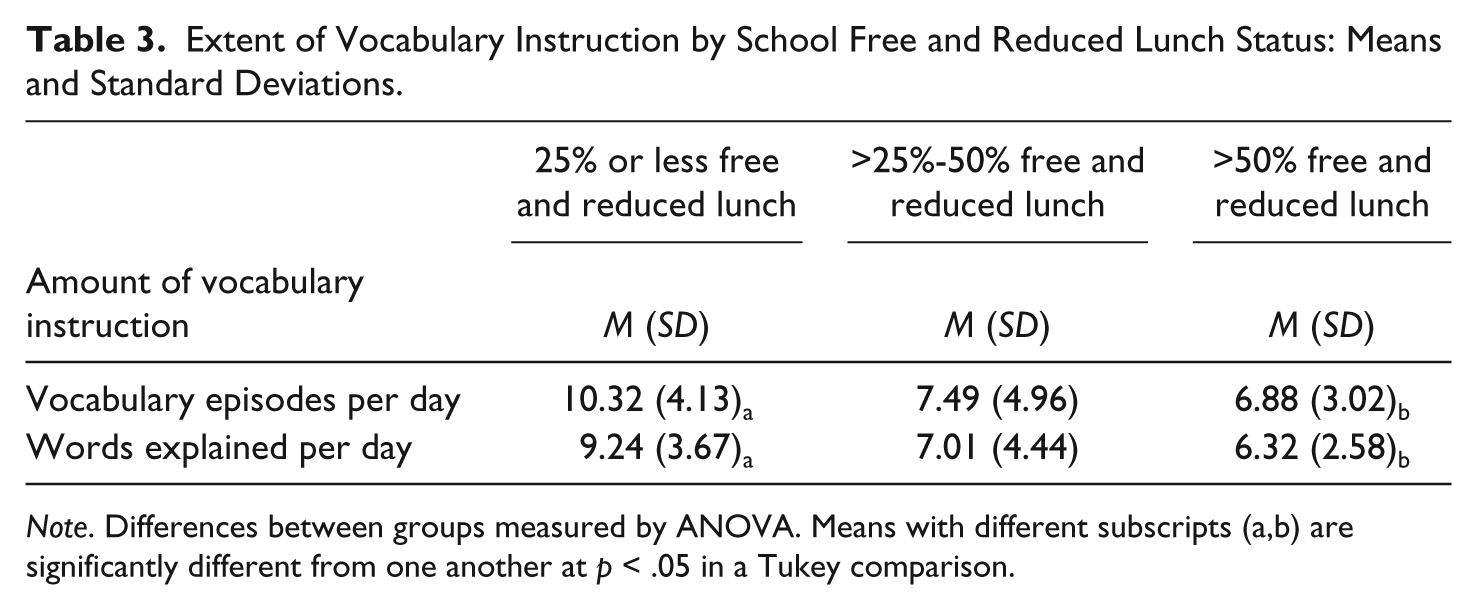
Note. Differences between groups measured by ANOVA. Means with different subscripts (a,b) are significantly different from one another at p < .05 in a Tukey comparison.
Number of Words Taught
For our next analysis, we began by considering how many episodes were dedicated to the same word each day. It was possible that teachers might dedicate several vocabulary episodes to addressing a single word, discussing the same word repeatedly over the course of the school day. In contrast, the number of vocabulary episodes might more closely parallel the number of words addressed, suggesting that the teacher discussed a broader set of words fewer times each day. Therefore, we also considered the ratio of vocabulary episodes to the number of words taught.
We found that kindergarten teachers used their 8 vocabulary episodes to teach 7.44 (SD = 3.72) different vocabulary words per day, suggesting that teachers rarely discussed the meaning of the same word more than once during the day. Again, the range was considerable with teachers addressing 0 to 17 different vocabulary words per day. There were significant differences between teachers serving in low poverty and high-poverty schools, F(2, 52) = 3.30, p < .045, Cohen’s d = 0.92; teachers in the most economically advantaged schools addressed a greater number of vocabulary words per day. However, there were no differences across groups in the ratio of episodes to words taught per day, suggesting that across these classrooms, teachers generally provided only one explanation per day for each word.
In addition to variability across the sample, we found within-subject variability. Table 4 shows only low to moderate correlations among teachers’ vocabulary episodes from one observation to another. For example, in one classroom, the teacher provided 10 vocabulary episodes during the first observation and 13 during the second observation. However, the same teacher had only 1 vocabulary episode during the third observation and none at all during the fourth observation.
Summary of Intercorrelations for Number of Vocabulary Episodes Across Four Observations.
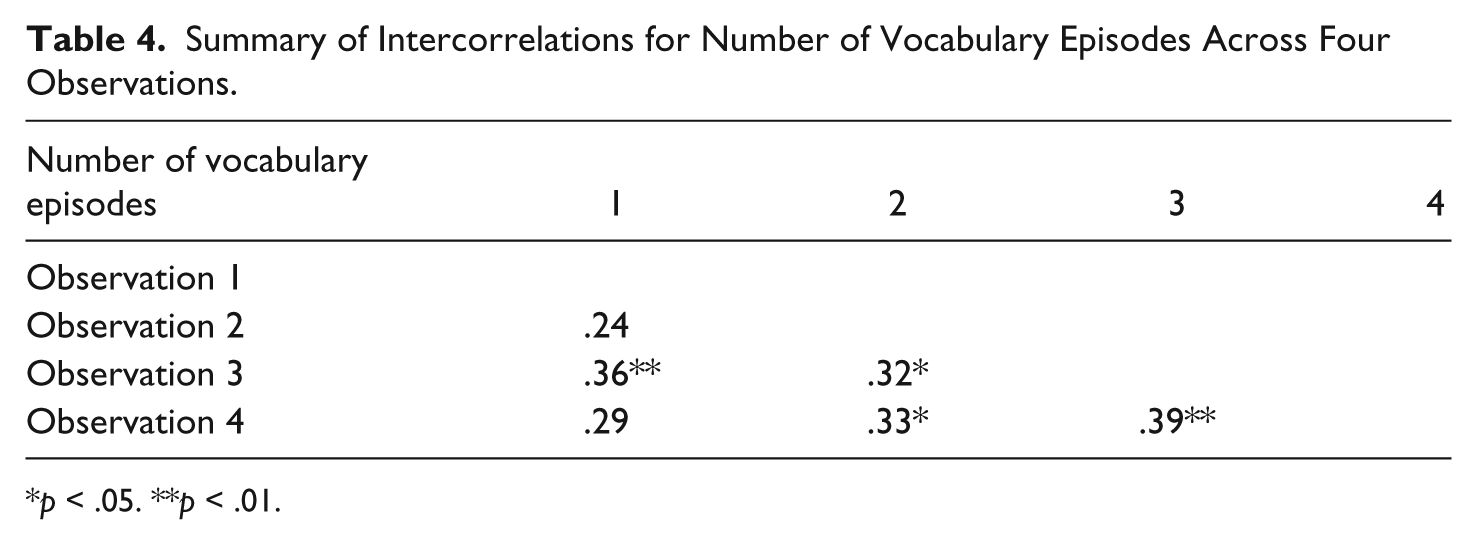
p < .05. **p < .01.
These findings indicate that the number of times that teachers discussed vocabulary words with students was inconsistent not only from classroom to classroom but also from day to day within the same classroom. Therefore, rather than a consistent regime of systematic teaching, the reality of daily oral vocabulary instruction in kindergarten was far more intermittent.
Word Difficulty
To further understand the words taught during vocabulary episodes, we examined the difficulty of all words that teachers chose to explain. Given that there is little consensus on a particular approach to identifying difficulty level, we used three different measures to examine the difficulty level of words selected for instruction.
There was converging evidence across the three approaches to analysis: The majority of words explained by kindergarten teachers were considered common, easy, or basic. Of the 7.5 words explained per day, on average 3.94 (SD = 2.21) were common words on the Dale–Chall list, 4.53 (SD = 2.31) were rated as Tier 1 basic words, and 3.03 (SD = 1.75) were rated as easy on the Words Worth Teaching list. 2 There were no differences in the number of common words F(2, 52) = 1.11, ns, Tier 1 words F(2, 52) = 0.39, ns, or easy words F(2, 52) = .80, ns, explained across SES groups. Across three different measures and across teachers in these different SES settings, the majority of words explained to children by their kindergarten teachers can be considered words that children typically learn without instruction (see Table 5).
Word Difficulty by School Free and Reduced Lunch Status.
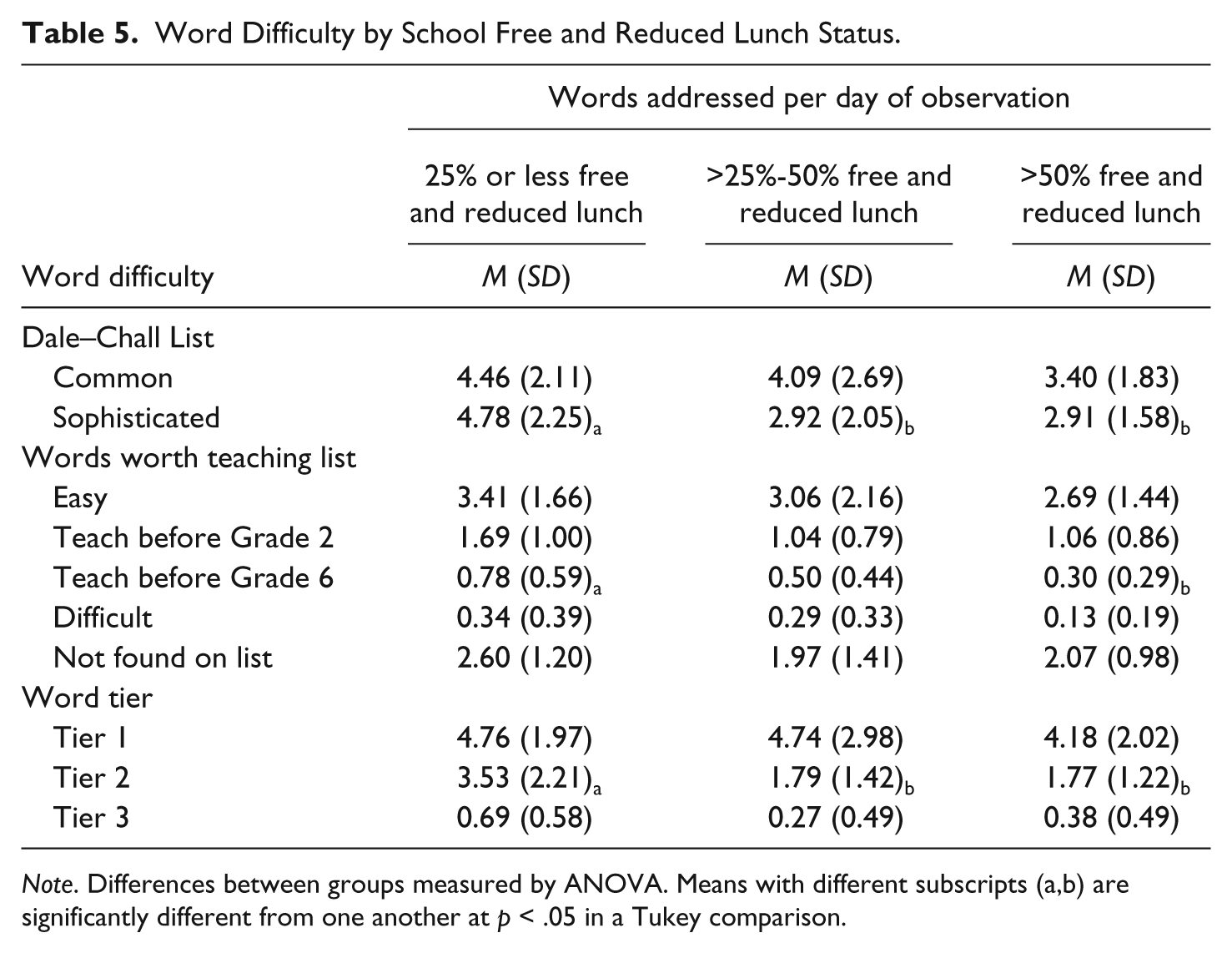
Note. Differences between groups measured by ANOVA. Means with different subscripts (a,b) are significantly different from one another at p < .05 in a Tukey comparison.
Fewer of the explained words were listed on these measures as appropriate candidates for vocabulary instruction in kindergarten, with on average 3.50 (SD = 2.10) sophisticated words explained per day, almost 2.32 (SD = 1.81) Tier 2 words explained per day, and 1.25 (SD = 0.92) words on the Words Worth Teaching list designated to be taught between kindergarten and Grade 2. Therefore, the majority of the words explained during vocabulary episodes did not align with those that experts designate as candidates for oral vocabulary instruction in kindergarten. Rather, most words addressed were those that students are likely to learn without instruction. It was unclear how teachers may have selected the words they discussed during vocabulary episodes.
In addition, we found that across three measures, teachers serving in low poverty schools explained more challenging words than teachers serving in economically diverse or high-poverty schools. As shown in the table, teachers serving in the most economically advantaged schools taught more sophisticated words not on the Dale–Chall list F(2, 52) = 5.31, p = .008, more Tier 2 words F(2, 52) = 6.60, p = .003 and marginally more words designated to be taught between kindergarten and Grade 2 on the Words Worth Teaching list F(2, 52) = 3.07, p = .055. Effect sizes for these comparisons (Cohen’s d ranged from 0.85 to 0.95) were large. Not only were economically advantaged children exposed to more vocabulary words than their peers but also these additional words were likely to be the challenging words that are considered essential for vocabulary development and reading comprehension.
Curriculum Usage
There were differences by school SES on whether teachers used a core reading curriculum (i.e., comprehensive curriculum or basal curriculum) for reading instruction with teachers in the highest SES schools least likely to use a core curriculum. Rather, teachers who did not use a core curriculum indicated that they used a particular method (e.g., guided reading) to support their instruction or that they designed their own literacy instruction. We hypothesized that these differences in curriculum usage may have influenced observed vocabulary instruction (see online supplementary Table 6). While curriculum use differed by school SES, this was unrelated to the number of vocabulary episodes taught F(1, 50) = .01, ns, the number of words taught F(1, 50) = .01, ns, or the number of sophisticated words taught per day F(1, 50) = .52, ns. We found no relationship between the type of curriculum used and observed vocabulary instruction.
Teaching Experience
There were also differences in teaching experience by school SES with the least experienced teachers serving in high-poverty schools. Therefore, we thought that teaching experience might be related to vocabulary instruction (see online supplementary Table 7). As shown in Table 7, while teachers’ years of experience differed by school SES, this experience did not significantly influence the number of vocabulary episodes taught F(2, 52) = .64, ns, the number of words taught F(2, 52) = 1.36, ns, or the number of sophisticated words taught per day F(2, 52) = 2.31, ns. We found no significant relationships between observed vocabulary instruction and teachers’ years of experience in the classroom.
Length and Pattern of Vocabulary Episodes
We next considered whether vocabulary episodes were typically brief or more extended interactions by counting teachers’ utterances associated with each episode. Each unit of speech bounded by silence was counted as an utterance. For example, one teacher asked, “What do you think an auditorium is?” When there was no response, she stated, “It’s a big place with lots of people. Have you ever been like to go see a play or something at the high school in the big auditorium?” This was counted as three utterances. Therefore, a sentence, a sentence fragment, or a brief conversation turn, would each be counted as one utterance (Dickinson & Smith, 1994).
We found that vocabulary episodes were very brief, consisting on average of 2.50 (SD = 0.68) utterances by the teacher. We found no differences in this feature of vocabulary instruction across groups. There were no differences across SES groups in the number of utterances that teachers used during each vocabulary episodes F(2, 52) = .07, ns. Therefore, word explanations were brief in all classrooms.
We found two primary patterns of interaction during vocabulary episodes. In the first pattern, a word was used in a text or conversation and then the teacher stated a brief definition before continuing with the lesson or activity. For example, one teacher stopped during a read aloud to explain, “That’s the predator. That means he wants to eat the frog,” and then after these two utterances, she continued reading. Another teacher used the word celebrate during a conversation about a child’s birthday, and then defined the word using a single utterance, “Celebrate means to do something fun.”
In the second pattern of interaction, a word was used in a text or conversation and the teacher first checked to see if one or more students knew the word by asking for an explanation of its meaning. After questioning the children, the teacher then stated or restated the definition. For example in a reading lesson on words that start with the /r/ sound, one child suggested a remote.
Remote, what’s a remote?
It goes with the TV.
Yes, it’s a push button that turns the TV on or off.
Or in another example during a read aloud, a teacher stopped briefly and said
What’s a hive? What’s a hive, Evan?
What the bees live in.
Yes, what the bees live in. Bumblebees live in a hive.
Taken together, our analysis indicated that vocabulary instruction consisted of single, brief, word explanations that occurred intermittently. Furthermore, children who attended schools in economically advantaged settings were likely to encounter more explanations involving more challenging words compared with those in high-poverty schools. In short, these results indicate that those children who may need vocabulary instruction the most received the least in their kindergarten classrooms.
Vocabulary Episodes Across Instructional Contexts
In our last analysis, we sought to understand the contexts in which vocabulary instruction occurred during the kindergarten day. Specifically, we were interested in whether certain subject areas might better support vocabulary instruction. In particular, we wondered whether there were differences in the attention to content-focused vocabulary episodes across different SES classrooms. Typically, content areas that teachers addressed included reading and writing instruction, math, science, social studies, morning meeting, and read alouds.
We examined how many vocabulary episodes occurred per minute of instruction in each content area taught. The goal was to understand whether vocabulary episodes were particularly dense in certain subjects, such as science or social studies (see online supplementary Table 8). As shown in Table 8, when teachers read aloud to children, this context elicited the greatest number of vocabulary episodes per minute, reflecting the traditional role of read alouds in providing an instructional context for vocabulary explanations. Not far behind, however, were the content areas of science and social studies. These content areas constituted the richest contexts for vocabulary episodes.
The least conducive areas for vocabulary instruction were writing and reading instruction. Given the focus on the rudiments of basic skills, these content areas were less likely to emphasize vocabulary.
While read alouds, science, and social studies were contexts with the greatest number of vocabulary episodes per minute when they were taught, subsequent analysis of teachers’ time use indicated that these subjects were least likely to be addressed across kindergarten classrooms (see online supplementary Table 9). As indicated in Table 9, teachers devoted less than 11 min per day to read alouds, only about 2 min per day to science instruction, and 1 min to social studies instruction. In fact, mean scores overestimated the average number of minutes in these subject areas; median scores revealed no science or social studies instruction at all in many kindergarten classrooms. These data indicate that certain content areas—specifically, read alouds, science, and social studies—appeared to provide opportunities for vocabulary episodes when teachers addressed these areas. However, other than read alouds, these content areas received minimal to no time at all during our observations in any of these kindergarten classrooms.
Discussion
The purpose of this study was to develop a portrait of oral vocabulary instruction in kindergarten classrooms. Our goal was to provide an in-depth description of the quantity and quality of oral vocabulary instruction provided by teachers serving in a range of SES contexts. Our analysis revealed that vocabulary instruction in kindergarten consisted of single, brief, word explanations provided by the teacher. These explanations occurred intermittently and were embedded across all contexts throughout the day. Teachers seemed to discuss words to support children’s understanding of the immediate context; however, these words tended to be easy rather than more complex. In short, the evidence suggested that vocabulary instruction observed in a large group of kindergarten classrooms consisted of word explanations during “teachable moments” throughout the day. We found that teachers serving in the more economically advantaged schools provided more of these teachable moments and addressed more challenging words than teachers serving in high-poverty schools.
The teachable moments observed in this study represent important informal opportunities to engage children in word learning, somewhat parallel to the types of language exchanges between parents and their children. But, how might this type of instruction in the teachable moment contribute to children’s vocabulary development? Previous research (Weizman & Snow, 2001) in children’s homes found that mothers’ helpful explanations of sophisticated words (i.e., words not on the Dale–Chall list) were associated with improved vocabulary outcomes for kindergartners from low-income backgrounds. Likewise, Biemiller and Boote (2006) summarized studies where children received a single storybook reading with onetime embedded explanations. They concluded that, on average, children learned 15% of previously unknown words. Also, brief explanations of words in context likely help children’s immediate understanding of that context—the text or lesson being addressed at the time (Sternberg, 1987). Therefore, based on these studies, it is likely that eight teachable moments addressing vocabulary per day would facilitate children’s incremental learning of some previously unknown words, contribute to breadth of word exposure, support comprehension within the immediate instructional context, and would contribute to the general oral language environment in the classroom.
However, it is concerning that teachable moments were the only type of vocabulary instruction observed in kindergarten classrooms and that teachable moments for vocabulary were least likely to take place when teachers served in high-poverty schools. While studies have documented differences in children’s home-based vocabulary learning opportunities by SES (e.g., Hart & Risley, 1995), this study revealed differences in children’s school-based learning opportunities. The features of vocabulary instruction—brief explanations in the teachable moment—were the same across classrooms, however, teachers serving children in high-poverty schools provided significantly fewer of these word explanations. These teachers were less likely to discuss word meanings with children than those serving their more economically advantaged peers. They also explained fewer challenging words, providing more limited support for children’s development of academic vocabulary. To project these findings over the course of a year, the differences would translate into a troubling equation: Children in high-poverty schools would receive only 60% of the vocabulary instruction provided to their more economically advantaged peers. These results suggest that teachers serving children who are most likely to arrive at school in need of vocabulary instruction (Farkas & Beron, 2004; Hoff, 2013) found fewest teachable moments to address it.
Notably, factors associated with high-poverty schools such as lower levels of teaching experience and the use of a core reading curriculum program were not significantly related to observed vocabulary instruction in this study. Wright and Neuman (2013) found large variability in attention to vocabulary instruction across commonly used core reading curricula, which may explain why curriculum usage was unrelated to enacted vocabulary instruction in this study.
Teachable moments occurred sporadically and children, across classrooms in this study, were exposed to a word’s meaning once on any given day. This type of teaching relies on the fast mapping of a word to its referent (Carey, 1978), an hypothesized mental process in which a new word can be learned based on a single exposure to a given unit of information. Although it was once thought to help explain the prodigious rate at which children gain vocabulary, recent evidence suggests that children do not learn words through fast mapping alone, but by predictive relationships between objects, sounds, and actions that develop over time (Nagy & Scott, 2000; Neuman, 2009). Single word explanations may provide meaning, but this knowledge is far from complete and may not be intensive enough to accelerate vocabulary development for children who may need more systematic instruction (Neuman & Dwyer, 2011).
We found that teachers’ explanations of words were very brief and primarily served the immediate context. For example, an explanation of calf as, “a baby whale is called a calf,” was an appropriate explanation for this word in the book being read, yet this explanation in context provides a narrow definition for this word. Based on this explanation, children would not learn that other animal babies are called calf or that calf is also a part of the body. Studies (Coyne et al., 2009) have found that embedded explanations result in partial word knowledge, whereas more extended instruction promotes more full and refined understanding of target words. Yet, observed vocabulary teaching in kindergarten more closely resembled Durkin’s (1978-1979) notion of mentioning, brief snippets of partial meaning, rather than the rich or multidimensional instruction described in vocabulary intervention studies focused on depth of word learning (Beck & McKeown, 2007, Silverman, 2007).
Across three different criteria (Beck et al., 2002; Biemiller, 2009; Weizman & Snow, 2001), there was convergence among them that most words explained during vocabulary episodes were not challenging, or sophisticated, or of high utility for mature language users. Therefore, words explained during teachable moments did not reflect research-based recommendations on systematic word selection to promote children’s academic vocabulary development (Nagy & Hiebert, 2010). It remains unclear how teachers decided exactly which words to discuss in kindergarten.
Aside from read alouds—the most common context in the research for vocabulary teaching—children were likely to encounter word explanations in social studies and science. Our episodes per minute calculations revealed that these subject areas provided rich opportunities for vocabulary instruction. Ironically, however, subject areas that appeared to support vocabulary were the least likely to be taught across all classrooms. Children received on average about 10 min of read alouds, 2.5 min of science instruction, and even less of social studies per day, with many teachers not addressing science or social studies at all across 12 hr of observation. Therefore, we observed minimal instruction that might build vocabulary and conceptual knowledge to support long-term comprehension goals.
The type of vocabulary instruction observed in kindergarten classrooms stands in contrast to more systematic instruction provided in effective vocabulary interventions for young children (Marulis & Neuman 2010, 2013). Intervention studies emphasize extended instruction to address the meanings of systematically selected academic vocabulary (Beck & McKeown, 2007; Neuman et al., 2011; Silverman, 2007). Children need to discuss and practice these words in multiple contexts to promote depth of processing (Stahl & Nagy, 2006). Neuman and colleagues (Neuman & Dwyer, 2009; Wright & Neuman, 2013), for example, have emphasized an instructional regime that involves the intentional selection of words, instruction, practice, review, and progress monitoring. Future research should consider how to bring features of effective intervention studies into regular classroom practice, including a better understanding of potential barriers that might be preventing systematic, oral vocabulary instruction from being implemented in kindergarten.
Results from this study may also shed light on previous research that has found limited schooling effects on children’s vocabulary development. Studies by Skibbe, Connor, Morrison, and Jewkes (2011) and Christian, Morrison, Frazier, and Massetti (2000) reported that children’s chronological age, not whether they experience 1 or 2 years of schooling, predicted children’s vocabulary outcomes. It has been suggested that young children may not need instruction to learn new vocabulary words, but may learn better through play, given that schooling is not associated with vocabulary growth. Such hypotheses, however, may be based on the current state of vocabulary instruction in school and not on its potential to improve children’s learning. In intervention studies, children learn vocabulary when it is taught systematically (Marulis & Neuman, 2010, 2013). The informal instruction observed in kindergarten may not be powerful enough to affect children’s vocabulary trajectories.
There are, of course, important limitations to this study. First, our study measured only a representative sample of instruction over the year and our schools were selected from only one state. Additional replications are necessary to examine how vocabulary teaching in kindergarten might evolve throughout the year and to examine differences across a broader range of geographic locations. Second, our strategy was to isolate vocabulary episodes to better understand their potential contribution to vocabulary learning. We focused on this observed vocabulary instruction and did not attempt to measure teachers’ general oral language discourse. However, it is clear that children learn words through day-to-day discourse. Consequently, we may have underestimated opportunities for vocabulary learning in kindergarten classrooms. Third, our analysis did not examine the special needs of children in these classrooms, and therefore we did not gather data on the percentage of second language learners in each classroom. Fourth, this study did not examine the influence of professional development on teachers’ vocabulary instruction; however, our results clearly indicate that interventions to improve vocabulary instruction are an important area for future research. Finally, our approach assumes that vocabulary teaching leads to improvement in children’s vocabulary learning; however, we could not specifically link our observations to child outcomes.
Given these limitations, this study paints a troubling portrait of vocabulary teaching in kindergarten. Despite research-based programs and curricula that have demonstrated powerful effects on oral vocabulary development (Marulis & Neuman, 2010, 2013), there is no evidence that these programs are currently being implemented in a wide range of kindergarten classrooms. Children in our study did not receive any formal instruction to support the development of academic vocabulary that is critical for reading comprehension. Unfortunately, this paucity of vocabulary instruction in kindergarten may have long-term negative consequences for children’s literacy development and success in school. Rather, we found only informal word explanations in the teachable moment. Teachers in high-poverty schools explained fewer total words each day, and addressed fewer challenging words than teachers serving in more economically advantaged schools, suggesting disparity in vocabulary exposure over time. Therefore, vocabulary teaching as it is currently instantiated in kindergarten may in fact be contributing to, rather than ameliorating, vocabulary gaps by SES.
Footnotes
Declaration of Conflicting Interests
The author(s) declared no potential conflicts of interest with respect to the research, authorship, and/or publication of this article.
Funding
The author(s) received no financial support for the research, authorship, and/or publication of this article.
Notes
Author Biographies
References
Supplementary Material
Please find the following supplemental material available below.
For Open Access articles published under a Creative Commons License, all supplemental material carries the same license as the article it is associated with.
For non-Open Access articles published, all supplemental material carries a non-exclusive license, and permission requests for re-use of supplemental material or any part of supplemental material shall be sent directly to the copyright owner as specified in the copyright notice associated with the article.
