




Abstract
The present study examines how sixth grade students’ discussions about texts and comprehension strategies looked similar and/or different based on their identities as readers and their reading levels. Findings indicated that students who self-identified as high-performing readers talked about texts and strategies in ways that were different from students who self-identified as being average or low-performing readers. These differences remained regardless of students’ assessed reading levels. Students who identified as high-performing readers discussed using comprehension strategies as a way to clarify or deepen their knowledge of content and to support their interpretations of text. They also selected strategies based on what they believed would best help them address their specific comprehension problems. By comparison, students who identified as average or low-performing readers separated their talk about strategies from their talk about the texts and tended to have one or two favorite strategies that they repeatedly used regardless of their success.
Middle school students’ abilities to comprehend texts are critical to their academic success (Fordham, 2006). However, results from the recent National Assessment of Educational Progress (NAEP, 2009) showed that 68% of the eighth graders tested were considered to be reading at or below a basic level. Students who read at or below a basic level often have difficulty doing more than extracting basic facts from texts and struggle to critically evaluate and apply what they read to their lives. Therefore, understanding and responding to the reading comprehension needs of middle school students is critical to helping them succeed in school and in life.
Although students with reading difficulties may be common in middle school classrooms, they sit alongside students who meet or exceed grade-level expectations in reading. All middle school students, regardless of their reading abilities, need continued reading instruction to meet the growing and complex reading demands that are placed on them both in and outside of school (Caldwell & Leslie, 2004; Moje, 2007). Therefore, addressing the reading comprehension needs of middle school students is about more than responding to students who demonstrate regular difficulties with texts. Teachers need to be able to provide instruction and experiences that respond to a diverse range of readers (Dennis, 2008).
Helping students comprehend texts in subject-matter classrooms is no simple task. Doing so requires more than memorizing facts, defining vocabulary words, and answering a set of questions at the end of a chapter. Students must engage in a range of skills, including (a) identifying main ideas, (b) evaluating evidence, and (c) assessing sources that arguments are based on (Ganske & Fisher, 2010). Students must also learn how knowledge is created and communicated and how reading and writing within one discipline is both similar and different from reading and writing in others (Heller & Greenleaf, 2007; Moje, 2008).
To help all students improve their reading comprehension abilities, researchers have advocated that subject-matter teachers provide explicit instruction on comprehension strategies and how to use them with a variety of texts (Coiro & Dobler, 2007; Deshler, Palincsar, Biancarosa, & Nair, 2007; Graves & Aimonette, 2008; Hall, 2005). Comprehension strategies are defined as “deliberate, goal-oriented attempts to control and modify the reader’s efforts to decode text, understand words, and construct meanings of text” (Afflerbach, Pearson, & Paris, 2008, p. 368) and include making and checking predictions, rereading, and asking and answering questions before, during, and after reading. As students internalize and apply strategies on their own, they can increase their comprehension of texts, become more responsive to comprehension difficulties, and better apply what they read to their lives (Kintsch & Kintsch, 2005; Pressley & Hilden, 2006).
Although comprehension strategies have been extensively written about (May, 2011), they are just one aspect of helping students comprehend academic texts. The sociocultural context students operate in, along with their cognitive abilities, text difficulty, motivation to read, and purposes for reading, also influence how they approach interacting with texts and comprehending them (RAND Reading Study Group, 2002). Strategies can help students resolve comprehension difficulties and deepen their comprehension, but students also need opportunities to learn a variety of them and see how they are used across different texts (Fisher, Frey, & Ross, 2009).
Despite the promise strategy instruction holds, researchers know very little about how to teach them in ways that are responsive to students with diverse reading abilities and that attend to the needs of adolescents specifically (Conley, 2008; Hagaman & Reid, 2008; Maniates & Pearson, 2008). As Conley (2008) has argued, researchers have primarily focused their studies on comprehension strategies for elementary-aged children. Although such research has provided an important foundation, it leaves many questions about how strategy instruction might best be constructed for adolescents and integrated into subject-matter curriculum in ways that are manageable for teachers and useful to students.
Developing strategy instruction that responds solely to middle school students’ cognitive needs and, by extension, their current grade-level reading abilities is likely to have a limited impact (Hall, 2010). Students may choose not to apply strategies during reading even when they understand how to do so and want to improve their reading comprehension abilities (Dole, Brown, & Trathen, 1996; Duffy, 2002; Duffy et al., 1986; Hall, 2009; Paris, Lipson, & Wixson, 1983). Students who self-identify as poor readers often choose to disengage from reading rather than publicly reveal their perceived weaknesses as readers and may make such decisions with the full knowledge that their abilities to comprehend texts and learn content will be compromised (Hall, 2007; Smith & Wilhelm, 2004). Students who self-identify as good readers may still have difficulty comprehending texts beyond a literal level but, because they associate themselves with a positive reading identity, may not believe they need to engage differently with texts or would benefit from further strategy instruction (Caldwell & Leslie, 2004; Ivey & Broaddus, 2000).
How students learn and use strategies is then, in part, connected to how they identify themselves as readers or how they want to be identified by their peers or teachers (Gee, 2001; Hall, 2009; Moje & Lewis, 2007). Effective strategy instruction should then take into account students’ cognitive strengths and weaknesses and their identities as readers. A first step in developing such instruction requires understanding how identities might be related to students’ engagements with strategies and texts to bridge their cognitive and social worlds and help them develop as readers.
The present study sought to better understand how middle school students’ reading identities as well as their current grade-level reading abilities might be related to the ways they discussed comprehension strategies and texts in small group settings. In doing so, this study provides an in-depth analysis of how identities were enacted in social settings around texts and strategies and how identities both constrained and supported students’ development as readers. The research question was as follows:
How do students’ discussions about texts and comprehension strategies look similar and/or different based on their identities as readers and their reading abilities?
Theoretical Framework
There are many definitions and theories regarding what identity is and how individuals’ identities form and change over time (Moje & Luke, 2009). In this study, I view individuals’ identities as shaped by their environment, their understandings of the norms of that environment, and how they view themselves in relation to those norms (Egan-Robertson, 1998; Holland, Lachicotte, Skinner, & Cain, 1998; Sarup, 1996). Individuals’ identities are formed, reinforced, and/or re-formed based on their past and current experiences and how they situate themselves within those experiences (Alsup, 2005).
Students’ conceptualizations of what it means to be a reader are constructed at an early age. Through their interactions with their teachers, peers, and family members, students learn what it means to be identified as a certain type of reader and the positive and negative consequences associated with each (McDermott, Goldman, & Varenne, 2006). The norms connected with a particular reading identity, such as good or poor reader, are grounded in what Wortham (2006) refers to as models of identity. Models of identity serve as frameworks for understanding oneself and others. They are deeply entrenched and have long-standing cultural and historical roots making them difficult to change. According to Wortham (2006), “Individuals behave in certain ways or possess certain characteristics, and those behaviors or characteristics are interpreted by the individual and by others as signs of identity, as indications that the individual belongs to a recognized social type” (p. 30).
In school, there are many factors students can draw on to understand the different reading identities available to them, the characteristics that each identity possesses, and who they are in relation to the presented models. One factor is language. Teachers often tell students the qualities associated with a particular type of reader (Hall, Johnson, Juzwik, Wortham, & Mosley, 2010). Often these models of identity are not open to question or reconfiguration, suggesting that the dominating models are the only ones available and that students should ascribe themselves accordingly (Skeggs, 2008). Although people can decide how to identify themselves, it is often those in the most powerful positions who get to decide what identities look like within a given context (Lin, 2008).
In school, it is the autonomous model of literacy that often serves as the framework for developing students’ reading identities and helping them think about what it means to comprehend texts (O’Brien, 2006; Street, 2005). According to Alvermann (2009),
The autonomous model, which is prevalent in schools in the United States, views reading and writing as neutral processes that are largely explained by individual variations in cognitive and physiological functioning. It is a view that assumes a universal set of reading and writing skills for decoding and encoding printed texts. (pp. 15-16)
When teachers apply an autonomous model of literacy to their instruction, reading comprehension becomes centered on finding and locating correct answers within a text using the reading skills and strategies students have at their disposal (Hall, 2010). School-based texts, such as textbooks, are typically seen as neutral documents that contain information for students to identify and extract. Although students’ background knowledge about a given topic may be seen as relevant and useful in comprehending a text, their personal day-to-day experiences beyond the topic are often seen as having little relevance.
Students’ identities within an autonomous model are created based solely on skills, what they can or cannot do, with little attention to the social and cultural factors that can shape their literate acts and reading development. As a result, students who relinquish control of their literate identities to schools can compromise who they become as individuals (Moje & Lewis, 2007). As students learn where they fall within the models of identity made available to them, they may begin to adopt the habits and practices teachers connect to the model they align with (Rogers, 2002). Ironically, although the autonomous model of literacy attempts to extract reading from any sociocultural context, it also creates a social context by defining how reading is viewed and valued.
By contrast, an ideological model of literacy (Street, 1985) views reading as a complex social practice that encompasses the teaching and application of skills and strategies that aid in reading comprehension. Reading instruction is not bound to teaching skills and strategies in a specific sequence but rather focuses on helping students learn how to read, write, use, and discuss texts in both formal and informal ways for academic, social, and personal purposes (O’Brien, Stewart, & Beach, 2009). Reading instruction is grounded in the lives of the students and the histories, ideas, questions, and identities they bring with them. It is the students, and not the skills or the texts, that serve as the framework for instruction.
Students’ identities as readers are a central component of the ideological model. Understanding how students define themselves, and what experiences have shaped their identities, allows teachers to better understand and respond to students’ interactions with texts (Coffey & Street, 2008). Although teachers who utilize an ideological model do help students develop reading skills and strategies, students are not expected to conform to preexisting models of identity or adopt the identity of a good reader as a teacher defines it (Hall, Greene, & Watts, 2011). Instead, students are given control to define and shape their identities. They may openly critique the models of identity they have experienced in school, work to create their own definitions of reading and literacy, and define who they want to become as readers.
The autonomous and ideological models result in very different conceptual understandings about what it means to comprehend texts and thus how students should be taught. At a basic level, reading comprehension refers to extracting and/or creating meaning from texts and using that information in some way (McLaughlin, 2008). Although Luke, Woods, and Dooley (2011) note that such definitions have long been a part of the history of reading, they expand on it by arguing,
Comprehension does not necessarily entail verification of literal and inferred meanings, but critical analyses of their possible origins, motivations, and consequences through understanding of semiotic codes and pragmatic and interactional conventions. This perspective allows one to move beyond conventional definitions of comprehension (e.g., Snow et al., 1998) to a definition that includes, but is not limited to, cognitive processes for bringing past experiences to reading and for constructing, retaining, and recalling meaning with a degree of fidelity to the semantic contents of a given text. (p. 160)
Therefore, they argue, although comprehension involves the use of skills and cognitive processes, it is also a social and cultural phenomenon as students’ lives and experiences shape their interactions with and understandings of texts.
However, the autonomous model of literacy ignores or places little emphasis on the social and cultural aspects of students’ lives. Under an autonomous model, comprehension is viewed as a discrete skill that is not influenced by students’ identities and can be improved on with additional skill instruction and practice (Christenbury, Bomer, & Smagorinsky, 2009). Students can demonstrate comprehension by answering predetermined questions on their own.
Under an ideological model, comprehension is deeply intertwined with identity and the social interactions with others. Although answering a set of predetermined questions may shed some light on students’ comprehension, how they apply information and instruction provides greater insight into how well they understand what they read. Skills and strategies are taught, but attention must be paid to the classroom context and how students are positioned within it (McCarthey, 1998).
Although the different reading identities that exist in school for what makes someone a certain type of reader may not hold up under scrutiny, they do have very real consequences for how students engage with texts and reading instruction (Richardson & Eccles, 2007). Students’ understandings of who they are as readers contribute to the decisions they make about reading (Luttrell & Parker, 2001). When expected to read and discuss texts in small groups or whole-class settings, students who identify as poor readers may withdraw or limit their involvement in an effort to avoid being publicly identified as a poor readers. Students who identify as good or above-average readers may be more likely to participate publicly since they likely have experienced more success with reading in school, believe they can accomplish the task at hand, and feel they have something to contribute. Therefore, students’ interactions with texts and instruction are not necessarily mediated by their cognitive reading abilities but rather their interpretation of what it means to be a certain type of reader and how they understand themselves in relation to those norms.
Method
I conducted this mixed-methods study over a period of 12 weeks. Three sixth grade social studies teachers and one of their classes participated. Four types of data were collected in each classroom: (a) the Gates–MacGinitie, Fourth Edition (MacGinitie, MacGinitie, Maria, Dreyer, & Hughes, 2000), test of reading achievement, (b) the Reader Self Perception Scale (Henk & Melnick, 1995), (c) biweekly field observations, 78 total, to ensure fidelity of the instruction and observe students as they engaged with the instruction, and (d) 144 small group discussions that were audiotaped and transcribed to examine the discourse in the small group conversations.
I designed the instruction provided by the teachers to understand how students discussed texts and their use of comprehension strategies. Collecting data on students’ current reading abilities, along with their reading identities, allowed me to consider how each factor appeared to shape students’ approaches to discussing texts and comprehension strategies. Finally, the data permitted me to conduct an in-depth analysis of each classroom as a single case as well as look for patterns and variations that existed across classrooms.
Participants
Two middle schools, in two different districts, located in the rural South participated. Both schools had failed to make adequate yearly progress in reading in the previous 4 years. The first school, Mill Creek, had 681 students, with the average sixth grade class containing 18 students. The state’s online report card for Mill Creek said that according to the most recent end-of-grade reading exam approximately 20% of the student population read below grade level. Two teachers from Mill Creek, Ms. Anderson and Ms. West, participated.
The second middle school, Oak Grove, had 921 students, with the average sixth grade class containing 25 students. The state’s online report card for Oak Grove said that according to the most recent end-of-grade reading exam approximately 30% of the student population read below grade level. One teacher from Oak Grove, Mr. Cook, participated.
The participating teachers all taught multiple sections of social studies each day. They were asked to nominate one class to participate in the study they believed needed the most help in reading. The teachers and principals decided which class to nominate. A total of 52 students participated, about 17 students per class.
Classroom Procedures
Students engaged in a series of four instructional cycles that I designed for the purposes of this study. Each cycle contained six steps and typically took 2 weeks to complete. Students first received instruction from their teacher on a comprehension strategy while a trained research assistant or myself observed. Next, they read a piece of text on their own and documented their strategy use. Then they engaged in a small group discussion about the text and their strategy use. Students then read a second text on the same topic as the first, documented their strategy use, and engaged in a second discussion. Finally, students reflected on what they had learned from reading the texts and about comprehension strategies and discussed their understandings with their group.
Strategy instruction lasted approximately 30 minutes and was taught using the model developed by Duffy and colleagues (1986), which has been shown to increase students’ understanding of comprehension strategies. Teachers began each lesson by naming and defining the strategy being taught. Next, teachers modeled how to apply the strategy during reading and engaged students in guided practice.
Strategies were taught in the following order: (a) becoming metacognitive, (b) making and checking predictions, (c) activating prior knowledge, and (d) asking, revising, and answering questions before, during, and after reading. I chose the first strategy, becoming metacognitive, to help students become more aware of their strategy use and prepare them for participating in their small group discussions. The teachers and I agreed on the remaining strategies based on the needs of the students and reading comprehension strategies that were a part of the sixth grade curriculum.
Teachers had limited knowledge about comprehension strategies and reading instruction in general. Therefore, I developed lesson plans for each strategy that followed the Duffy et al. (1986) model. Lessons were not scripted but provided teachers with a detailed outline and a text to use in their lesson. Teachers were given the lesson plans one week in advance of the instruction and were able to ask for clarification if needed.
After the strategy instruction, students completed a reading assignment that provided them the opportunity to apply comprehension strategies and learn social studies content. I selected readings written at a sixth grade reading level that matched the topics teachers wanted students to learn about. The teachers preferred not to use the district-adopted social studies textbook because they found it too difficult for the majority of their students. Mr. Cook proposed using texts from the website edHelper (www.edhelper.com), and Ms. Anderson and Ms. West agreed with the idea.
edHelper provides texts for students on a variety of academic topics including social studies. Within content areas, texts are grouped together by topic (i.e., ancient Rome or American government) and then by subtopic within the broader categories. edHelper provides a suggested grade range for the text as well as the Flesch–Kincaid reading level, making it easy to identify texts at a sixth grade level. Texts averaged three pages in length, were informational, and typically contained a picture and a short caption related to the topic. Teachers provided me with information about what their students were studying and the topics the texts should center on. I identified appropriate texts on edHelper at least one week in advance and shared them with the teachers to see if they matched what they wanted students to learn.
During the first cycle, all students read the same texts. For the remaining cycles, students in Ms. Anderson’s and Ms. West’s class read the same texts, whereas students in Mr. Cook’s class read different ones. The difference in text use was the result of Mr. Cook teaching different content.
Students read a text on their own and documented any strategies they used as they read it. Appendix A shows the chart students completed. Strategies were listed under the “strategies” column in the chart after they had been taught. Students could list additional strategies they used in the blank spaces provided.
Students answered an average of six questions about each reading (see Appendix B for examples). I developed the questions, and the teachers reviewed them approximately one week in advance of the reading and could make or request revisions. The teachers wanted the majority of the questions to require students to draw on the text to formulate and justify an argument. Teachers also requested fact-based questions such as, “What did stonecutters do?” but these made up only one or two of the questions students were asked about each text.
The teachers reviewed the questions with the students before they began the reading. Students answered the questions on their own in writing. Students could work on answering questions as they read or complete them all at once after they had finished reading. Teachers used the questions to determine what students learned from their readings and to facilitate the small group discussions that followed.
Students engaged in small group discussions after completing each reading. In their discussions, students were expected to share their understandings of the text they had read as well as their comprehension strategy use. Students had control over what they discussed and were told to come to their group with at least one topic or question to explore. Examples of topics they were given included (a) something they did not understand about the text, (b) their experiences with using one or more comprehension strategies during reading, and (c) an idea from the text they wanted to discuss further. Students were never encouraged or told to discuss the questions they had answered or to report out all the strategies they had tried.
Groups consisted of four to five students who shared similar beliefs about themselves as readers, identifying themselves as high-performing, average-performing, or low-performing readers, and remained consistent throughout the study. To the extent that it was possible, students with a specific reading identity (low, average, or high performing) were randomly assigned to discussion groups. However, in some cases there were only enough students with a specific reading identity to form one group within a class.
Students’ reading comprehension abilities were not a factor in forming the groups. Within each group all students shared the same reading identity, but there was a mix of students who read on, above, or below grade level.
Table 1 shows how many groups within each class self-identified as low-, average-, or high-performing readers, how many members were in each group, and the number of students within a group who read below, on, or above grade level.
Group Makeup
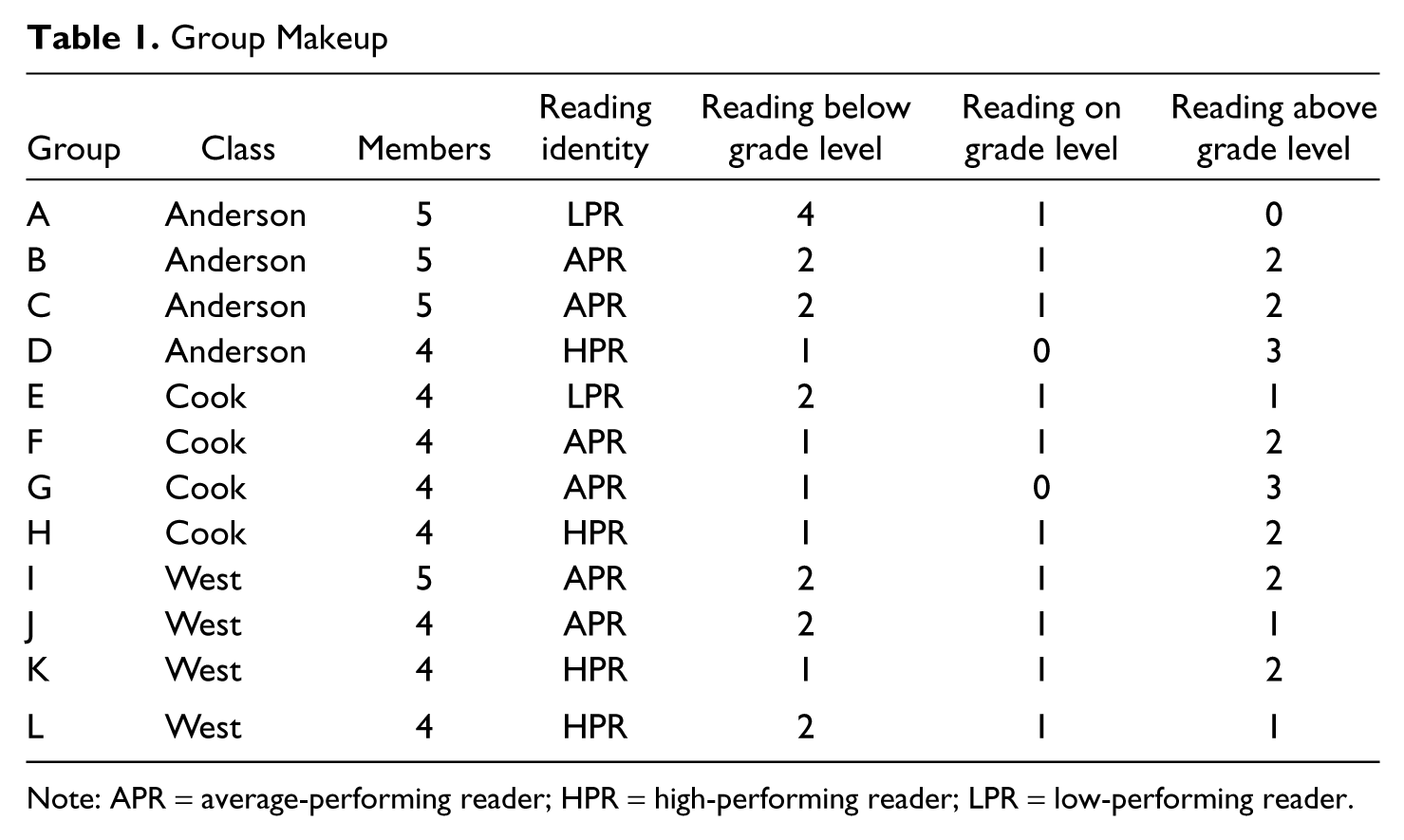
Note: APR = average-performing reader; HPR = high-performing reader; LPR = low-performing reader.
After their discussion, students were given a new piece of text to read. As before, they documented their strategy use as they read and then participated in a discussion with their group. They then reviewed their materials from their two most recent readings to identify what they learned from the readings and about comprehension strategies. Students discussed their conclusions with their group. After the third discussion, teachers started instruction on a new comprehension strategy and the process began again.
The instructional sequence was designed to help students learn how to use comprehension strategies in purposeful ways to gain knowledge from texts. As discussed earlier, teaching strategies through an autonomous model can result in students having a narrow view of comprehending texts and reading in general. Focusing only on how well students apply comprehension strategies to a given text also reinforces who is considered a good or poor reader in school.
By drawing on an ideological model, the instruction students experienced in this study allowed them to discuss texts and strategies for an academic and a personal standpoint. Students’ experiences were grounded in their ideas, questions, and understandings about texts and strategies. Because students were given the freedom to decide when and how to use strategies, they were given the space to develop their agency as readers. Small group discussions became places where all students had something to contribute and were not places that attempted to position students as certain types of readers or suggest they should adopt specific ways of engaging with texts.
Data Sources
Test of reading achievement
Students took the Gates–MacGinitie, Fourth Edition (GMRT-4; MacGinitie et al., 2000) test of reading comprehension at the beginning and end of the study. The GMRT-4 has acceptably high levels of reliability. The Kuder–Richardson formula reliabilities range from .80 to .87 (MacGinitie, MacGinitie, Maria, & Dreyer, 2008).
The GMRT-4 required students to read fiction and nonfiction texts. There are no standardized, whole-class measures that test students’ comprehension of social studies texts specifically. Students take a vocabulary and a comprehension subtest. The GMRT-4 provides a grade-level equivalency score for each subtest based on the number of questions answered correctly as well as an overall grade-level equivalency based on their combined vocabulary and reading comprehension scores. Students completed Form S, Level 6, which was the appropriate level for sixth graders, before the study began. They completed Form T, Level 6, at the end of the study.
For this study, students were classified as reading below, on, or above grade level based on their combined score. Students whose combined score was 5.9 or lower were considered to be reading below grade level. Students whose combined score was between 6.0 and 6.9 were considered to be reading on grade level, and students with a 7.0 or higher combined score were considered to be reading above grade level.
Grade-equivalent scores are just one way to understand students’ reading abilities. In this study, I viewed grade-equivalent scores as a rough estimate of where students were as readers when they completed the assessment. A limitation to this assessment is a student may have scored lower than usual because of extenuating factors in her or his life. However, using grade-equivalent scores provided a framework for better understanding the dynamics of each discussion group and allowed me to see if patterns existed within the discussions based on students’ grade-level scores.
Assessment of self-efficacy
Students completed the Reader Self-Perception Scale (RSPS; Henk & Melnick, 1995) at the beginning and end of the study. The RSPS measures how students in Grades 4 through 6 perceive their reading abilities. Reported alpha reliabilities ranged from .81 to .84.
Students answered 33 questions using a Likert-type scale. The questions measured four areas: (a) progress, (b) observational comparison, (c) social feedback, and (d) physiological states. Students’ responses were assigned a value of 1 to 5 points. Raw scores were then summed for each of the four areas. I then added the four scores together to receive a total score. Based on their overall scores, students were identified as holding a high, average, or low self-perception about their reading abilities. I arrived at cutoff scores by identifying the lowest score the RSPS said a student could achieve within an area and still be considered high, average, or low. Adding the cutoff scores together across the four areas within perception type allowed me to arrive at the acceptable scoring range for identifying each student’s perception of their reading abilities. Students whose overall score was between 145 and 160 were considered to see themselves as high-performing readers, students whose overall score was between 124 and 144 were considered to see themselves as average-performing readers, and students whose scores were 123 or less were considered to see themselves as low-performing readers. Initial scores on the RSPS were used to form discussion groups.
According to Henk and Melnick (1995), students who identify as high-performing readers tend to believe they are the best readers in their class, that their peers, teachers, and/or family members think they are excellent readers, and that they have few if any comprehension problems. Students who identify as average-performing readers typically enjoy reading, believe they can read as well as most of their peers, and think they have few difficulties comprehending. Finally, students who identify as low-performing readers typically do not believe they are good at reading, believe they are not as capable of reading as their peers, and do not think they are good at solving their comprehension problems.
Observations
Observations were conducted in each classroom twice a week. The first observation occurred on the day when reading instruction was provided to ensure fidelity of instruction. Researchers audiotaped and observed the teachers’ reading instruction and completed a checklist to document the strategy being taught, how accurately teachers followed the instructional model, and the length of time spent teaching each component.
The second observation occurred when students were reading, writing, and discussing texts. Research assistants alternated between seeing a session where students read and wrote about their strategy use and a session where students participated in small group discussions. The primary role of the research assistants during the observations was to complete their checklist or take field notes. However, they were able to help teachers with any procedural questions and answer questions about the intervention.
Discussions
Students participated in three small group discussions in each cycle, two focusing on texts they had read and one where they reflected on what they had learned about texts and comprehension strategies, for a total of 12 discussions per group. Each discussion lasted an average of 15 minutes, and all were audiotaped and transcribed. A total of 144 discussions were recorded.
Data Analysis
I followed the analysis methods recommended by Miles and Huberman (1994) to analyze the small group discussions. Miles and Huberman argue that qualitative data must be reduced (through coding), displayed through matrices, graphs, or charts, and then verified to reach conclusions. Given the volume of transcripts from the small group discussions, it was necessary for me to identify and then focus on the sections that were most relevant to the study. As patterns emerged through coding, I created charts to display them, which allowed me to see what was happening within and across groups and classes. The back and forth process of reducing and displaying data allowed me to verify what was taking place.
To begin data analysis, discussions were analyzed at the group level, within classes, and across classes. I began at the group level, where I analyzed each group within each class individually. Then, I analyzed groups that shared the same reading identities within each class. Next, I analyzed groups within class to identify any similarities or differences across reading identities. Finally, I looked across classes. In looking across classes I first analyzed the discussions of groups that shared the same reading identities. I then analyzed across all groups and classes.
Analyzing discussions at the individual group level within class and across classes allowed me to determine if findings were unique to a specific group, to students who shared the same reading identities, or to a specific class. It also allowed me to make comparisons across groups who held different reading identities. In the paragraphs that follow, I explain how each level of analysis occurred.
First, all discussions were transcribed and read to identify patterns. I first identified places in the transcripts where students explained the strategies they did or did not use. A strategy could be identified explicitly or implicitly. For example, a student who said he had used his background knowledge to help him understand a text would be labeled as explicitly naming the strategy of background or prior knowledge. A student who said she thought about what she already knew about the topic to help her learn would have been labeled as implicitly naming the same strategy. Once I had identified where talk about a strategy was occurring, I then identified what students said they did or did not learn from using strategies, questions they had about using strategies, and the rationales that guided their strategy use. I assigned descriptive codes to the patterns I identified.
I next reviewed the transcripts and the descriptive codes to identify patterns that existed at each level of analysis. I created pattern codes to understand if there was a connection between how students discussed comprehension strategies and how they identified themselves as readers. Descriptive pattern codes that were related were collapsed together under a single code. Appendix C includes examples of the codes I generated.
Then, I created a matrix displaying the pattern codes at each level of analysis. I looked across pattern codes at each level to determine the assertions that could be made. Once I had identified assertions, I reread the pattern codes and determined which assertion, if any, they served as evidence for. I next reread the pattern codes and transcripts to confirm the evidence that supported them as well as to locate any disconfirming evidence. I then regrouped pattern codes under the appropriate assertion.
Interrater Reliability
After I had completed my analysis, a doctoral student in education was trained to code small group discussions to determine if there was agreement on how I coded them. The student was provided with my coding manual and an explanation of the codes. We first coded three discussions together so she could learn how I had developed the codes and how I applied them to the transcripts. We then coded five discussions separately and talked about our decisions. The doctoral student then coded 48 discussions on her own. This accounted for one-third of the total discussions. Cohen’s kappa (Cohen, 1960) showed acceptably high levels of agreement (κ = .85).
Findings
Results from the GMRT-4 showed that students improved in their vocabulary knowledge and abilities to comprehend texts. Results from the RSPS showed that students experienced positive changes in how they saw themselves as readers. Small group discussions showed that students who saw themselves as high-performing readers (HPR), regardless of their reading abilities, had discussions that were markedly different than students who identified themselves as average- (APR) or low-performing (LPR) readers.
First, in HPR groups, students discussed using comprehension strategies as a way to clarify or deepen their knowledge of content and to support their interpretations of text.
In APR and LPR groups, students separated their talk about strategies from their talk about the texts. Second, students in HPR groups selected strategies based on what they believed would best help them address their specific comprehension problems. Students in APR and LPR groups tended to have one or two favorite strategies they repeatedly used regardless of their success. Students’ documentation of strategies showed they had recorded the strategies they brought forth in these discussions and claimed to have used 97% of the time.
Findings From the Gates–MacGinitie
The Gates–MacGinitie (MacGinitie et al., 2000) was administered to all students at the start and end of the study. Students took both the vocabulary and reading comprehension subtests. Scores from the test can be interpreted in two ways. First, students received a grade-level score for each subtest. Second, they received a grade-level score for their combined performance on both subtests.
Table 2 shows the pre and post mean scores for the vocabulary and comprehension subtests, the mean combined score for both, and the standard deviations. The scores show that, overall, students who participated in the study made a gain of approximately half a grade level over the 3-month period. Table 3 shows what percentages of students were considered to be below, on, or above grade level at the start and end of the study based on their combined vocabulary and comprehension scores. The results displayed in Table 3 show that there was a 12% increase in the number of students who scored on or above grade level in the post assessment.
Pre and Post Mean Scores for Vocabulary and Comprehension Subtests
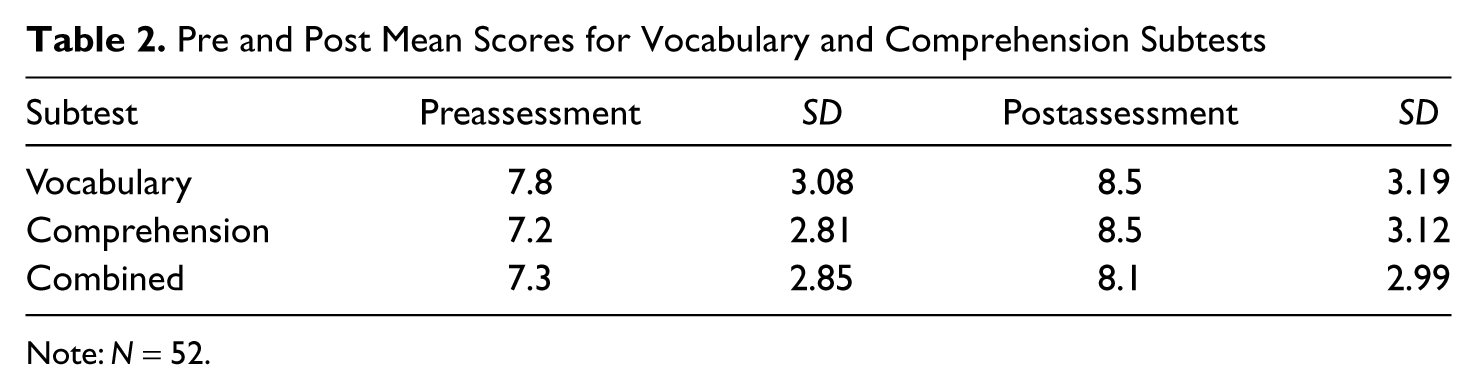
Note: N = 52.
Students’ Reading Below, On, or Above Grade Level
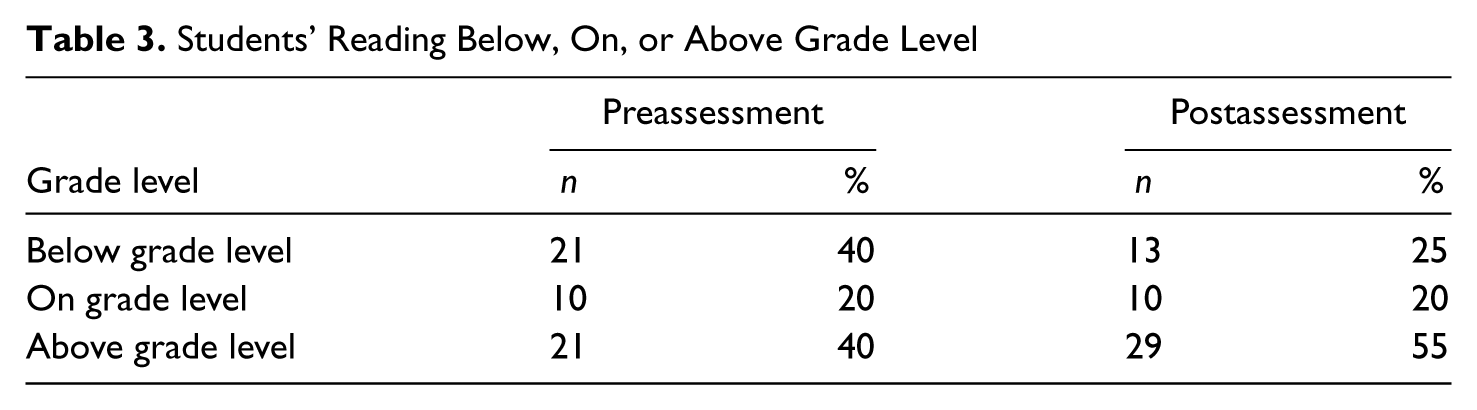
A paired samples t test was conducted to determine if the intervention affected students’ combined scores on the Gates. There was a statistically significant increase in Gates scores from Time 1 (M = 7.33, SD = 2.85) to Time 2 (M = 8.13, SD = 2.99), t(52) = 4.331, p < .0005 (two-tailed). The mean increase in Gates scores was 0.81083, with a 95% confidence interval ranging from 0.43 to 1.20. The eta-square statistic (.28) indicated a large effect size.
Findings From the Reader Self-Perception Scale
Table 4 shows the findings from the pre and post RSPS assessment. The scores show that about half of the students saw themselves as APR at the start and end of the study. However, at the end 13% of the students no longer self-identified as LPR, and there was a 15% increase in students who self-identified as HPR.
Findings From the Reader Self-Perception Scale
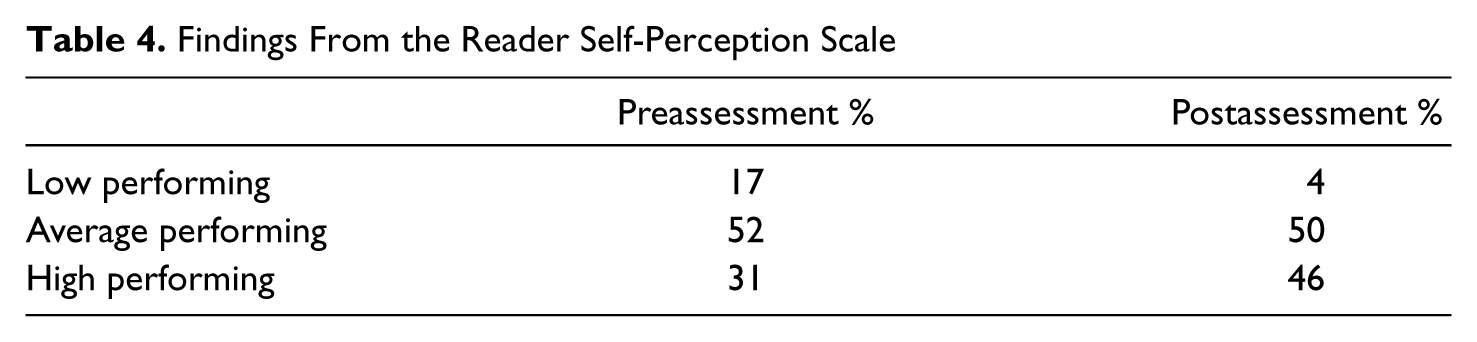
A paired samples t test was conducted to determine if students experienced significant changes in each of the four areas the RSPS tested. There was no statistically significant change in students’ perceptions about the progress they were making in developing their reading abilities or in their physiological states, how they internally felt about reading, and their reading abilities, from Time 1 to Time 2.
However, there was a statistically significant increase in students’ observational comparison as readers from Time 1 (M = 33.0189, SD = 5.22) to Time 2 (M = 34.2642, SD = 5.67), t(52) = 2.063, p < .05 (two-tailed). The mean increase in scores was 1.24, with a 95% confidence interval ranging from 0.03 to 2.45. The eta-square statistic (.07) indicated a moderate effect. The mean increase suggests that students were beginning to see themselves as being just as capable of reading and understanding texts as their peers.
There was also a statistically significant increase in students’ observational feedback as readers from Time 1 (M = 21.3774, SD = 4.52) to Time 2 (M = 23.1887, SD = 3.84), t(52) = 4.943, p < .0005 (two-tailed). The mean increase in scores was 1.81, with a 95% confidence interval ranging from 1.07 to 2.54. The eta-square statistic (.31) indicated a large effect. These findings indicate that students believed they were receiving positive feedback about their reading abilities from others such as peers, teachers, and family members.
Using Strategies to Clarify and Deepen Comprehension
Discussions of students in HPR groups showed they used comprehension strategies to clarify and deepen their knowledge of text. HPR groups accounted for 48 of the 144 discussions (33%). Of their discussions, 33 (68%) contained one or more instances of such talk. Within these 33 discussions, 8 contained one instance, 14 contained two instances, and 11 contained three instances. Each instance lasted an average of 3 minutes.
During the first 6 weeks of the study, it was students who read on or above grade level who offered such explanations. In Example 1, students in an HPR group discussed a text they had read about gladiators as part of their studies on ancient Rome. Joshua, an above-grade-level reader, shared how he used asking and answering questions to deepen his understanding about gladiators. Andrew, a below-grade-level reader, did not discuss how he did or did not use comprehension strategies but did indicate he agreed with Joshua’s decisions and interpretations.
Example 1
. . . I wanted to know what they [the gladiators] did. I don’t know. I was wondering what they did with the wounded gladiators. That’s like a question I asked.
. . . Yeah. That’s a good question. What’d you get?
Gladiators were professionally trained warriors. It’s in the second sentence.
Yeah, but what did they have to do as warriors? That’s what I wanted to know. What is a gladiator? And then here it says they were slaves. A slave or criminal that would be forced against his will to battle for sport.
So they weren’t just warriors.
Not like I thought. I thought they’d be like warriors in an army. But they weren’t. So it’s like they were forced to be warriors and fight in a game, which is different than being in an army.
That was a good question.
Yeah. It helped me understand the paragraphs better.
Joshua’s statements show how he asked questions to further his understandings about gladiators. His statements also show how he modified his prior knowledge about gladiators to incorporate his new understandings. Although Andrew did not talk about strategies and content like Joshua, he twice stated that Joshua’s question was good and briefly acknowledged that gladiators were more than warriors in Line e.
During the first five discussions, students like Andrew, who identified as HPR but read below grade level, participated very little, making an average of three statements per discussion. Their statements were short and agreeable in relation to what their peers said about strategies and content. However, after participating in six to eight discussions, they began to shift their talk and take the lead in explaining how they used comprehension strategies in ways that were similar to Joshua in Example 1.
Example 2 is an excerpt from the seventh discussion held by a second HPR group. It shows how Daniel, a below-grade-level reader, explained how he used strategies to help him comprehend text to his group members, who all read above grade level. The group had read a text about the Middle Ages and how young boys were trained to become knights. They discussed how only boys could become knights—something that initially confused Daniel and raised several questions for him:
Example 2
What’d y’all think of this? I thought this was really easy to read. It would be cool to be a knight.
At first I thought, oh yeah, knights, I know what they are. But then why could only boys be knights?
It says right here—
Yeah. I saw that. It says only boys could be knights. Not girls. But it doesn’t say why a girl couldn’t be a knight.
Huh?
Look. It just says that boys were knights and nothing about girls. Why couldn’t a girl be a knight?
It [the text] doesn’t say.
Yeah. And so I thought, I, ok, hold on.
Where are you going?
I’ll be right back [leaves group].
What is he doing?
He’s getting something out of his folder.
I got that thing we read yesterday about growing up in the Middle Ages.
Oh yeah. It talked about girls.
Hmm . . . ok, look here. It says girls had to do all the housecleaning and stuff. They were needed around the house more. And so they couldn’t be knights. That was like a man’s job.
Yep. A man’s job.
And I just thought that wasn’t fair. Because what if a girl wanted to become a knight?
She couldn’t. That’s what it sorta says here. Only boys got to be knights.
Yeah but—ok, hold on—this is confusing going back and forth like this. Look at paragraph three.
Where?
In the, in the knight story.
You had to be a son of a knight or noble to become a knight.
Yeah, like you had to be a rich person. You couldn’t be like a, a . . .
Like a peasant.
Yeah, you couldn’t be poor. Girls couldn’t be knights because they had to clean the house but boys couldn’t be knights if they weren’t rich.
Line B shows how Daniel began his reading by considering his background knowledge about knights. However, as he began to read he wondered why only boys could be knights. Although Tony refers Daniel back to the text to answer his question, Daniel remains firm that the specific text Tony was referring to did not adequately address his question. Starting with Line m, Daniel demonstrates to his group how he found his answer by referring back to a text read on a previous day. In Line s, Daniel returns to the original text on knights and asks the group to read a specific paragraph that helps connects both readings to the question he wishes to address.
Academically, Daniel’s position within the class was one of a student who read below grade level. His teacher communicated to me on more than one occasion that she had serious concerns about Daniel’s ability to participate in his group and improve as a reader. However, Example 2 shows how students like Daniel, who read below grade level but identified themselves as HPR, were able to talk about and use strategies in ways that might exceed expectations. Daniel’s example also highlights how below-grade-level readers in HPR groups were able to take a leadership role within their groups and use strategies and texts to not only deepen their knowledge of content but also expand the understandings their group members held.
Separating Strategies From Text
Discussions in APR and LPR groups showed that students, regardless of their reading abilities, talked either about what strategies they used or about the content of the text. However, they never discussed strategies and content simultaneously like students in HPR groups. In the APR and LPR groups, all discussions began with a brief review of what strategies group members had recorded on their papers. Example 3 shows how students in an APR group talked about strategies they used during reading in their first discussion.
Example 3
I used visualization.
I reread a lot of it.
Sarah, how did you use visualization?
I pictured what I was reading.
Where?
In every paragraph.
Ok.
Did anybody use any other strategies?
I used prior knowledge.
Nope.
Although Justin asked Sarah to say more about how she applied the strategy of visualization when reading, Sarah did not provide more than a definition of visualization and a statement that she used it regularly. She did not say what types of pictures she created for herself or how using visualization did or did not help her comprehend the text.
Students’ discussions about strategies did not change in subsequent discussions. Example 4 shows how the final discussion of an LPR group maintained a strong resemblance to the discussion in Example 3:
Example 4
Today in my reading I used making and checking predictions.
I didn’t use making and checking predictions, but I did use my prior knowledge when I read.
What about you Emma?
Well I used um making and checking predictions, and I used asking and answering questions.
What about you Patrick?
I used my prior knowledge when I read and asking and answering questions and uh that’s it.
Ok. Let’s talk about the story.
After students in APR and LPR groups reported out their strategy use, they shifted to talking about the content of a reading. However, in discussing content, APR and LPR groups never talked about how they used strategies during reading, nor did they engage in using them during discussions. Instead, students reported out what they understood the text to be saying.
In Example 5, students in another APR group read the same text about the Middle Ages that Daniel’s group read in Example 3. However, the group of APR students stated what they learned about the text and relied on each other to answer their questions.
Example 5
What would be the advantage of becoming a knight?
I don’t know because I’m not a guy.
I think it would help you protect your family and your home. If like, if you were like, let’s just say Chris was a knight. They would treat like guys who were knights with respect. That’s an advantage because they get treated with respect.
What she said.
Did squires um help with the, get the um, go into the battlefield and stuff like that?
Like get the armor and take the horses everywhere? Sort of. I think they went into battle with the knights and stuff.
That’d be scary. Uh-huh. Scary.
Like Daniel in Example 3, Leslie also had a question about knights. However, neither Leslie nor her group members engaged in using comprehension strategies or the text to answer her question. Instead, members offered their own understandings about why it might be beneficial to become a knight. Chris, who read above grade level, offered little in his responses except to voice agreement. Throughout the remainder of their discussion, the students never referred back to the text and did not engage in using comprehension strategies to help deepen their understandings of text.
Using Strategies to Support Interpretations of Text
Discussions of students in HPR groups showed they used comprehension strategies to support their interpretations of texts when disagreements occurred. Of the 33 discussions held by HPR groups, 15 (45%) contained such examples. Within these 15 discussions, 9 contained one instance and 6 contained two instances. Each instance lasted an average of 3 minutes.
In Example 6, students in an HPR group had read a text about the lost city of Atlantis as part of their studies on ancient Greece. The excerpt highlights their debate about how the city was destroyed. Michael argued that Atlantis was destroyed by a volcanic eruption. Diane disagreed and said the city was destroyed because the island sank. To solve their dispute, the group turned to the text.
Example 6
Ok. Look right here.
Starting with the second sentence?
Yeah. The second sentence in paragraph five has it. Reread it.
Man, that’s what I just said.
They were a highly developed society but, but . . . .
But the volcano killed all their island.
It says that “more than half the island sank into the ocean.” You gotta look at it again.
The volcano blew everything up. It exploded and then it sank.
Ohhhh. I get it.
That’s what volcanoes do. You have to think what you know about them. Volcanoes they like tear everything up. So like first it blew up, and then the island sank.
It wouldn’t have sank if the volcano didn’t blow up.
In the above discussion, Diane, Michael, and Thomas used the text and several comprehension strategies to defend their interpretations of the text as well as resolve their disagreement. Diane, a below-grade-level reader, explicitly asked Michael, who read above grade level, to reread a portion of the text she believed would support her interpretation of it. Thomas, who also read below grade level, explained how they needed to not only reread the text but also draw on their background knowledge about volcanoes to understand what an eruption could do to an island. In Line i, it appears that Diane understands Michael’s argument and is now in agreement with it.
In APR and LPR groups, disagreements about an interpretation of the text occurred in 57 (59%) of their discussions. Of these 57 instances, 44 (77%) involved students arguing their position without referring to the text or using a comprehension strategy to solve their problems. Arguments ranged from as little as 2 minutes to as long as 5 minutes. In Example 7, an APR group had read a text about the life of Christopher Columbus. The group was discussing why Columbus wanted to sail west. Karen argued that Columbus wanted to sail west because the world was round. The rest of her group argued that her answer was incorrect and did not make sense, as an excerpt from their discussion shows:
Example 7
He [Columbus] wanted to sail west because the world is round.
That’s not why though. He had to reach the Indies.
I got all the other people trying to reach the Indies went East, and he went West.
Why?
Because he believed the world was round.
Really.
It has nothing to do with it. . . . He was trying to find a shorter way.
Well that’s not what the story said. I promise.
He can’t go East because if he went East, it would be like oh land, how do you sail a boat on land?
If he went east it’d be the same thing as everybody else. He wanted to go the other way to see if he could get there. It had nothing to do with the world being round.
Well he was trying to find a short cut, but he was trying to find it because the world was round. So you all are both right.
Now, no, because no, no. It wasn’t because the world was round. It was because—
He already knew the world was round so why—
The world was round had nothing to do with it. He didn’t go over there because the world was round. . . . It had nothing to do with the world being round. . . .
Yes it does.
No it doesn’t. No it doesn’t.
Although Jay was an above-grade-level reader, his interactions with Karen, a below-grade-level reader, were different than what took place between Diane, Michael, and Thomas in Example 6. Rather than explain, or ask their peers to explain, how they arrived at their understandings about why Columbus wanted to sail west, Karen and Jay maintained that their positions were correct without offering supporting evidence. In Line h, Karen made a brief reference to the text by saying that Jay’s interpretation was not what was said in the “story.” However, no one checked the text to determine the accuracy of her claim.
Selecting Strategies to Solve Comprehension Problems
Discussions of students in HPR groups indicated that students selected comprehension strategies they believed would best help them address their specific comprehension problem. Of the discussions held by HPR groups, 22 (67%) contained one or two of such instances. In Example 8, students in an HPR group discussed why they had purposefully chosen to engage their prior knowledge while reading a text on castles and living during the Middle Ages.
Example 8
Michael, did you use prior knowledge?
Yes, I did. I used it to um like, like I have seen castles before—[interrupted by Thomas]
Oh yes. I did.
But I wanted to like picture what the moat, moats and Bailey castle looked like so I used it [prior knowledge] to figure out how tall they were and what they looked like. I’ve seen pictures of castles before. So I thought about that and figured they had to look like that.
Ok. Wait, wait, wait.
I did. I did. I did.
Wait, wait, wait. Thomas, you used it?
Yes, and I put about like the castles like I saw pictures of them.
Ok. Then why did you use it?
Because, um, I read the story, and it said on the first paragraph something like that um I read about castles. And I thought if I saw a castle in my head I could see the stuff they were talking about. Then I would understand it.
In Example 8 Amy, who read on grade level, led the group in talking about how and why they used their prior knowledge during their reading. Michael’s response to Amy in Line d suggested that he purposefully selected prior knowledge and visualization to help him as he read the text. Michael acknowledged that as he read, he wondered how tall a castle would be and what it might look like. Therefore, he drew on his prior knowledge about castles to help him construct a picture in his head. Thomas also shared that he had used the same strategies as Michael’s because he believed they would best help him understand the terms used in the text.
In addition, students in HPR groups offered explanations for why they avoided using particular comprehension strategies when reading in 13 (39%) of their discussions. In Example 9, students in a different HPR group discussed the limitations of drawing on prior knowledge. For their discussion, students had been asked to read a text about an explorer named Henry Hudson. Their teacher, Mr. Cook, had purposefully selected this reading because he wanted them to expand their knowledge of explorers beyond Christopher Columbus. In their discussion, students talked about how they were unable to use prior knowledge in their reading:
Example 9
I tried to use my prior knowledge but it did not help me. I didn’t know a lot about Henry Hudson.
Yeah.
He, I didn’t really know about him. So like I had no prior knowledge I could use when I read.
Yeah, that’s true.
I tried to use it too, but I didn’t think it was helpful.
Why didn’t it help you, the prior knowledge, well why didn’t you think you weren’t going to use it, prior knowledge?
Because I didn’t really know about the guy.
That’s the way I was.
Yeah. Ok.
The above excerpt shows that students believed they had little prior knowledge because they were unfamiliar with the explorer they were reading about. Since students did not recognize the name of the explorer, they believed that they had little background knowledge that could help them. Therefore, they concluded it made little sense to use their background knowledge during reading. Students’ decisions not to apply prior knowledge did not mean they had no background knowledge about other explorers, the types of activities explorers engaged in, or the challenges they faced. However, they do show that students were considering the successes and limitations of the strategy based on their current understandings.
Using Favorite Strategies to Address Comprehension Problems
In 63 (66%) of the discussions among APR and LPR groups, students reported they made their decisions about strategy use based on how well they liked a strategy and not how helpful it may have been in addressing a particular comprehension problem. In Example 10, an APR group was discussing a text about the life of Christopher Columbus. Adam, who read on grade level, told his group that he did not understand why Columbus would want to leave his country and sail in the first place. He thought it was “dangerous” and that Columbus “seemed to have a pretty good life already.” The following discussion then occurred:
Example 10
What were your questions?
I don’t know like um why did Christopher Columbus like want to sail or stuff like that.
Oh. Ok.
Robert?
I used visualization. It helped me better understand, understand the story better.
How? How does that answer Joseph’s question?
I don’t know. I just visualized like ships sailing and stuff and it seemed like fun.
You always say that. Visualization is always your answer to everything.
It’s fun.
Did anybody do anything different? Like make a prediction or something?
But a prediction doesn’t help either.
Yeah—you always want to make predictions and they don’t help. That’s your favorite thing, predictions.
They do too help.
How? Answer the question.
I don’t know. Like you could guess why he wanted to leave and see if you were right.
In the above example, Robert, who read below grade level, did not attempt to answer Adam’s question but instead explained how he thought visualizing was helpful. However, when Linda challenged Robert to explain how visualizing helped address Adam’s question, he had nothing else to offer.
Linda, an above-grade-level reader, introduced predictions as a way to address the problem but was also reminded that her suggestion was something she preferred to do. When suggesting a strategy to address Adam’s question, responses were not based on what might work best. Instead, group members turned to what they personally relied on and enjoyed using regardless of its effectiveness.
Discussion
Reading Identities and Comprehension Strategy Use
The findings from this study extend our knowledge about the role of identity and how it mediates students’ interactions with texts. Prior research has shown that students’ identities can shape their motivation and engagement when reading texts (Hall, 2007; Ivey & Broaddus, 2000). However, this study has found students’ identities can also play a role in how they think and talk about texts.
Students’ discussions showed that how they talked about strategies and texts was connected to how they identified themselves as readers. Students in HPR groups utilized strategies in ways that were much different from those of students who self-identified as APR or LPR. However, it is also important to recognize that students in HPR groups who began the study reading below grade level limited their participation during the first 6 weeks of the study and did not talk about texts and strategies in the same way as their peers who read on or above grade level.
Discussions can provide students space to examine ideas and learn new ways of thinking and speaking (Knickerbocker & Rycik, 2006). They also provide a forum for students to interact with others from diverse backgrounds and with differing perspectives (Eeds & Wells, 1989). For those students in HPR groups who began the study reading below grade level, their experiences in the group may have helped them learn a new way of talking about texts and strategies. Because they saw themselves as highly capable readers, they may have been more willing to try out new ways of speaking. It would be interesting to see how self-identified APR and LPR students of varying reading abilities would have responded if they had regular opportunities to hear the same kind of talk.
It is also important to note that although some students experienced a positive change in their reading identities, we cannot assume that they will also change the ways they talk about texts and use strategies. Presumably, students’ initial scores on the RSPS were grounded in their prior histories and experiences in school. The identities they entered the study with were likely developed and reinforced over time based on such things as how their teachers and peers identified them as readers and their understandings of what it meant to be a particular type of reader (Holland & Lave, 2001; Wortham, 2006). Students whose identities are in the midst of a shift may be more open to engaging with texts and instruction in new ways if they see themselves in a more positive light.
Although students’ identities were a central focus for this study, students’ successes or failures to use comprehension strategies in more sophisticated ways cannot be connected solely to how they identified themselves as readers. As Dressman, Wilder, and Connor (2005) have argued, there is no single explanation or theory that accurately captures why some students succeed and others struggle with reading. In this study, identity theory provides an important and different way to view students and understand their experiences with reading in school. Students may enact the characteristics they perceive to be a part of their reading identity even if their cognitive abilities suggest that they should be engaging with texts much differently.
Students’ Grade-Level Reading Abilities
This study shows that students of varying reading abilities may need more or less support when applying comprehension strategies and discussing texts than teachers might assume. Students did not always engage with texts and strategies in ways that aligned with their current grade-level reading abilities. Some students engaged with texts and strategies in ways that were more sophisticated than what might typically be expected based on their current reading level, whereas others engaged in ways that were less sophisticated than what we might expect. As a result, the findings challenge our ideas about what it means to be classified as a particular type of reader and how teachers think about reading instruction.
Although grade-level scores are just a small piece in understanding students’ reading abilities, they often serve as the central framework for teachers’ decisions about reading instruction, including what skills are taught, what texts are selected, and the kinds of experiences students have with reading (Mraz, Rickleman, & Vacca, 2009; Schreff & Piazza, 2008). Although students’ grade-level scores on any test are not a prescription for instruction (Archer, 2010), students who read below grade level are more likely to do workbook activities and less likely to experience rich discussions about texts (Allington, 2007). Students who meet or exceed grade-level expectations in reading are more likely to read a wider range of texts, engage in more critical thinking about texts, and participate in discussions about them (Hall, Burns, & Edwards, 2011).
Students’ discussions also show that reading comprehension development does not progress in an orderly manner. As Conley and Wise (2011) state, “Despite the romantic view that one year of schooling builds into another, school-based comprehension proceeds in anything but a clear developmental progression” (p. 94). Although grade-level reading scores might give a basic starting point of what kinds of instruction some students might need, they give no indication of how students apply instruction or what guides their decisions. It is important to not be too attached to labels and to examine and question the models of identity that permeate reading instruction and are taken for granted within classrooms.
The findings from this study are not intended to suggest that grade-level reading scores should be ignored or that students’ self-perceptions as readers should primarily drive reading instruction. It is important to remember that GMRT scores are based on national norms and students’ perceptions are based on localized experiences that have occurred over time. However, making instructional decisions based primarily on students’ grade-level reading scores could be misleading and may result in students receiving instruction that they do not need or not providing them with instruction that would be more beneficial.
Connecting Identities and Students’ Cognitive Abilities With Strategy Instruction
Little is known about what effective strategy instruction for adolescents might look like (Conley, 2008). Recent suggestions for improving strategy instruction include modeling how strategies are used with a variety of texts for a variety of purposes, selecting texts that will allow students to experience strategy use, and helping students learn to use strategies to create new knowledge (Conley & Wise, 2011; Palincsar & Schutz, 2011). Although such suggestions are important for instruction, the findings shared here suggest that strategy instruction also needs to be responsive to students’ identities and identity development.
Little research has examined what literacy instruction that takes students’ identities into account looks like. Often teachers tell adolescents who they must become and demand that they acquire the identity their teachers have crafted for them to be successful (Moje & Dillon, 2006). However, research has started to show that teachers can make a significant difference by helping students develop understandings about what it means to be a reader and giving them the power and space to take control over who they want to become as readers (Hall & Greene, 2011). Such work has the power to disrupt long-standing models of identity, empower students to reshape their reading identities, and help students take charge of their academic development while improving their overall reading comprehension (Hall, 2012).
There is no singular approach for providing instruction that connects current and developing identities alongside skills development. However, Lea and Street (2006) argue that such instruction would not focus on students’ deficits. Instead, students would closely examine the different texts within a given discipline, learn how texts are read, used, and written within a discipline, and explicitly consider how their experiences within a class shape their identities. In this context, the struggles that students experience as they develop as readers, learn new knowledge, and create or refine identities are made public and viewed as a normal part of academic and personal development.
As students have opportunities to learn about how people are identified and positioned, they become aware of how identity influences their decisions and interactions with others around reading (Wortham, 2003). They can begin to develop broader ideas about what it means to be a reader and start to see that it is possible for themselves and their peers to improve their reading abilities (Johnson, 2005). Students stand to gain greater control over shaping their academic development without feeling they have to assimilate into the dominant culture of school (Nieto, 2002). Positive transformation of students’ identities and reading development is likely to occur as students and teachers work together to achieve new identities and reading goals.
Footnotes
Appendix A
Appendix B
Appendix C
Declaration of Conflicting Interests
The author(s) declared no potential conflicts of interest with respect to the research, authorship, and/or publication of this article.
Funding
The author(s) received the following financial support for the research, authorship, and/or publication of this article: This project was supported by a grant from the Lezley and Jeff Hoffman Seed Grant Research Award.
Bio
References
Supplementary Material
Please find the following supplemental material available below.
For Open Access articles published under a Creative Commons License, all supplemental material carries the same license as the article it is associated with.
For non-Open Access articles published, all supplemental material carries a non-exclusive license, and permission requests for re-use of supplemental material or any part of supplemental material shall be sent directly to the copyright owner as specified in the copyright notice associated with the article.
