




Abstract
This study examines how students in Finland (16-18 years of age) constructed meaning and knowledge in a collaborative online reading situation. Student pairs (n = 19) were asked to write a joint essay on a controversial issue. First, the pairs discussed the topic freely to activate their prior knowledge. Next, they gathered source material on the Internet. Finally, they composed a joint essay. The data were collected using an interaction approach to verbal protocol data, along with video screen captures. In the analysis, three units were employed: episodes (n = 562) for describing online reading practices; utterances (n = 944) for identifying collaborative reading strategies; and collaborative reading patterns (n = 435) for clarifying how the student pairs constructed meaning and knowledge. Collaborative reading patterns were categorized according to a four-part model. A hierarchical cluster analysis was conducted to identify students’ collaborative reading profiles. Five collaborative reading profiles emerged: co-constructers (two pairs), collaborators (two pairs), blenders (six pairs), individually oriented readers (four pairs), and silent readers (five pairs). Overall, it appeared that some students were capable of working in pairs, whereas others had a stronger preference for working alone. Collaborative profiles might offer teachers both an evaluative and an instructional tool to support collaborative interaction in their classrooms.
Keywords
This study explored how students engage in collaborative online reading as they constructed meaning and knowledge in a collaborative online reading situation. The issue is important because many settings, including the workplace, increasingly require online reading and collaborative problem solving (PIAAC Expert Group on Problem Solving in Technology-Rich Environments, 2009; Smith, Mikulecky, Kibby, Dreher, & Dole, 2000; Theisens, Roberts, & Istance, 2010). In these settings, the reading of online information and knowledge creation often becomes a social, rather than an individual, practice (Engeström & Sannino, 2010; Leu, Kinzer, Coiro, Castek, & Henry, in press; Paavola, Lipponen, & Hakkarainen, 2004). Given these issues, it is likely that schools will be increasingly encouraged to develop more collaborative and online literacy practices with students. We see the beginnings of this movement in the development of national curricula or standards containing these elements (Australia Curriculum, Assessment and Reporting Authority, n.d.; Common Core State Standards Initiative, 2010).
Although extensive research exists about reading as an individual practice, there is little research about reading as a collaborative social practice, especially in relation to the co-construction of meaning and knowledge. The present study is an initial investigation into students’ meaning and knowledge construction practices during a collaborative reading situation, where online information is used to explore different viewpoints of an important problem. As such, it may provide preliminary direction into methods, analyses, and results that can inform the study of more socially and digitally constructed reading practices. Understanding the nature of these practices may provide important direction to developing a generation prepared for literacy and life in the 21st century.
Theoretical Frameworks
Understanding how meaning and knowledge construction take place during reading may be one of the most complex tasks in literacy research. As Huey (1908/1968) wrote, over 100 years ago, “To completely analyze what we do when we read would almost be the acme of the psychologist’s achievements, for it would be to describe very many of the most intricate workings of the human mind” (p. 6). Huey, however, described reading as an individual practice. Even more complex, perhaps, is the socially constructed nature of reading when two individuals read and develop ideas together from online information, engaged in collaborative meaning and knowledge construction as they solve a challenging problem.
These complexities suggest that multiple theoretical frameworks may be useful to direct research in this area (Labbo & Reinking, 1999). A unidimensional theoretical framework may be inadequate for the complexities that exist at the interstices of the collaborative construction of knowledge and online reading. As Prawat and Floden (1994) note, “Rather than strive for theoretical purity, it may make more sense to reach across theoretical boundaries, selecting those aspects of each world view that seem most appropriate for the task at hand” (p. 38). Consistent with these ideas, we draw on two theoretical frameworks that appear to provide the most productive lenses for this investigation: social constructivist theory and the new literacies of online reading comprehension.
Social Constructivist Theory
We use social constructivist theory (Palincsar, 1998; Vygotsky, 1986) to inform our insights of the dynamics that take place during collaborative online reading and discussion. We also use this perspective to inform insights into the co-construction of knowledge that takes place during these interactions. Social constructivist theory argues that knowledge is co-constructed within a social activity and evolves through negotiation (Palincsar, 1998; Prawat & Floden, 1994). Students acquire knowledge when they work on their understanding and relate new ideas and ways of thinking to their existing view of the world (Barnes, 2008; Kukla, 2000).
According to Barnes (2008), one of the best ways to work on one’s understanding is through discussion since it enables students to try out their ideas and explore contradictory views. Collaborative activities, such as joint information problem solving and argumentative discussion, provide mechanisms for enhancing higher-order thinking and thus produce learning (Dillenbourg, 1999; Palincsar, 1998). This may be especially true when students read online about a controversial issue since many different points of view may be encountered. Engagement in collaborative argumentation enables students to learn together by examining different points of view and the arguments for and against each position (Marttunen & Laurinen, 2007).
In this study, social constructivist theory informed our understanding of how student pairs explored a controversial issue by reading online and simultaneously engaging in argumentative discussions to jointly construct a multifaceted picture about a complex phenomenon.
Online Reading Comprehension Theory
To inform our understanding of online reading elements, we use online reading comprehension theory (Leu et al., in press; Leu, Kinzer, Coiro, & Cammack, 2004). Online reading comprehension theory is one aspect of a broader new literacies theory (Coiro, Knobel, Lankshear, & Leu, 2008) used to inform our understanding of the new literacies required by new informational and communication technologies that continuously emerge in an online world. Online reading comprehension theory defines reading on the Internet as a process of problem-based inquiry involving the additional skills, strategies, dispositions, and social practices that are important as we use the Internet to solve problems and answer questions. At least five processing practices occur during online reading comprehension: (a) reading to identify important questions, (b) reading to locate information, (c) reading to evaluate information critically, (d) reading to synthesize information, and (e) reading and writing to communicate information (Leu et al., 2004; Leu et al., in press). This lens was useful to inform our understanding of the collaborative reading of online information that took place in our study.
Collaborative Reading
Consistent with the social constructivist theory with which we framed this study, we use the term collaborative reading to capture two essential elements. First, analogous with collaborative learning (Suthers, 2006), collaborative reading is a socially contextualized form of reading; reading takes place with at least one other person. Second, consistent with research on the beneficial effects of discussion, it includes a process in which meaning and knowledge are jointly constructed through text-based discussion (cf. Suthers, 2006).
There are at least two forms of collaborative reading where discussion has a slightly different role. First, reading and discussion can be successive processes. This means that the readers first read the same text separately and make separate interpretations of the text, after which readers discuss their interpretations. Thus, discussion is based on the representations and interpretations that individuals have already made by themselves of the text. Second, reading and discussion can be interwoven. In this case, readers attend to the same text simultaneously, which offers them opportunities to make joint interpretations of the text by discussing. In this study, we explored the latter form of collaborative reading.
Various forms of collaborative reading have often been included in discussion-based teaching methods. It has been shown that teaching methods in which students discuss their ideas and make their reasoning explicit have a positive effect not only on the quality of group discussion but also on students’ individual cognitive development (Applebee, Langer, Nystrand, & Gamoran, 2003; Mercer & Littleton, 2007). This research has found that discussions that include interpretations (Teasley, 1995), higher-order questions (King, 2007), and explorations and argumentation (Mercer, 1996; Mercer & Littleton, 2007) are particularly beneficial for learning.
Discussion is a flexible meaning-making tool (Barnes, 2008) with which readers can easily test their interpretations of texts and the ideas built on those interpretations. Hence, students could be expected to construct not only an understanding of text content but also an understanding of the process of constructing meaning from text (Kucan & Beck, 1997). In addition, discussions provide students with opportunities to develop a more critical stance toward the information they read since alternative perspectives are shared and explored (Reznitskaya et al., 2008).
Collaborative Reading as Co-construction of Meaning and Knowledge
The most comprehensive review of research in reading comprehension (RAND Reading Study Group, 2002) concluded that skillful readers actively engage in deep-level processing (Kintsch & Kintsch, 2005; Pearson, 2001), which includes complex relationships among the reader, the text, and the task in a sociocultural context. This process is highly active and is driven by an effort to construct meaning. We build on this work, but because of our interest in collaborative reading and the social constructivist framing of our work, we focus on the social context and the task element within the RAND Reading Study Group model.
In this study, collaborative reading was explored as the construction of meaning and the construction of knowledge. Reading as the construction of meaning is defined as a closely text-related activity, the purpose of which is to achieve a deep understanding of the text. During the construction of meaning, readers go beyond the literal comprehension of a text by connecting the text with their prior knowledge (King, 2007; Pearson, 2001; RAND Reading Study Group, 2002). For example, a student who reads that censorship is common in totalitarian countries may construct meaning by considering totalitarian countries with which they are familiar, such as China and North Korea, to better capture the ideas in the text.
Reading as the construction of knowledge is defined as a loosely text-related activity where the purpose is to solve problems, construct explanations, or explore different views by utilizing the ideas presented in the text (Van Aalst, 2009). During the construction of knowledge, a text acts as the stimulant for extending one’s thinking. For example, after exploring different arguments for and against Internet censorship, readers may begin to consider an idea new to them—how to protect children from harmful material without violating freedom of speech, restructuring their knowledge in important ways.
Although the distinction between the construction of meaning and the construction of knowledge can be made in theory, in practice these processes are typically recursive and reciprocal so that it becomes difficult to neatly differentiate them. At times the construction of meaning may serve as the basis for knowledge construction, and at other times knowledge construction may serve as the basis for meaning construction. The intertwined nature of meaning construction and knowledge construction is especially evident during collaborative reading.
As we study reading as a socially constructed activity, we explore collaborative reading as an activity with the potential for the co-construction of both meaning and knowledge. How might this take place? First, students who read together can co-construct meaning by carefully considering ideas presented in the text, by clarifying misconceptions, and by grasping subtleties implied in the text (Heisey & Kucan, 2010). Second, students can co-construct knowledge when they extend, deepen, or transform meanings of the text by building on each other’s ideas (Van Drie, Van Boxtel, Jaspers, & Kanselaar, 2005). For example, engagement in collaborative argumentation may deepen and expand students’ knowledge as they examine issues from different perspectives (Andriessen, Baker, & Suthers, 2003; Jadallah et al., 2009).
Issues of meaning construction and knowledge construction may be a particular concern during online reading. Volet, Summers, and Thurman (2009) argue that when reading concentrates on gathering facts from the text, it may not produce more than raw material from which knowledge may be constructed. Unfortunately, recent studies (Jedeskog & Nissen, 2004; Kiili, Laurinen, & Marttunen, 2009) indicate that many students concentrate on locating and gathering facts at the expense of deeply processing the information they find. These results suggest that students would benefit from challenging and purposeful online reading tasks that direct their thinking processes toward the construction of meaning and knowledge and do not lead them to simply gather facts.
In particular, solving problems, constructing an explanation, or deciding a course of action might be these kinds of purposeful tasks (Wells, 2007). The construction of meaning and knowledge is also likely to take place within an activity that asks students to read online information around a controversial issue and engage in collaborative argumentation. This study sought to explore this possibility by looking closely at the socially constructed interaction protocols as students completed this type of online reading activity.
Research Questions
The research questions addressed in the present study were the following:
How do student pairs engage in online reading practices when they read on the Internet to explore a controversial issue?
How do student pairs co-construct meaning and knowledge when they read online to explore a controversial issue?
How do students, who use different collaborative reading patterns to co-construct meaning and knowledge, perform on an essay-writing task?
How do students experience collaborative work when reading online and composing a joint essay?
Method
Participants
The participants of the study were 38 students (23 females, 15 males), from 16 to 18 years of age, who attended the same Finnish upper-secondary school.
The activities in this study were integrated into a course on Finnish language (mother tongue) and literature. The national curriculum for this course (Text and Influence) included teaching the basics of argumentation (see Finnish Board of Education, 2003). Four similar courses were simultaneously taking place, taught by four different teachers. The 38 students from these courses volunteered to participate in the study. The students who did not participate were given a compensatory individual essay task that they composed at home.
Finnish students are quite familiar with computers and Internet. According to a survey conducted among Finnish students aged 15 to 16 years (Luukka et al., 2008), 95% of students have a computer with an Internet connection at home. In addition, 84% of boys and 76% of girls reported at least some daily use of web pages. Browsing web pages is more common at home than at school: Of students, 93% said that they have browsed web pages during last year at home, and 73% reported their use at school. According to the teachers of the present study, traditional texts and individual learning methods are currently dominating in their Finnish language classes.
In this study, the students worked in pairs. They were allowed to choose their partner freely so that students who already knew each other could form a pair. This was thought to increase the likelihood of productive collaborative work because students were able to choose a partner with whom they felt comfortable sharing their ideas. Previous research suggests that one important condition for productive collaboration is interpersonal trust (see, e.g., Dirks, 1999; Kreijns, Kirschner, & Jochems, 2003). The self-selection process resulted in 10 pairs of girls, 6 pairs of boys, and 3 pairs consisting of a girl and a boy.
Task
The students were asked to write a joint argumentative essay on the issue “Should Internet censorship be tightened?” and consider the topic from different perspectives in their essays. Prompts during the task were not given. In argumentative tasks, a topic has been found to have an important role in students’ engagement in active, argumentative discussions (Salminen, Marttunen, & Laurinen, in press; Udell, 2007; Zohar & Nemet, 2002). The topic of Internet censorship was chosen for several reasons. First, the topic had relevance to students’ lives. Second, it was thought that both genders would be interested in the topic. Third, the topic was discussed in public and in the press at the time of the study.
First, the pairs were asked to discuss the topic freely (10-15 min) to activate their prior knowledge. Next, they were asked to search for and read additional information on the Internet (30 min). Finally, they collaboratively discussed the content of the essay as they used a word processor to compose the essay together (45 min). Typically, essays were composed so that, first, students negotiated which ideas would be included in the essay. Then, essays were typed by a single member of the pair, with the other playing an active role in dictating portions, making editing suggestions, and suggesting revisions, where needed. Throughout the task the students worked face to face, and in the searching and composing phase, the students worked on one computer. The researcher recorded data from one pair at a time as they completed each portion of the task.
At the end of the session, the students individually answered a short poststudy questionnaire. The questionnaire contained 14 Likert-type scale items (a 5-point scale ranging from totally agree to totally disagree) that focused on collaborative work compared to individual work.
Interaction Protocols
Rather than using a think-aloud approach employed with individuals to gain access to solitary thinking processes (e.g., Pressley & Afflerbach, 1995), this study used an interaction approach to collect verbal protocol data. An interaction approach uses pairs, or groups, of participants who are instructed to talk together as they perform a given task (Miyake, 1986). Interaction protocols provided access to the collaborative meaning and knowledge construction that took place in each dyad. A software program was used to simultaneously capture in one video file all students’ web-based activities as well as the face-to-face discussion between the dyads. Thus, transcribed interaction protocols included information about the web pages students visited and the search terms that students used in their search queries as well as the discussions. During the tasks the students visited different kinds of web pages that represented various views in terms of the topic. For example, the students used news pages, Wikipedia, discussion boards and blogs, interviews, and pages of web communities.
Although systematic analysis of mouse movements on the screen was not done in this study, those mouse movements that helped us to interpret students’ discussions were taken into consideration. For example, some mouse movements helped us to know what part of a web page students were reading. In addition, when a student underlined a sentence from a text and said to his or her partner “this might be important,” it was interpreted in the same way as an action of reading an important point from the text aloud.
Students’ Essays
Following the collaborative reading of online sources, students wrote a joint essay. The four teachers evaluated the students’ joint essays (M = 275 words, SD = 87 words). Each teacher evaluated the essays of his or her own students. The teachers applied national evaluation standards used in the scoring of matriculation exams for Finnish language and literature (exams for graduation from upper secondary school in Finland; see http://www.ylioppilastutkinto.fi/en) so that the emphasis was more on the quality of the content than on grammar. The results of the scoring showed that the students performed well on the essay task, with all essays receiving one of the three highest marks (see the appendix).
In the Finnish educational system, upper secondary school teachers’ scoring of writing exams is constantly calibrated. The matriculation exams (in the end of the upper secondary school) are arranged twice a year. Each teacher scores his or her students’ essays. Following teachers’ scoring, outside evaluators appointed by the board of the matriculation exams score the essays. If there is a wide disagreement in scoring, a third evaluator scores the essay and the final score is informed to the teacher. Thus, it is likely that the scoring of essays was consistent across the teachers, given the regular training and calibration that teachers received. To evaluate this assumption, two essays from each of the three marks (a total of 6 essays, or 32% of the essays) were randomly chosen and given to an independent rater who evaluated the essays. The evaluation of scores from this independent rater, following the study, demonstrated 83.3% agreement with the original teachers’ marks. Given the more extensive training in scoring received by the teachers, their scores were used in the analysis.
Analysis of Interaction Protocols
The analysis of interaction protocols proceeded in three phases, with a different unit of analysis used during each phase (see Figure 1). In Phase 1, episodes were used as the unit of analysis to describe online reading practices. During Phase 2, utterances were used to identify collaborative reading strategies. During Phase 3, collaborative reading patterns were used to clarify how the student pairs co-constructed meaning and knowledge. The terms in italics are defined below.
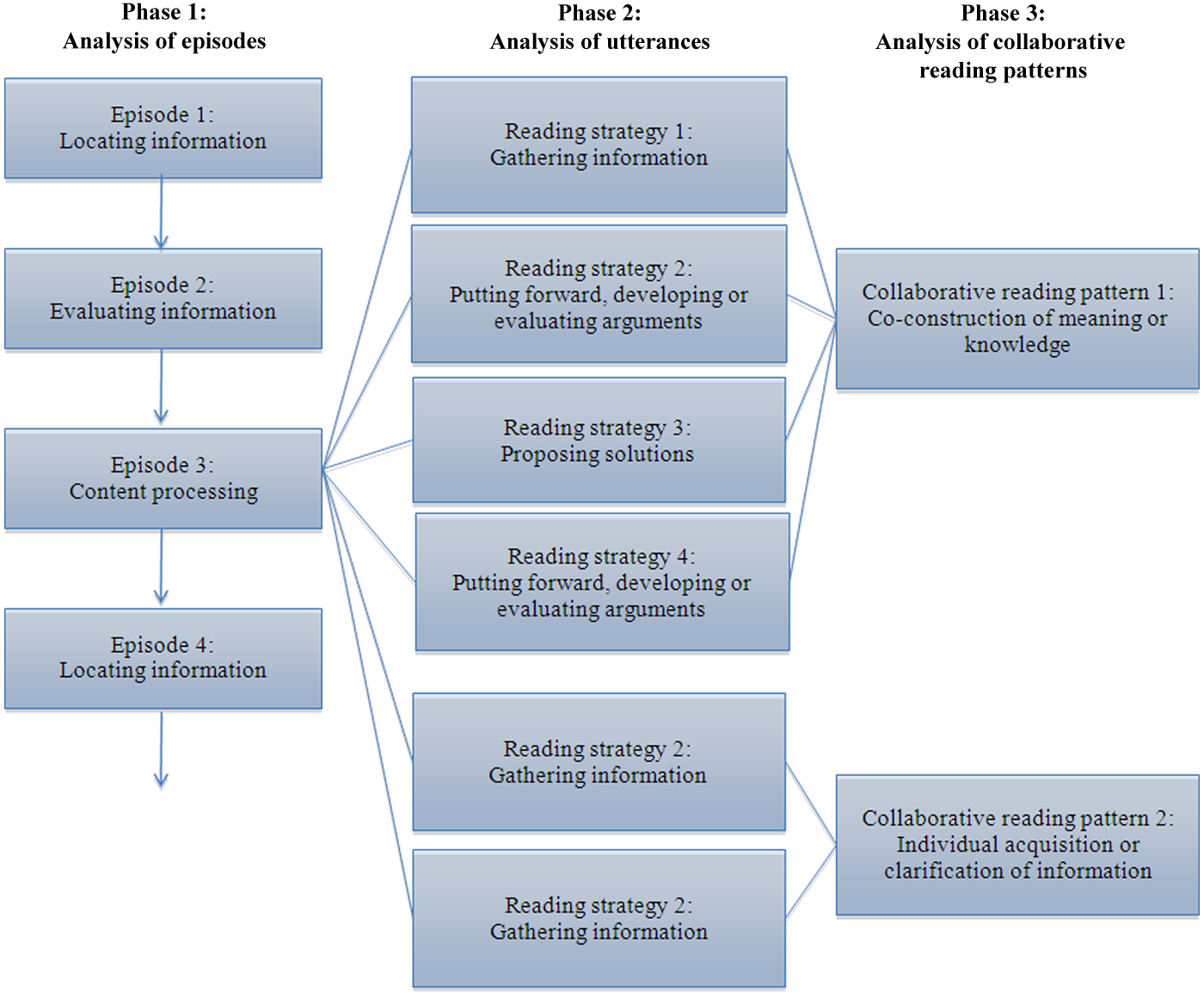
Illustrative example of the progression of analysis
The analysis of different kinds of episodes enabled us to divide student discussions and related web-based activities into segments that described the student pairs’ use of different online reading practices. Moreover, the analysis of episodes served as a basis for further analysis conducted in Phases 2 and 3. An episode as the unit of analysis has previously been used in studies on interaction during collaborative learning (Van Boxtel, Van der Linden, & Kanselaar, 2000) and collaborative writing (Vass & Littleton, 2009).
In the second phase of the analysis, we identified the utterances that indicated the use of a collaborative reading strategy. However, the coding of the interaction protocols at the utterance level does not reveal the dynamics of students’ discourse (Van Boxtel et al., 2000). Thus, to be able to answer the second research question, a more holistic analysis of collaborative reading patterns (Phase 3) was needed. In this analysis, we combined the coding of collaborative reading strategies with the observations concerning the reciprocal nature of students’ use of the collaborative reading strategies.
Phase 1: The Analysis of Episodes Used to Define Online Reading Practices
The analysis began with defining and categorizing online reading episodes. An episode (n = 562) was defined as a thematic entity consisting of successive activities and verbal interactions that served one of several specific reading practices: (a) locating information, (b) evaluating information, (c) content processing, (d) monitoring and regulating activities (one’s own, others’, or joint activities), and (e) off-task discussions. In locating information episodes (n = 180) students considered their search strategy, formulated a search query, or chose links from the search results. In evaluating information episodes (n = 90) students had to decide whether a certain web page was worth opening or not. If they opened the page they had to evaluate whether it was reasonable to read it further. The students used credibility or relevance of information as evaluation criteria. Content processing episodes (n = 195) consisted of acquiring information, making sense of it, making connections between the text and relevant prior knowledge, and/or extending and exploring ideas presented in the text. Monitoring and regulating episodes (n = 93) included interactions when the students planned, monitored, regulated, or evaluated their own, their partner’s, or their joint activities. Off-task episodes (n = 4) were unrelated to accomplishing the task.
The first three aforementioned categories are based on Leu and colleagues’ online reading comprehension theory (Leu et al., 2004; Leu et al., in press). An additional category, monitoring and regulating activities, was included in the analysis. This category was added because monitoring and regulating one’s reading processes are shown to be important both for reading traditional, linear printed texts (Baker, 2008) and for reading nonlinear texts on the Internet (Coiro & Dobler, 2007; Kiili, Laurinen, & Marttunen, 2009). Since these five categories sometimes overlapped, the assignment of a category was based on the most dominant characteristics of the episode that best corresponded to the description of the category. The length (in seconds) of each episode was measured to determine the total amount of time the student pairs spent on it.
Because our focus was on the construction of meaning and knowledge, we concentrated the analysis of this study on content processing episodes, the most numerous. During the second phase of the analysis, all of the utterances that took place during content processing episodes and indicated the use of a collaborative reading strategy were identified and categorized to investigate the depth of the students’ content processing.
Phase 2: The Analysis of Utterances Used to Identify Collaborative Reading Strategies
The categories of collaborative reading strategies emerged as a result of theory (Pressley & Afflerbach, 1995) and data-driven examination using an inductive analytic analysis (Bogdan & Biklen, 2003). We identified 944 utterances that indicated the use of a reading strategy. Since the reading strategies were shared and students had opportunities to build on one another’s strategies, we refer to these as collaborative reading strategies. The categories of collaborative reading strategies, with examples, are presented in Table 1.
Collaborative Reading Strategies
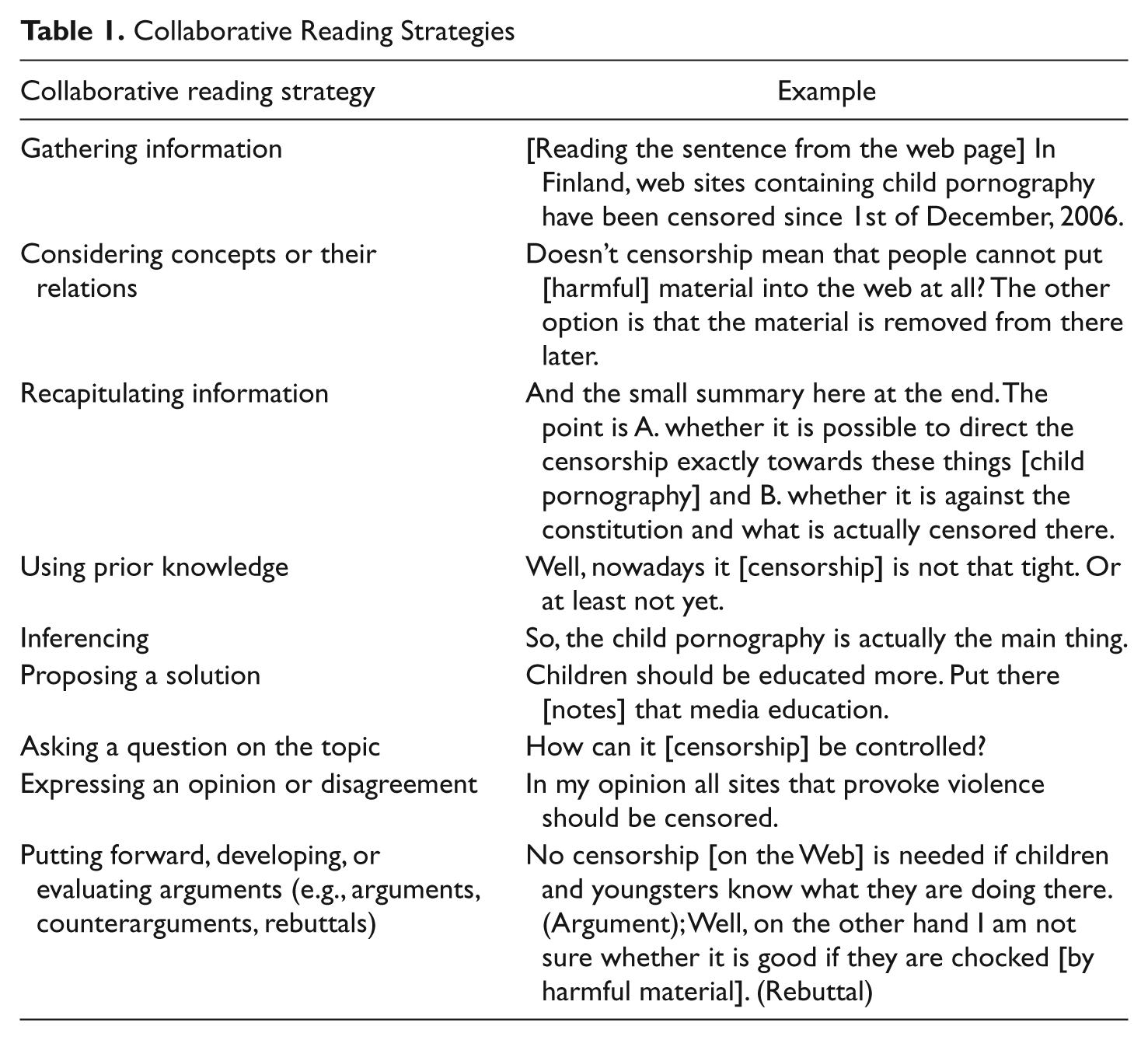
The reliability for coding collaborative reading strategies was examined by having another person code 4 out of the 19 interaction protocols. These protocols included 22.0% of the collaborative reading strategies. We found 84.5% agreement. In all cases, the initial coding was used in the analysis.
Phase 3: The Analysis of Collaborative Reading Patterns Used to Identify Co-construction of Meaning or Knowledge
The final phase of the analysis concentrated on exploring how students construct meaning or knowledge during content processing episodes. The unit of analysis was a collaborative reading pattern, which consisted of an utterance or sequence of utterances that indicated a certain type of collaborative reading.
In the analysis, we applied the theoretical model of socially regulated learning presented by Volet et al. (2009, p. 131). Their model comprises two dimensions: content processing and social regulation. The content processing dimension is a continuum from low-level content processing (acquisition and clarification of information) to high-level content processing (construction of meaning). The social regulation dimension is a continuum from individual regulation to coregulation as a group.
We modified their model to enable the framework to better fit the analysis of collaborative reading. Henceforth, we use the terms deep level of processing (construction of meaning or knowledge) and shallow level of processing (acquiring or clarifying information) when we refer to the content processing dimensions (see, e.g., Friedman & Rickards, 1981; King, 2007). Since this study focuses on students’ collaboration during reading in general, not particularly regulation processes, we replaced the social regulation dimension with the collaborative content processing dimension. The collaborative content processing dimension can be described as a continuum from individual content processing to collaborative content processing.
On the basis of this analytic framework, four reading patterns (see Figure 2) were distinguished: (a) individual acquisition or clarification of information, (b) individual construction of meaning or knowledge, (c) pair co-acquisition or clarification of information, and (d) pair co-construction of meaning or knowledge. When defining and categorizing reading patterns, both collaborative reading strategies (whether strategies indicated deep or shallow level of processing) and students’ contributions (whether emphasis was on individual or collaborative content processing) were taken into account. The patterns were categorized according to the dominant type of collaborative reading. For example, when a pattern appeared with students engaged in the co-acquisition or clarification of information at the beginning, followed by a short moment of individual construction of meaning or knowledge, and then ended with students engaged in the co-acquisition or clarification of information about the initial issue, the collaborative reading pattern was coded as the co-acquisition or clarification of information.
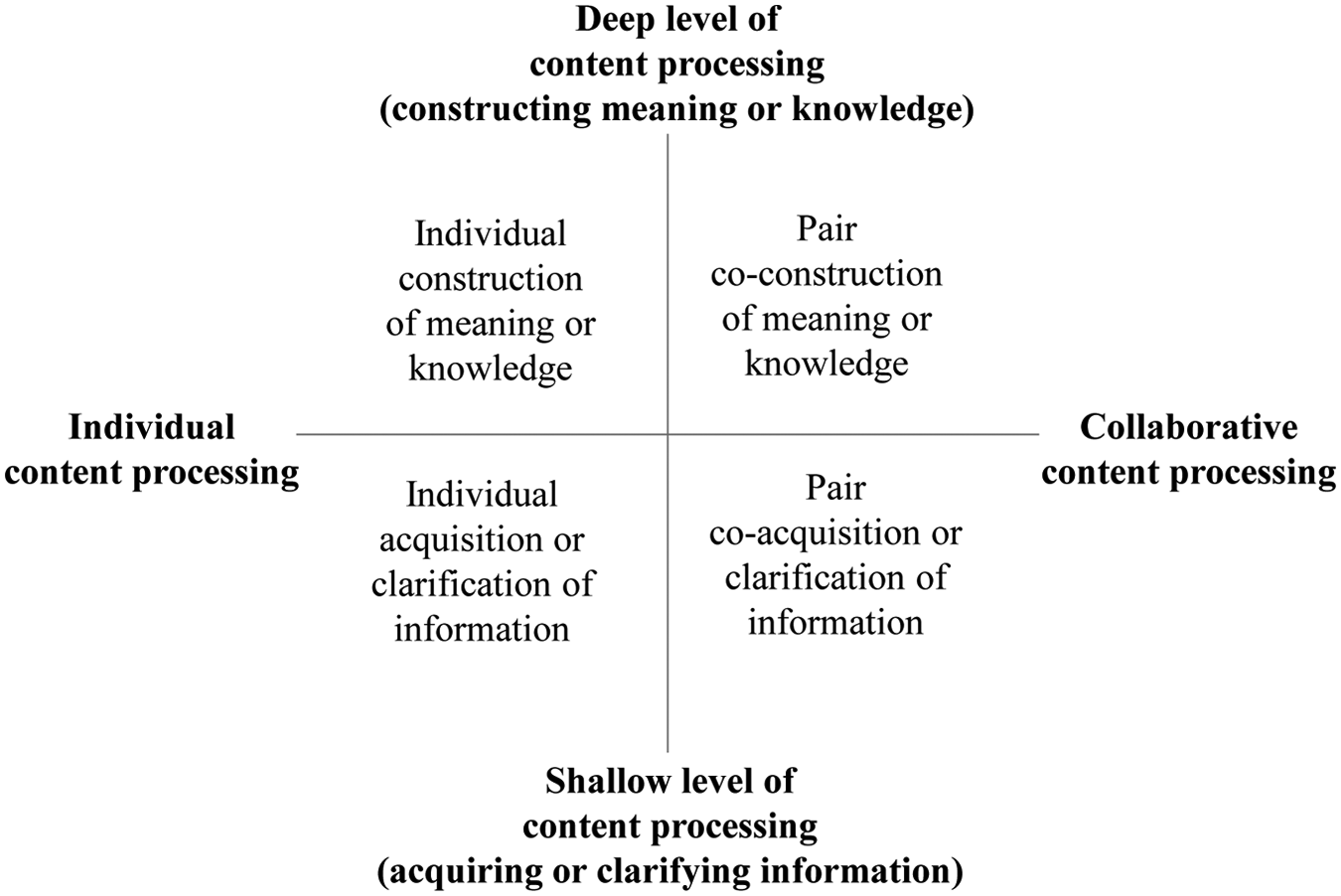
Framework for analyzing construction of meaning or knowledge. Modified from Volet, Summers, and Thurman (2009, p. 131). Reprinted with permission from Elsevier.
The reading patterns that appeared existed on a continuum that ranged from individual reading patterns to collaborative reading patterns. In this study, individual reading patterns were not purely individual because the reader shared his or her ideas with the listener, even if the listener did not respond or only made short comments to indicate that it had been heard. For this reason, we use the term individually oriented collaborative reading pattern (henceforth individually oriented reading pattern). The defining quality of an individually oriented reading pattern was that something had been communicated to a partner about what had been read but that little discussion ensued. During collaborative reading patterns, there was back-and-forth conversation.
One individual reading pattern, silent reading, was added because it was impossible to determine whether a silent reader was acquiring information or constructing knowledge. When a student pair read silently for 15 seconds or more in the middle of other patterns, the silent reading was separated out and coded as Pattern 5.
The boundaries of the collaborative reading patterns, that is, where one pattern begins and where it ends, were determined by two kinds of shifts. First, because of the multilevel analyses, some of the boundaries of the patterns were related to shifts in online reading episodes. The collaborative reading pattern either began or ended when an online episode of locating, evaluating, monitoring and regulating, or off-task discussion began or ended. For example, when students left the web page and started to locate information, both the content processing episode and the collaborative reading pattern ended.
Second, the boundaries of the patterns were sometimes determined by a shift in the type of collaborative reading processing, that is, the shift between individually oriented and collaborative-oriented content processing and/or between shallow and deep content processing. The most common shift in the processing type occurred when students finished the discussion and started to read silently or vice versa. Finally, the shift in the processing type was sometimes related to the shift in the discussion topic or type of information encountered.
The reliability for coding collaborative reading patterns was examined by having two persons classify 4 (out of 19) interaction protocols. These protocols included 22.5% of all the reading patterns (the patterns of silent reading were excluded). The percentage of agreement was 83.9%. In all cases, the initial coding was used in the analysis.
Pair Co-construction of Meaning or Knowledge (n = 70)
A collaborative reading pattern was coded as the co-construction of meaning or knowledge in those instances where students’ content processing indicated only the co-construction of meaning, only the co-construction of knowledge, or the co-construction of both meaning and knowledge.
When student pairs co-constructed meaning or knowledge, both students made substantial contributions to the discussions and engaged in deep-level processing. The example in Excerpt 1 illustrates how Mari and Jaana engaged in deep-level content processing by using reading strategies such as inferencing and putting forward and developing arguments. Both students also made considerable verbal contributions to meaning making, and they built their ideas on their partner’s thoughts. The students were reading online text material about the role of the Central Criminal Police in the censorship of child pornography in Finland. Excerpt 1 begins with Mari’s question on the role of the police in censorship. In the next speech turn, Jaana justifies the role of the police by reference to the law and proposes a consequence for illegal actions. Next, Mari agrees with the consequence by elaborating it. Finally, Jaana questions the effectiveness of the punishments for this crime.
Excerpt 1
Is it a task for the police? Or should we now? I mean, is it the job for the police to organize censorship on the Internet?
I think that it is a task for the police to impose a fine, because it’s illegal
If you violate the law, there should be [a fine], you know [
They should impose a fine and then totally remove it [harmful web site]
So it’s a punishment. But, mm . . . usually, the people who put these things on the web don’t care whether it is illegal or not. You know, it doesn’t matter
They just want to make money when people visit their web sites and people watch that stuff. There is some kind of payment so that these people get money
To conclude, Excerpt 1 illustrates two critical features of the pattern of co-construction meaning or knowledge: the reciprocity in the elaboration of ideas and the use of those kinds of collaborative reading strategies that indicate a deep level of content processing.
Pair Co-acquisition or Clarification of Information (n = 85)
A collaborative reading pattern was coded as the pair co-acquisition or clarification of information in those instances where students’ content processing utterances indicated only the co-acquisition of information, only the co-clarification of information, or both the co-acquisition and clarification of information.
During the patterns of pair co-acquisition or clarification of information, students reciprocally gathered or clarified information from the texts they were reading. The example in Excerpt 2 illustrates how Tiina and Kati gathered information from the web site about censorship on the Internet. At the beginning of the excerpt Tiina pays attention to the definition of censorship, and then Kati and Tiina gather information, particularly on how Internet censorship is unofficially conducted.
Excerpt 2
And it says what it [censorship] means in the world
Yes. Surveillance of the users
It is said that it is impossible to control
What’s this—release the operators? Over there . . . Internet operators
Mm. Then it says that like-minded communities have emerged into the discussion groups and they block out critical talkers
Where? [Kati asks where the information is located on the web page]
This last sentence. [Tiina points the sentence with a mouse]
Okay.
Excerpt 2 shows that the students processed content in a reciprocal manner, but compared to Excerpt 1, the students applied a narrower repertoire of collaborative reading strategies by concentrating on gathering of information.
Individual Construction of Meaning or Knowledge (n = 26)
An individually oriented reading pattern took place when a single student expressed meaningful thoughts to his or her partner, without a pattern of collaborative construction in the utterances. An example of an individual construction of meaning or knowledge appears in Excerpt 3, below. Here Noora indicates how she is gathering information and putting forward, developing, or evaluating arguments, but Sini makes only brief comments with the purpose of expressing acceptance.
Excerpt 3
It said here that why not then letters, I mean post, is not controlled all the time
But on the other hand, on the Internet everything spreads much wider.
Mmm.
That couldn’t happen through the regular post. In a way that’s the reason why precisely the Internet is controlled
As shown in the Excerpt 3, the individual construction of meaning or knowledge is characterized by the fact that only one of the students expresses meaningful thoughts by using a collaborative reading strategy or strategies that indicated a deep level of content processing.
Individual Acquisition or Clarification of Meaning (n = 68)
The pattern was coded as individual acquisition or clarification of meaning when a single student gathered or clarified information from a text, as Tiina did in the following excerpt.
Excerpt 4
It says that the law does not have an effect on pedophiles
They get it [pornography] from elsewhere
Mmmm.
In February the police accidentally added to their list [a list for operators to censor particular sites] a web site that criticized censorship
So, the police are in error
Mmmm. . . .
Excerpt 4 illustrates that in the pattern of individual acquisition or clarification of information, one student is responsible for it.
Collaborative Reading Profiles—Hierarchical Cluster Analysis
Following the identification of collaborative reading patterns, a hierarchical cluster analysis was conducted to identify students’ collaborative reading profiles. Hierarchical cluster analysis is suitable when there are a limited number of cases (Aldenderfer & Blashfield, 1984). Our analysis was based on the percentage of content processing time spent by students in five areas: co-construction of meaning or knowledge, co-acquisition or clarification of information, individual construction of meaning or knowledge, individual acquisition or clarification of information, and silent reading. Between-group linkage was used as a clustering method and squared Euclidean distance as a clustering measure. Five clusters were identified on the basis of the generated dendrogram. The decision on the number of clusters was based on the basis of logical, identifiable clusters. The five-cluster solution was chosen because in this solution each cluster had critical features that differentiated them from each other.
Results
Online Reading Practices
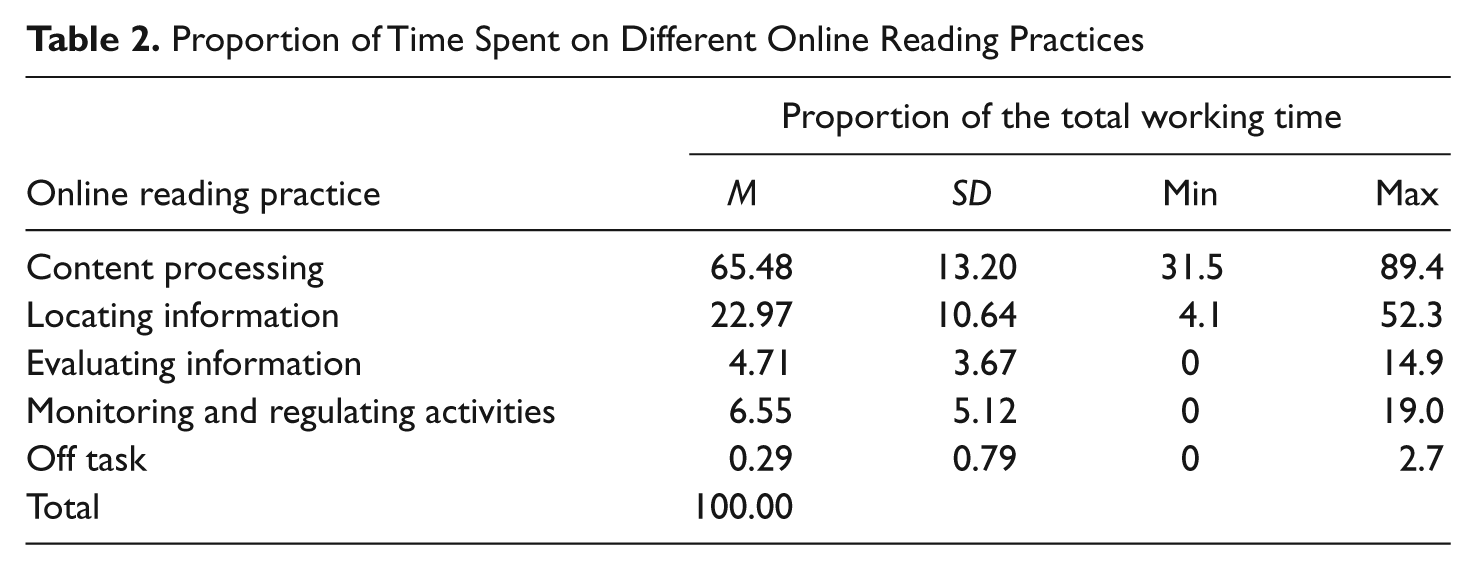
Table 2 shows that the student pairs spent, on average, 65.5% of their working time on content processing and 23.0% on locating information. There were considerable differences between the pairs in how they allocated the time they spent on different online reading practices. The time spent on content processing ranged from 31.5% to 89.4%, and the time spent on locating information ranged from 4.1% to 52.3%. This result indicates that some student pairs had difficulty in finding relevant information. Evaluating information, monitoring and regulating activities, and off-task practices appeared with far less frequency than content processing practices and locating information practices.
Proportion of Time Spent on Different Online Reading Practices
Collaborative Reading Patterns
Table 3 shows that student pairs spent 46% of their content processing time on collaborative reading patterns, 45% of their time on silent reading, and 9% of their time on individually oriented reading patterns. From collaborative reading patterns, the student pairs spent more time on pair co-construction of meaning or knowledge (28% of total content processing time) than on pair co-acquisition or clarification of information (18%).
Descriptive Statistics on Reading Patterns
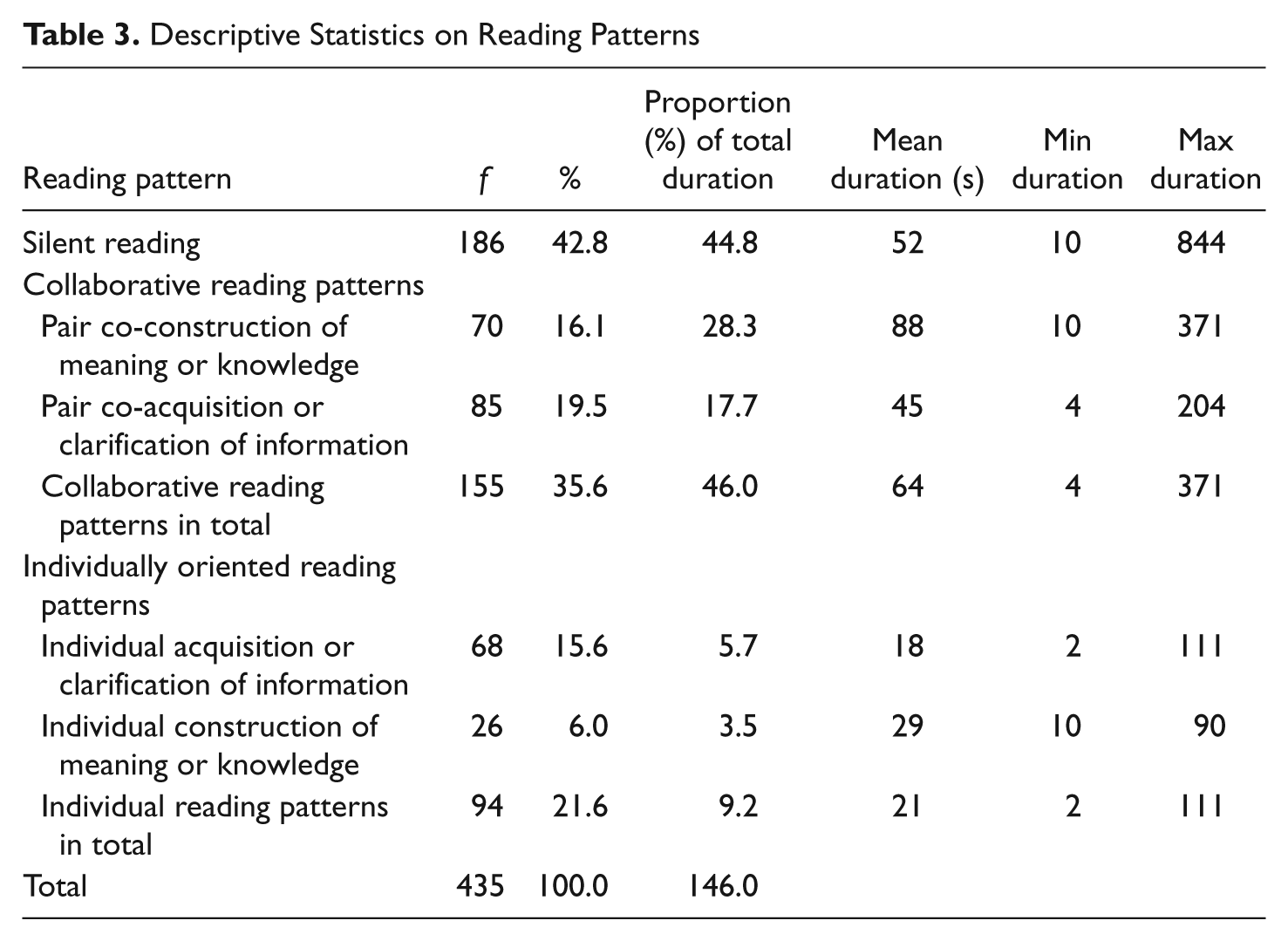
The patterns of co-constructing meaning or knowledge (n = 70) were on average the longest patterns, with a mean duration of 88 seconds; by contrast, the other patterns lasted, on average, from 18 to 52 seconds. The longest pattern of co-constructing meaning or knowledge was 6 minutes 11 seconds, which indicates that the pair in question was substantially engaged in co-construction of meaning or knowledge.
Collaborative Reading Strategies and Their Distribution Within the Collaborative Reading Patterns
Table 4 provides descriptive information on the frequency of different collaborative reading strategies and how these were distributed within collaborative reading patterns. The most common reading strategy was gathering information, which accounted for 37.1% of all strategies. The second most common strategy, at 16.0%, was putting forward, developing, or evaluating arguments.
Collaborative Reading Strategies Within Collaborative Reading Patterns
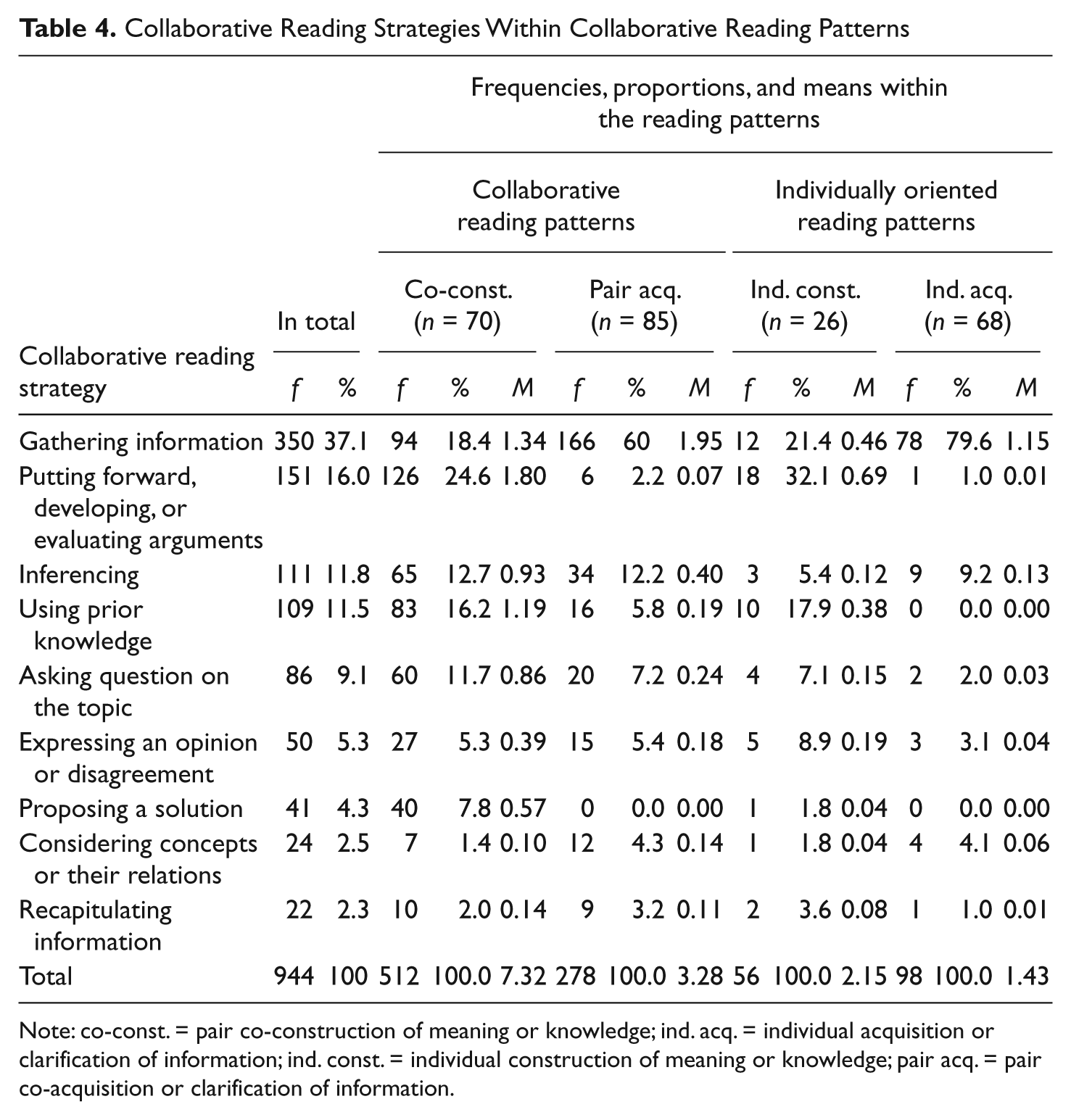
Note: co-const. = pair co-construction of meaning or knowledge; ind. acq. = individual acquisition or clarification of information; ind. const. = individual construction of meaning or knowledge; pair acq. = pair co-acquisition or clarification of information.
More than half of the reading strategies (512 strategies out of 944) were shared during the patterns of co-construction of meaning or knowledge. The most common strategy when co-constructing meaning or knowledge was putting forward, developing, or evaluating arguments (M = 1.80 utterances indicating the use of the strategy), accounting for 24.6% of all the strategies. The second most common strategy was gathering information (M = 1.34). The difference between the total means for collaborative reading strategies involving patterns of co-construction of meaning or knowledge (M = 7.32) and patterns of individual construction of meaning or knowledge (M = 2.15) may be seen as evidence of good engagement in collaborative work among the population of this task. The same pattern can be found when comparing pair co-acquisition or clarification of information (M = 3.28) to individual acquisition or clarification of information (M = 1.43).
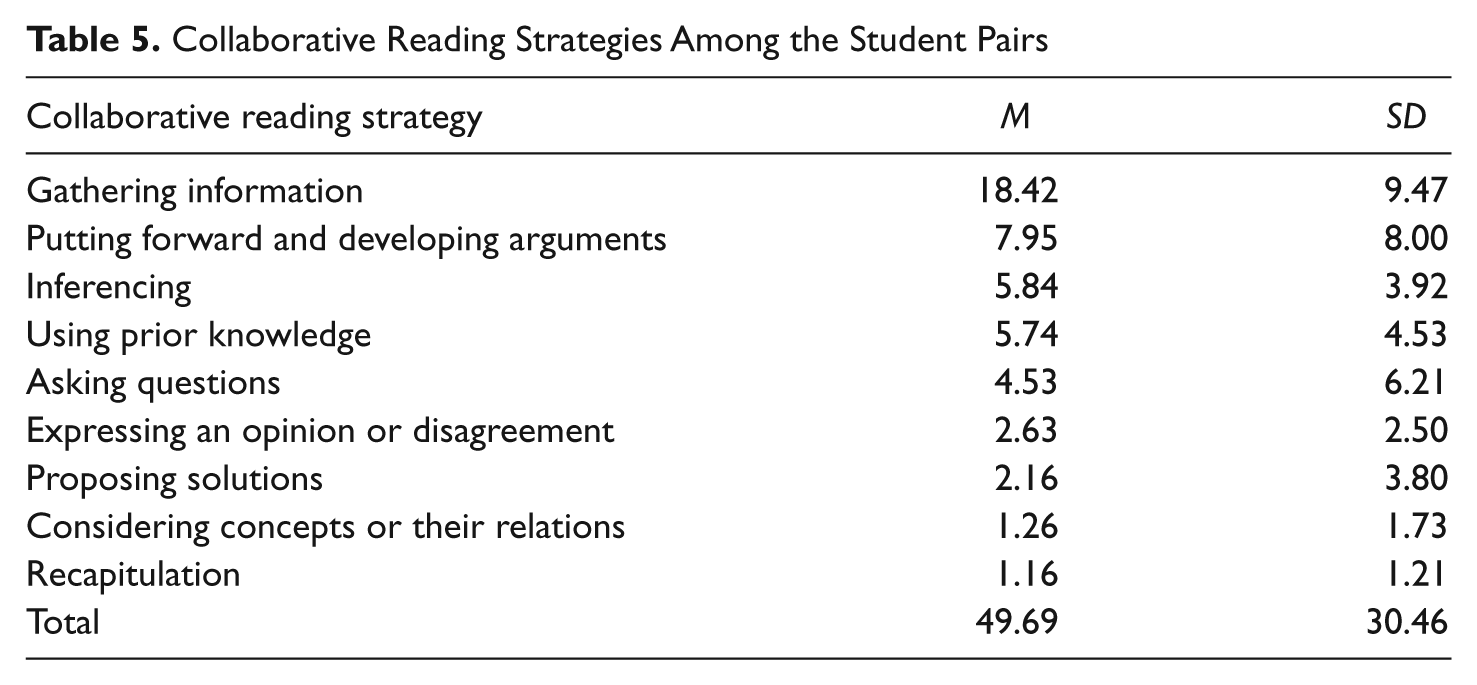
When collaborative reading strategies were examined among the pairs, there was a wide variation in how the student pairs applied the strategies (Table 5). On average, the student pairs shared 49.7 collaborative reading strategies, and the standard deviation among the pairs was 30.5. On average, the student pairs gathered information 18.4 times (SD = 9.5), put forward, developed, or evaluated arguments 8.0 times (SD = 8.0), and made inferences 5.8 times (SD = 3.9).
Collaborative Reading Strategies Among the Student Pairs
Collaborative Reading Profiles
In the cluster analysis, five different collaborative reading profiles emerged: (a) co-constructers (n = 2 pairs), (b) collaborators (n = 2 pairs), (c) blenders (n = 6 pairs), (d) individually oriented readers (n = 4 pairs), and (e) silent readers (n = 5 pairs). The clusters were named by considering how the means of the different variables, used in the cluster analysis, were distributed. Table 6 presents the mean proportion of time the student pairs spent on different collaborative reading patterns.
The Means of Each Cluster With Respect to the Proportion of Time Spent on Different Reading Patterns
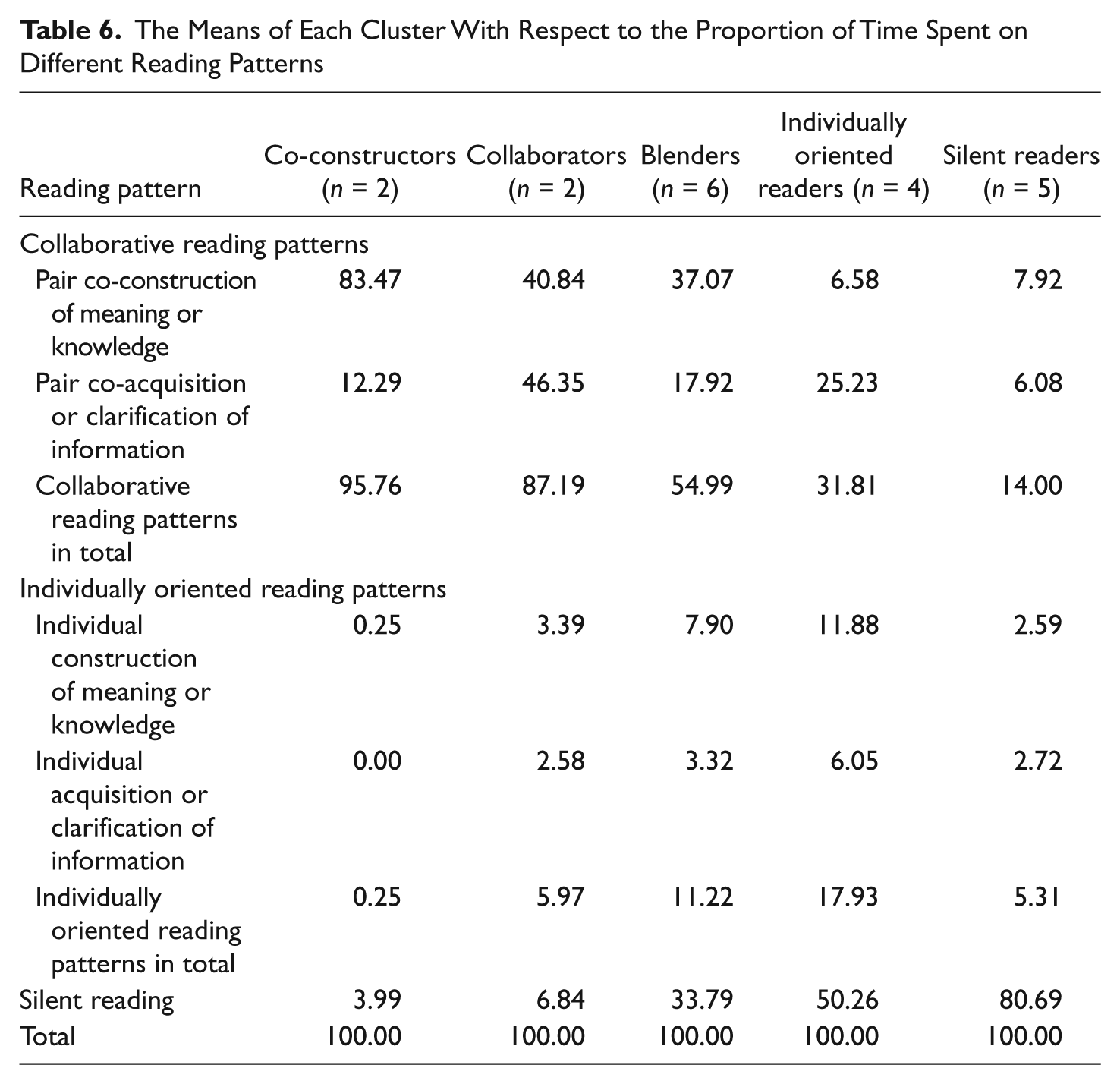
Co-constructors (n = 2 pairs) engaged in collaborative content processing with a strong emphasis on pair co-construction of meaning or knowledge (83% of content processing time). Co-constructors shared, on average, 110 collaborative reading strategies, and, in addition, both pairs applied different reading strategies in a versatile way. They gathered information from the web pages (on average 28.5 strategies), put forward, developed, or evaluated arguments (M = 21.0), and asked questions (M = 17.0). Both pairs saw the task as a problem to solve; on average, they proposed a solution for solving the dilemma of Internet censorship on 11.5 occasions.
Like co-constructors, collaborators (n = 2 pairs) engaged mostly in collaborative content processing. Although co-constructors’ collaborative content processing emphasized the co-construction of meaning or knowledge, collaborators’ collaborative content processing was distributed more equally between the co-construction of meaning or knowledge (41%) and the pair co-acquisition or clarification of information (46%). During their discussions collaborators shared, on average, 58.5 reading strategies. The most common strategies included gathering information (M = 18.5) and using prior knowledge (M = 11.5). Collaborators also asked questions (M = 9.0) during their content processing.
The third cluster was labeled blenders (n = 6 pairs) since these students mixed collaborative (55%) and individually oriented (45%) content processing. They spent most of their time on the co-construction of meaning or knowledge (37%) and on silent reading (34%). Blenders shared, on average, 59.8 collaborative reading strategies during their content processing. Gathering information (M = 21.7) was the most common reading strategy, and putting forward, developing, or evaluating arguments was the second most common reading strategy (M = 11.5).
Individually oriented readers (n = 4 pairs) spent more time on individually oriented content processing, with greater emphasis on silent reading (50%) than on collaborative content processing. They shared, on average, 41.0 reading strategies during their discussions. Like the student pairs in all the other clusters, individually oriented readers also gathered information actively (M = 24.5). Their second most common reading strategy was putting forward, developing, or evaluating arguments (M = 5.3).
Silent readers (n = 5 pairs) spent most of their working time on reading silently (on average, 81% of content processing). Because of the vast amount of time spent on silent reading, silent readers shared, on average, only 16.8 reading strategies during content processing.
The clusters were also compared in how they spent their working time using different online reading practices. The clusters that were most engaged in collaborative content processing appeared to also engage in the most monitoring and regulating activities. On average, co-constructors spent 9.4% and collaborators spent 11.9% of their working time on monitoring and regulating their activities. Blenders spent only, on average, 3.9%, individually oriented readers 5.2%, and silent readers 1.7% of their working time on monitoring and regulating their activities. The time spent on other online reading practices was much the same among the each cluster.
Students’ Essay Performance
When evaluating the student pairs’ essays, the teachers used only the three highest scores: outstanding (6 points), excellent (5 points), or good (4 points). The teachers indicated that these student pairs wrote substantially better than other similar students when composing an essay individually. The average mark awarded the pairs’ joint essays was 4.79 (SD = 0.79). Thus, on average, student scores on the essays fell between excellent and good, but closer to excellent. Four joint essays were evaluated as outstanding, seven as excellent, and eight as good. When the marks of the student pairs in the different clusters were compared, a downward trend was observed. Both student pairs in the cluster of co-constructers received outstanding marks for their essays (M = 6). The two pairs named collaborators received excellent marks for their essay (M = 5). The average mark of the blenders was 4.83, that of the individually oriented readers was 4.75, and that of the silent readers was 4.20.
Students’ Experiences on Collaborative Work
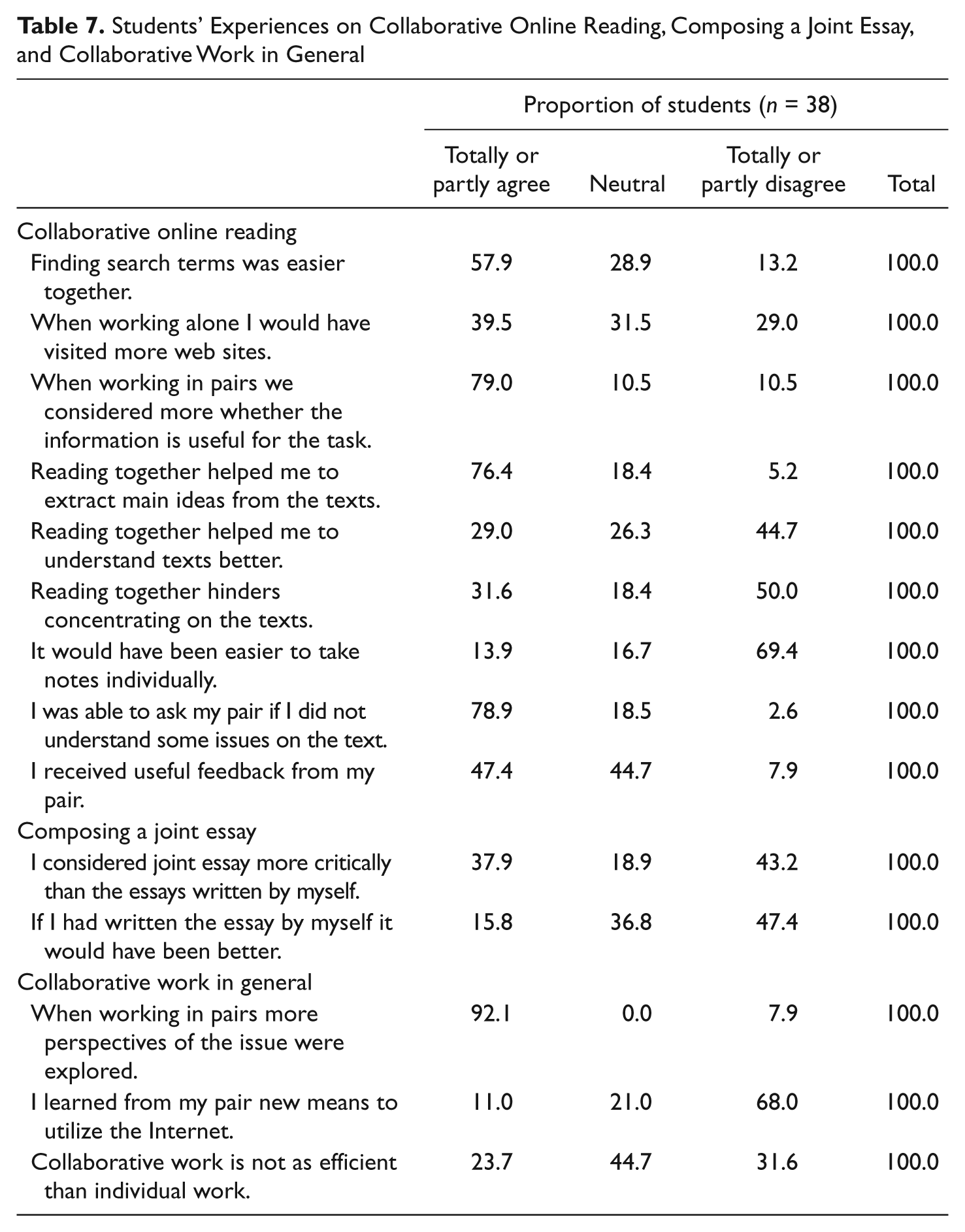
Table 7 reports students’ responses to poststudy questionnaire items on collaborative work compared to individual work in relation to online reading practices, composition of a joint essay, or collaborative work in general during the entire task. In general, the students found collaborative work beneficial. A majority of the students (92%) found collaborative work particularly useful when it came to exploring different perspectives of the issue. Most of the students also reported that collaboration was beneficial for evaluating the usefulness of information (79%) or extracting main ideas from the texts (76%). The students also reported that they were able to regulate their understanding by asking their partner when he or she did not understand some issue in the text.
Students’ Experiences on Collaborative Online Reading, Composing a Joint Essay, and Collaborative Work in General
Discussion
This study sought to explore how students engaged in collaborative online reading as they co-constructed meaning and knowledge to explore a controversial issue. In addition, it sought to determine how student pairs, who used different collaborative reading profiles to co-construct meaning and knowledge, performed on an essay-writing task. Although extensive research exists about reading as an individual practice, there is little research about reading as a collaborative social practice, especially in relation to the co-construction of meaning and knowledge that takes place with online reading. Reading multiple texts with conflicting opinions and discussing these different points of views was thought to promote students’ co-construction of meaning and knowledge during online reading and, possibly, enhance performance on an essay-writing task.
The results of this study are explored by discussing the larger, collaborative online reading practices and then the reading patterns and specific collaborative reading strategies that appeared within these reading patterns. The results suggest that patterns and strategies emerge during collaborative online reading that may be supportive of both meaning and knowledge construction.
How Do Students Engage in Online Reading Practices?
Of all types of online reading practices observed, the greatest proportion of time was spent on content processing. On average, student pairs spent nearly two thirds (65%) of their time on content processing practices and 23% of their time on practices related to locating information. Only about 12% of the time, on average, was spent on other reading practices: evaluating information, monitoring and regulating activities, and off-task practices.
Content processing practices and locating information practices accounted for 88% of the total working time, and the variance in each was substantial. Time spent on locating information was negatively associated with time spent on content processing (r = –.894, p < .01). Thus, about 80% of the variance in the time spent on content processing can be accounted for by knowing the time spent on locating. This pattern is consistent with a trade-off between locating information and the content processing of information. That is, students who spent more time with locating information had less relative time for content processing. This supports the idea that the ability to locate information is important during online reading comprehension (Bilal, 2000; Kiili et al., 2008; Kuiper & Volman, 2008) and that the two may be reciprocal (Henry, 2006). Being able to locate appropriate information efficiently may be a gatekeeping online reading practice, increasing opportunities to engage in content processing.
The results concerning the time spent on locating and content processing practices, along with the substantial variance, were similar to those of the previous study by Kiili et al. (2008), in which students read individually. In both individual and collaborative reading contexts, students spent roughly similar amounts of time with locating and content processing practices. Lazonder (2005), on the other hand, found that students located information more effectively in collaboration than alone. It is not clear why the results in this study, compared to the study by Kiili et al. (2008), did not show a similar pattern.
Although the episodic analysis used in this study provides a useful, initial approach for exploring students’ online reading practices, it is important to recognize that it focused only on the larger scale practices that took place during collaborative online reading. This was because of the fact that we categorized episodes according to the dominant online reading practice in each. There appeared to be some practices that were not the most dominant single practice but rather were interwoven throughout several of the larger, more visible practices. Monitoring and regulating activities, in particular, appeared within episodes of other dominant practices. Further research that focuses solely on these important areas needs to be conducted to more fully understand their contribution to collaborative online reading.
How Do Student Pairs Co-Construct Meaning and Knowledge?
Collaborative reading patterns
Although this study involved only a small number of student pairs, the nature of the reading patterns that appeared helps to expand our understanding of online reading, showing how online reading may be situated as a very collaborative, social practice that contributes to the co-construction of meaning or knowledge. Table 3 shows that student pairs spent, on average, 46% of their time on collaborative reading patterns, 45% of their time on silent reading, and 9% of their time on individually oriented reading patterns. In addition, the mean duration of time spent on collaborative reading patterns was greater (64 seconds) than either silent reading (52 seconds) or patterns that supported individual content processing (21 seconds).
Although this study found that a substantial proportion of time was spent on collaborative reading patterns, there is also the possibility that one or several additional elements of the design contributed to this result. The topic, for example, may have played an important role. It seemed, at least to the researcher who was present in the teaching experiment, that the task was engaging for the students. One reason for students’ engagement may have been that the topic had relevance to the students’ lives. In addition, it should be noted that the teacher did not assign reading pairs, but rather students self-selected their own partners. The possibility of choosing a partner might have helped students to feel safe to express their ideas to their pair. For example, Eteläpelto and Lahti (2008) found that among teacher students the most important obstacle for creative collaborative course work was an environment that was perceived unsafe. Future research will need to explore the relative contributions that each of these elements played in the positive results that were achieved. In addition, it would be useful to explore the relative contributions of each of these elements at lower age levels in the proportion of time spent on collaborative reading patterns. Are older students more capable than younger students of working collaboratively during the reading of online information? If so, what types of supports might be provided to enable younger students to take greater advantage of the benefits we found in this study of collaborative online reading? How might we structure classroom lessons at every grade level to achieve the pattern of results that emerged in this study? We do not yet know the answer to these questions.
In short, this study found substantial amounts of time being spent by students in pair co-construction of meaning or knowledge and pair co-acquisition or clarification of information when they read online together, exploring a controversial issue within an argumentation framework. This is not to say, however, that all of their reading time was spent in social interaction that contributed to meaning and knowledge construction. An important portion of time was spent on silent reading, the nature of which was impossible to determine in the present study. In addition, a smaller proportion of time was spent on individual content processing patterns. Analogous to research in collaborative learning (Volet et al., 2009), this study suggests that when participating in a collaborative reading situation, students do not interact collaboratively or co-constructively all the time. This study may, however, provide baseline data on social collaboration and collaborative meaning and knowledge construction for one type of lesson that may be compared to other types of lessons in which online reading takes place, evaluating the extent to which different types of lessons generate collaborative meaning and knowledge construction.
Collaborative reading strategies within different reading patterns
Data in Table 3 indicate that the patterns of pair co-construction of meaning or knowledge were, on average, more than 3 times longer (88 seconds) than the patterns of individual construction of meaning or knowledge (29 seconds). In addition, data in Table 4 indicate that patterns of pair co-construction of meaning or knowledge also contained more than 3 times as many collaborative reading strategies (7.32) than the patterns of individual construction of meaning or knowledge (2.15). Thus, both more time was spent and more strategies appeared during pair co-construction of meaning or knowledge patterns than individually oriented patterns. These results suggest that in classroom lessons that aim at co-construction of meaning and knowledge, students need adequate time to explore information sources and to engage in text-based discussions; these do not appear to be the types of lessons that should be rushed.
One explanation for the greater number of strategies in the pair co-construction of meaning or knowledge patterns might be that when a student finds a useful way to explore an idea, the other student begins to use similar types of productive strategies. Anderson et al. (2001), for example, found that certain discourse patterns, argument stratagems, had a snowballing or spreading activation effect on other participants. Once a useful argument stratagem, such as managing the participation of classmates, making an argument explicit, or acknowledging uncertainty, was employed, other students also started to use it. Thus, it may be that deep processing of information runs dry more quickly when only one student is responsible for it.
We also note that the most frequent collaborative reading strategy in this study was gathering information (n = 350), accounting for slightly more than a third of all collaborative reading strategies. This supports the important role of locating information during online reading (Kuiper & Volman, 2008). The study also showed that each pair engaged in more gathering information strategies during collaborative content processing (M = 1.34 for pair co-construction of meaning or knowledge; M = 1.95 for pair co-acquisition or clarification of information) than during individually oriented content processing (M = 0.46 for individual construction of meaning or knowledge; M = 1.15 for individual acquisition or clarification of information). This is consistent with the interpretation that active, productive collaboration took place during most aspects of online reading in this study.
The results of this study appear to suggest that collaborative online reading among self-selected pairs, organized around an argumentative task assignment, promotes information processing that goes beyond the simple gathering of facts and extends to the deeper construction of meaning or knowledge. Previous work (Kiili et al., 2009), in which students were asked to read individually on the Internet to prepare for an essay, resulted in students concentrating mainly on the gathering of facts; 80% of all reading strategies were classified as fact gathering in that study. In this study, the corresponding percentage was only 37%, a reduction of slightly more than half. Indeed, an analysis of Table 4 shows that nearly two thirds of the collaborative reading strategies used by students went beyond the simple gathering of facts. This is what may have led to the positive effects on the essay-writing task, especially given that those students who engaged in greater co-construction of meaning (the co-constructors) appeared to achieve the highest average score on the essay assignment. Thus, the use of an argumentative task assignment may be useful in generating greater co-construction of meaning and deeper levels of online reading and thinking than other types of assignments. This finding may be especially important for teachers who seek to develop higher levels of thinking with online reading assignments in their classrooms. However, because of the small sample size, the results should be interpreted with caution, requiring both replication and additional study with larger sample sizes.
Table 4 also indicates that the most frequent collaborative reading strategy when co-constructing meaning or knowledge was putting forward, developing, or evaluating arguments (25%). This strategy might have helped students to consider a topic from different perspectives and engage in more productive discussions and possibly learning. This is supported by the poststudy questionnaire that the students completed after the teaching experiment. On the questionnaire 92% of the students agreed with the statement “When working in pairs, more perspectives emerge on the issue under discussion compared to individual work.” The positive impact of an argumentative task found here is consistent with several studies, in which university students worked online with restricted, preselected texts (Le Bigot & Rouet, 2007; Wiley & Voss, 1999). The present study shows that similar effects may be achieved with argumentative tasks when students are not restricted to the locations they use to gather information.
This study suggests that when we explore online reading as a collaborative process, as opposed to an individual process, additional opportunities emerge that may be supportive of both meaning and knowledge construction. As students engaged in content processing practices, they frequently negotiated their understanding and put forward and developed arguments to convince their partner of their point of view. Since readers collaboratively built on one another’s ideas, expanding their own thinking, collaborative online reading may support construction of meaning and knowledge beyond individual reading. Further research is needed to explore the full range of contexts in which this takes place with a larger and wider range of students.
Finally, it is important to also observe that using an interaction approach to the collection of verbal protocol data, as in this study, may provide certain methodological advantages. It appears to provide access to meaning and knowledge construction processes in a manner that is less intrusive and more consistent with more natural interaction patterns. Previously, students’ individual reading processes have been widely studied by using think-aloud methods (Ericsson & Simon, 1993; Pressley & Afflerbach, 1995). One concern of using a think-aloud method, raised by Miyake (1986), is the artificial nature of the research situation since readers are asked to think aloud in a situation in which they would normally be silent. Thinking aloud during reading intrudes on processing (Pressley & Afflerbach, 1995). Collecting data while students collaborate and discuss their ideas with their partner may provide access to otherwise hidden strategies in a more ecologically valid manner. This suggests that the use of interaction methods may be a promising methodological avenue to explore in future studies that use verbal protocol analysis.
How Do Student Pairs, With Different Collaborative Reading Profiles, Perform on an Essay-Writing Task?
The results in this study showed that student pairs clustered into five different reading profiles based on how they collaborated. Moreover, these profiles aligned closely with the students’ essay-writing performance.
Collaborative reading profiles
Cluster analysis indicated that students varied considerably in how they collaborated. Five collaborative reading profiles appeared: co-constructors, collaborators, blenders, individually oriented readers, and silent readers.
Overall, it appeared that some students were capable of working as pairs and took full advantage of the collaborative situation by spending a substantial proportion of their time in the pair co-construction of meaning or knowledge. Others, by contrast, had a stronger preference for working alone. The differences that appeared in Table 6 are striking. There appeared to be a substantial difference in the proportion of time spent on the pair co-construction of meaning or knowledge between the individually oriented readers and the silent readers and the other three clusters. Individually oriented readers and silent readers spent, on average, only 7% to 8% of their time on the pair co-construction of meaning or knowledge, whereas the other three groups spent from 37% to 83%.
The results suggest that simply participating in a collaborative reading context does not ensure that all students will be able to collaborate in a fully productive manner. Thus, in the future, attention should be paid to developing methods for teaching students how to collaborate productively to achieve higher levels of collaboration and co-construction of meaning and knowledge. For example, Mercer and Littleton (2007) obtained encouraging results in their long-term intervention studies in which pupils were taught to use explorative talk, both in classrooms and in group work. This may be a promising direction to pursue.
Since the co-constructors engaged to the greatest extent in co-constructing meaning or knowledge during content processing, they appeared to take the greatest advantage of the collaborative reading situation for thinking through the controversial issue together. Previous work suggests that engagement in argumentative discussions (Mercer & Littleton, 2007) as well as asking questions during collaborative reading (King, 2007; Volet et al., 2009) often plays an important role in maintaining high-quality interactions among students that benefits learning. This appears to be what happened in this study.
Essay performance
Overall, the teachers in this study reported that in general the joint essays were noticeably better than individual essays, which students normally write in the class. Although these are only self-report data, they are consistent with other research showing the potential benefits of collaborative work (e.g., Gokhale, 1995; Yarrow & Topping, 2001).
This study found that mean scores on the joint essays mapped closely to the reading profile and the relative proportion of time that student pairs spent co-constructing meaning or knowledge during content processing. Both student pairs with the highest proportion of time spent co-constructing meaning or knowledge received the highest possible mark for their essay (6 = outstanding). The two pairs in the collaborators profile received the next highest mark (5 = excellent). Continuing down the scale in terms of the proportion of time spent co-constructing meaning or knowledge, the average mark of the blenders was 4.83, that of the individually oriented readers was 4.75, and that of the silent readers was 4.20.
It seems, at least in this study, that students’ essay performance benefited from engagement in collaborative and deep-level content processing during collaborative online reading. However, these results should be interpreted cautiously since the number of student pairs in each cluster was small. In addition, there might have been other factors, such as students’ writing abilities and collaboration during composing the essay, that affected the quality of student pairs’ writing. Although all the student pairs were able to discuss the topic on the basis of their prior knowledge in the prior knowledge activation phase, differences on students’ level of prior knowledge might also have played a role in composing the essay.
Conclusions
This exploratory study examined how 16- to 18-year-old students in Finland constructed meaning and knowledge during collaborative online reading about a controversial issue. It found several promising patterns that should be explored further with larger numbers of students, different age groups, different types of tasks, and greater controls. Much of the time in collaborative reading was spent on content processing practices. Within these content processing practices, student pairs spent a substantial percentage of time collaborating on content processing that supported collaborative meaning or knowledge construction. Patterns of pair co-construction of meaning or knowledge averaged 3 times as long as patterns of individual construction of meaning or knowledge and contained more than 3 times as many reading strategies than patterns of individual construction of meaning or knowledge. In addition, essay-writing performance aligned closely with the reading profiles of student pairs: Student pairs who spent the greatest proportion of time on co-constructing meaning or knowledge received the highest scores on their essays; student pairs who spent the least amount of time received the lowest scores. These results suggest that lessons that are organized around collaborative online reading to foster the co-construction of meaning and knowledge may lead to positive outcomes but are likely to require greater time.
Footnotes
Appendix
Acknowledgements
We would like to thank Kaisa Kähäri and Hanna Laakso for her help in the data analysis.
Declaration of Conflicting Interests
The author(s) declared no potential conflicts of interest with respect to the research, authorship, and/or publication of this article.
Funding
The author(s) received the following financial support for the research, authorship, and/or publication of this article: This study was funded by the Academy of Finland.
Bios
References
Supplementary Material
Please find the following supplemental material available below.
For Open Access articles published under a Creative Commons License, all supplemental material carries the same license as the article it is associated with.
For non-Open Access articles published, all supplemental material carries a non-exclusive license, and permission requests for re-use of supplemental material or any part of supplemental material shall be sent directly to the copyright owner as specified in the copyright notice associated with the article.
