




Abstract
Entering the Economic Base of the Pyramid (BoP) is often portrayed as an effective way for multinational corporations (MNCs) to grow and alleviate poverty, yet only few MNCs succeed. Although scholars have suggested that emotional arguments may be critical in motivating MNCs to engage at the BoP, it has remained unexplored how managers who develop BoP ventures inside MNCs use emotional framing to persuade organizational members to support their initiatives. Building on a multiple-case study of a Fast-Moving Consumer Goods Company, we find that captivating, solidifying, and perpetuating emotional frames allowed managers to earn and maintain commitment from volunteers and senior managers and sustain venturing efforts up until a stage where ventures were considered for launch despite an obvious sense of profitability. These findings contribute to a theoretical understanding of processes that enable BoP venture development inside MNCs, and contribute to the literatures on emotional framing and corporate entrepreneurship.
Keywords
Addressing the needs of more than four billion people earning less than US $5 a day is considered an effective way for multinational corporations (MNCs) to develop future markets and help alleviate poverty (e.g., Hart & Christensen, 2002; Prahalad, 2004). Indeed, scholars have argued that corporations can make a “great fortune” by targeting those living at the so-called Economic Base of the Pyramid (BoP; Prahalad & Hart, 2000) while addressing sources and consequences of poverty (Seelos & Mair, 2007). Yet, despite strategic motivations of corporations to pursue “business activities aimed at serving the needs and well-being of disenfranchised individuals” (Hart et al., 2016, p. 401), only very few MNCs managed to profitably develop products for the BoP (Reficco & Gutiérrez, 2016).
The reasons that have been identified for failing are many. The BoP context is challenging in which markets are perceived to have failed, institutional voids are present, consumers have little to spend, and behavioral change in consumers is often required (Jones Christensen et al., 2015; McMullen, 2011). Distinctive conditions at the BoP also affect the scalability of business activity (Chliova & Ringov, 2017) and require MNCs to create economic and societal value simultaneously (London & Hart, 2004). As a consequence, entering the BoP typically requires MNCs to develop new capabilities (Hart & London, 2005), create new business models (Angeli & Jaiswal, 2016), and form partnerships to co-create products (Nahi, 2016), causing BoP ventures to take a long time to come to fruition, if ever (London, 2008).
Challenges also lie in the way MNCs are organized. MNCs are pressured by capital markets to maximize short-term profits, and internal processes and performance management systems guide managerial behavior accordingly (Bansal & DesJardine, 2014). Such a setup not only diminishes the willingness of managers to pursue opportunities at the BoP or to persist in BoP markets (Hart et al., 2016) but also presents formidable challenges to those developing BoP ventures within MNCs. Regardless of whether MNCs are as organizations amenable to BoP venturing, research suggests opposing incentives, procedures, metrics, time horizons, and cognitive frames may in many instances inhibit BoP venturing (Olsen & Boxenbaum, 2009; Reficco & Gutiérrez, 2016) and leave managers who develop BoP ventures feeling unsupported. When subsequently facing a lack of time, financial resources, and access to internal expertise, managers who are developing BoP products often need to find creative ways to mobilize resources (Halme et al., 2012), engage more senior managers (Zahra & Wright, 2016), and overcome “resistance to inclusive innovation from upper echelons or more central units of the firms in which they work” (George et al., 2012, p. 677).
As it remains highly uncertain whether entering the BoP is as lucrative as is popularly suggested (Seelos & Mair, 2007), and financial rewards and career development are closely tied to short-term profit and effective time use (Gutiérrez & Vernis, 2016), scholars have argued that BoP venture development typically requires “emotional arguments for encouraging private sector engagement” (Prahalad, 2004, p. xv). More specifically, it has been suggested that using emotionally tinged language is an effective way for managers to spark senior management interest in BoP ventures and have more senior managers deviate from standard evaluation criteria to enable BoP venture development (Simanis & Milstein, 2012). We know from research outside the BoP context that the use of framing—the packaging and organization of information—can be a powerful tool for managers to find support for organizational initiatives (Cornelissen & Werner, 2014), particularly when such frames invoke emotions that resonate with senior managers and others in the organization whose support they seek (Giorgi, 2017; Lockwood et al., 2019). However, it remains unexplored how managers use emotional framing to mobilize resources and persuade other organizational members to support their project in the context of BoP venture development.
To date only a handful of studies considered how managers use emotions as “feeling states with an identified cause or target” (Huy & Zott, 2019, p. 32) as a framing tactic to advance initiatives with social objectives inside corporations. For example, Anderson and Bateman (2000) and Mayer and colleagues (2019) show that managers use emotion-evoking language to gain senior management support for social initiatives. Relatedly, Wickert and de Bakker (2018) found that managers established emotional proximity between internal decision makers and specific social problems they sought to address to inspire a feeling of personal responsibility. However, these studies do not broadly consider how managers use emotional framing “between opportunity identification and exit” (Cardon et al., 2012, p. 3). While Huy and Zott (2019) recently explored how entrepreneurs modify other’s emotions throughout the venture development process to mobilize and “squeeze out” existing resources, we still lack an understanding of how managers inside large MNCs use emotional framing to develop BoP ventures whose objectives are both economic and social.
To address this gap, this study explores how managers inside an MNC use emotional framing throughout the venturing process. Because emotional framing likely plays a critical role in enabling BoP venture development, we carried out an inductive multiple-case study by considering when and for what purpose managers used emotional framing in developing BoP ventures inside a large Fast-Moving Consumer Goods Company (FMCG). While all four ventures emerged in response to the FMCGs’ strategy to develop markets at the BoP, we find that captivating, solidifying, and perpetuating emotional frames allowed managers to earn and maintain commitment from volunteers and more senior managers and sustain BoP venturing efforts up until a stage where they were considered for market launch despite an obvious sense of profitability. Depending on their function, we find that middle managers employed different emotional frames. Marketing managers who autonomously developed BoP ventures used emotional framing at an earlier stage to recruit volunteers than R&D managers who developed BoP ventures as part of their roles. We also find that R&D managers formed external partnerships to prevent venture termination, while marketing managers sought to relate BoP ventures to the feeling of their brands for BoP ventures to survive.
Our study extends existing research in multiple ways. First, while BoP research has largely neglected intrafirm processes to explain BoP venturing outcomes (Halme et al., 2012), including the interplay between mid-level and senior managers (George et al., 2012), we contribute to this body of literature by unveiling how middle managers use emotional framing to gain and maintain managerial support. Second, we contribute to an emerging body of literature on emotional framing inside MNCs (Raffaelli et al., 2019). We identify and expand on three distinct types of emotional frames and show how these frames allowed managers to earn, strengthen, and lock in commitment from organizational members. As such, we extend the work by Anderson and Bateman (2000), Wickert and de Bakker (2018), and Mayer and colleagues (2019) who found that managers use emotional framing to advance sustainability in its broadest sense. Third, we contribute to research on corporate entrepreneurship by showing how emotions can enable venture development inside MNCs. Building on studies showing how entrepreneurs maintain and modify emotional states of investors and employees to mobilize resources and make better use of existing ones (e.g., Cardon et al., 2012; Huy & Zott, 2019), we unveil how managers use emotional framing to develop BoP ventures inside an MNC.
Theoretical Background
The BoP is considered an attractive growth option for MNCs. Entering the BoP allows MNCs to operate beyond their home markets where they often face stiff competition and stagnated growth trajectories (Hart & Christensen, 2002) while addressing the needs of the world’s poorest is considered an effective way for MNCs to help alleviate poverty (George et al., 2012). Despite BoP venture development often being portrayed as a lucrative and inclusive growth opportunity, the BoP presents a host of challenges that temper MNC’s chances of success and diminish their willingness to pursue opportunities at the BoP or to persist in BoP markets (Chliova & Ringov, 2017; Hart et al., 2016).
Challenges to BoP Venture Development
New venture development generally suffers from profit conservatism (Shane & Venkataraman, 1996), a focus on efficiency (Andriopoulos & Lewis, 2009), and a preference for solutions that are familiar, mature, or near to existing solutions (Ahuja & Morris Lampert, 2001). BoP venturing, however, represents a radical departure from business as usual (Hart et al., 2016), presenting additional challenges.
For one, the BoP is a tough segment to reach. Markets require institutions and rules to emerge and thrive (McMullen, 2011). Yet the weakness or absence of supportive institutional arrangements at the BoP often constrains market participation. As such, MNCs often need to develop fundamentally new capabilities (Chliova & Ringov, 2017) and form partnerships to build skills and legitimacy (Seelos & Mair, 2007). Such explorations and partnerships lead to greater uncertainty and require experimentation over long periods of time (London, 2008).
Second, MNCs may be forced to combine profitability and growth with addressing symptoms and sources of vulnerabilities from poverty (London et al., 2010). While economic, social, and environmental considerations are often closely intertwined in low-income markets, creating social impact allows MNCs to become locally embedded (London & Hart, 2004). Such joint pursuit of objectives at the BoP, however, calls for employees to think outside the dominant short-term profit paradigm in the face of complex social issues (Hahn et al., 2014) and to reconcile potential conflicts when advancing multiple objectives simultaneously (Santos et al., 2015). To develop ventures at the BoP, MNCs thus need to leave their comfort zone to learn new ways of doing things (Gutiérrez & Vernis, 2016) and contend with fundamentally different risks and complexities (Hart et al., 2016).
A key challenge here is that the organizational activities of MNCs—innovation processes, incentive systems, performance management criteria, and resulting routines—are set up to focus on quick profit (Halme et al., 2012; Olsen & Boxenbaum, 2009). Economic short-termism tends to characterize MNCs, whereby they prioritize present over future needs and try to avoid the uncertainty of developing new knowledge, often as a result of capital market pressures (Bansal & DesJardine, 2014). A subsequent focus on quick and more certain gains in their traditional markets weakens the case for investing time and resources in BoP ventures (McMullen, 2011). And as routines and processes to understand, evaluate, and explore opportunities at the BoP tend to radically differ from common practices, managers who develop BoP ventures likely face adversity (Reficco & Gutiérrez, 2016).
How BoP Ventures Are Developed
For BoP ventures to develop, studies point to the crucial role of middle managers who, “through their entrepreneurial zeal and persistence,” overcome resistance from senior managers or central units of the MNC (George et al., 2012, p. 677). Even if MNCs are well disposed to BoP venturing, studies show that middle managers who typically develop BoP ventures likely suffer from a shortage of time, financial resources, and access to internal expertise (Halme et al., 2012; Olsen & Boxenbaum, 2009). As a consequence, managers who develop BoP ventures on their own initiative or as part of their job are considered to play an important role in enabling BoP venture development by creatively mobilizing resources, highlighting the importance of BoP ventures for their companies’ success, and persuading more senior managers to support BoP ventures (Halme et al., 2012; Zahra & Wright, 2016).
Critically, senior managers can use their power and discretion to push BoP ventures through the organization (George et al., 2012). While mid-level managers are typically conditioned to operate in higher margin markets, senior managers can help expand manager’s understanding of BoP markets and allow BoP ventures to develop inside a protected space (Prahalad & Hammond, 2002), sheltered from standard innovation processes and performance management systems centered on short-term profit (Simanis et al., 2008). Because leveraging synergies between BoP ventures and mainstream businesses as well as the corporate infrastructure are considered important for success (Reficco & Gutiérrez, 2016), senior managers also play an important role in facilitating integration across BoP ventures and the rest of the MNC (Jansen et al., 2009).
Emotional Framing
To gain organizational support, a large body of literature considered how managers who develop new products inside organizations package and organize information to achieve cognitive and emotional resonance with their audience (Giorgi, 2017). For example, managers were found framing their product initiatives as potential opportunities or responses to threats (Howell & Shea, 2001; van Burg & Romme, 2014) and using language that resonates with their audience (Lockwood et al., 2019). While both cognitive and emotional factors facilitate adoption decisions of new products (Raffaelli et al., 2019), frames are thought to be particularly effective when they “match or align with the audience’s beliefs, values, aspirations, or ideas” (Giorgi, 2017, p. 712) and elicit emotions (Lockwood et al., 2019).
Problematically, BoP ventures typically carry a lot of uncertainty and take a substantial amount of time to become profitable, if ever (London, 2008). As a consequence, emotional arguments are believed to play a critical role to encourage corporate engagement at the BoP (Prahalad, 2004). Emotions are known to shape managerial decision-making (Elfenbein, 2007) and inspire a prosocial cost–benefit analysis (Tangney et al., 2007). Emotions are also considered to alter stances towards risk and result in a broader array of perceived benefits (Miller et al., 2012). As such, emotional framing is suggested to be an effective way for managers to gain senior management support and make more senior managers deviate from standard evaluation criteria to enable BoP venture development (Simanis & Milstein, 2012). However, research has not yet considered how managers who develop BoP ventures use emotional frames that “appeal to organizational members’ sentiments and aspirations in innovation adoption” (Raffaelli et al., 2019, p. 1013).
A burgeoning body of research does, however, consider how employees use emotions to gain organizational support for social initiatives (Howard-Grenville & Hoffman, 2003; Piderit & Ashford, 2003). Scholars have observed a variety of framing tactics used by employees, including the usage of moral language (e.g., Mayer et al., 2019), moralizing an issue (Kreps & Monin, 2011), and expressing emotions (e.g., A. Chen et al., 2020). Managers were also found to seek support for social initiatives by eliciting pity (Anderson & Bateman, 2000) and establishing an emotional connection between social problems and their audience (Wickert & de Bakker, 2018). Yet, these studies only provide a static image of how emotions are used to earn managerial support and do not account for the dynamic nature of venture development and the various challenges that have to be overcome throughout such a process.
Considering that venture development consists of multiple stages over a longer period of time, there remains a need for “process-based studies of affect over time and at various stages of the [entrepreneurship] process” (Cardon et al., 2012, p. 4). Within the context of new venture creation, entrepreneurs were found to convey emotions to find support with resource providers (X. P. Chen et al., 2009; Mitteness et al., 2012), gain access to persons important to their success (Baron & Markman, 2003), and squeeze more out of existing resources (e.g., employees and investors) throughout the venturing process (Huy & Zott, 2019). Yet, it remains unexplored how managers inside corporations use emotions to mobilize resources and gain organizational support to develop new ventures, including social ones such as those at the BoP where the use of emotions may be particularly salient. With emotional arguments suggested to play an important role to enable BoP venture development (Prahalad, 2004; Simanis & Milstein, 2012), we set off to explore how and for which purpose managers use emotional framing to develop BoP ventures inside a large FMCG.
Method
Given a dearth of research on how managers who develop BoP ventures inside MNCs use emotional framing to gain access to resources and organizational support, we undertook an inductive study of multiple cases, comparing four BoP ventures inside a product division of a large FMCG (Yin, 1994). Such a comparative design permits the formation of emergent theory through within and across case comparison (Eisenhardt, 1989).
Research Context and Sample Selection
The research setting we selected is a large Western European FMCG operating in more than 100 countries with recorded net sales over US $50 billion from 2015 onward. Four product divisions oversaw more than 400 brands, with three regional units in charge of sales of more than 100 country organizations and corporate support functions including R&D. Renowned for pushing the frontier of BoP venturing, the FMCG was well suited for our research. The FMCG is known for being present in developing countries for over a 100 years, the firm’s corporate sustainability strategy in which BoP venturing plays a pivotal role as well as the CEO’s outspoken support for developing businesses that address the needs of the poor. For analytical generalization purposes and to reduce irrelevant sources of variance within or between firms, we restricted our investigation to four BoP ventures that emerged within one product division internally known for its BoP venturing efforts (Yin, 2009).
Upon gaining research access to the FMCG in 2015, we learned of 11 BoP ventures. We selected four BoP ventures that we deemed most suitable for theory-building (Eisenhardt, 1989)—four ventures that were most advanced in their development and closest to market launch. This sampling reduced the risk of ventures ending prematurely based on bad business concepts and allowed us to track their development retrospectively (2010–2014) and in real time (2015–2018). This led us to select four cases described in Table 1.
Description of Cases.
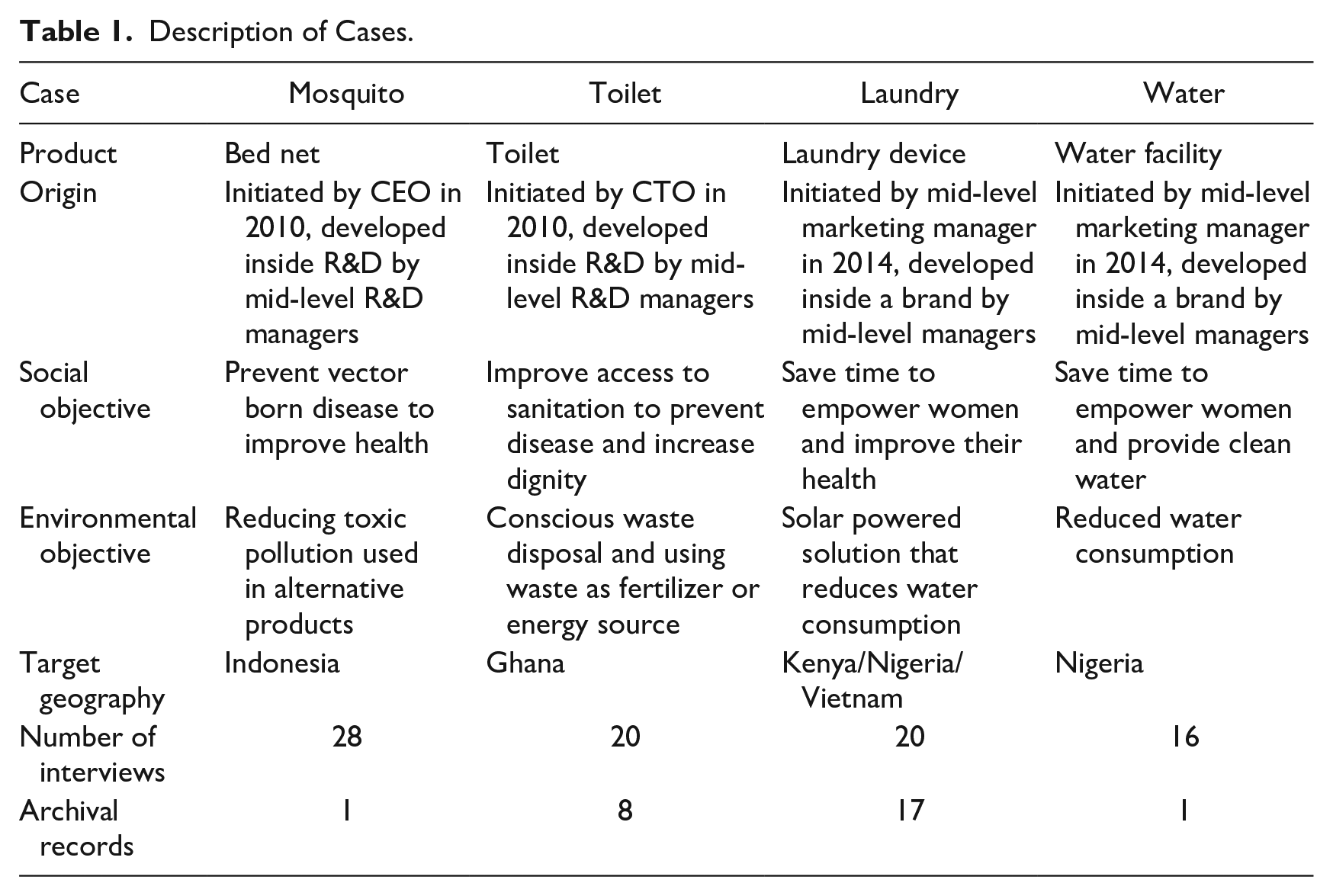
With each venture focusing on different markets, geographical areas, and social issues, the four BoP ventures shared in common that products were specifically developed to profitably address the pressing needs of those living at the BoP. In addition, the BoP ventures also sought to achieve environmental objectives. Specifically, the BoP ventures we studied were: a bed net to address vector-borne disease from mosquito bites (“mosquito venture”), kiosks with boreholes selling clean water to address excessive time spent collecting water (“water venture”), a toilet service to address limited sanitation access (“toilet venture”), and a portable washer to address excessive time spent doing laundry (“laundry venture”). In each case, mid-level managers who were developing these ventures—either autonomously (water & laundry venture) or as part of their role (mosquito & toilet venture)—required support from more senior managers inside the product division and country organizations to initiate and then sustain BoP venture development. At the time we started our research in 2015, the four BoP ventures were insufficiently profitable according to conventional standards. This enabled us to study how emotional framing played a role during a BoP venture’s development process up until the point where ventures were (dis)continued on the basis of financial criteria.
Data Collection
As shown in Table 2, our primary data comes from 56 semi-structured interviews with 36 informants, which took place on site and over the phone between 2015 and 2019. For each venture, we interviewed two types of informants: (a) mid-level managers who developed BoP ventures and (b) senior managers and other employees affiliated with the BoP ventures. 1 An interview protocol was used, and so were specific interview techniques such as “courtroom” questioning and event tracking (Eisenhardt, 1989). By sharing concrete examples and events, informants relied on their episodic memory leading to more accurate, convergent, and comprehensive accounts (Vouri & Huy, 2016).
Informants and Interviews.
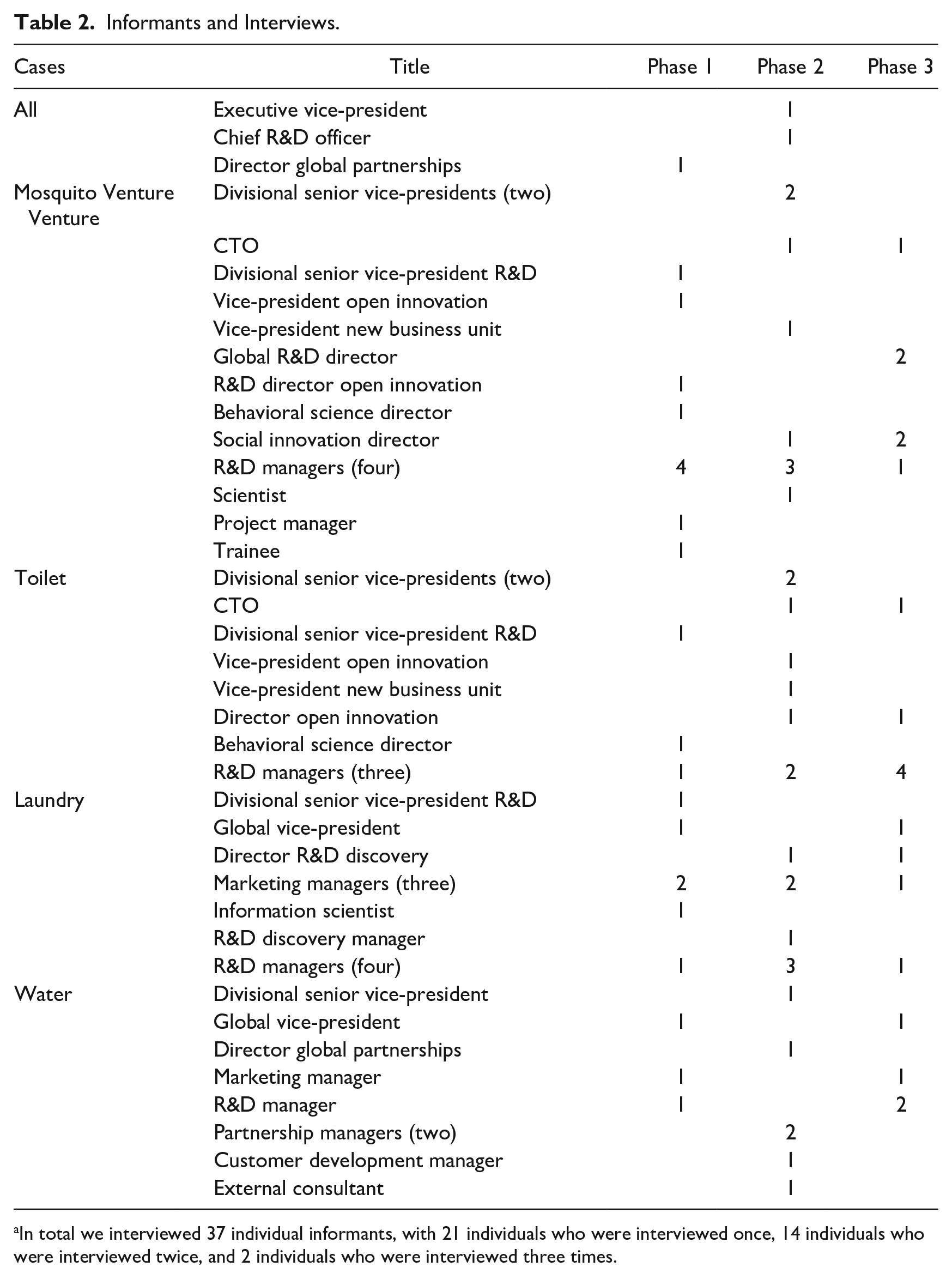
In total we interviewed 37 individual informants, with 21 individuals who were interviewed once, 14 individuals who were interviewed twice, and 2 individuals who were interviewed three times.
We undertook three phases of data collection. First, we identified and interviewed employees who were involved in BoP venturing to understand how the ventures emerged and how they developed inside the FMCG. These data allowed us to understand how interactions and organizational actions influenced BoP venture development. In the second phase, through snowball sampling, we interviewed other informants to extend our data collection and validate the plausibility of earlier accounts. During the third phase, we built on the initial analyses of the first two phases, seeking to complement our understanding of how managers developing BoP ventures used emotional framing throughout the venturing process.
To triangulate our data, we sought to complement interviews with archival data from the company (Yin, 2009). The highly confidential and strategically sensitive nature of the information made informants somewhat reluctant to share archival data; hence, a limited amount of internal documents was made available for triangulation purposes. The archival records obtained included internal presentation slides (14), an internal Excel spreadsheet (1), internal reports by employees (7), internal reports by consultants (7), publicly available reports by the firm (15), and public reports by nonprofit organizations and consultancies (4).
Data Analysis
We took an iterative approach between data and theory to explore patterns and identify key themes, which ultimately enabled us to develop novel inferences from our data (Strauss & Corbin, 1998). Sequential to our data collection phases, our theorizing evolved in three steps. First, we identified through open-coding whether and how managers packaged and organized information to realize “alignment of a frame with the audience’s passions, desires, or aspirations” (Giorgi, 2017, p. 717). To code how managers used framing to appeal to their audience’s emotions, we identified a set of actions through which managers sought to achieve emotional resonance by “moving” or “shaking” their target recipients (Giorgi, 2017). For example, we found that managers explained social problems at the BoP by showing images or communicated to volunteers in a specific way to make them feel part of a team.
Second, we sought to deepen our understanding of emotional frames by identifying relationships between first-order categories. By grouping actions through which managers sought to achieve emotional resonance to accomplish a certain objective (e.g., earning senior management commitment or strengthening volunteer commitment), we informed emotional framing practices as our second-order themes. Comparing differences and similarities within and across cases, we identified eight emotional frames through which managers who developed BoP ventures sought to gain access to resources and secure organizational support. For example, managers deliberately shared consternation, shared numerical data, and showed graphical images when talking to more senior managers about the magnitude of a social problem at the BoP. Such a way of appealing to emotions aimed to inspire a desire to solve a specific social problem by drawing attention to its significance, which we labelled the “problem gravity frame,” and was used to earn a commitment from more senior managers.
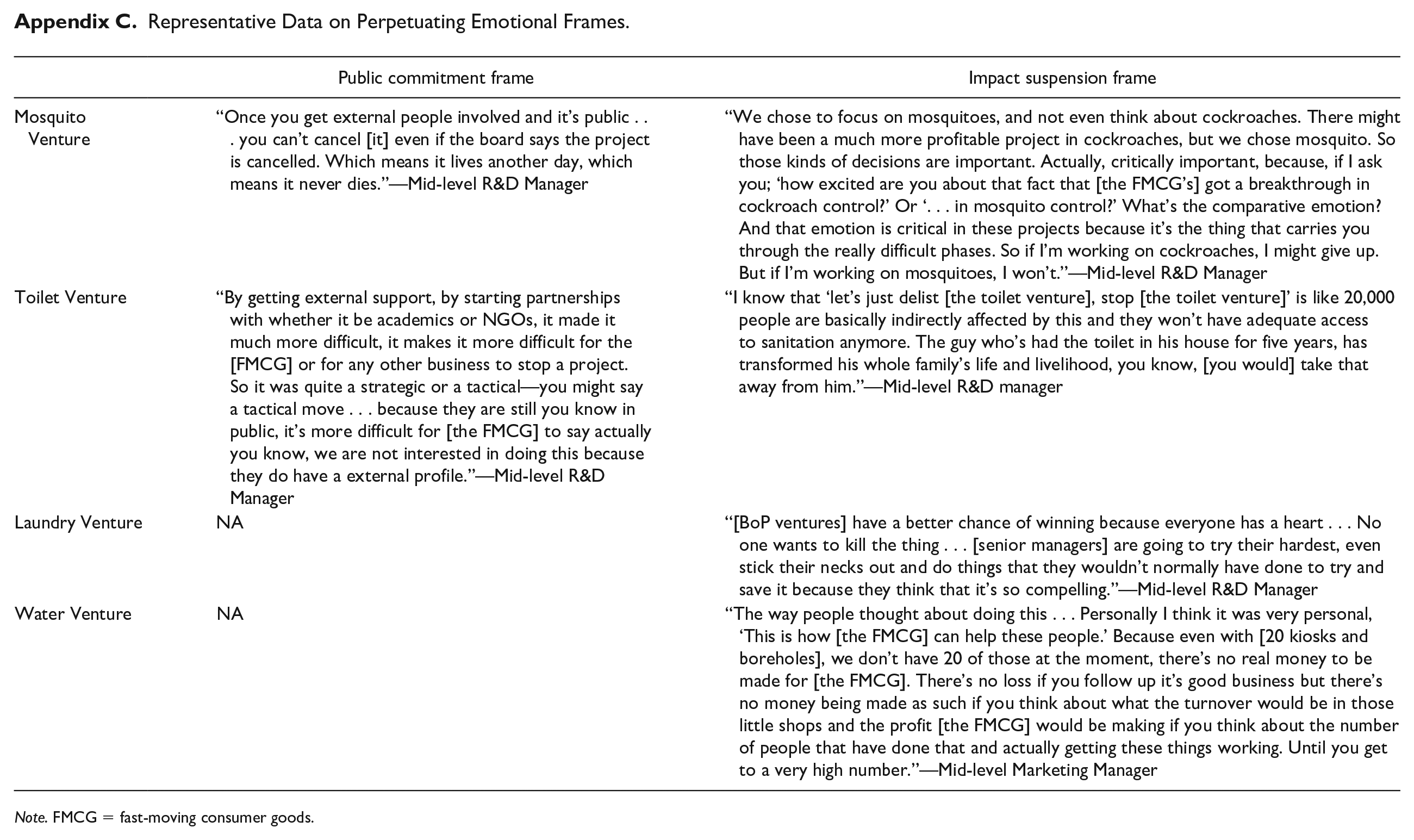
Third, we used theoretical coding to relate second-order themes to aggregate dimensions. Here we distinguished between types of emotional frames that were used to either earn commitment (i.e., captivating frames), strengthen commitment (i.e., solidifying frames) or lock in commitment (i.e., perpetuating frames) from organizational members. Parallel to our evolving understanding, we redefined our coding procedures (Glaser & Strauss, 1997). Figure 1 summarizes, by dimension, the corresponding first-order concepts and second-order dimensions, from informant interviews and archival data. Representative data for each dimension are shown in Appendices A, B and C.
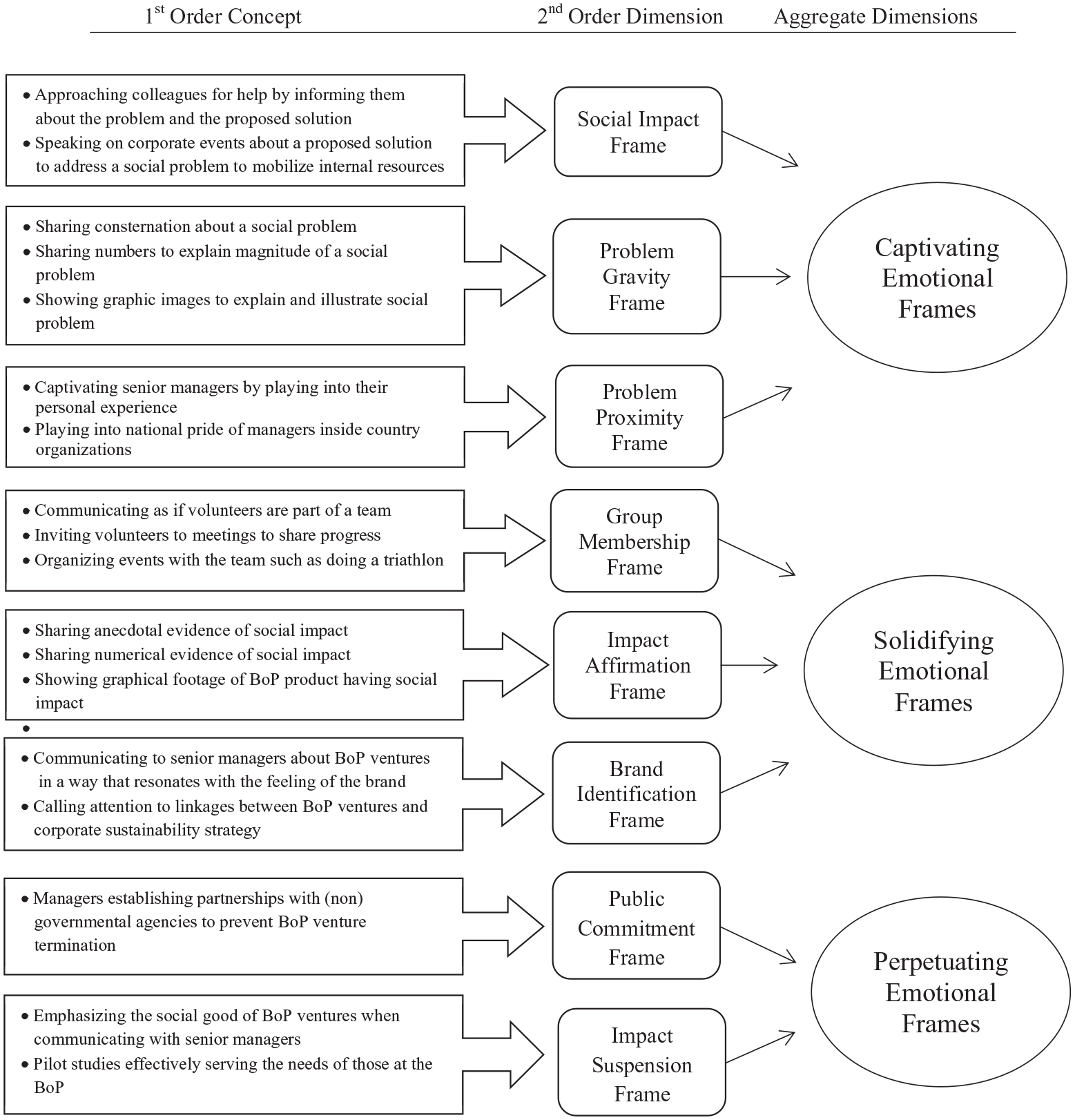
Data Structure.
Findings
Like most MNCs, the FMCGs’ innovation processes and performance management systems primarily centered on maximizing short-term profit and avoiding uncertainty. Accordingly, we find that for BoP ventures to develop inside the FMCG, managers used emotional framing throughout the venturing process to earn and maintain commitment from volunteers and more senior managers. We identified three types of emotional frames: captivating emotional frames, allowing managers to earn commitment from other organizational members; solidifying frames, allowing managers to strengthen commitment from other organizational members; and perpetuating frames, allowing managers to lock-in commitment from other organizational members. Emotional frames enabled managers to gain access to resources that were required to conduct field research in BoP target markets, earn support from more senior managers to fund pilot studies in BoP markets, and stall time for extensive experimentation to demonstrate a business case. Below, we unpack the three types of emotional frames that were used by managers for the purpose of developing BoP ventures.
Captivating Emotional Frames
Although BoP venturing was part of the MNC’s corporate sustainability strategy, our data show that managers could not access human and financial resources through standard innovation processes. To gain access to human and financial resources, new ventures were required to advance through a standardized stage-gate process (O’Connor, 1994). Stage-gates refer to a predetermined process a new product must go through from inception to product launch, with each stage defined by a particular set of activities and deliverables followed by a review from senior managers to decide whether the product may advance to the next stage.
Problematically, Stage 1 of the stage-gate process required managers to demonstrate a profitable business case to gain access to resources. Estimations of profitability were calculated based on quantitative data on customers and pricing. Without such data readily available when targeting unfamiliar customers at the BoP, managers required upfront investments for field research and pilot studies to collect these data. A mid-level R&D manager said, “we buy a lot of consumer data for the products that we sell, and the categories that we sell. We don’t buy data in this space. So I need the cash to go and buy data.”
Furthermore, stage-gates were also closely connected to the FMCG’s functional excellence model, which meant corporate support functions such as supply chain, R&D and finance would only become involved once new products advanced to certain stages. Given a need for early experimentation in target markets to learn about unfamiliar customer segments and collect data to demonstrate profitability, managers almost immediately had to engage in market testing at the BoP. However, market testing only typically occurred at a later stage, which meant BoP ventures could not advance through standard stage gates and gain access to internal resources, including support functions.
In each of the cases, we find that mid-level managers developing BoP ventures as part of their role or on their own initiative used captivating emotional frames to earn a commitment from other organizational members. We distinguish between three captivating frames that enabled managers to recruit volunteers who had time and/or specific expertise to develop new ventures, secure initial funding from senior managers to finance field studies and initial pilots, and find operational support to experiment in target markets and gain access to the FMCG’s sales channels from senior mid-level country managers. Captivating frames helped middle managers create BoP ventures during the initiation stage when initiatives were in an incipient state and had not yet been accepted as formal new ventures.
Social Impact Frame
To compensate for scant financial and human resources, we find that managers who were developing BoP ventures recruited volunteers to help conduct field research and initial pilot studies in their target markets. When approaching colleagues for help by informing them about a social problem at the BoP and their potential solution, or when speaking at corporate events about their BoP ventures, managers used a social impact frame by emphasizing the opportunity to advance the well-being of those living at the BoP.
Finding its origin inside a protected R&D space, the mosquito venture was initiated and funded by the CEO, head of product division, and Chief R&D Officer who ordered R&D managers to create a product to prevent vector born disease. Similarly, the toilet venture was initiated and funded by the CTO who allowed R&D managers to explore commercial opportunities to increase access to sanitation. Despite having sufficient financial resources to conduct field research, mid-level R&D managers developing the mosquito and toilet venture still relied on organizational members with specific functional expertise to voluntary help conduct pilot studies. Reflecting on this process, a mid-level R&D manager developing the mosquito venture recalled, “Trying to convince people working on it? Not a problem. . . It was easy to get people’s time. . . because they saw the excitement and saw the potential to really change the world.” Commenting on how R&D managers recruited young ambitious trainees to help conduct pilot studies, a R&D manager developing the toilet venture said, “what we tried to do was to try to highlight that there was an alternative way of working, and there were alternative areas where you could be involved that could make a difference.”
Contrary to these ventures developing inside protected R&D spaces, both the water and the laundry venture found their origin inside the product division, where mid-level marketing managers voluntarily initiated BoP ventures after their brands had introduced a sustainability strategy to empower women at the BoP. While initially developing both ventures in their spare time, the two marketing managers in charge of the water and laundry venture first sought to recruit volunteers to help conduct field research, after which they used volunteers to conduct pilot studies. Although a senior mid-level manager donated her own performance bonus to fund field research, the mid-level manager who initiated the water venture observed, You don’t have a formal team . . . so you depend a lot on volunteers or kind of another set of passionate people that want to help and want to share their expertise or knowledge or want to advise or want to spend their personal time or whatever time they have free on the project. So you know it’s a different way of bringing a team together. It’s kind of working more on the side of emotions and passions.
The mid-level marketing manager who initiated the laundry venture initially received no financial support from her superiors to explore ideas at the BoP, who were preoccupied with short-term results and favored incremental over more radical innovation. Subsequently, the mid-level marketing manager sought to gain access to human and financial resources by making her colleagues enthusiastic about the venture, including those with discretionary budgets. She recalled, It started very much as “If you are interested come and help this project.” We didn’t have a specific taskforce for this project, we couldn’t really ask for any resources [through standard processes] for this project so it was mostly showing it to people.
When communicating with other organizational members, the marketing manager strategically highlighted the impact her BoP venture aspired to have. She explained, You are just talking about okay, this is what’s happening to women in Africa and they are like, oh my god, yes I know like this is horrible. I was like, okay and this is how we can probably help.
Problem Gravity Frame
Because BoP ventures could not advance through standard stage gates processes, we find that mid-level managers who were developing BoP ventures required resource commitments from more senior managers to fund pilot studies in their target markets. When presenting their BoP ventures to senior (mid-level) managers, we find mid-level managers used a problem gravity frame, drawing attention to the significance of the social problem they sought to address by sharing numbers, graphic content, and consternation.
While R&D managers received funding to conduct field research, they still had to present initial findings to earn senior management’s commitment to conduct pilot studies. When presenting to senior managers, we observed mid-level R&D managers first explained the gravity of the social problem. An R&D manager in charge of developing the mosquito venture stated, “I took [the CEO] through the deck of about 15 slides, starting from the problem. It doesn’t take very long to describe the problem, everyone knows it’s a big social need.” Another R&D manager added, “we showed people the facts. . . and actually showed the people this was big deal.” R&D managers who were developing the toilet venture successfully used a similar captivating frame to earn senior management commitment. The CTO remembered, You know, some of the kinds of things that they [R&D managers developing the toilet venture] had was. . . whatever it is, is 3 billion people don’t have toilets, or some ridiculous number. Our feeling was, that’s just not right in today’s world.
In a similar vein, mid-level managers developing the water venture also used a problem gravity frame when approaching senior mid-level managers inside the sustainability department for funding. A mid-level manager involved in the water venture offered, there’s always an emotional element to things. Maybe that’s kind of a rule of thumb. What I feel is, emotions work very well. . . Your personal emotions. . . I think you need to always have an emotional and a functional story.
Commenting on how personal emotions were an important aspect when middle managers presented their initiative for funding during an internal venture competition, a mid-level marketing manager developing the laundry venture stated, we started to think about what is it that we can do about these women because we ourselves were kind of shocked to the kind of—to the amount of effort that they needed to go through. . . It was just like this is why we decided to do this job. Look at it, you know.
Besides sharing consternation, managers also shared graphic content to earn senior management support. The mid-level marketing manager said, In every single PowerPoint that we have, we have photos of women washing and that’s all you need to say. Honestly it’s that powerful. . . When we were trying to explain why this was important, that was basically what we were doing.
Problem Proximity Frame
Product stage gates typically only involved country organizations once products were ready to be tested, and sufficient evidence of profitability within a 3-year time period could be provided. Yet, the need for early market testing at the BoP created a necessity to involve country organizations at a much earlier stage. Operational support from country organizations was critical to experiment with BoP ventures on the ground. However, as sales organizations responsible for selling the FMCG’s brands, country organizations had stringent short-term financial targets and were typically reluctant to support new initiatives. To earn commitment from senior mid-level country managers and gain permission to operate in their markets and use their sales channels, we find mid-level managers used a problem proximity frame, highlighting the personal relevance of BoP products by playing into the personal experience and national pride of country managers.
Because managers who were developing BoP ventures were aware that country managers typically had personal experience with social problems and shared a strong sense of national pride, managers strategically altered the way they spoke about BoP ventures by strongly emphasizing the impact element and underlining how BoP products could help citizens of their target country. An R&D manager developing the mosquito venture explained, The VP of sales in Indonesia he had Dengue fever, very very bad to the point of hemorrhaging. . . You can sell a story to someone like that, you can sell a story about a lifesaving intervention in a very different way than you can sell a story of a new shampoo. . . Had this guy not been bitten by a mosquito and he not had firsthand experience and had he not understood that Dengue can be life threatening it certainly would be more difficult to go and talk to him. The Board of Directors in Indonesia they have all been bitten by mosquitoes. They all know somebody that has contracted a disease. . . So the conversation you can have around that is so much more straight forward because they connect to the issue, they understand the business opportunity and they want to have social impact. If you can put on their desks, here’s business impact, here’s social impact, who is going to turn around and say no.
With respect to managers strategically leveraging a sense of national pride, an R&D manager developing the toilet venture stated, “[managers of country organizations] have much faster, this local proudness and local experience. . . They also are closer to the social side of things.” Commenting on how the problem proximity frame was instrumental to earn senior mid-level management support, a mid-level manager developing the water venture further explained, It’s very difficult to kind of get this ball rolling. I think through emotions, [you can get] your local teams mobilized and create that pull. . . What you see on the [water venture], is very much that people are connected to the reality on the program. They developed something like. . . “I want to help the people in my country.” So it was also the fact that we were exploiting this gap quite successfully.
While we find that managers who were developing the mosquito, toilet, and water venture could successfully use the problem proximity frame, managers developing the laundry venture experienced country organizations of her target markets only considered short-term profit. A manager involved in the laundry venture stated, we were trying to get the local market to commit. . . and every time they are. . . telling me that “I’m going to lose share and then invest on something else that is actually not giving me share back? That’s stupid.”
Solidifying Frames
The FMCG typically expected new ventures to generate revenues in the multi-millions, become the first or second player in the given market, and be profitable within 3 years by conventional margins. At the time we started our research, none of the BoP ventures in our sample was even close to meeting these criteria. A mid-level R&D manager explained, [You need that] period of support, of grace, where you are given a little bit more hope in those first five years, six years of a project. I guess a lot of social innovation projects do take time. . . You’re not going to go from zero to market penetration of 50 to 60% and of millions of consumers, which is what [the FMCG] has currently.
To deviate from standard performance criteria and gain time to experiment in BoP markets, it was essential managers strengthened senior management support. An executive confirmed, “[BoP venturing] takes longer and takes more money. . . you’re only allowed to break the rules if you’ve got a senior manager [on board].” Commenting on the need to earn and maintain senior management support, a mid-level R&D manager said, “[first] it’s to try and get some money to do a test. The second time it’s to [prove customers are willing to] pay money, and marketing and branding. The third time is, obviously, to get request to launch.”
In each of the cases, we find that mid-level managers developing BoP ventures as part of their role or on their own initiative used solidifying emotional frames to strengthen commitment from organizational members. We distinguished between three captivating frames that enabled managers to keep volunteers engaged and strengthen support from more senior managers inside the product division and country organization, allowing mid-level managers to keep making use of volunteers, get more funding to scale up experimentation in BoP target markets, and have more human resources allocated to BoP ventures. Solidifying frames helped managers turn their initial ideas into more structured and formalized BoP ventures during the development stage, enabling their development with a dedicated team.
Group Membership Frame
Whereas BoP venture development required extensive experimentation for a long period of time, and internal experts from support functions (e.g., supply chain or finance) who typically helped new products develop were not allocated to BoP ventures, we find that managers developing BoP ventures sought to keep volunteers and partners committed throughout the venturing process. In highlighting the association between volunteers, external partners and a core team of managers developing BoP ventures, we find managers employed a group membership frame by communicating to volunteers and partners as if they were part of a team, inviting them for team meetings, and organizing team events.
For example, mid-level R&D managers developing the mosquito venture frequently invited volunteers and external partners to participate in team meetings and even organized a team event. A mid-level R&D manager explained, We did a charity triathlon last year, as a team . . . We had as many of our partners involved as we did in team meetings. It’s a very emotional connection across the whole team. Even when people step out because they’re not—needed, if you like—they still are very ready to step in again.
Marketing managers developing the laundry venture similarly sought to strengthen the commitment of volunteers. A volunteer recalled, The team did involve me. . . the project leadership team I think were also very welcoming and supportive and there were a number of emails where they were asking me for what did I think about certain things which normally actually doesn’t happen. . . I was looked on as a member of the project team.
As a consequence, managers who were developing both BoP ventures experienced volunteers remained at their disposal. A mid-level R&D manager concluded, “I actually don’t want to admit how much resource I’ve had. . . I’ve had an enormous amount of help from people who have just volunteered to help.”
Notably, the toilet and water venture wouldn’t sell through the corporation’s standard sales channels and were less operationally related to the FMCG than the mosquito and laundry venture. As a consequence, we observed managers saw less need to keep volunteers committed for a longer period of time. Commenting on the more opportunistic nature of how managers of both ventures made use of volunteers, a manager developing the water venture stated, there are different volunteers at the different stages. . . they had different roles in the process so then they were not part of the project all the time. They just kind of—you know, they were brought to the project. . . to kind of fill the gap that we had at certain point in time.
Impact Affirmation Frame
While BoP ventures could not demonstrate sufficient profitability after managers conducted initial field research and early pilot studies, further experimentation was required for BoP ventures to inform and prove the business case. To maintain and increase resource commitments from senior (mid-level) managers despite a lack of immediate profit, we find mid-level managers developing BoP ventures used an impact affirmation frame, whereby focusing attention in their communication on demonstrating the social impact of their BoP products by sharing anecdotal evidence, numerical evidence and graphical footage of how their BoP products helped improve human lives.
Commenting on how the impact affirmation frame had helped managers develop the mosquito venture by maintaining senior manager support, a mid-level R&D manager stated, We went to Indonesia, we showed the product to consumers, we put it in their homes, we videoed the responses of those consumers—which were very positive—mothers with children in their arms saying how much it had changed their lives. . . And we shared the product and the insight and the idea with the VP responsible for the [product division] in Indonesia. And he said “is there a business in this?” And we had to show him some numbers, and some projections of “this is the kind of price point” and he said, “I see it’s absolutely not ready, but there’s a business here somewhere, and more importantly this is something that we should do.”
R&D managers developing the toilet venture used a similar approach. A R&D manager explained, it wasn’t immediately [profitable] and. . . it wouldn’t do for many years but at least we were able to run pilots. . . the key thing was talking in [the FMCG’s] language, so. . . this is the impact we’re making in terms of social impact.
A mid-level marketing manager developing the water venture similarly underlined the importance of providing evidence of social impact and stated she was still in the process of collecting “information of what is the impact and of how the positive impact of the [water venture] can be maximized.” Numerical and anecdotal evidence were considered an effective framing tactic to maintain senior management support. A mid-level marketing manager developing the laundry venture said, Once we did research and then we actually had data to back it up. . .we latched on afterwards a lot to the stories. . . Having these individual stories made it so real, made it so possible. So I think people love it. People were just eating it up really. . . we would talk about everything, about the project. . . this is all the stuff that we have done and this is this woman like Douche. . . This was her life and we have pictures. This is what she was doing. This is every day of her life. This is her playing or using [the BoP product]. This is how she looks now. Now she has her own business. Now she makes her extra money. Now she went back to school. . . we had like 3 or 4 stories like that but every time we would tell people about it, you could just see their eyes like sparkle.
Brand Identification Frame
When initially presenting BoP ventures to senior (mid-level) managers inside the product division to gain access to financial and human resources, mid-level marketing managers who were developing the water and laundry venture were specifically asked to relate BoP ventures to the sustainability strategy of their brands as part of a BoP venture’s business case. In response, we find managers using a brand identification frame, closely establishing a strong link between the BoP venture and the feeling of a brand. A mid-level marketing manager developing the water venture recalled, it wasn’t really a detached kind of idea that we just tried to force fit and link with the brand. It’s more of how you speak about it; how you articulate the project and how you articulate the ambition of the brand.
A marketing manager developing the laundry venture further said, We took the brand personality to heart and I honestly think it was the best way for us to do it. This is this woman. . .. Look at her, she is already great. Look at all that she is doing. But it’s hard because of this, this and that and now that she has this, it’s even better. . . For [the brand], we never say it’s from bad to good. All of the examples, all of the communication that we do, all of the films that we create, it’s never from bad to good. . . So even in bad situations, we are already putting a more positive spin.
Because R&D managers who developed BoP ventures inside a protected R&D space created entirely new brands, there was no need to show how BoP ventures would fit existing brands. All managers connected BoP ventures to the corporate sustainability strategy and framed their ventures as an important way for the FMCG to deliver on its sustainability objectives.
Perpetuating Frames
While BoP ventures in our sample struggled to demonstrate profitability according to conventional standards, and were expected to require several years before such a level of profitability could be achieved if even, we find managers relied on perpetuating frames to maintain organizational members committed and stall time for BoP venture development. Perpetuating frames were used to lock in commitment from more senior managers, and came in the shape of a public commitment frame and impact suspension frame. Both frames ensured that human and financial resource commitments were sustained by senior (mid-level) managers and that BoP ventures were allowed more time to grow and demonstrate profit. Perpetuating frames helped middle managers mature BoP ventures, incorporating successful BoP ventures as an ongoing part of the FMCG.
Public Commitment Frame
Importantly, BoP ventures were strongly dependent on external partnerships with (non)governmental agencies to help bridge capability gaps and legitimize their activities. While such partnerships held great importance to the development of BoP ventures, we found that mid-level R&D managers also strategically sought to create exit barriers by forming partnerships early in the process. By making public commitments to external parties, mid-level R&D managers sought to prevent early venture termination in the absence of short-term profitability and extend resource commitments. A mid-level R&D manager developing the mosquito venture explained, “once you get external people involved and it’s public. . . you can’t cancel [it] even if the board says the project is cancelled.” Another mid-level R&D manager developing the toilet venture similarly said, by starting partnerships with whether it be academics or NGOs, it makes it more difficult for the [FMCG] or for any other business to stop a project. So it was quite a strategic or a tactical—you might say a tactical move. . . because they do have an external profile.
Notably, we find only R&D managers used a public commitment frame to create exit barriers. Mid-level marketing managers rather emphasized the importance of creating strong connections with their brands to ensure the survival of their BoP ventures, which R&D managers could not do.
Impact Suspension Frame
Managers developing BoP ventures realized BoP ventures required a substantial amount of time to demonstrate profitability according to conventional standards, if ever. As a consequence, mid-level managers understood the emotional appeal of BoP ventures was critical to their survival in absence of short-term profitability. Continuously emphasizing the social good of BoP ventures when communicating with more senior managers to inspire a sense of guilt when terminating BoP ventures, a mid-level manager developing the laundry venture explained, “[BoP ventures] have a better chance of winning because everyone has a heart. . . No one wants to kill the thing.” She further said, “[senior managers] are going to try their hardest, even stick their necks out and do things that they wouldn’t normally have done to try and save it because they think that it’s so compelling.” A senior mid-level R&D manager confirmed, this is what defines all of these initiatives. People care about. . . the good that they are doing [and]. . . the potential benefit and opportunity that you can provide to people if you can get this to work.
In one instance, we observed the emotional appeal of a social problem even made R&D managers focus on mosquitoes instead of other vectors. A mid-level R&D manager offered, Those kinds of decisions are important. Actually, critically important, because, if I ask you; “how excited are you about that fact that [the FMCG’s] got a breakthrough in cockroach control?” Or “. . .in mosquito control?” What’s the comparative emotion? And that emotion is critical in these projects.
As another important aspect of the impact suspension frame, mid-level managers commented on the importance of pilot studies effectively serving the needs of those at the BoP to elicit remorse when BoP ventures would be terminated. A mid-level manager developing the toilet venture said, “let’s just delist [the toilet venture], stop [the toilet venture] is like 20,000 people are basically indirectly affected by this and they won’t have adequate access to sanitation anymore.” Indeed, a senior mid-level manager protected the toilet venture after his superiors had ordered the venture to be shut down. The manager shared, we thought [an executive] may be making the right decision that it is not a business [the FMCG] would ever run but it was the wrong thing to do for the world. . . We kept it alive because we believed it was the right thing to do.
Similarly, the water venture operated well below required standards of profitability. A mid-level manager reflected, “the way people thought about doing this. Personally I think it was very personal, ‘This is how [the FMCG] can help these people.’ . . .there’s no real money being made.”
Although perpetuating frames helped managers lock in senior (mid-level) management support, interviewees commented that emotional framing practices could not prevent BoP venture termination based on low profitability or a perceived lack of internal fit. Emotional framing did, however, enable managers to gain, maintain, and preserve senior (mid-level) management commitment long enough for BoP ventures to reach a certain level of maturity for them to survive. While two BoP ventures continued operating inside the FMCG (mosquito and water), two ventures spun out into separate social enterprises (toilet and laundry venture) where (ex)employees remained involved in their further development.
Discussion
Our study set out to explore how managers use emotional framing throughout the BoP venturing process inside a large FMCG. As captured in Figure 2, our data unveil that emotional framing allowed managers to earn and maintain commitment from volunteers and more senior managers and sustain BoP venturing efforts up until a stage where products were considered for market launch despite an obvious sense of short-term profitability. Through captivating emotional frames, we find that managers could earn commitment from other organizational members and gain access to human and financial resources that could not be accessed via standard procedures. Captivating emotional frames also allowed managers to gain permission from country managers to experiment in their target markets at the BoP, secure operational support, and sell through a country’s existing sales channels. Through solidifying emotional frames, we find that product managers kept volunteers and more senior managers engaged during lengthy experimentation in BoP markets. Solidifying emotional frames also allowed middle managers to increase human and financial resource investments by more senior managers to develop BoP ventures beyond the initial pilot stage. Finally, we find that through perpetuating emotional frames, managers could sustain resource commitments from more senior managers and stall time for BoP ventures to mature despite insufficient profitability. Below we unpack the theoretical contributions of our research.
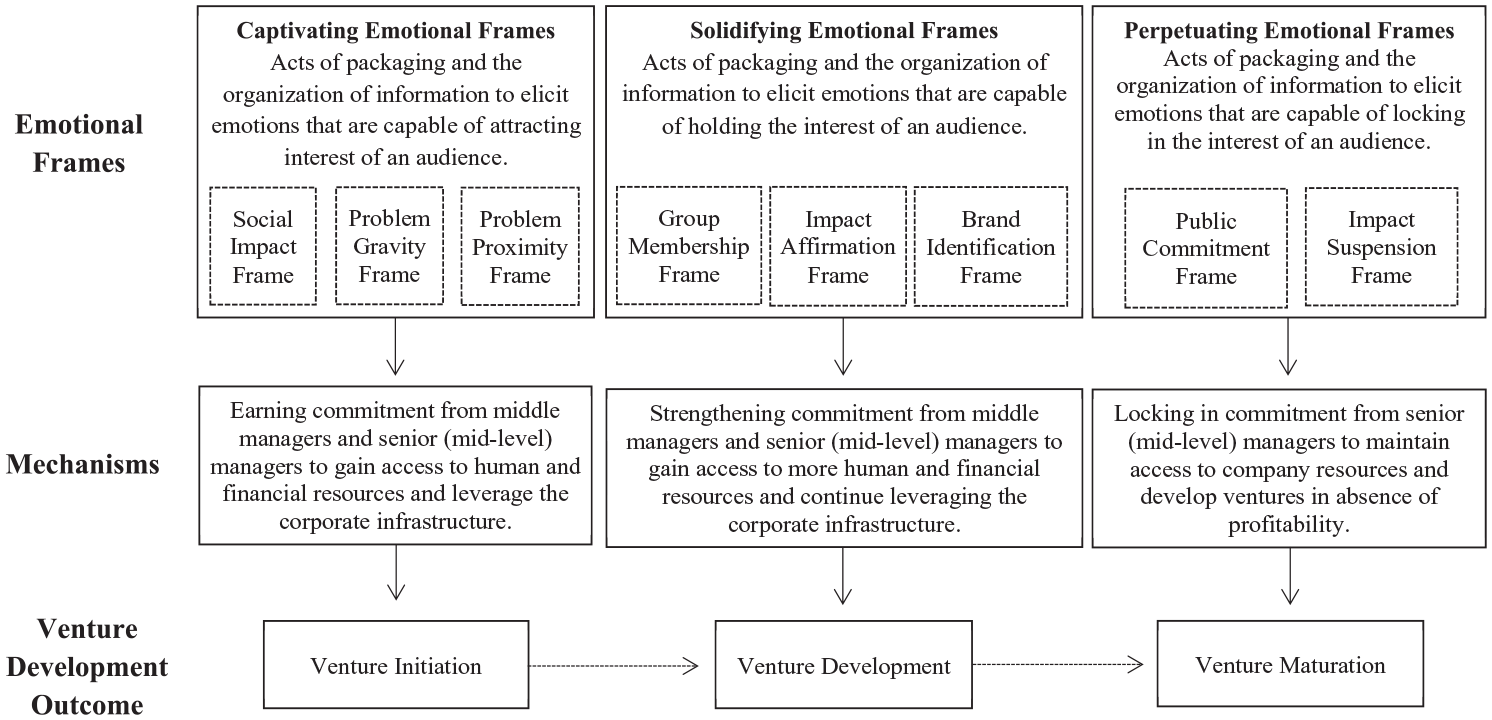
Conceptual Framework.
The Role of Emotional Framing in BoP Venturing
Research has long suggested that emotional arguments are critical to motivate corporate engagement at the BoP (Prahalad, 2004) and that emotional framing is considered an effective way for middle managers to earn senior (mid-level) management support for BoP ventures in the face of high uncertainty and long payoff horizons (McMullen, 2011; Simanis & Milstein, 2012). While to date the role of emotional framing remained unexplored in scholarship on BoP venture development, we contribute to existing BoP research by showing how managers who developed BoP ventures used emotional framing for two key purposes.
First, given a corporate emphasis on short-term profit and uncertainty avoidance, managers who develop BoP ventures inside MNCs typically struggle to gain access to internal resources regardless of whether firms consider BoP venturing of strategic importance to develop future markets or not (e.g., Olsen & Boxenbaum, 2009; Reficco & Gutiérrez, 2016). Building on the work by Halme et al. (2012) who highlight the importance of intrapreneurial bricolage—“entrepreneurial activity within a large organization characterized by creative bundling of scarce resources” (p. 743)—to compensate for a lack of resources in such kind of scenario, we find that emotional framing allowed managers to mobilize internal resources without much ado. Through captivating emotional frames, managers could recruit volunteers and use their slack budgets while solidifying emotional frames kept volunteers engaged throughout the venturing process. Both types of emotional frames allowed managers to compensate for a lack of time, dedicated resources, and access to internal expertise. As such, our findings show that emotional framing helped facilitate intrapreneurial bricolage and echo findings by Halme et al. (2012) who underline the importance of bricolage in a corporate setting where adequate support structures for BoP venturing are found wanting.
Second, considering that BoP ventures tend to be incompatible with conventional innovation processes and incentive systems centered around short-term profit (Reficco & Gutiérrez, 2016), middle managers who develop BoP ventures typically require senior management support to deviate from standard processes and systems to gain access to resources and develop BoP ventures (Halme et al., 2012; Zahra & Wright, 2016). As observed in the data, captivating frames allowed middle managers to earn support from more senior managers, solidifying frames allowed middle managers to strengthen their support, and perpetuating frames allowed middle managers to lock in their support. We find these three types of emotional frames allowed middle managers to earn and maintain commitment from managers who have the power and discretion to deviate from standard performance criteria (George et al., 2012) and helped facilitate conditions that permit the exploration of new business opportunities and new capability development at the BoP (Hart et al., 2016).
Emotional Framing Inside Corporations
Second, we contribute to an emerging body of research on emotional framing inside MNCs. The use of framing has long been recognized as a powerful tool for managers to find support for organizational initiatives (Cornelissen & Werner, 2014), especially in the context of social (Wickert & de Bakker, 2018) and environmental initiatives (Anderson & Bateman, 2000), where morals may trump economic arguments (Mayer et al., 2019). Yet, only recently have scholars started calling attention to the role of emotions in frame effectiveness (Giorgi, 2017; Lockwood et al., 2019). As such, scholars examined how entrepreneurs maintain and modify emotional states of investors and employees to mobilize and make better use of existing resources throughout the venturing process (Huy & Zott, 2019), proposed emotional framing is important for managers to advance nonincremental innovation (Raffaelli et al., 2019), and highlighted the importance for future research to consider how entrepreneurial individuals use emotional framing to achieve emotional resonance with their audiences (Snihur et al., 2021). By studying how entrepreneurial actors used emotional framing throughout the BoP venturing process, we answered the call by Raffaelli et al. (2019) and Snihur et al. (2021) to further explore emotional framing in an entrepreneurial context and identified three types of emotional frames that facilitate new venture development inside a large FMCG.
Through expanding on various types of emotional frames managers used sequentially, we move beyond a unidimensional conception of emotional framing. While distinguishing between types of emotional frames, our findings show that managers sought to achieve emotional resonance by appealing to three sorts of audience emotions (Lazarus, 1993). For example, managers sought to elicit positive emotions that promote motivation and behavioral activation when inspiring a sense of belonging through a group membership frame. Managers also sought to elicit negative emotions that inspire individuals to avoid unfavorable conditions, such was the case when inducing fear of venture termination by means of a public commitment frame. Finally, we observed managers sought to elicit emotions “that are linked to the interests or welfare either of society as a whole or at least of persons other than the judge or agent” (Haidt, 2003, p. 276) when, for example, highlighting the (local) impact potential of their initiatives. Appealing to such so-called moral emotions may be unique to social initiatives, making managers forgo their personal interest and move beyond an organizational focus on short-term profit (Crilly et al., 2008; Hafenbrädl & Waeger, 2017). Depending on the type of initiative and development phase, we thus find that managers may strategically appeal to three sorts of audience emotions when using emotional frames.
Regardless of whether employees developed BoP ventures autonomously or as part of their role, we find managers mostly used similar emotional framing tactics, including undertheorized ones such as sharing visuals during presentations (Lockwood et al., 2019) or manipulation (Dörrenbächer & Gammelgaard, 2016). However, we found only mid-level marketing managers who developed BoP ventures from the bottom-up inside existing brands framed ventures in line with a brand’s values and beliefs (Raffaelli et al., 2019). Because senior (mid-level) managers challenged these managers to do so, our findings underline the interactive nature of framing and call attention to the agency of audiences (Cornelissen & Werner, 2014). We also found only R&D managers formed partnerships with external parties to prevent venture termination through public disclosure (Reinecke & Ansari, 2016). We thus show that, depending on an employee’s position, emotional framing tactics may vary.
Emotions and Corporate Entrepreneurship
Last, we contribute to research on corporate entrepreneurship and the role of emotions. While emotions are known to affect managerial decision-making (Barsade & Gibson, 2007; Elfenbein, 2007), to date only very little empirical studies address how emotions influence venture development inside corporations. Vouri and Huy (2016) found that aggressive behavior by senior managers induced fear among middle managers, whereby obstructing new product development. Conversely, Brundin and colleagues (2008) showed that positive emotional contagion by senior managers inspired entrepreneurial initiative taking by employees. From the perspective of middle managers, Biniari (2012) found that negative emotions resulting from and influenced by interactions between entrepreneurial and other employees had detrimental effects on new ventures activities. Although scholars suggest negative emotions discourage innovation adaption (Raffaelli et al., 2019), we find positive, negative, and moral emotions enabled BoP venture development inside an FMCG where existing processes and systems did not support such type of initiatives. Our findings thus suggest that emotions, including negative ones, may enable corporate entrepreneurship.
Implications for Managers
The practical implications of our study are twofold. First, while the FMCG aspired to develop future markets at the BoP, we observed that short-term centered performance management systems and innovation processes did not support such long-term strategy. To develop BoP ventures in the face of subsequent resource scarcity and gain support from more senior managers to deviate from such processes and systems, we find that managers inside the FMCG used emotional framing to mobilize resources and pursue investments with longer payoff horizons. Our data suggest that emotional framing may very well be critical to recruit volunteers, compensate for scant evidence of a business case to start ventures, and stall for time in the absence of adequate and/or immediate profits, allowing BoP ventures to develop inside MNCs. Managers in other organizations could similarly consider using captivating, solidifying and perpetuating frames for such purposes when developing BoP ventures or any other sustainable venture looking to address social and/or environmental problems.
Second, our findings show that emotional framing may be critical to BoP venture development, yet indicate that emotional reasoning by managers may potentially expose MNCs to flawed managerial decision-making. Senior managers may thus consider a set of rational decision criteria that account for various internal and external challenges of BoP venture development, preventing managers from over-investing in BoP ventures that lack a business case. At the same time, our study underlines that BoP venture development requires a different set of performance metrics and a tailored innovation process. Such alterations may be particularly salient for MNCs who strategically seek to enter the BoP, rendering strategic efforts at the BoP less dependent on whether managers are able to persuade (senior) managers across the organization to deviate from standard processes and performance measures.
Limitations and Future Research Directions
When delineating the limits of our study, we highlight limitations that may also provide springboards for future research. First, our study took place inside a corporation known for its commitment to BoP venturing and sustainability in general. Critically, the organizational context is known to shape manager’s beliefs and reasoning, influencing whether emotions lead to more CSR behavior (Crilly et al., 2008). Future studies may thus consider whether and how managers use emotional framing inside MNCs that are less conducive toward sustainability. Second, our data are based on a limited set of BoP ventures that all managed to advance to a stage where they were considered for market launch. While such sampling design allowed us to reduce the risk of BoP ventures ending prematurely based on bad business concepts, our data do not permit us to account for (in)actions with regard to emotional framing that explain venture failure at a premature stage. Future research may thus consider studying BoP ventures from the opportunity identification phase onward, each “racing” toward market launch (Eisenhardt, 2021). In selected cases, future studies could also account for comparative emotions of social issues, whereby considering the degree to which the social and/or environmental objectives of ventures are more or less emotionally laden. Third, we find that specific emotional frames were used to find support among country managers compared with other (senior) managers inside the FMCG. While still largely treating senior (mid-level) managers as a homogeneous internal audience, future studies may consider other relevant sources of audience heterogeneity (Lockwood et al., 2019). Moreover, our data did not permit us to further examine emotional framing tactics managers used when communicating with internal and external audiences. Considering that BoP venturing often involves multi-sector partnerships (Hart et al., 2016), future studies may consider whether and how emotional framing practices differ when managers target internal or external audiences, especially when their target audiences operate under a different logic (Ashraf et al., 2017). Last, because BoP venture development represents a specific type of venturing, future studies may address whether and how managers use emotional framing when developing ventures with solely commercial objectives. In any case, our in-depth exploration of how emotional framing plays a role in BoP venture development opens the door for research to explore emotional framing in new venture creation inside MNCs (Raffaelli et al., 2019), and advances our understanding of intrafirm processes that explain BoP venture development outcomes (George et al., 2012).
Footnotes
Appendix
Representative Data on Perpetuating Emotional Frames.
| Public commitment frame | Impact suspension frame | |
|---|---|---|
| Mosquito Venture | “Once you get external people involved and it’s public . . . you can’t cancel [it] even if the board says the project is cancelled. Which means it lives another day, which means it never dies.”—Mid-level R&D Manager | “We chose to focus on mosquitoes, and not even think about cockroaches. There might have been a much more profitable project in cockroaches, but we chose mosquito. So those kinds of decisions are important. Actually, critically important, because, if I ask you; ‘how excited are you about that fact that [the FMCG’s] got a breakthrough in cockroach control?’ Or ‘. . . in mosquito control?’ What’s the comparative emotion? And that emotion is critical in these projects because it’s the thing that carries you through the really difficult phases. So if I’m working on cockroaches, I might give up. But if I’m working on mosquitoes, I won’t.”—Mid-level R&D Manager |
| Toilet Venture | “By getting external support, by starting partnerships with whether it be academics or NGOs, it made it much more difficult, it makes it more difficult for the [FMCG] or for any other business to stop a project. So it was quite a strategic or a tactical—you might say a tactical move . . . because they are still you know in public, it’s more difficult for [the FMCG] to say actually you know, we are not interested in doing this because they do have a external profile.”—Mid-level R&D Manager | “I know that ‘let’s just delist [the toilet venture], stop [the toilet venture]’ is like 20,000 people are basically indirectly affected by this and they won’t have adequate access to sanitation anymore. The guy who’s had the toilet in his house for five years, has transformed his whole family’s life and livelihood, you know, [you would] take that away from him.”—Mid-level R&D manager |
| Laundry Venture | NA | “[BoP ventures] have a better chance of winning because everyone has a heart . . . No one wants to kill the thing . . . [senior managers] are going to try their hardest, even stick their necks out and do things that they wouldn’t normally have done to try and save it because they think that it’s so compelling.”—Mid-level R&D Manager |
| Water Venture | NA | “The way people thought about doing this . . . Personally I think it was very personal, ‘This is how [the FMCG] can help these people.’ Because even with [20 kiosks and boreholes], we don’t have 20 of those at the moment, there’s no real money to be made for [the FMCG]. There’s no loss if you follow up it’s good business but there’s no money being made as such if you think about what the turnover would be in those little shops and the profit [the FMCG] would be making if you think about the number of people that have done that and actually getting these things working. Until you get to a very high number.”—Mid-level Marketing Manager |
Note. FMCG = fast-moving consumer goods.
Declaration of Conflicting Interests
The author(s) declared no potential conflicts of interest with respect to the research, authorship, and/or publication of this article.
Funding
The author(s) received no financial support for the research, authorship, and/or publication of this article.
