



Abstract
This article presents an in-depth case study on cross-sectoral collaborative business model development (CBMD) that is pressured to produce systemic sustainability transformations. Drawing on paradox theory, we identify three paradoxical tensions—value, creativity, and consumer tensions. While engaging these tensions offers synergy and creativity potential, engagement barriers limit stakeholders’ ability to harness this potential. Stakeholder networks can access synergy potential by engaging meso-level tensions through increased trust and collaboration. Yet, macro-level engagement barriers posed by governments and society lead to a reliance on incumbent patterns and reduce creativity. This research advocates for reconsidering CBMD processes and regulatory frameworks to enable engagement with these paradoxical tensions. Our implications offer insights for industries transitioning from centralized models to more individualized, decentralized approaches. The findings underscore the necessity of promoting reciprocal interactions and engagement across different levels and the early integration and strategic orchestration of stakeholders to cultivate trust and align objectives.
Keywords
Introduction
Companies striving to implement novel technologies aiming for higher efficiency and reduced CO2 emissions are challenged by simultaneously harnessing their economic, environmental, and social potential (Schaltegger et al., 2016a; Vernay et al., 2020). For instance, implementing technologies for sustainable transitions often requires cross-sectoral collaboration between different organizational stakeholders due to dependencies in the value chain, the need to change-related products, or an individual organization’s missing expertise (Horisch et al., 2014). Subsequently, implementing such technologies requires transferring resources (e.g., knowledge) on and between multiple levels (Garcia et al., 2019): into and within stakeholder firms on a micro level, within stakeholder networks on a meso level, and with governments, society, and markets on the macro level (Demarest, 1997). In addition, stakeholders in such settings must simultaneously optimize the distribution of economic value among stakeholders and the technologies’ contribution to environmental sustainability (Garcia et al., 2019). Therefore, implementing novel technologies for sustainability must be accompanied by business models (BMs) to integrate complex, multilevel value flows and value propositions (Bolton & Hannon, 2016; Demarest, 1997; Reuter & Krauspe, 2023). Hence, research highlights collaborative business model development (CBMD) for sustainability (Pedersen et al., 2020). CBMD enhances the individual value proposition by actively leveraging stakeholder synergies, optimizing value generation and distribution (Oskam et al., 2020; Ricart et al., 2020), and promoting holistic solutions incorporating all available resources (Juntunen et al., 2019; Kroh, 2021). Yet, it can lead to potentially detrimental conflicts in the stakeholder network (Oskam et al., 2020; Stål et al., 2022).
Current research on CBMD for sustainability focuses on conflicts on the stakeholder network level (meso-level) throughout the process of BM development (Munten et al., 2021; Oskam et al., 2020), the (adverse) effects of collaboration for individual organizations (micro-level) participating in a stakeholder network (Henry et al., 2020; Stål et al., 2022; Velter et al., 2020), or their dependency on macro-level policies (Geels et al., 2021). Yet, conflicts in the CBMD for sustainability may also arise between the stakeholder network and macro level (including external stakeholders like society and governments) as they pressure them to create systemic transitions (Gasbarro et al., 2017; Hodson & Marvin, 2010; Rey-Garcia et al., 2021). We follow previous research on CBMD and adopt a paradoxical lens to analyze the tensions resulting from this macro-level pressure and their handling (Smith & Lewis, 2011; Soderstrom & Heinze, 2021).
We know little about how the external pressure to produce systemic transitions affects the working behavior of a stakeholder network, explicitly the BM development. Hodson and Marvin (2010, p. 477) describe systemic transitions as “change in the socio-technical organization of infrastructure networks.” We argue that such pressure creates paradoxical tensions on the meso level and between the macro and meso levels. Paradox theory presents a remarkably insightful lens on CBMD, as it helps to reveal synergy and creativity potential through the exploration of paradoxical tensions within the stakeholder network (e.g., Oskam et al., 2020; Smith & Lewis, 2011; Van der Byl & Slawinski, 2015). Investigating CBMD from a paradoxical perspective helps understand how stakeholder networks handle and engage in tensions (Hahn et al., 2015; Radziwon & Bogers, 2019; Rydehell, 2020). Consequently, our research question is:
What paradoxical tensions result from external stakeholders’ pressures (macro level) on collaborative business model development for sustainability (meso level), and how can stakeholder networks engage with them to draw from their synergistic and creative potential?
To answer this question, we conducted an in-depth case study on a partly publicly funded experimental setup between governmental institutions and local companies (Yin, 2018). The stakeholders develop an energy system for an urban area’s climate-friendly, self-sufficient residential district—an energy district (Shnapp et al., 2020). The project aims to create systemic change by implementing and optimizing novel renewable energy technology and generating economically viable BMs transferrable to other projects. We observed the BM development for 1 year and interviewed 12 stakeholders to investigate paradoxical tensions and their handling.
Our case study reveals three paradoxical tensions and two managerial responses. First, on a meso level, stakeholders struggle with simultaneously optimizing between economic and environmental optimization, the value tension. We extend previous insights by investigating this tension as a result of macro-level pressures. It challenges the collaborative effort through the complex balancing of contributions toward environmental sustainability with economic risk and value creation among stakeholders. Furthermore, at the interface of the macro- and meso-level, stakeholders face a creativity tension from the regulatory environment and a consumer tension regarding consumers’ process integration. Barriers on the macro- and meso-level inhibit actively engaging with the paradoxical tensions and limit harnessing their synergistic and creative potential. The stakeholder network responds to the tensions by sticking to incumbent patterns and relying on trust formation.
Our findings contribute to several literature streams. First, we add to the literature on collaborative BM development for sustainability (Oskam et al., 2020; Pedersen et al., 2020) by considering the external pressures to bring systemic change (Gasbarro et al., 2017; Hahn et al., 2015; Hodson & Marvin, 2010). The stakeholder network must collaborate and integrate necessary parties early on (Juntunen et al., 2019; Kroh, 2021). This integration enables orchestration between the stakeholders for common goals (Oskam et al., 2020; Soderstrom & Heinze, 2021). Second, to understand the collaboration, we take a paradoxical lens (Van der Byl & Slawinski, 2015) and identify three major tensions and two managerial responses in CBMD for sustainability (Hengst et al., 2020; Henry et al., 2020; Jay, 2012). We categorize our findings according to the model from Smith and Lewis (2011) to investigate how meso- and macro-level barriers inhibit the stakeholder network from engaging with the tensions. The stakeholder network can unlock tensions’ synergy potential by mitigating meso-level engagement barriers (Russo Spena & Di Paola, 2020). Yet, they cannot unlock the creativity potential of paradoxical tensions at the interface of the meso and macro levels as they are inhibited by engagement barriers on the macro level they cannot mitigate themselves (Engels et al., 2019).
Theory
Collaborative Business Model Development for Systemic Transitions
The need for stakeholder engagement increases as a company’s own capabilities no longer suffice to deal with novel technologies, changing regulations, or competitive pressure (Kroh, 2021; Russo Spena & Di Paola, 2020). Stronger stakeholder engagement is necessary because implementing novel technologies for sustainability often involves addressing complex challenges beyond companies’ traditional areas of expertise (Horisch et al., 2014). Companies need to engage with stakeholders to understand the context in which they operate and identify synergies. For example, the urban energy transition requires integrating various renewable energy sources, improving energy efficiency in buildings, and implementing new energy storage technologies, which entails engaging with diverse stakeholders such as energy suppliers, local authorities, and residents (Kroh, 2021). Organizations are more successful if they expand their knowledge through actively engaging with other stakeholders. Therefore, companies’ future performance depends on their partner choice and objective in mutual knowledge generation (Hahn et al., 2018).
Furthermore, actors and institutions on the macro level influence stakeholder firms working together to create systemic transitions. This can happen indirectly through industry and market conditions like technology availability and fit (Wicki & Hansen, 2019) or consumer acceptance (Mylan, 2017). Alternatively, macro-level institutions like governments can directly influence stakeholders through technology-forcing policies (Geels et al., 2021) or direct funding of projects expected to produce systemic transitions. Due to the multilevel dependencies of systemic transitions, their success depends on the collaboration and resource transfer across those levels (DiVito et al., 2021; Gasbarro et al., 2017).
New BMs are often necessary to implement novel technologies for sustainability (Plewnia & Guenther, 2021; Reis et al., 2021) and drive the success of systemic transitions (Bolton & Hannon, 2016). Following Zott et al. (2011, p. 1038), BMs are a “new unit of analysis, offering a systemic perspective on how to ‘do business,’ encompassing boundary-spanning activities (performed by a focal firm or others), and focusing on value creation as well as on value capture.” Consequently, decentralized energy systems need small-scale BMs that account for their complex technology (Gauthier & Gilomen, 2016) and complex value distribution (D’Souza et al., 2018; Velter et al., 2020) while providing value to consumers (Reuter & Krauspe, 2023; Vernay et al., 2020). Therefore, stakeholders must surpass their traditional schemes of value generation to exploit the full potential of sustainable technologies and evenly distribute risk and value among stakeholders. Integrating the stakeholder network perspective is also essential for BM development to integrate sustainable objectives (Dahlander et al., 2021; Geels et al., 2021). For example, Öberg et al. (2012) point out that assessing desirable sustainable outcomes must be done on the stakeholder network rather than at individual levels. Only looking at individual perspectives neglects synergy potential, weakening the sustainable impact.
Research describes this phenomenon as CBMD for sustainability (Pedersen et al., 2020). When actively managed, collaboratively developed BMs can move beyond individual benefits and provide an inclusive value distribution among stakeholders and ecosystem-centered governance (Ricart et al., 2020). For instance, including multiple stakeholders in the BM development may increase commercial viability and social acceptance (Brulhart et al., 2019; D’Souza et al., 2018; Shnapp et al., 2020).
Yet, balancing social, environmental, and economic value creation and capture is challenging (Stål et al., 2022) because stakeholders must also justly distribute economic value and risk among all stakeholders (Oskam et al., 2020; Van der Byl & Slawinski, 2015). Therefore, CBMD for sustainability can easily fail. Possible causes for conflict are the number of stakeholders (Kroh & Schultz, 2023), different commitments (Garcia et al., 2019; Günzel-Jensen & Rask, 2021), and missing trust between stakeholders (Garcia et al., 2019; Munten et al., 2021). Establishing trust is crucial because it enables effective collaboration, risk-taking, and information and resource sharing, especially when different organizations with different cultures and expertise are involved. In addition, many studies investigate barriers posed by regulation and policy (e.g., Inês et al., 2020; Weigelt & Shittu, 2015).
Ultimately, CBMD for sustainability may lead to sustainable (BM) innovations, especially if stakeholders are pressured to create systemic change and must provide new value propositions (Hodson & Marvin, 2010). As Boons and Ludeke-Freund (2013) describe, sustainable innovations must encompass a value proposition that considers economic, environmental, and social value offerings while being grounded in sustainable supply chain management principles. Also, they should have close customer and stakeholder relations to take full responsibility for production and consumption and a financial model that distributes economic costs and benefits equitably among actors involved (see Schaltegger et al., 2016b, p. 267).
Organizational Paradoxes
Several authors argue that adopting a paradox lens can aid in understanding the complex nature of challenges caused by sustainable transformations and can help in harnessing creative and synergistic potential (Battilana et al., 2015; Miron-Spektor et al., 2022; Van der Byl & Slawinski, 2015). Tensions can manifest in various forms, such as opposing viewpoints, competing priorities, or contrasting objectives. A paradoxical tension is a specific type of tension characterized by the simultaneous and persistent presence of opposing forces or expectations that cannot be easily resolved or reconciled. Smith and Lewis (2011, p. 2011) characterize paradoxical tensions as “contradictory yet interrelated elements (dualities) that exist simultaneously and persist over time; such elements seem logical when considered in isolation, but irrational, inconsistent, and absurd when juxtaposed.” They often involve trade-offs or inherent contradictions that make finding a simple solution challenging. Smith and Lewis (2011, p. 383) categorize organizational tensions of learning, organizing, performing, and belonging and all combinations between them. This categorization aids in understanding causal relationships that create and surface tensions and defining managerial strategies to engage with paradoxical tensions (Lewis & Smith, 2022).
(Collaborative) developments for sustainability may foster paradoxical tensions because of the increased processual complexity and accommodation of multiple values (Hahn et al., 2018; Hengst et al., 2020; Jay, 2012). For instance, merging economic and environmental goals (hybrid goals) within one project can cause the paradoxical tension of performing (e.g., Van Bommel, 2018). Thereby, Smith and Lewis (2011, p. 389) highlight that paradoxical tensions may lead to detrimental or beneficial, sustainable outcomes, 1 depending on how they are handled. In particular, engaging with paradoxical tensions may spur creativity and utilization of synergies (Jay, 2012; Lewis & Smith, 2022; Miron-Spektor et al., 2022), potentially optimizing environmental performance and economic value distribution in the short and long term (Hahn et al., 2018; Slawinski & Bansal, 2015). Yet, several organizational (e.g., organizational inertia) and individual factors (e.g., conservative mindsets and defensiveness) may prevent stakeholders from actively engaging with the paradoxical tensions (Jay, 2012; Smith & Lewis, 2011). Furthermore, it is possible that “navigating paradoxes at one level triggers tensions at a different level” (Lewis & Smith, 2022, p. 533).
Paradoxical Tensions of CBMD for Sustainability
Several studies investigate (paradoxical) tensions inherent in CBMD for sustainability (Van der Byl & Slawinski, 2015). However, they systemize different levels on which such tensions manifest (Hahn et al., 2015). We differentiate between the micro (organization/stakeholder), meso (interorganizational/stakeholder network), and macro levels (external, for example, government and society; Demarest, 1997).
Geels et al. (2021) take a macro-level perspective, focusing on policy and investigating technology diffusion for sustainability innovations. They argue for a tension between enabling technological learning and driving deployment. While learning requires time, technology deployment depends on an organization’s efficiency. Similarly, Öberg et al. (2012, p. 284) point out that desirable sustainable outcomes must be assessed on the overarching network rather than at individual levels. Only looking at individual perspectives misses potential synergy effects, weakening the sustainable impact. Similarly, several authors show that challenges for the cross-sectoral stakeholder network, such as mutual goal setting and value capture, must be tackled on this meso level (Horisch et al., 2014; Oskam et al., 2020). Therefore, several potential approaches exist to categorize tensions on the meso level (Rey-Garcia et al., 2021; Russo Spena & Di Paola, 2020; Tura et al., 2019). Explicitly, Henry et al. (2020) identify a paradoxical tension between stakeholder inclusion and processual efficiency and highlight constant engagement as a management practice to resolve paradoxical tensions.
In contrast, Hengst et al. (2020) take a micro-level perspective and find that while the studied organization’s sustainability strategy seems legit, its implementation alongside the classical strategy leads to tensions between product features, values, and goals. Furthermore, they derive a framework to show how organizations can resolve or benefit from the tensions by “working through them.” Van Bommel (2018) employs a similar approach and finds how firms that exercise more paradoxical or integrative strategies can better manage BMs for sustainability and achieve “both/and” scenarios instead of having to choose between alternatives (“either/or”). This “both/and” perspective is achievable by a paradox mindset and distinguishes paradoxical tensions from dilemmas that offer clear, weighable pros and cons and require an either/or decision (Smith & Lewis, 2011). Building on those insights, Lewis and Smith (2022) describe different approaches actors employ to react to paradoxical tensions. For example, “Assumptions” describes how a paradoxical mindset allows stakeholders experiencing tensions to engage with them instead of seeing them as problems requiring decisions for one or the other alternative.
Considering the interface between the meso and micro levels, Stål et al. (2022) reveal that institutional logic forms the interest of organizations in BM development for sustainability, while different power bases determine if organizations seek conflicts in the collaboration or try to manipulate each other. Similarly, Velter et al. (2020) take a boundary view investigating the individual alignment process with the stakeholder network (meso-level). Oskam et al. (2020) identify three tensions regarding the value creation and capture occurring when individual stakeholders scale their BM development to partnerships. They also find two patterns of “releasing” tensions: orchestration of value sensing and continuously searching value. Similarly, Soderstrom and Heinze (2021) point out that orchestration and clear guardrails help to engage with sustainability paradoxes. DiVito et al. (2021) identify three tensions (knowledge sharing, interest alignment, and coopetition) and assign three organizational mechanisms that helped organizations (safeguarding knowledge, customizing information flows, and connection to external knowledge).
Several studies investigate the interface between individual organizations (micro-level) and the stakeholder network (meso-level). They primarily find tensions due to the challenging goal alignment (e.g., Soderstrom & Heinze, 2021; Velter et al., 2020) and the creation and capture of economic and environmental value in and between stakeholder firms (Hengst et al., 2020; Oskam et al., 2020). However, research on the interface of the external environment (macro level) and the collaborative context at the meso level is sparse. For example, Garcia et al. (2019) take a systemic perspective to analyze the challenges of value creation and capture on micro, meso, and macro levels. Similar to studies on the micro and meso levels, they find that incongruent goals across levels and the fact that value creation and capture occur at different levels challenge stakeholders. However, they focus on describing the challenges and do not investigate the engagement of such challenges.
Multiple authors endorse the engagement of tensions inherent in CBMD for sustainability across collaboration levels (e.g., Lewis & Smith, 2022; Van Bommel, 2018). Adopting a paradox view enables fruitful engagement with the tensions to use cross-sector stakeholder collaboration’s synergy and creativity potential.
Subsequently, engaging with the paradoxical tensions of CBMD for sustainability may increase goal alignment and balance value creation and capture across all levels. As the pressure to produce systemic transformation is high, we must better understand the tensions on the meso-macro interface and, in particular, investigate what mechanisms prevent stakeholders from engaging with them.
Method
Methodological Approach
We chose a qualitative research approach to identify dominating paradoxical tensions in CBMD for sustainability, observe their handling, and analyze managerial responses. A case study provides in-depth knowledge about social and behavioral elements (Yin, 2018). Specifically, it allows us to analyze the stakeholder behavior over time. By accompanying the project, we achieved insights into the actual work effort and results. We combined this effort with expert interviews that provide a more general industry perspective. This approach allows us to identify implemented actions for paradoxical tension handling and gain insight into engagement barriers and (missed) potentials. To analyze the multitude of data that we collected, we rely on the Gioia method (Gioia et al., 2013).
Case Selection
We selected a case where multiple stakeholders collaboratively aimed to develop economically viable BMs for the energy system of an energy district. So far, case studies of energy districts have revealed great insights (e.g., Bolton & Hannon, 2016; Jay, 2012). Shnapp et al. (2020, p. 3) define energy districts as community projects that need “to be investible whilst providing the municipality and district-dwellers with low-carbon solutions that provide co-benefits to the citizens and local authorities.” Such energy districts are located within a city and strive for energy self-sufficiency and carbon neutrality. The urban setting and private funding distinguish them from energy communities. No dominant design for urban energy districts exists, and they must adapt to local circumstances. This leads to innovative activities, including diverse choices in (novel) technology for energy generation and distribution, new mechanisms of customer interaction, and changes in system boundaries for the involved organizations. The project consortium comprises stakeholders from business, local government, and academia who jointly want to showcase the economic viability of sustainability in an urban setup. Figure 1 shows a stakeholder map distinguishing the stakeholders based on their level. Notably, consumers, academia, and the locals are at the meso- and macro-level interface. While the consumers are not part of the stakeholder network, they form the link to macro-level actors together with academia and the local government.
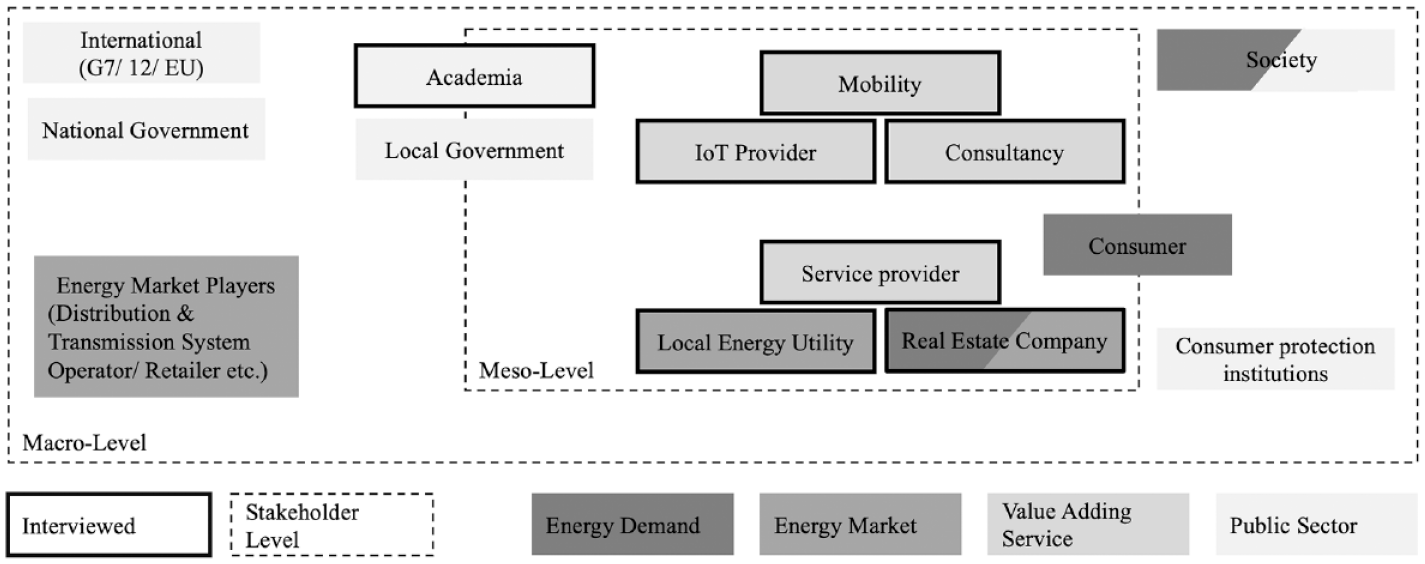
Stakeholder Map Distinguishing the Investigated Stakeholders Based on Their Level.
The case is especially suitable for our research objective for two reasons. First, stakeholders implement unfamiliar and novel technologies for all involved to meet the prescribed sustainability targets. Developing energy systems with such technologies deviates from stakeholders’ everyday business, but its learnings are crucial for their future business. The experimental approach and the diversity of technologies and involved parties require complex BMs to distribute value and risk fairly while accomplishing sustainability and economic goals.
Second, the stakeholder network actively decided to work together, open up their development processes, and rely on each other to achieve their sustainability goals. They made careful decisions about the involved parties and cooperated with the university to achieve transparency toward citizens and expert communities. The stakeholders designed their partnership for the long term, encompassing the willingness to collaborate in future projects. Also, they decided to develop and operate the energy system for the following years together.
Third, the government, society, and existing customers put external pressure on the stakeholders to offer more sustainable housing. The energy district is one subproject of a city-wide project substantially funded by the German Federal Government. Thus, stakeholders must implement sustainable technologies and showcase their transferability, economic viability, and social acceptance.
Case Description
The residential district will house 3,100 inhabitants in a medium-sized city in Germany. Garages are distributed over the district, partly equipped with electronic vehicle charging. The design integrates and preserves existing nature by incorporating biotopes and habitats for local reptiles. Peripheral zones are “green” to create a fluent transition between residential areas and existing nature. Furthermore, the district pursues social objectives by providing 25% of the flats for low-income households and an additional 10% for special living arrangements such as multigenerational housing.
Heating and electricity are the main contributors to residential carbon emissions. Therefore, the transition to sustainable energy systems is partly achieved by decentralizing (renewable) energy generation. The energy system aims for minimal carbon emissions by relying on renewable energy sources. Photovoltaic (PV) systems generate electricity on rooftops and façades of buildings. Various sources provide heat, such as industrial waste heat, exhaust-air heat pumps, geothermal energy, and solar energy from combined photovoltaic-thermal systems. The buildings fulfill the German “Effizienzhaus 40”-standard for exceptionally energy-efficient buildings.
Developing BMs is fundamental for viably operating the emerging energy system. Scholars developed various possible BMs (e.g., Reis et al., 2021), but as each energy district faces different local restrictions and opportunities, no “one-size-fits-all” BM exists. Furthermore, detailed planning allows the stakeholders to improve energetic (and thereby environmental) and economic potential. Therefore, the project pursues a holistic approach, consistently leveraging synergies to increase all sectors’ energy efficiency. Furthermore, the project seeks to identify ways to shift loads over time, optimizing the grid loads and the utilization of renewable energy sources.
Data Collection
Building on Yin (2018) for case study design, we considered multiple information sources (see Table 1) and followed the Gioia method (Gioia et al., 2013) to analyze the data. First, the case study team accompanied the 18 cross-sectoral collaborative BM development workshops organized by the responsible real estate company for 1 year. Those workshops were collective workshops defining the value generation processes of the energy districts. Besides the real estate company, representatives of the service provider, energy utility, academia, and consultancies always participated. IoT providers joined only topic-related workshops. Throughout the observation period, those workshops moved from discussing initial concepts for the energy system to deciding about specific technologies to be implemented and how and by whom they should be operated. For example, the stakeholders decided that combining photovoltaic-thermal plants, geothermal and air heat pumps, and available local waste energy should meet the (heat) energy requirements. In accordance with the technical setup, they discussed multiple alternatives for ownership structures, value propositions for customers, interfaces between stakeholders, and distribution of tasks and value among stakeholders. Depending on the development progress, experts from the stakeholder organization (e.g., for taxation) were invited to judge alternatives better. In addition, we participated in 39 project meetings that informed all relevant stakeholders about the current project status (e.g., the planned start of construction). Because of data privacy, we documented each workshop with extensive notes.
Data Overview.
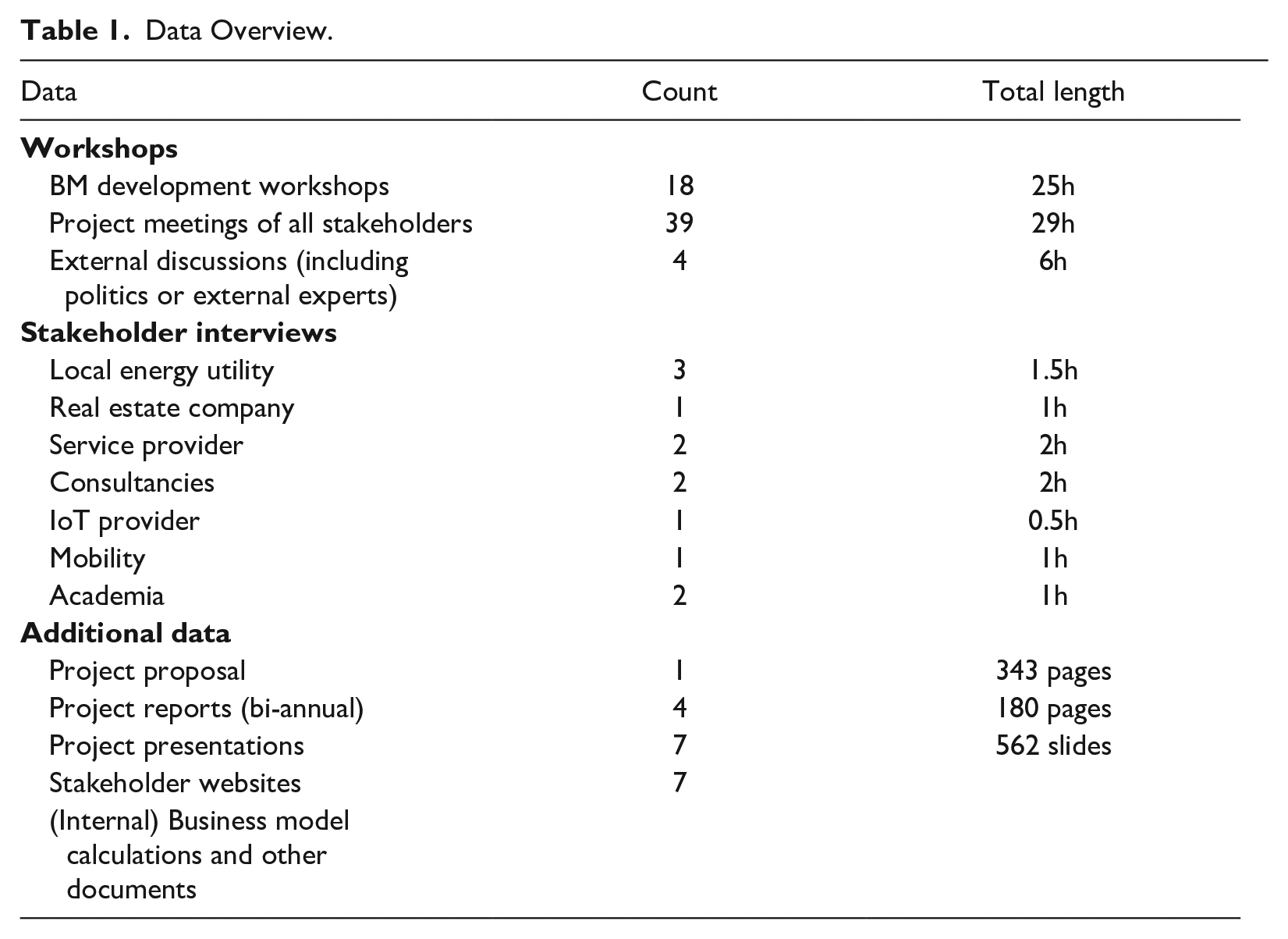
Second, we held semi-structured interviews with 12 stakeholder representatives directly involved in BM development. We timed the interviews shortly before the finalization of the BM and construction started to benefit from a perspective covering the whole development process and ensure the topic was top of mind. The interviews covered five topic areas with several questions each: (1) the perceived importance of BMs for the (individual) stakeholders, (2) perceived collaboration problems in the (BM) conceptualization phase and their handling, (3) perceived collaboration problems in the BM elaboration and finalization, (4) customer and external stakeholder integration during development, and (5) expected implications of the project for the participating stakeholders and society.
Third, we accessed documents like proposed business cases, cost planning, technical planning, and documents about strategic orientation. Discussions with external experts and politicians, corporate websites, and the project proposal enriched the data. Furthermore, we assessed project reports that ensured reporting obligations and attended several presentations that portrayed current progress for the funding authority. Table 1 gives an overview of the collected data.
Data Analysis
We used MAXQDA to code and analyze the data and inductively build first-order concepts and second-order themes (Gioia et al., 2013). Exemplary data elements are transcribed quotes from interviews, protocolled observations during workshops or meetings, or information from corporate documents. The workshops and meetings showcased examples and provided an understanding of the practical severity of interview findings. We followed an inductive approach to study the present paradoxical tensions and their handling. To answer the research question, we followed a stepwise approach.
First, we extracted 257 single data elements (quotes, observations, etc.) from the data connected to the CBMD process. For the final data structure, we selected 165 elements. The other codes were excluded because they were interchangeable or irrelevant to the final research questions, as they focused too much on technical details or general problems of the energy transition irrelevant to the CBMD context.
Next, we inductively condensed data elements with similar information to first-order concepts. Thereby, first-order concepts always represent the view of interviewed or observed stakeholders. Based on our qualitative interpretation of these codes, we built second-order themes related to the research question focused on paradoxical tensions in CBMD for sustainability. Here, a pattern emerged: First-order concepts either described the existence of paradoxical tensions, opportunities, or solutions that can be accessed when engaging with the paradoxical tensions, barriers that prevent stakeholders from engaging with the tension, or managerial responses to those paradoxical tensions. We introduced second-order themes to showcase this pattern. Furthermore, we could abstract the second-order themes into three aggregate dimensions that entail the description of a paradoxical tension that stakeholders face, as well as potential sustainable outcomes and engagement barriers: creativity, consumer, and value tension.
Results
Our case reveals that involved stakeholders encounter multiple paradoxical tensions. Engaging with them uncovers the potential for synergies and creativity (Battilana et al., 2015; Jay, 2012; Miron-Spektor et al., 2022; Van der Byl & Slawinski, 2015), leading to sustainable outcomes as described by Smith and Lewis (2011). Yet, the stakeholder network experiences multiple engagement barriers on the meso and macro levels, leading to ignoring or circumventing the paradoxes and wasting the opportunity to seize presented opportunities. The case reveals three central paradoxical tensions (Creativity, consumer, and value tension) and two managerial responses (Sticking to known patterns and relying on trust formation) in the stakeholder network. Table 2 presents an overview of the observed paradoxical tensions and their engagement potentials and barriers. For an in-depth overview of the coding structure of the tensions and their responses, see Tables A1–A5 in the Supplemental Appendix.
Coding Structure of the Identified Creativity, Consumer, and Value Tension.
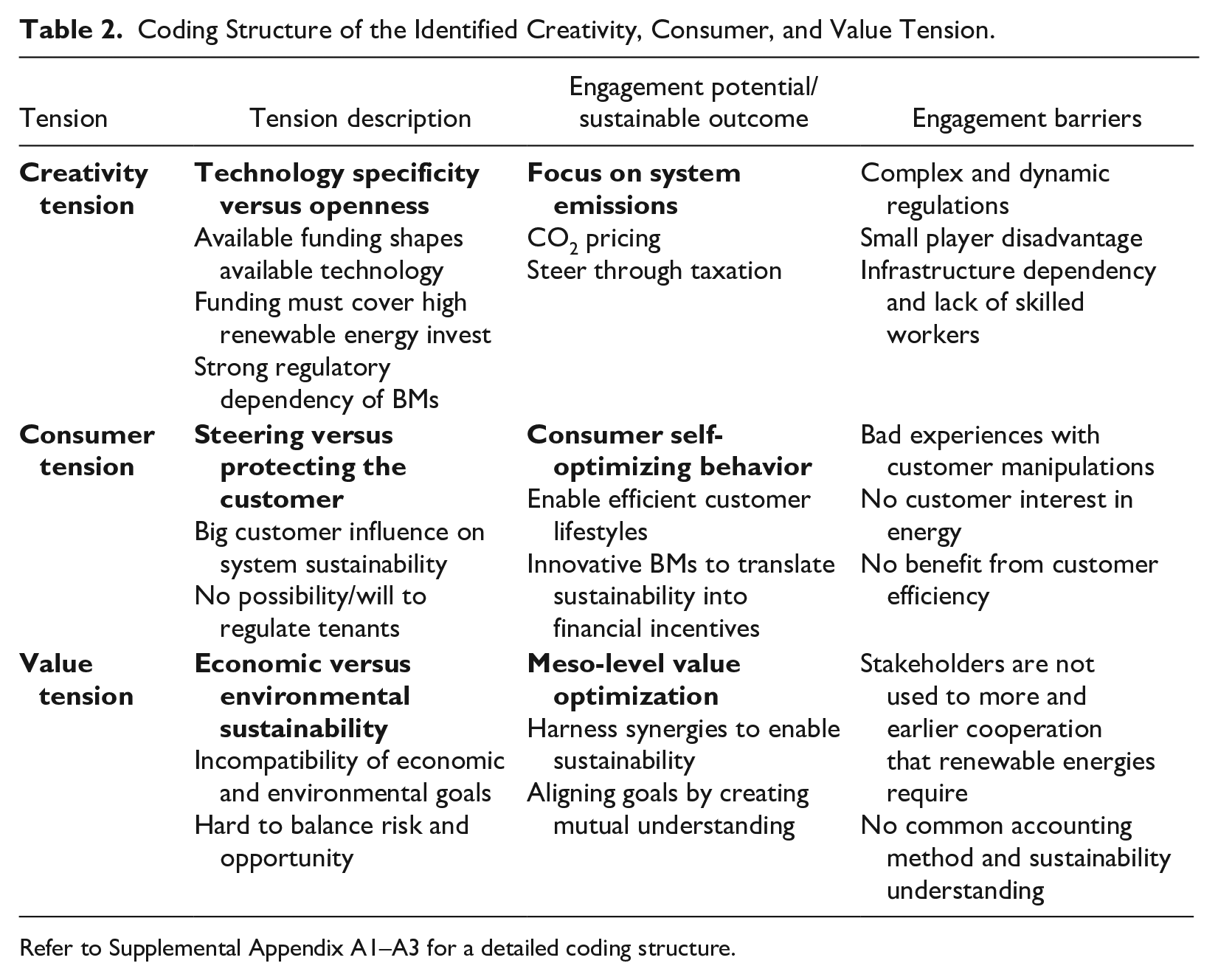
Refer to Supplemental Appendix A1–A3 for a detailed coding structure.
Creativity Tension
Creativity tension describes the paradoxical tension between legislative specificity and technology openness. On one hand, regulations and funding schemes must support technological and market developments for climate-friendly technologies and BMs to lower (national) CO2 emissions as fast as possible. However, supporting specific technologies and BMs creates lock-in effects and decreases creativity. We observe a strong dependence on public funding for novel technologies like photovoltaic-thermal modules. Nevertheless, a dominant design for renewable energy systems has yet to be found. Regulative leeway enables technology and BM openness to optimize energy systems and find prevailing technologies and BMs. Therefore, the stakeholder network is caught between implementing optimal novel solutions from a technical and operational standpoint or solutions that allow for extensive funding.
Stakeholders describe the paradoxical creativity tension by three main constituents. First, the available funding schemes and applicable regulations heavily shape the implementable technologies: There are also many regulatory obstacles. People would like to build something [technologically optimal], but it simply doesn’t work from a regulatory point of view. (Int. 2)
This dependency is partly due to the high investment costs of renewable energies that public funding schemes must cover in the current market: The funding significantly contributes to making the projects or investments much more attractive. I believe that if funding were to be stopped, the energy transition would become even more difficult. (Int. 7)
Furthermore, the applicable BMs are also heavily restricted by regulations. Stakeholders must “put the puzzle together” (Int. 5) to find BMs that fulfill the demands of regulations and other stakeholders while adapting to the chosen technologies and maintaining economic viability: Currently, it happens a lot that we see problems with realizing BMs or installations because in the complex construct between tax models, regulatory models [. . .], there is sometimes no more overlap. (Int. 2)
In the workshops, we also observed a strong dependency of different BMs on the ownership structure of the property and energy system with different configurations allowing for other tax models and thereby heavily influencing different BMs’ economic viability (obs.).
Yet, as the stakeholders notice, restructuring the regulatory environment and funding schemes (through engagement) bears creative potential. They see a focus on actual CO2 emissions and the incurring costs combined with a focus on steering through the taxation of CO2 emissions as a way to foster holistic BMs that decrease overall emissions while maintaining economic viability when compared with alternative (fossil-based) energy systems: I believe that we do not need all the funding if we steer more with energy prices and emission prices. [. . .] Once efficiency is worth it, investing in efficiency is worth it. (Int. 8)
Four engagement barriers inhibit stakeholders from engaging with the creativity tension and harnessing its creative and synergistic potential. First, the regulatory complexity and dynamism combined with the requirement to actively “pull in” information about regulations and their interpretation restrict the possibility of thinking creatively: Regulations have become more dynamic in recent years [. . .]. In some cases, one can no longer keep up with reading, and it is even more difficult to exert a meaningful, productive influence in a direction that is somehow sensible for everyone. (Int. 1)
Second, novel BMs, especially those that focus on selling decentralized energy directly to consumers, are heavily impeded by regulations that do not scale down to the size of the provider: It does not matter if I have ten power plants and deal with the energy of ten plants or if I have a PV system with a hundredth of the energy. The requirements to become active as an electricity provider do not scale down. (Int. 2)
Third, energy systems’ dependency on the existing electricity grid and the lack of skilled workers to implement energy systems and expand the energy grid technically severely restrain their possibilities: It is not about no one wanting it. It is about [. . .] being completely overburdened, that we have no more companies to put [the grid] into the ground. [. . .] It is just the workforce that is missing. (Int. 2)
Consumer Tension
Consumer Tension describes the paradoxical tension between steering and protecting the consumer. On one hand, shaping or controlling consumer behavior and lifestyles can create sustainability and efficiency gains. On the other hand, real estate companies are required to protect consumer rights and want to maintain freedom of choice. However, consumers and their behavior arguably have the biggest impact on energy efficiency and sustainability. This impact further increases in the case of renewable energy systems, as the latest technological achievements only achieve their potential if used appropriately. Ideally, consumers embrace energy-conscious behavior and actively contribute to the energetic optimization of energy districts by optimizing their consumption behavior. This approach requires enabling consumers through knowledge and innovative BMs that translate sustainability potential to financial incentives. Therefore, the stakeholder network is caught between treating the consumer (i.e., tenant) as an internal or external stakeholder.
We observe two concepts that express the consumer tension. First, stakeholders realize the big impact that consumers could have by adjusting their lifestyle and consumption behavior: I believe that the role of the customer is massively underestimated. I believe that the customer has a great deal of leverage regarding energy or the energy transition. [. . .], because the optimal operation is only possible if the customers behave optimally. (Int. 12)
However, the stakeholders do not realize this potential, either because they focus on direct monetary benefits and do not see those when incentivizing efficient behavior (obs.) or because they do not want to regulate consumers and are subject to consumer protection laws. For example, we observed a clear objective for a low heat price following the argumentation that “tenants should not finance the energy transition” (obs.): We don’t want to regulate the customers or the tenants. It would be easy to save a lot of energy if we said that, in the future, we would all be sitting at 20 degrees [Celsius] with a thick sweater in the living room, then we would immediately have a huge impact, and we all don’t want that. (Int. 5)
Engaging with the tension between shaping consumers’ energy consumption and leaving them free to decide about their lifestyles allows for BMs that establish consumer self-optimizing behavior, thereby harnessing synergistic and creative potential. Providing insights about their consumption behavior and energy efficiency enables consumers to optimize themselves without being steered or regulated externally: So, in general, if I want to sell services, I should always be guided by what the customer wants. However, we have the issue in the efficiency markets that the customers must, of course, first become enabled so that they can formulate their wishes. (Int. 5)
Furthermore, stakeholders express that consumers mainly react to financial incentives. Therefore, they must translate the energy system’s efficiency gains into individual (financial) incentives for the consumer. For this reason, dynamic tariffs are an often-discussed BM element (obs.): Green counts as soon as there is a financial bonus [. . .]. So the financial added value is a necessary condition before green aspects actually play a role. (Int. 7)
We observe three engagement barriers that hinder stakeholders from facing the paradoxical tension of steering versus protecting the consumer. First, many stakeholders had bad experiences in the past with customers who manipulated installations meant to increase efficiency because they reduced their comfort. This leads them to perceive a decreased potential of consumers self-optimizing their behavior: The experience is actually that such things as temperature and sound regulation, for example, through the ventilation system, are not tolerated, and partly irrational reactions occur in relation to the existing situation. This means, for example, that ventilation systems are simply taped shut. [. . .]. People [often cannot adequately] regulate their room temperature, and how can we expect them to switch from heating to cooling during the transition period? If they [do not] properly use their master thermostat? (Int. 4)
Furthermore, energy is often uninteresting for consumers. Even if they want to save energy and live efficient lifestyles, they often do not want to deal with the technical details of energy generation and consumption: I think that many people have no sense of energy; they don’t know what it means when I turn off the lights for a month. Or when the heating is running all day. I think society lacks understanding about energy. (Int. 7)
Finally, one of the main barriers inhibiting real estate companies from introducing sustainability-incentivizing BMs is their lack of benefits when customers behave efficiently. The current system transfers energy costs to the tenant without companies having the opportunity to earn from increased efficiency. Yet, the landlord must invest in and install systems and devices that enable the consumer to live more efficiently. For example, many funding opportunities exist for installing renewable energy systems, but only a few for monitoring and optimizing the system operation (obs.): Nobody of the stock-holding companies is interested in whether the warmth is produced efficiently or not because the costs always lie with the tenant. (Int. 5)
Value Tension
Value tension describes the tension of simultaneously pursuing economic and environmental sustainability as a stakeholder network. Generally, no guidelines exist on leveraging financial investments with energy- or emission-saving potential. Consequently, the question of reasonability was prevalent throughout all discussions and decision-making (obs.). The value tension emerges in two ways on the meso level. On one hand, stakeholders are caught between pursuing economic performance and contributing to the environmental sustainability of the energy system and, on the other hand, between justly balancing contributions to environmental sustainability with economic value capture and risk-taking by individual stakeholders. We observe that engaging with the value tension is key to enabling holistic energy system optimization and realizing maximal environmental and economic potential.
Two constituents describe the dual-layered structure of the value tension. First, stakeholders mention the incompatibility of economic and environmental goals, often driven by the high investment costs of renewable energies (obs.). Also, we saw that stakeholders not financially involved in the project often advocate for higher sustainability targets (obs.). Vice versa, we see a strong inclination toward achieving sustainability and transforming their daily business. This is shown both by participating in the project in the first place and by decision-making. While singular decisions focus on economic viability, conceptual and strategic decisions are driven by providing environmental sustainability and systemic change for society (obs.): Parallel to the overall development towards a climate-neutral building stock, it has a certain significance, but the commercial aspects are in the foreground, so we cannot set up business models that we cannot finance. (Int. 4)
However, the stakeholder network runs into challenges when required to distribute the economic value-capture and risk-taking of BMs that focus on exploiting environmental sustainability potential from a macro-level perspective and potentially achieving systemic transformations: And then there are some objects where someone has to bite the bullet in this constellation. [. . .] It’s often the case that someone has to bear the entire risk but has no opportunities, [. . .] And if one stakeholder has to bear the risk and the other has all the opportunities, that can be represented in a business relationship once, but in the long term it simply can’t be represented. (Int. 2)
Engaging with the value tension allows stakeholders to harness synergistic potential on the meso level to provide solutions that optimize environmental and economic value creation from a macro-level perspective. Through intense collaboration, they can realize the implemented technologies’ synergy potential and foster systemic transformation while maintaining economic viability: [Renewable energies are a] very expensive energy source in production. And I have to transfer that somehow. And if I can’t leverage synergy effects by networking, by having simultaneities, [. . .], we’ll never manage to transform [the energy system] in a socially responsible way. (Int. 2)
To achieve this holistic thinking, stakeholders must align their individual with common project goals. They should create mutual understanding, for example, what they understand by “climate neutral”: I think it’s important to think about joint communication and, if you’re founding joint companies, to think about the goals of this joint company, so if energy suppliers and real estate companies work together, I think it’s very important that everyone puts their goals on the table at the beginning and says, “Listen, I’m happy to work with you, but I really have this or that goal,” and the other person says, “Okay, I’m happy to work with you, but I really have that goal.” (Int. 8)
However, several engagement barriers inhibit harnessing the synergistic potential of the goal hybridity tension. First, due to their complex nature, individuality, and newness, renewable energy technologies require more intense and earlier collaboration: Then I would say that the planning of such projects must be intervened a bit earlier, [. . .]. That will be a process that will take a little time, but it will come. (Int. 5) One must start talking together 2-3 years before decision-making. (Int. 2)
Still, such intense collaboration and coupling of sectors is new to the industry. This is particularly observable in the BM development as stakeholders are used to constructing buildings together but not to their collaborative operation: Above all, we have significantly more players, and our depth of intervention as an energy supplier in the building and our sphere of influence in the building is growing significantly [. . .]. Before, you just put in a gas line, the [owner] put in her condensing boiler, and everyone was happy with that. It was completely irrelevant to the house builder that he had an interface with the energy supplier that influenced what she built, which is a completely different issue today. (Int. 2)
Second, the lack of common accounting methods and no mutual understanding of sustainability impedes collaboration in the stakeholder network. Partly, this is because legal structures have not yet adapted to the relatively new phenomenon of law-making for climate neutrality and the energy transition and provide no common definitions (obs.): A clear definition is lacking: what does climate neutral mean? What is CO2 neutral, and what does everyone imagine of it? How will it be accounted and calculated? (Int. 2)
Managerial Responses
The observed paradoxical tensions challenge the stakeholder network and lead to two core responses. We find that some engagement barriers emerge on a meso level, resulting from conflicts or challenges in the stakeholder network. In contrast, others emerge on a macro level and are posed by governments and/or society, with stakeholders unable to influence them. The presented barriers primarily outweigh the determination to engage with the paradoxical tensions and harness their creative and/or synergistic potential. While most macro-level engagement barriers led to a defensive phenomenon, we label sticking to incumbent patterns, relying on trust formation reduces meso-level engagement barriers throughout the CBMD process. Unfortunately, this trust on a personal level requires time to build up, and its absence impeded the CBMD in the early phases, where stakeholders design synergy potentials. See a summary of the managerial responses in Table 3.
Coding Structure for the Identified Managerial Responses “Sticking to Incumbent Patterns” and “Relying on Trust Formation”.
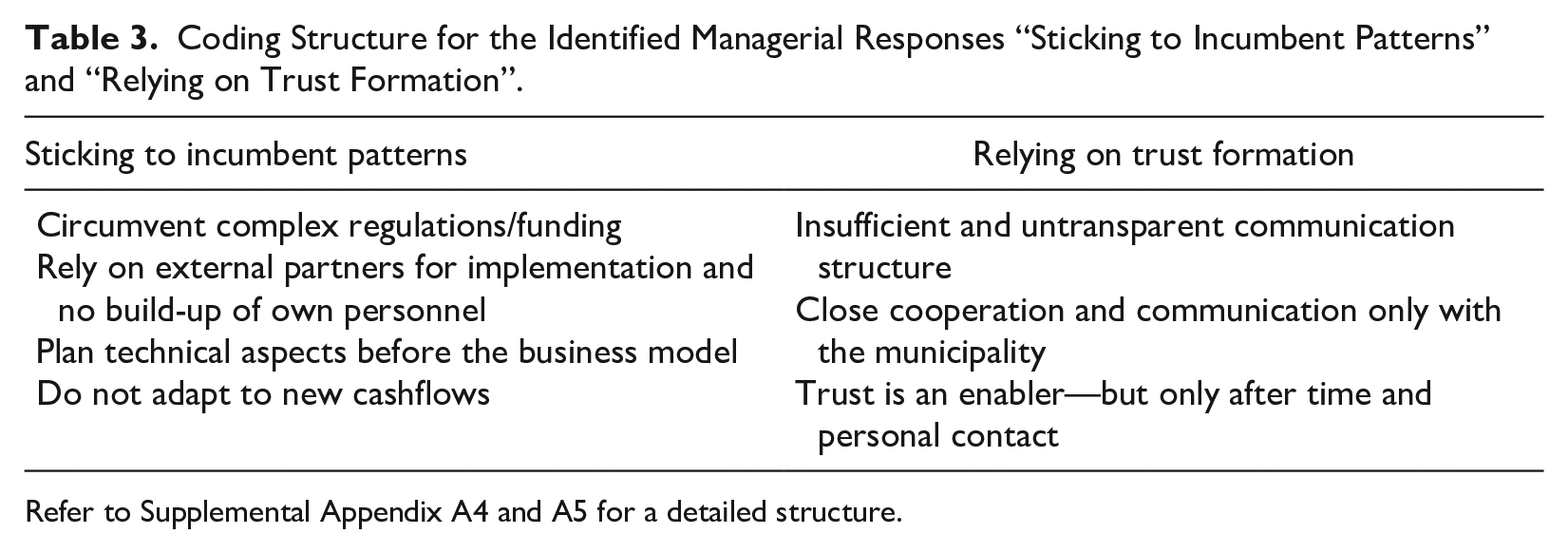
Refer to Supplemental Appendix A4 and A5 for a detailed structure.
Sticking to incumbent patterns describes the condition that instead of facing paradoxical tensions, they are, at first, often tried to be averted, and stakeholders try to rely on existing resources and competencies. First, it is caused by circumventing regulatory barriers. Instead of dealing with the regulations and funding schemes for potentially new technical implementations and corresponding BMs, stakeholders try to find solutions with as few regulatory changes as possible: Usually, when the hurdles arise, there is an assessment of how the hurdles can somehow be circumvented. The tax law colleagues are often very much involved, as are the other legal colleagues. But as a rule, the speed at which projects are implemented is so dynamic that no one has time to wait for such a long and extensive regulatory review. Something else is simply implemented. (Int. 2)
This missed innovation potential becomes apparent when discussing multiple innovative BMs, either rejected or seen as “future options” once regulations change or stakeholders know more about them (obs.). In addition, the core stakeholder team does not consider many suggested BMs because they do not have the required human resources or competencies. Therefore, they rely on external contractors for technical implementation and consultants to develop BMs (obs.). Also, they have no plans to build up those resources or competencies, making them dependent on external market developments: Well, I can’t judge [the severity of a shortage in skilled workers] in individual cases because we don’t handle the project through individual contractors but through general contractors. [. . .] my perception is that both material scarcity and craftsman scarcity play a big role in the cost development. (Int. 4)
Consequently, stakeholders rely on their core competency: technical planning. BMs are usually considered after the technical planning, both chronologically and hierarchically. While technical feasibility is undoubtedly a prerequisite for successful energy systems, stakeholders tend to neglect the interaction potential between new technological opportunities and innovative or adapted BMs that can increase system efficiency and viability: I think the most critical or the most difficult thing is that business models are reconsidered very late, the technical system was already fixed from the first performance plan, [. . .] and the business models have only come up acutely because [. . .] corresponding technological plans had to be available so that they can be completed and tendered accordingly. (Int. 12)
Finally, we observe the incompatibility of incumbent systems to new cashflows that renewable energy systems entail. Such systems often require higher investments upfront but have lower operating costs. Most stakeholders are used to depreciation periods of 10 to a maximum of 15 years. They cannot adequately finance systems like geothermal heat, which have operating periods of 30 years or longer (obs.): And then there’s the fact that business models are no longer so simple because the classic contractors have always calculated like this: I set up a plant [. . .] and know that the gas boiler will run for the next 15 years and that I will earn my money via the base price, no matter how much they consume. (Int. 5)
The stakeholder network’s lack of adapted organizational structures causes the second managerial response: “relying on trust formation.” First, interviewees perceived communication and overall cooperation as insufficient, especially at the beginning of the project. There is no clear data-sharing structure or information about what information is required by which stakeholder (obs.), and stakeholders must often actively ask for information. In many cases, this leads to an atmosphere of secrecy, as stakeholders are often unsure which information is tolerable to share: I just have the fear that every time they open up easily and give information out, they run the risk that [another stakeholder] is somehow backstabbing them there. (Int. 11)
Yet, throughout the project, it became evident that individual trust is an enabler of communication and improved collaboration. While some stakeholders have historically been working together (e.g., the energy utility company and the municipality), others have not. From the interviews, we got the impression that this historical cooperation and subsequent build-up of trust was tremendously beneficial for the CBMD: There is a relationship of trust and awareness there, and we can say: Yes, these are the hurdles that we have. These are the hurdles that you have. And I think we can talk more openly with each other about many topics with the municipality. (Int. 2)
However, for the other stakeholders, we could observe that there was not a lot of trust present at first. On one hand, it required some mutual project work and implementations (obs.). On the other hand, it required time and personal familiarization to form: When we met for the first time in real life at the project meeting, I think last year in May, at [place], I also met [person from stakeholder A] for the first time, for example, and we talked about God and the world, what her background actually is, where she has already worked, and I had the feeling that it raised it to a more personal level and you got to know each other. [. . .]. I have the feeling that [stakeholder A] is a bit more involved now. (Int. 12)
Case Conclusion
The presented case investigates a complex CBMD process for complex products (e.g., Henry et al., 2020; Oskam et al., 2020). The results show how several internal and external engagement barriers inhibit the stakeholder network from harnessing the paradoxical tensions’ creativity and synergy potential for sustainability (Reuter & Krauspe, 2023; Rydehell, 2020; Shah & Guild, 2022).
While the stakeholder network could not unlock creativity potential as the macro-level engagement barriers constrained them, they could realize some synergy potential. The energy district is currently under construction, and a BM for its operation that includes multiple stakeholders and organizational interfaces has been found. Yet, we argue that other managerial responses could have unlocked the use of more synergy potential by engaging earlier and more intensively with the value and consumer tensions, which are (partly) inhibited by meso-level engagement barriers. In particular, the consumer tension was not engaged as its macro-level engagement barriers dominate. Development processes must adapt to the challenges of CBMD for sustainability (Oskam et al., 2020; Pedersen et al., 2020). While the stakeholders have almost no influence on mitigating the external engagement barriers, they could invest in strategies (e.g., building up human resources and regulatory competencies) to better cope with them.
Yet, stakeholders can mitigate the internal engagement barriers without significant investments by adopting new handling strategies. For example, pre-project phases can build trust between stakeholders. New processes could parallelize technical and BM development and create clear communication structures and guidelines to balance sustainability and financial measures. Furthermore, an adapted (temporary) organizational structure created explicitly for the CBMD for sustainability could mitigate the meso-level engagement barriers as it eases the definition of common goals and understanding and provides a basis for early trust formation (Roome & Louche, 2016). This is particularly evident, as all paradoxical tensions of the studied case include tensions of organizing (Smith & Lewis, 2011).
Discussion
Framework: Paradoxical Tensions and Their Responses in CBMD for Sustainability
Curious about the effect of external stakeholders’ pressure to produce sustainable transformations on a stakeholder network that collaboratively develops BMs for sustainability, we performed a qualitative analysis and reveal paradoxical tensions of creativity, consumer, and value. Furthermore, we find that creativity and consumer tensions materialize at the interface of the meso and macro levels. Therefore, stakeholders acting on the meso level cannot engage with those paradoxical tensions as engagement barriers on the macro level constrain them; they are “out of reach.” Subsequently, stakeholders cannot achieve the potential sustainable outcome after engaging with the paradoxical tensions (cf. Smith & Lewis, 2011, p. 389) without macro-level actors’ interference. However, the value tension is solely inhibited by barriers within the stakeholder network and can find sustainable outcomes through resolution. See Figure 2 for an overview of this framework.
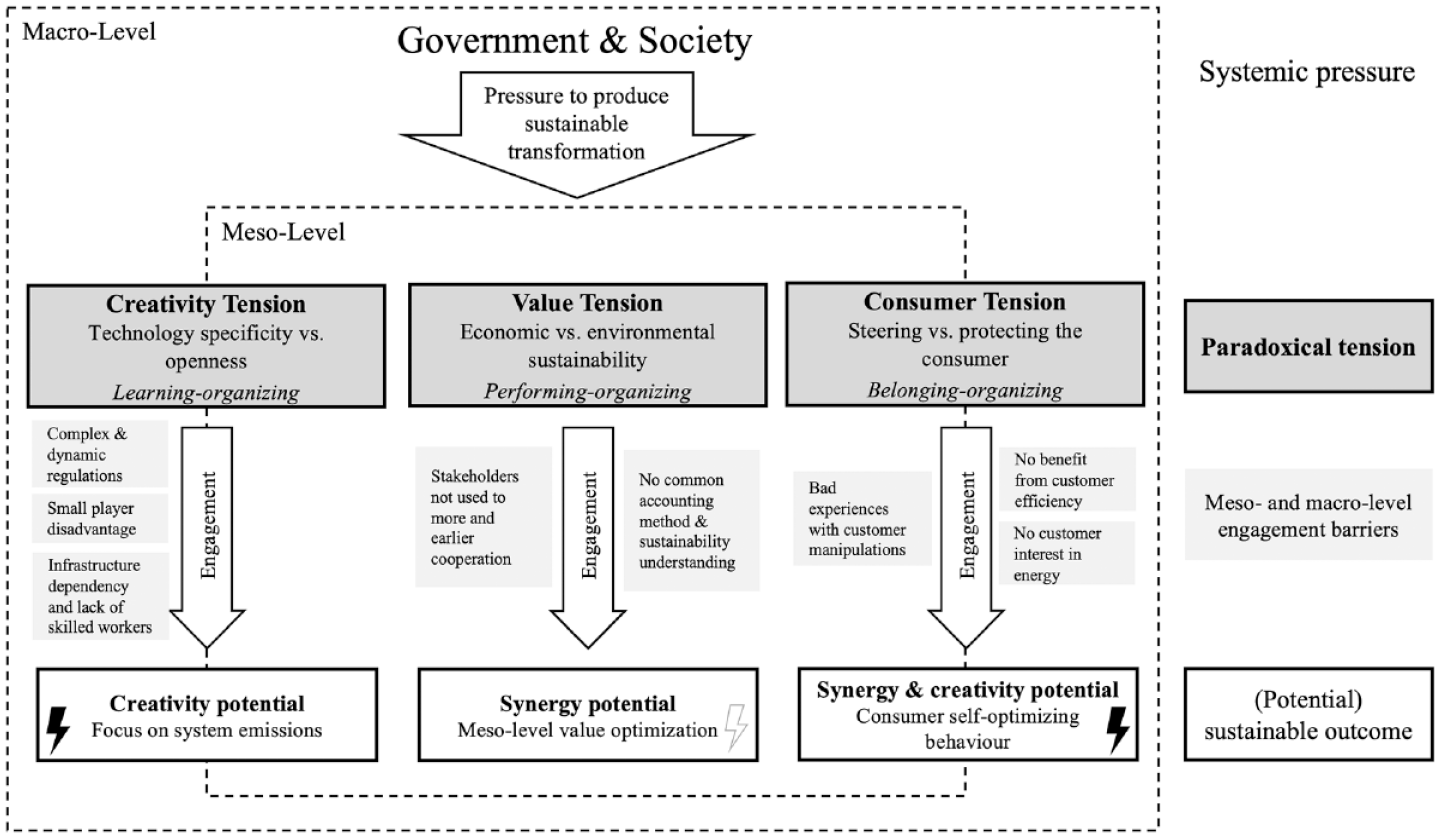
Framework of Paradoxical Tensions and Their Responses in CBMD for Sustainability.
Following Smith and Lewis (2011), the value tension is a tension of “performing-organizing,” the creativity tension of “learning-organizing,” and the consumer tension of “belonging-organizing.”
Performing-organizing tensions are defined as: “Interplay between means and ends, employee vs. customer demands, high commitment vs. high performance” (Smith & Lewis, 2011, p. 383). In the present case, the interplay between costly means to foster ends for environmental sustainability is omnipresent as economic and environmental objectives often contradict and result in performing tensions (Soderstrom & Heinze, 2021; Van Bommel, 2018). Yet, the interorganizational collaboration intensifies the significance of this tension and transfers it to a meso-level (Garcia et al., 2019). Individual stakeholder organizations must constantly shift between optimizing economic and environmental value creation of the stakeholder network and ensuring a balance of their own contributions and economic value capture with risk. Seemingly incompatible, the stakeholder network must either lower their outcome expectations of one goal or find a “sacrificial lamb” to contribute to the environmental goals without balanced economic value and risk (c.f. Stål et al., 2022).
Furthermore, Smith and Lewis (2011, p. 383) define learning-organizing tensions: “Organizational routines and capabilities seek stability, clarity, focus, and efficiency while also enabling dynamic, flexible, and agile outcomes.” In this case, organizations shape their development and structure to comply with available funding schemes to operate as cost-efficiently as possible. From a macro-level perspective, policymakers aim to diffuse climate-friendly technologies as fast as possible to lower carbon emissions and promote specific technologies and BMs (Geels et al., 2021). Yet, new or creative combinations of existing technologies with innovative BMs could fulfill the same goal (Gauthier & Gilomen, 2016; Reuter, 2022). Therefore, funding and regulations focusing on system sustainability could be employed, for example, by pricing in carbon (lifetime) emissions and steering through taxation of carbon emitters. They allow creative BMs for energy systems that holistically reduce emissions by spanning across organizational interfaces (Oskam et al., 2020).
Finally, belonging-organizing tensions are “tensions between the individual and the aggregate, individuality vs. collective action.” In the present case, the consumers are not part of the stakeholder network. Yet, discussions about their role often emerge, such as how much the consumers should be accountable for the energy system’s emissions. Consumers arguably have the most considerable influence on carbon emissions, and consequently, controlling their energy consumption behavior would be the biggest driver of environmental and economic performance (Juntunen et al., 2019; Mylan, 2017). However, this is not combinable with existing consumer protection laws and consumers’ freedom of choice. The stakeholder network struggles with including the consumers as part of the collective action while maintaining their individuality (Henry et al., 2020). A potential sustainable outcome of this tension would harness synergy and creativity potential by employing new BMs that enable consumers to holistically optimize their behavior considering the energy system at the meso level (Hodson & Marvin, 2010; Sulkowski et al., 2018). For example, energy suppliers can incentivize optimal consumer behavior through BMs with flexible pricing (Helms et al., 2016).
The stakeholders react to those tensions with two managerial responses. First, the stakeholders feel overwhelmed by the macro-level engagement barriers and respond by Sticking to known patterns. This is a defensive response mechanism that may spur “vicious cycles,” as described by Smith and Lewis (2011), and may be an indicator of a lacking paradox mindset in the stakeholder network (Lewis & Smith, 2022; Soderstrom & Heinze, 2021). Although the stakeholders see and describe the potential sustainable outcome of increased creativity by engaging with the presented tensions, they cannot resolve them independently (Miron-Spektor et al., 2022). Second, relying on trust formation is the response to meso-level engagement barriers, which partly enables the exploitation of synergies (Garcia et al., 2019; Munten et al., 2021). Over time, common understanding and the willingness to contribute to the overarching, meso- and macro-level goals have increased.
Contributions
With these findings, we make two main contributions. First, we add empirical insights to the comparably young phenomena of CBMD for sustainability (Pedersen et al., 2020) and, more specifically, for energy districts (Shnapp et al., 2020). Second, we apply paradox theory to show how systemic pressure and unidirectional influence lead to paradoxical tensions on the interface of the meso and macro levels. Remarkably, fruitful engagement with them must happen across both cooperation levels (Jay, 2012; Lewis & Smith, 2022).
CBMD for Sustainability Under External Pressure
Several studies analyze conflicts on the stakeholder network level occurring throughout BM development (Munten et al., 2021; Oskam et al., 2020) or the (adverse) effects of collaboration for individual organizations participating in a stakeholder network (Henry et al., 2020; Stål et al., 2022; Velter et al., 2020). We extend the existing literature by integrating how the pressure to produce systemic changes from a macro level (Hodson & Marvin, 2010) influences the stakeholder network on the meso level during CBMD (Gasbarro et al., 2017; Hahn et al., 2015; Rey-Garcia et al., 2021). The case highlights joint thinking of BM development, stakeholder engagement, and technological planning. As Hall and Roelich (2016) and D’Souza et al. (2018) highlight, innovative BMs with complex value propositions are necessary to seize the opportunities of renewable energy technology. Our study shifts their approach toward a holistic understanding of technology and BMs: Stakeholders must commonly and simultaneously think in BM and technology categories to design energy systems (Plewnia & Guenther, 2021; Rydehell, 2020; Shah & Guild, 2022). Therefore, stakeholders must be integrated earlier and to a greater extent (Kroh, 2021). We show that timing is crucial to leverage the risks of increased stakeholder integration: optimal levels of stakeholder integration can only be found through extensive transparency and regular interaction. Overall, the value tension contributes to the call for better orchestration of stakeholder networks (Horisch et al., 2014; Oskam et al., 2020; Soderstrom & Heinze, 2021). Aligning goals early on in CBMD and constantly readjusting are essential to create a mutual sense of the project (Battilana et al., 2015). This transparency and openness create trust over time, which is vital to opening up development processes (Garcia et al., 2019; Roome & Louche, 2016).
In addition, the findings provide insights into the organization and BM development in energy districts (Gauthier & Gilomen, 2016). The current literature on energy districts is predominantly technical (Hedman et al., 2021). Yet, energy districts with decentralized energy systems are a significant part of the EU’s plan to decarbonize the housing sector. Corporate mindsets, organizational structures, and policy must adapt to foster their diffusion and exploit the presented opportunities. To foster the diffusion of energy districts, we support the call for increased experimental setups that allow for regulative leeway and unbureaucratic feedback cycles between meso and macro levels (Engels et al., 2019; Lowitzsch et al., 2020).
Paradoxical Tensions and Their Multilevel Engagement Barriers
Our model complements prior research by taking a processual perspective analyzing the collaborative BM development (Jay, 2012; Van Bommel, 2018). This procedure allows us to not only list barriers or challenges (Garcia et al., 2019; Öberg et al., 2012; Russo Spena & Di Paola, 2020) but also investigate the underlying causality (Schaltegger et al., 2016a) and what prevents stakeholders from engaging the paradoxical tensions. Following paradox theory, we identify synergy and creativity potentials that unfold if stakeholders focus on actively engaging the tensions (Miron-Spektor et al., 2022; Van der Byl & Slawinski, 2015). Engaging those tensions can harness energy districts’ economic and environmental opportunities (Battilana et al., 2015; Jay, 2012; Van Bommel, 2018). Yet, the case reveals that the meso and macro levels pose engagement barriers. While synergistic potential is accessible by mitigating the meso-level engagement barriers, creative potential can only be harnessed by overcoming macro-level engagement barriers. Ultimately, this means that the barriers posed on a macro level hinder harnessing the value of sustainable outcomes on the macro and meso levels alike. Therefore, we add to prior studies about the engagement of paradoxical tensions by outlining the multilevel nature of this process in collaborative settings (Jay, 2012; Lewis & Smith, 2022).
As the creativity tension shows, the challenges posed by complex and specific legislation inhibit innovative BMs (Bolton & Hannon, 2016; Plewnia & Guenther, 2021; Tura et al., 2019). For example, balancing technology-forcing policies and regulative leeway is challenging but would enable technological learning and efficiency (Geels et al., 2021; Shao et al., 2020). A balance between supporting new markets and not over-subsidizing specific but mature markets must be found (Leisen et al., 2019). Also, the consumer tension reveals the importance of society and consumer integration for the success of (sustainable) BMs. Currently, studies on the acceptance of renewable energy often focus on the social acceptance of electric energy plants in a local context (e.g., Langer et al., 2018) and tend to neglect BM acceptance and heat energy. However, BMs play a crucial role in integrating customers because they decide the level of involvement and customer understanding (Sulkowski et al., 2018). Closer consumer relations in energy systems may bring systemic transformation by accelerating technology diffusion and economic viability (Hodson & Marvin, 2010; Vernay et al., 2020).
Our study highlights a key aspect of systemic transitions (e.g., the energy transition), typically initiated at the macro level: We observe a vibrant, bidirectional interaction between the micro and meso levels. In contrast, the influence from the macro level on the meso level is predominantly unidirectional. Stakeholder networks often lack opportunities to engage with macro-level entities. This imbalance becomes particularly salient in developing and implementing sustainability technologies, which require decentralized, individualized approaches.
Therefore, instruments like living labs with experimentation-enabling regulations focusing on actual CO2 emission savings compared to the status quo (Engels et al., 2019; Weigelt & Shittu, 2015) foster experimentation and feedback cycles. This insight, emphasizing the transition from universal, centralized solutions to more individualized, decentralized ones, holds potential applicability across various industries undergoing similar transitions.
Managerial and Policy Implications
Creating awareness of the paradoxical tensions identified in this article helps stakeholder networks engage with the tensions and seize their creativity and synergy potential. Managers and politicians can reduce the engagement barriers that inhibit the CBMD process. The two managerial responses, sticking to incumbent patterns and relying on trust formation, describe coping mechanisms for the observed paradoxical tensions. While creating clear communication structures, overarching goal hierarchies, and strategies to increase trust among stakeholders are valuable practices that may decrease the meso-level engagement barriers and increase the utilization of synergy potential in the stakeholder network, sticking to incumbent patterns does not exploit creativity potential. Our case shows that regulatory and societal pressure leaves little opportunity for creative BMs in stakeholder networks. Sticking to the incumbent patterns leads to the technical implementation of novel technologies but misses the potential of creative BMs that could enhance their operative efficiency and increase their diffusion.
While managerial strategies should focus on mitigating the engagement barriers on the meso-level, policymakers should focus on mitigating the macro-level engagement barriers that create paradoxical tensions and engagement barriers on the meso- and macro-level interface. Our investigation shows that the macro-level engagement barriers lead to stakeholders not being able to engage with the paradoxical tensions but only coping with them, for example, by investing in additional (human) resources and building up competencies. Yet, in the studied case, managers refrain from those strategies because of organizational inertia and lack of availability.
Future Research
Our study comes with limitations, opening possibilities for further research. First, a single case study might limit the generalization of our results. However, this deep dive allowed us to observe paradoxical tensions and identify their creativity and synergy potential. Future research can conduct a cross-case study to identify project peculiarities determining the severity of the tensions and stakeholder configurations that allow engagement of tensions inhibited by macro-level engagement barriers. Second, quantitative or multicase studies could investigate the success factors of different managerial responses to the observed paradoxical tensions. Third, the project accompaniment and interviews resulted in only a few insights into integrating society in energy districts. This shortage shows a lack of customer orientation at all system levels and among stakeholders. Future research must investigate ways to incorporate society and harness its environmental potential and how to incentivize companies to foster such. Fourth, while we assume general applicability for industries transitioning from universal, centralized solutions to more individualized, decentralized ones, future research can investigate the peculiarities of other industries.
Supplemental Material
sj-docx-1-oae-10.1177_10860266241239350 – Supplemental material for Engaging Paradoxical Tensions in Cross-Sectoral Collaborative Business Model Development for Sustainability: A Case Study in the Urban Energy Transition
Supplemental material, sj-docx-1-oae-10.1177_10860266241239350 for Engaging Paradoxical Tensions in Cross-Sectoral Collaborative Business Model Development for Sustainability: A Case Study in the Urban Energy Transition by Christian Tschiedel, Tim Feiter and Alexander Kock in Organization & Environment
Footnotes
Declaration of Conflicting Interests
The author(s) declared no potential conflicts of interest with respect to the research, authorship, and/or publication of this article.
Funding
The author(s) disclosed receipt of the following financial support for the research, authorship, and/or publication of this article: The authors gratefully acknowledge the financial support of the project DELTA Reallabor (grant agreement No. 03EWR002B) by the Federal Ministry of Economic Affairs and Climate Action (BMWk) and project supervision by the Projektträger Jülich (PtJ).

Supplemental Material
Supplemental material for this article is available online.
Notes
Author Biographies
References
Supplementary Material
Please find the following supplemental material available below.
For Open Access articles published under a Creative Commons License, all supplemental material carries the same license as the article it is associated with.
For non-Open Access articles published, all supplemental material carries a non-exclusive license, and permission requests for re-use of supplemental material or any part of supplemental material shall be sent directly to the copyright owner as specified in the copyright notice associated with the article.
