




Abstract
This study aims to analyze the association between green human resource management practices and green culture and proposes a green competing values framework that entails four green cultures: green clan, green adhocracy, green market, and green hierarchy culture, adopted from Cameron & Quinn’s (2011) competing values framework. We elucidate that each green culture is shaped through ability-motivation-opportunity enhancing green human resource management practices in alignment with desired green beliefs, values, and symbols to achieve organizational sustainability goals. Thus, our model acts as a diagnostic toolkit for identifying the organization’s dominant green culture and how a specific green culture can be generated that assimilates with the organization’s green objectives. Our theoretical contributions include extending sustainable Human Resource Management (HRM) studies by employing a green competing values framework to enhance organizational and staff green behaviors, and critically appraising such outcomes to negate the adoption of standardized practices as descriptive, prescriptive solutions in green HRM studies. We provide implications for practice and elucidate future research directions in organizational sustainability and green HRM.
Keywords
Introduction
The business management arena has dominantly focused on achieving short-term financial goals while ignoring the long-term impact of organizational actions on environmental sustainability (Maley, 2014; Pimentel et al., 2022; Vernay et al., 2022). According to the World Commission on Environment and Development, environmental sustainability is defined as meeting present needs without compromising future generations’ ability to meet their own needs (Brundtland, 1987; Jackson et al., 2012) and is not seen as possible to achieve without businesses subsuming a sustainability focus in the firm (Jabbour & Renwick, 2020; Wagner, 2015). Studies have revealed the role of Human Resource Management (HRM) in promoting and developing sustainable processes in organizations (Bush, 2020; Cooke et al., 2022; Ehnert et al., 2020; Macke & Genari, 2019), as sustainable HRM corresponds to human resource processes that tend to minimize organizational carbon footprints by incorporating sustainable corporate practices within organizations (Buller & McEvoy, 2016; Y. Jiang et al., 2022). Accordingly, a growing conversation in the context of sustainable HRM has encouraged scholars to shift their focus on developing HRM practices that facilitate environmental sustainability (Portocarrero et al., 2021; Stahl et al., 2020; Taylor et al., 2012). This marriage of HRM and environmental sustainability has led to the emergence of a specific HRM sub-field called green HRM (Jackson, 2022; Paille, 2022; Renwick, 2020; Vázquez-Brust et al., 2023). Within green HRM, sustainability may occur through the cultivation of a green organizational culture to enhance the firm’s environmental performance (Crichton et al., 2022; Y. Jiang et al., 2022), and such a green culture within the organization could be stimulated through robust green HRM workplace level practices (Garavan et al., 2022; Roscoe et al., 2019).
The green HRM literature has highlighted the role of various HRM practices to concretize green symbols and beliefs as part of organizational culture that facilitates attaining required sustainable organizational goals (Hooi et al., 2022; Memon et al., 2022; Muisyo, Qin, Ho, & Julius, 2022). However, as Ulrich (1984) cautioned that HRM practices need to be consistent with each subculture’s needs due to the fundamental differences in workgroup member expectations, organizations need to be prudent in using standard HRM practices to minimize the divergence from specific organizational goals. Accordingly, they need individual green HRM practices to achieve the desired pro-environmental objectives of the firm (Benevene & Buonomo, 2020). In other words, due to green HRM practices operating in firms, the organization could develop unintended values corresponding to varied firm cultures. Therefore, organizations need to be mindful of adopting standard practices while enhancing the required organizational culture.
Corresponding to multiple cultures, Cameron and Quinn (2011) demonstrated through the competing values framework that organizations operate with competing demands, such as a contradictory focus of internal integration versus external differentiation or a contrary structure of flexibility versus stability. Each competing demand can generate a specific set of values and beliefs, engendering a dominant culture from any of the four types of organizational culture, i.e., clan, adhocracy, market, and hierarchy (Cameron & Quinn, 1999; Tong & Arvey, 2015). However, the existing literature in the HRM domain has predominately discussed green culture developed through standard green HRM practices (Roscoe et al., 2019). Limited studies have underlined the role of specific green HRM practices needed to accomplish the dominant green organizational culture with respect to a specific set of values and beliefs, which our study offers. To our knowledge, this study is the first to streamline our understanding of different types of green culture that can be formed via the corresponding green HRM practices in an organization. In doing so, we introduce a new green competing values framework (green CVF) based upon the popular work of Cameron and Quinn (2011) organizing the taxonomy of the competing values framework.
While current literature has examined the existing competing values framework in various organizational contexts (Cameron et al., 2022; Gong et al., 2022; Goodman et al., 2001; Hooijberg & Petrock, 1993), each of the dimensions has been scarcely examined in the environmental context, which our green CVF incorporates. Though the green CVF in our study has been derived from the foundational tenets of the original competing values framework, the former is distinct from the latter. Unlike the competing values framework, which is impervious to the implication of resource utilization on the environment, the bedrock of our green CVF is based upon mindful resource consumption to mitigate the negative impact of organizational activities on the environment. Moreover, the four cultural categories in the competing values framework have distinctive traits. Research utilizing the competing values framework to study organizational culture has indicated that a corporation often displays a predominance of one culture type, with varying degrees of the other three types of cultures in the firm (Cameron et al., 2022; Prajogo & McDermott, 2005). Our green CVF incorporates discussion on each culture and details the green HRM practices that would facilitate cultivating the values associated with a required dominant green culture. Our framework thus provides a means for businesses to understand and evaluate essential organizational culture components that might facilitate change and improvement. As many businesses face the need to transform their cultures toward environmental sustainability, the absence of a shared language, key elements or dimensions, and a starting point for dialogue is a significant obstacle. Our conceptual model of a green CVF attempts to bridge this communication gap.
To classify green HRM practices for each of the dominant green cultures within a green CVF, our study utilized the ability-motivation-opportunity (AMO) model (Appelbaum et al., 2000; Bos-Nehles et al., 2023), which is a frequently employed model in green HRM research (Obereder et al., 2022; Renwick et al., 2013; Rizvi & Garg, 2021; Yu et al., 2020), and one we have used to investigate the green HRM and green culture link. Specifically, using the AMO framework, we argue that HRM practices influence the firm’s particular culture through enhancing employees’ ability, motivation, and opportunity.
Based on the above discussion, we contribute theoretically to sustainable HRM studies through extending and critiquing them. First, we extend the relevant literature through using a green competing values framework to shape employee green behavior, which is needed as some organizations using standardized green HRM practices need to avoid adopting conflicting socio-cultural values. Second, we critique the CVF and AMO theory, which is required to avoid description, prescription, and organizations over-claiming their benefits in sustainability studies. Our literature extension and critique are less seen developments in the sustainable HRM literature.
Theoretical Background
AMO-Enhancing HRM Practices
HRM comprises a bundle of practices, including hiring, staffing, training, development, and performance appraisal, which contribute toward improving organizational performance (Paillé et al, 2020; Renwick, 2020; Wright et al., 2001). In contrast to the conventional view, which considers HRM practices as a combination in an additive manner, the configurational perspective highlights that HRM practices comprise interrelated functions, where firm performance is more influenced by the holistic patterns of synergistic HRM practices than a single HRM practice (Delery & Doty, 1996; Youndt et al., 1996).
Based on the configurational approach, effective HRM practices comprise work practices that influence employee behavior and attitude by impacting their skills and knowledge (ability), willingness to exert effort (motivation), and chances to express their talents in work (opportunity) (Delery & Gupta, 2016; Ogbonnaya & Valizade, 2018). Such practices are defined as AMO-enhancing HRM practices (Delery & Gupta, 2016), which are likely to increase employees’ job performance by increasing employee green capabilities, incentives, and openings to attain superior organizational performance (Delery & Gupta, 2016; B. Zhang & Morris, 2014). Through AMO, HRM primarily focuses on those practices that enhance employee outcomes in the organization (Appelbaum et al., 2000; Harney & Jordan, 2008), such as higher productivity and a lower turnover rate (S. Kim et al., 2018; Macduffie, 1995).
Capability-enhancing HRM practices comprise recruitment, staffing, and training focused on increasing the employees’ skills, knowledge, and ability to enhance their competency in executing job tasks (Kundu & Gahlawat, 2018). For example, employees gaining new green capabilities may shape their employability and future career prospects (Jackson, 2022; Joshi, 2022) and enhance green competence-building practices (Obereder et al., 2022). Incentive-enhancing HRM practices comprise performance appraisal that elicits higher levels of employee work motivation by providing necessary inducements to direct employee efforts toward accomplishing organizational goals (Huselid, 1995; Y. Jiang et al., 2022). Examples of such green incentives include organizations connecting executives’ total pay to firm-level environmental performance, staff financial benefits from commuting to work, and company awards to stimulate employee pro-ecological workplace behaviors (Obereder et al., 2022; Renwick, 2020). Opening-enhancing HRM practices aim to enhance firm performance by providing a resourceful work environment, such as a supportive climate, empowerment, and involvement that enable employees to utilize their abilities and motivate them to work enthusiastically (K. Jiang et al., 2012). Examples of such green openings are staff inclusion in environmental problem-solving and decision-making, employee green suggestion schemes, staff sharing ecological information, and firms building green teams (Obereder et al., 2022; Renwick et al., 2013).
The configurational perspective suggests that the presence of any of the workforce characteristics defined by AMO is necessary but not sufficient for enhanced organizational performance (Katou & Budhwar, 2010). For example, a skilled workforce that is not motivated or allowed to use its skills effectively cannot perform well. Hence, to gain superior organizational performance through HRM, the organization needs to develop systems of practices that foster capabilities, incentives, and openings to realize its full potential (Becker et al., 1997; Delery & Gupta, 2016). Hence, all three types of AMO-enhancing-HRM practices are required to be present in combination to improve organizational performance.
Over the last decade, organizations have been moving toward the idea of sustainability as part of their business strategy. Considering the rise in the salience of pro-environmental adaptation in organization strategy, HRM practices need to be in tandem with modified objectives within the green canvas (Davis et al., 2020). Organizations have begun to link their HRM strategies to sustainable goals, commonly known as green HRM (Kramar, 2014; Renwick et al., 2013; Renwick, 2020). Green HRM acts as a proactive approach for instigating green behavior among employees through promulgating formal HRM policies incorporating green values and philosophy (Jackson et al., 2014). Here, green HRM comprises practices such as hiring, training, appraisal, and compensation management that are channeled to enhance positive organizational environmental outcomes (Amini et al., 2018; Kramar, 2014; Renwick et al., 2013).
The existing literature has widely used the AMO framework to classify green HRM practices (Benevene & Buonomo, 2020). From the lens of AMO-enhancing HRM practices, green HRM comprises three main sets of HRM practices focused on enhancing (a) green capability through attracting/selecting/training high-performing employees and focusing on enhancing their skills, knowledge and ability toward achieving green goals, (b) green incentives through increasing employee commitment toward attaining organizational green goals, and (c) green openings by providing the resources that facilitate employees to use their ability and motivation to attain organizational green objectives (Renwick et al., 2013; Yu et al., 2020). Research suggests that green HRM practices facilitate green culture (Jabbour & Santos, 2008; Roscoe et al., 2019), which the next section details.
Green Organizational Culture
Research in sustainability has shown an association between organizational culture and sustainability goals (Osei et al., 2023). Organizational culture is defined as the core set of values, artifacts, behavioral norms, and patterns that govern the interaction of people in the organization and create meaning in their jobs and at the organization at large (Howard-Grenville, 2006). In the context of assessing organizational culture, our study borrows from the popular work of Cameron and Quinn (2011), who introduced a competing values framework entailing core competing values with two conflicting dimensions, that is, (a) the competing structural tension of control versus flexibility, and (b) the focus competing tension of internal versus external environment (Braunscheidel et al., 2010; Denison & Spreitzer, 1991), which comprise of four types of culture; clan, adhocracy, market, and hierarchy. The competing values framework has applicability across a wide range of contexts with the utility of facilitating assessment and systematic comparisons of differentiated cultures across multiple organizational levels (Braunscheidel et al., 2010; Howard, 1998).
Studies show that HRM practices can facilitate intended behaviors and values, leading to a green culture that stimulates environmental sustainability in the organization (Aggarwal & Agarwala, 2023; Al-Swidi et al., 2021; Roscoe et al., 2019). However, it is essential to note that these sustainability goals could vary, corresponding to each dimension of the competing values framework, as, for example, Wijethilake et al. (2021) highlight that each cultural dimension under the competing values framework aligns with its respective sustainability focus. Through their work, although it is recognized that a different sustainability focus could be present for each competing value, limited studies have examined the corresponding HRM practices that could cater to the development of specific values in the context of each dimension in the competing values framework. Largely, the literature unanimously discusses standard HRM practices for the formation of a green culture, despite each culture demanding alignment with specific HRM practices for accomplishing the organizational goals (Aycan et al., 2007; Smircich, 1983). Hence, we need to be prudent in utilizing standard HRM practices to avoid engendering unintended socio-cultural behavior and values within organizations (Benevene & Buonomo, 2020; Ulrich, 1984). Currently, we have a limited understanding of the mechanism through which various green HRM practices lead to the cultivation of a green culture in organizations (Muisyo, Qin, Ho, Julius, & Barisoava Andriamandresy, 2022; Roscoe et al., 2019), which our study herein unfolds. Specifically, our study elucidates various AMO-enhancing green HRM practices that enable the development of a dominant green culture using the competing values framework.
There are four types of organizational culture in the competing values framework: clan, adhocracy, hierarchical, and market culture (Braunscheidel et al., 2010; Deshpandé et al., 1993). First, a clan culture (also called group culture) has an internal focus and flexible structure. It comprises shared values, emphasizes collectivism, and is manifested through consistent interactions among organizational members (Wilkins & Ouchi, 1983). Second, an adhocracy culture also has a flexible approach to the structure but with an external focus and develops an atmosphere of continuous adaptability, which stimulates creativity in tasks and augments a risk-taking predisposition (Khurosani, 2013; Yang et al., 2022). Third, similar to the adhocracy culture, a market culture is focused on the external environment but with a control system intended to earn profits by aggressively competing and focusing on customer demands (Denison & Spreitzer, 1991). Fourth, a hierarchy culture can be traced to an image of bureaucracy emphasizing structure, rules, procedures, and strict control with defined responsibilities and processes (Parker & Bradley, 2000; Weber, 2015). While some part of each of these four cultures could be present in the organization or its sub-parts, the dominant culture would emerge based on the core values governing that institution (Cameron & Quinn, 2011).
With the change in organizational goals toward sustainability, organizations are adopting policies and procedures to deal with waste, minimize resource misuse, and address pollution-related problems. However, such changes are superficial and will not lead to the creation of sustainable organizations unless organizations make sustainability a part of their culture to respond to environmental challenges (Wijethilake et al., 2021) and create a sustainability-oriented culture to shift toward environmental sustainability (Bertels et al., 2010; Crane, 1995). Research has shown that organizations with a culture that supports organizational sustainability goals contribute toward superior environmental performance (Galpin et al., 2015; Sroufe et al., 2010).
In sum, existing scholarly work on organizational culture has predominantly discussed the interlinkages of green HRM practices with green culture (Aggarwal & Agarwala, 2023; Masri & Jaaron, 2017; Norton et al., 2015). However, no study has yet discussed the role of specific green HRM practices in developing a particular green culture in an organization. To understand the manifestation of intended culture through specific AMO-enhancing green HRM practices, this study amalgamates the existing competing values framework with the green domain, as detailed in the next section.
Proposed Model
Here, we discuss a green competing values framework (green CVF) model entailing four green cultures, that is, green clan, green adhocracy, green market, and green hierarchy culture, which are detailed in Figure 1. Each quadrant of our model elucidates AMO-enhancing green HRM practices that facilitate the consolidation of beliefs and symbols for the given green culture. Furthermore, research shows that green HRM practices can be an enabler of green culture (Muisyo, Su, et al., 2022), which, through conscious implementation, can engender the required culture. Our model argues that although green HRM practices are not mutually exclusive, there is a set of green HRM practices that can act as a vehicle for the desired green culture. Thus, the particular set of capability, incentive, and opening-enhancing green HRM practices could stimulate the required behaviors and values that would aid in the development of a dominant culture among the set of existing green cultures in the firm, as shown in Figure 1.
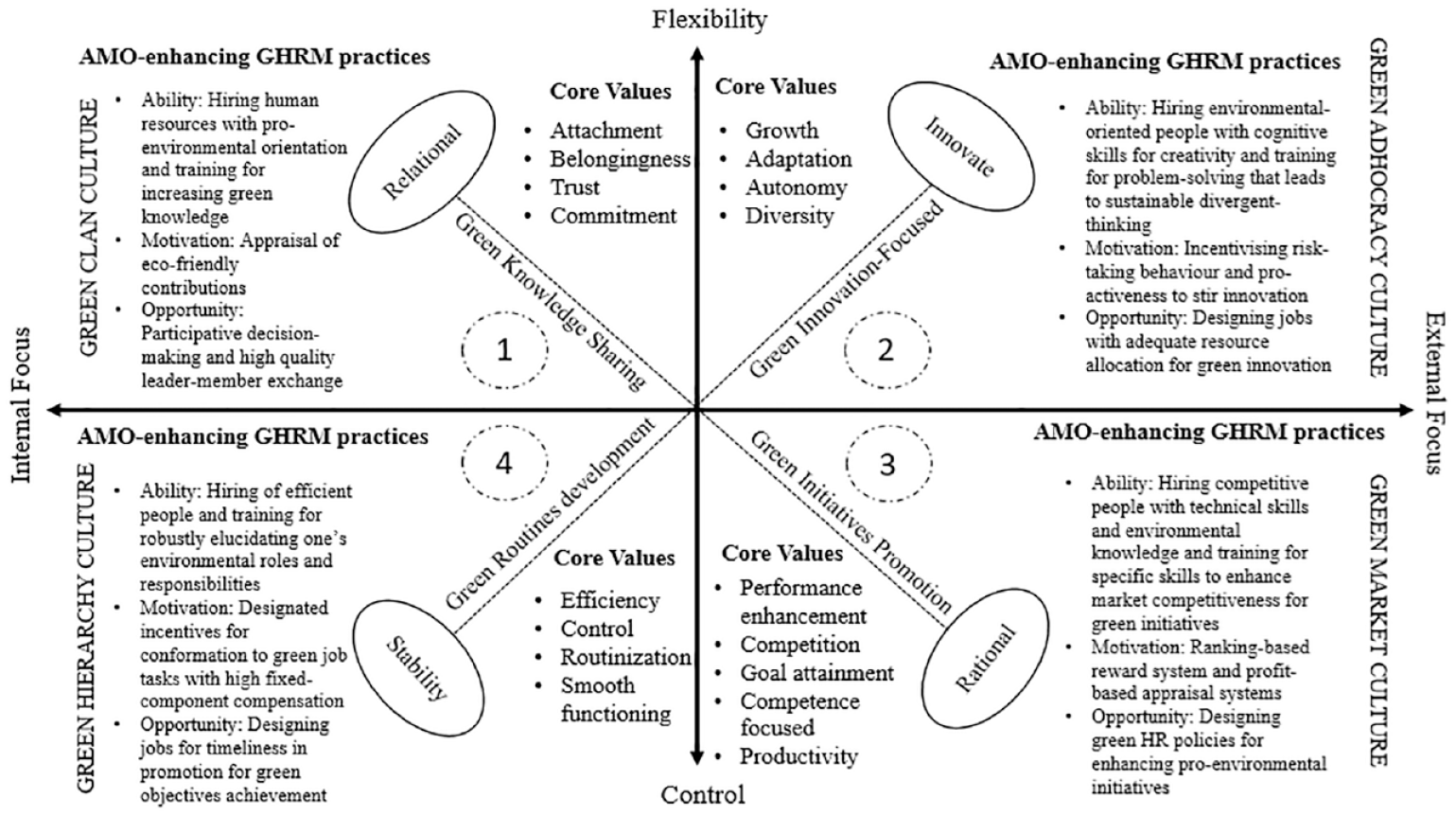
Green Competing Values Framework.
Green Clan Culture
The first quadrant in our green CVF corresponds to a green clan culture. The clan culture in the organization primarily focuses on the core values of attachment, belongingness, trust, and commitment (Cameron et al., 2006). Such clan-based organizations have a high internal focus and flexible orientation emphasizing participation, encouraging supportiveness, and facilitating team interactions (Denison & Spreitzer, 1991; Krajcsák, 2018). A clan culture propagates the orientation of collaboration. Therefore, a clan culture has the strategic objective of stimulating employee empowerment, strengthening team building, enhancing employee involvement, and establishing open communication in the work ecosystem. Accordingly, those practices that satisfy the strategic objectives of a clan culture would facilitate establishing such a culture. The synergy between AMO-enhancing green HRM practices that deliver clan culture values could consolidate a culture with a pro-environmental orientation and collaborative approach. Herein, a pro-environmental orientation is specifically defined as “pro-environmental behavior,” which is where social norms influence staff behaviors through interventions among private individuals, such as energy and pesticide use, recycling, littering, and water conservation (Bamberg & Moser, 2007; Y. Jiang et al., 2022). Based on our model, we call such a culture a green clan culture.
AMO-enhancing HRM practices can facilitate the firm’s culture formation, and a green clan culture can be developed through certain HRM practices. The capability dimension in AMO focuses on capability formation in employees that entails rigorous recruitment, job enrichment, and extensive training (K. Jiang et al., 2012). Accordingly, green HRM practices within the scope of capability for establishing a green clan culture would fall under the ambit of the nature of recruitment and training that enhances an environmental sustainability orientation in employees while ensuring commitment toward the organization. For example, Cop et al. (2020) found that the HRM practice of green training for employees plays an instrumental role in making organizations greener by developing employee organizational citizenship behavior toward the environment. Here, green training corresponds to the system of learning practices related to environmental issues to improve employees’ awareness and skills in environmental management (Tang et al., 2018). Accordingly, green training stimulates a sense of employee commitment toward the organization through organizational citizenship behavior, which aligns with the core value of commitment in a clan culture.
Furthermore, studies have shown that green human capital creates organizational commitment in employees. Green human capital entails the culmination of employee knowledge, skill, wisdom, and creativity regarding environmental protection embedded in employees and the organization (Shoaib et al., 2021). Here, the study by Paillé and Valéau (2021) of 384 French employees showed that green training positively impacts employees’ environmental commitment, whereas environmental concerns demonstrated by the organization are perceived as supportive. Organizational support would garner employees’ commitment toward the firm and environment, which could facilitate a green clan culture’s value of employee commitment. Therefore, recruitment and training of green human capital would enhance employee commitment toward the organization and drive a clan-centric culture with a pro-environmental orientation.
From the perspective of incentive-enhancing HRM practices to develop employee collaboration and commitment with a green orientation, various green HRM practices can play a vital role. For example, the study by Y. J. Kim et al. (2019) showed that recognizing employees’ eco-friendly contributions through performance appraisal can strengthen employee commitment toward environmental sustainability actions. Such a green HRM practice tends to stimulate discretionary acts in employees that are, even though not explicitly required, still executed and directed toward environmental improvement. In addition, Paillé et al. (2014) found that the green HRM practice of performance appraisal linked with environmentally sustainable behavior has a positive relationship with employee organizational commitment behavior for the environment. Therefore, the green HRM practice of recognizing eco-friendly behavior in performance appraisal would facilitate employee environmental sustainability commitment and act as an empowering agent to consolidate a green clan culture in the firm.
Further, opening-enhancing green HRM practices can facilitate the formation of a green clan culture. For example, participative decision-making human resource practices are considered an opportunity for employees to collaborate (K. Jiang et al., 2012), and Pham et al. (2020) showed that participative decision-making as a human resource practice tends to augment employees’ organizational commitment. Managers who trust their staff and provide employees fair opportunities to participate show more commitment than staff members who lack supervisory trust and participation (Ryu & Hong, 2020). Thus, participative decision-making as a green HRM practice that facilitates cultivating an employee’s environmental sustainability commitment-based value in the organization can establish a green clan culture. In terms of green opening-enhancing HRM practices, providing a supportive green climate can augment employee pro-environmental behavior. For example, data from the Polish hospitality sector (Zientara & Zamojska, 2016) showed that a green organizational environment improved the assimilation of staff ecological ideals and stimulated affective employee attachment to the company through organizational citizenship behavior for the environment. Hence, an environmentally sustainable climate in the firm can enhance the green behavior of employees and increase their commitment toward the organization, which could facilitate the development of a green clan-based culture in the firm.
Green Adhocracy Culture
The second quadrant in our green CVF corresponds to a green adhocracy culture. An adhocracy culture in the organization primarily focuses upon the core values of growth, adaptation, autonomy, diversity, and concerns with the developmental paradigm by emphasizing creativity, acquisition of resources, and variety (Cameron et al., 2006; Denison & Spreitzer, 1991). Such adhocracy-based organizations have a high external focus with a flexible orientation (Krajcsák, 2018) for enhancing entrepreneurship risk-taking abilities, encouraging long-term vision, and exploring new opportunities (Denison & Spreitzer, 1991; Kimberly & Quinn, 1984). An adhocracy culture advocates creativity orientation and strategically emphasizes new standards, ensuring continuous improvements, anticipating required needs, and exploring creative solutions. Accordingly, those AMO-enhancing HRM practices that capture the adhocracy culture’s strategic objective would facilitate establishing such a culture. We focus on green HRM practices that bridge the strategic emphasis of an adhocracy culture, entailing creative orientation and thus enabling the formation of a green adhocracy culture.
Certain types of capability-enhancing green HRM practices can stimulate a culture of innovation and creativity, as an employee’s green ability tends to foster green innovation in the firm (Singh et al., 2020). Here, green innovation refers to producing environmentally friendly products using greener raw materials and eco-friendly designs (Aguilera-Caracuel & Ortiz-de-Mandojana, 2013). Research showed that green recruitment includes hiring employees with pro-environmental knowledge and abilities who tend to appreciate and understand their environmental beliefs (Jackson & Seo, 2010). Here, employee capability acts as an idea-generation tool to find possible solutions to various problems (Elsbach & Stigliani, 2018). As an employee’s green capability could stir environmentally friendly idea generation, recruitment focused on green capability could eventually enhance green innovation and, thus, facilitate the formation of a green adhocracy culture in the organization. Similarly, green training can play a vital role as a motivating catalyst for stirring firm green innovation. Huang et al. (2016) elucidate the salience of learning the ability to innovate that can be consolidated through training, especially green training, entailing a sequence of environmental activities that encapsulates eco-design methods and augmented awareness of renewable technology to act as an impetus for green innovation. Moreover, green training can foster new ideas for sustainable process innovation (Soewarno et al., 2019). It can stimulate eco-innovations that aim to protect the environment and reduce greenhouse gas emissions (Neto et al., 2014), where green training is a systematic process that guides workers to behave within given organizational objectives (Jabbour, 2013), which helps develop green innovations. Andersén’s (2022) study also found that entrepreneurial and employee sustainability orientation is positively linked with green innovation. Thus, green training could be oriented toward developing employees’ environmental sustainability orientation. Hence, the green training that instigates green innovation would enhance a green adhocracy culture as the core value of the culture of innovation is satisfied.
Research has shown various incentive-enhancing HRM practices that can promote green organizational innovation. Studies such as Ahmed et al. (2020) and Singh et al. (2020) have shown that certain employee green incentive-based practices positively influence green innovation in the firm. For example, systematic compensation practices are an incentive-enhancing HRM practice that can infuse green innovation among employees; as Huber and Hirsch (2017) showed, employees need to be structurally incentivized to ensure the long-term fulfillment of their environmental responsibilities. Such long-term investment for environmentally sustainable value enhancement could contribute toward green innovation in the firm (Xiaofang & Zhuohang, 2022). Therefore, green HRM practices enveloped around human resource practices that can activate green innovation in the firm could bring about a green culture assimilated with a strategic orientation of innovation and the value driver of innovation output, leading to a green adhocracy culture.
Philosophizing high-performance HRM practices as a three-spoke umbrella for sustainability augmentation in the firm, one of the spokes, apart from capability and incentives (above), is opening-enhancing HRM practices that can enhance green innovation. Singh et al. (2020) showed that certain green openings for employees could intensify green innovation in the firm because one of the opening-enhancing HRM practices adopted by the firm is to strengthen employee empowerment and involvement. As employees are empowered to lead their creative ideas on environmental performance, these ideas can mold into green product innovation in the organization (Muisyo & Qin, 2021). Such innovation can produce beliefs and symbols in alignment with a green adhocracy culture, which is hinged upon the orientation of green innovation. Similarly, forging an environmental sustainability climate can facilitate innovation in the firm. For example, a study by Syafri et al. (2021) showed that a sustainability-enhancing environment in the firm through openings, experimentation, and stabilization could spur green product and process innovation. Furthermore, Song et al. (2020) showed that the green creativity climate positively influenced the green innovation performance of the firm. Accordingly, green climate functions as an opening to cultivate green behavior and enhance the performance of the organization. Hence, opening-enhancing HRM practices that enhance staff orientation of creativity and innovation can advance a green adhocracy culture in the firm.
Green Market Culture
The third quadrant in green CVF is of a green market culture. An organization’s market culture primarily focuses on the core values of productivity, goal attainment, performance enhancement, and infusing rationality through emphasizing competitiveness, enhancing competency, and achieving well-defined goals (Cameron et al., 2006; Kimberly & Quinn, 1984). Such market-based organizations have a high external focus with a control orientation (Krajcsák, 2018), as the market culture in the organization tends to catalyze a competitiveness orientation. Hence, a market culture strategically emphasizes assessing customer preferences, enhancing productivity, creating external partnerships, and stirring competitiveness. Therefore, those AMO-enhancing HRM practices that act as the vehicle to conciliate the strategic emphasis on competitiveness would aid in dominantly consolidating a market culture in the firm. Accordingly, the culture assimilating the competing approach with a sustainability-centric position could establish a culture called a green market culture.
Studies have probed and found the influence of capability-enhancing HRM practices on the competitiveness and productivity of the organization. For example, green training tends to develop green-related competencies, which can augment the firm’s organizational capacity while reinforcing the organization’s commitment toward environmental initiatives (Daily et al., 2012). Such training pivoting upon environmental sustainability would enhance the green competitiveness of the firm (Longoni et al., 2018). Therefore, green training enveloping the intent to enhance competitiveness would act as an enabler of green market culture, as a green market culture seeks to reflect the core value of competition and productivity. Similarly, green recruitment can act as a capability-enhancing practice that can aid in the firm’s competitiveness. Considering green recruitment entails hiring people with proficiency and abilities in managing environmental-centric management systems, new staff equipped with sustainable knowledge can facilitate enduring the environmental values and increase the green image of the firm to make it more competitive (Obaid, 2015). As green training and recruitment instigate the firm’s competitiveness in the environmentally sustainable domain, the core value of competing is facilitated, leading to the enhancement of green market culture.
Further, studies have also shown that incentive-enhancing HRM practices can augment performance enhancement and profitability of the organization. For example, a study by Ardiza et al. (2021) empirically showed the influence of green performance appraisal on employee performance. As green performance appraisal is considered an assessment of employees toward organizational green objectives, employees tend to feel motivated to engage in activities associated with producing green results, thus engendering higher performance through robust green performance appraisal. Similarly, the HRM practice of compensation systems associated with sustainable use of organizational resources can enhance employee productivity, as a pay and reward system can be incorporated that benefits employees by changing staff behavior and diminishing negative employee behaviors (Zoogah & Verlag, 2011) in the direction of environmental sustainability. In the context of ecological responses and as a signal to the workforce, employees with an environmental orientation can be rewarded as part of a staff morale-boosting function. The incentives involved are primarily classified as financial (e.g., bonuses, cash, rates) and non-financial (e.g., holidays, absences, and presents to their staff), with all these incentives having a substantial effect on the performance of individuals who contribute to enhancing environmental sustainability (Renwick et al., 2013). Thus, the amalgamation of an environmental appraisal and green compensation system can improve employee productivity. Such systems would act as the vehicle to deliver the core values of productivity and competitiveness, eventually showing the firm’s dominant disposition of green market culture.
The prior literature has assessed the role of opening-enhancing HRM practices in increasing the productivity and performance of the firm. For example, green HRM practices that enhance employee green competencies positively influence proactive environmental management and firm financial performance (O’Donohue & Torugsa, 2015). Similarly, a study by Zameer et al. (2020) showed that green brand image enhancement of the firm due to creativity competition among employees could lead to an augmented competitive advantage. Hence, opening-enhancing HRM practices can advance the green market culture in the firm by enveloping the orientation of productivity and performance.
Green Hierarchy Culture
The fourth quadrant in our green CVF corresponds to a green hierarchy culture. A hierarchy culture is internally oriented with an organizational structure powered through intensive control mechanisms. It is developed over the core assumption of control and predictability to propagate efficiency through clearly defined employee roles. Organizational structure and practices can direct and regulate employee environmental sustainability-oriented behaviors (Norton et al., 2015; Robertson & Barling, 2015). The green hierarchy culture is aligned herein with characteristics of a hierarchy culture galvanized with the belief that people behave in an intended pro-ecological manner when they have clear pro-environmental roles and procedures that are formally defined by the environmental sustainability rules and norms of organizations (Gao et al., 2021; Grønhøj & Thøgersen, 2017). A green hierarchy culture is based on the strategic orientation of control, as along with control as a strategy, the values germinated through green hierarchy culture are associated with routinization, efficiencies, and timeliness. A specific green HRM practice needs to be operationalized to establish a green hierarchy culture in the organization, and these green HRM practices facilitate the consolidation of green hierarchy beliefs, values, and behaviors.
From the AMO perspective, various HRM practices facilitate consolidating the firm’s green hierarchy culture, as studies have found that certain capability-enhancing HRM practices can enhance the organization’s culture of control and efficiency along with a green orientation. For example, Usman et al. (2022) showed that green training has become a laudable strategy to ensure the environmentally sustainable behavior of employees even outside work and acts as a strong control mechanism for management over workers inside the firm. In addition, green training facilitates perceived behavioral control while ensuring organizational and operational efficiency (Cop et al., 2020). Similarly, reflecting the organization’s environmental policies and strategies during recruitment tends to create a commitment for applicants with a sustainability orientation (Tulsi & Ji, 2020). With such a commitment, employees enter the organization and ensure timeliness in working to meet organizational productivity targets, consolidating operational efficiency in the firm. Hence, such capability-enhancing HRM practices can facilitate the formation of a green hierarchy culture.
Research has further shown that incentive-augmenting HRM practices can also facilitate the development of organizational culture with the orientation of control and efficiency (Ahammad et al., 2015). For example, in accordance with the neoclassical economic paradigm, owners desire to remunerate supervisors for efforts related to efficiency maximization by developing adequate employee reward and compensation systems. When a company introduces a sustainability policy in addition to an existing business strategy, it may overlook the fact that the effort devoted to generating profits may not be comparable to the effort required to achieve environmental policy objectives (Lothe & Myrtveit, 2003). This is a classic illustration of the multitasking model. For instance, exerting effort to produce a product with less pollution may be in direct opposition to exerting effort to produce the product at a competitive price and more efficiently. One way to modify staff compensation schemes would be to alter the incentives and develop performance measures correlated with each effort type, as such robust compensatory green HRM practices could adequately motivate employees to generate required efficiencies while ensuring an environmental sustainability orientation (Lothe & Myrtveit, 2003).
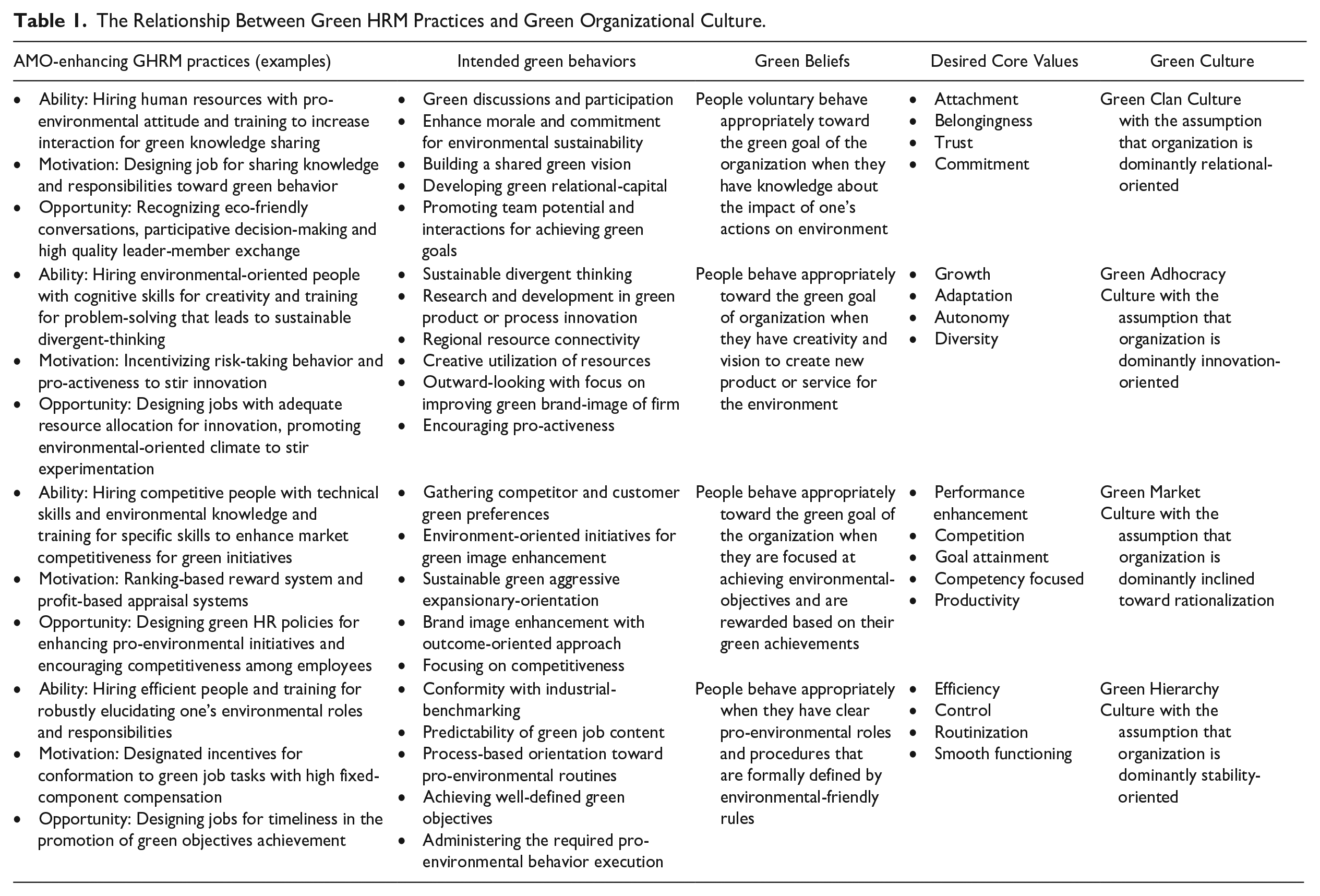
The literature has highlighted the role of opening-enhancing HRM practices that can consolidate the culture of control and efficiency. Here, researchers found that employees involved in environmental issues as part of their defined job roles have a greater understanding of environmental problems and are better equipped through resources to address environmental issues, resulting in enhanced environmental performance (Rothenberg, 2003). In addition, green HRM practices to develop a process-based orientation toward pro-environmental routines would design jobs with robust career-succession planning to achieve green objectives (Dumont et al., 2017; Maller et al., 2012). Thus, routinized tasks that could encourage employee involvement would illustrate the opportunities representing employee participation in sustainable development and propose a remedy to environmentally unsustainable problems. As the opening-enhancing green HRM practice of employee involvement through systematic procedures can enhance performance and efficiency, it consolidates the primary strategic emphasis of a green hierarchy culture, as detailed in Table 1 below:
The Relationship Between Green HRM Practices and Green Organizational Culture.
Discussion
Well-designed green HRM practices tend to consolidate green cultures to stimulate employee motivation and opportunities for contributing toward a firm’s strategic objective of achieving environmental sustainability (Renwick, 2020). In alignment with accelerating the attainment of sustainable organizational objectives, our study highlights differentiated AMO-enhancing green HRM practices and builds a green CVF to establish an intended green culture in the organization. We discussed green CVF as comprising four green cultures, i.e., green clan, green adhocracy, green market, and green hierarchy, which are characterized along the dimensions of structural and focus orientation.
It is important to note that there could be a cross-integration of these practices within the same organization, depending upon the culture that a particular department in an organization intends to achieve. For example, the marketing department could be more inclined toward designing a market-based organizational culture, while the research and development department in the same organization could be governed by the dominant culture of adhocracy (Cameron et al., 2006). These cultures could interact with each other in a particular way that would promote a mix of these cultures in the organization.
Our study makes several contributions in extending the existing competing values framework discussion into a green context (Cameron & Quinn, 2011; Goodman et al., 2001; Wijethilake et al., 2021), alongside highlighting how a dominant culture of specific values, beliefs and behavior can get formulated by practicing specific green HRM practices, unlike providing a unidimensional approach to the application of common green HRM practices to develop a green culture (Masri & Jaaron, 2017; Roscoe et al., 2019). Through a more nuanced approach to achieving organizational sustainability outcomes, our study extends the existing understanding of inter-relationships between green HRM practices, organization culture, and firm sustainability (Al-Swidi et al., 2021).
Contributions to Theory
We contribute theoretically by extending sustainable HRM studies and by critiquing such works. First, we extend the literature by employing a green competing values framework to expand the theoretical understanding of CVF (Cameron et al., 2006) to cultivate a desired green organizational culture and achieve sustainable outcomes. In Table 1, our green CVF model provides a theoretical understanding of attaining specific green cultures through AMO-enhancing green HRM practices for specific environmental goals. Our green CVF contributes to the green HRM knowledge base (Garavan et al., 2022; Roscoe et al., 2019) by highlighting the need for organizations to comprehend specific cultural fundamentals in facilitating employee green behaviors and undergoing transformative cultural shifts in pursuing environmental sustainability. We also extend existing research on AMO-enhancing green HRM practices (Aggarwal & Agarwala, 2023; Masri & Jaaron, 2017; Norton et al., 2015), as it predominantly focuses on mainstream, unitarist, and functionalist views on how organizations shape staff behaviors and culture to embrace environmental sustainability (Garavan et al., 2022; Roscoe et al., 2019). These extensions are needed because relevant literature works suffer from the limitations of description, size, and relevance. Here, sustainability and green HRM studies need a new organizing framework to guide future research, as they suffer from description and prescription due to their practitioner origins. Moreover, as green HRM studies are now a large research area containing 3.5 million related works (Memon et al., 2022), they require conceptual clarity to be useful. Further, such works need extending to become relevant before they hit a “roadblock” where economic survival becomes more important for businesses to enact rather than introducing green HRM initiatives (Paulet et al., 2021).
Second, we contribute to the literature by critically appraising sustainability and green HRM works to increase their academic rigor. Here, we respond to calls requiring caution in adopting standardized HRM practices that unintentionally promote socio-cultural behaviors and values that may contradict environmental sustainability objectives (Benevene & Buonomo, 2020). Instead, we elucidate a focused relationship between green HRM practices, culture, and sustainability goals, ensuring each green CVF dimension aligns with its respective sustainability focus. Such critique is needed because AMO-based green HRM works mainly concern prescribing how organizations could “go green” by employing particular workplace practices. We also critique the existing literature on the application of such green HRM practices (Aggarwal & Agarwala, 2023; Masri & Jaaron, 2017; Norton et al., 2015) by rigorously appraising the CVF and AMO theory to explain stakeholder organizational behavior, which is needed as it is less seen in other studies. Moreover, some green HRM works lack robustness and risk descending into over-claiming benefits, e.g., firms using sustainability and green HRM to help increase profits or enhance employee satisfaction (Yuan et al., 2023). However, evidencing such claims requires more conceptual examination and further empirical testing to reveal their downsides (cf. Cooke et al., 2022).
In summary, this study contributes to the relevant literature by advancing a theoretical understanding of integrating “green” elements into the CVF to achieve a sustainable culture and extending nuances in AMO-enhancing green HRM practices within green settings to facilitate organizational sustainability. Here, sustainable and green HRM studies seem like a large group of disparate works that suffer from appearing descriptive, prescriptive, and lacking critical analysis. We propose herein that our green CVF and use of AMO theory negates such limitations by offering a new conceptual pathway and model forward to guide future research, which is more analytical and critically based.
Implications for Practice
Our green CVF has multiple utilities for managerial application, as it provides an initial guideline for adopting specific AMO-enhancing green HRM practices that human resource managers can utilize for achieving a desired organizational culture with respect to each green organization’s value. In addition, a green CVF acts as a diagnostic tool for determining the prevalence of the dominant culture in the organization, which can assist in altering or improving organizational practices as per desired organizational objectives. Further, the green CVF acts as a comprehensive guide for human resource professionals in hiring, selecting, training, and establishing an intended green culture in the organization through aligned green HRM practices for consolidating specific green beliefs, values, and behavior in the firm, as it recognizes the co-existence of multiple cultures within the same firm and the differences in the values of each of those cultures. Hence, a green CVF makes human resource professionals cognizant of the nuances involved in hiring employees with the right mix of competencies for orchestrating a range of organizational resources in the process of moving toward the firm’s green objectives with respect to the specific culture operationalized. Indeed, the green CVF functions as a guiding lens for mindful resource consumption and enhancing the overall impact of green activities for achieving sustainable goals. It acts as a behavioral repertoire for managers to enhance their skills for managing employees to achieve green-centric organization goals.
Limitations and Future Research
An initial limitation of this study lies in its exploratory nature, which, when combined with our novel use of a green competing values framework, may benefit from further intensive interrogation. A second limitation lies in our study needing to be grounded in new, original empirical data so as to test the utility of our conceptual model further. A third and final limitation pertains to coverage, as while the literature base we use is highly robust, further testing of our green competing values framework conceptual model in under-researched contexts and new locales could further extend existing scholarship in this field.
Our proposed green CVF is a developmental and tentative model and an exploratory attempt to conceptualize it at a general level. Although our study systematically analyses the existing literature on green HRM practices in an environmental context and its conceptual grounding from the competing values framework, future studies need to add to existing arguments by investigating this model empirically. In addition, descriptors could be identified, and alternative analytical methods could be used to modify the current propositions of our green CVF model, as it is an initial attempt to start a conversation in the direction of systematically building the green culture literature in the direction of a more comprehensive approach for creating sustainable organizational outcomes through AMO-enhancing green HRM practices and green culture. This model can be improved further through future studies that could theoretically test it with investigations that compare the four quadrants. Further, while we highlight the advantages of a dominant culture type (Cameron & Quinn, 2011), there are also unique aspects of multiple culture types (Denison & Spreitzer, 1991). Hence, we should recognize synergistic interactions among the values facilitated through various green HRM practices defining an organization’s culture. Therefore, future studies could integrate understandings from different organizational actions on the interlinkages of different green HRM practices across varied organizational cultures.
Moreover, although the existing green-context research base primarily discusses the unidimensional nature of green culture (Masri & Jaaron, 2017; Roscoe et al., 2019), the construct of culture is much broader and more integrated than its single dimension (Schulte et al., 2006). Culture is a unified dimension of assumptions, beliefs, values, norms, and behaviors that interact to create a multi-constitutional construct. Hence, future research could shed light on the configurational approach of green culture, rather than only focusing on green culture as a standalone construct, by ascertaining an organization’s profile or patterns of green organizational behavior. This multi-dimensional approach of considering culture as a bundle of beliefs, values, norms, and behaviors could project additional insight into this complex social phenomenon. Here, configurational theory could provide a valuable theoretical perspective to ground future research on green organizational culture. We expand on the points above by detailing future research ideas at the institutional, leadership, team, and employee levels—and use this fourfold classification as a heuristic device to do so—as an aid to increase our understanding.
Institutional Level
Context factors conceptualized at the organizational level until now have received a great share of research attention (Norton et al., 2015). However, a more nuanced approach is required to understand the relationship between green HRM practices, green culture, and organizational performance. As our study is focused on a systems approach by investigating the impact of AMO-enhancing green HRM practices on particular green culture in the organization, further investigations could be conducted on how other sub-dimensions of strategic human resource activities, such as HRM philosophy, policies, programs, and processes (Schuler, 1992) are formulated in the organization in a green context. In green HRM research, we may need to take a step back and develop a holistic understanding of developing green-linked values and their derived green HRM practices. A question to be addressed in this regard is whether organizations require strategic re-orientation (modification of existing objectives) or organizational transformations (to alter existing systems with new ones) (Isaksen et al., 2022). It is important to determine strategic orientation as this could influence organizational actions (Hu et al., 2019). In addition, as it takes many years to formulate and structure a desired culture in the organization, switching cultures or continuously changing the values driving employee behaviors could be a challenge for organizations and require continuous practice implementation (Canato et al., 2013). Hence, organizations need to evaluate the trade-offs associated with each value and the practices that need to be inculcated such that the transformation or re-orientation must be consciously decided. Considering this, future studies could investigate the conflicts or clashes encountered in organizations while switching from existing (non-green) values to green values. This research stream may benefit from highlighting the factors that could impact organizational processes while executing a cultural change from profitable to green goals or from one green value to another.
Leadership Level
Contextual factors researched at the leader level include the subcategories of leadership style, activities, behavior, and environmental attitudes, as leaders have a role to play in formulating and regulating the behavior of employees and directing organizational culture (Giberson et al., 2009). For example, transactional leaders work within their organizational cultures following existing rules, procedures, and norms, and transformational leaders change their culture first by understanding it and then re-aligning the organization’s culture with a new vision and a revision of its shared assumptions, values, and norms (Bass & Avolio, 1993). Similarly, to inculcate the specific organization’s green culture, managers and leaders need to consciously re-align with the policies, practices, and programs that encourage employee green-oriented behaviors. The kind of leadership style has an implication for the behavior of employees promoted in the organization, as servant leadership involves empowering employees (Murari & Gupta, 2012), and this could be an important style of leadership functionality in the green clan culture while transformational leadership could be an essential leadership skill set in undertaking innovation (Khalili, 2016), which can be a useful leadership style in case of a green adhocracy culture. Further, Robertson and Barling (2013) reported that leaders’ environmental transformational leadership style positively and indirectly affects employee green behavior via leader green behavior and employees’ harmonious environmental passion. Hence, future research could investigate the leadership styles influencing the formation of a particular green culture across the four quadrants in green CVF.
Leaders’ traits and values can have implications for organizational culture and change in the organization (Berson et al., 2008; Giberson et al., 2009), and future studies could investigate the alignment of leader personalities and values in deriving organizational green goals and how that influences the dominant organizational green culture. Here, the person-environment fit could function as a theoretical lens to understand leader-environment alignment in the firm (Kristof-brown et al., 2005). Further, we have a limited understanding of the leadership-linked competencies for encouraging a green culture in the organization, as leaders’ skills could have implications for subordinate green behaviors. Future research may thus usefully investigate the skills and competencies required in leaders to formulate a specific green culture in the organization.
A green CVF encompasses that all four cultures are desirable for one organization, and switching between the two could be a point of paradox for managers or leaders. Ergo, future studies might investigate the type of paradoxes involved at the leadership level to inculcate organizational green cultural change (Lavine, 2014). Such paradoxes may include learning, belonging, performing, and organizing (Smith & Lewis, 2011), that is, whether employees should be trained for future green goals or training be oriented toward current organizational non-green goals.
Team Level
As teams are members who come together to accomplish a goal, the climate of team culture could also influence employee behaviors (Y. Jiang et al., 2022). Here, previous research has recognized the existence of different sub-cultures in the form of organizational teams (Jermier et al., 1991) and shown that sub-cultures have a significant relationship with employee attitudes (Adkins & Caldwell, 2004). For example, perceived colleague support was found to have a positive and indirect effect on eco-helping behavior, mediated by job satisfaction, commitment to colleagues, and intentions to help (Paillé et al., 2016). Hence, while driving the green goal culture incorporation, it is important for the organization to consider HRM practices that impact teams as well. Future research, therefore, could investigate factors at the team level that can impact the dominant culture formation in the organization and how AMO-enhancing green HRM practices influence the nature and dynamics of such teams, which consequently impact employee behavior.
However, the interconnectedness between individual members and the group as a whole, particularly with regard to environmental attitudes and values, is still subject to discussion and debate. Thus, scholars may usefully investigate how environmental group norms influence people within the group and how environmental values propagate within a group, leading to the formation of a dominant green culture in the organization. For example, A. Kim et al. (2017) described a social process whereby the shared values of the group influence individual green behaviors. Researchers discovered, in particular, that member’s environmental green behavior is directly impacted by how much environmental issues are discussed, knowledge is shared, and behavior is supported inside the group (Y. Jiang et al., 2022). Future studies can investigate factors at the team level, such as characteristics, nature, practices, and group orientation, that can impact organizational dominant culture formation and how AMO-enhancing green HRM practices influence the activities of such teams.
Employee Level
Numerous studies have concluded that employees’ motivation and personality are important factors impacting green employee behaviors (Ababneh, 2021). Future research could benefit from investigating the motivations and personalities of employees across all four quadrants of green CVF to examine the impact of AMO-enhancing green HRM practices on employee outcomes. In addition, Stern (2000) demonstrates that the environmental behavior of employees is influenced by contextual, attitudinal, socio-demographic, and habitual factors, and our study uncovers two such contextual factors: green HRM practices and green culture. Future studies may usefully examine factors such as age, gender, trait, and personal inclinations impacting employee green behaviors. In addition, the literature shows that employees’ ability to conduct corporate environmental initiatives is a function of individual personal objectives (Pichel, 2008). Thus, future research could investigate the relationship between an individual’s intrinsic motivation and environment-oriented behavior across the four quadrants.
As components of trust in management could also play an intermediator role in impacting the relationship of green HRM practices on employees’ behavior (Y. Zhang et al., 2015), future studies might investigate the role of trust in management across the different quadrants in impacting relationships between green HRM practices, organizational culture, and employees’ behavior. Further, while incorporating green-linked change in the organization, employees could resist accepting such an orientation in staff attitudes and behavior. To reduce employees’ inhibitions, perceptions of justice may enhance trust among employees toward change incorporated in the firm (Jones & Skarlicki, 2012). Hence, future research could discuss the role of justice perception in facilitating the effective implementation of green-linked change in the firm.
Conclusions
As organizations are rapidly adopting environmentally friendly practices, the altered orientation of businesses toward making themselves greener has compelled the existing HRM literature to shift the conversation toward designing green HRM practices for such organizations. Our study contributes to the literature by highlighting the implementation of AMO-enhancing practices to consolidate a culture for achieving green goals. Based on the popular competing values framework, we elucidate four types of green organizational culture: green clan, green adhocracy, green market, and green hierarchy, enveloped around corresponding green values and beliefs. Theoretically, our model utilizes the AMO lens to illustrate the differentiated green HRM practices employed to attain a desired socio-embedded green culture for organizational goals and provides new future research directions in green HRM.
Footnotes
Declaration of Conflicting Interests
The author(s) declared no potential conflicts of interest with respect to the research, authorship, and/or publication of this article.
Funding
The author(s) received no financial support for the research, authorship, and/or publication of this article.
