



Abstract
Managing organizational change toward corporate sustainability requires leaders to engage in sensegiving activities to alter organizational members’ interpretation of issues within and outside the organization. However, we still lack detailed insights into how efforts aimed at changing members’ cognitive frames through sensegiving are shaped by differences in members’ roles and role identities. To address this shortcoming, we draw on an 18-month longitudinal case study of a sustainability initiative within a medium-sized firm. We show that role identities shape the effectiveness of sensegiving, since they can lead individuals to dodge, delete, or disregard frame-challenging information. At the same time, persistent differences in frames across individuals within the organization may lead organizational members to constrain, criticize, or counteract others’ role adjustment. By developing a framework that shows how interactions between sensegiving, role identities, and cognitive frames shape organizational change, our work contributes to the literature on corporate sustainability, sensemaking/sensegiving, and role identities.
Introduction
Pressing societal issues, such as climate change and social inequality, call for fundamental organizational transformations toward sustainability—the simultaneous pursuit of economic, social, and environmental goals. While organizations are moving toward sustainability, many struggle to make progress (Wickert & De Bakker, 2018). One reason is that sustainability is a highly complex issue, encompassing economic, societal, and ecological dimensions that are tightly interwoven (Gao & Bansal, 2013; Van der Byl & Slawinski, 2015). This complexity leads to pronounced inter-individual differences in how actors perceive, interpret, and act on sustainability issues (Sharma, 2000; Wright et al., 2012), which in turn affects individuals’ decisions and actions in change processes (Maitlis & Christianson, 2014). For example, if individuals perceive strong conflicts between the economic and the ecological dimensions of sustainability, they may question or even resist initiatives targeted at sustainability-oriented change.
In recent years, the insight that organizational change toward sustainability hinges upon individuals’ perception has prompted scholars to investigate cognitive frames, defined as a mental “knowledge structure that directs and guides information processing” (Cornelissen & Werner, 2014, p. 4). Literature on cognitive frames stresses that actors possess a limited capacity to perceive and process cues from their environment such that organizational change depends on whether and how individuals attend to and interpret change-related issues within and outside the organization (Hahn & Aragón-Correa, 2015; Hahn et al., 2014; Hockerts, 2015). At the same time, the literature also shows that change agents can purposefully manipulate the frames 1 of other organizational members by initiating sensemaking, that is, a process during which individuals question their existing frames and update their representation of reality. This process of purposefully triggering sensemaking is called sensegiving, defined as “the process of attempting to influence the sensemaking and meaning construction of others toward a preferred redefinition of organizational reality” (Gioia & Chittipeddi, 1991, p. 442), and includes information provision and specific rhetorical means such as metaphors and analogies.
While existing studies have significantly advanced our understanding of how cognitive frames matter in the context of organizational change toward sustainability and how leaders can use sensegiving to alter frames, we currently lack detailed insights into the mechanisms that contribute to differences in individuals’ responses to sensegiving efforts. The literature on organizational change consistently shows that individual responses to sensegiving efforts differ markedly, with some adopting change initiatives and others resisting (Monin et al., 2013; Onkila, 2017). However, thus far, we know relatively little about why individuals with similar frames respond differently to sensegiving. While initial studies have investigated the factors that trigger and facilitate sensegiving (Maitlis & Lawrence, 2007), most have studied activities at the organizational level, focusing on managers as sensegivers (Maitlis & Christianson, 2014). Yet, organizational change hinges on the commitment of a broad spectrum of employees who fulfill various organizational roles and possess distinct role identities, that is, self-perceptions of their role in an organization (Monin et al., 2013). Role identities have been shown to impact individuals’ goals, motives, and practices in organizations significantly (Chreim et al., 2007; York et al., 2013). For example, role identities have been used to explain the extent to which individuals engage in environmental entrepreneurship (Wry & York, 2017) or voluntary activities (Grant, 2012; van Schie et al., 2019). Yet while previous work suggests that identities affect how individuals make sense of organizational change (Weick, 1995), we know relatively little about how role identities may affect individual responses to sensegiving.
Better understanding the interplay between role identities and sensegiving is critical, as it sheds light on the microfoundations of changes in cognitive frames and corporate sustainability. In addition, investigating the relationship between role identities and sensegiving over time holds important implications for practice, as it helps us understand how managers wishing to spur organizational change can design interventions to alter individuals’ frames and role identities.
To investigate how efforts aimed at changing individuals’ cognitive frames through sensegiving are shaped by differences in individuals’ role identities, we present the findings of an 18-month longitudinal study of a sustainability initiative at a medium-sized car retailing company. As part of the initiative, the company aimed to improve company-internal processes by instating an environmental management system, achieving a DIN ISO 50001 energy management certification, tackling waste- and water-related issues, increasing employees’ job satisfaction, and improving corporate image (see methods section for details). This setting was well suited for our analysis because members differed significantly in how they perceived, interpreted, and acted on sustainability issues over time. Therefore, following the sustainability initiative from the beginning allowed us to generate in-depth insights into how these differences were related to sensegiving activities and individuals’ role identities. As a specific feature of our study design, we selectively intervened in the change process by providing information to selected organizational members. These interventions allowed us to study in detail how giving the same information to individuals with different roles affected their cognitive frames and sustainability practices differently. This helped us disentangle the interaction between sensegiving, role identities, and cognitive frames. Given our interest in deriving recommendations for how managers can spur sustainability-oriented change, we study mechanisms that both hinder and spur change, focusing on those that connect our constructs of interest.
We find that sensegiving plays an important role for sustainability-oriented change and unpack the detailed mechanisms at work. More importantly, however, we show that sensegiving may be more or less effective for different individuals, since their role identity serves as an information filter that induces them to dodge, delete, or disregard information that can trigger changes in individual frames. As a result, for some individuals, spurring action through sensegiving requires altering their role identity. At the same time, we demonstrate that such role identity work is hindered if other members possess different cognitive frames, since such persistent differences can lead other members to constrain, criticize, or counteract individuals’ efforts to adjust their role identity.
As its main contribution, our study advances the literature on corporate sustainability, sensegiving, and cognitive frames by providing a novel process framework that shows how role identities shape sensegiving activities aimed at altering cognitive frames and how cognitive frames, in turn, affect changes in role identities in sustainability initiatives. By investigating interactions between individual-level constructs, our study adds to the literature on the microfoundations of corporate sustainability (Gond et al., 2017). Moreover, by highlighting how interdependencies between cognitive frames and role identities as two important antecedents of organizational change can lead to vicious circles and lock-ins, our findings inform recent work that has taken a systemic perspective on corporate sustainability (Bansal et al., 2021; Williams et al., 2017).
Theoretical Background
Drivers of Corporate Sustainability
Amid growing concerns about climate change and the depletion of natural ecosystems, organizational researchers have become increasingly interested in what drives firms to engage in corporate sustainability (Aguinis & Glavas, 2012). While much work in this area focuses on external drivers and sustainability on the firm level, studies focusing on the role of individuals have gained attention in recent years. This latter stream investigates what drives individuals to engage in sustainability within firms and support or resist related change initiatives. Research shows that individuals’ contribution to corporate sustainability hinges on various psychological factors—for example, personal needs or values—and organizational variables—for example, culture or structure (Aguinis & Glavas, 2019).
While the list of potential drivers and antecedents is long, an important overarching finding is that implementing sustainability is a complex undertaking. Sustainability investments involve evaluating the complex, interconnected, and often uncertain relationships between economic, social, and environmental factors, which may be both complementary and conflicting (Gao & Bansal, 2013; Wannags & Gold, 2022). As Sharma (2000) points out, decision makers engaging in corporate sustainability “face a great deal of ambiguity in understanding the issues, the implications of these issues for their organizations, and ways to respond to these issues” (p. 683). Similarly, Arroyo (2017) emphasizes that sustainability is an issue that affects and is affected by many stakeholders, implying that a wide range of actors must be involved in related change initiatives.
The Role of Cognitive Frames for Organizational Change
Acknowledging the complexities and uncertainties of implementing sustainability in firms, research has started to investigate how differences in individuals’ cognition influence corporate sustainability (Gröschl et al., 2019; Hahn et al., 2015; Hockerts, 2015). In line with the broader literature on organizational change, scholars acknowledge that how individuals respond to change initiatives heavily depends on how they perceive and interpret internal and external cues (Gioia & Chittipeddi, 1991). The literature shows that—particularly in times of complexity and uncertainty—organizational members differ significantly in how they interpret changes in their environment and which capabilities they perceive as useful. This may lead to interindividual differences in decisions and actions, which may contribute to organizational inertia (Cornelissen & Werner, 2014). For example, Hahn et al. (2014) introduced “paradoxical” and “business case” frames as two ideal-type cognitive frames that shape managerial scanning, interpretation, and action in the context of corporate sustainability. They argue that individuals holding a business case frame stress the complementary nature of economic, social, and ecological aspects, leading them to pursue a narrower but more proactive approach to sustainability. In contrast, individuals holding a paradoxical frame take a broader but less proactive approach, as they see the different dimensions of sustainability as both complementary and conflicting. 2
Frame Changes Through Sensemaking and Sensegiving
The observation that cognitive frames matter to individual action raises the question of how frames can be altered to support organizational change (Cornelissen & Werner, 2014). Studies highlight that cognitive frames are strongly linked to experiential knowledge, which is why frames are closely related to an individual’s background and influenced by organizational routines (Eggers & Kaplan, 2013; Garud & Rappa, 1994; Howard-Grenville, 2005). At the same time, the idea that frames represent knowledge structures also suggests that frames are malleable, that is, they can be altered if individuals receive novel information or have new experiences (Cornelissen & Werner, 2014). Indeed, the literature on organizational change points out that cues that violate prior expectations may trigger a process of “sensemaking” during which individuals question their existing frame and develop an updated representation of reality (Cornelissen et al., 2014; Maitlis & Christianson, 2014). In other words, sensemaking is triggered when “[d]iscrepant events, or surprises, trigger a need for explanation” (Louis, 1980, p. 241).
Sensemaking is not random; it can be shaped by change agents to steer the formation of frames in line with the desired outcome of the change initiative (Gioia & Chittipeddi, 1991). Importantly, leaders and other change agents can engage in a process of sensegiving, that is, using targeted information and rhetoric to call members’ existing frames into question and promote the emergence of new ones (Maitlis & Sonenshein, 2010). For example, in their classic study of change in a university, Gioia and Chittipeddi (1991) show how leaders used symbols, imagery, and other influence techniques to shape members’ vision of the organization. In the context of sustainability, previous studies show how managers use internal and external communication to spur organizational change (Angus-Leppan et al., 2010) or defend the organization in times of crisis, for example, by using legal, scientific, economic, and ethical modes of justification (Basu & Palazzo, 2008; Crane & Glozer, 2016). Studies demonstrate how managers’ sensegiving was critical to reduce financial analysts’ opposition to corporate sustainability initiatives (Arvidsson & Johansson, 2019) and involves strategic narratives, for example, as companies defend their strategies to stakeholders during environmental crises (Egbon & Mgbame, 2020).
Sensegiving and Organizational Role Identities
While we are beginning to understand how leaders can shape members’ cognitive frames to spur organizational change, an important puzzle remains: Why do individuals respond differently to managerial sensegiving efforts? In fact, the literature on organizational change consistently shows that individuals’ responses to sensegiving efforts differ markedly, with some adopting change initiatives and others resisting (Monin et al., 2013). Although understanding what shapes the effectiveness of sensegiving efforts is critical for designing targeted change initiatives, existing studies provide only limited insights into the mechanisms driving such differences in response.
Initial studies have investigated the factors that trigger and facilitate sensegiving, pointing out that sensegiving is enabled by leaders’ expertise, power, legitimacy, and opportunity (Hahn & Aragón-Correa, 2015; Maitlis & Lawrence, 2007). For example, studies in the context of sustainability have pointed out that, to gain support in times of change, managers designing sensegiving efforts must consider the audience and ensure the message resonates with employees (Frandsen et al., 2013; Grunwald et al., 2021). At the same time, existing studies focus largely on top and middle managers, shedding very limited light on the detailed responses of individual employees at lower levels (Maitlis & Christianson, 2014). This is not surprising, given the key role that senior managers play in initiating organizational change. Still, fully understanding change requires a broader perspective that explicitly accounts for how individuals are embedded within organizations (Maitlis & Lawrence, 2007; Tosti-Kharas et al., 2017). For example, previous research on corporate sustainability suggests that success entails changing practices in multiple functions and hinges on the commitment of employees in many different roles (Paillé & Valéau, 2021). Along with individuals’ interpretations, these roles, in turn, may shape whether and how organizational members with a specific cognitive predisposition respond to sensegiving efforts.
Indeed, the literature on role identities has shown that individuals often develop close connections to the role they play and its related goals, values, norms, and interaction patterns (Abbott, 1988; Reay et al., 2017). The resulting role identities—that is, individuals’ perceptions of their own role within an organization (Farmer et al., 2003) 3 —are connected to specific expectations regarding appropriate behavior (Mead, 1934; Stryker, 1980; Stryker & Burke, 2000) and closely linked with actors’ interpretations, goals, and practices (Chreim et al., 2007; Pratt et al., 2006; York et al., 2013). For example, Battilana and Dorado (2010) found that microfinance loan officers who identified as teachers or social workers emphasized values of social welfare, whereas those who identified as accountants or lawyers stressed commercial values. In a similar way, role identities have been used to explain the extent to which individuals engage in environmental entrepreneurship (Wry & York, 2017) or voluntary activities (Grant, 2012; van Schie et al., 2019). In other words, if an individual’s role identity includes social or environmental dimensions, this increases the degree to which they engage in sustainability-oriented activities and reduces their resistance to sustainability-oriented change.
While the literature on role identities suggests that organizational roles may shape individuals’ actions, we lack insights into how role identities may shape how individuals respond to sensegiving efforts directed at changing individuals’ cognitive frames. Although the literature has pointed out that identity shapes processes of sensemaking (Weick, 1995), much less is known about the impact of identities on sensegiving. Indeed, even within the literature on sensemaking, the vast majority of studies are concerned with how sensemaking facilitates identity change at the organizational level (Clark & Geppert, 2011; Sandberg & Tsoukas, 2015).
Exploring how role identities shape sensegiving in the context of organizational change is critical as it helps advance the microfoundations of corporate sustainability by revealing interactions between different individual-level drivers (Glavas, 2016). In fact, in a recent review, Gond et al. (2017) point out that “[e]ven with the diversity of drivers analyzed in prior research, investigations of how those drivers interact remain underdeveloped” (p. 237) and call for “integrative analyses of the drivers of CSR and the boundary conditions and mechanisms underlying individual reactions to CSR” (p. 240). In addition, exploring how role identities shape sensegiving helps us better understand the drivers of changes in cognitive frames. Indeed, Cornelissen and Werner (2014) stress that we know little about how frames emerge, manifest, and are adjusted by actors over time. Accordingly, they call for “research to progress beyond ‘naming frames,’ and explore framing as dynamic processes of meaning construction within and across groups and organizations” (p. 51).
Method and Data
To address our research question, we used a single-firm, longitudinal case study design including elements of action research and ethnography (Lee, 1999; Yin, 2003). The focus on a single firm allowed for a deep exploration of individuals’ frames, role identities, sensegiving, and behavior, while our research design enabled us to generate detailed insights into the dynamic nature and interdependencies of our core variables of interest (Jay, 2013). Our research design broadly followed the phases of action research, including data collection, analysis, and intervention (Jay, 2013). However, in contrast to a pure action research approach, our main interest was in generating generalizable theoretical insights rather than solving a practical problem. To this end, while some of the researchers were involved in the change initiative and took on the role of insiders, others observed the process from outside to extract generalizable insights (Gioia & Thomas, 1996).
Research Setting
This research draws on an 18-month study of a sustainability initiative within a medium-sized car retailing and service firm in Germany, which we call “CarCorp.” CarCorp owns eight branches, has 290 employees, is more than 80 years old, and is a regional incumbent in its market. As an authorized dealer of a major German car brand, CarCorp focuses on selling new and used cars and spare parts to both private and commercial customers, alongside repair, rental, and leasing services. To achieve these goals, CarCorp has five divisions (new cars, used cars, utility vehicles, service, and key accounts), each headed by a second-tier manager reporting directly to the CEO.
Like other automotive firms, CarCorp faced new environmental regulations as well as customers’ increasing sensitivity regarding sustainability. In 2015, as a result of these developments, CarCorp’s CEO decided to accelerate the company’s sustainability efforts with a new initiative in cooperation with the local university. The long-term goal was to instate an environmental management system, achieve a DIN ISO 50001 energy management certification, tackle waste- and water-related issues, and increase employees’ job satisfaction. The project was also seen as important since electric vehicles and sustainable mobility services such as car sharing were beginning to emerge as strategic topics in the mobility sector. A major goal of CarCorp’s CEO was therefore to improve the company’s image to complement strategic efforts to sell more electric vehicles. At the same time, the CEO made a conscious choice not to address strategic questions in the project—that is, the aim was to improve the sustainability of internal processes rather than products. The project was conducted as part of a third-party-funded research project; accordingly, the researchers and authors of this paper received no remuneration from the company. Overall, our field work spanned the three main phases of CarCorp’s sustainability initiative, which included preparation (Phase 1, June–October 2015), an analysis of opportunities and first interventions (Phase 2, November 2015–April 2016), and a broader roll-out (Phase 3, May–December 2016).
The initiative provided a unique research opportunity for at least two reasons. First, before this initiative, CarCorp had made very few efforts toward sustainability, which allowed us to clearly attribute changes in sustainability practices to the initiative. As we shall see, however, the initiative did not affect all individuals within the organization equally at each point in time and nor did individuals who were equally exposed to the initiative necessarily increase their engagement in sustainability practices to the same degree. Studying these interindividual differences allowed us to investigate the role that frames and role identities played in corporate sustainability, how sensegiving efforts shaped individuals’ frames, and how both frames and role identities changed over time. In this context, the relatively small size of the firm proved helpful, as it allowed us to identify all individuals involved and trace the changes in their frames and organizational roles (Rouleau, 2005).
Second, two authors of this article were involved in the initiative from the start; supported the implementation of the environmental management system and participated in all activities related to the sustainability initiative and corresponding organizational changes. This granted the research team access to all decision-making processes, relevant actors, and a wide variety of secondary data sources. In addition, it provided a unique opportunity to shape the cognitive frames of selected individuals by giving them information on the economic viability of specific sustainability-related investments. As a result of these targeted interventions, we could identify how sensegiving changed individuals’ cognitive frames; specify how these changes in frames, in turn, affected sustainability practices; and investigate how sensegiving and changes in frames interacted with individuals’ role identities.
While being part of the organization conferred many advantages, a downside of using action research elements is that it can introduce biases into the research process (Jay, 2013). Particularly, the close involvement of the researchers could lead them to interpret observations through the lens of the organization without applying a critical, external perspective. To remedy this potential problem, in line with the literature, we made use of multiple data sources, which allowed us to critically question our own and our informants’ perspectives (Lüscher & Lewis, 2008). In addition, the literature recommends being transparent and reflexive about one’s own role, impact, and interpretations—a recommendation we followed throughout our work (Eden & Huxham, 1996). As a specific measure targeted at reflexivity, a third researcher took the role of an external observer. In line with the methodology used by Gioia and Chittipeddi (1991), this allowed the research team to gain very detailed insights into the firm’s dynamics while retaining the ability to reflect critically on the developments observed (see also Gioia et al., 2013).
Data Collection
We collected data from various sources, including interviews, observations, and archival documents. We started by conducting semi-structured, face-to-face interviews at the beginning of Phase 1. This served to create a reference point for individuals’ cognitive frames, roles, and sustainability practices to be compared with later phases. Interviewees comprised the CEO, one project assistant, and all five second-tier managers as initially, these were the only individuals involved in the initiative. As we did not yet have a clear understanding of our constructs of interest, their interrelation, or their relevance, the interview guide covered a broad set of themes and questions. For example, we asked our interviewees to describe their general attitude toward sustainability; their knowledge of sustainability issues at CarCorp; and their perceptions of the potential financial as well as environmental benefits for the company of undertaking sustainability initiatives. Generally, we used open-ended questions to ensure that interviewees shared their perceptions freely, in their own words (Yin, 2003). Moreover, while providing a structure, we deliberately left room to probe emerging themes (Eisenhardt, 1989). In addition to the seven formal interviews, we took real-time notes in meetings and informal discussions throughout Phase 1, collecting two hours of informal interviews and 13 hours of observational material.
Throughout Phase 2, one researcher began to actively support CarCorp in its activities; analyzed the business case for several sustainability-related investment opportunities (e.g., in energy efficiency) and presented the results to the management team together with employees. Providing management with information on sustainability investments constituted a deliberate sensegiving intervention, which allowed us to study how such information affected individuals’ sustainability-related cognitive frames. To support the investment analysis, we collected a variety of secondary data and frequently exchanged information with participants via informal discussions and telephone calls.
To trace changes in individuals’ knowledge, frames, roles, and behavior compared with Phase 1, a second researcher captured 24 hours of observational material in the form of sustainability and management meetings and internal workshops. Moreover, at the end of Phase 2, we conducted a second round of formal interviews with the same seven individuals as before, who remained the only ones aware of the initiative. We inquired whether our interviewees had gained any additional insights during Phase 2; how they evaluated the business case for sustainability at CarCorp; and whether they had witnessed any changes in their own or others’ behavior.
In Phase 3, we phased out our direct support and focused on observation, collecting more than 12 hours of observational material. Moreover, to capture individuals’ cognitive frames, roles, and behavior at the end of the phase, we conducted a third round of interviews. Compared with the previous rounds, we interviewed more CarCorp members as more employees were now directly involved or indirectly affected by the initiative. Therefore, besides interviewing the CEO, project assistant, and second-level managers, we conducted 12 further formal interviews with members of the newly founded sustainability team and employees who were not directly involved in the initiative. We asked individuals to report on how they perceived the value of the sustainability project; changes in their perceived role within the organization; and conflicts they encountered in the implementation of sustainability. In addition, a social event held in a restaurant allowed us to capture individuals’ reactions to the project in a more spontaneous and candid way (Maitlis, 2005).
In general, we continually sharpened the focus of the data collection as we began to better understand the context, individuals, relevant issues, and emerging themes (Gioia et al., 2013). As we were an active part of the team driving the initiative, we were able to ask questions specifically targeted toward each individual CarCorp member. Moreover, the large amount of time we spent at CarCorp enabled us to observe spontaneous reactions, emotions, and non-articulated patterns.
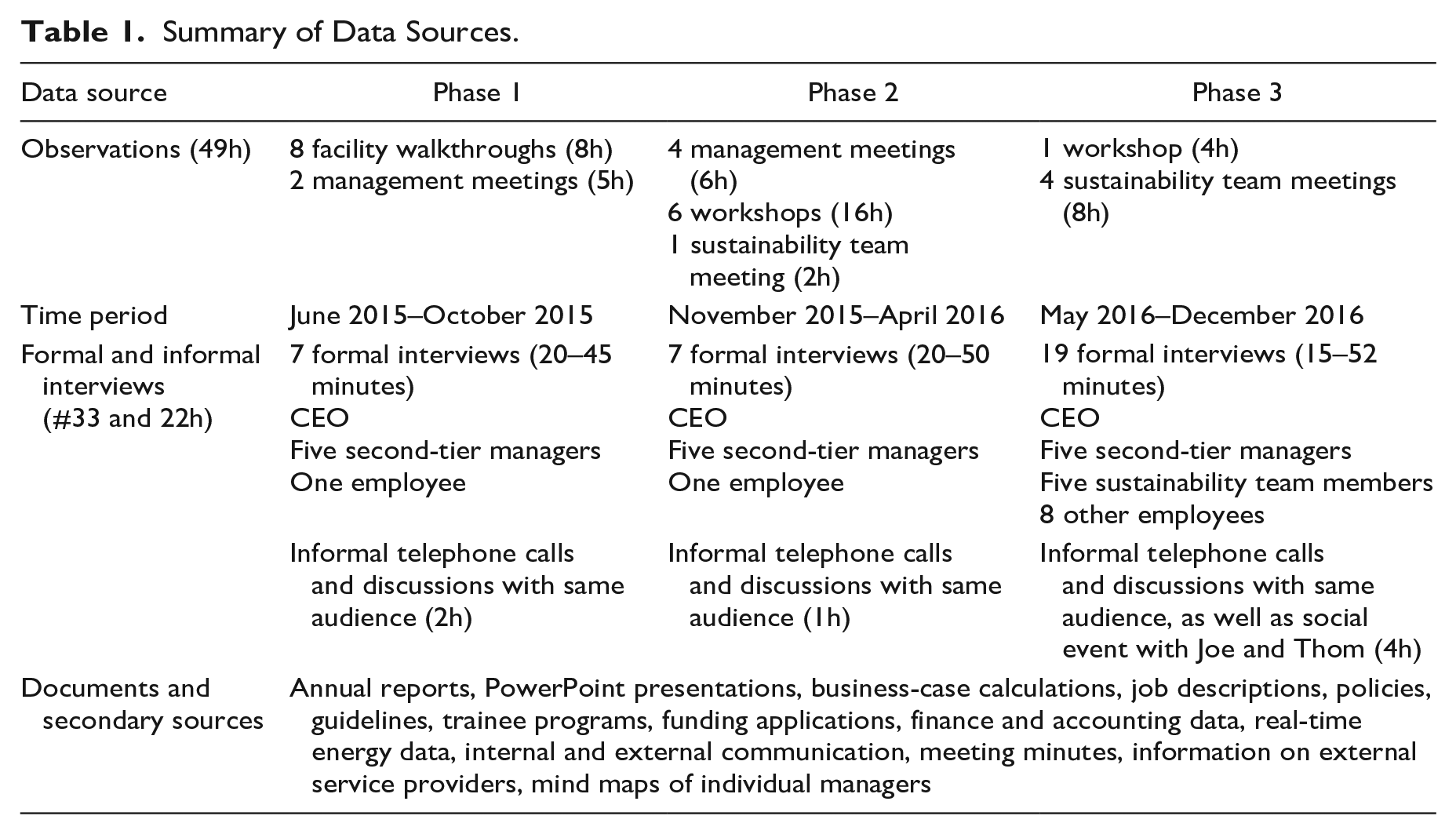
In total, we collected more than 49 hours of observational material and a large amount of archival and secondary data. Moreover, we conducted 33 formal interviews, generating 22 hours of interview material. Triangulating between the multiple sources reduced the possibility of impression management and contributes to the internal validity and reliability of our findings (Slawinski & Bansal, 2012). To ensure consistency, the interviews were recorded as audio files and transcribed. Two researchers (one insider and the external observer) regularly reviewed and discussed the interviews and meetings to identify emerging theoretical patterns and potentially adapt data collection processes or interview guides (Yin, 2003). We used memos to capture evolving insights or future explorative routes. Finally, to enhance reliability, all relevant documents were added to a case study database (Eisenhardt, 1989; Yin, 2003). Table 1 summarizes the data collected.
Summary of Data Sources.
Data Analysis
Data analysis was closely intertwined with data collection (Whiteman & Cooper, 2011). We aimed to be inspired by existing literature but not beholden to it to avoid focusing on known concepts too early (Gioia et al., 2013). As a result, our analysis was informed by the literature on cognitive frames and corporate sustainability from the start, whereas the importance of organizational roles and individual role identities emerged over the course of the initiative. Given our interest in individuals’ frames and behavior, our unit of analysis is the individual CarCorp employee.
To avoid honing in on specific themes too quickly, data analysis in the first phase followed no standardized protocols and was mostly based on informal discussions of memos, observations, or learnings, aided by ethnographic techniques (Gersick, 1988; Gioia & Chittipeddi, 1991). Following the first round of interviews, two researchers—one of whom had not been directly involved in collecting the data—then dived deeply into the growing dataset, assisted by MaxQDA. We used open coding techniques and analyzed the material individually to establish a detailed understanding of each CarCorp member involved (Corbin & Strauss, 2008). After the individual analyses, the codes were compared and discussed in meetings. Throughout the process, we were mindful of remaining open in our interpretations, using in vivo codes to let codes emerge from the data. For example, codes were used to describe employees’ previous, current, and planned sustainability practices (e.g., “plans to integrate all employees”) or their perceptions and interpretations of sustainability (e.g., “perceives sustainability to be linked with high initial costs”). Moreover, codes were used to capture decision-making processes, individual interpretations of information, sustainability knowledge, expectations, or organizational factors that could influence individuals’ support for the sustainability initiative. Based on this growing understanding, we created detailed characterizations for each CarCorp member—for example, the individual’s level of know-how, or the importance they attached to sustainability. This characterization served as a baseline or status quo from which to track future changes and enable comparative analysis. In addition, we conducted a first comparison across individuals to identify preliminary patterns and relationships that might explain why individuals did or did not engage in sustainability practices. However, codes were not yet aggregated to higher level concepts or categories; rather, we started with narratives to capture events as well as individuals’ interpretations and experiences (Gioia & Chittipeddi, 1991).
In further analysis, we continually iterated between data, evolving insights, and the literature (Gioia et al., 2013). The approach was inspired more by the process dimension of our research and focused on changes in the interactions, frames, and practices of the employees involved. As in the first phase, we first analyzed our data by summarizing our main insights in the form of memos and descriptive narratives. At the end of Phase 2, we then conducted another round of coding encompassing all the material, followed by an extensive discussion of our derived codes, categorizations, and relationships. This time, coding moved to a more conceptual level as dominant patterns emerged (Whiteman & Cooper, 2011). Specifically, in line with the existing literature, we noted that individuals differed in whether they perceived the economic dimension of sustainability to complement or conflict with its social and environmental dimensions, leading us to differentiate between “trade-off” and “win-win” frames. 4 Yet, in contrast to the existing literature, we noted that in several instances there was a third frame, which we labeled an “uncertainty” frame. Individuals holding this frame lacked the experience and information to form a clear idea of how the dimensions of sustainability were related.
In line with previous literature, we measured frames by mapping individuals’ beliefs about the links between the different dimensions of sustainability, drawing on concrete examples from their work context. In addition, individuals’ perceptions of their organizational roles emerged as important drivers or inhibitors of action. Specifically, we noted that some individuals saw their primary role in the organization as engaging in economic activities, while others also saw social and environmental activities as important parts of their roles. After experimenting with different construct names, we subsumed these self-views under the heading “organizational role identities” and differentiated two distinct categories: “economic” and “hybrid.” In a similar way, we noted that individuals’ personal identity (i.e., their general self-view beyond work-related roles) was important in explaining why they tried to change their organizational role. Based on these observations, we developed a preliminary process framework, including the categories of individual knowledge, cognitive frames, individuals’ support for organizational change, and organizational role identity.
We used this preliminary framework to sharpen our observations and focus the third round of interviews on the relationships between the categories (Eisenhardt, 1989). Drawing on the full set of data, we then conducted a final round of coding using a closed set of categories we had derived. To this end, we discussed our codes and categorizations extensively within the research team to arrive at consensual interpretations (Gioia et al., 2013). Comparing patterns in the codes across individuals and time then allowed us to derive conclusions about how individuals’ frames and role identities had evolved over the previous 18 months and how changes in frames, in turn, affected changes in role identities. We noted that sensegiving played an important role in frame adjustments, but that the effectiveness of sensegiving depended on the role identities of organizational members. To describe in detail how role identities affected sensegiving, we conducted another round of coding and identified three main mechanisms, which we labeled dodging, deleting, and disregarding. Similarly, we distilled three mechanisms that describe activities through which a person’s role adjustment may be affected by other organizational members holding different frames: constraining, criticizing, and counteracting. Finally, we sought to better understand the processes of sensegiving and changes in role identities (which, in line with the literature, we label “role identity work”). Toward this end, we coded the mechanisms behind these processes, leading us to identify revealing, reframing, and relating as the mechanisms behind sensegiving and extending, emending, and exchanging as the mechanisms specifying role identity work. The final coding scheme showing the first-order codes, second-order themes, and aggregate constructs is available in the Supplemental Online Appendix.
Based on these observations, we were able to iteratively refine our theoretical framework to describe the process of changes in cognitive frames and role identities in more detail (Cloutier & Langley, 2020; Langley & Tsoukas, 2010). In this process, we continually compared our growing insights with the relevant literature to challenge the novelty of our findings and enhance the construct validity of our framework (Eisenhardt & Graebner, 2007; Gibbert et al., 2008; Yin, 2003). We also critically discussed our framework’s applicability to other firms and sectors to establish the external validity of our findings (Miles & Huberman, 1994). Finally, we presented the framework to the members of CarCorp to probe its internal validity and plausibility. Our interviewees confirmed that the framework accurately captured the dynamics they observed and indicated that it offered them significant practical value.
Findings
Our analysis shows that the extent to which members of CarCorp engaged in sustainability practices differed significantly across individuals and changed over time. Our analysis suggests that these differences can be explained by two main factors: individuals’ cognitive frames and their organizational role identity. We differentiate three types of frames: trade-off, win-win, and uncertainty. Employees holding trade-off frames see the economic dimension of sustainability as standing in conflict with environmental or societal goals—for example, because they see sustainability as expensive, or perceive no clear economic benefit from it. In contrast, employees holding a win-win frame believe that pursuing environmental or societal goals can lead to financial savings and sales opportunities. Finally, employees holding an uncertainty frame have no clear idea about how the different dimensions of sustainability are linked.
In addition, we differentiate between two types of organizational role identities that individuals can possess: economic or hybrid. In this study, we define role identity as an individual’s self-view of their role within an organization. Employees with an economic role identity see their main role as pursuing economically oriented practices (e.g., selling cars). Employees with a hybrid role identity see their role in the organization as integrating economic, societal, and environmental goals (e.g., reducing paper consumption and costs). 5 Frames and role identities are independent in the sense that a trade-off, win-win, or uncertainty frame can co-occur with either an economic or a hybrid role identity.
In the following, we describe in detail how cognitive frames, role identities, and individuals’ support for the sustainability initiative at CarCorp evolved over time to develop a process framework that provides insights into how individuals’ role identities shape sensegiving during organizational change toward sustainability. We start by briefly outlining members’ cognitive frames and role identities at the beginning of the initiative, setting out the general context of change and individuals’ starting points. Subsequently, we first describe and illustrate the process of sensegiving and the three mechanisms through which individuals’ role identities shaped the effectiveness of sensegiving efforts targeted at initiating sustainability-oriented change. Then, we explain the process of role identity work and how (i.e., through which mechanisms) the cognitive frames of organizational members shaped individuals’ motivation and ability to change their roles and role identities.
The Starting Point: Dominance of Trade-Off and Uncertainty Frames, Economic Role Identities, and Limited Action
Before the initiative, most employees at CarCorp had trade-off frames and economic role identities, that is, they did not regard sustainability as part of their organizational role and perceived environmental and social aspects as standing in conflict with the main economic goals of the company. Employees saw their primary role as making sure CarCorp provided high-quality services. As Alex, the manager of the sales department expressed:
Environment?. . . [pause]. . . I don’t know? I’d rather focus on sales. In this company we mainly care about money. [Alex]
Only a few individuals—including Bill, the CEO, and two tier-two managers, Joe (services manager) and Kurt (utility vehicles manager)—had a hybrid role identity, that is, felt that sustainability was important and part of their executive role. While Joe described himself as someone who cared about sustainability in general, Bill saw himself as a role model for employees and wanted to show them how to use natural resources mindfully in their work. At the same time, both Bill and Joe had a trade-off frame and thus doubted whether social and environmental aspects could be pursued without jeopardizing the company’s main economic goals. Although they believed that fostering sustainability could potentially create a variety of environmental, social, and financial benefits, they could not say how sustainability could enhance the firm’s economic performance. Thus, they expected sustainability to come with considerable upfront costs and implementation problems:
I believe that everything I do for the natural environment will cost the company a lot of money. I think that you probably have to invest significantly to harness potential benefits. [Joe]
Other second-tier managers—like Conor, manager of the used-car department—framed sustainability in a similar way but more vaguely, indicating an uncertainty frame:
The form in which sustainability will lead to financial benefits is something I am not able to describe at the moment. I believe there is a lot of potential to do things better. But I cannot name them accordingly. . . My feeling is that it will be a time-intensive process, with a lot more to do than just exchanging hardware. [Conor]
This lack of knowledge about the linkages between economic, social, and environmental aspects and the underlying business case made Bill and Joe very careful in their approach toward sustainability. Before the initiative, CarCorp had no consistent, top-down sustainability strategy, and the first small steps toward organization-wide sustainability practices were quickly abandoned when employees showed little interest. For example, in 2014, Joe had initiated a program to encourage employees to cycle to work, but it had failed miserably:
We had a project where we tried to incentivize our employees to use their bicycles instead of their cars to get to work. . . Indeed, many of them only have a short drive to work. . . We tried to make this an attractive alternative for employees. However, no response! Absolutely nothing! . . . We learned the hard way that most employees don’t want such things. [Thom]
As a result, CarCorp only pursued sustainability practices in those departments whose second-tier managers had a win-win frame. For example, Kurt strongly believed that sustainability fell under his responsibility and that it offered considerable potential for cost savings. Therefore, he invested in energy-related improvements, as clear win-win opportunities.
You have to represent and integrate sustainability into your personality. . . You have to be a sustainable role model, and then others will follow. Last year, we modernized our department, upgraded and reduced the lighting as well as our heating equipment. . . I believe we will save around 30–35% of energy costs in the next few years. [Kurt]
A similar, albeit less comprehensive project was started by Zack, the manager of a sales department, who did not see sustainability as his prime responsibility but perceived it as providing clear economic benefits, especially given that the car industry was starting to move toward electric mobility.
Sensegiving
The previous section showed that before the start of the initiative, most individuals within CarCorp did not regard sustainability as part of their organizational role and perceived environmental and social aspects as standing in conflict with the main economic goals of the company. However, as the sustainability initiative unfolded, more and more individuals started to take sustainability-related action. In line with the literature, these changes were primarily triggered by sensegiving activities that drove changes in individuals’ cognitive frames. Specifically, individuals started to support the sustainability initiative as they moved from an uncertainty or trade-off frame toward a win-win frame. Sensegiving involved three mechanisms—revealing, reframing, and relating—all of which were important drivers of changes in frames.
Revealing
The first sensegiving mechanism, revealing, involves uncovering and communicating novel information. Indeed, if one seeks to alter individuals’ frames, presenting novel information can be helpful, as it may challenge established knowledge structures and lead individuals to reassess existing interpretations of reality. An example of revealing arose at the beginning of the change initiative. Bill, the CEO, decided to cooperate with a research team from the local university to analyze CarCorp’s energy footprint, calculate business cases for energy efficiency, and identify potential investment opportunities. The team installed metering hardware to track energy consumption and analyzed the data collected with Joe and Thom, who had volunteered to support the initiative. Subsequently, the research team presented the results, optimization potentials, and business case to Bill and the management team. As a result, several managers significantly changed their frame, as they were surprised by the potential energy savings. For example, Joe stated that “I kept being surprised! [. . .] The figures were moderately calculated and still they were shocking—in a positive sense, of course.” In a similar way, Bill expressed that “we knew that it wasn’t good to waste electricity, but [prior to the presentation] we didn’t know where and when we were doing it.”
Reframing
Next to revealing, another important mechanism of sensegiving was reframing, which we define as presenting information in a way that resonates with an audience. Information (whether novel or not) can be communicated in different ways, which affects how it is perceived and whether it triggers changes in frames. In the case of CarCorp, the external research team translated the energy savings it had identified into monetary and CO2 savings, thereby making the potential savings more tangible for managers, who were primarily interested in understanding potential outcomes for business and climate change. For example, Alex, one of the managers, stated, “If you told me how much energy we consume, I would first think about what this means in terms of costs. Might sound strange, but I think that many of us here think that way.” The analysis indicated that CarCorp could save energy-related costs of around 74,000 USD per year and reduce its carbon footprint by around 280 metric tons per annum. These numbers resonated well with managers and changed their view of the initiative, as the following statement by Joe indicates:
Prior to the project [presentation] I thought that everything I do for the environment costs a lot of money. [. . .] After the project [presentation], I think that I don’t really need to invest a lot to generate a lot of benefit both for the environment and the bank account. And that’s an insight I never would have expected, in no way. [Joe]
Relating
The third and final sensegiving mechanism was relating, which we define as juxtaposing novel information with known information to illustrate and highlight its relevance. In the case of CarCorp, the research team explained that the electricity consumed equaled that used in 3,000 cycles of an average washing machine, that the monetary savings amounted to 37% of the current annual electricity bill, and that to compensate for the associated carbon emissions, 58 hectares (~143 acres) of forest would need to be planted—an area equivalent to 2.5 times the famous city lake close to CarCorp’s headquarters. These comparisons helped managers fully understand the potential of the initiative and retain the communicated information. For example, Thom stated that “I was really flabbergasted by your metaphors related to the 3,000 washing machines or the city lake. I believe everyone was flabbergasted who saw that for the first time.” Another person agreed:
The example with the washing machines. It is only when I heard this that I realized, “Oh my god, that’s really a lot [of electricity].” If you only get the number of kilowatt-hours, you wonder: “OK, is that a lot or not? I don’t really have a point of reference.” But if you see the comparison, you realize it. [Thees]
Role Identities as Moderators of Sensegiving
The previous section introduced three mechanisms we found to be important elements of effective sensegiving. Interestingly, however, not all individuals who were targets of sensegiving responded by adjusting their frames. Instead, we find that each individual’s role identity served as a significant information filter and thus a moderator between sensegiving and frame adjustments. Specifically, we identify three filtering mechanisms: disregarding, dodging, and deleting, explained in detail below.
Disregarding
Disregarding involves downplaying the importance of the information provided as part of sensegiving. The individual receives information that could potentially challenge their frame, but pays it no attention; as a result, its impact on the frame remains limited. At CarCorp, disregarding occurred in the first phase of the project when the external research team presented the results of their analysis to the management team, despite the research team’s major effort to reveal, reframe, and relate frame-challenging information. Specifically, as result of the presentation, only some of the managers adjusted their frames, while many of the other second-tier managers, who did not consider sustainability to be part of their role, barely took any notice of the new results. Bill, Joe, and Thom, in particular, began to see sustainability as having the potential to generate major financial benefits and switched their frames from trade-off to win-win. They were surprised at the scope of opportunities and the level of savings—which, given the small size of CarCorp, were significant. Following the project presentation, the CEO announced a quicker and broader implementation of sustainability practices in the company—for example, by directly targeting on-site renewable energy generation:
The results really surprise me, and we will consequently try to push all activities. I already figured it out mentally, and improvement practices need to be planned as soon as possible; our understanding of what we can achieve in the field of resource protection heavily expanded. In fact, this project is impressive and opened our eyes while providing the necessary push for concrete action. Honestly? I never expected the savings to be in that dimension. [Bill]
However, many of the other second-tier managers, who did not consider sustainability to be part of their role, barely took any notice of the new results. Many reported that they could not remember the information presented and that they did not regard the results as important for their daily work.
We did receive a presentation. [. . .] I cannot remember the content. It was about energy and what it means for the company. . . However, I have the feeling Joe and his team are coping well with the project. I am more like the silent observer. They would contact me if they needed my support. . . I have to admit that I do not read the information. I do not know why, but there are so many topics that do not relate to me. [Alex]
Dodging
Changes in frames were also hindered by dodging, where information provided by leaders never reaches individuals because they purposefully assume roles in which they can avoid it. We find that roles that are close to the topic of the change initiative necessarily receive more information on specific issues; consequently, frame changes are more likely to occur for individuals who voluntarily assume roles connected to the initiative. An example of dodging occurred in the second phase of the project, when Joe, who had taken on responsibility for the change initiative, decided to form a sustainability team consisting of 12 employees holding various positions in different organizational functions. Prior to joining, team members had neither been involved in the analysis of the company’s status quo nor heard about its outcomes. As a result, few team members knew much about the potential for energy-related savings and most had trade-off frames. However, when Bill shared the presentation prepared by the external research team, they were impressed by the enormous potential and started to see sustainability as a great way to reduce costs (i.e., switched to win-win frames). Motivated by their deeper understanding of the various relationships between environmental and financial savings, the sustainability team started to prepare the implementation of the energy management system through energy auditing, future improvement planning, documentation, and distribution of responsibilities. The team adjusted the invoice printing configurations in the company’s IT system, realizing a 50% paper saving. In addition, they installed an efficient air compressor, planned necessary certification activities, and designed systems for employees to propose optimization practices. However, while the sustainability team members thus changed their frames, role identities, and contributions to sustainability, this was not the case for other individuals within the company. Since they were not provided with information on the cost and energy savings, they did not change their sustainability-related frames (“not my business”). By purposely avoiding specific roles and role identities, individuals can thus dodge information, preventing them from adjusting their frames and behavior.
Deleting
The third and final mechanism that affects how role identities shape the effectiveness of sensegiving activities is deleting. Deleting involves individuals purposely erasing information they receive during sensegiving because they consider it to be irrelevant or even harmful to their role identity. In contrast to dodging, individuals do receive the information aimed at changing their frame, but actively delete it. This is also distinct from disregarding, where information is processed but only partially retained.
An example of deleting arose in the third phase of the initiative, during which the sustainability team engaged in extensive internal and external publicity to communicate the results (excluding details of cost savings) to all employees and external stakeholders. In addition, workshops were held to raise employee awareness. Interestingly, despite these efforts, employees differed sharply in how much notice they took of the sustainability initiative. Those who already saw sustainability as part of their role (i.e., had hybrid role identities) closely followed the sustainability team’s efforts and changed their behavior. For example, Greg, a foreman in the utility car department, reported that he found the initiative interesting since he had long been trying to convince trainees to always switch off the lights. Subsequently, he had started going through the facilities to check that employees were not wasting energy.
Those employees who did read the material started to see sustainability as an opportunity for the company, as witnessed by a growing number of suggestions and positive comments that the sustainability team received. Still, most employees were not interested and did not consider sustainability updates as relevant to their job. For example, Tracey, a service clerk in the sales department felt that she had enough to do just dealing with customers, so she trashed every email from the sustainability team straight away:
We did receive emails and internal news several times. However, I have never read them. I always delete this news as I am not interested in this topic. . . I do not deal with this topic. In the end it is irrelevant for me. I don’t ask about the progress of the project either. [Tracey]
Tracey’s role identity directly induced her to delete any information that could have changed her frame right away. In the case of CarCorp, the phenomenon of individuals in specific roles being able to disregard, dodge, or delete information meant that even information that was widely promulgated over a 12-month period had no frame-changing effect on those individuals whose role identity led them to focus on economic tasks. This illustrates how role identities serve as information filters, which, in turn, shape how individuals adjust their frames in response to sensegiving and engage in organizational change.
Role Identity Work
The observation that the effectiveness of sensegiving depends on individuals’ role identities suggests that sensegiving activities need to be accompanied by changes in roles and corresponding role identities. Indeed, we observe that as individuals change their role identities from purely economic ones to those that include social and ecological dimensions, they become more open to frame-challenging information. Our data suggest that changes in role identities often resulted from changes in individuals’ roles, which took place in three distinct ways: role extending, emending, and exchanging.
Extending
The first mechanism, extending, leaves the individual’s original role unchanged but adds new elements to it, leading to an augmented role identity. In the case of CarCorp, role extension took the form of organizational members voluntarily working on sustainability-related issues outside normal work hours. For example, Joe, Thom, and all members of the sustainability team first used this mechanism to alter their roles, only later switching to other modes of role-identity work. As Thees, a member of the sustainability management team, pointed out, “initially, we met after work, at around 5 pm.” Thom confirmed that, in the beginning, the sustainability team meetings were “voluntary, after normal working hours.”
We observe the main underlying driver for role extension and corresponding changes in identities to be a mismatch between individuals’ personal identities and their organizational role identities. All individuals who extended their roles over the course of the project strongly valued sustainability-related issues on a personal level. For example, Thom expressed that his new role as an assistant to the head of sustainability was something he particularly enjoyed, since he had always wanted to integrate sustainability more fully into his job. As part of the new mandate, Thom started to work more on sustainability-related issues, and sustainability quickly became an essential part of his organizational role identity:
Privately, I live a very conscious life already. I am vegan and try to be very sustainable. Currently, I enjoy being allowed to be more sustainable at work, which was in fact a no-go in our repair shops before. Sustainability is something I can take home and tell my girlfriend about, as I highly identify with it. Sustainability is therefore getting more and more interesting for me. It is great to be part of a project that reflects my personal interests. . . That’s why I’m not thinking, “Oh my god, this is a lot of additional work to do.” Quite the contrary; I enjoy doing it. [Thom]
Emending
The second mechanism was role emending, which we define as replacing some elements of the old role with new ones. In contrast to role extension, in role emending the previous role is not left unchanged. Instead, members at CarCorp who made their roles more hybrid altered them by integrating social and environmental tasks and goals. For example, after noticing the initiative’s potential in the project’s second phase, Bill, the CEO, allowed Joe, Thom, and the sustainability team to engage in sustainability-related tasks during normal working hours. As a result, all went through a phase of role emending. While previously sustainability was seen as an add-on activity, the new situation required them to change their old role to free up resources for the new sustainability-related tasks. For example, Thees stated that
We’ve shifted [the sustainability team meetings] into working hours, between 3 and 5 pm. . . . So, they are no longer voluntary hours, but all counted.
Similar to extending, the increased engagement with sustainability that results from the emending of roles, in turn, led to changes in individuals’ role identities toward sustainability. For example, in the second phase of the project, Joe and Thom became the official spokespersons for sustainability in the company, which made environmental and social issues a bigger part of their organizational role identity and induced them to expand the scope of activities:
Personally, I now see myself as the engine of this project—as a booster who even needs to slow down sometimes. I also see myself as the coordinator of the whole thing—the one who connects the interfaces and keeps the wheels spinning: the engine, initiator, coordinator, or keeper of the flame. [Joe]
Exchanging
The third mechanism is exchanging, which describes a formal change in individuals’ roles. In contrast to both extending and emending, a role exchange allows the individual to take on a completely new role that retains no elements of the old one. The only person at CarCorp who formally shifted their role from an economic to a hybrid one was Joe when he was granted a formal position as head of sustainability. This top-down, formal change of Joe’s role, which was institutionalized in his employment contract, gave him an official mandate to spend 30% of his time on sustainability. As Bill, the CEO of CarCorp, explained, the official role change meant that the job description would be changed such that “Joe will become responsible for the energy management. It will be his secondary role.” Similar to role extending and emending, formal changes in individuals’ roles increased the time individuals spent on sustainability-related issues, leading to greater identification. As Joe reported, “I can use my time as I wish, and that’s the advantage. If it were otherwise, it wouldn’t work.”
Frames as Moderators of Role Identity Work
The previous section described the mechanisms through which individuals at CarCorp adjusted their roles and corresponding identities. Importantly, however, we noticed that changes in role identities did not happen smoothly but were hindered by the fact that other organizational members held cognitive frames that stood in contrast to those of the individuals seeking to change their roles. Specifically, we noticed that the majority of CarCorp employees possessed a trade-off frame, which led them to engage in three main activities that impeded others’ role identity adjustments: constraining, criticizing, and counteracting.
Constraining
Constraining describes situations in which leaders do not give individuals the leeway and resources necessary to adjust their roles because their own frames cause them to believe that these resources are not well spent. An example are the members of the sustainability team, whose superiors denied them sufficient resources and leeway to engage in sustainability-related activities. Joining the team meant that the individuals faced an additional workload, as they participated in sustainability meetings and contributed to the various sustainability projects. Yet the fact that sustainability took up part of the working day raised the problem of how to divide their limited resources between their new and existing organizational roles, especially when their superordinate did not actively support the sustainability initiative. This resulted in two members of the sustainability team dropping out because they could not handle the underlying conflicts. Those employees who stayed on stressed that when they had to attend sustainability meetings, their colleagues in the department often had to step in and take on extra work. This further eroded acceptance of the sustainability effort among those employees who saw little value in the effort in the first place:
My colleagues are not amused. They tell me, “You with your ridiculous sustainability! What are you doing in your meetings?..” . . At the beginning of the sustainability team, we received 12 initial applications. Shortly after, we were down to seven members, and maybe some more will quit their posts. The workload will grow, not shrink. These employees left because they had problems balancing both roles. . . For me, it would help if the executive team defined how many working hours I am allowed to spend on sustainability. [Thom]
Overall, despite the sustainability team’s best efforts and significant progress, many employees continued to argue that broader engagement would only be possible if they were given considerably more time and resources.
I have no time left for additional projects. My workload is already large enough and I don’t want any additional work. Although I like the sustainability team, I can’t do everything. If the company would free up some time, then I could get involved. [Damien]
Criticizing
Criticizing involves organizational members verbally delegitimizing an individual’s new role because, according to their cognitive frame, it provides no value. At CarCorp, multiple members of the sustainability team reported that they had been verbally insulted or mocked by their colleagues. Colleagues questioned whether the sustainability team developed any useful output and, behind their backs, made fun of their new roles:
I recognized that some colleagues do not take our work seriously. One of them said, “Watch out! The muesli-munching, bike-riding ecos are on the road again. . . My goodness, we invest so much time and money in such nonsense now. Who cares what light bulbs we use? You should deal with something else instead. Instead of investing money in such things, you could pay me a higher salary.” [Ben]
By criticizing the roles and role identities of those involved in the sustainability initiative, those organizational members with a trade-off frame and economic role identities made role changes toward sustainability less attractive and less likely. We noticed that those individuals who engaged in sustainability increasingly started to question their engagement in the face of strong criticism. Only those individuals with a particularly strong personal identity rooted in sustainability were able to take the criticism in their stride.
Counteracting
Finally, counteracting describes visible action, such as sabotage, by which members harm the person who is in the process of adjusting their role. One example of counteracting that we discovered at CarCorp was that employees left washrags in the mailbox of the sustainability team, which had been installed to collect suggestions for new projects. Through such actions, organizational members seek to undermine the legitimacy and success of the project. Although closely related, the core difference between counteracting and criticizing is that the former is behavioral while the latter is verbal.
In sum, our findings reveal the complex interplay between sensegiving, role identities, cognitive frames, and role adjustments: Role identities shape sensegiving activities and thereby changes in cognitive frames, while cognitive frames, in turn, shape the extent to which roles and corresponding identities are adjusted. These findings help us understand why, despite targeted sensegiving, organizational change may be difficult to achieve. Table 2 summarizes CarCorp members’ cognitive frames, role identities, and support for the sustainability initiative throughout the three phases.
Cognitive Frames, Organizational Role Identities, and Support for Organizational Change of CarCorp Members Throughout the Three Phases a .
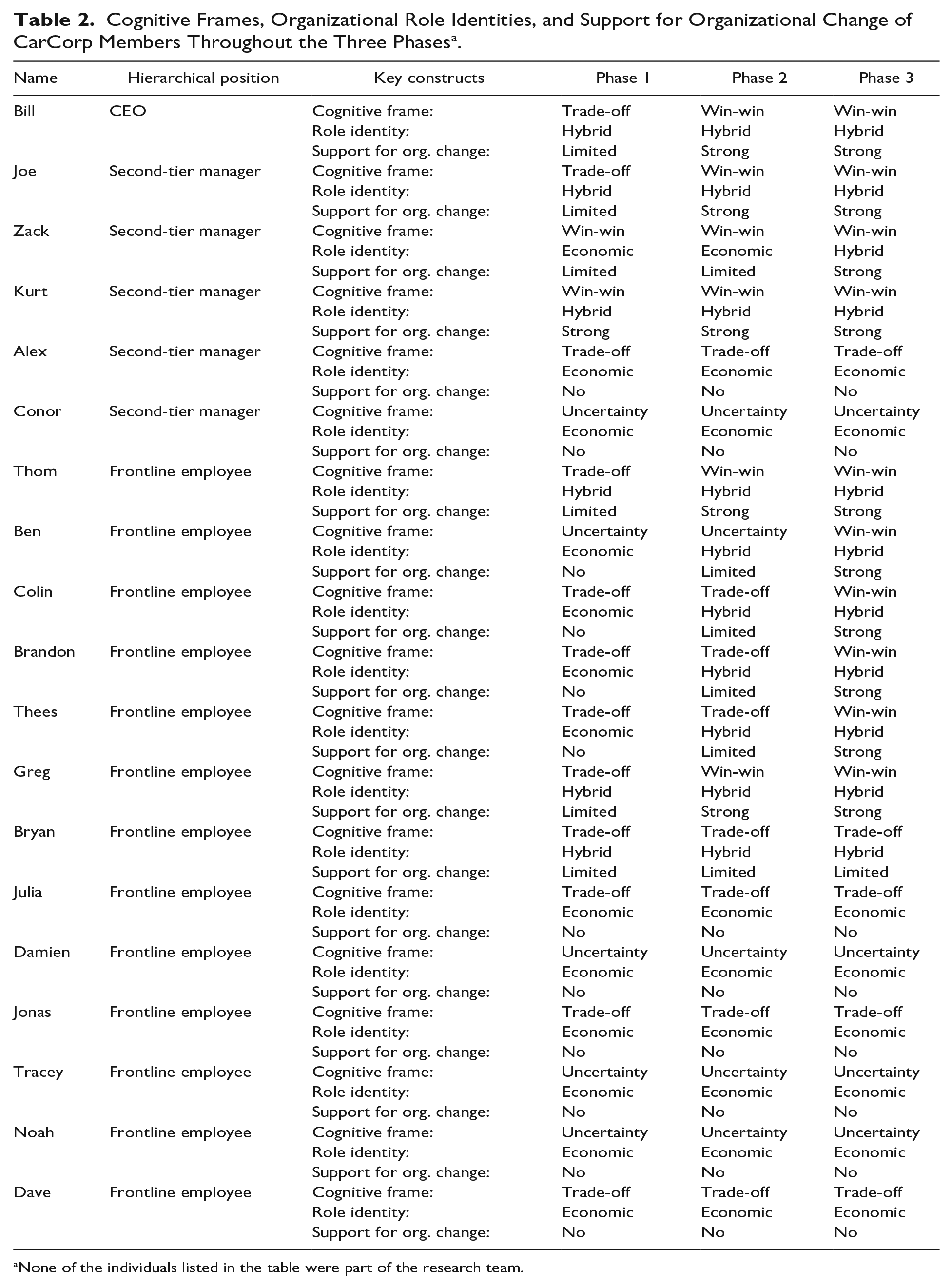
None of the individuals listed in the table were part of the research team.
Theoretical Framework
Figure 1 shows the framework we developed to summarize how individuals’ role identities shape sensegiving activities during corporate sustainability initiatives. As described in the previous section, we find that securing individuals’ support for organizational change requires change agents to stimulate adjustments in cognitive frames from trade-off to win-win, which can be done by making systematic use of sensegiving, that is, revealing, reframing, and relating frame-challenging information. Yet we show that the effectiveness of sensegiving varies across individuals depending on their legacy in organizational role identity, since possessing a strong economic role identity may lead individuals to disregard, dodge, or delete frame-challenging information. Adjustments in individuals’ role identities, in turn, are the result of role identity work, which involves extending, emending, and exchanging roles. At the same time, the process of role identity work is shaped by the legacy in organizational members’ cognitive frames, as members holding trade-off frames may engage in constraining, criticizing, or counteracting the process of role identity adjustment.
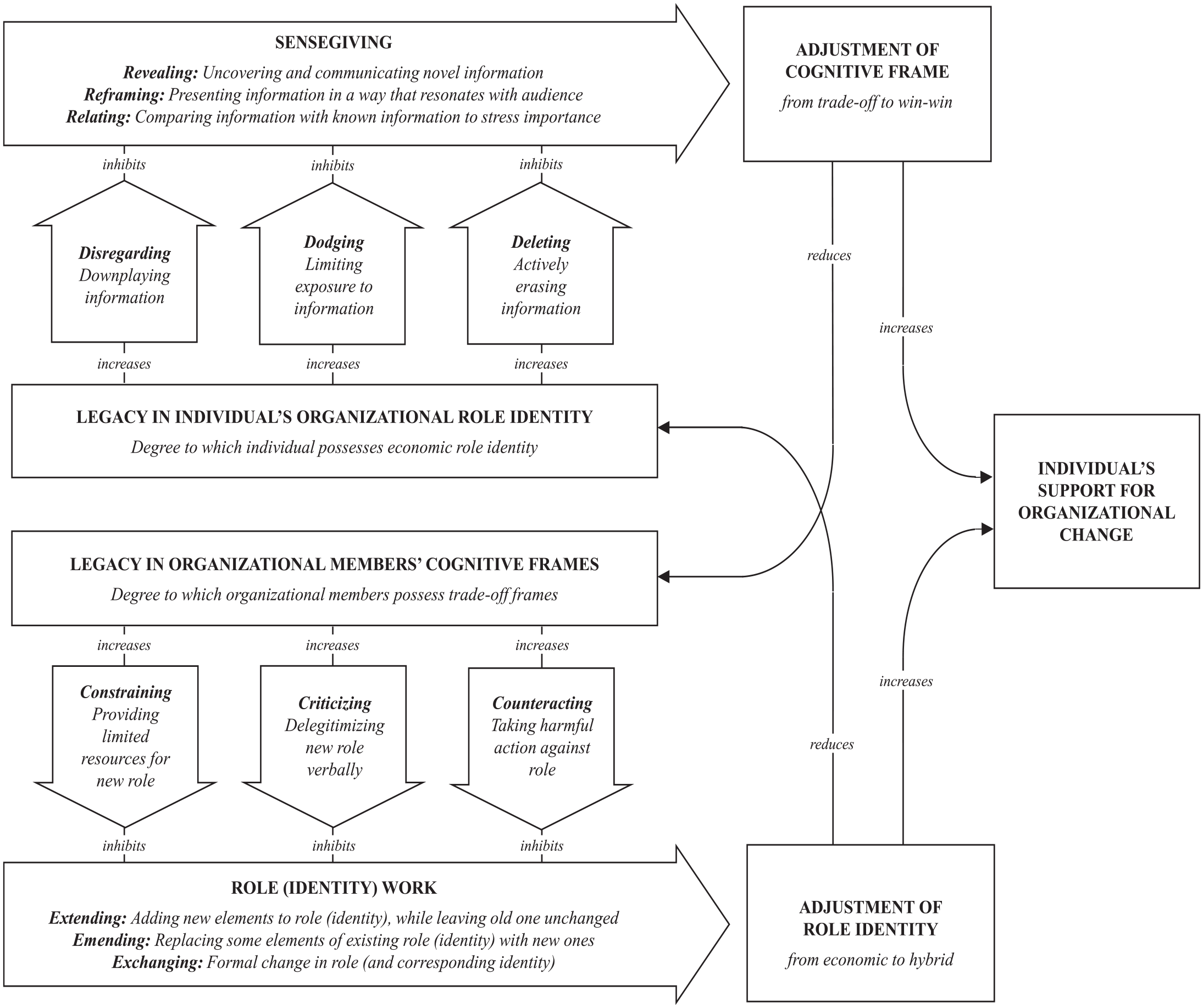
Process Framework Showing How Role Identities Shape Sensegiving in Times of Organizational Change Toward Sustainability.
Any one of the three mechanisms of sensegiving—revealing, reframing, or relating—can trigger changes in frames on its own, but our findings indicate that the most effective sensegiving combines all three. For example, revealing novel information may stimulate frame changes in itself, as surprises trigger sensemaking processes. However, in line with previous research, our findings indicate that sensegiving is more effective if information is framed in a way that resonates with the audience and juxtaposed against known facts. At the same time, however, reframing and relating can trigger frame changes even if the information is not new, suggesting that the three mechanisms need not occur at the same time or in a specific order.
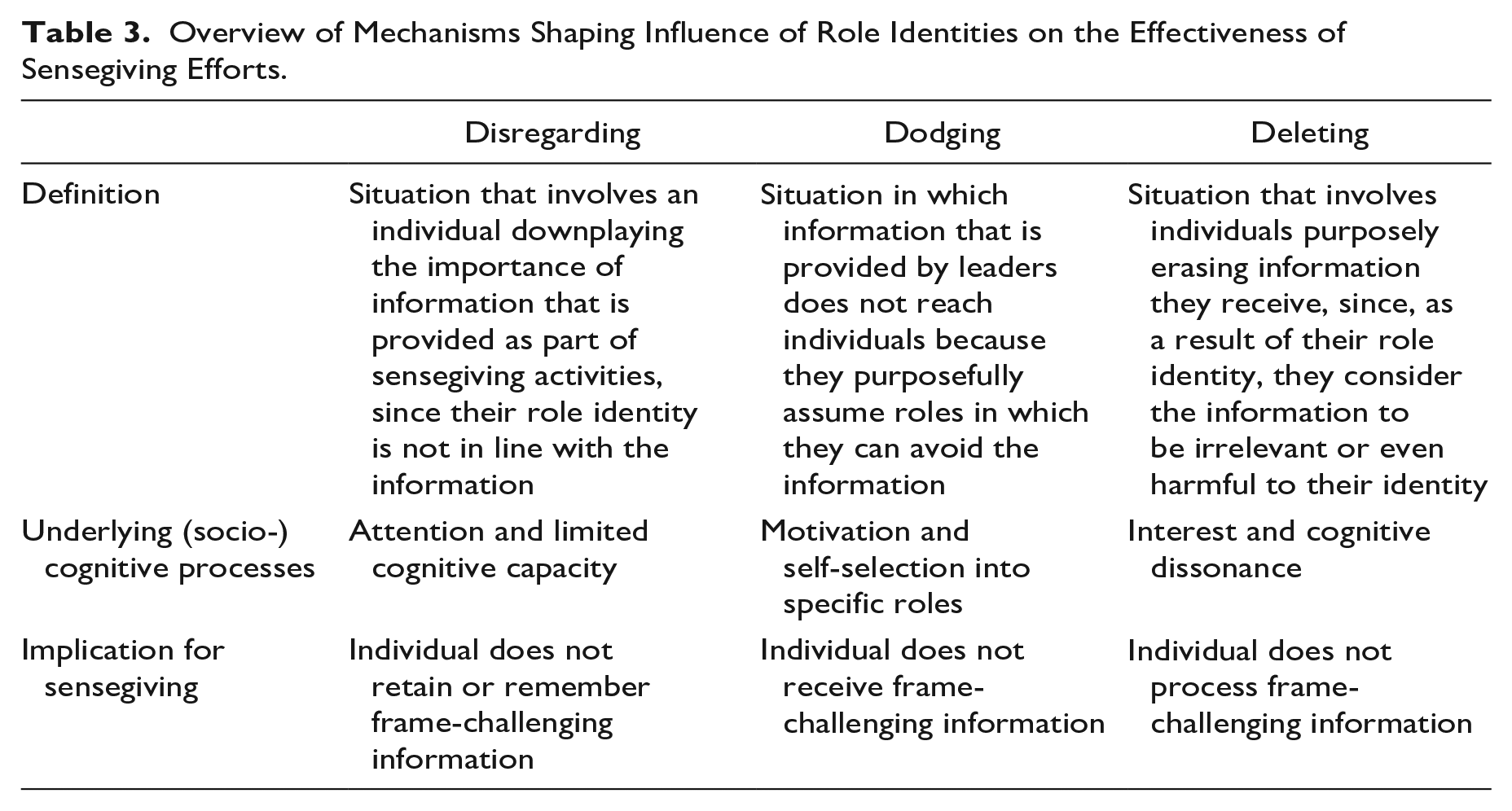
The mechanisms of disregarding, dodging, and deleting rely on distinct (socio)cognitive processes and differ in their implications for the process of sensegiving (see Table 3). 6 In the case of disregarding, individuals receive and process the frame-challenging information but do not remember or retain it. The underlying (socio-)cognitive process driving disregarding is thus individuals’ limited attention/cognitive capacity, which leads them to filter out information that is not directly in line with their existing role identity. In the case of dodging, individuals never receive the frame-challenging information as they choose organizational roles in which they are shielded from it. The underlying (socio)cognitive processes driving dodging are –thus individual motivation and self-selection into specific roles, which defines individuals’ position in organizational information networks and thereby affects their exposure to specific pieces of information. In the case of deleting, finally, individuals receive the frame-challenging information but actively filter it out based on immediate, superficial judgments before it can be processed and retained. The underlying (socio-)cognitive processes are personal interest and cognitive dissonance, which lead individuals to discard information because it is instinctively perceived as irrelevant or even harmful to an individual’s -self-worth due to a clash between the information and their role identity.
Overview of Mechanisms Shaping Influence of Role Identities on the Effectiveness of Sensegiving Efforts.
The three mechanisms of disregarding, dodging, and deleting work in parallel, that is, individuals can potentially be subject to more than one. For example, individuals may self-select into specific roles where they can avoid specific types of information and may actively delete any information that, despite their shielded role, manages to reach them. The fact that the mechanisms complement each other is due to the fact that they operate at different points in the sensegiving process, that is, completely prevent either the (a) receipt (dodging), (b) processing (deleting), or (c) retention (disregarding) of information. If frame-challenging information reaches an individual due to a lack of dodging (or deleting), sensemaking can still be prevented by disregarding (or deleting).
The three mechanisms of role identity work in our case occurred sequentially and typically followed the order of extending, emending, and exchanging. Individuals first engaged in sustainability-related activities voluntarily in their free time, and only later integrated these activities into their roles or completely switched roles. However, it seems possible that managers foster corporate sustainability by directly creating new, formal roles or changing individuals’ role descriptions, implying that the three mechanisms are relatively independent.
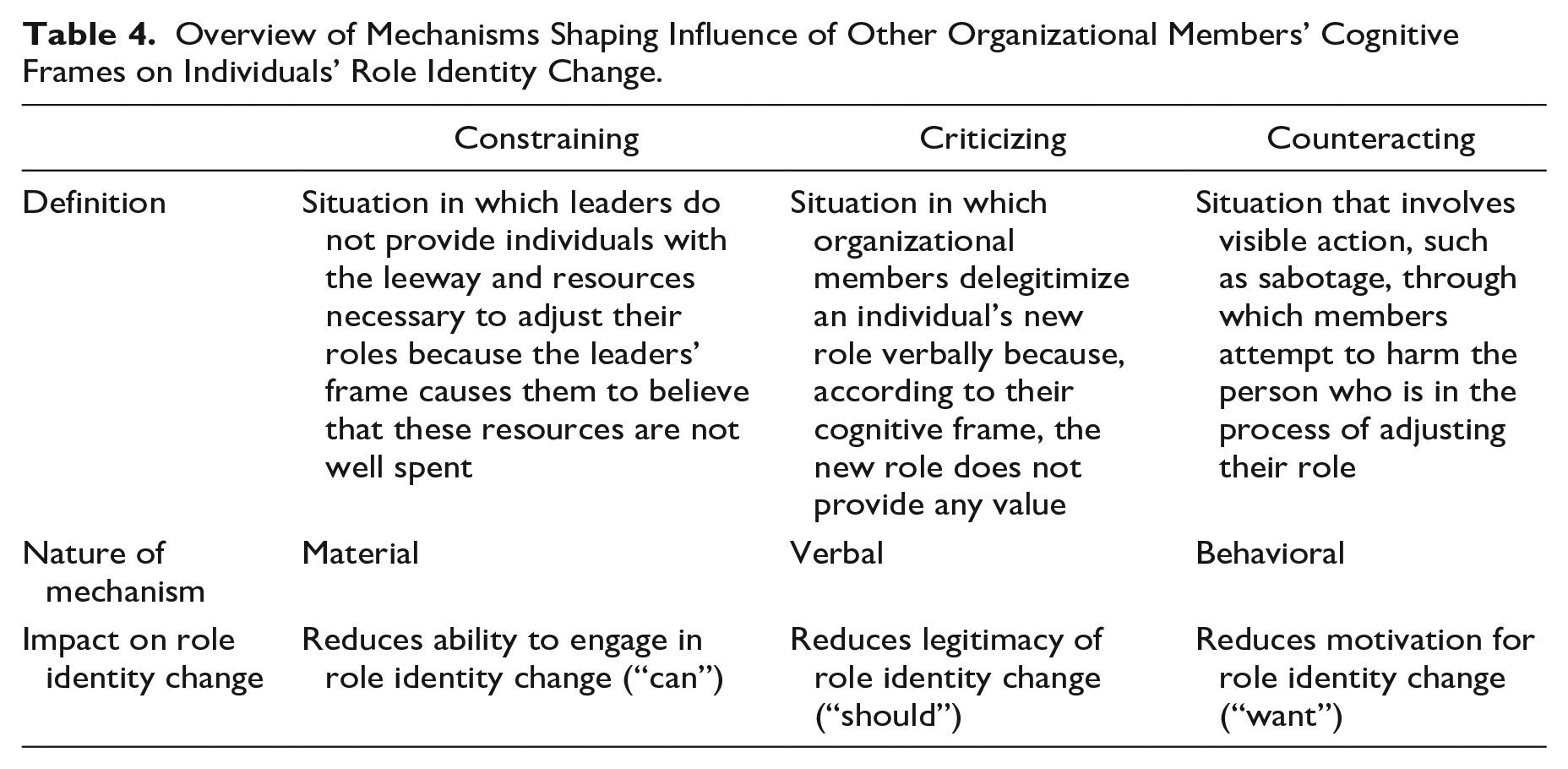
Finally, Table 4 gives an overview of the three mechanisms through which other organizational members’ cognitive frames shape individuals’ adjustment in role identities. It shows that, similar to the mechanisms of disregarding, dodging, and deleting, the three mechanisms of constraining, criticizing, and counteracting differ in their nature and their implications for the process of role (identity) change. Specifically, the nature of constraining is material in that it limits the physical, monetary, and human resources available to individuals wishing to engage in role identity change. In this sense, constraining limits the degree to which individuals “can” change their role identity. The nature of criticizing is verbal, as it aims at reducing the legitimacy of role identity changes by means of language. In this sense, criticizing affects individuals’ perception of whether they “should” change their role identity. The nature of counteracting, finally, is behavioral, as it includes visible actions targeted at undermining or even sabotaging changes in role identities. By openly showing opposition and undermining individuals’ morale, such actions usually aim at reducing the degree to which they “want” to change their role identity. Similar to the mechanisms described in Table 3, the mechanisms of constraining, criticizing, and counteracting can appear simultaneously, as they affect different drivers of the change process, all of which are crucial for its success.
Overview of Mechanisms Shaping Influence of Other Organizational Members’ Cognitive Frames on Individuals’ Role Identity Change.
Discussion
Implications for the Literature
As our main contribution, we advance the literature on corporate sustainability, sensemaking/sensegiving, and cognitive frames by developing a framework that describes the detailed mechanisms through which organizational members’ role identities affect sensegiving activities in times of organizational change toward sustainability. In recent years, the literature on corporate sustainability has taken a particular interest in investigating the influence of cognitive frames as an antecedent of corporate sustainability efforts (Hahn & Aragón-Correa, 2015; Hahn et al., 2014; Hockerts, 2015). Thus far, however, this literature has focused on classifying frames and linking them to action. We extend previous insights by showing how changes in frames are shaped by individuals’ role identities and also provide detailed insights into how changes in role identities, in turn, are affected by cognitive frames.
Pertaining to changes in frames, previous studies have (a) shown that successful organizational changes require organizational members to engage in a process of sensemaking to alter cognitive frames and (b) pointed out that leaders can shape this process by engaging in sensegiving (Gioia & Chittipeddi, 1991). In this context, the literature has also identified different sensegiving mechanisms, such as strategic narratives (Egbon & Mgbame, 2020). An unresolved puzzle in the literature, however, is why organizational members respond differently to sensegiving. While the existing literature has started to study the antecedents of sensegiving (Maitlis & Lawrence, 2007), it has not yet provided insights into how sensegiving activities are shaped by the different roles and role identities of organizational members. To address this shortcoming, we provide a process framework that describes the detailed mechanisms through which individuals’ role identities affect sensegiving activities. We show that sensegiving involves mechanisms of revealing, reframing, and relating, thereby adding to the literature that has investigated the factors that contribute to successful sensegiving (Maitlis & Lawrence, 2007). While the literature has previously pointed to the importance of rhetorical devices, we show that framing is particularly effective if it contains novel information and includes relating, that is, juxtaposes the novel with known information. More importantly, however, we show that role identities affect sensegiving as they filter out information that is intended to alter individuals’ frames through three main mechanisms: dodging, deleting, and disregarding. As described in the previous chapter, these mechanisms build on distinct (socio)cognitive processes, thereby linking our work to previous studies that have investigated the role of attention (Hoffman & Ocasio, 2001), motivation (Tabernero & Hernández, 2011), and interest (Karp, 1996) in the context of organizational and individual change toward sustainability, but thus far have not been linked to sensegiving. At the same time, the different mechanisms operate at different stages of the sensegiving process. While dodging hinders the receipt of frame-challenging information, deleting and disregarding hinder its processing and retention.
Taken together, by revealing these mechanisms, our study adds to the sensemaking literature by providing rich insights into the connection between role identities and sensegiving and explaining why sensegiving activities may not be equally effective for all individuals—even those who share the same frame. Previous studies have investigated the relationship between identity and sensegiving but have focused intensively on how sensegiving is used to shape organizational identities rather than on how identities at the individual level affect sensegiving activities (Clark & Geppert, 2011; Sandberg & Tsoukas, 2015). In addition, our study adds to a growing stream in the sensemaking literature that has studied situations in which sensemaking breaks down (Weick, 1993). This literature has pointed out that organizational identities and cultures can serve as buffers that prevent individuals from noticing important cues in their environment (Maitlis & Christianson, 2014). We complement these studies by showing that role identities serve a similar function at the individual level by preventing individuals from noticing or retaining frame-challenging information provided to them as part of sensegiving activities. This finding is particularly noteworthy because the literature on sensemaking thus far sees stable roles as promoters, rather than hindrances, of sensemaking efforts (Weick, 1993). Overall, our work thus adds to studies that take a micro-perspective on sensemaking and sensegiving (Rouleau, 2005) and answers recent calls to investigate the antecedents of changes in cognitive frames over time (Cornelissen & Werner, 2014).
In addition to advancing the literature on sensemaking/sensegiving, our work also contributes to the literature on role identities by providing detailed insights into the antecedents of changes in these identities. Prior literature has described how actors use identity work to change role identities (Brown, 2015). Thus far, however, the literature on identity work has primarily focused on how actors redefine their identities at the level of organizational fields, rather than how individuals within organizations may alter their role identity through identity work at the organizational level. Based on our analysis, we find that individuals adjust their organizational role identities through three main mechanisms: role extending, emending, and exchanging. All three mechanisms involve changes not only in individuals’ identity but also in their informal or formal roles. This notion is in line with the literature on role identities, which has suggested that “role” and “identity” are two sides of the same coin (Barley, 1989).
Moreover, studies show that role identities are built and maintained through social relations, which lead to external accountability pressures (Stets & Biga, 2003; Wry & York, 2017). Enacting a role in a way that meets others’ expectations leads to praise and confirmation of one’s role identity (Stryker & Burke, 2000), whereas deviations from external expectations may incur criticism. We show that others’ expectations pertaining to established roles may serve as obstacles to individuals’ role identity change. Specifically, we demonstrate that differences in frames across organizational members may contribute to resource and legitimacy conflicts when these individuals try to change their organizational roles and role identities. Similar to the relationship between sensegiving and changes in frames, we identify three mechanisms through which the frames of other organizational members may inhibit the adjustment of roles—namely, constraining, criticizing, and counteracting. While constraining describes the withholding of material resources, criticizing and counteracting describe activities of delegitimizing or even sabotaging individuals’ efforts at role identity change. Since the different mechanisms tackle distinct prerequisites for change (the “can,” the “should,” and the “want”), all three can hinder or even prevent changes in roles and role identities.
Overall, by showing how cognitive frames and role identities jointly shape corporate sustainability initiatives, our study makes an important contribution to the literature on the microfoundations of corporate sustainability (Godfrey & Hatch, 2007; Hafenbrädl & Waeger, 2017; Wry & York, 2017). Previous work in this field has primarily investigated the different micro-level factors in isolation, leading to a fragmentation of the field and hindering progress in this important stream of research (Aguinis & Glavas, 2013; Glavas, 2016; Gond et al., 2017). By starting to integrate the different streams, our work provides an important step forward in the literature and opens up novel research opportunities at the intersection of different individual-level antecedents.
In addition, knowledge of how individuals’ cognitive frames and role identities shape sustainability-related action is critical for practitioners wishing to advance sustainability within their own organizations. For example, our findings indicate that convincing employees that “it pays to be green” is not sufficient to stimulate corporate sustainability on a broader scale (Hockerts, 2015). Only if employees see the pursuit of social and environmental objectives as part of their role will they actually exhibit strong sustainability-related action. In this sense, our findings suggest that when trying to advance corporate sustainability, integrating social and environmental aspects into individuals’ organizational role identities is at least as important as showing that it pays to be green. In fact, our findings suggest that changing cognitive frames to implement sustainability-oriented organizational change often requires changes in individuals’ role identities, which in turn are hindered by other organizational members’ cognitive frames. This suggests a vicious circle between cognitive frames and role identities, which explains why many organizations wishing to implement sustainability struggle to make progress. By highlighting how interdependencies between different factors can lead to lock-ins and inertia, our findings are in line with recent work that has taken a systemic perspective on corporate sustainability (Bansal et al., 2021; Williams et al., 2017). Complementing this perspective, our study provides first insights into how managers can deal with such situations. Specifically, our findings indicate that breaking the vicious circle between frames and role identities requires managers to combine sensegiving activities with interventions aimed at creating new organizational roles and providing individuals in these roles with sufficient resources and legitimacy. Only when individuals are given the space to alter their organizational role identities will frame-challenging information actually lead them to accept and contribute to sustainability-oriented organizational change.
Limitations and Future Work
Our research offers several promising avenues for future research. First, we study the process of implementing sustainability within a German car dealer. While the focus on an individual firm allowed us to provide a rich description of the mechanisms and dynamics at work, it raises the question of how far our findings are generalizable to firms operating in other sectors or countries. We, therefore, call for future research that tests and refines our model in other industries. In this context, we see particular value in studies that employ quantitative methods (e.g., experiments and surveys) to better understand the cognitive processes underlying the mechanisms we identify as well as the interdependencies between them. Second, the study is limited as it focuses on one specific sustainability initiative. Since CarCorp had not previously engaged in sustainability, and ecological issues were of particular concern, the issues it addressed during our study mostly related to reducing water and resource consumption and increasing energy efficiency, since these issues held more win-win potential than alternative measures. Given that investments in other areas may be more difficult and win-win opportunities may not exist, future studies should widen the scope to companies that are more advanced, tackle challenges other than sustainability, or engage in more strategic changes. Finally, it would be interesting to shed additional light on practices allowing organizations to implement changes in the roles and role identities of employees. For example, should companies integrate issues such as sustainability into every organizational role, or assign separate roles to social, environmental, and economic objectives? And do bottom-up initiatives characterized by a more informal integration of issues into employees’ roles lead to stronger related action than top-down initiatives that result in the formation of formal roles? Addressing these and other questions in future research holds the potential to significantly advance our knowledge of the drivers of organizational change and may also provide useful guidance for practitioners wishing to spur change in their organizations.
Supplemental Material
sj-docx-1-oae-10.1177_10860266231183955 – Supplemental material for Not My Business: How Individuals’ Role Identities Shape Sensegiving During Corporate Sustainability Initiatives
Supplemental material, sj-docx-1-oae-10.1177_10860266231183955 for Not My Business: How Individuals’ Role Identities Shape Sensegiving During Corporate Sustainability Initiatives by Joern Hoppmann, Marcel Richert and Timo Busch in Organization & Environment
Footnotes
Declaration of Conflicting Interests
The author(s) declared no potential conflicts of interest with respect to the research, authorship, and/or publication of this article.
Funding
The author(s) received no financial support for the research, authorship, and/or publication of this article.

Supplemental Material
Supplemental material for this article is available online.
Notes
Author Biographies
References
Supplementary Material
Please find the following supplemental material available below.
For Open Access articles published under a Creative Commons License, all supplemental material carries the same license as the article it is associated with.
For non-Open Access articles published, all supplemental material carries a non-exclusive license, and permission requests for re-use of supplemental material or any part of supplemental material shall be sent directly to the copyright owner as specified in the copyright notice associated with the article.
