




Abstract
Established firms often develop new businesses through internal corporate venturing (ICV), for instance, to capture value from novel sustainable technologies. We illuminate the early definition stage of ICV’s by asking: When and how business model schemas—that is, managerial understandings of how value is created and captured—change in ICV? We conduct a qualitative, embedded case study of the change in a business model schema for e-mobility in a Swiss utility’s ICV. We uncover a key trigger: strategic re-framing—the active re-formulation of the definition of a given situation within ICV–top manager interactions. The strategic re-framing’s specificity level provokes either schema restrictions or expansions via the distinct accommodation practices it induces. Our theoretical model of business model schema change contributes to the literatures on managerial cognition, business models, and ICV, suggesting that business model schema change in ICV is a semi-autonomous process that involves both independent and joint endeavors.
Keywords
Introduction
Firms need to continually innovate their business models if they are to adapt and succeed (Casadesus-Masanell & Zhu, 2013; Desyllas & Sako, 2013; Zott & Amit, 2007). For instance, firms innovate business models to capture value from novel sustainable technologies—those that may reduce environmental harms and increase resource use efficiency, such as electric mobility and renewable energy (Bohnsack et al., 2014; Hockerts & Wüstenhagen, 2010; Reuter, 2022). To spur such corporate innovation, large established firms often rely on internal corporate venturing (ICV)—“entrepreneurial initiatives that originate within a corporate structure and are intended from their inception as new businesses.” (Burgelman, 1983; Garrett & Covin, 2013, p. 1; Kuratko et al., 2009). The ICV literature has investigated the ICV process as well as ICV’s impacts on corporate outcomes and the conditions in which it likely produces outcomes (see Burgelman, 1983; Covin & Miles, 2007; Garrett & Covin, 2013; Garud & vandeVen, 1992; Keil et al., 2009; McGrath, 2001). However, very little research has focused explicitly on this distinct and fairly conceptual definition stage in the ICV process, in which managers’ understandings of novel business models are formed (Burgelman, 1983).
To shed light on ICV’s definition phase, we adopt a cognitive or schema lens. It suggests that realized business models are shaped by how managers think or conceive of them (see Barr et al., 1992; Bingham & Kahl, 2013; Dane, 2010; Huff, 1990; Weick, 1995). In particular, business model schemas represent managerial understandings of how value is created and captured (c.f. Baden-Fuller & Mangematin, 2013; Barr et al., 1992; Doz & Kosonen, 2010; Furnari, 2015; Martins et al., 2015). They critically shape what is enacted, that is, how resources, activities, and attention are structured in an organization (see Aspara et al., 2011, 2013; Burgelman, 1983; Chesbrough & Rosenbloom, 2002). A core focus of the research is the need for managers’ business model schema change, defined here as a process involving a series of adjustments in managers’ understandings of how value is created and captured. First, the research has identified management’s failure to change their existing business model schemas as a key reason why established firms such as Polaroid failed in environments of technological change (Tripsas & Gavetti, 2000). In turn, firms that have succeeded in such environments changed their business model schemas, which enabled them to unlock a new technology’s value potential (Chesbrough & Rosenbloom, 2002). However, firms do not merely face any technological change, but they increasingly face transitions toward sustainable technologies (see Bohnsack et al., 2014; Foss & Saebi, 2016; Hockerts & Wüstenhagen, 2010), which drives the need that managers change their business model schemas to unlock both economic and environmental value (see Rabilloud & Reuter, 2022; Reuter, 2022). Although scholars have started to uncover the organizational drivers of firms’ business models for sustainable technologies (Bohnsack et al., 2014), little is known about the drivers of managers’ business model schema change in such settings. Second, where the research did focus on managers’ business model schema changes, it has foregrounded the roles of experience-based mechanisms (Berends et al., 2016; Martins et al., 2015). Also, the broader schema literature has emphasized the roles of either experience-based mechanisms for independent actors’ schema change or of top-down-induced change of organizational members’ schemas (see Balogun & Johnson, 2004; Bingham & Kahl, 2013; Dane, 2010; Fiske & Dyer, 1985; Gröschl et al., 2019; Labianca et al., 2000; Walsh, 1995). Yet, ICV is a bottom-up-driven process involving multiple managerial levels (Burgelman, 1983). Both of these literatures could not fully explain when and how business model schemas change in ICVs and what the managerial drivers are. Because this question has such strong practical and theoretical relevance, we ask, “When and how do business model schemas for novel (sustainable) technologies change in ICVs?”
We address this question with a qualitative and embedded case study design (Yin, 2009) of the change in a business model schema for e-mobility in a Swiss utility’s ICV, uncovering the triggering role of strategic re-framing—defined as the active re-formulation of the definition of a given situation within ICV–top manager (TM) interactions—in business model schema change in ICVs. We find that the strategic re-framing shaped both expansions and restrictions of ICV managers’ schemas via the distinct schema accommodation practice types it induced. Whether the ICV managers’ schema is expanded or restricted largely depends on strategic re-framing’s level of specificity. High-specificity strategic re-framing leads to schema restrictions by provoking joint accommodation practices within interactions between the ICV and the other business units’ managers (BUM), referred to hereafter as ICV-BUM interactions. In turn, low-specificity strategic re-framing leads to schema expansions by provoking more independent or autonomous accommodation practices by the ICV managers. As we find and argue, this is so because strategic framing’s specificity level provokes distinct informative and directive effects. When strategic re-framing is absent, the existing business model schema remains fairly stable.
We advance a theoretical model of business model schema change in ICVs that emphasizes strategic re-framing within ICV-TM interactions as a key trigger and schema accommodation as a crucial managerial mechanism. We integrate existing literatures by arguing that schema change is a semi-autonomous process. It is both an independent and a joint endeavor between the ICV managers and the other business units’ managers within ICV-BUM interactions and is, in turn, largely shaped by the strategic re-framing in ICV-TM interactions. We contribute to the literatures on managerial cognition (see Balogun & Johnson, 2004; Bingham & Kahl, 2013; Dane, 2010; Gröschl et al., 2019; Walsh, 1995), business models (see Baden-Fuller & Mangematin, 2013; Berends et al., 2016; Martins et al., 2015), specifically, on schemas of business models for sustainability (Bohnsack et al., 2014; Schaltegger et al., 2016), and ICV (see Burgelman, 1983; Garrett & Covin, 2013; McGrath, 2001; Thornhill & Amit, 2001).
Internal Corporate Venturing
ICVs have commonly been referred to as “entrepreneurial initiatives that originate within a corporate structure and are intended from their inception as new businesses.” (Garrett & Covin, 2013, p. 1; see also: Govindarajan & Trimble, 2005; Kuratko et al., 2009). They seek to develop novel products and/or markets for a firm (Block & MacMillan, 1993; Burgelman, 1983; Kuratko et al., 2009), and therefore engage in business model innovation (Futterer et al., 2018; Sund et al., 2021). For instance, Intel used ICV to commercialize its R&D (Burgelman, 1983); Evonik used Degussa to spur the commercialization of radical nanotechnology (Maine, 2008); and E.ON’s ICV unit Future Energy Ventures is seeking to develop digital business models that redefine the energy industry (Mawson, 2020).
Broadly, ICV is a lever for corporate innovation. Because large established firms are often seen as ill-suited for entrepreneurial endeavors (Dess et al., 1999), they invest in ICV to develop new sources of organic growth. A key facet of ICV is its relative autonomy, which enables it to overcome inertial forces from the existing business (Garrett & Covin, 2013; Thornhill & Amit, 2001). ICV seeks to develop growth opportunities that are beyond a firm’s established business by developing novel business models based on different products, markets, and technologies (McGrath et al., 2006). The research has focused on ICV’s outcomes for a firm (Keil et al., 2009; McGrath et al., 2006) and on the conditions in which they succeed (see Covin & Miles, 2007; Futterer et al., 2018; Garrett & Covin, 2013; Kuratko et al., 2009; Narayanan et al., 2009; Sorrentino & Williams, 1995; Thornhill & Amit, 2001; van Burg et al., 2012). It has also disentangled the ICV process (Burgelman, 1983, 1988; Garud & vandeVen, 1992). ICV involves a definition phase, when a new business opportunity is conceptualized, and an impetus phase, when the new initiative is developed. The overlaying strategic context integrates the venture into the firm’s strategy. The structural context exerts control over the venture (Burgelman, 1983). Accordingly, the ICV managers’ development of their understanding of the new business model, of how it may create and capture value is a key aspect of an ICV’s definition phase. In addition to the primary research emphasis on ICV process, outcomes, and contingencies, some researchers have begun to investigate this definition phase. For instance, scholars have uncovered that ICV managers may face tensions for satisfying both TMs and managers from other business units (Sund et al., 2021). They may also face cognitive barriers to selling innovate business ideas to the core business (Egfjord & Sund, 2020). However, despite these advances, there has been very little research on when and how ICV managers’ understandings of business models change.
The Cognitive Perspective on Business Models
From a cognitive lens, business models are not only a reality that exists “out there” and is observable in organizations’ actions. Instead, realized business models are shaped by how managers think or conceive of them (see Baden-Fuller & Mangematin, 2013; Chesbrough & Rosenbloom, 2002; Furnari, 2015; Martins et al., 2015; Petrovic et al., 2001; Tikkanen et al., 2005). Schemas are theories of action or knowledge structures that contain concepts—the salient elements of a situation—and the interrelationships between these concepts (Bingham & Kahl, 2013; Dane, 2010; Elsbach et al., 2005; Fiske & Dyer, 1985). For instance, scholars studied managers’ schemas of technology (see Bingham & Kahl, 2013), of the corporate strategy (see Barr & Huff, 1997; Huff, 1990; Nadkarni & Narayanan, 2007) or corporate sustainability (see Gröschl et al., 2019; Hahn et al., 2014). In turn, these schemas shape what is enacted (Weick, 1995). For instance, managers’ schemas of the links between organizational actions, and between these actions and the environment, have been found to explain organizational responses (see Barr et al., 1992; Nadkarni & Narayanan, 2007).
A business model schema is a distinct schema type that represents the managerial understandings of how value is created and captured (see Baden-Fuller & Mangematin, 2013; Furnari, 2015; Martins et al., 2015; Tikkanen et al., 2005). Business model schemas connect technical potential to the realization of economic value (Chesbrough & Rosenbloom, 2002, p. 529). They comprise understandings of the causal links between business model elements as well as between these elements and the surrounding context (see Baden-Fuller & Mangematin, 2013; Furnari, 2015; Tikkanen et al., 2005). Business model elements comprise the targeted user groups (the customer segments), the customer engagement (the value proposition), the revenue collection methods (the monetization), and the architecture or governance system (the value chain) (Baden-Fuller & Mangematin, 2013). These elements refer to either value creation or value capture, or both. Business model schemas represent managers’ ways of thinking about these elements. Since they are manipulable in their minds, they may lead to different configurations of an enacted business model (Tikkanen et al., 2005; Weick, 1995). Despite these advances, however, little research addressed managers’ schemas of business models for sustainability (cf. Bohnsack et al., 2014; Schaltegger et al., 2016). This is a critical shortcoming because firms are increasingly required to adapt to the transition to sustainable technologies realizing both economic and environmental value (Bohnsack et al., 2014; Hockerts & Wüstenhagen, 2010; Reuter, 2022).
Schema Change
Although it is generally recognized that schemas tend to endure even in the face of disconfirmatory evidence (Dane, 2010; Fiske & Taylor, 1984), the research has investigated the drivers and mechanisms of schema change. Schemas are accommodated when new situations are encountered. In turn, schema accommodation contrasts with schema assimilation—when people draw on existing schemas to understand the world. When novel information doesn’t fit into an existing schema, actors will seek to re-establish coherence by adapting an existing schema or creating a new schema that better aligns with the new contingencies (Barr et al., 1992; Fahey & Narayanan, 1989; Hedberg, 1981; Isabella, 1990; Weick, 1995).
Where the research did address business model schema change, it has concentrated, first, on largely autonomous and experience-based mechanisms, such as experiential learning or analogical transfer, that foreground the roles of independent actors (Berends et al., 2016; Martins et al., 2015). With constructs such as experimentation (Bocken & Snihur, 2020; McGrath, 2010), effectuation (Chesbrough, 2010), and trial-and-error learning (Sosna et al., 2010), scholars have advanced that business models are adjusted as managers experiment with what works and what does not (Bocken & Snihur, 2020; Demil & Lecocq, 2010; Lehoux et al., 2014). Past experiences are encoded and successful actions are retained. Changes occur if there is a gap between an outcome and the expected performance (Levitt & March, 1988). Also, the broader managerial cognition and schema literatures have emphasized that schemas change along with increasing domain experience (see Bingham & Kahl, 2013; Dane, 2010; Fiske & Dyer, 1985; Walsh, 1995). As actors gain understanding in a domain, a schema becomes more stable, and the concepts and relationships become harder to change (Dane, 2010). Furthermore, schemas change through the analogical transfer of knowledge from one experience domain that is familiar to the actor to one that is novel (Bingham & Kahl, 2013; Martins et al., 2015).
Second, scholars with a more social constructivist stance have argued that schema changes are also induced by social influences in the settings in which actors are situated (Elsbach et al., 2005; Lave & Wenger, 1991; Rentsch, 1990). Scholars have investigated recipients’ adoption of a novel schema that has been put forward by top management. They have advanced three models. In the conflict model, schemas change through dialectical processes in which actors negotiate to resolve the tensions between old and new schemas, resulting in a new negotiated schema (Bartunek, 1984, 1993). In the comparison model, the old schema is replaced by a new one if the recipients’ comparison of the two meets their expectations. This may be positively reinforced with social interaction, negotiation, and confirmatory behaviors (Labianca et al., 2000). In the conversion model, recipients’ established schema is replaced by a new schema, for instance, as a result of more direct influence (Poole et al., 1989).
Together, the literature has foregrounded either the experience-based mechanisms of autonomous actors’ schema change or of top-down-induced change of organizational members’ schemas. However, business model schema change in ICV may neither be an endeavor that is driven only by independent ICV managers, nor one that is induced by senior managers in a top-down way. Instead, ICV is a bottom-up process that involves multiple managerial levels (Burgelman, 1983). Successful ICV is both fairly autonomous and integrated into the corporate parent (Garrett & Covin, 2013; Thornhill & Amit, 2001). Much may be gained from studying business model schema change in ICV settings, since it may enable us to shed further light on the combined roles of both the more autonomous and the induced endeavors. We ask: When and how do business model schemas for novel (sustainable) technologies change in ICVs?
Research Setting
We studied the business model schema for e-mobility in the ICV of a large Swiss utility (hereafter: UTIL). UTIL 1 is one of Switzerland’s five largest electricity providers operating in Switzerland and Europe. The research has recognized that firms’ quests for novel business models may be shaped largely by sustainable technologies (see Bohnsack et al., 2014; Reuter, 2022). To diversify beyond the electricity business and seize growth opportunities in the then-nascent e-mobility technologies, UTIL’s management launched a “direct” ICV (hereafter: EMOB) (Miles & Covin, 2002). E-mobility significantly departs from the conventional business of large-scale electricity production (i.e., hydro, nuclear, and gas) and distribution, which faced an increasingly threatening environment, with pressures for resource-saving production and market liberalization. With EMOB, UTIL sought to find novel revenue streams in the end-customer business. EMOB comprised an integrated business team of three persons, a steering committee of three persons, and a separate accounting unit (9:2). Because e-mobility was still nascent and the team had no experience in this domain, we selected EMOB as a particularly revelatory site (Eisenhardt, 1989) to study a business model schema change starting in 2009 when top management commissioned an analysis of the e-mobility market until its first market tests around 2018, when it was stabilized and enacted with the first market tests.
EMOB’s business model schema evolved from selling charging stations that would bind customers to green electricity products (i.e., ALL GREEN) to a more holistic and standalone focus on e-mobility: A platform for charging solutions with an ecosystem of products and services that would be sold to private customers and to multiplicators in a white label (i.e., CONNECT&ROLL). EMOB’s business model schema changed, with six changes relating to the value proposition, value chain, customer segments, and monetization. We treated each change as a case, as follows: (a) from ALL GREEN to CONNECT&ROLL (value proposition), (b) from no to some electric vehicles (value proposition), (c) from slow to fast charging (customer segment), (d) from any hardware to MANUF’s hardware (value chain), (e) from external to self-made installations (value chain), and (f) from one-time sale to subscription models (monetization).
Method
We conducted a qualitative and interpretive case study with an embedded design (Yin, 2009).
Data Collection
We collected data from primary and secondary sources (for an overview over the data sources and their uses, see Table 1) that enabled us to trace EMOB’s business model schema change. It comprised internal documents (e.g., presentations, e-mails, memos, management proposals), publicly available sources (e.g., annual reports), semi-structured interviews, and participant observations. Although one of the authors was an insider with in-depth insights into the focal phenomenon, the other assumed a stringent outsider role. The latter played devil’s advocate, probing the insider’s observations, triangulating them with the other data sources (i.e., the interviews and internal documents) and taking the lead in the analyses and theorization, thereby avoiding possible bias (Miles & Huberman, 1994, pp. 265–266). Our primary data are internal, real-time, nonintrusive, and textual data (i.e., internal presentations and memos), which may be less subject to recall bias or impression management (Barr & Huff, 1997). We, thereby, focused on a source that was drafted directly by the actors, which more directly represented their thinking compared with more public sources (e.g., shareholder letters). In turn, a core assumption of any content research is that the themes we observed in the archival data actually reflected the managers’ shared thinking about the business model (cf. Barr & Huff, 1997). We triangulated the insights across sources to enhance construct validity (Eisenhardt, 1989).
Overview Over the Data Sources and Their Uses in the Analyses.
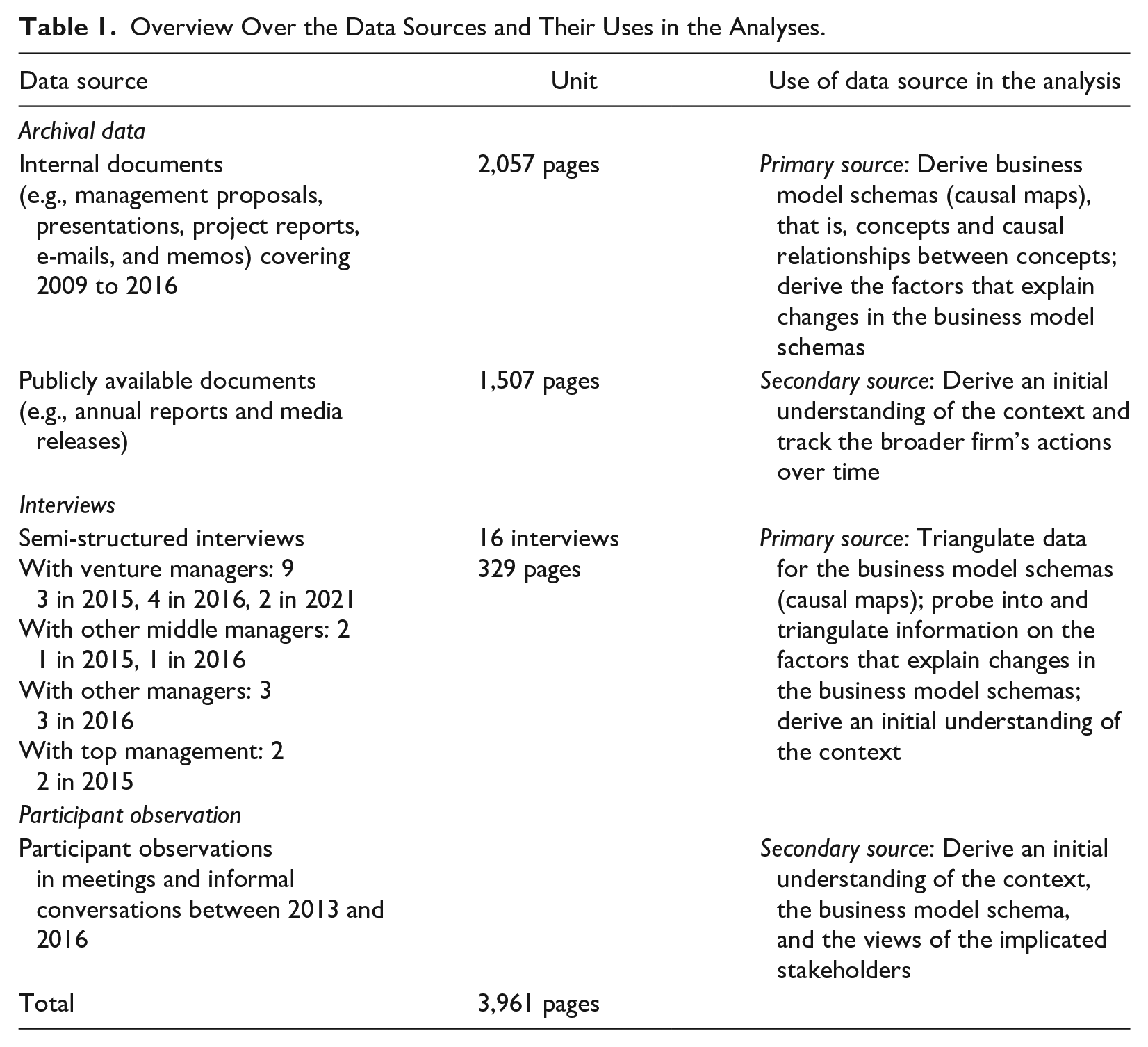
The interviews lasted about 1 hr and were transcribed. They started with open questions that were gradually refined. They asked the interviewees to tell the story of how the team’s thinking about the business model evolved. The questions progressed to asking how specific elements changed or to explain why these changes occurred. To identify our key informants, we adopted a snowball sampling approach (Miles & Huberman, 1994). Because business model change involves the “continuous interactions of the respective firms’ key actors over a sustained period” (Wirtz et al., 2016, p. 46), we ensured, first, that we included informants from different hierarchical levels in the organization. This included EMOB managers, senior managers, and other business units’ managers. Second, they represented the different business units, such as market, marketing, distribution, and new technologies. Third, they were either retrospective or real-time. We guaranteed confidential treatment of the informants’ identities so as to ensure their statements’ veracity (Miles & Huberman, 1994) and to avoid any informant bias (Eisenhardt & Graebner, 2007). We could draw on a rich dataset that enabled us to trace the changes in managerial thinking over time and to probe the factors that could explain changes in thinking.
Data Analysis and Emerging Concepts
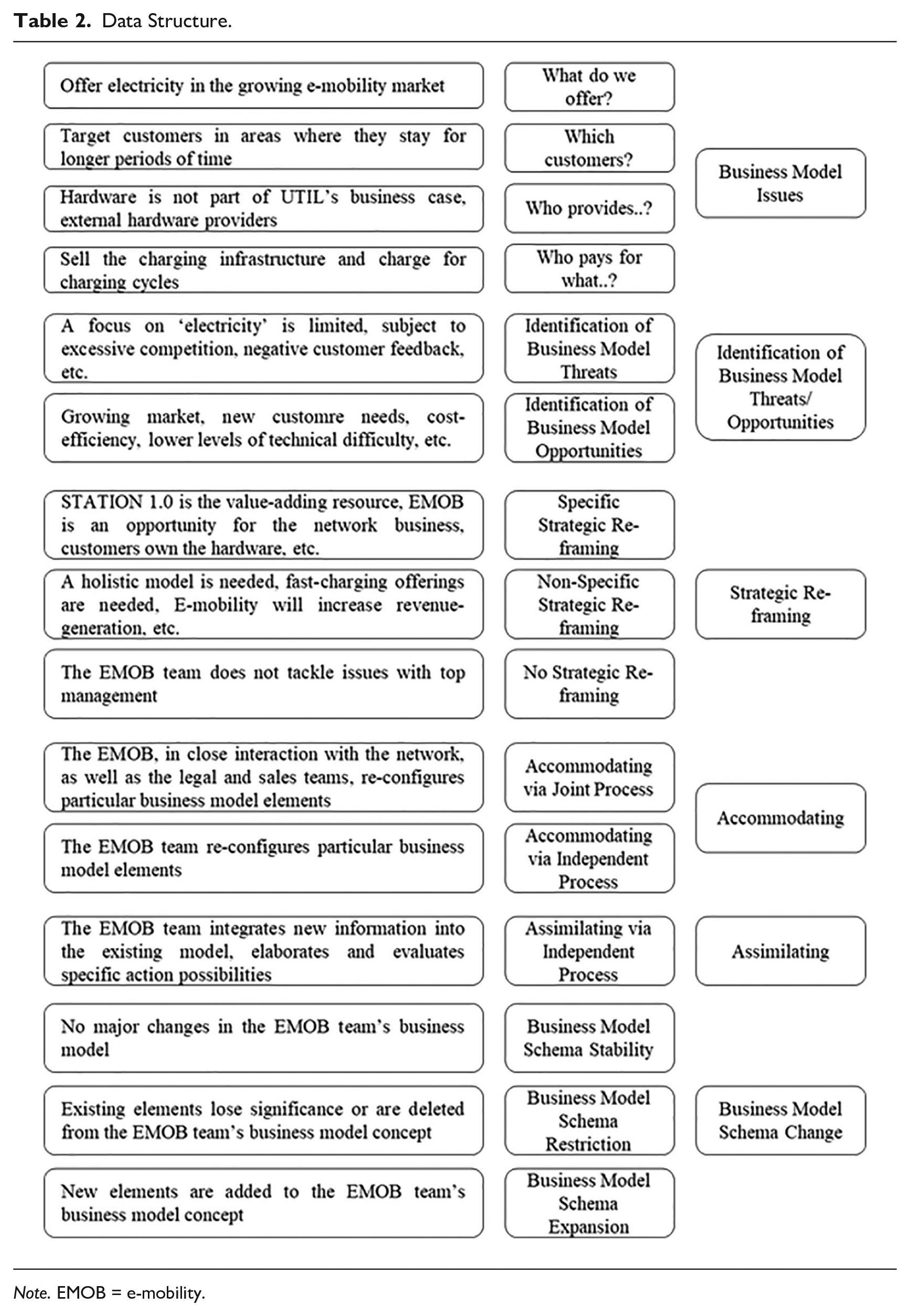
Our data analysis was iterative. We circulated back and forth between the data, the literature, and the emerging theoretical constructs of our data structure (see Table 2) (Gioia et al., 2012). The analysis had two phases, focused on (a) the business model schema change and (b) the triggers and mechanisms that led to the business model schema change.
Data Structure.
Note. EMOB = e-mobility.
Business Model Schema Change (vs. Stability)
Our data analysis started with a detailed analysis of EMOB’s business model schema and the changes it underwent over time. Although the literature has offered different business model typologies (e.g., Baden-Fuller & Mangematin, 2013; Osterwalder & Pigneur, 2010), we were interested in the ICV managers’ understandings of the ICV’s business model in line with our interpretive lens. We adopted a causal mapping approach that centered on the patterns of cause-effect relationships in the ICV managers’ understandings of EMOB’s value creation and value capture (see Furnari, 2015; Huff, 1990). Such maps represent “graphical representations of the structure of individuals’ idiosyncratic belief systems in a particular domain.” (Nadkarni & Narayanan, 2005, p. 9).
First, we performed a content analysis following established research procedures. We focused on concepts and their interrelationships (see Barr & Huff, 1997; Barr et al., 1992). To illustrate, our textual data stated: “As soon as we couple charging with electricity delivery, we get in the way of other utilities.” (8:42). We coded two concepts (the first “combining charging with electricity [ALL GREEN]” and the second, “intensified competition”) and the causal link between the two (“as soon as”), which we represented as + signifying a positive relationship. To ensure that they don’t represent merely individual statements, but the shared schema of the ICV team (our unit of analysis), we only created a code if there was corroboration by multiple sources of evidence. To structure the data, we denoted the first concept as referring to EMOB’s value proposition, following the business model elements in the literature (Baden-Fuller & Mangematin, 2013). Since managers concentrated on one element at a time, we crafted distinct maps for each. We coded instances of business model schema change when we observed a shift in the nature of a business model element. For instance, we coded the shift from the slow-charging segment to one that includes the fast-charging segment as a business model schema change. In contrast, a simple addition of restaurants to the existing hotel customers within the slow-charging segment was not coded as a business model schema change. This led us to inductively derive six changes in the business model schema, two for the value proposition and value chain, and one for the customer segment and monetization, respectively.
Second, to uncover not only what changed, but how the business model schema changed and the triggers, we used open-coding (Glaser & Strauss, 1967). We developed a two-order code scheme (Gioia et al., 2012), where we gradually turned to the academic literature to relate the concepts that emerged from our data to theoretical concepts (see Table 2). We uncovered two business model schema change types: A business model schema expansion occurred when an existing schema was accommodated by adding or replacing concepts and/or relationships, while a business model schema restriction occurred when concepts and/or relationships were eliminated. These changes contrasted with the absence of business model schema change when an existing schema was mobilized—referred to as business model schema stability. For each case, we bracketed distinct temporal episodes (Miles & Huberman, 1994; Skocpol & Somers, 1980), which enabled us to observe and compare episodes of business model schema stability and episodes of business model schema change.
Triggers of Business Model Schema Change (vs. Stability)
Third, to uncover when business model schemas changed, we used open-coding to identify the triggers (cf. Kirtley & O’Mahony, 2020) that prompted the ICV managers to make a change in their business model schema. We realized that, before each change in a business model element, the ICV managers considered specific issues, which triggered the questioning of the business model elements that were currently in place. We refer to business model issues as developments either inside or outside the ICV that are likely to strongly impact on its ability to meet its business model objectives (cf. Ansoff, 1980, p. 431). We found that these identified business model issues involved the interrogation of the different business model elements, such as the value proposition (e.g., What do we offer?), the value chain (e.g., Who provides the hardware?), customer segment (e.g., Which customers?), monetization (e.g., Who pays for what?). First, we coded triggers by the substantive content of these business model issues, for instance, competition, costs, technological trends, and/or legal risks. Second, we coded these business model issues’ perceived favorability (opportunity vs. threat) from the shared perspective of the ICV managers, because it may trigger different responses (Dutton & Jackson, 1987). An opportunity is a business model issue with a favorable impact or a potential gain for the ICV, while a threat is a business model issue with an unfavorable impact or a potential loss for the ICV (Jackson & Dutton, 1988). Third, we coded triggers by the ICV managers’ temporal focus (i.e., past, present, or future), as it may elicit different responses (Nadkarni & Chen, 2014). Fourth, as we realized the implication of multiple management levels, we coded triggers by who (i.e., ICV, top, and other business units’ managers) was implicated in the issues’ resolution. Fifth, we used case-ordered tables (Miles & Huberman, 1994) to map the different triggers and schema changes so as to identify patterns between the two (see Table 3). This led us to focus on the distinct triggering role of the ICV team’s identified business model issues.
Types of Business Model Schema Change and Triggers.
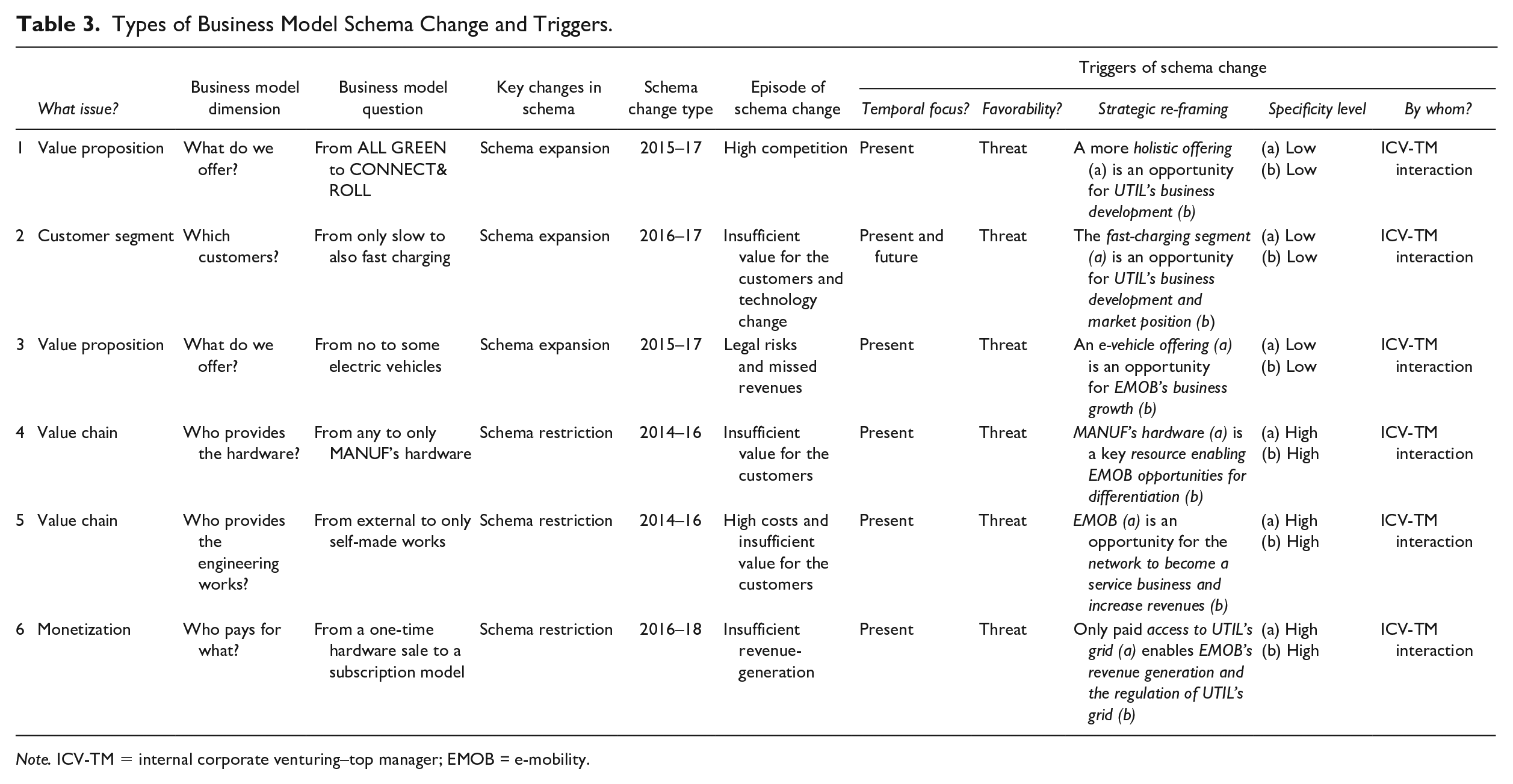
Note. ICV-TM = internal corporate venturing–top manager; EMOB = e-mobility.
Sixth, we returned to the data to uncover how the ICV team went about the resolution of these business model issues. Toward this aim, we crafted case narratives (see Burgelman, 1983) for each business model schema change to trace the process, that is, the causal ordering of the constructs and the mechanisms (Rohlfing, 2012) that led either to business model schema changes (expansion vs. restriction) or to business model schema stability and to spotlight similarities and differences across the six cases. Here, we realized the role of what we came to refer to as strategic re-framing as the key mechanism for resolving the ICV team’s identified business model threats within ICV-TM interactions. Strategic re-framing is the active re-formulation of the definition of a given situation within ICV-TM interactions. 2 In our case, they re-formulated the identified business model threats into business model opportunities in these interactions. These re-framed business model opportunities created expectations (cf. Tannen, 1979) of the ICV’s strategic goals for the firm, such as increasing the network business’s revenues, EMOB’s strategic differentiation in the market, adapting to anticipated market and technological developments, etc. Importantly, strategic re-framing greatly varied regarding the specificity level (from low to high). As we found, specificity is a semantic property of noun phrases, such as the re-formulations of the identified business model threats we observed. A high (low) specificity level refers to assertions between particular (any) concepts, for instance, between particular business model and strategic concepts. In other words, specificity differentiates between concepts that are unique in a given situation and those that are not (Enç, 1991; Frawley, 1992) or between concepts for which the referent’s identity is certain (Von Heusinger, 2002). Specificity may include implicit or explicit case markings in noun phrases, such as a “certain” concept (Enç, 1991). To illustrate, the concept ‘MANUF’s hardware’ has higher specificity than “suppliers” hardware,’ because the former refers to the unique supplier MANUF (the identity is certain), while suppliers does not refer to any de facto entity (the identity is uncertain). Also, the concept ‘the network team’s revenues’ (the identity is certain) has higher specificity than UTIL’s “business development,” which refers to different possible entities within UTIL or to UTIL as a whole (the identity is uncertain).
To dig deeper into the mechanisms through which the strategic re-framing in ICV-TM interactions may have provoked the identified changes in the ICV team’s business model schema, we further examined our data to identify distinct practices. We discovered that strategic re-framing not only shaped the ICV team’s independent accommodation of the business model elements. Importantly, it also shaped the ways in which the ICV team interacted with the other business units—the ICV-BUM interactions. They then engaged in a rather joint accommodation of the business model elements with the aim to fulfill the business model opportunities that have been advanced in the strategic re-framing. We grouped the schema accommodation practices into categories, depending on whether the ICV team performed these practices independently or jointly with the other units. Accommodating is referred to here as the practice of re-configuring particular business elements in the business model schema with the aim to fulfill the advanced business model opportunities. It contrasts with assimilating, which is the practice of integrating new information into the existing business model schema. We again replicated the insights across the cases and validated our insights with our informants. As a result of our analyses, we reached a state of theoretical saturation (Gioia et al., 2012) where the derived theoretical concepts created a coherent theoretical framework of business model schema change in ICV.
Findings
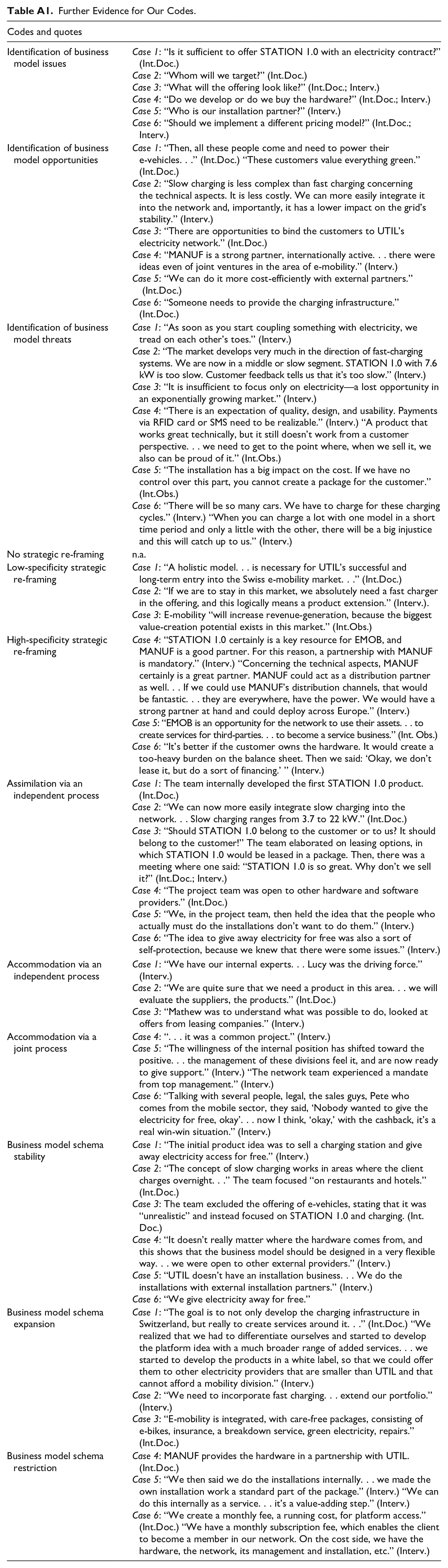
Figure 1 represents our inductively derived theoretical model of business model schema change in ICV, which we will now present. It is based on the key constructs of our data structure, as presented before. First, we introduce the path to business model schema stability. Episodes of schema stability could be observed across the six cases. They preceded episodes of schema change and lasted on average 2.6 years. We then introduce the path to business model schema change. Episodes of schema expansions and of schema restrictions could be observed in three cases of business model schema changes each—Cases 1, 2, and 3 and Cases 4, 5, and 6, respectively. They lasted on average 2 years. To present our findings, we focus on a selected set of cases—Cases 1 and 2 as well as 4 and 5. Appendix Table A1 provides further evidence for the six cases. Appendix Figures A1 and A2 3 provide illustrations of the business model schemas.
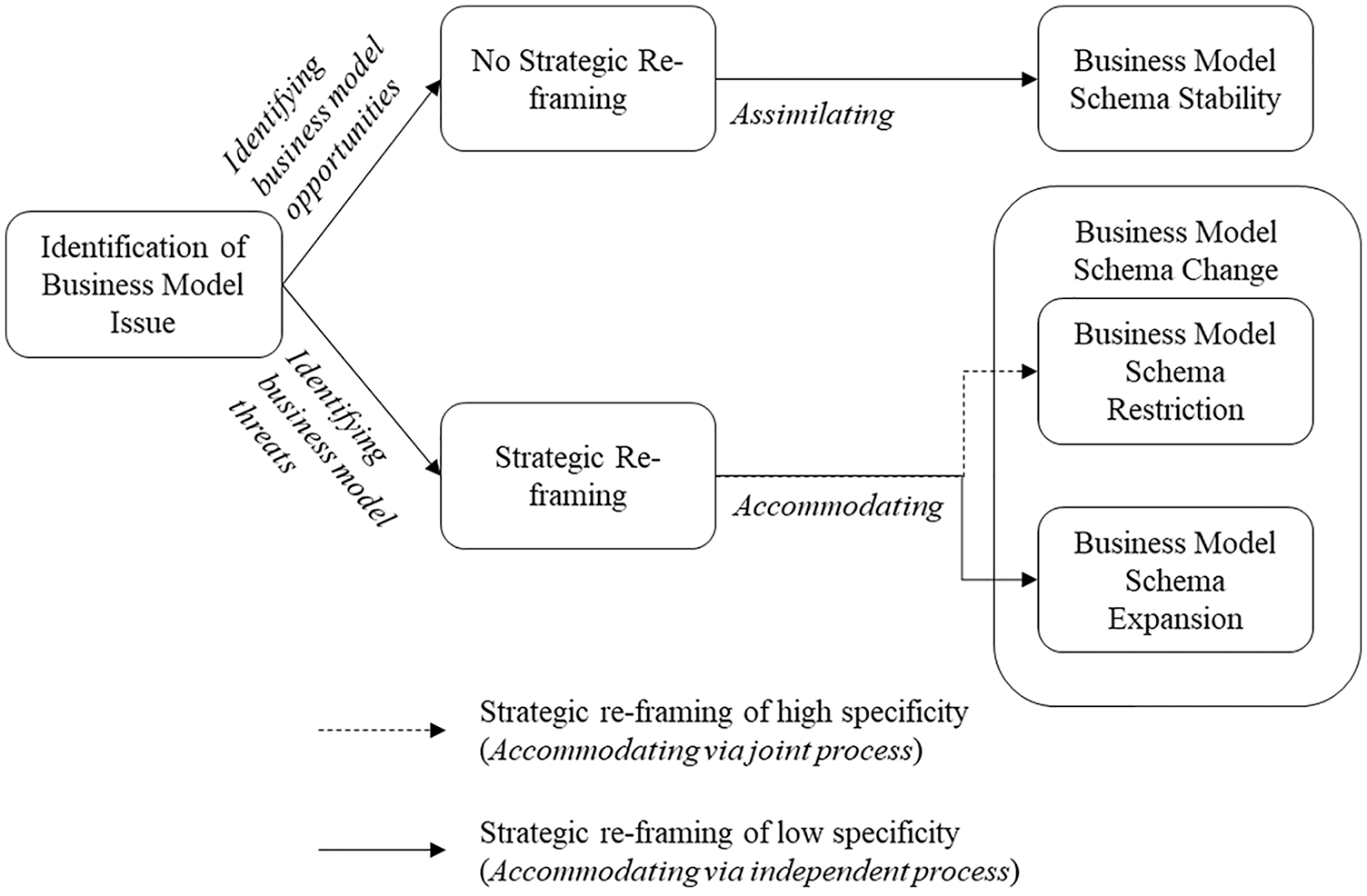
Strategic Re-Framing and Business Model Schema Change in ICVs
The Path to Business Model Schema Stability
Business Model Issues and No Strategic Re-Framing: Identification of Business Model Opportunities
As we found, when ICV managers identified business model opportunities, it led to no strategic re-framing.
Case 1: The ALL GREEN Value Proposition
Since its inception, the EMOB team advanced that there was an “opportunity” to seize for UTIL in the then-nascent Swiss e-mobility market. “E-mobility will come. It will be a huge market. UTIL wanted to seize this trend early on. It was very visionary,” as a team member noted. The team largely assumed that Swiss e-mobility customers had strong ecological motives and strong preferences for environmentally friendly products, stating that the Swiss e-mobility market valued “everything green.” (Int.Doc.). Unsurprisingly, electric vehicles needed to be fueled with green electricity. On the basis of this continued assumption, EMOB managers focused on the “ALL GREEN” value proposition. The offer entailed a charging station (STATION 1.0) with a premium green electricity contract that comprised a price surplus and a certificate to bind its customers to its electricity products—an “all green electricity offering for mobility.” (Int.Doc.). This identified opportunity was not greatly discussed but was largely taken for granted in management meetings.
Case 2: The Slow-Charging Customer Segment
Relatedly, the EMOB team conceived of the slow-charging (3.7–22 kW) customer segment as an “opportunity” for EMOB (Int.Doc.). This focus was the most profitable for the firm, had the lowest infringement to the grid’s stability, and was seen as a more accessible or cheaper alternative for customers than fast charging (Interv.). This basic opportunity was not greatly discussed but was widely accepted.
Case 4: Sourcing Any Hardware in the Value Chain
From the outset, the EMOB team relied on the any hardware assumption, stating that “it doesn’t really matter from whom the charging infrastructure originates” (Interv.). Hardware should be sourced from external providers, because “hardware development did not fit with the business case.” (Interv.). “Opportunities” existed in sourcing it more cost-efficiently externally, and in ways that enabled staying “in line with the market” (Interv.), which was expected to further develop in terms of “expectations for quality, design, and usability of the charging stations.” (Interv.). As EMOB managers stated, “we held the view that it was not necessary that we would do it.” The opportunities perceived in the sourcing of charging stations from different providers were widely accepted.
Case 5: Sourcing External Engineering Works in the Value Chain
Concerning the engineering works, such as the installations of the charging points and the network connections, in 2013, the EMOB team assumed that “installations would not be realized internally.” (Int.Doc.). This followed from the offers EMOB received from the network team. Although these installations were highly comparable to the daily business of UTIL’s network business, which owned three operation centers, “[t]he network people were not happy to do something like this”), because they preferred their habitual remit (Interv.). In turn, the offers the EMOB team received from external providers represented “opportunities” for more cost-effective installation works. EMOB would source the installations from external providers that were soon considered “indispensable elements of the business’s success” by the EMOB team (Interv.).
No Strategic Re-Framing and Business Model Schema Stability
As we found, when ICV managers maintained business model opportunities, they did not engage in strategic re-framing in ICV-TM interactions. They assimilated information in line with the existing schema. The business model schema remained fairly stable as a result.
Case 1: The ALL GREEN Value Proposition
The EMOB team concentrated on how it could develop products on the basis of this proposition and acquire its first customers (Int.Doc.). “The initial product was, at the end of the day, to sell charging stations and to offer free electricity access,” as a team member noted. It sought to develop a premium electricity product, target the premium segment, specifically, from the local hotel sector with three different electricity offerings (Interv.). This basic ALL GREEN proposition did not undergo any major changes.
Case 2: The Slow-Charging Customer Segment
With its focus on the slow-charging customer segment, it focused on its implementation (Int.Doc.). They considered the different location types where customers would spend several hours (e.g., restaurants, hotels), so as to fit the charging cycles, which would take several hours. This focus on the slow-charging segment remained fairly stable.
Case 4: Sourcing Any Hardware in the Value Chain
Based on the any hardware schema, the EMOB team then focused on its implementation. They argued that “there are already numerous manufacturers.” (Interv.). We need to “choose the right suppliers, because maybe the good thing of our business model is that it can work also with other hardware.” (Interv.). MANUF’s hardware should be integrated alongside alternatives (Interv.). “It can also be some other provider.” (Int.Doc.). Also, the any hardware schema did not greatly change.
Case 5: Sourcing External Engineering Works in the Value Chain
Relatedly, based on the benefits of the external installation works, the team then concentrated on the implementation by developing partnerships with a network of Swiss installation firms (Int.Doc.).
The Path to Business Model Schema Change
Business Model Issues and Strategic Re-Framing: Identification of Business Model Threats
As we found, when ICV managers identified business model threats, it led to strategic re-framing within ICV-TM interactions, in which the identified business model threats are re-formulated into opportunities for business elements to fulfill the firm’s strategic goals.
Case 1: The ALL GREEN Value Proposition
By 2015, the EMOB team identified “threats” relating to the ALL GREEN value proposition. Because ALL GREEN was only a limited “electricity offering” (Interv.), it threatened its success. With a mere electricity offering, one would step into the footholds of other utilities, which whom one would face strong competition (Int.Doc.). Furthermore, the ALL GREEN label involved a labeling issue 4 ; as an interviewee stated: “Three of these agencies said: sorry, cannot work. . . for language reasons.” After raising the identified threats to top management, the EMOB team was invited to a management meeting in 2015. As an interviewee noted: “We realized that [the ALL GREEN proposition] was not ideal. . . it made sense to move away from it.” In the meeting, it was concluded that more than electricity was needed: “A holistic approach that would go well beyond the ALL GREEN concept would be central to a successful and long-term market entry in Switzerland.” (Interv.).
Case 2: The Slow-Charging Customer Segment
Around 2016, the EMOB team identified “threats” to the business model success with the mere focus on slow charging. This focus would not fulfill customers’ expectations (e.g., overly long charging cycles) and risked not living up to the anticipated technological developments. The EMOB team consulted with top management. In these ICV-TM consultations, it became clear that, despite the uncertainties surrounding which charging technologies will prevail in the future and the higher anticipated costs (Int. Doc.), a focus on fast charging was necessary to secure UTIL’s position in the future e-mobility market. A focus on fast charging would enable UTIL to better seize the anticipated developments in fast charging technologies and secure the long-term position in the market.
Case 4: Sourcing Any Hardware in the Value Chain
By 2014, the team realized that the sourcing of external providers’ hardware provoked serious issues regarding the customers’ “expectations for quality, design, and usability of the charging stations,” as interviewees stated: Product management has to take over a lot of the work. . . at the end of the day, for a product that technically works fine—that is great!—but eventually it does not fulfill the cost and the customers’ experience. It does not fulfill the customers’ expectations.
In the EMOB team’s interactions with top management, they “realized that [one] had already invested so much money” that would be sunk costs (Interv.). Instead of emphasizing the weaknesses of the key provider’s—MANUF’s—hardware, they now emphasized the opportunities that would emerge if one entered into a stronger partnership with MANUF and if one further adapted MANUF’s hardware to EMOB’s specific needs. One could then deepen EMOB’s integration into the value chain. With an own stake in the manufacturing, UTIL could seize important revenue and differentiation opportunities. In these ICV-TM interactions, it was concluded that, from now on, EMOB should cooperate more closely with MANUF (Int.Doc.): “MANUF’s hardware” is a “key value-adding resource” for EMOB “with substantial impacts on the revenue streams” (Interv.).
Case 5: Sourcing external engineering works in the value chain. In a related vein, in around 2014, the EMOB team identified cost and customer value issues that resulted from sourcing engineering works from external partners, as this interview statement illustrates: [Customers] have to spend a lot of money on the installation. If we ask six-thousand or more for the installation, they can be scared off and they may have a problem with it.
Again, the EMOB team consulted with top management on the identified issues. In these meetings, it was concluded that the internal installations should constitute a “critical value-adding step in the value chain.” Realizing installations internally rather than externally could create opportunities for differentiation and for revenues in the e-mobility market. Only then would it contribute to UTIL’s envisioned strategy of “becoming a service company” (Int.Doc.).
Lower-Specificity Strategic Re-Framing and Business Model Schema Expansion
We found when strategic re-framing in the ICV-TM interactions had a lower specificity, it triggered the ICV managers to accommodate the existing business model schema independently (without much interaction with the other business units’ managers), which led to schema expansions.
Case 1: From ALL GREEN to CONNECT&ROLL. The re-framed issue, suggesting that only a holistic approach would ensure the nonspecific goals of “UTIL’s future business development and growth” (Int.Doc.), acted as a goal for the EMOB team’s refinement of the EMOB business model schema. It led the EMOB team to elaborate a new value proposition on this basis. The team came up with the idea of developing a platform for holistic charging solutions, which they labeled CONNECT&ROLL. As illustrated below, they further expanded the platform’s value proposition. They shifted away from the mere focus on the STATION 1.0 charging station, and considered a much wider range of possible charging infrastructures as well as a range of different services that would be connected to it.
We referred to an all-included care-free package. The client pays a little more for the electricity and gets everything, really. . . Suddenly, the entire business model focused on the network of infrastructure and services, not only on STATION 1.0. (Interv.)
Case 2: From Slow to Fast Charging
The re-framed issue, which suggested that a focus on fast charging was necessary to secure UTIL’s position in the future e-mobility market, again served as a trigger and as an expectation for the managers to achieve with EMOB. Because the focus on fast charging did not specify any specific technologies or segments among the available ones, it was of low specificity level. The team recognized the need to expand its current focus on slow charging, so as to also include fast-charging segments. It led the team to explore the different ways in which different fast charging technology standards could be integrated by conceiving of various alternatives in different segments, that is, the public or semi-public charging infrastructure, or in service stations (Int.Doc.).
Higher-Specificity Strategic Re-Framing and Business Model Schema Restriction
We found when strategic re-framing had a higher specificity, it triggered the ICV managers to accommodate the existing business model schema jointly with the managers of the other business units in ICV-BUM interactions, which—in turn—led to schema restrictions.
Case 4: From Any Hardware to Only MANUF’s Hardware
The re-framed issue in interactions between the top management and ICV management suggested that “MANUF’s hardware is a key value-adding resource” for EMOB “with substantial impacts on the revenue streams. . . MANUF’s hardware and software solutions need to be taken” (Interv.; Int.Doc.). Despite the EMOB team’s skepticism about MANUF’s hardware, it now put forward that “MANUF’s hardware is a unique selling proposition” (Interv.). With this specific focus on MANUF’s hardware rather than that on any provider, the EMOB team began interacting with the managers from other business units in the organization. The specific focus on MANUF’s hardware created a shared vision and was experienced as a sort of mandate to elaborate for both the EMOB managers and the other business units’ managers. Together with the other business units, the EMOB team began to elaborate how exactly UTIL could manufacture the hardware based on MANUF’s technical components (Int.Doc.) and still retain the industrial rights: “We do it ourselves, have it in our own hands, want to sell it ourselves. . . that was what crystallized in the end” (Interv.). Thus, EMOB had restricted its schema about the hardware’s origin from one focusing on any external hardware provider to one fully focused on MANUF as a crucial and value-adding partner in the own hardware manufacturing. This partnership allowed EMOB to pursue a deeper integration into the value chain. Other providers were no longer considered.
Case 5: From External to Only Self-Made Installations
We found that the issue that was re-framed as “installations should be realized internally” for differentiation and revenue-generation reasons (Int.Doc.) shaped the EMOB team’s thinking about EMOB’s value chain configuration. On this basis, the team again solicited interactions with the managers from the network team based in another business unit. They now revised their initial disinterest in EMOB and became more collaborative with the EMOB team. For the network team, “the pressure had massively increased” (Interv.). It now had a mandate to contribute to EMOB’s installations and acknowledged that installations could be attractive, as the following illustrates: Now suddenly, engineering is particularly interested in offering services to third-parties. They have the mandate for it and see it as a possibility. This is really great, because it enhances the internal pressure to do it and to support it.
On the basis of this re-framed issue, the EMOB and network teams elaborated on the specificities of the internal engineering works, including the installations, the maintenance of the charging points, the network planning, and connection in selected areas (Int.Doc.). Now, one drew on “internal competences and resources to add value in the chain,” as a team member noted. These closer interactions with the network team allowed the EMOB team to narrow its focus to only the integration of the internal installations and again to envision a deeper integration into EMOB’s value chain. External providers were no longer considered.
A Theory of Strategic Re-Framing and Business Model Schema Change in ICV
As developed, our inductive findings suggest the critical role of strategic re-framing, which occurred within ICV-TM interactions, triggering changes in the ICV team’s business model schema. We will now theorize the proposed relationships between the key constructs of our inductively derived theoretical model.
Business Model Issues and Strategic Re-Framing
As our inductive findings suggest, depending on whether the ICV managers identify business model threats or business model opportunities, it either triggers or does not trigger strategic re-framing within ICV-TM interactions. When ICV managers identified business model opportunities, they may have remained in a more automatic mode of applying the existing schema (cf. Louis & Sutton, 1991) with little questioning of the existing business model elements.
In turn, as we found, when ICV managers identified business model threats, it triggered strategic re-framing in ICV-TM interactions. In this case, they may have identified a discrepancy and experienced tension as well as a state of arousal (cf. Weick, 1995). Rather than applying the existing schema, they may have switched to a more active mode of questioning and examining the existing business model schema (cf. Louis & Sutton, 1991). As we found, this active interrogation of the existing business model elements took place within ICV-TM interactions. In particular, it is through the strategic re-framing in ICV-TM interactions that the discrepancy caused by the identified business model threat may have been overcome. Here, the identified business model threats were actively re-formulated into business model opportunities, suggesting that particular business model elements were expected to represent opportunities to achieve the firm’s strategic goals. Accordingly, strategic re-framing emphasized more supportive relationships that outweighed the discrepancy and relieved the discomfort created by the business model threats. Strategic re-framing changed the definition of the situation (cf. Hedberg, 1981) from one that emphasized the negative consequences of particular business model elements to one that emphasizes the possible positive effects of particular business model elements on the corporate objectives. Also, psychology research has advanced that positive assertions, which may represent positive illusions, have an adaptive role when people face threats or negative situations. They may increase optimism, perceptions of control and mastery, and commitment to a course of action (Taylor, 1989; Taylor & Brown, 1988), which may be stronger when it is public, because people feel bound to it (Cialdini & Goldstein, 2004; Salancik, 1977).
Strategic Re-Framing and Business Model Schema Change
As we found, when strategic re-framing is present, it triggers change in the ICV managers’ business model schema, which involves both schema restrictions and expansions. Each schema restriction and expansion may contribute different facets of the schema’s change. In turn, when strategic re-framing is absent, ICV managers engage in assimilating practices, which lead to business model schema stability.
Also, we found that strategic re-framing concerning its specificity level (from low to high). Whether a schema is restricted or expanded depends on the strategic re-framing’s specificity level in the ICV-TM interactions. As we found, it is because the strategic re-framing’s specificity level induces distinct informative and directive effects that it provokes distinct accommodating practices as a result. In particular, these effects critically shape whether the accommodating practices are a more independent endeavor by the ICV team or a joint endeavor within ICV-BUM interactions. Both high- and low-specificity strategic re-framing may be necessary for a schema’s change in ICVs.
Specifically, our inductive findings led us to suggest that higher-specificity strategic re-framing likely provokes restrictions in the ICV managers’ business model schema. Such higher-specificity strategic re-framing was more focused on unique business model concepts and on the firm’s unique strategic goals. Because this higher-specificity strategic re-framing may provoke distinct informative and directive effects, as we found, it led the ICV managers to engage in accommodating practices jointly with the other business units’ managers.
First, higher-specificity strategic re-framing may have a higher informative effect than lower-specificity strategic re-framing. By representing an unambiguous reality of how things are (cf. Weick, 1995), it alerts managers to remain attentive to the unique business model concept and the firm’s unique strategic goal. It increases the ICV managers’ attention focus (cf. Ocasio, 1997) on the unique business model concept (e.g., internal engineering works) and on its unique goal (e.g., foster the network business’s performance). This narrows the alternatives they had considered before (e.g., any providers’ engineering works). It also has a filtering effect on incoming information (cf. Ocasio, 1997). Similarly, research has suggested that more specific claims provide more detailed information (Darley & Smith, 1993). They draw more attention to them and they keep the audience’s attention longer, as a result of which greater importance is attached to them (Mackenzie, 1986; Robinson & Eilert, 2018).
Second, higher-specificity strategic re-framing may not only have an informative but also a higher directive effect than lower-specificity strategic re-framing. It gets the audience to do something (see Searle, 1979; Vanderveken & Susumo, 2001). It provoked the ICV managers or the managers from the other business units who otherwise would have disregarded or downplayed the unique business model concept to recognize it and to commit to it. In this vein, research has suggested that a claim’s specificity level increases its credibility (Ganz & Grimes, 2018) and induces more favorable perceptions than lower-specificity claims (Maronick & Andrews, 1999). To illustrate with our findings, while the ICV managers initially downplayed MANUF’s hardware, the assertion that only MANUF’s hardware is a value-adding resource for EMOB led the ICV managers to change their attitude from disregarding to recognizing this unique hardware’s value potential and to elaborating on how it could be levered to achieve the unique strategic goals. The ICV managers experienced it as a mandate to re-configure the EMOB business model schema so as to achieve the proposed opportunities.
Third, similarly, higher-specificity strategic re-framing induced greater levels and more focused interactions between the ICV managers and the managers from the other business units, because they now shared a reality (cf. Weick, 1995). They were prompted to help elaborate how exactly the unique business model concept could fulfill the firm’s unique goals. To illustrate, although the EMOB team initially faced resistance from the internal networks department, the assertion that only internal engineering works will generate revenues for the network team increased the network team’s commitment to conjointly elaborate, with the EMOB team, how the internal engineering works could be integrated into EMOB’s offering. Not only the ICV managers but also the other units’ managers, experienced it as a mandate to re-configure the EMOB business model schema so as to achieve the proposed opportunities. Overall, this schema change resembled a joint process, in which the ICV team and the other units’ managers jointly engaged in accommodating practices to re-configure the business model schema in ICV-BUM interactions.
In a related vein, our inductive findings led us to suggest that lower-specificity strategic re-framing likely provokes expansions in the ICV managers’ business model schema. Such lower-specificity strategic re-framing was focused on fairly generic business model concepts and on their impacts on the firm’s nonunique strategic goals. Because this lower-specificity strategic re-framing may provoke distinct informative and directive effects, as we found, it led the ICV managers to engage in accommodating practices fairly independently (i.e., with little interaction with the other units’ managers).
First, lower-specificity strategic re-framing may have a lower informative effect, which may expand the ICV managers’ attention scope (cf. Ocasio, 1997). By emphasizing nonunique business model concepts (e.g., e-mobility offerings) as well as their relationships to nonunique strategic goals (e.g., UTIL’s market position) that support several possible interpretations at the same time, it represents a more ambiguous reality. This triggers the need for ICV managers to engage in further meaning-making in an attempt to reduce the experienced ambiguity (cf. Weick, 1995). As we found, in such circumstances, ICV managers strongly expanded the alternative concepts and the relationships they considered in an attempt to understand how the business model could benefit the firm’s strategic objectives that were formulated in a nonspecific way. For instance, it led them to elaborate how the different e-mobility offering types (i.e., the identity of the e-mobility offering is uncertain)—such as e-vehicles categories, such as e-bike, e-scooter, e-car, and charging infrastructures and services—could allow UTIL to secure its market position in different market segments.
Second, lower-specificity strategic re-framing may have a lower directive effect on the other business units than higher-specificity strategic re-framing, but a greater directive effect on the ICV managers. Because it involves greater ambiguity and more room for interpretation, it may trigger lower recognition and commitment by the other units’ managers, who—as we observed—felt less concerned. In turn, it may trigger the need that the ICV managers reduce the experienced ambiguity (cf. Weick, 1995) by themselves with the aim of advancing the ICV initiative inside the organization. As we observed, the ICV managers engaged in more independent accommodating practices of the business model schema.
Third, as we found, lower-specificity strategic re-framing may trigger less focused and overall lower levels of ICV-BUM interaction. The schema accommodation resembles a more independent process by the ICV team, since it fails to engage the other unit managers. As we found, also lower-specificity strategic re-framing triggered the ICV managers to engage in accommodating practices of their business model schemas. Specifically, it led to schema expansions, such that they involved a greater breadth of nonunique business model concepts (e.g., different e-vehicle offering types) and their relationships to nonspecific corporate strategic goals (e.g., UTIL’s business development).
Discussion
Based on our qualitative and embedded case study of the changes in the ICV managers’ business model schema for a novel sustainable technology, we have developed a theoretical model of schema change. It emphasizes the triggering role of strategic re-framing that takes place in ICV-TM interactions and theorizes its impacts on the changes that it provokes in the business model elements, which we referred to as the business model schema change. As we found, the latter involves both schema expansions and schema restrictions. Furthermore, we found that, depending on the strategic re-framing’s specificity level, it may provoke distinct accommodating practices, which may take place either independently by the ICV managers, or jointly within ICV-BUM interactions. In turn, they lead to either schema expansions or restrictions. Broadly, our findings suggest that an ICV’s business model schema change is a semi-autonomous process that involves both independent and joint endeavors of an ICV with multiple managerial levels. Our study contributes to the research into managerial cognition, business models (for sustainability), and ICV.
First, our findings contribute a more integrative model of schema change to the managerial cognition literature. The latter emphasized the role of either autonomous, experience-based (e.g., experiential learning, expertise, or analogies) or top-down-induced mechanisms (e.g., conflict, comparison, or conversion; see Balogun & Johnson, 2004; Bingham & Kahl, 2013; Dane, 2010; Gröschl et al., 2019; Poole et al., 1989; Walsh, 1995). As we find, schema change is a semi-autonomous process that involves both joint endeavors within ICV-BUM interactions, as well as independent or autonomous endeavors by ICV managers. Relatedly, our study contributes to the cognitive schema lens on business models by advancing a theoretical model of business model schema change (see Baden-Fuller & Mangematin, 2013; Berends et al., 2016; Martins et al., 2015). Our theoretical model emphasizes strategic re-framing in ICV-TM interactions as a key trigger of business model schema change. As we found, strategic re-framing helped overcome ICV managers’ negative definition of the situation—the identified business model threats. Furthermore, depending on the strategic re-framing’s specificity level, it may provoke either rather joint or fairly independent schema accommodating practices, which—in turn—shape whether schemas are restricted or expanded. As we argued, this is so because the strategic re-framing’s specificity level provokes distinct informative and directive effects. Thus, strategic re-framing foregrounds not only the critical role of the ICV-TM interactions in an ICV’s business model schema change but also the effects it provokes in ICV managers and on their interactions with the other business units’ managers.
Moreover, with our focus on strategic re-framing, we contribute a novel mechanism to the literature on framing (see Cornelissen & Werner, 2014; Dewulf & Bouwen, 2012; Kennedy & Fiss, 2009). As we found, it is through strategic re-framing that the identified business model threats are re-formulated as business model opportunities. Thus, issue framings may be less stable than may typically be assumed. As we have shown, negative definitions of situations may be overcome. Specifically, social interactions—in our case, ICV-TM interactions—may play a critical role in such strategic re-framings. Furthermore, as we found, strategic re-framing provokes distinct changes in managers’ business model schemas. As we found, it sets distinct expectations (cf. Tannen, 1979), which may act as a critical trigger for provoking change. It is how managers frame their problem environment, which shapes whether and how they change their business model schemas. Broadly, our model illuminates the interplays between language and cognition (cf. Weick, 1995) by showcasing the formative effects that strategic framings in ICV-TM interactions can have on ICV managers’ schema change.
Second, our theoretical model adds to the literature on schemas of the business case for sustainability (Hahn et al., 2014; Hockerts, 2015) and on their change (Gröschl et al., 2019). Through strategic re-framing, the emerging business model concepts for a sustainable technology are coupled to the corporate strategy concepts—in our case, within ICV-TM interactions. As we found, strategic re-framing creates a critical momentum that triggers the business model schema’s accommodation through both independent and more collective practices inside the organization. For the latter, it is a critical means through which the ICV managers can overcome the internal resistance, instead gaining wider recognition by and commitment from other business units’ managers to further develop the business model schema. Furthermore, we have shown that incumbents may in fact overcome the challenges associated with the lack of expertise and market attractiveness of sustainable technologies (Johnson & Suskewicz, 2009). Although many studies have foregrounded incumbent firms’ path dependence in the face of sustainable technologies (Hockerts & Wüstenhagen, 2010; Unruh, 2000), others have suggested vicarious learning’s role (Bohnsack et al., 2014). We add the ICV’s role in advancing novel business model schemas for sustainable technologies. Thus, at a broader level, these findings contribute to the literatures on business model innovation in large established firms (see Snihur & Wiklund, 2019).
Third, our findings have extended the ICV literature. First, the proposed theoretical model sheds much-needed light on the ICV managers’ business model schema change in the ICV’s definition phase. As we found, strategic re-framing’s specificity level has the potential to provoke distinct informative and directive effects that trigger either more independent schema accommodation practices by the ICV managers, or joint schema accommodation practices by the ICV and other business units’ managers. Although both may be necessary for the ICV’s business model schema change, strategic re-framing’s specificity level may constitute a critical means through which the paradox of support and autonomy between the ICV and the parent can be managed (Garrett & Covin, 2013; McGrath, 2001; Thornhill & Amit, 2001), namely, by either triggering a more independent or a more joint business model schema change process. Broadly, our findings suggest that the ICV definition phase may be a more semi-autonomous process rather than only an autonomous one, as is typically assumed (Burgelman, 1983).
Second, as we found, strategic re-framing takes place within ICV-TM interactions and is triggered by ICV managers’ identification of business model threats. It is through strategic re-framing that such negative definitions of situations are overcome as they are re-formulated as business model opportunities. As we found, strategic re-framing constitutes a critical means or linguistic practice through which TMs “link” the ICV’s business model to the corporate strategy and convey the ICV’s strategic goals to the ICV managers. These goals motivated the ICV (and the other business unit) managers to accommodate their business model schema accordingly. Thus, strategic re-framing is a critical managerial mechanism that couples the ICV to the corporate strategy already in the definition phase (Burgelman, 1983; Covin & Miles, 2007). Furthermore, these findings may add to the research that emphasizes the contextual and organizational factors for persistence in ICV (Garud & vandeVen, 1992). Because strategic re-framing re-formulates a rather negative definition of the business model’s situation in more positive terms, it has the potential to enhance both ICV managers’ and the other business unit managers’ commitment to and persistence in the ICV’s definition phase.
Boundary Conditions and Future Research
The proposed theoretical model may provide ample avenues to apply it to other settings, to test it and to further refine it. This study has limitations, which open future research avenues.
First, future research may add further nuances on the conditions in which strategic re-framing is likely to provoke the theorized effects. A core limitation is that we have advanced strategic re-framing’s role for business model schema change only in the context of a direct ICV, which is developed within the focal firm by corporate employees (Miles & Covin, 2002, p. 25). Thus, researchers may investigate its role in other ICV types (e.g., indirect-internal, direct external or indirect external), in more entrepreneurial settings or as being performed by other actors. We anticipate that strategic re-framing in ICV-TM interactions matters for any corporate venture that will be integrated into the parent and less so if it will be external. However, strategic re-framing may occur at a later change stage when external ventures are integrated into the parent. Because, in settings of venture reintegration, the more independent schema accommodation process may be less important than the more joint one, higher-specificity strategic re-framing may be needed. Furthermore, while we have uncovered that strategic re-framing occurred within ICV-TM interactions, this may be due to the organization’s type. Future research may study strategic re-framing in other interfaces, for instance, those involving middle managers with a key role in connecting bottom-up initiatives to the corporate strategy in larger, more divisionalized, and more diversified firms (Burgelman, 1983; Floyd & Lane, 2000). Alternatively, strategic re-framing may be performed by venture team leaders. Furthermore, one study limitation may be that the strategic re-framing’s performative effects were in part due to top management’s formal power. Actors with such power may be more likely to provoke performative effects of language (Searle, 1979) and social influence effects (Cialdini & Goldstein, 2004). Researchers may study whether managers in other positions who engage in strategic framing—as the one we observed—likely induce similar or other informative and directive effects. Even more, scholars could investigate whether strategic re-framing within ICV-TM interactions in the definition phase sets the stage for the ICV’s eventual success by tracing it over a longer timeframe. Scholars may further investigate whether and how strategic re-framing not only shapes changes in managers’ schemas of individual business model elements, but also changes in more architectural business model schemas or in the corporate strategy formulation process by triggering bottom-up influences (Burgelman, 1983; Covin & Miles, 2007; Floyd & Lane, 2000). Finally, scholars may investigate into the role of strategic re-framing for other types of strategic changes in organizations (Laamanen et al., 2015).
Although we have focused on strategic re-framing’s role for the change of business model schemas toward sustainable technologies, scholars may validate and extend its roles in the context of other managerial schemas, such as sustainability schemas (see Gröschl et al., 2019; Hahn et al., 2014) or strategy schemas (see Barr & Huff, 1997; Huff, 1990; Nadkarni & Narayanan, 2007). In addition to the role of managers’ experience backgrounds, strategic re-framing offers an alternative trigger for changes in corporate sustainability schemas. Strategic re-framing may also be mobilized in other interfaces, for instance, within interactions between corporate sustainability managers and TMs. For instance, the literature advanced the business case and the paradoxical schemas as two schema types in corporate sustainability that vary in the number and interconnectedness between different types of economic, social, and environmental concepts (Hahn et al., 2014). We anticipate strategic re-framing’s role not only in the business case schema, as developed here, but also in the paradoxical schema. Furthermore, strategic re-framing may shape the transition from a paradoxical schema to a business case schema of corporate sustainability, and vice versa (cf. Rabilloud & Reuter, 2022). Finally, researchers may investigate strategic re-framing’s drivers. For instance, the literature on initiative selling (De Clercq et al., 2011) or on managerial roles (Floyd & Lane, 2000) may offer useful hints to theorize in which conditions strategic re-framing is likely to occur within ICV-TM interactions or in other interfaces.
Conclusion
This study was motivated by the need to better understand the early definition phase in ICV, in which managers develop business model schemas for novel sustainable technologies. It suggests that ICV managers’ business model schema development is a semi-autonomous process that involves both independent endeavors of the ICV managers and joint endeavors between ICV managers and the managers from the other business units within ICV-BUM interactions. As we found, whether business model schema development is a rather independent or joint process is critically shaped by the specificity level of the strategic re-framing that occurs within ICV-TM interactions. As we proposed, this is so, because the latter provokes distinctive informative and directive effects on ICV and business unit managers. Overall, our study thus sheds light onto how the interplay between social and cognitive dynamics shape the early definition phase in ICV and on strategic re-framing’s role for managing the paradox of autonomy and support in ICV.
Footnotes
Appendix
Further Evidence for Our Codes.
| Codes and quotes | |
|---|---|
| Identification of business model issues | Case 1: “Is it sufficient to offer STATION 1.0 with an electricity contract?” (Int.Doc.) Case 2: “Whom will we target?” (Int.Doc.) Case 3: “What will the offering look like?” (Int.Doc.; Interv.) Case 4: “Do we develop or do we buy the hardware?” (Int.Doc.; Interv.) Case 5: “Who is our installation partner?” (Interv.) Case 6: “Should we implement a different pricing model?” (Int.Doc.; Interv.) |
| Identification of business model opportunities | Case 1: “Then, all these people come and need to power their e-vehicles. . .” (Int.Doc.) “These customers value everything green.” (Int.Doc.) Case 2: “Slow charging is less complex than fast charging concerning the technical aspects. It is less costly. We can more easily integrate it into the network and, importantly, it has a lower impact on the grid’s stability.” (Interv.) Case 3: “There are opportunities to bind the customers to UTIL’s electricity network.” (Int.Doc.) Case 4: “MANUF is a strong partner, internationally active. . . there were ideas even of joint ventures in the area of e-mobility.” (Interv.) Case 5: “We can do it more cost-efficiently with external partners.” (Int.Doc.) Case 6: “Someone needs to provide the charging infrastructure.” (Int.Doc.) |
| Identification of business model threats | Case 1: “As soon as you start coupling something with electricity, we tread on each other’s toes.” (Interv.) Case 2: “The market develops very much in the direction of fast-charging systems. We are now in a middle or slow segment. STATION 1.0 with 7.6 kW is too slow. Customer feedback tells us that it’s too slow.” (Interv.) Case 3: “It is insufficient to focus only on electricity—a lost opportunity in an exponentially growing market.” (Interv.) Case 4: “There is an expectation of quality, design, and usability. Payments via RFID card or SMS need to be realizable.” (Interv.) “A product that works great technically, but it still doesn’t work from a customer perspective. . . we need to get to the point where, when we sell it, we also can be proud of it.” (Int.Obs.) Case 5: “The installation has a big impact on the cost. If we have no control over this part, you cannot create a package for the customer.” (Int.Obs.) Case 6: “There will be so many cars. We have to charge for these charging cycles.” (Interv.) “When you can charge a lot with one model in a short time period and only a little with the other, there will be a big injustice and this will catch up to us.” (Interv.) |
| No strategic re-framing | n.a. |
| Low-specificity strategic re-framing | Case 1: “A holistic model. . . is necessary for UTIL’s successful and long-term entry into the Swiss e-mobility market. . .” (Int.Doc.) Case 2: “If we are to stay in this market, we absolutely need a fast charger in the offering, and this logically means a product extension.” (Interv.). Case 3: E-mobility “will increase revenue-generation, because the biggest value-creation potential exists in this market.” (Int.Obs.) |
| High-specificity strategic re-framing | Case 4: “STATION 1.0 certainly is a key resource for EMOB, and MANUF is a good partner. For this reason, a partnership with MANUF is mandatory.” (Interv.) “Concerning the technical aspects, MANUF certainly is a great partner. MANUF could act as a distribution partner as well. . . If we could use MANUF’s distribution channels, that would be fantastic. . . they are everywhere, have the power. We would have a strong partner at hand and could deploy across Europe.” (Interv.) Case 5: “EMOB is an opportunity for the network to use their assets. . . to create services for third-parties. . . to become a service business.” (Int. Obs.) Case 6: “It’s better if the customer owns the hardware. It would create a too-heavy burden on the balance sheet. Then we said: ‘Okay, we don’t lease it, but do a sort of financing.’ ” (Interv.) |
| Assimilation via an independent process | Case 1: The team internally developed the first STATION 1.0 product. (Int.Doc.) Case 2: “We can now more easily integrate slow charging into the network. . . Slow charging ranges from 3.7 to 22 kW.” (Int.Doc.) Case 3: “Should STATION 1.0 belong to the customer or to us? It should belong to the customer!” The team elaborated on leasing options, in which STATION 1.0 would be leased in a package. Then, there was a meeting where one said: “STATION 1.0 is so great. Why don’t we sell it?” (Int.Doc.; Interv.) Case 4: “The project team was open to other hardware and software providers.” (Int.Doc.) Case 5: “We, in the project team, then held the idea that the people who actually must do the installations don’t want to do them.” (Interv.) Case 6: “The idea to give away electricity for free was also a sort of self-protection, because we knew that there were some issues.” (Interv.) |
| Accommodation via an independent process | Case 1: “We have our internal experts. . . Lucy was the driving force.” (Interv.) Case 2: “We are quite sure that we need a product in this area. . . we will evaluate the suppliers, the products.” (Int.Doc.) Case 3: “Mathew was to understand what was possible to do, looked at offers from leasing companies.” (Interv.) |
| Accommodation via a joint process | Case 4: “. . . it was a common project.” (Interv.) Case 5: “The willingness of the internal position has shifted toward the positive. . . the management of these divisions feel it, and are now ready to give support.” (Interv.) “The network team experienced a mandate from top management.” (Interv.) Case 6: “Talking with several people, legal, the sales guys, Pete who comes from the mobile sector, they said, ‘Nobody wanted to give the electricity for free, okay’. . . now I think, ‘okay,’ with the cashback, it’s a real win-win situation.” (Interv.) |
| Business model schema stability | Case 1: “The initial product idea was to sell a charging station and give away electricity access for free.” (Interv.) Case 2: “The concept of slow charging works in areas where the client charges overnight. . .” The team focused “on restaurants and hotels.” (Int.Doc.) Case 3: The team excluded the offering of e-vehicles, stating that it was “unrealistic” and instead focused on STATION 1.0 and charging. (Int.Doc.) Case 4: “It doesn’t really matter where the hardware comes from, and this shows that the business model should be designed in a very flexible way. . . we were open to other external providers.” (Interv.) Case 5: “UTIL doesn’t have an installation business. . . We do the installations with external installation partners.” (Interv.) Case 6: “We give electricity away for free.” |
| Business model schema expansion | Case 1: “The goal is to not only develop the charging infrastructure in Switzerland, but really to create services around it. . .” (Int.Doc.) “We realized that we had to differentiate ourselves and started to develop the platform idea with a much broader range of added services. . . we started to develop the products in a white label, so that we could offer them to other electricity providers that are smaller than UTIL and that cannot afford a mobility division.” (Interv.) Case 2: “We need to incorporate fast charging. . . extend our portfolio.” (Interv.) Case 3: “E-mobility is integrated, with care-free packages, consisting of e-bikes, insurance, a breakdown service, green electricity, repairs.” (Int.Doc.) |
| Business model schema restriction | Case 4: MANUF provides the hardware in a partnership with UTIL. (Int.Doc.) Case 5: “We then said we do the installations internally. . . we made the own installation work a standard part of the package.” (Interv.) “We can do this internally as a service. . . it’s a value-adding step.” (Interv.) Case 6: “We create a monthly fee, a running cost, for platform access.” (Int.Doc.) “We have a monthly subscription fee, which enables the client to become a member in our network. On the cost side, we have the hardware, the network, its management and installation, etc.” (Interv.) |
Declaration of Conflicting Interests
The author(s) declared no potential conflicts of interest with respect to the research, authorship, and/or publication of this article.
Funding
The author(s) disclosed receipt of the following financial support for the research, authorship, and/or publication of this article: The manuscript has greatly benefited from the inputs of the members of the Swiss Competence Center for Energy Research (SCCER CREST) and of the Chair for the Management of Renewable Energies at the University of St. Gallen. The research has been funded in part by the Swiss Commission for Technology and Innovation, by the University of St. Gallen’s Grundlagenforschungsfonds (grant agreement Number 1031538) and by the EU Horizon 2020 project EMPOWER (grant agreement Number 646476).
