




Abstract
Firms can embed sustainability efforts in business model elements such as key resources, key activities, or key partners. To capitalize on their sustainability efforts, firms must present these efforts in a way that is meaningful to consumers that is—translate them. This study explores how sustainability efforts are translated to consumers on webpages, newsletters, and social media profiles of Norwegian yarn firms. Data analysis revealed that firms’ sustainability communications could be related to underlying business model elements. At the same time, to consumers they were framed as product attributes or consequences to consumers, society, or the environment. This shows that firms conveyed business model information, but not in business model terms, which supports the idea of business model translation. The findings also indicated variation in how sustainability efforts were framed based on the firm’s sustainability focus.
Introduction
This study uses translation theory to explore the notion of communicating sustainable business models (SBMs) to consumers. Translation theory is a framework for understanding how objects (e.g., ideas, concepts, practices) change as they move within and across organizational contexts (Sahlin & Wedlin, 2008; Wæraas & Nielsen, 2016). Objects like knowledge have shared meaning in specific communities of knowledge in which they have been created (Bechky, 2003; Pawlowski & Robey, 2004). Knowledge from one community might be unintelligible in another community. To put this into the business model (BM) context, the knowledge that a firm has regarding its own BM (explicit or implicit) might be unintelligible to other groups, such as consumers. In such situations, transfer is not enough, the information has to be translated, which entails showing the meaning or use of the information in the recipient’s world (Bechky, 2003).
A BM describes the logic and activities involved in value creation, delivery, and capture in an organization (Magretta, 2002; Osterwalder et al., 2005; Teece, 2010). All firms have BMs, but they might differ in whether they use the concept explicitly or if the BM is implicit, detectable only through the de facto decisions a firm makes with regard to value creation delivery and capture (Fielt, 2014; Gambardella & McGahan, 2010; Havemo, 2019; Muegge, 2012; Teece, 2010).
SBMs are an extension of the BM concept (Geissdoerfer et al., 2018) and include aspects typically omitted by traditional BMs, such as social and environmental effects of running a business (Stubbs & Cocklin, 2008). SBMs aim to deliver more multifaceted value to a wider range of stakeholders than traditional BMs (Bocken et al., 2013). Schaltegger, Hansen, and Lüdeke-Freund (2016) define SBMs as a conceptual approach that helps describing, analysing, managing and communicating what sustainable value a company proposes to its existing and potential customers, and all other stakeholders, how it creates and delivers this value, and how it captures economic value for the company while maintaining or regenerating natural, economic and social capital beyond the organization’s boundaries.
Firms, both in general and the ones investigated in this study, vary in the extent to which they embrace sustainability in their BMs. Few firms have SBMs in the “ideal” sense (cf. Stubbs & Cocklin, 2008), while many may incorporate some aspect of sustainability in parts of their BM (see, e.g., Stål & Bonnedahl, 2016; Upward & Jones, 2016 for a discussion about strong and weak sustainability in business). In this study, the term SBM is used to also include firms that incorporate some aspects of sustainability in their BMs. This is also referred to as firms’ sustainability efforts or BM sustainability features in this study.
Harnessing external support is a key aspect in the change toward sustainability in small and medium enterprises (Wiesner et al., 2018). Communicating SBMs can be one way to harness the necessary support. This idea is in line with the narrative view of the BM, which highlights how BMs can be addressed to various audiences to harness support, convey complex stories, create shared understanding or convince external audiences (Doganova & Eyquem-Renault, 2009; Havemo, 2019; Massa et al., 2017).
However, communicating BMs to external audiences can be challenging. BM-related knowledge, whether explicit or implicit, is created by and for members of a given organization. As such, there is likely to be knowledge asymmetry between the firm and an external audience regarding the BM. Furthermore, Doganova and Eyquem-Renault (2009) showed that even similar target audiences are interested in different aspects of the BM (e.g., venture capitalists vs. business angels). Translation theory suggests that to transfer knowledge across contexts, one needs to show the use or meaning of the knowledge in the recipient context (Bechky, 2003). Together, this suggests that the opportunities and challenges of communicating BMs depend on whom they are being addressed to and why. This study is interested in the topic of communicating SBMs to consumers.
A few studies have looked at the topic of communicating BMs to investors, potential partners, and start-up competitions (Doganova & Eyquem-Renault, 2009; Perkmann & Spicer, 2010; Wallnöfer & Hacklin, 2013). Common to these studies is that the target audience, just as the focal firm, belongs to the business domain. Consumers are a very different target group—they are likely to have less interaction with the BM concept as well as different interests in it compared with the stakeholders in the business domain. As a result, few of the insights from the mentioned studies can be transferred to the consumer context. At the same time, consumers constitute the demand side for a product or service, and it is essential to harness their support for any firm’s survival. Communicating BMs can play a role in that, but to communicate across domains, firms need to show the meaning of the information in the consumer’s context.
We do not know to which extent consumers are interested in a firm’s BM, especially on a conceptual level. Nevertheless, it is reasonable to assume that there are some elements of the BM that consumers might be interested in, such as unique aspects related to the creation or delivery of the value proposition that differentiate the firm. This is especially relevant for sustainability features of BMs.
Sustainability efforts are often costly to the firm but at the same time can be a differentiating factor (Gupta et al., 2013). However, they are not always detectable to consumers. For instance, a firm’s choice to source organic wool will not be detectable for a consumer inspecting a yarn or sweater made from this wool unless the firm informs about it. Thus, communicating the BM sustainability features is a necessary (if not a sufficient) condition to capitalize on them. The challenge of communicating them lays in showing how something that is typically not visible, interesting or easily understandable to the consumer can be useful and meaningful to them. Translation theory is one approach to study and understand such processes.
This article uses translation theory to explore to which extent firm’s online sustainability communications can be viewed as their SBM translation in the context of the Norwegian yarn industry. The yarn industry can be considered a part of the larger apparel industry, which is one of the dirtiest industries in the world (EcoWatch, 2015). Data are collected from the consumer-aimed content that Norwegian yarn brands present through their webpages, newsletters, and social media accounts. Thematic analysis and pattern matching are used to understand how the sustainability information is framed to consumers and whether it can be related to BM elements. The findings revealed that firms did convey BM information, but not in BM terms, which supports the idea of BM translation. Furthermore, there was variation in how sustainability efforts were framed to consumers based on the firm’s sustainability commitment and focus. Implications of these findings for research and practice are discussed in the end of the article.
Literature
Translation Theory
Translation theory is situated within institutional theory. Its early developments were linked to exploring such questions as how institutional change comes about, or how certain ideas or practices (e.g., new management practices) circulate and become popular in institutional contexts (Sahlin & Wedlin, 2008). A central aspect of translation theory is that as these objects (both material and immaterial) cross institutional boundaries, they do not remain unchanged but are adapted to local contexts, that is, translated (Sahlin & Wedlin, 2008; Wæraas & Nielsen, 2016).
Translation happens for several reasons. One of them is that objects like knowledge have shared meaning in specific communities of knowledge in which they have been created (Bechky, 2003; Pawlowski & Robey, 2004). Due to this situated nature, knowledge from one community might be unintelligible or difficult to adopt in another community. To share knowledge, transfer is not enough, it has to be transformed—framed in a way that is meaningful in the recipient context (Bresman, 2013). The term translation captures this type of transformation (Bechky, 2003).
The concept of sustainability in business can be considered a circulating idea that firms translate into their local contexts as they adopt it. For instance, Linneberg et al. (2019) investigated how managers and front-line employees in the hospitality sector in Denmark translate the idea of corporate sustainability into organizational work practices. However, translating sustainability ideas does not necessarily imply that the organization has adopted sustainability practices but merely that the concept underwent a change as it was adapted to the local context.
Stål et al. (2015) found that translating the issue of greenhouse gas reduction from policy to industry in the agricultural sector in Sweden seldom led to practice change and could even result in maintaining the status quo. Wright and Nyberg (2017) revealed how select corporations in Australia translated a grand challenge like climate change into “business as usual.” Similarly, Litrico and Lee (2018) showed how the concept of sustainability was naturalized, that is, adapted and made to capture the ideals and values of the industry—in the context of aviation. Recently, translation theory was also applied to SBM research. Ode and Wadin (2019) used it to understand how a specific BM spreads in a new market, using the solar energy industry as a case.
As the above examples illustrate, translation theory has often been applied to study how an external idea is adopted into an organization (Sahlin & Wedlin, 2008), such as firms adopting the global sustainability reporting initiative (Vigneau et al., 2015). However, organizations (i.e., their members) can also engage in producing and editing content in order to present themselves or increase their attractiveness to selected audiences (Lamertz & Heugens, 2009; Sahlin & Wedlin, 2008). Translation can focus on the pursuit of specific interests, involving acts of persuasion, trying to convince others to embrace a certain point of view or to enroll stakeholders (Callon, 1984; Wæraas & Nielsen, 2016). For instance, Lamertz and Heugens (2009) used the institutional translation lens to investigate how Canadian beer breweries present themselves on online platforms and how media reproduce such content.
This approach to translation theory appears particularly compatible with the idea of communicating BMs to persuade external audiences (Doganova & Eyquem-Renault, 2009; Massa et al., 2017). Havemo (2019) recently combined these two perspectives in an empirical study, focusing on how a Swedish start-up communicated its BM in public and nonpublic sources. However, little is known about how BMs or SBMs can be addressed to consumers.
Translating Sustainable Business Models to Consumers
Consumer concern for sustainability issues in contexts such as apparel consumption is growing, especially among younger people, yet it is far from being the decisive purchase criterion (Lehmann et al., 2019). Lehmann et al. (2019) suggest that one pathway to harness consumers’ increasing awareness of sustainability issues is through firms’ communication of their sustainability efforts. Indeed, various scholars have pointed to the need for firms in apparel to clarify and improve their sustainability communication (Connell, 2010; Cowan & Kinley, 2014; Henninger et al., 2016; Jacobs et al., 2018).
Sustainability marketing is one of the scholarly disciplines that has explored ways of communicating sustainability to consumers (Chabowski et al., 2011; Connelly et al., 2011; Hult, 2011; Kotler, 2011). Among other topics, earlier research has looked at heterogeneity of groups based on lifestyle or values and social class (cf. Sinus-milieus). For instance, scholars have investigated the lifestyle of health and sustainability segment and its potential link to other sustainability-oriented behaviours (Kim et al., 2013; Pícha & Navrátil, 2019; Sung & Woo, 2019).
However, a significant challenge is that sustainability-oriented values do not necessarily lead to purchasing behaviour. Indeed, the attitude–behaviour gap is as present in apparel purchase (Connell, 2010; Jacobs et al., 2018) as it is in other contexts (Aschemann-Witzel & Niebuhr Aagaard, 2014; Juvan & Dolnicar, 2014). Providing sustainability-related information is clearly not enough to trigger sustainable purchase decisions. However, recent studies within food purchase (Camilleri et al., 2019) and energy saving (Ungemach et al., 2017; Yoeli et al., 2017) show that framing sustainability information in relevant and/or familiar terms can positively affect the uptake of more sustainable behaviours. The idea of framing context-specific information in familiar terms is in line with translation theory and shows its potential in studying sustainability communications.
When it comes to translating SBMs to consumers, a central question is how to frame SBM-related information in terms that are familiar, meaningful, and useful to the consumer. There are several aspects to consider when it comes to this topic. First, communicating sustainability is challenging in general. For instance, there is lack of agreement on how to measure sustainability efforts (Searcy, 2012), and some sustainability outcomes, such as contribution to local community or culture, are difficult to quantify (Wells, 2016).
Several scholars highlight the complex nature of value creation in SBMs. Freudenreich et al. (2019) argue for a multidirectional view of value creation in SBMs, where stakeholders are both recipients and cocreators of value. Similarly, Bocken et al. (2013) as well as Schaltegger, Hansen, and Lüdeke-Freund (2016) indicate that SBMs aim to create more multifaceted value and to a wider range of stakeholders compared with conventional BMs. As a result, identifying individual contributions to increased sustainability (or decreased unsustainability) in specific areas is difficult. Furthermore, consumers can be sceptical to firm’s sustainability claims (Darnall et al., 2018).
Second, BMs are largely a firm-level concept and consumers have little interaction with it. It can be challenging to show how information regarding this firm-level concept is relevant or useful in a consumer’s world.
Third, in industries like apparel, creating an offering that has sustainability attributes requires firms to embed sustainability efforts in one or several of their BM elements. These elements often relate to early parts of the value chain, such as raw materials, production processes or suppliers. Such efforts are not necessarily visible as attributes of the final product. In addition, these parts of the value chain and BM have not typically been presented to consumers. Indeed, the apparel industry is notorious for its lack of transparency, which allows to hide unsustainable practices (Fashion Revolution, n.d.). However, this trend is changing with consumers expressing interest in transparency in apparel (Bhaduri & Ha-Brookshire, 2011), which highlights the relevance of studying SBM communication to consumers. A translation theory perspective on communicating SBMs to consumers suggests that firms need to not only make their SBMs more transparent but also frame them in terms relevant to the consumer.
Method
The research design of this study is a qualitative explorative case study (Yin, 2014), with 18 firms from the Norwegian yarn industry representing embedded units of analysis (cf. Yin, 2014). The design was chosen because it is suitable for new topic areas (Eisenhardt, 1989) and is useful in addressing “how” questions for exploratory research (Rowley, 2002).
Context and Sample
The study is contextualized in the Norwegian yarn industry. The yarn industry can be considered a part of the larger apparel industry. Although handicrafts might seem to have a marginal role in apparel, interest in crafts such as knitting has been growing rapidly among young women (Myzelev, 2009; Stannard & Mullet, 2015). Indeed, a recent survey in Norway revealed that every fourth adult—nearly half of all women—reported that they had knitted something in the past 12 months (Laitala & Klepp, 2018). Furthermore, the volume of yarn sold in Norway is 2.5 to 3.0 times higher compared with similar countries, such as Sweden, Denmark, or Finland (Klepp & Tobiasson, 2017).
The Norwegian textile industry (including yarn production) has been declining over the past few decades (Klepp & Tobiasson, 2017). However, some trends, such as increasing focus on sustainability in apparel, local production, slow fashion, and handicrafts are promising developments for the industry. Indeed, over the last decade several new local yarn businesses have started up. Most of the yarn brands in Norway offer products with sustainability attributes and provide sustainability-related information on their webpages. Furthermore, they make active use of online platforms in their communications with consumers. Together, this provides a suitable outset to explore the chosen topic.
Initially, 26 brands were considered. This included firms that produce in Norway (mainly spinning mills or firms that specialize in hand-dyeing yarn) and firms that have Norway as their main market but produce or buy the yarn abroad. It did not include farms selling their own produce. The investigated brands constitute the vast majority of yarn brands in Norway. Eight brands were later excluded either because they had no sustainability-related content, had closed, or did not have recent enough information on their online platforms. Thus, in the end, the sample contained 18 brands.
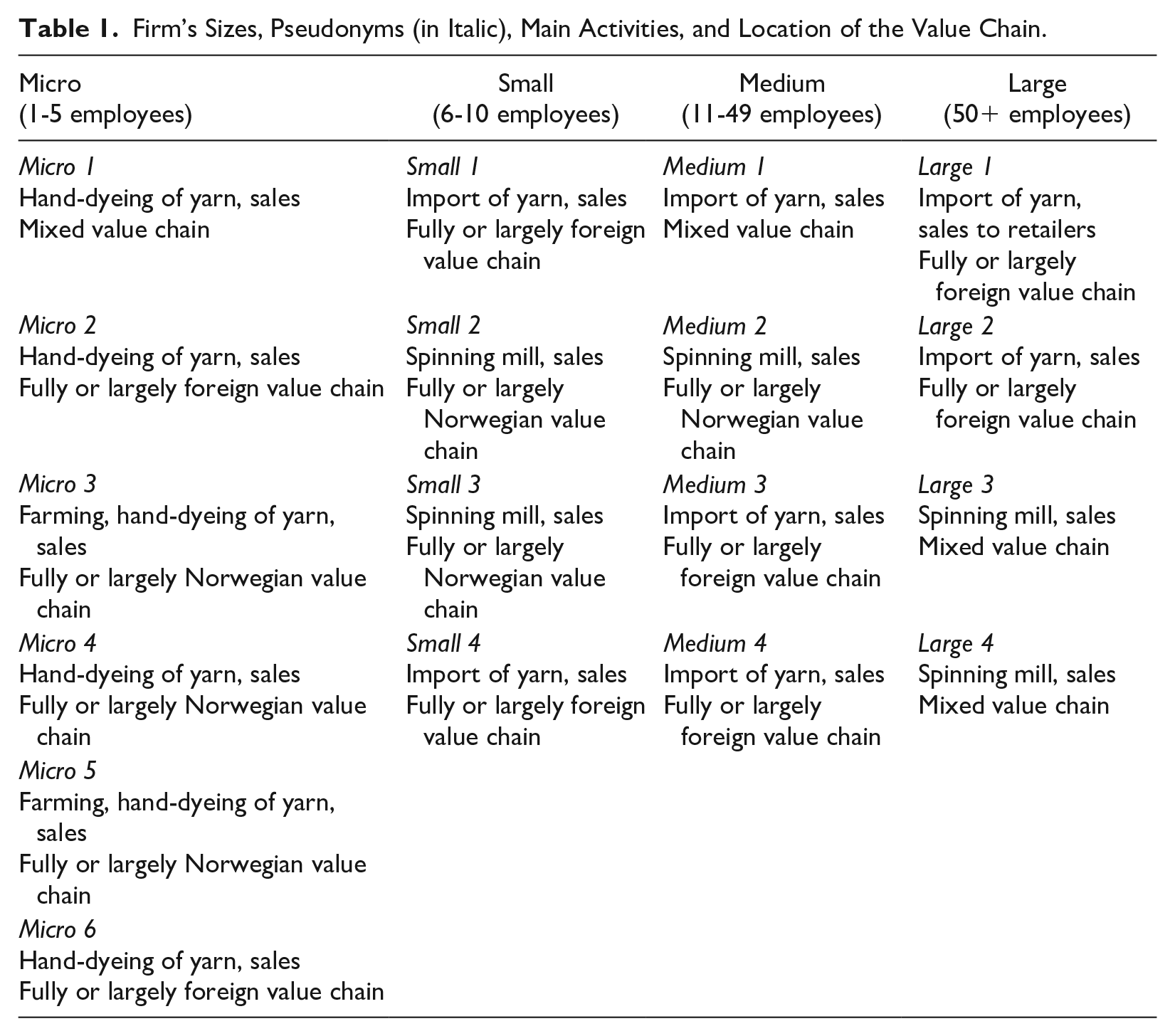
Table 1 provides an overview of the firm’s sizes, their main activities and whether the value chain is largely Norwegian, foreign, or mixed. Note that firm size clusters are based on the number of employees; they are also arbitrary, created to reflect the small scale of industry in Norway. Furthermore, many of the firms sold more types of products than just yarn. The activity and value chain information provided in the table concerns yarn and not other products.
Firm’s Sizes, Pseudonyms (in Italic), Main Activities, and Location of the Value Chain.
Data Collection
Data were collected from online platforms where firms present themselves and communicate with their consumers—webpages, social media profiles, and newsletters. Most of the websites also functioned as online shops, which supports the idea that they are aimed at consumers. When investigating their social media profiles (Instagram and Facebook), data were collected over a 3-month period (January–March or February–April 2019). Subscriptions to newsletters were made when possible; however, over the course of the study period, only three brands sent out newsletters. Collecting data from multiple sources allows for triangulation of findings, which, in turn, helps address the validity of the findings (Bryman, 2012).
Text, pictures, and videos were collected as data. When deciding which information was relevant for the study, priority was given to direct mentions of sustainability, for example, using terms such as “ecological,” “organic,” “fair trade,” “sustainable,” and “environment.” In such instances, the relevant segment would be copied together with its surrounding text, for better contextual understanding in the data analysis process. Potentially sustainability-related data were also collected. For example, many yarn brands had extensive information on product care and maintenance or the breed of the animals producing the fibre. Pictures, logos, and videos were also collected when considered relevant. For example, images depicting animal husbandry for the spinning mills that also kept their own animals. Data were compiled in separate Word files for each firm.
Data Analysis
The data analysis included two parallel processes. On the one hand, thematic analysis (Braun et al., 2019) was used to investigate how the sustainability-related information firms produced was framed to the consumers. On the other hand, pattern matching (Yin, 2014) was used for the same data to investigate whether firms revealed any BM-related information in their online communications to consumers. Together, this allowed searching for evidence of a change in the way a concept is framed consistent with translation theory.
Thematic Analysis
To start with thematic analysis, it is a method for capturing patterns across qualitative data sets (Braun et al., 2019). Braun et al. (2019) distinguish three types of thematic analysis: a coding reliability approach, a codebook approach, and a reflexive approach. In this study, the reflexive approach is used because in contrast to the other two approaches, it allows for codes and themes to emerge inductively from the data. The data analysis followed steps suggested by Braun et al. (2019) and included familiarization with the data, generation of codes, constructing initial themes, reviewing themes, and defining themes.
Familiarization with the data began with data collection and included several readings through the whole data set. Generating codes involved assigning “labels” to segments of data to help reduce and organize them as well as to gain an overview of the initial trends. The coding was inductive and focused on similarity and contiguity (Maxwell & Chmiel, 2014) but was also guided by the research focus and the core concepts used in the study, such as sustainability efforts, translation, and consumer value. In line with Silverman (2014), data from a few selected firms were analyzed first and the emerging codes were applied (and subsequently adjusted if necessary) to new firms, to evaluate their suitability for inclusion in the data set.
Attributes and Consequences
Theme construction occurred in parallel with a review of the literature on sustainable apparel consumption. This combined process led to the identification of two concepts as relevant in understanding how firms framed their sustainability-related information to consumers, namely, attributes and consequences. It was inspired by the means-end approach to consumer motivation (cf. Gutman, 1982).
Attributes are “the characteristics by which products are identified and differentiated” (Common Language Marketing Dictionary, 2020). In his seminal article, Gutman (1982) differentiates attributes and benefits (consequences) in that “people receive benefits whereas products have attributes.” As such, a consequence is a result (physiological or psychological, intended or unintended, desirable, or undesirable) happening due to the consumer’s behaviour. According to the approach, consumers buy goods as means to achieve desirable ends (consequences). Attributes help indicate if the product will provide the desired consequence.
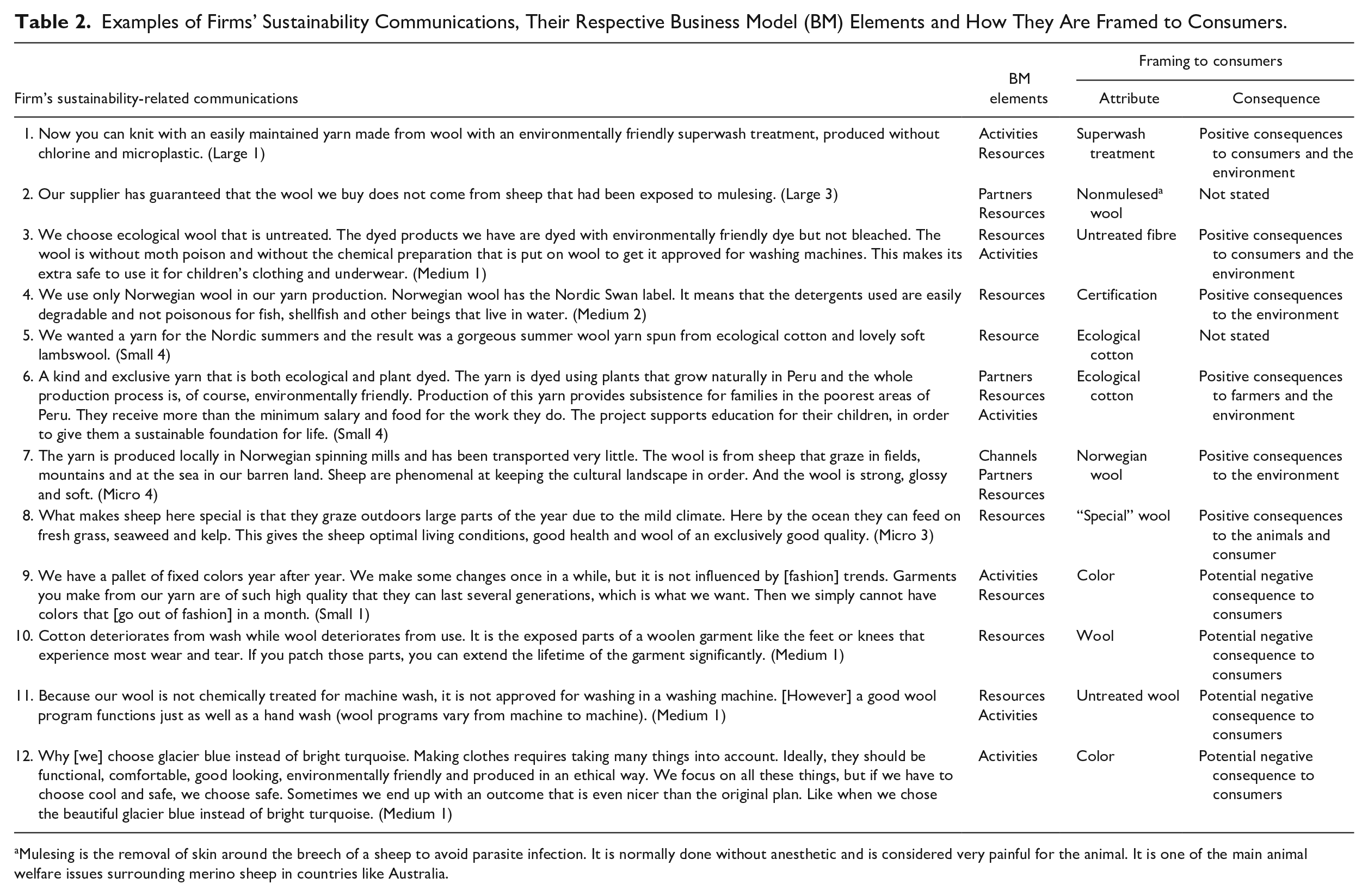
Once these concepts were identified, they were applied to the whole data set. When applying these concepts to the raw data, segments would be classified as either of the two. For instance, claiming that a yarn has environmental certification would be categorized as an attribute, while claiming that certified yarn is less harmful for the environment or the consumer’s health would be classified as a consequence. Table 2 (Columns 1, 3, and 4) provides examples of the attributes, consequences, and quotations from the sampled brands illustrating them.
Examples of Firms’ Sustainability Communications, Their Respective Business Model (BM) Elements and How They Are Framed to Consumers.
Mulesing is the removal of skin around the breech of a sheep to avoid parasite infection. It is normally done without anesthetic and is considered very painful for the animal. It is one of the main animal welfare issues surrounding merino sheep in countries like Australia.
Pattern Matching
To investigate whether firms revealed any BM-related information in their online communications to consumers, a pattern matching (Yin, 2014) technique was used. Pattern matching involves comparing an empirically based pattern (i.e., empirical data) with a conceptual pattern. In this study, the conceptual pattern against which empirical data were compared was the BM canvas (Osterwalder & Pigneur, 2010).
The BM canvas is popular both among practitioners and researchers (Bocken et al., 2014; Breuer & Lüdeke-Freund, 2017; Dentchev et al., 2018; Geissdoerfer et al., 2018; Joyce & Paquin, 2016; Ladd, 2018; Lüdeke-Freund et al., 2018; Massa et al., 2017; Morioka et al., 2018; Ojasalo & Ojasalo, 2018). Osterwalder and Pigneur (2010) identify nine BM elements: key partners, key resources, key activities, value proposition, customer segments, customer relationships, channels, cost structure, and revenue streams.
None of the investigated firms disclosed their BM explicitly in BM terminology or through BM frameworks like the canvas. However, BM information could be identified through interpreting the sustainability information firms conveyed and relating it to their underlying BM elements. For example, when a firm communicates the use of organic raw materials, it indicates key resource choice. When a firm conveys that product accessories they sell are made by a company employing disabled people, it indicates key partner choice. Table 2 (Columns 1 and 2) provides examples of firms’ sustainability-related communication and their underlying BM elements.
Findings
Attributes and Consequences: Similarities
Information about firm’s sustainability efforts often appeared as product attributes and/or consequences to various stakeholders. Common proenvironmental attributes included third-party certification, reduced chemical treatment of raw materials (including dyeing), animal welfare measures and environmentally friendly raw materials. Similar to findings by Brehmer et al. (2018), they centred around the creation of nonfinancial value.
The proenvironmental attributes often appeared in conjunction with the positive consequences they might have for consumers such as softness, shine, breathability, or reduced health risks. Consequences for the environment were presented less frequently and were framed in more abstract terms. The following example illustrates a combination of an attribute (certification) and its consequences for both consumers and the environment: Global Organic Textile Standard certification is your guarantee that the wool comes from ecological sheep farms that adhere to the strictest criteria for ethical animal husbandry and maintenance of animal health and welfare. The dyes are selected based on the strictest ecological standards which reduces the risk for allergies, illness or harm to the environment. (Large 1)
There was less information regarding firm’s prosocial efforts than proenvironmental efforts. The most common prosocial attributes included Fairtrade certified yarn or raw material, supporting actors in the yarn value chain or contributing to charitable causes. They were typically framed as consequences for people in the yarn supply chain, or recipients of charitable causes that a firm supported, as the following two examples illustrate: [The alpacas we use] live free high up in the Andes and provide livelihoods for many poor small-scale farmers. (Small 1) In October we knit the Pink Ribbon sweater! The Pink Ribbon initiative will contribute to increased knowledge about late complications after breast cancer treatment. (Large 1)
Brehmer et al. (2018) also found that prosocial efforts in a BM often took the form of employing or supporting underprivileged groups. However, the yarn firms in this sample stand out from many sustainable apparel firms in that they also supported causes that had nothing to do with yarn production or sales, for example, the Pink Ribbon initiative.
Attributes and Consequences: Variation
Within the 18 brands that had sustainability-related information in their online communications there was considerable variation in how many products with sustainability attributes they had, how much sustainability-related information they provided, and which aspects of sustainability they focused on. Based on those variations, three main groups were identified—those with a strong sustainability focus, those with a strong localism focus, and those with a weak sustainability focus. A few of the firms had a dual focus—either a strong sustainability and localism focus or a localism and weak sustainability focus.
None of the firms could be said to adhere to strong sustainability as defined by Stål and Bonnedahl (2016) or Upward and Jones (2016). However, firms with a strong sustainability or strong localism focus could be categorized as Business Sustainability 2.0 (cf. Dyllick & Muff, 2016). Business Sustainability 2.0 implies that: “Companies create value not just as a side effect of their business activities, but as the result of deliberately defined goals and programs addressed at specific sustainability issues or stakeholders” (Dyllick & Muff, 2016). In contrast, firms with a weak sustainability focus would only qualify as Business Sustainability 1.0 where selected sustainability challenges are “integrated into existing processes and practices without changing the basic business premise and outlook” (Dyllick & Muff, 2016).
The firms with a strong sustainability focus differed from the rest of the sample by being open about some of their products lacking potentially desirable attributes. This resonates with Upward and Jones (2016), who argue that strongly sustainable BMs should describe how the firm meets the needs of its stakeholders and how it fails to do so. For instance, it could include having a narrower colour palette or more demanding garment maintenance (Examples 9-12 in Table 2) or larger quality variation, as in the following example: Because we wish to preserve as much as possible the natural features of mohair fiber, our yarn has greater variation than “factory” yarn. We view it as a positive thing, since it shows that what you are holding in your hand is in fact a natural product without harmful additives. (Small 2)
Each time the lack of potentially desirable attributes was discussed, “solutions” were also presented. Firms typically chose between two pathways. One of them was to reframe what is considered “good” or “valuable” as in the above example. This pathway is similar to Glavas and Mish (2015), who pointed out how sustainability-oriented firms work to redefine what is valuable and try to help consumers have the same definition of value. Lundblad and Davies (2016) showed that sustainable apparel consumers also engage in this type of rationalization, where potential drawbacks were redefined as benefits. Another pathway was to suggest practical solutions that would help mitigate the negative effects, as in the following example: Wool is a more expensive raw material than cotton and clothes from wool are therefore more expensive to make. Producing wool under safe ethical conditions, without child labor or other abuse of the workforce also affects prices. Nevertheless, using wool does not have to be expensive. One needs fewer garments, and with some patching of areas with the most wear and tear, the garments can be used for a long time. (Medium 1)
The firms with a strong localism focus differed from the rest of the sample by opting for localism terminology over that of sustainability. The sustainability of localism has been debated (Curtis, 2003; Hess, 2008). In apparel it is considered an aspect of slow fashion that in turn is seen as one pathway to more sustainability in the industry (Fletcher, 2010). On the other hand, Wells (2016) found that BM sustainability strengths and weaknesses of local microbreweries and large multinational breweries are asymmetric and therefore difficult to compare. However, he argues that localism can still be considered a part of the “wider sustainability agenda” as it reduces transportation and enables wealth generation locally.
This uncertain relationship between sustainability and localism is reflected in the firm’s communications through infrequent use of sustainability phrases such as “environmentally friendly” or “sustainable.” Rather, the firms focused on highlighting the positive consequences of localism for the environment, society, or consumers. Common positive consequences included maintenance of cultural landscapes, conservation of endangered or less common breeds of sheep, reduced transportation, and supporting farmers’ livelihoods, for instance: We especially focus on spinning wool from endangered sheep breeds as a contribution to increase value creation to the farmers that keep these sheep and therefore make it more attractive to have them. (Small 3)
Examples of framing sustainability-related information as attributes and consequences could be found throughout the sample. However, brands with a weak sustainability focus were more likely to present their efforts only as attributes and not as consequences. For many of these brands, the only identifiable sustainability effort was selling some yarns from nonmulesed sheep wool (see footnote in Table 2 for more information about mulesing). However, the firms did not explain what mulesing was, or what the consequences of sourcing nonmulesed sheep wool were.
Business Model Elements
The data analysis revealed that although firms did not refer to their BMs explicitly, the information regarding their sustainability efforts could be related to underlying BM elements.
Most of the sustainability-related information could be related to the four BM elements of key resources, key activities, key partners, and channels. For instance, a statement that “Our supplier has guaranteed that the wool we buy does not come from sheep that had been exposed to mulesing” (Large 3) indicates key partner and resource choice. Likewise, communicating the use of organic wool reveals information about key resources; not chemically treating wool relates to key activities, while choosing climate neutral options when mailing products relates to channels, and so on.
BM elements are interrelated and affect each other. For instance, most of the firm’s sustainability efforts would also affect the cost structure and revenue streams. Furthermore, the BM elements identified in the data analysis are essential to creating the value proposition. The operational decision in this study was to only use key resources, key activities, key partners, and channels, because the sustainability efforts were situated primarily in these elements, and their effect on the rest of the BM elements would be secondary, although still important.
Some of the sustainability-related information could not be related to elements of the BM canvas. This specifically concerned sustainability value statements and goals and was typically provided by firms with a strong sustainability focus: When we choose products, everything from buttons, bags or yarn type, there is a long process behind it. We have to be true to our beliefs. When it comes to quality, lasting values, ethical trade and sustainable production—we do not budge. Price is of course important, but we do not budge on our values. It is our values that our firm is founded upon and we stick to them through thick and thin. (Small 1)
Such information does not fit the BM canvas template. However, Breuer and Lüdeke-Freund (2017) point out that entrepreneurs’ values can have a fundamental influence on the business logic. They state that “sustainability-oriented business models are an example of how particular values can exert such an influence.” As a result, the information regarding a firm’s sustainability values and goals is still relevant when it comes to the intersection of sustainability and business models.
Discussion
This study contributes to BM and SBM research and practice through using translation theory to explore the idea of communicating SBMs to consumers. BMs, and by extension SBMs, can be addressed to various audiences to harness their support (Massa et al., 2017). There are a handful of studies investigating how conventional BMs can be communicated to target groups in the business environment (Doganova & Eyquem-Renault, 2009; Havemo, 2019; Perkmann & Spicer, 2010; Wallnöfer & Hacklin, 2013).
This article contributes to this line of inquiry in three ways. First, by investigating an unusual target group for BM communication, namely, consumers. Second, by focusing on the communication of sustainability features of BMs, or SBMs. And third, by using a novel approach—translation theory—to study SBM communication. Furthermore, by looking at SBM translation to consumers this study also contributes to the new and growing area of inquiry that looks at the SBM-consumer interface (Bocken 2017; Tunn et al., 2019; Viciunaite & Alfnes, 2020).
A translation theory perspective on communicating SBMs stresses that simply making them visible (i.e., making the BM more transparent) is not enough. The information has to be framed in terms that are meaningful and useful for the target audience—that is, translated.
One way that firms in this study framed their BM sustainability efforts was as consequences to various stakeholders (consumers, underprivileged groups or the environment). This is in line with the service-dominant logic in marketing, which states that people buy goods to obtain the services the goods provide them (Vargo & Lusch, 2004). Framing sustainability efforts as consequences reveals the services and uses that they can provide in the consumer’s domain or in domains the consumer cares about. These findings show that firms were conveying BM information, yet it was not presented in BM terms, which supports the idea of BM translation. Together, this suggests a novel angle to study firm’s sustainability communications or promotion as the translation of a firm’s SBM.
However, from the collected data it is impossible to say whether firms viewed their own communications as BM translation. Nonetheless, the fact that their sustainability communications could be both related to underlying BM elements and framed as attributes and consequences in the consumer’s domain, indicates that translation has taken place, even if not intentionally. Indeed, Doorewaard and Van Bijsterveld (2001) point out that translation is often unintentional.
The findings revealed that firms had varying approaches to communicating their BM sustainability efforts that correlated with their approach to sustainability (strong sustainability focus, weak sustainability focus, and localism focus). I focus largely on the approaches of the firms with a strong sustainability focus since they appeared to put the biggest effort in reaching out to consumers and had the most elaborate approach to communicating SBMs. The approaches of the firms with a weak sustainability or localism focus are discussed briefly afterwards.
Firms with a strong sustainability focus communicated not only their SBMs but also the sustainability values that were central to the business, such as animal welfare or a clean environment. Values relate to the BM through having an influence on the business logic (Breuer & Lüdeke-Freund, 2017). Communicating values in this context creates a more coherent story, conveying not only the BM choices but also the reason for them. Magretta (2002) stresses that having a coherent story is essential for BMs to pass the “narrative test.” Communicating values is perhaps even more important for SBMs as sustainability efforts can lead to a lack of potentially desirable attributes (Examples 9-12 in Table 2). From a translation theory perspective, conveying firm’s sustainability values to consumers makes the lack of desirable attributes more meaningful as it explains and legitimates the reasons for it.
Firms with a strong sustainability focus went beyond making their sustainability efforts visible and meaningful to the consumer. They also suggested behavioural changes that consumers could engage in their domain, such as washing or mending practices. As a result, consumers could not only offset the lack of desirable attributes but also enhance the sustainable value provided by the firm. Sulkowski et al. (2018) describe similar behaviour as consumer “shaking”—providing information to solicit cooperation in adopting more sustainable practices. This also resonates with Upward and Jones (2016), who suggest that strongly sustainable BMs should provide a foundation for value cocreation with an organization’s stakeholders. This type of communication is especially relevant in apparel, where the use phase is estimated to have the highest negative environmental impacts in the life cycle (Almut et al., 2014).
Firms with a localism focus exhibited a similar approach to SBM translation in that they both made their efforts visible and explained why they should be meaningful to consumers. Such a similarity is understandable, since the localism approach can be viewed as a component of or a pathway to more sustainability in business (Bocken et al., 2014; Wells, 2016). The main differences between these two types of firms were the content of communication (localism specifically vs. more general sustainability) and that localism firms did not provide information encouraging consumer’s behavioural changes.
In contrast, firms with a weak sustainability focus provided minimal information. While they made their sustainability efforts visible, they rarely explained their relevance to the consumer. Sustainability efforts appeared to be an appendix to their usual BM, rather than a core aspect (cf. Dyllick & Muff, 2016). As a result, their communications presented a less coherent narrative (cf. Magretta, 2002). On the one hand, this poses the question of how well such communications would harness consumer support for the sustainability efforts. On the other hand, this might not be a critical area for these businesses, as sustainability-oriented consumers did not appear to be their main target group.
In sum, this study argued that one way to harness support for SBMs is through communicating them to various stakeholder groups. Translation theory suggests that to communicate SBMs, the information has to be framed in terms relevant to the target audience. The empirical findings from this study provided illustrations of how firm’s online sustainability communications to consumers can be viewed as their SBM translation. Furthermore, the findings revealed the different lengths of framing sustainability efforts as relevant to the consumers—from simply making them visible to soliciting cooperation for sustainable value cocreation.
Implications and Future Research
This study illustrated how firm’s sustainability communications toward consumers can be viewed as their SBM translation—communicating about the SBM in a way that is meaningful to the consumers. This has implications for marketing research—it suggests a novel inquiry angle to study promotion in viewing it as the communication of a firm’s BM. This is a relevant question for both conventional and sustainability-oriented firms. Future empirical research in this field could search for commonalities in translation (e.g., “rules” of translation, cf. Røvik, 2007 or Wæraas & Sataøen, 2014) as well as identify successful or failed translations—findings that would also be useful to practitioners.
A related limitation is that it was not possible to establish, from the data collected, if the firms viewed their own communications as SBM translations. Future research could focus on collecting primary data from firms (e.g., interviews) to explore if firms view their sustainability communications as SBM translation.
The novel angle of viewing sustainability communications as translation of an SBM is also relevant for practitioners. Firms tailoring their sustainability communication strategies could start by considering which aspects of their BM need to be made transparent to reveal their sustainability efforts and how to frame them as relevant to the target audience. This requires firms to understand the consumer’s world and how they interact with the firm’s offering (Ojasalo & Ojasalo, 2018).
There are also implications for BM research. Previous research (Doganova & Eyquem-Renault, 2009) showed that BMs can be used as communication devices—that is, firms can communicate through their BM as a formalized representation to audiences such as investors. This study illustrates how firms communicate about the BM to a different audience—consumers. This shows variation in how the BM is communicated in different contexts, in line with the boundary object view of a BM (Doganova & Eyquem-Renault, 2009). Future research might continue exploring this topic by looking at, for example, how the same firm presents their BM to different audiences. Are there similarities or differences in the processes, mechanisms or outcomes of BM translation based on whom it is addressed to?
Translation theory provides the tools to study how the SBM changes as it is presented to different audiences or moves into different contexts. This study used translation theory to investigate content that firms produce to present themselves. However, translation theory could also be used to study the circulation of ideas and concepts (Sahlin & Wedlin, 2008). Therefore, it could extend the research stream investigating how SBMs coevolve (Schaltegger, Lüdeke-Freund, & Hansen, 2016) and spread (Cantele et al., 2020; Ode & Wadin, 2019) in a given environment.
Footnotes
Acknowledgements
I would like to thank Frode Alfnes and Arild Wæraas, from the School of Economics and Business at the Norwegian University of Life Sciences, especially for their support and advice in the early stages of developing this manuscript. Furthermore, I would like to thank the two anonymous reviewers who provided positive and constructive comments that allowed improving the manuscript significantly. Finally, I would like to thank the deputy editor, Prof. Dr. Stefan Schaltegger, both for the constructive comments and for a level of engagement beyond all expectations.
Declaration of Conflicting Interests
The author declared no potential conflicts of interest with respect to the research, authorship, and/or publication of this article.
Funding
The author disclosed receipt of the following financial support for the research, authorship, and/or publication of this article: This research was supported by a grant from The Research Council of Norway: Enhancing local wool value chains in Norway, project number 244618.
