



Abstract
Strengthening sustainability in global supply chains requires producers, buyers, and nonprofit organizations to collaborate in transformative cross-sector partnerships (CSPs). However, the role played by nature in such partnerships has been left largely unattended in literature on CSPs. This article shows how strategizing nature helps CSPs reach their transformative potential. Strategizing nature entails the progressive revealing and reconciling of temporal tensions between “plants, profits, and people.” We show how a CSP took a parallel approach—recognizing the divergent temporalities of plants, people, and profits as interlaced and mutually determined—toward realizing their objective of implementing living wages in a sub-Saharan African country’s the tea industry, simultaneously driven by the revitalization of tea plantations. The promise of better quality tea leaves allowed partners to take a “leap of faith” and to tackle pressing issues before the market would follow. Our findings thus show the potential of CSPs in driving regenerative organizing.
Keywords
Introduction
Cross-sector partnerships (CSPs) between businesses and nonprofit organizations (NPOs) are increasingly seen as a promising approach to addressing tough societal issues that are hard to manage by other forms of action (Athanasopoulou & Selsky, 2015; Clarke & Crane, 2018). It is expected that issues that risk falling in-between the responsibilities of different societal sectors can be addressed more effectively by working together, helping businesses achieve systemic change, that is, “a significant alteration within a system, potentially leading to substantial impacts” (Clarke & Crane, 2018, p. 308). It is claimed that CSPs have the potential to move businesses beyond an economic view of their own supply chain and to strengthen the sustainability in the entire sourcing region collectively, balancing economic, social, and ecological considerations (MacDonald, Clarke, & Huang, 2019; Narrod et al., 2009; Valente, 2010; Valente & Oliver, 2018). Although a fair amount of work has been done on sustainability and CSPs (cf. Dentoni, Bitzer, & Pascucci, 2016; Valente & Oliver, 2018; van Hille, de Bakker, Ferguson, & Groenewegen, 2019) and on sustainable supply chain management (cf. Pagell & Wu, 2009; Quarshie, Salmi, & Leuschner, 2016; Vurro, Russo, & Perrini, 2009), the incorporation of ecological considerations in such work still appears to be challenging. A better understanding of the role of nature in CSPs in supply chains, therefore, is needed.
In this article, we focus on the issue of living wages in agricultural supply chains and explore how this socioeconomic issue is intimately connected with both ecological and economic issues. Although socioeconomic issues in supply chains are often addressed through certification schemes and standards, such schemes, it is claimed, fall short in effectively addressing the issue of wages (Bennett, 2018; Henry & Pechevy, 2017). In many studies of living wages, meanwhile, little attention is paid to ecological effects, if at all. We argue, therefore, that the further integration of economic, social, and ecological considerations is crucial to achieve systemic change and that the ecological component should be seen as being of strategic importance as well. It remains understudied how actors in CSPs navigate the tensions between ecological, social, and economic interests (or plants, people, and profits) that are inherent in these transformative change processes. In this article, therefore, we examine the following research question: How do participants in a transformative CSP reveal and reconcile tensions between plants, people, and profits?
To examine this research question, we will consider transformative CSPs as complex forms of organizing that aim to achieve systemic change. Examining the operations of a particular CSP aiming to combine plants, people, and profits, we set out to provide an empirical contribution to our understanding of what transformative CSPs entail. We present a detailed case study of the collaboration process between businesses and NPOs to tackle the issue of living wage, which is closely entangled with the social and natural environment of a tea-sourcing region in a sub-Saharan African country. 1 Because such work requires collaboration between competitors (Valente & Oliver, 2018), the involvement of relatively neutral conveners, such as NPOs or government agencies, guarantees that the different interests of sector partners are duly represented in the CSP (Gray & Purdy, 2018; van Hille et al., 2019). While the CSP we examined aimed to achieve a living wage, with improved working conditions for the employees of tea production companies (tea pickers), this could not be achieved without an agenda for revitalizing the country’s entire tea industry, comprising crop replanting, factory refurbishment, and improved irrigation. As these social and environmental challenges, in addition to pressing economic challenges, were to be included in an all-encompassing CSP, this called for transformative organizing, taking into account challenges across different dimensions. It also emphasized the crucial role of ecological revitalization to enable improvements in social and economic terms. Our analysis shows how the revitalization of plantations and the strategic consideration of nature was deployed to increase profit margins that afforded living wages for employees; it also shows how these three dimensions can hold each other hostage and how this could be overcome. We also contribute to research on transformative CSPs, showing how such CSPs could include plants, people, and profits in their strategy while accounting for the different timescales of these three elements.
In the second section, we discuss theoretical notions on the role partnerships can play in achieving transformative change, and in the third section, we then introduce our case setting and research methodology. After that, we present our findings in three parts: outlining the situation before the CSP was implemented, the situation after the CSP was kickstarted, and what has changed between these situations. We conclude with a discussion of the implications for theory.
Theory
CSPs are seen as an organizational form that enables businesses, in collaboration with NPOs and/or governments, to directly target the broad and complex sustainability challenges they encounter in their sourcing regions, considering economic, ecological and social issues. Whereas such collaborations already involve a variety of actors, including nongovernmental organizations (NGOs), their inclusiveness in the case of agriculture-based chains of small firms and workers is still debated (Bennett, 2017; Henry & Pechevy, 2017; Ruysschaert, 2016; Valente & Oliver, 2018). Partnerships involving these “missing actors” more directly could potentially contribute here. CSPs can be defined as collaborative arrangements between business, NPOs, and/or government “formed explicitly to address social issues and causes that actively engage the partners on an ongoing basis” (Selsky & Parker, 2005, p. 850). Such partnerships are formed to share the responsibility of different societal sectors for creating or solving social or environmental issues, or because it is too complex to find solutions unilaterally within one sector or organization (Austin & Seitanidi, 2012; Bryson, Crosby, & Stone, 2006; Selsky & Parker, 2005). Over the past decades, we have witnessed a proliferation of CSPs in practice—followed by a steady growth of scholarly interest in the phenomenon (cf. Austin & Seitanidi, 2012; Clarke & Crane, 2018; Gray & Purdy, 2018; Selsky & Parker, 2005; Valente & Oliver, 2018).
CSP research has emphasized the transformative potential of CSPs (Gray & Purdy, 2018), also referred to as the potential of CSPs to lead to “systemic change” (see a recent Special Issue of the Journal of Business Ethics, Clarke & Crane, 2018). 2 Transformation is needed to address the more complex social and environmental issues the world is currently facing (e.g., Grin, Rotmans, & Schot, 2010; Senge, Dow, & Neath, 2006), and this requires companies to move away from “corporate sustainability” with its narrow focus on firm or industry toward a more inclusive approach, integrating insights from ecology to effectively address “planetary boundaries” (Whiteman, Walker, & Perego, 2013). Transformative CSPs have the ambition to address complex social and environmental issues (Waddock, 1989), and they are the most intense form of cross-sector social interactions in the “collaboration continuum” developed by Austin and Seitanidi (2012). Transformative CSPs aim “to cocreate transformative change at the societal level” (Austin & Seitanidi, 2012, p. 736) and intend to “deliver transformation through social innovation bettering the lives of those afflicted” (p. 743). Such CSPs, therefore, are more inclusive and more interconnected than any other type of CSP (Le Ber & Branzei, 2010).
Yet the interplay between economic, social, and ecological issues is receiving less attention. In line with Clarke and Crane’s (2018) definition of systemic change, therefore, we define transformative change as the result of actions that lead to a significant alteration (a transformation) within a system, potentially leading to substantial impacts involving economic, social, and ecological issues. Recent research on CSPs aiming to achieve transformative change attests to the potential of such partnerships to address complex sustainability issues in the eyes of both researchers and practitioners (Gray & Purdy, 2018). However, it remains unclear “how to design effective partnerships for achieving systemic (or transformative) change, or perhaps more critically, under what conditions they can achieve such change and under which they cannot” (Clarke & Crane, 2018, p. 304).
We respond to this call by examining how a transformative CSP can help address economic, social, and ecological issues simultaneously by emphasizing the crucial role played by “strategizing nature.” We consider its transformative potential in terms of combining elements of “planet” and “profits” in a partnership aimed at people. CSPs are popular tools for addressing social issues, but questions remain as to how they perform in achieving lasting transformation toward sustainability in global supply chains. Our case study comprises a CSP in the tea industry, where partners set out to collaborate in an attempt to raise wages for plantation workers and improve their families’ livelihoods (the people) and discover that they also need to revitalize the tea crops (plants) and strengthen the profitability of the country’s tea sector (profits) to achieve their aim.
Method
Because we were interested in long-term CSP development, we adopted an inductive, qualitative research approach. We deliberately chose an open approach to data collection and analysis, which allowed us to analyze the developmental process of the CSP as it occurred, and which helped us incrementally zoom in on the most salient dimensions of this process. A qualitative approach was fitting because we studied an understudied empirical context (Bansal, Smith, & Vaara, 2018). The object of our case study was a CSP focusing on implementing living wages in several tea production regions in a developing country in sub-Saharan Africa. This CSP was selected as an extreme case given the unique turn to revitalize plantations following reported difficulties in achieving a living wage via certification. We had real-time access during several years, with the first author working for, and later collaborating with, the convener of the CSP. Because of our unique ties with the partnership, we were very well positioned to collect data on the sensitive process of partnership development from its very initial stages onward. In what follows, we will first present the research setting before detailing our data collection and analysis methods.
Research Setting
The CSP we studied was launched in 2015 and is still ongoing. Its original objective was to address the gap in living wages that remains prevalent in the tea industry in its country of focus. The CSP process was initiated by three European stakeholders who collaborated to produce a study on wage issues in multiple tea production countries in 2013: the Convener, the Sustainable Procurement Coalition, and the NGO. The Convener is an NPO funded by multiple European governments, with the ambition to strengthen sustainability in supply chains across various commodity sectors and sourcing regions, through convening, funding, and learning activities. The Sustainable Procurement Coalition (“the Coalition”) is an NGO-type organization funded by international procurement companies, with the aim to strengthen sustainability in the tea supply chain. Within the CSP’s governance structure, they represent procurement companies. The NGO is a large international organization with the objective to end poverty worldwide. Although the report focused on multiple tea production countries, our current study focuses on one African country where the NPOs initially focused their efforts and set up the CSP.
The 2013 report revealed the severity of low wages in several regions but did not quantify what exactly a living wage would be in these regions, as this is a relative concept, and what is considered a “decent standard” of living may be perceived differently across different national and regional contexts (Werner & Lim, 2016). Specifying the living wage benchmark for our focal country, therefore, was one of the first follow-ups to the report, in the form of a consultancy study conducted in 2014, funded by the certification bodies to establish both a new methodology of calculating living wage in context and a benchmark for the focus country’s tea growing regions. Together, these two studies provided the Europe-based stakeholders with an evidence base to kickstart a joint CSP and to act on the study results, with the objective of closing the living wage gap in this particular tea production area. It is in this context that our research started.
Data Collection
Our data collection spanned a period of 3 years, from March 2016 to February 2019. In the first 2 years, we collected both primary and secondary data (interviews, observation, participation, and documents) and were able to follow the CSP development and implementation in real-time. The third year, we only collected secondary data. In our first year of data collection, we also sought secondary data for retrospective analysis, comprising information on the CSP initiation stages. Combining these multiple sources of data, our final dataset enabled triangulation on the CSP development across a 5-year period, spanning May 2013 through December 2018.
Interviews
Our primary data source was semistructured interviews with organizational representatives directly involved in the CSP. We started our interviews within the host organization (the Convener) and, through them, gained access to the CSP and its participants. Initially, we purposefully sampled interviewees from the four organizations that played a key role in the establishment of the CSP, but as our research progressed, we included additional participants that signed a Memorandum of Understanding (MoU) and, hence, were part of the CSP (including procurement and production companies, among others). In total, we conducted 29 interviews with representatives from 16 organizations, half of whom were part of the CSP Steering Committee. In some cases, we interviewed representatives twice to record their changing perceptions over time. Six interviews with producers took place around the first Annual Progress Meeting of the CSP in October 2016, and four interviews with procurement companies took place toward the end of our data collection period (late 2017 to early 2018). The interviews took place either in person (15) or via Skype (17).
As is common in an inductive research design, we adapted our interview guide as our research progressed, based on new insights. In our initial interviews with the four Steering Committee members, we first aimed to gain an in-depth understanding of the how and why of the CSP design, the genesis of the CSP, and the divergent viewpoints of the key organizations on strategy and progress, and then to understand the mutual relationships between these four Steering Committee organizations. Later, as we broadened our group of interviewees, we used the same interview guide for all interviewees, focusing broadly on the interviewees’ perceptions of the CSP, including questions on their rationale for participating in the CSP, their views on its progress and governance, their perception of the roles played by key stakeholders (Steering Committee members), the challenges in the CSP process and the achievements to date. In the final interviews with representatives of the Convener, we discussed our initial analyses with respondents to get feedback on our interim results. Interviews ranged between 30 and 90 minutes each and were audio recorded and transcribed verbatim in English (24) or Dutch (3), with the exception of two interviews on which extensive notes were taken. In total, we obtained 1,174 minutes and more than 500 pages of transcribed interview data.
Observation and Participation
In the first year of data collection, the first author conducted her research from the Netherlands-based office of the Convener for 1 day a week, which facilitated her close involvement in the development of the CSP. She also held many informal conversations about the CSP with multiple employees of the Convener to understand their involvement in CSPs and to fine-tune the research question, and these informal interactions continued throughout the entire first year of data collection. Many of these conversations were held with the Program Director (formerly Senior Program Manager), who championed our research throughout the entire data-collection period, allowing us access to several key events and introducing us to important stakeholders. We recorded novel insights and information gained during these informal conversations. In June 2016, the first author joined a 2-day annual tea sector event in London to meet the key players (Steering Committee members), and the research was presented to the Steering Committee to secure their support for its continuation given the sensitivity of the negotiations. Having secured approval, the first author then joined the CSP’s first Annual Progress Meeting in the focal country (including preparatory meetings), as part of a 12-day field visit to the tea growing regions in the country. These two visits (June and October 2016) were instrumental in understanding the background of the global tea supply chain, the tea production process, the producers’ context and, most important, the CSP’s country of implementation. Furthermore, these visits led to many informal interactions with interviewees and other partners in the CSP. Together, these two field visits produced about 40 pages of field notes and many photos of tea plantations and factories.
Secondary Data
We gathered and analyzed a wide variety of secondary data sources, to help us understand the establishment of the CSP prior to our involvement, and to track progress throughout the data-collection period up until the third year of implementation (2017-2018). Publicly available documents included CSP progress reports as well as NGO studies on the tea sector and more specifically on wage issues. Interviewees provided us with supporting documentation for some of their comments in the interviews, including blog entries, policy statements, e-mail conversations with other partners, and consultancy reports. The largest and most informative part of our document database, however, was provided by the Convener, who granted us access to crucial documents about the CSP process and its establishment, including meeting minutes and 217 e-mail conversations that took place during the MoU negotiations.
Data Analysis
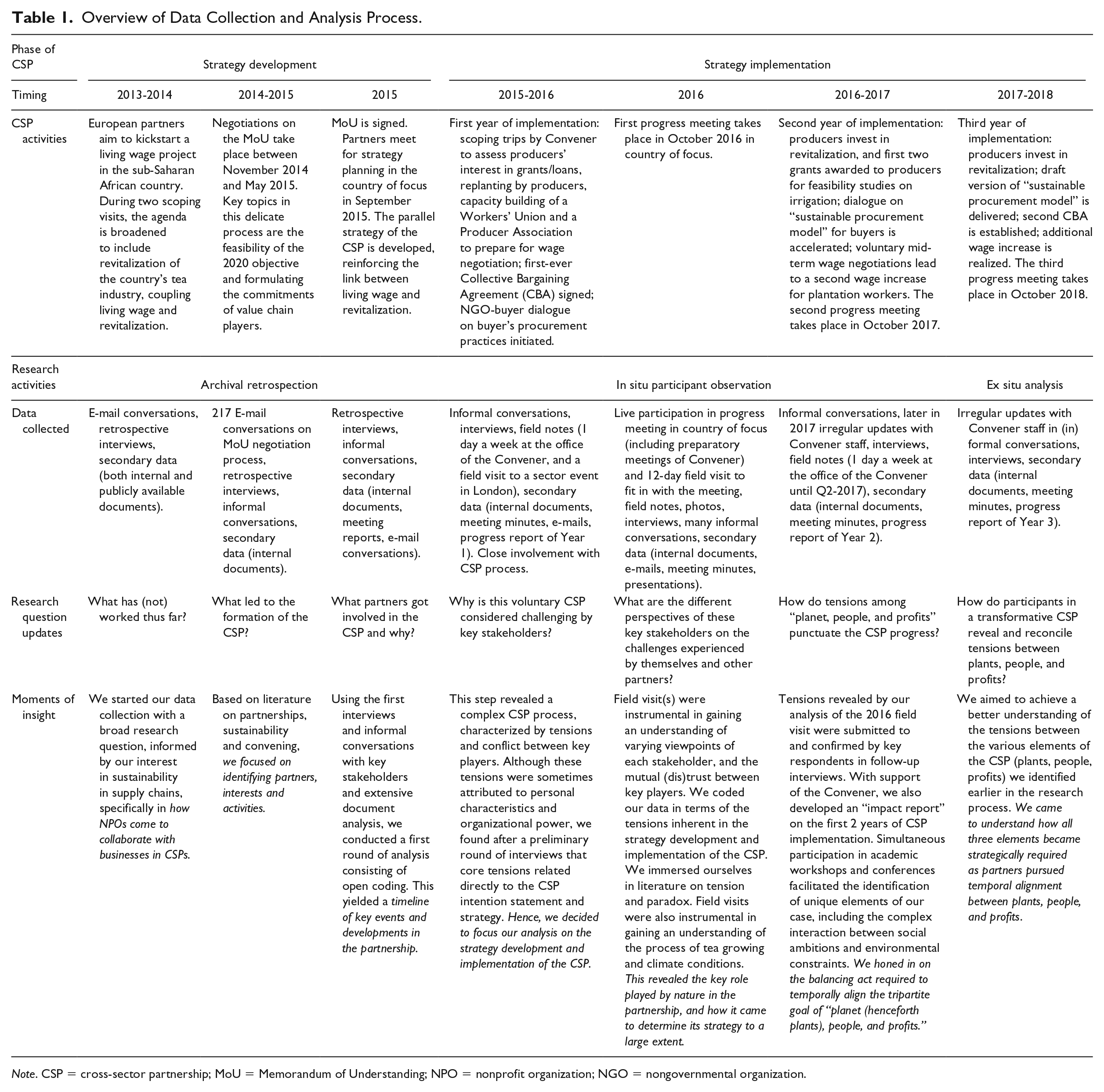
Table 1 shows some of the key events in the CSP process, separating the two phases of strategy development and implementation we identified in the case. The start of the implementation phase is also the moment when we started our data collection with a retrospective (archival) analysis of the strategy development phase. In the first year of implementation, we were closely involved in the process as participant–observers, whereas we studied the CSP from a greater distance as external researchers in the second and third years. At the request of the Convener, we wrote a practitioner report to showcase the results of the CSP and lessons learned in its first 2 years of implementation.
Overview of Data Collection and Analysis Process.
Note. CSP = cross-sector partnership; MoU = Memorandum of Understanding; NPO = nonprofit organization; NGO = nongovernmental organization.
Table 1 shows the iterative process of discovery, showing how we started our inquiry with a broad research question on the “why” and “how” of the CSP and gradually refined the research question as our understanding of the CSP progressed over time. There were several pivotal moments in the process which led to our main observations as presented in the following Findings section. As is common in an inductive research approach, however, the road toward these discoveries was sometimes messy and multilayered: we acknowledge this iterative character in the final row of Table 1, which summarizes some steps taken in the analysis (i.e., coding or developing a detailed timeline of the process) and the choices made in narrowing our research focus toward the balancing act between plants, people, and profits.
Findings
Below, we will present our findings in three sections, considering the situation before the new CSP approach was incorporated, the situation after incorporation and then highlighting what has changed through this approach. Presenting our findings in this way allowed us to examine in detail how the approach that was taken made a marked difference from conventional approaches.
Before: Toward Living Wages in the Tea Industry?
For many years now, the global tea industry has been scrutinized by campaigns and reports of NGOs covering a variety of unsustainable practices, including the unequal value distribution in its supply chain (van der Wal, 2011). A key topic here has been the low wages paid to wage workers (“tea pickers”) on estates in tea producing countries, and the tensions this gives rise to in terms of social and environmental responsibilities in both tea production and procurement. To address social and environmental issues in their supply chain, global tea procurement companies have stimulated certification among their suppliers, and many tea production sites are now labeled by one or more certification standards.
The 2013 NGO study that kickstarted the CSP we study here, however, showed that plantation workers’ wages were still an issue of concern on certified and noncertified tea estates. Indeed, despite certification, wage levels for tea pickers did not meet “living wage” standards, enabling workers and their families “to afford a basic, but decent lifestyle that is considered acceptable by society at its current level of economic development” (Anker, 2011, p. 5). The report found a root cause of this problem in the certification criteria related to wages, which required certifiers to pay the country’s legal minimum wage, but which was insufficient for workers’ sustainable livelihoods in many countries. NGOs, therefore, called for raising wage levels to the standard of a living wage, in line with Anker’s definition. These calls to raise wages led to renewed negotiations in the tea sector on how the living wage benchmark could be achieved in several production regions.
Following these calls, the Convener and the Sustainable Procurement Coalition together took the lead in establishing the CSP we focus on, and they visited the tea production country twice, in May and November 2014. These visits followed the 2014 consultancy report that had calculated the living wage for the country. The Convener and the Coalition were accompanied by some members of the Coalition, including international tea procurement companies. These visits served to confront the tea producers with the report’s findings on the living wage problem, to raise their interest in a joint approach toward resolving the issue and to better understand the challenges faced by the tea producers.
During these initial scoping trips, discussions between the Europe-based stakeholders, the Producer Association representing all tea production companies in the country and individual producers revealed that the country’s tea sector was facing many challenges that the producers prioritized over the issue of wages. These included environmental challenges such as droughts, leading to intensified seasonality and more pressure on producers’ productive season; economic challenges such as low prices for the country’s produce on the international market, pressuring profit margins, and limiting the influx of investment capital; and production challenges such as aging tea bushes and old factories, lack of irrigation facilities, unstable power supply, and pests and diseases affecting the product. In short, they were facing a situation involving a negative cycle of exhausted crops, low profits and low wages.
Against the backdrop of these challenges, the Convener conducted a competitiveness analysis of the country’s tea sector in 2014, which showed that the competitive advantage for the country’s tea producers on the international market lay primarily in the low production costs, which related largely to the workers’ low wages. As it was recognized that an increase in wages would concurrently lead to an increase in production costs, this would affect the sector’s primary source of competitive advantage. Implementation of living wages, then, was likely to seriously threaten the sector’s overall viability. The situation appeared to be in a stalemate.
After: Combining Living Wage With Revitalization in the CSP’s Strategy
Together with producers, the NPOs identified an opportunity for overcoming this impasse: the tea leaf itself. By improving the quality of the tea plants, higher prices could be charged, leading to higher profit margins and allowing for an increase in workers’ wages. The agenda of the European NPOs and their business partners (international tea buying companies and national producers), therefore, was broadened from “implementing living wage” to include “revitalizing the industry.” This goal—combining social and environmental elements—was manifested in the partners’ intention statement, in which they expressed a commitment to “work[ing] together to achieve a competitive, profitable tea industry where workers earn a living wage by 2020” (Internal document).
The organizations included in the CSP spanned all levels of the supply chain, and included tea producers, trade unions, international tea buyers, certification standard bodies, NGOs, and donors. Though the CSP was endorsed by the country’s government, no government officials were directly involved. Plantation workers were initially not included in the CSP either as they were insufficiently organized, but the NGOs and trade union endeavored to engage them and represent them as best as they could. After several negotiations, a MoU was signed by all participating partners in May 2015 to solidify the CSP. The CSP was led by a Steering Committee consisting of the four organizations that played a decisive role in the establishment of the CSP and its strategy: the Convener, the Sustainable Procurement Coalition, the NGO and the Producer Association. 3
In a first planning meeting in September 2015 shortly after the MoU was signed, the partners developed a strategy comprising five “pillars” 4 that should jointly lead to accomplishing the 2020 ambition of the CSP. Here, we will focus on two of these pillars: “developing a profitable estate sector” (revitalization) and “living wage” and the relation between these two, as these are key to our analysis of the relation between plants (revitalization) and people (living wage).
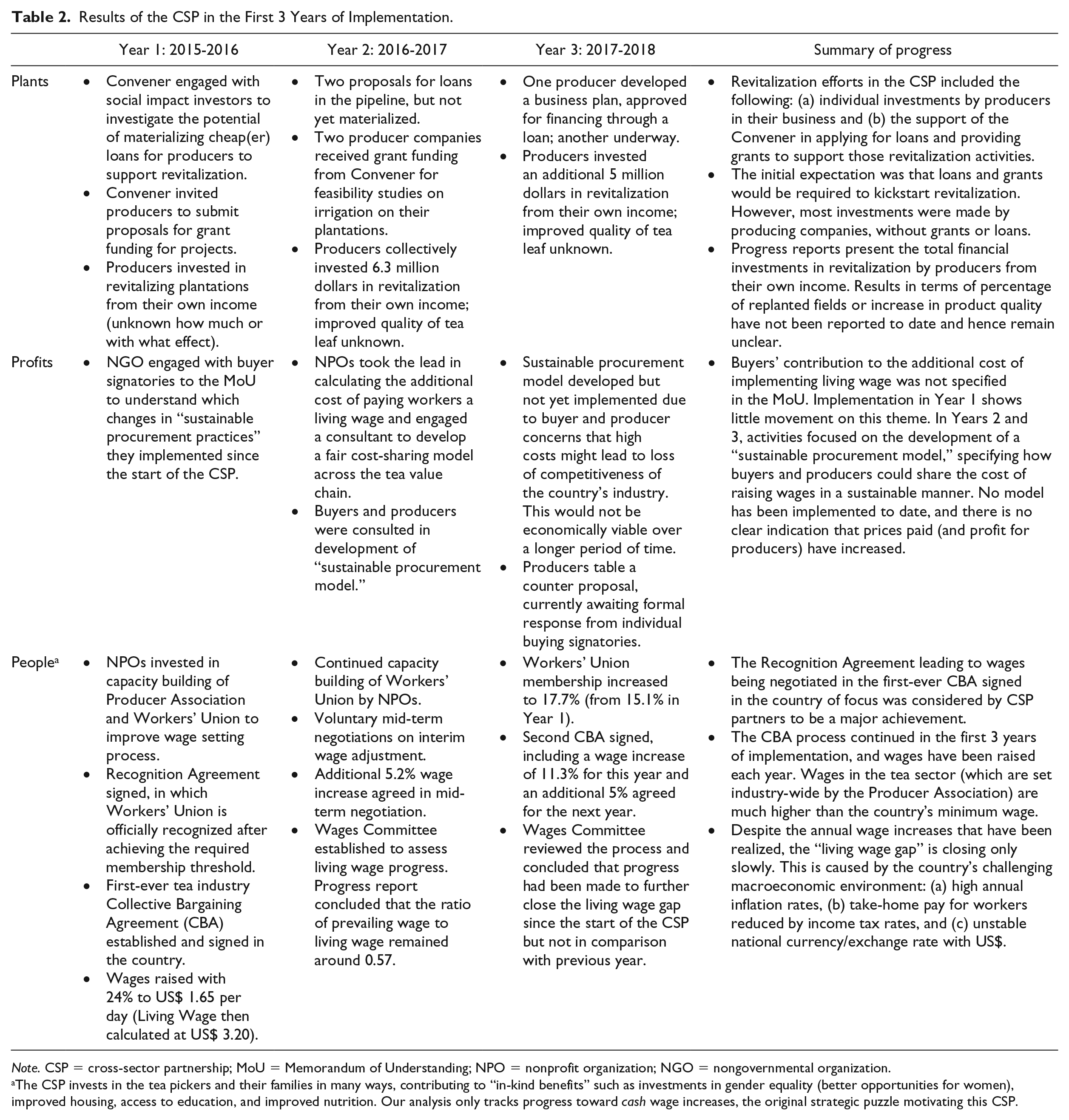
These two elements of plants and people appeared to be connected by a third element: profits. By revitalizing the industry through a program of replanting, irrigation, and factory refurbishment, the quality of the tea leaf was expected to improve. This would enable producers to charge higher prices and hence improve their profit margins, allowing them to increase wages for their tea pickers and leading to improved livelihoods. Although there appears to be a sequential order in this theory of change, we found that the CSP decided to implement activities on plants, people, and profits simultaneously in their effort to achieve living wages by 2020. In what follows, we will present the developments in each of these three elements in the first 3 years of implementation, as also summarized in Table 2.
Results of the CSP in the First 3 Years of Implementation.
Note. CSP = cross-sector partnership; MoU = Memorandum of Understanding; NPO = nonprofit organization; NGO = nongovernmental organization.
The CSP invests in the tea pickers and their families in many ways, contributing to “in-kind benefits” such as investments in gender equality (better opportunities for women), improved housing, access to education, and improved nutrition. Our analysis only tracks progress toward cash wage increases, the original strategic puzzle motivating this CSP.
Plants
When the CSP strategy was developed, the Producer Association told NPOs that most producers had limited investment capital to enable the revitalization of their plantations. Therefore, a grant-funding structure was developed, allowing producers to apply to the Convener for grants aiming, for example, to conduct feasibility studies on potential investments on tea plantations. Such studies could lead to the development of business plans for producers to seek out cheap loans from social investors to enable revitalization investments.
Progress Reports disclosed, however, that this approach did not work as planned. Although the first grants were already provided in the second year, no loans have materialized to date. Producers invested in revitalization from their own resources, without the financial support from NPOs or social impact investors. These investments started already in the first year of implementation and were reported each year. Yet the CSP does not report what these investments have delivered to date in terms of revitalization, that is, what percentage of fields has been replanted, how many producers have implemented improvements in irrigation or how many factories have been refurbished.
It remains unclear, therefore, what progress has been made in terms of improved tea leaf quality: we expect that the investments in irrigation and factory refurbishment may have led to an increase in tea leaf quality, but we do not know to what extent. Investments in replanting cannot have led to a quality increase yet, as newly planted tea bushes take 3 to 5 years to mature. The country, moreover, faced a period of severe drought in the second year of CSP implementation, and we expect, therefore, that the replanting program has taken longer than anticipated—in spite of investments made by the producers.
In sum, with regard to the plants, the NPOs intended to support this element financially, but this did not work out as planned. In fact, investments so far have been made primarily by producers themselves, who have shown a strong commitment to the plant revitalization agenda as is in their interest. It remains unclear, however, what these investments have actually delivered and to what extent climatic conditions have frustrated the process, so that the actual results in terms of the revitalization of the tea plantations remain unsure.
Profits
With regard to profits, we see limited progress in the first year of implementation, at least on the industry level. Our interviews with buyers and producers show that conversations have taken place in individual buyer–supplier relationships to increase clarity on buyers’ quality requirements, and that long-term contracts have been negotiated in some cases. Because of the commercially sensitive nature of these agreements, however, they have neither been specified nor reported in the CSP progress report. At the collective level, meanwhile, no progress has been reported in terms of actual price increases either. In the MoU, the commitments of buyer signatories were ambiguously worded, not mentioning their responsibility to “increase prices,” but stating more loosely that their role is to “implement business practices that support the economic ability of employers to pay a living wage” (MoU text, internal document). Progress reports to date do not report on any novel business practices having been implemented as yet, but some initiatives have been reported aiming to examine if and how buyers can implement sustainable procurement practices that will support the CSP’s revitalization and living wage agenda.
One such initiative is the work initially done by the NGO, who interviewed all buyer signatories in Year 1 to better understand their procurement practices, and whether these had changed since signing the MoU. After the first year of implementation, both producers and NPOs concluded that producers had shown more action (in terms of plants and people) than buyers had (in terms of offering a better price). In Years 2 and 3, therefore, the NPOs collectively prioritized this element and attempted to accelerate progress. They engaged a consultant to calculate the cost of paying workers a living wage and to develop a model of how this cost could be fairly shared across the tea value chain. We see slow but incremental progress in this element. Currently, a “sustainable procurement model” is being developed but has not yet been accepted or implemented by the producers and buyers.
In sum, with regard to profits, the CSP does not report on an increase in price or profits for the country’s tea leaves yet. The profit element creates tensions between what can be realized at the collective level versus what can be done at the level of individual relations between buyers and producers. That is, prices are agreed in buyer–supplier relationships and influenced by the world market, but progress needs to be made on the collective level to reach the CSP’s ambitions. NPOs play an important role here.
People
Important results have been achieved with regard to the people element: wages have been raised each year since the inception of the CSP, both in kind and in cash. This is hopeful progress, as it suggests that the parallel implementation of all three elements is working: instead of waiting for results in terms of plants and prices, producers have already negotiated higher wages with plantation workers. The recognition of the Workers’ Union and the achievement of the first-ever Collective Bargaining Agreement (CBA) are considered key achievements of the CSP by all stakeholders involved, which would not have been possible without the pressure provided by the CSP: “The fact that there is a CBA now, for the first time in history [ . . . ] I think this proves what has been [achieved] I think this is a direct result of the whole program” (Convener).
Whether these wage increases have led to sustainable livelihoods of plantation workers, however, is currently being studied by the Convener. Although the Wages Committee, was established in the second year of the CSP’s implementation to assess living wage progress, thinks significant improvements have been made in cash wages (especially compared with the country’s minimum wages), they also report on macroeconomic factors that reduced their impact on closing the “living wage gap”: (a) high inflation reduced the purchasing power of wages; (b) wage increases in 2016 and 2017 led workers to enter a higher income tax threshold, reducing their take-home pay; and (c) devaluation of the local currency. They also report, however, that improvements in in-kind benefits (i.e., nutrition, housing, etc.) have led to improvements in the lives of tea plantation workers.
In sum, with regard to people, a lot has happened in the first 3 years of the CSP. The fact that wages are now negotiated between workers and employers is considered to be a key achievement, although the actual impact of each wage increase has been frustrated to some extent by macroeconomic factors that are out of the CSP’s scope. Producers have stretched themselves, moreover, to afford these wage increases so the CSP now also has to deliver in terms of plants and profits. So what has changed?
What Has Changed? Stacking Temporalities in Combining Revitalization and Living Wage
It would have seemed logical for the CSP to opt for a sequential approach: in order to achieve payment of a living wage to benefit the people working on the tea fields, a better quality of plants would first be needed, which in turn would have led to a better price and higher profits. The payment of living wages would seem to be conditional on these elements. Yet, rather than selecting such a sequential approach, the CSP engaged in a complex process of working on the multiple elements simultaneously. In this section, we focus on why and how they implemented this parallel strategy.
Identifying Problems
Implementing a sequential approach to achieving living wages was considered to be problematic for two reasons. First, it would require producers to kickstart the process by investing in the revitalization of their crops. Due to low profit margins, however, producers indicated that they had limited investment capital to do so: “They [buyers and NPOs] think there’s higher profit margins than there are. They expected that a lot of it could be done out of existing margins. [ . . . ] Now they are realizing that it can’t” (Producer). As producers did not have any guarantee whatsoever that their investments would be rewarded with higher prices, they were not very eager to be first movers.
Second, a sequential approach could not deliver the people component by 2020 as replanting and revitalizing crops is a long-term process: newly planted tea bushes take about 3 to 5 years to mature and become productive, and only parts of the area could be replanted every year to ensure the continuity of revenues. Even if producers had started replanting immediately after the MoU was signed in mid-2015, therefore, the first new, higher quality leaves would only be available for international tea buyers around 2019. It seemed unrealistic to expect prices and profit margins to increase sufficiently by 2020, enabling producers to afford a wage increase to the living wage level for all their plantation workers.
Reaching these objectives in 2019 also appeared overly optimistic to the first author, who witnessed the consequences of climate conditions affecting the crop during her field visit. She was shown around a field full of newly planted tea bushes, 90% of which had died within a few months after being planted because of an unexpected period of severe drought in the region. This meant that the replanting had to be done all over the year after, leading to even longer timelines in terms of increasing productivity and quality at tea plantations: As a country, we’re facing some challenges, climatic challenges. You can plan, you can come up with a very good plan, but it’s a rain-fed kind of agriculture. The rainfall is not there. How can you do it? You can’t do it. (Producer)
This second problem makes clear, therefore, that a sequential strategy in terms of revitalization first, and living wage second would not work if the living wage was to be realized by 2020. As one respondent noted as follows: One of the key issues from our perspective is that the replanting program is a long-term project. And the CSP [toward 2020] is a short-term project. So we’re using a long-term solution to reach short-term objectives. So there’s a mismatch. (Producer)
Changing Temporalities
Following the ambition of achieving living wages in a commercially viable way, it would appear that the conflict between long-term and short-term goals could be resolved quite easily by adjusting the timelines of the CSP and make it a long-term project. All partners were fully aware of the long-term process of crop growing, so why not aim for living wages by 2025? Why did the partners opt for 2020 as the target year as solidified in the MoU? The negotiation of the MoU spanned an intensive 5-month period between December 2014 and April 2015, centering primarily on the issue of feasibility: was it realistic to expect payment of living wages by 2020?
We found that stakeholders had divergent viewpoints. The individual producers and the national Producers’ Association, on the one hand, emphasized the sequential order of the process, in which revitalization took precedence over potential wages raises. The European NPOs and the international procurement companies, on the other hand, were eager to make progress toward living wages sooner rather than later. In their opinion, although the CSP sought an economically viable strategy to sustainably address the issue of low wages, they also felt a moral obligation to address the severe poverty of plantation workers as soon as possible.
The NPOs considered it unacceptable that plantation workers would continue to live in poverty while producing a crop that was sold to international high-end markets: “Our priority has always been, and remains, that we don’t think that it’s right or sustainable that workers who are producing tea for profitable companies are living in extreme poverty” (NGO). They were concerned that revitalization efforts would primarily benefit the tea producers’ profit margins rather than the workers’ wages. A sequential approach, potentially only leading to improved livelihoods in the distant future, was not acceptable to them.
International tea buying companies also felt pressure on their reputation and wanted wage raises to occur as soon as possible: “We are under a lot of pressure from our members [procurement companies], who are driven, you know, in large part by reputational risk management” (Sustainable Procurement Coalition). Individual procurement companies, however, indicated that, for them, the CSP was about more than just mitigating reputational risk: one of the representatives of a procurement company noted that the CSP involved a sustainability nexus [ . . . ]. They’re all part and parcel and they’re all interconnected to some degree. [ . . . ] We’re interested in people on the ground in [country] having a better life—and a sustainable industry. You know, if it was just about money that would make life simple [ . . . ]. So there’s a bigger picture to it. (Buyer)
Clearly, European partners (buyers and NPOs) did not want to wait for revitalization to happen first but wanted to work on both components simultaneously: the plight of the local people, dependent on the plants and their associated profits, was too poignant to wait for the lengthy natural process of tea crop cultivation to be completed. Natural constraints also had to be factored into the strategy: because of the volatile climate conditions, waiting for the tea plants to grow could potentially lead to nullifying the living wage agenda altogether and lead to a relapse of the entire country’s tea industry toward its old, exploitative way of production, which would negatively affect both plants and people. Although a sequential process as shown at the top of Figure 1 would have seemed logical from the producers’ perspective, and 2025 might have been a more realistic target year, therefore, the CSP also had to consider the moral ambition of poverty alleviation, which precluded such a sequential and long-term approach. As a Convener representative noted, We are balancing between what it is possible to achieve from an economic perspective versus what is socially desirable. [ . . . ] But all of us feel it is so important for this tea industry to survive, which makes it worth fighting for, and which makes it justifiable also for implementing a public-private partnership, which governments also support [financially]. (Convener)
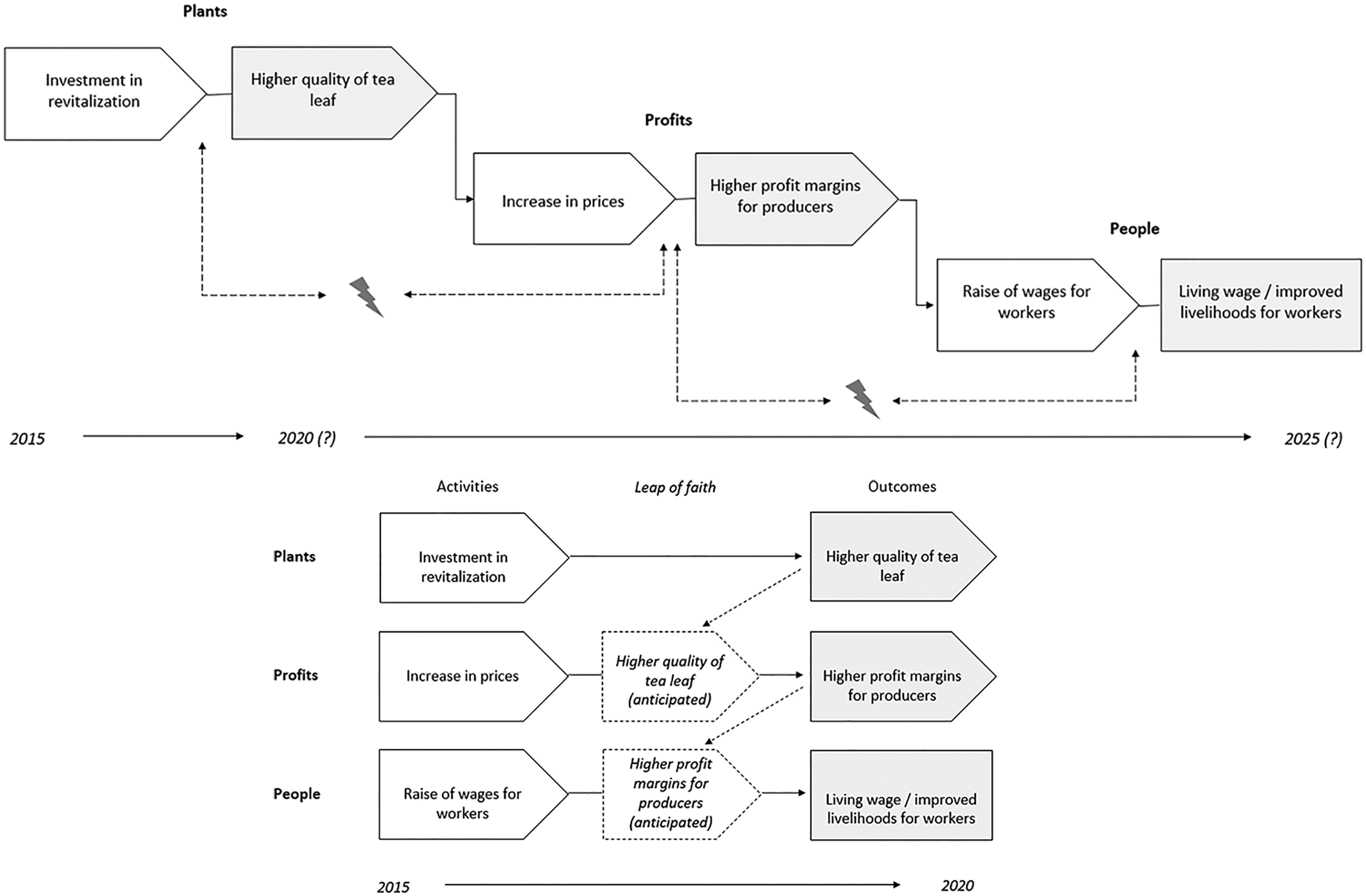
Sequential versus parallel process of implementing living wage.
Pressing for 2020 as the target year for living wage implementation was also a strategic choice, as illustrated by this quote from the same Convener representative: We had a lot of discussion about the intention statement, especially whether you will “work towards it,” or “achieve it” by 2020. [ . . . ] And we were initially quite careful in our ambition [ . . . ]. But we also thought: if you don’t put some pressure on it, nothing will happen, is our experience. [ . . . ] and it took time to convince especially the producers about this. But we said to them: a program with a strong ambition that is supported by all parties in the value chain will also put a lot of things in motion: it will spark creativity, innovation, and also funding from relevant donors. And if you have only some loosely defined ambitions, no one will be interested. (Convener)
Clearly, then, it was a deliberate choice by the leading CSP organizations to present a bold intention statement that they realized was quite ambitious, if not outright unfeasible. Nevertheless, the European partners convinced the producers and other stakeholders to sign up for the 2020 ambitions in spite of their reservations.
Following these developments, the CSP partners developed a parallel strategy in their 2015 strategy planning session to work on revitalization and living wage simultaneously, focusing activities on plants, people, and profits in sync, in order to deliver on the living wage component of the CSP more quickly. This theory of transformative change approached the process from plant revitalization toward living wage not as a sequential but as a parallel or interconnected process, explicitly incorporating the components of plants, people, and profits simultaneously. In this strategy, all elements of the process were considered equally important to achieve the desired transformations toward more sustainable tea production by 2020.
Figure 1 (the lower part) illustrates how the CSP stacked the three elements and the distinct temporalities involved. Rather than first investing in plants, leading to increased prices and profits, which could then afford the higher wages that would benefit people (upper part), the partners agreed from the start that it would be more effective to work on these three elements concurrently (lower part). To achieve an increase in the quality of their product, producers were asked to invest in their plants through replanting, irrigation, and factory refurbishment. Simultaneously, they were asked to invest in their people, by implementing better HR practices and by improving secondary (in-kind) benefits. 5
At the same time, buyers were asked to alter their procurement practices, which included, for example, paying a higher relative price for the country’s tea crop and committing to long-term contracts with producers to ensure higher profits and security. With this promise of increased prices, producers would then kickstart wage negotiations with the Workers Union to gradually increase workers’ wages toward the living wage benchmark by 2020. It was expected that such a parallel process would lead to quicker results in terms of improved plantation workers’ livelihoods: investments in profits and people would happen in sync while the tea plants were maturing and the plantations were being revitalized. By doing so, the natural constraints of growing tea were incorporated into the strategy of the CSP, which enabled partners to commit to a bold intention statement to deliver on their promises by 2020.
A Leap of Faith: Trust in Plants, People, and Profits
The parallel approach required both buyers and producers to abandon, at least in part, their usual economic rationale and to take a leap of faith, which did not come naturally to these business actors. The involvement of independent NPOs proved important in building the required trust between producers and buyers to enable simultaneous implementation of the elements plants, people, and profits. Furthermore, the NPOs supported the process in a practical way, in terms of financial contributions and by providing expertise and capacity building on relevant topics. Here, we see the value of a CSP strategy to enable this leap of faith and the transformative change.
However, the results in the first 3 years of implementation as presented in the previous section (“After”) show how this theory of transformative change proved to be complex to implement in practice, especially with regard to aligning the activities in all three elements, which was considered to be an essential part of the strategy. In fact, the results in the plants and people elements exceeded those in the profits element in the first years. This lack of synchronization of the different elements of the CSP caused friction on several occassions because it undermined the leap of faith that partners took when they agreed to participate in the program. After all, a nonsynchronized process endangers the stability of the CSP as the prioritization of one goal could potentially exclude other goals and, in this case, could even imply the collapse of the tea industry if the current crops fail to generate enough income to maintain payment of higher wages over a longer period of time. As one respondent noted, If we [producers] move any faster than this, we’re going to collapse because wage is a very big component of our cost of production. So the increase in labor cost and the change in what price we’re getting should move in tandem. (Producer)
Although the leading CSP organizations attempted to stimulate the activities on plants, people, and profits to be aligned in order to safeguard their partners’ trust and commitment to the CSP, it turned out that the strategy also had its limitations. Although the partners in the CSP attempted to “control” nature by including it in their strategy (i.e., move ahead with other elements of the change strategy rather than wait for the tea plants to mature), there appeared to be more capricious natural elements that could not be strategized. Whereas one can fairly easily predict the time it takes to cultivate a tea crop and plan for this in one’s strategy development, climate issues are clearly beyond any CSP stakeholder’s influence. Periods of drought or flood cannot be strategized and are difficult to incorporate into timeframes. With regard to the uncontrollability of natural elements, CSPs need to design strategies that incorporate both predictable and unpredictable natural conditions and that allow room for setbacks. Indeed, the CSP we studied is well-aware of this issue and is increasingly also working on “climate change impact mapping” to inform producers about potential climate change adaptation practices. The realization that nature can only be strategized and accounted for to a moderate extent is being felt throughout the partnership, where unforeseen natural circumstances and macroeconomic factors continue to frustrate the actual impact of wage increases realized to date. Yet the scope of the CSP has widened, and the realization that plants, people, and profits are interconnected issues has been accepted by all CSP members.
Discussion
In this study, we examined a CSP aiming to implement a living wage in a sub-Saharan African country’s tea industry through a broader agenda of crop revitalization. Key actors sought to achieve the ambition of securing a living wage for tea plantation workers by revitalizing the country’s tea industry, and thus explicitly included nature as a crucial part of their strategy. Although the connection between plants, profits, and people initially appeared to be sequential, key actors in the CSP soon pursued a parallel approach: rather than waiting for the productivity of tea plants to increase first, the other elements of profits and people were put in motion at the same time, promising an increase in tea leaf quality in the future. The partners in the partnership thus opted for a parallel approach that allowed for interim calibration. Through evaluation and negotiation, they aimed to reach an equilibrium, honoring the living cycle of tea plants and pursuing a living wage while ensuring profitability. Taking nature seriously thus produced strategic insights and actions that were unavailable before.
This “strategizing” of nature into the CSP required everyone to understand the nesting of plants, people, and profits. Partners understood that the prior stalemate was due to the exclusion of nature from their initial strategic thinking, which only the inclusion of nature could resolve. Yet pursuing the three elements in parallel required the stacking of divergent temporalities. This inclusive process required a leap of faith from business actors, which was facilitated by involving independent NPOs that had no direct stake in the tea supply chain (compared with buyers and producers), and who could play a convening role in developing and implementing an approach that incorporated an explicit focus on plants to enable change for the entire sourcing region. In earlier work on CSPs examining plantation-grown commodities, such as studies on coffee (Bitzer, Francken, & Glasbergen, 2008; Raynolds, 2009) and tea (Mzembe, Lindgreen, Maon, & Vanhamme, 2016; Vellema & van Wijk, 2015), this leap of faith remained largely under the radar. And although calls for systems thinking are regularly being made (see Williams, Kennedy, Philipp, & Whiteman, 2017, for a review), such thinking to date mainly seems to have grown more and more inclusive of actors but largely seems to have taken nature for granted.
Our research emphasizes the regenerative character of nature; by explicitly factoring in the limits and potentials of their natural context, the approach taken in our case goes beyond seeing temporalities as sequential toward seeing them as parallel. Plants mature in different cycles, and their being planted, pruned, and harvested fully conditions both profits and payouts to people. The original thinking was myopic. Once replaced by a fuller picture of plants and their lifecycles, the exact same temporalities can be understood as coevolving in parallel and close relationships as shown in Figure 1 (lower part): if nature is explicitly included, this focuses the system on plants rather than on profits. Our research thus shows how, in CSPs, nature (plants) needs to be embedded in strategizing efforts in order to find a solution for a social issue (people) while also addressing economic rationales (profits). Rather than prioritizing any one of these, the selected strategy included each component as an equally relevant part in the attempt to completely revitalize the industry and induce transformative change.
This insight counterbalances the long-time focus of the CSP literature on societal benefits and stakeholders (cf. Austin & Seitanidi, 2012; Selsky & Parker, 2005). Businesses needed to be aware of their role in society at large, and the NPOs enabled businesses to take the leap of faith that was required to kickstart the process and convinced businesses to incorporate work on plants, people, and profits simultaneously. This is in line with the work of Valente and Oliver (2018, p. 678), who noted that CSPs “may be an effective means of managing the complexity of sustainability when participants exhibit an openness to innovative forms of collaboration.” They also emphasize the systemic change that is needed, and the interplay between field-level and organization-level activity. In our case, the CSP enabled the transition to take place at the level of the industry, instead of working with individual buyer–supplier relationships. Over time, as NPOs will probably step back from the initiative, the NPOs’ “theory of change” suggests that businesses will carry on with this work—with an adjusted strategy that takes nature into account. Whether this will occur is beyond the scope of our study but certainly merits further research.
With our research, we aimed to improve our understanding of transformative CSPs by studying how effective partnerships for achieving systemic or transformative change can be designed, and how their potential can be realized (Clarke & Crane, 2018). In doing so, we simultaneously increased our understanding of how regenerative organizing can be kickstarted through CSPs. As Slawinski, Winsor, Mazutis, Schouten, and Smith (2019) note, “regenerative organizations seek to reverse [social problems and environmental degradation], emphasizing how to help local places flourish.” Our study has shown that, in order to achieve such transformation, partnerships need to be inclusive of people, planet, and profits in their design, as these elements are highly interrelated and involve different timescales. Moreover, it is crucial to take into account the (un)predictability of nature and the importance of balancing partners’ objectives in terms of priorities in each of the three key elements of plants, people, and profits. This will help ensure simultaneous progress in each of these three elements, as their alignment is essential in making the leap of faith that is required for achieving the envisioned change. Failure to do so will inhibit transformative potential, whereas sensitivity to these conditions will enable transformation (Williams, Whiteman, & Kennedy, 2021). In our study, the role of independent NPOs proved to be essential to facilitate the transformation process and to link the three key elements.
Limitations and Future Research Directions
Our efforts notwithstanding, we acknowledge some limitations in our research, which also provide stepping stones for future research. First, as the CSP is ongoing, it remains to be seen whether it will achieve lasting transformation in terms of business sourcing policies after the partnership has come to an end. Hence, although our study shows the potential of transformative CSPs in kickstarting a regenerative strategy, more research is required to better understand its long-term effects and to further examine this connection between CSPs and transformative change.
In our interviews, respondents repeatedly mentioned the innovative nature of the partnership, it being the first partnership to actually attempt to implement living wage in such an all-encompassing approach and to explicitly link it to the need for crop revitalization. Therefore, the CSP is also “learning by doing,” and hence it would be highly relevant to study the actual transformations achieved after 2020 and to examine the potential applicability of such a format to other regions or industries. Experiences in similar studies can be helpful in doing so (Valente & Oliver, 2018).
What our case uniquely highlights is the important role of plant revitalization in driving social and economic improvements. We should be looking at the integration of these different elements (Montabon, Pagell, & Wu, 2016), as well as at studies considering systematic decoupling (Whiteman & Cooper, 2016) to understand why more regenerative strategies are difficult to implement. Yet our study indicates that there are options to do so, we need to learn from these.
Finally, it would be useful to combine a perspective on “strategizing nature” as introduced here with recent work on supply chain management, for example, where calls for more synergy and dialogue have been made concerning ways in which “ethical and moral considerations could be integrated in the broader debate on sustainable supply chains” (Quarshie et al., 2016, p. 91). Giving nature a voice in such considerations could help overcome “a significant weakness in current sustainable supply chain research, namely that it is focused on a focal firms’ profits now rather than the entire supply chain’s future impact on the environmental and society” (Montabon et al., 2016, p. 12). More work that brings together insights on CSPs and sustainable supply chain management, while acknowledging the importance of strategizing nature would be needed.
Conclusion
Our research shows how participants in a transformative CSP came to strategize nature by progressively revealing and collectively reconciling the temporal tensions between “plants, profits, and people” in the tea sector in a sub-Saharan African country. Participants strategized nature by making ambitious commitments to treating the temporality of plants, people, and profits as interlaced and mutually determined—several years before they could verify that upgrading the plantations with premium varieties would sufficiently enrich the profit margins to warrant increases from minimum wage to living wage for the workers. Temporalities that initially appeared to be sequential were soon recognized as being nested within the growing cycle of plants and unfolding in parallel. This leap of faith afforded feed-forward evaluation (could it yield higher profit margins?) and calibration (could workers negotiate a larger share of these anticipated profits?) while waiting for newly planted varieties of plants to reach maturity. We explained how explicitly including nature into strategy complements systemic thinking by bringing to the fore multiple interdependencies and allowing partners to align multiple temporalities. Following our detailed analysis, we propose that transformative CSPs can be a promising vehicle to drive regenerative organizing.
Footnotes
Acknowledgements
We are indebted to our respondents, in particular our host organization, for allowing us to join them on this unique living wage journey. Earlier versions of this article were presented at several conferences and workshops, including EGOS (2018) and the Cross-Sector Social Interactions (CSSI) Symposium (2018). We thank the participants for helpful comments. At the CSSI Symposium, we had the pleasure to connect with Oana Branzei on this Special Issue. We are very grateful to have worked with such a committed and enthusiastic team of Special Issue Editors: Sally Russell, Gail Whiteman, and particularly Pablo Muñoz and Oana Branzei, who patiently supported us in carving out our contribution to the emerging community of regenerative organizing.
Declaration of Conflicting Interests
The author(s) declared no potential conflicts of interest with respect to the research, authorship, and/or publication of this article.
Funding
The author(s) disclosed receipt of the following financial support for the research, authorship, and/or publication of this article: This work is part of a Research Talent programme, project number 406 14 066, financed by the Dutch Research Council (NWO).
Notes
Author Biographies
