




Abstract
This article focuses on the current state of the science related to audiologic rehabilitation of individuals with dual sensory impairment, with an emphasis on considerations for provision of appropriate hearing assistive technology for this population. A substantial increase in the number of older adults is predicted in the coming years, many of whom will have significant age-related impairments in hearing and vision. Thus, hearing care professionals will be called on increasingly to attend to the special needs of people with dual sensory impairment to ensure maximal quality of life and independence for these individuals. Access to sound is critical for individuals who live with compromises in both vision and hearing. Hearing assistive technology may improve not only their speech perception but also their connection and orientation to the environment, as well as enable greater mobility. Thus, the audiologist's provision of appropriate and carefully selected hearing assistive technology may contribute dramatically to the quality of life of the individual with dual sensory loss. Prefitting, fitting, and postfitting considerations in providing hearing aids and other assistive technology to individuals with dual sensory impairment are reviewed.
The predicted increase in the next few decades in the number of older adults, many of whom will have multiple sensory impairments, will undoubtedly have a pronounced impact on delivery of audiology services. Leonard and Horowitz 1 conducted a survey of more than 300 persons who were receiving vision rehabilitation services and found that 39% of their respondents reported a significant hearing problem in addition to their vision problem. Sensory impairments such as vision loss and hearing loss may severely compromise the quality of life and independent functioning of older Americans.2,3 The sensorineural hearing loss experienced by older adults may havedramatic effects on communication and psychosocial function. Potential consequences of hearing loss experienced by older adults include altered psychosocial behavior, strained family relations limited enjoyment of daily activities; jeopardized physical well-being; interference with the ability to live independently and safely; interference with long-distance contacts on the telephone (potentially jeopardizing safety and security); interference with medical diagnosis, treatment, and management; and interference with compliance with pharmacologic regimens. 4 Similarly, visual impairments can severely compromise an older adult's activities of daily living, safety, and psychosocial functioning. When hearing impairment and vision impairment occur simultaneously, there are often severe activity limitations and participation restrictions, and thus, the negative effects on quality of life and independence are magnified.5–8
Older adults with dual sensory losses of hearing and vision often experience isolation, disappointment, and frustration during their so-called “golden years.” 8 Thus, audiologists have an important role, along with vision specialists, in helping these individuals engage in routine activities of daily living that ultimately impact their social participation and quality of life. Beyond improvement in speech perception, amplification may enhance the person's orientation and mobility. As Tharpe et al 9 point out, the abilities to identify one's location and to move safely through one's environment are critical for independence and social interaction. The purpose of this article is to provide guidelines to audiologists for the selection and fitting of hearing aids for older adults with dual sensory loss (defined in this article as a combination of hearing and vision loss). Prefitting considerations, hearing aid fitting factors, and postfitting support to ensure successful hearing aid use for this population will be discussed.
Prefitting Considerations: Determining Candidacy for Hearing Assistive Technology
Erber 10 offers relatively straightforward guidelines for determining candidacy for use of hearing aids by older people with hearing and vision deficits. He points out that older adults typically experience sloping, high-frequency hearing losses. Thus, their ability to perceive speech features, such as voicing, nasality, and vowels, which are predominantly low frequency, is relatively unimpaired, whereas their ability to perceive high-frequency consonants via audition may be compromised. Fortunately, many of the high-frequency consonants such as s, th, sh, and f are at least partially visible on the lips during face-to-face conversations. Individuals with poor vision, however, may not be able to compensate for a high-frequency hearing loss via lipreading, and thus, hearing aids may be essential to enhance their perception of many of the consonants. In Erber's schema, audiologists would consider both vision and hearing abilities when determining candidacy for hearing aids. If the older patient has a high-frequency loss (above 1000 Hz) and normal vision, usually communicates in optimal conditions, and reports little difficulty in one-to-one conversation, hearing aids may not be of significant benefit to the person. However, if in addition to a high-frequency loss, older patients have poor vision, they may not be able to converse fluently in one-on-one situations because they cannot avail themselves of the visual cues of high-frequency speech sounds.
Erber 10 points out that audiologists often do not consider the importance of the older adult's vision abilities in everyday communication settings. Speech recognition materials are typically presented auditory-only, even though most older adults can avail themselves of visual cues during their everyday communication interactions. It may be helpful for audiologists to include auditory–visual presentation of materials, such as word and sentence lists, to obtain a more accurate representation of how well the patient understands speech in typical face-to-face conversations. Furthermore, it is critical to find out about the person's lifestyle, self-rated conversational performance, and communication needs. Does the individual typically converse with one person, face-to-face, in optimal listening conditions? If so, he or she may do quite well, as long as there are no vision compromises. Does the person often dine or socialize with two or more communication partners? If so, he or she may need hearing aids, particularly if there are vision compromises. Does the individual report little difficulty communicating in everyday listening situations, despite a combination of vision and hearing losses? If so, his or her likelihood to report benefit from hearing aids is limited.
Additionally, the audiologist should find out if the person has other chronic conditions that may affect hearing aid candidacy, such as arthritis, reduced tactile sensation, and compromised physical and mental health. In the older adult population, with or without vision difficulties, it is prudent to also consider age-related cognitive changes, such as slower information processing, that may affect conversational abilities,11,12 as well as auditory processing difficulties. 13 There is some research evidence available to show that slower-acting hearing aid fitting algorithms may assist older adults who have limited abilities to process rapid information such as speech.11,12
In summary, given the fact that nearly every person experiences changes in vision as a result of the aging process, 7 it seems that best practices for determining hearing aid candidacy of older adults would mandate consideration of the patient's vision status. Lifestyle, communication needs, and vision status can be identified via a questionnaire or brief interview, and the effects of age-related vision problems on speech perception can be estimated relatively quickly by administering word and sentence recognition tests in two conditions: auditory-only and auditory–visual combined.
Hearing Aid Fitting Considerations
One of the most important considerations for the actual hearing aid fitting is to increase the visibility of the devices and their components. The typical hearing aid is beige, both in its body as well as its controls. Given the contrast sensitivity issues experienced by many older individuals, an attempt should be made to highlight the landmarks of the hearing aid. For example, the volume control wheel can be carefully marked in black to provide a contrast with the rest of the hearing aid. Alternatively, instead of a volume control wheel, a volume control switch may be used, enabling the person to feel the volume control with more certainty. Hearing aids with wide dynamic range compression, that automatically adjust gain depending on the characteristics of the listening environment, would be ideal for many individuals with dual sensory loss.
There are a number of other automatic hearing aid features that may be helpful for patients who have vision problems as well as hearing loss. Directional systems that switch automatically from omnidirectional to directional in noisy settings free the hearing aid user from manually switching the hearing aid's directionality control. In addition, digital hearing aid systems that automatically select the electroacoustic program depending on the listening situation may be helpful for individuals with hearing and vision losses. For telephone use, telecoils that switch automatically to the telecoil setting when a magnetic field from the telephone receiver is detected may be helpful. All of these automatic features of hearing aids would free the person with compromised vision from having to struggle to locate and manipulate the various switches and settings.
It is likely that in most cases the audiologist will recommend binaural hearing aids. With a binaural fitting, the patient with dual sensory loss will probably have greater ability to localize the sources of sounds, as well as more comfortable listening. Bergman 14 found that deaf–blind individuals reported greater ease of listening with binaural hearing aids, and other investigators have reported that binaurally aided individuals, in general, are more relaxed in various listening situations than individuals who wear only one hearing aid.15–17
Both hearing loss and vision loss may interfere with localization of potential hazards in the environment. 9 Tharpe and her coauthors 9 studied the effects of directional and omnidirectional hearing aids on speech perception and sound localization, using a small sample of children and adults with dual sensory loss. As expected, the subjects obtained significantly better scores on a test of speech perception in noise when their hearing aids were in the directional mode. For sound localization, the directional setting yielded higher scores with a 0° heading (ie, facing toward direction of the speaker); whereas, the omnidirectional setting yielded significantly higher scores with a 180° heading. The authors point out that considerably more research is warranted to obtain definitive data about the amplification needs of individuals with significant visual impairments. In the meantime, they suggest that a reasonable approach, based on their results, would be to offer a directional/omnidirectional microphone option to enhance the ability of individuals with dual sensory loss to move around their environments safely.
Although hearing aid users may obtain significant benefit for understanding speech in noise when using directional microphones, results of recent research suggest that directional microphones may confound sound localization, particularly in the horizontal plane. Specifically, research by Keidser et al 18 revealed that fitting cardioid microphones (microphones with greater sensitivity to front than rear sounds) bilaterally can enhance the ability to differentiate front–back sounds. However, when there is a microphone mismatch (eg, a cardioid microphone is used for one ear and an omnidirectional microphone on the other), the ability to differentiate sounds on the horizontal plane (ie, left/right sound localization) may be reduced dramatically. Horizontal localization is particularly important for individuals with vision problems because it helps them locate sound sources, as well as determine who is speaking in a group conversation. Thus, audiologists must carefully consider and measure the effects of specific directional microphone options when they make critical decisions about appropriate amplification for their patients with dual sensory loss.
Another consideration for the hearing aid candidate who has hearing and vision problems is potential difficulties in handling the hearing aid and its battery. Upfold et al 19 found that older individuals report in-the-ear hearing aids as being the easiest to manipulate, followed by in-the-canal and behind-the-ear hearing aids (at the time of this study, completely-in-the-canal hearing aids were not being routinely dispensed). Battery size is also a potential issue. Devices such as the Energizer EZ Change™, a battery dispenser with magnetic arms, can be of assistance when changing the battery.
When the older adult with dual sensory loss exhibits pronounced difficulties in speech recognition in noise, the audiologist needs to be proactive in recommending assistive devices beyond hearing aids. Although many older adults reject the use of FM devices,20,21 they should still be made aware of the options available to help them understand speech in noisy settings. Furthermore, if the older adult obtains an FM device, care must be taken to provide instructions on how to use the device and when and where the device should be used to obtain maximum benefit. By determining the patient's lifestyle and communication needs, as mentioned above, the audiologist will also be able to recommend other hearing assistive technology that may be useful for the older adult, such as alarm clocks with raised markings on the dial and an electrically activated vibrator for the alarm, doorbell signals that vibrate, sound indicators that give out vibratory signals when an audio signal such as a telephone is detected, wrist-worn pagers that utilize a vibratory signal, amplified telephones with large dial numbers and vibratory ringers, and vibrating smoke alarms.
Lastly, self-efficacy of the older adult with dual sensory loss may need to be addressed regarding the use and care of hearing aids. Self-efficacy, as defined by Bandura,22,23 is the domain-specific belief that one can successfully complete a task. Learning to use a hearing aid may appear daunting to the individual who also has vision problems, and the audiologist should try to bolster the new hearing aid user's confidence in this area. According to Bandura, 22 one of the best ways to avoid low self-efficacy is to avoid failure when learning a new task. In the case of the new hearing aid user, that means minimizing problems in handling the hearing aids from the outset and learning how to use and care for them. Hence, the importance of postfitting support in the form of education and counseling cannot be overemphasized.
Postfitting Support
Older adults with hearing loss may benefit not only from rehabilitation services and technology offered by professionals but also from supplementary written materials following the fitting of hearing aids. To create effective patient education materials, the age-related vision problems experienced by many older adults must be considered. Design considerations include font size and style, colors, content, and organization of the text.
There are a number of ways that aging may impact vision, and these changes in vision should be considered in the design of patient education materials. Typically around 45 years of age, the ability to focus on objects both far and near away declines. 7 Thus, fonts of at least 14 points should be used for education materials, case history forms, contracts, etc. Bernier 24 recommends at least 3 points between line spaces for materials printed in size 14 font. Simple, rather than elaborate, fonts will be easier to read (Figure 1). The American Printing House for the Blind 25 further recommends use of a typeface without serifs (Figure 2), headings and subheadings that are larger and bolder than the regular text that is used, left-only justification, printed materials with no divided columns or words, and black print on white, ivory, cream, or yellow with a dull finish to avoid glare.

The second font sample in this figure will be the easiest to read in patient education materials.

Examples of (A) a font with serifs (Times New Roman) and (B) a font without serifs (Arial).
Color discrimination may also decline with age. 7 The ability to detect differences between dark colors, such as brown, black, and navy, as well as between pastels, may be difficult. Thus, audiologists must carefully design and evaluate their patient education materials to ensure sufficient contrast and visibility for the older patient. In an effort to create attractive patient education materials, the audiologist may choose peaceful color contrasts such as mauve on pale green, or bright colors, such as blue on pink. The difficulty with these choices, however, is that they may not present enough contrast for the older eye to discern the letters (Figure 3). Use of black font on a white background, albeit relatively uninteresting, may be significantly more visible to the older eye. This is true for signage as well as written educational materials.
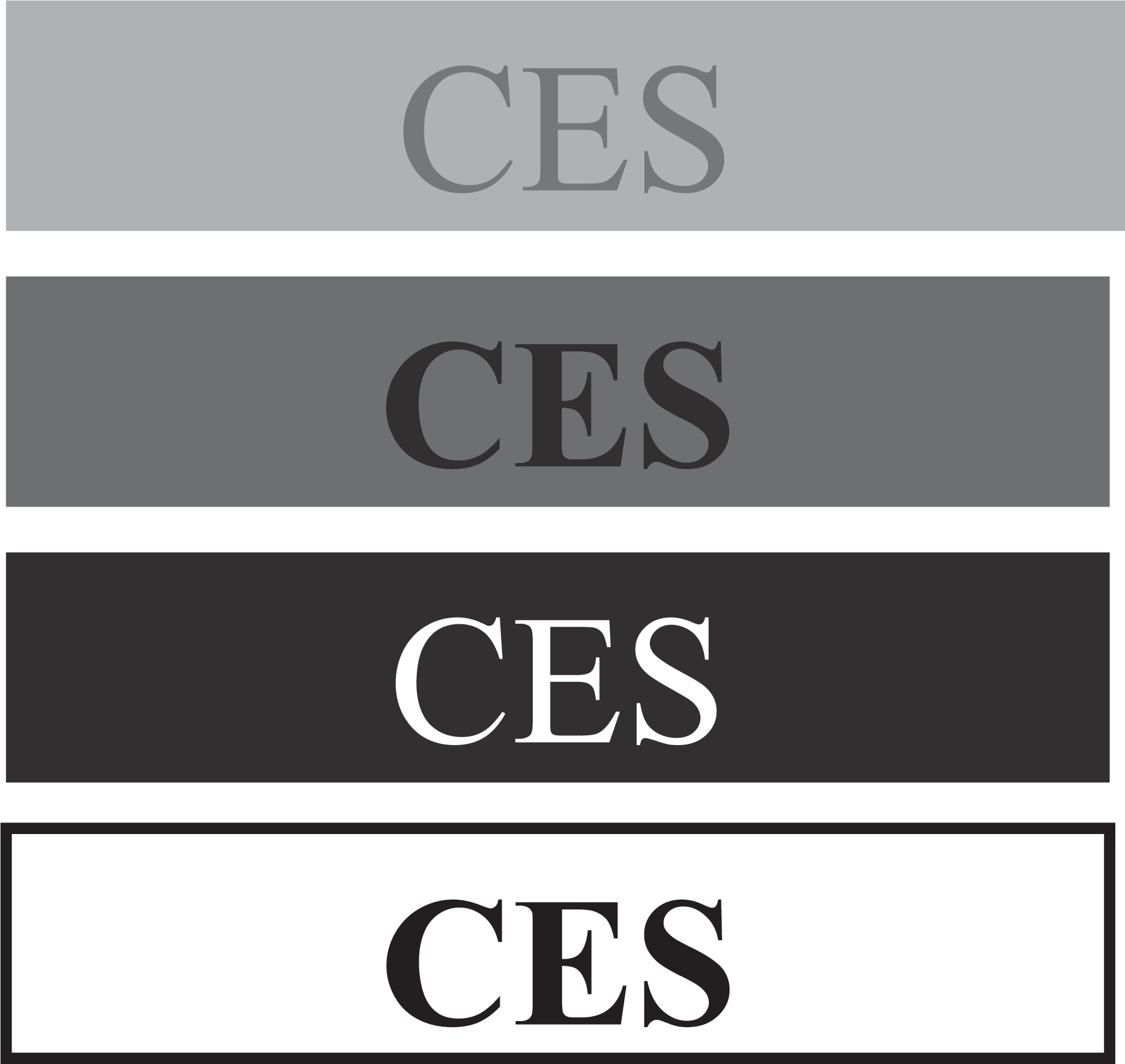
Font and background contrast examples.
The organization of patient education materials must be clear and simple, with key points bulleted or highlighted in some manner. Ideally, there should be only 3 to 4 main points for each topic discussed in the educational material. 26 Elsewhere the author has stressed the importance of a comprehensive program of postfitting support for older adults who are new hearing aid users, beyond the provision of patient education materials.11,27 A number of treatment options recommended for older adults, in general, may also be helpful for elderly adults with dual sensory loss. These include formal listening training, postfitting attention to the patient's self-efficacy for managing communication challenges, and clear speech training for frequent communication partners.
Vision Considerations for the Audiology Practice Site
Watson 7 cautions that when the older adult's visual acuity is measured in favorable conditions, it may appear to be only moderately affected. It may be dramatically affected, however, when there is reduced room illumination, lack of contrast, or the presence of glare. Thus, practitioners should evaluate the visual environment in which they will be offering services to older adults.
Lighting
Illumination features of the practice are a critical area to consider. The challenge is that although many older patients may benefit from increased lighting, others, such as patients with cataracts or age-related macular degeneration, may be sensitive to extreme lighting and to glare. Dimmers for overhead lighting are helpful, and incandescent lighting is usually preferred because it results in less glare than fluorescent lighting. Sheers can be used to reduce glare from windows with direct sunlight. If furniture surfaces are shiny and reflective, table cloths may be used to reduce glare. Flex-arm hobby (task) lamps positioned throughout the various clinical areas would also be ideal. The hobby lamps may be helpful when reviewing reading materials with the patient or when orienting the patient to the hearing aid controls.
Because light/dark adaptation declines with age, many older patients may have difficulty transitioning between bright and dim areas. If the soundproof room is relatively darker than the clinical suite, a lamp with a dimmer switch might be placed in the booth to assist with the patient's adjustment to different lighting.
Magnification
Magnification devices throughout clinical areas are also useful and may enable the patient to see hearing aid components (eg, microphone, volume wheel, telephone switch, battery door) more easily. These may be handheld devices, magnifiers that are on adjustable stands, or closed-circuit television devices. The latter are devices that consist of a camera that projects a magnified image on a monitor and can be purchased from companies that provide low vision aids. Smith and her coauthors 26 reported use of a visual magnification device for audiologic rehabilitation support programs for older adults. The portable device used was coupled to a television (Figure 4), allowing magnification of hearing aids. The device weighed less than 7 lbs and thus could be easily moved from one clinical site to another.
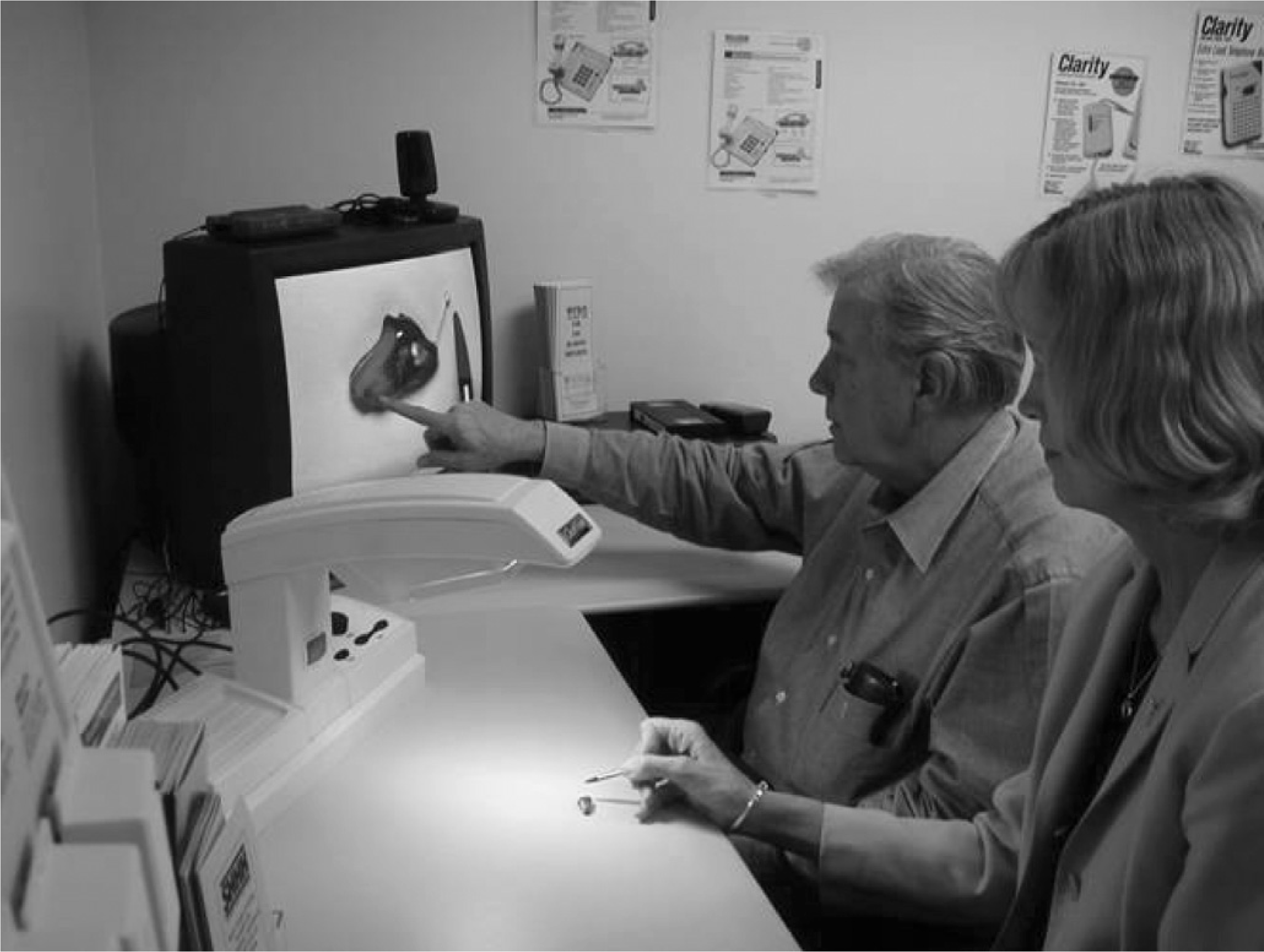
Patient and audiologist review features of a tiny completely-in-the-canal hearing aid that is magnified using a portable closed-circuit television device.
Collaboration With the Vision Specialist
Consultation with a vision specialist should also be included in best practices for audiologic management of patients with dual sensory loss. A vision specialist may conduct assessments that are useful for the audiologist. For example, information regarding visual acuity and contrast sensitivity can be provided by the vision specialist, which in turn could guide the audiologist in a number of ways, such as determining the need for color contrast in hearing aid controls and designing patient education materials. Additionally, the vision specialist could suggest magnification devices for the audiology practice, safety considerations for the patient's mobility in the audiology office, and vision screening measures that the audiologist might use for older patients.
Other Considerations for the Audiology Practice
The audiologist should become familiar with some of the courtesies and accessibility issues that are helpful for older patients with visual losses. The patient may be accompanied by another adult, such as a friend or family member who drove them to the audiology appointment. In this case, whenever possible, the audiologist should address questions and comments to the patient, rather than saying something like, “Does she attend social activities very often?” When moving from the interview area to the sound booth, ask the patient if it would be okay for him or her to take your arm as you move from one place to the other. Let the patient know when you are leaving a room, and when returning to a room you have left, say your name and indicate that you are back. For safety purposes, as well as the patient's sense of security, do not leave the patient standing alone in a hallway or a room with no furniture or landmarks. And of course, avoid giving directions that depend on vision, such as “Go ahead and sit in that chair over there.”
Another important general consideration for the audiologist is to understand that patients with dual sensory loss vary considerably in the nature of their visual difficulties. One patient may have visual acuity of 20/200, whereas other patients may have intact visual acuity but difficulty with peripheral or central vision, reduced contrast sensitivity, sensitivity to glare, or a combination of these visual challenges. Thus, a one-size-fits-all approach will not be appropriate, and fitting and dispensing modifications need to be customized for each patient's needs.
A critical area in need of attention is the safety of patients who move about the clinical setting. Hazardous obstacles may cause the patients to stumble or even to injure themselves. Hallways and pathways throughout the office suite should be free of clutter. If there is a step up into the sound suite, or an unexpected step anywhere in the clinic, it should be marked clearly with sharply contrasting and visible colors, such as neon yellow and black.
Finally, the patient with dual sensory loss is usually accompanied to the clinic by a family member or friend, and depending on the wishes of the patient, these social support entities should be included in counseling and education programs. Significant others may play a key role in helping the patient adjust to the hearing aids. Watson et al 28 found that family support was the most powerful predictor of continued use of low-vision devices among veterans, and it is likely that this is true for new hearing aid users with dual sensory loss. The problems associated with living with dual sensory loss are experienced by the entire family and extended social circle, not just the person who has both hearing and vision difficulties. Family members, in particular, can help the person learn to use his or her hearing aids and can provide encouragement as he or she adjusts to amplification.
Conclusions
It is likely that audiologists will see an increasing number of patients with dual sensory loss in the coming years. The combination of visual and auditory problems can have pronounced effects on the patient's independence, quality of life, and social participation and hence the audiologist will need to offer audiologic management protocols that are effective for minimizing activity limitations and participation restrictions. Several strategies and approaches for meeting the hearing care needs of these individuals have been suggested in this article. There are no one-size-fits-all solutions for fitting hearing assistive technology for individuals with dual sensory loss. Each patient will need an individualized treatment plan to help ensure maximal benefits from amplification. The reader is encouraged to offer and request information from vision specialists, rather than to work in isolation with a patient who has both hearing and vision loss. There has been a dearth of research regarding dual sensory loss, especially in the area of treatment efficacy. Until best practices are defined for audiologic services with this population, the practitioner must approach each person individually and seek assistance from individuals in the vision field. To learn more about vision impairment, low vision, and other vision rehabilitation services, the reader is encouraged to contact the Lighthouse Information and Resource Service, Lighthouse International, 111 East 59th Street, New York, NY, 10022-1202, (800) 829-0500,