




Abstract
As sales of advanced-technology hearing instruments continue to increase, there is increasing need for evaluation and fitting techniques to advance as well. Two recent technological innovations for improving the measurement and verification of high-tech hearing instruments are ICRA (International Collegium of Rehabilitative Audiologists) test signals and the Universal REM-Link™. The Universal REM-Link functionality allows use of these ICRA test signals from within any hearing aid manufacturer's fitting software through a computerized real ear measurement (REM) system, like the Siemens UNITY PC Probe module. These new and powerful hearing instrument fitting tools are a significant advancement in the verification of hearing aid performance and represent the “next generation” of PC-based integrated fitting systems.
From the Past to the Present
For more than twenty years, hearing health care professionals have been using probe microphone measurement as an objective method for the selection, fitting and verification of hearing instruments. Before REM equipment became commercially available, one of the most common fitting verification procedures used was the functional gain test. However, sound-field based functional gain testing is highly subjective, time consuming, unreliable and provides limited information about the true response characteristics of the given hearing instrument in-situ. Moreover, this procedure only provides estimates of gain for a single input level. With the advent of computerized REM instruments, dispensers had an objective procedure that actually measured the hearing aid circuit performance while in the patient's ear, which was seen by many as turning hearing instrument fitting from an “art”, fraught with trial and error, into an improved “scientific approach.” (Mueller et al, 1992).
Most early REM systems used unmodulated pure-tone, narrow-band or broadband test signals to perform real-ear insertion gain (REIG) tests. Early fittings were based on audiometric threshold data used to calculate REIG fitting targets, with the goal being to provide the user with maximum intelligibility. These steady-state test signals were conducive to testing a majority of the hearing instruments available at that time, which were based on single-channel amplifiers with both linear and non-linear analog circuits. Over the years, numerous improvements have been made to REM test equipment and procedures, prompted by research and technical innovations by hearing scientists, clinical professionals and manufacturers alike. However, the development and introduction of software-programmable, multi-channel digital signal processing (DSP) circuits now requires further advancements of probe-microphone procedures in order to improve the fitting and verification for high-tech hearing instruments. The combination of ICRA test signals and the new Universal REM-Link functionality represent a significant step toward advancement of the hearing aid fitting process and subsequent patient satisfaction.
Probe Microphone Targets
The newest generation of high-tech hearing instrument circuits is generally of multi-channel non-linear designs, which requires revision of traditional fitting targets based on linear circuits, or development of new formulae. Some of these new fitting targets and strategies developed to address non-linear circuits are the IHAFF (Independent Hearing Aid Fitting Forum, 1994) procedure, the DSL i/o Fitting Software DSL i/o method (Seewald et al, 1997), and the FIG6 (Killion, 1994) formula. Even though these target methods are widely used with non-linear circuits, they cannot always be applied directly to today's instruments with multiple channels of compression. Because of channel summation and other factors, some hearing instrument manufacturers provide modified versions of these formulae as part of their fitting software in order to better accommodate multi-channel processing (e.g. DSL i/o in the Siemens CONNEXX™ software). And recently the NAL-NL1 (Keidser et al, 1999) formula was introduced, which specifically takes multi-channel processing (up to four channels) into consideration when calculating targets.
ICRA Test Signals
Another challenge to improving fitting procedures has been to develop new test signals, which are better suited to today's hearing instrument circuitry. Unmodulated, or “steady-state” signals such as sinusoidal or broadband noise are still used in most REM equipment. If the dispenser neglects to turn off the noise reduction feature of a hearing aid when testing is conducted, these signals tend to activate the adaptive noise reduction functions of non-linear DSP circuits, causing them to react as if the signals were “noise,” (see Figure 1).
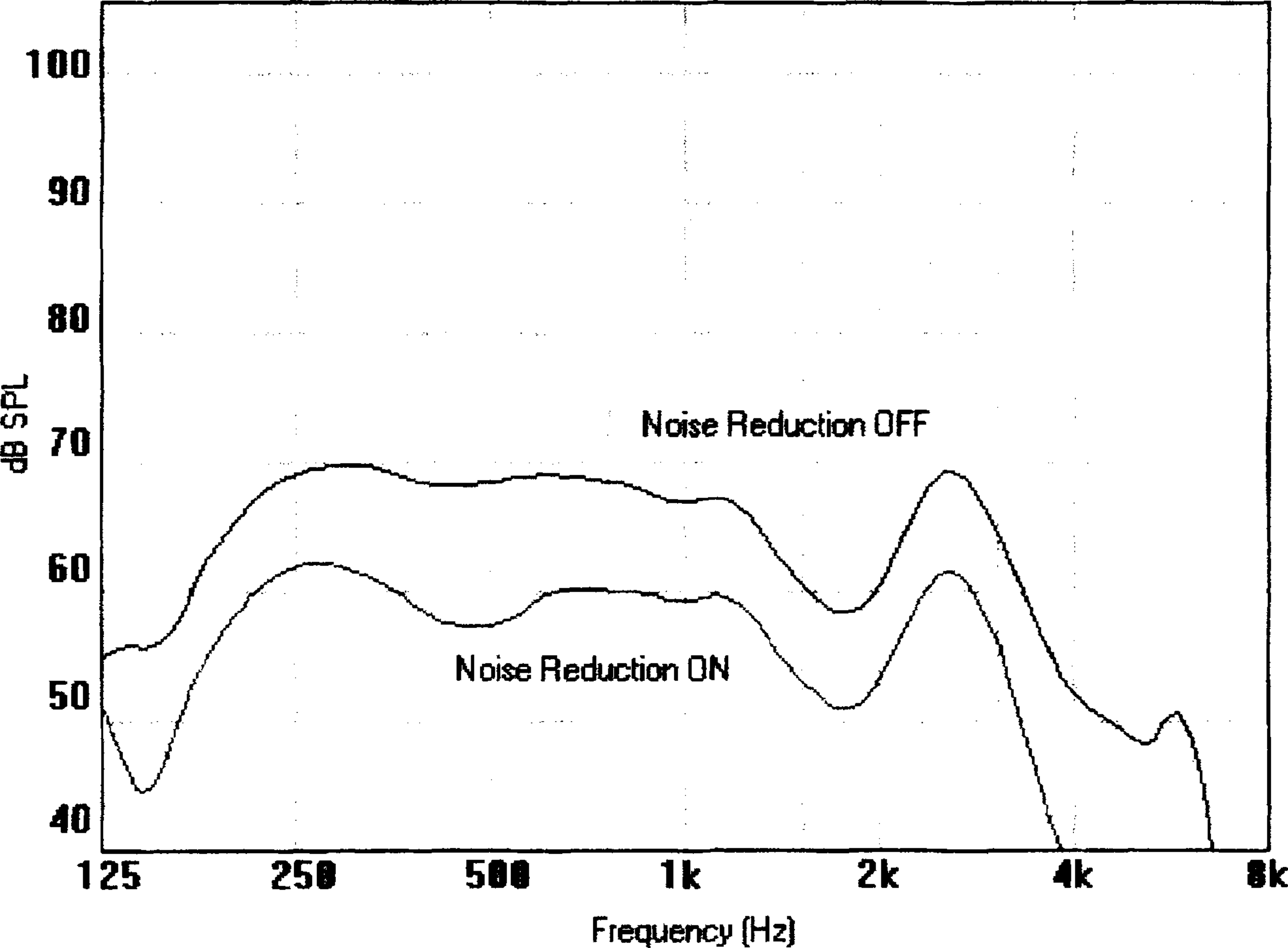
Effects of noise reduction feature on speech noise input.
When this happens, the adaptive functions can have many effects on the hearing instrument response, most typically reducing the gain and output, or changing the frequency response characteristics. The probe-microphone results therefore, will underestimate the gain that the patient would receive for a speech signal in the real world. Signals that are modulated, and therefore more speech-like, can “fool” the circuit into maintaining optimum gain, output and frequency response characteristics during probe microphone or test box measures.
One family of modulated test signals designed for testing DSP and other non-linear circuits are the ICRA test signals. The International Collegium of Rehabilitative Audiologists (ICRA) utilized the Hearing Aid Clinical Test Environment Standardization (HACTES) work group to develop these signals. There are a total of nine ICRA signals, three of which are unmodulated random noise – male weighted signals with normal (signal = selected output), raised (selected level + 5.7 dB), and loud effort (selected + 12.1 dB). The other six signals are all speech-modulated, including 3-band female and male weighted speech spectrums, 2 person babble, and 6 person babble at different voice levels (normal, raised, loud). These six “noise” signals are well-suited for evaluating multi-channel digital signal processing hearing instruments, because of their speech-like modulation characteristics.
Figure 2 illustrates the REAR differences between an “unmodulated” broadband signal (speech noise) and the “modulated” ICRA signal (2PB-N) at 65dB input level. These results were obtained with a Siemens SIGNIA™ with the digital noise reduction feature turned “on.” Observe that the circuit interpreted the unmodulated signal as “noise” and, in this case, reduced output of the hearing aid. Conversely, the modulated ICRA signal was recognized as more of a “speech-like” signal and the gain was not reduced. At this time, using the modulated ICRA signals seems to be a better choice, as compared to the unmodulated signals, for simulated “real-world” type speech situations when testing DSP circuits, especially when adaptive noise reduction technology is in use.

Effect of input signal (ICRA Signal vs. Speech Noise) on output of DSP circuit.
Universal REM-Link
Another challenge to improving high-tech fitting and verification was to bring ICRA signals and non-linear probe-microphone targets into a fast, user-friendly package that was seamlessly integrated with programmable fitting software. Thus, the concept of Universal REM-Link was developed. The Universal REM-Link test procedure allows dispensers to perform probe-microphone measures from within any NOAH™-compatible hearing instrument manufacturer's fitting software module. In the Siemens UNITY PC Probe REM device, it requires three easy point-and-click steps to super-impose the REM graph over NOAH and therefore the fitting module's screen. To accomplish this, the first step is to open Universal REM-Link by clicking on the menu item in the UNITY PC Probe Module (Figure 3). Next, open the hearing aid manufacturer's fitting software from NOAH's fitting module selector. Finally, resize the Universal REM-Link controller window within the given manufacturer's fitting software screen. In the accompanying figures, Siemens' CONNEXX fitting software is used for demonstration purposes (Figure 4). The Universal REM-Link window may be resized and repositioned with Windows' click, drag and drop functions.
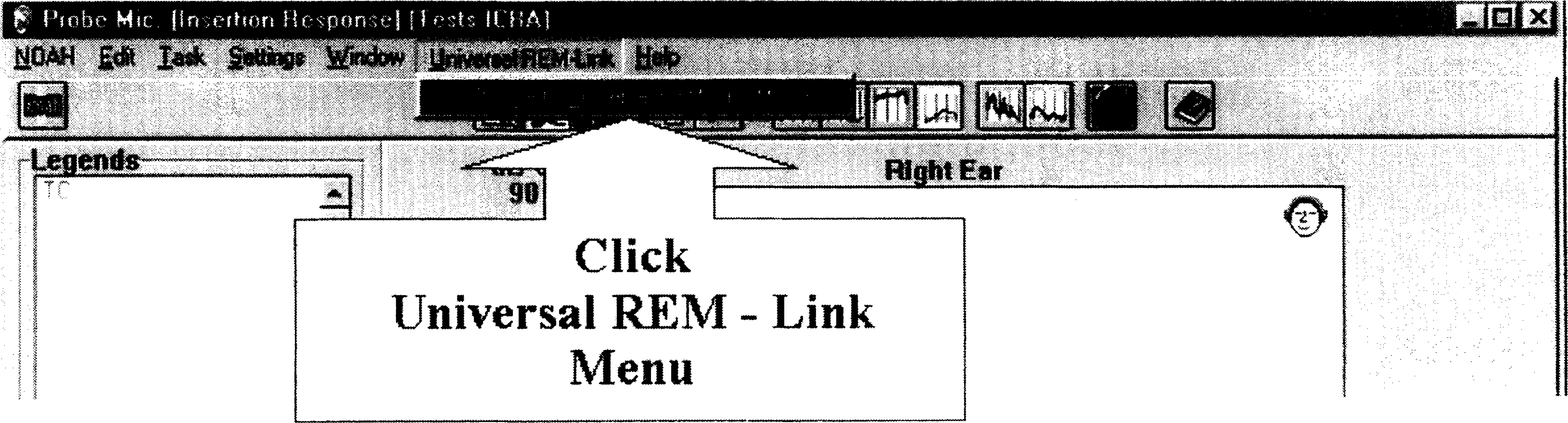
Universal REM-Link menu item in UNITY PC Probe Module.

Universal REM-Link super-imposed on hearing aid fitting software screen.
With Universal REM-Link operating within the manufacturer's fitting window, it is now a simple task to perform probe-microphone tests with the digitally programmable hearing aid in the patient's ear. The dispenser has complete and simultaneous control of both the fitting software and the REM software and test. The dispenser actually sees the real effect of “any and all” hearing aid fitting changes, adjustments and modifications as they are being made. This procedure allows the fitter to take advantage of all the features of the given manufacturer's hearing instrument and perform a quick and accurate real-time fitting.
The Future
Advances in hearing aid technology have prompted development of new fitting and verification methods. In the future, technological innovations are foreseen that will combine diagnostic and fitting procedures into one integrated fitting approach, resulting in increased speed and accuracy of fit, along with quantified and objective outcome measures.
One evolving innovation is the measurement of hearing acuity in dB SPL at the eardrum. This has been achieved using traditional transducers as well as using hearing instruments as the transducers. Adding a new level of accuracy to these “real-ear” hearing tests will allow standardized procedures to be adopted industry-wide. More accurate hearing acuity measures will naturally get us closer to the optimal fitting of hearing instruments.
Another innovative extension of this real-ear technology is the use of speaker arrays to measure individual transfer functions in a 360-degree space. These transfer functions can then be coupled with spatialization signal processing to create 3-D sound environments in the dispensing office (Shennib and Redinger, 1997). Imagine creating a virtual lecture hall or cocktail party environment in your office to test the benefit of those new directional hearing aids or the adaptive speech enhancement features of DSP instruments. This not only becomes exciting for the dispenser, but vital for the end-user to experience the hearing aids in a real-world environment before walking out of the office. Once we have created real-world listening situations in our offices, truly interactive hearing aid fittings and verifications become a reality.
Even without these Star Trek-like simulated environments, using current REM equipment, modulated test signals, and the new non-linear probe-microphone targets, more accurate and complete testing of the latest generation of multi-microphone directional hearing instruments will soon become commonplace (Mueller, 2001).
Summary
The advent of high-tech multi-channel DSP signal processing within hearing instrument circuits demanded changes in REM equipment and testing procedures. “High-tech fitting tools” like the ICRA signals and procedures such as Universal REM-Link bring us one step closer to providing more reliable test procedures for fitting “high-tech hearing instruments” with advanced signal processing circuits. Taking advantage of all the benefits of digital signal processing circuits means proving to the end-user the advantages of this technology and then verifying these advantages through objective and subjective test procedures.