



Abstract
Radio frequency (RF) heating has been studied to inactivate bacteria in some powder foods. In this study, a 6 kW, 27.12 MHz RF system was used to pasteurize Salmonella in black fungus (Auricularia auricula) powder. The effects of different conditions (initial aw, electrodes gaps, particle sizes) on RF heating rate and uniformity were investigated. The results showed that RF heating rate was significantly (p < 0.05) improved with decreasing electrodes gap and increasing initial aw, and the heating rate was the slowest when the particle size was 120–160 mesh. However, these factors had no significant (p > 0.05) influence on heating uniformity. RF pasteurization of Salmonella in black fungus powder was also studied. The results showed that, to inactivate Salmonella for 5 log reductions in the cold spot (the center of surface layer), the time needed and bacteria heat resistance at designated temperature (65, 75, 85 °C) decreased with increasing aw, and the first order kinetics and Weibull model could be used to fit inactivation curves of Salmonella with well goodness. Quality analysis results showed that although RF pasteurization had no significant (p > 0.05) effect on Auricularia auricula polysaccharide (AAP) and total polyphenols, obvious changes were found on color. Results suggested that RF pasteurization can be considered as an effective pasteurization method for black fungus powder.
INTRODUCTION
Black fungus (Auricularia auricula) powder is a product obtained by crushing of dried black fungus. Black fungus powder is gradually welcomed by consumers due to its excellent nutritive values, multiple edible methods and easy storage. It contains Auricularia auricula polysaccharide, B vitamins, melanin and adenosine beneficial to human health (Agarwal et al., 1982; Liu et al., 2019; Xiang et al., 2021). It has many biological activities, such as anti-virus, anti-tumor and antioxidant. Thus, black fungus powder is suitable for consumption by people of all ages, especially old people. The diversity of edible methods of black fungus powder is also an important reason why it is liked. It can be drunk when dissolved in boiling water or mixed with other materials as a solid beverage (Rong, 2019). It can be added to dough to make various flour products (Fan et al., 2021; Yuan et al., 2017). In recent years, a series of public foodborne outbreaks by pathogenic bacteria have been associated with powder foods which is the typical low water activity (aw) foods, such as flour, milk powder, vegetable spices (Henry and Fouladkhah, 2019; Jernberg et al., 2015; Zhang et al., 2020a). A serious Salmonella outbreak in North America in 2020 was linked to dried black fungus from China, and Japan also found Salmonella positive in dried black fungus from China in import inspection and requested to strengthen the inspection of Salmonella in black fungus (CDC, 2020). These outbreak incident of Salmonella in black fungus is an alarm for human. Black fungus can be contaminated with foodborne pathogens by environment, equipment and human during growing, production and transportation. In one of our pre-experiment, Salmonella was inoculated in black fungus powder with initial population of 6log CFU/g to simulate contamination, there were still more than 4 log CFU/g after 2 months storage. Therefore, it is imperative to sterilize black fungus powder before entering the market to ensure the safety.
Existing pasteurization methods for powder foods contain thermal and non-thermal processing methods. The conventional thermal methods such as steaming will destroy the sensory and nutrients seriously because of long processing time (Ahmad et al., 2019). Novel thermal processing methods include infrared heating (Fu et al., 2019), ultraviolet radiation (Park et al., 2020) and microwave (Kar et al., 2019; Pina-Perez et al., 2014). Likewise, there are some non-thermal methods including pulsed light (Lee et al., 2020), pulsed electric field (Pina-Perez et al., 2018), cold plasma (Thomas-Popo et al., 2019), and irradiation (Byun et al., 2019; Robichaud et al., 2021). Infrared heating, ultraviolet radiation and pulsed light can only sterilize the surface of powder foods due to their poor penetration depth. Pulsed electric field is often used in liquid foods, like juice (Zhu et al., 2019). Microwave is commonly used in powder foods and has volumetric heating, but poor heating uniformity is its principal limiting factor.
Radio frequency (RF) is a novel thermal pasteurization technology with frequency of 3 kHz-300 MHz, and its mechanism of heat generation is based on ionic conduction and dipole rotation of food material in the alternating electromagnetic field (Marra et al., 2009). RF has great potential as an alternative pasteurization method because of high heating rate and penetration depth (Zhang et al., 2018a). Recently, many studies of RF pasteurization for inactivating pathogens in powder foods have been reported, such as wheat flour, corn flour, spices, milk powder, vegetable powder (Lin et al., 2020; Ozturk et al., 2018, 2019; Ozturk et al., 2020; Xu et al., 2018; Zhao et al., 2017). Zhao et al. (2017) treated broccoli powder with RF pasteurization and founded that microbial count was decreased from 3 log CFU/g to less than 30 CFU/g. Liu et al. (2018) also used RF pasteurization to kill S. Enteritidis in wheat flour, and obtained ideal pasteurization results.
At present, the pasteurization methods of black fungus powder mainly include irradiation and hot air in industrial production, no study has been reported on RF pasteurization of black fungus powder. Therefore, it is necessary to study different factors on heating rate and heating uniformity of black fungus powder during RF treatment, and find the heating law. Salmonella is an important potential food-borne pathogen in powder foods, and caused black fungus microbial contamination incident in 2020 (Gambino-Shirley et al., 2018; Jernberg et al., 2015; Zweifel and Stephan, 2012). Therefore, it is valuable to study Salmonella as a representative pathogen in black fungus powder. Firstly, it is important to consider the Salmonella survival law in black fungus powder. According to previous study, the initial water activity (aw) of red pepper powder plays an important influence on the heat resistance of Salmonella during RF treatment (Hu et al., 2018). Then, it is needed to investigate whether Salmonella also follow this rule in black fungus powder of different initial aw. Moreover, there are no studies to discuss the effect of RF pasteurization treatment on the quality of black fungus or processed powder. Hence, our explorations will both provide references and technical support for the application of RF pasteurization of black fungus powder.
The objectives of this study were to (1) evaluate the effect of different factors on RF heating rate and heating uniformity of black fungus powder; (2) to determine the cold spot in packaged black fungus powder during RF treatment; (3) to investigate inactivation trend of Salmonella at the cold spot at different pasteurization temperature, and the effect of the initial aw of black fungus powder on RF pasteurization efficiency; (4) to evaluate quality changes of black fungus powder after different RF pasteurization treatments.
MATERIALS AND METHODS
Materials and samples preparation
Commercially bulk black fungus powder was purchased from Xi’an Lander Biotech Co., Ltd (Xi’an, Shaanxi, China). It was made of black fungus from Northeast China. Bulk black fungus powder was pasteurized by irradiation while processing. Take 10 g uninoculated sample mixed with 90 mL 0.1% buffered peptone water, then the diluted sample was homogenized for 2 min, plated on Salmonella Shigella (SS) agar and incubated for 24 h at 37 °C. Salmonella was not detected in the uninoculated sample. Black fungus powder was packed in PE bags and stored at room temperature.
Three different particle size samples of 80–120 mesh, 120–160 mesh and 160–200 mesh were divided by sieves of different sizes. The sieved samples were stored in refrigerator at 4 °C for later use. The initial aw of black fungus powder was 0.31 (moisture content of 7.8% (w. b.)), measured at 25 °C using a water activity meter (HD-4, Huake Instrument Co., Ltd, Wuxi, China). The moisture content of the black fungus powder was 7.8% measured by the standard of GB5009.3-2016. In order to obtain samples of different targeted aw, samples were transferred to vacuum desiccators with various saturated salt solutions of known relative vapor pressures at 25 °C (Lian et al., 2015). The targeted aw contained 0.43 (Potassium carbonate), 0.57 (Sodium bromide), 0.64 (Cobalt chloride) and 0.71 (Strontium chloride). It takes 3–5 days to equilibrate samples to targeted aw, then finished samples were measured by water activity meter and stored at 4 °C. And moisture content of black fungus powder reaching the above four aw were 8.9%, 10.9%, 12.7% and 14.2%.
Bacterial strain and cultivation
In this study, two strains of S. typhimurium ATCC 14028 and S. senftenberg ATCC 43845 were selected to make Salmonella cocktail. They were obtained from a laboratory in College of Food Science and Engineering (Northwest A&F University, Yangling, China). Salmonella cultures were kept in a stock dispersion in 25% sterile glycerol at −80 °C until used. Working cultures of S. typhimurium and S. senftenberg were streaked onto LB agar separately and incubated at 37 °C for 12 h. Then a loopful from strain plate was transferred to 50 mL LB broth, cultivated in a constant temperature incubator shaker at 170 rpm/min and 37 °C for 12 h to achieve extended culture of bacteria. To obtain the Salmonella cocktail, same volume cell suspension of each strain was aliquoted into a 10 mL sterile conical tube, and followed by centrifugation at 4 °C and 5000 g for 3 min. After the supernatant was discarded, mixed pellet was washed 3 times and re-suspended with 0.1% (w/v) peptone water. Then the bacterial population of cocktails was adjusted to approximately 108 CFU/mL based on the value of OD600 nm.
Sample inoculation and equilibration
100 g commercially sterilized black fungus powder was transferred to a sterile disposable plastic tray for inoculation, then 1 g prepared Salmonella cocktail was sprayed onto surface of sample through a sterile atomizer and hand-mixed for 15 min in a biosafety cabinet. To validate whether the bacterial was well-distributed in samples, 5 samples (1 g each) were selected randomly from inoculated samples and enumerated using the method in 2.5. The sampling result was 6.06 ± 0.09 Log CFU/g, which was very close to the 6 Log CFU/g of theoretical calculation, and the standard deviation was very small. This indicated that the bacterial had been well-distributed in black fungus powder. The inoculated samples were transferred in new sterile PP cases and placed in vacuum desiccators with various saturated salt solutions. The targeted aw of samples were 0.57 and 0.64, which were used to study influence of aw on inactivation efficacy. The aw of samples was measured at 25 °C every day, and the samples were removed from vacuum desiccators when they reached targeted aw, and then 1 g of the inoculated sample was packaged in a PE pouch (30 mm × 40 mm × 1 mm) for the RF pasteurization. The bacterial population of inoculated samples is 106 CFU/mL approximately. Uninoculated samples were treated identically for equilibration.
RF pasteurization study
RF system and temperature measurement
A 6 kW, 27.12 MHz pilot-scale free running oscillating RF system (GJG-2.1-10A-JY; Hebei Huashijiyuan High Frequency Equipment Co., Ltd, Hebei, China) was used in the study. The electrode gap of RF system could be selected between 100 and 300 mm which affected heating rate and uniformity of samples (Cui et al., 2021). And temperature measurement methods consisted of one optical fiber sensor system (HQFTS-D1F00; Xi’an Heqi Opto-Electronic Technology Co., Ltd, Xi’an, China) which could measure real-time temperature change in samples, and an infrared camera (A300, FLIR Systems, Inc., North Billerica, MA, USA) which could record sample temperature distribution of one layer. All of these temperature measurement methods could be found in our previous researches (Zhang et al., 2018b; Zhang et al., 2019).
Effect of different factors on RF heating
The samples (136 g) of 25 °C was filled into a cylindrical PP container, then knocked the container to make samples vibrate and maintain the height at 50 mm. To obtain the sample cross-section at the height of 25 mm, when half of the sample was loaded, a paper sleeve (close to the container wall) with preservative film at the bottom was putted into the PP container to separate the sample at the height of 25 mm, then the other half of the sample was filled, and kept the height at 50 mm. PP container was placed in the middle of the two electrodes (Figure 1(a)). Different electrodes gaps (110, 115, 120, 125, 130 mm) and initial aw (0.43, 0.57, 0.64, 0.71) of black fungus powder were chosen to study the influence of different factors on RF heating rate and uniformity. Besides, in order to study the effect of different particle sizes on RF heating, and eliminate the influence of height, 160 g (80–120 mesh), 150 g (120–160 mesh) and 136 g (160–200 mesh) samples were filled into container and kept the height at 50 mm.
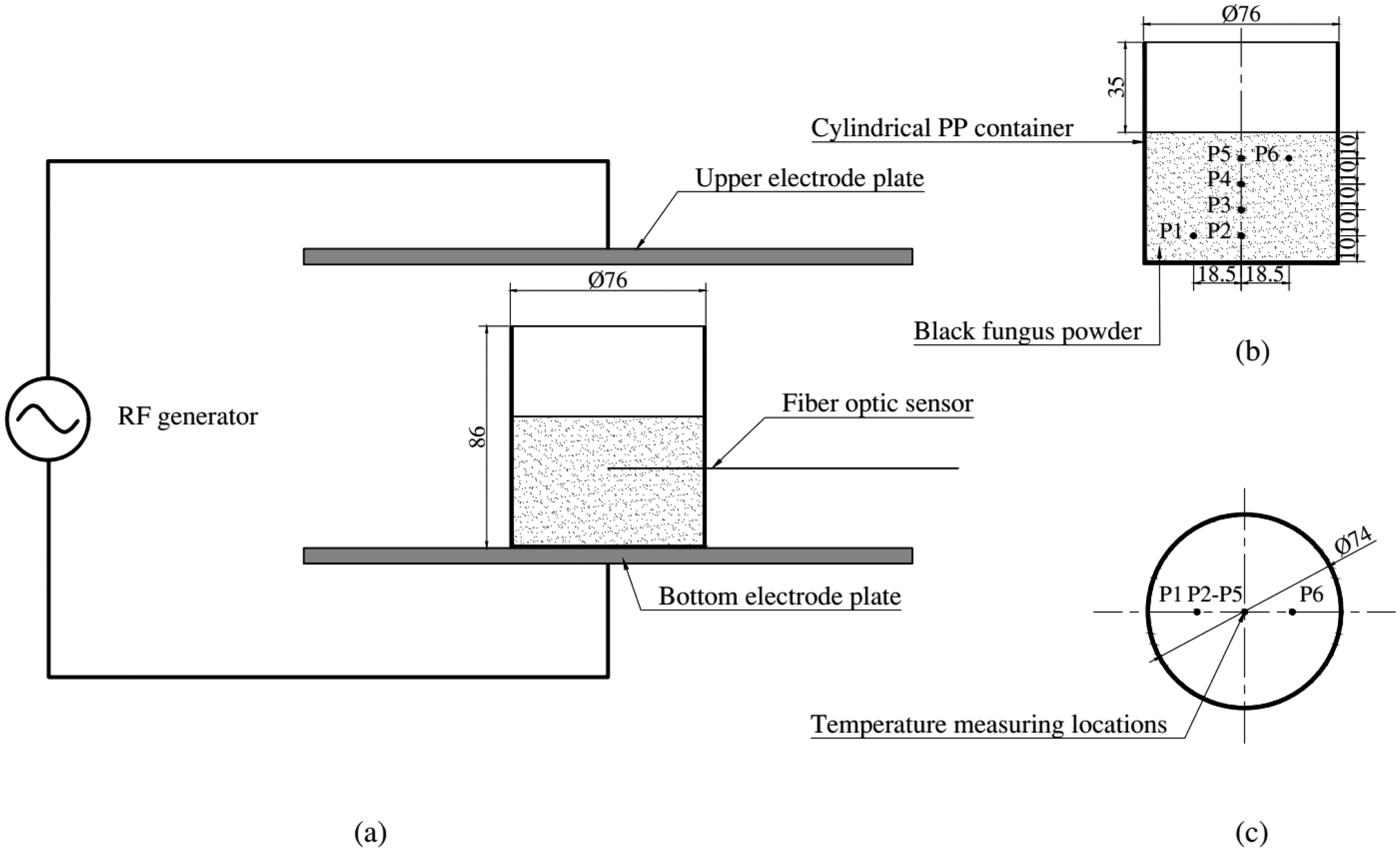
Schematic diagram of (a) the black fungus powder placed in RF heating system (6 kW, 27.12 MHz) and (b, c) sample in the container and optical fiber measuring locations (all dimension are mm).
Four optical fiber sensors were inserted into sample at P1, P3, P4, P6 (Figure 1(b) and (c)), and average temperature value of 4 points was used to evaluate heating rate. The surface and middle layer temperature distribution of samples were measured by infrared camera when temperature of 4 points reached 80 °C. Heating uniformity was evaluated by uniformity index (λ), which was calculated using the Eq. (1) (Jiao et al., 2015).

Cold spot exploration
136 g black fungus powder (160–200 mesh) with initial aw of 0.57 was filled into PP container, 110 mm electrodes gap which obtained the highest heating rate was selected to explore the cold spot location of black fungus powder during RF heating. In order to investigate vertical temperature distribution, 4 optical fiber sensors were inserted into container from bottom to top (P2 to P5) to record temperature change. As for horizontal temperature distribution, upper layer (surface) and middle layer (25 mm high) were selected to study. When the temperature of all points reached 80 °C, PP container was immediately transferred from RF system, and remove the container cover to map upper layer with infrared camera. As for middle layer, the paper sleeve containing the upper half of the sample was removed, then the middle layer was exposed and mapped with infrared camera. Each experiment was repeated thrice.
RF pasteurization treatment of black fungus powder
In order to explore the effects of temperature and initial aw on the heat resistance of Salmonella in black fungus powder during RF pasteurization, black fungus powder (160–200 mesh) with different initial aw of 0.57 and 0.64 (designated as Law and Haw, respectively) were used for RF pasteurization with 65, 75, 85 °C. The gap between top and bottom electrode was 110 mm. As shown in Figure 2, 135 g uninoculated sample was put into PP container, and then 1 g packaged inoculated sample was placed at the cold spot obtained in 2.4.3 which was the center of surface. The inoculated bag method was used in many RF pasteurization studies because of high safety, no impact for RF heating and easy operation (Liu et al., 2018; Wei et al., 2019).
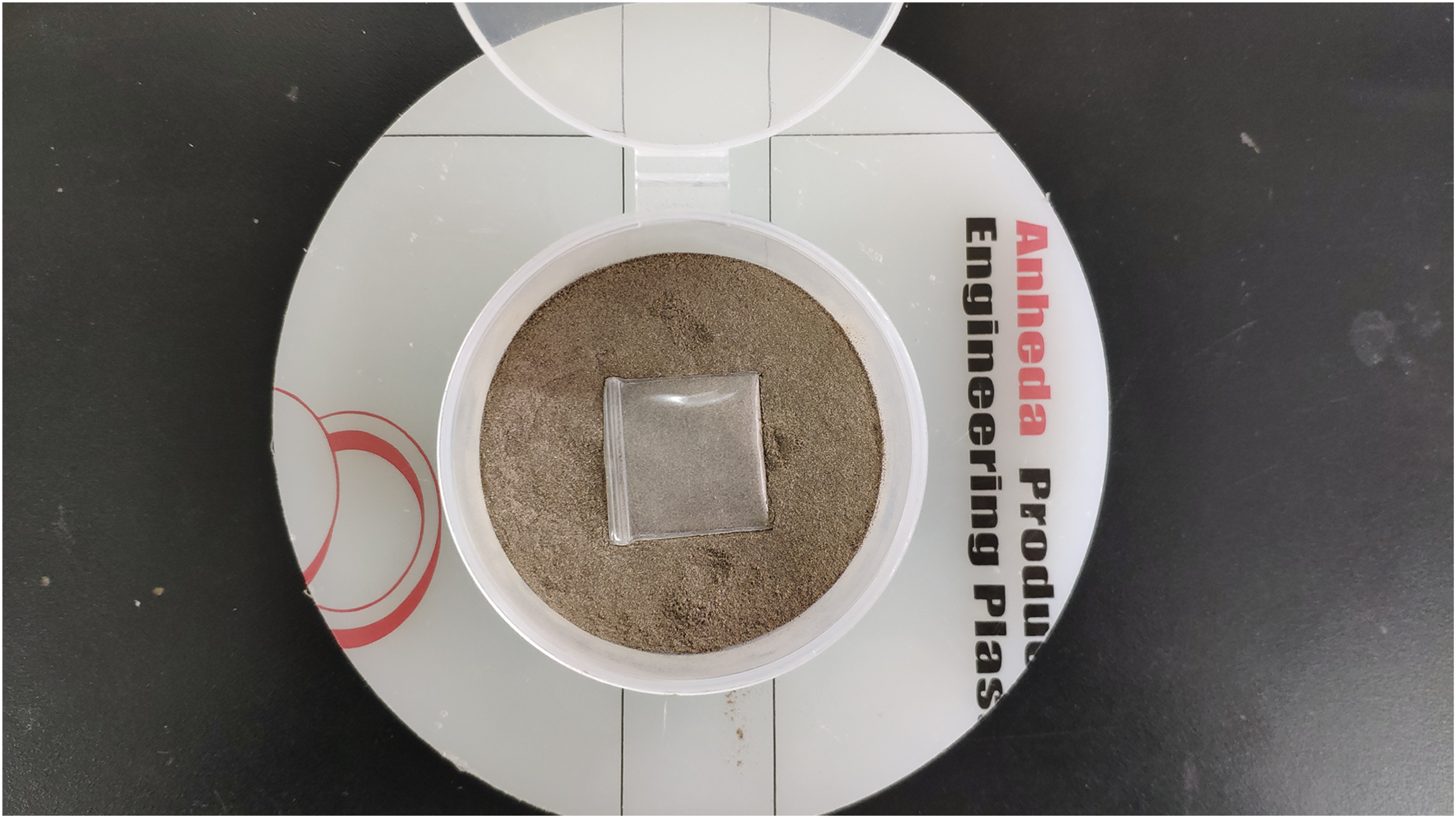
1 g packaged inoculated sample positioned at the cold spot (the center of surface) with 135 g uninoculated sample.
Firstly, the PP container with sample was placed on the bottom electrode and heated to 65, 75, 85 °C. The PP container with sample was transferred into a hot air oven when the average temperature reached 65, 75, 85 °C, and then maintained target temperature until Salmonella reached 5 log reductions (detection limit) respectively. In order to obtain microbial inactivation curve of Salmonella under different pasteurization conditions and the holding time to kill all Salmonella, different specific time points were selected to enumerate during holding time. After pasteurization treatment, the inoculated bag was placed in an ice-water bath immediately to eliminate extra thermal effect. Each time point was repeated thrice.
Microbial enumeration
The inoculated sample (1 g) in PE bag was transferred to a sterile homogeneous bag and was diluted in 99 mL 0.1% buffered peptone water, then homogenized for 2 min at 480 rpm/min. After homogenization, blended samples were diluted (1:10) in peptone water to obtain the suitable diluent. 0.1 mL suitable diluent was plated on selective medium SS agar using coating method, and each diluent of the same dilution equally plated onto three plates. All plates were incubated at 37 °C for 24 h and counted for Salmonella populations. The populations were expressed as log CFU/g and log reductions were calculated using the Eq. (2):

Mathematical modeling
Nowadays, predictive microbiology has been widely used as a tool to assess the inactivation patterns under different factors, and due to the reproducible nature of a bacteria response to the environment, the existing mathematical model can be used to fit the inactivation rate of microorganism so as to obtain appropriate safety control methods (McMeekin et al., 1993). To analyze the inactivation kinetics of Salmonella in black fungus powder, the first order kinetics, Weibull model and modified Logistic model were used in the present study.
First order kinetics
The first order kinetics assumed a linear relationship between the logarithm of the number of residual bacteria and the treatment time, and the equation was as follows (Jiao et al., 2019):

In order to further analyze the heat resistance of Salmonella in black fungus powder with two different aw, the z values (°C) were obtained by Eq. (4) which indicated the increase in temperature required to reduce D to 90%.

Weibull model
The Weibull model was the one of the most used nonlinear models to describe microorganism inactivation curves, and its equation was as follows (Saucedo-Reyes et al., 2018):


Modified Logistic model
The Logistic model was a common s-curve model which was proposed by Cole et al. (1993). And the parameters were reduced to three after later revision, as shown in Eq. (6). In the present study, if A was fixed as 5, it indicated that the −5 log reductions can be achieved under different RF pasteurization, so the model would be simplified to two parameters.

Model comparison
The coefficient of determination (R2) and root mean square error (RMSE) were selected in the present study to evaluate the fitting effect of different models. RMSE was defined by the Eq. (8):

Quality analysis
The uninoculated Law and Haw samples were chosen for RF pasteurization treatment of different target temperature with corresponding holding time which obtained from the 2.4.4, and were used for quality analysis. Taking the untreated samples as the control group, the effect of RF pasteurization on the physiochemical properties of black fungus powder was studied.
Color
The colorimeter (Ci7600; Aiseli color technology co., LTD, Shanghai, China) was used to determine the color of the samples and the values of L*, a* and b* were measured. The total color difference (ΔE) with reference the control sample was calculated by the Eq. (9) (Yao et al., 2020):

Water holding capacity (WHC)
WHC was measured according to the method described by Chau and Huang (2003) with modifications. Weigh 0.500 g sample accurately in 100 mL centrifuge tube by mixing 15 mL distilled water, then stand for 24 h at room temperature. After centrifugation at 4000 r/min for 20 min, poured out supernatant and sucked up residual water with filter paper. After standing for 5 min, WHC was calculated by Eq. (10):

Nutrients
Nutrient components used for evaluation included Auricularia auricula polysaccharide (AAP) and total polyphenols. AAP content was determined using the method of phenol-sulfuric acid by the China National Agricultural Standard NY/T 1676-2008. The total polyphenols was measured according to the method of foline-phenol (Singleton and Rossi, 1964).
Statistical analysis
All data were presented as mean values and standard deviation (SD) after at least triplicate experiments. ANOVA and Turkey’ test with a significant level of 0.05 were performed with SPSS 20.0 (IBM Inc., USA). Microsoft Excel 2016 (Microsoft Office, Redmond, WA, USA) and Origin 2021 (OringinLab, New York, USA) were used to analyze data and drawing.
RESULTS AND DISCUSSIONS
Effect of different factors on RF heating rate and uniformity
Heating rate
The time-temperature curves and uniformity index results under different experimental conditions are shown in Figure 3. Figure 3(a) showed the effect of particle size on RF heating rate, there were no significant (p > 0.05) difference in heating rate between 80–120 mesh and 160–200 mesh. However, the value of 120–160 mesh sample was significantly (p < 0.05) lower than other two particle sizes. This could be due to the different tap density of samples with different particle sizes. Ozturk et al. (2016) found that dielectric constant and loss factor increase with the increasing compaction density in a small range of compaction density. In addition, dielectric properties of powder may be influenced by the particle size. These factors could jointly affect the RF heating rate, and the specific rules need to be further explored. The electrodes gap and initial aw of samples significantly affected the RF heating rate in Figure 3(b) and (c), and sample heating rate increased with the increasing initial aw and the decreasing electrodes gap. It needed 195, 160, 143 and 130 s for average temperature of black fungus reached to 80 °C when initial aw were 0.43, 0.57, 0.64 and 0.71. Hu et al. (2018) also found similar trend in red pepper powder RF heating with different initial aw. This could be due to that the free water in the sample increase with the increasing aw, which makes the loss factor larger and heating rate faster. The relationship between electrodes gap and heating rate had also been reported (Cui et al., 2021; Shen et al., 2020). With the change of electrodes gap, the electric field density and power density in the RF cavity were changed. More energy was generated from RF generator for material heating, while electrodes gap decreased (Cao et al., 2019).
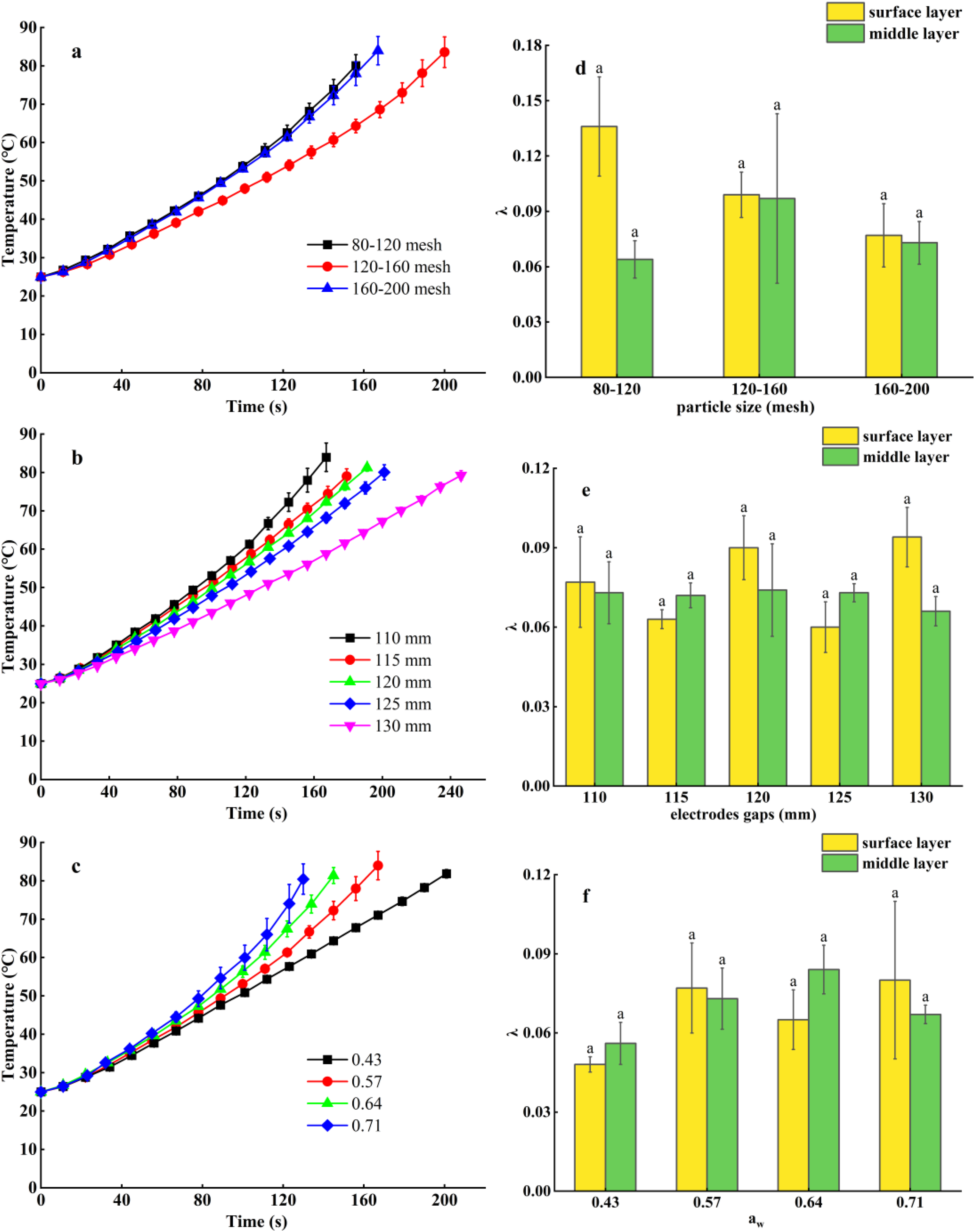
Time-temperature curves and heating uniformity index (λ) of samples (aw = 0.57) of different particle sizes at 110 mm electrode gap (a, d). Time-temperature curves and heating uniformity index (λ) of samples (aw = 0.57) of 160–200 mesh at different electrode gaps (b, e). Time-temperature curves and heating uniformity index (λ) of samples with different initial aw of 160–200 mesh at 110 mm electrode gaps (c, f). The same letter in the same column chart indicates no significant difference (p > 0.05).
Heating uniformity
Figure 3(d)-(f) showed that there was no significant difference of heating uniformity index (p > 0.05) under different conditions. This indicated that the RF heating uniformity of black fungus powder was not significantly improved by changing the electrodes gap, aw and particle size. In our previous study (Zhang et al., 2021), a rotator which combined RF system could effectively improve heating uniformity of green peas. Hence, the rotator can be introduced to improve the heating uniformity of black fungus powder in the future. In order to reduce the heating time, electrodes gap of 110 mm and 160–200 mesh were selected for subsequent study.
Cold spot
Figure 4(a) showed the temperature curves of 4 points in vertical direction which represented vertical temperature distribution. With the decreasing height of point, the heating rate increased gradually, and the measured heating rate are P5 < P4 < P3 < P2. So, in the vertical direction, the closer to the bottom of sample, the higher the temperature. Wei et al. (2019) reported that the temperature of bottom center location was the highest in three center locations, and temperature of bottom edge location was also higher than middle edge and top edge during RF heating of ground black pepper. As for horizontal temperature distribution, results were shown in Figure 4(b) and (c). Edge heating phenomenon was observed in each layer, the center temperature was the lowest Some studies which used cylindrical containers obtained similar results (Ozturk et al., 2018; Pan et al., 2012), and similar heating patterns were also reported for corn flour (Ozturk et al., 2019), coffee bean (Pan et al., 2012), potato starch (Zhu et al., 2017). This is due to that the edge areas absorb more electromagnetic energy (Tiwari et al., 2011), so edges was heated faster than center.
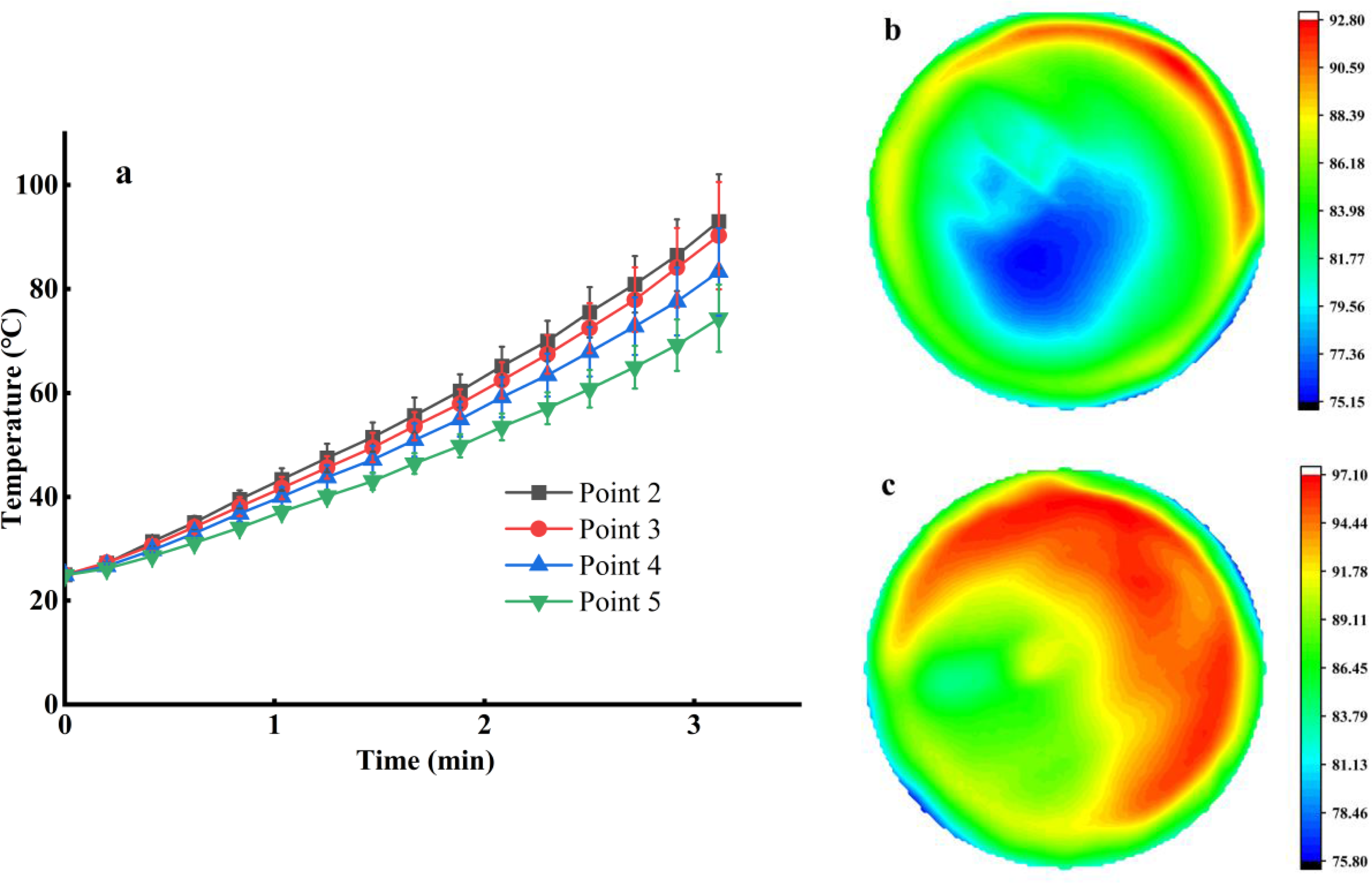
Time-temperature curves of 4 vertical locations during RF heating (a). Upper layer (b) and middle layer (c) temperature distribution of samples after all locations reached 80 °C.
In summary, the center of surface layer was the cold spot during RF heating of black fungus powder. This may be due to the thermal convection between surface layer and the surrounding air, resulting in the heat loss of top sample (Ozturk et al., 2020). The steam generated from bottom is not easily lost. Liu et al. (2018) and Lin et al. (2020) also founded that top layer center was cold spot. The inoculated bag was placed in this location to represent the worst-case scenario of pasteurization studies.
Inactivation of Salmonella by radio frequency heating
Pasteurization effect in heating and holding stage
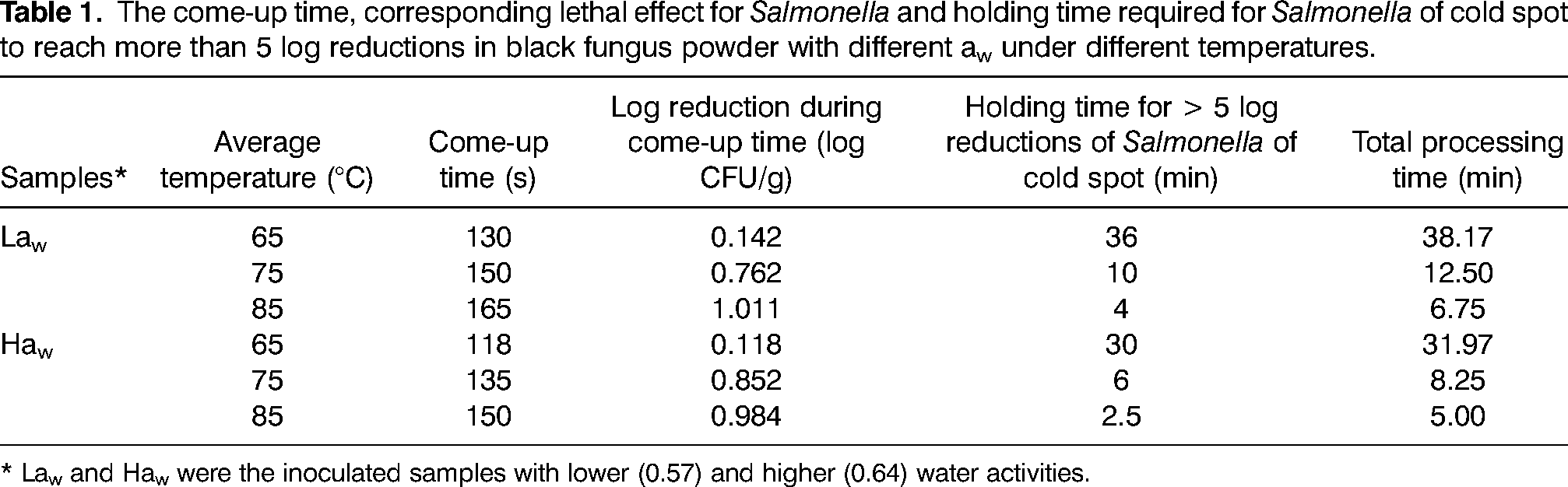
Table 1 showed the come-up times (CUT), corresponding bactericidal effect, holding times and total processing times for the black fungus powder under different pasteurization treatments. During the temperature-rise period, based on time-temperature profiles of different initial aw in 3.1.1, the CUT of Law samples were 130, 150, 165 s reaching 65, 75, 85 °C, and the CUT of Haw samples were reduced to 118, 135, 150 s respectively. The reason for the change of the heating rate had been discussed in 3.1. As provided in Table 1, at the same aw, the log reductions of Salmonella in the inoculated bag decreased significantly with the increasing average temperature. When the target average temperature was 65 °C, log reductions in Haw and Law sample were 0.12 and 0.14. When the average temperature reached 75 °C, for Haw and Law sample, the log reductions were 0.85 and 0.76, while the lethality were 0.99 and 1.01 at 85 °C. It indicated that Salmonella survivors will be significantly reduced when the average temperature of black fungus powder is higher than 65 °C during heating process. The reduction of Salmonella at high aw was higher than low aw group at 75 °C, Hu et al. (2018) founded that the log reduction during CUT increased with aw of red pepper powders from 0.57 to 0.71. However, there was no obvious difference in the lethality between two aw groups at 65 and 85 °C. It is necessary to analyze the pasteurization results during temperature-hold period, so as to accurately understand the influence of aw on the heat resistance of Salmonella in black fungus powder.
The come-up time, corresponding lethal effect for Salmonella and holding time required for Salmonella of cold spot to reach more than 5 log reductions in black fungus powder with different aw under different temperatures.
* Law and Haw were the inoculated samples with lower (0.57) and higher (0.64) water activities.
Figure 5(a) and (b) showed the microbial inactivation curves of Salmonella in black fungus powder under different conditions. And the holding time required to inactivated Salmonella of samples of different aw in cold spot to below the detection limit (> 5 log reductions) at 65, 75, 85 °C were provided in Table 1. Because the cold spot is considered to be the worst inactivation location, when no pathogen could not be detected in the cold spot, it can be considered that is no residual pathogenic bacteria in the sample. At 85 °C, it only took 2.5 to 4 min to inactivate Salmonella, while it took 8 to 10 min at 75 °C. When the oven temperature was set at 65 °C, it took more than 30 min to eliminate. It indicated that the inactivation efficiency increased significantly with the increasing temperature. Liu et al. (2018) reported that the inactivation effective to kill Salmonella increased by more than four times when the holding temperature was increased from 75 °C to 85 °C. This indicated the heat resistance of Salmonella obviously reduced at a high temperature. In addition, by observing the shape of inactivation curve at 65 °C from Figure 5(a), the inactivation rate was first faster and then slower after 16 min. Similar changes could also be observed in curve at 65 °C in Figure 5(b). It may be that the bacterial cells had adapted to the applied pressure with the extension of holding time (Jiao et al., 2019). By comparing the holding time of different aw at the same temperature in Table 1, it could be found that the time of Haw sample at 65 °C was 30 min, which was significantly shorter than Law sample of 36 min. And at 75 and 85 °C, holding time of Haw sample was also shorter than other Law samples. It indicated that the heat resistance of Salmonella in black fungus powder was affected by aw. Similar trend was reported for Cronobacter sakazakii by Zhang et al. (2020c), with the aw increased, the time required to pasteurize C. sakazakii was shorter.
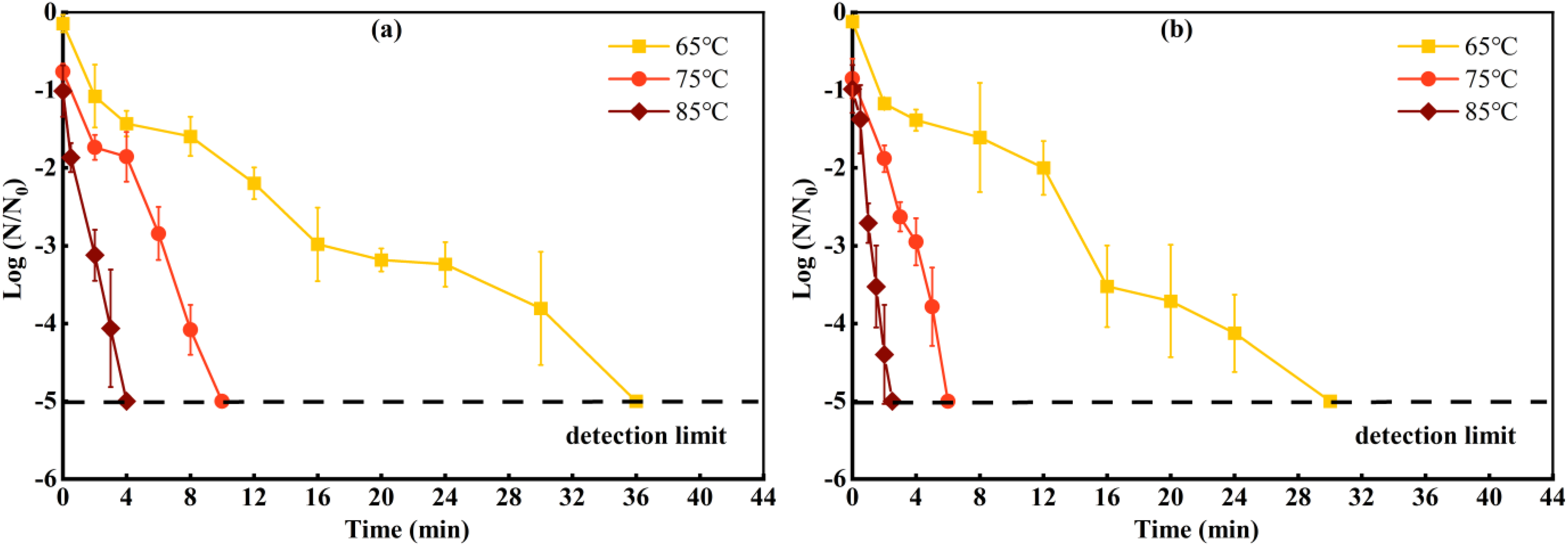
Inactivation curves of Salmonella in Law sample (a) and Haw sample (b) under different target temperature (65, 75, 85 °C) by RF heating.
Model fitting of Salmonella inactivation curves
It was incomplete and inaccurate to analyze the trend of inactivation curves according to the empirical description. Thus, primary models were needed for accurate prediction and quantitative analysis of the experimental results. Pasteurization experimental data were fitted with first order kinetics, Weibull model and modified Logistic model in Figure 6, and the parameters and fitting goodness were summarized in Table 3. The closer R2 was to 1 and RMSE to 0, indicating the better fit of the model. Among the three models, the first order kinetics and Weibull model produced better fit to 6 inactivation curves. For the first order kinetics, its R2 values ≥ 0.955, RMSE values ≤ 0.322, and Weibull model had higher R2 values and lower RMSE values. As for modified Logistic model, R2 values were 0.868–0.922 and RMSE values were 0.449–0.675, which indicated that the S-shaped curve was not suitable for the fitting of inactivation curves of Salmonella in black fungus powder. In the previous studies, the Weibull and Linear model had been proved to have a good fit for the inactivation curve of Salmonella in powder food (Hu et al., 2018; Jin and Tang, 2019; Ozturk et al., 2020).
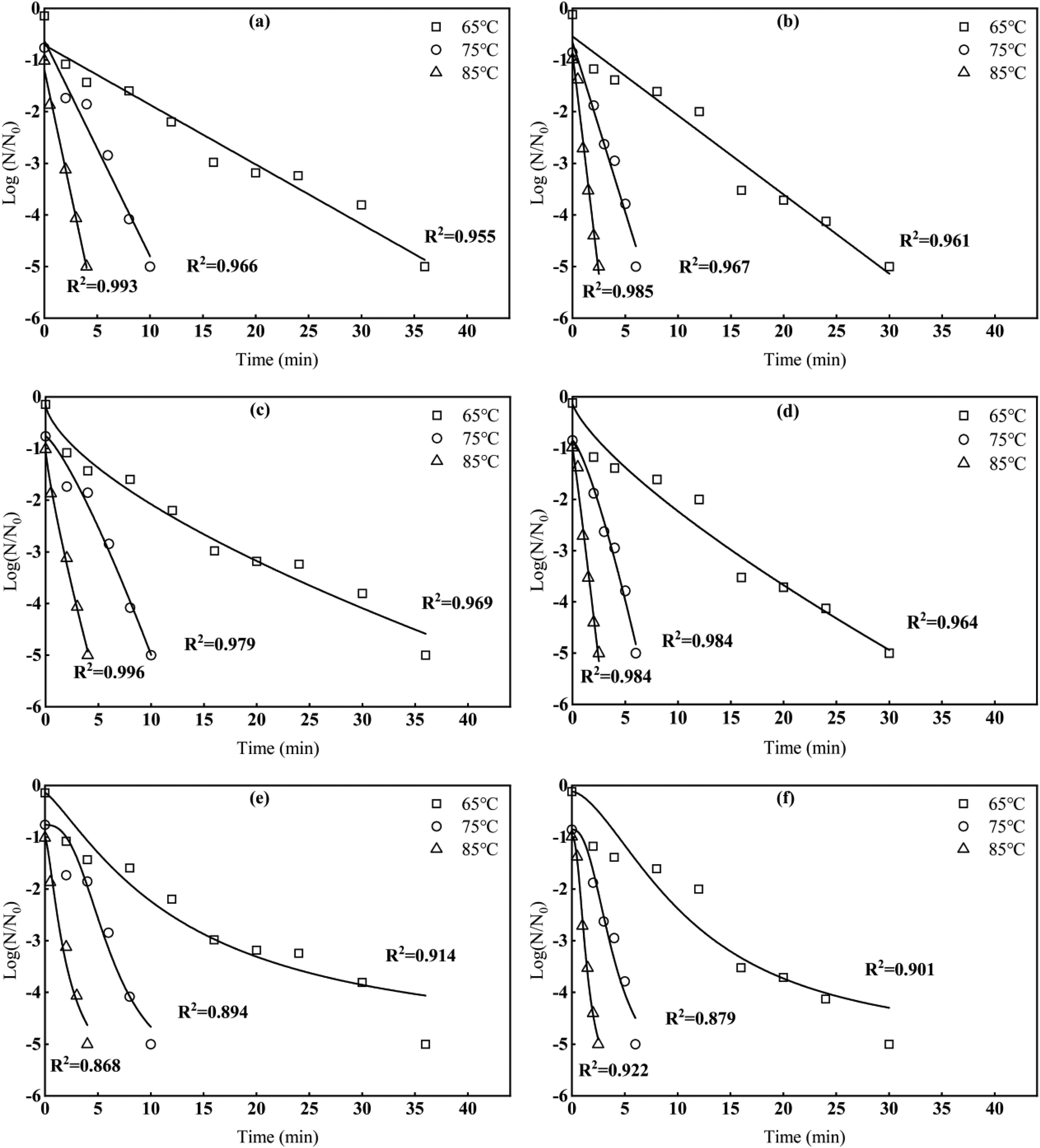
The inactivation kinetics of Salmonella in Law sample and Haw sample during RF pasteurization fitted with linear model (a, b), Weibull model (c, d) and Modified Logistic model (e, f) respectively.
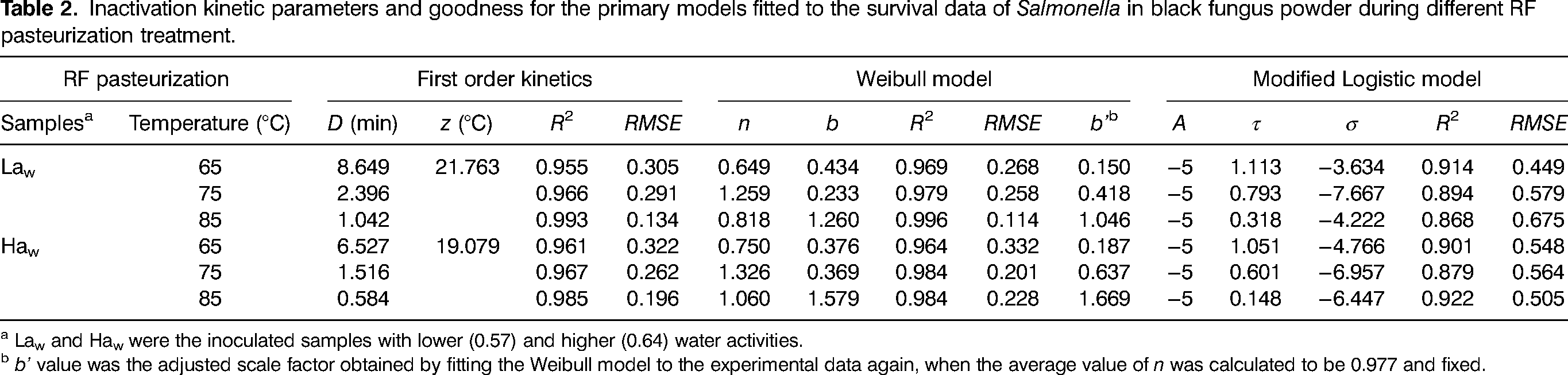
From Table 2, the D-values of Salmonella in Law sample at 65, 75 and 85 °C were 8.649, 2.396 and 1.042 min, and the D-values in Haw sample at 65, 75 and 85 °C were 6.527, 1.516 and 0.584 min. It indicated that high temperature and high aw reduced thermal resistance of the Salmonella cocktail in black fungus powder. Similar results were reported by Zhang et al. (2020b), the D-values of C. sakazakii in powdered milk with 0.3 aw at 60, 65, 75 °C were 48.7, 24.0, 17.3 min, and D-values at these temperatures decreased to 33.9, 13.9, 10.1 min when the aw was 0.4. The z-value was also an important thermal resistance parameter of bacteria. After calculation, the z-values of Law and Haw samples were 21.763 and 19.079 °C, which showed Salmonella in sample with higher aw was more sensitive to pasteurization temperature.
Inactivation kinetic parameters and goodness for the primary models fitted to the survival data of Salmonella in black fungus powder during different RF pasteurization treatment.
a Law and Haw were the inoculated samples with lower (0.57) and higher (0.64) water activities.
b b’ value was the adjusted scale factor obtained by fitting the Weibull model to the experimental data again, when the average value of n was calculated to be 0.977 and fixed.
The shape factor n was > 1 when Law sample at 75 °C and Haw sample at 75, 85 °C which indicated the curves were getting steeper with time, and this trend could also be observed from Figure 6(c) and (d). Hence, under these three pasteurization conditions, Salmonella damaged increasingly with the increasing holding time, and the other three treatment with n < 1, the rate of Salmonella inactivation decreased gradually (Jiao et al., 2019). In addition, there was no obvious linear relationship between n and temperature. In order to eliminate the influence of curve shape on b values, the average n value (
Quality analysis
It was necessary to discuss the quality change of black fungus powder after different RF pasteurization. Table 3 showed the quality results of control (untreated) and six different pasteurization treatments. Compared with control group, all RF treatment groups had significant changes (p < 0.05) in color parameters of L*, a* and b*. The ΔE* values of Law samples after different heating conditions were 4.96, 7.36, 6.48, however, the ΔE* of sample when heated at 65 °C for 36 min was significantly less (p < 0.05) than 75 and 85 °C. When aw was 0.64, the ΔE* of sample when heated at 65 °C was also significantly less than other heating conditions. This indicated that low pasteurization temperature has less effect on the color of samples than high temperature. Some studies also reported color was obviously influenced by RF treatment (Rifna et al., 2019; Yao et al., 2020).
Effect of different RF pasteurization methods on quality indexes of black fungus powder.
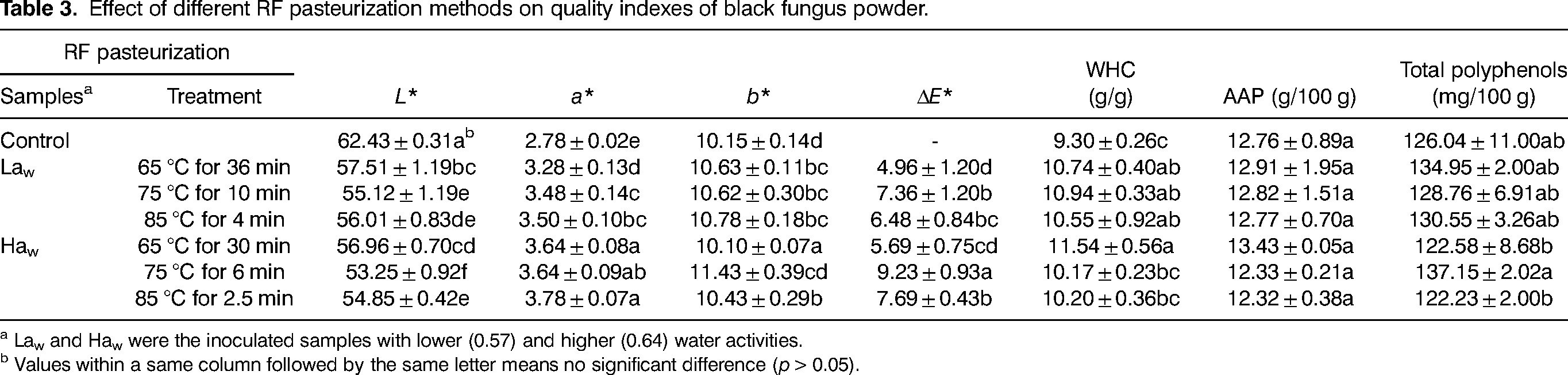
a Law and Haw were the inoculated samples with lower (0.57) and higher (0.64) water activities.
b Values within a same column followed by the same letter means no significant difference (p > 0.05).
WHC is an important index of the characteristic of black fungus powder, which is a comprehensive reflection of the physical and chemical reaction of protein, crude fiber and other components in black fungus. WHC of all treatment groups were improved, and a significant increase (p < 0.05) in WHC was found in Law samples at all 3 temperatures and high aw at 65 °C for 30 min. It might be that RF pasteurization treatment made black fungus powder form more spatial structure which was favorable for absorbing water. There was no significant difference between control and RF treatment groups for AAP and total polyphenols. Cui et al. (2021) found that the content of total sugar and reducing sugar in raisins had no significant change after RF heating. Chen et al. (2019) also reported that there was also no significant for total polyphenols in cumin seeds between RF treatment and untreated. In conclusion, in order to maintain the original quality of black fungus powder, RF heating of Haw at 65 °C for 30 min was more suitable.
CONCLUSION
This study demonstrated that the heating rate of black fungus powder was influenced by electrodes gap, initial aw and particle size of black fungus powder during RF heating, while these factors had no significant influence on heating uniformity. When the electrodes gap was 110 mm and particle size was 160–200 mesh, six RF pasteurization processes were obtained by changing aw of sample and target average temperature. And these pasteurization processes could inactivate Salmonella below the detection limit (> 5 log reductions). The first order kinetics and Weibull model could fit better on the inactivation curves of Salmonella in black fungus powder. And the heat resistance of Salmonella in black fungus powder decreased with the increase of heating temperature and water activity. Furthermore, by comparing the quality results of Haw and Law black fungus powder after 3 temperature treatments, nutrients such as AAP and total polyphenols were not affected by RF heating. Although the color was inevitably affected, the impact was relatively reduced when the temperature was low. And the WHC was improved after RF treatment. Overall, RF pasteurization was an efficient inactivation method for black fungus powder.
Footnotes
DECLARATION OF CONFLICTING INTERESTS
The author(s) declared no potential conflicts of interest with respect to the research, authorship, and/or publication of this article.
FUNDING
The author(s) disclosed receipt of the following financial support for the research, authorship, and/or publication of this article: This study was supported by the Key R&D Project of Shaanxi Province (Grant number: 2017ZDXM-SF-104), and General Program of National Natural Science Foundation of China (Grant number: 31171761).
DATA AVAILABILITY STATEMENTS
All data generated or analyzed during this study are included in this the manuscript.
