




Abstract
The fundamental solution of the linear elasticity problem of a non-polar isotropic shaft subjected to an externally applied torsional couple is extended to embrace effects of structural behaviour observed when the shaft is made of either polar isotropic or fibre-reinforced (transversely isotropic) material with fibre-bending stiffness. In the latter case, which is the subject of principal interest, the fibres are assumed parallel to the shaft central axis that is aligned with the axis of the externally applied torque. The shape of the shaft cross-section is essentially considered arbitrary, in the sense that full solution of polar material problem is subjected only to relevant conditions met in its classical, non-polar elasticity version. In dealing with polar isotropy, the obtained solution substantially enhances some initial analytical results that are already available in the literature. In dealing with polar transverse isotropy, the presented models and analytical results are new. It is verified that, in the latter case, the attained solution is exclusively dominated by fibre-twist features of deformation. This verification is underpinned by the observation that, as far as the torsion problem of interest is concerned, the unrestricted version of the theory of fibre-reinforced materials with fibre-bending stiffness provides a reliable relevant model, as well as equally reliable analytical results. However, due to the substantially smaller number of couple-stress elastic moduli involved in the restricted fibre-bending and fibre-splay versions of the theory, neither of the latter versions is able to do the same.
Keywords
1. Introduction
Section 9 in Spencer and Soldatos’s study [1] developed the linearised version of the couple-stress theory of elastic solids reinforced by a single family of unidirectional straight fibres with bending stiffness and revealed that the polar part of a relevant deformation is generally dominated by the interplay of three principal modes. These are the so-called fibre-splay, fibre-twist, and fibre-bending modes of deformation. Their coupled action requires from the theory to complement the standard set of five elastic moduli met in non-polar transverse isotropic elasticity with an additional set of eight new elastic moduli (also refer Section 5 in Soldatos’s study [2]). Seven of those new, polar response elastic moduli emerge in the constitutive equation of the deviatoric part of the couple-stress tensor [1] and, for simplicity are accordingly termed as “deviatoric couple-stress moduli” in what follows. The eighth modulus of that set is associated with the action of the spherical part of the couple-stress tensor [2]. It is recalled that the conventional versions of couple-stress theory [1,3,4] leave the spherical part (or, equivalently, the trace) of the couple-stress tensor indeterminate. However, a recent refined formulation of that theory [2,5] has now eliminated that deficiency.
It is remarkable that, on its own (if uncoupled, or filtrated, from its other two counterparts), each one of the aforementioned fibre deformation modes is characterised by features that resemble closely the transversely isotropic equivalent of one of three fundamental elasticity problems discussed by Timoshenko and Goodier [6] in Sections 9 and 10 of their study. These are the problems of the stretching of a bar by its own weight, the torsion of a shaft, and the pure bending of a plate (or bar), all three being of paramount theoretical significance and practical importance in non-polar isotropic linear elasticity.
The fact that the fibre-bending deformation mode exhibits features that resemble pure bending of a relevant transversely isotropic elastic specimen guided the application of a filtration process [7] that produced the now-called restricted fibre-bending version of the linearised couple-stress theory developed by Spencer and Soldatos [1] and Soldatos [2]. By considering that the fibre-bending deformation mode is generally most influential in the majority of practical applications, that restricted version [7] succeeded to reduce the number of seven deviatoric couple-stress elastic moduli emerging in the unrestricted theory into, just, a single one. The extra (eighth) polar elasticity modulus that relates to action of the spherical part of the couple-stress tensor still emerges in this case, but only as a necessary second polar elasticity modulus (also refer Soldatos [8]).
A second restricted version of the same, unrestricted, linearised couple-stress theory [1,2] proposed by Soldatos et al. [9] and succeeded to predominantly capture features chracterising the aforementioned fibre-splay deformation mode. That version of the theory reduces the initial number of seven deviatoric couple-stress elastic moduli to two, thus leaving the extra modulus that relates to action of the spherical part of the couple-stress as a third polar elasticity modulus. The rather evident relation of that version with the fibre-splay deformation mode was further verified, analytically, in Soldatos’s study [10], which studied in detail the dilatation features that dominate deformation of a self-stretched bar made of transversely isotropic polar elastic material.
In modelling and solving the pure bending problem of a fibre-reinforced plate with fibre-bending stiffness [8] the unrestricted (full) theory and its restricted fibre-bending version produce practically identical analytical results, while the restricted fibre-splay version fails to yield reliable relevant information [9]. In an analogous manner, though on the opposite end of the fibre deformation spectrum, the restricted fibre-bending version fails to provide reliable information when employed to study the problem of a self-stretched fibre-reinforced bar, for which, however, the full theory and its restricted fibre-splay version are found practically equivalent [10]. It is accordingly concluded that, in more general boundary value problem applications, the single deviatoric couple-stress elastic modulus employed by the restricted fibre-bending version of the theory accounts for completely different fibre deformation effects to those accounted for by the pair of its counterparts appearing in the restricted fibre-splay version.
The outlined theoretical progress and analytical findings suggest that the last remaining, fibre-twist deformation mode is likely to exhibit features that resemble torsional characteristics of some appropriately built transversely isotropic cylindrical shaft. The lack and need for discovery of possible relevant information, thus, adequately describes the principal subject of the present investigation. This aims (1) to initiate a study of the torsion problem of a polar fibre-reinforced shaft on the basis of the unrestricted linear couple-stress theory of present interest [1,2] and, through appropriate analytical comparisons, (2) to also gather, partially or totally, additional information regarding the relevant performance of either of its restricted versions.
It is recalled in this context that torsion of polar anisotropic shafts was also considered and studied by Taliercio and Veber [11,12]. However, unlike this study that is based on the anisotropic couple-stress theory stemming from previous studies [1,2], Taliercio and Veber [11,12] were interested on applications underpinned by the relevant micropolar theory. Namely, a theory that employs an augmented number of displacement and micro-rotation unknowns and, also, makes use of a non-symmetric strain tensor.
Nevertheless, the interests of this communication also embrace torsion of polar isotropic elastic shafts, where there is no fibre presence. Relevant investigations do exist in the literature [13–17]. However, the studies [13–15] are based on theoretical background, stemming from strain-gradient and relaxed micromorphic models, that is more sophisticated than the present, simpler framework of the couple-stress theory. On the contrary, Tsiatas and Katsikadelis [16] and Kwon [17] make use of a modified version of the conventional couple-stress theory proposed by Yang et al. [18] and, hence, are nearer to the polar material models of present interest [5,7]. In this connection, some interesting comparisons are also made between the analytical findings detailed by Tsiatas and Katsikadelis [16] and Kwon [17] and their counterparts stemming from this study, whose basic concepts and equations are briefed in Section 2.
Section 3 initially introduces existing basic background regarding the problem of torsion of a non-polar linearly elastic isotropic shaft with arbitrary cross-section [6,19] and, afterwards, upgrades it in a manner that embraces torsion of corresponding transversely isotropic shafts. Moreover, it connects that background with polar material behaviour and describes the form attained by the corresponding solution when a fibre-reinforced shaft subjected to torsion has a cross-section of arbitrary shape. Section 4 next attempts to solve the same problem with use of either the restricted fibre-bending version of the theory or its fibre-splay counterpart and, thus, reveals that, due to substantial number reduction of the involved polar material elastic moduli, neither of those versions can provide any kind of information in this case. As is already implied, Section 5 turns into the corresponding case of polar linear isotropy and provides relevant analytical results that refer to shafts of either general or elliptical cross-section. Section 6 summarises and discusses further the principal findings of this investigation.
2. Preliminary theoretical concepts and basic equations
In cases that a linearly elastic material responds to mechanical loading in a manner that characterises polar material behaviour, its strain energy function attains the form (e.g. [1–5,7]):.

where We is the strain energy function of the corresponding non-polar linearly elastic material and Wk is positive semi-definite and quadratic in the components of a tensor,
Hence, by decomposing the components of the emerging non-symmetric stress tensor,

and regardless of the type of the involved anisotropy, one initially finds that the symmetric part of that tensor is naturally consistent with the well-known definitions:

Here, as well as in what follows, use is made of the standard definitions of the small strain and rotation tensors,

respectively, where
In the case of present principal interest, where there exists anisotropy due to the presence of a single family of straight fibres with bending stiffness, the components of the curvature tensor

where the appearing fibre direction vector,

where

represents the deviatoric part, of the couple-stress tensor,
The most general form of the polar part of the strain energy function is as follows (e.g. [7–10]):

where the values of the eight elastic moduli β1–β7, and

Hence, introduction of (2.8) into (2.6a) yields the constitutive equation:

which naturally satisfies (2.6b). It then becomes evident that this constitutive equation receives no contribution from the part:

of the curvature-strain energy function (2.8).
Due to the anticipated polar material behaviour, the standard equilibrium equation met in non-polar elasticity needs to be replaced with a pair of such equations, namely:

where
Nevertheless, and in view of (2.7), determination of those components,

which guarantees uniqueness of the value of the strain energy function (2.1) (e.g. [2,5,10]). Here, the appearing spin-type vector

is identified as the axial vector of the antisymmetric small rotation tensor defined in equation (2.4b).
Any relevant, well-posed boundary value problem must be accompanied with a set of six natural, geometric or mixed boundary conditions. In the former case, for instance, the components of the traction and the couple-traction vectors acting on a bounding surface must respectively be given, in consistency with the Cauchy-type formulas, as follows:

where
3. Torsion of a polar transversely isotropic shaft
Figure 1 depicts an elastic cylindrical shaft of length L, placed within a Cartesian co-ordinate system, Ox
i
, and subjected to some externally applied torsional couple
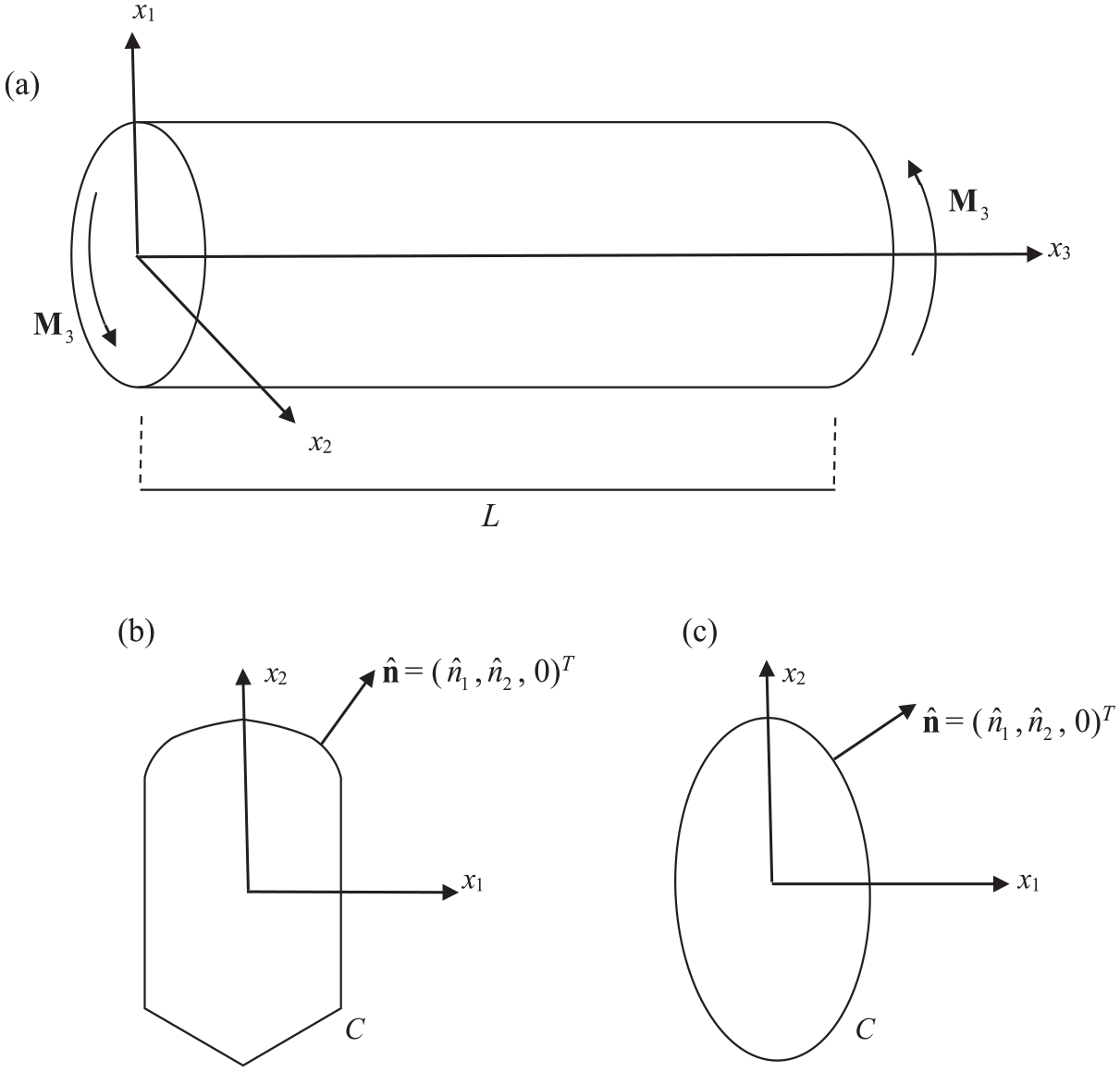
Schematic representation of (a) a cylindrical elastic shaft of length L, subjected to externally applied torsional couple,
It will be seen that, if the shaft is made of non-polar material, the origin of the co-ordinate system, O, may be placed on any cross-section, regardless of the general shape of the latter. However, it will also be seen that this matter may require special care in cases that the shaft exhibits polar material behaviour.
In the case of a shaft made of non-polar isotropic material, this torsion problem is susceptible to a well-known, classical solution that is attributed to Saint-Venant [6, 19], in particular, presents an extensive historical review of the subject and, in Art. 226, extends that solution to embrace symmetries of material anisotropy that are as advanced as those met in linearly elastic monoclinic materials. This study is principally interested on polar material response of a shaft reinforced by a single family of straight fibres aligned with the x3-direction. Hence, the type of anisotropy involved is confined within the material symmetries of transverse isotropy.
3.1. Torsion of a non-polar transversely isotropic shaft of arbitrary cross-section (m = 0 )
It is accordingly considered that the axis of the applied torque and the axis of transverse isotropy are both parallel to the x3-direction of the co-ordinate system. In that case, the form attained by the generalised Hooke’s law stemming from Equation (2.3) can be expressed in terms of five independent elastic moduli (e.g. Soldatos [10]) as follows:

where, in line with Equation (2.2b), enclosure of shear stress indices within parentheses implies that the stress tensor is symmetric.
It is fitting to also point out that this form of the generalised Hooke’s law reduces to its isotropic elasticity counterpart by replacing the appearing elastic moduli with the following:

where
Accordingly, the transversely isotropic extension sought starts again with the displacement choice [6,19]:

where the positive constant

while the corresponding rotation components are given as follows:

Introduction of Equations (3.4) into (3.1) then yields the non-zero components of stress as follows:

Hence, satisfaction of the equilibrium equations of non-polar elasticity (

still requires from the warping function to be harmonic [6,19], namely to satisfy the Laplace’s PDE,

Moreover, two of the zero-traction boundary conditions,

applied on the shaft lateral boundary (see Figure 1) are satisfied identically, while the third requires from w to further satisfy the PDE:

whose precise form depends on the unit vector
Since neither of the PDEs (3.8) and (3.10) is influenced by the elastic moduli appearing in Equation (3.1), their solution, as well as the solution of the torsion problem of the non-polar transversely isotropic shaft, is seen mathematically identical to their non-polar isotropic counterparts. It follows that, as is shown by Timoshenko and Goodier [6] and Love [19], (1) the resultant force produced by the non-zero stresses (3.6) on any cross-section is zero and, therefore, (2) those non-zero stresses are statically equivalent to the couple,
Moreover, (3) the magnitude of that torsional moment relates to the torsion parameter

where the value of the appearing “torsional rigidity,”

depends on the form of the warping function, w, the shape and the area of the shaft cross-section, S, as well as on the value of the out-of-plane shear modulus, C44.
It follows, by virtue of Equations (3.4), (3.8), and (3.10), that regardless of the precise location of the co-ordinate origin, every cross-section is subjected to (1) the same out-of-plane strain field (3.4), (2) the same warping, and (3) rotates around the x3-axis by an angle (3.5a) that changes continuously along the x3-axis. As a matter of fact, if the co-ordinate origin (x3 = 0) is unnecessarily placed on a particular cross-section, (3.5a) implies that the latter is essentially chosen to represent a reference cross-section that is considered restrained against torsional rotation. In other words, both the sense and the amount (3.5a) of torsional rotation observed on any shaft cross-section are dependent on its oriented distance, x3, from the chosen reference cross-section.
It is accordingly recalled that, in dealing with the special case in which C44 satisfies section (3.2c), Timoshenko and Goodier [6] and Love [19] provide complete solutions of this torsional problem for several different forms of the shaft cross-section. Appropriate replacement of the isotropic material shear modulus,
For instance, it is already known that the cross-sectional warping function and the torsional rigidity of an elliptic shaft are respectively given as follows [6,19]:

where a and b represent the length of the ellipsis semi-axes along the x1 and x2 directions, respectively (see Figure 1(c)). Use of (3.11) thus yields:

which completes the solution of the non-polar elasticity problem in this special case.
It is worth recalling that this result is in agreement with its counterpart stemming from the elementary theory of torsion, according to which the cross-section of a non-polar circular shaft (b = a) does not warp during torsion (w = 0).
3.2. Polar material behaviour (m ≠0 ): fibre-reinforced shaft with fibre-bending stiffness
It is now considered that transverse isotropy is due to the presence of a single family of straight fibres with bending stiffness. Due to the externally applied torque and subsequent shaft torsion, those fibres twist and, as a result, become the source of polar material behaviour.
By virtue of Equation (2.1), it is accordingly considered that the analysis detailed in Section 3.1 (1) is still valid and (2) is complemented by the polar material part of its counterpart detailed in Section 2, where, (3) it is necessarily (see Figure 1):

The fibre-curvature components (2.5), thus, attain the more specific form:

and, by virtue of Equations (3.4) and (3.5), reveal that their nonzero counterparts,

are all constant.
The polar part (2.8) of the strain energy function then attains a simple form,

which, by virtue of (2.9d), is indeed positive semi-definite. It thus becomes understood that (1) the present polar material study makes use of a single couple-stress elastic modulus only, namely

The deviatoric couple-stress constitutive Equation (2.10) then simplifies into the following:

and returns only three nonzero deviatoric couple-stresses, namely

whose values are naturally in agreement with the fact that a deviatoric tensor is traceless (
It is observed that Equation (3.21) consists of normal deviatoric couple-stresses only. Hence, by virtue of Equation (2.7), the couple-stress tensor,
3.3. Determination of the spherical part of the couple-stress
Determination of the spherical part of the couple-stress now requires reduction of the PDE (2.13) into an explicit relevant form that must be solved for

When combined with Equations (3.19) and (3.21), these relationships thus enable the PDE (2.13) to attain the form:

Potential solutions of this PDE may be sought with the use of the method of characteristic lines, which has already been employed elsewhere [5,8,10] in connection with different types of relevant boundary value problems. In this context, the Appendix 1 outlines the initial steps that the method may employ before the shaft cross-section and, henceforth, the form of the warping function, w, are specified. Nevertheless, solutions onf (3.23) for a given form of w may also become available with use of some different method and, as is next seen for the general case of unspecified w, even by using the simple method of inspection.
It is accordingly observed that the PDE (3.23) admits a particular solution of the form:

where
The left end of the shaft thus is considered restrained against torsional rotation, and since the other end is located at x3 = L, it is:

In this manner, the particular solution (3.24) now attains the simpler form:

Potential combination of Equations (3.25) and (3.26) seems to require from
It is further noted in this regard that the possibility of placing the co-ordinate origin on some different cross-section, such as the middle cross-section of the shaft, needs not be considered. This is because such a choice essentially splits the shaft into two parts, each of which can be treated in a similar manner. Namely, having one of its ends restrained against rotation/torsion.
Introduction of Equations (3.26) into (3.23) makes now possible the unique specification of the constant

3.4. Completion of polar elasticity solution for general shape of the shaft cross-section
Combination of Equations (2.7) and (3.21) reveals that the only non-zero couple-stresses acting throughout the circular shaft are the normal couple-stresses:

The couple-stress tensor thus happens to be symmetric in this particular boundary value problem application, a fact that is evidently in agreement with a corresponding result obtained by Koiter [4] and Soldatos [5] for isotropic shafts of circular cross-section (further elucidation is provided Section 5 below).
The remaining arbitrary constant,

Accordingly, introduction of Equation (3.29) into Equation (2.15b) yields:

or, in explicit form,

It follows that the single, non-zero component of the out-of-plane couple-traction acting on the unfixed end boundary (

However,
The simplest way of implementing this consideration is by choosing:

so that (3.32) returns:

In this manner, the non-zero couple-stresses (3.28) acting throughout the body of the polar shaft are found to be

As is already pointed out, the singularities observed at the left end of the shaft (
It is next seen that the components of the couple-traction acting at any point of the shaft lateral boundary are

or, in explicit form,

where

is applied externally all around the shaft lateral boundary.
It is further observed, that by virtue of Equation (2.12b), the non-zero couple-stress field (3.35) gives rise to the following, anti-symmetric part of in-plane shear stress:

Emergence of these stresses does not affect equilibrium but may invalidate the zero-traction boundary conditions (3.9) imposed on the lateral boundary of the non-polar material shaft.
It is indeed seen that the traction components acting on the lateral shaft boundary are given as follows:

or, explicitly,

because (3.9) are still valid.
It is accordingly concluded that, regardless of the shape of its cross-section, the present polar fibre-reinforced shaft can maintain the deformation pattern Equation (3.3) attained by its non-polar material counterpart only if the non-zero in-plane tractions Equation (3.41a, b) are also applied externally on its lateral boundary, along with their couple-traction counterparts Equation (3.37a, b).
In practical terms, potential failure of a relevant material specimen to attain the displacement pattern Equation (3.3), when subjected to a standard torsion test, consists strong indication of polar material behaviour. In that case, the linearity of the torsion problem of interest anticipates that, upon increasing the value of the loading parameter
It is worth recalling in this regard that a search for the actual deformation pattern that the implied polar material specimen will attain to, during a simple torsion experiment, may be sought by solving the polar material problem studied in this section in a retrospective manner, after replacing the set of extra, non-homogeneous boundary conditions (3.37a, b) and (3.41a, b) with their homogeneous equivalent (
3.5. Example: elliptic cross-section
As an example of the outlined analysis, consider an elliptical shaft whose cross-section, shown in Figure 1(c), is bounded by the plane curve:

where, a and b represent the lengths of the ellipsis semi-axes along the x1 and x2 directions, respectively. In this special case, the outward unit normal of the lateral boundary is given as follows:

It is already seen that the warping function and the torsional rigidity of such a shaft are given in Equation (3.13), while Equation (3.14) gives the relation between the torsional parameter
In this case, the PDE (3.23) thus attains the more specific form:

where,

It is observed, by inspection of its left-hand side, that the PDE (3.44) admits a particular solution of the form:

where
However, physically admissible solutions require rejection of the logarithmic singularity observed on either of the co-ordinate planes located at x1 = 0 and x2 = 0. This becomes possible by choosing:

thus leading again to Equation (3.24) and, subsequently, to Equation (3.26). The remaining of the analysis detailed in the preceding section remains intact though, where appropriate, use must also be made of the special form attained by the components (3.43) of the unit vector
4. Consideration of the restricted versions of the theory
Either of the existing restricted versions of the full theory aims to simplify the mathematical analysis outlined in Section 2 by capturing effects that are principally due to a certain type of fibre deformation features and, thus, by decreasing considerably the number of the eight elastic moduli appearing in the polar part (2.8) of the strain energy function. In this context, the restricted version that principally captures fibre-bending deformation effects makes use of two polar material moduli only, while its counterpart that is interested to capture deformation effects of the fibre-splay type uses three polar material moduli.
In either of those restricted versions, one of the implied elastic moduli, termed as
It is recalled in this regard that the fibre-bending deformation mode is naturally considered as most influential potential source of polar material response in the large majority of relevant boundary value problems [1,5,7,8]. However, it is further found [10] that problems solely influenced by fibre-splay type of deformations are outside the region of applicability of the fibre-bending version of the theory, and, likewise, problems that are purely influenced by fibre-bending type of deformations fall outside the applicability region of the fibre-splay version [8].
It will now be seen that, in a similar context, problems that are solely influenced purely by fibre-twist type of deformations are outside the region of applicability of both restricted versions of the theory. This will be done by attempting to connect either of those restricted versions with the analysis and results detailed in the preceding sections, where the torsional deformation imposed on a fibrous composite shaft is a natural cause of fibre-twist.
It is accordingly recalled [9,10] that, in the case of the restricted fibre-splay version, the polar part (2.8) of the strain energy function attains the simplified form:

and, hence, neglects the energy contribution that its unrestricted counterpart associates with the fibre-twist elastic modulus,
In dealing with the restricted fibre-bending deformation version of the theory, one has again to begin with the relevant curvature-strain part of the strain energy function, namely [1,7]:

where

represents the fibre-curvature vector, and Equation (3.15) is also accounted for. However, since the displacement components (3.3) are at most linear in the x3 co-ordinate parameter, all three fibre-curvature components (4.3) and, subsequently, the polar part (4.2) of the strain energy function acquire zero values. It thus is similarly concluded that the restricted, fibre-bending deformation version of the theory perceives, erroneously, that the fibrous composite shaft is made of a non-polar elastic material.
5. Polar material isotropy
Torsion of a shaft made of polar isotropic material has been considered and studied by Tsiatas and Katsikadelis [16] and Kwon [17] with use of a modified couple-stress theory proposed by Yang et al. [18]. As is mentioned by Yang et al. [18], the foundation of that modified theory diverts from the laws of classical mechanics that consider the couple of forces as a free vector. As a result, Yang et al. [18] are driven to conclude that the deviatoric couple-stress tensor should be symmetric.
Evidently, this study supports the side of the original version of the theory [3,4], which endorses the view that the deviatoric couple-stress is generally non-symmetric. It will accordingly be seen that the deviatoric couple-stress tensor does happen to be symmetric in the special case of this torsion problem, but this is due to the special features of the problem and contrasts other relevant observations (e.g. [4,5,10]).
It will then follow that the attempted simplification, proposed by Yang et al. [18] and employed by Tsiatas and Katsikadelis [16] and Kwon [17], makes no difference when applied to the problem of present interest. Consideration of the original [3,4], rather than the modified [18] couple stress-theory will leave unaffected the results presented by Tsiatas and Katsikadelis [16] and Kwon [17].
Nevertheless, the refined couple-stress theoretical framework employed in this section (see also [2,5]) determines not only the deviatoric couple-stresses, but also the spherical part of the couple-stress tensor. In this connection, the theoretical background outlined earlier for fibre-reinforced solids with fibre-bending stiffness (Section 2), is next slightly reformed and becomes suitable for adaptation of the rules of polar linear isotropy [5].
5.1. Re-adjustment of the principal theoretical background
It is accordingly recalled that the equilibrium equations (2.12), as well as all additional features and relevant concepts described by Equations (2.13)–(2.15) are still valid. In the present case though, the strain energy function (2.1) is represented as follows:

where We still represents the strain energy function met in non-polar linear elasticity.
The corresponding form of the polar material part of Equation (5.1) then is:

where the curvature-type tensor,

and, thus, essentially represents an infinite number of virtual, spin-type vectors. It is recalled [2,5] that the first of these conditions enables preservation of the uniqueness of the value of the strain energy function.
The displacement generated spin vector

and, hence, violates the second of the conditions (5.3).
Under these considerations, the non-polar material constitutive equation (2.3) is accompanied by its polar material equivalent:

where, however, the appearing spin-gradient tensor,
Moreover, the symmetries of material isotropy require that:

where,

are the symmetric and antisymmetric parts of

Upon replacing

which imply that the deviatoric couple-stress tensor is generally non-symmetric.
It is worth recalling at this point that, since the couple-stress tensor is assumed symmetric by Yang et al. [18], the studies of the shaft torsion problem conducted by Tsiatas and Katsikadelis [16] and Kwon [17] made no use of the elastic modulus
Consideration of Equation (5.3a), followed by a comparison of Equations (5.9a) and (5.6), leads next to the conclusion that Equation (2.11) is now replaced by the following:

It follows that, in the present case of polar material isotropy, the PDE (2.13) reduces to:

Nevertheless, contraction of the free indices appearing in Equation (5.8) reveals further that:

Hence, a combination of this result with Equation (5.11) leads to:

which is clearly a non-linear PDE for the unknown trace of the couple-stress,
5.2. Effect of polar material response on the solution of the non-polar torsion problem
The analysis detailed in Section 3.1 is still valid when dealing with torsion of a linearly isotropic polar material shaft, in the sense that it is still underpinned by the displacement field Equation (3.3) and, subsequently, by the kinematics described by Equations (3.4), (3.5), and (3.22). Hence, Equations (3.2c) and (3.6) suffice to accommodate isotropic material behaviour in the case of non-polar linear elasticity, while the warping function, w, is still required to be a harmonic function that also satisfies the boundary condition Equation (3.10).
As a result of these considerations, Equation (3.22) yields:

where use is made of the fact that w is a harmonic function. Hence, the nullification of the anti-symmetric part of the spin gradient

which, like its counterpart, Equation (3.18) met in the case of the corresponding fibre-reinforced shaft, is influenced by a single polar elastic modulus only. However, unlike Equation (3.18), which is independent of w, Equation (5.15) is substantially influenced by the form of the cross-sectional warping function.
It is also fitting at this point to note that, due to complete lack of influence that the elastic modulus
Under these considerations, the constitutive equation (5.9b) produces the following non-zero deviatoric couple-stress components:

which naturally comply with the requirement of traceless deviatoric tensor (

A combination of Equation (5.16) with a suitable solution of the PDE (5.17a) will fully determine the couple-stresses and, as is already anticipated in Section 3.2, use of Equation (2.12b) will finally enable determination of the anti-symmetric part of the stress tensor. However, such a successful conclusion can become possible only after the shape of the shaft cross-section is decided and, hence, after a subsequent solution of the PDE (3.10) yield the form of the warping function, w, which now appears not only in Equation (5.16) and the left-hand side of Equation (5.17a) but also in the right-hand side of the latter PDE.
5.3. Polar isotropic shaft with elliptical cross-section
Consider, for example, an elliptical shaft whose cross-section is bounded by the plane curve Equation (3.42) and, thus, possesses the outward unit normal,
The second derivative of the warping function Equation (3.13) with respect to either of the in-plane co-ordinate parameters is zero and, hence, the shear couple-stress components (5.16d) are also zero. The normal deviatoric couple-stresses:

thus, stand as the only non-zero components of the, thus, symmetric deviatoric couple-stress tensor, where the appearing parameter A is still given in Equation (3.45a). Hence, the non-zero deviatoric couple-stresses are all constant, and this enables again reduction of the polar elasticity equilibrium Equation (2.12a) into its already satisfied non-polar elasticity form (3.7).
In this case, the PDE (5.17) thus reduces to:

It is observed that its simplest possible solutions are obtained for constant values of the spherical couple-stress and are as follows:

A combination of Equations (5.20) and (5.18) with Equation (2.7) then reveals that the normal couple-stresses can attain either of the two sets of constant values:

It is further observed in this regard that, since the direction of
A straightforward way towards this incorporation begins by re-defining the total torsional moment acting on the elliptical shaft as follows:

and, by virtue of Equation (3.14), thus deduce that

With further use of Equation (5.21c), this relation returns two values of this torsional parameter, namely

By thus replacing Equation (3.14) with Equation (5.24), either of the two sets of in-plane normal couple-stresses:

may be considered as representing the only non-zero couple-stresses of principal interest.
Hence, by inserting Equation (5.25) into Equation (2.15b), one determines the couple-traction field acting throughout the body for either of the implied solutions. On the lateral shaft boundary, where the outward unit normal is given according to Equation (3.43), that field produces the boundary couple-tractions:

or, in explicit form:

It follows that the constant couple-stress field (5.25) can be maintained by an elliptical shaft only if the nonzero normal couple-tractions (5.27a, b) are applied externally throughout the shaft lateral boundary. It must be mentioned in this context that observations and comments analogous to those detailed in the last two paragraphs of Section 3.4, for the relevant analysis referring to torsion of the fibre-reinforced shaft, may also become applicable in this case, and need not be repeated or discussed any further.
However, a note must be made of the fact that, in the present case, either of the couple-stress fields (5.25) is constant. This observation implies that, by virtue of Equation (2.12b), the anti-symmetric part of all stress components is zero. It thus follows that, the stress field observed throughout the body of a polar, isotropic elliptical shaft subjected to combined torsion and action of the boundary couple-tractions (5.27) is still symmetric.
5.4. The special case of a shaft with circular cross-section
Due to its simplicity, the torsional problem of a polar isotropic circular shaft was first considered, as an example application, in Koiter’s pioneering publication [4]. However, the spherical part of the couple-stress tensor, left indeterminate by Koiter [4], was determined most recently by Soldatos [5].
The shape of a circular cross-section is evidently obtained as a special case of its elliptic counterpart considered in the preceding section, by setting A = 0. In this manner, all results presented in Equations (5.18)–(5.21) become equivalent to their counterparts obtained in Section 5.1 of Soldatos’ study [5], where, however, the axis of the externally applied torsional moment is aligned with the x1 co-ordinate axis.
In this connection, the only new relevant information that the present analysis may add on its counterpart presented by Koiter [4] and Soldatos [5] relates to the emergence of Equation (5.24) and its subsequent reduction,

where the appearing torsional rigidity of a circular isotropic shaft,

is evidently obtained by setting b = a and
6. Conclusion and future research directions
Upon reversing the order of the Introduction narrative, it can be claimed that this communication dealt with a substantial expansion of a couple-stress theory application, first employed by Koiter [4] in his pioneering relevant publication and more recently complemented by Soldatos [5]. Namely, the problem of torsion of a polar isotropic circular shaft subjected to an externally applied torque.
In a first step, that expansion re-formulated that fundamental polar elasticity problem by enabling it to embrace the general case of an isotropic shaft of arbitrary cross-section (Sections 5.1 and 5.2) and, afterwards, developing its analytical solution for the case of an elliptical shaft (Section 5.3). The obtained solution led to full determination of (1) the couple-stress field (including both its deviatoric and spherical parts) and, hence, (2) the stress field (including both its symmetric and anti-symmetric parts). This step thus also prepares the ground for future potential applications, where, as has already happened in the case of the corresponding non-polar isotropic shaft [6,19], relevant solutions may be sought and found for several different shapes of the shaft cross-section.
In a second step (Section 3), the implied extension was engaged with material properties of transverse isotropy that is due to presence of a single family of straight fibres, aligned with the shaft axis and possessing bending stiffness, and succeeded to complete the corresponding solution for a polar material shaft of arbitrary cross-section. In that case, formulation of the boundary value problem was underpinned by the linearised version of the relevant couple-stress theory developed by Spencer and Soldatos [1] and Soldatos [2]. It is worth recalling that the theory makes use of as many as eight fibre-deformation-related elastic moduli, seven of which appear in the deviatoric couple-stress constitutive equation. The eighth such modulus relates to the action of the spherical part of the couple-stress. The whole set of employed moduli enables the unrestricted theory to capture and tailor together effects that are due to three inter-related fibre-deformation modes, first observed in Section 9 of Spencer and Soldatos’ study [1] and now termed as the fibre-bending, the fibre-splay, and the fibre-twist such.
However, the rather large number of the involved couple-stress moduli still justifies careful use of the existing pair of restricted versions of the full theory (termed as the restricted fibre-bending and the restricted fibre-splay versions). Either of those versions conveniently employs a substantially reduced number of couple-stress elastic moduli, at the expense of reducing accuracy and confining applicability to certain boundary problem subclasses. In this context, Section 4 completed a relevant round of interesting studies and comparisons (also refer [8–10]) that refer to the relation of the full (unrestricted) couple-stress theory employed in Section 3 with its implied pair of restricted versions.
Accordingly, in summarising principal criteria that would help the choice of a most suitable restricted version, one may begin by recalling that the number of seven deviatoric couple-stress moduli emerging in the unrestricted theory reduces to, just, a single one in the case of its restricted fibre-bending version. That version captures effects predominantly due to the fibre-bending deformation mode, which is naturally regarded as the most influential such in the large majority of applications. The fibre-bending version provides practically identical results to those obtained through use of the full (unrestricted) theory for problems that are purely influenced by fibre-bending types of deformation, but fails to provide any kind of physically meaningful information when dealing with problems that are purely influenced by fibre-splay and/or fibre-twist types of deformation.
On the other side of the deformation spectrum, the restricted fibre-splay version of the theory makes use of only two deviatoric couple-stress elastic moduli and gives practically identical results to those obtained through use of the full theory for problems that are purely influenced by fibre-splay types of deformation. However, that version fails to provide physically meaningful information when dealing with problems that are predominantly influenced by fibre-bending and/or fibre-twist types of deformation.
In dealing with future relevant developments, attention must also be given to an alternative type of relevant boundary value problems, where a fibre-reinforced specimen may exhibit polar material behaviour despite that its fibres (or, simply, material preference directions in such cases) are perfectly flexible. The theoretical foundation of such a development has become most recently available in Soldatos’s study [20], where it is perceived as the anisotropic material extension of the polar isotropic material theory employed in Section 5 of the present communication (also refer Soldatos [5]).
It is anticipated, more generally, that systematic engagement of existing versions of the couple-stress theory with modelling and solution of fundamental boundary value problems, such as those studied already in non-polar (symmetric-stress) elasticity, can substantially assist the ongoing effort of decoding the secrets, and improving understanding of the usefulness of this and, perhaps, other theoretical frameworks stemming from the Cosserat theory of elasticity [21]. Namely, by connecting the couple-stress theory founded by Mindlin and Tiersten [3] and Koiter [4] with the route of the early developments followed by non-polar linear elasticity (e.g. [6,19,22]).
Footnotes
Appendix 1
Declaration of conflicting interests
The author declared no potential conflicts of interest with respect to the research, authorship, and/or publication of this article.
Funding
The author received no financial support for the research, authorship, and/or publication of this article.
