




Abstract
This communication reconsiders and reorganises parts of existing knowledge that refers to Cosserat-type hyperelasticity formulations in a manner that respects and pays tribute to the early development pattern of the couple-stress theory and, also, associates with it more recent findings and relevant discoveries related to a certain type of polar hyperelastic behaviour of fibrous composites. It further shows that these different branches of couple-stress theory can both emanate, as special cases, from a common, more general, advanced theoretical hyperelasticity framework. It thus reveals that proper completion of any relevant theoretical formulation requires in advance specification of a pair of kinematic parameters, each of which (1) is related, in a virtual or actual manner, to the observed global, macroscopic elastic deformation of the material, but (2) is principally relevant to the polar part of the observed material response. The first of these parameters represents a pseudovector field whose gradient is energetically reciprocal to the emerging couple-stress field, while the second represents either a vector or a pseudovector field that serves specific constitutional needs characterising the source of the anticipated polar material response. Different versions of couple-stress theory formulations, thus, are obtained by appropriately choosing or suitably tuning that pair of kinematic parameters. It is also seen that, regardless of the employed couple-stress theoretical model, full solution of a relevant well-posed boundary value problem is generally achievable with use of a two-step solution process. The first step includes determination of the deviatoric couple-stress and the actual spin vector of the global material deformation. In the second step, these initial findings enable formation of an additional differential equation whose solution leads to determination of the spherical part of the couple-stress.
Keywords
1. Introduction
The principal difference between the classical Cosserat-type couple-stress theory [1–4] and the relevant hyperelasticity formalism of fibre-reinforced materials with fibres resistant in bending [5] lies in the part of the constitutive considerations referring to couple-stress emergence and action. The former, basic theory [1–4] considers that couple-stresses are energetically and, therefore, constitutionally reciprocal to the gradient of a specific spin vector of the macroscopically observed deformation, namely the axial vector (pseudovector) of the antisymmetric rotation tensor. The latter, more recent theoretical development [5] refers to fibre-reinforced materials in which couple-stress develops due to deformation resistance of individual fibres, and is, therefore, reciprocal to the gradient of a fibre direction vector. Despite their noted fundamental difference, these essentially different theoretical formulations also exhibit substantial similarities. The most striking such similarity lies in the fact that both formulations leave the spherical part of the couple-stress tensor (for simplicity, spherical couple-stress in what follows) indeterminate.
Following the appearance of Spencer and Soldatos [5], further relevant investigation and study (e.g. works by Soldatos [6–12] and references therein) gradually led to better understanding of the origin and the nature of the observed similarities of and differences between those two theoretical formulations. Every step followed on that curiosity-driven research route was naturally underpinned by the knowledge available and the relevant understanding that was achieved at the time. The gradually accumulated new information suggests now that (1) there exists a more general couple-stress theoretical framework, which both models can individually emanate from as special cases, and (2) the logical order of development or presentation of that framework does not necessarily coincide with the chronological order that Spencer and Soldatos [5–12] developed and presented their findings.
The present communication, thus, aims to reconsider and reorganise the existing theoretical knowledge in a manner that (1) respects and pays tribute to the early development and pattern of the couple-stress theory [1–4], and (2) suitably connects and associates with it the more recent findings emerging from the works by Spencer and Soldatos [5] and Soldatos [6–12]. In this context, it (3) describes the aforementioned, more general and still-developing couple-stress hyperelasticity framework, (4) promotes its relevance and connection with both the conventional Cosserat-type theory [1–4] and its fibre-reinforced material counterpart [5,11], and, thus, (5) indicates or makes clearer several topics and research routes that remain open for further exploration.
Towards these purposes, section 2 outlines the principal equations and concepts of the conventional couple-stress theory [1–4] and thus highlights the bounds or limits of interest of this communication. Historically, parts of section 2 may therefore be associated with or even compressed within the present introductory section. However, by forming an independent unit, section 2 also sets a structure plan that is largely followed throughout the remaining of this paper. In that context, section 2.3 pays separate attention to infinitesimally small deformations of polar elastic materials and, thus, (1) uncovers the controversial fact that the elastic energy stored internally in a polar elastic material differs from its displacement gradient counterpart, and (2) makes it easier to understand the reasons that lead to the well-known spherical couple-stress indeterminacy. Hence, section 2 (3) introduces and justifies reasons that necessitate the refinement of the conventional couple-stress theory, detailed afterwards in section 3 (see also the work by Soldatos [12]).
Section 4 sets up the foundations of the aforementioned, general, couple-stress hyperlasticity framework, which holds regardless of whether the couple-stress field is energetically reciprocal to the gradient of a vector [5,11] or a pseudovector field [1–4,12]. The latter case, where the couple-stress field is reciprocal to the gradient of some appropriate axial (spin-type) vector field, is next considered in sections 5 and 6. These sections demonstrate the manner that the proposed general framework produces, as special cases, relevant isotropic and anisotropic versions, respectively, of polar material hyperelasticity. A direct connection thus is established between the newly established general framework detailed in section 4 and the refined [12] and conventional [1–4] couple-stress formalisms considered earlier in section 3 and 2, respectively. Section 7 then establishes a corresponding kind of connection between the same general formalism (section 4) and the theory of fibre-reinforced materials with fibres resistant in bending [5,10], by considering reciprocity of the couple-stress field with the gradient of a fibre direction vector. Section 8 summarises the progress made with this communication, highlights its principal findings, and underlines the most important conclusions drawn.
2. Basic equations and concepts of the conventional couple-stress theory
The 1960s marked a substantial interest in the revival and further development of the Cosserat’s couple-stress theory [1]. At the beginning of that decade, Mindlin and Tiersten published their influential relevant contribution [2], which noted that, at the time, the Cosserat brothers had left the theory in the form of four equations. Namely, the equations labelled (205.2), (205.10), (205.17), and (241.4) in the now classic work of Truesdell and Toupin [3]. The first three of these equations refer to the state of equilibrium of the elastic polar material of interest, while the fourth is a power balance equation that makes use of the material velocity (and relevant vorticity/spin vector) and relates to energy conservation.
2.1. Equilibrium
By here neglecting, for simplicity, the non-mechanical terms included in the work by Truesdell and Toupin [3], as well as the influence of inertia and body forces, the first two of those four equations meet the familiar form of the equations of static equilibrium

where
Equation (1b) makes it evident that, due to its interaction with the gradient of the couple-stress tensor, the stress tensor is generally non-symmetric. With use of the standard decomposition of the stress tensor,

into symmetric and antisymmetric parts, the second equilibrium equation converts into

which, from now on, is regarded as a constitutive equation for the antisymmetric part of the stress tensor. In this context, constitutive equations are required to either be provided or be sought and found only for the couple-stress tensor and the symmetric part of the stress tensor.
Upon inserting equations (2) and (3) into equation (1a), and assuming that the couple-stress components are at least twice differentiable functions, the pair of equations (1) reduces into a single equilibrium equation,

which is the third of the four Cosserat’s equations noted by Truesdel and Toupin [3] and, subsequently, Mindlin and Tiersten [2].
It is fitting at this point to note that, in the usual manner, the components of the traction and couple-traction vectors acting on any internal or bounding surface of the material are, respectively, given as follows:

where
2.2. Energy balance—indeterminacy of the spherical part of the couple-stress
The fourth of the aforementioned Cosserat’s equations [2,3] is the power balance equation

where

provide the components of the appearing rate of deformation tensor, vorticity tensor, and its relevant axial/spin vector, respectively, in terms of the velocity gradients.
Equation (6) will be rederived in section 3.1, as a special case of a more general power balance equation which, by making use of virtual velocity and spin vectors, underpins a refined version of the couple-stress theory. It is recalled in this context that any axial or spin vector, like the one defined in equation (7c), is in fact a pseudovector because it does not change its sign, as vectors do, under reflection-type orthogonal transformations of the co-ordinate system [14].
It is also noted at this point that Mindlin and Tiersten [2] were apparently first to mention that the spherical part of the couple-stress tensor, mrr, (1) fails to be accounted for in the equilibrium equation (4), (2) does not mark its contribution into the energy balance equation (6), and, hence, (3) remains indeterminate in the conventional couple-stress theory.
Indeed, by denoting with

the assumption of twice differentiable couple-stresses enables reduction of the equilibrium equation (4) into the following:

It, thus, is seen that the spherical couple-stress,
Moreover, upon inserting equations (8) and (7c) into equation (6), and making also use of the identity

one obtains

which reveals that
The equilibrium and the power balance equations (9) and (11), respectively, hold regardless of whether the polar elastic material of interest undergoes finite or infinitesimally small elastic deformations. However, more specific attention on the magnitude of the deformation will be paid later. Namely, after the symmetry group of the material and its influence in the formation of the internal energy density, W, will also be considered and lead to formulation of appropriate sets of constitutive equations.
In dealing, for instance, with finite elastic deformations of isotropic polar materials, such a set of constitutive equations is obtained in section 5. Nevertheless, it is fitting at this point to refer separately to the special case of infinitesimally small elastic deformations, which received substantial attention in the works by Mindlin and Tiersten [2] and Koiter [4] and, traditionally, makes use of linear constitutive equations.
2.3. Infinitesimally small elastic deformations—displacement gradient energy
The special case of linear polar elasticity is based on the concept of infinitesimally small deformations and, thus, anticipates that W is accurately approximated by a quadratic form or the involved deformation gradients. Since Mindlin and Tiersten [2] paid considerable, and Koiter [4] exclusive, attention to the special case of linear polar isotropy, that case has been regarded as a natural point of reference in many subsequent publications and will also attract specific attention later.
It is appropriate in this context to recall that, when dealing with linear elasticity, equation (11) is approximated as follows:

where the components of the appearing small strain tensor, displacement-generated spin vector, and small rotation tensor, respectively, are defined, in terms of the gradients of the displacement vector

It is further recalled that the postulation of practically identical deformed and reference configurations justifies here the approximation
Since W is customarily considered quadratic in the deformation gradients, the polar elasticity extension of Clapeyron’s theorem [8,9] enables equation (12) to attain the following alternative form:

where
It is pointed out that, in deriving equation (14c), use is also made of the identity

which stems from the spin-vector definition (equation (13b)) and is naturally analogous to equation (10). It is, in fact, through action of this pair of identities that conventional couple-stress theory is deprived ability to record any kind of influence that the spherical couple-stress may exert on the energy balance of the polar material of interest.
It is recalled in passing that this well-known indeterminacy drawback of the conventional couple-stress theory has always been an issue of considerable controversy and debate. That debate may be traced through relevant publications cited elsewhere (e.g. works by Soldatos [11,12] and references therein) and needs not be referred here to any further. However, along with the indeterminacy problem itself, that debate provides another reason supporting the search for refinement of the conventional theory.
It may now be argued that a third energy term may appear in the right-hand side of equation (14a). Such an energy term, which may potentially involve mixed products of displacement and spin gradients, had indeed initially been included in, but subsequently eliminated from either version of the conventional polar linear elasticity presented by Mindlin and Tiersten [2] and Koiter [4]. Reasons that underpin elimination of that energy term are provided in both publications [2,4], and will also be shown valid in what follows, wherever this is appropriate and necessary.
For reasons that will be clarified in subsequent sections, a reminder becomes now necessary of the concept of the displacement gradient energy function [9,11],

where

represents an amount of energy that is due to the interaction of the antisymmetric part of the stress with the small rotation field (13c).
As is well known, the displacement gradient energy (16) and the internal energy (14a) are identical in the special case of non-polar linear elasticity, where

It is though further observed that
It is accordingly also observed that integration of equation (18) over an arbitrary volume, V, of the material, followed by application of the divergence theorem and a subsequent use of equation (5b), yields

This result reveals that the contribution of
Hence, by considering a special case in which S represents the part of the outer boundary that is subjected to couple-traction boundary conditions, one concludes that equation (19) implies that there exists some connection between the total energy difference, which
3. Refined couple-stress theory
While the identities (10) and (15) result as consequences of purely algebraic definitions and handling, their involvement affects the physics efficiency of the outlined conventional polar material model. This fact naturally raises a question regarding the validity of the postulation that declares the spherical couple-stress energetically reciprocal to the divergence of the displacement-generated spin vector. Along with the relevant observations noted in the preceding section, that question prompts and motivates a search for potential improvement, or refinement of the conventional couple-stress theory.
The fact that the spherical couple-stress does not influence the state of equilibrium seems unsusceptible to such improvement or refinement, because neither equation (10) nor (15) affects the main part of the analysis detailed in section 2.1. However, this pair of identities does affect the energy balance of the system, which thus invites attention for potential reconsideration.
3.1. Reconsideration of the energy balance equation for elastic deformations of arbitrary magnitude
The outlined observations underpin introduction of an unspecified, auxiliary, virtual spin-type vector field,

where α is a non-zero real constant, and
Since

the divergence of such a virtual vector is generally non-zero. Hence,

Within the standard framework that underpins the principle of virtual work [13,15], it is further recalled that, wherever appropriate, virtual velocities and, hence, virtual rotation and spin fields are replaceable by their virtual displacement counterparts, regardless of the magnitude of the deformation. In the light of the relevant relationship established between equations (7b, c) and (13b, c), the virtual fields (22) are accordingly anticipated stemming from a pair of dual virtual fields

to which they relate as follows:

Under these considerations, the standard process of energy balance that led to equation (6) is refined as follows:

where the action of the velocity-spin vector
Application of Reynolds transport theorem, followed by consideration of the equilibrium equation (1a) and application of the divergence theorem, leads to

With use of equations (2), (7), and (1b), this equation reduces to

which generalises and, thus, replaces the power balance equation (6).
Hence, with further use of equations (8) and (10), equation (27) is seen equivalent to

which generalises its conventional counterpart (equation (11)). Evidently, equation (28) reduces to equation (11) in the special case that dismissal of equation (20) allows replacement of the virtual spin field
Due to the requirement (20) and, therefore, to the subsequent condition (21), the customary decomposition (8) of the couple-stress, into deviatoric and spherical parts, does not prevent anymore the spherical couple-stress,

identifies a subclass of virtual spin vectors that makes equation (28) identical with its conventional counterpart (11). Validity of equation (29) thus enables equation (11) to remain also valid.
It is emphasised that, on its own, the single equation (29) is insufficient to uniquely determine all three components of the auxiliary spin vector
3.2. Infinitesimally small elastic deformations
In the special case of small elastic deformations, W is again represented by a quadratic form of the displacement and the spin-vector gradients. In the light of equations (12), (13), and (24), the balance equation (27), thus, is approximated as follows:

where the gradients of the appearing virtual spin vector are generally assumed of the same order of magnitude with the displacement gradients.
With use of the polar elasticity extension of Clapeyron’s theorem [8,9], the implied quadratic form of W then enables equation (30) to acquire the equivalent energy balance form

where
With use of equation (8), equation (31c) can conveniently be expressed in the following alternative form:

In agreement with the relevant comment that follows equation (28), the choice
More generally though, since equation (32) can obtain the form

and, therefore,

the value
In this regard, a comparison of equation (34) with equation (18) makes it understood that some other, non-trivial solution of equation (34b) may now be sought by requiring from

Validity of this equation implies that, by virtue of equation (34a), both the conventional (section 2.3) and the present refined versions of linear couple-stress theory account for the same amount of internal energy. It is emphasised though that, in the light of equations (31) and (14),
Under these considerations, use of equation (8) enables the second part of equation (35) to acquire the following form:

This is essentially a partial differential equation (PDE) for the otherwise indeterminate spherical couple-stress,
Nevertheless, potential solution of this PDE also requires previous identification or determination of the energy term
It is re-emphasised that the remaining, unused part of equation (35) is insufficient for unique determination of all three components of the auxiliary, spin vector
4. Founding principles of couple-stress hyperelasticity
Formulation of couple-stress hyperelasticity may begin with the standard consideration that a generic material particle is initially at a position

which gives rise to the deformation gradient tensor,

respectively.
It is here postulated that, in couple-stress hyperelasticity, the tensor

which is energetically reciprocal to the couple-stress tensor
Precise determination of
It will be seen in this context that the present, generalised couple-stress theoretical framework embraces the analysis detailed in the works by Spencer and Soldatos [5,11] as well. It is thus appropriate to parenthetically note that if

where
Under these considerations, the well-known introductory postulates and definitions met in non-polar material hyperelasticity are now complemented by further introducing the constitutive assumption,

which is considered adequate for the present purposes, at least within the bounds of polar material isotropy. Nevertheless, as also happens in non-polar hyperelasticity, additional agencies that identify possible preference material directions may still be included into the general form of W in cases of polar material anisotropy. It, thus, is anticipated that most of the analysis presented in this section is still applicable in such cases.
Within the framework of the refined couple-stress formulation developed in section 3.1, the constitutive assumption (41) leads to

and, henceforth, to

which is to be compared with its counterpart stemming from equation (26).
It is next recalled that invariance of equation (41) under rigid body rotation requires from W to depend on the scalar products of the vectors
By thus ignoring the fibre direction vector involved in the work by Spencer and Soldatos [5], that process requires reduction of equation (41) into the form

where the components of the appearing symmetric right Cauchy–Green deformation tensor are given in equation (38b), and

It is emphasised though that unlike the work by Spencer and Soldatos [5], where
The necessary equivalence of the energy representations (41) and (43) thus requires from W to depend on
It is noted in passing that, dependent on the constitutive features of a polar elastic material, no reason prevents existence, and, hence, incorporation into this general theoretical framework, of two or more
5. Couple-stress hyperelasticity of isotropic materials: connection with the virtual vector Φ
5.1. Finite deformations
It is now postulated that the general vector field

and

This equation must coincide with the power balance equation (28) which, by virtue of equation (29), is anticipated equivalent with its conventional counterpart (11). Hence, a comparison of equation (46) with equation (11) yields

Since

The first of these equations is a constitutive equation for the symmetric part of the stress and its form looks identical to that of its counterpart met in non-polar hyperelasticity. However, its apparent simplicity is deceptive because, as is implied by equation (43), it must be reduced into an equivalent form that depends on
The second of equation (48) requires from the coefficient of

which is essentially a restriction on the admissible forms of W that guarantees the symmetry of
The last of equations (48) is an augmented form of a constitutive equation for the couple-stress. This fact becomes more evident and informative by considering the couple of special cases that the present analysis is fundamentally interested on.
Accordingly, by initially ignoring equation (20) and, thus, selecting

the outlined analysis is engaged with the conventional couple-stress theory briefed earlier in section 2. In this special case, equation (48c) reduces to

and, due to the arbitrariness of

As is detailed in section 2, a combination of this constitutive equation with its symmetric stress counterpart (48a) and the equilibrium equation (9) suffices to determine the deviatoric couple-stress components in any well-posed boundary value problem. However, that combination still leaves the spherical couple-stress,
On the other hand, though, upon restoring validity of equation (29), one distinguishes a second special case in which the virtual vector

where use is also made of equation (8).
In that case, equation (48c) reduces to

which, due to the arbitrariness of

It is recalled (see end of section 3.1) that the implied combination of conditions (53) and (29) is already anticipated insufficient for unique specification of

Interest on the latter simplification stems from the fact that, since
As is implied in equation (43), W must depend on

while, by virtue of (57a), the symmetry restriction (49) reduces to

It is noted that equation (57a) still holds in the case of the conventional version of the theory, where dismissal of equation (20) enables the outlined calculations to take place after equations (45b) and (48c) are replaced by equations (50c) and (51), respectively. However, the reduced form of the couple-stress constitutive equation (52) of conventional couple-stress hyperelasticity is found to be

Regardless of whether conventional or refined couple-stress hyperelasticity is attended to, W thus is required to be an isotropic invariant of the tensors
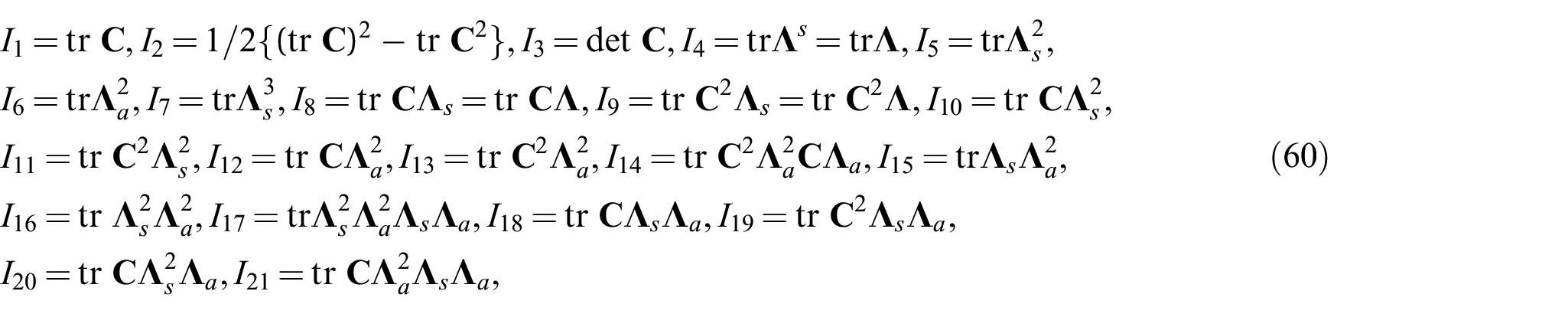
where, the appearing symmetric the antisymmetric parts of the pseudotensor Λ, namely

respectively, are evidently also pseudotensors.
The constitutive equations (57) of the refined theory can then be expressed as follows:

It is noted, though, that the invariants I4, I7, I8, I9, I14, I15, and I20 are odd functions of the pseudotensors (61) and, therefore, can enter W only in terms of their squares and products.
It is further observed that in the case of the conventional theory, where (50) holds, it is

Hence, the set (57a) and (59) of the constitutive equations of the conventional theory reduces to the following:

It is now recalled that validity of equation (29) implies that the power balance equations of the conventional and the refined theory, namely, equations (11) and (28), coincide. Hence, the difference noted between the couple-stress constitutive equations (62b) and (64b) supports the feeling that the spherical couple-stress contribution, which is missing in the left hand (64b), is related with the generally non-zero value that the invariant I4
Further clarification regarding the origin and the nature of the anticipated connection between I4 and the spherical couple-stress may become easily understood by distinguishing and studying separately simple special forms of the internal energy function. The special case of polar isotropic linear elasticity is underpinned by one of the simplest such forms of W and, thus, enters naturally into the next part of the present analysis.
5.2. Infinitesimally small deformations
The special case of polar, isotropic linear elasticity has been considered and studied independently in the work by Soldatos [12], where comparisons are also made with early fundamental publications referring to the conventional couple-stress theory [2,4]. It is therefore adequate in this section to (1) describe the way that appropriate linearisation of the outlined finite deformation equations leads to relevant equations detailed in the work by Soldatos [12], and (2) briefly recall and quote some relevant concepts and results serving the purpose of the present communication.
The starting point of the implied linearisation process is the standard approximation of W with a quadratic function of the deformation gradients, which, in turn, anticipates ultimate derivation of linear constitutive equations. It is recalled in this context that, in the case of polar material behaviour, the quadratic form sought for W is a reasonable approximation of the internal energy function because the gradients of both the actual and the virtual spin vectors are of the same order of magnitude with the displacement gradients.
It is accordingly observed that only 6 of the 21 invariants listed in equation (60), namely, I1, I2, I4, I5, I6, and I8, are of the first or second order in the implied deformation gradients. These are, therefore, the only invariants that may contribute into a quadratic form of W. However, the second-order invariant I8 is an odd function of the pseudo-tensor (61a). Hence, since it can contribute into the internal energy only through its square, I8 is dropped from a quadratic representation of W. For the same reason, the product of the first-order invariants I1 and I4 is also dropped.
It further happens that I8 and I1I4 were the only potential second-order invariant contributors that involve mixed products of displacement and spin gradients. It follows that, as is anticipated in equation (31a), the quadratic form sought for W will necessarily split, into a term

reveals that

where λ and μ are the standard Lamé moduli.
On the other hand, infinitesimally small strains and spin gradients justify the approximations

where the distinction made earlier between deformed and undeformed material configuration and, therefore, between the capital and the low-case indices can now be dropped. It follows that the linearised form of the remaining three invariants is as follows:

The most general, quadratic form of the polar part of the internal energy function (31a) thus is

where
It is next observed that, due to the involvement of the tensor

which naturally coincides with the standard constitutive equation met in non-polar isotropic linear elasticity.
The corresponding linear couple-stress constitutive equation is similarly obtained by inserting the approximations (67), as well as

This constitutive equation is evidently identical with its counterpart obtained in the work by Soldatos [12] solely on purely linear elasticity considerations. Hence, by contracting the appearing free indices, and taking equation (20) into consideration, one further obtains the following value of the spherical couple-stress:

It is observed that, in the case of the conventional theory, where equation (15) holds, equation (69) reduces to

This observation leads to the conclusion that the term
Since all information that the conventional theory makes available through the solution of a relevant, well-posed boundary value problem is still valid (see also section 3.2), the spherical couple-stress remains the only physical quantity that still needs to be determined. By accordingly requiring from the unaccounted energy part,

Nevertheless, inversion of equation (72) and subsequent elimination of the appearing unknown virtual spin divergence enables conversion of equation (74) into the non-linear first-order PDE

for the unknown spherical couple-stress.
Hence, for any well-posed boundary value problem, solution of the PDE (75) can be pursued immediately after the solution is completed of the conventional couple-stress theory equations. Unique specification of the, thus, obtained spherical couple-stress will also require association of equation (75) with some appropriate boundary condition. The latter will emerge either from the unused part of the traction boundary conditions (5b) or from the corresponding geometrical counterpart of the same. A pair of relatively simple relevant examples and their solutions is available in the work by Soldatos [12].
5.3. The role of the invariant I4 = trΛ and its internal energy contribution
The invariant
Nevertheless, in the case of infinitesimally small deformations, the relatively simple material properties of isotropy enable direct connection of
It is recalled in this context that the form of any strain energy density employed in finite elasticity applications is required to be consistent with its own approximate form that serves the purposes of the linear, small deformation version of the theory. The noted connection of
In other words, the quadratic form

which equation (35) associates with the extra energy contribution (18) in the small deformation regime, is regarded as a leading-order approximation of the influence that the spherical couple-stress exerts on any admissible form of a corresponding internal energy density employed in relevant isotropic finite hyperelasticity applications. It follows that a term of the form (76) is anticipated present in any admissible internal energy density or in its equivalent polynomial expansion in terms of the invariants (60).
Alternatively, a W
m
-term must be present in any admissible, relevant internal energy density, and its leading-order (infinitesimal deformation) approximation must necessarily be quadratic in
6. Polar material anisotropy
Basic principles and equations of couple-stress hyperelasticity are already set and discussed in the last couple of sections, though section 5 focused on the material symmetries of isotropy only. Relevant extensions that incorporate into the theory effects of material anisotropy can now be pursued in the manner that non-polar anisotropic hyperelasticity extends its isotropic material counterpart. The present section aims to initiate that theoretical extension process by demonstrating it only in the special case that material symmetries are those of transverse isotropy. The symmetries of more advanced anisotropic material configurations can be handled in a similar manner, though the analysis will be getting increasingly cumbersome with increasing the number of the involved deformation invariants. Detailed consideration of more advanced material anisotropy, thus, is expected to become the subject of future communications and studies.
6.1. Finite elastic deformations of polar transverse isotropic materials
While equations and definitions (37)–(40) still hold, it is now postulated that the specific internal energy density of the transverse isotropic polar material of interest is of the form

where the deformation gradient tensors

where
As happens in non-polar hyperelasticity, the augmented form equation (77) of the internal energy density leaves unaffected the principal analysis detailed in section 4. Hence, while equation (42) still holds, invariance under rigid body rotation requires reduction of equation (77) into the form

where the components of the tensors
Nevertheless, the influence that

where equations (61) still hold.
It is noted that the invariants I24, I27, I28, I29, I30, and I32 are odd functions of the pseudotensors (61) and, along with I4, I7, I8, I9, I14, I15, and I20 defined in (60), can enter the form of W only in terms of their squares and products. Under these considerations, the final form (62) of the constitutive equations of the refined theory, as well as the form (64) of their conventional theory counterparts, is seen also valid, provided that the upper limit of the appearing summation index, α, is modified and becomes 33.
6.2. Infinitesimal deformations
The process leading to the corresponding version of transversely isotropic linear elasticity resembles its counterpart employed earlier in section 5.2. That process begins with the search for a quadratic approximation of the form (79) of W which, as is detailed section 5.2, must depend on (1) the invariants I1, I2, I4, I5, and I6 appearing in (60), and (2) no more than the eight additional invariants I22, I23, I24, I25, I26, I27, I28, and I31, which are listed in (80) and are of the first or the second order in the deformation gradients.
Among those eight invariants, I27 and I28 are the only second-order invariants that involve mixed products of displacement and spin gradients. However, these are both odd functions of the pseudotensors (61) and, since they can thus enter W only in their squares and product, are dropped from the quadratic form sought for W. It follows that the ultimate form of W will again split in the manner implied in (31a), namely into a term
Hence, along with equation (65), the well-known [18] linearised versions of I22 and I23, namely

respectively, will now form the group of four invariants contributing into

where
It is now emphasised that the arguments employed in section 5.2 for the derivation of the linearised constitutive equation,

hold regardless of the material symmetries of the present polar elastic solid. It follows that not only equation (82) but also the corresponding linear constitutive equation of the symmetric part of the stress is identical with its counterpart met in non-polar transverse isotropic linear elasticity [18–20].
The last four remaining invariants are linearised with use of the small strain approximations (67), which leads to

Along with equation (68), these form the group of seven invariants that contribute to
The most general such form of

where
While J4 has a double term entry into equation (85), its entry that involves

which, in analogy with its isotropic counterpart (73), fails to record energy contributions that may be due to spherical couple-stress action.
In contrast, equation (85) does account for such energy contributions and by thus requiring from

The transverse isotropic counterpart of the constitutive equation (71) is then found to be

and a contraction of the appearing free indices produces the relationship

Equations (87) and (89) are algebraically considerably more complicated than their isotropic material counterparts (74) and (72), respectively. A straightforward conversion of equation (87) into a single PDE for the unknown spherical couple-stress does not seem feasible in this case, and
However, conversion of equation (87) into a relevant PDE may still become possible through a rather complicated and computationally cumbersome process. That process, which will not be pursued much further in this communication, is described by initially defining the nine-component vectors,

and, thus, rearranging the linear constitutive equation (88) into the matrix form,

where the components of the appearing 9 × 9 stiffness matrix
Inversion of the matrix equation (91),

will thus enable replacement of the unknown gradients (90b) of
This conversion process of equation (87) and the final form of the thus obtained PDE are anticipated more cumbersome and complicated in cases of advanced material anisotropy. This is evidently due to the emergence of additional deformation invariants (see, for instance, Appendix of Soldatos [12]), which complicates further the form of the constitutive equation (88) and, hence, of the stiffness matrix
It is noted in that context that studies related to anisotropic forms of the matrix
On the other hand, forms of the matrix
It is recalled in this context that, unlike the present formulation, micro-polar elasticity [23,24] is deprived the ability to present the latter pair of balance of momentum and balance of couple-stress governing equations in some alternative, reduced form that is analogous to equation (9) or (1.12) in the work by Mindlin and Tiersten [2] and equation (205.17) in the work by Truesdell and Toupin [3]. Instead, the formalism presented in the work by Eringen [23] necessarily considers that all six individual equations that are stemming from equations (205.2) and (205.10) of Truesdell and Toupin [3] are mechanically independent, and thus enables matching of an augmented number of six independent degrees of freedom with the augmented number of six independent governing equations.
7. Polar material behaviour of fibre-reinforced materials with fibres resistant in bending
It will now be seen that the couple-stress theory of hyperelastic fibre-reinforced materials with fibres resistant in bending [5,11] can also emerge as a special case of the theoretical framework introduced in section 4. In continuum mechanics, the fibres are assumed distributed through the bulk of the material [25] and their direction then coincides with a direction of material preference. In the case that a fibrous composite has embedded a single family of unidirectional fibres [5,11], the fibre direction thus defines a direction of transverse isotropy, and the general background underpinning section 6 might appear adequate for the developments outlined in the present section.
However, section 6 considers that not only the energy balance is sufficiently described with use of the actual and the virtual spin vectors
In other words, the polar material behaviour modelled in section 6 is regarded inherent in the anisotropic material of interest, as inherent also is regarded in the case of polar material isotropy (section 5) where its source remains macroscopically not observable or virtual and unknown. If the implied direction of material preference is felt representative of a single family of unidirectional fibres, the model developed in section 6 thus considers that family as an essentially perfectly flexible fibre phase of a polar elastic material. It is recalled in that context that fibres are naturally considered perfectly flexible in non-polar elasticity [5,26].
In the present case of interest, where the embedded unidirectional fibres resist the imposed deformation locally [5,11], the fibre direction and the direction of transverse isotropy are still considered identical and, hence, equation (77) still represents a suitable choice of the internal energy density. However, while the virtual pseudovector
In terms of the present notation, this postulation requires from the vector field
As is detailed in the work by Spencer and Soldatos [5], the components of the material derivative of the unit fibre direction vector,

which makes the search for an analytically manageable set of constitutive equations particularly challenging, if possible. In contrast, the choice

where

which enable easier handling of equation (42) and, hence, of parts of the subsequent analysis that resembles its counterpart detailed in section 6.
It is noted in passing that replacement of equation (93) with equation (95a) is justified by the fact that this makes no difference in two special cases of substantial practical importance. Namely, the case of practically inextensible fibres of any shape [26,29,6,30], and the case of straight extensible fibres. In the last remaining special case, where fibres may be extensible but curved, use of equations (95) leads to approximate constitutive equations, with the magnitude of the implied approximation being dependent on the magnitude of the involved fibre curvature. Alternatively, use of the cumbersome expression (93) may potentially lead to a set of constitutive equations which, if feasible, will be (1) generally different from those obtained in the work by Spencer and Soldatos [5] and Soldatos [11], but (2) reducible to the latter when fibres are either inextensible or extensible and straight.
Under these considerations, the use of equation (95b) enables equation (42) to obtain the form

and, henceforth, the form

which is identical with the equation labelled (5.15) in the work by Spencer and Soldatos [5] or (4.4) in the work by Soldatos [11]. It follows that all relevant results detailed in the works by Spencer and Soldatos [5] and Soldatos [11] can still be obtained here, though in a slightly different manner.
Accordingly, since equation (29) is pre-assumed valid throughout the present analysis, equation (28) remains equivalent with equation (11) and its comparison with equation (97) leads to

Due to the arbitrariness of
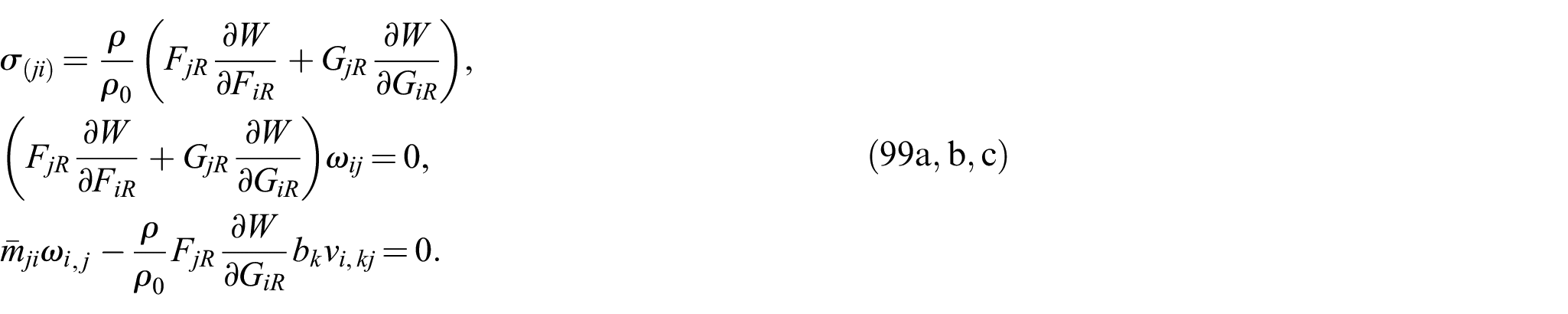
The first two of equation (99) are identical with their counterparts obtained in the work by Spencer and Soldatos [5]. Hence, equation (99a) is the relevant constitutive equation for the symmetric part of the stress, while by requiring from the coefficient of

which guarantees the symmetry of
Equation (99c) is slightly different from its counterpart obtained in the work by Spencer and Soldatos [5], because it contains the deviatoric part of the couple-stress, rather than the full couple-stress tensor. Nevertheless, with use of equation (7c), that equation reduces to

which requires from the symmetric part, with respect to the indices k and j, of the coefficient of

Hence, by multiplying both sides of equation (102) with

which, naturally, is identical with the ultimate form of the deviatoric couple-stress constitutive equation obtained in the work by Spencer and Soldatos [5].
The remaining of the analysis involves the transformation of the constitutive equations (99a) and (103) into their reduced form stemming from equation (79), namely from the reduced form of W that guarantees invariance of its value under rigid body rotation. That process is detailed in the work by Spencer and Soldatos [5] and, while need not be repeated here, leads to the following reduced form of the obtained constitutive equations:

It is fitting at this point to parenthetically commend on a suggestion made recently in the work by Shariff et al. [31], regarding the special case of curved extensible fibres and the approximation that equations (104) may involve in that case through the replacement of equations (93) with (95a). According to Shariff et al. [31], that approximation is claimed there removed through use of an artificial alteration of the definition (44) of the tensor
However, if it is assumed that the replacement of
Alternatively, a proper explanation is missing in the work by Shariff et al. [31] of the reason that the employed artificial alteration of
The lack of proper relevant explanations leads to the conclusion that, on its own, the artificial alteration of the
It is now recalled that the strain energy density (79) is an isotropic invariant of the tensors

as a function of the invariants listed in equations (60) and (80). It is though further recalled that in the present case of interest, Λ and, therefore, its symmetric and antisymmetric parts (61) are proper tensors, rather than pseudotensors. Hence, all invariants
In view of equation (105), and as is also detailed in the work by Spencer and Soldatos [5], the constitutive equations (104) can further be expressed in the following form:

It is noted that, as is made clear in the works by Spencer and Soldatos [5] and Soldatos [11], the couple-stress-generated invariant

fails to relate its internal energy contribution with the couple-stress constitutive equation (106b).
Association of the constitutive equations (107) with the equations of equilibrium (9) thus provides all the principal information needed for determination of the deformation, as well as of the stress and the deviatoric part of the couple-stress. On the other hand, Soldatos [11] discusses in detail the role of
In this context, the purposes of the present communication are sufficiently served by just observing, or recalling [11], that the implied role of
Substantial amount of further relevant information is provided in the work by Soldatos [11] and need not be repeated here. This is because the main distinction between the theoretical formulation presented in this section and its counterpart detailed in the work by Soldatos [11] lies only in the manner that couple-stress hyperelasticity of fibre-reinforced materials with fibres resistant in bending is formulated. While, like its first part [5], Soldatos [11] develops the theory from scratch as an independent entity, the present section has essentially presented the same theory as a special case of the more general couple-stress theoretical framework detailed in section 4.
8. Further remarks and conclusion
A connection route is established between the conventional couple-stress theory [1–4] and its counterpart referring to hyperelastic behaviour of fibrous composites with embedded fibres resistant in bending [5,11]. That route emanates from the constitutive assumption (41), which implies that the internal energy density of a polar elastic material depends not only on the two-point global deformation gradient tensor,
The first of these quantities is represented by a pseudovector (spin-type) field,
In this context, the conventional couple-stress formulation [1–4] assumes that both
This well-known drawback of the spherical couple-stress indeterminacy remains intact in the initial version [5] of the model that refers to polar material behaviour of fibrous composites containing fibres with bending stiffness. This is because, while
The emergence of that extra energy contribution is necessarily related to action of the indeterminate spherical couple-stress and, thus, enables resolution of that well-known indeterminacy problem. In the case of the composites model [5,11] where fibres are resistant in bending, that indeterminacy is removed by keeping
In the case of the conventional couple-stress theory [1–4], the couple-stress indeterminacy is removed in an analogous, though slightly different manner. Namely, by refining the theory in a manner that specifies
It is re-emphasised in this regard that, in either case, full solution of a relevant well-posed boundary value problem is generally achievable by means of a two-step solution process. This is because the variable coefficients of the implied extra PDE are dependent on the components of the deviatoric couple-stress tensor,
Regardless of the version of the employed couple-stress theory, the
The, thus, established route of theoretical connection reveals that both the classical couple-stress theory [1–4,12] and its fibrous composites counterpart [5,11] emanate from the same origin and have the same source. However, there also exist substantial differences between those two couple-stress theories, and these deserve further exploration and study.
The most striking such difference stems from the fact that the latter theory [5,11] is an anisotropic elasticity theory that models polar material behaviour emanating, in a specific type of composites, through resistance that strong and stiff embedded fibres may exhibit when subjected to bending, splay, and/or twist deformation modes. In contrast, by focussing to the Cosserat equations [3], the early relevant publications (Mindlin and Tiersten [2] and, especially, Koiter [4]) mainly studied polar material response that is inherent in isotropic elastic materials, where the source of such response is macroscopically unknown or unclear.
In that context, a transversely isotropic material extension of the implied isotropic couple-stress model [4] is presented in section 6 (see also [12]), which essentially initiates interest towards potential, further extension of that kind of inherent polar material behaviour within the region of more advanced anisotropic elasticity. It is worth noting in this regard that the constitutive equations of the latter, transversely isotropic version of conventional couple-stress theory, namely equation (64) with the upper limit of the appearing summation symbol raised to 33, differ substantially from their counterparts (106) obtained for the specific fibrous composite considered in section 7.
Moreover, the noted specific interest on composites containing very strong and stiff fibres enabled the theory developed in the work by Spencer and Soldatos [5] and Soldatos [11] to establish a couple of restricted, simplified theoretical models, which can handle more effectively relevant boundary value problems dominated by either their bending or their splay fibre deformation mode. In either of those special cases, the implied theory [5,11] achieves substantial reduction in the number of invariants employed in its constitutive equations (106) and, thus, attains substantial analytical simplification. It is, though, currently unclear whether a similar kind of theoretical simplification may become possible in cases of boundary value problems referring to inherent type of polar material behaviour.
