




Abstract
A recently developed, refined version of the conventional linear couple-stress theory of isotropic elasticity is extended to include the influence of anisotropic material effects. With this development, the implied refined theory (1) retains ability to determine the spherical part of the couple-stress and (2) is further furnished with constitutive ability to embrace modelling of linearly elastic solids that exhibit inherent polar material anisotropy of advanced levels that reach the class of locally monoclinic materials. This type of anisotropy embraces most of the structural material subclasses met in practice, such as those of general and special orthotropy, as well as the subclass of transverse isotropy. The thus obtained, enhanced version of the refined theory is furnished with ability to also handle structural analysis problems of polar fibrous composites reinforced by families of perfectly flexible fibres or, more generally, polar anisotropic solids possessing one or more material preference directions that do not possess bending resistance. A relevant example application considers and studies in detail the subclass of polar transverse isotropy caused by the presence of a single family of perfectly flexible fibres. By developing the relevant constitutive equation, and explicitly presenting it in a suitable matrix rather than indicial notation form, that application also exemplifies the way that the spherical part of the couple-stress is determined when the fibres are straight. It further enables this communication to initiate a discussion of further important issues stemming from (1) the positive definiteness of the full, polar form of the relevant strain energy function and (2) the lack of ellipticity of the final form attained by the governing differential equations.
Keywords
1. Introduction
The indeterminacy of the conventional, Cosserat-type [1], couple-stress elasticity emerged in the open literature in the early 1960s [2,3] (see also [4, p. 124]). In terms of the terminology employed in Mindlin and Tiersten [2] and Koiter [3], this indeterminacy problem is described as a failure of the theory to determine the trace, mrr, of the couple-stress tensor,
In simple terms, this well-known problem stems from the fact that the conventional couple-stress theory [2,3] considers that mrr is energetically reciprocal to a quantity which, regardless of deformation features or material properties, is always equal to zero. Namely, the divergence of the displacement spin-vector,
A successful resolution of the outlined indeterminacy problem is most recently achieved [9,10] by refining the conventional model in a manner that considers mrr energetically reciprocal to the gradient of a virtual spin-vector,
Since mrr thus is considered energetically reciprocal to
The implied refined formulation [9,10] is further capable to embrace the relevant hyperelasticity theory that models behaviour of elastic solids reinforced by fibres resistant in bending [11,12]. However, unlike the analysis detailed in Spencer and Soldatos [11], and Soldatos [12], where polar material response is specifically caused by fibre bending stiffness, Soldatos [9] has mainly been interested to establish connection with the pioneering developments detailed in Mindlin and Tiersten [2] and Koiter [3], where the anticipated polar material behaviour is regarded inherent in the selected material of interest, in the sense that its source is macroscopically unobservable and, therefore, unknown, or unimportant. The advances of the refined formulation presented in Soldatos [9] were thus principally confined within the bounds of linear polar material isotropy [2,3], although they also initiated a relevant discussion referring to polar transverse isotropy (see also section 6.2 of [10]).
This study embraces the viewpoint adopted in Mindlin and Tiersten [2], Koiter [3], and Soldatos [9], in the sense that it is still interested on linearly elastic materials that exhibit inherent polar material behaviour. However, it is predominantly interested to extend the analysis presented in Soldatos [9] for linear isotropic solids, by further considering cases of polar material anisotropy that is due to presence of one or more directions of material preference. It necessarily follows that, if such a preference material direction is felt representative of a single family of unidirectional fibres, the model considers that family as a perfectly flexible fibre phase of a polar elastic material. The class of locally monoclinic, polar, linearly elastic solids thus is regarded as possessing sufficient anisotropic generality for the present purposes.
Similar studies do exist in the literature [13,14], but their results are not compatible with the refined couple-stress theory of present interest. This is because Gourgiotis and Bigoni [13] focused on the anisotropic version of the conventional couple-stress theory [2,3], where the spherical couple-stress is indeterminate, while Ilkewicz et al. [14] were interested on corresponding analytical progress emerging in higher-order, micro-polar elasticity formalisms [5–8].
Under these considerations, a necessary recap of the main equations and features of the refined couple-stress theory is outlined in section 2. Section 3 follows with a proper introduction of the class of locally monoclinic anisotropic materials and derives, in indicial notation form, the relevant set of linear constitutive equations sought. The advanced anisotropy version of the refined couple-stress theory thus obtained is also furnished with ability to handle structural analysis problems of polar fibrous composites reinforced by one or more families of perfectly flexible fibres, including, for instance, the type of flexible cords first mentioned by Adkins and Rivlin [15] and Rivlin [16]. After suitable simplification of the obtained constitutive equations, such problems may include important cases of material anisotropy that is inferior to that of a locally monoclinic polar material, such as those represented by the material subclasses of general or special orthotropy and transverse isotropy.
In a relevant example application, section 4 continues and completes the relevant discussion initiated in section 4.2 of Soldatos [9] for the special case of local transverse isotropy. Particular attention is also paid to a further special case, where polar transverse isotropy is due to the presence of a single family of straight, perfectly flexible fibres. For that case, sections 5 and 6 study the consequences of the positive definiteness of the relevant strain energy function and the lack of ellipticity of the relevant governing equations, respectively. Section 7 summarises the main conclusions drawn in this study and highlights relevant directions of future expansion or relevant research.
2. Principal features and equations of the linear version of the refined couple-stress theory
The components of the traction and couple-traction vectors acting on any internal or external surface of a polar material are respectively as follows:


where
2.1. Equilibrium
In the absence of body forces and body moments, and under the assumption that the couple-stress components are at least twice differentiable, the pair of standard equilibrium equations met in polar elasticity reduce into the following:


where partial differentiation is denoted by a comma, and the stress tensor has been subjected to the standard symmetric and antisymmetric parts decomposition:


stands for the deviatoric part of the couple-stress tensor.
Equation (2b) thus emerges as a constitutive equation that provides the antisymmetric part of the stress as soon as the couple-stress components are fully determined. Since equation (2a) then remains as the only equilibrium equation left, it makes evident that the spherical part of the couple-stress, mrr, does not influence directly the state of equilibrium.
2.2. Kinematics
The standard kinematic quantities of non-polar linear elasticity still hold. Accordingly, the small strain and rotation tensors, as well the relevant spin-vector, are, respectively, defined as follows:



where
Since the standard definition (5c) of the conventional spin-vector gives rise to the identity:

an additional, auxiliary spin-vector,

and it also required to be such that:

Moreover, its components are assumed related with those of the conventional spin,

where the energy quantity Wm will be identified in what follows.
As will be seen next (see equations (12) and (14)), satisfaction of equation (9) enables the outlined refined formulation to account for the same amount of elastic energy that is recorded by the conventional theory. It is also noted that, by virtue of equation (9), the vectors
Most importantly, on its own, the single equation (9) is evidently insufficient for unique determination of all three components of
2.3. Elastic energy considerations—determination of the spherical part of the couple-stress
The total energy that is stored within an arbitrary volume, V, of a polar linearly elastic material is:

where S denotes the surface that surrounds V, and dS and dV stand for the corresponding surface and volume element, respectively. Moreover, the polar version of the involved strain energy function, W, is anticipated quadratic in the gradients of the appearing displacement and spin-vectors, and the equality sign holds only in the absence of deformation.
Introduction of equation (1) into equation (10), followed by application of the divergence theorem and a relevant process detailed in Soldatos [9], requires from the quadratic strain energy function sought to attain the form:

where


after equation (9) is also accounted for.
It is accordingly seen that, regardless of the type of material anisotropy involved, (1) the explicit form of

where use is also made of equations (4) and (6).
While equation (9) thus is inadequate for unique determination of the auxiliary vector

The polar part of W thus is allowed to attain a form that is quadratic in the gradients of any member of the set of virtual spin-vectors


It, however, happens that, in the special case that

The conventional couple-stress theory thus emerges as a singular linear elasticity model which, for any well-posed boundary value problem, can lead to determination of the displacement, the symmetric stress, and the deviatoric couple-stress fields only. In doing so, it makes use of the total amount of elastic energy recorded by its refined counterpart, namely, equation (12), which, by virtue of equations (8) and (14), includes an extra term that accounts for the energy contribution of mrr.
Since that indetermined spherical part of the couple-stress, mrr, thus is not accounted for in the resulting antisymmetric part (2b) of the stress tensor, the value of the total strain energy equation (11) differs from that of its displacement gradient counterpart:

This is because the here emerged rotation energy is found to be:

where use is also made of equations (2b), (5b), (9) and (14).
It thus becomes understood that the quantity
Under these considerations, the already available information enables conversion of the second part of equation (9) into the following:

where use is also made of equation (4). It will next be seen that, regardless of the involved type of material anisotropy, identification and proper consideration of
3. Locally monoclinic materials
It is already seen that, regardless of the involved type of material anisotropy, the explicit form of We, appearing in equation (11), is identical to its well-known non-polar linear elasticity counterpart. Hence, no further attention is needed either in the development of explicit forms of the We-part of the strain energy function of an anisotropic, polar, linearly elastic material or in the development of corresponding constitutive equations referring to the symmetric part of the stress tensor.
Given the symmetries of the anisotropic polar material of interest, it is instead sufficient for this section to look for and develop explicit forms of (1) the polar parts,
Locally monoclinic elastic solids are accordingly characterised by the unit vectors,

The subclasses of local material orthotropy and local transverse isotropy are then obtained, as special cases, by considering that these directions are either orthogonal (
It is re-emphasised although that, when dealing with fibre-reinforced materials, either of
3.1. Strain energy function
While the small strain tensor employed in equations (12a) and (15a) is symmetric, the spin gradient

respectively.
Since
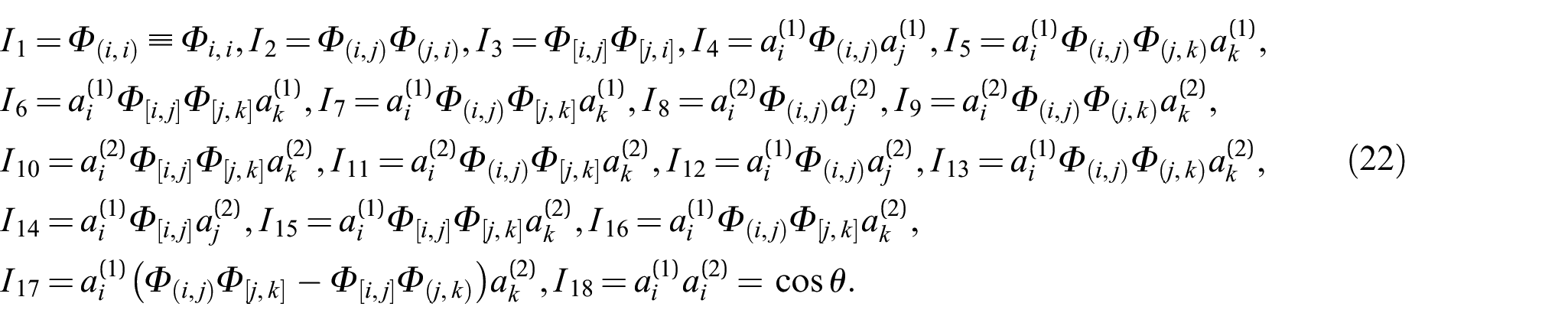
The most general quadratic form sought for the polar part of the strain energy function thus is as follows:

and involves a total of 27 independent elastic moduli having dimensions of force. Seventeen of those moduli are represented by the symbols
It is also noted that the deformation invariants
In the singular case of the conventional couple-stress theory (

A comparison of this expression with equation (23) makes it then understood that the energy contribution of the spherical couple-stress is marked in
It follows that the extra energy contribution, associated in equation (19) with the action of the spherical part of the couple-stress, is:

With the use of equation (22), the extra differential equation (19) is then enabled to attain the more specific form:

3.2. Constitutive equations
Connection of equation (23) with equation (15b), followed by the process detailed in Appendix 1, yields the following couple-stress constitutive equation:
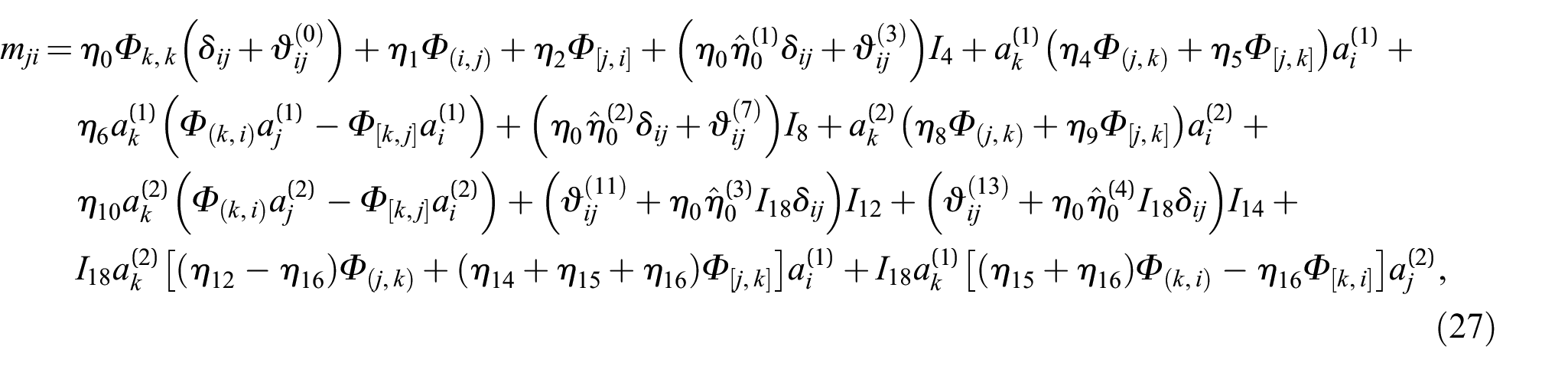
where considerable brevity is achieved with the use of the following tensorial quantities:
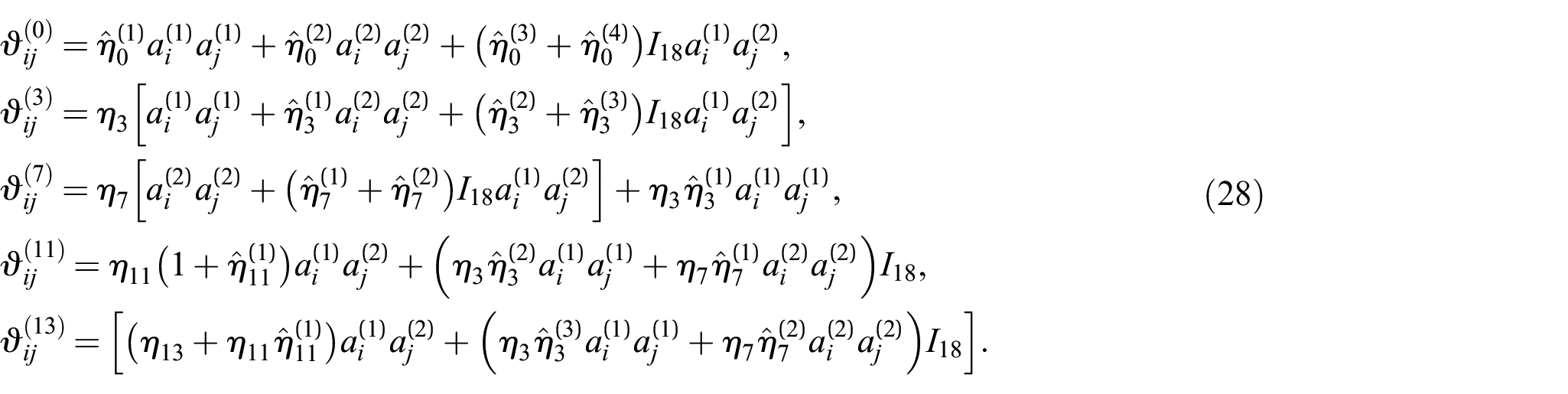
It is fitting at this point to mention, for later use, that the linear constitutive equation (27) can be rearranged and attain an alternative matrix form:

where


As will also be demonstrated with a particular example in section 4 below, the non-zero components of the implied 9 × 9 stiffness matrix
The deviatoric couple-stress constitutive equation of the conventional couple-stress theory becomes now also available, either by connecting equation (24) with equation (16) and, then, following a process analogous to that detailed in Appendix 1 or, more conveniently, by replacing everywhere in equations (21), (22), and (27) the symbol

where equation (28) still hold.
Successful solution of any relevant, well-posed boundary value problem, thus, requires from the conventional couple-stress theory to make available the ultimate forms of the displacement vector, the small strain tensor, and the actual spin-vector
Then, the spherical part of the couple-stress still needs to be determined through appropriate use and solution of the extra equation (26). In this regard, Appendix 1 provides additional information of the way that contraction of the free indices appearing in equation (27) leads to the following form:

of the spherical part of the couple-stress, where the appearing combined elastic moduli are given in equation (86).
3.3. Determination of the spherical part of the couple-stress
In the special case of material isotropy, where
Such a simple combination of equations (26) and (32) is not anymore possible in the case of any type of material anisotropy. However, the alterative form (29) of the couple-stress constitutive equation serves as a suitable starting point for the description of an alternative, although more cumbersome elimination process of the appearing gradients of
Since the components of the unit vectors

where use of equation (4) implies that:

The first part of equation (33) enables replacement of the unknown gradients (30b) of
As is exemplified in the subsequent section with the help of Appendix 2, the final form thus attained by equation (26) can be regarded as a first-order PDE for
It is worth noting that, with the couple-stress components thus becoming completely known, equation (33) might be re-employed to provide the gradients (30b) of the auxiliary vector
4. Application: transverse isotropy
4.1. Locally transverse isotropic materials
This example application considers a special case in which anisotropy of the polar elastic material of interest is due to the presence of a single family of perfectly flexible fibres. In that case, the analysis detailed in the preceding section simplifies by considering that:

and by thus accounting only for the first seven of the deformation invariants listed in equation (22).
Accordingly, the most general form of

In the singular case of the conventional couple-stress theory (

Since the extra energy contribution appearing in equation (25) thus also simplifies and becomes:

the extra equation (26) that will lead to the spherical part of the couple-stress determination also attains a simplified form:

Moreover, appropriate reduction of equations (27) and (31) yields the corresponding couple-stress constitutive equation:

for the refined couple-stress theory, and:

for its conventional model counterpart.
Hence, through contraction of its free indices, equation (40) provides the following constitutive equation for the spherical part of the couple-stress:

where:

As is previously outlined (see section 3.3) and is also demonstrated next for the further special case of straight fibres, appropriate combination of equations (41) and (39) will finally provide a more specific form attained by the extra PDE that leads to determination of the spherical part of the couple-stress.
4.2. Transverse isotropy due to single family of straight perfectly flexible fibres
In this, further special case, where anisotropy is due to the presence of a single family of perfectly flexible straight fibres, the analysis detailed in the preceding section attains further simplification by selecting:

and, hence, by placing the x1-axis of the co-ordinate system parallel to the fibre direction.
Four of the seven invariants appearing in the strain energy functions (36) thus also attain simplified forms, namely:

Hence, the extra energy contribution (38) is reduced accordingly, and the extra equation (39) becomes:

Moreover, the constitutive equation (40) reduces to:

and the simple form of the appearing quantities:

enables further reduction, as follows:

In this case, the stiffness matrix appearing in the alternative form (29) of the constitutive equation (49) attains the form:
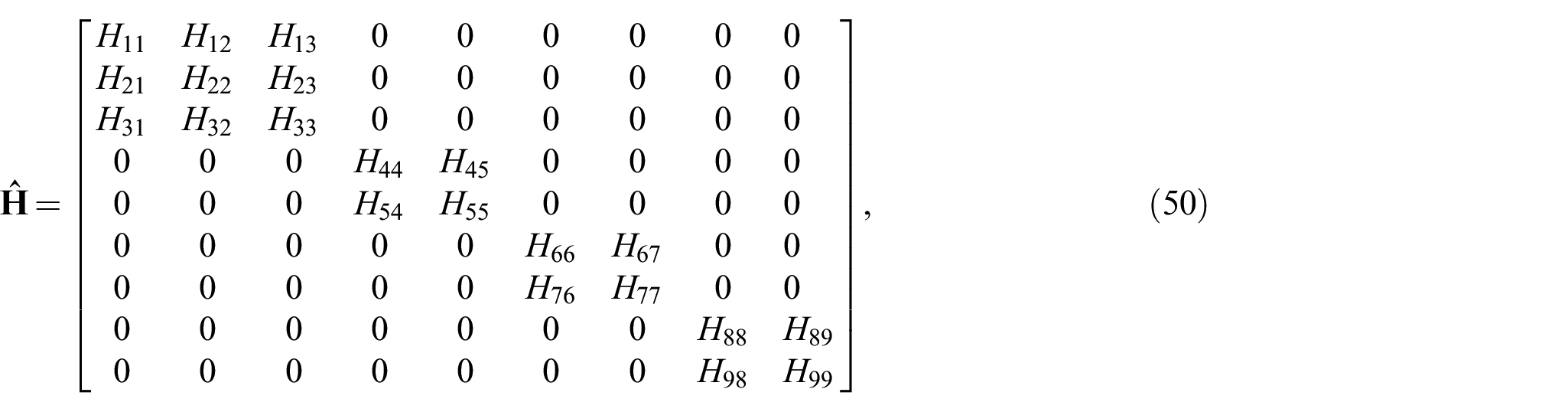
where the appearing non-zero elements are as follows:

A more comprehensive view of the structure of matrix

where the dimensions of each submatrix involved are included in associated parentheses, and:



on account of the relationships provided in equation (51).
The form (52) of

which is obtained either by contracting the free indices appearing in equation (49) or through direct use of equation (42). That conversion process is detailed in Appendix 2 and enables transformation of equation (46) into the non-linear PDE:

for the unknown
5. Positive definiteness of the strain energy function
Attention is now turned onto the restrictions imposed on the elastic moduli involved in the constitutive equation (49) by the required positive definiteness of the corresponding form that the strain energy function (11) attains in the case of polar transverse isotropy. Since that form of W splits naturally into two independent parts, namely,
Accordingly, since non-polar linear elasticity requires from the known, transversely isotropic form of We to be positive definite, it is sufficient for

where the superfix T signifies “transposed,” and the equality naturally holds only in the special case of non-polar linear elasticity.
Nevertheless, equation (56) is anticipated valid not only for the case of the refined couple-stress theory but also for the singular case of its conventional counterpart, where the influence of
5.1. Refined couple-stress theory
The special structure (52) of

It follows that positive semi-definiteness of equation (56) requires from each of the submatrices
In this context, positive semi-definiteness of

Connection of the first three of these inequalities with equation (51) imposes the following restrictions on the values of the relevant elastic moduli:

where:

Moreover, satisfaction of the last three of equation (58) requires imposition of the additional condition:

However, since both submatrices

where use is made of equation (51).
It thus becomes immediately understood that satisfaction of the first of the conditions equation (59) suffices to guarantee positive semi-definiteness of

are similarly obtained by observing that the elements of the principal diagonal as well as the determinant of
5.2. The singular case of the conventional couple-stress theory
In the case of the conventional couple-stress theory, where equation (6) holds, the constitutive equation (49) reduces to:

Moreover, the inequality equation (56) attains the special form:

where:

and the stiffness matrix
It is then seen that the structure of

where the appearing, composed elastic modulus, defined in equation (60), has already exerted remarkable influence on the positive semi-definiteness conditions (61).
It is seen that, when accompanied by the first of inequalities equation (59), the additional condition:

suffices to ensure positive semi-definiteness of
It is accordingly concluded that, along with their well-known non-polar, transversely isotropic elasticity counterparts, the inequalities (59), (61), and (68) suffice in this case to ensure positive definiteness of the strain energy function (11), for both the conventional and the refined versions of the linear couple-stress theory.
6. On the non-elliptic structure of the governing equations—weak discontinuity surfaces
A more detailed, although still preliminary discussion of the fact that the governing equations of polar linear elasticity are not elliptic is provided in section 5 of Soldatos [19]. That discussion is associated in Soldatos [19] with the governing equations of relevant fibrous composites containing fibres resistant in bending, but its principal mathematical arguments still hold in the present case of interest. It is accordingly found adequate for the present discussion to confine attention within the bounds of polar transverse isotropy that is due to the presence of a single family of perfectly flexible straight fibres.
In this context, the elastic moduli appearing in equations (40), (41) and, subsequently, in equation (49), are considered independent of the co-ordinate parameters and, therefore, constant. Naturally, the same is considered true for all five independent elastic moduli, λ, μT, μL, α, and β, appearing in the corresponding constitutive equation of non-polar linear elasticity:

whose form implies that equation (44) is also valid.
With use of constitutive equations thus emerging from equations (69) and (41), the principal equilibrium equation (2a) may take the form:

where use of equation (5) is also implied. Here,
In the special case of non-polar linear elasticity, where
However, in the present polar elasticity case, the elliptic or otherwise nature of the PDEs (70) is principally dictated by the corresponding nature of the term
It is recognised in this context that the set (70) of displacement-based equations is not elliptic. As a result, there may exist in the polar material of interest a finite number of surfaces, known as weak discontinuity surfaces (e.g., [19,21–23]), on which fourth-order derivatives of the displacement vector might be discontinuous, regardless of the continuity status of relevant lower-order derivatives. In this context, the present section considers it sufficient to contact a short but comprehensive study regarding the relevant status of the second term appearing in the left-hand side of equation (70).
Accordingly, insertion into the second term of the left-hand side of equation (2a) of the constitutive equation (64), followed by suitable use of equation (5c), enables subsequent algebraic manipulations to yield:

where Greek indices take the values 2 and 3 only.
A search for the anticipated weak discontinuity surfaces next requires determination of their unit normal

the jump of
By taking the difference of equation (70) on the two sides of that surface, and recalling that the second-order gradients of the displacement vector are considered continuous throughout the body of the transversely isotropic solid of interest, one obtains a generalised eigenvalue problem of the form:

where:

and

The unit vector,

The simplest possible such solution, namely:

reveals that any plane that is normal to the fibre direction is a weak surface. Such a result is interpreted as matrix failure (e.g., [21,22]) and, since it is generally not observable in cases of small elastic deformation that involve fibres resistant in bending [19], it is attributed to the fact that, in the present case, the fibres are considered perfectly flexible.
It is recalled, on the contrary, that planes parallel to the fibres are always weak discontinuity surfaces when fibres possess bending stiffness [19]. This result is interpreted as fibre de-bonding [21,22] and is still observable in the present case of perfectly flexible fibres, as can easily be verified by choosing:

Since the pair of these unit vectors can be chosen arbitrarily on the plane defined by equation (77), any plane containing the fibres does emerge as a weak discontinuity surface, regardless of whether fibres do [19] or do not resist bending.
Additional real solutions of equation (76) may also be possible, but their existence seems to be considerably dependent on the values of the elastic moduli involved in equation (75). Their determination and further examination may require considerable further investigation that is regarded beyond the immediate scope and purposes of this study.
7. Conclusion
The presented anisotropic extension of a recently developed, refined, linear couple-stress theory of isotropic elastic solids [9] retains the ability to determine the spherical part of the couple-stress. It is although also furnished with additional constitutive tools that enable it to model mechanical response of highly anisotropic materials that exhibit inherent linearly elastic polar material behaviour.
The type of material anisotropy considered has enough generality to embrace most of the structural materials employed in practice. This is because the derived constitutive law (section 3) enables consideration of relevant polar elastic solids possessing anisotropic properties that are as advanced as those met in the class of locally monoclinic materials. It follows that the obtained constitutive equation, presented in a suitable indicial notation form, can be simplified further and, thus, includes as special cases the important material subclasses of general and special orthotropy, as well as the subclass of transverse isotropy. In this manner, the implied refined theory is further furnished with ability to model structural analysis problems of polar fibrous composites reinforced by families of perfectly flexible fibres.
A relevant example application considered and studied in detail the subclass of polar transverse isotropy that is due to the presence of a single family of perfectly flexible fibres. That application departed with a derivation of the constitutive law that governs polar mechanical response of locally transverse isotropic materials (section 4.1) but soon after focused attention into the special but practically important case of polar transverse isotropy that is due to the presence of a single family of perfectly flexible straight fibres.
For that special case, the analysis succeeded to rearrange the relevant constitutive equation into a more comprehensive matrix, rather than indicial notation form, and thus achieved to exemplify the way that the spherical part of the couple-stress is determined. It is anticipated that similar, matrix notation forms of relevant constitutive equations will be found equally useful, and must therefore be pursued in the future, in several other advanced cases polar material anisotropy, such as those that are referred to above.
Meanwhile although, and still for the special case of polar transverse isotropy that is due to the presence of straight fibres, a detailed discussion was presented of further important issues stemming from (1) the positive definiteness of the polar form of the relevant strain energy function and (2) the lack of ellipticity of the final form attained by the governing differential equations. Accordingly, section 5 presented necessarily inequalities that, if satisfied by the elastic moduli involved in the polar part of the theory, guarantee the required positive definiteness of the strain energy function.
Moreover, the lack of ellipticity analysis detailed in section 6 arrived at the formation of an algebraic equation, whose solution suffices to determine all weak discontinuity surfaces that are present in the polar transverse isotropic material of interest. Complete solution of that equation is generally dependent on the numerical values of the aforementioned elastic moduli and must, therefore, be pursued numerically.
Nevertheless, the special structure of that algebraic problem led easily to a preliminary conclusion, according to which all material planes that are either parallel or normal to the involved family of perfectly flexible fibres emerge as weak discontinuity surfaces. It was thus noted with interest that this conclusion differs, at least partially, from its counterpart observed when fibres possess bending stiffness [19], where planes parallel to those fibres are, but planes normal to the fibres are not included within the set of the weak discontinuity surfaces sought.
The latter observation redirects attention into the fact that perfectly flexible fibres are considered in relevant mathematical models as material directions that are able to resist extension, but not compression or any other mode or kind of deformation. A connection thus seems emerging between the presented polar material analysis, including its large deformations’ counterpart [10], and recent non-polar hyperelasticity developments that exclude contribution of deformation effects stemming from fibres compression (e.g., [24–26]).
Footnotes
Appendix 1
Appendix 2
Declaration of conflicting interests
The author(s) declared no potential conflicts of interest with respect to the research, authorship, and/or publication of this article.
Funding
The author(s) received no financial support for the research, authorship, and/or publication of this article.
