




Abstract
We propose and assess a new decomposition-based interpolation method on fourth-order fiber-orientation tensors. This method can be used to change the resolution of discretized fields of fiber-orientation tensors, e.g., obtained from flow simulations or computer tomography, which are common in the context of short- and long-fiber–reinforced composites. The proposed interpolation method separates information on structure and orientation using a parametrization which is based on tensor components and a unique eigensystem. To identify this unique eigensystem of a given fourth-order fiber-orientation tensor in the absence of material symmetry, we propose a sign convention on tensor coefficients. We explicitly discuss challenges associated with material symmetries, e.g., non-distinct eigenvalues of the second-order fiber-orientation tensor and propose algorithms to obtain a unique set of parameters combined with a minimal number of eigensystems of a given fourth-order fiber-orientation tensor. As a side product, we specify for the first time, parametrizations and admissible parameter ranges of cubic, tetragonal, and trigonal fiber-orientation tensors. Visualizations in terms of truncated Fourier series, quartic plots, and tensor glyphs are compared.
Keywords
1. Introduction
1.1. State of the art
The development and design process of discontinuous fiber-reinforced composites [1] is nowadays supported by so-called virtual process chains [2, 3]. A virtual process chain usually includes the simulation of the mold-filling process [4–6] and subsequent structural–mechanical investigation of the component performance, taking into account the local microstructure [7–10]. The microstructure evolves during the form-filling flow and the resulting local orientation of fibers largely determines the local mechanical properties. A complete descriptor of the local fiber-orientation within a specified reference volume in terms of one-point statistics [11] is the fiber-orientation distribution function, which unfortunately is mostly unknown. However, averages of the local distribution function in terms of fiber-orientation tensors [4, 12] can be obtained both from simulations and experimentally. A spatial distribution, i.e., a field, of such fiber-orientation tensors is required to assess the mechanical performance of a composite part within a structural analysis. Techniques to perform such structural analysis range from, e.g., approaches based on mixture theory [13, 14], asymptotic homogenization [15, 16], and finite element method [17] to artificial neural networks [18, 19]. All approaches require a suitable resolution of the local microstructure descriptor. As fiber-orientation tensors act as state variables within most flow simulations [5, 20–22], fields of these tensors naturally occur within virtual process chains. Alternatively, fields of fiber-orientation tensors can be identified experimentally by computer tomography (CT) analysis [23–28]. Regardless of how a field of fiber-orientation tensors has been determined, there is usually a need to perform a mapping [29–31] from the discretization, the tensors have been obtained on, to a discretization which is appropriate for the structural simulation. Interpolation methods for fiber-orientation tensors can be adapted from a related field in medicine. In medicine, magnetic resonance imaging (MRI) is used to identify three-dimensional gray value images of tissues. Diffusion-weighted magnetic resonance imaging (DW-MRI) combines multiple MRI sequences to measure the diffusion of water molecules within tissues, thereby obtaining structural information on the tissue. The measured information is encoded by a three-dimensional field of diffusion tensors [32, 33]. As diffusion tensors differ from second-order fiber-orientation tensors only by a missing constraint on the trace, algorithms developed in medicine for interpolation of three-dimensional fields of diffusion tensors can be adopted to fiber-orientation tensors [29]. A selection of interpolation methods on DW-MRI diffusion tensors is given by early works [34–36] as well as a small selection of references [37–45] indicating the relevance of this field. The aforementioned contributions are accompanied by application-driven works [46, 47] or methods focusing on the underlying partial differential equations [48]. However, most of the methods are limited to second-order tensors and only a few deal with fourth-order tensors [49–51].
In the field of structural mechanics, on the contrary, fourth-order fiber-orientation tensors are increasingly used [52]. Insights into the algebra of fourth-order fiber-orientation tensors [53, 54] allow for the attempt to transfer interpolation methods designed for diffusion tensors to fourth-order fiber-orientation tensors. Bauer and Böhlke [55] combine a parametrization of fourth-order fiber-orientation tensors with algebraic constraints to derive admissible parameter ranges which represent the variety of the fiber-orientation tensor for selected material symmetries. The utilized parametrization is based on an a priori selected coordinate system, acting as eigensystem of both the second- and fourth-order parts of the fiber-orientation tensor of interest. The multiplicity of eigensystems of second-order diffusion and fiber-orientation tensors and uniqueness of projector representations are discussed, e.g., by Kraußand Kärger [29], Basser and Pajevic [56], and Hasan et al. [57].
1.2. Notation
Symbolic tensor notation is preferred in this paper. Tensors of first order are denoted by bold lowercase letters such as
1.3. Contribution
For a given discretized spatial field of fourth-order fiber-orientation tensors, we are interested in heuristic algorithms which interpolate the given field, generating a field of interpolated fourth-order fiber-orientation tensors. The distances of the spatial point of interest to its nearest neighbors might be interpreted as weights. Within this work, we evaluate a new decomposition-based interpolation method for fiber-orientation tensors of fourth order. The new method is based on the parametrization of Bauer and Böhlke [55]. This parametrization represents a fourth-order fiber-orientation tensor in terms of tensor components within an eigensystem of the tensor itself, therefore naturally separating structural and orientational information. The proposed interpolation method is a weighted average of the tensor components within their respective eigensystems. Therefore, the structural properties are encoded in terms of tensor components and the orientational information is encoded in terms of the respective eigensystems. In consequence, the identification of an eigensystem for each individual tensor involved in the interpolation is required. However, the parametrization of [55] is developed to generate fiber-orientation tensors based on a given eigensystem combined with given structural parameters. If in contrast, a given tensor is to be analyzed based on the parametrization, the first step is to determine the eigensystem of the tensor. This determination showed to be a non-trivial task, if the tensor being analyzed has at least partial material symmetry, either within its second- or fourth-order parts. Therefore, as a by-product, we investigate edge cases, caused by (partial) material symmetry, of fourth-order fiber-orientation tensors, extending the work of Bauer and Böhlke [55]. In particular, we study subspaces of fourth-order fiber-orientation tensors induced by cubic, tetragonal, and trigonal material symmetry. As a result, representations of fourth-order cubic, tetragonal, and trigonal fiber-orientation tensors are presented in terms of the aforementioned parametrization, each supplemented by admissible parameter ranges. Since the new interpolation method is built on a parametrization that naturally includes material symmetries, the interpolation method preserves any existing material symmetry of the tensors to be interpolated.
This paper is organized as follows. A brief definition of fiber-orientation tensors in section 1.4 is followed by a classification of problems in section 2. We distinguish three problems which we call averaging, disassembly, and interpolation problem and within this work focus on the latter. In section 3.1, we briefly discuss different classes of interpolation methods. We focus on decomposition-based methods as well as the interpolation of second-order tensors. We explicitly discuss the inherent ambiguity of eigensystems of second-order tensors and the association with the elements of the orthotropic symmetry group (see section 3.2.1). We recite an adoption of the Karcher mean in section 3.2.2. With a note on frequently used structural descriptors of second-order fiber-orientation tensors in section 3.2.3, we close the discussion of second-order information and focus on fourth-order fiber-orientation tensors in section 4. After a recap of the eigensystem-based parametrization of fourth-order fiber-orientation tensors [55] in section 4.1, we outline the new interpolation method in section 4.2. In section 4.3, we introduce a new convention to obtain a unique eigensystem of any triclinic fourth-order fiber-orientation tensor. Within section 4.4, we discuss limitations of this convention-based procedure in the presence of material symmetry. For each edge case, we demonstrate the identification of possible multiple eigensystems combined with a unique set of structural parameters. We apply the new method on examples in section 5. Parametrizations and admissible parameter ranges of cubic, tetragonal, and trigonal fourth-order fiber-orientation tensors are given in Appendices 1–3, respectively. Eigenvalues and eigentensors of irreducible fourth-order tensors of transversely isotropic, trigonal, tetragonal, and orthotropic symmetry are presented in Appendix 4. We close this paper with a discussion and comparison of visualization methods for fourth-order fiber-orientation tensors, focusing on truncated Fourier series, quartic plots, and glyph representations.
1.4. Fiber-orientation tensors
The fiber-orientation distribution function (FODF)

maps any direction

quantifies the fraction

called spherical harmonic expansion [12, page 154]. The operator


with the weights being defined by the fiber-orientation distribution function

and

for dimensions two and three, i.e.,

holds with the identity on second-order tensors

holds.
2. Averaging, disassembly, and interpolation
2.1. Motivation
Since the local mechanical properties of a discontinuous fiber-reinforced composite depend on the local orientation of the fibers, the quantification of this local fiber-orientation is an essential part of the computer-aided design process of such materials. Suppose, for a component geometry under investigation, the local fiber-orientation is given in the form of a spatially discretized field of fourth-order fiber-orientation tensors. This field is therefore based on a spatial discretization, i.e., each individual fiber-orientation tensor within this discrete field is assigned to a reference volume of the component and describes the average fiber-orientation within this reference volume. For simplification, let us also assume that the component geometry to be investigated is planar and the discretization is chosen in such a way that the individual reference volumes do not overlap. A small section with only four reference volumes of such a two-dimensional discretization is shown as an example in Figure 1(a).
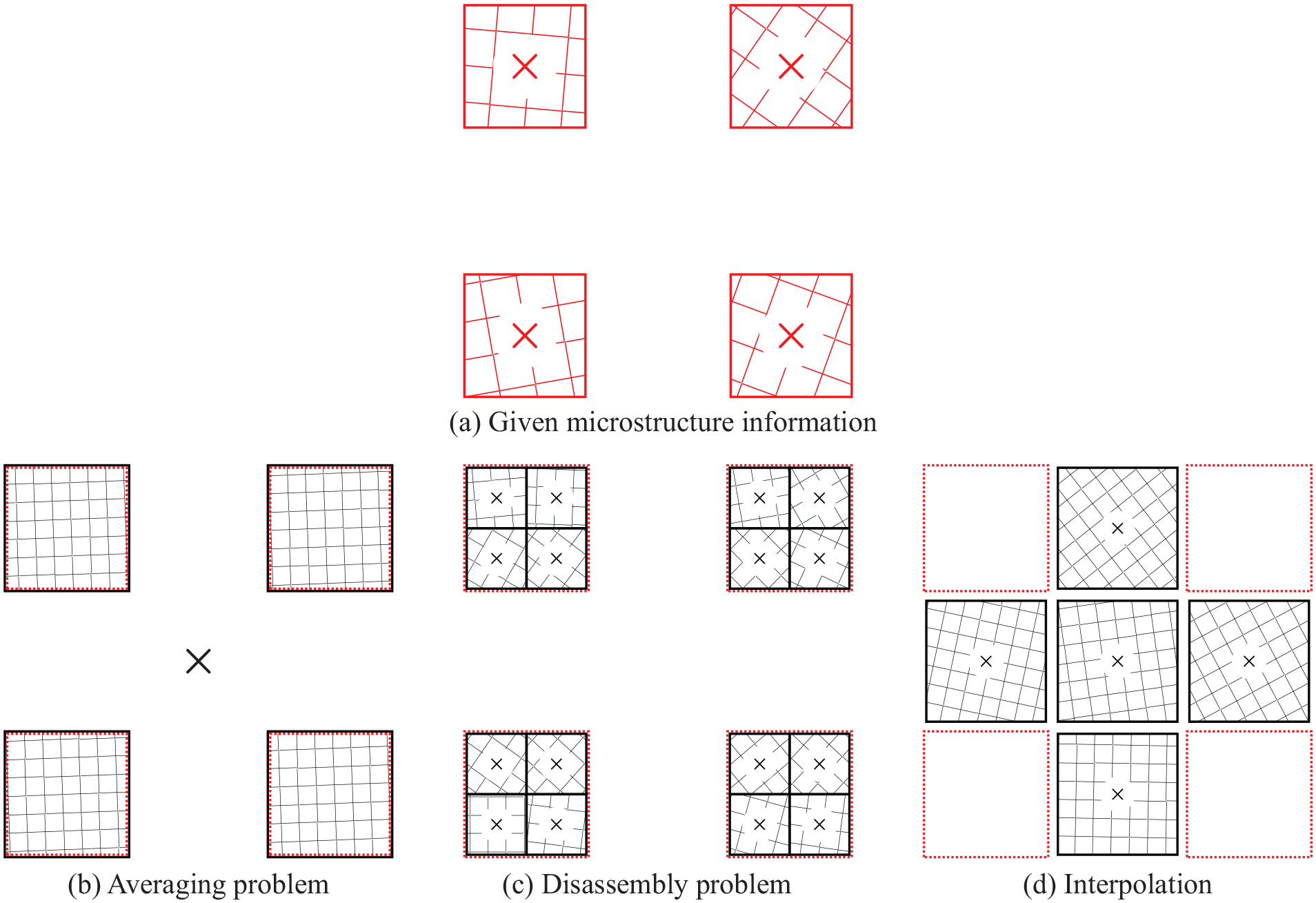
Schematic example of a given discretization of microstructure information. The example discretization is flat and consists of four non-overlapping reference volumes of equal size (a). The averaging, disassembly, and interpolation problems are depicted in (b), (c), and (d), respectively. The measured grid data are depicted in red, whereas the target volumes are colored in black. Most discretizations associate each information, e.g., a specific microstructure descriptor, with a spatial point, i.e., a location. We indicate the associated locations of the measured data and the target volumes with red and black crosses, respectively.
If for the considered component, engineering tasks are to be solved, the spatial discretization of the available fiber-orientation field is often not optimal for the subsequent analysis steps and a change of the spatial discretization is necessary. We categorize such changes of the spatial discretization into three different problems—averaging, disassembly, and interpolation. Averaging corresponds to combining reference volumes, whereas disassembly can be interpreted as splitting up a given reference volume and interpolation can be seen as a refinement of the given spatial field, usually incorporating some kind of weights or distance measure. The weights for the interpolation might be given, e.g., based on the spatial distance between reference volumes which are to be combined. Brannon [61] discusses the problem of interpolating or averaging physical quantities which are related to directions and rotations, demonstrating that the interpolation or averaging methods might be evaluated with respect to specific problems rather than in a general way. We analyze each of the three problems and discuss existing solutions to the interpolation problem before insights based on irreducible tensors and material symmetry lead to a new interpolation method for fourth-order fiber-orientation tensors.
2.2. The averaging problem
In a given field of microstructure descriptors, e.g., fiber-orientation tensors, each single entity is associated with a reference volume, which microstructure it describes. If the reference volume is considered a thermodynamic system, microstructure descriptors may be interpreted as intensive state variables, which are additive in a weighted sense. That is, the state variable of the union of two subsystems is the volume-weighted sum of the respective state variables of the subsystems. In the field of micromechanics, this property is usually represented by the exact split of the volume average over a system into the weighted sums of volume averages over the subsystems. In consequence, the fiber-orientation distribution function associated with a reference volume

where

with
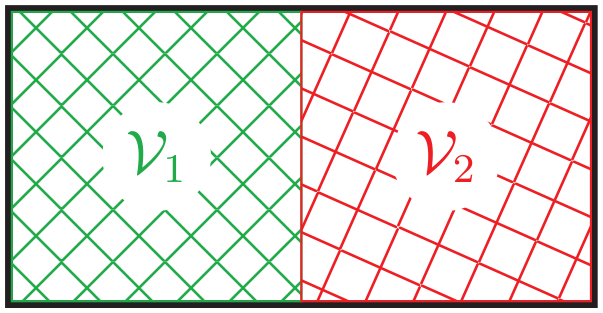
Minimal example of the averaging problem with two reference volumes with equal size, arranged next to each other.
In consequence, the unique solution of the averaging problem of fiber-orientation tensors is known directly and given by the arithmetic mean of tensor components in an arbitrary, but homogeneous, coordinate system. Interpolation methods which take the arithmetic mean of tensors have an averaging character.
2.3. The disassembly problem
We define the disassembly problem as the reversal of the averaging problem. In consequence, the disassembly problem is the identification of fiber-orientation tensors

with the reference volume

If
2.4. The interpolation problem
The required spatial resolution of fields of fiber-orientation tensors differs between individual steps of a virtual process chain. Solving initial boundary value problems on microstructured materials may require high-resolution fields of microstructural information, depending on the effects being studied and the scales associated with those effects. Obtaining such high-resolution fields of microstructure information often represents a bottleneck in the virtual process chain. One example is the determination of local fiber-orientation tensors using CT on long-fiber-reinforced composites such as sheet molding compound (SMC) and long-fiber–reinforced thermoplastics (LFT). The geometric dimensions of fibers in fiber-reinforced composites define the necessary resolution of CT scans. The smaller the diameter of the fibers, the higher the resolution of the CT scan must be selected [30]. The fiber diameter defines requirements on the CT resolution, which is independent of the desired spatial resolution of the tensor field.
If microstructure information on a coarse macroscopic grid is of interest, the CT scans may be restricted to a sparse grid of scanned reference volumes on the component. In a next step, the exact solution of the averaging problem discussed in section 2.2 can be used to average the sparse grid data of the scanned fiber-orientation tensors to values associated with the nodes of the coarse macroscopic grid [30]. The volumetric sizes of the staggered grid of scanned regions have to be carefully selected in order to reflect the microstructure of interest.
If, on the contrary, a granular field of local microstructure information is of interest, an identical scanning setup on a staggered grid of small reference volumes can be used with a successive refinement by interpolation. However, the evolution of fiber states between the measured points of the staggered CT grid is defined by a physical process, which itself is described by partial differential equations and the initial and boundary conditions during the manufacturing process of the component at hand. Therefore, simulation of such a physical process is impractical, although desirable. In consequence, interpolation methods are necessary to refine a given grid of measured orientation states. This refinement is called the interpolation problem.
Both the disassembly problem and the interpolation problem aim at a refinement of grid data. However, the reference volumes associated with the refined grid of the disassembly problem are contained completely within the measured reference volumes of the coarse grid. In contrast, interpolated orientation states can be associated with reference volumes which are located between measured reference volumes. This is visualized schematically in Figure 1(d). In general, the reference volumes might overlap.
An interpolation problem is specified by data on a source discretization and a specific target discretization onto which the date is to be interpolated. A solution to an interpolation problem depends on the type of weighting as well as the selected interpolation method. In this work, local weights, which depend on the meshing algorithm, the finite element type, and the shape functions, are preferred over global weights, such as Shepard’s method [30]. Weights on these two-dimensional fields are obtained by triangulation with linear shape functions.
3. Interpolation of second-order fiber-orientation tensors
3.1. Classes of interpolation methods
Interpolation methods for fiber-orientation tensors can be adapted from a related field in medicine. In medicine, MRI is used to identify three-dimensional gray value images of tissues. DW-MRI combines multiple MRI sequences to measure the diffusion of water molecules within tissues, thereby obtaining structural information on the tissue. The measured information is encoded by a three-dimensional field of diffusion tensors [32,33]. The diffusion tensors determined by DW-MRI are positive semi-definite and symmetric tensors of second order. Second-order fiber-orientation tensors can thus be identified as dimensionless diffusion tensors with fixed trace, see equation (9). In consequence, algorithms developed in medicine for interpolation of three-dimensional fields of diffusion tensors can be adopted to fiber-orientation tensors.
The exact solution to the averaging problem (section 2.2), hereafter called component averaging, maybe applied as an interpolation method by component-wise interpolation of tensor components in an arbitrary reference coordinate system. However, interpolation by component averaging leads to the swelling effect [37, 39, 41, 42], i.e., a tendency towards isotropic states, and does not reflect expectations on flow fields of fiber-orientation tensors. Association of component averaging with the averaging problem, see section 2.2 explains the swelling effect. Interpolation methods other than component averaging can be categorized into two groups—Riemannian interpolation methods and decomposition-based interpolation methods. Riemannian methods on diffusion tensors [37–39, 65] treat tensors as elements on a Riemannian symmetric space and use metrics on this manifold. As the new interpolation method proposed in section 4 belongs to the decomposition methods, we focus on this class of methods.
A first intuition on the differences between component averaging and decomposition-based methods is given by Figure 3, in which two elongated fiber-orientation tensors differing by almost a quarter rotation around one axis perpendicular to the large eigenvector are interpolated using two interpolation methods. Columns two, three, and four represent interpolated fiber-orientation tensors obtained by two different interpolation methods. The interpolated states in the upper row are calculated by averaging tensor components in a global reference coordinate system, i.e., the exact solution of an averaging problem with varying volume fractions. The lower row shows the new interpolation method and indicates its decomposition-based character, as the interpolated states preserve the homogeneous structure of the left- and right-most orientation states. As this method is a decomposition method and the reference fiber-orientation tensors are both unidirectional, the interpolated tensors only differ by a rotation. Associating this interpolation problem with a flow field and a single fiber, would clearly indicate high suitability of the decomposition method. However, as the interpolated fiber-orientation tensors describe averages of associated volumes instead of single fibers, judgment on the suitability of the different methods is difficult. If the angle between the given fiber-orientation tensors in Figure 3 is exactly ninety degrees, the solution of the decomposition-based method is not unique.
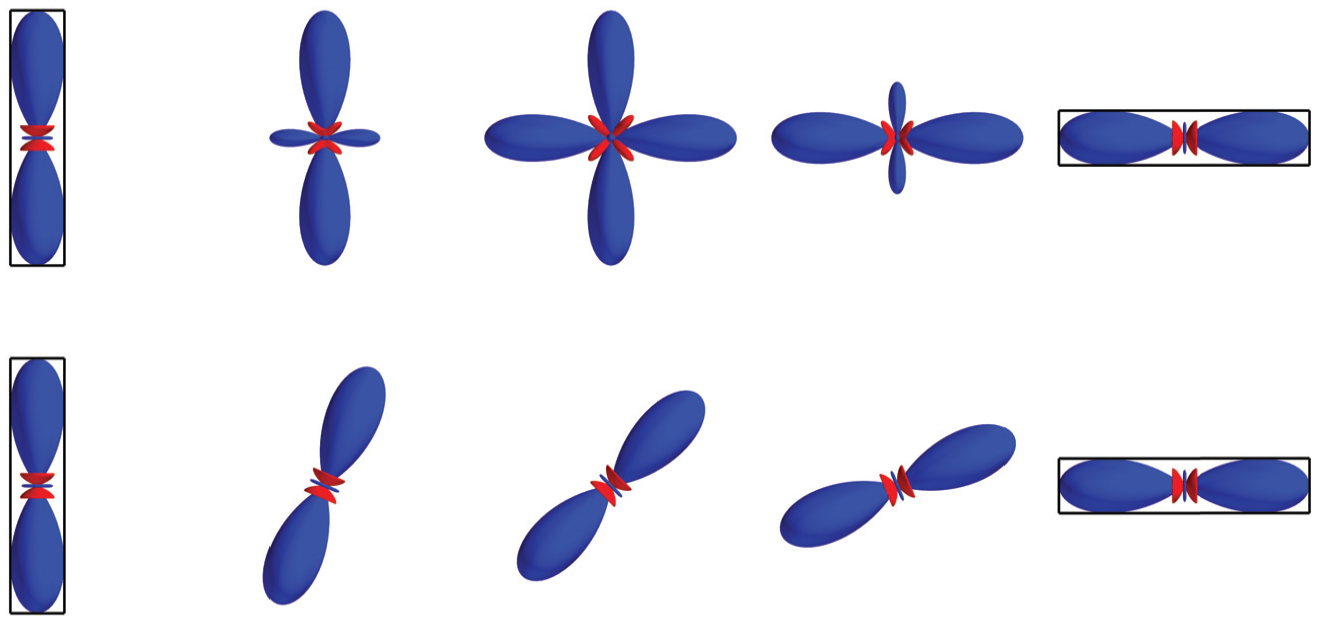
Two unidirectional fiber-orientation tensors of fourth order, which differ by a bit less than a quarter rotation, are visualized in the outer columns and represent an interpolation problem. The three-dimensional plots show reconstructed fiber-orientation distribution functions obtained by truncated Fourier series expansion in fiber-orientation tensors up to fourth-order, see [64, equation 31]. Positive parts of the distribution functions are colored blue, whereas negative parts are color-coded red, following [64] and a detailed discussion on visualization in Appendix 5. This figure follows [37, Figure 3].
Decomposition-based interpolation methods [41, 47, 50] decompose tensors into information on the orientation and structure. The information on the orientation can, e.g., be encoded as a coordinate system spanned by eigenvectors of the diffusion or fiber-orientation tensor and might also be referred to as rotation [66]. The structural information is also referred to as shape [47, 50], type of material symmetry [67], or scaling [66] and is commonly encoded by invariants. The independent interpolation of structure and orientation implies that interpolations of two tensors, which differ only by their orientation, have constant structure, i.e., the interpolation preserves the structure. An example of such a structure-preserving decomposition-based interpolation is given in the lower row in Figure 3. Likewise, decomposition-based interpolations between two non-identical tensors sharing identical orientations differ only by their structure. A decomposition-based interpolation of two fourth-order tensors which differ only by structure is given in Figure 8.
3.2. Decomposition-based methods
3.2.1. Orientation and multiplicity of eigensystems
Decomposition of a second-order fiber-orientation tensor

holds. If the vector




is a valid eigensystem of

mapping the arbitrary but fixed basis


and rotate

holds. If an eigenvalue has a multiplicity larger than one, which is the case for isotropic and transversely isotropic second-order tensors, two or three eigenvectors are arbitrary. This randomness is a major problem for coordinate system–based interpolation methods, but it is solved by Riemann methods, e.g., in the works of Batchelor et al. [37], Arsigny et al. [38], Fletcher and Joshi [39], and Barmpoutis et al. [65].
The decomposition algorithms aim at separating interpolation of orientation and structure. However, the orientation information of a second-order fiber-orientation tensor
Random choice: without awareness of the ambiguity, a set of eigenvectors
A specific global choice: Introduction of a convention in the form of preferred directions of specific axes in a global coordinate system. For example, the first axis of the eigensystem could be said to have a positive vector component in the global
Information from higher-order tensors: If a higher-order tensor with weaker material symmetry than orthotropy is known and corresponds to the second-order tensor of interest, conventions, e.g., on tensor components, can be used to define a unique eigensystem. To the best of the authors’ knowledge, this strategy is new.
No choice: Accounting for all eigensystems in the averaging process of orientations and selection of the closest combination within a set of coordinate systems which are to be averaged [42].
Projectors/eigenbases/rank-1 tensors: Use of an alternative representation of orientations without information about the orientation of the axes, e.g., [43, 56]. This strategy does not yield a coordinate system but three rank-1 tensors [29].
Strategies one and two are not isotropic and lead to an artificially bias on the orientation, as any resulting interpolation would depend on the choice of the global basis. Therefore, these strategies should be avoided. Strategy three is only applicable, if suitable higher-order tensor information is given. In the use case of fiber-orientation tensor, a suitable higher-order tensor is given by a fourth-order fiber-orientation tensor with weaker symmetry than orthotropy. If the fourth-order fiber-orientation tensor is orthotropic or has even stronger material symmetry, the selection of an associated eigensystem might remain arbitrary. Strategy three, applied to noisy data, might lead to only seemingly precise selection of the unique eigensystem. Strategies one to three associate a unique coordinate system to a given second-order tensor. In contrast, strategies four and five influence the following interpolation step. Strategy four is criticized by Gahm et al. [41], studied in Gahm and Ennis [43], and does not yield a unique coordinate system but requires handling several cases in subsequent interpolation steps. In this work, we focus on strategy three aiming at the interpolation of fourth-order fiber-orientation tensors. If the given fiber-orientation tensors have been identified experimentally and therefore contain noise, material symmetries are unlikely. The authors are aware that in the presence of material symmetry or localization, the choice of the specific coordinate system is determined by numerical inaccuracies rather than by real orientational information encoded within the fiber-orientation tensor. Strategies to reduce the ambiguity of eigensystems in the presence of (partial) symmetry of a given fourth-order fiber-orientation tensor are discussed in sections 4.3 and 4.4. A specific decomposition-based interpolation method is defined by a combination of an interpolation method for the orientation and an interpolation method for the structure. We start with investigations on common interpolation methods for the orientation information.
3.2.2. Interpolation of rotations
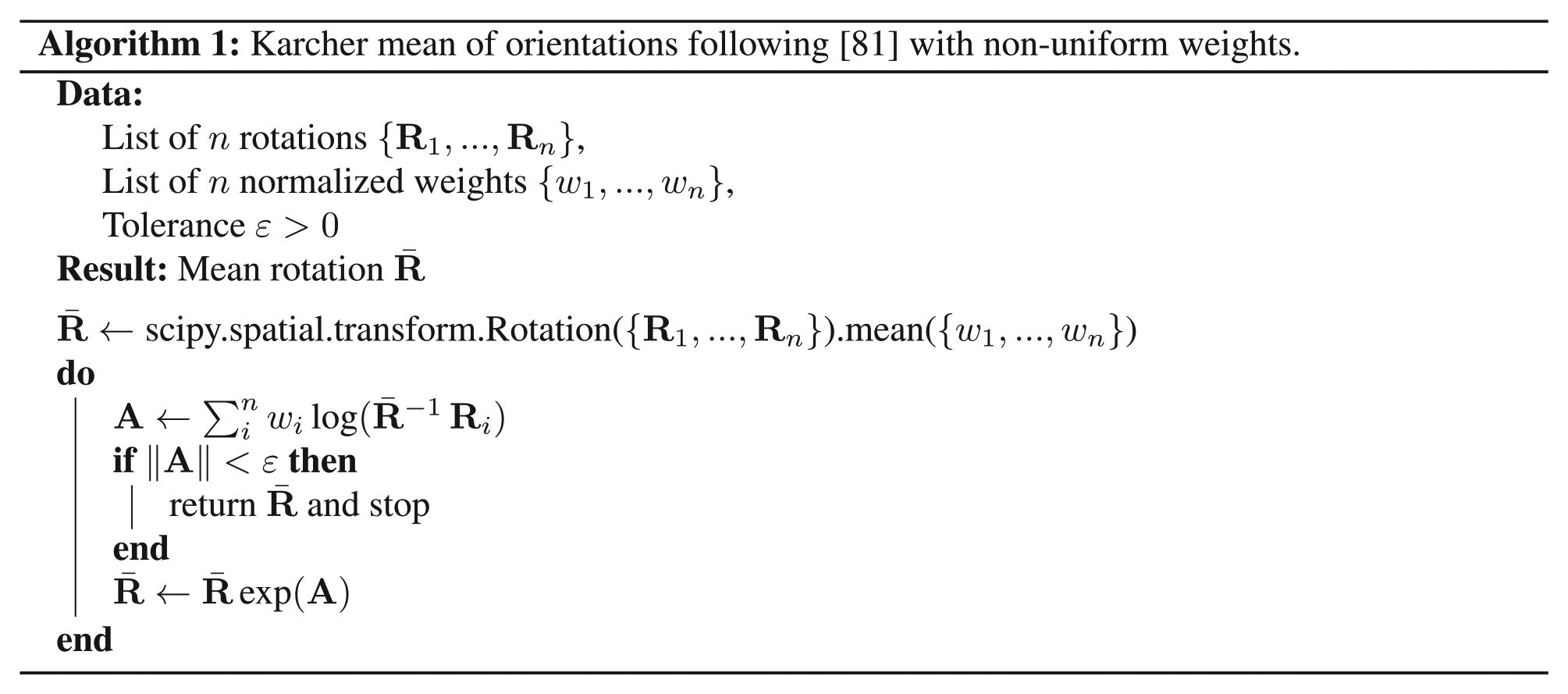
Rotations are elements of the special orthogonal group
3.2.3. Interpolation of structure
The structure of a second-order fiber-orientation tensor within an eigensystem is encoded by two scalars. A popular redundancy-free visualization of this variety of the structure is the fiber-orientation triangle [86, 87], e.g., used in the works [88, 89]. The classification of structurally differing second-order fiber-orientation tensors in terms of the fiber-orientation triangle is based on the ordering convention

see Bauer and Böhlke [55] for a detailed discussion. Any second-order orientation tensor can be represented by a pair
The structure information of second-order fiber-orientation tensors or diffusion tensors is characterized by two or three independent invariants, respectively. Eigenvalues
4. Interpolation of fourth-order fiber-orientation tensors
4.1. Eigensystem-based parametrization
We transfer the interpolation strategy of separating orientation and structure to fourth-order fiberorientation tensors. Therefore, we use the parametrization of Bauer and Böhlke [55], which separates information on orientation and structure. The orientation information is represented in terms of an eigensystem and the structure information in terms of tensor components. These tensor components are represented in the Kelvin–Mandel notation, explicitly introduced by Mandel [90], originating from Thomson [91] and also known as the normalized Voigt notation. The Kelvin–Mandel notation uses a six-dimensional basis spanned by


Bauer and Böhlke [55, equations (40) and (53)]. Given a fixed eigensystem

with a potentially triclinic fourth-order deviator

and the Kelvin–Mandel basis

following Bauer and Böhlke [55, equation (76)].
The selection of the decomposition is significantly motivated by the experience of the authors involved. Alternative decompositions are given by, e.g., the spectral decomposition [91] which is utilized in section 4.4.2, to determine the material symmetry class of a given tensor, or the Clebsch–Gordan formalism [99, 100], also known as joined invariant decomposition.
4.2. New method: Interpolation of tensor components within the eigensystem
Based on the parametrization in equation (26), we introduce a new decomposition-based method for the interpolation of fourth-order fiber-orientation tensors in Algorithm 2. In a nutshell, this algorithm defines the interpolation of the structural information as a weighted average of tensor components within the tensors respective eigensystems. In detail, Algorithm 2 proposes to interpolate
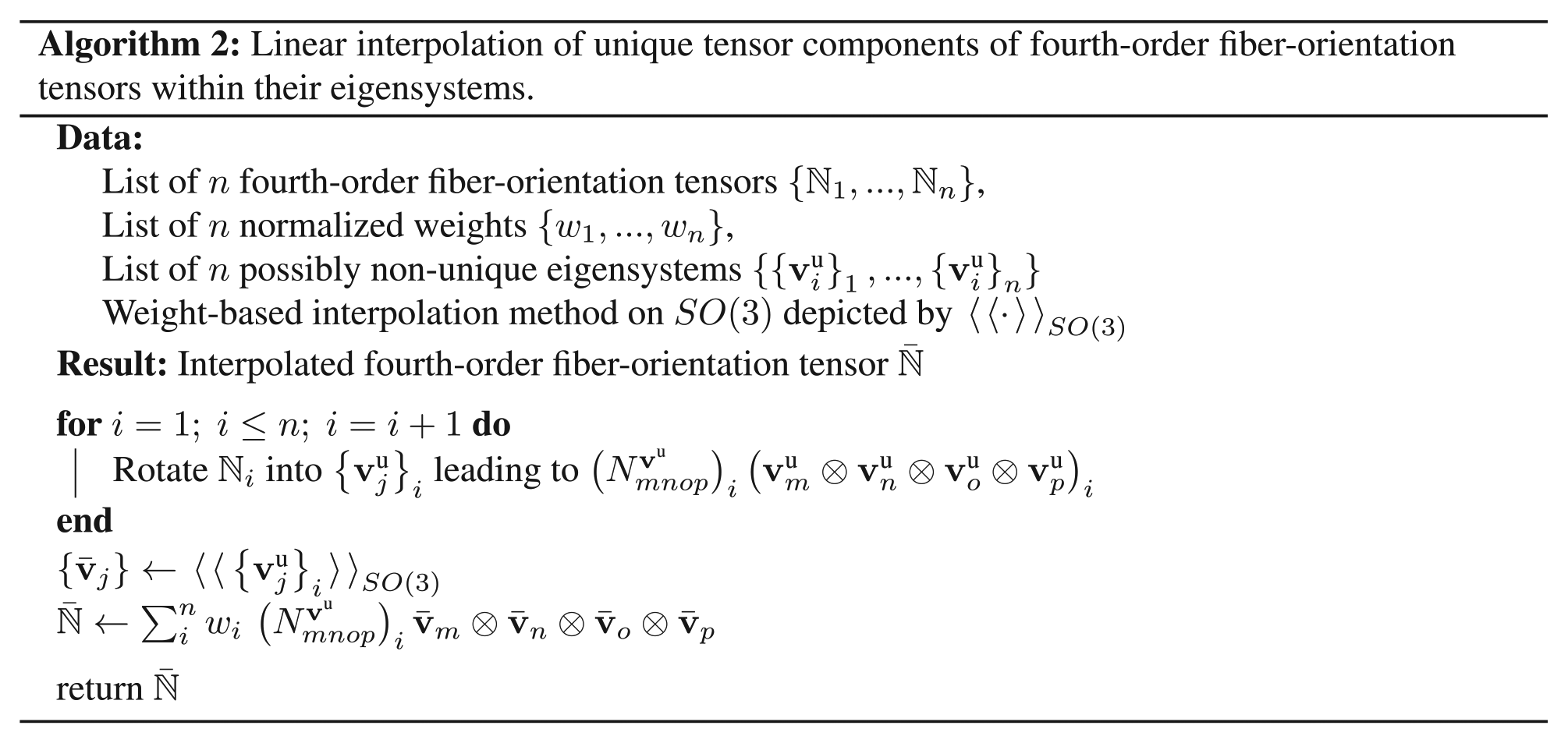
In the absence of any material symmetry, i.e., if all tensors which are to be interpolated are triclinic, each of these tensors possesses a unique eigensystem
To illustrate, why the identification of the eigensystem, in both the general case and the edge cases, require further investigation, it is worth noting that Bauer and Böhlke [55] developed the eigensystem-based parametrization in equation (26) to study the variety of fourth-order fiber-orientation tensors and used the parametrization as the starting point. Similarly, Bauer et al. [54] use the parametrization as the starting point for microstructure optimization in terms of semi-definite programming on fiber-orientation tensors. Starting with the parametrization fixes the eigensystem a priori. This is why the ambiguity of the four possible eigensystems of a second-order tensor in the absence of material symmetry elaborated in section 3.2.1 is not discussed by Bauer and Böhlke [55] or Bauer et al. [54]. Using the parametrization as a starting point, implicitly selects one of the possible eigensystems of the tensor of interest. This is even the case for material symmetries, e.g., isotropy for which the number of eigensystems is infinite, as any coordinate system represents a valid eigensystem.
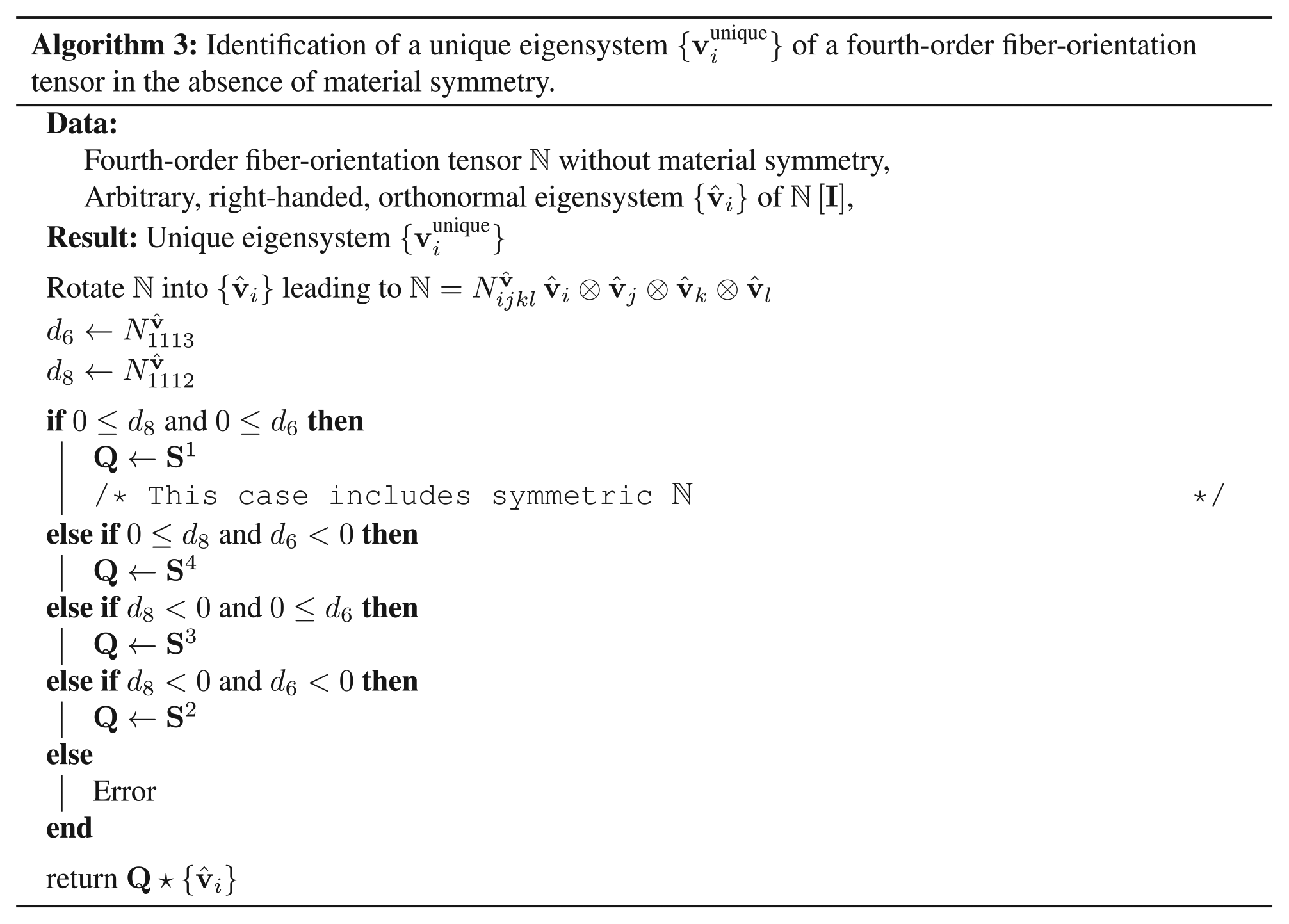
4.3. General case: The unique eigensystem in the absence of material symmetry
We investigate fiber-orientation tensors in the absence of material symmetry, i.e., we concentrate on triclinic tensors. Let the tensor components of a triclinic fourth-order fiber-orientation tensor


The action of elements in the orthotropic symmetry group




Comparing the tensor components in equations (31) to (34) reveals that the non-trivial rotations within the group
Although this convention might seem a bit arbitrary at first, it is quite common to use conventions on invariants to select features of an eigensystem. In the case of second-order fiber-orientation tensors
4.4. Edge cases: Identification of eigensystem and structural parameters in the presence of material symmetry
4.4.1. Implications of material symmetry on the uniqueness of the eigensystem
A unique eigensystem forms the basis for the decomposition-based interpolation method defined in section 4.2. However, in the presence of (partial) material symmetry, the unique eigensystem approach fails. We illustrate this with the example of cubic fourth-order fiber-orientation tensors.
For potentially noise-affected measurements of fiber-orientation tensors of real microstructures, the presence of material symmetries is rather unlikely, especially in the case of large reference volumes. In such cases, even a slight asymmetry of the fibers’ arrangement will lead to a triclinic fiber-orientation tensor. However, analysis of dilute microstructures or artificially generated microstructures may include fiber-orientation tensors which posses some kind of material symmetry. Therefore, we aim at associating given components of a fourth-order fiber-orientation tensor, with a unique set of parameters

and contract to isotropic second-order fiber-orientation tensors, i.e.,
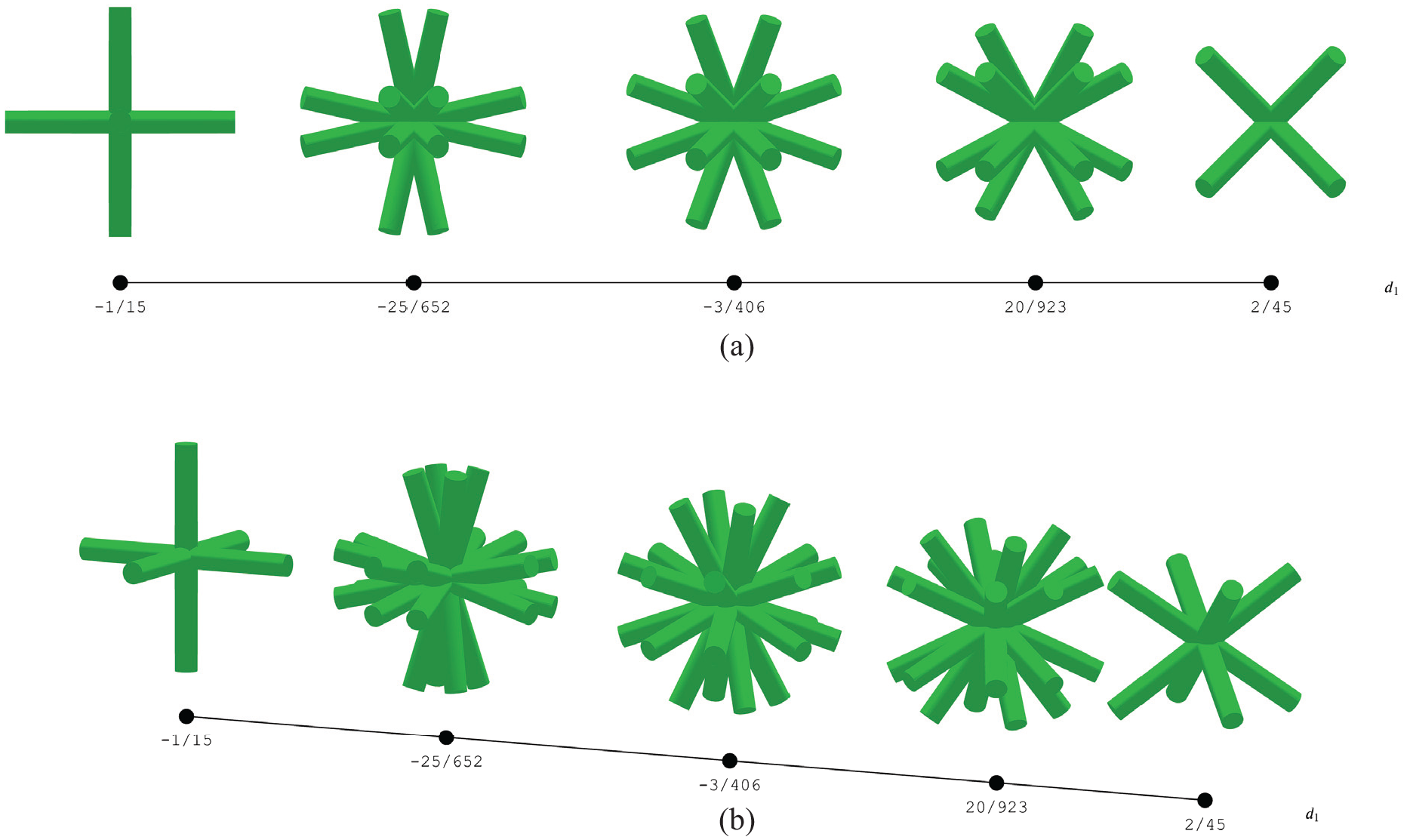
Examples of cubic fiber arrangements along the one-dimensional parameter space of cubic fourth-order fiber-orientation tensors: (a) first view and (b) second view.
4.4.2. Identification of the material symmetry
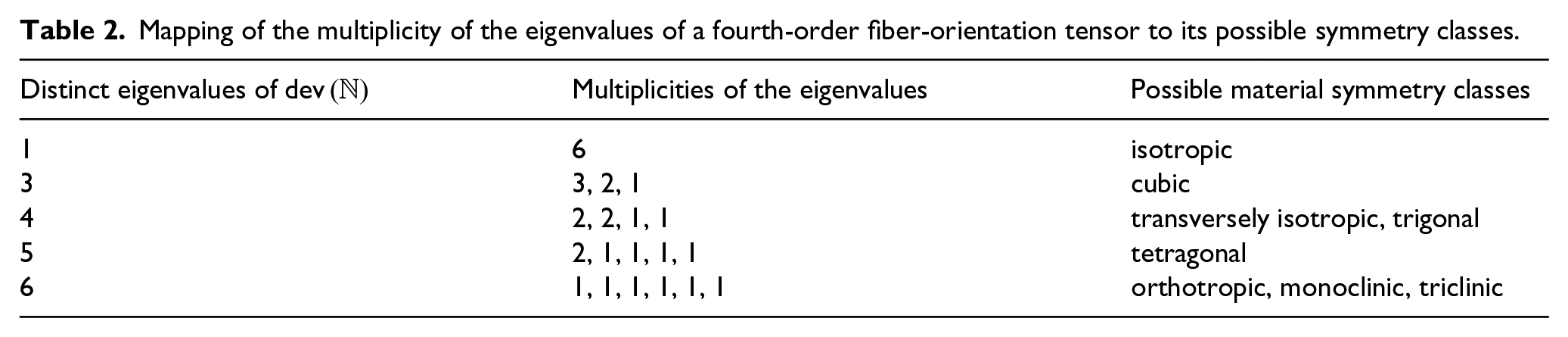
We try to identify the material symmetry class of given tensors based on the multiplicity of eigenvalues, following Bòna et al. [101] who summarize extensive research on the identification of material symmetry and a natural basis, i.e., an eigensystem, of given linear elastic stiffnesses, see Thomson [91], Mehrabadi and Cowin [92], Cowin and Mehrabadi [93], Rychlewski [97], Fedorov [102], Walpole [103], Rychlewski [104, 105], Yang et al. [106], Sutcliffe [107], and Browaeys and Chevrot [108]. Therefore, we define eigenvalues
Mapping of the multiplicity of the eigenvalues of a second-order fiber-orientation tensor

Mapping of the multiplicity of the eigenvalues of a fourth-order fiber-orientation tensor to its possible symmetry classes.
4.4.3. Cubic symmetry
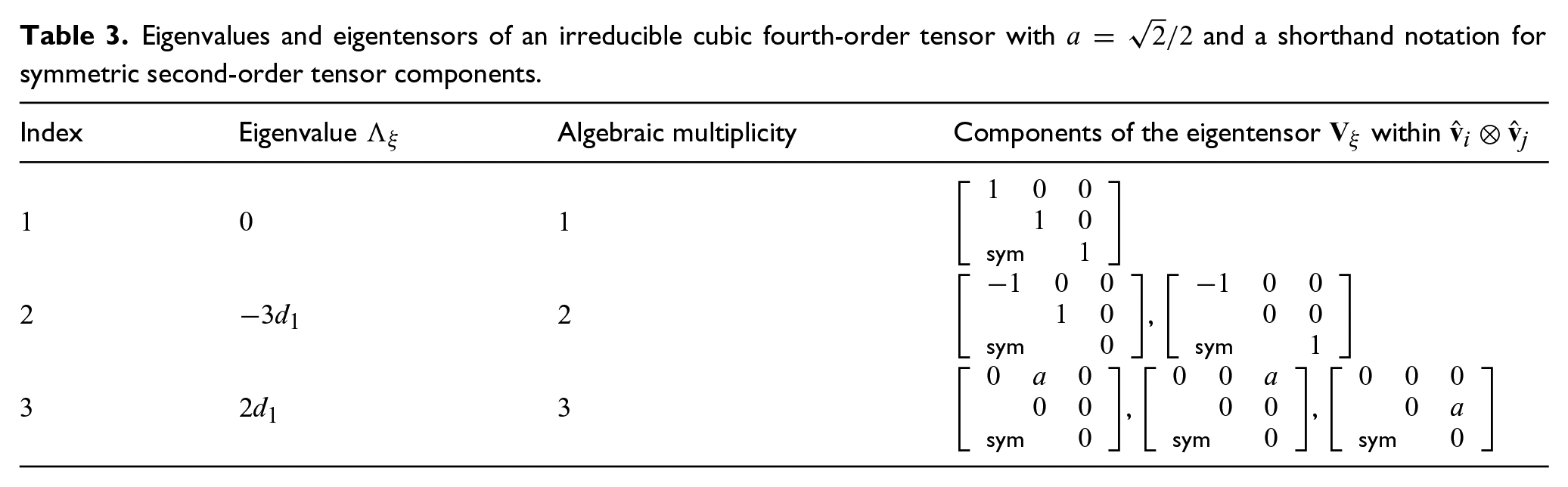
We start with cubic material symmetry. Table 3 shows the eigenvalues, their algebraic multiplicity and corresponding eigentensors of a cubic deviator
Eigenvalues and eigentensors of an irreducible cubic fourth-order tensor with
4.4.4. Transversely isotropic, trigonal, or tetragonal symmetry: Step one
A physical quantity which is either transversely isotropic, trigonal, or tetragonal has a preferred axis. We follow the convention of Bauer [109, Chapter 3] and select any parametrization such that this axis is parallel to
4.4.5. Trigonal or tetragonal symmetry: Step two
In contrast to the continuous rotational symmetry of transversely isotropic quantities, trigonal and tetragonal quantities are symmetric with respect to rotations of specific angles around a preferred axis only.
The preferred axis has been identified as the first axis
If the analyzed tensor is trigonal, the angle takes a value between 0 and 60 degrees. Once the angle minimizing the target function is identified, the parameters
If the analyzed tensor is tetragonal, rotations between 0 and 90 degrees have to be considered during the optimization process. Having obtained tensor components within the optimized coordinate system, one additional step is necessary to obtain a unique set of parameters. Rotation of 45 degrees around the axis
4.4.6. Orthotropic symmetry
For a given orthotropic fourth-order fiber-orientation tensor
First, if the second-order part

with
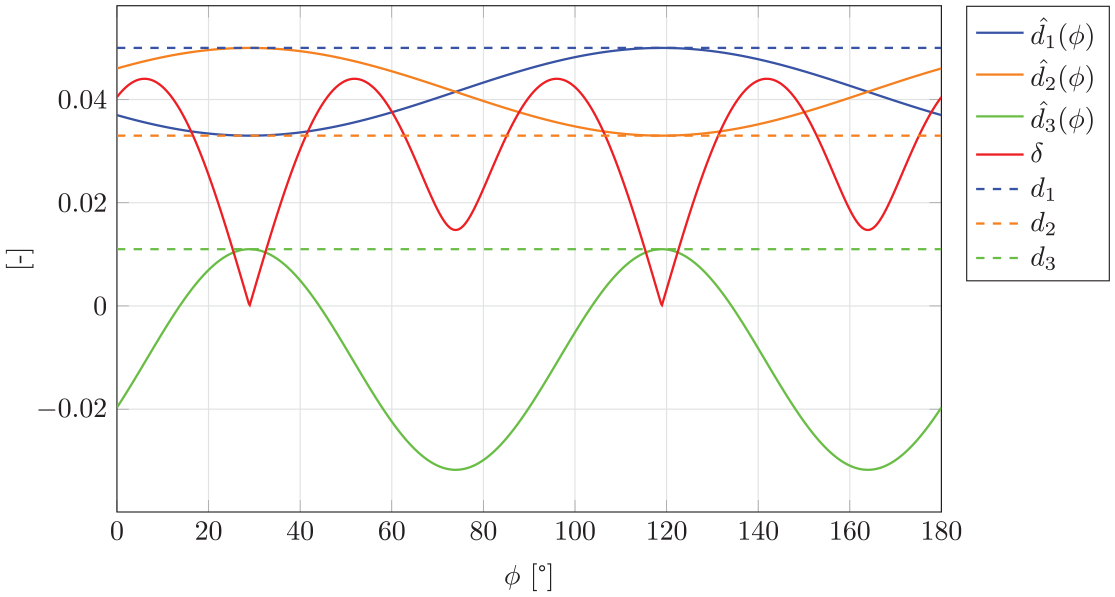
Identification of a unique parameter set of a randomly selected and randomly oriented orthotropic fourth-order fiber-orientation tensor
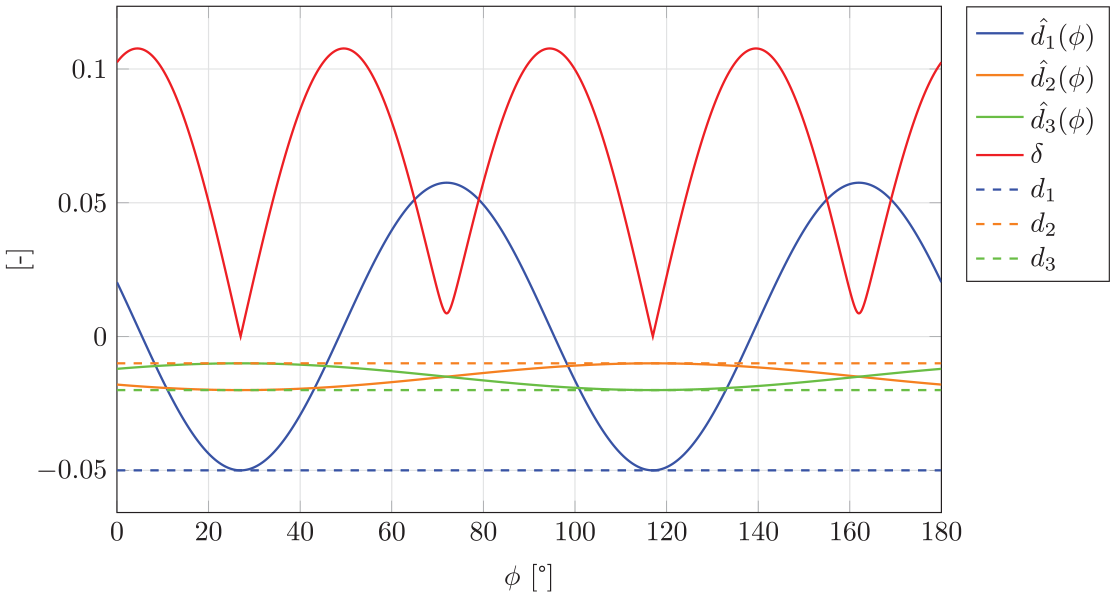
Identification of a unique parameter set of a randomly selected and randomly oriented orthotropic fourth-order fiber-orientation tensor
Third, if the second-order part

In the next step, we transform the fourth-order deviator into the eigensystem candidate and within this candidate system extract candidates for the parameters
4.4.7. Triclinic and monoclinic symmetries
Algorithm 3 defines a unique eigensystem for any triclinic fourth-order fiber-orientation tensor with orthotropic second-order part. This algorithm is not successful, if the second-order part of the tensor of interest is isotropic or transversely isotropic. However, those cases are rare, as a sufficient number of fibers are required to obtain triclinic fourth-order information and those fibers would have to state an arrangement which in second-order precision is more symmetric than orthotropic. Fiber-orientation tensors which fulfill this constraint can be easily constructed. However, the authors assume that such states are rarely found in real fiber arrangement. We refrain from developing an algorithm to cover this edge case. We deploy a similar argumentation for the monoclinic case.
4.4.8. Summary on edge cases
Following section 4.3, we can assign a unique eigensystem to any fourth-order fiber-orientation tensor, if the tensor (or equivalently its deviatoric parts of second and fourth orders) does not possess any (partial) material symmetry. If, in contrast, a fiber-orientation tensor does possess (partial) material symmetry, we might follow one of the strategies introduced in section 4.4 to identify a set of eigensystems in which the tensor components fulfill specific requirements. These requirements contain conventions on signs and relations of tensor components. The structural information is completely encoded within the unique set of tensor components within any of the eigensystems.
5. Application
5.1. Visualization and setup
Within the following sections, we apply the new interpolation algorithm (Algorithm 2) combined with the interpolation of rotations following Algorithm 1. We start with interpolation between two given fourth-order fiber-orientation tensors and advance towards the interpolation of planar tensor fields with linear varying weights obtained by triangulation. Within the following figures, fourth-order fiber-orientation tensors are visualized in terms of truncated fiber-orientation distribution functions approximated by leading second- and fourth-order tensors [64, equation (31)]. Negative values are indicated by red color. Alternative visualization methods for fourth-order fiber-orientation tensors, i.e., quartic and glyph plots, are discussed and compared to each other in Appendix 5.
5.2. Interpolation between two fiber-orientation tensors
Figure 7 visualizes the interpolation of two fiber-orientation tensors which differ solely by a rotation. The figure contains two views on five truncated fiber-orientation distributions each. Each distribution represents a fourth-order fiber-orientation tensor. The fiber-orientation tensors visualized by the left- and right-most distributions in Figure 7 are given, and the remaining bodies represent interpolated orientation tensors. Weights are linearly varying between the given orientation states.
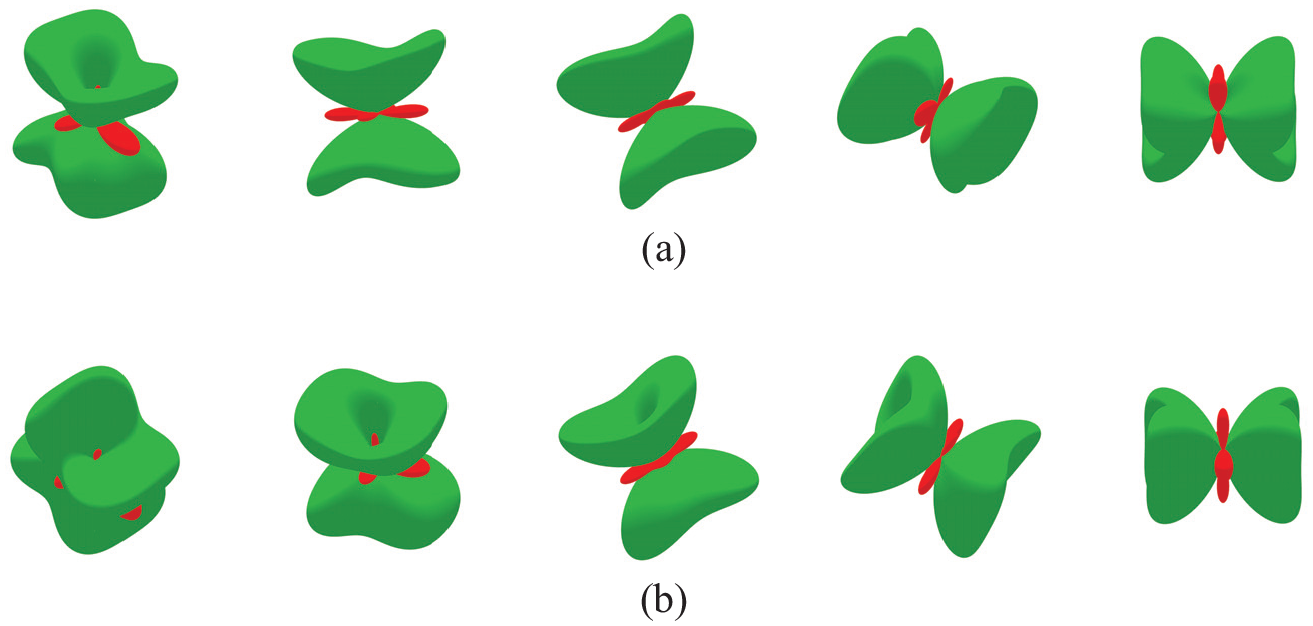
Interpolation between two fiber-orientation tensors which differ solely by a rotation, depicted by two views (a) first view and (b) second view. The visualized bodies represent truncated fiber-orientation distribution functions approximated by leading second- and fourth-order tensors [64, equation (31)]. Green color indicates the positive values, and red color indicates the negative values. The left- and right-most bodies are given; the others are interpolated. The given fiber-orientation tensors are orthotropic and defined by
In Figure 8, linearly weighted interpolation between two cubic fourth-order fiber-orientation tensors is shown. Again, tensors are visualized in terms of truncated distribution functions and the left- and right-most tensors are given; the others are interpolated. Qualitative comparisons between the discrete fiber realizations in Figure 4 and the fiber-orientation tensors visualized in Figure 8 reveal the encoding of the preferred fiber direction. It should be noted, however, that the concrete fiber arrangements in Figure 4 represent only one concrete realization each, whereas the fiber-orientation tensors visualized in Figure 8 represent a variety of fiber arrangements on average.
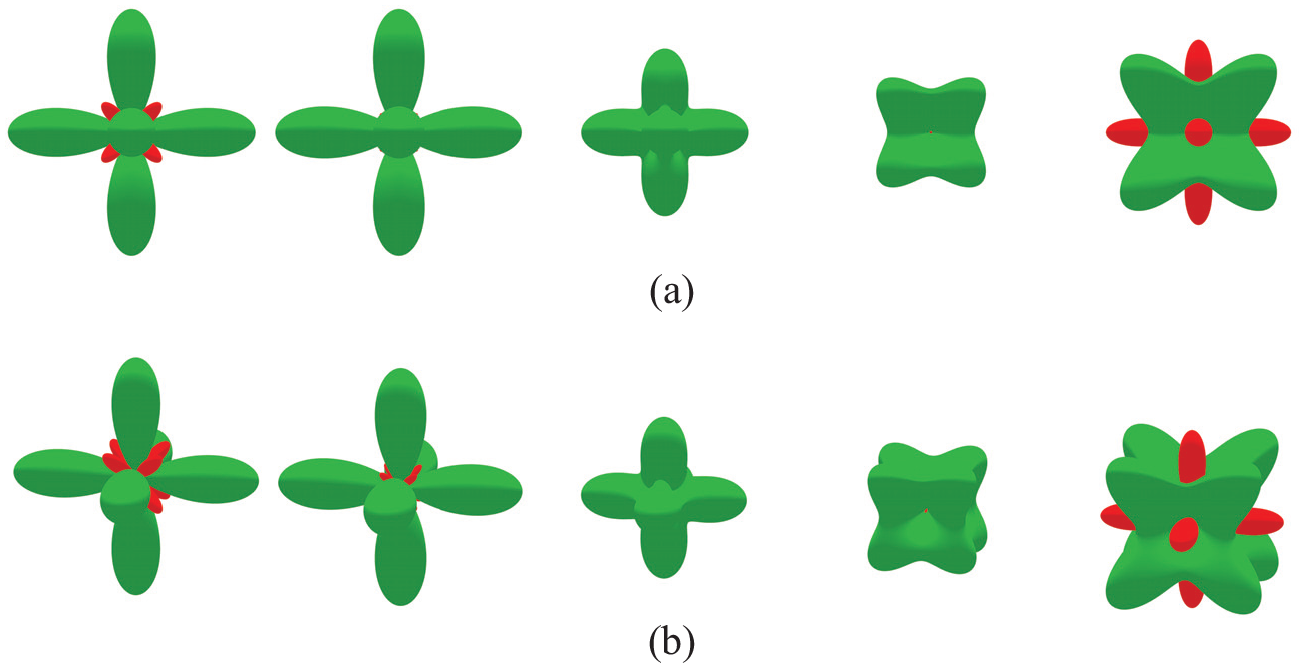
Interpolation between two extreme cubic fiber-orientation tensors with homogeneous eigensystems, depicted by two views (a) first view and (b) second view. The visualized bodies represent truncated fiber-orientation distribution functions approximated by leading second- and fourth-order tensors [64, equation (31)]. Green color indicates the positive values, and red color indicates the negative values. The left- and right-most bodies are given; the others are interpolated. The left-most body represents a cubic fiber-orientation tensor parametrized by
Figure 9 as well as Figure 10 show interpolation between two randomly selected triclinic fourth-order fiber-orientation tensors. The visualizations follow the pattern of Figures 7 and 8. The unique eigensystems based on Algorithm 3 of the given fiber-orientation tensors within Figure 9 differ only slightly, leading to a small rotation among the interpolated states. In contrast, the unique eigensystems of the given fiber-orientation tensors in Figure 10 differ by a large angle in any relative measure within the space of rotations, i.e.,
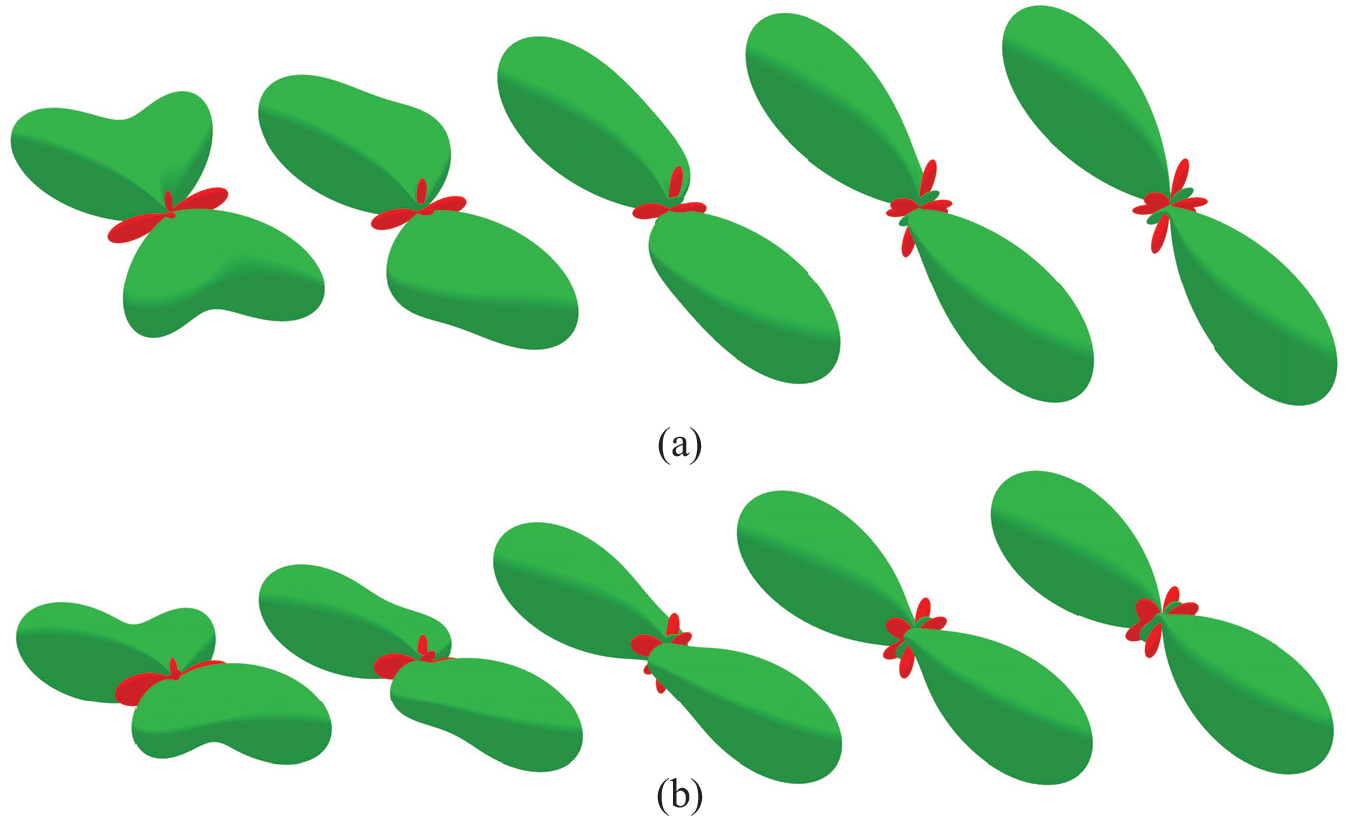
Interpolation between two randomly selected triclinic fourth-order fiber-orientation tensors, depicted by two views (a) first view and (b) second view. The visualized bodies represent truncated fiber-orientation distribution functions approximated by leading second- and fourth-order tensors [64, equation (31)]. Green color indicates the positive values, and red color indicates the negative values. The left- and right-most bodies are given; the others are interpolated. The left-most fiber-orientation tensor is approximately defined by
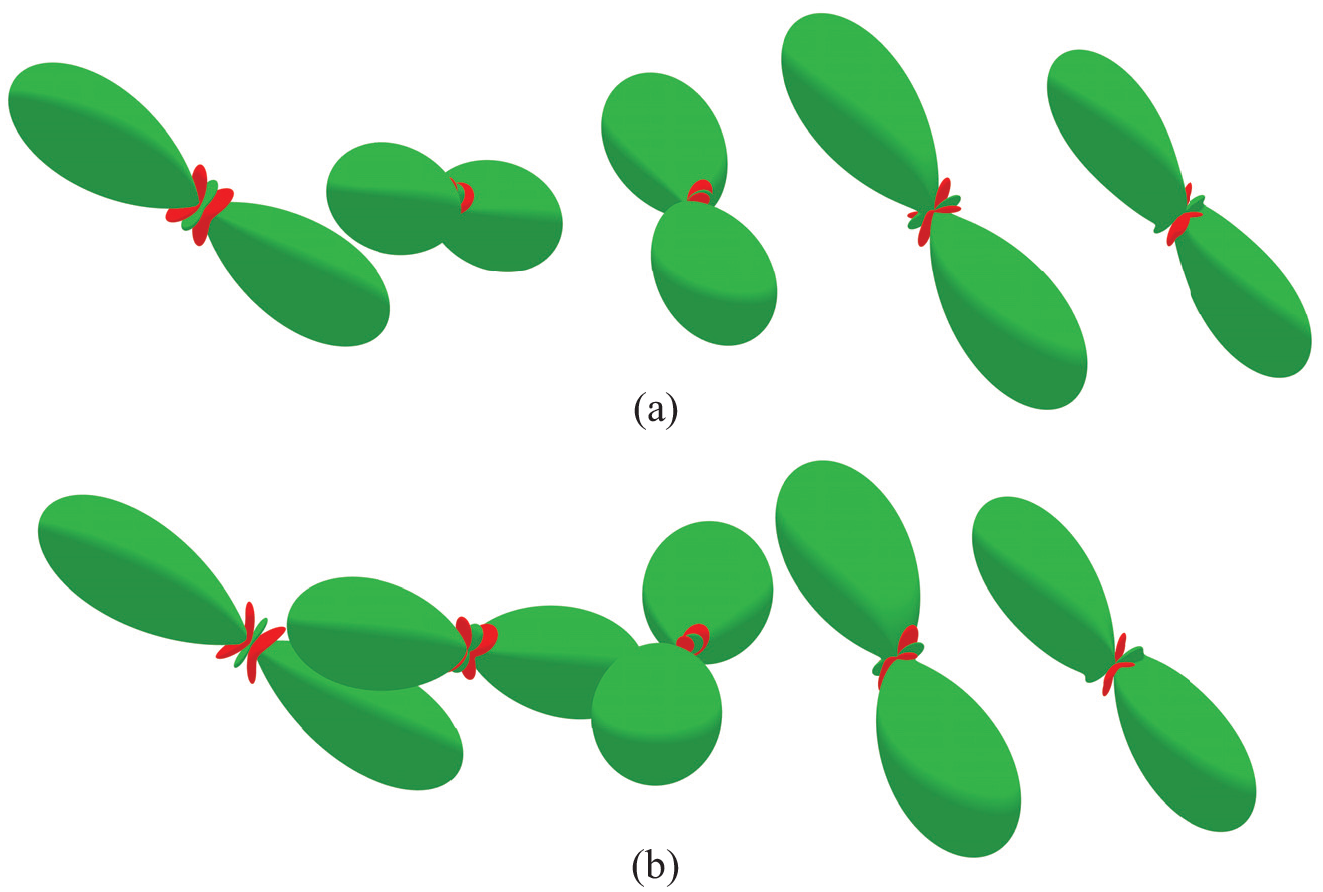
Interpolation between two randomly selected triclinic fourth-order fiber-orientation tensors, depicted by two views (a) first view and (b) second view. In contrast to Figure 9, the directions of the first axis of the unique eigensystems of the tensors to be interpolated differ significantly. The visualized bodies represent truncated fiber-orientation distribution functions approximated by leading second- and fourth-order tensors [64, equation (31)]. Green color indicates the positive values, and red color indicates the negative values. The left- and right-most bodies are given; the others are interpolated. The orientation of the unique eigensystem of a given tensor is specified by a rotation vector
5.3. Interpolation of transversely isotropic fourth-order structures on a planar grid
The subspace of transversely isotropic fourth-order fiber-orientation tensor is two-dimensional [8, 52, 112]. Within this two-dimensional space, we select five orientation tensors as reference grid points. These five reference tensors are the unidirectional, planar, and isotropic fourth-order fiber-orientation tensors combined with two tensors
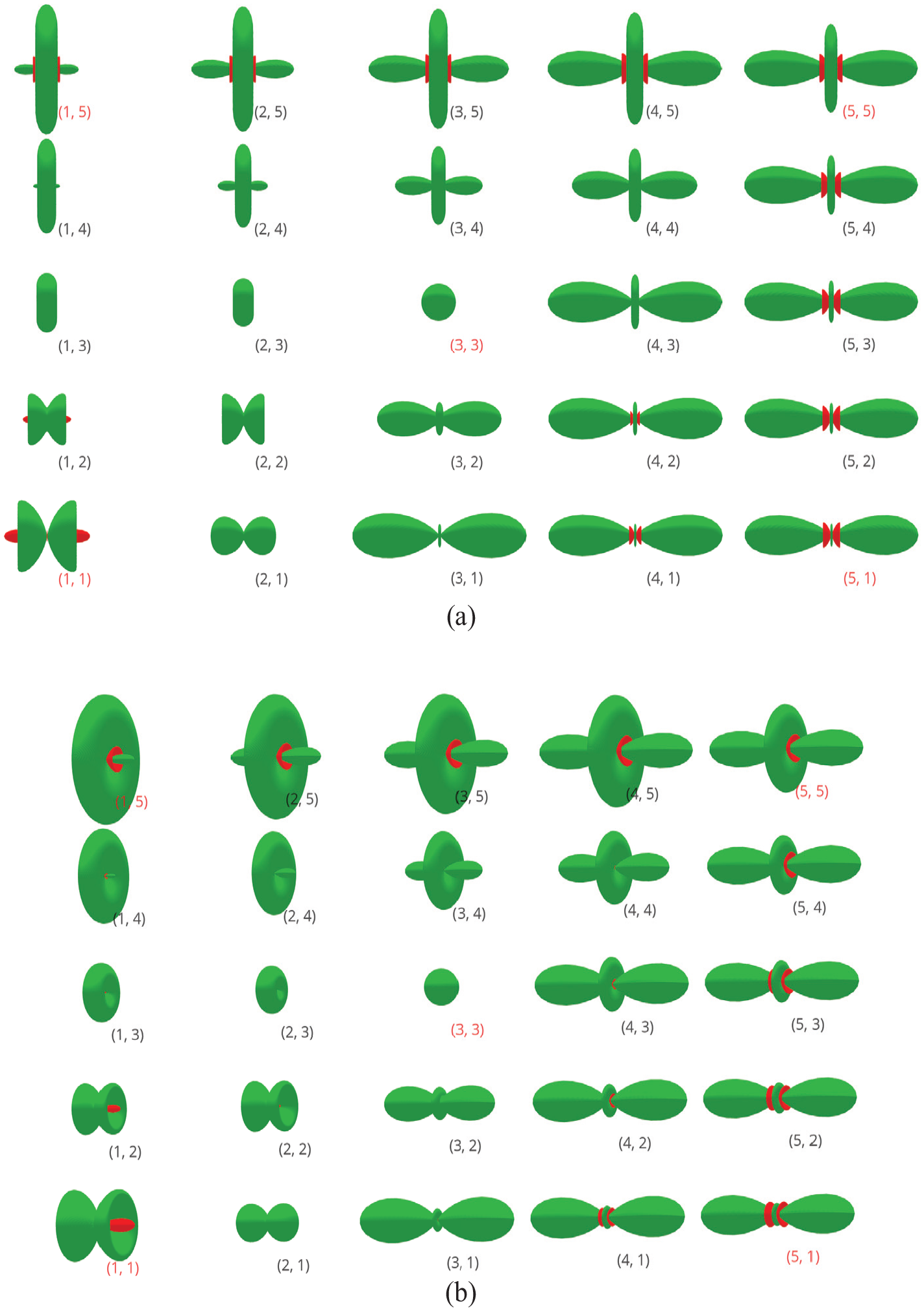
Interpolation problem of homogeneously aligned transversely isotropic fourth-order fiber-orientation tensor. Fiber-orientation tensor is represented as truncated fiber-orientation distribution function (FODF) approximations [64, equation (31)]. The FODF labeled in red are supporting grid points of the problem, whereas black labels indicate the interpolated FODF. Those FODFs which are nearly unidirectional, i.e., (4,2), (5,2), (3,1), (4,1), (5,1) are shrunk to fit into the figure. States on the diagonal, i.e.,
Mapping between indices in Figure 11 and transversely isotropic fourth-order fiber-orientation tensors.
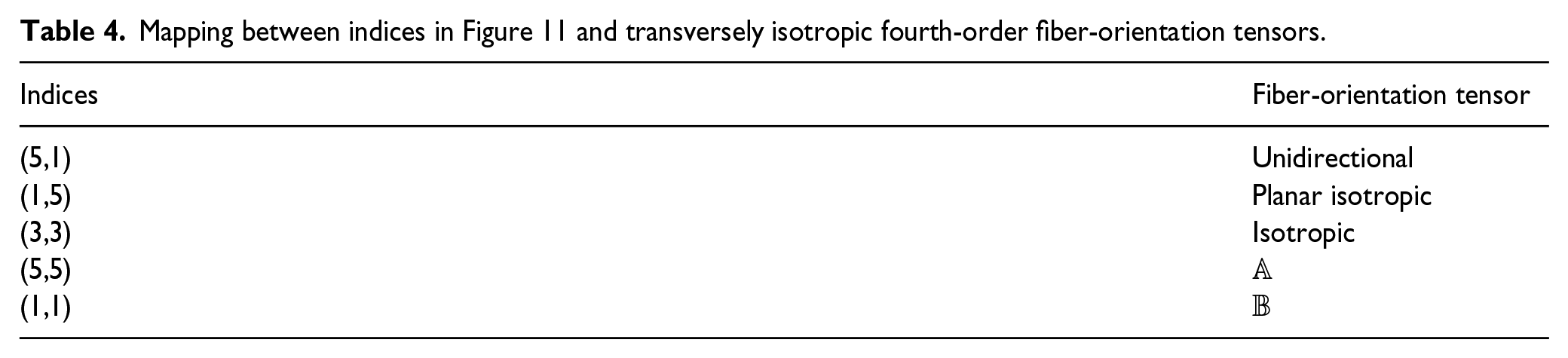
This missing definiteness leads to problems for decomposition-based interpolation methods as the orientation of eigensystems changes suddenly when passing this diagonal. The interpolated fiber-orientation tensors visualized in Figure 11 are obtained by linear interpolation of their tensor components within a given, homogeneous coordinate system. As the eigensystem identification procedure described in section 4.4.4, implemented in the computer code [111], is used, the transversely isotropic axes align throughout oblate and prolate orientation states. In consequence, the common ordering convention (equation (23)) for the eigenvalues of the contained second-order tensor does not hold.
5.4. Interpolation of measured fourth-order fiber-orientation tensors
The authors apply the new interpolation method defined in Algorithm 2 to a two-dimensional field of fiber-orientation tensors, measured by CT by Blarr et al. [113]. This problem consists of nine tensors which are nearly unidirectional. We obtain interpolation weights by triangulation and linear shape function. The resulting tensor field is visualized in Figure 12.
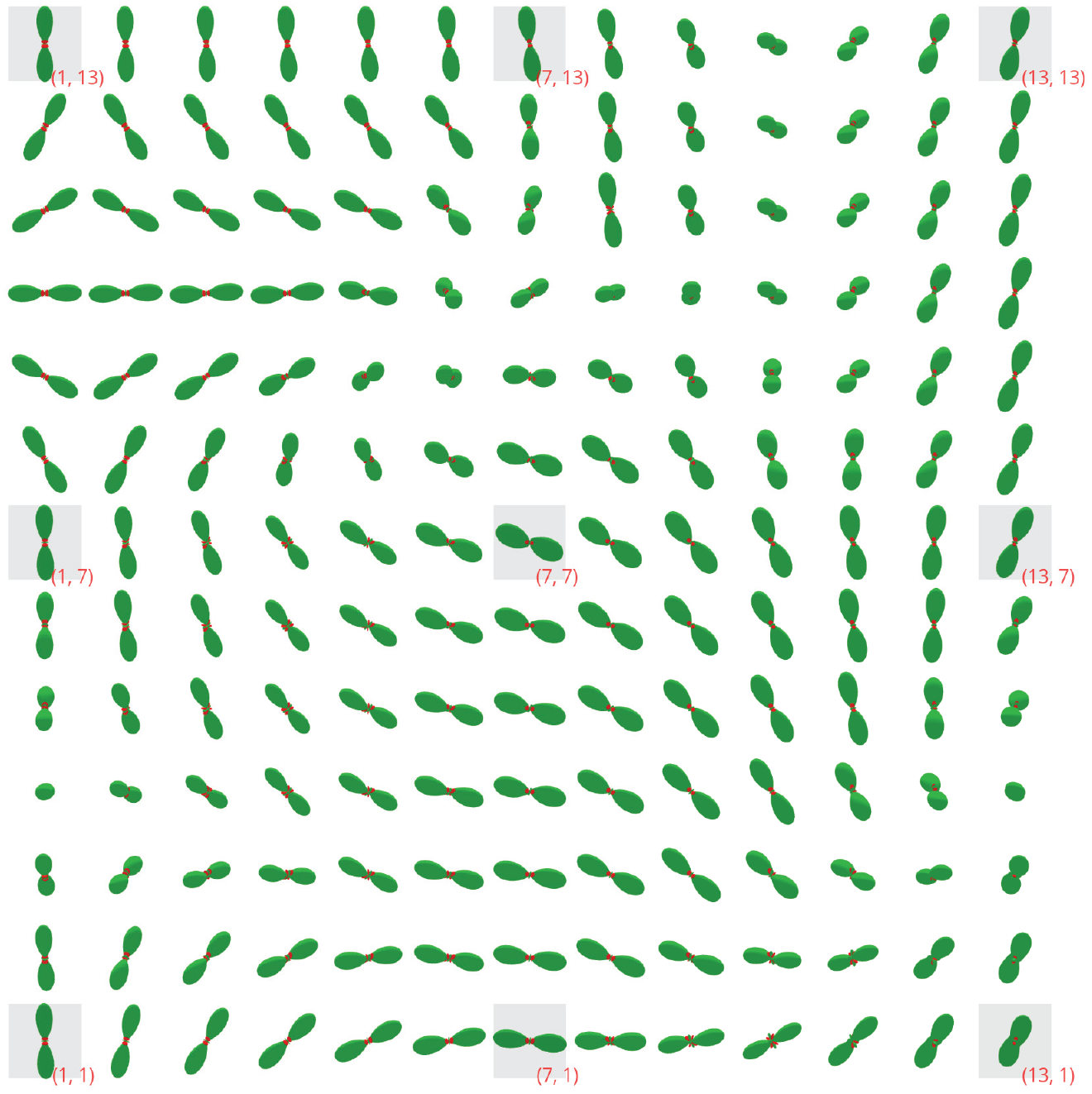
Interpolation of experimentally measured fiber-orientation tensors. The tensors are represented as truncated fiber-orientation distribution function (FODF) approximations [64, equation (31)] (see also Appendix 5). The supporting grid points of the problem are each indicated by a light gray box and red label. The remaining FODF representations are interpolated.
On the complete left edge, the right upper edge, and the lower right edge, we observe rotations larger than ninety degrees between two given grid points. This indicates that the orientation of the axis
6. Conclusion
In this paper, we discuss the interpolation of fiber-orientation tensors on spatially discretized fields and distinguish interpolation from other problems such as averaging and disassembly. Motivated by decomposition-based interpolation methods for second-order fiber-orientation tensors, we present a new interpolation method for fiber-orientation tensors of order four. The presented interpolation method is built on an eigensystem-based parametrization, thereby naturally separating the interpolation of eigensystems and structural properties. The structural properties are encoded in terms of tensor components in the mentioned eigensystem. We discuss the difficulty of non-unique eigensystems in the presence of various partial material symmetries. This discussion starts with a convention which, in the absence of material symmetry, defines a unique eigensystem of a given triclinic fourth-order fiber-orientation tensor. For most combinations of material symmetries of the second- and fourth-order parts of a given fourth-order fiber-orientation tensor, we present algorithms and conventions to determine eigensystems as well as unique parameter combinations.
It should be mentioned that edge cases can be avoided using projector-based methods instead of the discussed eigensystem-based parametrization [29, 56, 57]. In the context of these edge case considerations, the groups of cubic, trigonal, and tetragonal fourth-order fiber-orientation tensors are explicitly given for the first time in terms of parametrizations and admissible parameter ranges, therefore extending the existing contributions [31, 54, 55, 64]. Furthermore, eigenvalues and eigentensors of irreducible structure tensors with cubic, transversely isotropic, trigonal, tetragonal as well as orthotropic material symmetry are presented. However, the numerous case distinctions, which are necessary in the presence of arbitrary material symmetries, show that the new interpolation method is only conditionally suitable for practical applications. This statement is the result of a detailed analysis of the underlying parametrization and can be generalized as follows. The parametrization of Bauer and Böhlke [55] is very well suited to generate or analyze realizations of fiber-orientation tensors starting from a defined eigensystem. However, if an eigensystem of a given fiber-orientation tensor is to be determined, difficulties arise on edge cases, as repeated eigenvalues lead to ambiguities discussed in section 4.4. We collect and compare visual representations of fourth-order fiber-orientation tensors in terms of truncated Fourier series, quartic plots, and tensor glyphs. The work at hand concludes with application of the new interpolation method.
Footnotes
Appendix 1
Appendix 2
Appendix 3
Appendix 4
Appendix 5
Acknowledgements
Support by the German Research Foundation (DFG, Deutsche Forschungsgemeinschaft) within the International Research Training Group “Integrated engineering of continuous-discontinuous long fiber reinforced polymer structures” (GRK 2078/2)—project 255730231—is gratefully acknowledged. In addition, the support by the German Federal Ministry for Economic Affairs and Climate Action (BMWK) within the research project “EcoDynamicSMC” (funding indicator 03LB3023H) is also gratefully acknowledged.
Author contributions
J.K.B. contributed to conceptualization, methodology software, validation, formal analysis, investigation, resources, writing-original draft preparation, writing-review and editing, visualization, and project administration. C.K. contributed to methodology, software, validation, formal analysis, investigation, writing-original draft preparation, writing-review and editing, and visualization. J.B. contributed to validation, formal analysis, resources, and writing-review and editing. P.L.K. contributed to formal analysis and writing-review and editing. L.K. contributed to formal analysis, resources, supervision, project administration, and funding acquisition. T.B. contributed to formal analysis, resources, writing-review and editing, supervision, project administration, and funding acquisition. All authors have read and agreed to the published version of the manuscript. J.B. provided orientation fields determined by computer tomography for the present analysis.
Declaration of conflicting interests
The author(s) declared no potential conflicts of interest with respect to the research, authorship, and/or publication of this article.
Funding
J.K.B., J.B., L.K., and T.B. received funding by German Research Foundation (DFG, Deutsche Forschungsgemeinschaft) within the International Research Training Group “Integrated engineering of continuous-discontinuous long fiber reinforced polymer structures” (GRK 2078/2)—project 255730231. C.K. and L.K. received funding by the German Federal Ministry for Economic Affairs and Climate Action (BMWK) within the research project “EcoDynamicSMC”(funding indicator 03LB3023H).
