




Abstract
Fiber orientation tensors represent averaged measures of fiber orientations inside a microstructure. Although, orientation-dependent material models are commonly used to describe the mechanical properties of representative microstructure, the influence of changing or differing microstructure on the material response is rarely investigated systematically for directional measures which are more precise than second-order fiber orientation tensors. For the special case of planar orientation distributions, a set of admissible fiber orientation tensors of fourth-order is known. Fiber orientation distributions reconstructed from given orientation tensors are of interest both for numerical averaging schemes in material models and visualization of the directional information itself. Focusing on the special case of planar orientations, this paper draws the geometric picture of fiber orientation distribution functions reconstructed from fourth-order fiber orientation tensors. The developed methodology can be adopted to study the dependence of material models on planar fourth-order fiber orientation tensors. Within the set of admissible fiber orientation tensors, a subset of distinct tensors is identified. Advantages and disadvantages of the description of planar orientation states in two- or three-dimensional tensor frameworks are demonstrated. Reconstruction of fiber orientation distributions is performed by truncated Fourier series and additionally by deploying a maximum entropy method. The combination of the set of admissible and distinct fiber orientation tensors and reconstruction methods leads to the variety of reconstructed fiber orientation distributions. This variety is visualized by arrangements of polar plots within the parameter space of fiber orientation tensors. This visualization shows the influence of averaged orientation measures on reconstructed orientation distributions and can be used to study any simulation method or quantity which is defined as a function of planar fourth-order fiber orientation tensors.
1. Introduction
Suitable microstructure descriptors are essential for the prediction of effective properties of fiber-reinforced composites. Fiber orientation distribution functions (FODFs) represent exact microstructure descriptors of the orientation of axisymmetric fibers within a specified volume of a fiber-reinforced composite [1,2]. However, in practice [3,4], the exact distribution of fibers is commonly approximated by fiber orientation tensors which represent averaged directional measures and can be directly determined by non-destructive analysis methods, such as computer tomography [5,6]. Furthermore, fiber orientation tensors fit into the tensor-based framework of continuum mechanics which is frequently used in material modeling [7–9]. The dependence of material models on the set of admissible second-order fiber orientation tensors is studied numerically in, e.g., [10,11]. However, the dependence of material models or other quantities of interest such as reconstructed FODF itself on fourth-order fiber orientation tensors is rarely studied analytically. In addition, for some applications, e.g., damage modeling [12] or averaging schemes [8,9], the identification of an FODF based on given fiber orientation tensors is beneficial. Due to the averaged character of fiber orientation tensors, no one-to-one correspondence to an FODF exists. Nevertheless, for a given fiber orientation tensor, any associated FODF is of interest and eases the indirect visualization of fiber orientation tensors. Many fiber-reinforced composites are plate-like, and if the mean fiber length is larger than the plate thickness, the resulting fiber distribution is approximately planar. This holds, e.g., for sheet molding compound [4]. For such planar fiber distributions, Bauer and Böhlke [13] identify a set of all admissible fourth-order fiber orientation tensors. Based on this set and reconstruction methods following [1,14], the variety of reconstructed FODF based on planar fiber orientation tensors of fourth-order is studied in the current work.
This paper is structured as follows. Definitions of FODF and fiber orientation tensors are followed by a reformulation of planar fiber orientation tensors following Bauer and Böhlke [13]. Within the admissible set of planar fourth-order fiber orientation tensors given by Bauer and Böhlke [13], a subset of distinct planar fourth-order fiber orientation tensors is identified. FODF approximations by truncated Fourier series with planar leading fiber orientation tensors in a three-dimensional (3D) framework are identified as non-planar and motivate a two-dimensional (2D) framework. The reconstruction of FODF based on the maximum entropy method following Müller and Böhlke [14] is recast into this 2D framework. Discrete slices and points of the set of admissible and distinct planar fourth-order fiber orientation tensors are used to visualize reconstructed FODF based on fourth-order fiber orientation tensors. A note on FODF reconstruction solely based on second-order fiber orientation tensors including the exact closure [15] closes this paper.
1.1. Notation
Symbolic tensor notation is preferred in this paper. Tensors of first order are denoted by bold lowercase letters such as
2. Fiber orientation distributions based on planar fiber orientation tensorsof fourth order
2.1. Directional measures as microstructure descriptors
Taking the average of a tensorial quantity over orientations requires a directional measure which quantifies the orientations. Established directional measures of axisymmetric fibers are the FODF and fiber orientation tensors of several kinds and orders. Both FODF and fiber orientation tensors quantify orientations inside a reference volume which might be interpreted as a section of specified size at a specific position
2.1.1. Fiber orientation distribution function
The FODF

maps any direction

holds and normalization of

As fibers have a direction but no attitude,

2.1.2. Fiber orientation tensors
Fiber orientation tensors of Kanatani [1] first kind are defined by

with


are used. More details on the properties of

holds for

holds due to normalization (see [13]). Orientation tensors of Kanatani first kind are commonly used to represent directional data obtained by computer tomography scans or results of flow simulations [4]. Basic properties of the second-order orientation tensor

holds and there exists a rotation defined by an orthogonal tensor

mapping the arbitrary but fixed basis

an established classification of structurally differing

which is called spherical harmonic expansion [1, p. 154]. The operator
2.2. Admissible and distinct planar fiber orientation tensors
A parameterization of planar fiber orientation tensors of second-order

in the orientation coordinate system

in Kelvin–Mandel [23–25] notation, which is explained in detail in Appendix 1. The Kelvin–Mandel basis

with

see [13, equation (89)]. The set
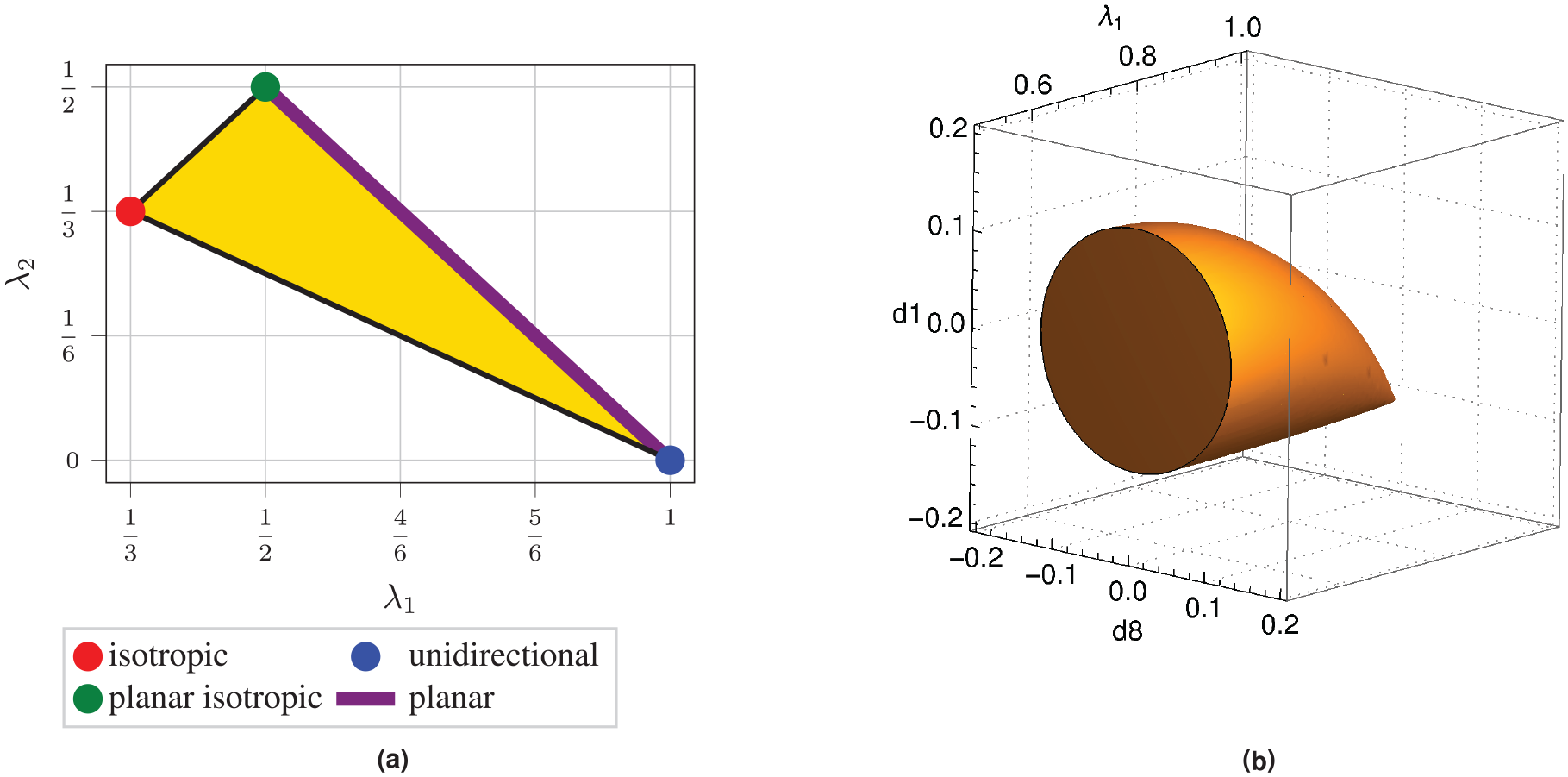
(a) Orientation triangle visualizing second-order orientation tensors. (b) Visualization of the set of admissible planar fourth-order fiber orientation tensors
As Bauer and Böhlke [13] derive

holds with the special orthogonal group in three dimensions



The parameters
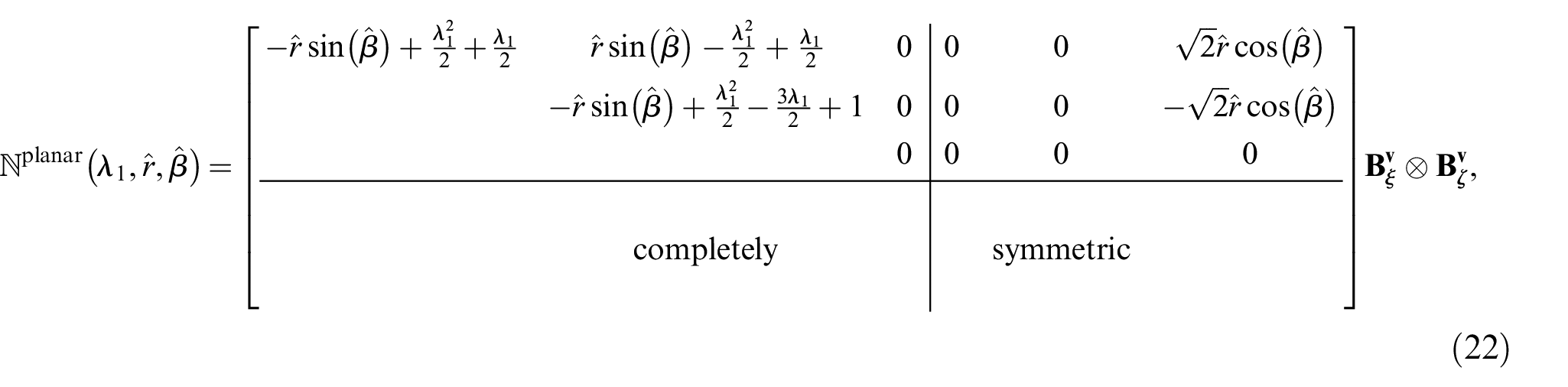
and equation (16) by

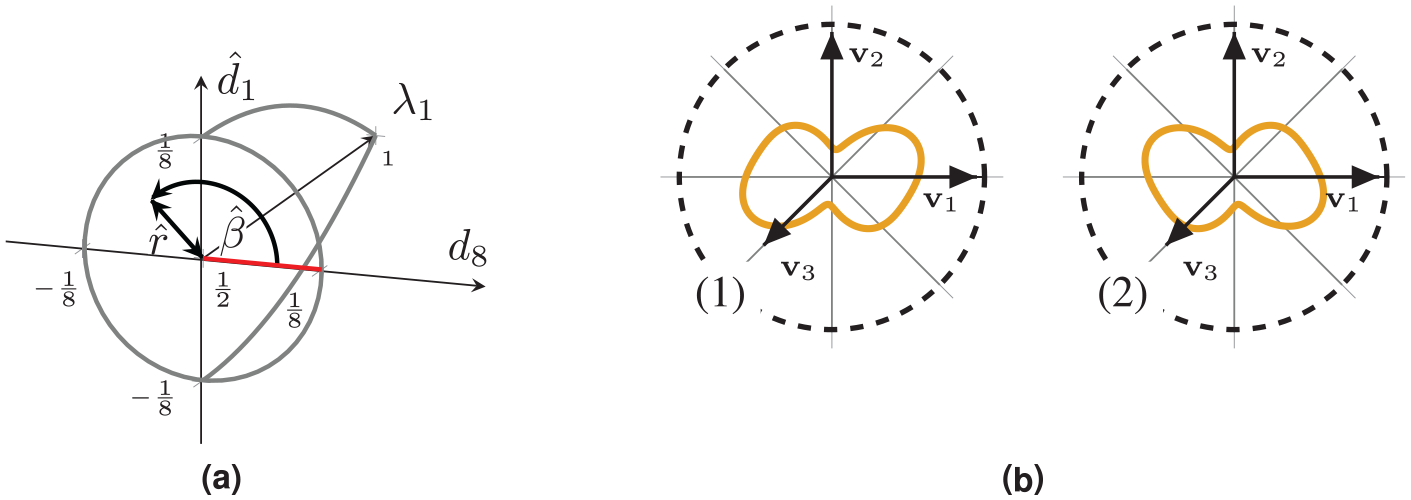
(a) The parameter space
For the special case
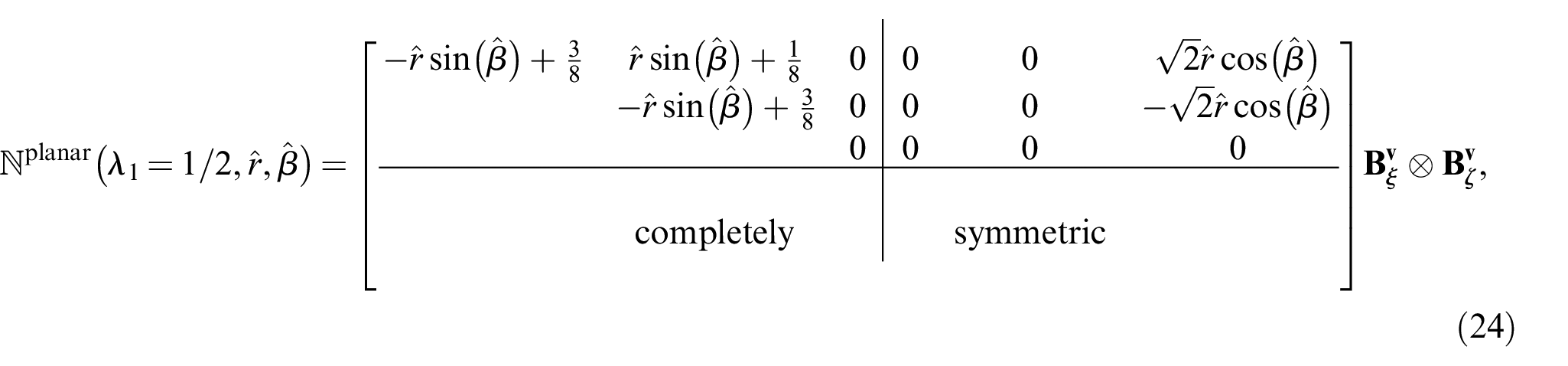
and comparison with representations of rotations in the Kelvin–Mandel notation in Cowin and Mehrabadi [26, section 3] and Mehrabadi and Cowin [25, section 3] indicates a rotational redundancy. Active rotation of


with a rotation around the axis

As the angle

In consequence, coincidence or symmetry of the eigenvalues
If

with

which rotates any physical quantity by

holds and motivates restriction to positive values of
2.3. Reconstructed FODF
In the previous section, distinct and admissible planar fiber orientation tensors of fourth order are identified. The question of interest is, which fiber orientation distributions are associated with these tensors? It is evident from equation (13) that for a given leading fiber orientation tensor, there is non one-to-one correspondence to an FODF. However, identification of any FODF which is connected to the given leading fiber orientation tensor is of interest. An approximation of an FODF by leading fiber orientation tensors up to fourth order in a 3D framework is given by

following equation (13), where

with a parameterization of the unit vector

The approximation

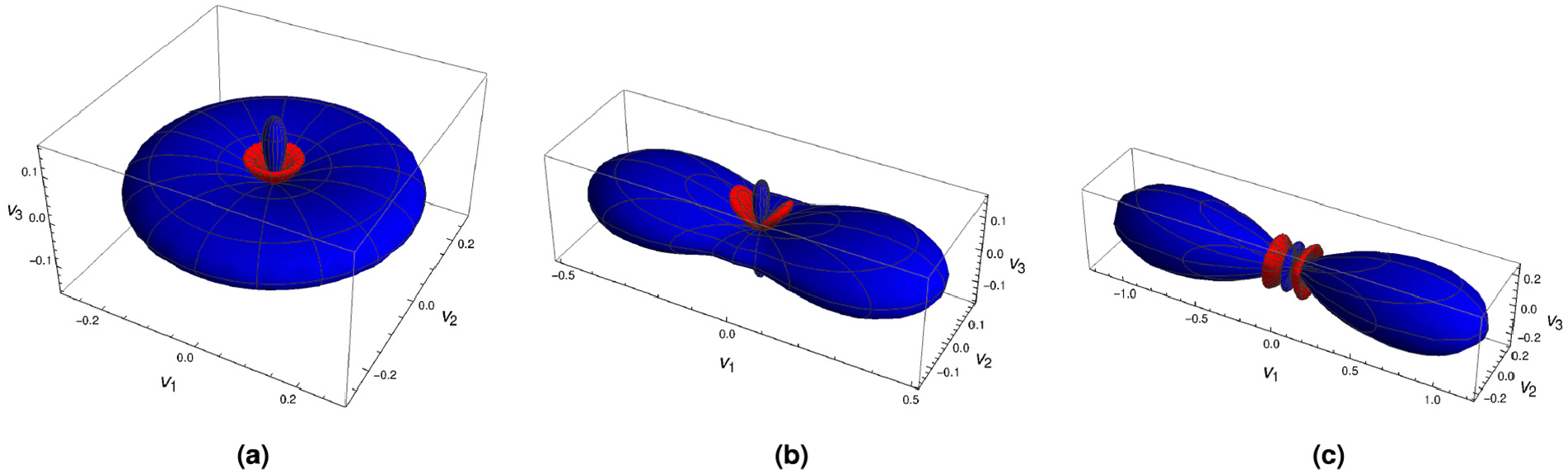
Approximation of the FODF by leading fiber orientation tensors up to fourth-order following equation (32), i.e.,
Vanishing deviators, i.e.,

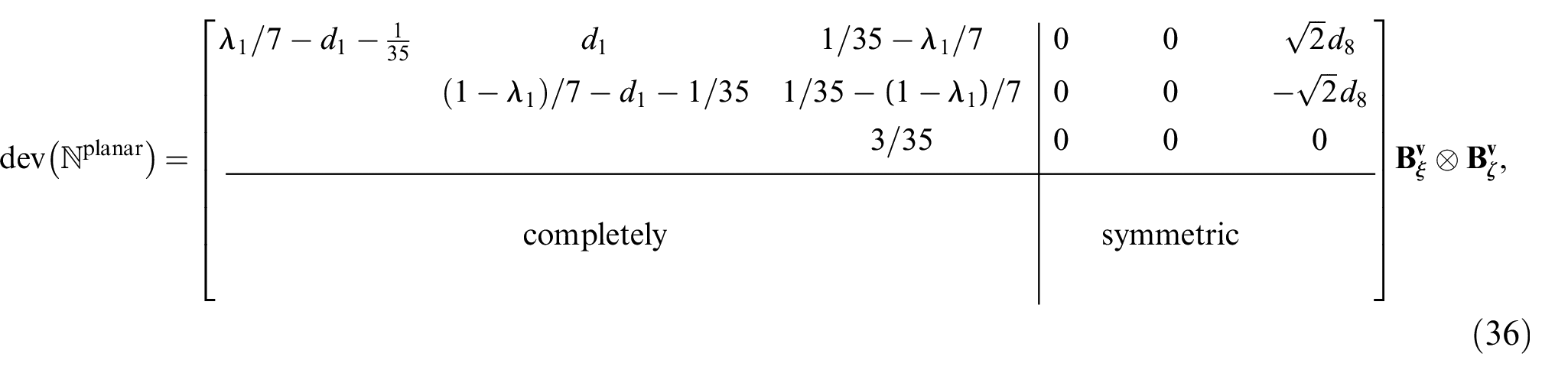
and demonstrate the drawbacks of expressing planar fiber orientation tensors in a 3D framework since the planarity has to be enforced by deviation from the isotropic state. Note that the fourth-order deviator depends on the parameter
2.3.1. Transition from 3D into 2D
Motivated by the previous section and following [1,27–30], planar quantities are expressed in a 2D framework with representations



with generic tensors
If planar orientation tensors are derived from a 2D framework, naturally no out-of-plane tensor components exist. Basic planar isotropic tensors in the 2D framework are given by


following Blinowski et al. [27, equation (2.3)] and Aßmus et al. [31, equation (38)]. Deviator operators are defined by


following Kanatani [1, (7.13)] and Vianello [28, section 3]. The central fiber orientation tensor in the 2D framework is identified as

and is called planar isotropic fiber orientation tensor of fourth order. It should be noted that this is not the only fourth-order fiber orientation tensor which contracts to the planar isotropic second-order fiber orientation tensor. Deploying harmonic decomposition in the 2D framework following Blinowski et al. [27, equation (2.25)] or Desmorat and Desmorat [29, equation (18)] with

and knowledge on irreducible tensors, any fourth-order fiber orientation tensor is parameterized by

with


Coincidence with the parameterization in the 3D framework is given by the prefactor in equation (47) and the specific choice of the factors

The shift by


The deviators specified in equations (35), (36), (50), and (51) directly enter approximations of the FODF in terms of truncated Fourier series.
2.3.2. Truncated fiber orientation distribution function in the 2D framework
In analogy to the three-dimensional case in equation (13), FODF can be reconstructed in a two-dimensional framework. An FODF is given in terms of fiber orientation tensors by a tensorial Fourier series [1, p. 158]

with a unit tensor of first order

and combined with

Introducing the coordinate transformation

yields the following formulation

The parameterization of

which directly indicates that the parameter
2.3.3. Maximum entropy reconstruction of the FODF
Identification of a representative FODF based on a given leading fiber orientation tensor is of importance for several applications, e.g., numerical calculation of orientation averages of direction dependent mechanical properties [8,9,12]. Truncated Fourier series are used in literature to identify an FODF based on fiber orientation tensors [6,33] although the identified functions do not meet the non-negativity requirement of an FODF. Naive averaging with partly negative FODF leads to non-physical results. Müller and Böhlke [14] give a solution to the reconstruction problem and identify FODF based on leading fiber orientation tensors by maximizing the information-theoretic entropy fulfilling normalization and non-negativity constraints. For limited available information, the entropy principle yields the most likely FODF fulfilling specified constraints. In this context, “most likely” corresponds to “maximizing entropy.” The procedure of Müller and Böhlke [14] is briefly repeated for the special case of fourth-order fiber orientation tensors and tailored to planar fiber orientation tensors. The maximum entropy approximation

and fulfills the constraints



where the constraint

corresponds to the Lagrange functional

with Lagrange multipliers

which fulfills the non-negativity condition identically. The Lagrange multipliers are obtained by solving the system of equations stated by the constraints in equations (59) to (61), with

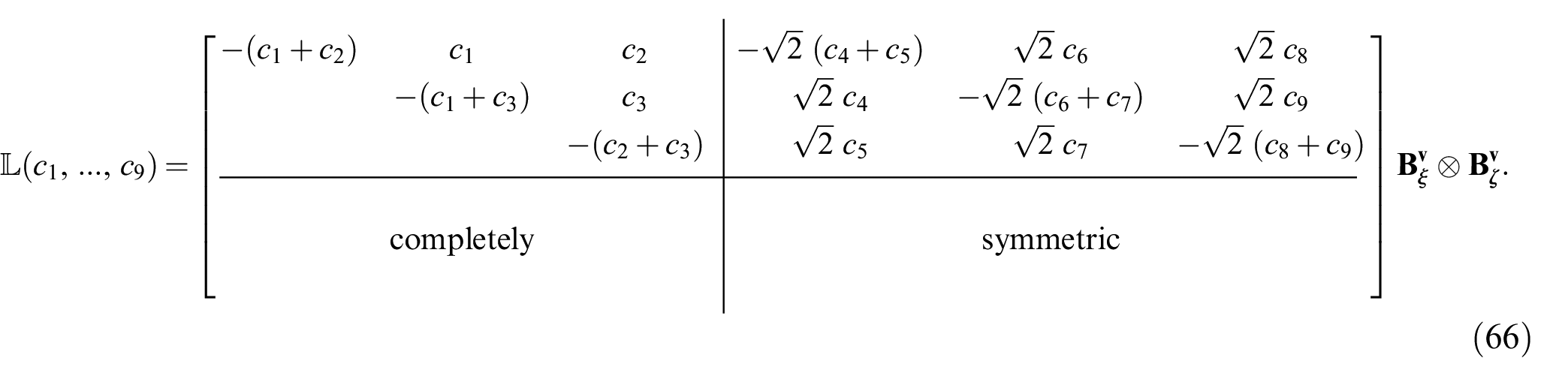
Number of independent components of irreducible tensors depending on order and dimensionality of the vector space.

Starting from the triclinic case in equations (65) and (66), material symmetries may be deployed to further reduce the number of independent components of the Lagrange multipliers, as the fiber orientation tensors and the reconstructed FODF share their symmetry group, i.e.,


which follows directly from the definition of


In consequence, combination of equations (69) and (70) leads to

For a given





The equations are solved numerically for a given tripled
2.3.4. Visualization of reconstructed planar fiber orientation distribution functions
Fiber orientation tensors represent averaged properties of an underlying FODF. In consequence, a complete reconstruction of the underlying FODF is not possible. It is of interest to visualize possible shapes of reconstructed FODFs based on admissible mean values. The admissible mean values are given by the set of distinct and admissible fiber orientation tensors of fourth-order
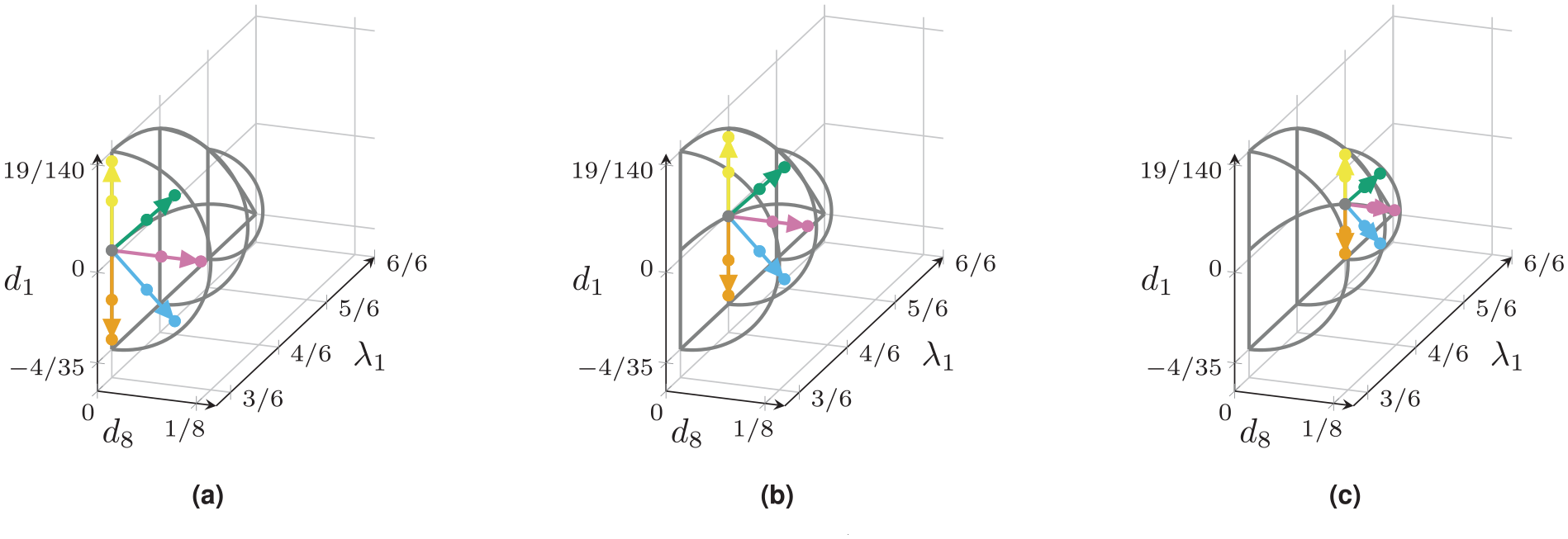
Definition of representative points in the parameter space

Shared legend for Figures 6(b), 7(a) and 7.
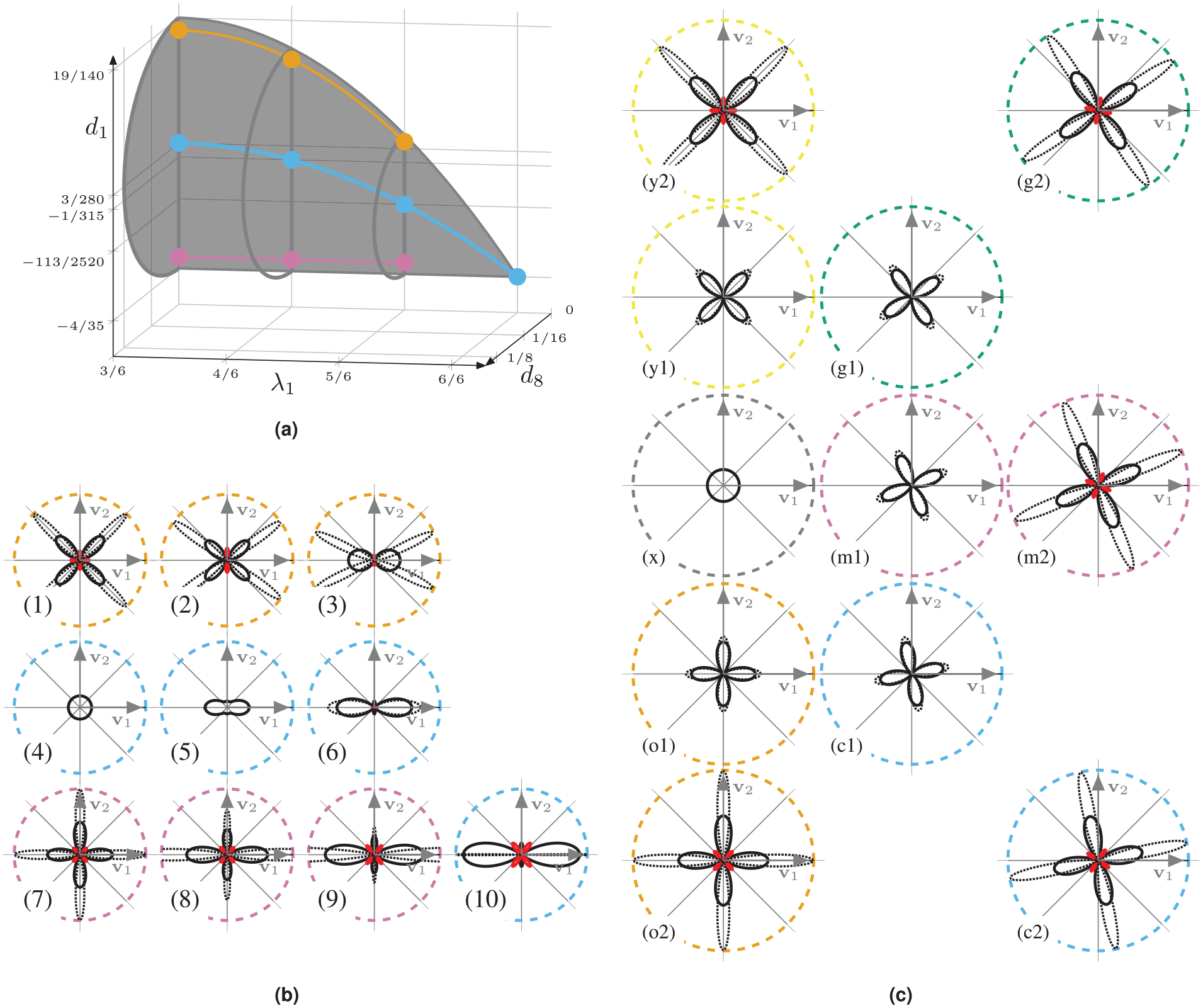
Parameters of points in
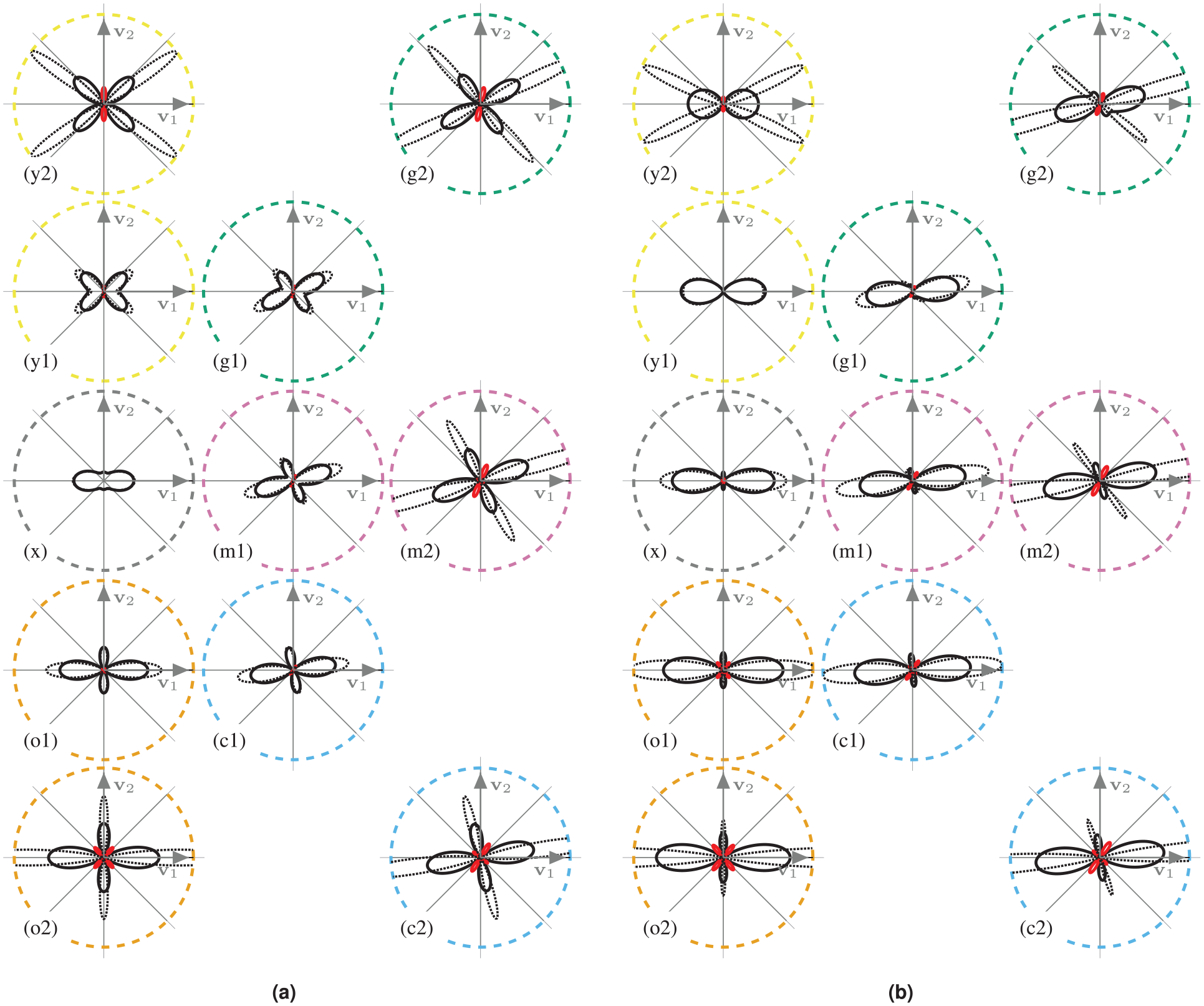
Reconstructed FODF along several paths. The radial spacing of the plots along the green and blue paths are not to true scale to allow for larger plots. A legend is given in Figure 5 and parameters of the points in
A slice containing orthotropic [13] fiber orientation tensors is shown in Figure 6(a) and the corresponding FODFs are given in Figure 6(b). The transition from the planar isotropic state in Figure 6(b) (4) toward the unidirectional state in Figure 6(b) (10) demonstrates the degeneration of the variety of fourth-order fiber orientation tensors towards the unidirectional state, which is defined completely by
The slices defined in Figure 4 and the corresponding FODF approximations in Figures 6(c) and 7(a) and (b) visualize the variety of reconstructed FODF among fourth-order fiber orientation tensors which contract to identical second-order fiber orientation tensors. Any FODF in Figure 6(c) leads to the planar isotropic second-order fiber orientation tensor
2.3.5. Reconstruction solely based on second-order fiber orientation tensors
If fourth-order fiber orientation information is not available, the parameter space of reconstructed FODFs degenerates to one parameter, e.g.,

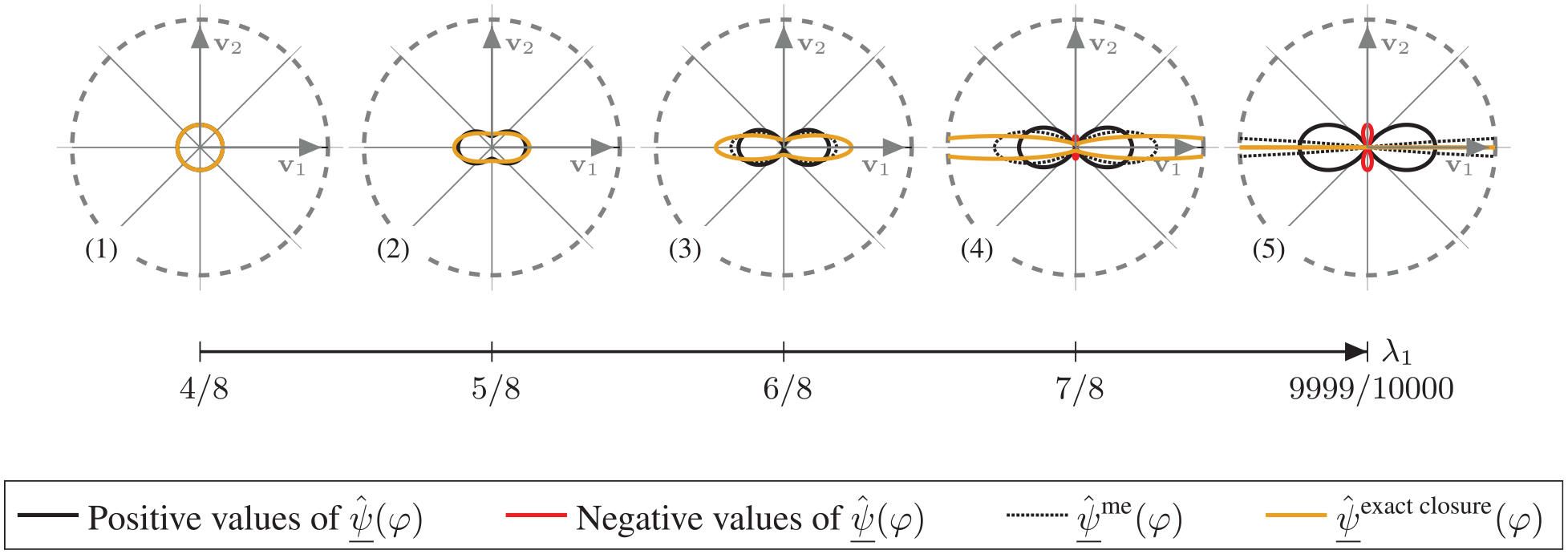
Influence of
Visualization of equation (77) for five values of
3. Summary and conclusion
Planar fourth-order fiber orientation tensors describe the fiber orientation in many sheet-like fiber-reinforced composites. The variety of these tensors is known [13]. The variety of reconstructed FODFs based on planar fourth-order fiber orientation tensors is studied in this work leading to the following insights:
Based on the set of admissible planar fiber orientation tensors in Bauer and Böhlke [13], a minimal set of admissible and distinct planar fiber orientation tensors of fourth order
The variety of reconstructed FODF is visualized by an arrangement of polar plots which mimics the shape of the admissible and distinct parameter space. This arrangement or view is generic and may be applied to study the dependence of other quantities on planar fourth-order fiber orientation tensors.
Reconstructed FODF based on truncated series expansion within a 3D framework is identified to be not planar as the central state in three dimensions is isotropic.
A 2D formulation of planar fiber orientation tensors is introduced and linked to parameterizations of planar fiber orientation tensors in three dimensions. The central, i.e., “isotropic,” state in two dimensions is planar isotropic.
Within the 2D framework, it is shown that interference of second- and fourth-order contributions leads to the variety of reconstructed FODF based on truncated Fourier series.
Visualizations of truncated FODF reconstructions in Figures 6(b) and 7 highlight their limitations and motivate more advanced reconstruction methods. The maximum entropy reconstruction of Müller and Böhlke [14] is explicitly formulated for the general 3D case and recast for the planar case in a 2D framework which leads to a low-dimensional optimization problem. Resulting FODF approximations are normalized and non-negative.
For given reconstruction methods, the structural variety of reconstructed FODF based on planar fourth-order fiber orientation tensors is limited. Throughout this work, separation of rigid-body rotations, and thus orientation in space, from structural properties of represented FODFs is accomplished by representations in the orientation coordinate system.
Visualization of reconstructed FODFs solely based on second-order fiber orientation tensors, including a reconstruction method based on the exact closure [11,15], closes this paper and motivates higher-order directional measures.
Footnotes
Appendix 1
Appendix 2
Acknowledgements
J.K.B. acknowledges Nils Meyer for valuable and intensive technical discussions. J.K.B. acknowledges Jonas Hund for valuable support and discussions on visualizations.
Author contributions
J.K.B. contributed to the conceptualization, methodology software, validation, formal analysis, investigation, resources, writing–original draft preparation, writing–review and editing, and visualization. T.B. contributed to the methodology, formal analysis, resources, writing–review and editing, supervision, project administration, and funding acquisition. All authors have read and agreed to the published version of the manuscript.
Declaration of conflicting interests
The author(s) declared no potential conflicts of interest with respect to the research, authorship, and/or publication of this article. The funders had no role in the design of the study; in the collection, analyses, or interpretation of data; in the writing of the manuscript, or in the decision to publish the results.
Funding
The author(s) disclosed receipt of the following financial support for the research, authorship, and/or publication of this article: The research documented in this manuscript has been funded by the Deutsche Forschungsgemeinschaft (DFG, German Research Foundation), project number 255730231, within the International Research Training Group “Integrated engineering of continuous-discontinuous long fiber-reinforced polymer structures” (GRK 2078/2). The support by the German Research Foundation (DFG) is gratefully acknowledged.
