



Abstract
Fiber orientation tensors are established descriptors of fiber orientation states in (thermo-)mechanical material models for fiber-reinforced composites. In this paper, the variety of fourth-order orientation tensors is analyzed and specified by parameterizations and admissible parameter ranges. The combination of parameterizations and admissible parameter ranges allows for studies on the mechanical response of different fiber architectures. Linear invariant decomposition with focus on index symmetry leads to a novel compact hierarchical parameterization, which highlights the central role of the isotropic state. Deviation from the isotropic state is given by a triclinic harmonic tensor with simplified structure in the orientation coordinate system, which is spanned by the second-order orientation tensor. Material symmetries reduce the number of independent parameters. The requirement of positive-semi-definiteness defines admissible ranges of independent parameters. Admissible parameter ranges for transversely isotropic and planar cases are given in a compact closed form and the orthotropic variety is visualized and discussed in detail. Sets of discrete unit vectors, leading to selected orientation states, are given.
1. Introduction
The microstructure of fiber-reinforced composites significantly affects the effective mechanical properties of the compound. Two local microstructure descriptors commonly used to predict the effective properties are the fiber volume fraction and the fiber orientation distribution. The local fiber orientation distribution is completely defined by a fiber orientation distribution function (ODF). However, in practical applications the ODF is usually approximated by a limited number of fiber orientation tensors, as tensor representations fit into the continuum mechanics framework. Multiple kinds of orientation tensors exist [1]. Practical applications related to fiber orientations include both identification of the fiber orientation information by experimental methods [2] or process simulation [3] and usage of the orientation information in fullfield [4], meanfield [5, 6], or damage simulations [7]. Both groups of applications, identification and usage of orientation information, benefit from a well-known variety of fiber orientation tensors. If the variety of fiber orientation tensors is well defined, the identified orientation tensors can be assessed and the space of input parameters of methods predicting effective mechanical properties is set. The variety of second-order fiber orientation tensors is well known [8–10] and used, e.g., in [4, 11, 12] to generate clear pictures of the dependence of mechanical properties on the second-order directional measures. However, concise descriptions and parameterizations of fourth-order fiber orientation tensors are rare. The variety of transversely isotropic fourth-order orientation tensors is identified by [13] and used in [5, 14]. [5] showed that the identification of effective mechanical properties based on up to second-order orientation tensors yields insufficient accuracy [15]. For a given second-order orientation tensor, closure approximations [8, 9, 16–18] identify a corresponding fourth-order orientation tensor based on assumptions. Closure approximations are used by, e.g., [5, 14, 19–21] to model mechanical properties. [15] assesses the reconstruction of ODFs based on closure approximations and minimum entropy method used by [5, 22].
This paper addresses the research question on the variety of fiber orientation tensors of order two and four. The paper has review character and is structured as follows. The definition of ODF and fiber orientation tensors is followed by a review on the variety of second-order orientation tensors, leading to the orientation triangle. The classical parameterization of the orientation triangle is framed and parameterizations which highlight the isotropic state and material symmetry are motivated. Implications of index symmetry of fourth-order tensors in Mandel’s [23] notation are discussed, before fourth-order orientation tensors are treated as special Hooke tensors and harmonic decomposition is applied. This translates the reasoning of [1] into continuum mechanics notation, leading to simplified notation with a focus on the isotropic state. A parameterization of a generic fourth-order orientation tensor is given based on a parameterization of the second-order orientation tensor in combination with a triclinic structure tensor. Admissible orientation states are identified by demanding positive semi-definiteness. Results of [5,13] on admissible transversely isotropic orientation tensors are reproduced and framed by coefficient-wise constraints. Minimal sets of discrete fiber orientations leading to special transversely isotropic orientation states are presented and discussed. The variety of orthotropic fourth-order fiber orientation tensors is visualized. Transversely isotropic and planar orthotropic fourth-order orientation tensors are highlighted as limiting orthotropic cases and admissible parameter ranges are specified. A compact parameterization of planar orthotropic fourth-order orientation tensors is given. Minimal sets of discrete planar orthotropic fiber orientations visualize the character of fourth-order orientation information. The variety of planar fourth-order fiber orientation tensors including a parameterization and admissible ranges is given. Notes on closure approximations close this paper. This paper closes with notes on a small set of closure approximations which are contrasted by the variety of fourth-order orientation tensors.
Notation
Symbolic tensor notation is preferred in this paper. Tensors of first order are denoted by bold lowercase letters such as
2. Variety of fiber orientation tensors
2.1. Fiber orientation
Given a reference volume (RV) of arbitrary size and shape, which might be interpreted as the part of a body

mapping any direction

holds and normalization of

As fibers have a direction but no attitude,

holds (see [4, 26]). The fiber orientation distribution function solely describes the orientation of the fibers. Being a one-point statistic information, the ODF contains no additional information on, e.g., the spatial arrangement of the fibers inside the reference volume. In a heterogeneous material with spatially varying microstructure, the ODF usually is influenced by the size of the RV (see, e.g., the size parameter in [27, Figure 4]). If the fibers have identical volumes, e.g., because of identical length and constant cross section, the volume fraction

with the volume of all fibers

if

holds. Equation (7) implies that
2.2. Orientation tensors of first kind
In the standard framework of continuum mechanics, physical quantities are expressed as invariant tensors. This enables the use of known transformation rules and simplifies the storage in computer memory. Kanatani [1] approximates experimentally obtained directional data by tensor series and [26] defines orientation tensors of Kanatani [1] first kind by

with


Equation (8) can be interpreted as a weighted summation of moment tensors. The moment tensor represents the tensorial character of a specific direction and weights are specified by the distribution information of the ODF. It follows from Equation (8) that

holds for

Orientation tensors of Kanatani [1] first kind are commonly used to represent experimentally obtained directional data, e.g., from computer tomography scans or results of flow simulations [27].
2.3. Orientation tensors of third kind
The ODF can be expressed as a tensorial Fourier series

which is called spherical harmonic expansion [1, page 154] and introduces orientation tensors of Kanatani [1] third kind

Constructing

In combination with Equations (11) and (12) this leads for




with the isotropic orientation tensor of second order

The operator
2.4. Variety of second-order orientation tensors
Equations (2) and (8) imply that orientation tensors of Kanatani [1] first kind and second order

holds and there exists a rotation defined by an orthogonal tensor

mapping the arbitrary but fixed basis

is common in literature (see [21, 23]). The constraint in Equation (12) is equivalent to

and reduces the number of independent components of
Representations of orientation triangles are given, e.g., in [8, 9, 11, 21] as well as in Figure 1(a). An alternative visualization is given by the orientation invariant map in [9, Figure 1b]. The triangle in Figure 1(a) is only one of the possible orientation triangles and is called the standard orientation triangle. The boundaries of the triangle are labeled in Figure 1(a) and follow directly from Equations (23) and (24) and
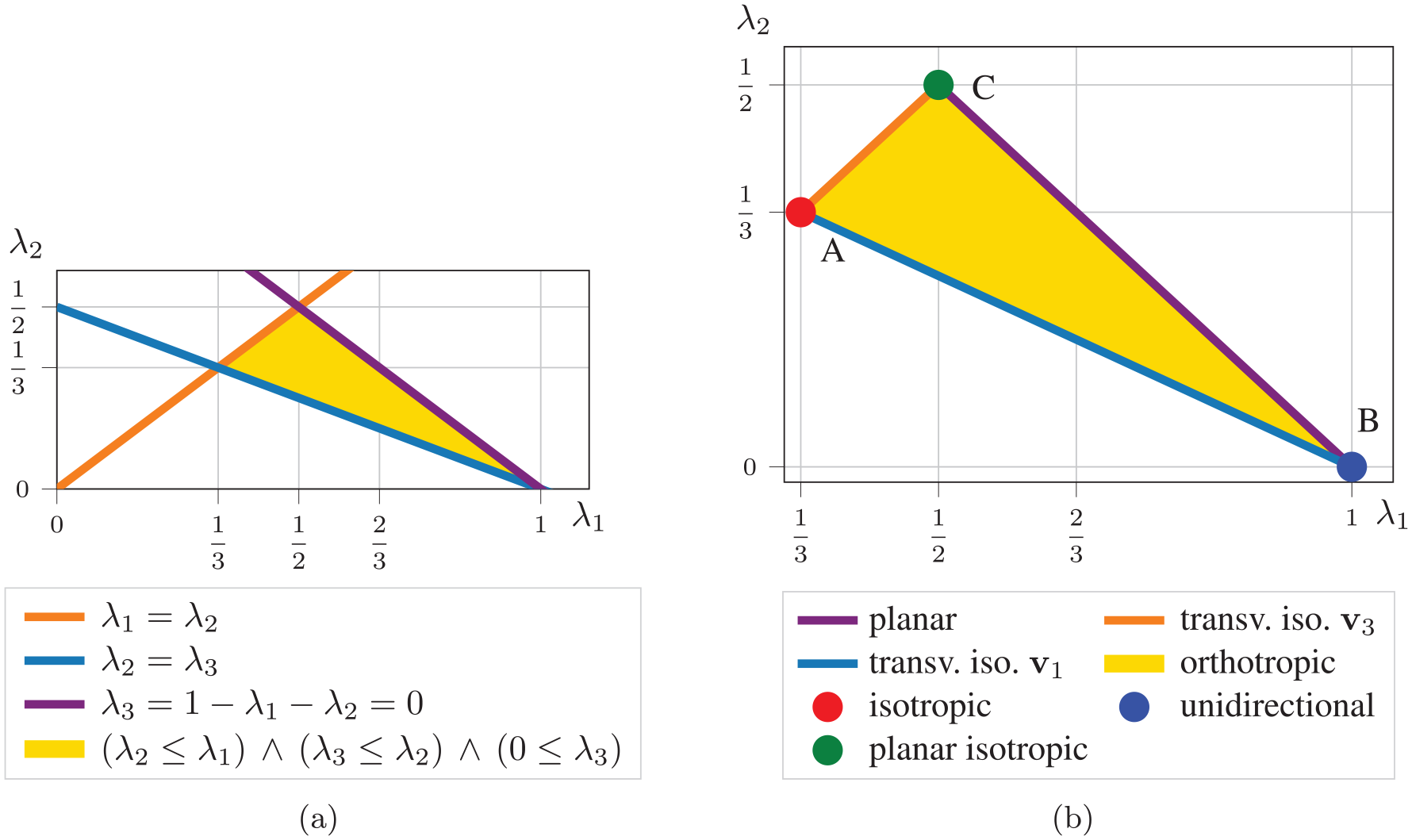
(a) Constraints defining the orientation triangle. (b) Material symmetries in the orientation triangle [8].
The triangles in Figures 1(a) and (c) are projections of one sixth of a orientation plane in the three-dimensional space spanned by
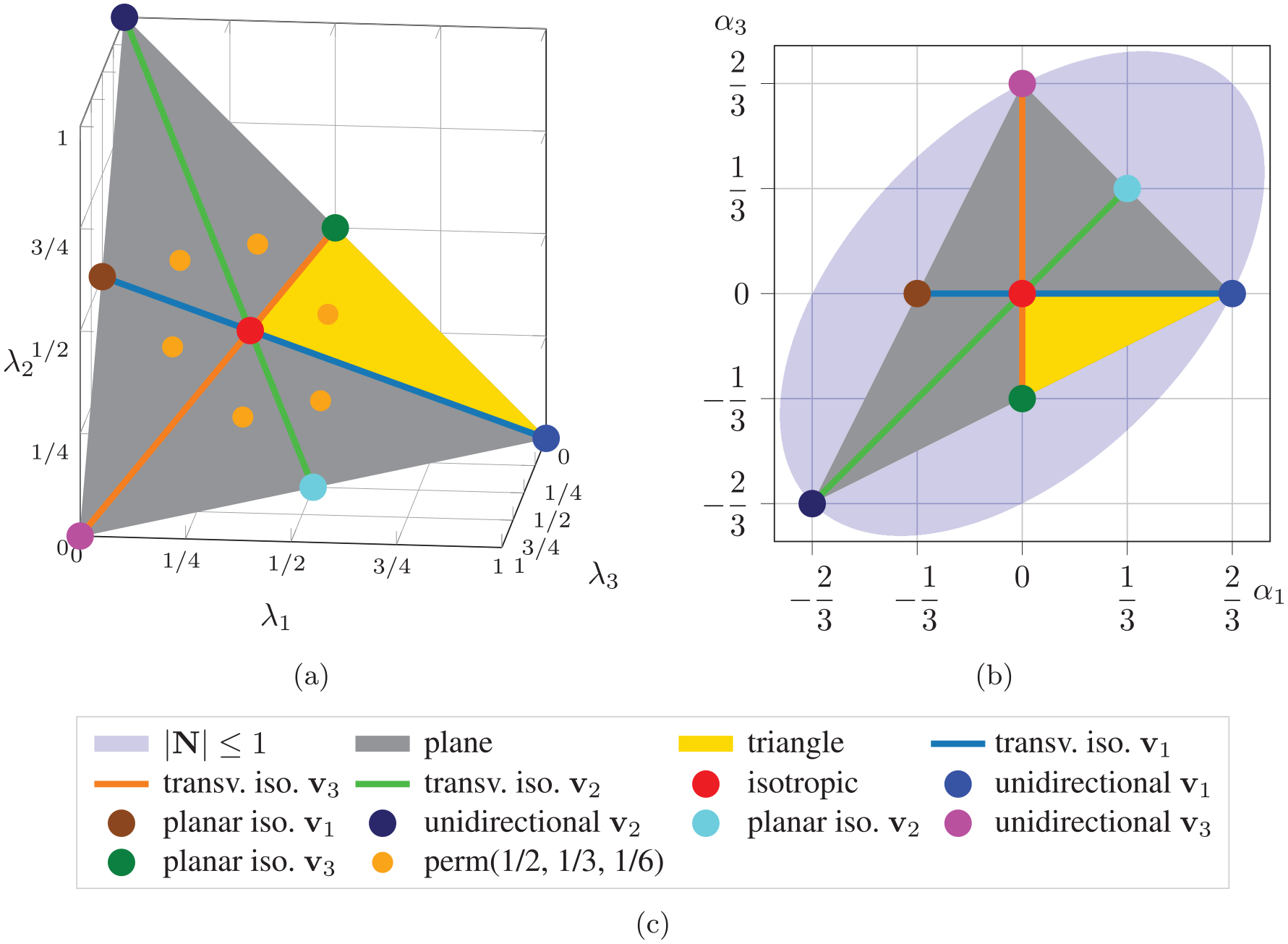
(a) Orientation plane, triangle, and selected orientation states in the space spanned by the eigenvalues of
2.4.1. Parameterizations of the orientation triangle
The classic parameterization of the orientation triangle in eigenvalues

with

Introducing two transversely isotropic deviatoric structure tensors

enables an alternative parameterization of the orientation triangle by

with

The parameterization in Equation (28) highlights the central role of the isotropic state, which is reached for

A parameterization reflecting the arbitrariness of the ordering convention on

requiring
Parameterizations of all transversely isotropic


A parameterization of transversely isotropic

Planar second-order orientation tensors inside the orientation triangle can be parameterized by, e.g.,

with
2.5. Variety of fourth-order orientation tensors
Equation (10) implies that

holds for a representation with tensor coefficients

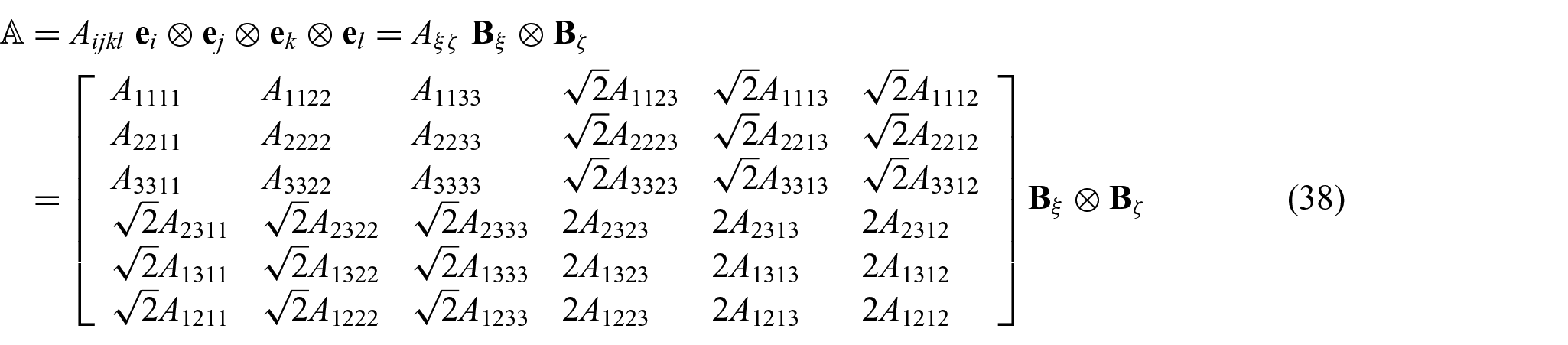
a minor symmetric tensor
with

is symmetric and contains 21 independent parameters. Complete index symmetry of
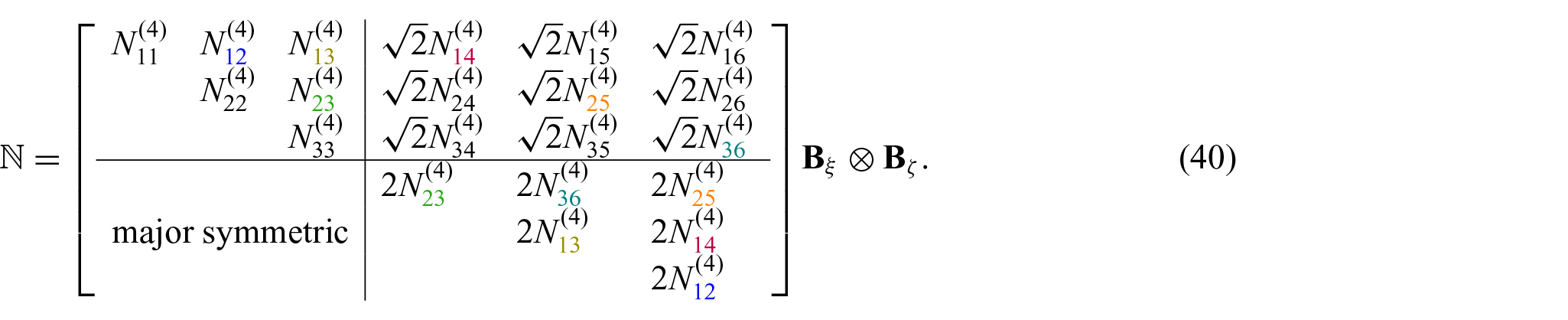
In Equation (40) indices of redundant tensor coefficients are colored. The redundancy implies that six coefficients in the upper left quadrant and nine coefficients in the upper right quadrant of the coefficients in Mandel notation define a completely symmetric tensor. This motivates a shorthand notation “completely symmetric,” which to the best of the authors’ knowledge has not been used in literature so far, see, e.g., Equation (53). As

reveals the implication of Equation (12) on
2.5.1. Harmonic decomposition
Linear invariant decompositions, including the classic harmonic decomposition, are frequently used on Hooke tensors. The fourth-order orientation tensor
Following [42], a Hooke tensor

with isotropic projectors

The parts

with


Applying the classic harmonic decomposition to […] the relations do not hold for most elastic materials, but only for materials which can be described as having central-force laws operating between points of a simple lattice, […]
This observation fits the model of fibers pointing towards the origin of a unit sphere. A stiffness which is linear in the orientation tensors does not have to fulfill the Cauchy relations as its deviatoric parts (
Motivated by their orthogonality, Rychlewski [42] proposed an alternative pair of symmetrization operators


As a consequence,



Due to the isotropy of the isotropic projectors, the linearity of the scalar product and the normalization of

Consequently, the isotropic part of

leading to
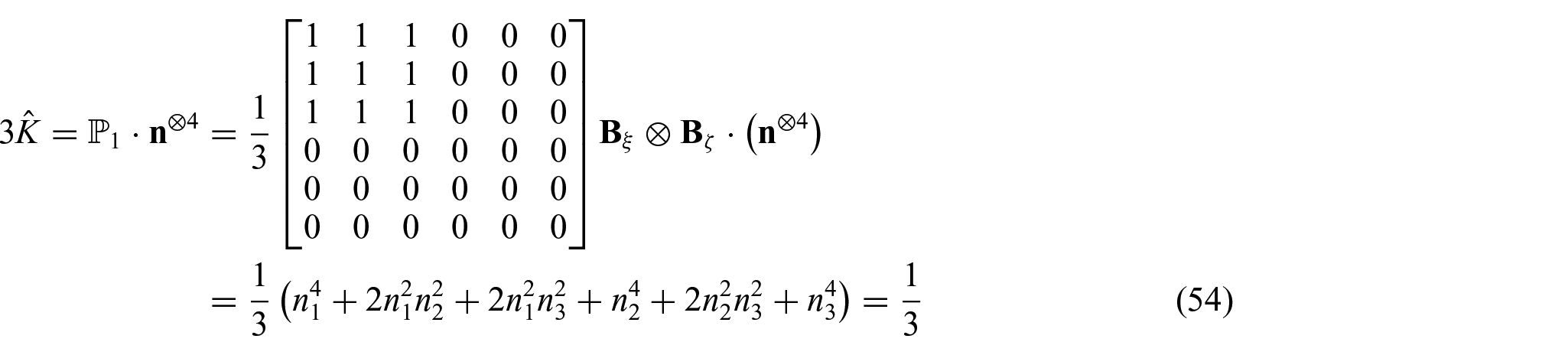
and

Thus, the isotropic part of any fourth-order fiber orientation tensor is fixed due to the normalization of both

leading to a compact representation of Equation (51) by

This representation emphasizes isotropy as the one element of directional measures. Equation (57) reveals that in contrast to the well-known harmonic decomposition of Hooke tensors, the harmonic decomposition of fourth-order orientation tensors only contains one irreducible subspace of second-order and the isotropic subspace degenerates from two scalars to a constant value. Coincidence of Equations (57) and (19) is given by

Interpretation of
2.5.2. Parameterizations and admissible parameter ranges of
The space of fourth-order orientation tensors

with a triclinic deviatoric structure tensor

which is a function of nine scalar parameters. The Mandel basis
Implications of symmetry classes of the ODF
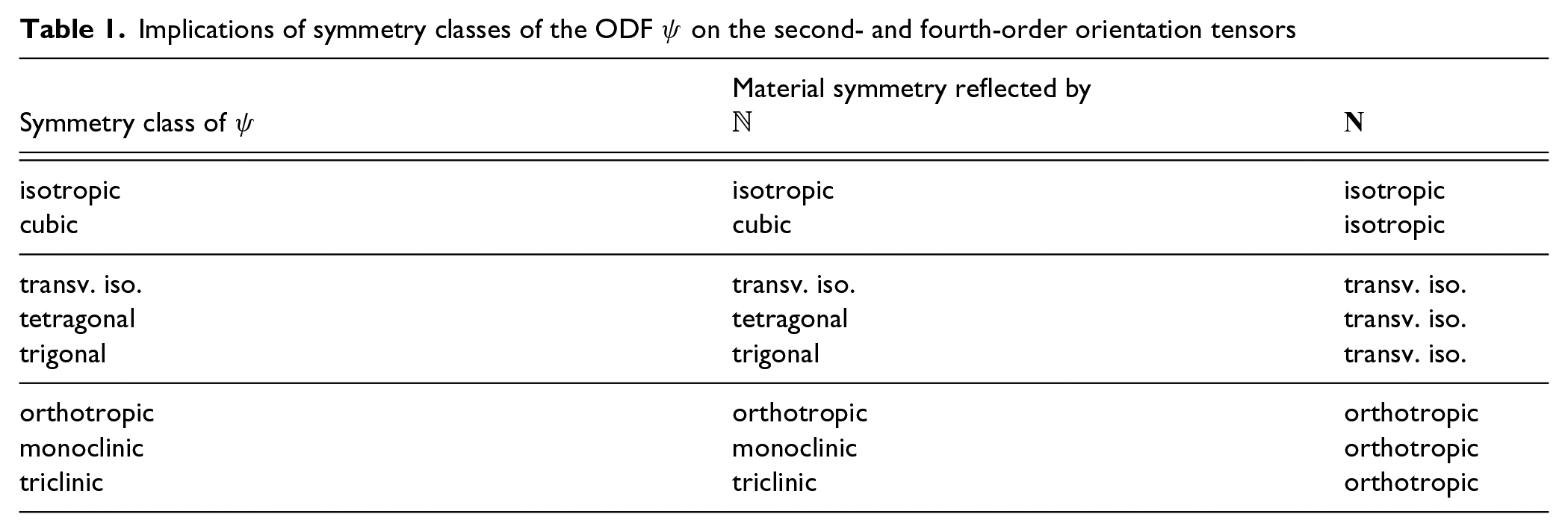
The hierarchy of material symmetries including visualizations of symmetry planes is given in [32, Figure 4]. As a consequence, index and material symmetry constrain the space of
The remaining algebraic constraint on

holds for any second-order tensor

holds. Explicit representations of the eigenvalues of
2.5.3. Transversely isotropic case
A transversely isotropic harmonic, i.e., completely symmetric and completely traceless, tensor of fourth order with principle axis in direction

see, e.g., [29, (75)], [47, A.3], or [5, (11)] and can be expressed in terms of the triclinic structure tensor defined in Equation (60). As a consequence, transversely isotropic fourth-order orientation tensors are parameterized in the orientation coordinate system by
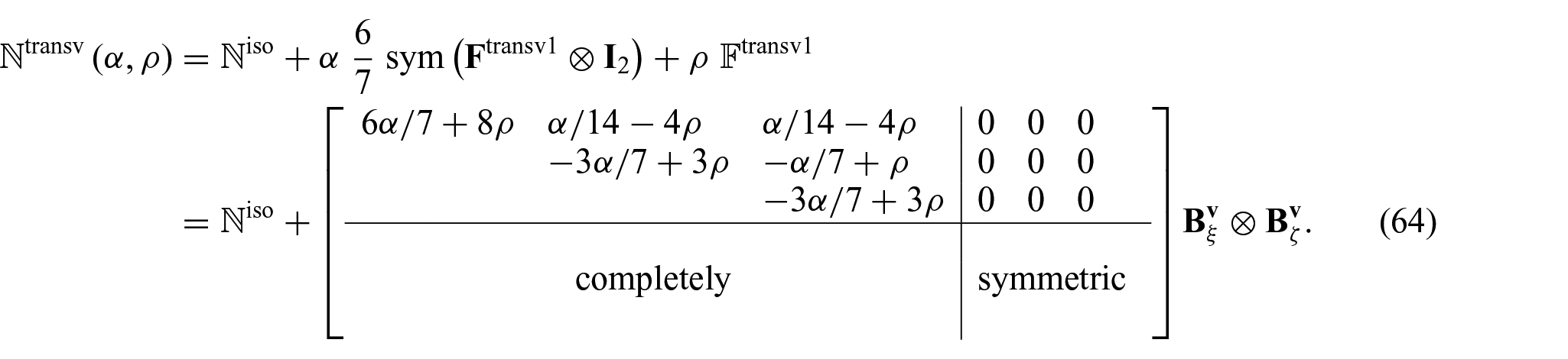
The choice of the principle axis only effects the mapping

given, e.g., in [5, 13]. The set
An alternative derivation of

for

is identical to the set

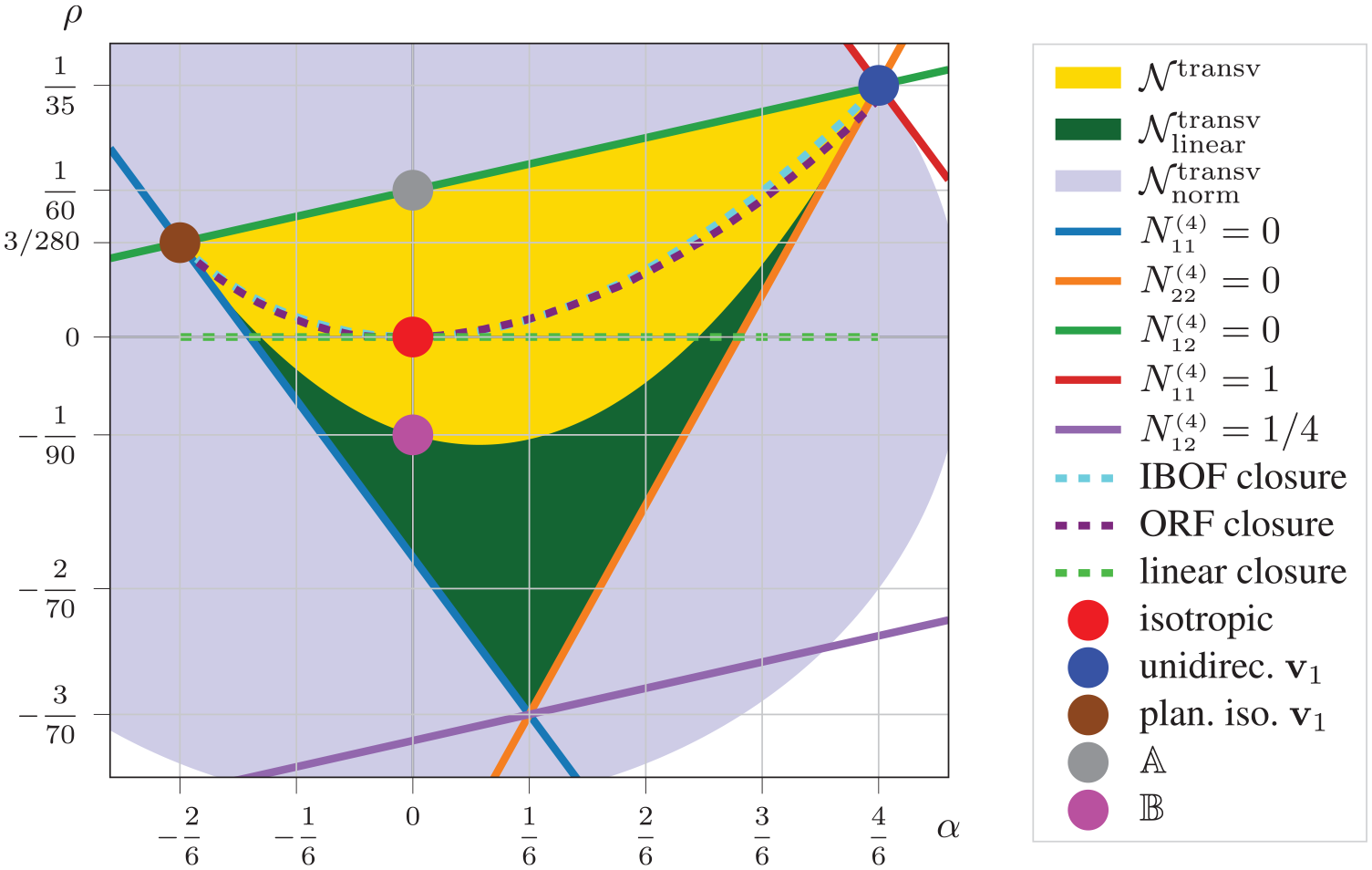
Transversely isotropic fourth-order orientation states following [13].
Figure 3 visualizes the relation
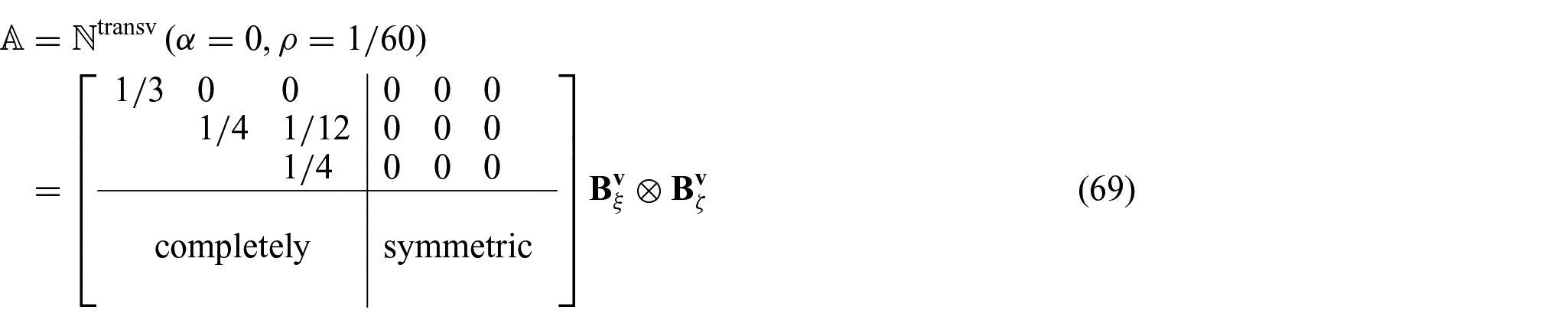
and
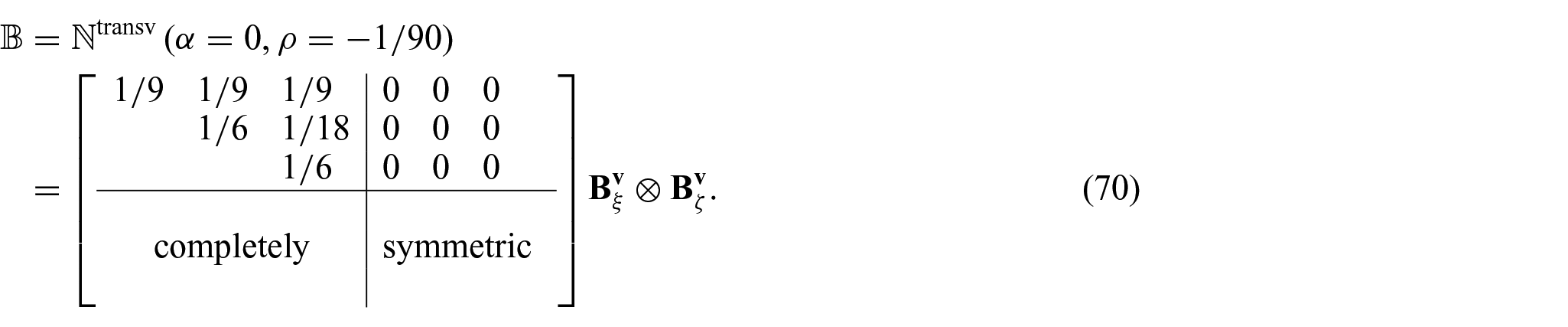
The states

holds, but the states differ significantly. Figure 3 shows that for the special case of transversely isotropy, only two second-order fiber orientation tensors, namely those defined by
An intuitive interpretation of the orientation states described by

based on a set of discrete fiber directions


given in the orientation coordinate system
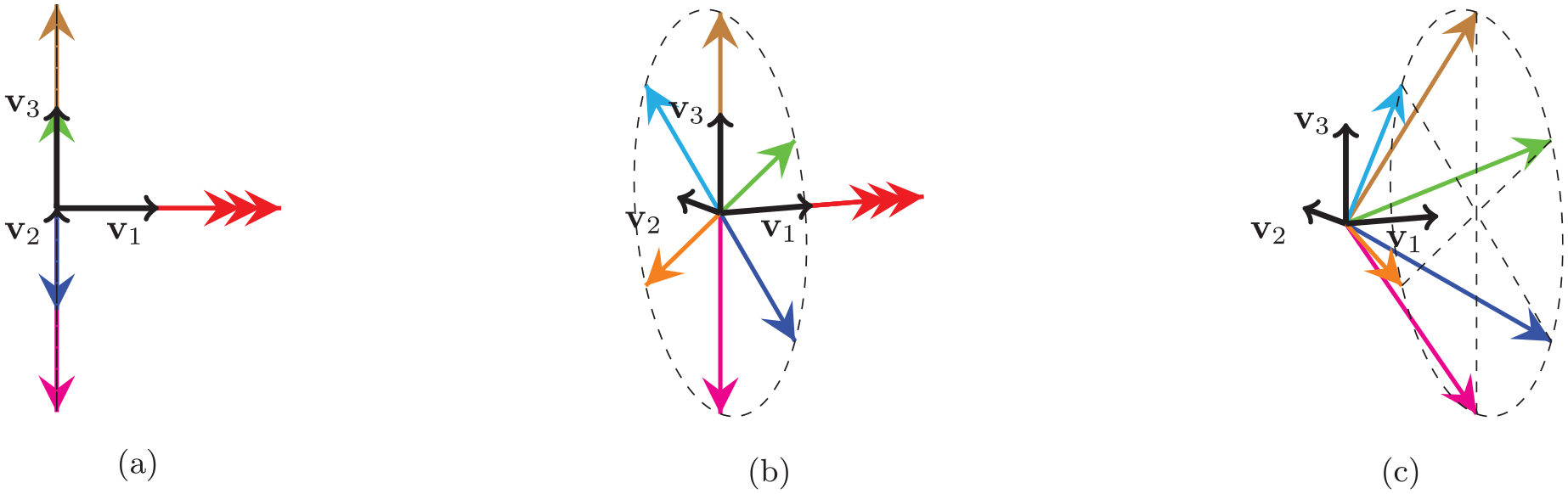
Visualization of minimal sets of discrete directions representing extremal transversely isotropic orientation states which are
2.5.4. Orthotropic case
An orthotropic harmonic tensor of fourth-order is given by

with

The set of admissible orthotropic fourth-order orientation tensors is

see Section 2.5.2. Parameterization of

Three eigenvalues of



due to the diagonal form of the lower right quadrant of

being cubic in
However, for a given specific second-order orientation tensor
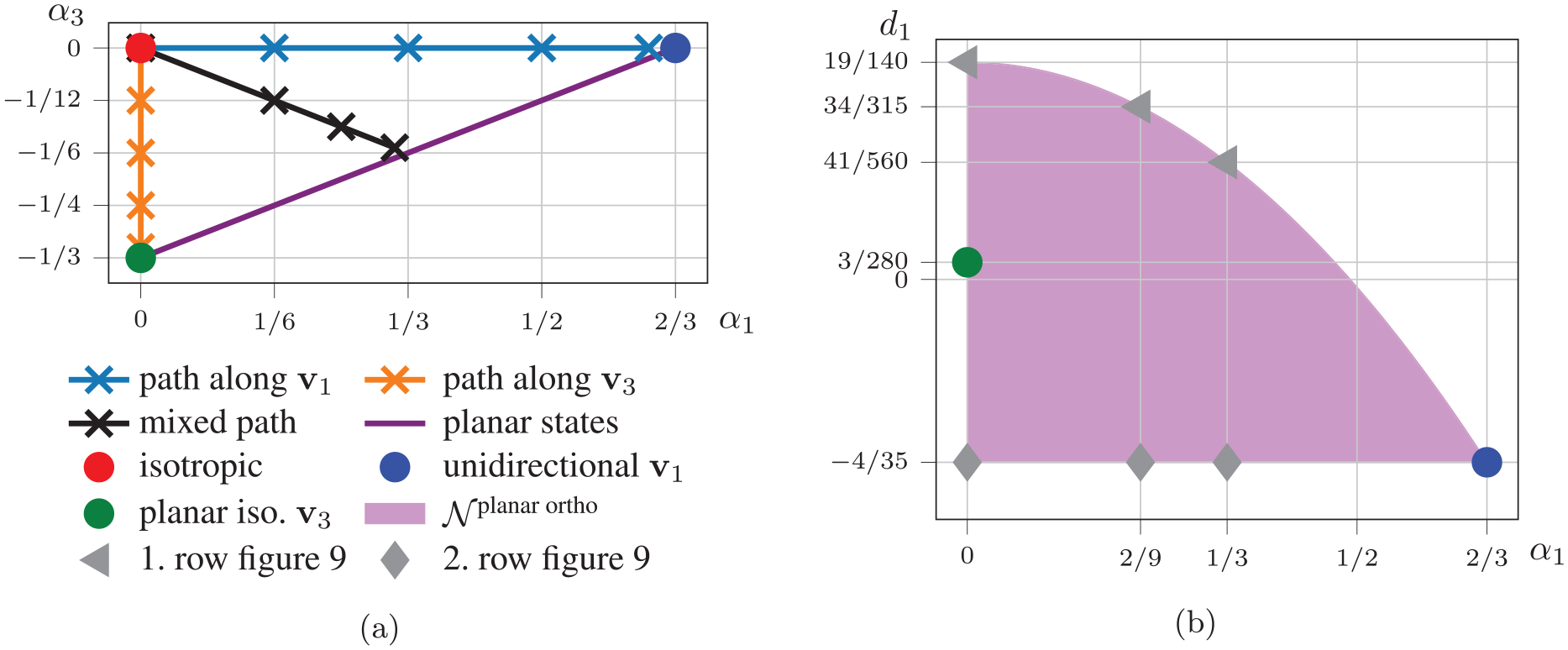
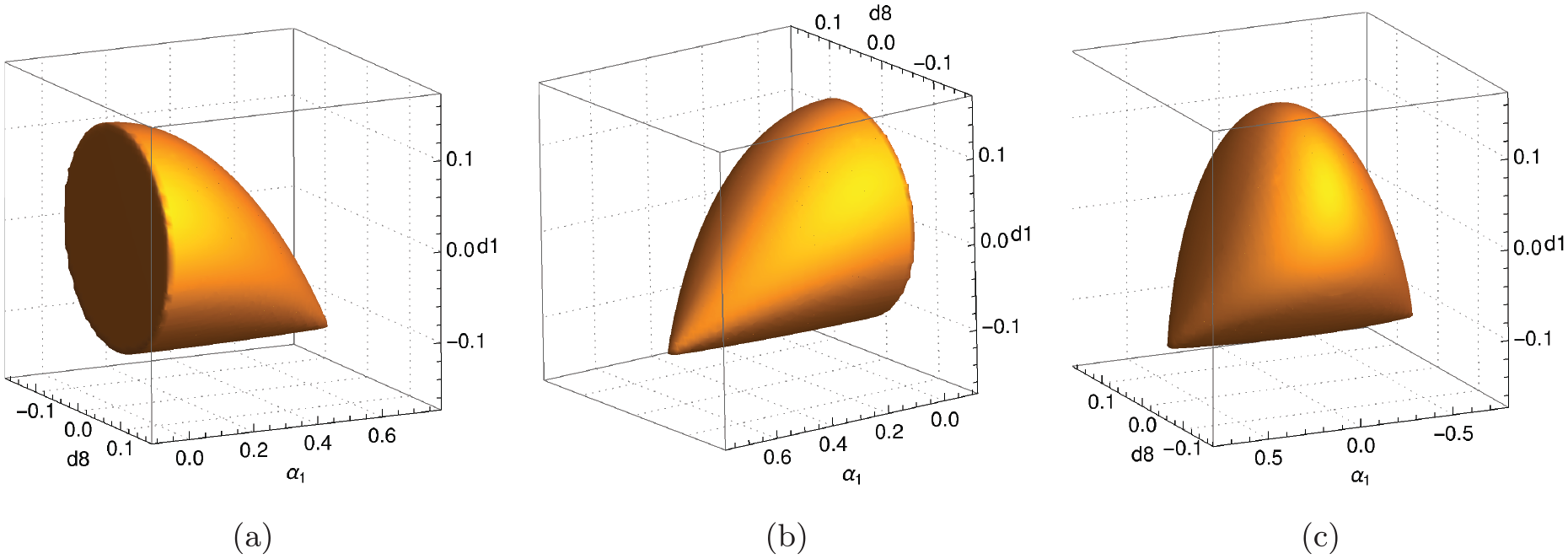
Figure 6 reveals that the admissible region of

with

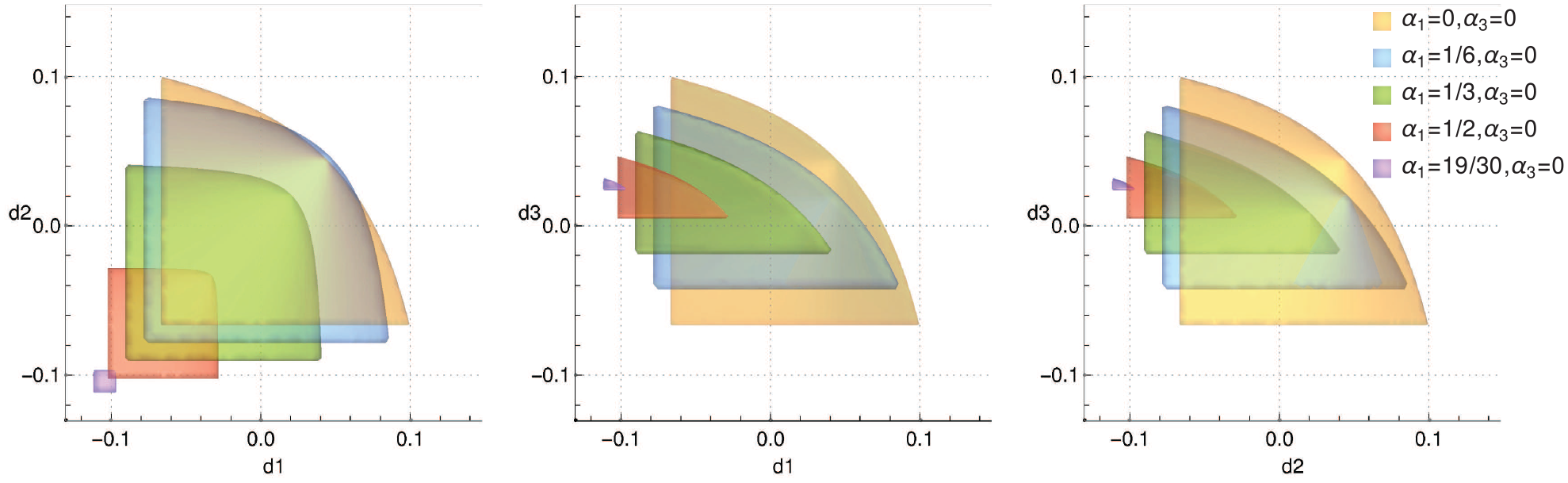
Three views on admissible ranges of
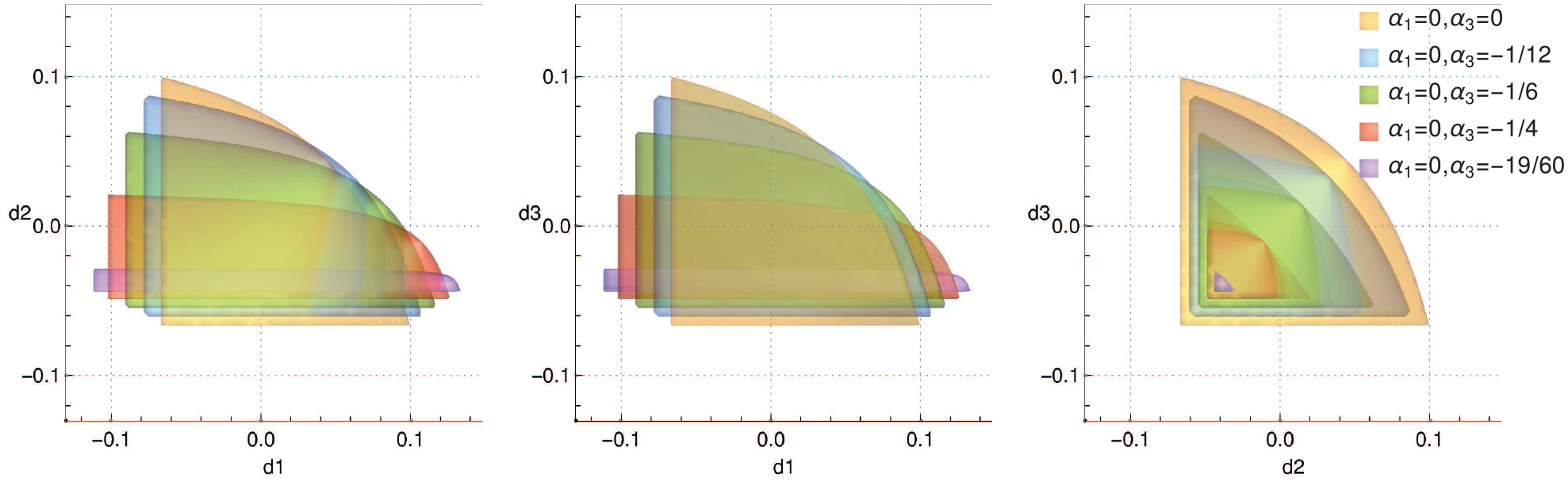
Three views on admissible ranges of
is visualized in Figure 5(b). For reference, the planar isotropic and unidirectional states are highlighted in Figure 5(b). To the best of the authors’ knowledge, the set of admissible orthotropic fiber orientation tensors of fourth order has not been presented in the literature before. Second-order orientation tensors which describe planar orientation states in a three-dimensional space have four variable parameters. Three of these four parameters define the mapping

and

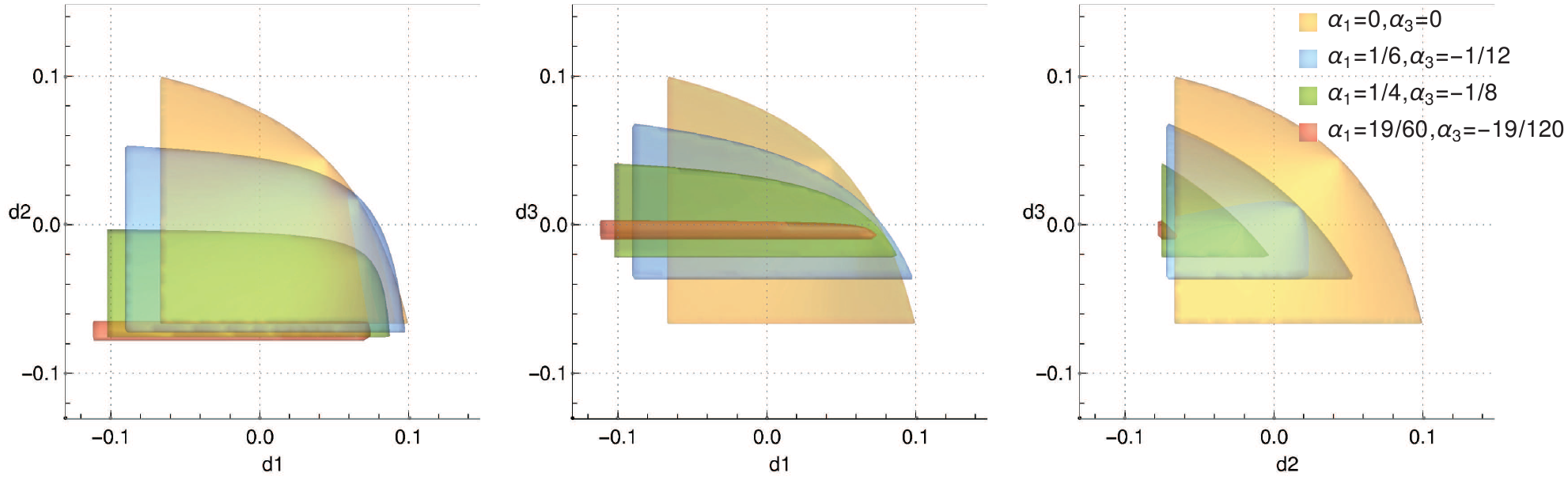
Three views on admissible ranges of
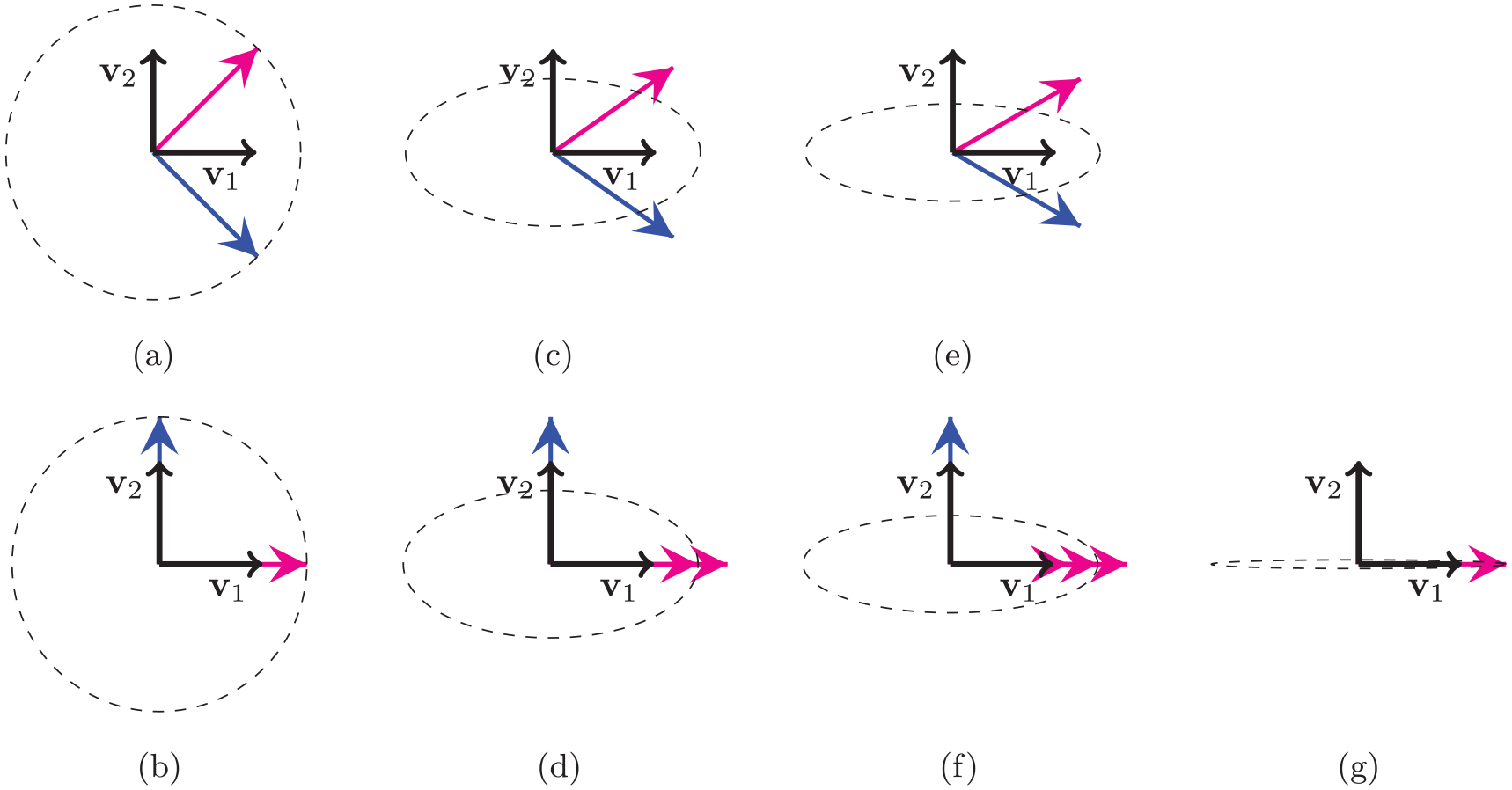
Visualizations of minimal discrete sets of directions in the orientation coordinate system
2.5.5. Planar case
Without loss of generality, inspection of planar states is restricted to orientation states which are located inside the plane spanned by

which fits into the general triclinic framework given by Equations (59) and (60) with

Similar to the planar orthotropic case, the parameters

with

To the best of the author’s knowledge, this set is new in literature and of great practical importance for shell-like components reinforced with long fibers. The set of admissible planar fourth-order orientation tensors is visualized in Figures 10(a) and 10(b). The connection to the admissible ranges in the planar orthotropic case, which is illustrated in Figure 5(b), is given by a projection of
(a), (b) Views on
2.6. A note on closure approximations
For a given second-order orientation tensor

holds. Based on the quantity which is directly affected by a closure’s assumptions, closure approximations might be classified into three groups. The first group contains closures based on algebraic assumptions. Closures based on assumptions on the material symmetry of orientation tensors form the second group. The third group contains closures which state assumptions on the ODF. The linear closure is given by

belongs to the first group and is defined in [17, Equation (13)] or [16]. The representation in (92) benefits from the notation introduced in Equations (56) and (57). The linear closure states that the unknown fourth-order orientation tensor is linear in the second-order orientation tensor. This implies vanishing fourth-order harmonic part, i.e.,
3. Summary and conclusions
Application of linear invariant decomposition with focus on index symmetry [42] transfers the results of Kanatani [1] into the continuum mechanics framework and leads to a compact representation of fourth-order fiber orientation tensors in Equations (56) and (57). A harmonic, i.e., completely symmetric and completely traceless, triclinic fourth-order structure tensor is introduced in Equation (60). This structure tensor has a simplified structure in the coordinate system spanned by the eigenvectors of the second-order fiber orientation tensor and leads to a parameterization of generic fourth-order fiber orientation tensors in Equation (59). Material symmetries of the ODF reduce the number of independent parameters. In the triclinic case, the independent parameters are a second-order fiber orientation tensor plus nine scalars. Admissible ranges of the independent parameters are discussed in detail for orthotropy, transversely isotropy, and planar cases. Insufficiency of coefficient-wise constraints are demonstrated for the transversely isotropic case. The variety of fourth-order fiber orientation tensors is given by the set of positive-definite tensors which can be expressed by Equation (59). Inspection of planar orthotropic states illustrates the character of fourth-order orientation information. Notes on closure approximations demonstrate their limitations on reflecting the variety of fourth-order fiber orientation tensors. As a summary, the parameterizations of generic second-order orientation tensors

generic fourth-order orientation tensors

orthotropic fourth-order orientation tensors

and planar fourth-order orientation tensors

are repeated, including the structure tensors


and

Admissible parameter ranges follow from the requirement of positive semi-definiteness (see Equation (62)) and are explicitly given for special cases of material symmetry in Equations (65), (84), (89), and (106).
In addition to the review contribution, novel technical and scientific contributions in this work are listed hereafter.
An invariant framework for parameterizations of fourth-order fiber orientation tensors based on deviators from the isotropic orientation state is developed. The most general case is obtained by an orthotropic deviator of second order and an triclinic deviator of fourth order. Within this framework, deviators of stronger material symmetries are obtained as special cases with constrained parameters.
Explicit parameterizations and admissible parameter ranges present in the literature are extended by orthotropic as well as planar fiber orientation tensors in a three-dimensional framework.
Visualizations of admissible parameter sets are given for the first time for the orthotropic states in Figures 5–8 and for the planar states in Figures 10(a).
Positive semi-definiteness is identified to be a stronger constraint on admissible orientation tensors than linear constraints on tensor coefficients which themselves are identified to be stronger constraints than a bonded norm.
A short hand notation for completely symmetric fourth-order tensors is introduced.
Representations of discrete fiber sets (Figures 4 and 9) are identified to be an valuable visualization of orientation tensors.
These results enable engineers to parameterize the space of admissible fiber orientation tensors obtaining a valuable tool for engineering applications such as model inspection or data validation.
Footnotes
Appendix A. Material symmetries of second-order tensors
Following [10], any symmetric tensor of second-order
The principle direction of the transversely isotropic case is randomly chosen to be the first axis. The number of independent coefficients is one, two, and three, respectively, and is indicated by the number of
Appendix B. Parameter sets of specific second-order orientation tensors
Table 2 contains arguments of parameterizations given in Equations (25), (28) and (30) leading to special orientation states.
Appendix C. Coefficient-wise extrema of moment tensors
Given a triangulation which divides the unit sphere into
The properties of
Defining coefficients of the
The set of weights
is valid it follows from
that the minimum of a coefficient of a moment tensor
leading to
leads to a representation of the moment tensor by
having extreme coefficient-wise values
with
which is visualized in Figure 3.
Appendix D. Parameterization of admissible N ortho with isotropic N
Explicit parameterization of those fourth-order orientation tensors which contract to the isotropic second-order orientation tensor is given by the set
Acknowledgements
We thank the anonymous reviewer whose critical review helped to improve and clarify this manuscript. Provision of the open source Python package [49] by Nils Meyer is gratefully acknowledged. Review by Jonas Hund is gratefully acknowledged.
Author Contributions
Julian Karl Bauer: Conceptualization, methodology software, validation, formal analysis, investigation, resources, writing-original draft preparation, writing-review and editing, visualization, Thomas Böhlke: Conceptualization, methodology formal analysis, writing-review and editing, supervision, project administration, funding acquisition. All authors have read and agreed to the published version of the manuscript.
Declaration of conflicting interests
The authors declare no conflict of interest. The funders had no role in the design of the study; in the collection, analyses, or interpretation of data; in the writing of the manuscript, or in the decision to publish the results.
Funding
The research documented in this manuscript has been funded by the German Research Foundation (DFG) within the International Research Training Group “Integrated engineering of continuous-discontinuous long fiber-reinforced polymer structures” (GRK 2078/2). The support by the German Research Foundation (DFG) is gratefully acknowledged.
Code

Abbreviations
ODF Fiber orientation distribution function
CODF Crystal orientation distribution function
IBOF Invariant-based optimal fitting
transv. Transversely isotropic
RV Reference volume
ORF Orthotropic fitted
unidirect. Unidirectional
plan. Planar
sym Symmetric
perm Permutation
iso Isotropic
ortho Orthotropic