



Abstract
We propose an effective method for the solution of the plane problem of an edge dislocation in the vicinity of a circular inhomogeneity with Steigmann–Ogden interface. Using analytic continuation, the pair of analytic functions defined in the infinite matrix surrounding the inhomogeneity can be expressed in terms of the pair of analytic functions defined inside the circular inhomogeneity. Once the two analytic functions defined in the circular inhomogeneity are expanded in Taylor series with unknown complex coefficients, the Steigmann–Ogden interface condition can be written explicitly in complex form. Consequently, all of the complex coefficients appearing in the Taylor series can be uniquely determined so that the two pairs of analytic functions are then completely determined. An explicit and general expression of the image force acting on the edge dislocation is derived using the Peach–Koehler formula.
Keywords
1. Introduction
The first continuum-based surface/interface model was established by Gurtin, Murdoch and co-workers [1–3]. This model, now commonly referred to in the literature as the “Gurtin-Murdoch model”, was recently clarified by Ru [4]. In the Gurtin–Murdoch model, the surface is treated as an elastic membrane of vanishing thickness adhering to the bulk without slipping. Consequently, the surface is resistant only to stretching (and not bending) rendering it incapable of supporting a compressive stress state. Steigmann and Ogden [5,6] improved the Gurtin–Murdoch theory by endowing the surface model with both stretching and flexural resistance. In other words, the surface energy in the Steigmann–Ogden model is a function of both the surface strain tensor and the surface curvature tensor. The Steigmann–Ogden model has been adopted in the analysis of a range of problems including those dealing with nanoscale composites [7–12].
In this paper, we study an edge dislocation interacting with a circular elastic inhomogeneity incorporating a Steigmann–Ogden interface. The resulting boundary value problem poses considerable challenges due to the complexity of the boundary conditions on the Steigmann–Ogden circular interface [7,9,10]. This perhaps explains why the solution of this interaction problem remains absent from the literature. Despite this complexity, we propose a simple and effective method which permits an analytical solution to this plane problem. Using analytic continuation [13–15] to enforce the condition of continuity of displacements across the Steigmann–Ogden interface, the pair of analytic functions defined in the surrounding matrix can be expressed in terms of the pair of analytic functions defined inside the circular inhomogeneity. Once the two analytic functions in the circular inhomogeneity are expressed in standard Taylor series with unknown complex coefficients, the complex form of the Steigmann–Ogden interface condition (specifically the relation between the jumps in interfacial normal and tangential tractions and the interfacial normal and tangential displacements and their tangential derivatives, see [7,10]) can be expressed explicitly. Consequently, all of the complex coefficients appearing in the Taylor series can be uniquely determined so that the pair of analytic functions defined in the matrix is then completely determined. Using the Peach–Koehler formula [16], we also establish the image force acting on the edge dislocation. The resulting explicit expression for the image force is quite general in the sense that both components of the Burgers vector can be nonzero. When the surface effect is neglected for a perfect interface, our result for the image force on a gliding edge dislocation simply recovers the classical result by Dundurs [16].
2. Complex variable formulation for plane isotropic elasticity
A Cartesian coordinate system


where

3. An edge dislocation near a circular inhomogeneity with Steigmann-Ogden interface
Consider a domain in ℜ2, infinite in extent, containing a circular inhomogeneity of radius R with its center at the origin of the Cartesian coordinate system. Let
According to Zemlyanova and Mogilevskaya [7], the boundary conditions on the Steigmann–Ogden circular interface can be expressed in polar coordinates

where

In Equations (4) and (5),

where

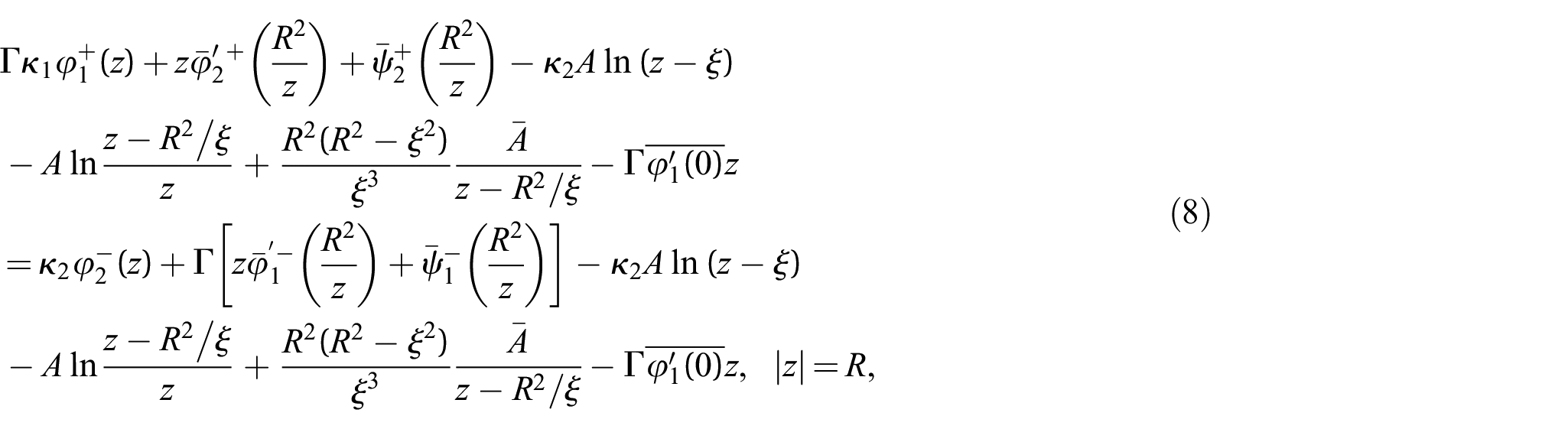
Using analytic continuation [13–15], Equation (6) can be further written in the form
where


Once

With the aid of Equation (10), we can rewrite Equation (11) as the following

The pair of analytic functions

where
Inserting Equation (13) into Equation (12) and expanding the three functions
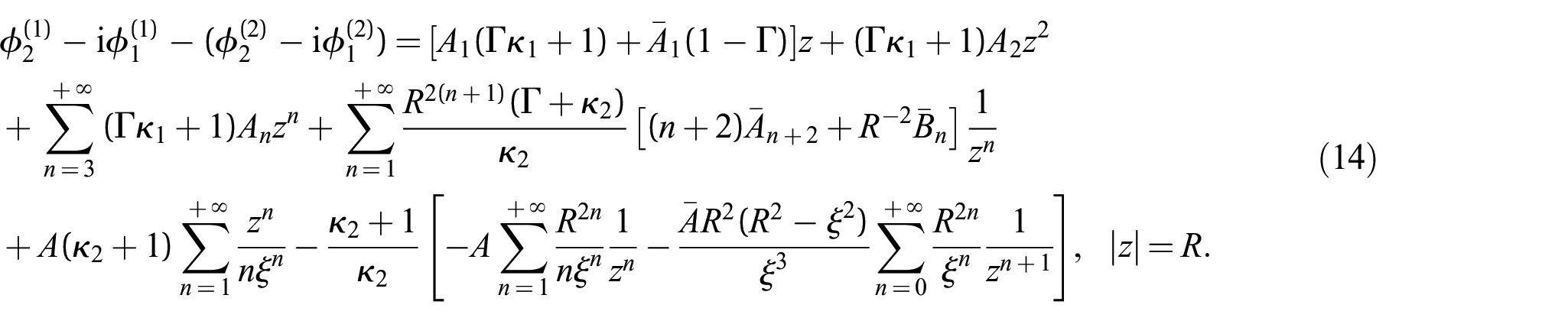
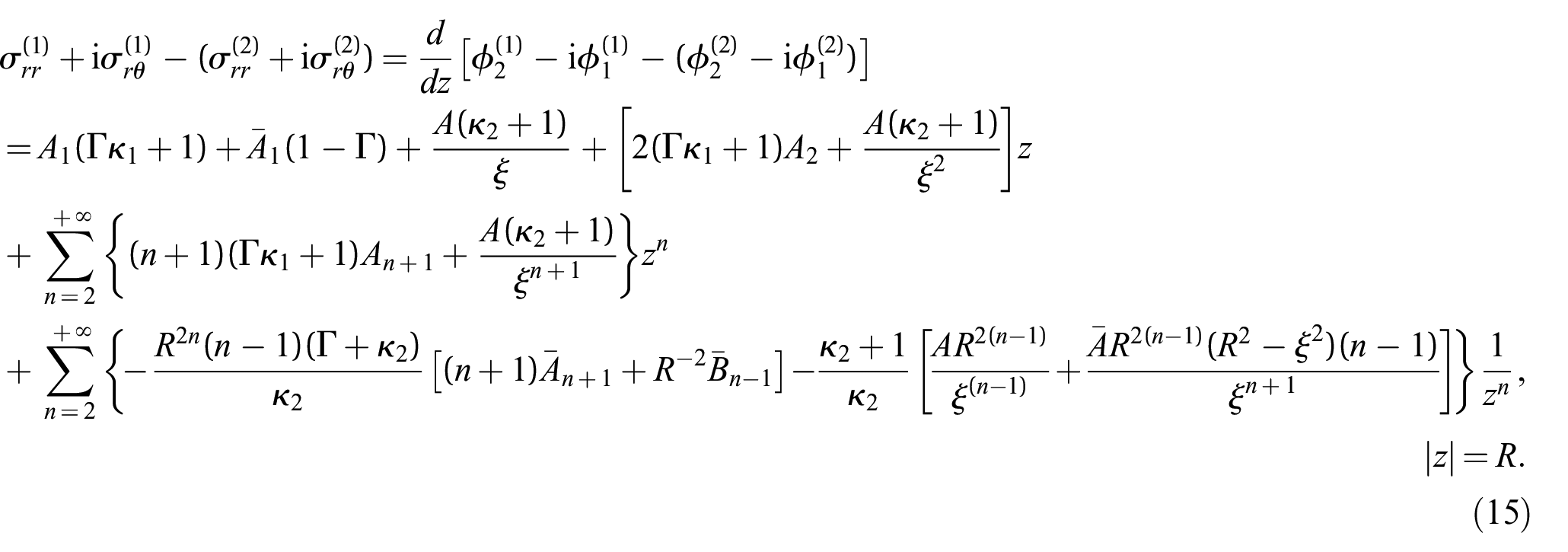
Using Equation (14), the jumps in normal and tangential tractions across the circular interface, which are simply the left-hand side of the interface condition in Equation (4)2, are given explicitly by
Using Equations (2)1 and (13), the interfacial normal and tangential displacements are given by

By considering Equation (16), the right-hand side of the interface condition in Equation (4)2 can also be written explicitly as
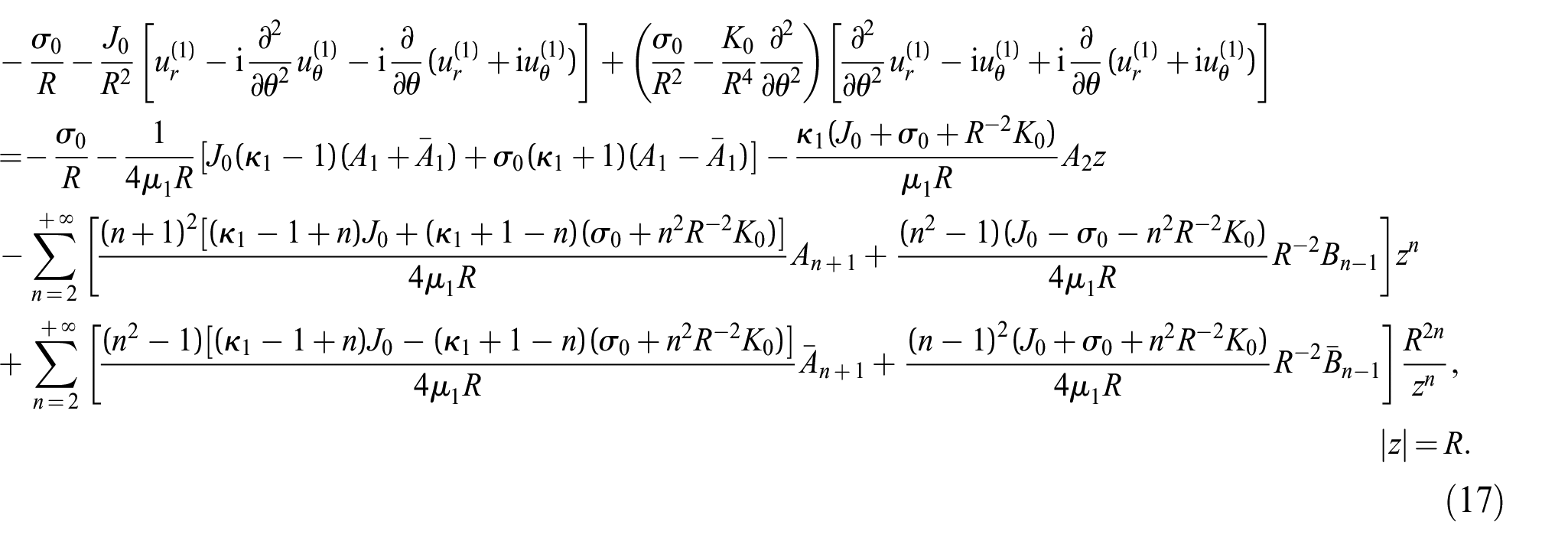
In deriving Equation (17), we first consider the term in


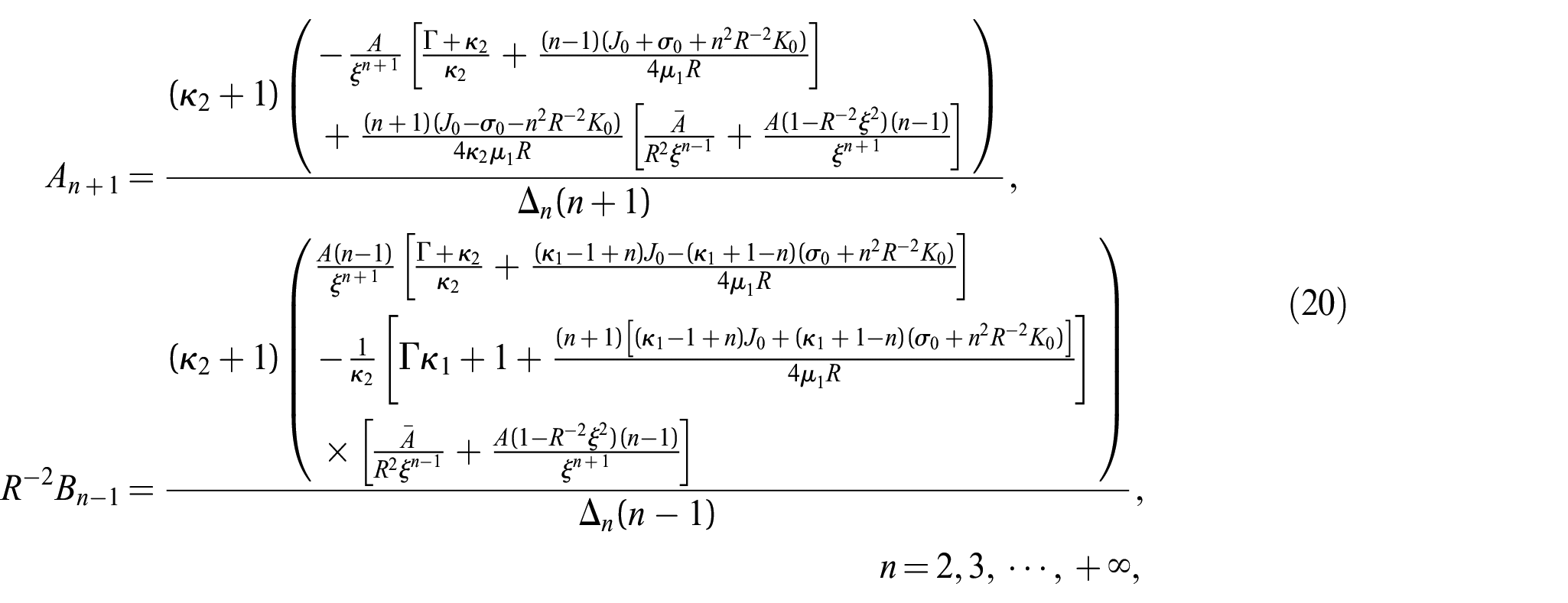
where
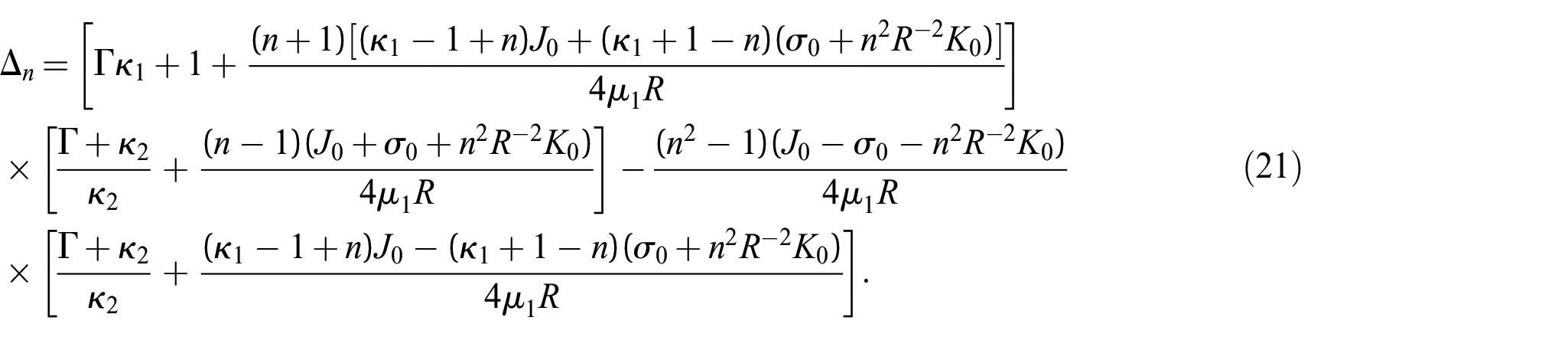
It is further deduced from Equation (18) that the rigid-body rotation at the center of the circular inhomogeneity is

and the average mean stress within the circular inhomogeneity is

where <*> denotes the average. The average mean stress within the circular inhomogeneity can be nullified when

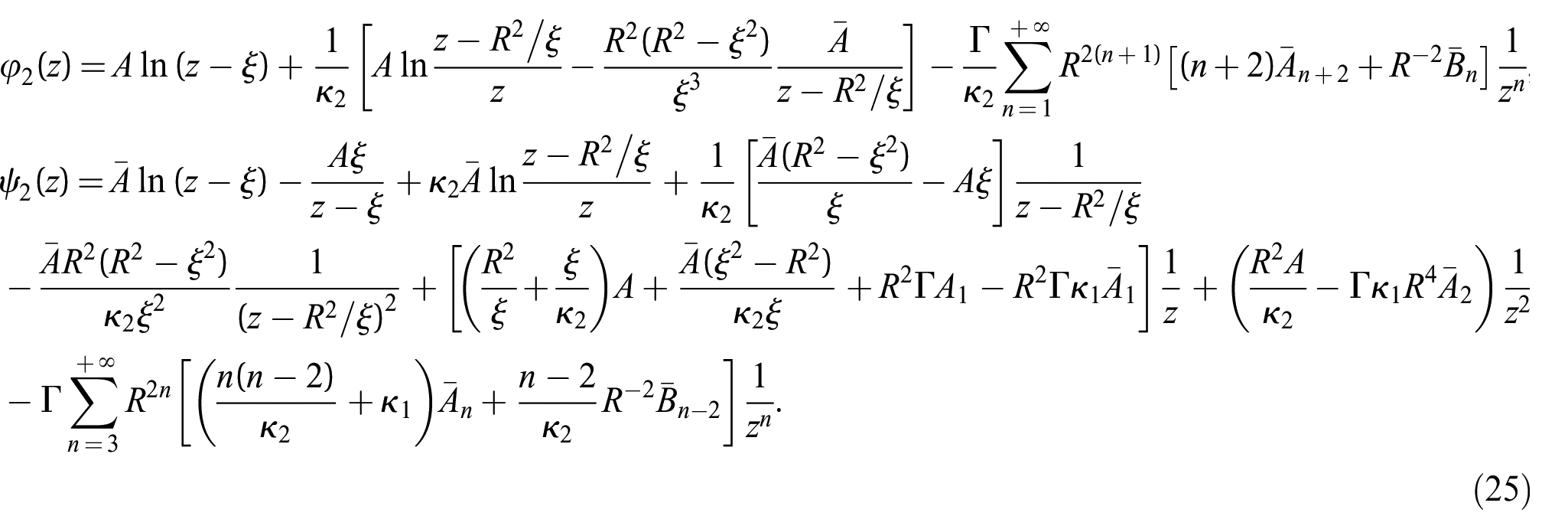
By substituting Equation (13) into Equation (10), the pair of analytic functions
Using the Peach-Koehler formula [16], the image force acting on the edge dislocations is given by

where
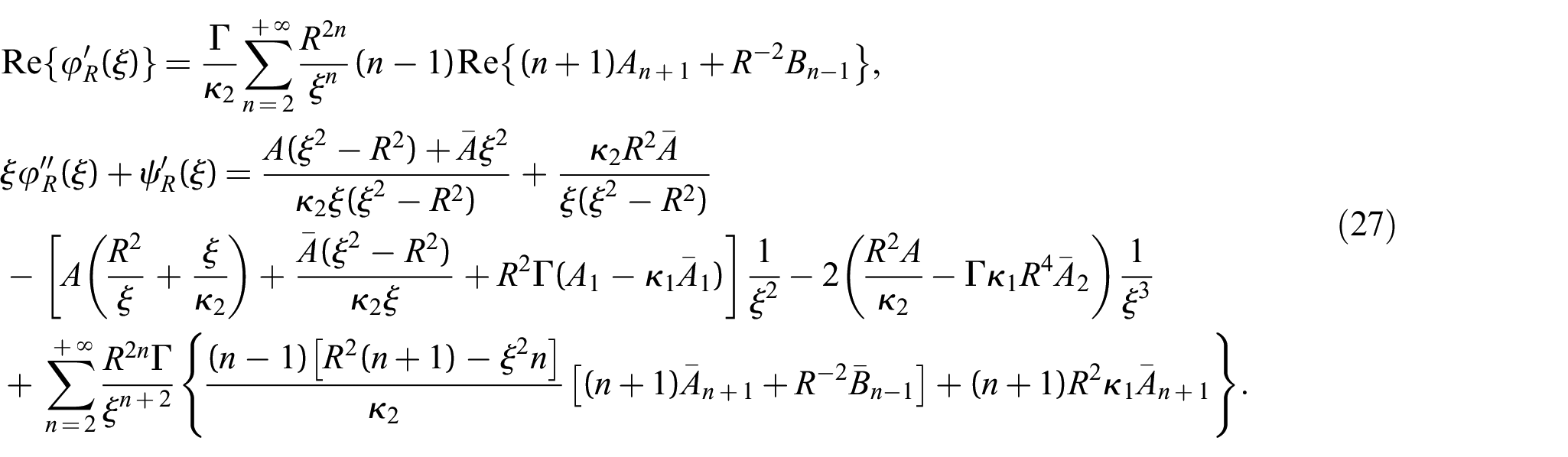
The term

It is clear from Equation (26) that
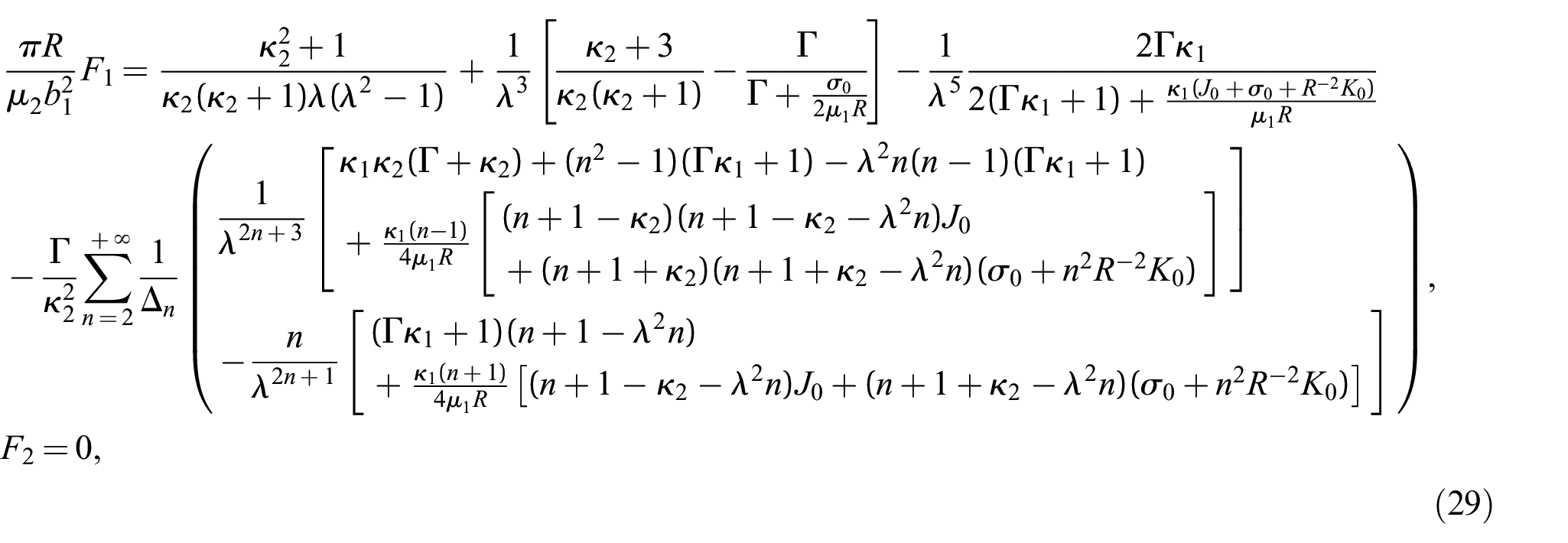
where

As a quick check, when

which is found equivalent to Equation (7.8) by Dundurs [16] in terms of the two Dundurs parameters α and β.
4. Conclusion
We have solved the interaction problem between an edge dislocation and a circular elastic inhomogeneity with Steigmann–Ogden interface. Using analytic continuation, the satisfaction of the continuity condition of displacements across the circular interface leads to the expressions for
Footnotes
Declaration of conflicting interests
The author(s) declared no potential conflicts of interest with respect to the research, authorship and/or publication of this article.
Funding
The author(s) disclosed receipt of the following financial support for the research, authorship and/or publication of this article: This work is supported by a Discovery Grant from the Natural Sciences and Engineering Research Council of Canada (Grant No: RGPIN – 2017 - 03716115112).
