Interaction between an edge dislocation and a partially debonded circular elastic inhomogeneity with the debonded portion occupied by a liquid slit inclusion
Open accessResearch articleFirst published online October, 2025
Interaction between an edge dislocation and a partially debonded circular elastic inhomogeneity with the debonded portion occupied by a liquid slit inclusion
We study the plane strain problem of a circular elastic inhomogeneity partially debonded from an infinite elastic matrix subjected to an edge dislocation at an arbitrary position. The debonded portion of the circular interface is occupied by an incompressible liquid slit inclusion. The original boundary value problem is reduced to a standard Riemann–Hilbert problem with discontinuous coefficients which can be solved analytically. The two unknown constants appearing in the analytical solution are determined by imposing the incompressibility condition of the liquid inclusion. Closed-form expressions for the internal uniform hydrostatic stress field within the liquid slit inclusion, the average mean stress within the circular elastic inhomogeneity, the rigid body rotation at the center of the circular inhomogeneity, and the two complex stress intensity factors at the two tips of the debonded portion induced by the edge dislocation are obtained.
A common observation in nature and in the engineering of new and advanced materials is the entrapment of liquid inclusions in solids such as crystals, rocks, biological tissues, hydrogels and elastomers. A composite consisting of a solid matrix and embedded liquid inclusions exhibits many unique macroscopic mechanical and physical properties such as enhancement of overall deformability and the stiffening phenomenon for “small” liquid inclusions [1–3]. The micromechanics analysis of a composite composed of a solid matrix and liquid inclusions has attracted focused and sustained attention in the last decade (see, for example, [1–17]). Recently, Wang and Schiavone (2024a,b,c) observed that interface crack growth in laminated and fibrous composites can be completely or partially suppressed when the interface crack is filled with an incompressible liquid slit inclusion. On the other hand, the study of dislocations interacting with elastic inhomogeneities is fundamental to a better understanding of strengthening and hardening mechanisms in composite materials [18,19].
In this paper, we are concerned with the two-dimensional interaction problem associated with an edge dislocation near a partially debonded circular elastic inhomogeneity in which the debonded portion is occupied by an incompressible liquid slit inclusion. A closed-form analytical solution to the interaction problem is derived by solving a Riemann–Hilbert problem with discontinuous coefficients resulting from the satisfaction of all the interface conditions on the existing solid–solid and liquid–solid interfaces of the composite. The two unknown constants (one of which is the internal uniform hydrostatic tension within the liquid inclusion and the other a complex constant) appearing in the analytical solution are uniquely determined by imposing the incompressibility condition of the liquid inclusion. Once the two unknown constants have been determined, the original two pairs of analytic functions characterizing the elastic fields in the circular inhomogeneity and in the matrix are revealed. Closed-form expressions for the internal uniform hydrostatic tension within the liquid inclusion, the average mean stress within the circular inhomogeneity, the rigid body rotation at the center of the circular inhomogeneity, and the two complex stress intensity factors at the two tips of the debonded portion of the circular interface are obtained. In particular, when the edge dislocation approaches the debonded portion of the circular interface or is very far from the circular inhomogeneity, elementary and explicit expressions for some of these physical quantities are presented.
2. Muskhelishvili’s complex variable formulation
A Cartesian coordinate system is established. For plane strain deformation of an isotropic elastic material, the three in-plane stresses , two in-plane displacements , and two stress functions are given in terms of two analytic functions and of the complex variable as [20]
and
where , µ and are the shear modulus and Poisson’s ratio, respectively. In addition, the three in-plane stress components are related to the two stress functions through [21]
3. Closed-form solution
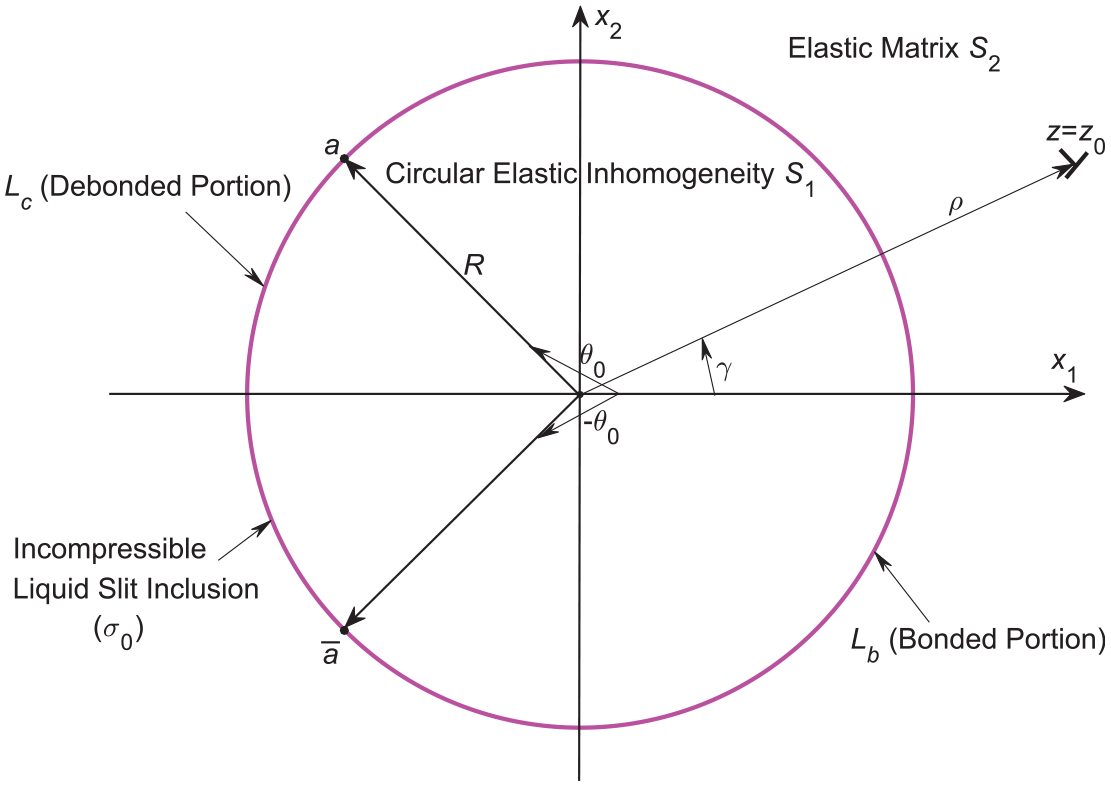
As shown in Figure 1, an isotropic elastic circular inhomogeneity of radius R with its center at the origin of the coordinate system is partially bonded to an infinite isotropic elastic matrix subjected to an edge dislocation with Burgers vector located at with . The matrix is not subjected to any remote loading and the rigid body rotation at infinity is zero. We represent the matrix by the domain and assume that the circular inhomogeneity occupies the region . The circular inhomogeneity remains perfectly bonded to the matrix along the arc of the circular interface L, and is debonded from the matrix along the remaining arc of the circular interface L. Thus, . In addition, the debonded portion is filled with an incompressible liquid slit inclusion, which admits an internal uniform hydrostatic stress field and which remains perfectly bonded to its surrounding media. Let the center of the arc lie on the positive x1-axis and the central angle subtended by the arc be . The two tips of the arc are located at and . Throughout the paper, the subscripts 1 and 2 are used to identify the respective quantities in and .
An edge dislocation interacting with a partially debonded circular elastic inhomogeneity with the debonded portion of the circular interface occupied by an incompressible liquid slit inclusion.
The continuity of tractions across the entire circular interface can be expressed as
which can be equivalently written in the form
where
The left-hand side of equation (5) is analytic and single-valued everywhere in , and the right-hand side of equation (5) is analytic and single-valued everywhere in including the point at infinity. Using Liouville’s theorem, we arrive at the following relationships
The continuity of displacements across the bonded portion of the circular interface can be expressed into
By taking differentiation of equation (9) with respect to the complex variable z, we have
Considering equation (10), we introduce an auxiliary function defined as follows
It is seen from equation (11) that is analytic and single-valued everywhere in , and is analytic and single-valued everywhere in including the point at infinity and behaves as as . Furthermore, it follows from equations (10) and (11) that is continuous across the bonded portion of the circular interface, i.e.,
The continuity of tractions across the liquid–solid interface between the liquid inclusion and the circular elastic inhomogeneity can be expressed as
where is the internal uniform hydrostatic tension within the liquid inclusion and remains to be determined. Substituting equation (7)2 into equation (13) and taking the derivative of the resulting equation with respect to the complex variable z, we arrive at
Making use of the definition of in equation (11), we can finally rewrite equation (14) in terms of the auxiliary function as follows
where the oscillatory index ε is defined by
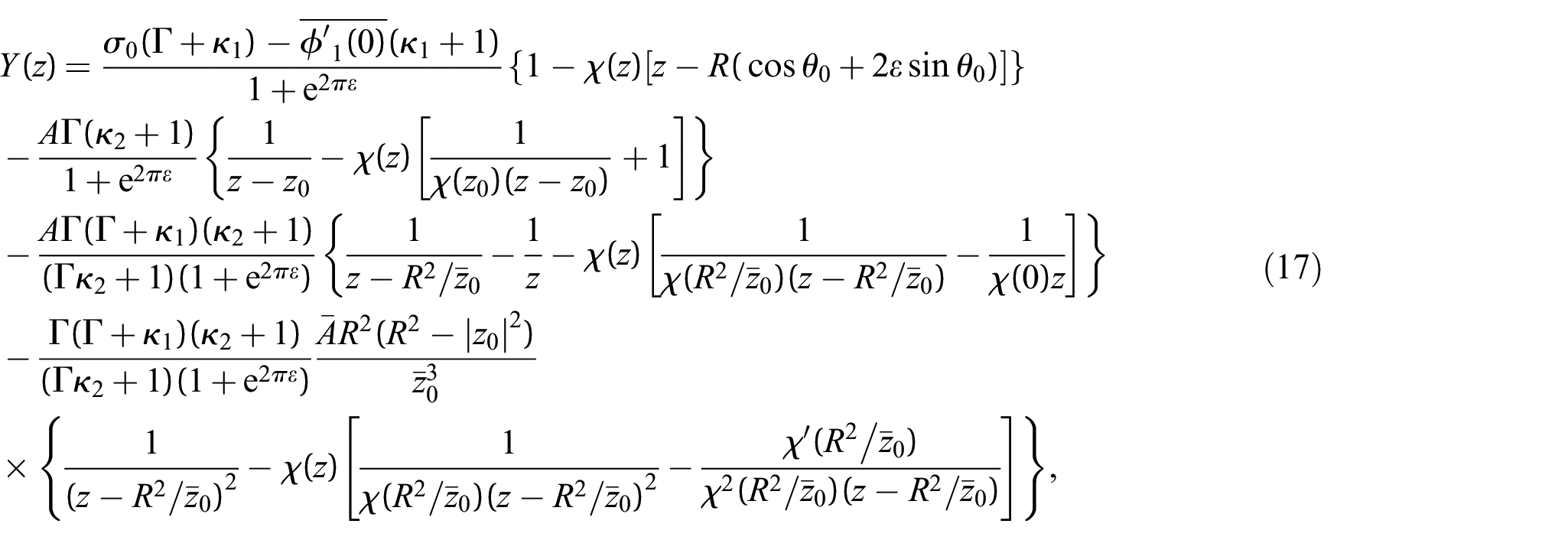
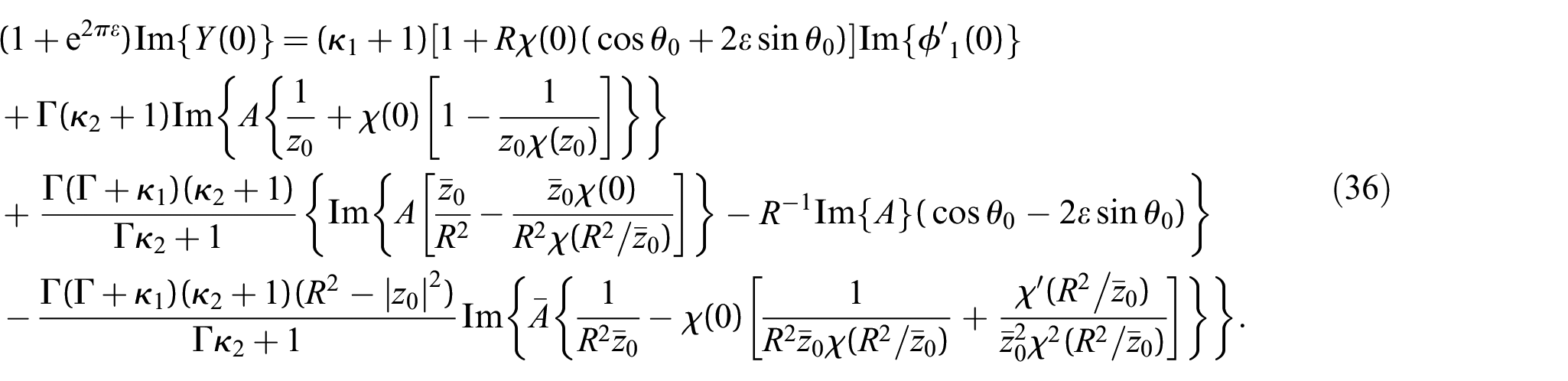
Equations (12) and (15) constitute a standard Riemann–Hilbert problem with discontinuous coefficients. The closed-form analytical solution to the Riemann–Hilbert problem in equations (12) and (15) can be derived as
where the Plemelj function is defined by
and
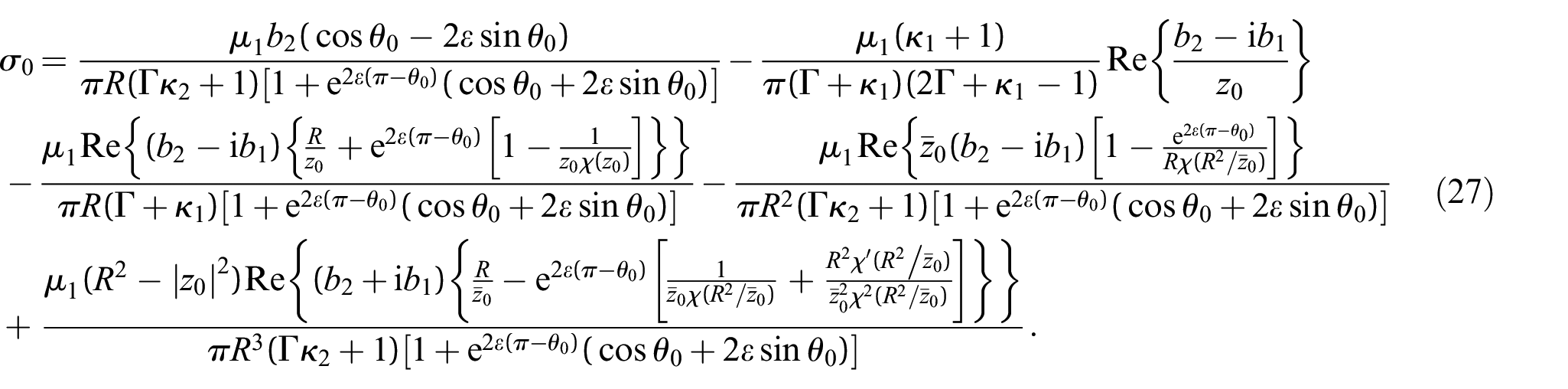
The branch cut for the Plemelj function is taken along and as . The two unknowns and in equation (17) remain to be determined. The incompressibility of the liquid slit inclusion requires that [6,19,22]
where is the normal displacement in polar coordinates . Equation (20) can be further written in the form
where the integral contour surrounds . In addition, since as , we have
which is unaffected by the specific position of the edge dislocation and is illustrated in Figure 2. It is seen from Figure 2 that (1) and always have opposite signs; (2) the magnitude of increases from zero to infinity as increases from zero for a completely debonded circular inhomogeneity to for a perfectly bonded circular inhomogeneity; and (3) the magnitude of increases as Γ decreases. Note that although the value of in equation (30) is independent of the specific position of the edge dislocation, is dependent on the dislocation position.
Variations of as a function of for different values of Γ determined by equation (30) with .
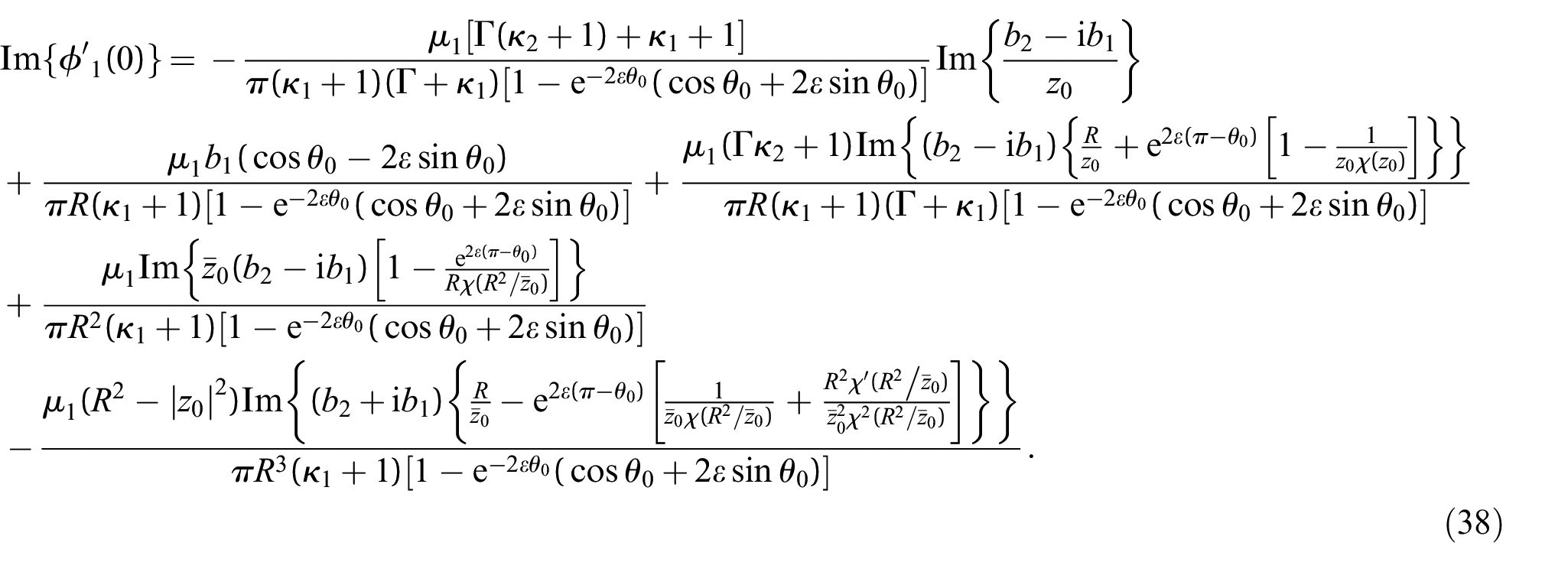
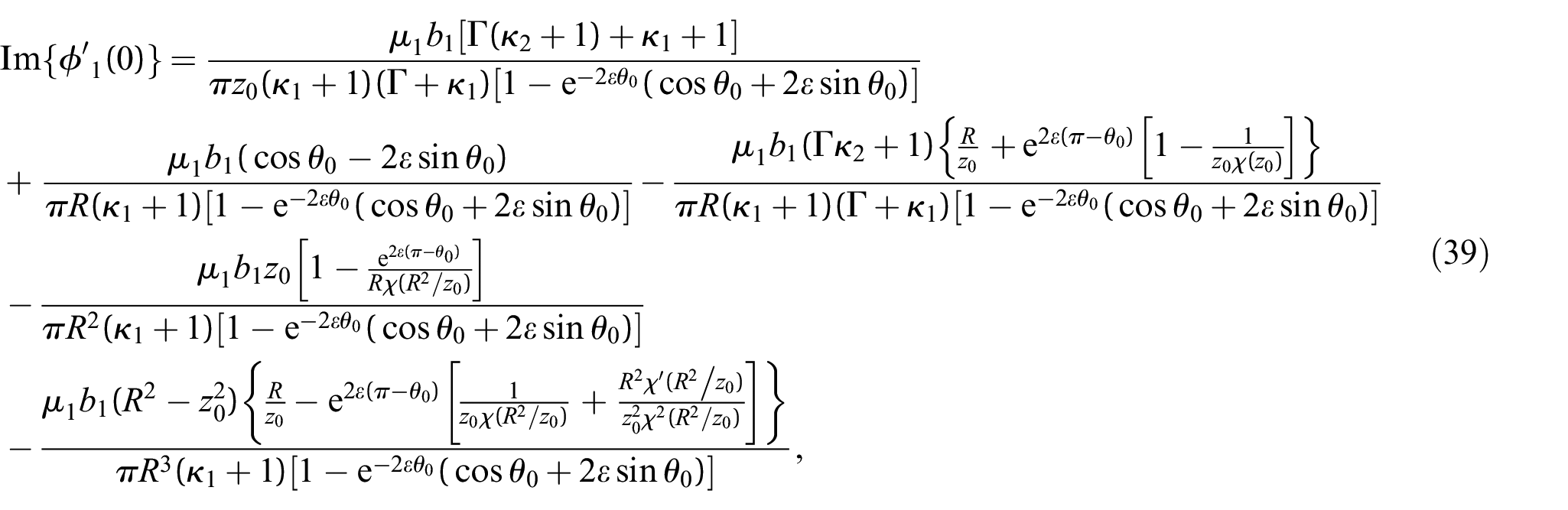
When the edge dislocation lies on the -axis, equation (38) becomes
which is unaffected by the component of the Burgers vector.
When the edge dislocation approaches the debonded portion of the circular interface, equation (38) reduces to
which is unaffected by the specific position of the edge dislocation and the component of the Burgers vector.
When the edge dislocation is very far from the circular inhomogeneity, we find from equation (38) that
4. Physical quantities
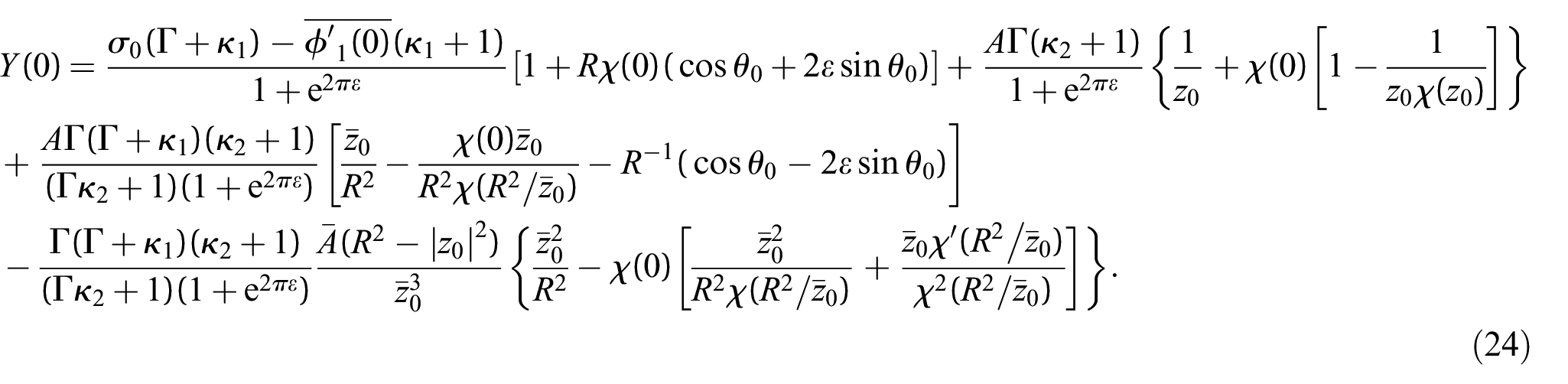
Now, is completely determined by equations (26) and (38) and by equation (27). This means that the auxiliary function has been completely determined, and consequently, the original two pairs of analytic functions defined in the circular inhomogeneity characterizing the elastic field in the inhomogeneity and defined in the matrix characterizing the elastic field in the matrix are determined from equations (7) and (11).
The average mean stress within the circular elastic inhomogeneity is given by
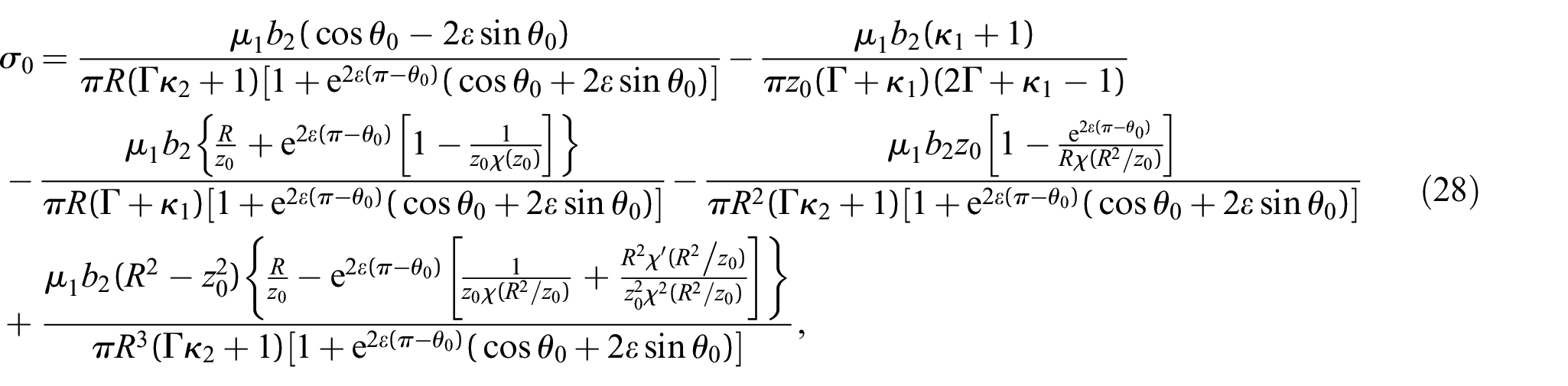
where <*> denotes the average over the circular inhomogeneity. Thus, the average mean stress within the circular inhomogeneity is independent of and the Poisson’s ratio of the matrix. When the inhomogeneity is completely debonded from the matrix with , the average mean stress within the circular inhomogeneity given by equation (42) is simply twice the value of given by equation (32). This is expected since in this extreme case, the internal stress field within the circular inhomogeneity is uniform and hydrostatic.
The rigid body rotation at the center of the circular inhomogeneity is determined by
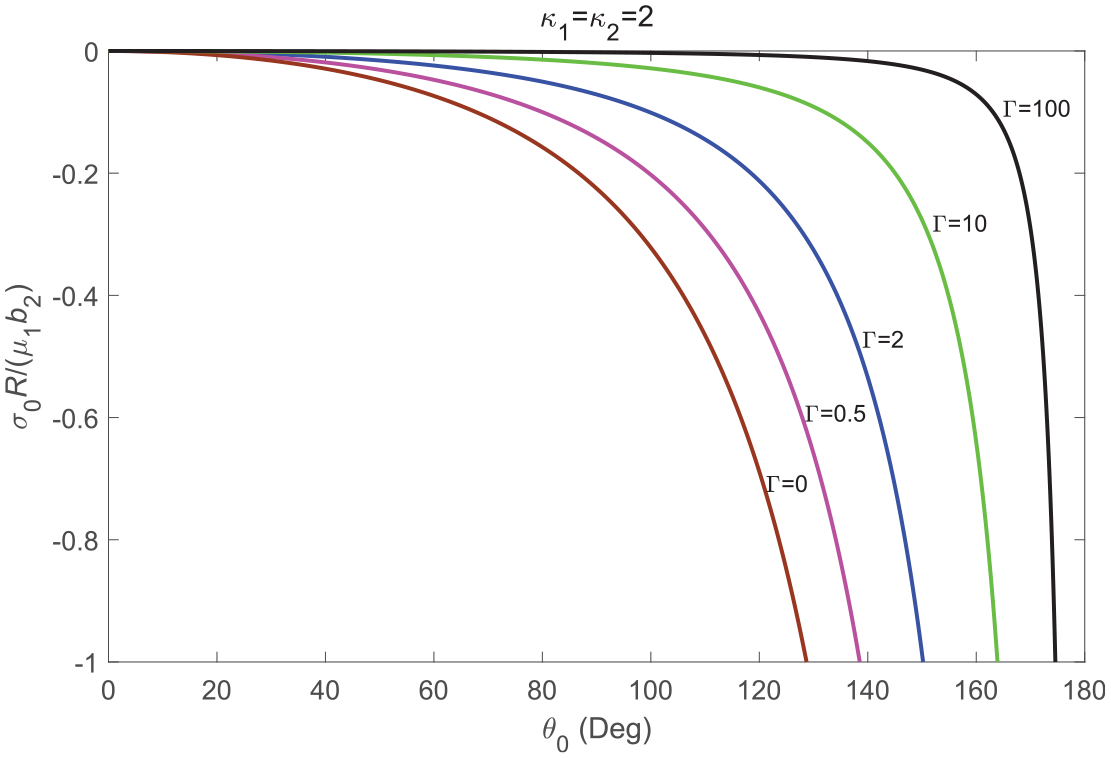
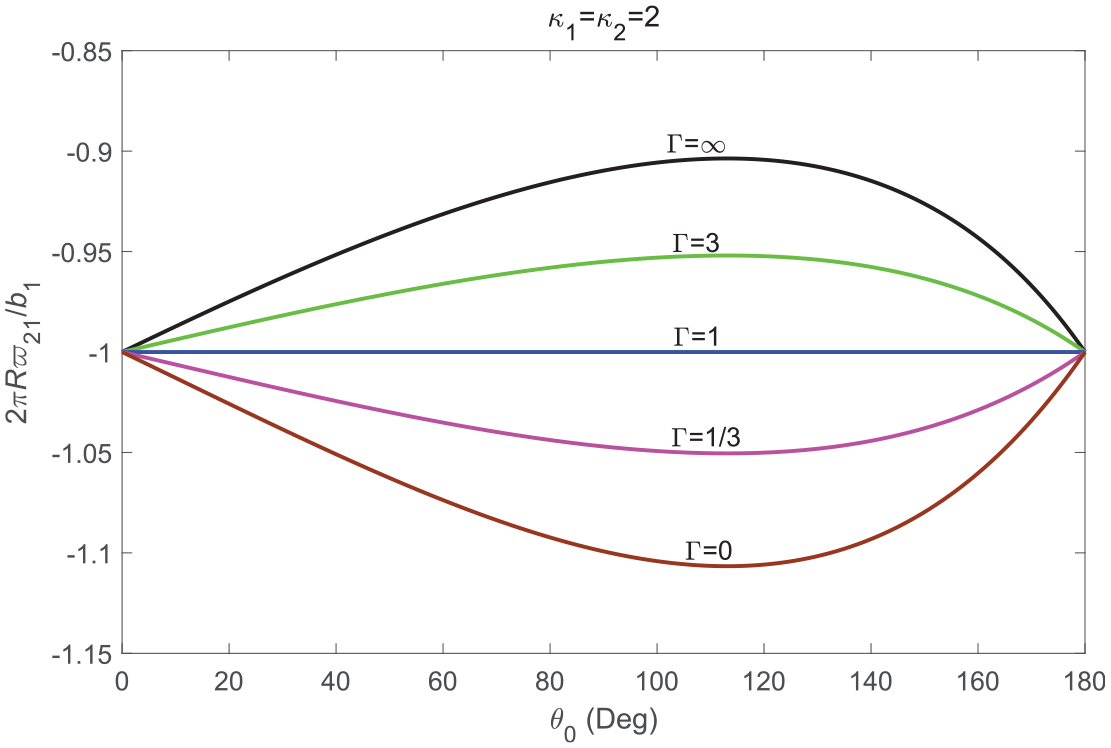
Thus, it follows from equations (39), (40) and (43) that the rigid body rotation at the center of the circular inhomogeneity is unaffected by the component of the Burgers vector of an edge dislocation lying on the -axis and is unaffected by the component of the Burgers vector and the specific position of an edge dislocation approaching the debonded portion . We illustrate in Figure 5 the rigid body rotation at the center of the circular inhomogeneity induced by an edge dislocation approaching determined from equations (40) and (43) as follows
It is seen from Figure 5 that (1) and always have opposite signs; (2) when for any value of Γ or when for any value of ; and (3) when , when . In fact, it is seen from equation (44) that when , the rigid body rotation at the center of the circular inhomogeneity induced by an edge dislocation approaching is simply for any value of .
Variations of as a function of for different values of Γ determined by equation (44) with .
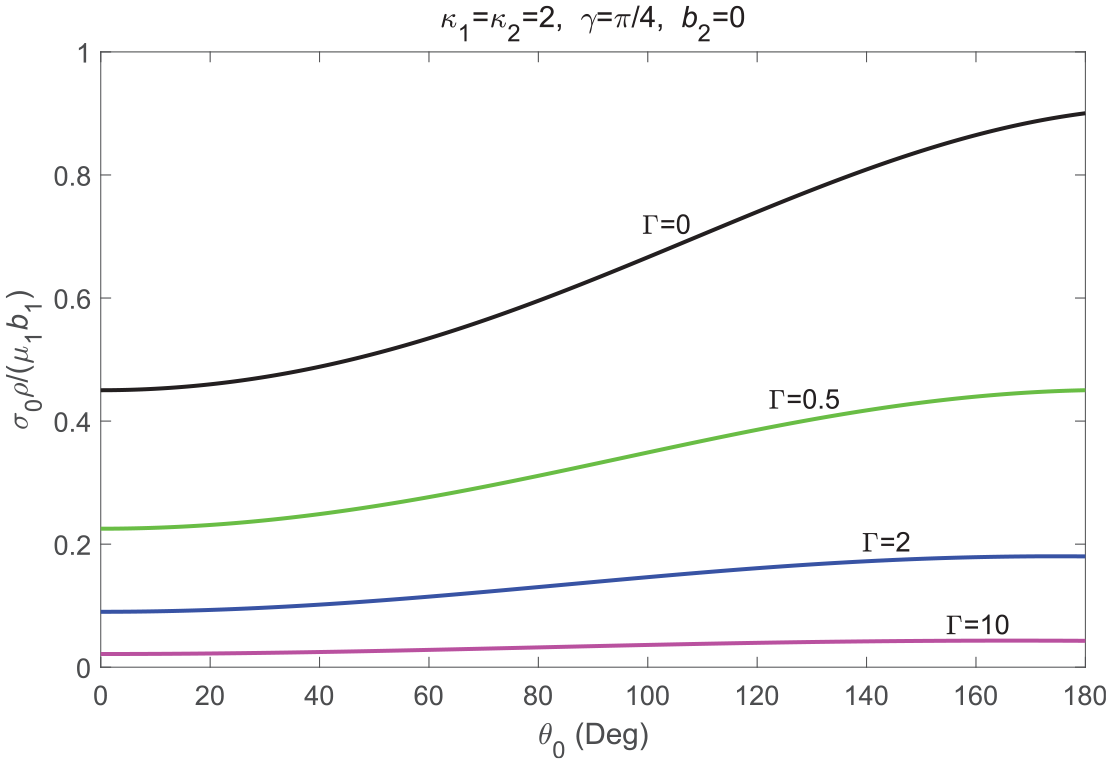
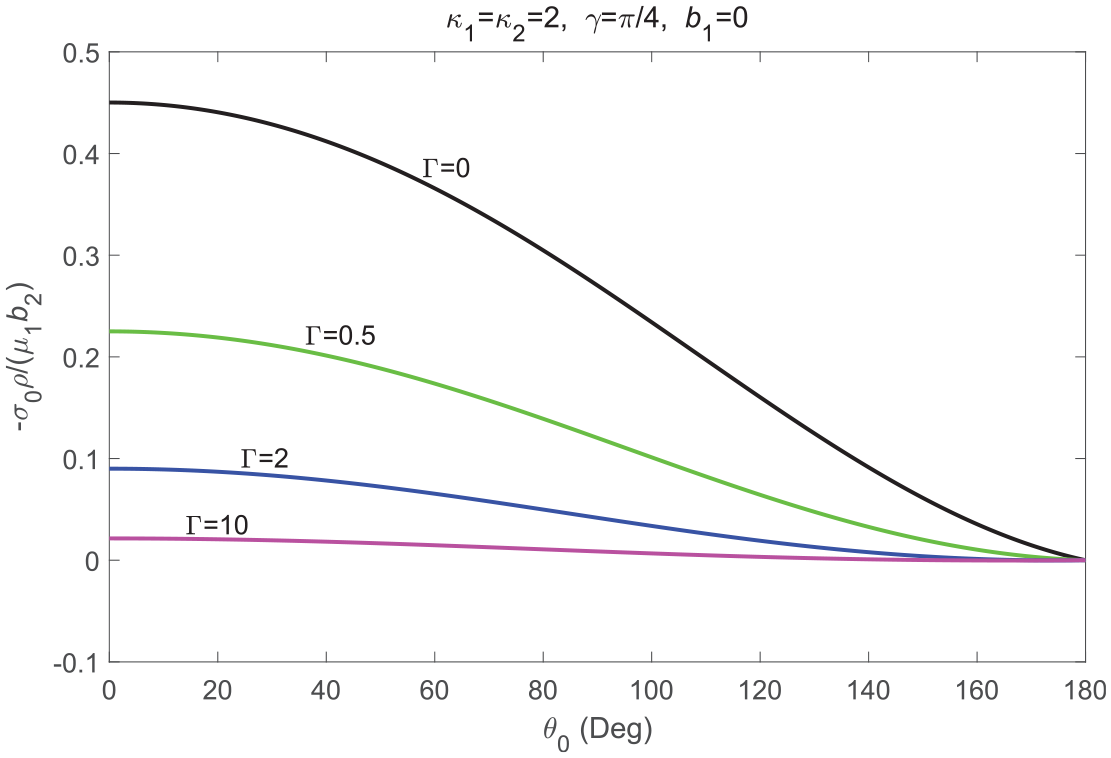
When the edge dislocation is very far from the circular inhomogeneity, we obtain from equations (41) and (43) that
which is the result for a perfectly bonded circular inhomogeneity, and
which can be confirmed from Figures 6 and 7. It is seen from equations (46) and (47) that the values of when and are independent of the elastic properties of both the circular inhomogeneity and the matrix.
Variations of as a function of for different values of Γ determined by equation (45) with .
Variations of as a function of for different values of Γ determined by equation (45) with .
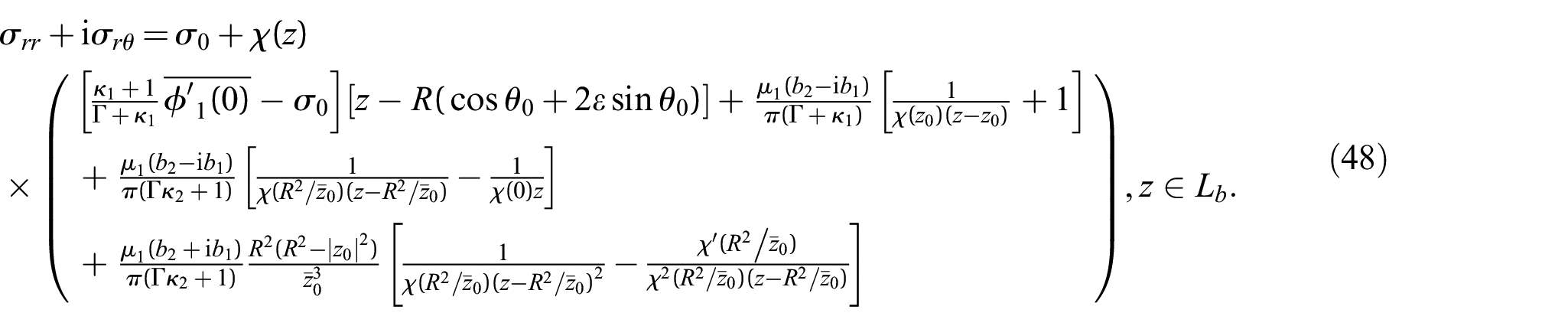
The normal and tangential tractions are distributed along the bonded portion of the circular interface as
It is seen from equation (48) that the normal and tangential tractions exhibit the oscillatory singularities at the two tips and . More specifically, from equation (48), we see that
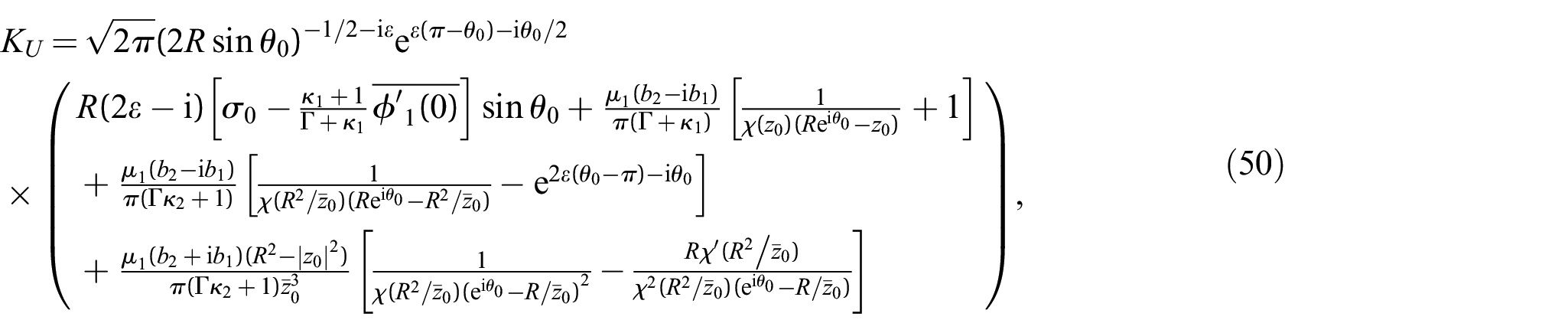
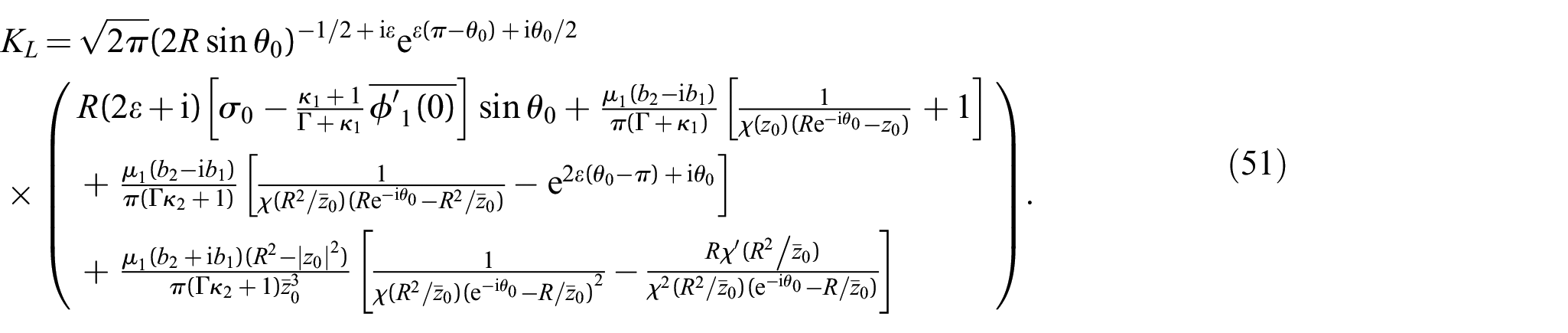
where the two complex stress intensity factors and are defined by
and
It is seen from equations (50) and (51) that when the edge dislocation lies on the -axis, (1) when the Burgers vector contains only the component and (2) when the Burgers vector contains only the component.
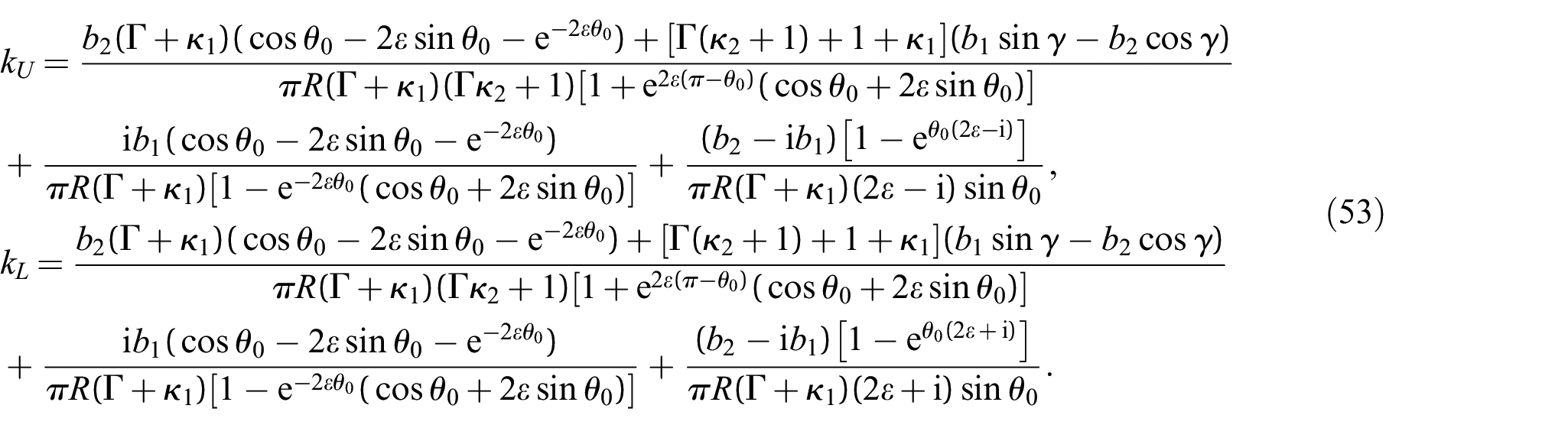
When the edge dislocation approaches the debonded portion of the circular interface, equations (50) and (51) reduce to
where the two dimensionless complex numbers and are defined by
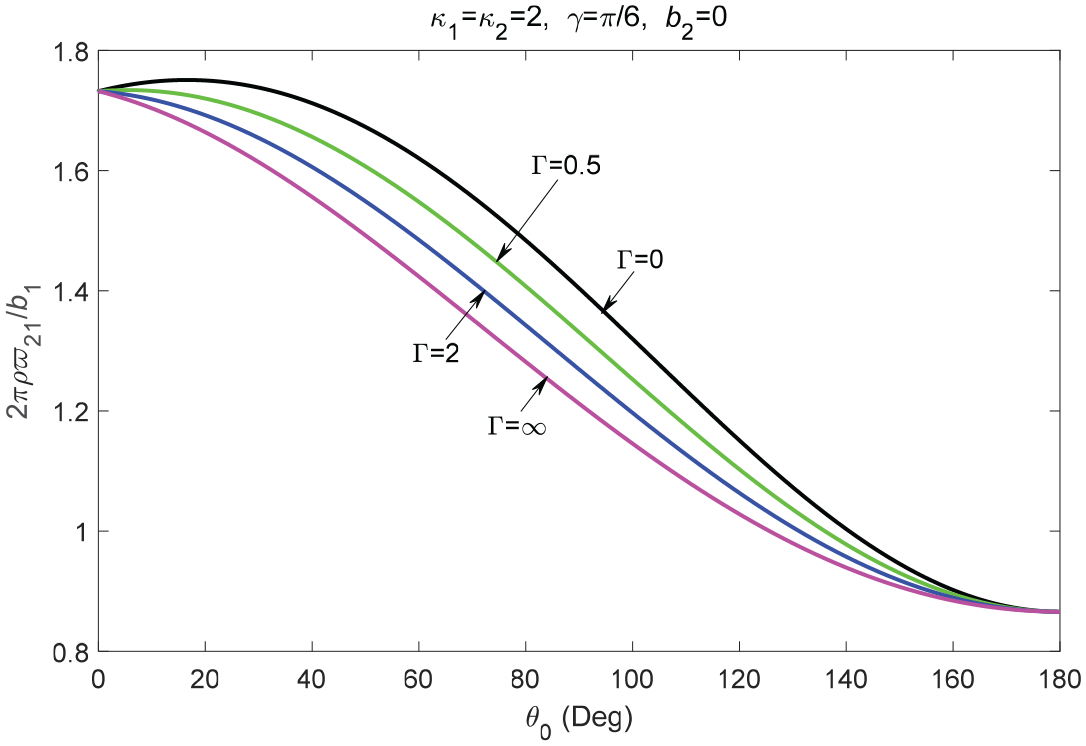
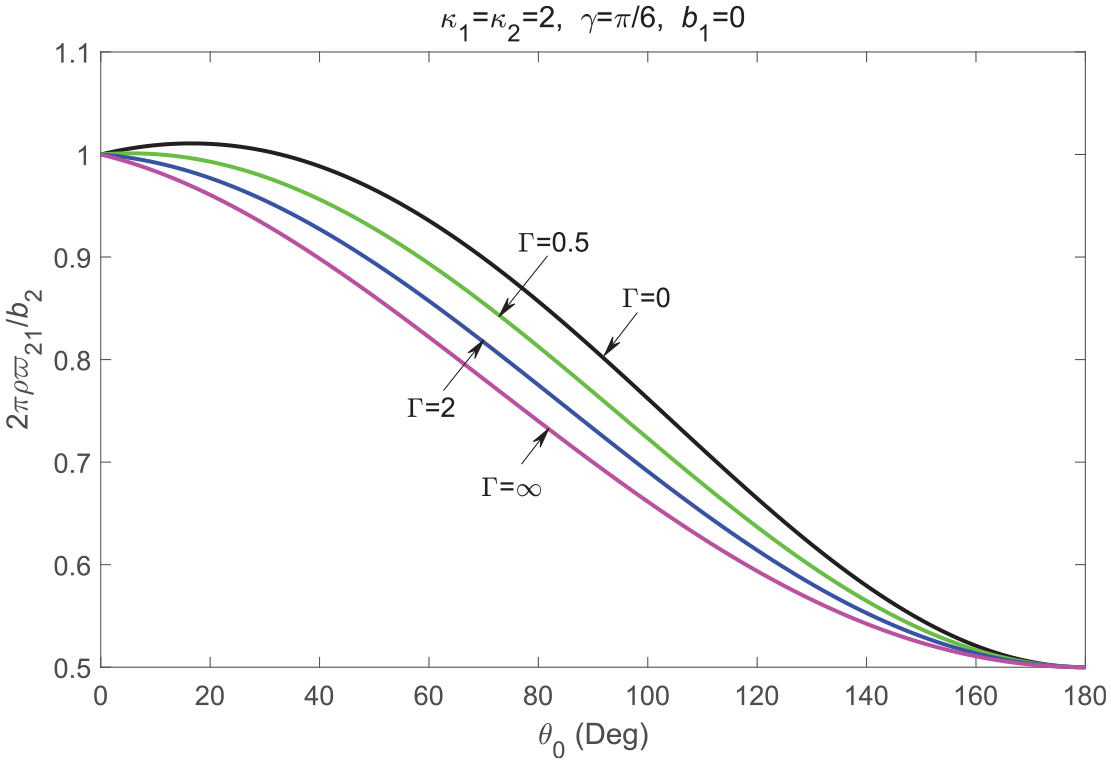
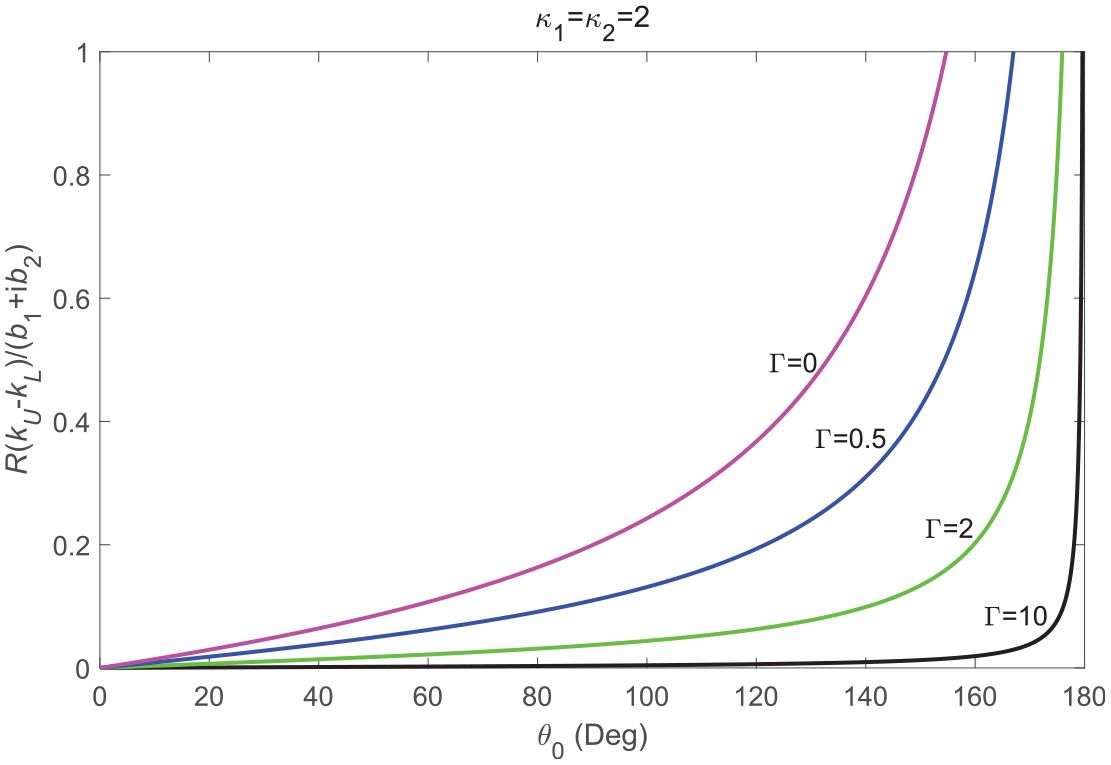
It is seen from equation (53) that (1) and remain finitely valued when the edge dislocation approaches the two tips of the debonded portion (i.e., ) and (2) is independent of the specific position of the edge dislocation described by γ and is given by
which is illustrated in Figure 8. It is seen from Figure 8 that the difference level increases as increases and/or Γ decreases.
Variations of as a function of for different values of Γ determined by equation (54) with .
Using the Peach–Koehler formula [18], we can further calculate the image force acting on the edge dislocation.
5. Conclusion
We have derived a closed-form solution to the interaction problem associated with an edge dislocation near a partially debonded circular elastic inhomogeneity with the debonded portion filled with an incompressible liquid slit inclusion. The original boundary value problem is reduced to a Riemann–Hilbert problem in equations (12) and (15) whose closed-form analytical solution is given by equation (17). By imposing the incompressibility condition of the liquid inclusion, the two unknowns and appearing in the solution are uniquely determined by equations (26), (27) and (38), revealing the original two pairs of analytic functions and characterizing the elastic fields in the circular inhomogeneity and the matrix, respectively. Obtained in closed-form are the internal uniform hydrostatic tension within the liquid inclusion in equation (27), the average mean stress within the circular inhomogeneity in equation (42), the rigid body rotation at the center of the circular inhomogeneity in equation (43), and the two complex stress intensity factors at the two tips in equations (50) and (51). When the edge dislocation approaches the debonded portion of the circular interface, the corresponding expressions do not contain the Plemelj function and are thus elementary (see equations (29), (44), (52) and (53)). When the edge dislocation is very far from the circular inhomogeneity, elementary and explicit expressions for the internal uniform hydrostatic tension within the liquid inclusion and the rigid body rotation at the center of the circular inhomogeneity are obtained in equations (33) and (45).
Footnotes
Declaration of conflicting interests
The author(s) declared no potential conflicts of interest with respect to the research, authorship, and/or publication of this article.
Funding
The author(s) disclosed receipt of the following financial support for the research, authorship, and/or publication of this article: This work was supported by a Discovery Grant from the Natural Sciences and Engineering Research Council of Canada (grant no. RGPIN-2023-03227 Schiavo).
ORCID iD
Peter Schiavone
References
1.
StyleRWWettlauferJSDufresneER. Surface tension and the mechanics of liquid inclusions in compliant solids. Soft Matter2015; 11(4): 672–679.
2.
GhoshKLopez-PamiesO. Elastomers filled with liquid inclusions: theory, numerical implementation, and some basic results. J Mech Phys Solids2022; 166: 104930.
3.
GhoshKLefevreVLopez-PamiesO. The effective shear modulus of a random isotropic suspension of monodisperse liquid n-spheres: from the dilute limit to the percolation threshold. Soft Matter2023; 19: 208–224.
4.
StyleRWBoltyanskiyRAllenB, et al. Stiffening solids with liquid inclusions. Nat Phys2015; 11(1): 82–87.
5.
MancarellaFStyleRWWettlauferJS. Interfacial tension and a three-phase generalized self-consistent theory of non-dilute soft composite solids. Soft Matter2016; 12: 2744–2750.
6.
WuJRuCQZhangL. An elliptical liquid inclusion in an infinite elastic plane. Proc Royal Soc A2018; 474(2215): 20170813.
7.
ChenXLiMXYangM, et al. The elastic fields of a compressible liquid inclusion. Extreme Mech Lett2018; 22: 122–130.
8.
ChenXLiMLiuS, et al. Mechanics tuning of liquid inclusions via bio-coating. Extreme Mech Lett2020; 41: 101049.
9.
KrichenSLiuLPSharmaP. Liquid inclusions in soft materials: capillary effect, mechanical stiffening and enhanced electromechanical response. J Mech Phys Solids2019; 127: 332–357.
10.
DaiMHuaJSchiavoneP. Compressible liquid/gas inclusion with high initial pressure in plane deformation: modified boundary conditions and related analytical solutions. Euro J Mech A-Solids2020; 82: 104000.
11.
DaiMHuangCSchiavoneP. Modified closed-form solutions for three-dimensional elastic deformations of a composite structure containing macro-scale spherical gas/liquid inclusions. Appl Math Modelling2021; 97: 57–68.
12.
TiFChenXYangH, et al. A theory of mechanobiological sensation: strain amplification/attenuation of coated liquid inclusion with surface tension. Acta Mech Sin2021; 37(1): 145–155.
13.
TiFChenXLiMX, et al. Cylindrical compressible liquid inclusion with surface effects. J Mech Phys Solids2022; 161: 104813.
14.
GhoshKLefevreVLopez-PamiesO. Homogenization of elastomers filled with liquid inclusions: the small-deformation limit. J Elasticity2023; 154: 235–253.
15.
WangXSchiavoneP. An incompressible liquid slit between dissimilar anisotropic elastic media. Euro J Mech A/solids2024; 104: 105197.
16.
WangXSchiavoneP. A partially debonded circular elastic inhomogeneity with an incompressible liquid inclusion occupying the debonded section. Acta Mech2024; 235: 897–906.
17.
WangXSchiavoneP. A partially debonded rigid elliptical inclusion with a liquid slit inclusion occupying the debonded portion. Math Mech Solids2024; 29(11): 2224–2235.
18.
DundursJ. Elastic interaction of dislocations with inhomogeneities. In: MuraT., ed. Mathematical theory of dislocations. New York: American Society of Mechanical Engineers, 1969, pp. 70–115.