




Abstract
We use Muskhelishvili’s complex variable formulation to study the interaction problem associated with a circular incompressible liquid inclusion embedded in an infinite isotropic elastic matrix subjected to the action of an edge dislocation at an arbitrary position. A closed-form solution to the problem is derived largely with the aid of analytic continuation. We obtain, in explicit form, expressions for the internal uniform hydrostatic stresses, nonuniform strains and nonuniform rigid body rotation within the liquid inclusion; the hoop stress along the liquid-solid interface on the matrix side and the image force acting on the edge dislocation. We observe that (1) the internal strains and rigid body rotation within the liquid inclusion are independent of the elastic property of the matrix; (2) the internal hydrostatic stress field within the liquid inclusion is unaffected by Poisson’s ratio of the matrix and is proportional to the shear modulus of the matrix; and (3) an unstable equilibrium position always exists for a climbing dislocation.
Keywords
1. Introduction
A composite consisting of a solid matrix and liquid inclusions (e.g., ionic liquids, liquid metals and ferrofluids) exhibits unique mechanical and physical properties such as enhancement of overall deformability [1] and a stiffening phenomenon when the liquid inclusions are “small” allowing for a significant surface effect [2–4]. The micromechanics analysis of liquid inclusions has attracted considerable attention from researchers recently. The objective is always to predict the local microscopic and overall macroscopic responses of composites containing liquid inclusions [2–11]. Although the study of dislocations interacting with elastic inclusions (or elastic inhomogeneities) has a long history [12–15], the problem of dislocations interacting with liquid inclusions has seldom been considered.
In this paper, using Muskhelishvili’s [16] complex variable formulation for plane elasticity, we solve the interaction problem associated with a circular incompressible liquid inclusion in an infinite isotropic elastic matrix under the action of an edge dislocation located at an arbitrary position. We derive a closed-form solution to the problem with the aid of analytic continuation [17]. We obtain two pairs of analytic functions: one pair defined in the incompressible liquid inclusion and the other in the matrix. Elementary and explicit expressions for the internal uniform hydrostatic tension, nonuniform strains and nonuniform rigid body rotation within the liquid inclusion and the hoop stress along the liquid-solid interface on the matrix side are presented. We find that the internal strains and rigid body rotation within the liquid inclusion are independent of the elastic property of the matrix. In addition, we show that the internal uniform hydrostatic tension is proportional to the shear modulus of the matrix and is unaffected by Poisson’s ratio of the matrix. The image force acting on the edge dislocation is obtained using the Peach–Koehler formula [12]. A gliding dislocation is always attracted to the circular interface, whereas an unstable equilibrium position emerges for a climbing dislocation. The existence of the equilibrium position for the climbing dislocation is attributed to the contribution from the internal uniform hydrostatic tension within the liquid inclusion. The acquired analytical solution for an edge dislocation can be further employed to study the interaction of a mode I or mode II finite crack interacting with a circular incompressible liquid inclusion under uniform remote in-plane stresses.
2. Complex variable formulation
We first establish a fixed rectangular coordinate system

and

where

Furthermore, the in-plane strains

3. An edge dislocation interacting with a circular incompressible liquid inclusion
As shown in Figure 1, we consider a circular incompressible liquid inclusion of radius R, centered at the origin of the coordinate system, embedded in an infinite isotropic elastic matrix subjected to the action of an edge dislocation with Burgers vector
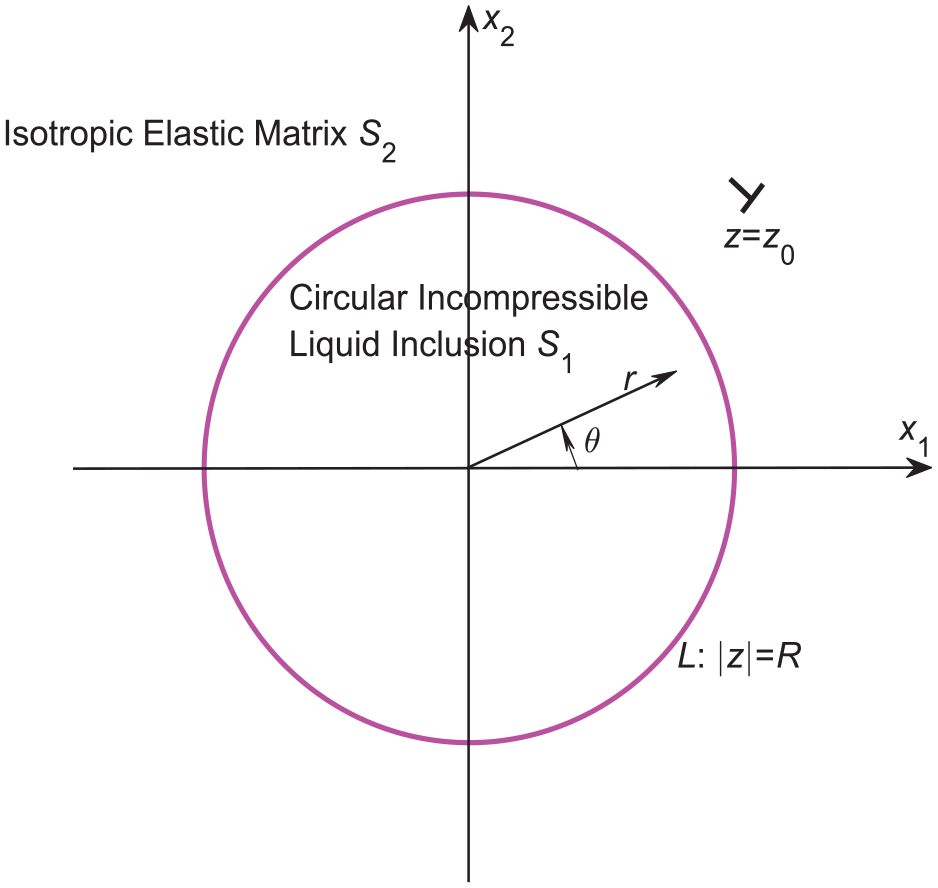
A circular incompressible liquid inclusion embedded in an infinite isotropic elastic matrix under the action of an edge dislocation located at
The most general form of the displacements and stress functions within the circular incompressible liquid inclusion is given by

where
In the ensuing analysis, for convenience, we introduce the following analytic continuations [17]:

Thus, the continuity conditions of displacements and tractions across the perfect liquid–solid interface

where the superscripts “+” and “−” indicate the values when approaching the circle
Equation (7)1 can be rewritten as

where

We can see that the left-hand side of equation (8) is analytic and single valued everywhere within the circle, and that the right-hand side of equation (8) is analytic and single valued everywhere outside the circle including the point at infinity. Using Liouville’s theorem, we arrive at the following relationships

Substituting equation (10) into equation (7)2 yields

The left-hand side of equation (11) is analytic and single valued everywhere inside the circle, and the right-hand side of equation (11) is analytic and single valued everywhere outside the circle including the point at infinity. Again using Liouville’s theorem, we arrive at the following expressions for

Inserting equation (12) into equation (10), we deduce that the function

From equation (12)1, we find that

Consequently,

From equation (15)1, we see that the internal hydrostatic tension

and
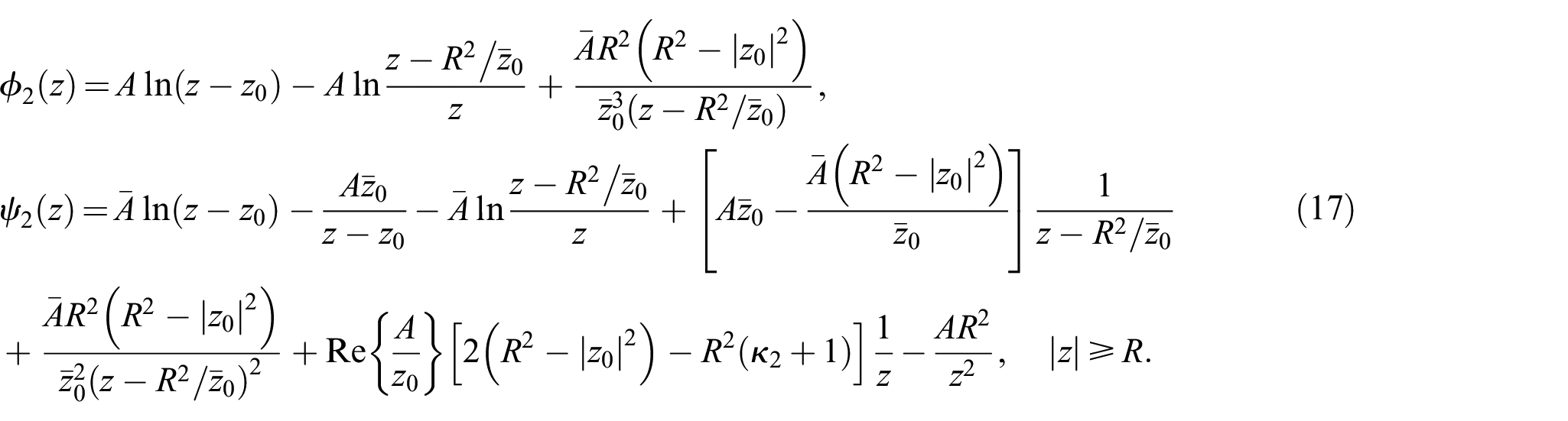
The internal nonuniform strains and nonuniform rigid body rotation within the liquid inclusion can be obtained from equation (4) with
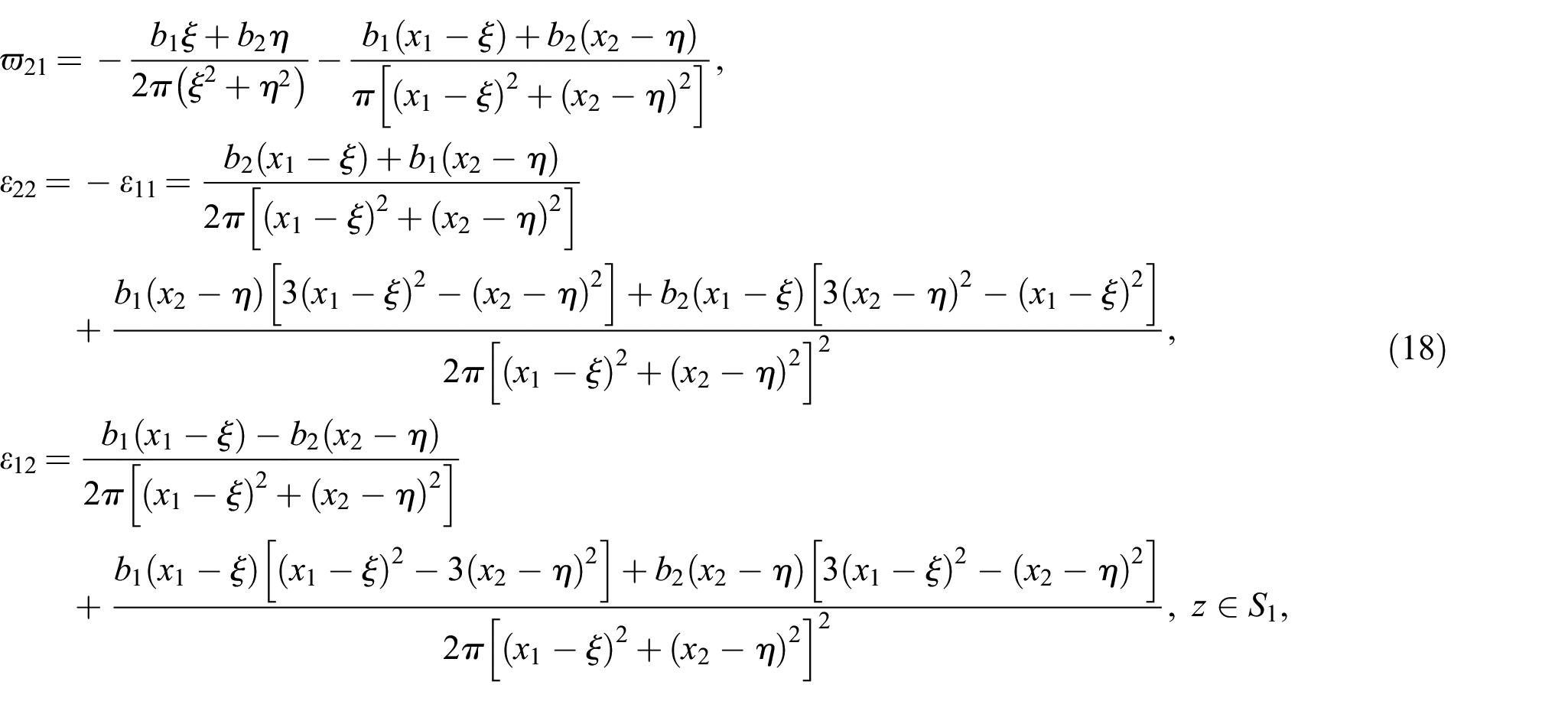
which is independent of the elastic property of the matrix
The hoop stress along the liquid-solid interface on the matrix side can be derived as

When the edge dislocation lies simply on the circular interface with

Using the Peach–Koehler formula [12], the image force acting on an edge dislocation lying on the

where

Consequently, we obtain from equations (21) and (22) the horizontal and vertical components of the image force as

It is seen from equation (23)2 that the vertical component of the image force

In this case, the gliding dislocation is always attracted to the circular interface. Equation (24) becomes equation (7.8) with
When the edge dislocation lying on the

Equation (25) cannot reduce to equation (7.9) with

it is repelled from the interface when

and it has an unstable equilibrium position at

The climbing dislocation is always attracted to the circular interface when the matrix becomes incompressible with
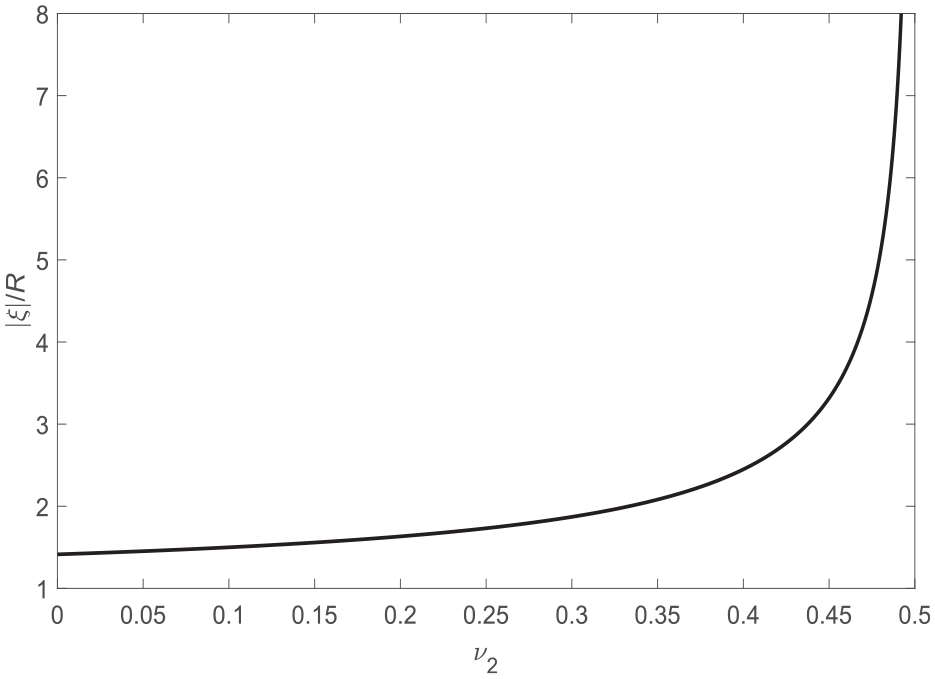
Variation of the unstable equilibrium position for a climbing dislocation as an increasing function of
4. Conclusion
A closed-form solution has been derived to the plane strain problem associated with an edge dislocation located at an arbitrary position in an infinite isotropic elastic matrix interacting with a nearby circular incompressible liquid inclusion. The two pairs of analytic functions
Footnotes
Funding
The author(s) disclosed receipt of the following financial support for the research, authorship, and/or publication of this article: This work was supported by a Discovery Grant from the Natural Sciences and Engineering Research Council of Canada (grant no. RGPIN-2023-03227 Schiavo).
