




Abstract
Strain-gradient elasticity is a special case of high-gradient theories in which the potential energy density depends on the first and second gradient of the displacement field. The presence of a coupling term in the material law leads to a non-diagonal quadratic form of the stored energy, which makes it difficult for the derivation of fundamental theorems. In this article, two variational principles of the minimum of potential and complementary energies are argued in the context of the coupled strain-gradient elasticity theory. The basis of the proofs of both variational principles is the equivalent transformation of the stain and strain-gradient energy density that allows to avoid the complication related to the presence of the fifth-rank coupling tensor
Keywords
1. Introduction
Gradient continuum theories have a long history. Early works in this regard are Cosserat and Cosserat [1] and Hellinger [2]. Then in the 60th and early 70th of the last century, they were generalized in [3–8]. Next resurgence of interest to higher-gradient theories took place in numerous papers due to necessity to overcome some restrictions of the classical elasticity [9–25].
Unlike gradient continuum theories, classical elasticity has a sound basis. There are many theorems on which we can rely, many of them are summarized in Gurtin [26]. These are theorems regarding the existence and uniqueness of solutions, auxiliary theorems like Betty’s reciprocal theorem, Clapeyron’s work theorem, and de Saint Venant’s principle, variational formulations like the minimum principle of the elastic potential, the minimum principle of complementary energy, corresponding maximum principles, the principles of Hellinger-Reissner, de Veubeke-Hu-Washizu, and some others, Hooke’s law is fully explored for all anisotropy classes [27]. For all of these, representation theorems for the stiffness tetrad can be found. So, regarding the linear theory [26], can be considered a concluding work.
In gradient elasticity, the proofs of fundamental theorems are presented mainly for the uncoupled case, that is, when the coupling tensor of fifth-order is assumed to be equal to zero. However, by dropping the coupling tensor of fifth order, it is restricted to centro-symmetric materials. This excludes 30% of all crystals [28] that may be piezo-active, and one can even construct isotropic materials that are not centro-symmetric, like an entangled bundle of coil springs of equal chirality.
The uniqueness theorem for isotropic, uncoupled gradient elasticity is given by Mindlin and Eshel [7]. The proof is based on the assumption of positive definiteness of the stiffness tensors of the fourth- and sixth-orders. Mindlin’s uniqueness proof holds for mixed boundary conditions, and there are no restrictions regarding the shape of the domain. Conditions of positive definiteness in absence of coupling terms were presented also in previous works [5,29]. The inequality constraints obtained by Mindlin [5] and Dell’Isola et al. [29] have been extended for the case of coupled strain-gradient elasticity by Nazarenko et al. [30]. To this end, it has been used so-called block diagonalization of the composite stiffness [31]. Such an equivalent transformation makes it possible to obtain the necessary conditions of positive definiteness and convexity of the hemitropic strain and strain-gradient energy, including the coupling stiffness
The principles of the minimum of the elastic potential (PMEP), which is minimized over the displacement field, and the principle of the minimum of the complementary potential (PMCP), which is minimized over the stress field, are elementary variational formulations of the elastostatic boundary value problem [26]. They serve as starting point for the construction of approximate solutions, they are needed for different mean value theorems, and they give upper bounds for the stored elastic energy and the global stiffness of elastic systems. All of this has important practical applications, for numerical solution methods like the FEM (approximate solutions) and as bounds for effective stiffness’s in homogenization theory (upper bounds). Likewise, maximum principles have been formulated. In homogenization theory, they give with the absence of body forces the lower bounds for the stored energy and hence for the effective stiffness.
Following Gurtin [26], the origin of the PMEP is hard to trace and goes probably back to the middle of the 19th century to Green and Kirchhoff. It can be derived from the virtual power principle by replacing the virtual stress power by the virtual change of the elastic energy. With appropriate assumptions regarding the test function, the principle of virtual power becomes the first variation of the elastic potential. Alternatively one can start from the local balance of momentum, multiply by a test functions and integrate. The independent function is the displacement field in the PMEP. Since the displacement method is much more popular than the force method (or flexibility method), it is fundamental to many finite-element implementations.
The PMCP is from the beginning of the 20th century. Its derivation involves stricter assumptions (star convex domains) and is hence less general than the PMCP. It requires statically admissible stress fields, of which the one that satisfies the stress boundary conditions also minimizes the complementary potential.
Since the starting point is the virtual power, the generalization of the PMEP to gradient elasticity is relatively simple, see e.g. previous works [33–36]. The extension of the PMCP is less clear. There are some works, like Polizzotto [35] (section 3.1 therein) who examines a stress-gradient elasticity. The change of the independent variable from one displacement field to several stress fields (
In this work, we generalize and derive the PMEP and the PMCP for the case of the coupled strain-gradient elasticity. Representing of the complementary energy in the coupled strain-gradient elasticity is not a trivial problem itself [see for details Nazarenko et al.’s study 31]. Using the block diagonalization technique presented by Nazarenko et al. [31] and Nazarenko et al. [30] we reduce the potential and complementary energies to uncoupled form and then derive the principle of a minimum of the potential and complementary energies.
The structure of this paper is as follows. The next section briefly outlines the main relations for potential and complementary energies, their representation in decoupled form and variational equation of the stress equilibrium with the boundary conditions. The principles of minimum potential energy and minimum complementary energy are proven (novel) after that. Finally, the conclusions and discussion are given in the last section.
2. Coupled strain-gradient elasticity
2.1. Potential energy
For a first strain-gradient theory, the strain and strain-gradient energy can be written as

where

and
∇ is the three-dimensional nabla operator

The dots denote scalar contractions, where the double and triple scalar contractions are determined with regard to orthonormal base vectors


The tensors






and

can be treated as the strain gradient. In the first case, a third-order tensor with one index symmetry has 18 independent components. Linearized rotations removed from

are saved in accordance with the compatibility conditions

is a strain gradient.
Equation (1) can be equivalently transformed as follows

in order to present the strain and strain-gradient contributions as decoupled (see Nazarenko et al. [30]). Here the superscript

and

We define the transpose of

that is, in terms of indices

The decoupled matrix representation of the potential energy density can also be achieved by splitting a modified second gradient of displacement and modified stiffness tensor of fourth-rank (see Nazarenko et al. [31]):

As indicated above, the superscript

and

2.2. Complementary energy
2.2.1. Terminology and the special case of linear elasticity
The following different energies are usually distinguished: The strain energy is the stored energy as a function of the strains. In terms of scalar strains and stresses it is

For a linear stress strain relation

it is

Geometrically, it is the area below the stress–strain curve up to the point (
The final value of energy is the product
The complementary energy is the difference between the final value of energy and the strain energy,

For linear stress–strain relations, it is equal to the strain energy in value

It is usually associated with a change of the independent variable from the strains to the stresses. Then

is the Legendre transform of the function

is

with


which is why we can obtain the complementary energy once we can invert the stress–strain relation after getting rid of
2.2.2. The coupled strain-gradient elasticity

where


This is the generalized Hookean law. The inverse is


It has been demonstrated by Nazarenko et al. [31] that the both modified equations for the potential energy density equations (11), (16) can be used in order to specify the compliance tensors



or



where
2.3. Variational equation of the stress equilibrium and the boundary conditions
The equilibrium equations and the natural boundary conditions for the model under consideration can be obtained using the Lagrange variational principle

where

or we obtain

with the stresses

Applying the chain rule and the divergence theorem in the form

gives

and

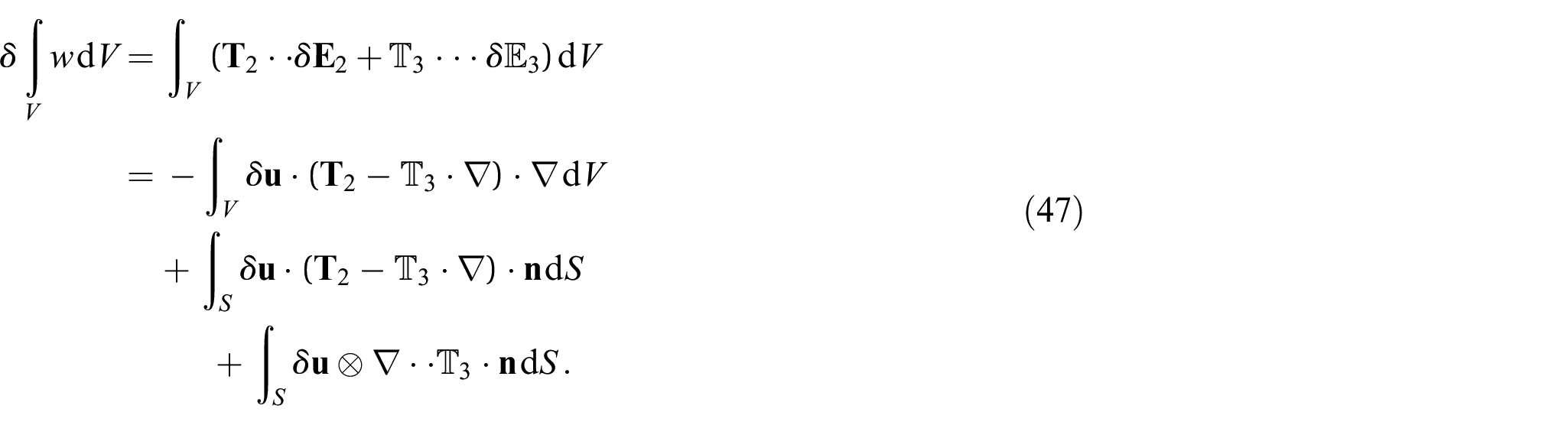
Given the identities equations (45) and (46), equation (43) can be presented as the sum of volume and surface integrals
It should be noted that

Here

and

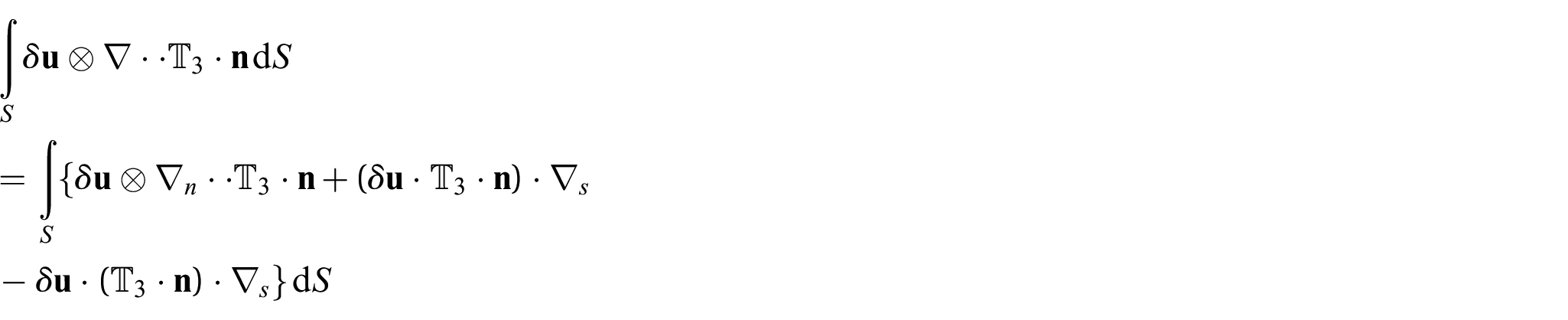
Decomposing the gradient of

We convert it into the sum of only independent variations

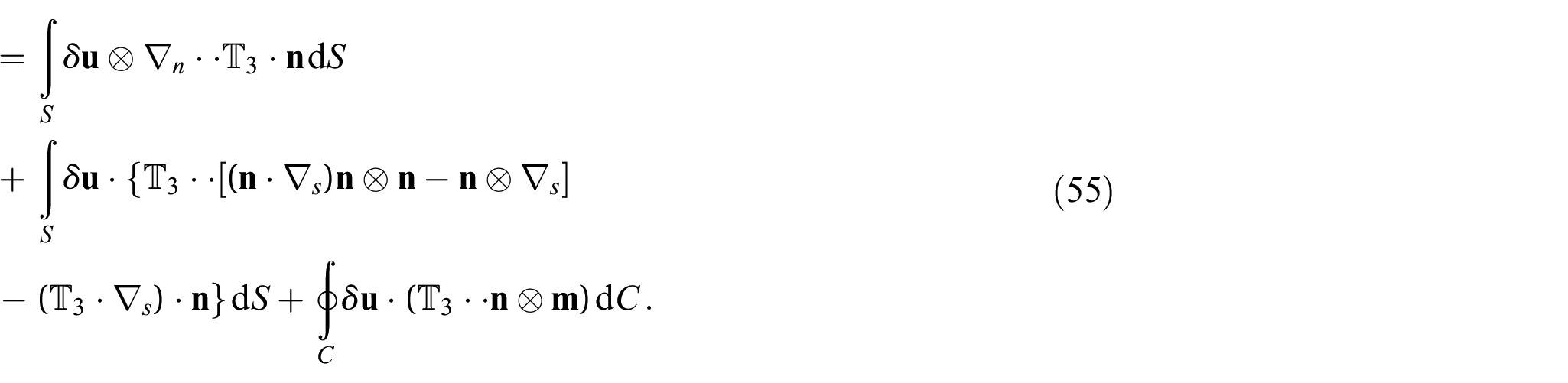
and using the surface divergence theorem in the form

with

where
Accounting for the identity equation (54) and equation (51), the last term in the variation of the total potential energy from equation (47) is
The variation of the total potential energy equation (47) can be written down as
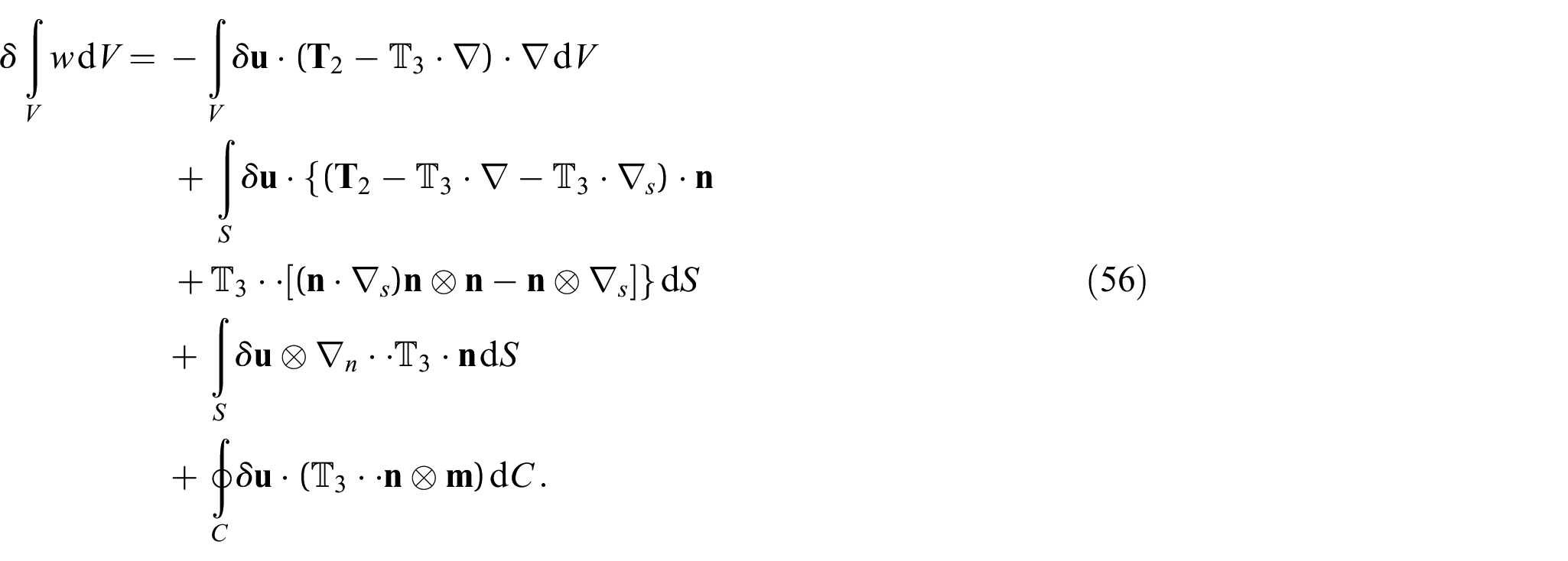
The admissible form of the work of external forces and double forces is governed by the variation of the strain and strain-gradient energy:

where

Here

and

The variation of the potential energy for all admissible functions

Accounting for equation (56), we obtain the stress equilibrium equation:

and the natural (static) boundary conditions for
The prescribed vector field of the tractions on the part of the body surface

The prescribed double tractions in normal direction on the

The prescribed line forces on edge on the part of edge

Here, the subscript
The kinematic boundary conditions in terms of the displacement



3. Variational principles
In this section, we present the proof of two variational principles for the coupled strain-gradient elasticity theory. One is the principle of the minimum potential energy, the other is the principle of the minimum complementary energy.
3.1. Principle of minimum potential energy

where the following fields are prescribed:
The body force
The tractions
The double tractions in normal direction
The line forces on edge
where
Then the functional

If equality holds, then

where

and


Then

where

Given that

and the identity

We have

The last term of the above equation can be written in accordance with equations (43) and (56) in terms of the displacement variation for zero-displacement boundary conditions on
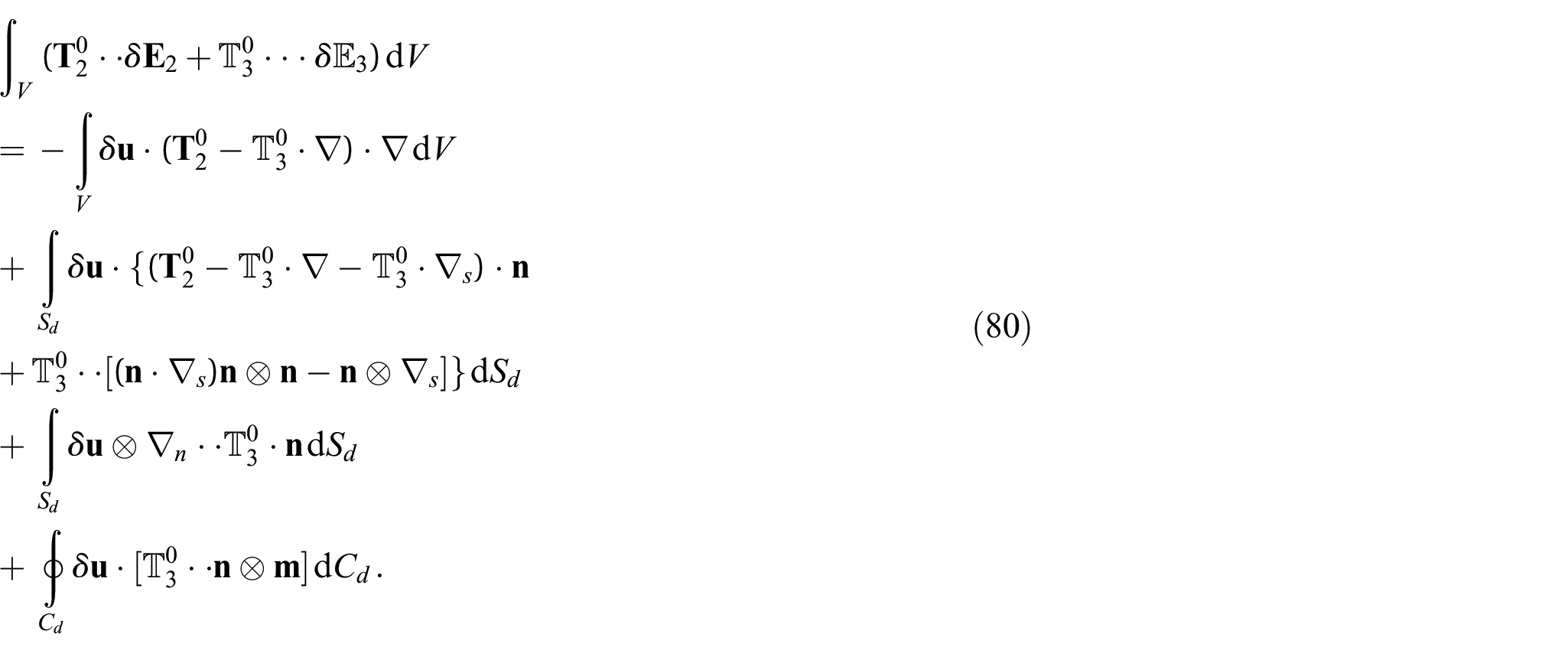
Thus
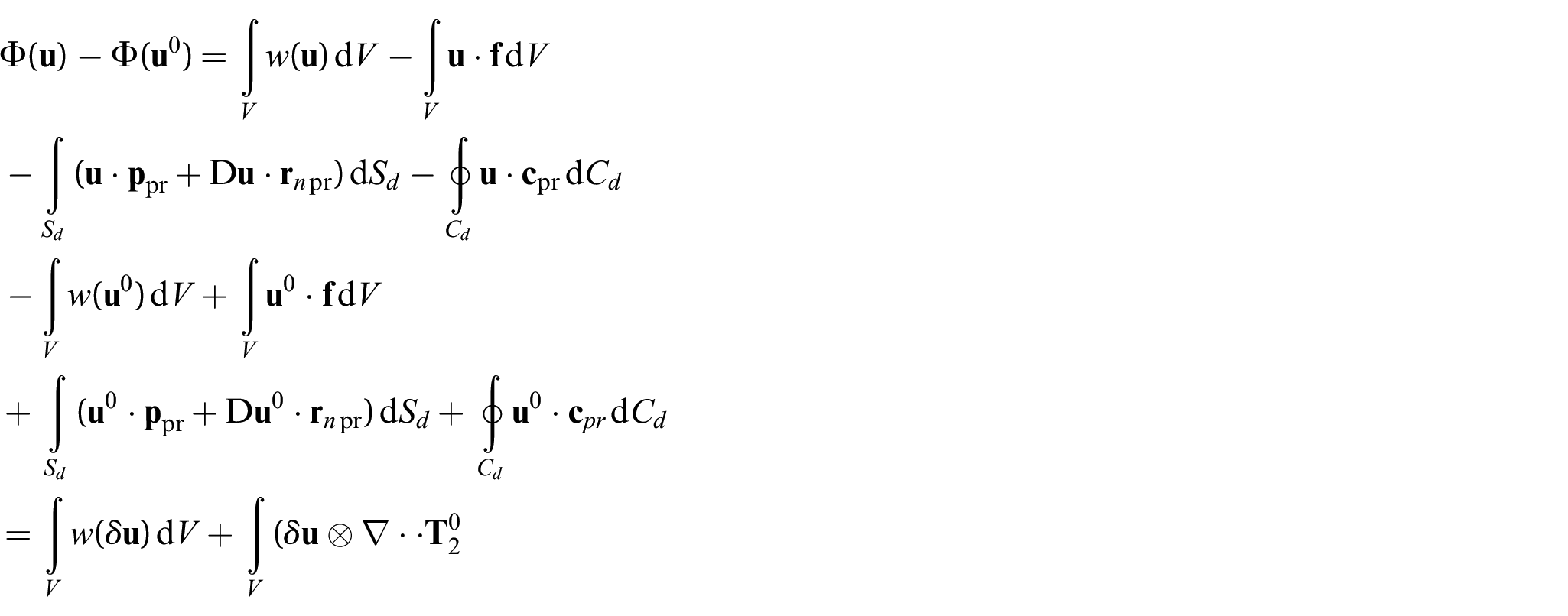
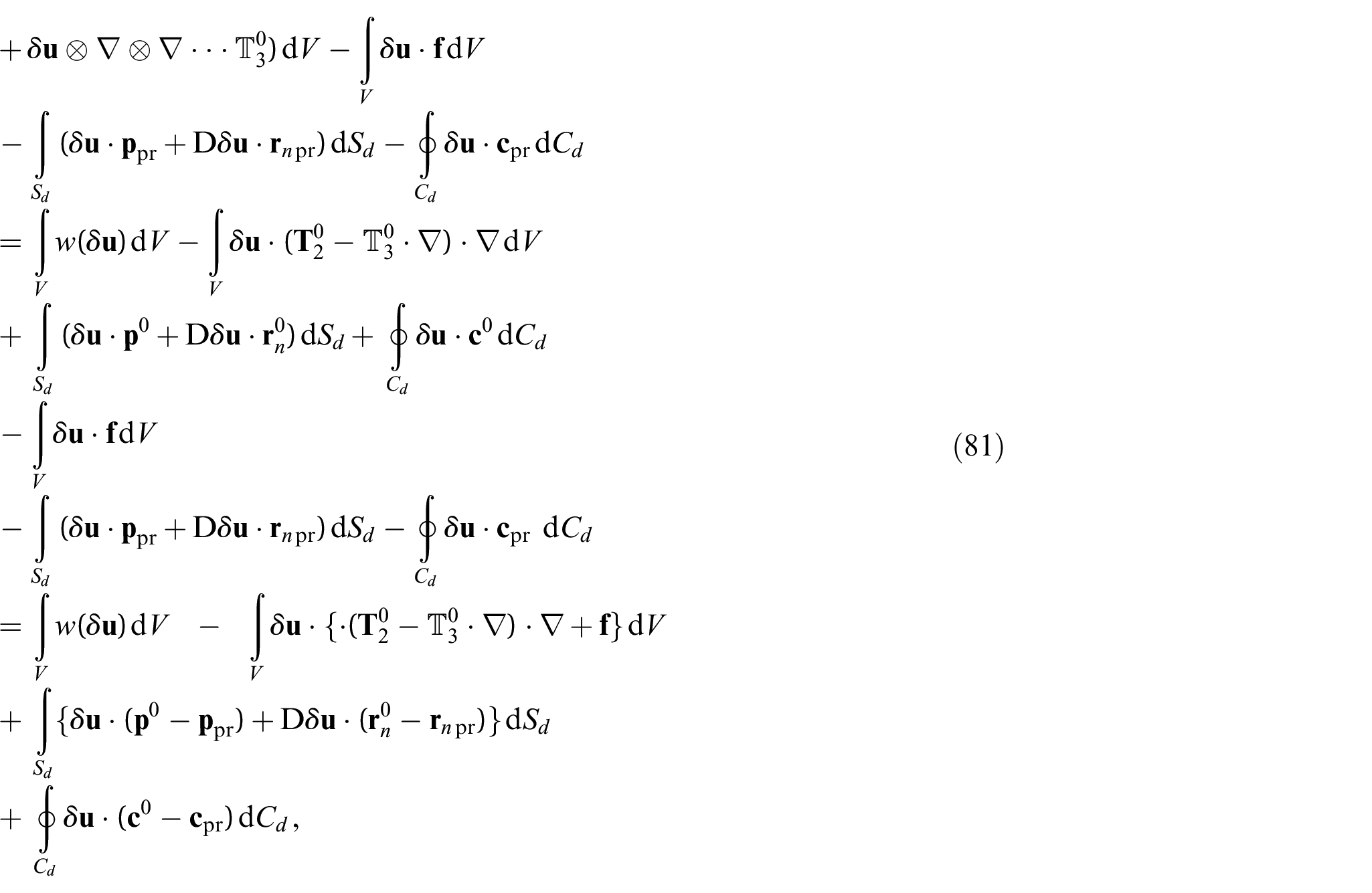
with

Since

Equality holds if and only if

or

Therefore, the two displacement fields can only differ by an (infinitesimal) rigid body motion

where

3.2. Principle of minimum complementary energy

and the natural (static) boundary conditions for the following prescribed fields:
The vector field of the tractions
The double tractions in normal direction
The line forces on edge
with

with the complementary elastic energy

If equality holds, then

Then
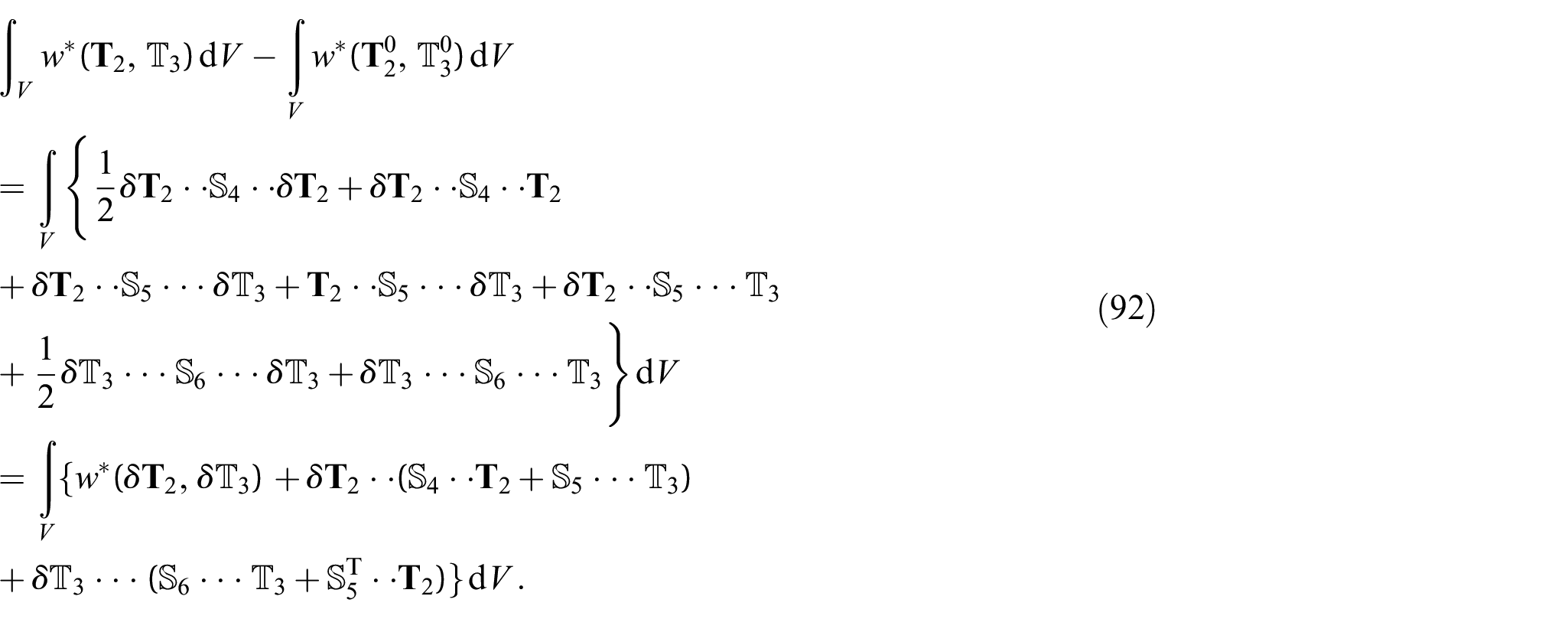
Given that

We obtain

Accounting for equation (2), we obtain (see details in Nazarenko et al. [32])
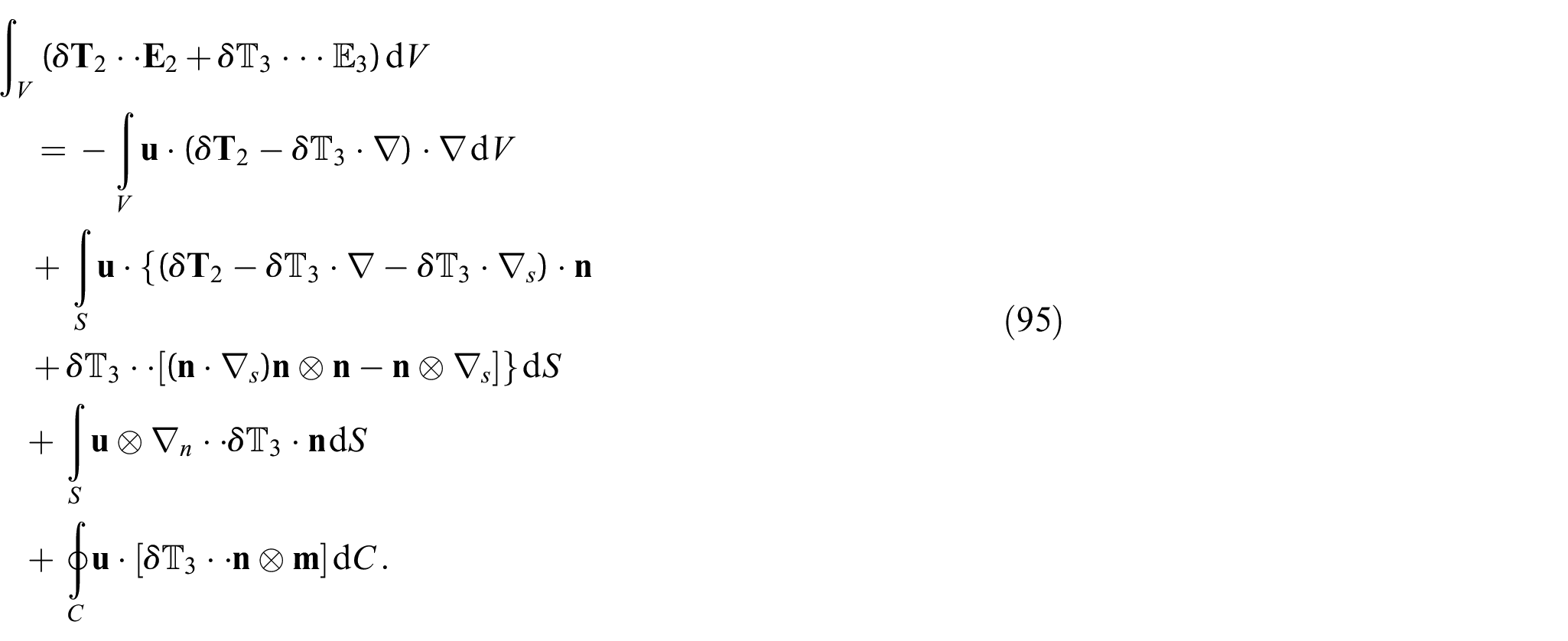
Thus, since
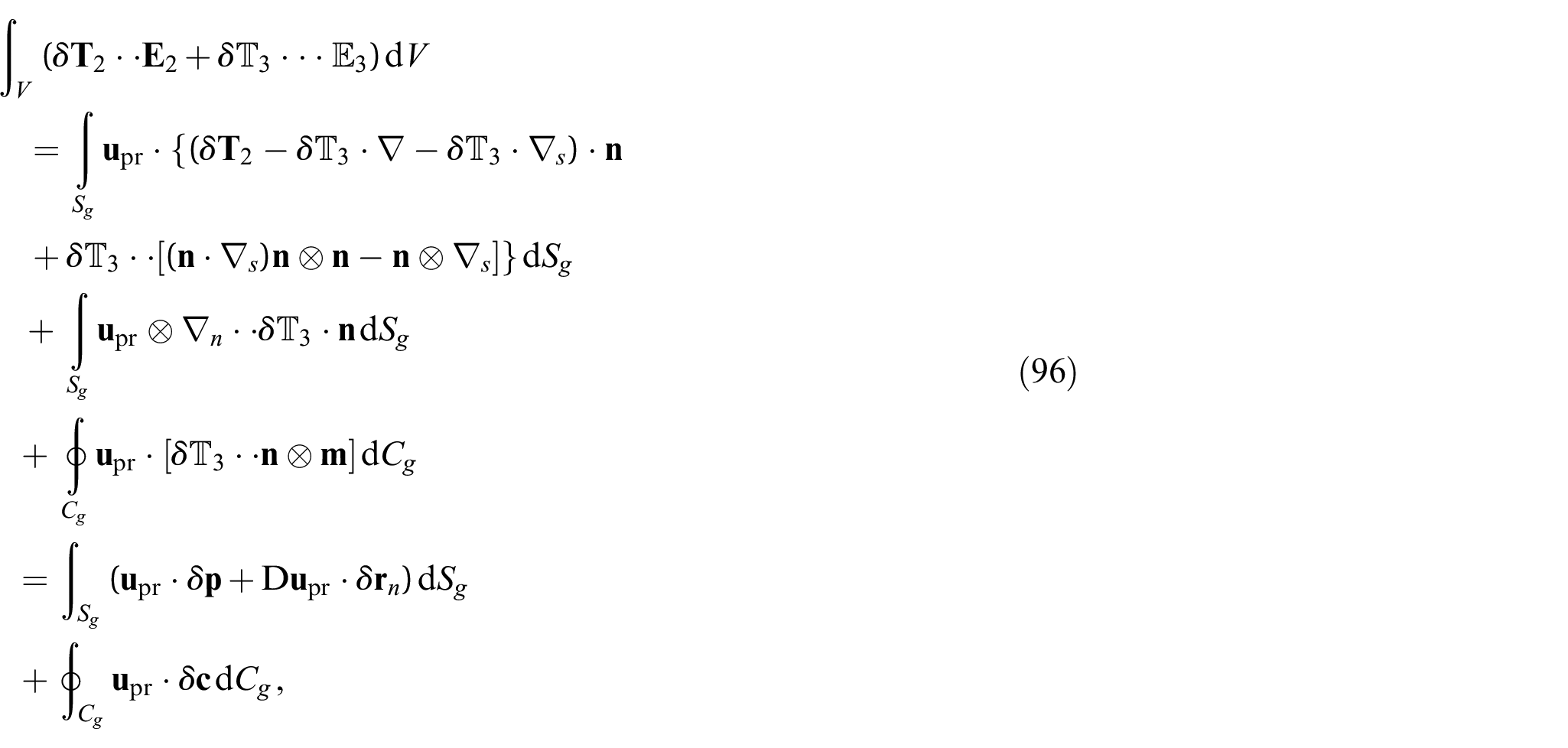
where

Finally
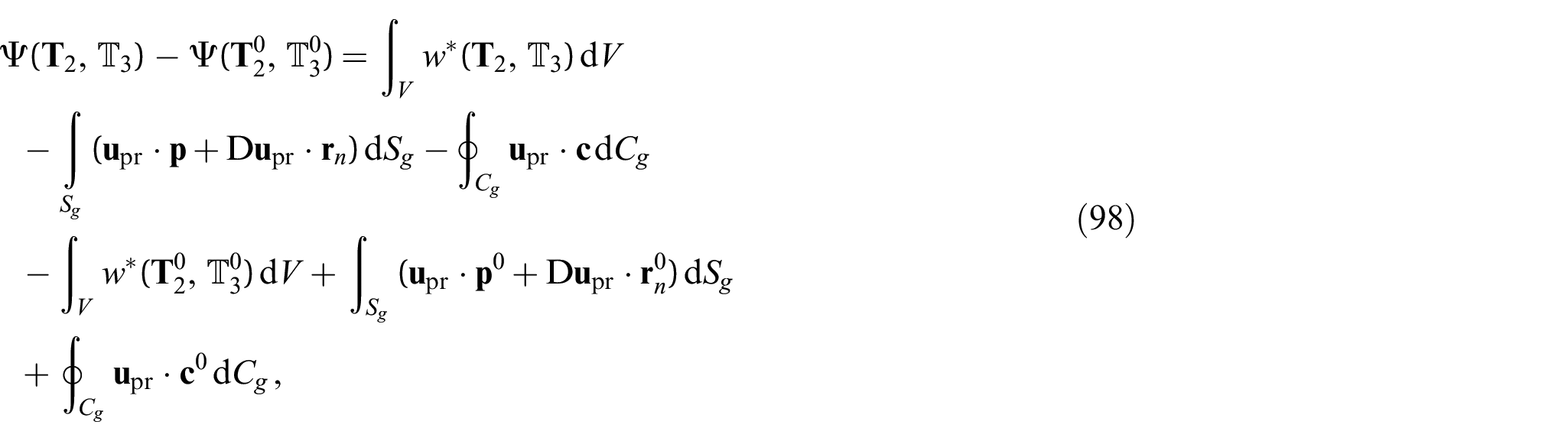
with

Accounting for equations (94) and (96) we obtain
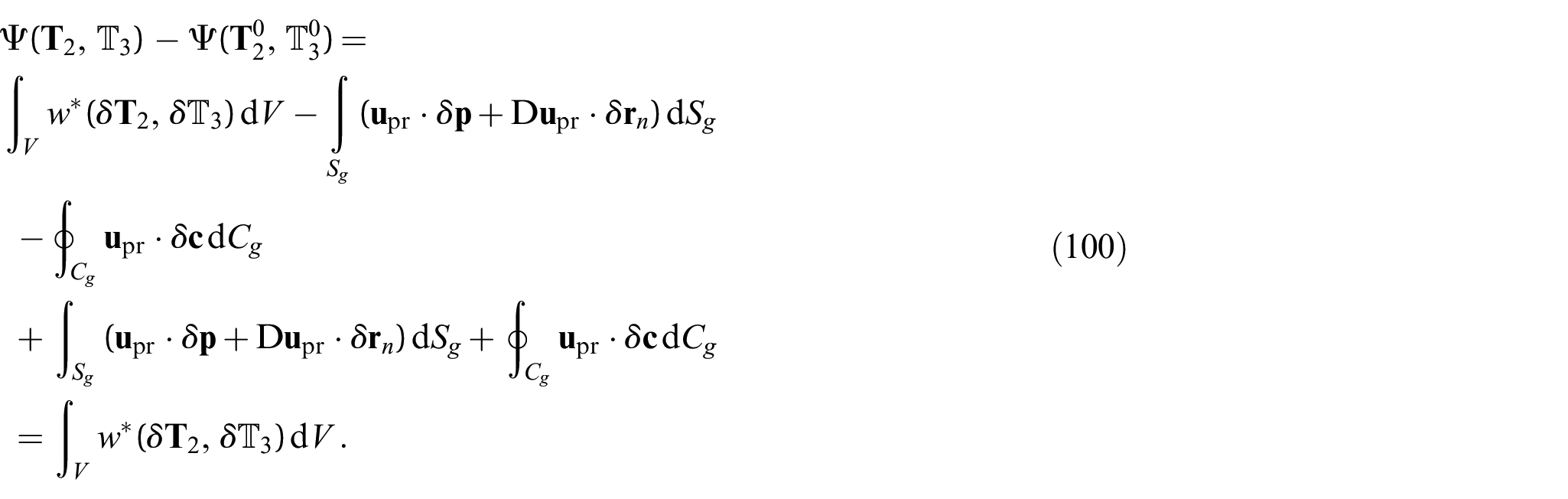
Therefore, since the positive definiteness of

and equality

holds only if

or

Indeed, it is shown by Nazarenko et al. [31] that the complementary energy equation (29) can be presented in a modified form

or

where

It is evident that
4. Conclusion
The variational formulations of the minimum of potential and complementary energies are considered for the coupled strain-gradient elasticity theory. They play an important role in the construction of approximate solutions by numerical methods like FEM and in the evaluation of the upper and lower bounds, like the Voigt and Reuss bounds [40,41] in homogenization theory.
The coupling term in the equations for the stored and complementary energies equations (1) and (29) complicate the proof of the minimum character of these principles. To overcome this, the equation for the potential energy is rewritten with substitute quantities. It leads to decoupling or diagonalization of the quadratic form of the potential energy. Such a diagonalization makes it possible to convert Hooke’s law, to obtain the relations for compliance tensors, to derive a closed-form expression for complementary energy and to prove that the solution of the boundary value problem is indeed minimizes the potential and complementary energies even in the presence of fifth-rank coupling tensor
It should be noted that the proofs are general and hold for any symmetry of stiffness tensors including non-centro-symmetric materials, even though in terms of the substitute quantities, the coupling stiffness is zero.
Footnotes
Declaration of conflicting interests
The author(s) declared no potential conflicts of interest with respect to the research, authorship, and/or publication of this article.
Funding
The author(s) disclosed receipt of the following financial support for the research, authorship, and/or publication of this article: Authors gratefully acknowledge the financial support by the German Research Foundation (DFG) via Project AL 341/51-1.
