



Abstract
Introduction
The use of electric mountain bikes (e-MTBs) has grown rapidly in recent years in the Alps. This study aimed to compare injuries and associated factors among e-MTB and traditional mountain bike (MTB) riders in bike parks and biking facilities in western Austria.
Methods
Data on injured e-MTB and traditional MTB riders were collected via bike patrols and regional rescue services using an online reporting tool. Information included sex, age, nationality, accident site, trail steepness, injury circumstances and causes, transportation mode, affected anatomic regions, and injury diagnoses.
Results
A total of 316 injured mountain bikers were documented, of whom 79.7% were male. The mean age of the injured individuals was 29.8±14.3 y. Among the recorded cases, 35 individuals (11.1%) were using an e-MTB. Injured e-MTB riders were, on average, significantly older than traditional MTB riders (35 vs 30 ys). Significant differences were observed between injured e-MTB and traditional MTB riders with respect to accident locations, slope steepness, circumstances and causes of injury, and mode of transportation. Although the head was the most frequently injured region among e-MTB riders (21%), the clavicle/shoulder region was the most frequently injured area among traditional MTB riders (32%). The most frequent injury diagnosis in both groups was a fracture, but fractures affected ∼27% of e-MTB riders compared with 52% of traditional MTB riders.
Conclusion
This study highlights significant differences in demographics, injury patterns, and accident circumstances between e-MTB and traditional MTB riders who have been injured.
Introduction
An electric mountain bike (e-MTB) is a mountain bike (MTB) equipped with an electric motor that provides pedal-assist support, also known as the pedelec system. 1 In the European Union, e-MTBs with motor assistance limited to 25 km·h–1 and a maximum motor power of 250 W are classified as pedelecs, exempting them from registration and insurance requirements. 1 However, due to the integration of an electric motor, e-MTBs are, on average, 7 to 10 kg heavier than traditional mountain bikes, which can pose challenges in certain situations, such as downhill riding. 2
Biking with e-MTBs is rapidly growing in alpine environments. In Germany, for example, e-MTB sales increased eightfold between 2015 and 2019, whereas sales of conventional MTBs halved over the same period. 3 In Austria, general bicycle sales rose to ∼500,000 in 2022. 4 Of the 212,000 MTBs sold in 2022, 50% were e-MTBs. 4 A 2020 MTB survey conducted by the Austrian Alpine Association included ∼15,000 participants, 22% of whom reported owning an e-MTB. 5
Biking with e-MTBs, particularly in alpine environments, is becoming increasingly popular in everyday life and tourism. 6 Schlemmer et al 6 found that tourists using e-MTBs on holiday were generally older and exhibited lower levels of physical activity than those using traditional MTBs. No significant differences were observed in their motivational patterns. 6 The Austrian Alpine Association survey reported that 75% of respondents identified the most significant positive effect of e-MTBs as enabling individuals with health impairments or older adults to participate in the sport. 5
According to the Austrian Alpine Accident Database, the proportion of injuries related to biking with e-MTBs increased from 1% in 2005 to 11% in 2020. 7 These figures highlight the need for further research into the associated risks and injury patterns in this emerging field and underscore the rapid growth in popularity of biking with e-MTBs. To our knowledge, only 1 recently published study has investigated e-MTB injuries, focusing on Australian data. 2 Using a voluntary online survey, Ruddick et al 2 collected information on e-MTB injuries and recorded a total of 67 injuries across 46 events between November 2022 and June 2023. 2 However, these authors surveyed only injured e-MTB riders and did not include a control group of injured traditional MTB riders within the same timeframe and geographic area. Therefore, the aim of this study was to assess and compare injuries and associated factors among e-MTB and traditional MTB riders within a defined timeframe and geographic area.
Methods
A retrospective epidemiologic study was conducted to analyze mountain biking injuries that occurred in various bike parks and biking facilities in western Tyrol, Austria, during the summers of 2023 and 2024. Throughout these periods, medically trained bike patrols were stationed at locations to provide first aid in the event of injuries and to systematically document mountain biking injuries and associated factors using an online reporting tool. Regional rescue services also contributed to the documentation of mountain biking accidents using the same online tool. The contents of the reporting tool were developed collaboratively by the authors, Red Cross representatives, mountain bike park representatives, and bike rescuers. The approved questionnaire was subsequently programmed by a specialized company and made available online, with access provided to rescue personnel. The study was conducted in accordance with the Declaration of Helsinki and was approved by the University of Innsbruck's Institutional Board for Ethical Questions in Science (Certificate No. 86/2025). Patient consent was waived because bike parks are required to routinely document accidents resulting in injuries.
Bike patrollers and rescue services documented the sex, age, nationality (ie, Austria, Germany, Switzerland, or other), helmet use, and e-MTB use (yes or no) of injured riders. In addition, the following were recorded: accident site (eg, downhill trail, bike park, forest road, or other), trail steepness (eg, flat, medium, or steep), circumstances of injury (eg, cycling uphill, cycling downhill, cycling on flat terrain, unknown, or other), cause of injury (eg, fall caused by riding error, fall during landing after jump, impact with a tree/pole/fence/etc, collision with another rider, heart attack/internal emergency, or other), and mode of transportation (eg, injured person independently, mountain rescue/rescue vehicle, helicopter, or other).
The primary anatomic regions affected by the most severe injuries were classified into 19 categories: head, face, neck, spine/back, chest, upper abdomen, lower abdomen, hips, clavicle/shoulder, upper arm, elbow, forearm, wrist, hand/fingers, thigh, knee, lower leg, ankle, and foot/toes. Diagnoses of the most severe injuries distinguished among the following: contusion, sprain, crushing injury, abrasion, open wound, dislocation, fracture, ligament and muscle injury, concussion, other brain injuries, and other types of injury.
Statistics
The data are presented as means ± SD as well as absolute and relative frequencies. To compare ages between e-MTB and traditional MTB riders, unpaired t tests or Mann-Whitney U tests were employed depending on whether the metric data were normally distributed, as assessed by the Shapiro-Wilk test. Additionally, differences in categorical frequencies were analyzed using χ2 tests. The effect size for difference testing using the Mann-Whitney U test is calculated as the effect size r, whereas for differences in frequency distributions using the χ2 test, the effect size ϕ is determined. According to Cohen, 8 these effect sizes are classified as small (>0.01), medium (>0.03), and large (>0.05) effects. All statistical analyses were performed using SPSS version 27.0 (IBM Corporation, Armonk, NY). All P values were 2-tailed, with values <0.05 being considered statistically significant.
Results
A total of 316 injured mountain bikers were documented over the 2 summer seasons 2023 and 2024. Of these, 79.7% were male. The mean age of those injured was 29.8±14.3 y. Of the recorded cases, 35 individuals (11.1%) were using an e-MTB. Most injured riders were from Germany (62.0%), followed by Austria (14.2%), Switzerland (7.9%), and other countries (15.9%). Helmet use was 100% among e-MTB riders and 97.9% among traditional MTB riders.
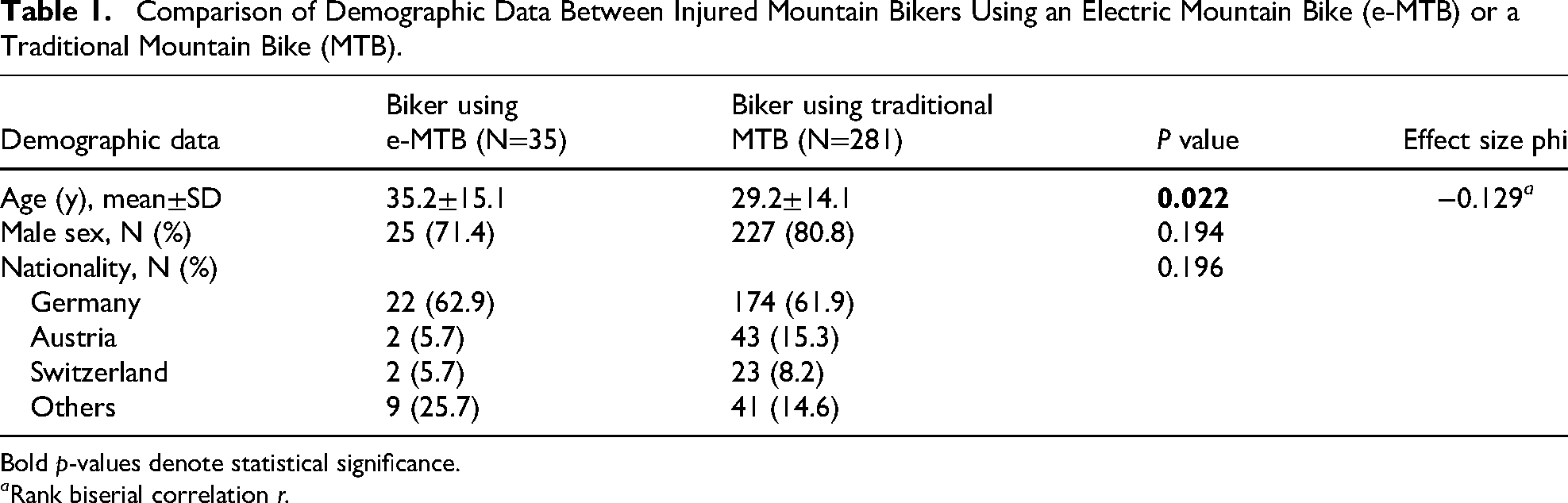
Table 1 compares the demographic data of injured e-MTB riders with those of injured traditional MTB riders. On average, injured e-MTB riders were significantly older by ∼5 y.
Comparison of Demographic Data Between Injured Mountain Bikers Using an Electric Mountain Bike (e-MTB) or a Traditional Mountain Bike (MTB).
Bold p-values denote statistical significance.
a Rank biserial correlation r.
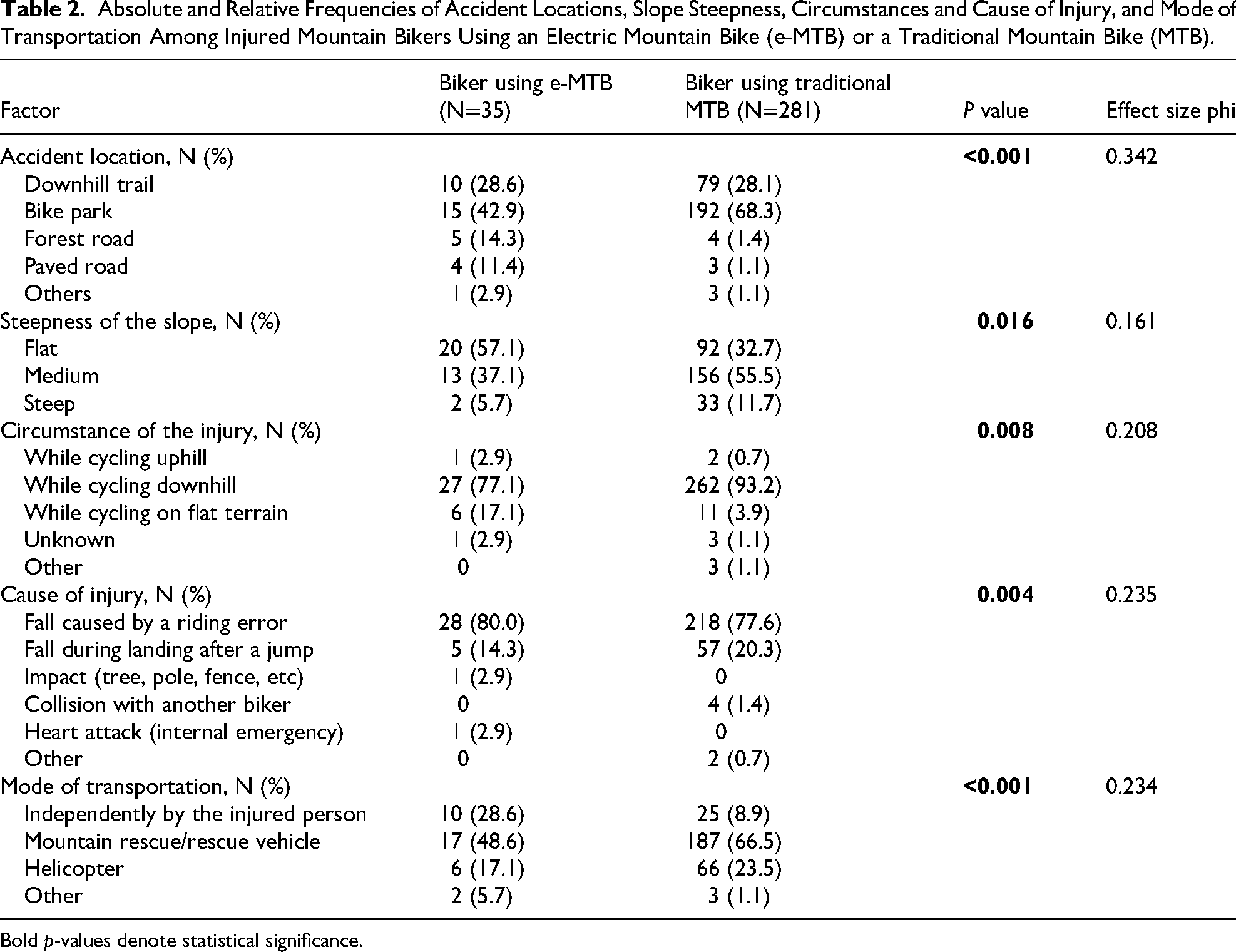
Significant differences between injured e-MTB and traditional MTB riders were found with respect to accident locations, slope steepness, circumstances and causes of injury, and mode of transportation (Table 2).
Absolute and Relative Frequencies of Accident Locations, Slope Steepness, Circumstances and Cause of Injury, and Mode of Transportation Among Injured Mountain Bikers Using an Electric Mountain Bike (e-MTB) or a Traditional Mountain Bike (MTB).
Bold p-values denote statistical significance.
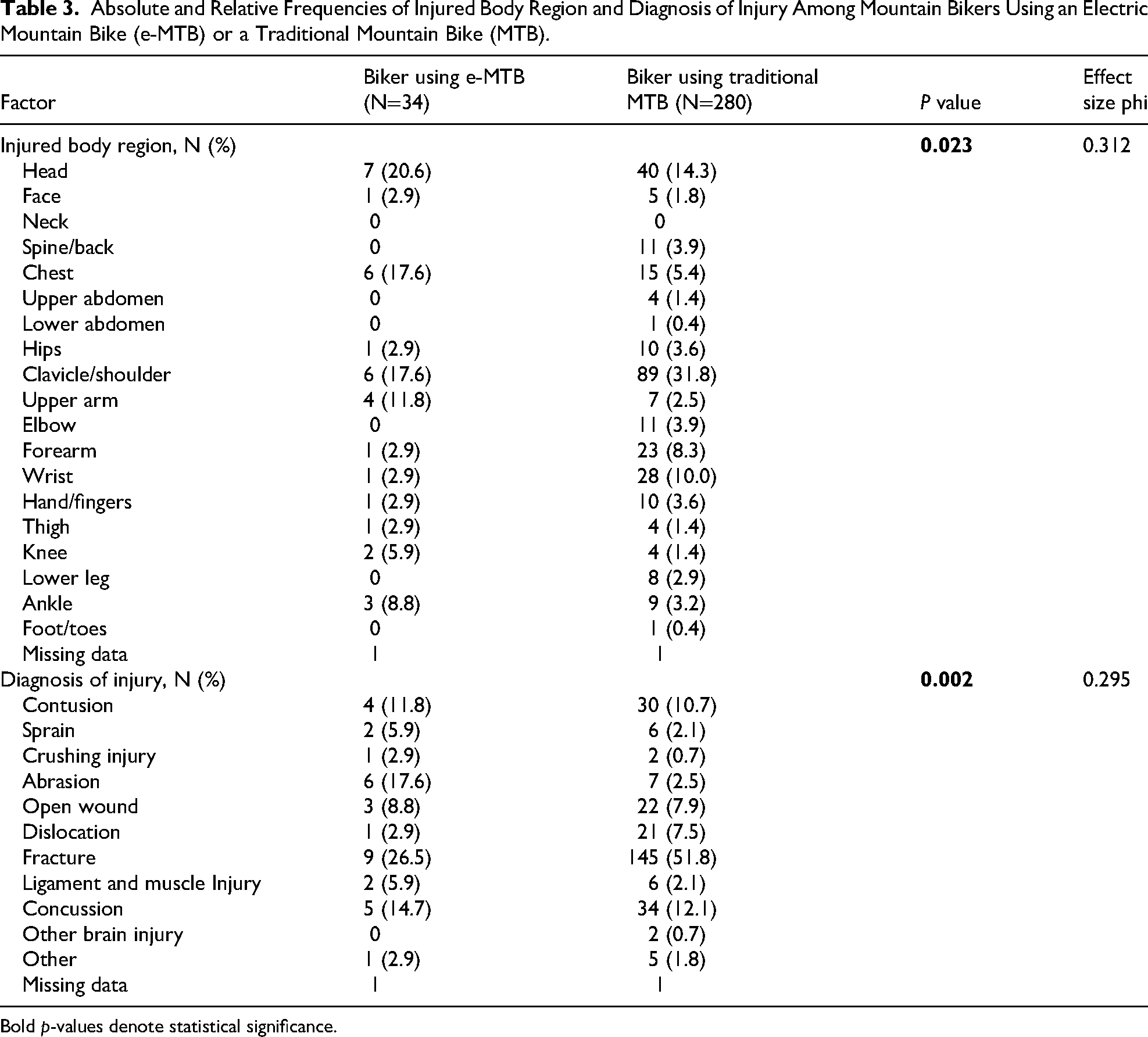
In the total cohort, the most frequently injured body region was the clavicle/shoulder, accounting for 30.3% of cases. The most common injury diagnosis was a fracture, representing 49% of all injuries. Table 3 shows significant differences between injured e-MTB and traditional MTB riders in the injured anatomic region and injury diagnosis. Although approximately one fifth of e-MTB riders most frequently sustained injuries to the head, the clavicle/shoulder region was the most frequently injured area among traditional MTB riders, accounting for nearly one third of cases. The most common injury diagnosis in both groups was a fracture, but fractures affected only around one quarter of e-MTB riders, whereas they accounted for almost half of all injuries among traditional MTB riders (Table 3).
Absolute and Relative Frequencies of Injured Body Region and Diagnosis of Injury Among Mountain Bikers Using an Electric Mountain Bike (e-MTB) or a Traditional Mountain Bike (MTB).
Bold p-values denote statistical significance.
Discussion
This study aimed to investigate and compare injuries and their associated factors among e-MTB and traditional MTB riders. Of the injured mountain bikers documented, 11% were riding an e-MTB. On average, injured e-MTB riders were significantly older than injured traditional MTB riders. Significant differences were identified in accident location, slope steepness, the circumstances and causes of injury, and the mode of transportation after the accident. Notably, e-MTB riders exhibited a higher proportion of head injuries than traditional MTB riders. Fractures were the most frequent injury diagnosis in both groups, occurring less often among e-MTB riders than among traditional MTB riders.
The lower percentage of injured e-MTB riders in this study may be attributed to the fact that most mountain biking accidents were documented in 2 mountain bike parks at ski resorts, where traditional MTBs can be transported uphill using ski lifts. Generally, e-MTBs are less prevalent in bike parks. 7 Nonetheless, this percentage aligns precisely with the 11% reported for e-MTB-related injuries in 2020 in the Austrian Alpine Accident Database. 7
Approximately 80% of injured mountain bikers were male, consistent with numerous other studies, some reporting an even higher proportion of male MTB riders.7,9–11 Although not statistically significant, the proportion of females among e-MTB riders was higher—by ∼9 percentage points—than among traditional MTB riders (28.6 vs 19.2%). For comparison, the proportion of females among e-MTB-related injuries was 35% in the study by Ruddick et al. 2 Some surveys suggest that e-MTBs broaden participation among older adults and females by reducing physical barriers to entry.
The average age of the injured mountain bikers in this cohort was 30 y. By contrast, 2 recent MTB studies with multiyear overviews reported an average age ranging between 35 and 37 y.9,12 This discrepancy may reflect the fact that most injuries in this study occurred in bike parks, where the average rider age tends to be lower due to the prevalence of downhill tracks and other human-made obstacles.13,14 Ruddick et al 2 reported a median age of 49 y for injured e-MTB riders in Australia. Evidence suggests that e-MTB riders tend to be older.6,15
Most mountain biking injuries occur during downhill riding, 7 particularly in bike parks.13,14 Although 93% of traditional MTB riders sustained their injuries while riding downhill, only 77% of e-MTB riders were injured during downhill riding, with 17% injured on flat terrain. Similarly, a study in Australia reported that 63% of e-MTB injuries occurred during downhill riding, 15% on flat terrain, and 22% during uphill riding. 2
In both groups, the primary cause of injury was a fall resulting from a riding error, accounting for ∼80% of cases. For comparison, Becker et al 16 reported that 72% of downhill mountain biking injuries were attributed to riding errors. A review by Kronisch and Peiffer 17 stated that errors in judgment and riding technique, such as excessive speed, inattentiveness, exceeding one's skill level, misjudging situations, improper braking maneuvers, and intoxication, can result in mountain bike injuries.
In this study, traditional mountain bikers were injured more frequently during landings after jumps than e-MTB riders were (20 vs 14%). This is likely due to the many human-made features in bike parks and facilities that encourage aerial maneuvers.
In this study, the clavicle/shoulder region was the most frequently affected anatomic site, accounting for 30.3% of all injuries. Consistently, Bonte et al 11 found that the shoulder girdle was involved in one third of reported MTB injuries. Bigdon et al 18 likewise highlighted that mountain biking injuries often affect the upper extremities, with clavicle fractures being the most prevalent. By contrast, e-MTB riders most frequently sustained head injuries, whereas traditional MTB riders most often suffered injuries to the clavicle or shoulder. Because falling forward over the handlebars is a common cause of injury, 11 the high prevalence of head and shoulder injuries is understandable. The reason for the higher proportion of head injuries among e-MTB riders in this study, however, remains unclear and warrants further investigation.
Fractures were the most frequently diagnosed injury in both groups, accounting for 49% of all injuries. For comparison, Ashwell et al 13 reported that fractures constituted 42.5% of injuries sustained at the Whistler Mountain Bike Park, British Columbia, the majority of which involved the upper extremities. Other studies likewise reported fractures as a common diagnosis in mountain biking.10,17,18 However, fractures were observed in only around one quarter of e-MTB riders, whereas they accounted for almost half of injuries among traditional MTB riders. This discrepancy may reflect the fact that compared with e-MTB riders, traditional MTB riders were predominantly male and younger and more often rode downhill on medium or steep slopes.
Injured e-MTB riders were 3 times more likely to seek medical attention independently (29 vs 9%) and less likely to be transported to hospital by ambulance (49 vs 67%) or helicopter (17 vs 24%) than traditional mountain bikers. For context, Woyke et al 9 reported an average helicopter transport frequency of 18% for mountain biking injuries in the Austrian Alps between 2006 and 2018. These findings suggest that within the bike parks and biking facilities studied, e-MTB riding injuries are generally less severe than those sustained with traditional MTBs.
Several limitations of our study must be considered. Selection bias is a significant concern because the study population primarily included individuals who sought medical assistance. Riders with minor injuries who did not report them may be underrepresented, potentially leading to an underestimation of certain cases. Reporting bias is another limitation because data collection relied on the voluntary participation and cooperation of bike park patrols and regional rescue services; a complete record of all injuries therefore cannot be guaranteed. Injury diagnoses were made by medically trained bike patrollers, but these diagnoses were not cross-checked against medical records. Additionally, confounding variables such as rider skill level and risk-taking behavior may influence the likelihood of injury and were not controlled for in this study.
The study is also subject to temporal and regional limitations. Data collected during a specific season or over a short period may fail to capture long-term trends or seasonal variations in injury patterns. Moreover, most injuries were documented by bike park patrollers in 2 major ski resort areas, which may not be fully representative of all mountain biking environments, particularly those frequented by e-MTB riders. To the best of our knowledge, only 1 existing study on self-reported e-MTB injuries from Australia is available, and it does not include a comparison with traditional MTB injuries. Although the cohort of injured e-MTB riders in this study is small (n=35), which increases the risk of spurious significance when using multiple χ2 tests, the proportion of 11% aligns precisely with the percentage reported in the Austrian Accident Database. Nevertheless, given the rapid growth of e-MTB biking as a recreational activity, further research on e-MTB injuries is warranted, ideally incorporating clinical diagnoses and more comprehensive datasets. 19
Conclusion
To our knowledge, this is the first study to compare injured e-MTB riders with injured traditional MTB riders in bike parks. Despite the small number of injured e-MTB riders, the findings may indicate differences in demographic characteristics, injury patterns, and accident circumstances between e-MTB and traditional MTB riders. On average, injured e-MTB riders were older and more likely to sustain head injuries, whereas injured traditional MTB riders were more likely to sustain clavicle/shoulder injuries. Although fractures were the most common injury diagnosis in both groups, they were significantly more prevalent among traditional MTB riders.
Footnotes
Acknowledgments
We acknowledge the contributions of Elena Pocecco and the members of the bike park patrol and rescue service in the development of the questionnaire.
Author Contribution(s)
Funding
The authors received no financial support for the research, authorship, and/or publication of this article.
Declaration of Conflicting Interests
The authors declared no potential conflicts of interest with respect to the research, authorship, and/or publication of this article.