



Abstract
Introduction
The ability of a 55.9 cm parabolic microphone to increase detection range in search-and-rescue (SAR) sound sweeps for the purpose of responsive lost-person searching was examined.
Methods
Five SAR personnel listened for 3 random words shouted once by persons simulating a responsive lost person at a target loudness of 88 dB (at 1 m) at various distances in coniferous lodgepole pine and deciduous aspen parkland forests. Intelligibility distance (where 50% of the shouted words were understood) and audibility distance (where 50% of the shouted words were audible but not intelligible), along with visual detection range, were determined. The lost person’s unaided ear audibility of 5 whistle models and 1 portable train horn, blown at each searcher's parabolic microphone audibility distance, was also determined.
Results
The parabolic microphone significantly increased both intelligibility and audibility distance by an average factor of 1.44 compared with the unaided ear. Intelligibility distance dipmic with the parabolic microphone was well predicted by the equation
Conclusions
The use of a parabolic microphone significantly increased auditory detection range. When combined with the tested portable train horn, our data suggests that SAR sound sweeps for a responsive subject with a parabolic microphone can expect area coverage rates 44% greater than with the unaided ear and approximately 20 times that of visual searching.
Keywords
Introduction
The majority of lost person search-and-rescue (SAR) operations occur in wilderness regions, accounting for 68% of incidents in the International Search and Rescue Incident Database (ISRID). 1 In search-and-rescue operations, the term “sound sweep” refers to the use of loud signaling—for example, a shout or air-blown whistle—followed by a short period of listening, by searchers moving along a search path in the hope of eliciting a response, usually shouting, by the missing person in order to guide searchers toward the lost person. Most lost persons are responsive when found—for example, 81% of ISRID subjects were classified as “well.” Thus, for lost person wilderness searching with a subject of unknown responsiveness, it is usually logical to first execute sound sweeps using calling and listening rather than visual searching, due to the far greater range of detection of sound sweeps and the relatively high probability of subject responsiveness. 2
A primary factor that determines the efficiency of SAR sound sweeps is the spacing between the calling and listening locations. Finlay 3 recently addressed this spacing for searchers listening with the unaided ear and developed an equation that predicts intelligibility distance di (the distance at which searchers understand half of the words being shouted by a subject) as a function of ambient noise sound pressure levels measured in decibels (dB).
To extend the range of sound sweeps, Bowditch et al 4 examined the use of a 66-cm parabolic microphone and found that it significantly increased both sound detection distances and success in identifying the direction of a calling subject. However, to implement sound sweeps with a parabolic microphone in a search operation, a theoretical model that predicts intelligibility distance with a parabolic microphone would be useful in order to specify spacing between signaling and listening locations. In addition, given that the range of detection of a parabolic microphone typically extends beyond the distance at which a shouting person can be heard with the unaided ear, an alternative acoustic signaling method, other than shouting by searchers, is needed in order to elicit a response from a lost person at the distance their shouts can be heard with a parabolic microphone. Thus, it would be helpful to know what acoustic signaling devices are capable of producing a sound that can carry this distance.
In the current work, we present data on intelligibility distance separately in deciduous and coniferous forests with a 55.9 cm parabolic microphone. At present, search personnel do not have a means of a priori specifying spacing between signaling–listening locations in sound sweeps done with parabolic microphones, which dramatically hampers the optimization of such sweeps. For this reason, a theoretical model is developed and presented here that predicts intelligibility distance as a function of ambient noise level. We also examined the ability of 6 acoustic signaling devices to be heard by a lost person at the audibility distance (defined here as the maximum distance that a human shouting at 88 dB measured at 1 m can be heard) of this parabolic microphone. The results may be useful to search personnel wanting to improve sound sweep coverage rates using the extended range associated with a parabolic mic.
Methods
Experimental Measurements
Searchers were recruited from active duty search volunteers within Edmonton Regional Search and Rescue Association (ERSARA) to participate in this study. The study was approved by ERSARA. One SAR volunteer noted they were usually unable to understand persons speaking on television without using closed captioning. That individual was excluded from being a listening subject in the present study. Experiments were performed in the same 2 wilderness locations as in Finlay. 3 This included a coniferous forest composed of mature lodgepole pines in the foothills of the Rocky Mountains west of Edmonton, Alberta (53.50382° N 118.01143° W), visited on the evening of June 6, 2025, and the morning of June 7, 2025, and a deciduous forest composed of aspen parkland in the 97 km2 Cooking Lake Blackfoot preserve east of Edmonton (53.47162° N 112.89556° W) visited on the evening of July 16, 2025. Figure 1 shows a typical habitat along one of the sound ray paths at the coniferous location.
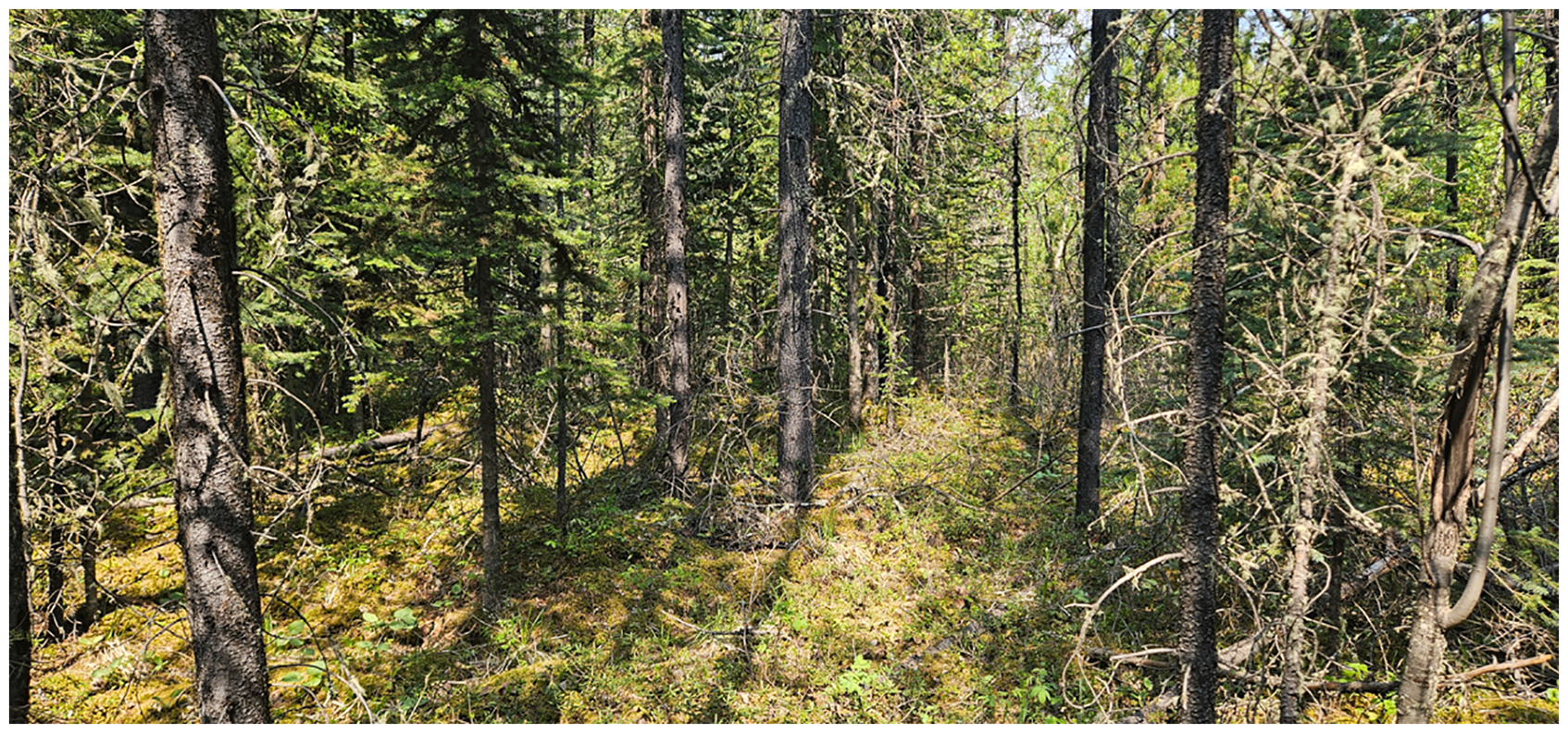
The coniferous forest location as seen midway along a sound ray path.
One male and 1 female shouter each stood 1 meter from a dB meter (Reed R8050, set to frequency weighting A, fast time weighting, www.reedinstruments.com) and shouted at the previously noted locations at a target sound pressure level of 88 dB, thereby simulating a responsive lost person. The male voice shouter is the same one who participated in the study of Finlay, 3 while the female voice shouter is different from that study. Each shouter vocalized 3 words, different each time, from a list of 100 previously prepared word triplets. Each triplet consisted of 3 different names of provinces and territories in Canada and states in the United States.
In the coniferous forest setting, 2 male and 1 female listener participated, while in the deciduous forest setting, 2 female and 2 male listeners participated. All listeners, except 1 male participant in the deciduous forest study, had also previously participated in the Finlay 3 study. Median age of the listeners was 44 years and ranged from 31 to 63. Listeners recorded ambient dB using a dB meter (the same model as above) each time they listened at varying distances from the sound source location, using GPS to determine their distance. Listener discretion was used to determine listening distances, with a broad goal of bracketing intelligibility distance within a 10-meter range. One female and 1 male listener participated in all experiment sessions, so the total number of independent listeners was 5. Both dB units were calibrated prior to each experiment using a sound calibrator (AZ Instrument model 8930, www.az-instrument.com.tw) at 94, 104, and 114 dB. One listener at a time listened with a single, commercially available parabolic microphone (Wildtronics Pro Mono Parabolic Microphone, set to low pass, with electronic gain set at maximum, www.wildtronics.com) connected to headphones (Technica ATH M40x, audio-technica.com), as shown in Figure 2.
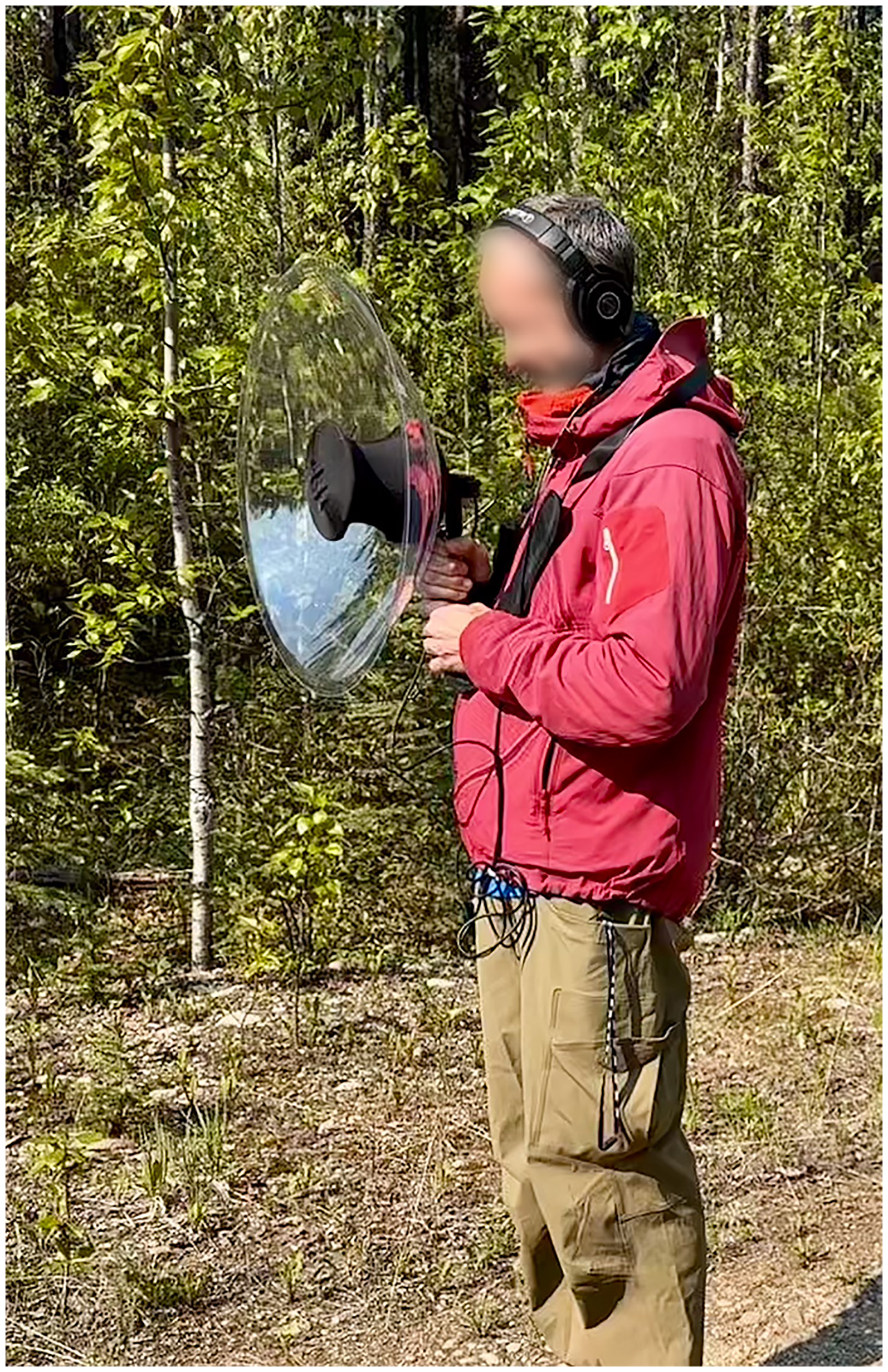
Image of SAR participant listening with the parabolic microphone and headphones during the coniferous forest portion of the present study. The face in the image has been blurred for privacy. Photo Credit: Nancy St.-Hilaire. Used with permission.
At each listening location, the directional bearing to the sound source was determined using GPS, and both the listener and sound source were oriented toward each other along this bearing using compasses. Radio communication between listeners and shouters was used to establish that both stations were ready before each calling/listening datapoint was obtained.
Intelligibility distance with the unaided ear was also determined for 2 males and 1 female in the coniferous forest location with the male shouter, and 1 participant (a male listening for the female shouter) at the deciduous forest location.
Intelligibility distance for either the parabolic microphone or unaided ear was determined for each listener in the same manner by linearly interpolating between adjacent listening locations that had more than 50% of the shouted words correctly heard by that listener. The audibility distance (ie, the maximum distance that the shouter was audible but not intelligible) was similarly calculated by linearly interpolating between adjacent listening locations that had more than 50% of the sound heard unintelligible by that listener.
Six acoustic signaling devices were used to determine which of these could be heard by a potential lost person listening at the maximum distance that their shouting response would be audible with the parabolic microphone. Five commercially available whistles were chosen as follows: SHvivik Emergency Whistle (the #1 selling “camping whistle” on amazon.ca), Roote Emergency Whistle (the #2 selling “camping whistle” on amazon.ca), Fox 40 Classic Official Whistle (the #1 selling “emergency whistle” on amazon.ca), HyperWhistle (advertised as the world's loudest whistle, www.hyperwhistle.com), and Storm Whistle (also advertised as the loudest whistle in the world, www.stormwhistles.com). The whistles were blown at the same locations as with the voice shouters mentioned previously, by the same SAR personnel performing the calling. In addition to these 5 whistles, a commercially available portable air horn (Impact Horns DeWalt Premium Quad Train Horn Gun, www.impacttrainhorns.com) was also used as a sound signaling device. The decibel levels of these 6 signaling devices were measured at a distance of 1 meter with the same dB meters noted earlier.
Temperature, wind speed, and humidity were measured approximately hourly at the sound source location using a weather meter (Kestrel 3000, www.kestrelinstruments.com), while absolute pressure was measured using a smartphone (Samsung Galaxy S23, Galaxy Sensors App).
Average visual range of detection was also determined at each of the 2 locations noted previously. One person (the subject) moved into the forest to a standing position where they could no longer see the other searchers, who faced away from the subject so that they did not know the exact location of the subject. The remaining searchers spaced themselves apart before approaching from different directions and measured the distance at which they could first see the subject. In the coniferous forest, 4 searchers determined the visual range of detection, approaching the subject from different directions, spread over an angle of 25°. For the deciduous forest, 3 searchers determined the visual range of detection, approaching the subject from different directions, spread over an angle of 123°. Figure 3 shows the subject at a visual range of detection distance in the deciduous forest setting.
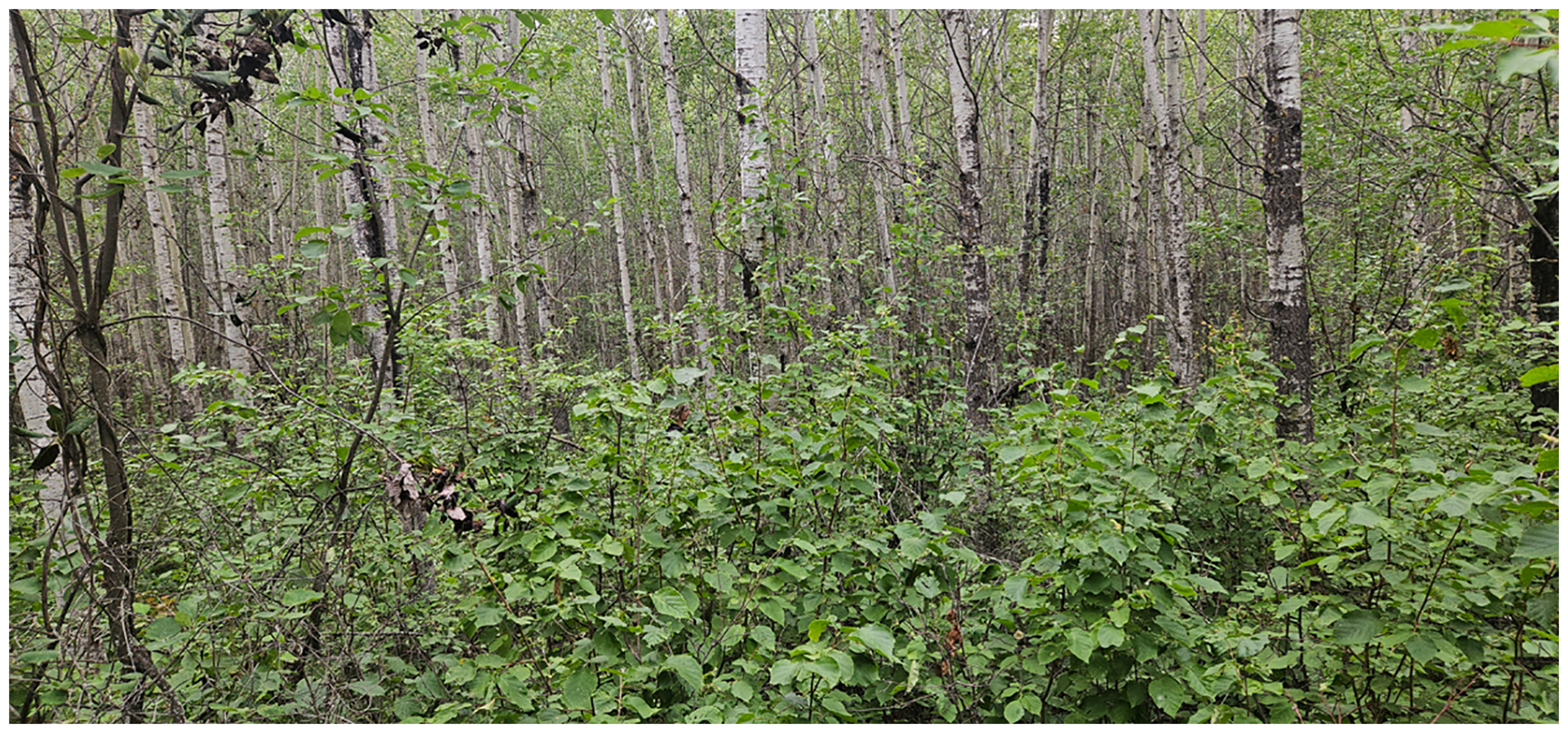
The deciduous forest location with a standing subject, just left of center, at visual range of detection distance.
Theoretical Modeling
The intelligibility distance di (at which 50% of words shouted at 88 dB, measured at 1 m, can be understood) for the unaided ear was predicted using the equation developed by Finlay,
3


Student t-tests were used to determine significance (p < 0.05).
Results
During the June 6, 2025, coniferous forest evening data acquisition, session temperatures ranged from 10° C to 16° C, relative humidity was 36%–46%, ground wind speed at the sound source location was 0–6 km/hr, and atmospheric pressure was 853–859 hPa. During the June 7, 2025, morning coniferous forest session, temperatures were 10° C–16° C, relative humidity was 29%–42%, wind speed at the sound source location was 0–10 km/hr, and atmospheric pressure was 868–870 hPa. For the deciduous forest session, temperatures were 15° C–22° C, relative humidity was 44%–61%, wind speed at the sound source location was 0–4 km/hr, and atmospheric pressure was 928–929 hPa.
Average ambient dB measured at the listening locations was 36.1 ± 2.4 (mean ± SD, n = 55) for the coniferous forest data and 39.2 ± 4.1 (mean ± SD, n = 42) for the deciduous forest data. Average calling dB at 1 m for the coniferous forest data was 89.7 ± 4.0 (mean ± SD, n = 51) for the male shouter and 89.9 ± 4.8 (mean ± SD, n = 62) for the female shouter, and for the deciduous forest data was 87.1 ± 6.1 (mean ± SD, n = 65) for the male shouter and 88.1 ± 5.8 (mean ± SD, n = 91) for the female shouter. Overall, the average calling dB was 88.6 ± 5.4 (mean ± SD, n = 269).
Average intelligibility distance di with the unaided ear was 147 m ± 27 m (mean ± SD, n = 4) and did not differ significantly from the average value of 148 m ± 14 m (mean ± SD, n = 4) predicted by Equation (1). Average ambient dB for the datapoints bracketing di was 37.2 ± 1.3 (mean ± SD, n = 8).
For the coniferous forest, average intelligibility distance dipmic with the parabolic microphone was 225 m ± 34 m (mean ± SD, n = 8) and average ambient dB for the datapoints bracketing dipmic was 36.2 ± 1.6 (mean ± SD, n = 16). For the deciduous forest, average dipmic was 190 m ± 57 m (mean ± SD, n = 7) and average ambient dB for the datapoints bracketing dipmic was 39.7 ± 4.1 (mean ± SD, n = 14). There was no significant difference between dipmic for male versus female shouters, nor for male versus female listeners. The overall average dipmic in both forest habitats was 209 m.
Figure 4 shows individual datapoints in both forest locations for intelligibility distance using the parabolic microphone, dipmic, versus ambient noise levels. Least squares fitting of Equation (2) to the datapoints gives a value of a = 8805. Thus, our predictive equation for dipmic is

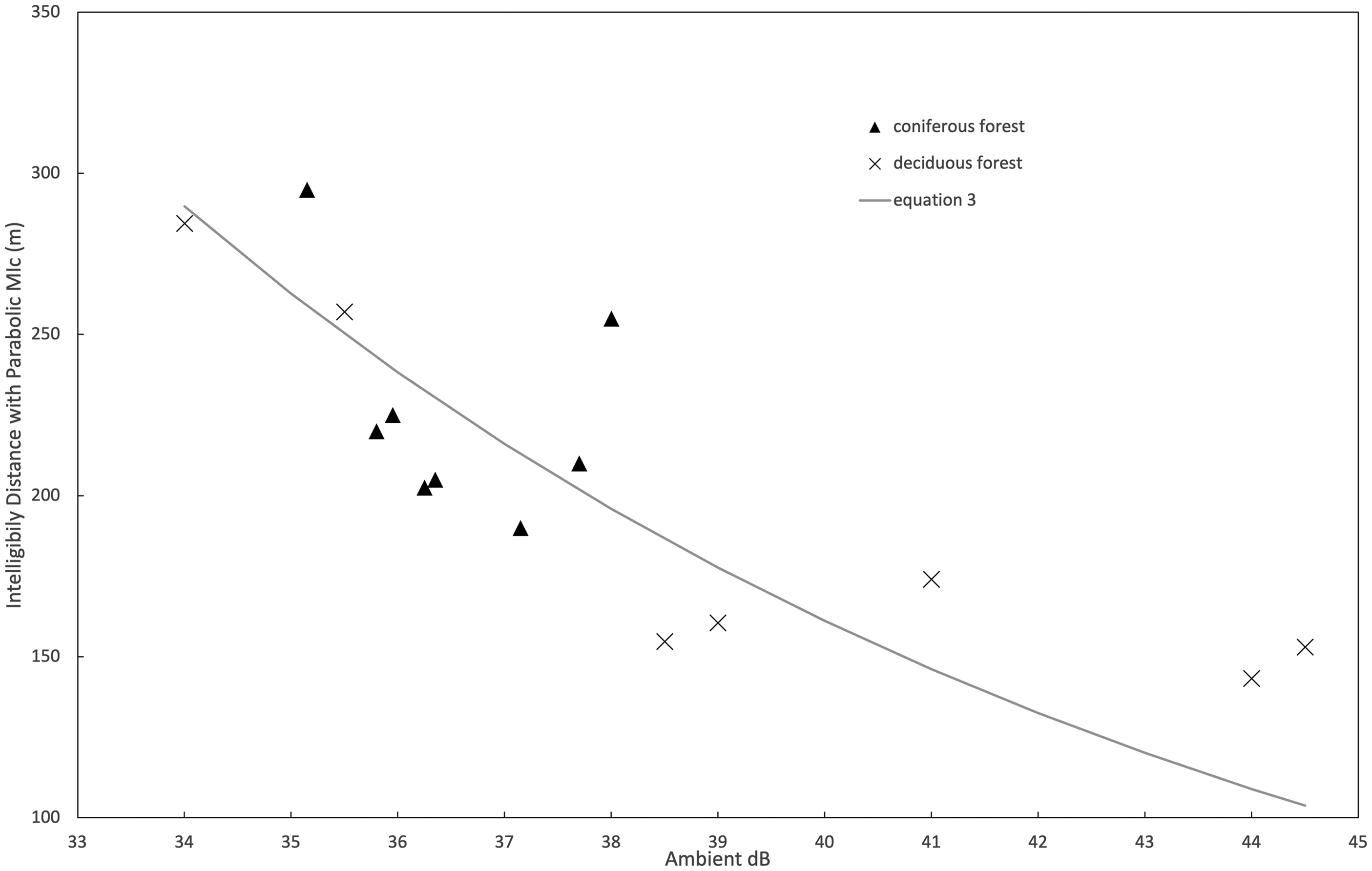
Measured values of intelligibility distance using the parabolic microphone, dipmic, in meters versus ambient noise levels (dB) are shown for the 2 forest locations, along with the value predicted by Equation (3).
The solid line in Figure 4 shows values calculated by Equation (3).
The parabolic microphone increased the audibility distance by an average factor of 1.44 compared with the unaided ear. This is the same as the value of dipmic/di predicted by Equations (1) and (3).
Decibel levels of the different signaling devices are given in Table 1. Three measurements were also made with the train horn held facing away from the dB meter, with the person holding the horn situated between the dB meter and the horn, which reduced its average measured dB by 5 dB and was significantly different from the value obtained facing toward the dB meter at the same 1 m distance (p = 0.03).
Average Measured Sound Pressure Levels (dB) at a Distance of 1 Meter, Standard Deviation (SD in dB), and Number of Measurements (n) Obtained with Each Signaling Device.
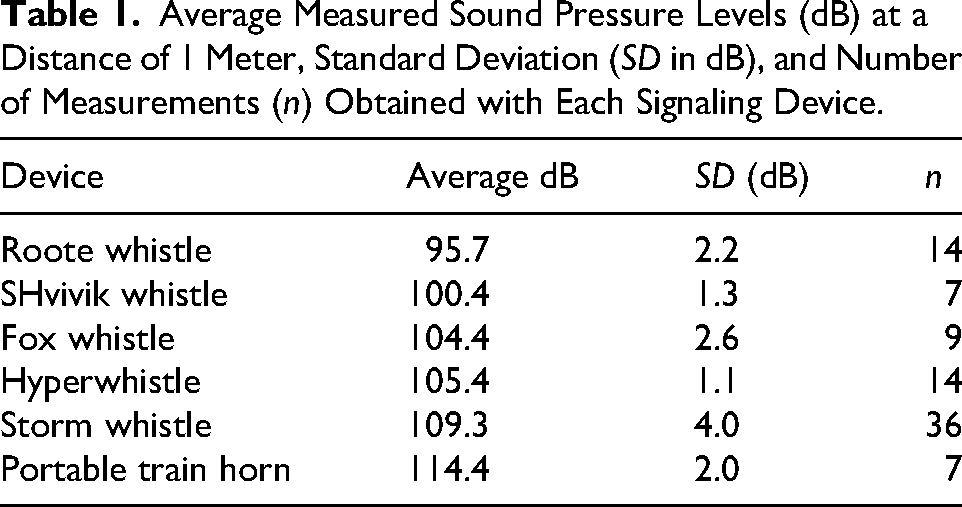
Of the 6 signaling devices shown in Table 1, only the portable train horn could be heard by all participants when at their audibility distance, dapmic, at which calling was audible (but not intelligible) with the parabolic microphone. The average value of dapmic was 813 m ± 360 m (n = 8).
Visual range of detection for the standing subject in the coniferous forest was 18.2 m ± 7.5 m (mean ± SD, n = 4) and in the deciduous forest was 8.6 m ± 2.8 m (mean ± SD, n = 4).
Discussion
Intelligibility distance for the unaided ear, di, was accurately predicted by Equation (1), indicating that despite using dB meters here, rather than smartphones, to measure dB as in our previous study, 3 and despite our including additional subjects and performing our data acquisition a year later, our data agrees well with that of Finlay. 3 This validation of past work supports our methodology and data acquisition approach.
The use of a 55.9 cm parabolic microphone significantly increased both intelligibility distance and audibility distance compared with the unaided ear (p = 0.03), in both cases by an average factor of 1.44. We also find that the dependence of dipmic on ambient noise follows the same functional dependence as the unaided ear—that is, the right-hand side of Equation (3) is simply 1.44 times the right-hand side of Equation (1), with dipmic well predicted by Equation (3). Indeed, the least squares fit of Equation (3) to the data in Figure 4 has a least squares coefficient of determination R2 = 0.58. Given the considerable variability present in our data due to wind gusts causing varying ambient dB levels during listening (standard deviation of 3.5 dB at the locations bracketing dipmic), variability in calling dB between words (standard deviation of 5.4 dB), intersubject variability in intelligibility distance (standard deviation of 48 m), and GPS variability in distance measurement (expected typical standard deviation of more than several meters), Equation (3) provides reasonable predictive ability.
The present study was designed to represent realistic detection by diverse SAR personnel of varying ages and sexes in a forest setting typical of the environment in which many prior lost person searches were performed by the present SAR personnel. A previous study in an open field with subjects having direct visual line of sight between the shouter and the listener was done by Bowditch et al. 4 They also found significantly improved detection range with a 66 cm parabolic microphone versus the unaided ear using SAR personnel in an open field. However, neither calling dB nor ambient dB were recorded at the time of calling and listening in their study. In addition, in their protocol, listeners detected shouters calling a single word repeatedly every 3 seconds for 5 minutes each time, with a direct line of sight available between the shouter and listener. This is quite different from our experiments and from realistic SAR sound sweeps. As a result of these factors, meaningful comparison to our data is difficult, and it is not possible to develop a predictive model from their data for use in SAR operations like that given by Equation (3).
Figure 4 also indicates that intelligibility distance with the parabolic microphone is well predicted by the same Equation (3) for both the coniferous and deciduous forests. Finlay 3 reached a similar conclusion for intelligibility distance with the unaided ear—that is, vegetation does not meaningfully affect intelligibility distance for the forest habitats considered here. This is supported by previous studies 5 that find sound attenuation by vegetation in forests is minor compared with geometric and atmospheric attenuation, which are accounted for in Equation (3).
The average dB level of 88.6 dB for shouting in this study is similar to values seen by previous researchers; for example, Pearsons et al 6 measured shouting for 100 subjects and reported an average value of 89 dB for males but 82 dB for females and children (all measured at 1 m distance, the same as here). The female shouter in the present study was able to sustain shouts at the target 88 dB throughout each several-hour session, as was the female shouter in the study of Finlay. 3 In addition, 70% of ISRID lost persons are male. Thus, the use here of a target 88 dB shouting loudness at 1 m distance can be considered realistic.
The observed increase in detection range provided by the use of the parabolic microphone may be beneficial in cases of injured lost persons where the injury results in a reduced loudness of their shouting—for example, due to a weakened overall state, or acute injuries to the thoracic region that result in pain during attempted shouting. While we have not explored the effect of reduced shouting intensity on detection range with the parabolic microphone, the results of Finlay 3 for unaided ear detection range suggests that replacing dBamb in Equation (3) with dBamb + ΔdB, where ΔdB is the reduction in dB from 88 dB, may allow prediction of reduced shouting intensity, although such an approach awaits confirmation by future studies. Regardless, given the much higher dB values of whistles measured here, as seen in Table 1, compared to shouting, public education programs that encourage hikers to carry auditory signaling devices are worthwhile.
Previous studies have shown differences in the changes in sound frequency spectrum for shouting by males and females, with female shouting shifting somewhat to higher frequencies than male shouting. 7 In addition, the present parabolic microphone increases in gain with frequency by 6 dB/octave, starting at 0 dB at 200 Hz. In contrast, habitat attenuation dB increases linearly with frequency. 5 Despite these possible sound spectrum effects, we find no significant difference between intelligibility distances between male and female shouters, which is perhaps not surprising given that calling here was all done at essentially the same dB value.
Previous authors have measured the maximum distance at which shouts and whistles can be heard in SAR sound sweeps, 8 finding a value of 332 m for shouts and 401 m for a whistle. However, those authors gave neither ambient nor signal sound dB values. Since both strongly affect audibility distances, comparison of their values to ours is difficult, although their values are similar to overall averages of these distances measured by us.
Finlay 3 discusses operational use of Equation (1) in sound sweeps with the unaided ear, and the considerations given there apply to operational use of Equation (3). However, an additional consideration with a parabolic microphone is its increased directionality compared to the unaided ear. The response of the parabolic microphone used in our study decreases by 5 dB at a frequency of 500 Hz (a typical fundamental frequency of human shouting 7 ) when aimed 45 degrees off angle to the sound source (Rutkoski B, Wildtronics, personal communication, July 14, 2025). Since a 7 dB drop would correspond to halving the range of detection when including both atmospheric and geometric attenuation, 3 and since we find shouts remain audible beyond twice dipmic, sweeping the microphone through 90° at each of 4 successive listening directions with bearings all differing by 90° (as suggested by Finlay 3 for unaided ear detection) is a logical operational protocol. With this approach, using a distance between calling-listening locations that is twice dipmic in a sound sweep along a line would give 78.5% coverage of the area within dipmic on either side of the line, 3 and a first approximation for probability of detection can then be estimated as suggested by Finlay 3 by multiplying the searched path length by 1.57 dipmic and dividing by the search segment area.
Because of the strong dependence of auditory detection distance on ambient noise levels, as seen in Equation (3), the improvement made in search coverage efficiency by using a parabolic microphone is also strongly dependent on the ambient dB. In the field studies presented here, we find the overall average intelligibility distance with the parabolic microphone is 1.44 times that of the unaided ear and is 18 times the overall average visual range of detection of a standing subject in these same locations. The time spent searching to find a responsive subject using a parabolic microphone versus the unaided ear or visual searching would be reduced by similar factors under the search conditions of our experiments. Noisier conditions (eg, strong winds) or local topographic obstructions to sound propagation (eg, a hill or cliff) would reduce the advantage of acoustic searching. On the other hand, sound sweep detection distances are unaffected by darkness, while visual range of detection is dramatically reduced after dark, so that the improved coverage efficiency of a parabolic microphone versus visual searching at night would be even more dramatic than seen here.
Obviously, success with auditory searching requires eliciting a response from the subject. SAR personnel normally use shouting or whistles to elicit subject calling. However, our data indicates that neither of these signaling methods can be reliably heard at distances where shouting of a lost person can be heard with a parabolic microphone. Only the portable train horn was audible to all listeners at these distances, which accords with Table 1 showing that this was our loudest tested signaling device. We thus recommend the use of a portable train horn or similar device when performing sound sweeps with a parabolic microphone, switching to shouting once searchers have moved within a distance at which the subject can reliably be heard with the unaided ear. Given our observed 5 dB reduction in loudness measured when pointing toward versus away from the train horn, in SAR operational use, it would be logical to direct blasts of the horn sequentially in each of the same 4 listening directions separated by 90° (alternating with listening for a response in each direction) to match operational use recommendations noted earlier for the parabolic microphone.
Limitations
The results here were obtained using only 5 SAR personnel. Future studies would be useful to determine the predictive ability of Equation (3) with a larger number of SAR personnel. The effect of hearing impairment was not studied, and none of the present study participants had a diagnosed hearing impairment. From an operational perspective, it is recommended that search managers query SAR personnel regarding hearing impairment and avoid assigning individuals with hearing impairment to sound sweep duties. Individuals with known hearing impairment would be expected to have reduced sound detection ranges, likely making Equation (3) inapplicable to those individuals. Prior participation in the Finlay 3 study by the subjects participating in the present study could have introduced a trained ear bias, although the fact that the unaided ear intelligibility distance measured here is no different from that in previous studies argues against such a bias.
Conclusions
Auditory detection ranges of human shouting increased significantly, by 44%, when listening with a parabolic microphone compared to the unaided ear. Intelligibility distance dipmic with the parabolic microphone can be predicted using Equation (3), which is simply 1.44 times a previously developed equation for the unaided ear, 3 and decreases rapidly with increased ambient noise levels. Of the 5 whistles and 1 portable horn tested here, only the sound of the portable train horn carried far enough to be used in eliciting a shouted lost person response at the audibility distance of the parabolic microphone. For the 2 heavily forested locations examined here, average visual range of detection was approximately 20 times less than dipmic. For responsive lost person wilderness SAR, sound sweeps using a parabolic microphone to listen at distances separated by twice dipmic are expected to be significantly faster than searching with the unaided ear and more than an order of magnitude faster than visual searching alone.
Footnotes
Acknowledgments
The assistance of the Edmonton Regional Search and Rescue Association (ERSARA) and, in particular, ERSARA members Peter Bezeau, Michael Cooley, Danielle Everitt, Nancy St. Hilaire, and Kira Place, who participated as field subjects in this study, is gratefully acknowledged.
Author Contribution(s)
Funding
The author received no financial support for the research, authorship, and/or publication of this article.
Declaration of Conflicting Interests
The author has no potential conflicts of interest with respect to the research, authorship, and/or publication of this article.
Data Availability Statement
Data further supporting the findings of this study are available from the corresponding author upon reasonable request.