






Abstract
Introduction
Metallic survival blankets are multifunctional medical devices frequently used to provide thermal insulation in sport and leisure activities and in emergency care. To assess further properties of survival blankets, we investigated their breaking strength under laboratory conditions.
Methods
An experimental study was performed with 2 commercially available survival blankets used by emergency medical services. Breaking strength measured with a tensile testing machine was determined consecutively with 10 tests conducted per brand.
Results
Breaking strength (mean±SD) of the tested brands was 3.8±0.4 kN, (range: 2.8–4.1 kN) and 4.0±0.5 kN (range: 3.2–4.6 kN). When using the windlass of a commercially available tourniquet for the longitudinally folded survival blanket, the windlass bent at a force of 0.8 kN; when using a carabiner, the force exceeded 3.6 kN before failure occurred in both blanket brands.
Conclusions
Both brands of survival blankets show impressive tensile strength, indicating that they have the potential to serve as temporary pelvic binders or even as makeshift tourniquets when urgent bleeding control is needed.
Introduction
Low-weight and low-bulk survival blankets with their distinctive silver and gold surfaces are essential components of first aid kits and professional emergency equipment. Historically, a thin polyethylene terephthalate sheet, called a “space blanket,” was originally used by the National Aeronautics and Space Administration’s Marshall Space Flight Center in 1964 to protect exterior surfaces of spacecraft from radiated heat. 1 Survival blankets are multifunctional tools. The gold color and light reflection from the surface increase visibility for search and rescue services. Survival blankets can protect against hypothermia by reducing heat loss from convection, evaporation, and thermal radiation. 2 Additionally, the blankets protect against ultraviolet radiation 3 and limit heat gain by reflecting infrared radiation. This is accomplished by the blanket providing shade and because aluminum increases thermal conductance from the body to the cold ground when the blanket is in direct contact with the skin. 4 When wearing the unfolded blanket under a waterproof jacket, it can protect against the wind. Furthermore, the foil can be used as a vapor barrier, and it can even be used to construct a stopgap bivouac sack in the wilderness.5,6
From our literature review, no information is available on whether survival blankets are strong enough to serve as makeshift tourniquets for treatment of severe hemorrhage. Adequate tightness, proper application, and correct positioning are mandatory to achieve sufficient circumferential compression to control bleeding by completely stopping the blood flow in a limb. 7 An improperly placed tourniquet can increase blood loss if it is only tight enough to occlude venous return. 8 Tourniquets cause pain from compression and ischemia, but the rate of complications has been reported to be low. 9 Potential complications include nerve palsies, compartment syndrome, venous thromboembolic events, and postischemic reperfusion damage. 9 Although improvised tourniquets have been reported to be less reliable than commercial tourniquets, they may be better than no tourniquet. 8 In particular, mass casualty incidents with multiple victims and trauma with severe hemorrhage during outdoor sports in the backcountry environment might necessitate use of improvised tourniquets.
In this experimental study, we investigated the resistance to tear forces of 2 conventional survival blankets commonly used by emergency services.
Methods
Experiment Design
We investigated 2 different blankets commonly used by the ground emergency medical services of the Austrian Red Cross, mountain rescue Tyrol, and helicopter emergency medical services in Austria. Assessment of breaking strength (maximum amount of tensile stress before failure) was performed at the mountain rescue center for safety and training in Fulpmes/Stubai, Austria. The following 2 brands were investigated: ARC rescue sheet (ÖRK, Vienna, Austria) and MRT rescue blanket (LEINA-WERKE GmbH, Windeck, Germany).
Both survival blankets are 160 × 210 cm in size with a surface color of silver on 1 side and gold on the other. Survival blankets used in first aid are categorized as medical devices. There was no human testing and thus no need for human research ethics approval according to the ethics committee of Medical University Innsbruck. Written informed consent was obtained from a mountain rescue Tyrol volunteer who participated as the model, with the understanding that photographs would be published in a scientific journal.
Assessment of Breaking Strength and Elongation
To predict how the blankets would perform when used for circumferential compression as temporary pelvic binders or as makeshift tourniquets, we measured breaking strength and elongation with a tensile strength testing machine for metal and plastic parts (Zwick/Roell Z100/TL3A Nr.137226; ZwickRoell GmbH & Co.KG, Ulm, Germany). The blankets of each brand were cut into 2 parts, each 105 cm long. For each trial, we tied the 2 ends of a longitudinally folded survival blanket segment together with a square knot. The loops were stretched between the 2 bolts (diameter: 1.2 cm, distance between the bolts: 20.0 cm) of the testing machine (Figure 1). In the original packaging, the ARC rescue sheets were laid out in 25 accordion-pleat layers (24 folds) of 6.4 cm width; in unpacked and vertically aligned position, the segment slightly fanned out to 7.0 cm in width. The MRT rescue blankets were laid out in 23 layers (22 folds) of 6.9 cm in width; in unpacked and vertically aligned position, the segment fanned out to 7.8 cm in width. Ten samples per brand were subjected to controlled tension until failure. Breaking strength was determined by plotting the force (N) immediately before failure occurred. Elongation (cm) at failure and the distance from knot to tear (cm) were recorded. The location of the tear was categorized as either central or peripheral. The pattern of the tear was classified as longitudinal, oblique, or transverse.
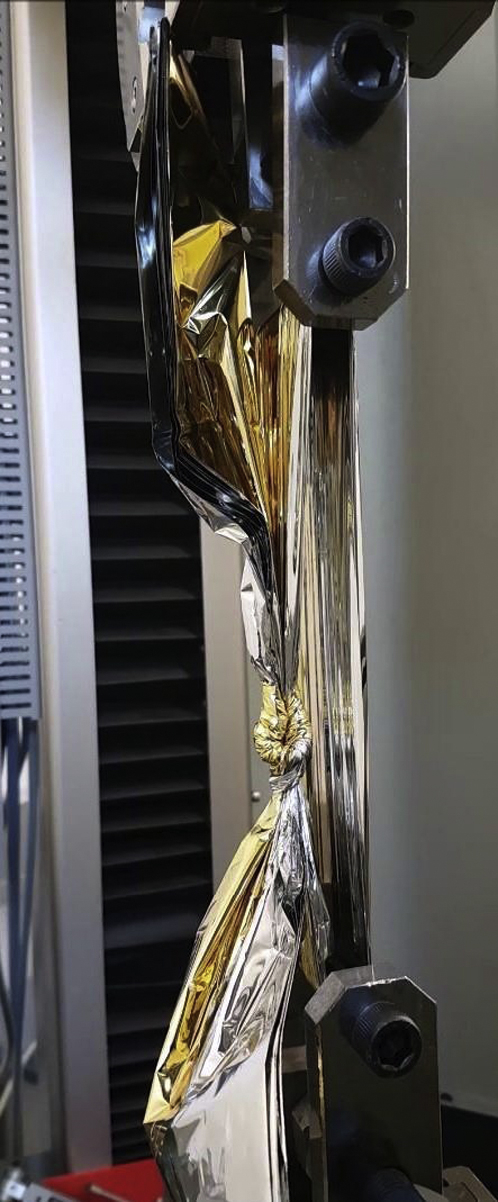
Tear resistance of survival blankets. Study setup with the blanket in unpacked and vertically aligned position and stretched between 2 bolts. The 2 ends of the longitudinally folded survival blanket segment are tied together with a square knot to resemble the condition of blankets used as temporary pelvic binders and makeshift tourniquets.
Assessment of Tourniquet Function
The tourniquet function of a longitudinally folded survival blanket (7 × 210 cm) was assessed using the windlass of a commercially available tourniquet (Combat Application Tourniquet C-A-T Gen 7, Rock Hill, SC). In another trial we replaced the windlass with a carabiner (passO-SC, Skylotec GmbH, Neuwied, Germany). In mountain climbing, commonly used carabiners with closed gate have a minimum 20 kN breaking strength in the main direction, corresponding to a static equivalent mass of approximately 2000 kg (20 kN·9.81 m·s-2).
Statistical Analysis
Descriptive statistics were applied using SPSS 25 (IBM SPSS Statistics Standard) to determine measures of central tendency (mean) and measures of dispersion (range, standard deviation, variance, minimum, and maximum). Data are presented as mean±SD with range.
Results
A total of 10 samples per brand were tested in 20 trials and showed variations in breaking strength between 2.8 and 4.8 kN. Breaking strength for the longitudinally folded ARC rescue sheet (25 layers) was 4.0±0.5 (3.2–4.8) kN. The tear ran transversely in 9 of the 10 tests and obliquely in 1 of the 10 tests. It was located peripherally in 1 of the 10 tests and centrally in 9 of the 10 tests. The pattern of the tear was homogeneous (running perpendicularly through all layers) when it occurred peripherally and was staggered (running through all layers at various intervals) when it occurred centrally. The mean distance from knot to tear was 5.7±6.7 (0–24) cm. Elongation at failure was mostly due to contraction of the knot. In the tested ARC Rescue Sheets, elongation at failure ranged from 3.3 to 7.5 cm.
Breaking strength for the longitudinally folded MRT rescue blanket (23 layers) was 3.8±0.4 (2.8–4.1) kN. The tear ran transversely and was centrally located in all tests. Distance from knot to tear was 17.8±6.2 (5–26) cm. Elongation at failure ranged from 3.7 to 7.4 cm in the tested MRT rescue blankets.
We used the windlass of a commercially available tourniquet for the longitudinally folded survival blanket (approximately 7 cm wide). At a force of 0.8 kN, the windlass bent. When using a carabiner, the force exceeded 3.6 kN when failure occurred in both blankets. A mountain rescue Tyrol volunteer demonstrated the application of longitudinally folded survival blankets as a temporary pelvic binder (Figure 2a) or as a makeshift tourniquet (Figure 2b).
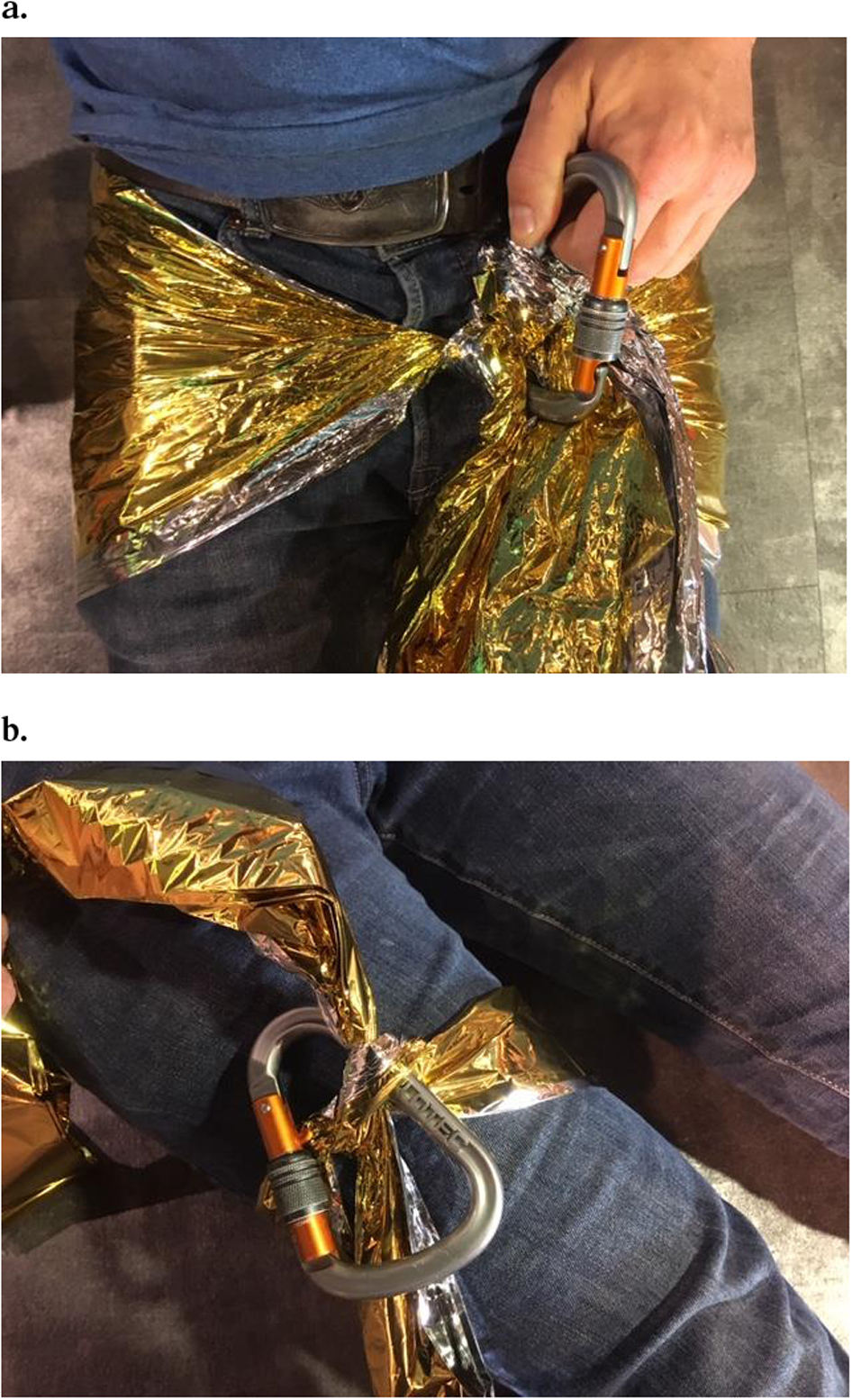
Multifunctional survival blankets. A, Temporary pelvic binder (approximately 21 cm wide) and (B) makeshift tourniquet (approximately 7 cm wide), each made of a commercially available survival blanket with ends tied together with square knots and a carabiner inserted between the 2 knots. The application techniques are demonstrated using a mountain rescue Tyrol volunteer as the model.
Discussion
We report breaking strengths of 2 multifunctional metallic survival blankets commonly used in sport and leisure activities and in prehospital emergency medicine. In our investigation, both tested blankets demonstrated impressive tensile strength. Our findings suggest that longitudinally folded survival blankets are flexible, strong, and wide enough to function as pelvic binders for treatment of unstable pelvic fractures and as makeshift tourniquets. In addition, the high breaking strength of survival blankets suggest that they may serve as extrication devices in the wilderness. It would be worthwhile to assess the potential of such blankets to facilitate transport of a patient in steep terrain when using 1 blanket as a hoop or 2 blankets as a hammock.
Our findings support the hypothesis that in wilderness emergencies, a survival blanket could substitute as a tourniquet when urgent control of bleeding from a limb injury is needed. Tourniquets are increasingly being used to stop bleeding and save lives.7,10 In our study, we also compared the breaking strength of longitudinally folded survival blankets with that of commercially available tourniquets by using the same windlass. 11 The strengths of the tested brands were similar to that of the tourniquets, limited only by the robustness of the commercially available windlass. We propose that in mass casualty incidents with multiple victims and in cases of trauma with severe hemorrhage in remote areas, tools such as a carabiner, a strong pair of scissors, or even a wooden stick could serve as a windlass.
When applying tear forces during the experiment, the 2 ends of the blanket were tied together with a square knot and the blanket was stretched between the 2 bolts of the testing machine. On one hand, we assumed that in the wilderness the most likely strategy for joining the 2 ends of the blankets is to tie them together. On the other hand, the strain is distributed unevenly in the strands in the vicinity of knots, significantly lowering the breaking strength in ropes. The more the curvature of strands is increased by knots, the greater the reduction in breaking strength that can be anticipated. 12 We expected the tear to occur close to or within the knots. However, our results reveal that the tear was located close to the knot in only 1 of the 20 tests. We suggest that in an actual setting, the 2 ends can be joined using 2 common square knots with a carabiner inserted between the 2 knots (Figure 2). If we consider the breaking strength of a common carabiner with the gate closed and loaded in the main direction to be a minimum of 20 kN, then the breaking strength of a carabiner with the strength in the transverse direction is diminished to approximately 7 kN. Despite this limitation, a diagonally loaded carabiner used to tighten a makeshift tourniquet is still estimated to be 10 times stronger than a conventional windlass.
We recommend that survival blankets in wilderness emergencies be prospectively tested for use as substitutes for pelvic binders, as makeshift tourniquets, and as extrication devices before supplementing the multifunctional scope of survival blankets in international guidelines and protocols.
Limitations
Our conclusions are based on experimental results of a few test runs involving new, unused survival blankets only. We did not test the tourniquet function in actual emergencies. The breaking strengths of only 2 types of products were tested under laboratory conditions. We are aware that thickness and product quality can differ between production series and among manufacturers and that testing a variety of available survival blanket products might reveal more differences. We did not investigate the use of survival blankets for treatment of severe extremity hemorrhage, nor did we investigate whether blankets can be used as pelvic binders for the treatment of unstable pelvic fractures. Until officially authorized, survival blankets for treatment of severe hemorrhage of limbs and unstable pelvic fractures are regarded improvised tools.
Conclusions
Survival blankets show impressive tensile strength, indicating that they have the potential to serve as improvised temporary pelvic binders or as makeshift tourniquets when urgent bleeding control is needed.
Footnotes
Acknowledgements
Acknowledgments: The authors thank Ing. Schweiger Fulpmes GmbH, Industriegelaende Zone A 12, 6166 Fulpmes, Austria, for their conscientious measurements.
Author Contributions: Study concept and design (MI, HK, FJW, WL); experimental investigation (MI, HK, HF); acquisition of the data (MI, HK, HF); analysis of the data (MI, HK, FJW,WL); drafting of the manuscript (MI, HK, FJW, WL); critical revision of the manuscript (MI, HK, HF, FJW,WL); and approval of final manuscript (MI, HK, HF, FJW, WL).
Financial/Material Support: Institutional resources for running expenses.
Disclosures: None.
Supplementary materials
Supplementary material associated with this article can be found in the online version at
References
Supplementary Material
Please find the following supplemental material available below.
For Open Access articles published under a Creative Commons License, all supplemental material carries the same license as the article it is associated with.
For non-Open Access articles published, all supplemental material carries a non-exclusive license, and permission requests for re-use of supplemental material or any part of supplemental material shall be sent directly to the copyright owner as specified in the copyright notice associated with the article.
