



Abstract
When dealing with drowning scenarios, time is of capital importance. In this sense, the search for innovative strategies that provide more effectiveness and safety for lifesaving professionals, as well as for bathers, is essential. The aim of this study was to systematically review the feasibility and effectiveness of unmanned aerial vehicles as a tool to assist lifeguards in performing their duties. A systematic literature search was conducted in October 2023 across the databases PubMed, Web of Science, Academic Search Complete, and Scopus, using the search terms: ((drone) OR (Unmanned Aerial Vehicles)) AND ((drowning) OR (water rescue)). A total of 5 studies were included in this review, whose quality ranged from moderate to strong, according to the EPHPP Quality Assessment Tool for Quantitative Studies. The results suggest that unmanned aerial vehicles may assist lifeguards in the prevention, detection, and rescue of drowning victims and people in distress in the water. Although preliminary, evidence suggests that lifeguards would benefit from the use of unmanned aerial vehicles regarding lifeguards’ and others’ safety.
Introduction
Drowning is defined as the process of experiencing respiratory impairment due to immersion or submersion in liquid. It remains one of the major causes of unintentional death worldwide, representing an estimated number of 370 000 fatalities every year.1,2 The vast majority of drownings occur among children and adolescents, with significant contributing factors including inadequate supervision and swimming ability, lack of warning signs near hazardous areas, and excessive alcohol consumption. 1 This threatening scenario is alarming, and several efforts should be made by authorities (eg, implementing supervision policies, installing clear and effective warning signs near dangerous areas, raising public awareness on water safety) to reduce the incidence of drowning worldwide. 3
Among the strategies to mitigate this challenging public health problem, lifeguards play a highly contributive role by preventing all kinds of accidents in aquatic environments, as well as rescuing drowning victims or people in distress in water.4,5 When performing a rescue, lifeguards may risk their own lives, placing their duty and mission above their own safety. 6
Advancements in science and technology have introduced unmanned aerial vehicles (UAVs) as a promising tool to augment lifeguarding efforts. 7 Unmanned aerial vehicles, commonly referred to as drones, offer versatile applications across various fields, including search and rescue missions.8,9 In maritime and river settings, UAVs can swiftly cover expansive areas and facilitate the rapid detection and response to drowning incidents. 7
The integration of UAVs into lifeguarding operations holds significant potential to revolutionize traditional practices and improve success rates in aquatic emergencies. 9 By using UAVs for surveillance, lifeguards can enhance their situational awareness and response capabilities.7,9 These devices can also be equipped with high-resolution cameras and thermal imaging technology, enabling lifeguards to identify potential hazards and locate individuals in distress with greater precision. 10 Moreover, UAVs can expedite search and rescue efforts by providing real-time aerial reconnaissance, reducing response time, and increasing the likelihood of successful outcomes. 10
In addition to surveillance and reconnaissance, UAVs may offer unique advantages in providing emergency assistance to individuals at risk of drowning.11,12 With the capacity to deliver flotation devices and lifesaving equipment to remote or inaccessible locations, UAVs empower lifeguards to intervene swiftly and effectively in emergencies. 12 Moreover, given the critical importance of time in drowning scenarios, this capability may be highly important for providing rapid interventions. 12 However, the successful integration of UAVs into lifeguarding operations requires comprehensive training and protocols to ensure safe and effective utilization. Lifeguards must be proficient in operating UAVs, interpreting aerial data, and integrating UAV-assisted rescue missions with existing protocols.
In summary, UAVs seem to represent a transformative tool for enhancing lifeguarding operations and mitigating the risks associated with aquatic emergencies.7,10 Therefore, the purpose of this review is to explore the effectiveness and feasibility of UAVs assisting lifeguards in performing their duties.
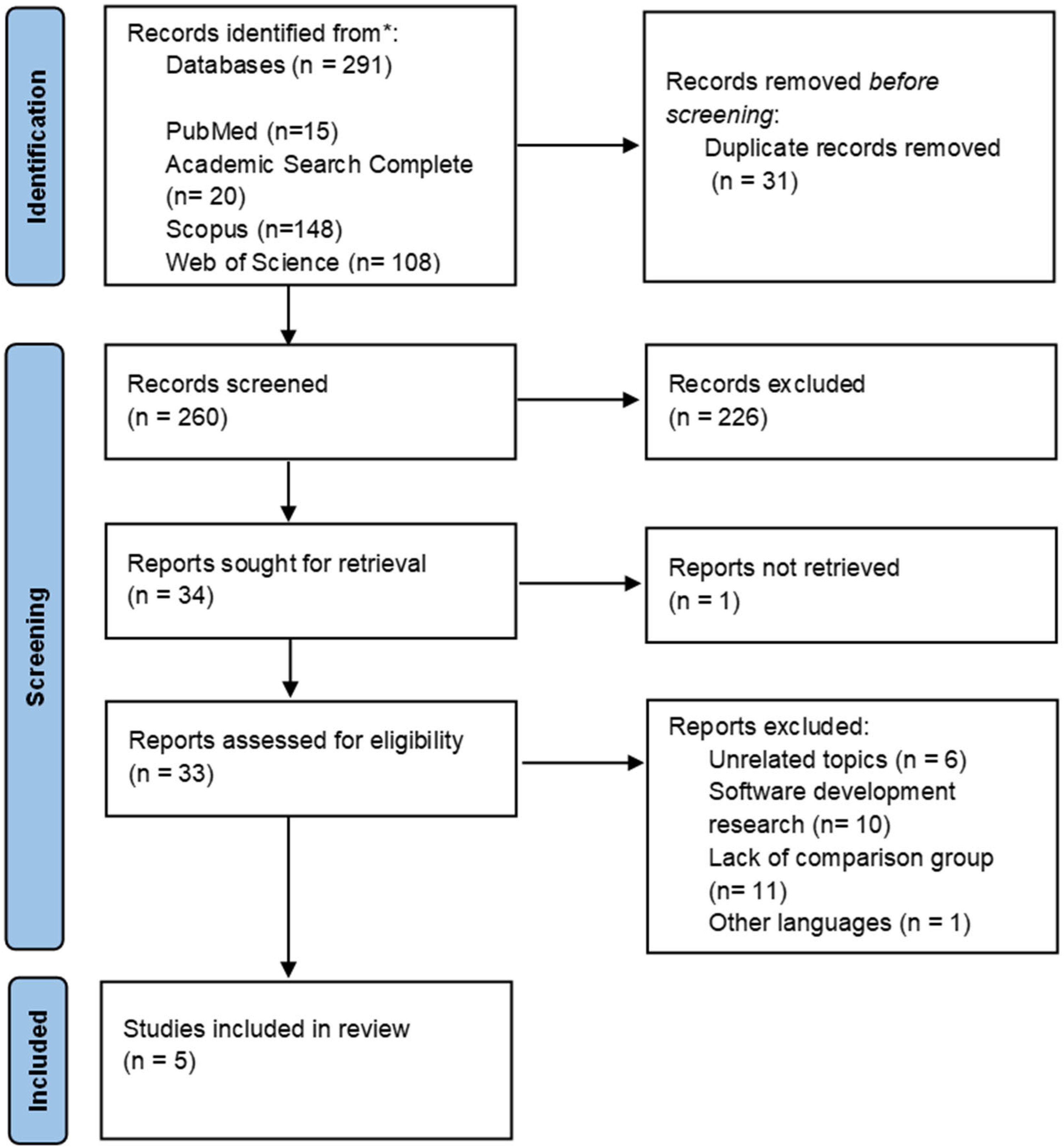
PRISMA flow diagram of the procedures used for the article search.
Methods
Search Strategy and Eligibility Criteria
This study was conducted following the PRISMA (Preferred Reporting Items for Systematic Reviews and Meta-analyses) guidelines for the identification, screening, eligibility, and inclusion of articles. 13
The article search was conducted across the electronic databases PubMed, Web of Science (core collection), Academic Search Complete, and Scopus, combining the search terms: ((drone) OR (Unmanned Aerial Vehicles)) AND ((drowning) OR (water rescue)) on October 24, 2023.
The screening of the articles met the following criteria: (i) they report a comparison between lifeguards and UAV; (ii) manuscripts were written in English, Portuguese, Spanish, or French; (iii) they present quantitative results; (iv) they are related to drowning prevention, detection, or rescue-assisting lifeguards; and (v) they are original research articles (ie, not conference papers, letters to editor, etc). The first round of screening against the inclusion criteria decided article exclusion/inclusion based on title and abstract, and the second round assessed full-text versions. This process was conducted independently by two investigators (FM, PS). To solve discrepancies, a third author was consulted for advice (HS).
Data Extraction and Quality Assessment
Data extraction included study category (drowning identification/prevention or rescue), participants’ general characteristics, condition of the data collection (eg, simulation/ real action, environment), parameters assessed (ie, outcome measures; eg, time to rescue, covered area), and summary results of the study.
Two authors (FM, PS) independently assessed the methodological quality of each study using the Effective Public Health Practice Project (EPHPP) Quality Assessment Tool for Quantitative Studies. 14 In brief, studies were classified as “weak,” “moderate,” or “strong” for the following criteria: selection bias, study design, confounders, blinding, data collection methods, and withdrawals and dropouts.
Results
Search, Selection, and Inclusion of Publications
The initial search identified 291 articles, which were exported to the citation manager software EndNote™ 20 (Clarivate Analytics, Philadelphia, PA). All duplicated references were removed (n = 31), resulting in 260 articles screened by title. After the first round of screening, a total of 34 articles were assessed for abstract and full text (1 was not retrieved). In total, 5 studies met the inclusion criteria (3 reporting drowning identification/prevention and 2 reporting rescue maneuvers) (Figure 1).
Quality Assessment
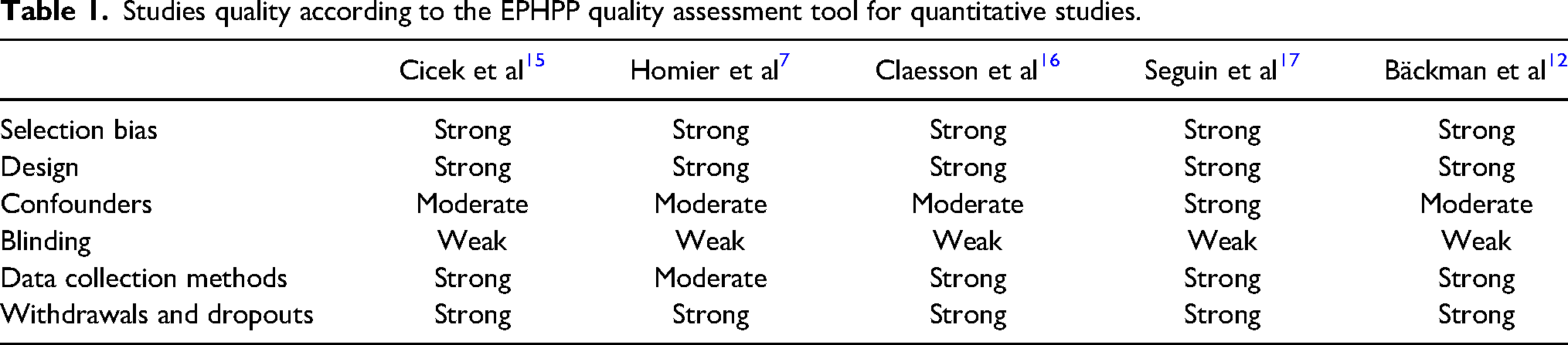
As illustrated in Table 1, from the 5 included studies, all presented strong methodological quality regarding selection bias, study design, and consideration of the absence of withdrawals and dropouts. A total of 4 studies (80%) were considered to reflect a moderate quality regarding confounders, while 1 (20%) presented strong quality. In addition, 1 study represented a moderate quality regarding data collection methods, while the remaining 4 studies presented a strong quality. Finally, considering blinding procedures, all studies reflected a weak quality.
Studies quality according to the EPHPP quality assessment tool for quantitative studies.
General Description of the Studies
From the 5 studies included in this systematic review, 3 reported outcomes associated with drowning prevention and identification, while 2 studies reported outcomes associated with water rescue, as presented in Table 2. All studies compared the ability of UAVs used by an operator with traditional search and rescue methods used by lifeguards.
General characteristics of studies.
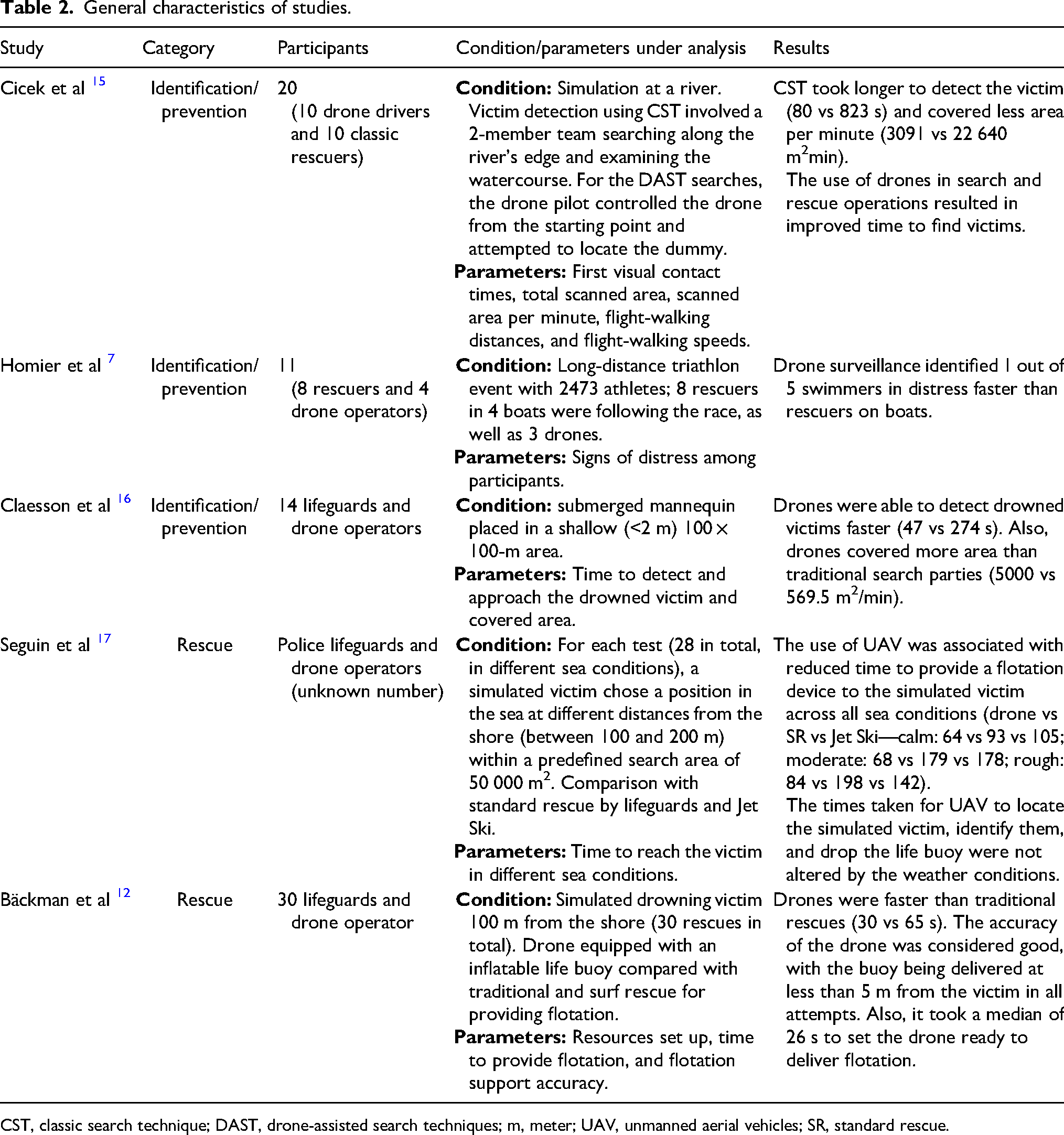
CST, classic search technique; DAST, drone-assisted search techniques; m, meter; UAV, unmanned aerial vehicles; SR, standard rescue.
Specifically, 2 studies reported that drone operators can detect a person in water about 5 to 10 times faster than a traditional search performed by on-land lifeguards.15,16 Moreover, due to the altitude that can be achieved by drones, their use resulted in about 7 times more covered area each minute. Additionally, 1 study aimed to assess the ability of a drone, compared to on-boat rescue teams, to detect people with signs of distress in the water at a long-distance triathlon event. 7 This study stated that, of the 5 participants presenting signs of distress, only 1 was detected earlier by drone operators.
Considering the use of these devices to provide floatation to simulated drowned victims and people in distress in water, 2 studies compared the time to provide floatation to a drowning victim.12,16 These studies reported that drones are about 2 times faster when compared to traditional rescue methods to reach a victim. The study of Seguin et al 16 compared the use of drones with classic rescue techniques across several sea conditions (calm, moderate, and rough sea). According to the results, drones are faster, irrespective of the sea conditions; however, as they get more challenging, the advantage of drones is expected to be enhanced since lifeguards take longer to reach their victims. Furthermore, the study of Bäckman et al 12 provided the time to set the drone up and the accuracy of the floatation delivery (ie, proximity to the victim). The drone operator took about 26 s to prepare the drone for the rescue while the lifeguards’ set-up time was not presented (ie, preparing rescue equipment); however, it is expected to be somewhat faster. Moreover, the flotation provision was considered accurate since all attempts reached the simulated victims within a maximum radius of 5 meters.
In general, the results of the included studies indicate that the use of drones may represent a feasible, valuable, and reliable contribution to detecting drowned victims or people in aquatic distress, as well as to providing flotation to conscious individuals in a faster way.
Discussion
This study used a systematic review approach to provide the first insights into the use of UAVs to support lifeguards in detecting, preventing, and rescuing drowning victims and people in aquatic distress.
Lifeguards should seek to avoid drowning through prevention; however, it is not always possible due to several factors, such as the amount of area they cover and the unpredictable actions of bathers.4,18–20 The studies assessing the efficacy of drones in detecting drowned victims or people in distress illustrated that the use of these devices can assist lifeguards in covering a wider area and having a clearer vision. Additionally, these devices may help in the vigilance of difficult access areas (eg, rocks, cliffs), making it easier and safer for lifeguards. Furthermore, it is important to recognize that the increased capacity of supervision most likely would result in a reduced number of rescues.
When attending to someone in distress in water, lifeguards can make use of different devices, such as fins, rescue boards, buoys, and Jet Skis, among others; however, none of those methods are shown to be as fast and safe as drones.16,21 Thus, it is logical to extrapolate that when the distance between the rescuer and the victim increases, the time gap between the use of UAVs and traditional methods gets wider. Nevertheless, future studies should further explore this aspect.
There may exist, however, some limitations to the application of these devices in realistic scenarios: firstly, weather conditions (eg, fog, strong wind) and the battery-consuming systems, as separate factors, may be important aspects to contemplate when implementing these strategies. 15 Secondly, the expensive cost of this equipment alongside the need for additional and specific lifeguard training may limit the implementation of this technology to water rescue by these professionals. In addition to their primary functions of identifying drowning victims and delivering flotation devices, the effective integration of drones into lifeguard operations relies on several critical factors. The capacity of drones to carry and deploy flotation devices is limited by their size and payload capabilities, necessitating further discussion on the practicality of these mechanisms in real-world scenarios. Furthermore, while early identification is presumed to enhance rescue outcomes by reducing time-to-rescue, this assumption warrants closer examination. In many cases, human intervention will remain indispensable, and the earlier identification of a victim does not guarantee a successful rescue without prompt and effective human response.
A limitation of this systematic review is that only 1 study was conducted under realistic conditions. 7 Despite representing a reliable method of conducting investigations, simulated conditions may not always mimic realistic scenarios with absolute precision. 22 Furthermore, the number and power of the included studies were mostly small, considering sample sizes and number of interventions. Nevertheless, the first insights about the feasibility and efficacy of the use of this technology in the context of water supervision and rescue are provided, addressing findings that may assist authorities in further developing lifeguard course content and creating greater and safer rescuing conditions for these professionals. We hypothesize that the extensive application of this technology would translate into a significant reduction in drownings and accidents in supervised and unsupervised aquatic areas.
Future Research Recommendations
Unmanned aerial vehicles represent an emergent area of study on drowning prevention and rescue; therefore, several lines of investigation can be followed. Firstly, the use of these devices across several meteorological conditions should be tested. Also, a remotely operated rescue buoy should be developed and tested, which would strongly contribute to lifeguards’ safety and would also be helpful when rescuing in rough sea conditions (eg, rip currents, big waves). Finally, future research should evaluate the actual impact of drone-assisted identification on overall rescue times and outcomes in real contexts, as well as develop optimal integration strategies for drone and lifeguard teams.
Conclusion
When assisting a victim of drowning or rescuing people in aquatic distress, often every second counts. Although preliminary, the findings of this review demonstrated that the use of UAVs as a tool to detect drowning victims and people in distress in water, as well as provide flotation to conscious individuals, may represent a feasible, safe, and time-effective way to improve both preventive and rescue actions. Nonetheless, the integration of UAV technology requires comprehensive training, effective protocols, and continued research to address the current limitations and assumptions, ultimately ensuring that these tools can be utilized to their fullest potential in improving lifeguards’ responses and outcomes.
Footnotes
Author Contribution(s)
Declaration of Conflicting Interests
The authors declared no potential conflicts of interest with respect to the research, authorship, and/or publication of this article.
Funding
The authors received no financial support for the research, authorship, and/or publication of this article.