



Abstract
Mental illness in adolescence has seen an unprecedented increase over the past decade. This has left parents, teachers, health-care providers, and other stakeholders wondering what is happening in the teenage population. What has caused such a significant increase in depression, anxiety, and suicidal thoughts and behaviors in young people aged 13–19? Most of the research in this narrative literature review of articles published from 2016 to 2024 points to social media use as a contributing factor. The goal of this paper is to present an analysis of research related to social media use and the increase in depression, anxiety, and suicide in adolescents. Identified themes include negative psychological and physical effects of increased social media use, several different types of addiction related to social media use, the mention of fear of missing out, cybervictimization, contagion phenomenon, and low perceived support.
Implications for Practice, Research, or Policy
Adolescents are suffering from a variety of issues related not only to the way they use social media content but also to the amount they consume daily. Depressive symptoms and increased suicide risk may accompany problematic social media use. Annual screening for depression and suicide risk is recommended for all adolescents between 12 and 18 years. Parents and providers should encourage limitations on adolescents’ social media use.
Issue
There are currently unprecedented rates of reported anxiety and depression in adolescents. While reports of depression have been on the rise since the early 2000s, it now has become the fourth leading cause of illness globally among adolescents aged 15–19 (World Health Organization, 2019). In the United States, rates of depression in adolescents have increased from 8.7% in 2005 to 11.3% in 2014 (Vidal et al., 2020) and as high as 15.8% in 2019 (Wilson & Dumornay, 2022). Suicide rates in the United States have increased 47.5% since 2000, making it the second leading cause of death in U.S. adolescents prior to 2020 (Vidal et al., 2020) and the leading cause of death in U.S. adolescents during and after the COVID-19 pandemic (Bridge et al., 2023). First depressive episodes are likely to occur in adolescence (Ivie et al., 2020), which is noteworthy because mental health problems that begin in adolescence often carry over into adulthood (Ma et al., 2021).
Increased social media use may contribute to depressive symptoms. According to Durbin et al., (2018), 92% of teens around the world use the internet daily, and 71% use at least two different types of social media. Cybervictimization is reported by 20%–40% of adolescents globally (Duarte et al., 2018). A large cross-sectional study in Norway found depression reported in 31.7% of adolescent girls and 12.3% of adolescent boys; this study also found that regular physical activity was associated with decreases in depressive symptoms (Kleppang et al., 2021). Alternately, increased screen time is associated with increased sedentary time, which can contribute to depressive symptoms and is a habit often carried from adolescence into adulthood (Ma et al., 2021).
Healthy lifestyle habits are associated with decreased depressive symptoms (Kleppang et al., 2021). Social media use may predispose to increases not only in depressive symptoms but also in the risk of cyberbullying (Durbin et al., 2018), especially in girls who spend more than two hours daily on social media (Ma et al., 2021). Cybervictimization is associated with increased risk of suicidal thoughts and behaviors, post-traumatic stress disorder, and depression (Duarte et al., 2018). Research is needed into causality and direction of the increased rates of depression, anxiety, and suicide in adolescents (Kleppang et al., 2021), focusing on targeted interventions such as limits on use of social media, increased exercise, and parental involvement (Vidal et al., 2020).
Purpose
This paper intends to identify themes in the existing research on the decline of mental health in adolescents, with a focus on the increase in reports of depression, anxiety, and suicidal ideations in conjunction with increased time spent engaging with social media in this age group over the last decade. Above all else, the primary purposes of this review are to identify the areas where adolescents remain most at risk and to offer suggestions for providers of adolescent health care and parents of adolescents and younger children.
The link between increased time spent on social media and increases in adolescents’ reported anxiety, depression, and suicide has been identified. Adolescents are suffering from a variety of issues related not only to the way they use social media content but also to the amount they consume daily. The question at hand is how to decrease adolescents’ social media use. Some states are creating limitations on social media use while in public schools. Some parents monitor screen time for teens. Some providers assess for social media use, depression, and anxiety in adolescent patients at every visit. All these actions must work together to reverse the trend in adolescents’ mental health in order to bring this population back to wellness.
Methodology
The goal of this narrative review is to explore the relationship between the decline of adolescents’ mental health and the increased use of social media. A comprehensive literature search was performed. Data analysis and thematic development followed the procedures recommended by Creswell and Creswell (2018) including validation and accuracy of the information, organization, data immersion, and identification and interpretation of repeating information. Ultimately, the research resulted in theoretical saturation with no new themes emerging. Repeating patterns, key concepts, and meaningful ideas noted throughout the research done in this area over the last 10 years contributed to the themes presented in this review. The identified themes include negative psychological and physical effects, addiction, fear of missing out, cybervictimization, contagion phenomenon, and low perceived support. Examining previous research contributes to recommendations for future research efforts to better serve this patient population. Articles on the subject matter, the various interventions, and future research goals support the identified themes. Suggestions previously made that have been answered with subsequent research are identified to acknowledge and highlight the progress in adolescents’ mental health and wellness.
Search Process
A search of “social media use and adolescent mental health” in PubMed returned 189 articles. When the PubMed search was changed to “social media use and adolescent suicide” the result was 501 articles. A different combination was performed with the terms “social media use” + “adolescent suicide” + “peer grief” and returned only two applicable articles. An advanced and systematic search was performed with the search terms “social media use” and “adolescent depression anxiety” and returned 441 articles. The important addition of “adolescent suicide” to that last search produced 66 articles. The Boolean connector “AND” was used to connect “social media use” AND “adolescent depression anxiety” AND “adolescent suicide.”
A search of “social media use and adolescent mental health” in Cumulated Index in Nursing and Allied Health Literature (CINAHL) returned 302 articles. When the CINAHL search was changed to “social media use and adolescent suicide” the result was 51 articles. A different combination was performed with the terms “social media use” + “adolescent suicide” + “peer grief” and returned no results. An advanced and systematic search was performed with the search terms “social media use” and “adolescent depression anxiety” and returned 80 articles. The important addition of “adolescent suicide” to that last search produced seven articles. The Boolean connector “AND” was used to connect “social media use” AND “adolescent depression anxiety” AND “adolescent suicide.”
A search of “social media use and adolescent mental health” in American Psychological Association (APA) PsycInfo returned 1,017 articles. When the APA PsycInfo search was changed to “social media use and adolescent suicide” the result was 162 articles. A different combination was performed with the terms “social media use” + “adolescent suicide” + “peer grief” and returned only one applicable article. An advanced and systematic search was performed with the search terms “social media use” + “adolescent depression anxiety” and returned 256 articles. The important addition of “adolescent suicide” to that last search produced 19 articles. The Boolean connector “AND” was used to connect “social media use” AND “adolescent depression anxiety” AND “adolescent suicide.”
Inclusion criteria were: articles with full-text availability, written in English, published with an abstract, and peer reviewed, published in the years 2014 through 2024. A search using these criteria yielded 60 articles. A rapid critical appraisal (Fineout-Overholt, 2019) of these 60 articles with added criteria of level of evidence, study design, methods utilized, and relevance/applicability to the analysis yielded 30 articles (see Table 1).
Relevant Research.
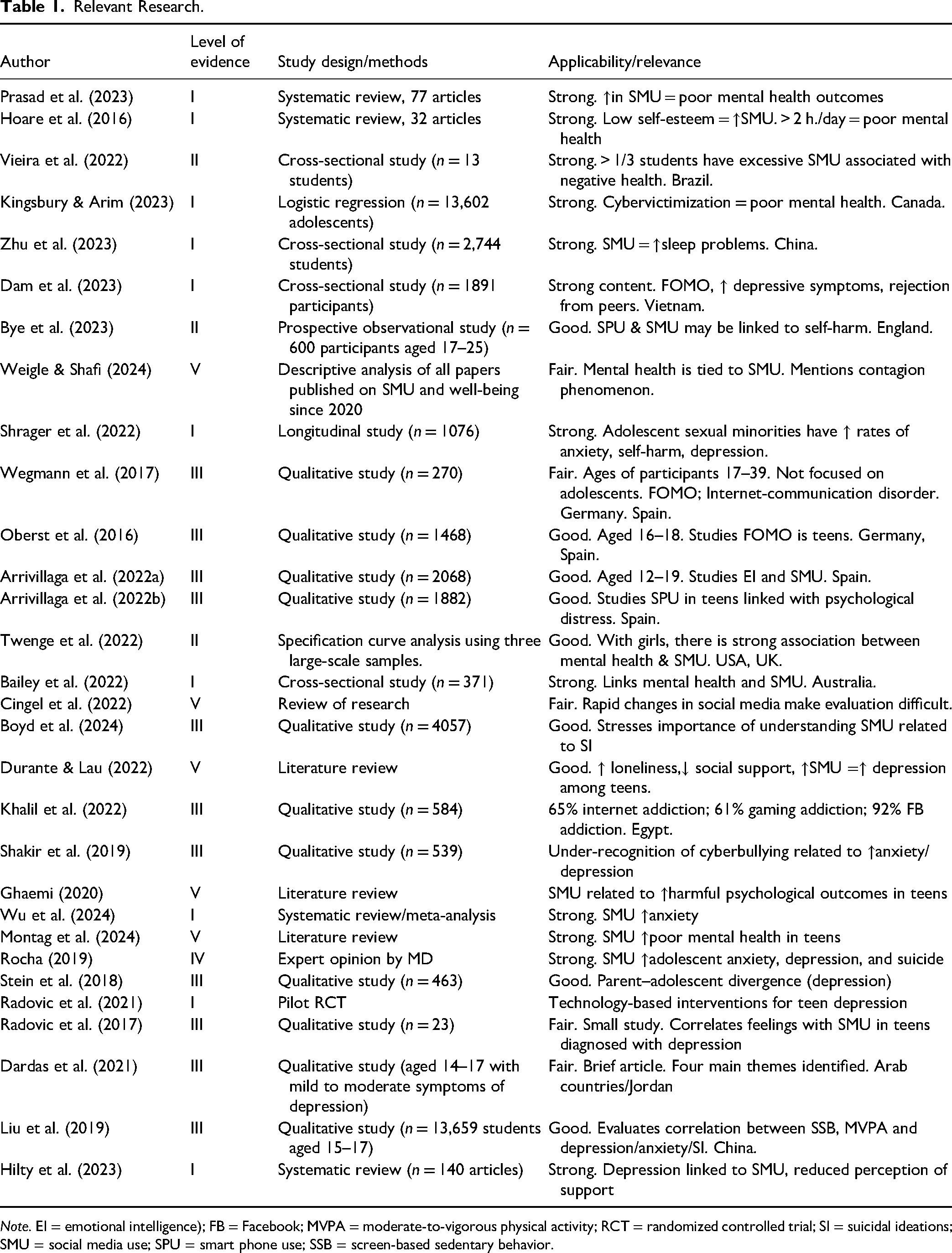
Note. EI = emotional intelligence); FB = Facebook; MVPA = moderate-to-vigorous physical activity; RCT = randomized controlled trial; SI = suicidal ideations; SMU = social media use; SPU = smart phone use; SSB = screen-based sedentary behavior.
Findings
A total of 30 studies published between 2016 and 2024 met the criteria for inclusion. Of these, 17 were completed in the US, six were completed in European countries, four were completed in Asia, and one study each was completed in Canada, Australia, and Latin America. The number of participants in the studies ranged from 23 in a qualitative study to over 13,000 participants in two of the quantitative studies.
Themes identified were Negative Psychological Effects, Negative Physical Effects, Addiction, Fear of Missing Out (FOMO), Cybervictimization, Contagion Phenomenon, and Low Perceived Support.
Negative Psychological Effects
Social media use in adolescents is linked to a decrease in mental health (Bailey et al., 2022; Ghaemi et al., 2020; Hilty et al., 2023). Social media use is also characterized by harmful psychological outcomes (Ghaemi, 2020) and poor mental health (Montag et al., 2024; Prasad et al., 2023). Many qualitative studies and literature reviews have found a correlation between social media use and an increase in adolescents’ anxiety (Rocha, 2019; Shrager et al., 2022; Wu et al., 2024), depression (Dardas et al., 2021; Durante & Lau, 2022; Radovic et al., 2017; Rocha, 2019; Shrager et al., 2022; Stein et al., 2018), sleep problems (Zhu et al., 2023), self-harm (Bye et al., 2023; Shrager et al., 2022), and suicide (Boyd et al., 2024; Liu et al., 2019; Rocha, 2019). Those at an even higher risk of adverse mental health outcomes include adolescent females (Twenge et al., 2022) and adolescent sexual minorities such as those in the LGBTQIA + community (Shrager et al., 2022). One cross-sectional study (n = 513) indicated that more than one-third of the students participating in the study associated adverse mental health with excessive social media use (Vieira et al., 2022), with annual increases in adolescent depression, anxiety, and suicidal thoughts and behaviors of up to 10% per year (Radovic et al., 2021).
Negative Physical Effects
In a large qualitative study (n = 13,659) by Liu et al. (2019), increased screen time and social media use, also known as screen-based sedentary behavior (SSB), was associated with decreased time for moderate-to-vigorous physical activity (MVPA), which was correlated with depression, anxiety, and suicidal ideation. Adolescents need to move their bodies and be free of screens for a time that makes them feel mentally and physically healthier. The National Institutes of Health recommends limiting screen time to no more than 1.5 h daily for 12–15-year-olds and no more than 2 h daily for ages 16 and older (Muppalla et al., 2023).
Addiction
The amount of time adolescents engage with social media is also a factor, with greater than 3 h daily resulting in a decline in mental health in self-report surveys, particularly in girls (Hoare et al., 2016). This is especially problematic according to one qualitative study (n = 584) which showed that 65% of the participants consider themselves addicted to the internet, 61% to gaming, and an overwhelming 92% to Facebook/Meta (Khalil et al., 2022). This may be characterized as problematic social media use (PSMU), an emerging and growing concern in the adolescent population, in which individuals believe that social media fulfills a basic psychological need (Arrivillaga et al., 2022a).
Fear of Missing Out
A relatively newly reported phenomenon, fear of missing out (FOMO), examined by Oberst et al. (2017) in a qualitative study (n = 1468) noted that FOMO may increase social media addiction. In a similar cross-sectional study, FOMO was linked to increased social media use and an overall impaired quality of life associated with peer rejection (Dam et al., 2023). Relatedly, those social media users who report negative consequences related to excessive use due to FOMO may have what is referred to as Internet-communication disorder (Wegmann et al., 2017).
Cybervictimization
The more time adolescents spend on social media, the more likely they are to experience cybervictimization, which is both underreported and associated with increased anxiety and depression (Shakir et al., 2019). Cybervictimization, also known as cyberbullying, involves any act that abuses, threatens, or intimidates through electronic communication (Samsudin et al., 2023). In a large logistic regression study (n = 13,602) by Kingsbury and Arim (2023), cybervictimization was linked to overall poor mental health, which is particularly concerning because this type of study determines the probability of an event occurring.
Contagion Phenomenon
Many of the articles in the review rely on qualitative studies in which adolescents are self-reporting. Several of the articles rely on a current or previous medical diagnosis of depression and/or anxiety. There is also mention of the contagion effect in which an adolescent, after exposure to depressing or anxiety-inducing content, or content about suicide, may self-diagnose incorrectly (Weigle & Shafi, 2024). Of particular concern is suicide contagion in which an adolescent relates to the suicidal ideations or actions of one of their peers. This is the focus of a chapter in Malcolm Gladwell's book, Revenge of the Tipping Point, in which he describes a small town in which a popular girl at the local high school attempted suicide by jumping off a bridge. She did not die, but six months later one of the girl's peers also jumped off the bridge and died. Four months later, a third classmate committed suicide using a gun. Seven years later, in the same small town, a similar contagion played out with five adolescents dying by suicide in a six-week period (Gladwell, 2024, pp. 95–96). Adolescents with fragile identity formation are at highest risk for this phenomenon, which is also known as cluster suicides (Kreisman & Straus, 2021, pp. 45–46).
Low Perceived Support
Researchers have noted certain characteristics that may predispose adolescents to problematic social media use, including low self-esteem (Hoare et al., 2016), loneliness with or without perceived low levels of support (Durante & Lau, 2022), and below average emotional intelligence (Arrivillaga et al., 2022a). All of these factors contribute to an overall decreased sense of well-being. Recent research indicates a feedback loop in which depressive symptoms are correlated with problematic social media use, which may in turn increase the depressive symptoms. Hilty et al. (2023) found depressive symptoms a predictor of problematic social use, while Arrivillaga et al. (2022a) found that adolescents using social media as a coping mechanism reported increased stress and depression.
Adolescents reporting low self-esteem may experience an elevated sense of loneliness and a feeling of decreased social support, which may increase social media use and subsequent depression (Durante & Lau, 2022). Similarly, depression in adolescents may predict not only problematic social media use but also a reduced perception of support (Hilty et al., 2023). Those reporting a disconnect from parents, also known as parent–adolescent divergence, also demonstrated increased social media use and depressive symptoms (Stein et al., 2018). Those at highest risk for this type of psychological distress include adolescents with low emotional intelligence (Arrivillaga et al., 2022b).
Discussion
The way that mental health and mental illness are defined and described varies greatly; how the presence of mental illness is communicated and the actual medical diagnoses have some overlap. Identification and awareness of the research themes examining possible factors in the overall decline in adolescents’ mental health over the past decade will hopefully offer some insight into what has happened, what is happening, and how adolescents’ health can be promoted and improved. It is also worth noting that social media has experienced becoming increasingly complex over the past decade, making the measurement of social media use and its effects on the adolescent population challenging (Cingel et al., 2022).
It is the opinion of this author, a primary care provider, that adolescent mental health is declining, at least in part due to the amount of time spent on social media. Reported adverse effects of social media use include a decline in executive functioning in adolescents, including working memory, the ability to change tasks, and inhibition (Muppalla et al., 2023). Studies in Quebec, Spain, and the U.S. show a negative correlation between screen time and academic performance (Muppalla et al., 2023).
During the development stage of adolescence, relationships with peers take priority over many other aspects of life. This is a natural and healthy phenomenon as teens move away from dependence on their parents toward more autonomy. However, social media use has changed the personal interactions between these young people. They are not honing skills in conversation and navigation of interpersonal relationships. They speak less and text more. They share videos that are trending. They post carefully curated pictures of themselves, mainly of good and happy moments. They “snap” each other to stay “in touch” rather than getting together or conversing face-to-face. They “ghost” one another rather than solve problems or resolve relationship conflicts. The compounding factor is that due to FOMO, they are drawn to online content and social media, unable to take time off from it because of the fear that they will be left behind.
Social media and online content can be distracting for adults with fully developed brains and exceptional emotional intelligence. How much more distracting must it be for adolescents to handle social media pressure and expectations while maneuvering through such a transitional and challenging stage of growth, balancing hormonal changes, friendships, schoolwork, and thoughts of the future, all while attempting to move away from the family unit emotionally. The daily barrage of the pressures associated with social media use has proven too much and adolescent mental health has taken a heavy hit around the globe.
Experts all over the world are researching and evaluating the decrease in mental health in the teenage population, as shown in this review. Even in an analysis with only 30 scholarly articles, it is evident that adolescent mental health is now a worldwide concern. Different phrases and descriptors may be used in different countries. However, the takeaway is the same—social media use is contributing to a decline in the mental health of adolescents in many places.
Limitations of Study
A narrative review is predominately qualitative, like the self-reporting of the adolescents participating in the research cited in this review. While every attempt has been made to remove bias, it is with a desire for full transparency that the author acknowledges the challenge of this as a practicing primary care provider caring for adolescents with anxiety and depression, some of whom have screen time greater than 8 h per day. Narrative reviews are often flexible and selective. The exact search criteria are included for reproducibility.
Implications for Future Research
The social media situation cannot be undone. There are countless challenges and obstacles to forcing adolescents to change their relationship with social media and screen time. Experts worldwide have made suggestions for future research and for supporting youth through this challenging era. Radovic et al. (2017) suggested that adolescents shift social media use to that which they perceive as positive, while encouraging clinicians to counsel all adolescents about social media use. Ghaemi (2020) called for clinicians to recommend social media use limitations. Boyd et al. (2024) stressed the importance of understanding adolescent social media use specifically as it relates to depression and suicidal thoughts and behaviors, while Wu et al. (2024) asked clinicians to consider social anxiety as a contributing factor when treating problematic social media use. Prasad et al. (2023) and Weigle and Shafi (2024) suggested more in-depth research to determine causality and relationships between poor mental health in youth and social media exposure. Hoare et al. (2016) suggested research to examine the psychological impact of reducing adolescent screen time as a leisure activity while evaluating the relationship between physical activity and diet.
Due to its recency, there is a call for FOMO to be further investigated as a specific predisposition to negative symptoms associated with excessive social media use (Wegmann et al., 2017). Bailey et al. (2022) called for development and dissemination of safe, high-quality support to promote well-being on social media for the adolescent population. Shakir et al. (2019) described the need for education and screening tools related to cyberbullying as urgent. That was several years ago. The situation has only grown worse.
Perhaps the most important recommendation comes from the US Preventive Task Force et al. (2022), calling for routine annual screening of adolescents between the ages of 12 and 18 for depression and suicide risk, cited in the literature review by Montag et al. (2024). As noted throughout many of the articles included in this literature review, depressive symptoms and increased suicide risk often accompany problematic social media use. A valuable reminder from Hilty et al. (2023) stresses the importance of including diverse youth and varying sociodemographic populations in all future research and treatment endeavors.
Footnotes
Declaration of Conflicting Interests
The author declared no potential conflicts of interest with respect to the research, authorship, and/or publication of this article.
Funding
The author received no financial support for the research, authorship, and/or publication of this article.

Author Biography